Nana #5

This review first appeared in The Comics Journal

Every volume of Ai Yazawa’s shojo manga series *Nana* has at least one sequence that will break your heart. In #5 it occurs towards the end. Ditzy protagonist Nana Komatsu is about to have a one-night stand with Takumi, a rock-star on whom she’s had a long-standing crush. While she’s in his hotel room, she gets a phone call from her roommate, Nana Osaki. Up till this point, Nana K. has been trying to convince herself that she’s got the situation under control, that she’s fine with NSA sex, and that the whole thing will be a fun and memorable experience. But while on the phone she realizes she doesn’t want to tell her friend what she’s doing. We cut from a cartoonish Nana O. laughing airily to a more realistic close-up of Nana K.’s stricken face. She seems to become fully aware of her sense of shame at the same time as the reader does, and under the pressure of that recognition, the narrative slows down. The buttons of the cell-phone loom incongruously, and images of Nana O.’s eyes drift and dissolve into scenes of Nana K. in bed with Takumi. Nana K’s self-consciousness, her helplessness, and her dreamlike alienation from her own actions all seem frozen or crystallized by an overwhelming but ambivalent longing: for the rock-star Nana K. is having sex with, for the roommate she’s just lied to, for an abstract, unachievable love. It’s a gorgeous moment, blurring the boundaries between prose and poetry, pop and art, with a surety that’s rare in any medium — and one that is, alas, almost unheard of in comics, at least on this side of the Pacific.

Update: Perennial Hooded Utilitarian commenter and fine-writer-on-his-own-hook Tucker Stone has a comixology column up about Nana and my other favorite manga series Parasyte. Check it out.

They Live

I’ve written a bunch before about how obsessed John Carpenter seems to be with manly men doing manly things with each other. They Live is so, so, so not the exception. For those not familiar with it, the movie’s plot is that the earth is inhabited by evil cadaverous aliens who disguise themselves by broadcasting mind control signals so humans see aliens as one of us (gabba gabba.) A resistance movement develops sunglasses which allow humans to see the aliens for what they really are (and, incidentally, allow you to read the real messages on billboards and advertisements — “consume” “don’t think” “procreate” etc.)

Ostensibly, this is all about critiquing consumerism and sneering at yuppies; the suggestion is that people are willing to accept working class disempowerment and the general crappiness of existence because of the evil alien propaganda (that is, television.)

Fair enough; but the movie is also absolutely obsessed with barely contained male-male attraction, its deferral, and its attendant homosexual panic. The main character is John Nada, played by Roddy Piper. His central relationship in the film is with Frank Armitage (Keith David). Both men are barely-getting-by construction workers; the first spark between them occurs when Frank notices the massively-muscled John working shirtless. The two then head off together to a shantytown where the laborers live communally; John has no family, while Frank’s wife and child have conveniently been left in another town: he hasn’t seen them in months.

The two men have a love/hate relationship, which culminates in the film’s emotional climax, an extended, brutal fight scene where the two men knock each other around an alley for way, way longer than seems necessary, grunting, bellowing, and grappling with each other. The fight is caused because John wants Frank to put on the magic glasses which will allow him to see the world as it really is.

Or, to put it another way, John wants Frank to be able to distinguish those who are straight from those who are just passing. The glasses are a kind of gaydar, bound up with violent homosexual panic. After putting them on for the first time, the formerly rather mild-mannered John starts blasting away with a machine-gun, shooting down all the aliens he sees. Similarly, the fight in the alley is all about Frank’s refusal to put the glasses on. When Frank does lose and wear the glasses, the two quickly reconcile and check into a seedy hotel together, where, looking at the bed, John makes a homophobic/homoerotic crack (if I remember rightly, he says, “So this is love.”)

There is one female character in the movie; Meg Foster the putative romantic interest. But she’s hardly onscreen, appearing only long enough to establish her deep (and almost completely unmotivated) untrustworthiness. The real emotional tie is between the two men; an emotional tie which can only be expressed through violence and then end, inevitably, in tragedy. The movie itself ends with the aliens exposed for all to see. The last image, in fact, is of a nude woman copulating with the standard porn-star exhalations; she looks down and sees she’s riding an alien. The anxiety about concealment is an anxiety about sexuality — what is passing as who, and how can we keep them from fucking us?

Just out of curiosity…is there any John Carpenter movie where he shows the least interest in any kind of heterosexual relationship? Oh wait…he does in “Prince of Darkness”, though there’s certainly a ton of homosexual subtext there as well. And, yes, in Big Trouble in Little China — though the hero there does decide to eschew heterosexual bliss in favor of a more meaningful relationship with his truck. Anything else? (I’ve now seen Escape From New York, the Thing, They Live, Prince of Darkness, Big Trouble, and Halloween (the last of which features a butch woman who seems to survive precisely because she doesn’t seem to have any sexual urges to speak of.))

Oh, and just to irritate Uland and amuse Tucker: The Thing is a masterpiece, They Live and Escape from New York are quite good, Big Trouble is pretty good, Halloween is okay, Prince of Darkness is crap.

Transporter, More than Meets the Eye….

I saw “The Transporter” recently, an action-adventure kung fu, things-blow up kind of movie — one of the best examples of the genre I’ve seen actually. The direction by Hong Kong cinema’s Corey Yuen is very slick and the plotting quick and smart; it effortlessly achieves the kind of seamless Eurosophistication which James Bond movies try for and achieve only very rarely. The fight scenes had an almost Jackie Chan level of inventiveness — my favorite was a fight in oil ooze, with everybody slipping and sliding around; our hero, Frank (a very hot Jason Statham) achieves victory by breaking the foot holds off a bicycle and donning them so he can stand while nobody else can. There was also a great scene where the protagonist doffs his shirt in order to wrap his enemies up in it: perhaps the best excuse for getting bare abs on screen I’ve witnessed. In fact, one of the most entertaining parts of the movie is Statham’s demeanor during the fight sequences; he’s always looking around carefully before he bursts into action, so you can almost see the wheels turning in his head as he tries to figure out how he’s going to take out *these* fifteen guys. It makes him seem both dangerous and vulnerable — and really lets you see how much you lose when you saddle your lead with a mask throughout most of the film (on which more in a moment.)

Transporter is also to be lauded for its resolute refusal to cater to action narrative cliches. Despite a couple of feints (a box of photographs, dark references to the past) the film never saddles Frank with a Tragic Backstory; there’s no wife whose express purpose is to be killed to provide our hero with motivation, no unreconciled father figure to add a stupid and easy poignancy. This seems to be the main reason the movie was critically panned — most reviewers whined about the lack of story. I, on the contrary, was almost absurdly grateful. Among other things, the decision to avoid bathetic self-righteous vengeance gave the movie a chance to actually give Frank something akin to characterization — he’s businesslike, fussy bachelor, adverse to mess in a neurotic and endearing way. Not an unfamiliar type, but well-played, and fun to see layered on top of the super-competent martial arts hero schtick.

I also quite liked the female lead, Lai Kei (Shu Qui.) She’s neither a fetishized action heroine nor a wet mop; she doesn’t know karate, but instead gets by on gumption, smarts, computer skills, and the occasional outright falsehood. She totally plays Frank, but retains our sympathy, and certainly isn’t punished for it (as she would be in a James Bond movie). Often in action movies you’re left wondering why (beyond the obvious physical appeal) the two leads would want anything to do with each other, but here the characters are both charismatic and charming; you can totally see why they’d be attracted to each other. And yes, Lai does have an unreconciled father; but the movie is content to just treat him as a big jerk, rather than as, for example, a sexual abuser.

The dialogue is also suprisingly snappy and clever; a discussion of Proust’s qualifications to be a police inspector had me laughing out loud, and the first sex scene between the protagonists (in which Frank seems positively exasperated) is both romantic and extremely funny. The whole movie is just a gem; a criminally underrated classic.

In contrast — I also saw Batman Begins recently, or as much of it as I could stomach. Ugly, whiny, dumb, with some quite decent actors wasted on a wretched script, the whole thing blighted by Liam Neeson’s tiresome and remorseless self-regard. Also, as my wife pointed out, putting ninjas in Tibet is clueless enough to actually border on racism — “Well, gee, it’s all Asia isn’t it? Hyuk hyuk!” The self-actualizing mumbo-jumbo (overcome your fear by dressing as a bat! That makes sense!) is really just embarrassing for everyone. There was a decent movie in there struggling to breathe free (featuring, perhaps, a lot more screentime for the very creepy Scarecrow) but it got buried under stupid New Age philosophy, the exigencies of a monumentally idiotic plot (Asian justice cult dedicated to the mercy killings of civilizations — I mean come on. What ever happened to good old-fashioned world domination? Isn’t that a good enough motivation anymore?), and the inevitable Tragic Backstory. It really makes you appreciate Heath Ledger even more; that he could turn Dark Knight into a decent movie rather than a repetition of this fiasco is an impressive testament to his talent.

Kim Deitch: What Is the Appeal, Exactly?

Kim Deitch is sort of a second-tier comics alterna-Deity. He’s not as famous as Art Spiegelman or Dan Clowes, or Chris Ware or R. Crumb — and his work isn’t as straight-up pretentious as any of those artists, either. As such, I’ve tended to try to ignore his stuff; it’s boring and nostalgic and generally leaves me saying, “who cares?” but it could certainly be a lot more irritating than it is.

I’ve gotta say, though, that Deitch’s cover for the latest Comics Journal is pretty fucking godawful. (It’s reproduced below: copyright Deitch himself, or the Comics Journal, or some combination of the two, presumably.)
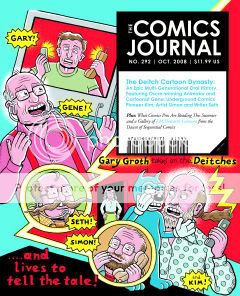
How does it suck? Let us count the ways….

1. Butt-Ugly Drawing
I’ve never been a huge fan of Deitch’s draftsmanship, but seeing it in glossy four-color really pushes it from “eh” to “ergh.” The character designs are awkward and flat and generally unmemorable. Neither realistically detailed, nor cartoonishly amusing, nor beautifully stylized, they hit that particular sweet spot of aesthetic alterna-nullity. Really, it seems like he drew this in Toys R’Us while gazing at some particularly unappealing humanoid plastic detritus.

2.Massively Lame Layout
Yes it’s cluttered and awkward, but it’s the clichés which kill me. The ironized faux pulp action cover page with the exclamation points and little yellow Splash! Bang! panels — how many more thousands of times do we have to see this crap? I guess it was sort of funny when underground folks like Deitch did it in the 60s…but that was getting on 50 years ago now. Could we come up with another cutesy layout gag to cover for the fact that we have no idea how to organize a page? Please?

3.Boring, Insular Content
We know you’re being interviewed, Kim. But couldn’t you maybe come up with something a little more interesting than just a picture of yourself and your relatives talking on the phone with Gary Groth? I know that would require a modicum of imagination, but it is a goddamn four-color cover — a showcase, you know? And no, putting that lame cat who’s in all your comics on the page doesn’t qualify as whimsy — it’s just another way of saying that you only have, like, the two ideas. (Incidentally, I did peel off the cover sticker; there is Additional Secret Content under there which, I am pleased to report, is just as boring and clichéd as the plainly visible content. Points for consistency, I suppose.)

I don’t know…maybe Deitch was having trouble meeting the deadline or something? As I said, I’m not a fan of his art in general, but this does seem a cut below his usual standard. In any case, it’s kind of embarrassing for a magazine devoted to comics to have such a thoroughly crappy cover. To say nothing of the embarrassment to the alterna-fanboys who worship this stuff (and yes, that includes you, Chris Ware.)

(To be fair, I thought last issue’s Tim Sale cover was beautiful. I guess they can’t all be gems…)

Update: Through the bizarrely instantaneous power of the Internet, there’s already a thread on the TCJ message board about this post. Ben Towle very politely suggests that I have crossed the line into personal attack, which certainly was not my intent. He also posted this image from Deitch’s Alias the Cat:
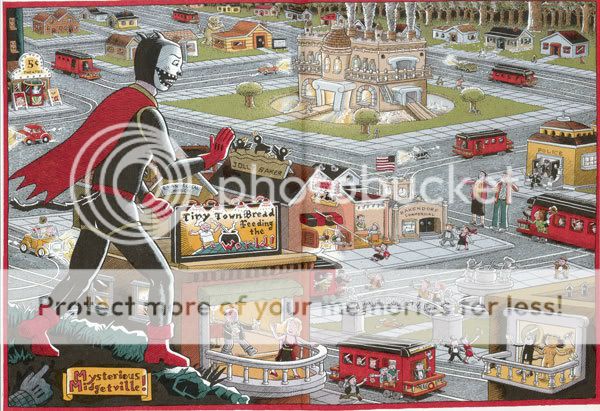
I quite like that, actually. It’s got a very nice Winsor McCay feel with the clean design and the manipulation of scale. He’s actually using the fact that his figures look like stiff, creepy dolls, too — and I really like details such as the smoke belching out of the castle. The colors are beautiful too, again in a McCay/art deco style. I can certainly see what Chris Ware loves about him here. So obviously Deitch can do imaginative, exciting work…. I don’t know, maybe there really was a deadline problem? Or maybe TCJ just brings out the insular hack in all of us?

Better Off Dead

I just read this really entertaining column by Tucker Stone about the much ridiculed Justice League of Detroit — a continuity blip when all the A-list leaguers wandered off and the title was left with Aquaman and a bunch of newbies.

I can’t remember if I had all those issues,but I certainly remember the sequence where (as Tucker describes) the newbies were killed off. It was extremely brutal and cold and quite sad. Tucker seems ambivalent about it, but I think those were actually excellent stories; as is so often the case, the only time the series really seemed to figure out what it was doing was when it terminated. A lot of that was, I think, because those last stories were written by J.M. DeMatteis. I think he wrapped the Detroit series up as a prelude to his goofy run with Keith Giffen — a run that also, actually, had a lot of suprising emotional depths.

So anyone know? Am I remembering right that DeMatteis penned those last few JL Detroit issue? Or am I just making that up?