Who Wrote the “Get a Life’ Sketch?

Judd Apatow, actually, with Bob Odenkerk. Saturday Night Live had the two of them as writers back in 1986, when Shatner did a guest-host appearance.

The sketch is famous because Shatner yells at a bunch of Trekkies for being such losers: “Move out of your parents’ basement!” and You, you must be almost 30… have you ever kissed a girl?” As we know, Apatow would do a lot more about losers later on.

BONUS:  Wikipedia has an entry for the Get a Life by Nadine Gordimer but not the one by William Shatner. I would never, ever have predicted that.

Source: Get a Life by William Shatner, with Chris Kreski

*Cough* — Manga — *Cough*

Valerie D’Orazio whines that nobody buys female super-hero comics.

The next step for women in mainstream comics is to translate our hopes and dreams and talents and superheroines we love into comic book sales. Past the idealism, past the blog posts, past everything — we need to sell these books. Nobody fucks with JK Rowling, and there’s a good reason for that.

Of course, D’Orazio is talking about stuff like Wonder Woman and Hellcat (how many of you bought the Hellcat mini-series? she asks plaintively.)

Here’s a tip or two for those wondering about super-hero comics:

1. Supporting titles as an act of socio-political charity may get you an unread copy or two of Hellcat, but it’s not going to prevent the series from getting cancelled.
2. There are a number of extremely successful female super-hero comics. They just aren’t put out by Marvel and DC.

Number 2 is probably going to leave the fangirls scratching their heads. Where are these successful super-hero titles with woman they ask? Why haven’t I seen them?

Well, the titles I’m thinking of are things like Buffy, and Sailor Moon, and Cardcaptor Sakura. Stuff that doesn’t look like super-hero comics; that comes out of a manga genre or crosses over with horror/goth. These titles have all the hallmarks of super-herodom — someone with extraordinary powers runs around saving people. But they forswear the kind of tights/double-identity/clubhouse continuity crap that is there to appeal to 25-35 year old guys.

In other words — you want super-hero comics for women? Then don’t go begging to the fans to support you. Instead, write fucking super-hero comics for women. Lots of women. Not just the very small number of women who care about the super-hero-genre-as-sold-through-the-direct-market. Because you know what? There aren’t enough of those women to support a title. There’s never going to be enough of those women to support a title. It’s just not going to happen. Especially in a fucking recession.

And, let me add, it’s not clear why it should happen. There’s lots and lots of product out there. Why do women need to run around trying to appreciate a genre that has never, and will never put them center stage as consumers? The fun bits of super-heroes for women can be picked out and put in other contexts — and, indeed, they have been. So why deal with the rest?

Now if you want to blame mainstream comics for promoting an insular, unimaginative approach to their product and marketing — hey, I hear you. But blaming women (or anybody) for not buying this crap? Color me unimpressed.

Update: Edited to correct spelling of D’Orazio’s name. Sorry about that Valerie!

Update the second: Well, to no one’s surprise, I didn’t actually read all the back links before I posted…but now I have (sort of.) Josh Tyler started things off with a kind men are from mars, women are from venus argument about why women don’t like super-heroes; then Heidi has a round-up of various folks taking him to task because women do too like super-heroes and he’s sexist.

I think Josh is right that women and men have different genre interests. I think his accusers are probably right that the way he parses those genre distinctions (women like romance; men like things that blow up) is simplistic enough to verge on lad mag territory (which is to say, it’s kind of sexist.)

Josh’s argument is in the context of movies; he’s arguing there aren’t many super-hero movies and there never will be, and that’s fine. But, of course, and again. there are heaps of female super-hero movies. Lara Croft, Buffy, Underworld (or whatever the hell that’s called), the Terminator, Alien — just lots of tough women onscreen performing super stunts in the interest of saving people. Oh, right…and Kill Bill and The Matrix has that too…and Charlie’s Angels, and…well, the list goes on. A lot of these are aimed at guys, obviously, but it’s hard to imagine they don’t have a bigger female audience percentage-wise than DC and Marvel do in general. Again, it’s not that women don’t like super-heroes; it’s that, within the limits of corporate fan fic, the aging stable of female characters owned by the big two just isn’t all that appealing to a broad audience. I mean, could you take Wonder Woman, give her a gun and a vampire boyfriend and…I don’t know, a horse, a cool car, anything except that fucking stupid invisible plane and the weird-ass lasso — and have her suddenly be popular? Maybe. But once you’ve done that, why call her Wonder Woman?

Wolverine Cooler for Kids

Dirk Deppey doesn’t write long form too, too often, which is everybody’s loss. He picks up his keyboard and runs with it in today’s Journalista though, explaining, among other things, why Jeff Parker sells better than Peter David but nobody seems to care.

One of the themes at which I’ve been hammering for the last couple of years is the bogus notion that “Direct Market = comic-book industry,” a myopic, self-absorbed viewpoint among superhero fans that sits at the heart of much modern thinking on the subject. As noted in the above link, the network of comic-book stores that constitutes the DM is overwhelmingly frequented by 25-35-year old men who’ve been reading superhero comics for a decade or more. But does this mean that companies like Marvel and DC can only cater to this crowd and this crowd alone to justify their continued publishing divisions? Posting in the comments section of Willingham’s essay, Marvel writer Peter David certainly seems to think so:

Here’s the interesting thing: Many fans have said much the same to me at conventions. And I routinely tell them that the types of stories they want to see, and the type of heroic clarity they desire, is routinely on display in the Marvel Adventures and the Marvel First Class books.
And fans will flinch back like Van Helsing from the cross and exclaim, “But those are… KID’S books.” And the titles routinely languish in the absolute basement of sales.

Make of that what you will.

Alas, this statement only makes sense if by “fans” you mean “comics-shop patrons.” Two figures illustrate the point: According to ICv2, Marvel Adventures: Spider-Man #45 sold just over 5000 copies to DM retailers in November… a low number to be sure. And yet, industry analyst Todd Allen notes the most recent circulation filings by Marvel Entertainment, which reveals that as of March 2008 the all-ages Spider-Man title had 31,479 subscriptions. If these numbers are similar to the current subscription base for the series, then the Jeff Parker-written series sells roughly six times the number of copies through the mail as those sold through what has come to be the seen as the traditional method of distribution, making its total circulation equal to the DM sales of David own X-Factor series.

Great Outdoor Pfft

I’ve seen a lot of folks recommend the online comic Achewood by Chris Onstad so I thought I’d give it a try.

Some twenty strips later and…why do I want to read this again? I don’t find the drawing at all interesting or compelling. I’m not in principle opposed to the amorphous mammal-blob school of cutesy drawing (I like Jay Ryan) but Onstad seems determined to do it in as boring a way as possible. His linework is blankly unvaried; he does nothing composition wise; the expressions are so repetitive that it makes his work look like clip-art. It reminds me of Dilbert…though I may actually like Dilbert better. Those strips are really viscerally ugly; Achewood doesn’t even manage that. It’s just boring. And holy crap is the bland computer font for the lettering annoying.

And, yeah, the gags don’t do anything for me either. This one, for example, got a lot of positive comments:

Photobucket

So getting drunk is funny. That’s brilliant, I guess. And being mistaken for gay is really funny too. And poignant. Don’t forget poignant.

Or there’s:this

Photobucket

Sorry, but “Sex Funeral” is a pretty piss-poor band name (the real band the Crucifucks is, for example, in the same vein except it’s actually clever.)

I think part of the appeal is supposed to be the not-funniness of it; the lameness of the jokes is itself a joke, in that ironic we’re-hipper-than-humor way. For non-humor humor to work, though, it needs to be weirder, and, yes, more earnest. Charles Schulz for example; Spike standing in front of a giant waterfall, for example, or Sally declaring she will triumph over her lazy eye; those are funny because there’s really nothing nothing nothing going on; they’re completely flat and ridiculous and at a 90 degree angle to what would usually be considered amusing. This stuff — drunkenness and dumb band names — it’s basic class clown boilerplate. It’s not unusual or unexpected to hear someone try to pass that off as a joke; it’s the sort of thing you’d hear at an amateur stand-up night. And, indeed, Onstad’s stuff in general reminds me of mediocre stand-up; mild smut, mild shock value, lame cultural references (let’s make fun of Flavor Flav!) — it’s really tedious.

Dirk says I’ve got to read six months of archived Achewood strips if I’m going to love it. Alas, I’ve got to get *a lot* more enjoyment out of individual strips if I’m going to read a book’s worth of this crap. In fact, so far, the magic seems to be working in reverse; the more strips I look at the more it pisses me off.

Update:..and that’s Onstad, not Onstaad. Corrected now. Duh.

Update 2: I’d urge folks to scroll down through comments. Tucker Stone and Bill Randall offer much more educated takes on the strip, and several others point out some of their favorite moments. All of which allows my loathing to take on a more complex, more meaningful shape….

New TCJ with bells on

Issue #295 of The Comics Journal is now out online and maybe in a day or two to the stands. Our contributors have several articles in:

  • Tom has a great column on a few books that try to breed superheroes with fashion for horrific results. Tom, I sat next to a madcap costume designer friend at the opening of one of his shows, where he bewailed the fact that they’d tea-stained all his costumes to dull the eye-melting colors. Months later, I found out he’s an X-Men fanatic. Hmm.
  • Noah with a long article on “Comics in the Closet” and reviews of Zot! (the first paragraph’s a gem) and Donald Dewey’s survey of political cartoons
  • My own column on Dousei Jidai (?????by Kamimura Kazuo (????), which is the other great living-in-sin manga from the early 70s, so if you’ve read Red-Colored Elegy, read this. And shorts on the comics movie Independents and Tatsumi’s Good-Bye— I’m still perplexed that it’s Best-Of fodder, read article for why. And I’ll have links & notes for Dousei Jidai on my other blog on Thursday.

Not only that, but I was delighted to see NG SUAT TONG back! He hasn’t lost a step: “Now if this bland listing seems somehow unfair to El Rassi’s artistry, let me assure the reader that the author has none.”

And when did Frank Santoro start doing the minicomics column? This issue? He’s a great choice, and I’m glad to see him there. Frank, welcome, but don’t be surprised if everyone starts assuming everything you say comes from a secret earpiece back to Gary Groth’s command center. (Also glad to see Tender Loving Empire reviewed.)

Yes, But Is It Comics?

This review ran in the Comics Journal a while back.

The visual arts have long been, keen on comics. From Roy Lichtenstein to the art-school trained members of Paper Rad to the recent Masters of Comics Art exhibition, high art institutions and practitioners are perfectly happy to appropriate, create, and interact with comics in various ways.

The reverse is less true. Certainly, there are comics creators who move in the high-art gallery world – but rarely without a chip on their shoulders. RAW’s self-promotional copy repeatedly and reflexively insisted on comics’ unique high-brow/low-brow status — though how anyone could mistake RAW for anything but high-brow is pretty unclear. And while artists may dip into and appropriate comics in various ways, comics creators rarely seem to pay much attention to what’s going on in the contemporary gallery scene. When I’ve glanced at such discussions on TCJ’s message board, I’ve been amazed at the level of animosity expressed toward the visual arts. The consensus seems to be that people who show in galleries are a bunch of talentless scam artists, emperors trying to cover their exposed peters with jars of urine and elephant dung.

I know that dada is only about a century old, and that, as such, it’s a bit much to expect comics professionals to get their minds around it. But even if you hate Duchamp and all his sneering progeny, there’s still heaps of worthy art out there. I go to galleries only occasionally, and I’ve seen plenty of visual art which focuses on strong representational illustration, narrative, and humor — art which should, in other words, appeal to a comics audience.

As just one example, take Chicago artist Ryan Christian. His drawings are semi-surreal in the best sense — that is, they’re quirky, unexpected, and funny. In fact, many of his illustrations function as single-panel cartoons. An image of a dinosaur torso affixed to a pair of naked male legs being threatened by a meteor with spread female genitalia caused me to laugh out loud. Somewhat more abstruse, but still quite entertaining, is a tiny drawing of a terrorist psychically destroying the head of a hapless basketball player as both stand in a bathtub. And Christian’s series of pieces featuring giant, dripping, copulating mud-entities looks like it would be at home in any number of underground-influenced comics anthologies — such as Legal Action Comics, for example.

As I said, Christian is just starting out, and while I like these pieces, I don’t love them. In part, the problem is a disconnect between form and content. Christian’s meteor/dinosaur/genitalia illustration could almost have been done by Gary Larson or Johnny Ryan — but both of those creators use a loose style which seems perfectly fitted to absurd, off-hand jokes. Christian, on the other hand, is an extremely tight illustrator, with a gift for subtle shading. The combination of beautiful line-work and throw-off one-liners makes the images come off as a little smug or cutesy, rather than as energetically gratuitous.

In some of his most recent work, though, Christian addresses these problems, and the results are dazzling. Rather than the sharply clean delineations between figures and (mostly empty) background in his earlier pieces, he has now started to incorporate elaborate moire patterns. At the same time, he’s moved away from the dryness of surrealism and toward a more pulpy mysticism. The result is ambiguous wizard-things floating through gorgeously patterned space. Again, Christian is a lot less sloppy than the Paper Rad crowd, but his work recalls theirs in some ways — that is, it touches on popular culture before wandering off into pure evocative eye-candy. Not only is the work lovely in itself, but — given the speed with which Christian seems to be developing — it shows enormous promise. I’m looking forward to seeing what he’s doing in two or three years.

Photobucket
Ryan Christian, hello friends

Another gallery artist who should by all rights excite comics fans is Neil Whitacre. Whitacre is a significantly more established figure than Christian, and his work is quite different. Where Christian’s drawings suggest cartoons — either through punch-lines or simplified figures — Whitacre’s work seems much more closely related to classic illustration. For example, one of my favorite Whitacre images shows a lanky, hairy, hippieish mountain-man sitting on what seems to be a tiny island, toasting a marshmallow by the waterside. The water is represented by smoothly undulating, broad inky strokes; the island foliage is an interwoven net; the night sky is stippled grey with some darker branches just peeking through. On the hippie’s shoulder sits a large, fluid white bird of indeterminate species.

The elegant, off-center composition, as well as the intricate use of different shades and patterns, suggests Japanese prints. And like those prints, the particularity of the details and the vividness of the scene makes it hard not to feel that there is a story before and after, of which we see only a single instant — or one panel, if you prefer. There’s obviously a sense of reflection here, but the very use of stillness points to motion outside the frame. This is a contemplative high-art moment, but its energy or weight relies in part on an obscure, never-quite-defined genre narrative of wilderness adventure.

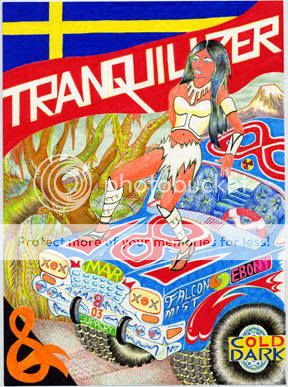
Whitacre manages to be indisputably high-art while retaining a low-art energy and verve — in other words, the holy grail of comicdom aesthetes, which calls to many but is seized by almost none. Whitacre’s color work may make this even more apparent; for example, a red, black, and blue image of a black cowboy riding a hammerhead shark is garish, tripped-out, trashy biker art of the sort that would make Juxtapoz magazine aficionados salivate. And yet, the image isn’t at all messy. Instead, the blue twisting patterns on the shark and the stylized flames drifting up and off-panel look like art nouveau wallpaper. Its absurd but restrained, evoking both the tasteless fussiness of flash tattoos and the tasteful fussiness of upper-crust decorative traditions — both masculine swagger and feminine delicacy. It’s clearly making fun of the first— whether located in the image of the cowboy, or the working-class artist, or, perhaps, in the racially oppressed. But the cowboy’s awkward, thrown-back pose, and the delicacy of the patterns, is also elegaically romantic. And, of course, Whitacre’s line-work is such that any piece he does is going to swagger more than a little anyway.
Photobucket
Neil Whitacre, Tranquilizer (No, not the image I talk about in the text; sorry about that.)

Neither Whitacre nor Christian is especially indebted to comics for material or inspiration. But neither do they reject it. Both have expressed interest in various comic artists (Christian is a fan of Paper Rad, Whitacre of Basil Wolverton). And both have thought about working in something like comics form. Christian has a zine coming out shortly called “Lonesome Dandy Quarterly.” Whitacre says he’s an “aspiring comics writer.” He’s currently working on a comic-like series called “Into the Abyss” about “a small-scale entrepreneur of sorts.” In other words, for both these artists, comics provoke interest, curiosity, and even ideas…but not anxiety. Comics, in other words, make the visual arts richer. The reverse is occasionally true as well, of course. But it would be nice if it were the case more often.
__________________

More Neil Whitacre images here and here

Ryan Christian’s blog is here

Fact

Walter Koenig, Star Trek’s Chekhov, has a mantelpiece loaded with action figures, ranks of them. Earth-2 Flash stands out. Koenig was already 20 in 1956, when the Flash got revived. His autobiography makes no mention of superheroes or comic books.

In other words, it’s a mystery.

Sources: How William Shatner Changed the World, directed by Julian Jones; Warped Factors: A Neurotic’s Guide to the Universe by Walter Koenig