The Sex Element, part 4

Sex, comics, porn… they don’t go together in my mind. Setting aside porn (as a mechanical solution to a problem of mechanical societies, not something I find critically interesting), I still struggled to come up with comics that I’d call sexy.

Two works stood out from my shelves. The first, an American underground from 1972, shows its Catholic hero plagued by the penii of his mind. His unrelenting adolescent libido turns everything he sees into phalluses, which send out raybeams befouling all they touch. Especially churches. At one point he’s caught between two churches with a phallus-ray shooting ahead from his crotch (this is just before his fingers undergo penitization into rayguns.  And his feet). As he turns and lops off a steeple with the ray, he says,

“All I can do is hope the one on the left is Lutheran!”

The book’s Justin Green’s Binky Brown Meets the Holy Virgin Mary. It’s not sexy at all, just tortured by sex. And religion, or least how both infect the adolescent imagination. It’s a stunning work, the greatest of all the undergrounds. And it’s the best example of the debased confessional, the dominant strain of sex in American art comics: squeeze something embarrassing out of the pen and then hide publish the results.

The second work, Baudoin’s Terrains Vagues. If the tortured mix of sex and religion is terribly American, this book’s terribly European. A man & a woman, lots of talking, lying in bed naked talking. Sex, too. I think there’s some cigarettes, seashores, luscious drawings of old towns.  Cafes.

(I need to move to Europe.)

Baudoin abstracts everything with sumptuous brushstrokes. He constrasts their sweep with intricate pen-and-ink, just as he contrasts the sex with his protagonist’s introspection: “Quand je penetrais une femme j’avais l’impression d’etre un vandale commettant. Une profanation.” Their relationship’s falling apart, reflected in the narrator’s drawings of her.

I guess breakups aren’t that sexy, either.

Still, the book’s much, much sexier than any other comic on my shelf. (The closest comparison is Le Portrait, Baudoin’s companion piece of a few years earlier.) It also works on the artist-model theme, which has been around for centuries, if mostly unexplored in comics. Of course, comics doesn’t have the tradition of the model stripping down while the artist draws 450 portraits in tiny boxes every month.

Comics also have no tradition of seduction.  Once those 450 portraits are done, the moment’s passed. But a poem, painting, or just a camera can serve to get someone in bed, or at least naked. Donne’s poem “The Flea” or Goya’s Majas, whose myth I prefer to believe. Comics share more with the diary, where you write about how you felt when it did or didn’t work. Hence the memoirs and confessions, or just the secret fantasies of sexy trombones with TV sets for heads.

Ta-Nehisi Coates — The Beautiful Struggle

Well, another gig I had lined up crashed and burned. For a brief shining moment I was the book reviewer for a magazine to be called Prettyboy — kind of a Maxim for girls, supposedly. Didn’t quite get off the ground though, leaving me with a bunch of reviews and nowhere to publish them. But there’s always the blog. So, here’s the first of several random book reviews that I’ll be posting over the next couple weeks; this one of Ta-Nehisi Coates’ memoir,”The Beautiful Struggle.”

*********************

The American memoir is a fairly simple formula. Clearly identify your colorful ethnic heritage (Chinese, Jewish, Irish…even Appalachian will do.) Milk said heritage for all it is worth. Discuss your simultaneous love of and resentment of said heritage. Milk your ambivalence for all it is worth. Feel deeply. Stir well, then appear on Terri Gross.

In The Beautiful Struggle (a deeply felt title if ever there was one) Ta-Nehisi Coates has followed the formula down to the ground. Coates grew up in Baltimore, the son of a Black Panther who ran his own Afrocentric press. Heritage, consciousness, and a fetishization of his own family’s exotic difference form the core of the story. Young Ta-Nehisi hated his oddity — his name, his family’s refusal to celebrate the Fourth of July, the ban on eating most kinds of meat. Yet at the same time that difference, that heritage, is his salvation — both in the narrative, since consciousness saves him from the street, and in the bookstore, where the ethnic accent is what he’s got to sell. Why are we reading this, after all, if not to learn about this unique subculture, where young men play the djembe drum and drop ebonics like the scatterings of Yiddish in a Philip Roth novel? It’s all about being torn between two worlds and reconciling with the father you leave behind and selling your nearest and dearest to a public that smacks its lips over each new flavor of nostalgia.

And yet, contradictorily, there’s something heartening about seeing this kind of book — a basic, tiresome, clichéd memoir — being written by a black man. Because, at least for the past hundred years or so, African-Americans have been pretty much the only Americans who could write memoirs that didn’t suck. Richard Wright and James Baldwin and Malcolm X wrote about their pasts with a bitterness that made it very hard to turn memory into all-purpose, non-denominational spice for a happy ethnic buffet. When they served you up their difference, it was, at least partially, in the hope that you’d choke on it, as they had been forced to do repeatedly, and for years.

The U.S. hasn’t become color-blind or anything; we’re still an awfully segregated nation, black President and all. But reading this book, I felt a little like blogger Andrew Sullivan said he did when, after going to hear Obama give a disappointing economics speech, he came home, sat down, and realized with something of a shock that a black candidate for President had just bored him for several hours on tax policy. The goal of integration is, in some sense, to become mundane. Why, after all, should African-American writers be burdened with writing all our decent memoirs, anyway? Why shouldn’t they be able to shamelessly exploit their ancestors just like every other two-bit poetaster? If the Holocaust can be a guarantor of sensitive seriousness and triumphant book tours, why not the crack epidemic in inner-city Baltimore?

Admittedly, Ta-Nehisi Coates’ memoir isn’t that bad. Occasionally he sets down his literary pretensions long enough to fire a zinger worthy of his very entertaining blog. I think my favorite is his quip about how frat boys ruined Bob Marley “like they do everything they touch. You can’t write as dreadfully as Art Spiegelman all in a day, I guess. Perhaps next generation, though. I have a dream.

the sex element: yes, please. eww, not you.

My parents enrolling me in nude figure drawing classes starting when I was fifteen was one of the best things that ever happened to me. I hadn’t kissed a boy or girl, but suddenly I found out how sharp light reflecting off completely bare human skin was utterly different than any kind of light reflecting off any kind of clothed human. The people were of course a range of ages, sizes, and colours, but every one, every time, was transcendently beautiful, and I mean that literally. Every time a model disrobed, I felt like I transcended my bodily existence and I was getting drunk through my eyeballs, without ever getting acutely physically aroused. If you’ll pardon the smugness, I think it spoiled me for mainstream western porn forever.

When I got around to fooling around with people I was attracted to, well, that was even better, in a whole other way.

Which is to say, I like nudity, I like sex, and if a comic can incorporate these elements in a way I dig, that is a big positive for the comic. I would almost go as far as to say that contextually-appropriate nudity and/or sexuality can be to the benefit of any given comic, in the same way that the best stories have a vein of humour, as different as it may be depending on the story.

Tom said that pictures of hot girls could disappear from comics and he wouldn’t care much. I’d put forth that every graphic work I can think of that incorporated nudity or sexuality well would be a lot poorer without that element. In the Night Kitchen would be significantly diminished without Mickey falling out of bed naked. As would be Diary of a Teenage Girl without the oral sex (well, duh), and Dykes to Watch Out For without the tasteful humping.

It’s not an original thought, but I believe sexuality in comics is appropriate in all sorts of cases: for titillation, anti-titillation, pushing a story forward or revealing character. Cerebus would not be Cerebus without the Astoria rape scene, and the girls’-school-ravishment scene was the perfect way to introduce Moore’s Invisible Man (the former I found horrifying and the latter hot, but I’ve heard the opposite from others).

That said, when the sexual element is done badly (by, say, people who come off as having watched a lot more porn than they’ve seen naked people) it’s unbearable, just like the worst parts of the worst novels are often the sex scenes. Given my abovementioned warped formative experiences, I’m most attracted to the bodies that call to mind naturally-occurring human forms and am mystified (at best) by obvious anatomical exaggeration, be it fashion-illustration manga-style or rubbery and brokebacked like the porn Noah praised here (I can get behind (hur hur) Aubrey Beardsley women (though not Aubrey Beardsley penises), because I have seen women who in the actual nude look like they’re wearing invisible corsets, with the wasp ribcages and beer guts).

In conclusion, I am for sexy comics but hate the porn aesthetic. And as a feminist, I get uncomfortable with a lot of the male-gaze-issues (I love-hate Frank Cho, for instance, and some of the straight male jobnik fans I’ve met), but I wouldn’t know where to start with talking about that.

Sex Element: Just Because the Men Are Dead Doesn’t Mean that Cheesecake Has to Be

So, as I recently threatened, I did in fact purchase the first volume of Brian K. Vaughn’s Y:The Last Man. It was…okay. The overall concept is pretty entertaining: one day, all of a sudden, every creature with a Y chromosome on earth dies. All that’s left are women, a guy named Yorick, and his male monkey. The rest of the series chronicles the result of the half-apocaypse, and follows Yorick’s more or less picaresque adventures in the company of various allies, including a government agent known as 355.

As I said, the start of the series bops along effectively. Perhaps too effectively, overall. It quickly becomes clear why Vaughn has been tapped for televison; his plot is suspiciously,and, over time, remorselessly glib. In a high-concept sci-fi series like this, the trick is really to start with your one interesting idea and then try to unfold events as naturally as possible from there. For instance, in Hitoshi Iwaaki’s Parasyte, the single idea (weird parasites invade people’s bodies, take control, and start eating humans) results in seemingly endless pulp creativity. What if the parasytes took over a dog by mistake? What if they failed to control the head and only got an arm? What if two parasites settled in a single body? Can a parasyte controlled body have a human baby? What happens with that? What if the parasytes took over a whole town? And so forth — except for a couple hiccups (the hero’s mother coincidentally getting eaten by a parasite is a little strained) the storyline is built around the hero’s effort to deal with thoughtful variations on the basic concept.

Vaughn is interested in exploring his high-concept to some degree. And his answers about how man-death would effect the military, or the goverment, or sex, are fine as far as they go. But he can’t quite figure out how to turn them into a story…and so he falls back on a wearisome series of coincidences and cheap ironies. Yorick is talking to his girlfriend on the phone just as the plague hits…and she gets cut off just as he proposes! So we don’t know what she said, get it? Oh, yeah…and also, she’s in Australia! So to find her he’s got to go all the way across the earth! There’s plot for you! What are the chances, huh? And, of course, Yorick’s mom is a congressperson, so he’s able to get tied into all the government plot stuff…and then his sister happens to have been brainwashed by Amazon’s and now she’s trying to kill him! What are the chances that the one man left in the world would have a rapid man-killing sister, huh? Ain’t life odd? The grinding of the plot is just really audible…and things aren’t helped any by Vaughn’s willingness to toss out characterization at the faintest whiff of possible “conflict”. Yorick, for example, is portrayed as being something of a lefty — he even suggests he voted for Nader at one point. Yet, when confronted with a town full of prisoners who managed to get free (rather than starve to death in jail) he starts shouting at them that they haven’t paid their debt to society. The whole thing just seems hyperbolic and stupid and unnecessary. Just have faith in your story, man. It’s not a bad story. You don’t need to invent melodrama every other page.

All of which is to say that this reads like slick media product by a fairly smart creator whose undeniable intelligence is always fighting a losing battle against the overwhelming instinct to pander to every passing shoddy contrivance. It’s one of the many possible curses of professionalism; the knee-jerk impulse to deliver gets in the way of coherent or thoughtful storytelling.

So, what does this have to do with the sex element?

Well, while professionalism has many downsides, one of the things it almost always provides in television and movies is the sex element. Sure, this episode of Torchwood has been completely derailed by the writers apparently irresistable desire to end with a Very Tragic Death — but at least I spent the last hour or so looking at Naoko Mori, so I don’t feel like my time was completely wasted. Or, yes, Tomb Raider 2: The Cradle of Life was almost insupportably stupid, but I did see Angelina Jolie in a skin tight outfit. And, yes, there are smoking hot guys in Torchwood and Tomb Raider, too. Even if it fails in everything else, professional pulp will provide you with objects of prurient interest. It’s not always enough, but at least it’s something.

Y is certainly better than Tomb Raider, and it isn’t significantly worse than Torchwood. But Pia Guerra can’t draw sexy to save her life. This is, obviously, an offshoot of the fact that the art is basically crap to begin with. It’s standard mediocre mainstream fare; indifferent anatomy, blocky layouts, no sense of composition — just a stylistic nonentity. So what you’ve got here is a slick, mediagenic pulp script in which basically all the characters are women (except for one young twentysomething guy who seems like he’s supposed to be hot as well) and there is just nothing sexy to look at. Vaughn even throws in a gratuitous super-model at one point — and does she look hot? No, she looks blocky and awkward just like everyone else.
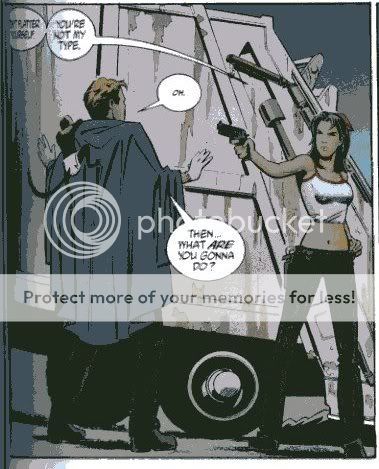
Photobucket
In the new future, even models will be poorly drawn. Copyright Brian K. Vaughn and Pia Guerra

What I’m saying is, if you got Jaime or Gilbert Hernandez to draw this series, the pages would be oozing sex and your eyes would be falling out of your skull and you’d feel like you’d gotten what you paid for when you paid for a goddamn slick pulp sci-fi story. Given that the Hernandez Brothers weren’t available, why wouldn’t you put somebody on this story who could deliver some very basic prurient interest?

There’s a simple answer to that question. The answer is that mainstream comics art is…well it’s not especially good. And one of the ways you can tell it’s not good is that it can’t even deliver professional cheesecake with any reliability (I just had a horrible flashback to that ridiculous Power Girl cover where her breasts seemed to be coming out of her stomach…never mind. We will not speak of it again.)

In a comment on his post, Tom said he liked looking at pictures of hot girls, but if pictures of hot girls disappeared from comics, he wouldn’t shed any tear. I certainly agree that you don’t necessarily need pictures of hot girls to have a good comic. Sometimes you don’ t even want pictures of hot girls (or guys, for that matter). But if you’re making slick, professional, genre product, and you don’t have the sex element…well, you haven’t done your job, and I feel justified in resenting it.

___________

A note about two possible objections:

First; yes, Pia Guerra is a woman. I don’t see that it makes much difference. Women and men in the female-drawn Nana are both hot, for example, because it’s a professional genre product, and that’s what you do in a professional genre product. And Guerra’s men aren’t especially cute either, as I noted.

Second; no, more prurience would not undermine Vaughn’s serious take on gender issues. This is because, while a group of crazed killer amazons spouting garbled Dworkin logic may be entertaining, it doesn’t really qualify as a serious take on gender issues. Sorry about that.

Update: I should have noted: this is part of a bloggy roundtable we’re doing on sex in comics. Tom started it off with this post on different ways in which there can be sex in comics and why he hates them all. Tom also posted his very skeptical take on Alan Moore’s Lost Girls. For my take on Lost Girls you’ve got to go back a bit, but I posted it here. And Miriam’s take in response to my post is here. And Miriam will add her own contribution to this forum tomorrow….

Update 2: Gah! Left out Naoko Mori’s name! Duh.

Update 3: Miriam’s post is now up here

The Monosyllable

Monosyllable — For most of the eighteenth and nineteenth centuries, this was the most common slang euphemism for one of the most dreaded of the four-letter words, i.e., cunt. ‘Mrs. Jewkes took a glass and drank [a toast to] the dear monosyllable. I don’t understand that word, but I believe it is baudy.’ (Henry Fielding, Shamela, 1761)”

—from Hugh Rawson, Dictionary of Euphemisms and Other Doubletalk

Lousy Things

One is Bosom Buddies. The show came and went in the early ’80 and had a reputation as being too cool for the room. I saw it once and the episode had a great line that encouraged me to think the show was ok. Decades later I rent the dvds and … oh boy. The title sequence is especially bad: music, winsome comedy shots, the lettering of the credits. So this is why people hate tv.

The show gave Tom Hanks his start, and I love Tom Hanks before he got too big for comedy. He;s good in the series; you can see why his career took off. Peter Scolari is ok. So is the lady playing their boss, and she gets a lot of airtime. The episodes I’ve seen all have at least one or two good lines. Yet these key elements are outbalanced by the sheer tonnage of crap presented by everything else in the program.
I say this as someone who likes tv and sitcoms.
The tv Mission: Impossible also looks pretty dire. I’ve seen just one episode so far, but boy. Peter Graves is the quintessence of dumb tv leading man. He has to start off each show by listening to that tape with the exposition (the “Your mission, if you choose to accept it” tape). He gets a look on his face like a dog trying to follow a conversation.