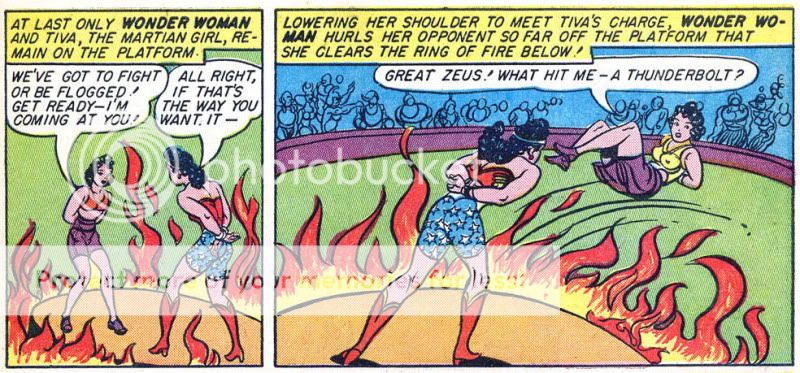
Feminists in Chains!

So I have finally put my obsession with Wonder Woman and my obsession with women-in-prison films together. You can see the results over at Comixology. Here’s a quote:

Indeed, male creators (and a few female ones) have been exploiting feminism for a good long while, now. Rape-revenge fantasies like the much lambasted I Spit on Your Grave (1978) or Ms. 45 (1981) get their horror, their energy, and their catharsis from a feminist view of patriarchy. In “I Spit on Your Grave,” for example, four men egg each other on in a brutally extended gang rape of Jennifer (Camille Keaton). She then seduces and murders them one by one, repeatedly playing on their inability to believe that she (a) didn’t want to be raped and (b) could possibly harm them in any way.

As you see, I get to talk about rape-revenge films too.

If you want more, more, more discussion of women in prison, you can go here. More discussion of Wonder Woman here and here.

Nominations for the Award of Most Clueless

Over at Icarus comics, Simon notes that manga didn’t get too many Eisner nominations. He argues, though, that manga fans shouldn’t be bitter; they should just create their own awards. Precocious Curmudgeon agrees. (Thanks to Brigid for the links.)

Simon’s point is that awards are more about industry promotion and celebrating creativity than they are about objective quality…and that manga is big enough and independent enough to promote itself.

This is certainly correct…for manga. Manga doesn’t need the Eisners. I do wonder, though, whether it’s true that the Eisners don’t need manga. Or, to put it another way — manga has opened comics up to some vastly underserved demographics. It’s inaugurated entirely new genres. It’s helped to change distribution models. It’s vastly changed what comics in America are, and who reads them.

So you would think, maybe, that the industry might want to celebrate that. Maybe comics might want to use their awards show as a chance to point out to the world how things have changed, to embrace new readers, to paint itself as dynamic and exciting and forward looking and inclusive.

But of course the Eisners aren’t all that interested in doing that. And the reason is that the old institutions of American comics still haven’t come to terms with the changes in manga. They’ve watched the demographics expand without being able to figure out how to take advantage of it; they’ve adapted to some of the distribution changes but haven’t been able to embrace even those whole-heartedly.

So while the lack of manga at the Eisners isn’t a big deal for manga, I think it is maybe a big deal for the Eisners, and for the industry they represent. In short, it’s a sign of a a big, fat failure on the part of American comics. As is so often the case, a snub says more about the quality of the perpetrator than it does about the object of scorn.

Update: Brigid offers a polite dissent, pointing out that many of the Eisner judges are quite aware of manga, and suggesting again that manga needs its own awards. She also suggests that the Eisner’s should maybe expand to include more manga categories in the meantime…which they should, and which, if they did it whole hog enough, would preclude the need for a separate set of manga. If you’re the Eisners, why not create a whole parallel set of manga categories? You’ve got a leg up to begin with, so why not become the prestigious award for manga as well as for comics? Again, that seems like a great way to seem, and for that matter, to actually be, relevant to a whole new group of comics consumers.

Brigid also offers a mini-apology of sorts for the fact that manga fans (and she herself) aren’t necessarily all that into Western comics. I don’t think any apology is ever necessary for matters of taste like that; there isn’t any moral duty to read one comic or the other. With an institution like the Eisners, it would make sense for marketing and industry reasons for the awards as a whole to be more open to manga, but that’s really a different issue than saying, “this judge should like manga more” (especially since, as Brigid notes, many of the judges like manga fine.)

Update 2: And as long as this seems to be generating some interest, I thought I’d point out a couple of other recent manga posts which might be of interest: Kinukitty kicks off her column “Gluey Tart: Adventures in Manporn” with a review of prettyboy assassin manga Blank Slate; I talk about the Japanese Superman; and, from a bit longer ago, Bill Randall talks about perfect girlfriend’s and Sungiku Uchida’s bizarre manga Minami’s Sweetheart.

Throw another update on the fire: Lots of interesting responses from Precocious Curmudgeon, Heidi and Simon.

By the by, everybody who has posted on this knows more about the Eisners and more about manga than I do. Just in case that wasn’t already clear….

Gluey Tart: Blank Slate

Blank Slate, by Aya Kanno
published in English in October 2008 by Viz Media
There’s a second (and final) volume, which was published in December 2008.

Welcome to “Gluey Tart: Adventures in Manporn.” I’m writing this column because manporn is an extremely important subject. Well, not really. I’m writing this because I’m obsessed, and, more important, because someone asked me.

There are a lot of people reading manporn in the U.S. (I’m going to use the terms “manporn” and “yaoi” more or less interchangeably. I define “yaoi” loosely – and I mean that in every sense of the word – as romantic stories written by and for women about beautiful men having sex.) If you go to Borders and scan the shelves, you’ll see lots of titles from June, Blu, and Deux. There are others, but those three are pretty reliable. There are lots of other sources as well, but my point is, it’s easily accessible. Borders, people. Why does that matter? Well, there’s a lot of us. We’re not as crazy and marginal as we looked even five years ago. Maybe I’m just trying to have a self-esteem moment.

Or maybe we’re talking about a big market for a largely marginalized group in U.S. comics: women. I invite you to draw your own conclusions about how much that matters. I’m mostly going to talk about yaoi and shonen-ai manga that have caught my eye, and natter happily about them. (Quick note: people disagree about everything, including the meaning and proper usage of “yaoi” and “shonen ai.” I use “yaoi” to mean “there’s sex!” and “shonen-ai” to mean “no sex, but sigh, look at the meaningful eye contact!”)

Oh, about the pseudonym. I use it because it’s only polite. I write porn on the Internet, and while I am proud of this endeavor, I am not eager to have my employers, coworkers, acquaintances, and family members casually Google me and wind up reading something that has the word “cock” seven times in the first paragraph. Because is this something they want to know about me? It is not.

Which leads us (more or less) to the first review. I use this word almost carelessly, albeit with gusto. There are sites that do proper reviews of yaoi manga and novels. My favorite is “Boys Next Door,” where they make a proper attempt at summarizing the plot and that sort of thing. What am I going to write about, then? We’ll see. No sex in my first selection, because there isn’t any. Not even any of those longing looks, because there aren’t any of those, either. What we do have is pretty boy overload, and a certain unmistakable vibe.

Photobucket

The boy on the cover is pretty. So pretty. All the major characters are pretty. Cool, angsty-looking pretty boys with big guns. Did I mention that they’re pretty? They really are. I’m not sure who’s who all the time. I’m not always sure what’s happening. Don’t misunderstand – we’re not talking about confusion that rips space and time. We’re talking about a series of brow-furrowing, minor WTF moments that end with a quiet snort of “Oh, I don’t care anyway.” My willingness to accept this kind of thing is not infinite; far from it. I will put the book down and move on to the next shiny object, no matter how pretty the boys are. Blank Slate is well within my tolerances for not making sense. And, not to belabor the point, the boys are so pretty.

It isn’t just the pretty. I was going to say there isn’t enough pretty in the world to make up for some messes, but that might be a lie. In this case, though, the story is entertaining enough, in a thug-style James Bond meets the Matrix sort of way. The exceedingly pretty protagonist of Blank Slate, Zen (isn’t that deep?), is an amnesiac master assassin – and I don’t mind admitting that it makes me sigh happily just to write those words. I could summarize the plot, such as it is, but it doesn’t really matter. There are three casually related stories that you really wish were more closely related, but they aren’t. Zen is the constant – cool and almost supernaturally competent. The story is atmospheric and stylish. You’ve heard that before? You’ve heard everything in this manga before. It’s OK.

Zen. Is he bad? You know it. But deep down, underneath it all, does he have a heart of gold? Well, no, thank God. And is he hot? So, so hot. Hot, beautiful, mystery assassin boy. It works, despite being a big old cliché fest. The art is lovely, and the story is basically satisfying in a vague but solidly cool, noir sort of way. This book made me want to go out and buy a pair of spy sunglasses, and maybe one of those ’70s navy blue sniper trench coats. Possibly a t-shirt that says “Assassins do it from behind.” And I don’t know about you, but I call that satisfaction.

Photobucket

Bound to Blog: Wonder Woman #2

As I said last week at about this time, I’m trying to blog through all the issues of the Marston/Peter run on Wonder Woman. I’m hoping to post about one issue every Thursday and this is the second.

And yeah, I know this is Wednesday. I jumped the gun; maybe I’ll do it Wednesday or Thursday, depending? We’ll see, I guess.
______________
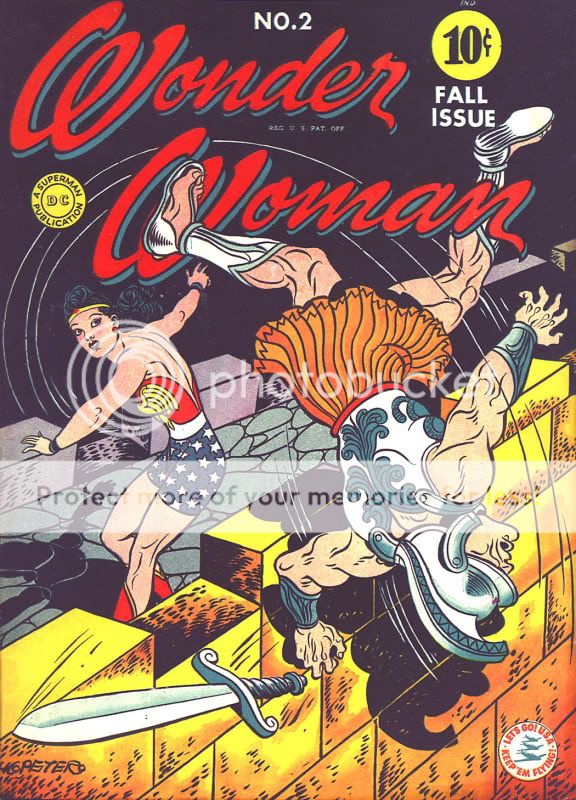
Photobucket

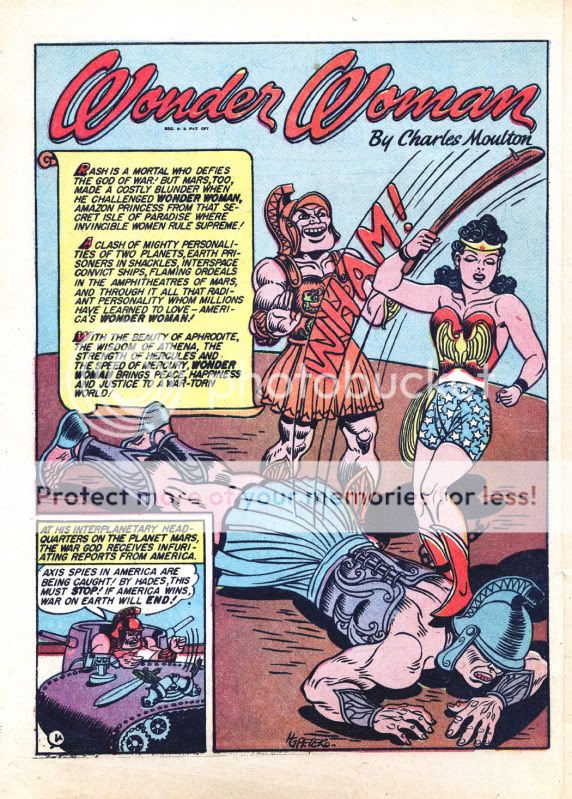
So I do love that cover, but it’s nothing compared to the initial splash page:
Photobucket

Thank you sir, may I have another?

It’s probably wrong for me to admit this, but I’ve danced around it before, and I might as well just come out and say it — I often find Peters’ soft-core efforts quite sexy. There’s something about the unabashed flowery femme of the designs and the stiffness of the figures that I definitely find appealing. He must have too, surely; WW is usually seen as all about Marston’s sexual obsessions, which I’m sure it was, but Peter must have had a fair bit to do with the goings on as well. In this drawing, for example — was it Marston who suggested that the big, tough Greek warriors should be wearing such frilly kilts? And the armor he’s got with all the filigree — and the colors! Ares (standing in the background yucking it up) really looks like he’s wearing a red dress. Peter has decided to make the God of War a transvestite. I don’t know…maybe it could all be Marston turning in incredibly detailed scripts a la Alan Moore…but I’m skeptical.

Anyway, unlike the last effort, this is essentially a single story — which means it’s virtually as long as a mini-series, clocking in at more than 60 pages. Even with a short story about Clara Barton and a prose piece, that’s a hell of a lot of pages…was this thing monthly? No, it says “Fall” on the cover, so I guess it must have been quarterly. Though Peter was also drawing WW’s adventures in Sensation Comics at the same time…it’s a lot of drawing, anyway you look at it.

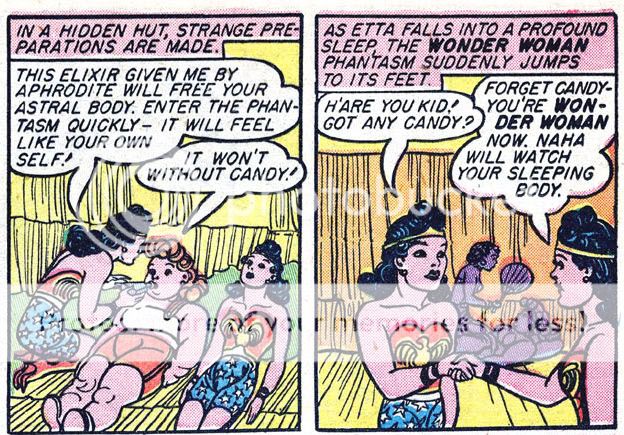
So what is the plot of this gigundus story? Well, Ares is pissed because WW keeps catching Nazi spies. This pisses off Ares because, as he says in that little inset panel above, “If America wins, war on Earth will end!” So Ares sets out to capture Wonder Woman, throw her in chains, make her his slave…you know the drill. He does this by arranging for the capture of Steve Trevor’s astral form. (How this works is a little unclear…but onward!) Steve is then taken to Mars, because Mars is where you live if you’re the God of War. WW leaves her body in the care of Etta Candy:
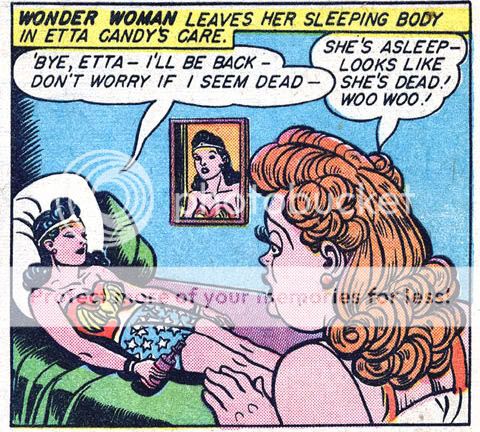
Photobucket

With those “woo-woos” WW whooshes up to Mars, where, after wearing a lot of chains and engaging in a series of healthy tests of strength, with some light spanking thrown in for good measure, she frees Steve and travels back to earth. Enraged, Ares sends a series of minions to recapture her: the Earl of Greed, the Duke of Deception, and the Count of Conquest. After many trials (by baseball, among other things) WW defeats them all, even Ares — ending war on earth! Okay, not quite; I guess he’s still got minions around or something. There will be more issues, in any case; they promise.

Since we’ve raised the weighty and altogether unfortunate profile of Etta Candy — it’s really worth pointing out what a completely bizarre character she is. It’s not just the “woo-woos!” and the fact that practically every speech bubble she’s given has to mention at least once how much she likes candy. That would just make her the comic relief. But what’s really strange is how important she is to the plot. As we saw above, Etta tended WW’s body while our hero was off on Mars. Etta’s far more than just a passive helper, though. In the battle with the Duke of Deception, for example, the Duke creates a fake Wonder Woman duplicate body (no, I don’t know why. Don’t ask silly questions.) Wonder Woman manages to capture the fake body…and then puts Etta’s mind in the duplicate body.
Photobucket

And in the final battle against Ares, when WW is tied up and helpless, she sends a mental radio message to Etta who somehow goes astral, brings acid (astral acid?) and frees WW.

In other words, plot-wise Etta isn’t really comic relief; she’s the indispensable assistant — even the cavalry. It’s *her*, not Steve Trevor, who gets to save Wonder Woman. Wonder Woman seems to treat her more or less as an equal, and Etta seems to see herself that way as well — Etta certainly, and bizarrely, doesn’t seem to see WW as someone to envy or aspire to — when her brain is placed in that slender, perfect body, all Etta can think about is how much she wants to go back to eating candy.

Obviously, it’s a bit of a leap to see Etta Candy as some kind of feminist icon. But…I don’t know. Compared to some of her later iterations (sex kitten cameo on the animated movie; loyal sidekick and romantic interest for Steve in the Perez run), fat, self-confident, and (perhaps mystifyingly, but still) competent doesn’t seem too bad.

Certainly, she seems to have it all over Steve.
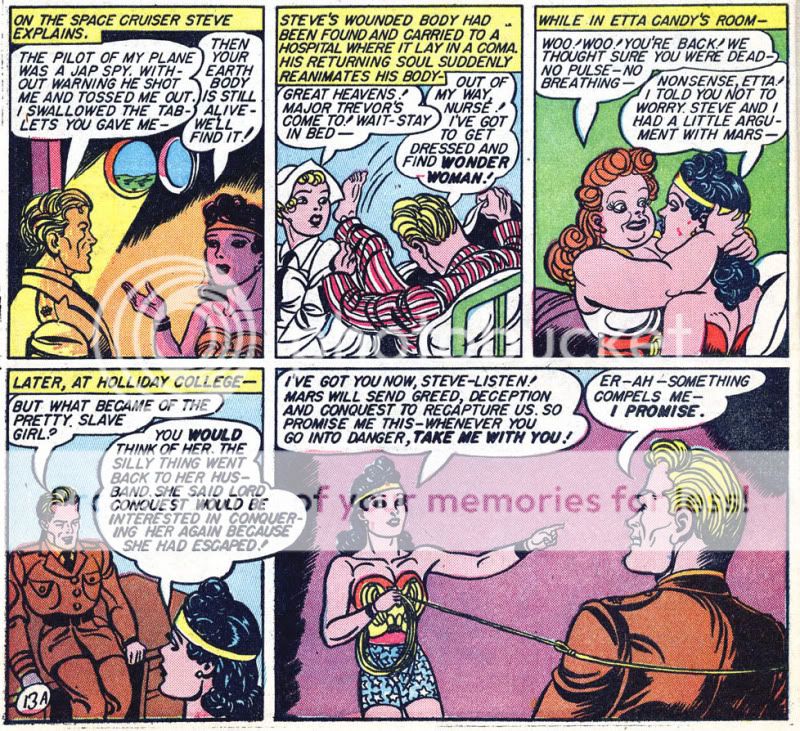
Photobucket

As you can see, in the last page of the first section, when they’ve escaped from Mars, it’s Etta who actually gets to share an embrace with WW. In the next panel, Steve expresses a very natural confusion about what the hell happened to a slave girl who helped them escape from Mars — and WW positively condescends to him. “You *would* think of her!” Silly man; you’ve only got one thing in your pretty little heads! But don’t worry, Steve, your little friend trotted back to her consensual B&D relationship with, ahem, the Count of Conquest! Now you silly little thing, let me tie you up and explain to you that you must never, never leave the house without an escort. You just have to have a firm hand with these men or the little dears will get themselves into trouble. Now let’s just settle things between us women, Etta. Could you fly to Mars with a bottle of acid, sneak into the dungeon of the God of War, and burn through my chains please? By tomorrow? And don’t tell Steve…he worries so!

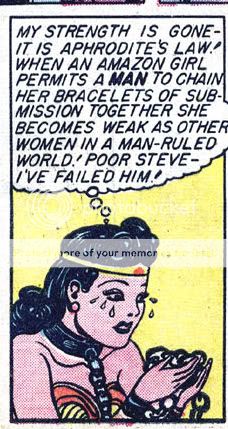
You may be wondering why on earth Wonder Woman needed to get Etta out to Mars anyway; why not just break her chains herself?

The answer is that Wonder Woman allowed her bracelets to be chained together by a man, which robs her of her powers:
Photobucket

Oooookay. But…what about this?

Photobucket

There’s Wonder Woman from earlier in the same issue. Looks to me like her wrists are changed together, right? And she’s looking pretty super there (incidentally, note that Peter appears to have gratuitously drawn in visible nipples on the woman WW is defeating. He does that occasionally.)

Of course, Marston isn’t a stickler for continuity. Still, what’s different between *this* binding and the other one?

The answer seems to be that in the instance where she lost her powers, WW was bound by a dark, handsome Italian.
Photobucket

As the Count of Conquest’s minion explains:
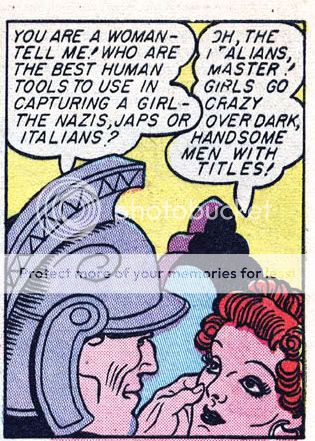
Photobucket

WW, in other word, is being punished for the weakness of allowing a man to hold sway over her (though she certainly never seems to be that interested in the guy…but I guess Marston holds his women to a high standard in these matters.) When she tearfully regrets failing Steve, the suggestion is that she’s been unfaithful. This is emphasized by the fact that she’s embarrassed to explain to Steve exactly what happened….
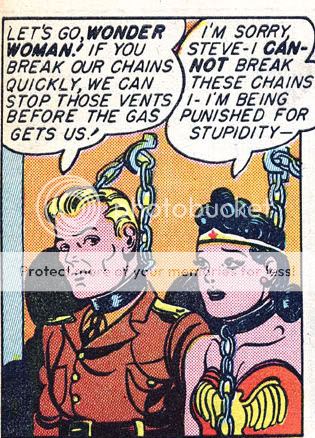
Photobucket

Again, though, what’s interesting is that the particular drama of unfaithfulness which is being suggested is one in which WW takes what is essentially the male role; she falls for the dark, seductive femme fatale, betraying the helpless, noble woman at home.

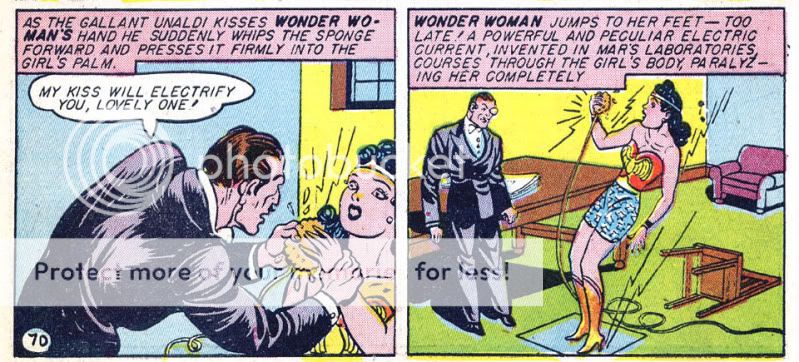
I’d be remiss if I didn’t point out that there’s an actual feminine femme fatale in the book as well — and by all appearances she is also bent on seducing Wonder Woman — or at least in luring her onto a cruise ship and engaging in…well, no surprises, really.
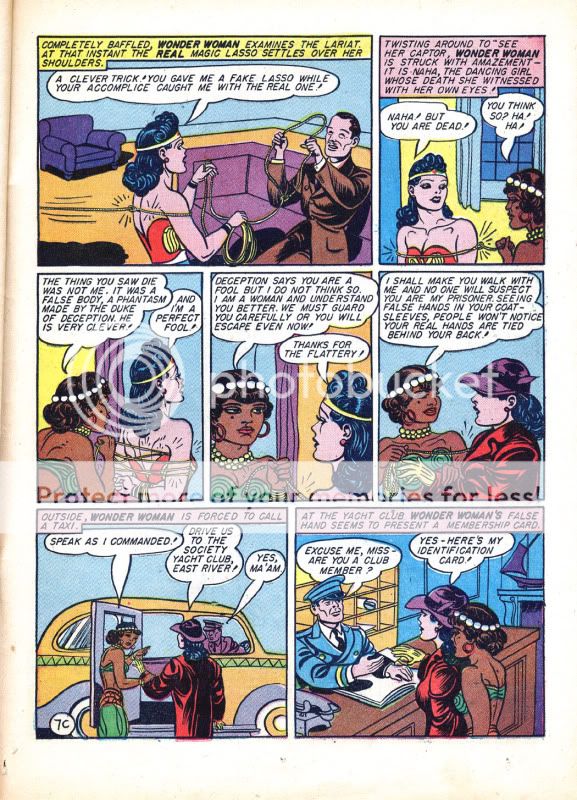
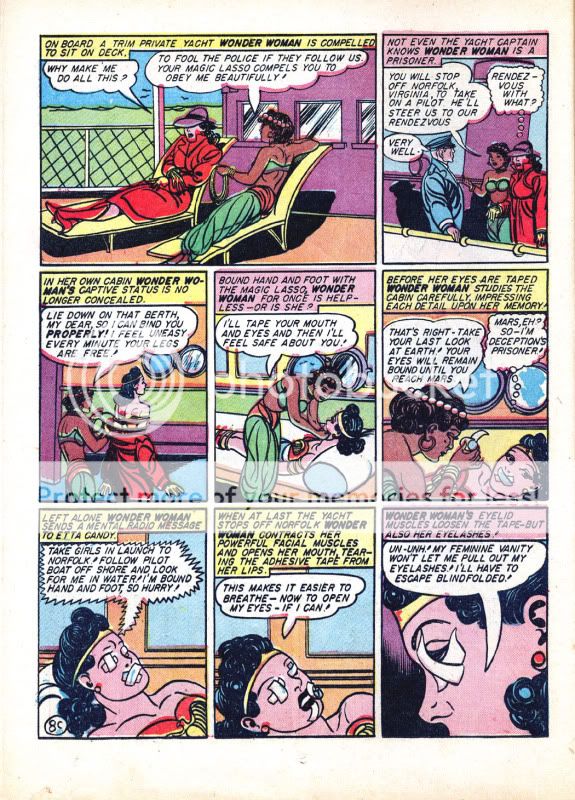
Photobucket

Photobucket

Leading her around with her hands secretly tied under her coat, huh? You have to wonder if Marston was trying that one at home. (Bonus points for fetishizing the exotic minority…and for implying that said exotic minority wears her colorful, diaphanous, scanty ethnic attire whereso’er she goes.)

Oh, and last time I promised cross-gender body swapping. Here you go:
Photobucket

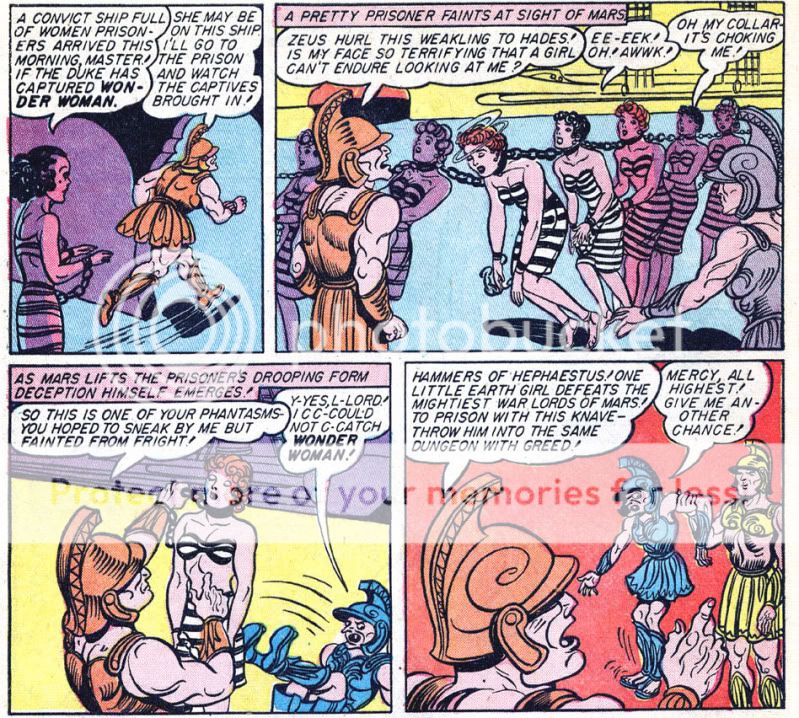
That’s Deception sneaking around in the body of a slave girl. Real women wear chains; real men wear tutus.

_____________

So I thought I was done, and then I keep thinking of more things I wanted to say. Stupid brain.

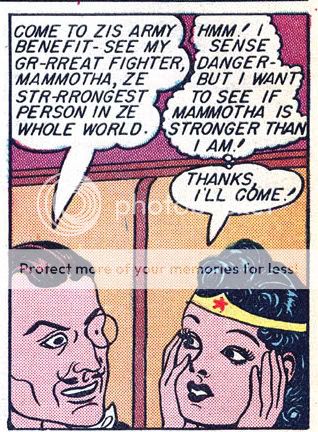
In terms of WW’s apparent need to avoid submission to, or even perhaps romantic relationships with men — there’s definitely something going on with a kind of butch tomboyishness, and perhaps a hint of a (cross-gendered) Peter Pan as well. There was a bit of that in the first issue as well; when Diana says she wants to leave Paradise Island to follow Steve, her mother says that that will mean giving up her “birthright” of immortality. That is, there’s a suggestion (thought it doesn’t seem to be much worked through) that Paradise Island is, like NeverNeverLand, a kind of metaphor for childhood, and that WW is a kind of magical and eternal child (she is made out of clay after all.) Again, in the second issue, we see WW has a real weakness for contests of strength:
Photobucket

She’s like a kid, unable to resist the opportunity to prove that she’s the strongest.

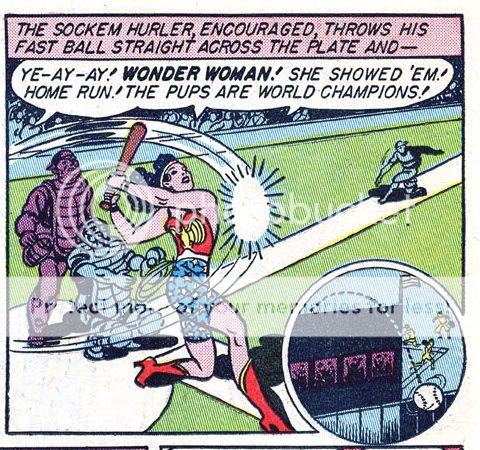
There’s probably something of that in all early super heroes…Superman certainly is a kid’s fantasy. It’s just that that’s really remained a part of Superman to some degree, but the corresponding meme for Wonder Woman has gotten a little lost, I think. Wonder Woman is a pretty sober character now; she’s more about standing up for women or peace or whatever, and maybe less about just beating the tar out of the boys at baseball. Which seems kind of too bad.
Photobucket

All right, that’s it…except, man, look at this Hitler caricature.

Photobucket

That is one gloriously saggy-faced ubermensch. And in the second panel, Marston has him so nuts he’s chewing the carpet. Literally. That cracked me up.

Victimhood

I was writing here about Camille Paglia’s not exactly original thought that feminist academics promote a “maudlin, victim-centric curriculum.” The term implies that the academics turn every subject and situation into a chance to view their favored group as victims. I find this is not true, not for feminists, not for blacks, not for conservatives, not for any group that feels pushed from the mainstream. For every situation that they spin into a chance to play victim, there’s another that’s turned into a chance to play hero. Often enough it’s the same situation. The essential aim isn’t to feel like a victim or a hero. It’s to feel important, to feel like you’re the center of the show.

Victimhood is passive, which is why critics pay attention to that half of the business. Everyone knows you’re not supposed to be passive, and people on the right have especially strong feelings about the point: they want everyone to be up and doing and starting small businesses. Wanting to feel important doesn’t get nearly as bad a press.

UPDATE: During all these years of complaining about the left’s “victim mentality,” the right has also been sneering at the left’s use of “empowered” and “empowerment.” Can’t say I blame them, but anyone who talks about being empowered is not addicted to being a victim, just to being self-important.

Hi, Manga Fans!

We did a manga roundtable a while back and I messed up my contribution by stringing it out too long. Basically, I don’t know manga and have the usual outsider’s reaction to the characters’ odd features, etc. I could have boiled my thoughts way down. As in:

Manga Haiku

Man, those eyes are big.
People like this shit? Jesus!
I prefer Batman.

I don’t mean it, though. We all read some of YKK and the art was first-rate. Now we’re reading Helter Skelter and the art is also quite fine and quite different. The story … well, gee, why spoil the moment?

Creative Types

I find this so stupid. Miles Davis and Donald Barthleme were involved with the same woman, a children’s writer named Karen Kennerly. Kennerly didn’t want them to meet, though not for the obvious reason. “I thought Miles would outcool Don, and Don had a very big investment in being cool,” she says. But the meeting happened, and it was at Elaine’s, of course.

When we got there — it was very early, about 6:30 — Miles was sitting at a table by himself, already halfway thru dinner. It wouldn’t have occurred to him to wait on anyone.

Well, sure.

He had on these big sunglasses. Finally, Don said, “Hey, man, why don’t you take off your shades?” Miles said, “Why? It’s all black.” After that the conversation was very stiff.

Yeah, I guess it would be.

Then Miles got up and said, “Bye. Gotta go. Good to meet you.” Don and I barely got thru dinner. It was very painful. We asked for the check and the waiter said Miles had covered it. Don said, “No, he has not. I am paying for this meal. Put his money on his tab.” The waiter didn’t know what to do, because Miles only came in about twice a year. Finally I took the boy aside and said, “Just consider yourself lucky that you got a big tip tonight.” He kept Miles’s money and let Don pay for the dinner.

Barthelme also had a really douchey beard. Miles, as noted, had those sunglasses.

Text quoted from Hidden Man: A Biography of Donald Barthelme by Tracy Daugherty