Nonpowered Superheroes

There’s Batman, there’s the Guardian, there’s Green Arrow, Hawkeye, and (sort of) Captain America. Also the Falcon and the Manhunter, I believe. In fact I’m sure there’s a lot of them, though only because there are so many superheroes in general. My guess is that the nonpowered heroes tended to crop up in the ’40s and became less commonplace during the Silver Age and after, though the examples above show that they didn’t die out.

This is leaving aside all the Batman satellites. In the interest of franchise homogeneity, anyone who wants to be Batted cannot have special powers. Though, given the number of people who keep getting superpowers, and the number of people who want to be Batman’s crimefighting associate, and the difficulty of Batman’s line of work, you’d think there would be at least some people with superpowers who’d be trying out for the role of girl-Robin or the Silver Bat or whatever. (My thoughts on Kathy Kane, and commenters’ very informative remarks about Bat-training, can be found here.)

I don’t count Iron Man as nonpowered, though he couldn’t have got into the Legion of Superheroes: they think gizmos are cheating. Of course, where you draw the line between Batman’s ton of gimmicks and Tony Stark’s armor could be the subject of much debate. But I’m sure the line’s there someplace.

Gaiman’s Sandman Heroines Not Real Good

UPDATE: I changed the post’s heading in honor of Anonymous, who I believe may be the ghost of Lionel Trilling.

************

A while back in Comments I said this about Neil Gaiman:

IMO he’s done a couple of good female characters (Element Girl, for example), and a couple more with decent schtick (Death, Thessaly), but his female leads tend to be hard to tell apart, at least in the Sandman series. For instance, what’s her name, Rose Hunter, or that other one, Barbie. They struck me as placeholders for the imagined Vertigo reader.

But his men aren’t all that great either, except when it comes to schtick.

Judging from some of the other Comments, there are people who can tell Barbie apart from Rose Walker and Rose Walker apart from Lyta Hall. I can’t, beyond such obvious markers as age, height and maternity status. Lyta had her kid taken away and is mad as hell, but I guess Rose would be too. Barbie is adrift and mopes around; then again Lyta doesn’t have much to say for herself until her kid gets yanked, and then she’s mainly just gritting her teeth. Barbie paints her face; Rose writes in her journal. I can’t remember anything any of them said. In The Kindly Ones, Rose writes in her journal that she’s a cold sort of bitch. Well, all right, but she didn’t seem that way in The Doll’s House or even Kindly Ones. She didn’t seem much of anything except a skinny kid with decent bone structure.

Above I refer to the girls as “placeholders for the imagined Vertigo reader” or, more properly, the imagined Vertigo reader’s imagined ideal self. That’s tough to prove, except for the moping, the face painting and journal writing, the low body fat and pleasing cheekbones, and the flattering sense of being important for reasons that are rationally undefinable (I’m a dream vortex!). So I’ll let it lie.

More Oliphant Weirdness

The guy still baffles me. Here we have him commenting on the queen and Mrs. Obama. It’s a fun strip, but it’s based on the idea that the queen herself was affronted by Mrs. O’s friendly hand on the shoulder. Whereas, in real life, the queen had no complaint and actually touched Mrs. O first; Buckingham Palace even issued a statement to let everyone know things were okay.

Yet the Oliphant cartoon is quite neat, not a commentary on reality but a fun sitcom spinoff from it.

UPDATE: In Comments, Matthew points me to a couple of other recent weirdies by the man, and I’ll throw in another here. Coincidentally, I just saw a post by the liberal blogger Hilzoy that gets at the Oliphant experience. Her topic was battered wives, so I’m hijacking her words to make a much more lighthearted point:

There are things that are comprehensible parts of the world, even if they’re rare, like having your car stolen; and then there are things that are unexpected in a completely different sense, like having your car turn into an elephant before your eyes: things that make you wonder whether you’re completely crazy.

Reading Oliphant, this experience is actually quite salutary. Frustrating as it is to see his brain twitch, you are left in a slightly different world than you inhabited before looking at the cartoon. Of course, the effect is overwhelmed when he does something borderline racist or anti-semitic, such as showing Israel doing the goosestep. (Yet the way he draws the shark/Star of David is brilliant.)

Unwittingly Funny Sentence

When this guy starts thinking, he doesn’t stop:

I have been wondering for a long time now, why it is I can’t fully enjoy Return of the Jedi, Aliens, Alien 3, Alien Resurrection, any Rambo emptying a SAW past First Blood, or any Rocky beyond the bell where an out-of-breath voice gasped wisely, “No rematch!”

More About Culture 11

Noah wrote for them and marked the site’s passing. At Balloon Juice, DougJ links to a Washington Monthly article about the site and adds his own thoughts.

The Monthly article says that one of C11’s founders was inspired by Tom Wolfe’s “Radical Chic,” the famous piece in which Wolfe tore into Leonard Bernstein and friends for holding a fund-raiser to benefit the Black Panthers. The C11 founder felt that this sort of approach was missing from conservative writing, the approach being (as the co-founder saw it) storytelling, the presentation of people doing things. He felt that conservatives leaned instead on the William F. Buckley approach of persuasion via argument.

At Balloon Juice, DougJ points out that a whole lot of conservative rhetoric comes down to exactly what Wolfe did in that essay. Conservatives paint a picture of the sort of person their opponents are; then they turn to the audience and say, “That person isn’t you. Don’t you hate him?” And very well they do it, but that is not well-honed argumentation; it’s persuasion via caricature.

I would add that, when it comes to the specific target of Wolfe’s “Radical Chic,” the MSM had already beat him to the scene. The essay describes Bernstein’s embarrassment and anger on reading a mocking, sneering, cutting satirical account of his Black Panther fund-raiser … in the New York Times. Of course Wolfe then came along and did a better mocking, sneering, satirical account of his own, because he’s a better writer than the Times has ever employed. But no conservatives at all were needed to spot the absurdity of the fund-raiser and deal with it accordingly.

Nowhere Man, Somewhere Dragon

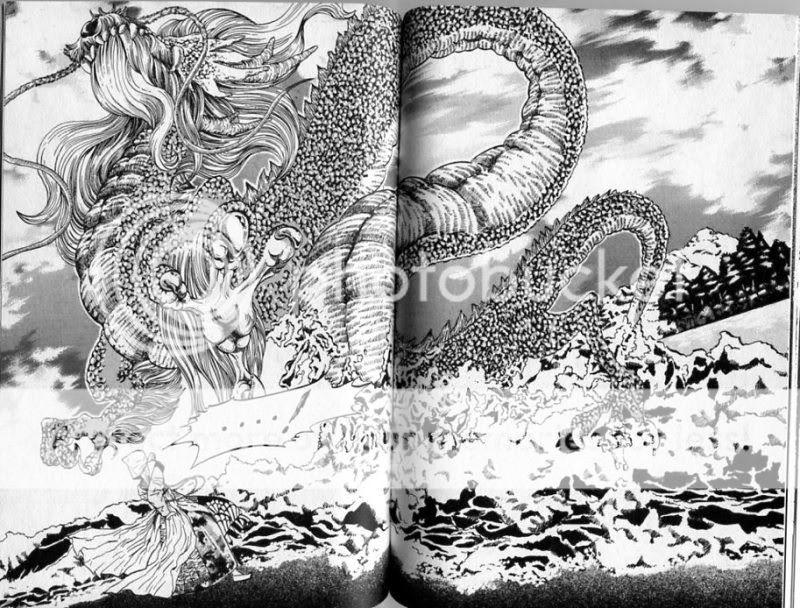
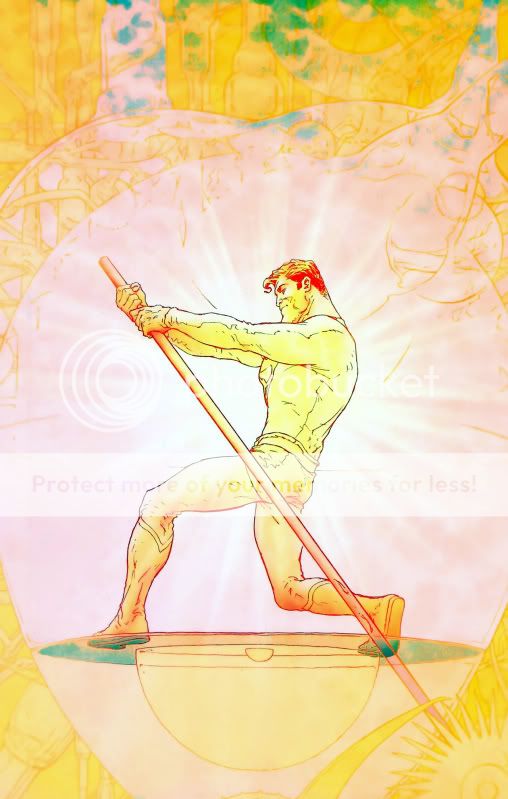
In this post a few days ago I compared these two pictures:
Photobucket

Photobucket

That first, with the dragon, is from Dokebi Bride, a Korean manwha by a young creator named Marley. The second image is from All Star Superman, drawn by Frank Quitely, one of the most respected mainstream illustrators currently working.

As I said in the previous post, both of these images are meant to be awe-inspiring, or viscerally impressive. And as I also said, Marley’s drawing really impressed me, while Quitely’s didn’t as much (I don’t hate it; I just don’t love it either.)

Anyway, I was thinking a bit more about these two images, and it struck me just how almost iconically west vs. east they are. In the first place, of course, Superman’s a Western symbol, and the oriental dragon is an Eastern one. More than that, though, is the way these two symbols work, and how they’re integrated into the stories.

Superman in general, and in this image in particular, is about individual triumph and modernity — individual triumph *as* modernity in some ways. (See Tom’s essay here for his take on this. Quiteley’s image, with its retro-modernist vibe and workers-of-the-world referencing, is positioning Superman as savior and worker — as salvation through work, you could even argue. It’s the apotheosis (pretty much literally) of sacrifice figured as massive effort — man puffed up through sheer sweat and muscle to take his seat at the helm of the universe.

(There’s a socialist/constructivist tinge to the design as well too, referencing Siegel’s design sense and the character’s initial quasi-socialism (beating up mine owners and the like. It’s kind of an interesting reminder that capitalism and socialism are *both* modernist and *both* puritan; both fetishize effort and progress in very similar ways. They’re more different inflections of the same idea than they are true opposites.)

Okay, where was I?

Oh right. So the point is that Quiteley’s image is about the bittersweet triumph over adversity; man attaining Godhead through superforce and sacrifice; an effortful Christ. The awe or reverence is the glow of triumph (though laced with some melancholy, since Supes has to keep the sun going forever, more or less.)

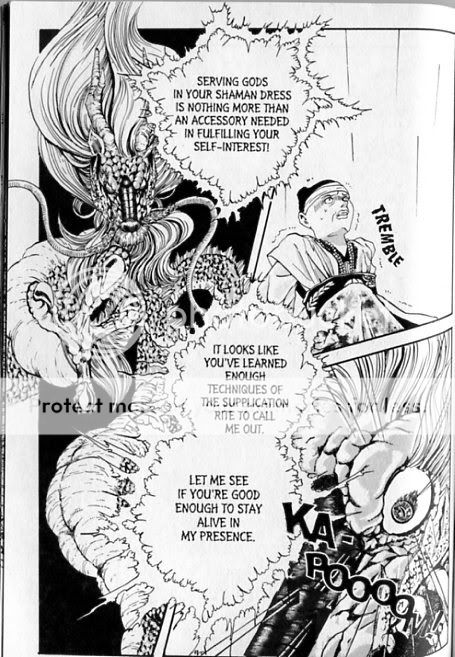
In Dokebi Bride, on the other hand, the awe has a very different inflection. Obviously, the dragon isn’t human, and, indeed, it dwarfs the woman in the frame. The point here is not mastery over nature (Superman controlling the sun through work) but the untameability of nature. The summoner here is actually a nascent capitalist; she wants to gain individual glory through demonstrating her summoning skills, and/or just through putting on a good show. The dragon is not amused:
Photobucket

This isn’t to say that the dragon is evil, or necessarily inimical to human beings; on the contrary, he has a close, even loving friendship with the the main character’s grandmother, who is the village shaman. Nor is the dragon all powerful; in fact, he’s weak and tired and old. But even an old dragon is a lot bigger than you and your dreams of glory, and fucking with him is a really bad idea.

It’s also interesting, I think, how nostalgia is worked through in these images. Both are definitely nostalgic; Quiteley’s is nostalgic for a more innocent modernism — a moment when progress to a super-future seemed possible. Marley’s is nostalgic for a rural Korean past and mythology; a countryside and a spirituality that are dying out. Both reference these nostalgias thematically (it’s what they’re about) and through their art styles; in Quiteley’s case, by reference back to the art nouveau/constructivist milieu of Siegel (and Winsor McCay, I think); in Marley’s, to innumerable examples of traditional art and printmaking.

The way the nostalgia works, though, is pretty different. Quiteley’s nostalgia, is, I would argue, kind of adrift. For all the talk about Superman-as-myth, the truth is he’s not Christ; his roots in our culture go back only 70 or 80 years, and he doesn’t actually stand for anything in particular except hitting bad guys and being kind of entertaining. Nostalgia for Superman isn’t really nostalgia for any big idea so much as nostalgia for a favorite toy…and, indeed, Quiteley’s image could almost be a toy box, or a figurine. Superman seems packaged, a commodity fetish, which points to its own possession (or the loss of its possession in a nostalgic past.). The drawing is deliberately set nowhere, in a kind of suffused emptiness; it’s an eternal frozen moment of nostalgia for one’s own wonderfulness, that goes nowhere and comes from nowhere.

Marley’s drawing, on the other hand, is a nostalgia for a particular place and a particular time. It is *this* fishing village in Korea that her grandmother is tied to (literally; she is possessed by a spirit that won’t let her leave.) The dragon is powerful, but it only rises *here*. For there to be wonder, there has to be a particular landscape, a particular time. The way the earth moves can’t surprise you if you’re able to fly off and turn it yourself.

The point here is that super-hero comics very rarely have a strong sense of wonder. With all the spectacular feats, you’d think they would — but somehow they all end up as tricks; they’re fun and goofy, or I guess more recently bloody, but they don’t actually inspire awe. And I think it’s because of something Tom said, “Superman keeps the universe our size.” Super-heroes are there to make things more manageable. Awe — a sense of vastness, of human insignificance or vulnerability — is antagonistic to everything they stand for. If Superman saw that dragon, he wouldn’t be scared or impressed — he’d just punch it in the snout. (As Wonder Woman did in a similar situation..) There’d be big explosions! There’d be excitement! There’d be action! But there wouldn’t be a moment where you said, “oh my god,” and felt rooted to one particular spot, and overwhelmed.

You Know Something? Fuck You

Privileged teenagers at one middle school are learning to empathize this year, whether they like it or not.

A teaser from the New York Times for this article here. From the article:

Many Scarsdale parents praise the empathy focus, but some students complain that the school has no business dictating what they wear or how they act in their personal life.

Hey, good point.

Others say that no matter what is taught in the classroom, there is a different reality in the cafeteria and hallways, where the mean girls are no less mean and the boys will still be boys knocking books out of one another’s hands.

Another good point. I had to put up with teachers for many years. Most of them concentrated on history, math, reading, science, and so on. Some of them were good, not many. But there was one teacher, one special teacher, who stood out. She was my 8th grade social studies teacher and she believed in something called values clarification. It involved listening to her talk and taking part in small-group exercises that resembled checklists from Psychology Today. What I learned from her is that the windier the subject, the less interested a teacher is in results. The point is for the students to create a Potemkin Village where the teacher can be mayor.

Of course one teacher might not be enough to support such a conclusion, but this one made an impression on me.