Gluey Tart: Restart

restart manga
Restart, by Shouko Hidaka
Digital Manga Publishing, 2008

“A drunken night of sex sparks the beginning of their relationship, but Tadeshi’s growing insecurity over the younger Aki’s meteoric rise to stardom gets in the way of love. Clearly, it’s not all glitz and glamour in the tumultuous world of modeling.” So sayeth the dust jacket.

I had a strange relationship with this book before I read it. I accidentally bought it twice (and Borders wouldn’t let me return the second copy, damn them to hell), and caught myself thinking about buying it four more times before I remembered. And that wouldn’t sound at all strange if you a) knew me and b) saw my four terrifying, teetering “to read” stacks. The point is, part of my brain clearly wanted to read this book.

It was right, of course. I’m confused about many things, but the kind of yaoi I like is not one of them. I’m torn here, by the way. Should I launch into a summary? Or tackle the cliché question? The former, I think.

restart manga

The major point of Restart is willowy, elegant-looking boys with long, messy hair. Or at least long, messy bangs.
I always award bonus points if one of the main characters has that little quasi-updo thing going, too.
I would say that’s just me, but it can’t be. It has to be a bit of a fetish for other yaoi fans, too; it occurs too often not to be. Because Japanese men are more fashion-forward and groomed than American men, but really, the incidence of the little half-ponytail in the wild is not extensive.

restart manga

The semi-random means of bringing the willowy, elegant-looking boys together is a misunderstanding that almost destroys their nascent relationship (let’s spin the wheel – oh, one of my favorites! They get drunk, have sex, one of them doesn’t remember it the next day, and they pine for each other until the mistake is cleared up), but finally resolves into a new connection, followed by meaningful makeup sex. There are longing looks across the room. There are resentful musings. There are hurt feelings and confusion. Followed by meaningful makeup sex.

restart manga

The sex can occur on- or off-screen; surprisingly, I don’t much care which. It’s always tricky, approaching the initial sex scene in a book by a mangaka you haven’t read before. Everything can be fine up to that, but there are just a lot of deal-breakers – I can be in love, love, love with everything about the story, and then, oh, God, the sound effects say “slurp.” You know. And then there’s how the genitals are, er, handled. They can’t show them in Japan (although some mangakas do anyway, always a pleasant change of pace), so there are conventions to let you know what’s being put where. There’s the ghost penis, where one of the characters obviously has his or his partner’s equipment in hand, but the hand is empty. Or there’s the partially rematerialized penis – think Star Trek, where everybody is kind of a shimmery cloud before they fully beam in. As far as where the penis is inserted, you often get a kind of cut-away; fingers are inserted into – nothing. And sometimes you just have to laugh. Laughing is enjoyable and, I understand, can help you live longer, but it isn’t always right for the big sex scene. Restart gets it right. There are a couple of sex scenes (actual, not implied), but it’s all about the romaaaaaaaaaance. Charged expressions, well-positioned hands (not a given), meaningful eye contact. And it starts in the bathtub, which just pleases me.

restart mange

TMI? Well, that’s the thing, when you’re talking about porn. Yaoi isn’t just about sex, but it is about sex. So while literary criticism is relevant, it isn’t really as relevant as whether it, you know, works. If it’s hot. That’s a combination of plot, story-telling, the quality of the art, and if it hits your favorite kinks – which can be the most important part. And that brings us back to cliché.

Those of you who are familiar with yaoi will recognize the getting drunk and having sex that is immediately followed by a misunderstand aspect of Restart whether you’ve read it or not. (I’m talking about the main story here, which comprises five chapters; there are two others, both enjoyable, but filler) It is not an original plot device. It is, in fact, a well-worn plot device – so much so that I actually think of it as a subgenre rather than a cliché. I don’t have a problem with that because the drawing is lovely, the story is sweet, and, most important, the romance works for me, and the sex works for me. That’s why I read yaoi; I want romantic porn. If the book succeeds on that level, it succeeds.

Yoshihiro Tatsumi Looks as Sharp as his Comics, in Non-Moldy Reissues

Judging from the pictures from TCAF. This post departs from my courtly ways; apologies in advance.

So more than once I read the many words Brandon from Are You a Serious Comic Book Reader? dropped about the graphic design of Drawn & Quarterly’s Tatsumi reissues. I guess he’s having an off day: gems like “the act of reissuing is a mix of hubris, fan boy exctiement [sic] gone wrong in the best and worst way, and opportunism” and “imperialist takeover” stand in for his not liking the design. Which is “twee and minimalist,” aimed at the “New York Times crowd” and the bad people who enjoy the Shins, Wes Anderson movies, and Neutral Milk Hotel. Those dreaded hipsters lurk in his argument, recalling someone’s glib quip that Tatsumi was hipster manga, when it’s really manga for smoke-cured old men.

Executive summary: Huh?

Anyway, let’s enjoy the graphic design in the Japanese versions of Tatsumi’s work. Maybe they’re twee and minimalist, aimed at those horrible cityfolk who read the Yomiuri, watch Le Pavillion Salamadre, and wear scarves. In the spirit of Tom’s fine series of Golden Age covers.

For context, here’s A Drifting Life, colonized by Tomine and the Canadians:


Here’s the same, pure as the finest vending machine sake:

Here, Seirinkogeisha’s recent versions of Tatsumi’s short stories:
And here’s a period cover to an ancient series of his I’ve never read and know nothing about save that it’s from around ’78:

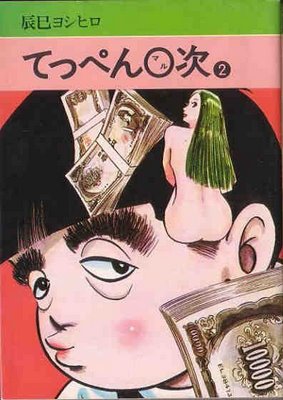
Looks awful. Money makes the man.

And an old collection:
“The Crowd with the Blues,” more or less, from Napoleon Books. I don’t have a date, but it’s at least 20 years old judging from the design. The only word I can really make out on the blue wrapper is “sex.”

Finally, we’ve got Chip Kidd, who’s really damn good. They’ve got Tadanori Yokoo, who’s a legend. Here he drags Shonen Magazine from the gutter to the gallery:

Click to see it bigger. These are from the late 60s, early 70s. The cover on the left is from Tomorrow’s Joe, and its design doesn’t strike me as all that different than Tomine’s version of Tatsumi’s work. More garish, still using the source art as springboard for graphic strategies not inherent to cartooning. See also his baseball calligraphy cover, which stunned readers and artists when it hit.

As always, I hope I made some points.

Nicked from all over. Here’s some links:

Postscript: Tatsumi did up the great saint of Shingon Buddhism with Sachiya Hiro? Who knew?

Best explanation I’ve ever heard

“At the meeting I was attempting to explain that unlike Sen. Schumer, I believe in traditional values, like we used to see on ‘The Andy Griffith Show.’  I made the mistake of referring to Sen. Schumer as ‘that Jew’ and I should not have put it that way as this took away from what I was trying to say.” 


That’s state Sen. Kim Hendren, R-Ark, telling an Arkansas political blog (the Tolbert Report) why it was that he referred to U.S. Sen. Chuck Schumer, D-N.Y., as “that Jew.” Apparently, when discussing adherence to your fine values, it is highly relevant to note that a person who disagrees with you is Jewish.

I like it that Sen. Hendren speaks frankly of the downside to slurring someone’s religion: it creates inconvenience for the person who does the slurring.

(Via Yglesias this time, not Sullivan!)

More on Mark Waid’s Wonder Woman

I already posted this picture once before:

Photobucket

But I thought I’d talk about it a little more. As I said, it’s Mark Waid and Ty Templeton, and it’s part of a seriesof crazed Silver Age Tribute Elseworlds covers they did. You should look at them all if you haven’t already; the one with Gorilla Grodd as Christopher Columbus is amazing, as is the one with Batman as the Biblical Adam worried that Eve will discover his double identity.

This cover is great too though. I’ve spent a fair bit of time here talking about the ways in which Wonder Woman is an impossible character to get right. Even doing Wonder Woman satire often falls flat…and when it works, as in Darwyn Cooke’s WW meets Playboy goof, it’s rarely anywhere near as funny as the Marston/Peter original series.

This is an exception though; that image is truly cracked. Part of its success, I think, is that it plugs into, and scrambles, some of the weird gender dynamics that inspired Marston in the first place. Basically, that cover is extremely, bizarrely Freudian. Luthor goes into the past to despoil the matriarchal paradise, “romancing” not only Hippolyta, but WW as well, who remakes herself in his image. Having her shave herself bald is just an awesomely ridiculous thing to do; on the one hand, it’s the ultimate negation of the character (who is more or less defined by her connection to the beauty of Aphrodite;) on the other hand, though, it makes her really butch, which is something that was definitely implicit (and often explicit) in the early WW stories. There’s also more than a tinge of Marston’s control fetish here: Big Daddy Luthor can make Wonder Woman do “whatever her father commands!” And the text up top is funnier if you know Steve Trevor at all…that incompetent is supposed to replace the uber-patriarch? Yeah, I can picture that scene.

It’s true that Ty Templeton is no Harry Peter…but the art is serviceable, and its stiffness (reminiscent of Ross Andru?) is charming in context. And what a completely insane idea. I’ve called Mark Waid a hack in the past, but this cover and the others in this series, are really brilliant. I almost wish he’d write one of these stories out…or do some other humor tale. Has he ever written an entire book that looks anything like this? Because I would buy it in a second.

Unusual

As I understand it, a hangover is supposed to last a day at most. Mine has started its third day, and I have learned why I do not normally drink hard alcohol.  Like Bertie Wooster, I’m evolving various metaphors to express the hangover experience. A favorite: my skull is made out of crepe paper; the contents have turned to egg yolk; if I move my jaw while speaking, some of the yolk may escape thru the vent just over my ear.

My condition contributed to an unpleasant moment at the Second Cup. The place is lovely in the morning, lovely and quiet. But if one person speaks loudly, their voice is inescapable. This morning the person who spoke loudly was one of the girls on the cafe’s staff.  Normally she is uncommunicative and busy cleaning. But lately she’s changed gears, and it turns out she has a voice like an auto collision with words set to it. To try another line, if a car alarm could say, “I mean, what is that?” it would sound just like this girl. 
After a couple of hours, I shuffled over, excused myself, and intruded in her conversation. I tried the diplomatic approach: “Because of the acoustics here, your voice kind of bounces around.” Her, after a moment’s thought: “Okay! I’ll turn up the music.” To be fair, I don’t think she was being stupid, just rude in a quick-witted way. I shuffled off again, and from that moment she was quiet. Not that a lot of moments were left, since her shift was almost over. I had waited a long while, subjectively the equivalent of years.
Now I’m at a different Second Cup, more crowded and in some ways noisier, but the noise is ambient instead of being focused, and it doesn’t talk, just grinds coffee. But the yolk is still sloshing about, and I miss my old Second Cup. I’m going to try the old place again and if necessary ask one of the other kids on staff to act as go-between so that a settlement can be reached with the noisy girl. Because, make no mistake, the kids are still great
UPDATE:   The hangover symptoms I describe are “the worst,” according to the boy who was sweeping the hallway outside the bathroom at my fallback 2nd Cup. He confirmed that a hangover lasting three days is highly unusual, not to say unheard of, and suggested that I might be suffering an allergic reaction to hard alcohol. The allergy would explain a lot, including my uncharacteristic good sense in staying away from hard alcohol for most of my life.
UPDATE  2:  10:30 pm, Montreal time. Coming here to the Cafe Depot, I found Ganesh and Pariabas, two young fellows in my building, hanging out on the front steps with Kevin, another young fellow but not normally one of their buddies. Ten minutes of discussion on the origins of my hangover, why I had drunk so much, funny things said by various parties while drunk, what I should do to avoid hangovers (water), and how Pari had drunk half a bottle of scotch for three weeks without any side-effects because it was during a leisurely vacation somewhere and he had been in a good frame of mind.  I move on with the gratifying sense of having been the center of attention. Maybe that’s why my hangover sticks around; on the other hand, sitting down here I found that I lowered myself into place like an old man with vertebrae that might pop their strings and scatter on the floor; so the effects are real and they linger.
A cheerful note: my favorite barista is behind the counter; usually she works the day shift. She’s a pretty, dark-eyed, good-natured girl with a boyfriend who loves Watchmen. She likes it too, but the book is really his obsession, not hers; I guess that’s suitable, seeing as how he’s the guy. They read it because of the movie, which they both liked a lot. I take this as a testament to Alan Moore: in however distorted a form, his story breaks thru to a new audience. I was going to say “gets thru to a new generation,” but Roger Ebert and (God, again) Andrew Sullivan both liked the movie too.
UPDATE 3:  Now into day four. All that’s left is an ache over my right eyebrow, and I’m starting to think that’s because of the overstuffed chair I use at my fallback 2nd Cup. 
UPDATE 4:  My hangover was officially gone as of yesterday morning, when a Cafe Depot barista (not my favorite) remarked that I was singing. A four-day hangover — not bad!

Bound to Blog: Wonder Woman #7

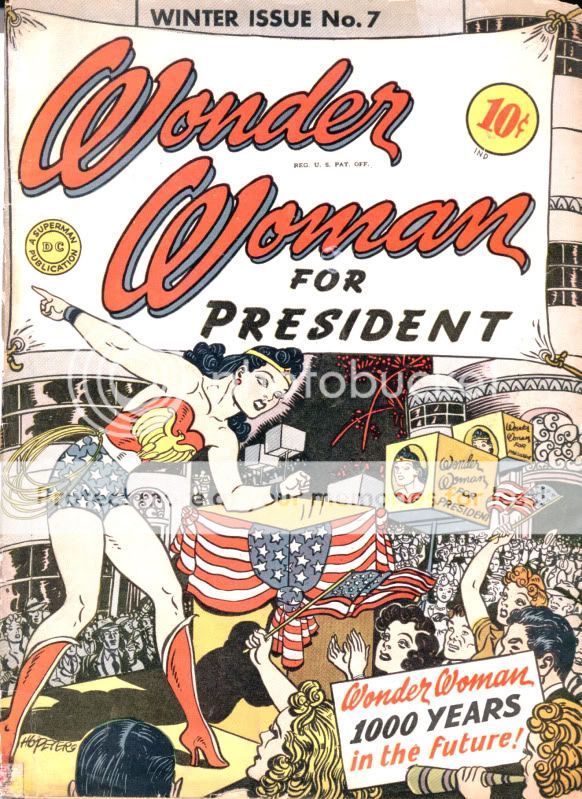
WW at this point seems to have gone back to being 4 times a year, after an issue or two of pretending to be 6 times a year. I couldn’t figure out how Peter was going to draw a page a day plus, and apparently neither could he.
Photobucket

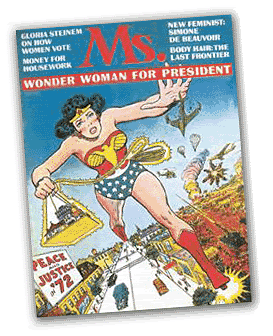
That’s the Marston/Peter cover for Wonder Woman #7. And this is the cover of the first issue of Ms. Magazine:
Photobucket

I talked about the Ms. Magazine cover here and here already, so I won’t go into what I see as its weaknesses. In any case, this isn’t necessarily the best Harry G. Peter cover ever either….though I do like a lot of the details. The stylized curlicues of the women’s hair in the foreground, for instance, and the tension lines in the fabric of the banner at the corners, and the frills on the architecture int he back, and the way WW’s fist at the center of the composition is too small, making the whole perspective go vertiginously kablooey.

But what I really wanted to point out was how different the two visions are. The Ms. Magazine cover sees a female presidency as a violent, weirdly monstrous event — the female president is a kind of King Kong, laying waste to man’s world. For Marston and Peter, a female president seems much more natural (albeit 1000 years in the future.) WW isn’t destroying MegaTokyo; she’s giving a campaign speech, which is more or less what you’d expect a Presidential candidate to do (though maybe not dressed in a swimsuit.) Moreover, there are men in that audience cheering her on — a reminder again that Marston sees female empowerment as benefiting men as much as (or maybe more than) women.

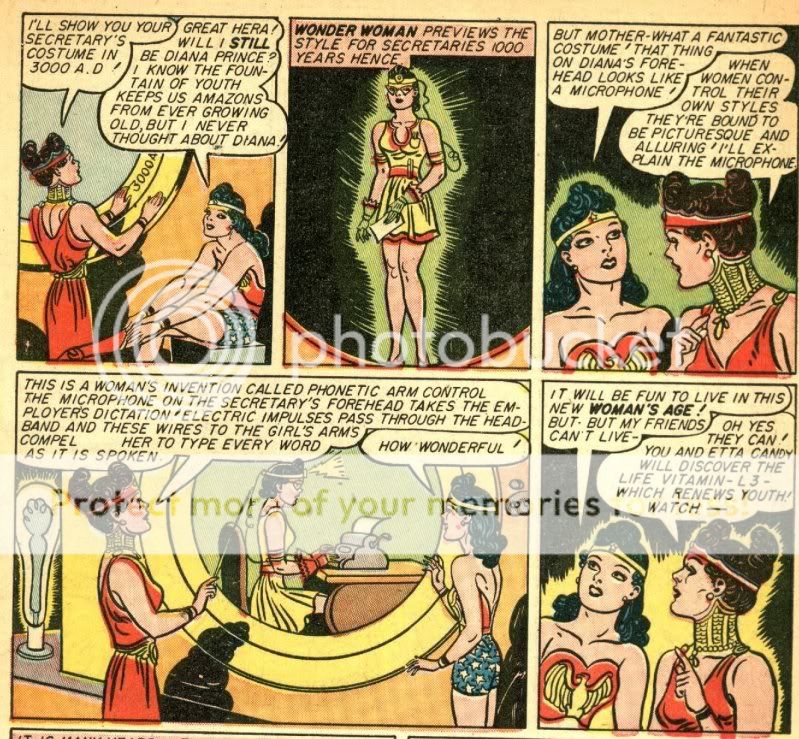
As the cover suggests, this is the most explicitly political Marston effort yet. Hippolyta, it seems, has a magic sphere, which allows her to see into the future. (There’s some hard deterministic nonsense about how the future is set ineluctably by the past, but I think it’s just a plot device rather than actual sincere crankery.) And in the future, it turns out, everyone will realize that women are better than men, and so women will rule the world by common acclamation, spreading peace and prosperity and the end of war. Plus, as a bonus, there will be one-world government. It’s Dave Sim’s worst nightmare, basically…though ultimately I think Marston’s future visions are even nuttier than Sims’. Or at least, they’re more entertaining:
Photobucket

Yes, in the future, liberated secretaries will dress in mini-skirts and submit themselves to routine mind control. Because “when women choose their own styles they’re bound to be picturesque and alluring,” and because when women choose their own career they’ll prefer to be turned into male-voice-controlled automatons.

I’m always a sucker for futures past, and Marston’s particular vision of a 1930s feminist future is hard to resist. On the one hand, gender roles remain the same as ever; Diana has been a secretary for 1000 years, and doesn’t really seem to have any ambition to do anything else. And yet, on the other hand….when forced, and almost despite herself, she goes right from being a secretary to running for President, with Etta as her VP. And she’s successful too, since, as Marston tells us, “Diana’s able speeches and Etta’s humor appeal equally to men and women.”

Diana is forced to run for president because the current office-holder, “Mistress President”, refuses to run against Steve Trevor, who has been nominated by the men’s party. Steve comes off worse here than anytime so far in the series, I think. Not that he’s evil at all…but he’s a completely brainless bimbo, who sticks a pipe in his mouth to prevent himself from absent-mindedly drooling all over his ripppling muscles.
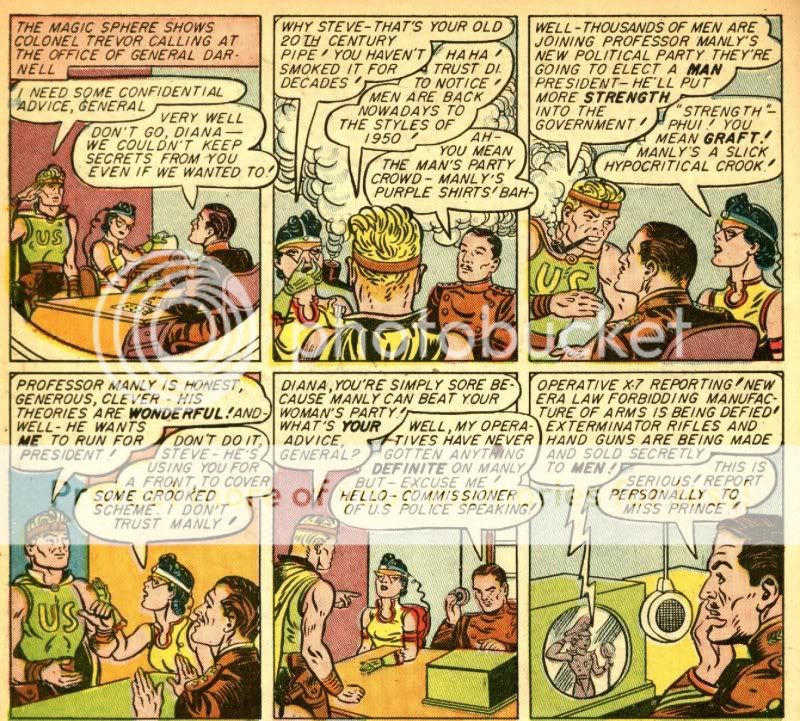
Photobucket

Thanks to the mooning-women vote, and to ballot stuffing, Steve wins…but soon falls out with his crooked vice-President, who is named, rather inevitably, Manly. Manly catches Steve and puts him in some cryogenic death trap, which is especially uncomfortable because Trevor’s wearing short-shorts.
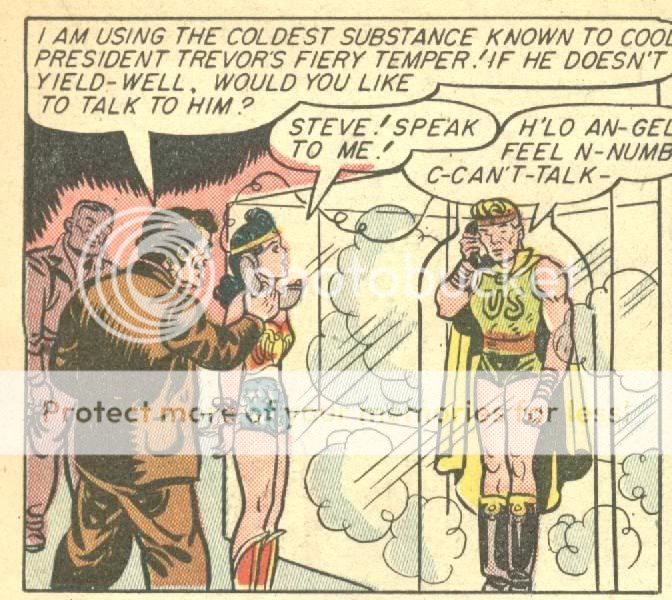
Photobucket

That outfit Peter has desinged for Steve, let me just emphasize again, couldn’t be much more ridiculous. It’s obviously a super-hero suit, with the US emblazoned on it…almost a Robin costume, actually. But the way Steve’s standing, straight and stiff, emphasizes the discomfort and awkwardness and, indeed, the vulnerability of it. Which is to say…I think Marston and Peter are fetishizing him. He’s supposed to be a sex symbol, and his predicament, I think, is supposed to be sexy. If Marston had a women trapped in that way in that position, it would be deliberately provocative — and I think it’s supposed to be here, as well.

You see some of the same impulse in this drawing:
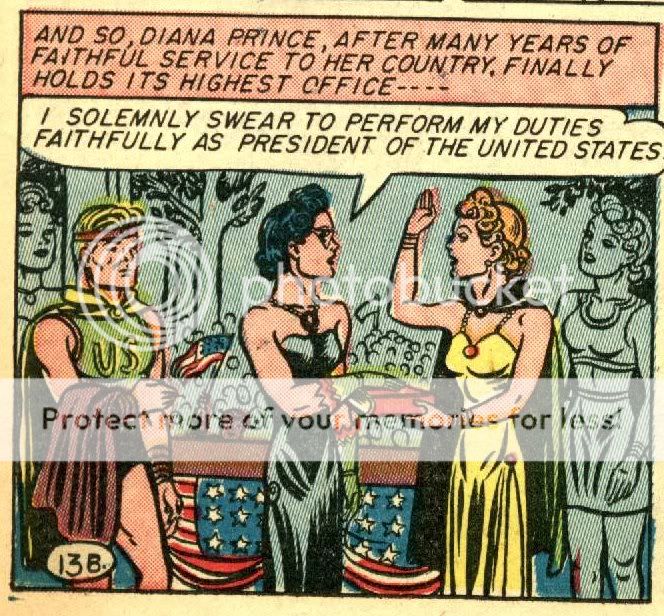
Photobucket

This is at the end of this segment of the story; WW has freed Steve and Diana has been acknowledged as the victor of the Presidential race. Nobody blames Steve for his actions, because he’s so dumb and so cute — and in this image, he really does look dumb and cute. He’s still wearing that outfit, which is the only one he has, and he’s off to the side, appearing (through Peter’s weird use of scale) significantly smaller than Diana. Indeed, with the scale and the shorts, and the oddly blank, expectant expression on his face, he really seems like a child waiting for his mother. The two women, on the other hand, are both impossibly thin and decked out in flattering, elegant dresses. Diana looks, frankly, hot, and extremely in control — which is, I believe, intended to make her even more hot (I think Peter gets the effect in part by making her shoulders too wide; it makes her seem bigger and stronger than life.) But I think the scene is designed to fetishize Steve too; his childishness, awkwardness, and vulnerability, make him appealing, manipulable, in need of protection — his extreme stupidity is part of his charm. Men are like children, who need to be controlled by mothering women. Maybe I’m completely off-base, but it seems like girls might quite enjoy this vision of an elliptically sexualized romantic object/child surrogate. Certainly Marston does, anyway.

The back and forth between mother/child relationships and female political authority runs throughout the issue. It’s most charming right at the beginning of the book, when WW’s Mom asks her to come back to Paradise Island for the Harvest Festival (that’s Thanksgiving for you non-pagans.) WW decides to surprise her mom by appearing in her Diana Prince outfit. Her mother is indeed, surprised, and then delighted:
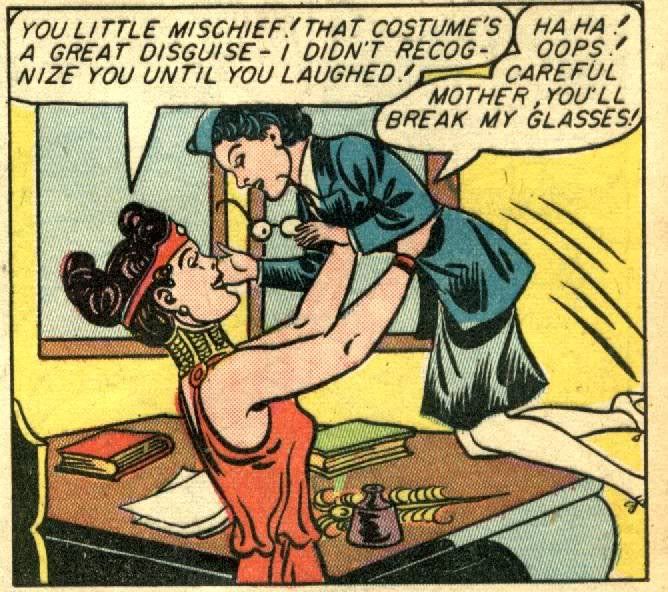
Photobucket

I think that’s just a really charming panel. Not least because it echoes the last one in this sequence from WWs origin in WW#1:
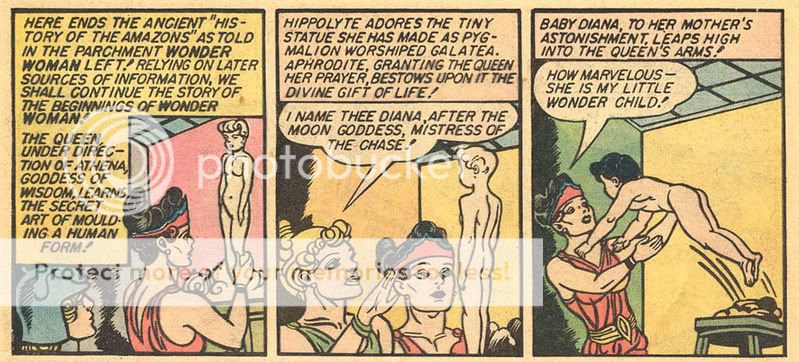
Photobucket

Hippolyta lifts her adult daughter as if she were a child (and again, Peter adjusts scale, so that Diana seems far smaller than her mother.) The intimacy and joy there taps into the adult desire to see the child remain a child…and into the pride in seeing her grow up. The decision to have WW dressed as Diana is inspired, and emphasizes the way in which Diana, who dresses in real clothes and has a real job, is much more grown-up than WW is.

This is, incidentally, one of the first times I’ve seen Marston do anything interesting with the secret identity. With male heroes, the secret identity division is often about male bifurcation; the distance between ideal masculine and individual male. Here, though, the split seems to be about child and adult; Wonder Woman is like a kid playing dress-up. In this sense, Diana may be as fun a fantasy object as WW; a kid can imagine being powerful and admired like WW, and can also imagine working and being a regular adult like…well, like Mom. I also love Hippolyta’s dialogue: “You little mischief!..I didn’t recognize you until you laughed!” I presume the main point is that the laughter let her know something was amiss…but when I read it first I took it to mean that she recognized her daughter by WW’s individual laugh.

After that very sweet scene, we move right on to major fucking weirdness. Hippolyta shows WW the future in the magic crystal…and the first thing she shows her is the death-bed scene of Etta Candy’s mother, Sugar Candy (believe it or not.) Etta has turned herself into a chemistry whiz in an effort to cure her mother, but all to no avail. So WW brings out some of the water of life. This only affects Amazons, but Etta, using her newfound scientific knowhow, drops some candy into it, releasing vitamin L-3, and — hey-presto! — the aged mother is filled with vim and vigor and there’s a little birdy singing outside the window:
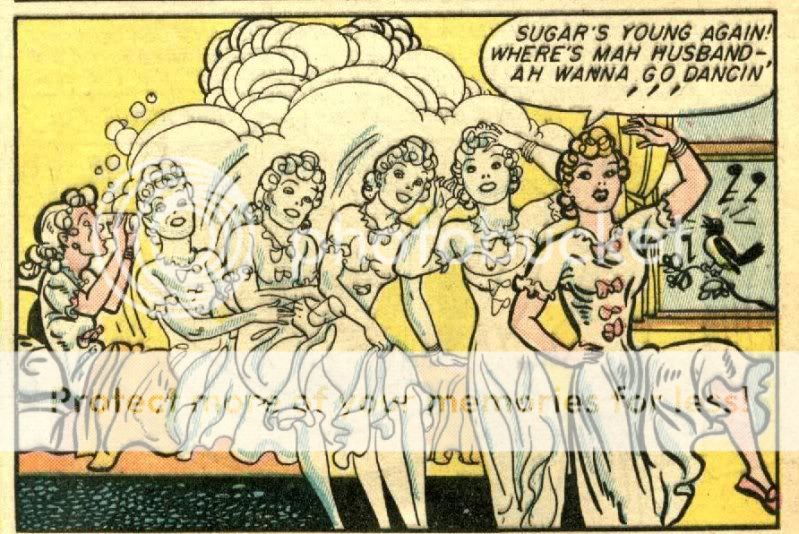
Photobucket

By replicating the figure and especially the dress, you get a panel that’s all frills and folds and lace, conveying a kind of oversaturated voluptuous girlishness. The fact that Sugar’s first thought is for her husband so she can go “dancing” is certainly a subliminally sexual. On the one hand, the life-potion is a gimmick, to allow all of WW’s supporting characters to live on into the future storyline. But Marston also ties it back into his own fetishes; mothers for Marston are sexy, and the scene is about the excitement of releasing that sensuality.

Here’s another bizarre moment:
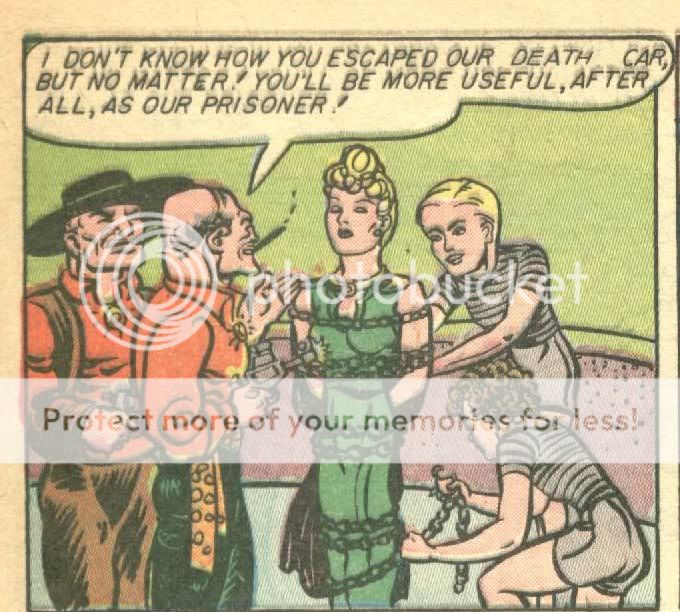
Photobucket

That’s Mistress President being tied up by former prisoners. But look at the prisoners tieing her up. They’re misshapen alien children out of something like Junko Mizuno. The panel is fetishizing, not just B&D, but specifically mother/child masochistic play.

As I think I’ve mentioned before, psychoanalysts often argue that all masochism is tied up (as it were) in a mother-child dynamic. Masochists are thought to be identifying with their mother in a confused Oedipal dynamic. For Marston, certainly, the idea of “loving authority” is a fairly explicit maternal alternative to the male paradigm of authority-as-law. You can see that pretty clearly in the sequence below:
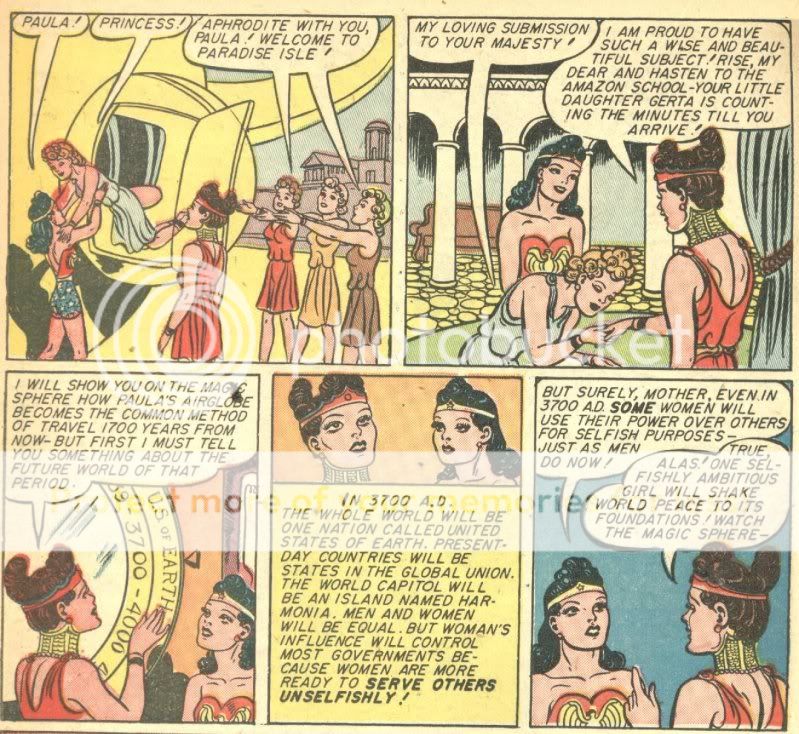
Photobucket

Paula’s “loving submission” to mother Hippolyta is followed by an explanation that woman are more fit to rule because they “are more ready to serve others selflessly.” The model of authority is feminine and maternal, with ruler as mother and subjects as children.

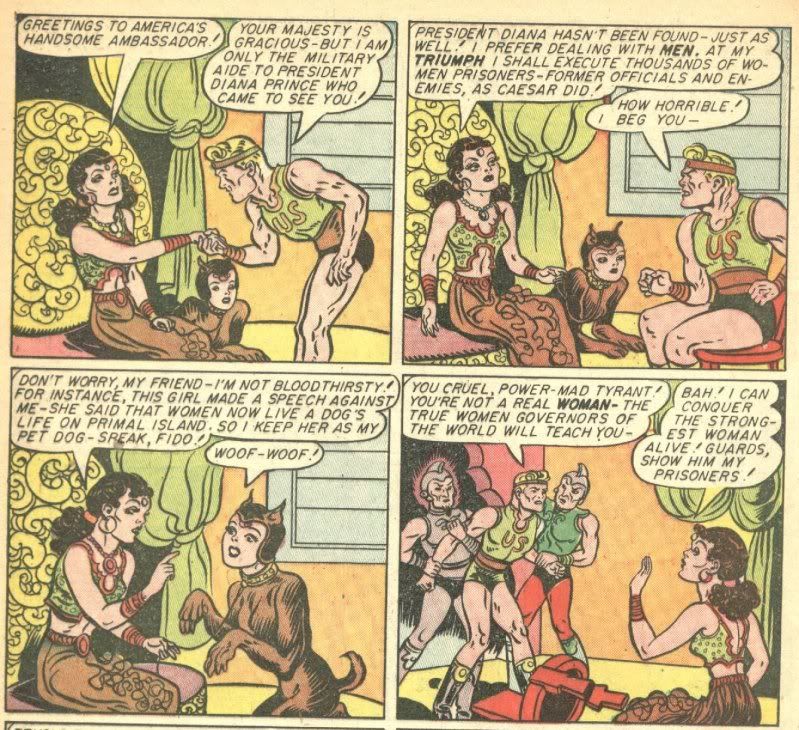
Of course, bad mothers are quite exciting too.
Photobucket

No, we never learn what she did to the dog-woman to break her will. Maybe she made her stare at the pattern on that yellow pillow behind her. I could look at that for a good long while myself…whoa, getting kind of sleepy there….

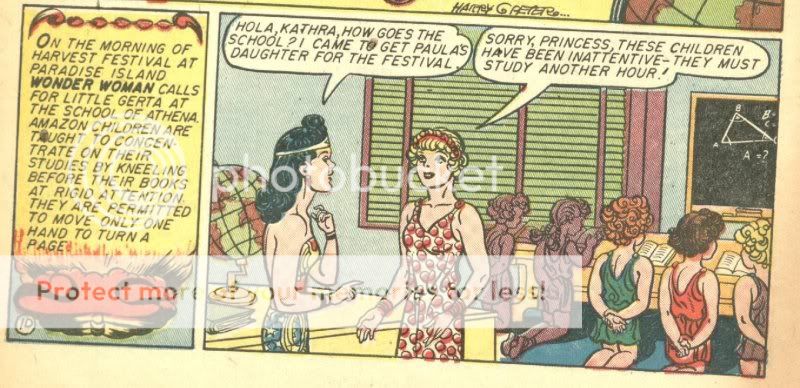
Ahem. Anyway, this is all pretty much good clean fun…or good fun, anyway. Things get a little dicey, though, when Marston stops fetishizing metaphorical mother/child relationships and starts fetishizing actual children. He moves perilously close to doing the second in the last story of this book. As, for example, here:
Photobucket

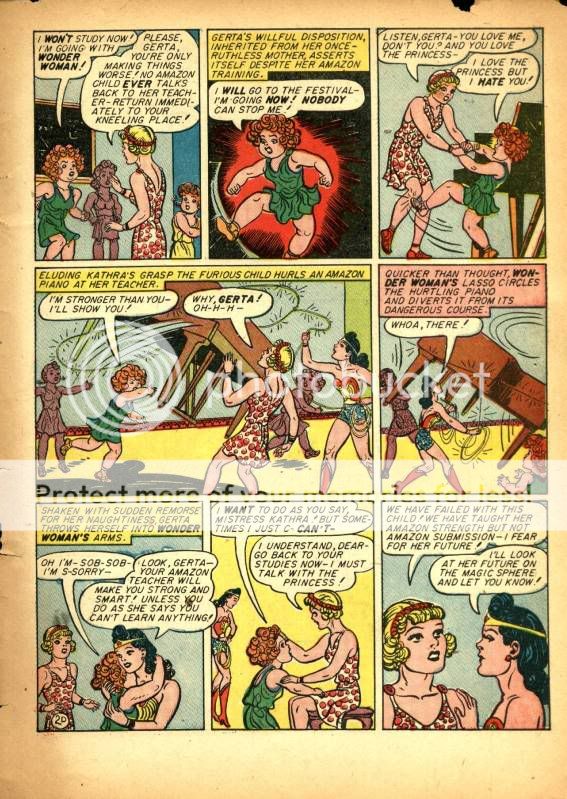
The rigid disciplining of children is, in itself, fairly nauseating; add in Marston’s fetishistic investment in submission, and you get something which is — well, vile. I think vile is the right word. He’s basically suggesting torturing children for his sexual pleasure. Of course, he adds in layers of sanctimony in order to deny that that’s what’s going on — it’s actually all for the little kiddies’ good, you see:
Photobucket

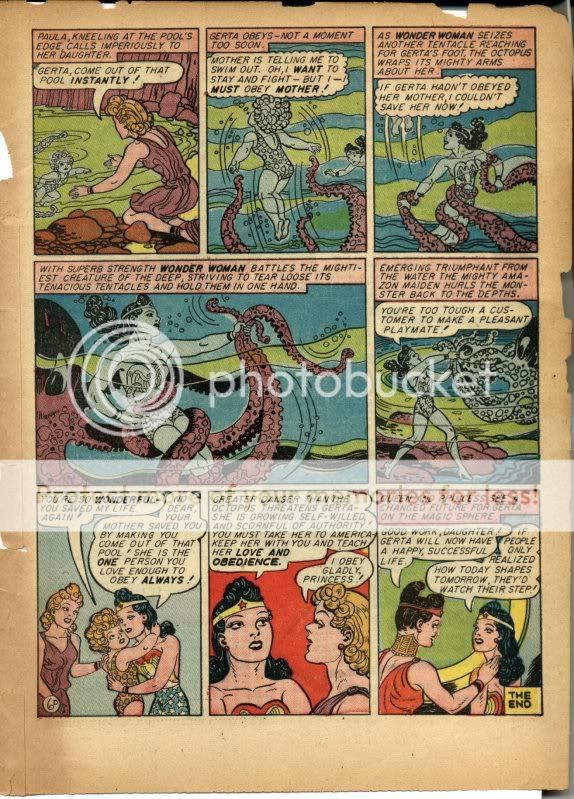
The story goes on to suggest that Gerta, Paula’s daughter — the kid who throws the piano — will come to a horrible end because she doesn’t like to sit still for hours at a time just to satisfy Marston’s kinks. Wonder Woman, though, educates her by opportunistically harnassing Gerta’s love for her mother, Paula. This does give Peter a chance to draw a great octopus, with beautifully textured arms and a ludicrous, gigantic cartoony eye, but otherwise the situation can’t be said to be especially pretty.
Photobucket

The problem here is that, in raising children — and for that matter, in general — the ideal of loving submission can actually be even more oppressive than strict obedience to an arbitrary law. The father only cares what you do and how you behave; as long as you don’t break the law, you can think and feel what you wish. Of course, sometimes it’s impossible not to break the law, and, indeed, the point of even having the law is to get people to break it so they can be punished — but, still, the point is, you’re dealing with externals. Whereas, with the kind of mother love that Marston seems to be advocating, it’s about internal acquiescence — using love as a lever to break the will. That’s all well and good between consenting adults, but using it against kids is really not okay — especially since schools really have used this nonsense against kids, and for a long time. Here, for example, are some hints for psychological discipline for ushers at the Jesuit school at Port-Royal in 1615:

“A close watch must be kept on the children, and they must never be left alone anywhere, whether they are in ill or good health… this constant supervision should be exercised gently and with a certain trustfulness calculated to make them think that one loves them, and that it is only to enjoy their company that one is with them. This will make them love their supervision rather than fear it. (Aries, p. 265)”

“…calculated to make them think that one loves them.” Kind of says it all.

Obviously, kids need to be socialized, and the relationship with parents is one important way that that gets to happen. But there’s socialization and socialization; reasonable demands and unresasonable ones. And when you start to demand that a child substitute a state functionary like a teacher for the parent, and then you insist that she acquiesce to all that functionary’s demands with loving submission — well, you get a situation where a kid is labeled as evil because she doesn’t want to sit in one place all day.

So at the beginning of the story, Marston seems able to express the mother-daughter bond with both natural ease and sincerity. In the middle, he obsessively treats that same bond as metaphor and fetishizes its, and at the end he proposes a system of child-rearing which is both queasily sexualized and frankly monstrous. From which we can conclude that Marston was a very odd duck, and that people who love kids shouldn’t necessarily be teachers — or, at the very least, shouldn’t be allowed to craft the utopian school systems of the future.

_____________

Thanks to Bert Stabler for alerting me to that quote from the loving Jesuits.