Whoops

I was reading this pretty entertaining interview with Fred Van Lente over at Comic Book Resources, and he was talking about his various projects like Hercules and Amazing Philosophers, or whatever; and I thought, well, maybe I should look for some of that….

And then I realized that he’s the guy who wrote Marvel Zombies 4.

I felt a little betrayed, honestly.

It just goes to show; giving a good interview and writing a good comic are two separate skills.

Lose the Girdle, Get Empowered (OOCWVG)

I doubt that Adam Warren was necessarily thinking specifically about Wonder Woman when he created his Empowered comic. Nonetheless, the two work off of many of the same touchstones: super-hero bondage fetishism; feminism, and an interest in presenting cheesecake for guys alongside girly stuff for everybody else.

To the extent that Empowered can be seen as a kind of Wonder Woman knock-off, it’s easily the best one out there, putting to shame even relatively successful efforts like Alan Moore’s Glory or Darwyn Cooke’s satirical take on the character. In large part this is because of how far away from the Wonder Woman concept Empowered strays. Though he uses a lot of the same ideas, Adam Warren comes at the material from a completely different place than Marston and Peter did.

The difference can maybe be summed up by saying that Marston was a system-builder — an actual honest to God academic crank who started from big-picture concepts about how feminism and bondage and gender fit together, and created a character and world to match his theories. Warren is not like that at all. He says he started Empowered as a bondage commission for fans with “special interests.” Similarly, the feminist title “Empowered” seems to be basically a goof. For Marston, feminism and fetish was his life work and his obsession; for Warren the confluence of the two is more a serendipitous passing fancy.

What Warren is really interested in, as it turns out, is the characters. Even in the first, throw-off three-pager, you can see this. A generic super-team (the “Super-Homeys”) stand around contemplating how to defeat the evil Death Monger. Various ideas are thrown out, until Empowered, very nervously, volunteers that maybe they should try cutting off his power source. This seems like a reasonable idea; but it is instantly dismissed when teammate Sistah Spooky points out that Empowered’s panty lines are clearly visible beneath her skin tight super suit! Everybody cracks up, Empowered scurries away weeping — and I guess they beat Death Monger somehow. Or, you know, not.

Empowered

The thing is, this isn’t just a gratuitous gag (as it would be in, say, Mini-Marvels) Empowered staggering off whimpering “stupid, I’m so stupid” is more Peanuts than Nancy; it’s actually painful. And it’s also feminist; the way Empowered is objectified and dismissed is, and is meant to be, textbook workplace harassment…at the same time as the character is obviously designed to be oggled by the reading fanboys. (And “designed” is the word — her skin tight costume won’t work if anything is worn over it. Also it rips easily. And when it rips, she is powerless, and gets tied up.)

Much like Marston, Warren is having it both ways. Where Marston pulled off that trick through constant and complicated theorizing, though, Warren manages it first of all by being genuinely funny. There’s plenty of the kind of witty sci-fi goofiness that made Warren’s Dirty Pair such a treat. He seems to have an endless supply of that sort of thing, from a gang of minions who make a living stealing from their super-villain bosses, to a support group for heroes who got their powers from exotic venereal diseases (watch out for the alien princesses and the anatomically correct robots, boys); to my absolute favorite, the evil Cthulhu like ancient evil which lives in a belt in Emp’s room watching DVD collections, listening to sports radio, and dispensing relationship advice to her Emp’s boyfriend. (“Bahh. Running out to the market of super to purchase feminine hygience products. Even among the eldritch ancient ones we had a word for such behavior. And that word was…P-whipped!”)

Even more important than the humor, though, is the fact that Warren seems to really care about his heroine. Empowered could easily have turned into a series of dumb blonde joke…but instead, Emp comes across as an incredibly likable character, way more competent and courageous than she or her teammates are willing to credit. As I said, Warren starts out by highlighting her unhappiness and humilitation, a la Charlie Brown — but he quickly heads for less depressing territory, giving her a yummy ex-evil minion as a boyfriend, and incidentally creating one of the best couples in super-hero comics. Thugalicious (does he have a name? He must, but I can’t find it. Oh well.) is incredibly sweet, setting up his villainous cohorts for defeat after defeat at Emp’s hands because “this stuff makes you happy, dinnit?” — and, less selflessly, because Emp “always gets completely sexed up and out of control after every super-hero outing.” In return, when thugalicious’ cohorts wise up and almost kill him, Emp, kicks the door over and with uncharacteristic competence blasts through a roomful of minions to get to her man (said man remarking, with heartfelt enthusiasm “Bad Ass!”)

Empowered

The end of this scene is pretty great as well. Generally when super-heroes save their loved ones, they’re pretty blase about it — along the lines of, “Aha, here I am again to rescue you just in time. You never doubted me, of course!” Emp, on the other hand, falls apart, weepingly cussing him out for being a macho asshole and getting himself in this pickle. It seems — and I think, is — such a natural reaction that it took me days to realize how unusual it was for the genre.

Warren’s decision to highlight Emp’s body-image issues also seems to me to be pitch perfect. Like all super-heroines, she is, of course, actually drop-dead gorgeous…but it’s the rare woman, drop-dead gorgeous or not, who wouldn’t have serious reservations about wearing a skin tight latex costume in public. Body issues are a real feminist concern, and treated as such (in the first strip for example). But they’re also a convenient way to make readers feel good about oggling the cheesecake. You’re not just enjoying the goodies on offer; you’re also sympathizing with the very likable heroine, and reassuring her that her ass is not, in fact, at all fat — or only fat in a good way.

In short, the book is both exploitation dreck and touching romantic sit-com — not to mention super-hero spoof — and the different genre modes all work to reinforce rather than undermine each other. it doesn’t hurt that Warrens’ artwork is excellent — and more than excellent for what he’s trying to do. His style is is very expressive in a manga vein — but it’s also got a scratchy, alternative 80s mainstream vibe that makes it look less slick and finished than most manga titles. It’s clear and stylish enough to deliver solid storytelling and very sexy cheesecake, but it also has a scrappy, smaller-than-life quality which sums up Emp herself.

In thinking about Emp and Wonder Woman, the “smaller than life” is I think the key. Wonder Woman is a paragon; that’s the point of the character. Emp is trying to be that, but it (usually) doesn’t quite work. Making that shift allows Warren to think about the issues Marston and Peter brought up in some new and interesting ways. Is it really ideal to have a feminist icon who is perfect at everything, for example? How courageous or heroic is Wonder Woman really when everything comes so easily to her? Is it really that important in a relationship to establish who is saving who, or, you know, can you save each other back and forth without keeping such merciless score? Can’t you just enjoy a little fetish porn without trying to make it part of some big right-minded philosophical system? The point isn’t necessarily that Empowered is better than Marston/Peter (I don’t think it is), but rather that to have a conversation with the original Wonder Woman that isn’t egregiously stupid, it seems like you maybe need to take a step back from it. Marston’s Wonder Woman was a very personal vision; so, in a lighter vein, is Warren’s Empowered. For my money, that makes Empowered a much more faithful daughter of WW than any of the “genuine” iterations of WW that have wandered zombielike across the DC universe for the last umpty ump years.

Update: More on Empowered as the savior of the DC universe.

S. M. Stirling

He ought to get a medal. I saw him yesterday at a Worldcon panel (“Why Do We Read Fantasy?”) for which all the other scheduled writers had bailed. He was up behind the table by himself and had to carry the day, and he did. There was a crowd of about a hundred, and he gave us a very well-worded, well thought-out account of his experience with and views on fantasy, then provided very well-worded, well thought-out answers to our questions (some of which were also pretty decent, some not). Stirling is obviously a smart and thoughtful man, and he has the further gift of being able to organize his thoughts into sentences even as they clear his mouth; it’s something I wish I could learn. And he listens. Some of the writers at the various panels tend to give generalized answers, but he was targeting what he said to what he was asked. So, all in all, we have one of the better hours I spent at the con.

update, I just checked out Mr. Stirling’s Wiki entry. I got to say, this stuff sounds really interesting. I especially want to look at the Draka series. 
update 2, A friend tells me he saw Stirling at another panel, one on parallel histories of Canada, “and he was really sharp there.”
I should also mention that Stirling was very funny.


Old David Heatley News

I had a bit of back and forth with David Heatley a while back. I missed his final, and very gracious comment:

I really appreciate everything that was said. I’m chastened by all of this. My long-winded response had way too much passive aggressive attitude in it. I can see that. I don’t like being bullied or being hit with personal attacks which have nothing to do with my book, but it was no excuse to go on the offense myself. This probably doesn’t seem at all obvious, but I really am trying to cultivate more humility in my life and relinquish a sense of control (Thanks for the person who said “you can’t control the reaction to your book.” I needed to hear that). My reaction “essay” really just illustrated the opposite tendency in me. This little shit storm of negativity was a good excuse to practice trying not to take it all personally. I’m not my book. I have an ego like anyone else and it can get ugly. Sometimes it needs to be cut down to size. Thanks to everyone who took a swing at me and to Frank for leading it off.

Not sure anyone else cares, but it made me feel a lot better about the back and forth. As I’ve mentioned elsewhere, David’s a friend, so it’s nice to feel that at least there’s the possibility that there aren’t as many hard feelings as I feared.

Comics Journal #299

The new Comics Journal is out. I have a number of essays in this one, including a piece on the O’Neill/Sekowsky Wonder Woman run, an essay on Howard Zinn’s People’s History of Empire, an essay on a Comics and Gender panel in Chicago, and short reviews of the Mammoth Book of New Manga and Mahwa 100. Bill has a short review of the anthology “I Saw You.” I don’t think Tom is represented this time out, alas.

Bound to Blog: Wonder Woman #13 (with Bonus Twilight Nattering)

I read the Twilight novel this week as well as Wonder Woman #13. And after finishing both, I have come to a conclusion. Girls like to read about pale, cold, spooky guys.
marston wonder woman

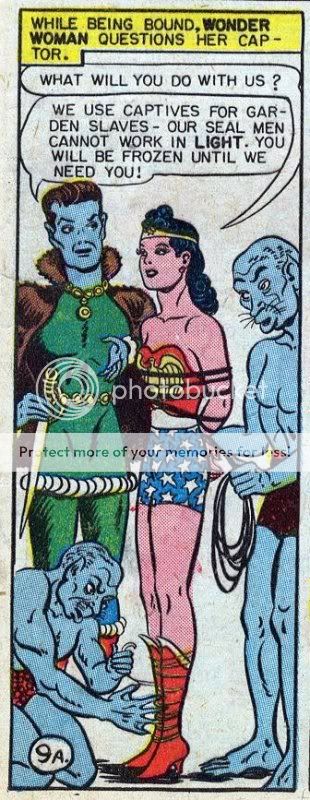
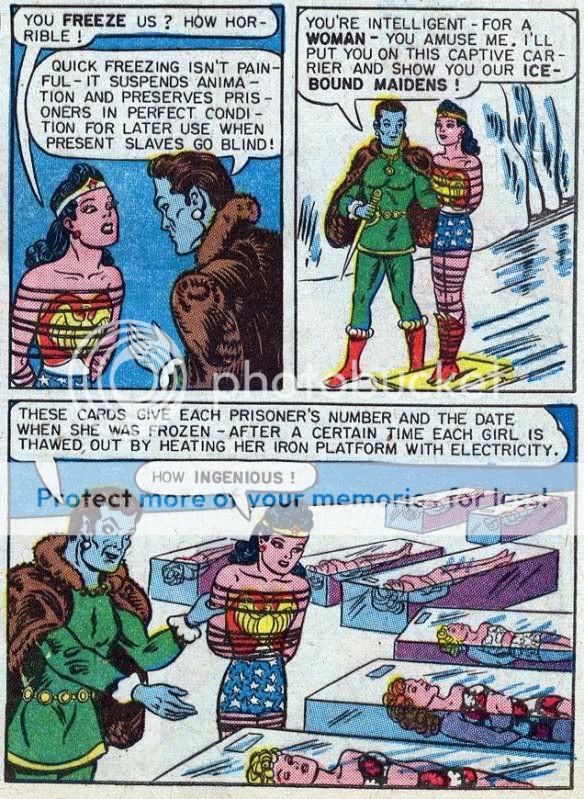
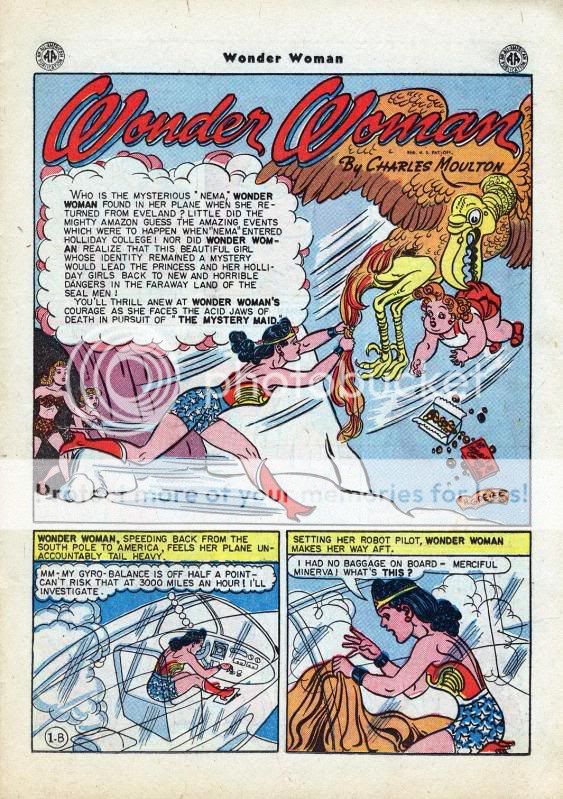
Yes, that’s right, this is the issue with Seal Men! (Not to be confused with Mole Men.) Anyway, the Seal Men are badguys rather than love interests… at least theoretically. It’s a little hard to tell, honestly. The head Seal Man does seem to have some kind of frisson with WW: there’s some mutural complimenting going on here, for example:
marston wonder woman

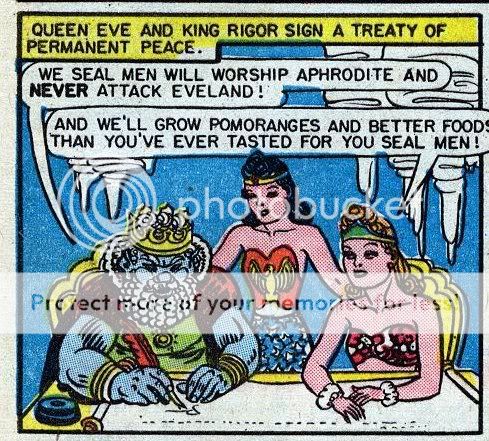
And then, at the end, the Seal Men renounce their evil ways and agree to worship Venus, in return for which the women they’ve oppressed agree to cook for them.
marston wonder woman

It’s kind of fun to think about what Marston would make of Twilight, actually. As I mentioned in my review of the movie, Twilight is obsessed with safety — vampire Edward is always talking about how he wants to keep human Bella safe. In fact, Bella’s major trait is that she’s accident prone. She’s incredibly physically clumsy, constantly endangering herself and others in gym. But that’s the least of it — she’s actually a magnet for danger. First, of course, she has some sort of superpowerful attractiveness for Edward in particular, which makes him want to bite her (because isn’t that what all tween girls secretly want?) And, of course, in later books, she’s also beloved by a giant werewolf with self-control issues. But more than that, she seems to really and truly attract everything dangerous within like 100 miles. In the first book, she’s almost gang-raped in a town that we are told (somewhat gratuitously) has no crime. Then she meets up with another vampire, and he too, decides that it is the goal of his life to drink her blood. At least in the second book she starts to actually take steps to put herself in danger (Edward leaves her, and she goes all bad girl), so it’s not all left up to chance…but even so, it’s pretty excessive.

This is a plot device, of course; we’ve got to have some vampirey super-stunts in here, after all. But it’s not *just* a plot device; it’s part of the wish-fulfillment. That is, where boys fantasize about being the heroic savior who sweeps the damsel in distress to safety, girls fantasize about being in danger so that the super-hero can come along and protect her. Bella isn’t actually a weak character; she’s very strong-willed and stubborn, and she’s pretty smart (not Elizabeth Bennet smart, as one snarky writer noted, but that really seems like a cruelly high standard.) In a lot of ways, she’s stronger, or at least more vivid than Edward, who is always a bit too unreal and perfect as much more than an over-perfect paper cutout. But she can’t be too strong, or the fantasy doens’t work; she’s got to have a weakness, and that weakness is physical. She’s not only weaker than the vampire; she’s weaker, physically, than everybody. She hurts herself playing volleyball.

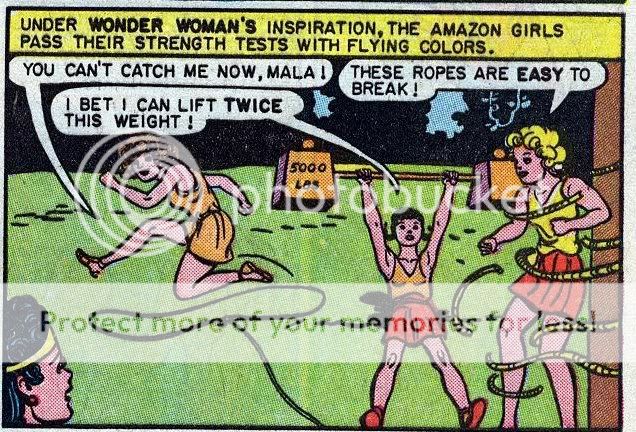
It’s kind of amazing how blatant this is…and how it seems to have been this blatant forever. That is, you look at Twilight, and female physical power, or lack thereof, is absolutely front and center in gender relations. And you look at Wonder Woman, written sixty years earlier…and it’s the same thing. Marston’s fantasy of female equality is absolutely centered on his insistence that women can be as strong as — no, check that — can be stronger than men. This is the case for WW herself, obviously, but Marston also presents it as true more generally; inspired by her example, the Amazons perform amazing feats, for example.
marston wonder woman

In both Twilight and WW, too, women’s weakness is fairly explicitly linked to male insecurity. That is, both Twilight and WW seem to assume that women are weak more or less as a sop to male egos. Edward is obsessed with keeping Bella safe…so much so that he veers right over the line between cutely attentive and creepily stalkery; he has major, major control issues, which Bella more or less, and the narrative absolutely, caters to. And those control issues are supposed to be attractive from a female perspective. That is, the book’s fantasy is of having someone so into you that they want to keep you from all harm. Which is a fantasy which obviously requires you not to be able to take care of yourself.

Marston analyzes relationships in the same way, though he comes to somewhat different conclusions. In the first place, he’s a good bit more merciless in his assessment of the gap between male ego and male reality:
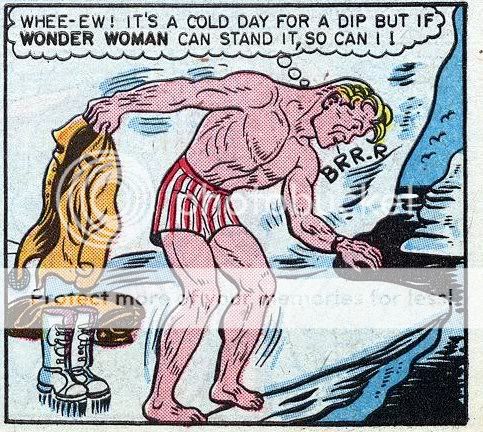
marston wonder woman

This is Steve diving into icy cold water in his boxer shorts to save WW. And, of course, this is played for laughs, with the shivering and the striped shorts and the fact that we know that WW doesn’t need the himbos help. And, indeed, Steve just gets himself in trouble:
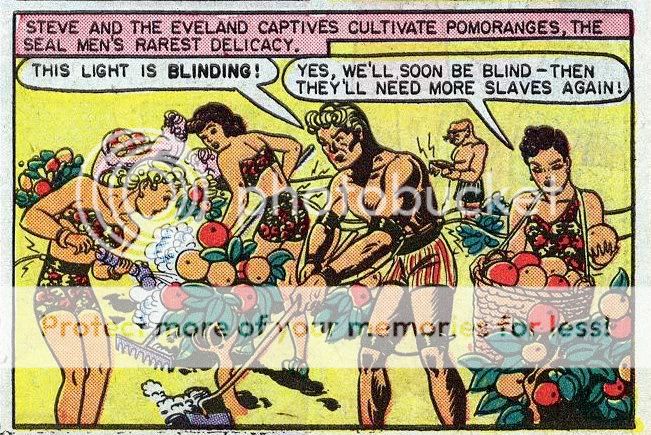
marston wonder woman

For Marston, men are ridiculous when they try to be strong rescuers. Which is why WW refuses to marry Steve:
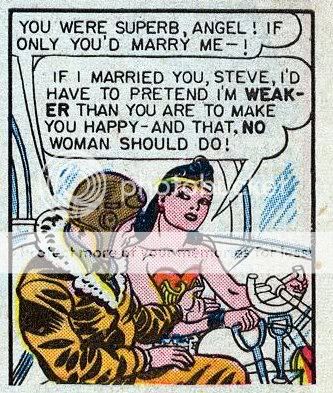
marston wonder woman

To have a relationship with a man, you have to pretend you’re weaker than he is. So far, Twilight and WW seem to agree. But Twilight differs in assuming that you should choose the relationship, while WW chooses the strength.

On the one hand, Marston does actually seem to be rejecting male-female relationships altogether; thus, perhaps, his obsession with female only communities. Another one pops up here, and is introduced and explicated in one of Peter’s most ravishing pages:
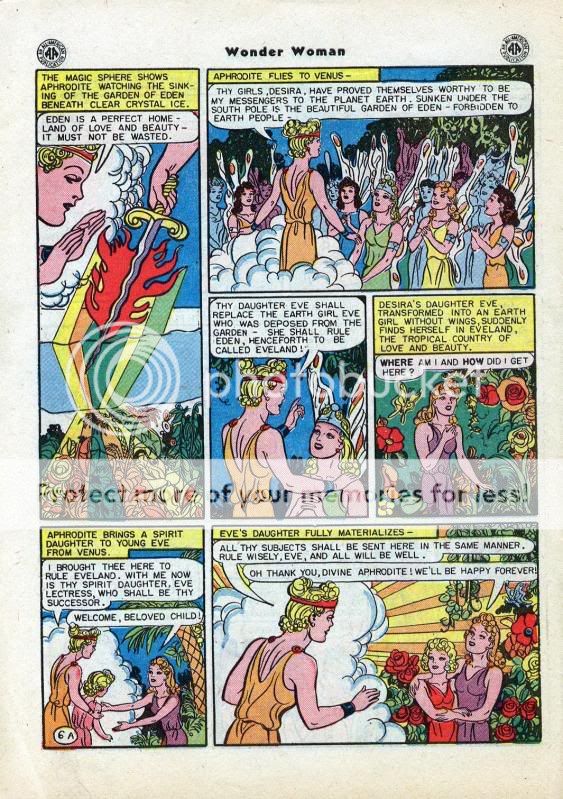
marston wonder woman

This is essentially a pagan, female recasting of the Garden of Eden. In this version, women don’t cause the fall; rather, they are so worthy that they are placed to rule alone in Eden, where they appear to propagate happily without the help of men at all. And when the dark, evil Seal Men do show up, it is they who are the tempters, luring women into their dark realm (what this luring consists of exactly is delicately passed over.)

The thing is that, of course, Marston doesn’t *really* hate men. It’s just that, what he wants as a man, is more or less the same thing that Bella seems to want as a woman. He wants someone to protect and control him, basically; as I mentioned, once the Seal Men submit to Venus, they and the women can live in peace, and the women will even cook for them (Bella is an excellent cook as well, perhaps not so coincidentally.)

Masochism, in other words, does appeal to both men and women. One of the things that appeals about a relationship is that you get the chance to be weak and have somebody else take care of you; you get mothered, and have somebody setting down laws and limits because they love you, not because they are just (which is a more stereotypically male mode.) Because Stephenie Meyer is female, Mormon, and (I think) conservative, and because Marston is male, a crank, and radical, the way the masochism works out in terms of gender politics is pretty different. But I think the impulse for, and the pleasures of, the fantasies are pretty similar

_____________________

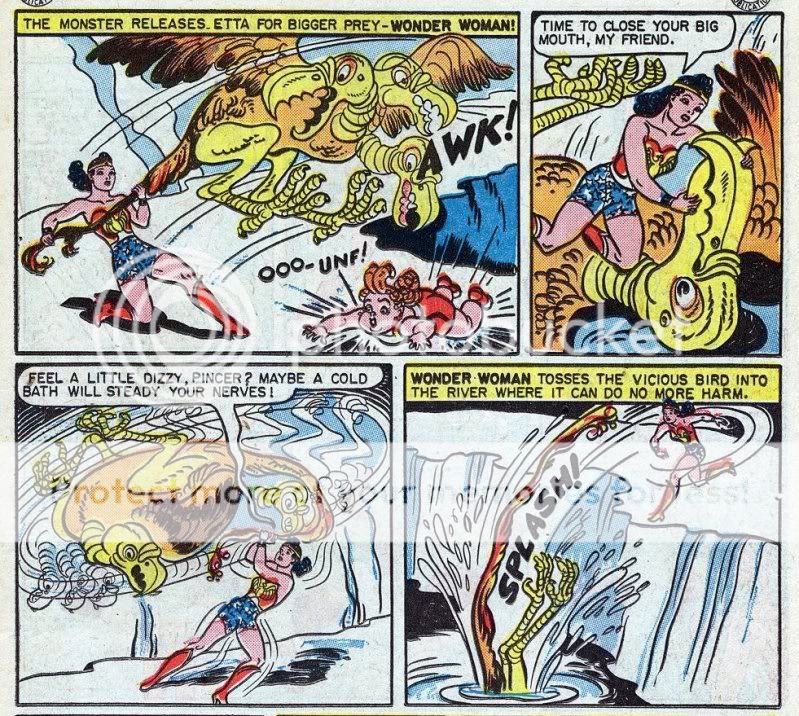
Just to add: this is one of Peter’s most impressive issues to date. I don’t have much to add to my already ga-ga enthusiasm for his work, but I did want to reproduce a few more pictures. So here you go:
marston wonder woman

His animals as always kill me. That cloth in the lower-right panel is also something pretty special, I think.
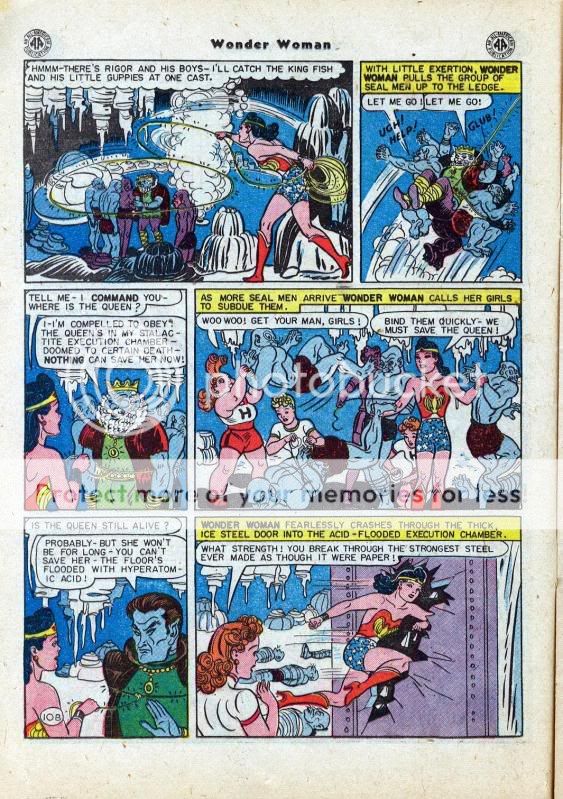
marston wonder woman

The way he blends detailed linework with goofy cartooning is really phenomenal; he reminds me both of Winsor McCay and somebody like Uderzo here. It’s ravishing slapstick.
marston wonder woman

As I’ve said before, I wish I knew who did the color work on these. It’s some of the most beautiful effects I’ve seen in comics, I think. I love the dark color palette in a lot of these underground scenes.
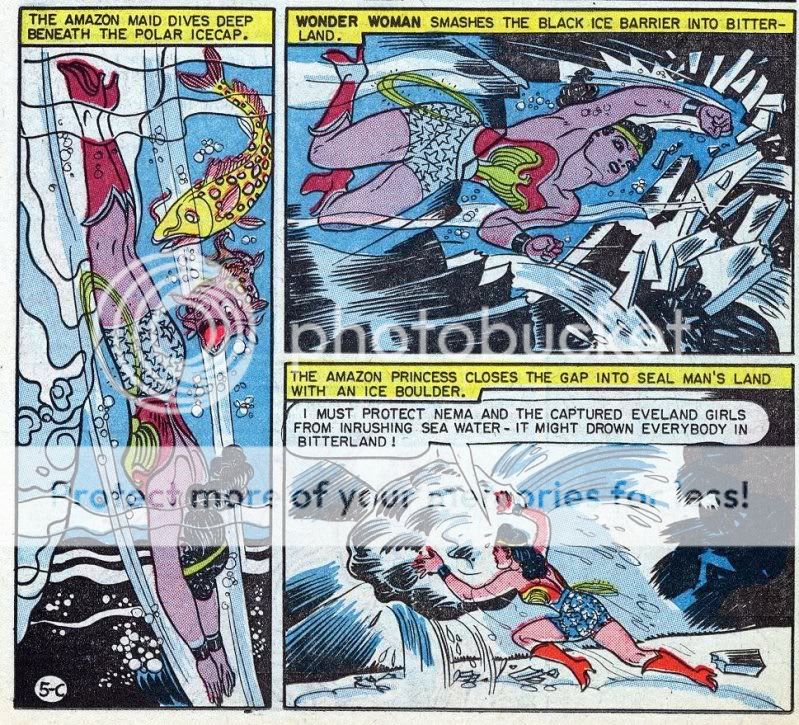
marston wonder woman

Notice how the fish and the water swirls complement the patterns in WW’s costume. He really was the only one who’s ever been able to make anything out of that outfit.

And finally: beware the Walrus Idol!
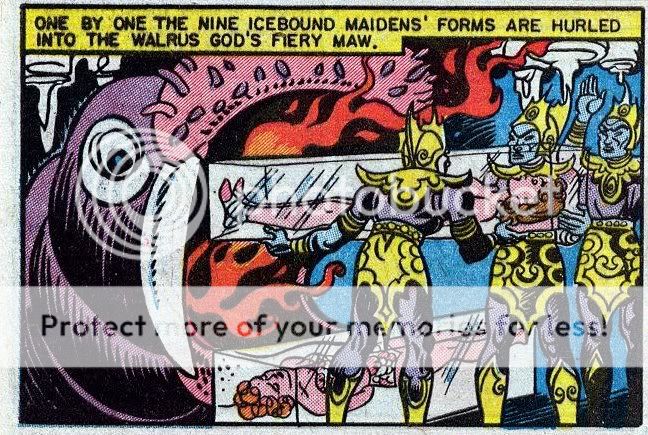
marston wonder woman
_________

Obviously the whole once a week thing with these isn’t quite happening…but I am going to finish them eventually, damn it. So 14 will show up at some point…maybe even next week, if I’m lucky.

What a great name

I suppose the scam artist got carried away by inspiration at the end. He thought, “Screw the payoff, I just want to do that name.”

You have been approved for a lump sum payment of  £750.000.00 GBP,  in this Year Toyota Global Award. Send us the required information as stated below to file for claims.

1.Full Name:…………..
2.Full Address:……….
3.Occupation:……….
4.Country……………

Regards
Mr Adelheid Fankhauser

It isn’t taken out of some cult sci-fi comedy novel. I googled and there’s at least one person in Europe going about with this name and he’s done well at the study of maltherapeutin, which sounds to me like the science of providing bad therapy with a folksy accent, though probably there’s more to it than that.
In other news, I spent two hours in large, crowded rooms with Neil Gaiman today and can report that he is charming beyond smooth. This was at Worldcon, where the Hugo is awarded and which is being held here in Montreal this year. I also met Lev Grossman, though I had no idea who he was. He gave me a chapbook with the first chapter of his novel, which I liked, and at the end there was an author’s bio. It revealed he is by far the most literarily connected person I’ve ever spoken to. Seemed like a nice guy! He had wandered into the back of the room during a misbegotten shambles of a panel whose scheduled participants had bailed and been replaced at the last minute. The subject was fantasy novels and how much politics and economics they should contain. Grossman offered that he was a fantasy novelist — heads turned — and that he had just finished a novel about a world much like the Narnia world but with some revisionism as to adult realities, including socioeconomic realities. For instance, how come Mrs. Hedgehog or whoever has a sewing machine when there are no factories in Narnia? That sounded good to me, so after the panel I asked for his name, he gave me the chapbook, etc. Hence the revelation that followed.
Back to the panel discussion. A very odd, even semi-deranged, lout also wandered into the room, but he sat up front and soon planted himself in the middle of the conversation, such as it was. Otherwise the place was full of whispery fans who deferred to each other; we didn’t even raise our hands properly, just bent our elbows and parked a hand by our ear, fingers curled over. So the strange lout began talking loudly and soon offered an idea that I liked: how do we  know that the whatever kids, Peter and Lucy and Susan and that other one, how do we know they were the first bunch to be sent along from our world to wake the sleeping king (or whatever their mission was). The fellow reasoned that getting the job done first crack out of the box was kind of a long shot. So maybe others had come along, failed, and died, and all over Narnia there were discreet little plots of land dedicated to the graves of the Wilkins children, the Anderson children, the Smith children, etc., but the talking animals didn’t want Peter and Lucy and the rest to know, so they covered it up. I liked that he remembered they would all be Anglo-Saxon family names.  
All right, so maybe it isn’t the greatest single pop-culture revisionist geek goof you ever heard, but it sure livelied up the occasion. That panel sucked so bad. And the idea would come in handy if you were doing a parody about it being the late ’80s and DC somehow acquiring the rights to Narnia and hiring some schmuck writer who had just read Watchmen