Miriam is sadly going to need to take an extended leave from the blog to deal with real life things. I think she will make an announcement herself — but she may well be too swamped to do even that for a bit. In either case, it’s been great having her here, and we’ll miss her posts. Hopefully she’ll be able to crawl out from under and come back to us in the not too distant future.
Monthly Archives: August 2009
Wiki Trek: “Errand of Mercy”
Joan Didion said belief in more advanced alien civilizations was a sign of intellectual immaturity. Three points: 1) She should know, 2) It’s nice that Jerry Siegel and Doris Lessing have something in common, and 3) Didion is probably right, kind of, and especially if a person fetishizes the superior alien development, makes a big fuss about the aliens being up there and us being down here, which old Trek certainly does — Jesus, again with the all-powerful light blobs. I guess the easiest way to get across we-are-not-the-center is by means of we-are-not-the-top, and the easiest way to understand we-are-not-the-top is to say they-are-the-top, those guys there, just look at them. It’s the baby version of a decentered perspective.
Anyway … The head guy on the planet. This time a 60-ish character actor in charge of a misguided local set-up—they’re pacifists—but it turns out the set-up isn’t really misguided because the aliens are all-powerful light blobs and can exercise overwhelming force without it counting as force, which I think is pacifism at its best.
Mem Alpha says the actor (John Abbott, born John Kefford in 1905, England) was “particularly active in sixties television, with guest appearances in many of the shows of that era. He lent a quiet dignity to the roles he played …” Wound up in Hollywood because during wartime that was the safest way home from Moscow, where he’d been serving as part of the British consulate. Got blacklisted a little later on, was then un-blacklisted because a producer wanted him.


Mem Alphs says: “Colicos made his final acting appearance in the concept demonstration trailer for Battlestar Galactica: The Second Coming, in which he reprised his role as Baltar … The four-minute trailer … was actually part of a thirty-minute pilot film for a proposed new Battlestar Galactica television series that would have continued where the original series left off. … However, the project was never picked up …”
Sidekick old alien. The actor (b. 1903, American) lived in Laurel Canyon for 40 years, got killed off twice in the Reeves Superman series, got blacklisted during the red scare, and basically worked a ton of smallish parts over the years. Wiki says he was Colonel Matterson in One Flew Over the Cuckoo’s Nest.


Quite a face: Another venerable alien. Actor (b. 1901) had only four screen appearances, Mem Alpha says. Presumably they were all around this stage of his life.

Music For Middle-Brow Snobs: The Devil Always Shits In The Same Graves
Well, the test run seemed to work, so I’m going to start doing these downloads every week. This time round we start with some gospel field recordings, move into psych dronishness, and end with pop.
Dock Reed — Low Down Death Right Easy
Andy Mosely, Hogman Maxey — I Know I Got Religion
Mary Pinckney — Been In The Storm So Long
Della Daniels And Ester Mae Smith — Move Upstairs
Muddy Waters — She’s Alright
Silvester Anfang — The Devil Always Shits in the Same Graves, Pt. 1
Drudkh — Where Horizons End
Damon and Naomi — Translucent Carriages
Beasties Boys — Something’s Got to Give
Anjulie — I Want the World to Know
Mary Wells and Marvin Gaye — What’s the Matter With You Baby
My favorite Michelle Malkin associate
Allahpundit confuses me because he’s a common-sense political extremist. Here he deflates a trying-too-hard right-wing frother:
The story burns hot with outrageously outrageous outrage, but I can’t lie. I’m not feeling it.
How do you froth without trying too hard? The Allahpundit post shows how, since he goes into full (but graceful) dudgeon about Obama’s errant views on the meaning of 9-11.
Bonus: The author of the outrageously outraged news story is a former acquaintance of mine; see here. [bonus update, Benen gives the outrageously outraged author what he’s looking for.]
update, Just leave it at home, please. Trust me on this.
update 2, An unwelcome category: animatronic public figures with faulty views on health care.

Empowered #2
I talked in a couple of posts about my enthusiasm for the first volume of Adam Warren’s Empowered.
I still enjoyed the second volume; Adam Warren’s manga-fetish art remains sexy; the gags are still funny (a 2nd-rate supervillain called the king of time who can’t actually control time, so instead hits people with clocks is a highlight); the characterization is still thoughtful and charming. Nonetheless, there are a couple of ominous trends. In particular, Warren keeps trying to explain stuff that really would maybe be better left unexplained. For instance, there’s a sequence where Empowered explains that her suit rips so easily, robbing her of her powers, because of her own lack of self-confidence; it’s a metaphor for her frayed ego, y’see.
Similarly, Warren seems to have a really unfortunate weakness for tragic backstories. Emp, we learn, had a dad who died of a brain tumor; Emp’s friend Ninjette has issues involving her childhood rejection by her ninja clan; Emp’s friend Thugboy also seems to be hiding some sort of tragic past which looks to be leading nowhere good. Part of what was delightful in the first volume was way Warren balanced treating the characters as gag punchlines and treating them as human beings. As the run goes on, he seems to be tipping more towards serious interpersonal drama, which would be okay if he was willing to actually take the time to do characterization rather than using the personal trauma shortcut.
I’m definitely still planning to get all of these, and I have hopes that things will improve again. But if this is the road we’re going down, I fear #1 may end up being my favorite of the series.
Wiki Trek: “This Side of Paradise”

The 50ish leader of the misguided planetary society (which in this case is an earth colony where spores make people into happy dopes). The dialogue played up the perfect physical health of the spore dopes, including the leader’s, of course; but the actor died of a heart attack the month after the episode was shown. Born in 1918 in Babylon, N.Y. He was the sheriff in To Kill a Mockingbird and a general in Fail-Safe (the Cold War nuclear showdown thriller that was overshadowed by Dr. Strangelove). (Wiki here.)

Earl Grant Titsworth again, a.k.a. Grant Woods, the stunt man who died in a motorcycle accident. Different episode than “Side,” though:

Random helmsman: Dick Scotter. Don’t think he had any lines, but good-looking:

Almost a regular: Lieutenant DeSalle appeared in this one and in “Squire of Gothos” and “Catspaw.” That’s two from season one plus the first episode to be shot for season two. Don’t think he ever did much, was just on hand and maybe said, “Aye, Captain” or the like. Did what looks like a respectable amount of work on Gunsmoke, Bonanza, Mission: Impossible, My Favorite Martian, etc. “Barrier’s final credit was the 1969 film Angel in my Pocket with Andy Griffith and Lee Meriwether. After leaving the acting profession, he became a legal officer for the US Coast Guard. As of 2007, he is a substitute teacher in northern Oregon.”

Privacy Is The Old Porn
A while back I read (via Andrew Sullivan) about the Erin Andrews video. For those who aren’t up-to-the-minute on internet memes, Andrews is an attractive ESPN sportscaster who was illicitly filmed semi-nude in her hotel room via a hidden camera. The video went viral, there was much excitement and hand-wringing and hypocritical panting of various sorts by various news outlets. Jennie Yabroff at Newsweek had a pretty thoughtful comment about the brou-ha-ha in which she said:
Andrews has a nice body, but so do lots of other naked women you can find on the Internet, and in much higher-resolution pictures. In the video, she appears to be getting ready to go out: brushing her hair, looking in the mirror. It’s not super-racy stuff. The quality of the video is so poor, it’s hard to tell Andrews’s identity. In fact, the tape has been online for months, and generated interest only when ESPN’s lawyers confirmed Andrews’s identity as the woman in the hotel room.
Obviously, the fact that Andrews is a celebrity has a lot to do with it. The fact that we’ve seen her face before somehow makes her body more interesting. And certainly, the fascination with naked celebrities is nothing new. Playboy understood that when it put Marilyn Monroe on the cover of its inaugural issue. But it’s doubtful Andrews would have caused such a stir had she posed for the magazine. What’s really provocative about the Andrews tape, what makes it good copy for Fox et al. is not that she’s naked, but that she thinks she’s alone.
Privacy, it seems, is the new nudity (my italics) This is why, when Jennifer Aniston poses topless for the cover of GQ no one does more than shrug, but when paparazzi catch her sunbathing topless, it’s tabloid fodder for weeks. Same with Britney Spears. Same with Janet Jackson. It’s not so much a desire to see nudity as it is to see candor, to see what the person looks like when she’s unaware she’s being watched.
I think Yabroff is pretty spot on in her analysis for the most part. But she’s wrong when she says that privacy is the new nudity. Privacy and porn have been linked for a really long time. In fact, in her book about pornography, Hard Core, Linda Williams essentially argues that the whole point of pornography, the impetus behind it, is as much knowledge as lust. Why does so much porn look like a clinical gynecological exam? Clinical isn’t really especially sexy; if the point was prurience, surely you could find a more appealing way to do it.
Williams argues that the reason for the gynecology is that porn is obsessed, essentially, with obliterating privacy; with making visible women’s interiors, both literally and figuratively. There’s an essentially sadistic desire to know and possess the women’s private self; to consume or fill that private space, so that the woman is entirely obliterated by the observer. That’s the kink; to have everything visible, accessible, and controllable. The violation, of self and of privacy, is always part of the thrill.
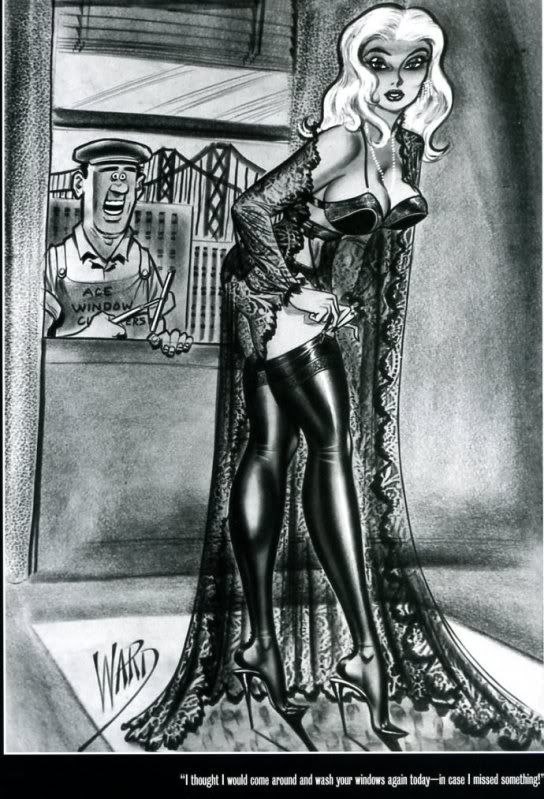
As just one example of the long-established fetishization of privacy, take the work of Bill Ward. Ward was a fifties pin-up cartoonist, a contemporary of Jack Cole and Dan DeCarlo. Ward was extremely prolific, but among of his most famous schticks (according to editor and scholar Alex Chun) were the telephone girls. Here are a couple of examples, from Chun’s The Glamour Girls of Bill Ward.

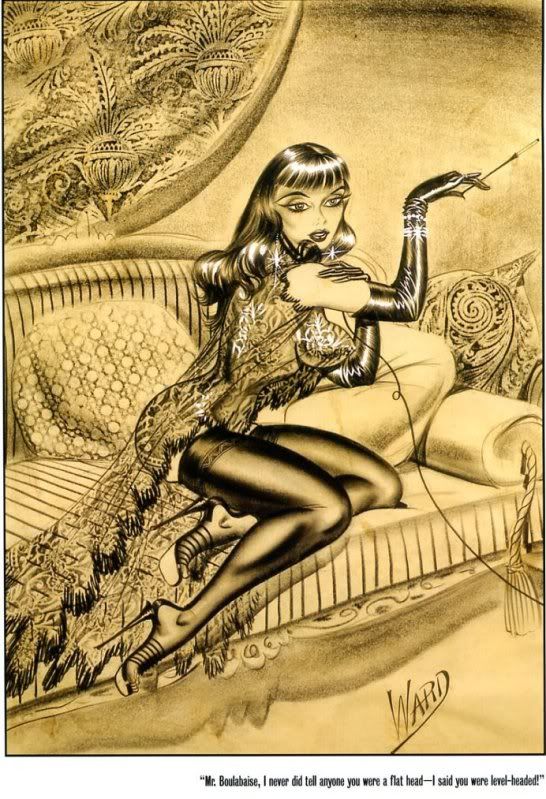
As you can see, it’s a pretty simple idea: luscious, top-heavy girls lounge about the room in lingerie, delivering their gag line into a phone. The scenario is built around a winking violation of privacy; the girls, safe in their rooms, think they are unseen by their interlocutors and therefore are free to cavort in lacy underthings. The viewer is like the camera in Erin Andrews hotel room; they get to see What Women Get Up To When They Believe They Are Unobserved. (Though, obviously, Ward’s fantasy women get up to more exotic shenanigans, at least in terms of attire, than Ms. Andrews did.)
One of the odd things about the fetishization of privacy in Ward’s drawings is how entirely undifferentiated it is. You get to be a secret voyeur in the boudoir of bevies of bodacious beauties — and dang if all those bevies are bodacious and beautiful in just about exactly the same way. Alone and uninhibited, they all wear garters and stockings and ridiculous heels, lace and filigree and fetishy nothings. There’s a similarity here to traditional porn movies, where, as Williams says, the obsession is with revealing the hidden insides of women — and what that means, functionally, is the same ritual shots of genitalia over and over. The point of the fetish is not just to reveal the private self, but to reduce that self to a series of easily recognizable tropes; you want to both know everything about the individual and have that knowledge be utterly banal. Again, this is pretty much textbook sadism, with individuals compulsively and repetitively turned into interchangeable, collectible objects — the denial, and indeed, the defilement of personality functioning in itself as the fetish.
I don’t actually mean to say that I hate Ward’s work or anything. He’s a talented artist, and he’s certainly nowhere near as sadistic as, say, Tabico, a pornographer whose work I admire excessively. Still, when I compare him to DeCarlo or Jack Cole, I have to say I do find his work kind of numbing…and even a little disturbing. DeCarlo’s women always have definite personality. For Cole, on the other hand, personality always seems to be beside the point — he’s really much more interested in surface voluptuousness than in pretending that his confections have, or are meant to have, actual brains, which is maybe why he so often doesn’t even bother to show you his women’s eyes. For Ward, though, personality matters — it’s just the same frozen personality over and over and over. His women’s eyes often look weirdly painted on; it’s like an endless procession of mannequins, all dressed in the same more or less fetishy style, all with the same overblown proportions. Probably the effect wouldn’t be so stultifying if you saw just one or two of the cartoons in those old Humorama magazines as they were originally run, but when you see them all together in a collection, it does become a little oppressive. Eliminating privacy goes a long way towards eliminating difference; if you systematically obliterate mystery, all that you’re left with is the homogenous and mundane. That’s why so much porn is so aggressively boring and why, though I can admire Ward’s skill, looking at his drawings gets wearisome very quickly.