Racism: Two-Fisted Solutions in the Mighty Marvel Manner (Black and White and Startlingly Offensive All Over)

Superheroes solve problems by hitting them very hard. This strategy works will enough when they’re fighting mad scientists, robots, or radioactive dinosaurs, but it doesn’t seem particularly well-suited for persistent social ills like racism. How are superheroes supposed to deal with a problem that has no specific face to punch? The answer, of course, is to give racism a face.

By the 1960s, the Civil Rights Movement had gained a great deal of political and social influence, but racism was still widespread. With so much national attention focused on race relations, it was only a matter of time before Marvel attempted to address the issue within the pages of its superhero books. Marvel had prided itself on publishing the superhero stories of “our” universe, completely unlike the silly, fantastical universe of DC Comics. And since many of the staffers and creators at Marvel were Jewish guys from New York City, it’s not surprising that they were firmly in favor of racial equality.

The first Marvel comic that specifically dealt with racism was Fantastic Four #21 (1963). Co-written by Stan Lee and Jack Kirby, this story pitted the FF against the ruthless Hate-Monger!

Fantastic Four,Racism

It’s not a bad costume for a racist: there’s the KKK pointed hood, some chain-mail (racists love references to the Teutonic Knights), a torch for lighting crosses, and a gun for shooting minorities. All set! The story begins with the FF up to their usual hijinks, but their fun is interrupted by the Thing who’s pissed that a mysterious figure known as the Hate-Monger is stirring up racial tension in New York City. Invisible Girl doesn’t think the FF should get involved because she’s a selfish jerk who’s never heard of Martin Niemöller. But she gets overruled by the boys and off they go to confront the Hate-Monger, currently mongering hate in Manhattan.

FF 21 page 6 panel 4

Racist he may be, but you have to admit he puts on an elaborate outdoor performance. The crowd is instantly swayed by his words, and they begin to attack nearby foreigners, though given the limitations of Kirby’s style, I’m not quite sure how they can tell this guy is a foreigner.

Fantastic Four,Racism
Maybe only foreigners wear bright blue suits? When the FF intervenes, the Hate-Monger blasts them with his Hate Ray, which causes them to start fighting amongst themselves. Apparently, hate isn’t so much a product of a bad upbringing as a product of evil science. The Hate-Monger plans to keep the FF busy with their in-fighting while he foments an anti-American revolution in the made-up country of San Gusto.

Fantastic Four,Racism

Obviously, anti-Americanism has to the be the product of vile evil-doers using Hate Rays. It couldn’t possibly be blowback from years of American interventionism. Speaking of which, Colonel Nick Fury comes up with a convoluted scheme to get the Fantastic Four to San Gusto so they can crush this hateful uprising. After beating on the rebels for a bit, Mr. Fantastic stumbles upon the Hate-Monger’s base and figures out the bad guy’s master plan (it involves bouncing hate beams off the moon. Yes, really.) and then he cures himself and his teammates with anti-hate pills (Yes, really). Then the FF and Nick Fury kick the crap out of the Hate-Monger’s stormtroopers. When the Hate-Monger tries to use his Hate Ray, the Invisible Girl forces him to blast his own men, who immediately shoot him dead. Poetic justice strikes again! But there’s one last question to answer: who is the Hate-Monger?

Fantastic Four,Racism

So let’s recap: Adolph Hitler survived World War II, reinvented himself as a super-villain named the Hate-Monger, and used his Hate Ray to start an anti-American revolution in a banana republic so he could use that country as a base to beam hate to the rest of the world. And by killing Hitler, the Fantastic Four solved the problem of racism … for three years.

Marvel dealt with the issue of race relations again in Avengers #32-33 (1966), by Stan Lee and Don Heck. The story begins with a hate group called the Sons of the Serpent, an obvious send-up of the KKK, viciously attacking a foreigner in a dark alley. And because I read Fantastic Four #21 first, I know that this man is a foreigner because he wears a tacky suit.

Photobucket

Meanwhile, Goliath has increased his size to ten feet tall but he’s now stuck at that height. Needless to say, this makes relations with his girlfriend the Wasp somewhat difficult. After several pages of whiny self-pity someone gets the bright idea to call another scientist to see if he can help. And so Dr. Bill Foster is introduced to the Marvel readership, and he’s black! At first, I thought it was cool that Marvel would introduce a black scientist and not comment on his race, but a few pages later that’s exactly what they do. While walking home from Goliath’s laboratory, Dr. Foster is ambushed and beaten up by the Sons of the Serpent. This leads to the obligatory righteous indignation from the hero. The dramatic pause before announcing the name of his team is a nice touch.

Photobucket

After sending Bill Foster home, Goliath meets up with the Avengers and they decide to investigate the Sons. At the same time, the sinister General Chen from an unnamed country that’s clearly China is arriving in New York, where he plans to give a speech at the United Nations. Issue 32 wraps up with Captain America captured by the Sons of the Serpent.

On a side note, some of you may have heard of a certain comics blogger, who shall go unnamed, with this crazy notion that old superhero comics were kinda queer. But I dare him to find anything homoerotic about the opening splash page of Avengers #33!

Photobucket

Okay, so maybe Captain America is pinned spread-eagle against a wall while a serpent-themed villain gloats with orgasmic glee while holding a phallic-shaped object. But other than that, where’s the gay?

With Cap as a hostage, the Sons of the Serpent plan to force the Avengers to speak out in their favor, knowing that the fickle public will immediately do whatever C-list heroes tell them to do. Meanwhile, the inscrutable General Chen plans to use the activities of the Sons to discredit the United States at the UN.

Photobucket

Note that the American diplomats are not so much concerned with the actual crimes of the Sons as they are with the fact that the crimes make the U.S. look bad to the rest of the world (over a decade earlier, the Justice Department expressed similar worries when it submitted an amicus brief to the Supreme Court when it was considering Brown vs. Board of Education of Topeka. The brief cited a statement by then Secretary of State Dean Acheson, who asserted that racial discrimination “gives unfriendly governments the most effective kind of ammunition for their propaganda warfare, … and jeopardizes the effective maintenance of our moral leadership of the free and democratic nations of the world.)” (The full amicus brief can be found here).

Getting back to the story, Goliath and the Wasp arrive at the big press conference where they’re supposed to offer allegiance to the Sons, but they stall for time while fellow Avenger Hawkeye goes to rescue Captain America. The story gets a bit wonky for a bit, but it eventually ends with the Avengers beating the crap out of the Sons and capturing their leader. And who is the leader of America’s worst hate group? It’s the nefarious General Chen!

Photobucket

Photobucket

So the Chinese are to blame! Some of you may be thinking that it’s nonsensical to blame Asians for the racial conflict between whites and blacks, but you’re forgetting that the Chinese are Communists. That means they’re bad.

After reading these two stories back-to-back, I noticed three common factors in how they approached racial conflict. The first is that they are exclusively concerned with how progressive white men respond to violent racism. After all, both the Fantastic Four and the Avengers are composed entirely of white guys with one token girl apiece. The only notable minority character is Bill Foster, but he’s little more than a Noble Black Men who gets assaulted, thus providing a motive for the Avengers to get involved. The comics also draw an unambiguous distinction between the law-abiding, racially tolerant (white) heroes and the racist villains.

Both stories also portray the source of American racism as foreign. In Fantastic Four, racist violence is sparked by none other than Adolph freakin’ Hitler. In Avengers, a general from Red China foments racism to make America look bad. This leads naturally to the conclusion that racism itself is foreign to America. Now I’m sure that Stan Lee and friends were well aware that racism existed in the U.S. long before Hitler or Red China came along. But it’s not a part of what they portray as the “real” America. To put it differently, as a rule America is tolerant and equal; racism must be an exception to this rule because it’s inherently un-American.

Another factor in both stories is that crowds display racist behavior only after they’ve been influenced by external forces. In Avengers, the Sons of the Serpent attempt to sway the public through a popular superhero team. In Fantastic Four, the external manipulation is technological. There’s an implicit rejection of the argument that racism can arise from ideas held by the majority. Instead, the public in Marvel America is fairly tolerant unless a foreign group manipulates them. This reinforces the idea that racism is alien to American society.

To sum up, these comics create a dichotomy between the majority of white Americans, who are tolerant and law-abiding under normal circumstances, and a minority of violent racists. The white superheroes, in particular, embody the highest values of America. The racists are fringe extremists, linked with hostile nations and totalitarian ideologies.

I think most people would agree that this treatment of racism is simplistic, at best. But the target audience for these books is children, and an argument can certainly be made that concrete examples of heroes beating the crap out of racist villains discourages racism in young, impressionable readers. And if racism really was limited to violent loudmouths, then there would be nothing wrong with these comics at all.

But these comics are problematic exactly because racism is a far more ubiquitous than mob violence and secret societies. Racism is a system that permeates numerous institutions and social structures, and an individual doesn’t necessarily need to have racist attitudes in order to perpetuate racial inequality. Take housing segregation as an example. American neighborhoods remain deeply segregated along racial lines. Yet most white homeowners (and realtors) are not card-carrying members of the KKK. They participate in a system that excludes blacks from white neighborhoods due to indifference rather than hate. And because many whites rarely come into contact with blacks on a regular basis, they aren’t even aware of any racial injustice (check out Noah’s review of “Sundown Towns” for more on this).*

Comics that associates racism exclusively with Nazis or similar extremists while ignoring the far more significant impact of systemic racism are not providing a valuable moral lesson. Rather, they encourage readers to pat their own progressive backs while doing nothing to actually challenge a system that sustains racial inequality. According to these comics, if you condemn hate groups and don’t go around assaulting immigrants, then you’re not a racist. And if you’re not a racist, then somebody else is to blame for the pervasive effects of racism. And when the vast majority of Americans refuse to assume any responsibility for problems like segregated neighborhoods, these problems never get addressed.

Superheroes solve problems by hitting them very hard. But when it comes to racism, Captain America might have to smack around a lot more people than usual. It’s much more comforting to just blame it all on Hitler.

*Thanks to Noah for the links

____________
Update by Noah: You can read the whole roundtable here.
Black and White and Startlingly Offensive All Over, Part Three: The Ambivalence Trap

It’s easy enough to rake comics over the coals for their viciously racist past, for all the loinclothed cannibalistic African savages with bones through their noses rampaging across jungle stories, for the puffy-lipped google-eyed Ebony “Mistah Spirit”ing this and “Mistah Spirit”ing that. (Ebony’s replacement, the parka-garbed, spear-toting Eskimo tot Blubber was hardly an improvement, though he was quieter, nor can replacing both with white kid Sammy exactly be seen as a step up.) Certainly there are mountains of that material littering comics history – jeez, Winsor McKay, practically the father of comics, whose whole worldview, at least as expressed through his work, can be summed up as whimsical, turned out a considerable body of appallingly racist material all by himself, from his first strip Tales Of The Jungle Imps through the odd support character Flip in Little Nemo In Slumberland – and from our vantage it’s easy to ignore the cultural context. Ebony originated as a horrific stereotype but Eisner, embarrassed by the character in his twilight years, was correct in reminding critics Ebony was largely the best of a bad lot. Hitler may have given comics their key supervillain, but the pulp magazine delivered comics’ key conspiracy, the Yellow Peril, a compartmentalized edition of the greater paranoia, fear of the Non-White Races.

If anyone thinks I’m inventing this conflation, I direct you to Robert E. Howard’s 1929 pulp novel, Skull-Face, whose eponymous Atlantean wizard rises from an eons’ long sleep in the ocean depths to be

“the leader and instigator of a world-wide movement such as the world has never seen before. He plots, in a word, the overthrow of the white races!

His ultimate aim is a black empire, with himself as emperor of the world! And to that he has banded together in one monstrous conspiracy the black, the brown and the yellow… When it comes, I look for a simultaneous uprising, against white supremacy, of all the colored races – races who, in [World War I], learned the white men’s ways of battle, and who, led by such a man as Kathulos and armed with white men’s finest weapons, will be almost invincible.

… I know not… what power Kathulos has that draws together black men and yellow men to serve him – that unites world-old foes. Hindu, Moslem and pagan are among his followers. And back in the mists of the East where mysterious and gigantic forces are at work, this uniting is culminating on a monstrous scale…”

And on and on, feverishly describing how western civilization and all its achievements and advances out of superstition will be wiped from the earth, and what few white men remain will be made slaves while white women become sex toys etc. (Much of the Yellow Peril’s unspoken appeal was this thrill of illicit, if vicarious, sex.) This was hardly original with Howard, who wrote Skull-Face as a Fu Manchu pastiche, and Fu author Sax Rohmer inspired multitudes of pulp writers a lot more garish than Howard, and Rohmer was only expressing the paranoid undercurrents of imperialism, the impossible, unthinkable fear that inferior peoples might reject the “gift” of westernization and someday rise up against their imperial masters. We’re not exactly free from those undercurrents even today; the national (or cultural, if you want to include western Europe with America) horror of Muslims in the wake of 9-11 was out of all proportion to the event, pulled off by a miniscule and not especially influential Muslim splinter group if they can be considered “true” Muslims at all, and the specter of the “destruction” of Western Civilization is pretty common these days in right wing literature. The idea of the “non-white peril” is so much a part of our current political background noise that most of us now only hear it as, no pun intended, white noise.

Neither Howard nor Rohmer were likely frothing racists; if you assess his output collectively, Howard seems to have been rather ambivalent toward race. Whether he scorns non-white races or praises them, and he’s no stranger to either, depends almost entirely on plot necessity. (In fact, he tends to praise more often where it serves no specific plot purpose but fleshes out characters.) By and large, pulp magazines were no place for progressive social views, and comics inherited that along with a lot of other pulp baggage, less an agenda than an acquiesence to the “white noise” of the day. The heyday of the Klan wasn’t that far behind Depression era America, and while a few Americans looked with trepidation at the rise of Nazi Germany, many more fretted over a militarized Japan. Race paranoia made for useful political ploys; to facilitate public outcry against it in 1937, hemp was “officially” renamed marijuana specifically to evoke images of Mexican drug dealers seducing virginal white womanhood with it at the same time pot was being reimaged as a “Negro” narcotic, for the same basic allusion. While I wouldn’t doubt there were flagrantly racist (meaning beyond the “white noise” systemic racism of the era, with specific intent to do harm to one or more minorities) editors and publishers involved in pulps and comics, it strikes me as likely, given my own experience, that ambivalence was the controlling factor in their portrayals of race.

Ambivalence is the great underwriter of systemic racism, found at every level of pop culture, and it’s particularly effective because it shifts the blame and transforms the enforcers into helpless victims of the process. Mainly, stereotypes are enforced not because it’s easy or because anyone involved in the creative process necessarily likes the stereotypes, but because the audience would be offended by any digression from the stereotype. In pop culture, the consumer is king – except the consumer has no direct input into content. Not “offending” – ie. challenging the preconceptions of – the consumer is standard operating procedure in media even today. While the logic flaw is that editors (and, by extension, the talent creating the work for the magazines they edit, whose real audience is the editor) begin from a preconception of what audience preconceptions are. That they’re frequently not wrong is where the vicious circle principle cuts in: editors make editorial decisions based on preconceptions of what consumers want, the material reinforces consumer preconceptions, and the purchase of the material reinforces editorial preconceptions.

When it came to race in comics, positive portrayals generally caught a lot more flak than negative ones. How many complaints did all the quasi-naked cannibals in jungle comics generate over the years? But when the astronaut in a ’50 EC Comics science fiction strip- integration/racial tolerance metaphor took off his helmet in the last panel to reveal he was a black man the Comics Code tried (unsuccessfully, fortunately) to get his race changed. DC’s early ’70s introduction of John Stewart as “the black Green Lantern,” the company’s first prominently displayed black hero, prompted a major distribution chain to dump the book, tailspinning it to cancellation. I doubt it’s accidental the Black Panther, Marvel’s debut black hero and briefly The Black Leopard when his original name became politically hot, was racially concealed head to toe on covers, while Kirby’s original design featured a revealing half-mask. His primary black foe, the feral Man-Ape, an almost perfect rendition of the voodoo/cannibal African stereotype, appeared prominently on covers without raising a retailer eyebrow. Really think the lesson most editors would learn from that is to buck the system?

I have to say I didn’t give a lot of thought to matters of race when I began writing comics in the late ’70s. (Then again, I had a rather sheltered childhood; the only time I ever heard the N word was in reference to stable boy statues – and all those where I grew up had white skin. That’s Wisconsin for you.) But it didn’t take me long to figure out minorities and women were more interesting characters to write, because unlike with white male heroes editors didn’t demand they be heroic at all times. This occurred to me after I wrote a Spider-Man story where he gets involved in a fight he really has no stake in besides pride, and when he realizes he can continue the fight or catch his cross-country flight home, he takes the flight. It got published, but I was thereafter told in no uncertain terms that no matter what Spider-Man does not run away from a fight! There was no use in arguing that when I grew up on the Lee-Ditko Spider-Man, he was no stranger to running away from fights. AKA white male heroes must be heroic at all times. I never got that pressure when writing minority or female characters; they were “allowed” (mainly by lower editorial expectations, I think) to make more human decisions for more human reasons. It wasn’t that editors were either specifically racist or felt those characters should have greater emotional latitude.

They were just ambivalent toward those characters, without thinking about it one way or the other, and they weren’t ambivalent about white male heroes. Corporate think was that audiences expected their heroes to be heroes. It’s just their heroes were white. It’s no secret that white heroes (though not all white heroes) outsold minority heroes; the question’s why. Because white readers refused minority characters? Because minority readers had no interest in minority characters? Because the writers, artists and editors handling those characters perpetuated stereotypes that miffed the minorities they were intended to appeal to? All of the above?

Bear in mind this was in the late ’70s/early ’80s when comics and American culture in general were finally willing to at least pay lip service to the notion of multiculturalism. (Nascent MTV was still unwilling to scare off viewers with “black” videos, though.) Things like early white writers having Luke Cage deride himself as “just a big dumb monkey,” though appalling, usually weren’t even vestigial racism. They were mis-transplanted Sgt. Furyisms. Then there was the “big picture” syndrome, perpetuating racism as counter-racism: Fu Manchu and the Yellow Claw can still dress in Mandarin drag, having fifteen inch fingernails and a string beard to match, and concoct hideous giant venomous spiders in their labs while preaching the destruction of the decadent West, ‘cuz, see, here’s heroic gi-clad (half-)Asian Shang Chi heroically defending our way of life, and there’s heroic American superspy Jimmy Woo, who looks just like us. If that’s not balance, what is?!

Jimmy Woo’s a key figure here, not because he’s a heroic Asian but because he’s a bland heroic Asian. In comics, the opposite of racism isn’t anti-racism but genericism. The problem, again in American pop culture across the board, is that middle class white America has always been the baseline. In comics in particular, with its natural emphasis on iconography, the appeal of racial stereotypes in most instances is less racist agenda than departure from the baseline to spice things up. Steve Englehart’s reconstruction of The Falcon as a superflyin’ pimp transformed into just the sort of Sidney Poitier wannabe to pluck Captain America’s liberal heartstrings is merely acknowledgement that pimps are more interesting than social workers. But that’s an underlying problem of minority characters in comics. To the extent they skew toward the baseline, they’re dull. To the extent they skew away from the baseline, they veer toward stereotype. (In comics, we call stereotypical characters “iconic.”) A side effect of multiculturalism is the wider variety of stereotypes, “good” and “bad,” we now have to choose from.

The baseline is its own curse. White males don’t bear the onus of “white issues”; minority characters are rarely considered “real” unless they confront issues pertinent to their race or sexuality. (Even most gay characters identified in comics eventually get an After School Special confronting gaybashing or AIDS, like those are the most overriding elements of gay life.) To the extent minority characters behave like white male characters, or don’t confront their identifying issues they may as well be white male characters. It’s a catch-22 of dealing with race and gender, again not restricted to comics. But in that strange way it reinforces the baseline and identifies it as “normal,” the same way the tumult of American life over the past 50 years has widely reinforced a flawed perception of ’50s America, which was in no way free of tumult, as “normal.”

As others have mentioned, we now look at The Spirit’s Ebony White, Tarzan’s black cannibal warriors, yellow-skinned Ming The Merciless slavering over Dale Arden’s porcelain beauty, and a million bloodthirsty redskins in a million cowboy comics, roll our eyes, wistfully shake our heads and write it all off as (collectible) products of a “simpler” time. But though the product has adapted to the times the market forces that produced all that and more are still with us, and as long as iconography is the main selling point of comics they’re going to be. The logic loop of “the Market” is driven not by hate but by ambivalence, swinging whichever way the wind blows at any given moment in pursuit of sales, of tapping into the zeitgeist, but in practice ambivalence is only half a step up from hate, and not necessarily preferable just because it means no harm.

_______________
Update by Noah: You can read all posts in the roundtable here.

Update2 by Noah: Steven is too much of a gentleman to promote himself, but if you are not reading his column at CBR, you’re missing out.

Black and White and Startlingly Offensive All Over: Part Two, Mainstream Comic Breakdown

I’m going to be talking today about race in mainstream comics. Not all of them, just the handful I’ve picked up and read, and blogged about.

Before anyone protests that I haven’t read enough of the story to know about the level of racism in the comics, I’d like to explain that I’m not looking for personal racism. I’m looking at institutional racism. Institutional racism is very different from personal racism. In personal racism, a creator’s beliefs about another group of people’s inherent inferiority come out in racial slurs, whacko depictions, and so on. There is usually (not always but often) a level of consciousness about the racism. Black people are evil Nazis! (See Noah’s post on Wonder Woman.)

Institutional racism is not like that at all. Oh, there can be instances where small cogs in the wheel add to the overall racist nature of the machine, but it’s mostly about the grinding pattern of racism. That pattern becomes a paradigm, a way things are, a view of the world. Sometimes that view of the world colors things so sharply that it blocks out reality.

That’s what I’d like to look at today.

By and large, our media industry has a white point of view, regardless of the color of the creators or even its recipients (yes, there are exceptions). This includes comics. By point of view, I mean that the main character, through whom we view the story, is presumed white. White is the default point of view, in the same way that the default point of view is male. Yes, there are exceptions, which is why the term ‘chick flick’ came about. People call them chick flicks to designate that they are not normal. There’s no gender labeling of summer blockbusters. We don’t call the latest Exploding City and People With Guns PG movie scheduled for Thanksgiving Day release a ‘guy film’, because that would be pointless. In the same way, we have Blaxploitation movies, because white movies are the default.

Again, I would like to assert that I am not accusing any comic creator, be they artist, writer, colorist, inker, letterer or editor, of personal racism. I don’t know them and have no idea of their own race, political views, or personal actions. I assume, instead, that they are good people doing the craft to the best of their ability.

What I’d like to look at today are the comics that I have read or that I have picked up to read. These are current releases, picked because I thought the covers were pretty or they sounded good. They were not chosen on the basis of writing a column about racism in mainstream comics. They are, in short, my normal reading material. This is important, because what I want to look at is not whether these comics are racist in the sense that Noah’s beloved Wonder Woman was, but whether they are institutionally racist.

Does the white point of view (regardless of its origin) color over the reality, the accuracy, of the worlds that these comics inhabit?

I don’t know, although I have my guesses.

So let’s start with Supergirl (#44 October 2009). This takes place in Metropolis, and thus the analog is Chicago (I grew up near Clark’s stomping grounds, and the big city is Chicago.) Chicago’s demographics are roughly: 42% White, 37% Black, 4% Asian, 14% other races, 3% two or more races. 26% are Hispanic, of any race. This is from the 2000 census. The nature of the census makes counting Hispanics difficult in some ways, but I am assuming that some of the percentages of Whites and Other races make up the some of the Hispanic numbers. It would be unusual in my experience for Hispanics to count themselves as Black unless they were of mixed parentage that includes Black.

The demographics of Supergirl are as follows:

Scene 1

Whites: 10 (83%)

Blacks: 1 (8%)

Hispanic (a benefit of the doubt guess): 1 (8%)

Scene 2

Whites: 13 (100%)

Scene 3

Whites: 5 (83%)

Blacks: 1 (17%)

Scene 4

Whites: 6 (100%)

Scene 5/6:

Whites: 19 (100%)

Well, allrighty then. Not exactly reality is it? The city is totally inaccurate.

Let’s switch to the X-Men (X-Men Legacy issue 226). This episode takes place in San Francisco. I’m going to quote Wikipedia on the demographics, because they write it very well:

Like many larger U.S. cities, San Francisco is a minority-majority city, as non-Hispanic whites comprise less than half of the population. The 2005–2007 American Community Survey estimated that 45.0% of the population was made up of non-Hispanic whites.[116] Asians make up 33.1% of the population; people of Chinese descent constitute the largest single ethnic group in San Francisco at about one-fifth of the population. Hispanics of any race make up 14.0% of the population. San Francisco’s black population has declined in recent decades, from 13.4% of the city in 1970 to 7.3% of the population in 2007.[116]

For this episode, I’m going to skip counting any person who is a non-natural color (e.g., green, crayola toned, etc).

Scene 1:

Whites: 4 (100%)

Scene 3:

Whites: 34 (97%)

Blacks: 1 (3%)

Note: a crowd scene

Scene 4:

Whites: 5 (100%)

Scene 5:

Whites: 37 (81%)

Blacks: 7 (19%)

Note: Also a crowd scene

You think San Francisco is 97% white? Really?! And again at 81%.

Note that there were no Asians that I could find, despite two distinct crowd scenes that showed faces. Two. A full third of the the city, and yet none were there. NONE.

Both cities depicted here should have had a majority of people of color, because both cities—like most cities in America—have a minority of whites.

I was going to keep going and do this with several more comics, and if anyone really really wants me to, I might, but it’s too damn depressing.

If anyone doubts the importance of portraying the world accurately-that is to say, with a wide variety of faces and skin tones and body types-I’d like to point you to this excellent speech.

____________________
Update by Noah: You can read all posts in the roundtable here.

Groth’s Mouthpiece

Jeet Heer over at Comics Comics explains what he hopes will happen with the revamped comics journal:

In terms of the print magazine, my strong sense is that the Comics Journal has always been strongest when Gary Groth has been most involved with it: his interviews with cartoonists have always set the gold standard in terms of being informed by the deepest research and asking the most searching questions. I’m thinking here of the classic and memorable conversations Groth has had with Chaykin, Crumb, Gil Kane, Jules Feiffer and many other creators. Now Groth is of course a very busy many with many broths to attend to, so the amount of time he gives to the Journal has wavered. But with two issues a year to put out, he should be able to reshape the magazine into something more closely resembling his own sensibility.

The Journal has often been accused of being just a mouthpiece for Groth’s opinions. To my mind, it’s regrettable that the Journal hasn’t often enough been Grothian enough.

In general, it’s a good rule of thumb that I’m going to violently disagree with everything that comes out of Jeet Heer’s keyboard. And, yep, that’s the case with this as well. The big things Heer pulls out as great moments in the past few years of TCJ are Gary’s massive interviews with the Deitch family, the roundtable on the controversial Schulz biography, and Gary’s long, long, long essay on Hunter S. Thompson . Basically, Heer likes to see Gary (and the Journal) indulging at length in his interest/passion for stuff most associated with the 60s.

I don’t have any problem with Gary doing that sort of thing; it’s his magazine, it’s what he loves, good on him. But…to look at the Journal, and say the best thing that could happen to it is for it to be more focused on that particular era, and more tied into Gary’s particular obsessions — I mean, basically you’re saying you want it to be more stodgy, more reverent, and more predictable. (And yes, despite his very entertaining and combative prose style, Gary can be both reverent and predictable in a number of ways.)

I think Heer wants a Journal that focuses on things that look like high art, treats them seriously (if not solemnly), and generally carries on the banner of “comics are art — no really” ad infinitum. The thing is, that battle has been won, more or less… and honestly, unless you’ve got some very particular axes to grind, it was never all that interesting a battle to begin with. For me, I’ve been happiest with the Journal when it pursued other visions — Tom Crippen working out why super-heroes matter and why they don’t, for example, or Dirk’s marvelous shojo issue. The larger, bi-annual approach seems like an opportunity to go further down that road…I’d love, for example, to see what Kristy Valenti or Bill Randall would do if given carte blanche with an issue. Gary will always be the Journal, in some sense, but one of the things he’s done right over the years, in my view, is to have the courage and the generosity to let other folks pursue their own idiosyncratic ideas and interests with his ink and his press.

Update: Heer continues to say things I disagree with. In comments he suggests

“it’s harder to write an appreciative essay than a negative one. “

People love to say this. I guess it may be true for Heer. It’s not the case for me. The review that I struggled with the most for the Journal was probably Lost Girls, which was negative. On the other hand, my positive review of Schulz’s Youth was pretty easy. It just depends on the book…and maybe the phase of the moon, I don’t know.

I think what Heer actually means is that positive reviews are more virtuous. I don’t agree with that either, but it’s a viewpoint, I guess.

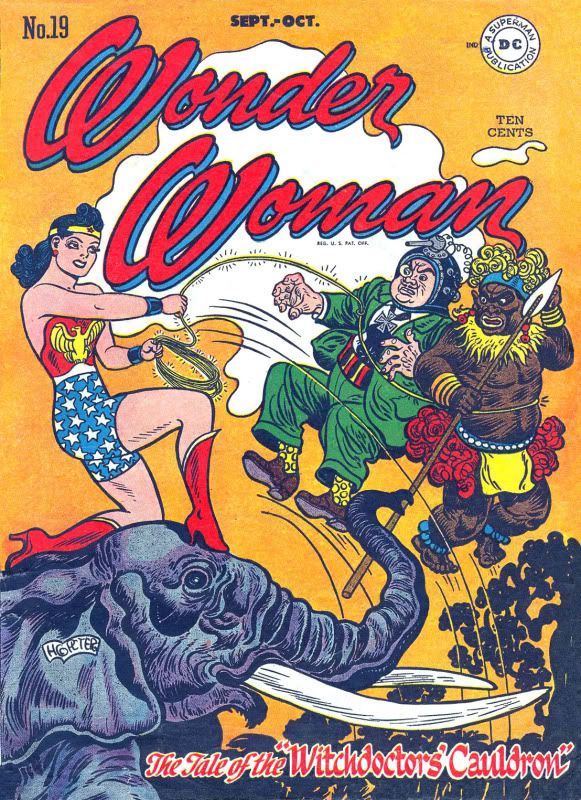
Bound to Blog: Wonder Woman #19 (Black and White and Startlingly Offensive All Over)

This is the first in a roundtable on race in comics titled Black and White and Startlingly Offensive All Over. It’s also the latest in a series of posts on the Marston/Peter run on Wonder Woman.

___________________________________

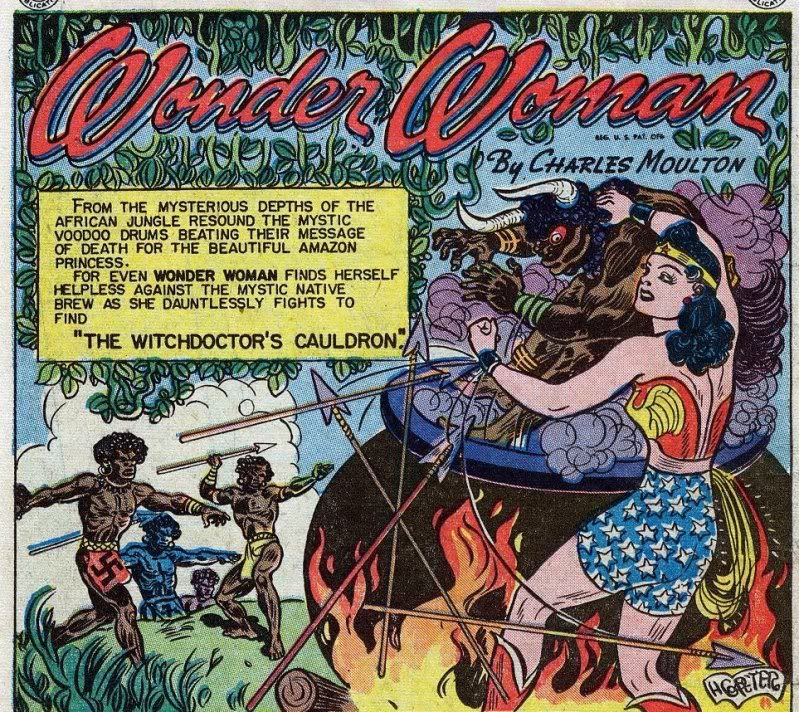
William Marston indulges in the occasional vicious asian or Jewish stereotype during his run on Wonder Woman. He doesn’t, however, tend to have many black characters. Wonder Woman 19, therefore, is something of a departure. But, as is their way, Marston and Peter make the most of it. Practically every comics creator from Herge to McCay to Crumb, has retailed offensive black stereotypes. But how many of them have done this?

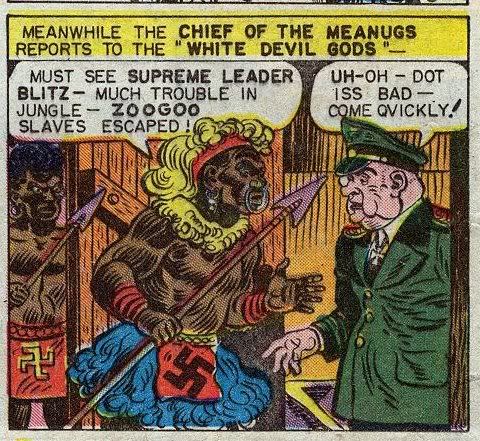
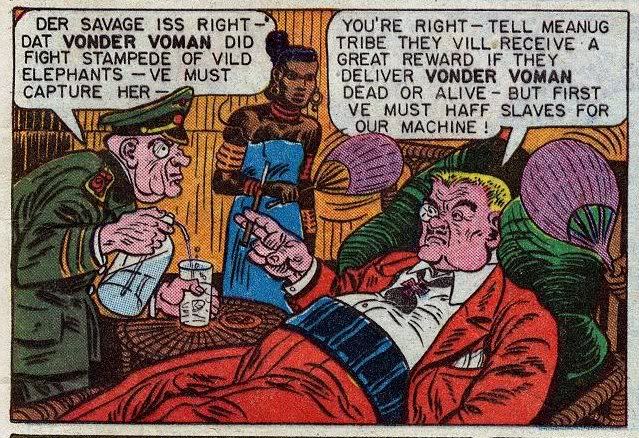
No, you’re not seeing things. Those are primitive African natives with swastika’s on their loincloths. The Nazis have allied with some evil natives, y’see, and the natives have, as a gesture of subservience, placed the Nazi symbol on their persons to demonstrate that they hold to the ideals of Hitler, including, presumably, the genocidal cleansing of both themselves and their entire continent. Really, it’s a kind of genius; the stereotypical, gibberish-spouting, African native has to be one of the most viscerally offensive images our quaint pictographs offer. You might think that there wasn’t really any way to take that and make it decidedly more vile. But I think Marston and Peter have managed it. Way to go, fellas.

I guess I could, at this point, go through the entire issue pointing out some of the more egregious incidents of racism — but I’m not sure there’s really a point, exactly. Marston and Peter buy every stereotype you’d imagine they’d buy. The natives think white people are gods; they have rhythm (Etta and the Holiday girls distract the natives by playing band music, because Africans can’t resist dancing when they hear indifferently-played college march tunes.) And, of course Africans are superstititious — WW mocks them for believing in voodoo, as opposed to in, I don’t know, invisible planes, (and, of course, voodoo is a syncretic New World phenomena, not based in Africa at all — though I guess maybe that’s pretty far down on the list of things to complain about at this point). In short, while Marston’s wackiness does shine through in certain ways (the swastika’s on the loincloths; his resolute refusal to sideline his slavery fetish no matter how hideously inappropriate it is in this particular context), he spends relatively less time on his own crackpottery and relatively more on the familiar crackpottery of racial prejudice.

In fact, in some ways the most surprising thing about this issue is not that Marston is a big old racist, but rather the extent to which he has to, or is willing to, compromise his own vision in order to accommodate that racism. As I’ve mentioned a time or two, Marston isn’t shy about indulging his obsessions. One of his standard plots/fantasy scenarios involves societies of more-or-less subhuman men paired with parallel societies of beautiful/enslaved women. I’m thinking particularly of the mole men (from Wonder Woman 4) and the Seal Men (from Wonder Woman 13).

Photobucket

marston wonder woman

In both of these stories, Marston uses the split between animalistic men/lovely women to work through his fetishes and his feminism. The bestial men enslave and dominate the women (which is fun, obviously); then the women turn the tables, conquer the men, dominate them, and make them fully human (because men can only reach their full potential when they’re ruled by women.) It’s a narrative near and dear to Marston’s kinky, kooky heart..

This issue of Wonder Woman initially seems like a perfect forum for him to break out those old tropes one more time. After all, the African men here are explicitly portrayed as animalistic:

Moreover, they are portrayed as almost exclusively male. When women are shown in the background, as here

they fit the standard Marston/Peter formula you’d expect; that is, they look more human and appealing than they’re bestial mates. There is even one panel where Marston toys with the idea of giving these women a more prominent (and dominant) role:

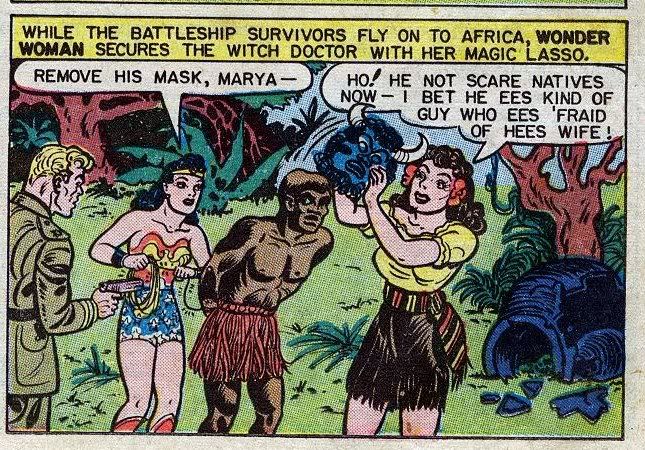
This comment denigrates the chief in some sense (suggesting he’s in thrall to his wife.) But within Marston’s framework, men are *supposed to* be dominated by their wives. In the normal course of a Marston story, this would be the moment to bring out that wife, and have her influence transform and save her mate, turning him not only into a good man, but into a human being.

But while that can work for Mole Men and Seal Men, it can’t work for Africans. Marston is chary about portraying African women with good reason. Women for him are always superior; Africans are, and have to remain, inferior. A major role for an African women in a Marston comic is, therefore, literally unthinkable — in the sense that he doesn’t seem to be able to think it. Not only his feminism, but his interest in gender politics seems to buckle under the pressure of his racism.

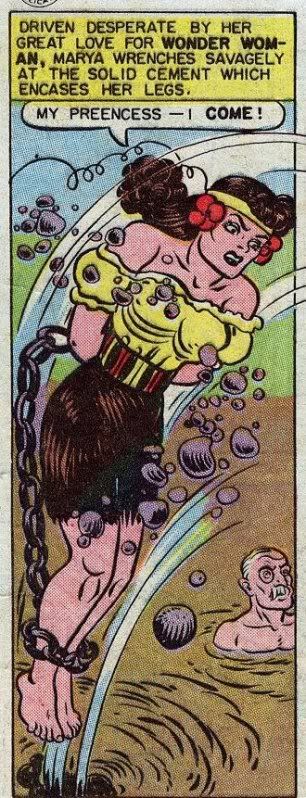
It’s perhaps interesting in this regard that WW #19 includes one of Marston’s most explicit elucidations of romantic female friendship. For most of the adventure, Wonder Woman is aided by Marya, a giant Mexican woman who idolizes WW, referring to her as “My preencess!” Trina Robbins summarizes this relationship nicely in her essay Wonder Woman: Lesbian or Dyke?

Another story deals with Marya, a beautiful eight foot tall “Mexican mountain girl,” who definitely has a crush on Wonder Woman. She calls Wonder Woman “brave princess” and “beautiful princess.” When the two women are captured in nets, Wonder Woman, ungraciously considering only her dumb blond “boyfriend,” Steve Trevor, tells her, “I’m sorry for you, Marya, but at least we’ve saved Steve…” Marya, with the selflessness of true love, replies, “I care not what happen to me if I help save your friend, Preencess!” Finally, Marya is encased in cement up to her chest. But when the amazon princess is about to be killed, “Driven desperate by her great love for Wonder Woman, Marya wrenches savagely at the solid cement which encases her legs.” Leaping from the cement she shouts, “My preencess — I come!” Finally, Wonder Woman freed and the villains vanquished, Wonder Woman declares, “The credit goes to the biggest girl and the bravest — my little friend Marya!” Marya kneels at the amazon’s feet, clutching her hand rapturously, saying, “Oh Preencess!”

Female-female relationships (bordering on, or more than bordering on, lesbianism) are important throughout Marston. But it seems telling that one of the most explicit appears in, and takes so much space in, this particular issue. It’s interesting too that Marya is essentially a white Latina marked as racially different (her size, her accent) and yet also as white (the “natives” call her white repeatedly.) It’s as if Marston started, say, the Seal Men story, suddenly realized he couldn’t run variations on his women-dominating-men fetish, and so instead backed-and-filled in order to run variations on his lesbian fetish.

The thing about the lesbian fetish, at least as represented here, is that it doesn’t have any political or social implications. The WW/Marya story is of personal friendship and love; in this case Marston doesn’t connect his fetishes to broader social ideals the way he does in the Seal Men and Mole Men stories. Marston can’t think of African women having power; therefore, though he can imagine individual examples of sisterhood, he can’t, in this particular comic, imagine a collective feminist movement. Marston’s racism, in other words, actually and actively gets in the way of his feminism. Reading this, I was reminded of the fate of numerous civil rights struggles after Reconstruction failed — basically, when the U.S. abandoned its commitment to equality for black people, it also abandoned its faith in social justice generally, with the result that women’s rights, for example, were set back for generations. This comic maybe provides an insight into why that might have been; to the extent that you don’t believe in equality, it becomes difficult to imagine, or to work for, equality.

_______________

Update: Again, the rest of the roundtable on race is here.

Utilitarian Review 11/1/09

Utilitarians Here

The big news this week is that sometime in the next couple of months HU is going to be moving over to TCJ.com. You can find more details at the link…but the short version is that the content will stay the same; only the URL will change.

This week started out with the third part of my discussion of comics, gender, and gayness.

Vom Marlowe expressed her surprised but enthusiastic affection for Marvel Adventures Spider-Man.

I had a more mixed reaction to the Giffen/Hamner revamp of Blue Beetle (check out comments for a dissent from popular and talented artist Gene Ha.

Richard sneered at Strange Tales and Wednesday Comics alike.

I claimed that Andy Helfer’s Malcolm X is better than Crumb’s Kafka.

Kinukitty praised Waning Moon despite the squicky boy in cat ears.

Vom Marlowe explained how librarians have made it easier to find graphic novels.

And finally this week’s music download featuring everyone from Bobby Gentry to Frost Like Ashes is up. If you missed last weeks shoegaze extravaganza, it’s still available here.

We’re getting started a smidge late this week, but tomorrow we’ll begin a roundtable on race in comics, featuring discussions of Marston’s Wonder Woman (of course), Lee/Kirby Fantastic Four, American Born Chinese, and more. The estimable Steven Grant will be guest-blogging as part of the roundtable…so check back throughout the week!

Utilitarians Everywhere

I have an article on Reason about the new movie, Men Who Stare At Goats.

It’s no secret that New Age mumbo-jumbo is the driving force behind every third Hollywood movie, from Field of Dreams to Fight Club to Star Wars. The Men Who Stare At Goats may begin by mocking this impulse, but it’s careful to leave itself an out: In the end, it never firmly declares that Lyn’s powers are bullshit. Indeed, if the movie begins with skepticism enlivened by a cutesy hedge of belief, it ends with full-on gullibility, gilded with an occasional patina of irony. Thus, in the climactic scene, army soldiers inadvertently tripping on LSD wander around harmlessly while guru Bill Django frees captured Iraqis from their torture chambers. As he flings open the door, he triumphantly declares “in the name of the New Earth Army and loving people everywhere, I’m liberating you!”

Again, if the analogy were to work, the freed Iraqis should instantly be shot—possibly by some of those tripping soldiers carrying guns.

My review of the 1950s Bill Monroe boxet from JSP is at Metropulse.

And my review of a 70s kraut novelty record, Dracula’s Music Cabaret is over at Madeloud.

Other Links
In response to my Comics in the Closet series, Gene Phillips makes an entertaining case for the gayness of Captain America.

Steven Grant has a nice discussion of the Comics Journal’s heydey in light of the recent announcement that it is going to a bi-annual format.

Andrew Sullivan has a really lovely piece on race in the U.S. from his British perspective.