Phallus Dei 5: Shambling On

Man Thing Part One;Man Thing Part Two;Man Thing Part Three; Man-Thing Part Four

________________

In his last post, Tucker refused to say anything about Man-Thing #3, preferring instead to talk about his experience caring for killer attack dogs. This was a wise move; I would rather hear about killer attack dogs than about Man-Thing #3. Nor do I want to hear about Man-Thing #4, in which we learn that Foolkiller has a tragic backstory. Even less do I want to discuss Man-Things 5 and 6, in which Steve Gerber introduces us to a sad clown, which is theoretically interesting, you see, because it is a clown who is sad, which is ironic. And also poignant. With a tragic backstory.

And yes, Man Thing #7 has a tragic backstory too. It’s the backstory of Man-Thing himself, actually. Remember, Man-Thing was once…a man! And in this issue renegade conquistadors slosh him with the water of life, causing him to almost remember his past, and to regrow one human hand. That’s kind of a squicky image….But you know, really, I look deep into my heart of hearts and…yeah, I still don’t care.

These comics suck. Not in an apocalyptic or interesting or surprising way; not in a way that’s even much fun to laugh at. They suck in a rote, boring way. They suck because Steve Gerber, like masses of other writers for television, stage, and screen, thinks the key to entertaining drama is pop psychology and predictable, feeble irony. If you’ve got a preacher, he’s got to be a hypocrite; if you’ve got a rich guy, he has to be a heartless bastard. If you’ve got a clown, he has to be sad. Put enough of these startling reversals together and you’ve got a story with a meaningful human moral. Add in suitably portentous contrivances (the sad clown is dead, but his ghost rises and makes a bunch of random passersby, including the oddly acquiescent Man-Thing, re-enact moments from his sad past) and maybe, if you’re lucky, somebody’ll even think you’re profound.

So there’s Steve Gerber for you; meaningful human morals and pretentions to profundity. Which would be fine, if Gerber had ever actually experienced a single thought about meaning or morals or, for that matter, humans. But he hasn’t. He’s got nothing to say, jack. He might as well be the mindless, shambling Man-Thing for all the brain activity you can detect in these pages. Calling a developer “F.A. Schist” is the sort of thing he passes off as clever. He’s the hectoring, droning drunk you can’t shut up, except he doesn’t even have that much character. The drunk at least tends to have a pungent urgency about him. Gerber manages to be bland even in his crankery.

It is frustrating that there are some indications (such as the Wundarr story that Gerber could write entertaining comics if he’d just chuck the serious messages and go for laughs. But what’s really annoying is that Man-Thing as a concept was originally pretty good. That first issue, and the seven-page Len Wein/Neil Adams follow-up really had something going for them. They were vicious and mean, built around revenge and senseless death and violence and bodily disfigurement. They even had good cheesecake. They were solid exploitation pulp, with some nifty ideas and whacky visuals. And Gerber took that and turned it into tired TV melodrama. All I can say is, fuck him.

I suppose I should talk about Mike Ploog now. Ploog did the art for Man-Thing 5, 6, and 7. He has a very strong reputation…but I have to say, I’m not exactly seeing what all the fuss is about. He tends to make Man-Thing thinner and more hunched. I think the ultimate result really is to make him cuter. I can’t really get worked up about it one way or the other, in any case. Ploog does have a talent for exaggerated faces, which is kind of balanced by the fact that his more ordinary faces tend to look awkward and unexpressive. Certainly, in terms of rendering and layout, he doesn’t seem anywhere near Gray Morrow’s level. If anything, I’d rate him slightly below Val Mayerik, the completely unheralded penciller who was doing Man-Thing before Ploog came on board.

I don’t know. I may be being overly harsh because I am thoroughly sick of this crap, and I’ve got what? twelve issues to go or something? Perhaps some titles were just never meant to be collected into big honking anthologies….

Update: More Tucker on Man-Thing Action!

Alan Moore’s purple prose

Through the corpse-orchard. Through the boneyards … Strange fruit brushes his cheeks. The skinless aristocrat of the cemeteries follows close behind, white head nodding, smiling, top hat fallen over one socket … Somewhere, a bird screams.


From Miracleman, when Mr. Cream is having a nightmare. The thing is, I like all that, and especially the description of the skeleton monster (“skinless aristocrat”), but I would tolerate it only in a comic book. There it’s okay. In regular prose, writing like this would make me groan. Oh, someone wants to show off! He can’t just say skeleton! And by “comic book,” I expect I mean mainstream comics, the sort put out in the world to entertain and make money. If a creator starts out as a presumptive artist and then gets into the purple, I want the creator to shut up. If the creator starts out as a working professional and then tries a few ambitious tricks and angles, I’ll wait to see how the tricks and angles play out. Of course, very often they crash to the ground. Moore wrote good purple prose, an effective purple, not like the endless wind of ’70s Marvel. Miracleman, at least in its first few issues, is one of the few Moore works with a caption-picture ratio of something like 1:1; the captions never go away for long, and they do a lot of talking. But they do a lot less talking than their counterparts in a typical Len Wein issue of Thor. Having made the choice to be verbal, Moore still avoids being verbose. The Marvel writers would flail about and imagine they had dreamed up gorgeousness. Moore goes ahead and gets the job done in a sentence or so, a phase. Even so, they’re very ripe sentences and phrases.
I’m not against fancy writing in general, though most often it goes wrong and, when it does, it produces a much worse stink than plain writing gone wrong. I guess what I look for are passages that produce all the wonderful things sought from fancy writing but without seeming to show off, which is a very subjective judgment. Moore’s captions definitely show off, but they’re on the same page as pictures of a guy in a weird costume, so somehow I give them a break — another subjective judgment. 
UPDATE:  All right, here are a couple of groaners. Miracleman’s wife gives birth:

Moments later the placenta slides out, a marvelous life-support system of glistening burgundy.

Oh, ha ha ha ha! 
Two aliens reminisce:

Once, near Antares, we copulated as whale-mollusks amidst the churning methane.

Ho ho ho ho.
Oh well, genius is prodigal. Moore’s got a million of them and, as Andrew “Dice” Clay was wont to say, they can’t all be golden.

Couple of Links

Ted Rall is fed up with Obama and says he should quit: “This guy makes Bill Clinton look like a paragon of integrity and follow-through.” It’s an op-ed piece, not a cartoon.

Via Matthew Yglesias, a blog titled Economics: Where Graphic Art Meets Dismal Science. Sample posts: “Alien Technology and Economic Growth: Lessons from Solow,” “Supernatural Disaster Insurance,” “Superman, New Krypton, and Labor Unions.” I didn’t read anything, just glanced. I assume there’s a lot of tongue-in-cheek going on, he said carefully.

Partially Congealed Pundit: Joe Audubon

Last week we had Johnny Monomyth; this wee it’s Joe Audubon. This is a one-page strip I did using manipulated clip art for Bert Stabler and David Heatley’s wonderful New Graphics Revival.

(The text is a little small, but if you click on it I think you should be able to read everything, except maybe where the little alien says, “Shucks.”)

joe audubon

The original was actually in color, though it appeared in black and white. So as an extra bonus:

Photobucket

Gluey Tart: The Dawn Of Love

Photobucket

The Dawn Of Love, by Kazuho Hirokawa
November 2008, Digital Manga Publishing

I had one of those moments, when I saw this on the shelf. I often go trolling for yaoi, and I’m often disappointed. But every once in a while, I spot a cover that makes me suck in my breath and pause a moment, building the anticipation. Is this going to look as good when I pick it up? Flip through it? I sort of circle the book for a moment, glancing at other titles, trying not to rush the moment. Flirting with it. Then I pick it up and find out if it’s love or what.

Different things attract me. Sometimes it’s the design; sometimes it’s the art. Pretty colors, even. (I’m just a magpie of a yaoi enthusiast.) Maybe a combination thereof. When I saw The Dawn Of Love, I laughed out loud. It’s the gayest looking cover I have ever seen. Really. Look at it. Oh, wait; you need to see the back, too.

dawn of love

ZOMG, as they say. Big, pink flowers, frilly clothes – and, holy shit, a pink velvet suit! – classic romance novel pose, pink nail polish. So gay! I was delighted. Delighted, I tell you. I didn’t even look at the plot synopsis – I didn’t care. It’s not like I wanted to discuss string theory with it, right? I am capable of being incredibly superficial in cases like this, and after staring at the cover of this book for a few seconds, I was ready to buy it a drink and take it home.

Or to a love hotel, which would be appropriate for this title, since there’s a lot of sex, and almost all of it happens in love hotels. That’s significant to the plot, by the way. The author’s notes include this adorable bit: “Unbelievably, [the main characters] spend 45% of the time naked! The story still manages to progress somehow, thanks to these two characters, the love hotel guidebook I obtained several years ago, and my photo-illustrated manual of sexual positions, The Shijuhatte.” (The Shijuhatte, known as the Japanese Kama Sutra, is a trip by itself – there’s a Japanese version you can browse on your cell phone, but for English speakers, this NOT EVEN REMOTELY WORKSAFE but strangely hilarious site will, er, fill you in.) Anyway, there’s a lot of sex in this manga. A lot. Well-drawn sex, in my opinion. And lots of it. All in service of the plot, mind you. (That was a little joke there. Get it? Service?)

There is a plot, really. Masahiro, who’s a goofball, but studly, falls head over heels for Takane, who’s a man-slut, but – well, that’s all. It must be the perm. He’s appealing, no doubt about it, but we don’t find out a lot about why someone would fall so hard for him. No matter! Masahiro has enough personality for both of them, and Takane does eventually come around (presumably that isn’t really a spoiler; for the love of God, look at the cover!). The characters really are endearing, in part because their faces are so expressive. Kirokawa really has a knack for capturing broad swathes of emotion and telling little nuances.

dawn of love

Within the first few pages, Masahiro convinces Takane to have sex with him. (How? He asks.) After being with Takane once, Masahiro decides he must have him, and Takane agrees to be more than casual “sex friends” if Masahiro can keep him entertained for an entire week. Masahiro is up for the challenge, and his condition, upon winning his prize, is that Takane kiss off the rest of the guys he’s been seeing. Complications ensue. Complications are resolved. It’s satisfying. Masahiro and Takane sail off into the big gay romantic sunset. Happy sigh. (And suddenly I’m thinking of that Lemonheads song from the ’90s – “Big Gay Heart.” I like that song.)

dawn of love

You can’t really tell from the plot synopsis, but this manga is full-on charming. Takane is sultry and comes across as a free spirit. Masahiro is kind of an idiot savant. He’s loud and profane and kind of embarrassing, but he understands about love, and he’s arrogant, self-assured, and smart enough to make Takane understand, as well. His asides are the kind of thing that usually make me wince – and I did wince a few times, but I always laughed. Maybe I’m more in touch with my inner Kiss t-shirt wearing 13-year-old boy than I should be, but “relieve my errant wood” cracks me up. And “But your wiener’s pretty good, too, right?” “Of course! Another guy could never beat my wiener!” I mean, it’s painful, but it also made me laugh so hard my coffee came out through my nose. (Beat my wiener. Heh.)

dawn of love

dawn of love

There’s also an older story, “A Flower Awaits Summer.” The art is much less subtle (in the author’s notes, Hirokawa laments this: “Why? Why are the lines so thick, me of three years ago?!”). It’s still cute, though, and those expressive faces are already in evidence. The theme is not drastically different from that of the main story – a younger man who’s afraid of being hurt is convinced to give love a chance. (In the main story, which is rather nuanced, strange as that might sound, the one who needs convincing needs convincing because he’s never been in love and doesn’t understand what it means.) It’s short and sweet, despite the thickness of the lines.

dawn of love

Romantic sex. Sexy romance. Character development. Happy endings. Lots and lots of flowers. Wee!

dawn of love

Bound to Blog: Wonder Woman #9

wonder woman

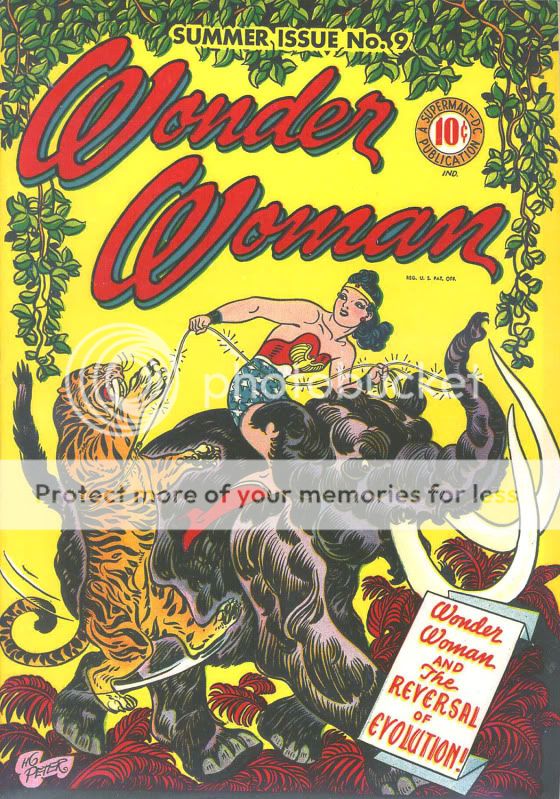
Another Peter animal cover. I really can’t get enough of those.

This issue is insane. I mean, sure, you could say that about every issue I guess…but this one really goes the extra mile of nuttiness.

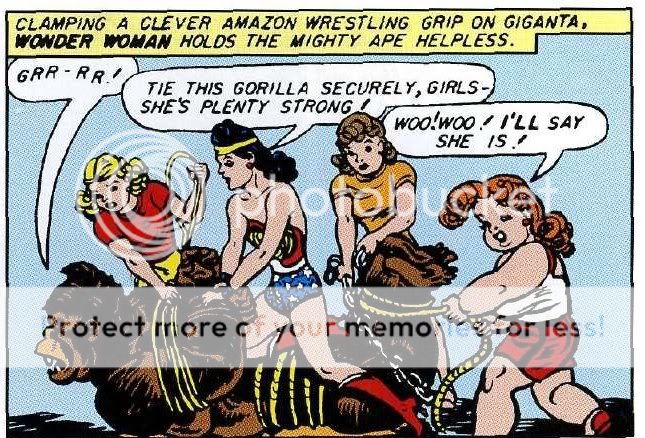
I mean: gorilla bondage.
wonder woman

Need I say more?

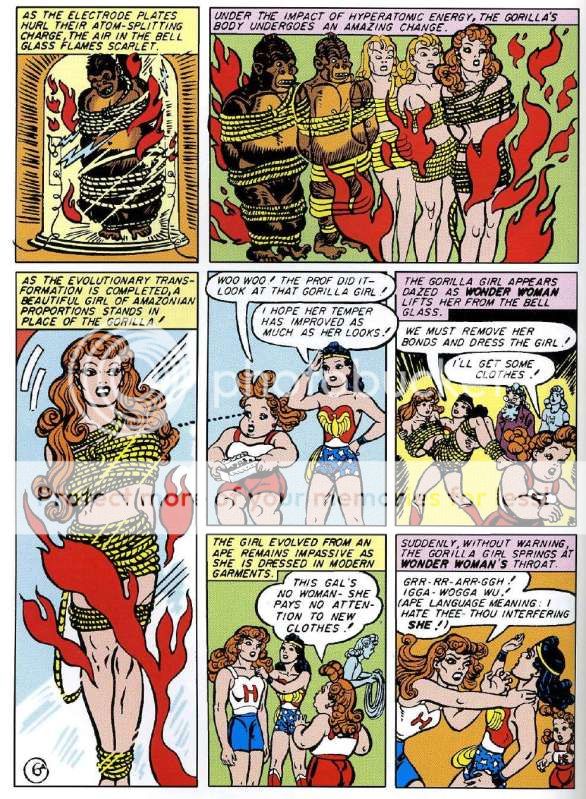
All right; so the plot, such as it is, is that Professor Zool of Holiday College has invented an evolution machine, which he pithily calls “The Evolutionizer.” He gives it a test run on a convenient rogue gorilla:
wonder woman

This is the first issue, I think, where Peter’s layouts start to loosen up a little; and the effect is really impressive. That big panel shot of the gorilla woman with the stylized flames, naked except for the rope — I bet Marston studied that carefully. Peter emphasizes the voyeuristic aspect too in the next panel, where Etta’s so impressed that her line of sight busts through the panel borders, and WW seems a bit lascivious as well.

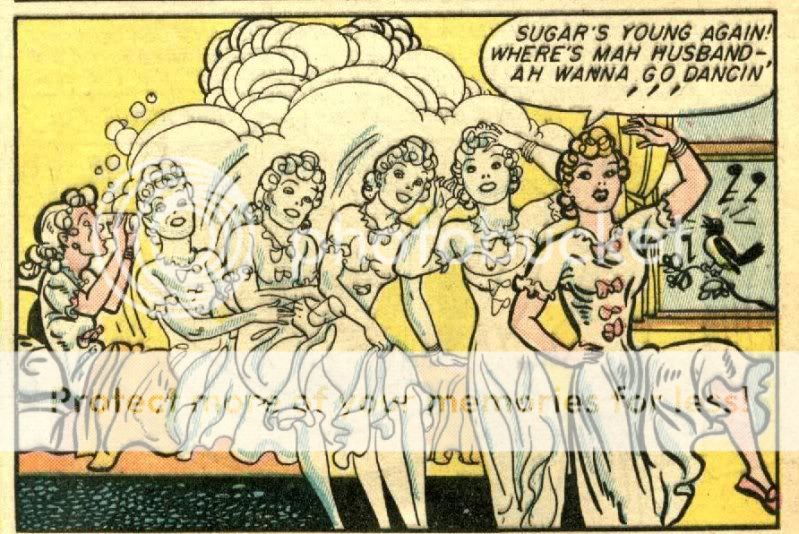
Maybe even more striking, though, is that image at the top of the gorilla evolving. It recalls this image from #7:
Photobucket

I’ve talked a lot over these posts about the relationship between Marston’s fetishes and his feminism. I think there’s obviously a connection there between his fetishes and his utopianism as well. The idea of people, and particularly women, becoming more evolved or perfected is exciting to him…and yes, he thinks turning a gorilla into a human is really hot. I think there’s some sense that he’s thrilling to the idea of a women retaining animalistic characteristics, which is a fairly standard issue fetish (just think Tigra.) But I think it’s also exciting because of the control aspect; the sense of seeing someone change and directing the change. Sociological and psychological liberal do-gooding turns him on.

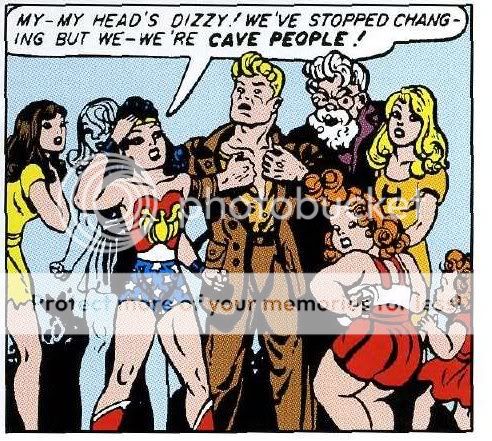
Though devolving is fun too.
wonder woman

Steve pulling open his shirt as he turns into Neanderthal Steve is fairly priceless, as is Etta posing like a semi-monkey person.

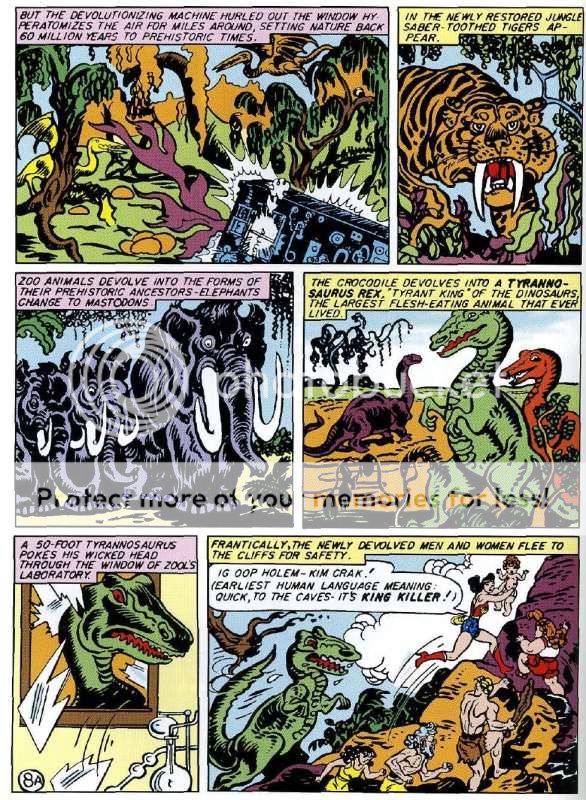
And, hey, WW throws the devolver out the window, and that means everyone can get in on the act…as the entire world (or just the immediate neighborhood? It’s kind of unclear….) is sent back to the past, where we’ve got some beautiful prehistoric fauna for Peter to draw the heck out of:
Photobucket

And how about this:

wonder woman

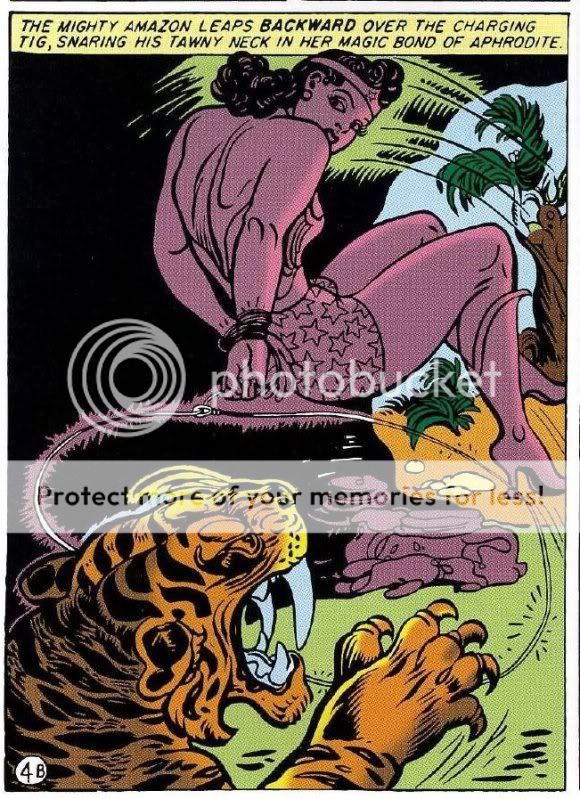
Yes, you got that right, kiddies; that is Wonder Woman lassoing a tiger backwards with her hands tied behind her back. I’m sorry, but that is fucking bad ass. Peter gives the image what is I think his biggest non-splash panel so far in the series, and it so deserves it. In the first place, the color balance is lovely; making WW a uniform grey really makes the tiger pop.  And the tiger itself is unreal; cutting it off at the edge like that makes it appear enormous, and I love the paw; all misshapen bulging knuckles and giant claws. I am in general a fan of Peter’s shoulder-blades and back muscles, and he uses them to fine effect here. Most of all, though, WW’s expression just perfect as she peers over her shoulder. She’s not worried, not even all that intent, just kind of blasé, with that little Elvis sneer, because hell, she lassoes tigers backwards all the time.

Obviously, this is more off the cuff than Alan Moore’s Rorschach stunts or even than Frank Miller’s Dark Knight why-do-I-wear-a-target-on-my-chest, but it has some of the same “holy shit!” pulp cool about it. It’s not something Marston and Peter generally manage, or even try for in quite this way, but they do nail it here.

Did I mention it’s really hot, too? Or have I just been reading too many of these things?

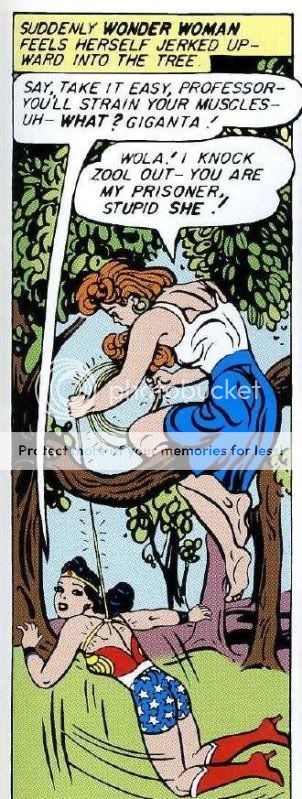
Anyway, speaking of inappropriate interests, back in the evolutionary past there are — what do you know? — evil masculine tree people who like to tie women up. Giganta (that’s the gorilla-turned-woman) learns a trick or two from them and…well, you know what happens.
wonder woman

That’s a superb panel too. It’s the linework on Giganta’s dress, and the way she’s hunched and her crossed legs, and that tree just underneath her in the background, that looks like it was scribbled by a child.

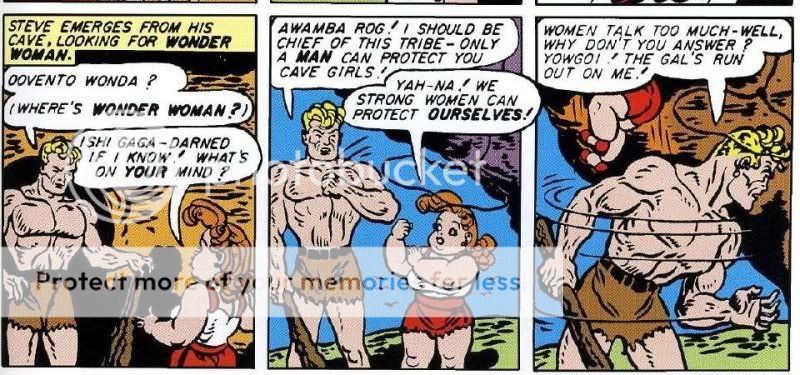
Even beyond catering to his usual fetishes, though, Marston is clearly having a blast and a half; the devolution gives him and Peter an opportunity to dabble in some broad slapstick….
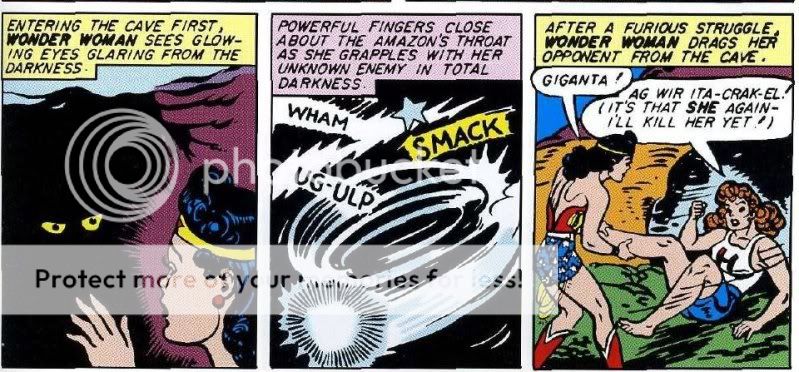
wonder woman

wonder woman

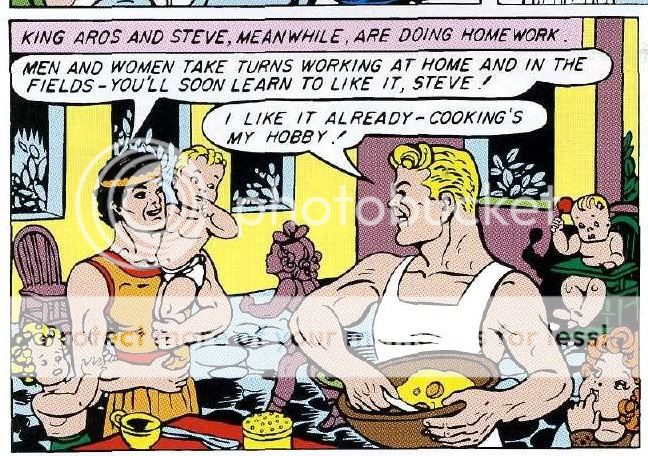
As you can see in that second example, Peter delights in having the characters talk in a ridiculous pidgin caveman dialect. He also, and a little uncharacteristically, decides to mock both ends of the gender war. Etta claims women are strong enough to care for themselvs; Steve says women need men to protect them; both have their pretentions to competence slapped down with vaudeville aplomb. (Though, of course, in the end women win, since it’s WW who saves the day.)

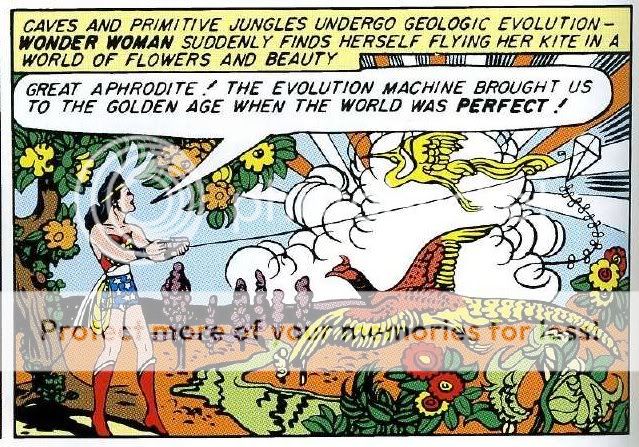
Anyway, eventually they re-evolve, though not all the way. Instead of getting to modern times, they end up in — well, let WW tell you:
wonder woman

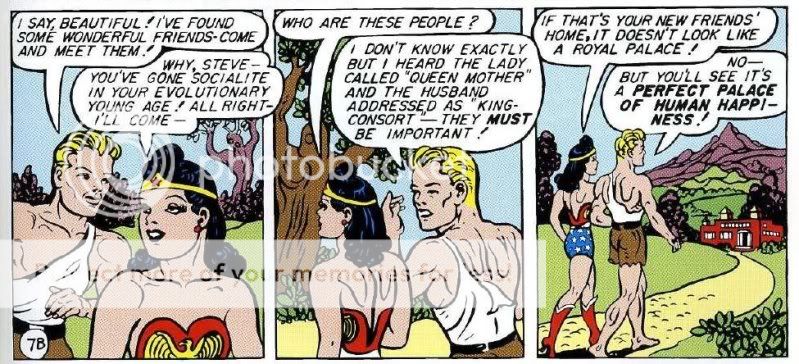
Yes, it’s the evolutionary golden age when everything was perfect. The sun always shines, birds flit about, the rich live in hovels because they’ve given all their goods to the poor, Etta loses weight, and Steve is transformed into a bishonen Edwardian metrosexual.
Photobucket.

It’s hard to know exactly what Marston is thinking here. Surely his grasp of history isn’t this poor, right? I said right?

Be that as it may, I assume this era he’s talking about is supposed to be the much-vaunted but probably entirely fictitious anthropological matriarchal age. In any case, the golden age is, of course, ruled over by women, who are wise and good, but who, unfortunately, don’t yet understand the joys of forcible restraint.
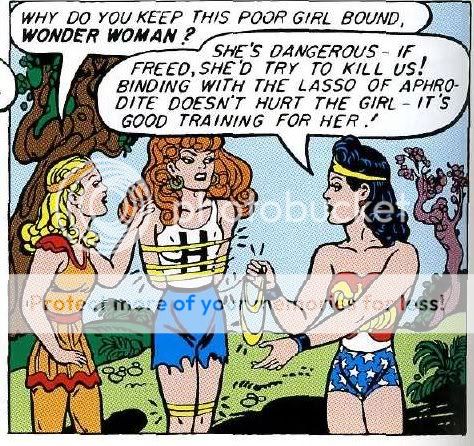
wonder woman

So Giganta gets free and wreaks havok, the upshot of which is that men decide they want to rule instead of women, on the grounds that men are stronger than women. So WW beats the tar out of the lead male guy who has a caveman forehead. However, that doesn’t quite settle things:
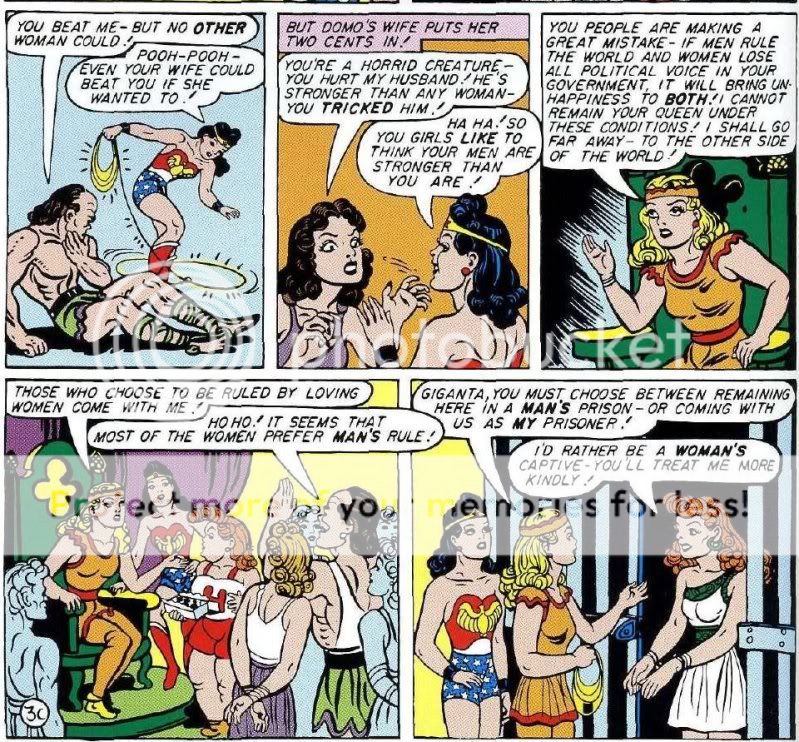
wonder woman

For Marston, women are actually stronger than men, but they like to pretend that men are stronger, presumably for romantic/sexual reasons.

From a feminist perspective, you can see where this might be maybe a problematic position. On the one hand, Marston is claiming women are superior (even in physical strength.) On the other, he seems to be arguing that their oppression is their fault.

There’s an article I stumbled on over at the League of Substitute Super-heroes (I couldn’t find the author’s name) which goes off on this point:

On a more complex level, Marston was not a feminist because he believed women were the keepers of men through their sexuality. Ignoring the rampant heterosexism in such an idea (not to mention the disturbing idea of blaming others as an entire group for the behaviours of other individuals or groups) making women responsible for men’s problems is a trait Marston shares with most misogynists, whether they are the Promise Keepers, backlash “Femme-Puppets” 2 or even the religious wowsers who would be deeply opposed to Marston and his lifestyle if the man was alive today. He believed that, “Normal men retain their childish longing for a woman to mother them” and that “[a] woman’s charm is the one bond that can be made strong enough to hold a man against all logic, common sense, or counterattack.” This is a dangerous position to hold in regards to gender relations, though in Marston’s case, one probably borne more out of ignorance and privilege than outright malice. To come out in the 21st century and tell a domestic abuse victim that all she needs to do is use her “feminine allure” more on her husband is mind-boggling, but from Marston’s point-of-view, it would be the chosen response. Never mind that victim-blame is the great feeder of the mentality that causes most domestic violence and gender-related violence in society. The manifestation of this attitude in the Wonder Woman comic series was the tokenism of Steve Trevor, always being “rescued” by his girlfriend, much the same way as Lois is always caught by Clark after plummeting through the air for a bit as she is so often found doing. Both cliches are two sides of the same misogynistic coin.

As I said, there’s definitely something to that. But on the other hand…I mean, Marston seems to be suggesting, at least in this comics sequence, that domestic abuse victims should slug their husbands and tie them up…which maybe wouldn’t work ideally either, but isn’t quite as squicky, at least (or differently squicky, anyway). In addition, a big part of the point here really seems to be an argument about false consciousness. That is, Marston identifies the problem as women downrating themselves (for whatever reason); he wants women to realize that they’re as good as men, or better than men. And he’s also got a very explicit statement that women need to have political power for everyone’s sake…which was the argument women used towards the beginning of the century when they were trying to get the vote (women’s vote was supposed to abrogate a number of moral evils, including drink — temperance and suffrage were closely linked.)

I actually think that claiming women are morally superior to men is a really problematic strategy for feminism — I don’t think it’s true, for one thing, and the distance between rhetoric and reality can be painful. The suffragette movement in England, for example, ended in unhappy success; they did get the vote, but he social transformation they promised because of that didn’t happen, which caused a fair amount of bitterness within the movement. Though, on the other hand, the promise of moral rejuvenation was an effective one in rallying groups who might not otherwise have been interested in women’s political fortunes…basically, all radical movements have to overpromise if they’re going to succeed.

Feminism, or any movement for oppressed people, has always got a tension around the issue of victimization. On the one hand, of course, you need to point out that you are victimized, and emphasize the injustice and how it needs to be changed. On the other hand, nobody likes to see themselves as a victim, and if you emphasize victimization too much, you can end up arguing that your oppression has essentially broken you and made you incapable of equality (this is what happened to slaves following the Revolution; the argument about oppression ended up being used against them; it was claimed they “weren’t ready” for freedom, an argument which was used to justify another hundred years of oppression.) So you need to have a positive vision too; you need to say “Black is Beautiful,” or women are moral beacons, or whatever — you have to say that your particular experience or essence is valuable. But if you go too far in this direction, then it becomes unclear what you’re complaining about, exactly…if oppression hasn’t harmed you, if you’re better off than your oppressors, then why should the oppressors even consider themselves oppressors?

So, yes, Marston is pretty far out on one end of that debate, and it causes real problems when he tries to analyze oppression. And it’s worth pointing that out. But on the other hand, what he really sees himself doing in WW, I think, is encouraging girls to value themselves, and I think that, you know, that’s probably a worthwhile goal as well. Improving self-esteem in girls could even have positive effects on domestic abuse statistics down the road, at least arguably.

Also, I have to say, Steve being rescued by a woman is pretty different than Lois being rescued all the time by Superman. The essence of sexism is disproportion. It means something different to have genre conventions fulfilled (by having a man rescue a woman) and to violate them (by having a woman rescue a man.)

And, anyway, Steve isn’t always rescued by his girlfriend. Sometimes Etta rescues him.

Well, I’ve nattered on kind of endlessly. Let’s finish up; everyone eventually evolve all the way up to ancient Greece, at which point Wonder Woman meets her mom before she (WW) was born, which is sweet, I think. Also, Steve is hunted as a husband by hordes of rope-wielding Amazons.
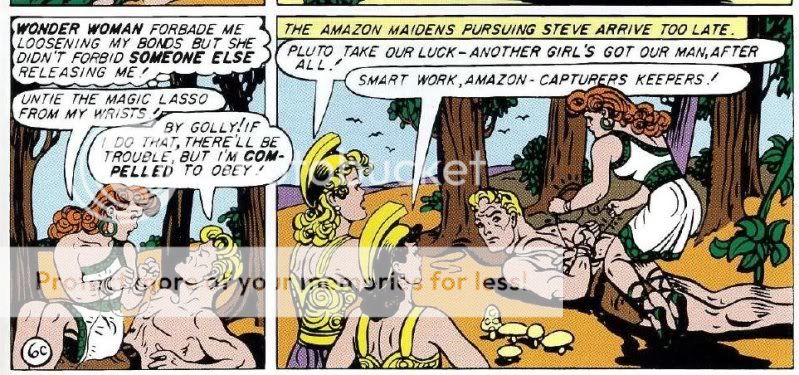
wonder woman

I like Giganta’s reasoning there, too; masochists love legalistic loopholes in their bondage contracts. Or that’s what Deleuze tells me.

Oh yeah, and Wonder Woman fights Achilles and beats him. And then she unties Steve:
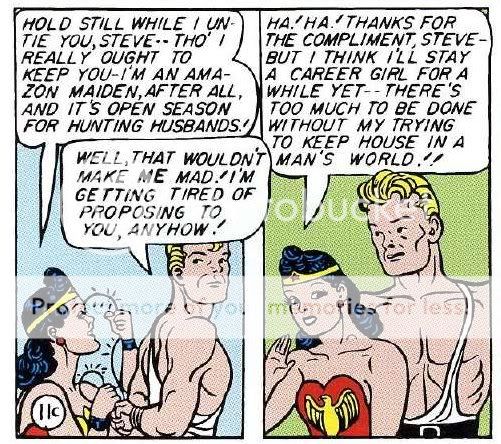
wonder woman

That’s a cute, sexy little flirtation: I can almost see there why one commenter on an earlier post said that Steve and WW actually seem to like each other. Though, of course, the punch line is that you can’t both save the world and get married. That’ll show me for defending Marston’s feminist bona-fides, I guess. Did he really believe that wives needed to stay home and tend to their husbands? On the one hand, both his wife and their mistress worked at various points. On the other hand; his female President in WW#7 and his female ruler in this issue both appeared to be unmarried. I guess when you’re married you need to keep your husband in line full time; it’s only when you’re not tied down to one guy that you can go off and rule them all. Though the mole men seemed to eventually agree to some sort of collective government by their wives…. And his golden era includes a proviso that men and women divide work in and out of the home equally….
wonder woman

In any case, I’ll try to pay a little more attention to Marston’s views on marriage in the issues I’ve got left — only 19 to go….