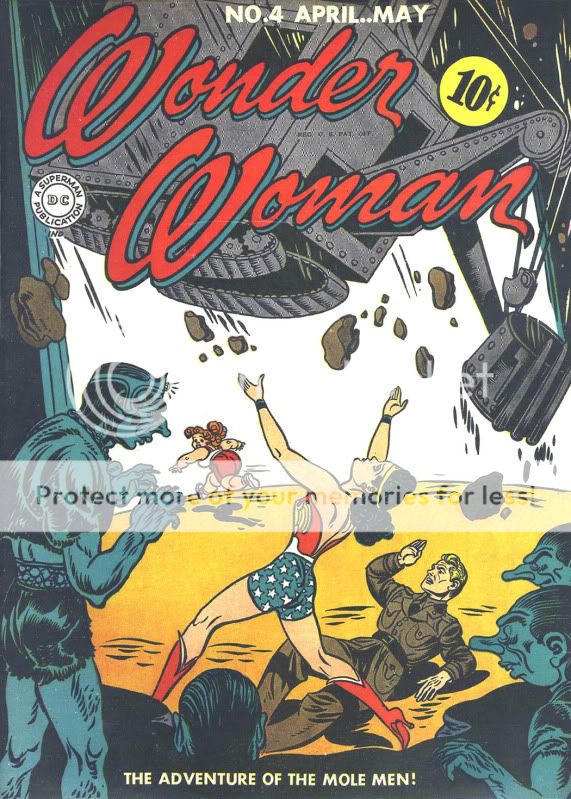
Not sure anyone but diehards are reading this at this point…but in case you’re new, I’m blogging my way through the entire original Marston/Peter run on Wonder Woman. We’re up to issue 4. And here’s the cover….
I’d sort of hoped to see the last of Baroness Paula Von Gunther last issue when she pulled a Bleak House and got her ugly mug replaced. I’m not that interested in her, and she’s always involved in espionage plots, which aren’t necessarily my favorite Marston efforts. No luck, though; she’s back for this entire issue apparently, being subjected to a series of tests by Aphrodite to prove that she’s sufficiently submissive or dominant or good or some combination of all three. And sure enough, the first story is pretty underwhelming. I mean, oh sure, you’ve got hot Chinese girls showing off their whip scars….
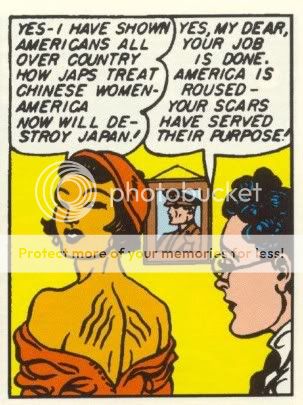
and hot Chinese girls showing off their whip scars
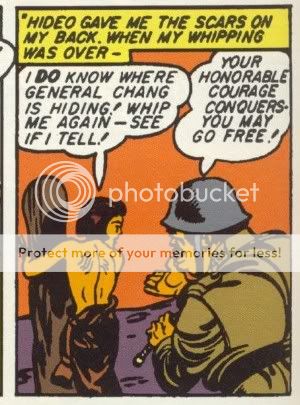
and then there’s the hot Chinese girls showing off their whip scars
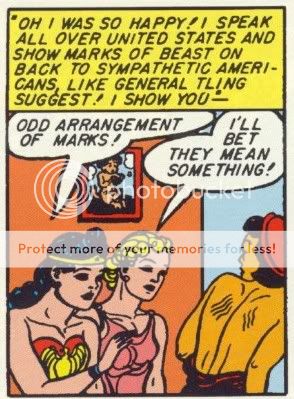
And there’s also hot Amazon on Amazon action with some poorly motivated competition involving catching each other with ropes, and then there’s the girls attached to weird rejuvenation machines (Paula invents one, everyone having apparently forgotten that WW invented one in issue #1). Also some really nasty Japanese caricatures. But most of it’s pretty familiar by now, and there aren’t any deer costumes or anything to push it over the edge into utter jaw-dropping WTF absurdity. Except maybe for the Japanese gnats that bite women and cause them to attack men.
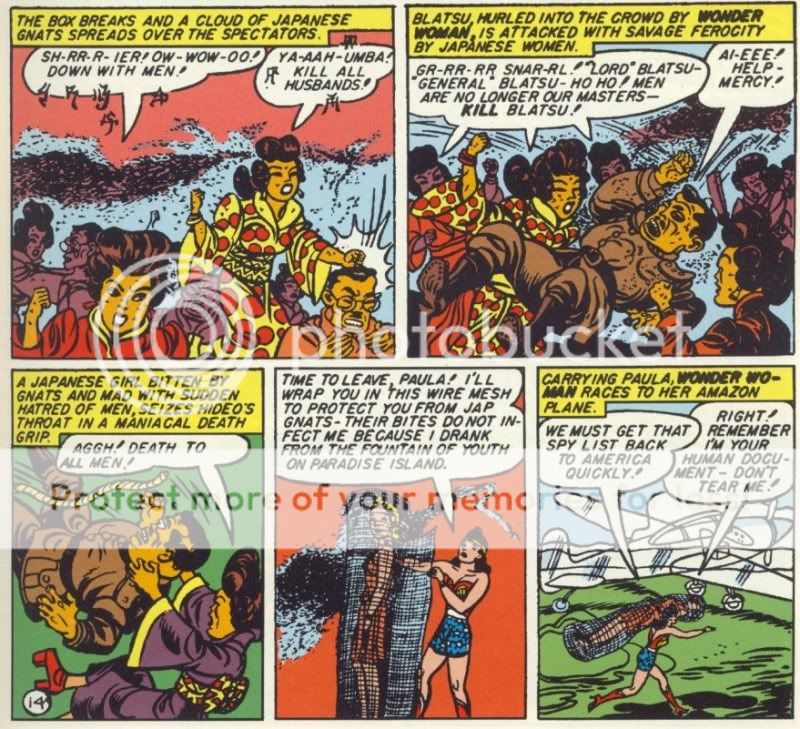
That’s pretty crazy. But even there….I don’t know, I was hoping for more than just a couple of panels of murderous women…and kind of hoping to see WW herself flip out. But doesn’t happen; she’s drunk from the fountain of youth on Paradise Island, you see, which apparently gives you immunity to rabid gnats. Those Amazons think of everything.
The next sotry, though, is more like it. Instead of espionage, we’ve got a mysterious race of mole men lurking under Holiday College. Of course, the Mole Men keep herds of chained and semi-willing female slaves tied up in their underground kingdom. Though the mole men are blind from their long time in the dark, they keep track of their slaves by covering them with special paint that emits ultraviolet rays which can penetrate the mole men’s sealed eyelids. Amidst a subterranean performance by the Holiday College band, WW and Paula free the female slaves, and then perform non-consensual surgery on all the mole men, restoring their sight. Now that they’re able to see the beauty that is women, they become all submissive, and beg their former slaves to take command of them. Happy endings all round.
In their own bizarre way, the WW comics are definitely part of a tradition of children’s fantasy literature. Underground kingdoms show up in many classics — Journey to the Center of the Earth obviously, but a a more likely precursor in terms of trippy oddness might be L. Frank Baum’s Dorothy and the Wizard in Oz. (not “of Oz”; this one involves them wandering in the underworld beneath Oz.) In one panel, Paula says as she drops and drops, “this is like a dream of falling,” which seems like it has to be a deliberate nod to Carroll. There are several other similar scenes as well….
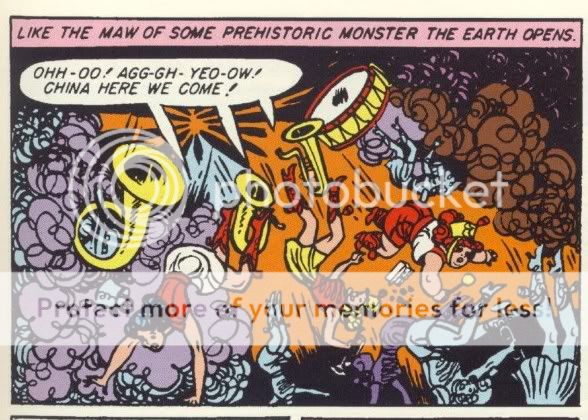
I love that drawing, especially; Parker’s scribbly curls of smoke setting off the elegantly controlled lines of the tuba and Peter’s characteristically stiff figure drawing. I like the way the smoke opening up in the off-center middle gives the sense of a great deal of space just out of vision; it’s almost like you’re seeing a small segment of an infinite universe of plummeting co-eds. There’s a touch of Winsor McCay, if McCay were, say, 10 years old. And horny.
Because, and to no surprise, Parker’s evocation of childish scribblies is matched by prepubescent eroticism. Dropping through space, the girls unconsciously assume the position; bent over, butt high, or even just legs pointing straight up, face obscured. The helplessness of falling is definitely fetishized, even more so here:
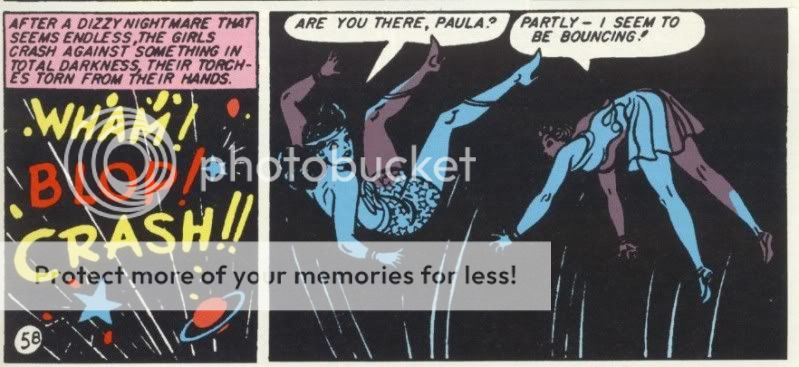
Cartoony cartoony sound effects give way to bouncing about helplessly in the dark, with Paula unconsciously pointing her posterior towards the camera. (They’re bouncing on a taut fabric held held by numerous women — kind of the adventure version of a sleepover pillow fight.)
I guess one could say that Marston and Peter are perverting the Alice story…but it might be closer to the truth to say that they’re explicating a perversion that was already there. Lewis Carroll had his own sexual interests (though they were probably less kinky than Marston’s) and you don’t have to read “Lost Girls” to pick up tinges of polymorphous pleasures in Alice. Falling into holes, “Eat Me!”, “Drink Me!”, flesh stretching and twisting and elongating…. I know, at least, when I was a kid, I found John Teniel’s illustrations of Alice growing and telescoping to be oddly suggestive. Same with the various weird bodies described in “Dorothy and the Wizard in Oz” — in fact, truth to tell, I don’t remember a ton from that book except the sense of bizarrely sublimated bodies wandering through a subterranean landscape.
There’s at least some literature on the link between the fantasy genre and masochistic fantasy. A bit back I read a 1923 essay by Anna Freud called “Beating Fantasies and Daydreams”; she was talking about a 15-year old girl who had early masturbatory beating fantasies which were elaborated into an extensive fantasy life with a whole cast of characters, a complex history, multiple scenarios that she’d go back into and tweak or revise or rethink. She called the stories “nice stories” because they weren’t explicitly sexual, but she came to see them as springing from that original primal beating fantasy; as being inherently masochistic. (And a quick search of the web reveals that the girl was not in fact an anonymous girl, as she claimed, but rather Anna Freud herself.)
I think masochism generates, and thrives on stories; on pretending or adopting different power relations — let’s pretend you control me, or that you are going to hurt me. Those stories are often as much the object of fetishization as the masochistic acts themselves (which is what I was getting at in this post.). Certainly for Marston’s narratives seem to be both fantasies and fantasies, as it were, and I suspect that this is the reason that WW’s origin story isn’t as elegant a some other heroes, like Superman, Spiderman, Batman, etc. Tom suggests it’s because Marston had trouble imagining powerful women but I think it’s more likely that Marston had a stake in complicated stories — stories particularly with lots of characters, lots of relationships, and lots of power reversals. (And I think the “lots of relationships” part, at least, is actually often typical of genre literature aimed at girls, as opposed to more solitary-hero literature aimed at boys. But I digress….)
You can see some of what I mean when I say “the narrative is a fetish” by looking at how Marston uses it didactically. That is, Marston actually spends a lot of time essentially providing instructions about being a strong/good woman. Women must always trust their strength:
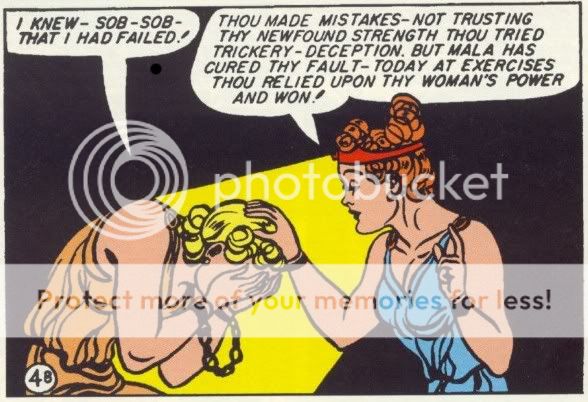
They must have a strong self-image (and you can find out whether they do by using a machine which reveals their subconscious thoughts…because involuntary confession is healthy…and stimulating!)
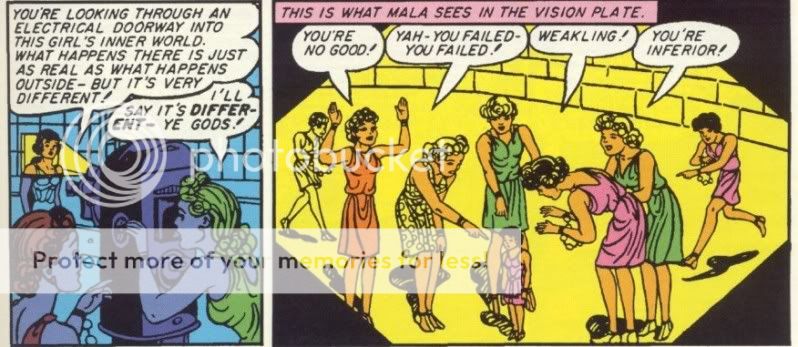
(This is from the third story, where we also get to see the subconscious image of themselves that men have, incidentally. Here’s one representative example:
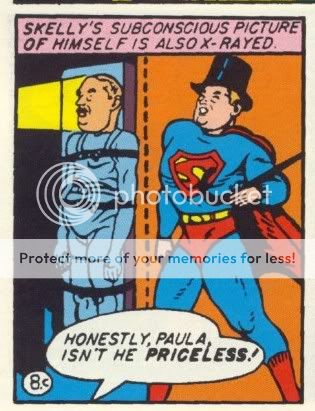
Hey! Is that Mort Weisinger?)
Sorry about the detour. Back to instructions for healthy young women: they should carry themselves like queens not slaves.
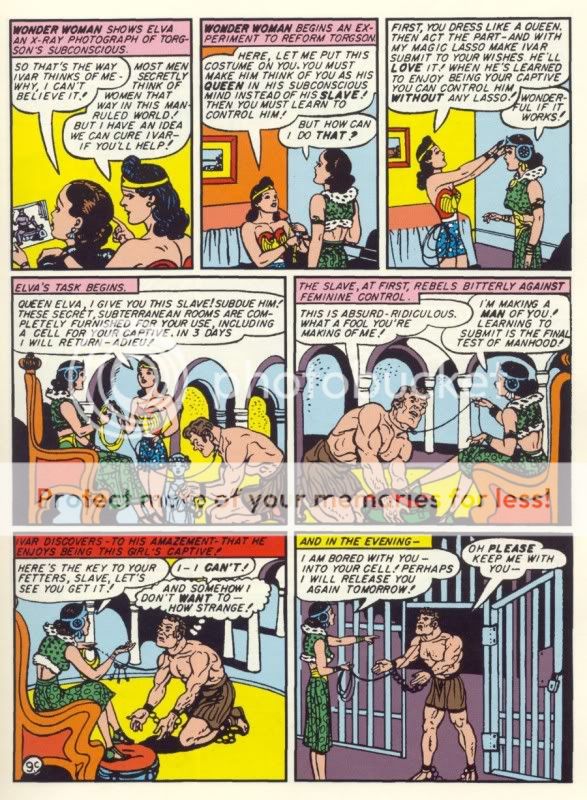
And they must never, ever abandon the scenario or…disaster!
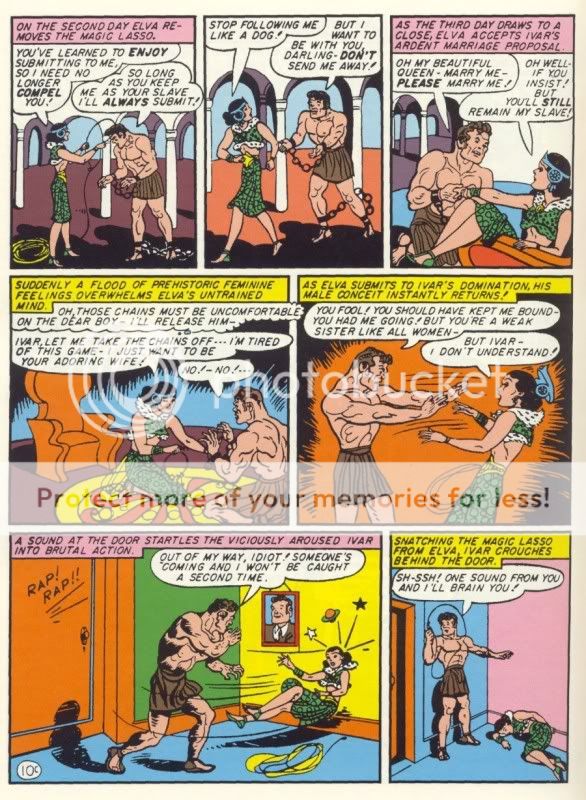
Similarly, you must never deny responsibility or turn away from authority; woman need to accept their mothering, reforming role even if it means burning their images into the brains of unprepossessing middle-aged idiots
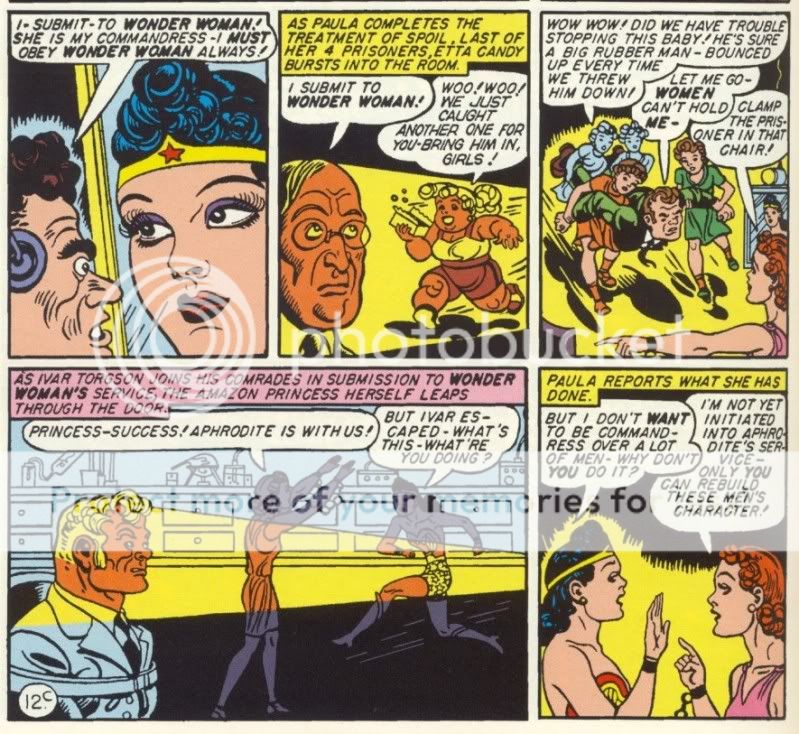
Or even if it means arbitrarily deciding to keep folks in non-consensual slavery
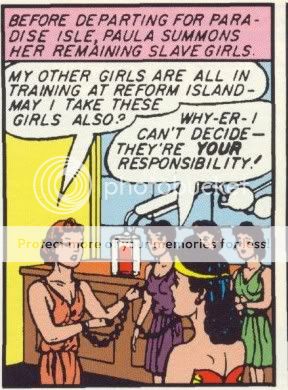
because if you shirk authority, Aphrodite will reprimand you:
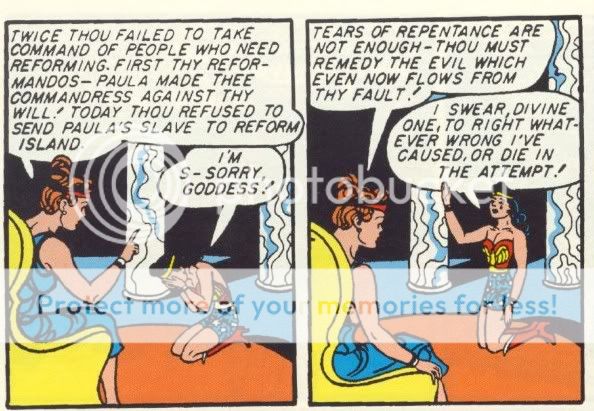
(I think I’ve mentioned before how much I like Peter’s use of scale. WW is here drawn way smaller than perspective calls for, which emphasizes her vulnerability and submission. He does that sort of thing all the time.)
The point here is that the instructions are all basically narrative in nature; they’re about telling stories correctly, or participating in role-playing in the correct way. And, of course, these instructions are themselves part of the story; correction and instruction is itself part of masochistic fetishization. This is part of the reason that Marston’s moralizing instructions never feel tacked on or like gratuitous pandering to the condescending uplift view of the role of children’s literature. The instructions for living he provides are integrated, idiosyncratic, and charged; they’re clearly as much the point for him as are the fight scenes, or the bondage scenes.
It’s also why when it’s on, WW has a a fetishistic frisson between form and content which is like little else in comics. I’ve compared the series to Henry Darger before, and I think looking to outsider art makes a lot of sense; there’s an obsessive pleasure in the craft — the storytelling and I think the art as well — which is echoed in the obsessive pleasure in the content in such a way that the two are almost inseparable, reinforcing each other in a kind of cascade.
To go back to the mole man story…details are piled on details in a way that seems almost random and certainly excessive (as fetishes tend to be excessive.) Thus, the mechanics of mole-men/slave relations and interactions are explained in loving and really ridiculous detail: in the deep dark, women’s eyes adjust to the dark quickly, but men’s don’t, and so the men go blind, like the mole men. But the mole men can nonetheless see the slaves, even though mole men eyes are sealed shut from disuse. How can they see the slaves you ask? Well, because they slather the slaves in a special glowing paint which gives off ultra-violet radiation, penetrating the mole-men’s lids and allowing them to whip their slaves. And that’s just the exposition for one page…never mind the static earth electricity or the horrible dancing trap or the escape plot involving the Holiday Girls breaking into song, or…well, you get the idea.
These narrative tergiversations, though, all circle around and lock into Marston’s (and probably Peter’s) obsessions; you can almost hear the series of sighs as they elaborate and close, elaborate and close. The glowing paint, for example, creates the narrative necessity (or excuse) for some of Peter’s most striking visuals; panel after panel of women glowing like beacons in the dark, with Peter picturing their radiance through quick, thick obsessive lines merging into inky cocoons — mysterious and contained, transcendent and controlled, otherworldly in bizarre lurid green and purple. (Again I ask, who did the colors for these books?)
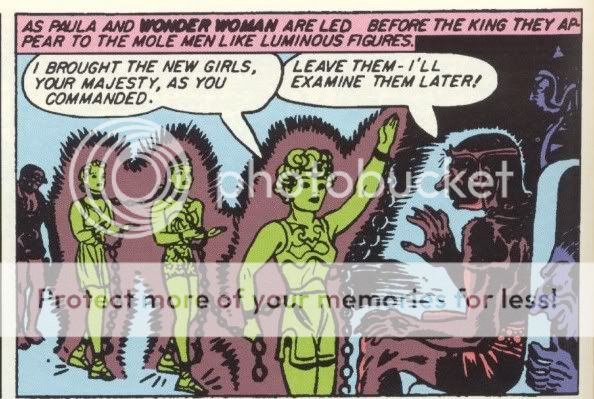
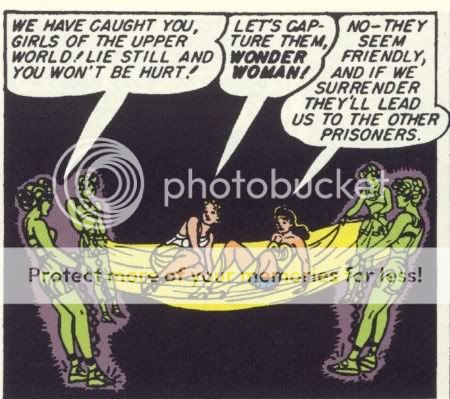
The emphasis on sight, blindness, and invisibility is another Marston obsession, and here you can really see how it locks in with his bondage and masochistic and narrative preoccupations:
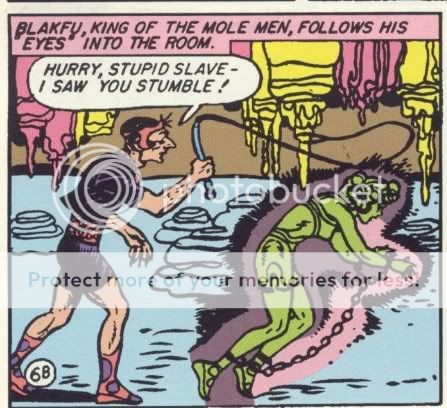
Again, that’s such a great drawing by Peter, with those lovely scribbly lines defining the floor and the regimented series of stalactites obtruding into the foreground to give the sense of contained, claustrophobic space, both oppressive and womb-like. On one level, the mole man is the master; he’s whipping her. But on another level, she is the only thing he can see. Her submission and denigration (being slathered in paint (and yes, I’m sure Marston thought that was kinky in itself) so she can be better punished) makes her the center of his vision. He’s blind because he’s a man, and so a fool…but there’s also the sense that he’s blind contractually, as part of the negotiation whereby the top in a B&D relationship pretends to be in control. Not that this is necessarily a metaphor or a coded symbol of any of these things in particular, but rather that all of the tropes — control, blindness, single-focus, debasement, the promise of a fantastic and unduplicatable intimacy, the sense of a shared dark space, the narrative explanation and negotiation — are pleasurable in themselves, and then get combined and recombined in a kind of fractal fetish.
All of which means that Marston’s statements about power always have at least as much to do with rubbing the fetish as they do with actual analysis or advocacy. Thus, when he makes feminist statements — I don’t think they’re totally useless to a feminist cause, but they are compromised, in that the goal of his feminism is always more about the men’s desires than women’s. As a for instance — why *should* Wonder Woman have to take control of the lives of a bunch of middle-aged male idiots? Her tomboyish response of, hey! forget this! I’ve got better things to do! seems entirely reasonable and even admirable, and when Aphrodite scolds her for it, it seems unjust and transparently done on Marston’s behalf. Similarly, at the end of the Mole-Men episode, when the mole men regain their site and beg their former slaves to rule over them, you’d really like the slaves to say, “hell no! fuck off!” Especially since, if the female slaves were actually the ones with the power (as it intimated in various ways) it makes sense that the male slaves will now be, in some sense, the topping bottoms. Having women rule is about allowing the men to become self-actualized — or allowing Marston to get his rocks off.
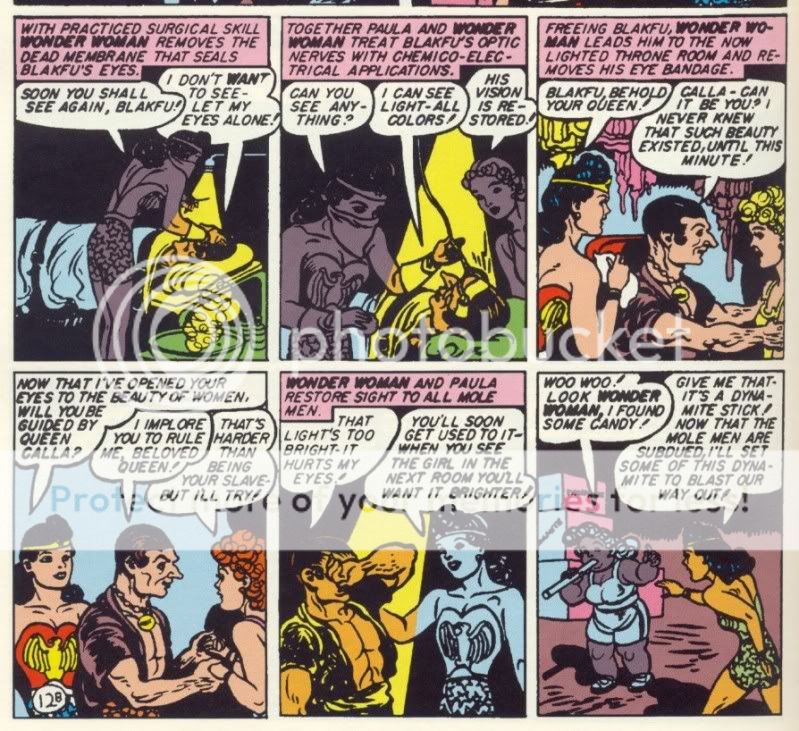
And yeah, that last panel is Etta Candy so blinded by oral desire and subterranean dimness that she starts sucking on a stick of dynamite. I was sort of hoping she’d get a mole-man of her own, but no such luck. Maybe next issue.



