Ooku Volume 1: Some Impressions

Fumi Yoshinaga’s Ooku is set in an alternate Edo period Japan where the male population has been halved by an epidemic known as the Redpox with the women taking the majority of male societal roles as a result. Noah has a short synopsis and glowing review of the first volume at the previous HU site and is probably its most articulate proponent. In fact, his gushing enthusiasm for the series is the reason why I picked up a copy of volume 2 without even bothering to read the volume I had at hand.

I’m a bit more ambivalent about what I’ve read so far.

One of my problems with Ooku is that it asks us to accept a logical leap of faith without sufficient justification: that a Japan reduced to a population consisting of 25% men would be ruled and dominated by women over the course of 3 Shogunates (80 years). The haste with which the scenario is dispensed to the readers in the initial pages of the first volume suggests that Yoshinaga is less concerned with the internal consistency of her scenario than with its final consequences.

Continue reading

Anything But Capes

Alternate Title: Barbarians at the Blog!

Back in 2000, the world was a better, simpler place.* The American comics market exemplified this simplicity. It consisted of Marvel superheroes, DC superheroes, Image superheroes, a few dark fantasies from Vertigo, and those Star Wars comics that Dark Horse keeps churning out. Not exactly a broad selection, but perfect for aging nerds who grew up reading superhero comics and watching Star Wars.

But something happened over the past decade. Publishers started producing more comics that had nothing to do with superheroes. Suddenly, there were a lot more horror comics, crime comics, science fiction comics, war comics, and even Westerns (you know something big is going down when Westerns make a comeback). If the comics industry didn’t grow much in size, it at least grew in variety.

Over the next couple months, I plan to see what the American comics market has to offer that doesn’t involve capes and tights. Because I’m interested in what the comics industry is producing at the beginning of the new decade, I’ll only be looking at recent titles, not reprinted material. To keep myself focused, I’m going to organize the books into genres and review a sample of titles. I have no intention of reading and reviewing every title of every genre, so instead I’ll rely upon a complex scientific formula to select titles that are most representative of each genre. The explanation of my method is provided in footnote **. After the reviews, I’ll summarize the state of each genre, looking at both its size in the market and the overall quality of its titles.

I’ll begin with a genre that has had its share of ups-and-downs in the comics market … barbarians! For the sake of clarity, barbarian comics are fantasy stories about muscular men in loin clothes killing shit with swords and axes. Of course, there’s room for variation on this basic model. For example, woman in chainmail bikini can be substituted in for man in loin cloth. But barbarian stories are not simply high fantasy tales; there needs to be a significant amount of violence, sex, and characters who never wear pants (as a counterexample, The Lord of the Rings has some violence but no sex and way too many pants). Also, comics about fantasy strongmen who arrive in the present day and fight crime are not barbarian stories. They’re superhero stories that steal the surface appeal of barbarian stories.

I looked hard for recently published barbarian comics, but I found only about half a dozen titles, four of which I chose to review below. None of these titles were selling well in the Direct Market, but all of the titles had prior storylines collected and sold as trades, so presumably the DM isn’t the only source of sales. Now, onto the reviews…

Conan the Cimmerian #16
Writer: Timothy Truman
Artists: Timothy Truman and Tomas Giorello
Colorist: Jose Villarrubia
Publisher: Dark Horse Comics

Fact: The Cimmerians were a real people who inhabited the region around the Black Sea in the 8th and 7th centuries B.C.

Fact: They didn’t look like Austrian bodybuilders.

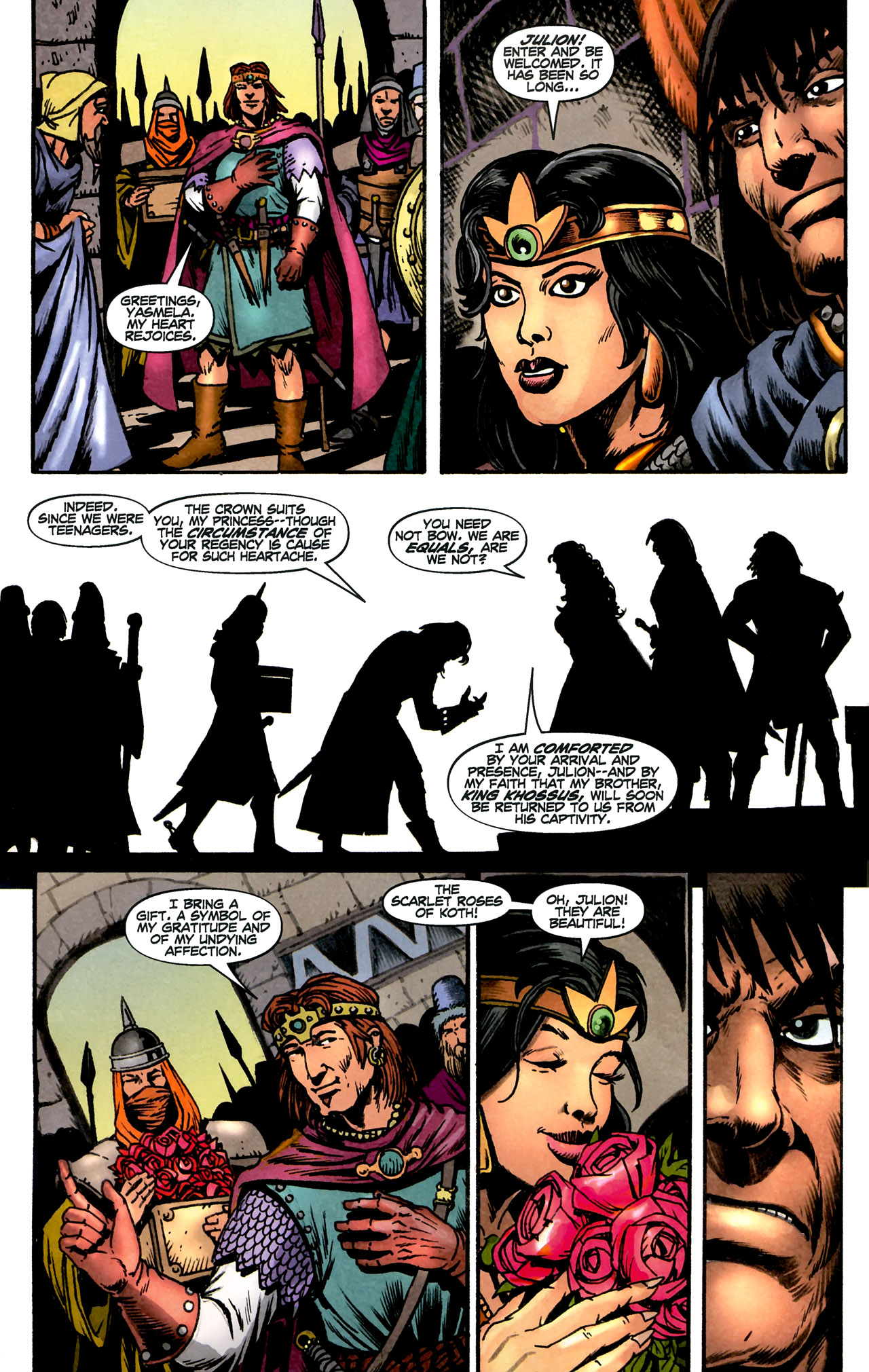
Of course, the Conan story has nothing to do with history and everything to do with Robert E. Howard‘s testosterone-fueled fantasies. But Conan isn’t just another masculine power fantasy. He pretty much is THE masculine power fantasy, the epitome of violence, sex, and rugged individualism. And no survey of barbarian comics would be complete without covering the latest iteration of the muscle bound brute who started it all.

I lucked out with Conan the Cimmerian #16, because it’s the beginning of a new storyline. There’s no recap page, but I had no problem figuring out what was going on. Conan somehow landed himself a sweet gig as the military adviser to a hot princess named Yasmela. Conan’s in love with her, but she only has eyes for an exiled prince named Julion, who’s girly compared to Conan. We know he’s a girly man because he does girly things, like giving flowers to girls and using multisyllabic words.
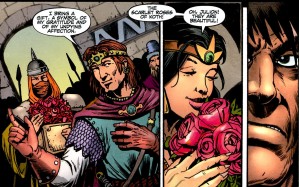
So Conan decides to impress her by doing something stupid, which results in his war band getting ambushed, and then Conan almost gets eaten by a velociraptor (it’s fantasy, not history).

As Conan stories go, this isn’t bad. It has character-driven conflict, Conan is a badass but not infallible, and there’s violence and (implied) sex.

The comic falters on the art. Tomas Giorello does the first seven pages and the final page, and his work is perfectly suited to a Conan book. His backgrounds are lush, and he uses numerous small lines to give more detail to his characters, which would be annoying in a different context, but in a barbarian book it gives the characters a distinctly savage look.  But the majority of the comic is drawn by writer Timothy Truman, and his style is far less detailed and far more cartoonish. It isn’t terrible art, but the transition from Giorello to Hutton and back again is jarring, especially in a comic that’s only 24 pages.

Overall, a decent barbarian comic, but not one that entices me to follow the series.

Hercules: The Knives of Kush #1
Writer: Steve Moore
Artist: Cris Bolson
Colorist: Doug Sirois
Publisher: Radical Comics

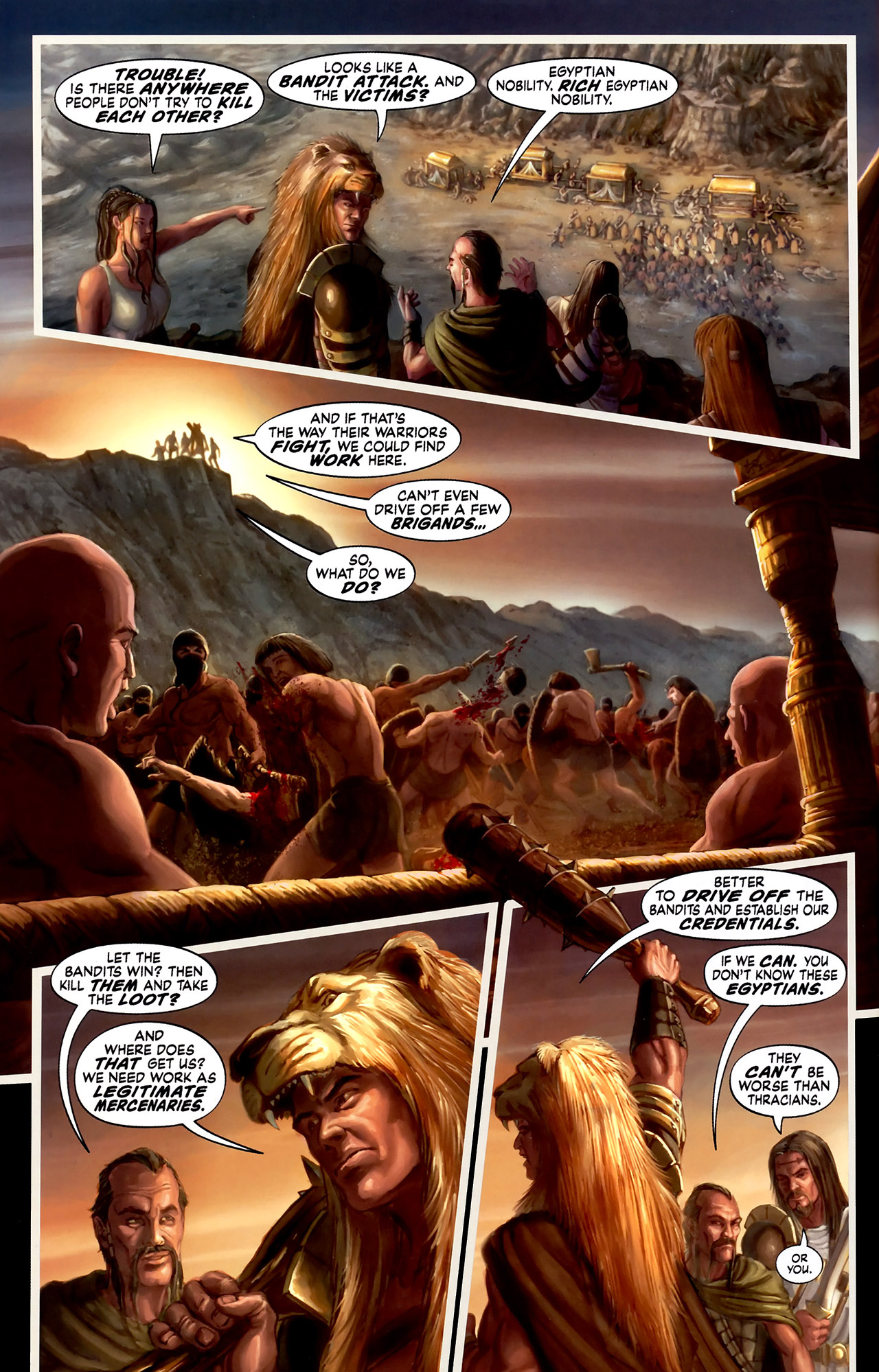
Reading Hercules, I couldn’t help but take pity on the Nemean Lion. The Nemean Lion was just doing what lions do when a violent Greek showed up and killed him, skinned him, and decided to hear the Lion’s head as a hat.
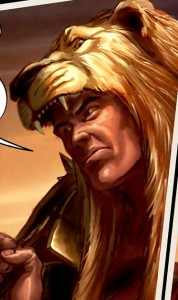
I spent a lot of time thinking about the Nemean Lion because this comic wasn’t very interesting.

The plot is serviceable: Hercules and his band of misfits arrive in Egypt during a civil war. They decide to work as mercenaries for the legitimate pharaoh, who’s losing the war to his half-brother. It seems that the would-be-usurper has formed an alliance with a sorcerer who leads the titular Knives of Kush.

Unfortunately, nothing else about the comic is the least bit engaging. Most of the characters, including Hercules, lack a distinguishable personality or voice, and in any case they spend spend the entire issue delivering page after page of exposition and occasionally engage in non-witty banter.

The art is also pretty bad. Cris Bolson puts a lot of detail into his panels, but his characters look stiff and plastic. As a result, the fight scenes resemble action figures posed in mid-attack, which robs the violence of any excitement. His sexy women aren’t very sexy either.

Hercules is a hard character to screw up. But he’s also been so extensively ripped off and parodied that creators need to bring something more to the table than just a standard sword and sorcery plot. That’s about all you get here.

Warlord #9
Writer/Artist: Mike Grell
Colorist: David Curiel
Publisher: DC Comics

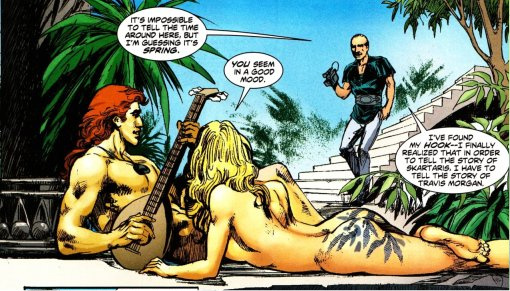
Warlord follows the adventures of Travis Morgan, a man from the regular world who somehow got trapped in the barbarian world of Skartaris. But other than the occasional war, being trapped in Skartaris doesn’t seem like such a bad deal. Morgan has a hot princess girlfriend named Tara and a hot pseudo-girlfriend named Shakira who can turn into a cat. In fact, hot, scantily-clad women are as numerous as trees in Skartaris. And Morgan seems to have embraced the local dress-code because his outfit consists of boots, a helmet, and armored underwear.

Not much happens in this issue, but that may not be a failure in the writing so much as the fact that this is a “down-time” issue. In a superhero comic, down-time issues are normally where characters sit around and whine about their relationships, but in Warlord the characters just have sex. And there is a lot of sex in this issue. Nothing too racy, of course (this is still a DC comic), but Grell manages to include some nice cheesecake. Though the guitar as phallic symbol is a little too obvious.
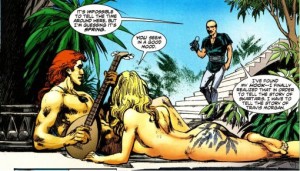
As an artist, Grell has his share of strengths and weaknesses. His backgrounds are well-designed and his characters can be quite attractive. But his fight scenes lack any real sense of impact, his characters often seem disconnected from the panels they occupy, and panel layout can occasionally be rather confusing.

Problems with the art aside, of all the barbarian comics I read, this seemed the most polished and one with the most depth to its characters and universe. Not surprising, given that Mike Grell created Warlord, and he clearly knows what he’s doing with this book. Unfortunately, this comic has some dense continuity, not just with the previous 9 issues but also with prior Warlord comics. To be fair, there’s a quite a bit of exposition that’s intended to help new readers catch up, but knowing what happened previously isn’t the same as caring. Like so many comics that have been around (off-and-on) for years, Warlord proceeds with the assumption that its readers are already fans, and there’s only minimal effort to show new readers why they should care about any of this.

But I’m curious enough about Warlord that I’ll probably look for the first trade paperback and see whether my opinion changes.

Queen Sonja #1
Writer: Joshua Ortega
Artist: Mel Rubi
Colorist: Vinicius Andrade (*that is an awesome name*)
Publisher: Dynamite

Don’t let the title fool you. This is not a Female Force bio-comic about Queen Sonja of Norway. Rather, this is the sequel to Dynamite’s Red Sonja comic, but there’s no evident continuity with the previous title. As someone who never read a Red Sonja comic, I can appreciate the fresh start.

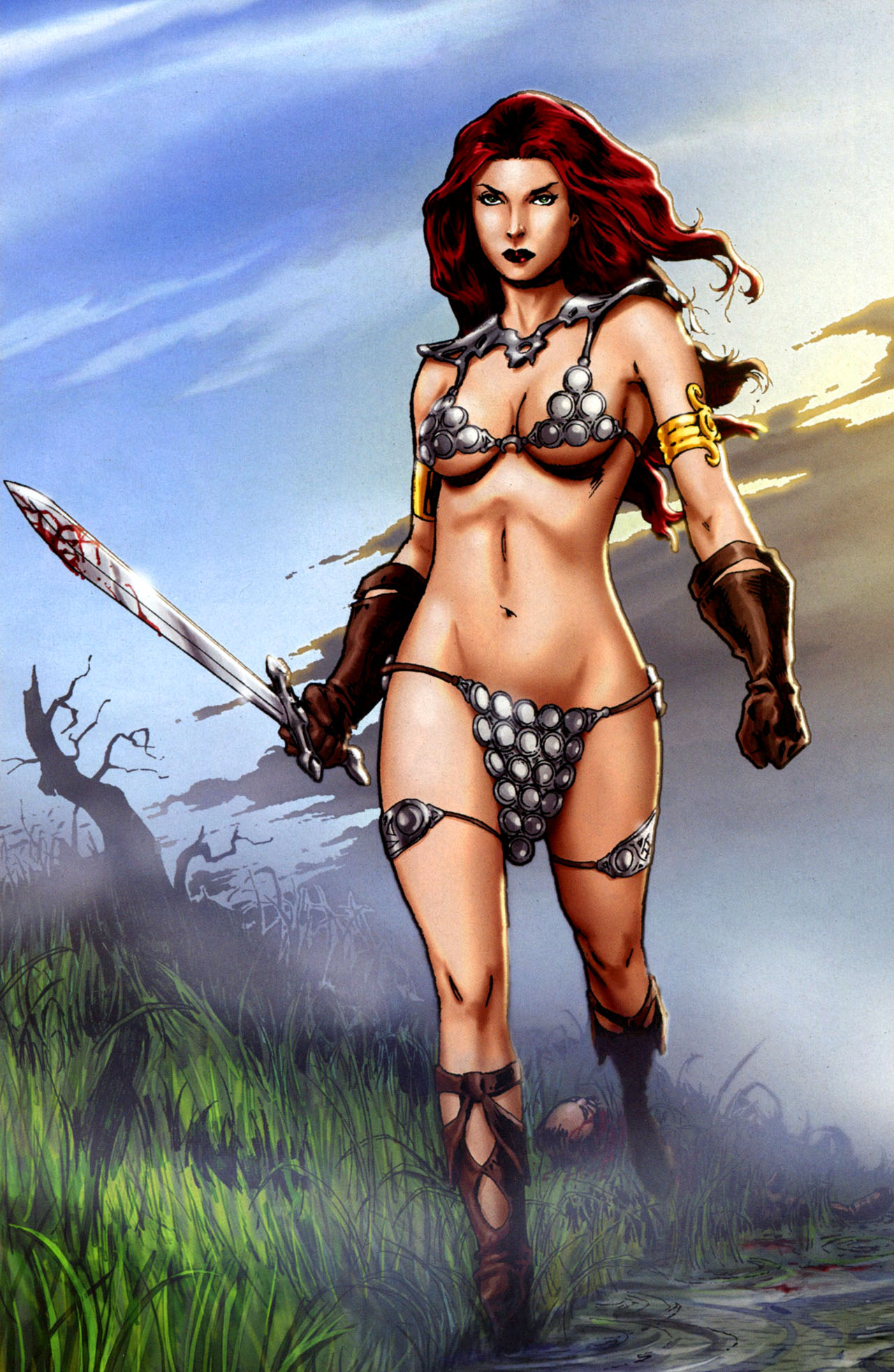
As the title makes clear, Sonja is now a queen (of Made-up Land), and the comic is mostly a flashback about how she ended up on the throne. Sonja agrees to avenge an old woman’s late husband and recover a family heirloom, and along the way she’s clearly going to come into conflict with an evil empire. There’s also plenty of violence and gore in this comic, in the best barbarian tradition. But the plot and the action (not to mention the one-dimensional characters) are completely overwhelmed by the massive amounts of cheesecake. Every other panel focuses on Sonja’s perfect body and the chainmail bikini that seems perpetually about to fall off.
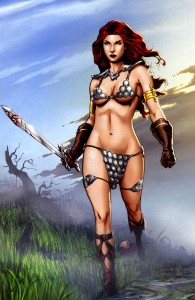
Now, I don’t have a problem with cheesecake, I just wrote a paragraph praising the cheesecake in Warlord, but in this title the cheesecake was ridiculously excessive. But when I stopped to think about it, the cheesecake is ultimately what this comic is all about. Let’s be honest: the selling point of Red Sonja is not really the violence and it certainly isn’t the plot. It’s a comic about a hot red-head in a chainmail bikini. Either you want to look at a hot red-head in a chainmail bikini, or you don’t. Giving her a more tasteful outfit would only take away the one thing that makes Sonja memorable. And there’s no point in pretending that readers, especially women, are going to be won over by Sonja’s “personality,” or the slim bits of dialogue.

Admittedly, my interest in barbarian comics is that of a casual reader, not a fan, but a monthly comic seems  like an expensive way to indulge a fetish for barbarian pin-ups. Still, the current Red Sonja franchise has lasted for over 4 years, so there must be plenty of people out there who like this. And unlike superhero comics, barbarian comics aren’t (or shouldn’t be) marketed towards children, so the cheesecake here isn’t age-inappropriate.

_

State of the Genre: meager. Very few titles to choose from, and most of them lack truly distinctive features  that set them apart from the rest. They all satisfy the basic expectations for a barbarian comic (fantasy setting, violence, cheesecake, lack of pants), but only Warlord suggests that it might have something more in content.

The next time I appraise a genre, I’ll try one that’s a bit more robust, maybe horror.

_________________________

*This is not true.

I Think Ganges Is Boring

Apparently, this means that I should just give up writing about comics altogether and, I don’t know, join a monastic order of geeks and castrate myself with a rusty center-staple according to Sean Collins, who broke all the bones in his hands and found one of those funny fedoras just so he could call himself the Mr. A of random critical comics pronouncements.

Some of you are no doubt asking yourselves — what the hell is Ganges? Who is Mr. A? Who is Sean Collins? Who cares?

If you asked yourself all, or any of those questions, or indeed, any question at all, ever — you sir (or madam) are beneath contempt. Find an entire run of comics journal back issues, liquify them through the power of your lameness, do a zombie ritual to resurrect the lower intestine of Art Spiegelman’s sainted father, and then use the latter as tubing to rectally partake of the former until first-rate poorly-edited critical prose gushes from your newly erudite nose hair like wisdom from the Internet or brilliant babies from your mama.

Let’s have some other, lesser people talk then.

Hey, here’s Tucker Stone. He likes Ganges. Fuck him.

There’s a temptation to label mainstream fans as being lazy for not caring about Swallow Me Whole or Blankets, to call them “bone-ignorant” — that’s just a bunch of horseshit. It’s an attempt by boring assholes to assign an overall meaning to a bunch of personal choices made by a group of people that those boring assholes don’t know anything about. On an individual level, I’ve heard a couple of people say they don’t want to read comics that focus on the mundanities of regular life, but I’m more often exposed to people who just like what they like because it’s what they fucking like. Besides, the attitude you’re describing — that’s not coming from real sampling of readers. It’s coming from the internet’s sampling of readers, it’s coming from small publishers (and most small publishers are readers with credit problems), and the internet and small publishers are pretty much wrong all the time about why people like the things that they like, because most of the people who write blogs, read blogs, leave comments — they aren’t the majority opinion. They’re the minority opinion. If the comics internet was an accurate representation of what comics mattered to people, it would be shitloads of articles about Bone, Y: Last Man, Crumb’s Genesis — and it’s not. And thank God it’s not! But what you’re talking about — why people react the way they do, and what does that mean — hell, the internet isn’t going to answer that question. It doesn’t know either.

Yeah, yeah, yeah. You don’t know, the Internet doesn’t know…cry me a river, fanboy. You know who knows? I know. And what I know is that the river Ganges is filled with floating turds just like your taste, asshole. “Oh, why can’t this Robin comic be more like Glenn lying next to his wiiiiiiffffeee? Why are abstract comics so difficult to understand? What’s this critical discourse doing in my pants, and why’s it feel so good when I touch it?”

Hey, here’s Sean Collins. He likes Ganges too. Fuck him.

I mean, if you met someone who only watched superhero movies, you’d think that was weird and dumb, and you’d be right, and saying so wouldn’t make you a boring asshole, it’d make you a person who was right. Moreover, saying so does not mean you’ve extrapolated that they’re some horrible CSI Miami-watching mouthbreather or anything else about “who they really are” or whatever. You’re just a critic, addressing what people are saying about specific comics, which is a valid thing for a critic to do.

Finally, Tucker’s coup de grace is the fact that most of the audience doesn’t really care about critics or critical approaches to what they enjoy reading anyway. But so what? Most of the people in the theater with us at Up in the Air yesterday have never read Pauline Kael. But criticism is not therefore an egomaniacal waste of time, any more than making art that most of the audience for that art form doesn’t really care about would be. Kevin Huizenga shouldn’t hang it up just because he’s not Jim Davis; similarly, we shouldn’t crumple up the idea of analyzing art and arguing for standards and throw it in the trash because many people would just rather read/watch/listen and then do something else.

If you met a person who only watched superhero movies, that person would be fucking dead, Mr. Genius, because if they only watched superhero movies that would mean they weren’t doing things like eating and breathing and and even if you really like Heath Ledger you’re not going to make it through Dark Knight like that. So, yeah, go ahead and make fun of the corpse on your couch, Mr. Collins, and pat yourself on the back for maintaining standards and analyzing art and rejecting egotism by dressing just like Kevin Huizenga. Bravo for you!

Here’s Tom Spurgeon. He likes Ganges. You know the drill.

In broad terms it’s not that MOME readers should be suggested to read Tiny Titans, but that a hugely presumptive, distorted dismissal on their part should be as open to criticism, especially when it risks the industry being shaped according to those presumptions.

I’d like the industry to be shaped like the Comics Reporter’s tiny distorted titan rearing up to declaim “Happy birthday! I am sorry I cannot attend your promotional event!” Then watch those fuckers who only read one kind of comic scatter like inferior third world populations. I love the smell of eclecticism in the morning.

Also, if you’re a Mome reader, you should just give up. I mean really people. Talk about no self-respect.

Gluey Tart: Dining Bar Akira

Dining Bar Akira

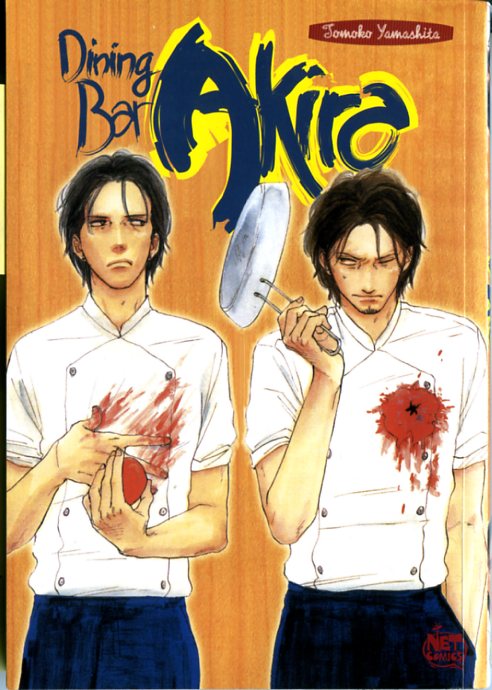
Dining Bar Akira, Tomoko Yamashita, 2009, NetComics

I was sold on this title when I saw the cover. That backfires on me sometimes, yes, but sometimes you just know. Look at those grim, sour faces. The threat of violence in the angle of the frying pan and the smears of tomato. The hint of interest and promise of…

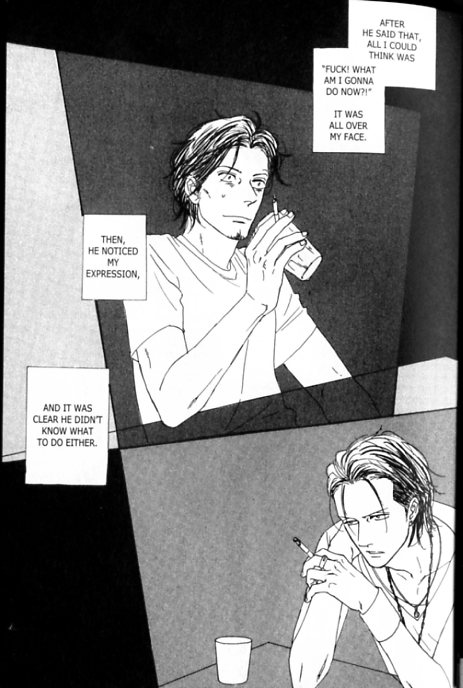
The drawing in this volume just blows me away. I love the style, just a little more realistic than the tall, tall, tall, skinny, skinny, skinny, inhumanly pretty boys. These characters are immediately identifiable as men, and the expressions – every shade of volatility, incredulity, and annoyance. The first page tells the whole story.

Dining Bar Akira

Torihara, a part-time worker at Akira’s restaurant, tells Akira he has feelings for him. Both of them are guarded and twitchy and petulant anyway, but Torihara’s news freaks Akira the hell out. This isn’t one of those stories where one party confesses his love and then waits, broken-hearted, until the other party realizes he’s really been in love along, and then everyone embraces as flower petals trail across a splash page. Torihara doesn’t expect Akira to take his declaration well, and he’s not so thrilled about the situation himself. But he’s really irritated about Akira’s reaction and takes every opportunity to show it.

There’s not much story or character development here, but the situation interests and pleases me. Also, I’m just a big fan in general of cranky. These characters are extremely ambivalent about their feelings for each other, and, you know, that happens, sometimes. Even though Torihara started the ball rolling, when he notices that Akira is starting to fall for him, it makes him uneasy. He thinks Akira is a mess and a drunk and kind of an idiot. We can all sympathize, I think. As for Akira – who is a mess and a drunk and definitely an idiot – he wants to be straight, and even if he didn’t, he wouldn’t want to get together with Torihara, who is much younger and also an employee. It is yaoi, though, so they’re doomed. They circle each other, they fight, they give into the sex, they can’t deal with any of the relationship stuff that isn’t sex, they fight, they finally work something out.

Did I mention that they fight? For fully 75% of the book. It’s pretty entertaining – the art, anyway. I’m not crazy about the translation – normally I don’t pay a lot of attention, but I kept getting the feeling that there were colloquialisms that weren’t quite coming across. You know, when the characters are arguing and there’s lots of banter and should-be witty repartee, and you find yourself saying “Huh?” a lot. Also, typos. Come on, people.

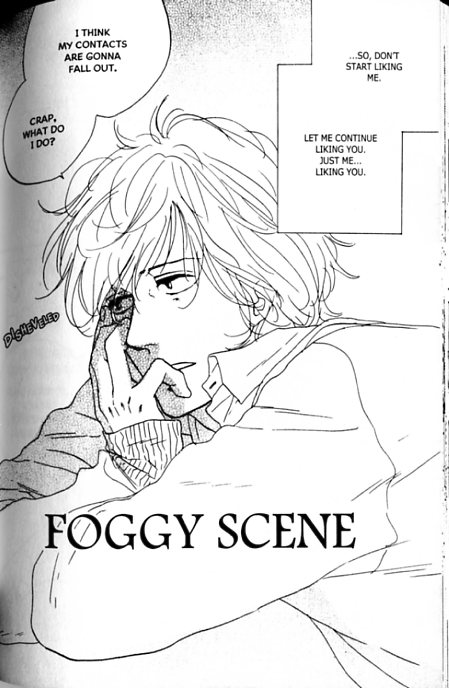
There are a couple of short side stories that are equally well-drawn, and also bitchy and adversarial, although nobody’s actually coming to blows. Ah, well. In the first one, “Foggy Scene,” the opening page once again tells you everything you need to know.

Dining Bar Akira

“I think my contacts are gonna fall out” really did it for me. The premise of this story is slightly twisted in a way I find endearing. Yatsue is a high school student who has is in love with his best friend, who isn’t interested, so he drowns his sorrows in a fling with an older man he meets at a club (and lie about his age to). Because every detail is incredibly realistic, said fling shows up at school the next day as the new teacher, Isai. Yatusue pursues the teacher, not because he’s in love with him, but because he can’t have his friend, and he wants someone to want him. I won’t ruin the ending for you – it’s interesting and ambiguous.

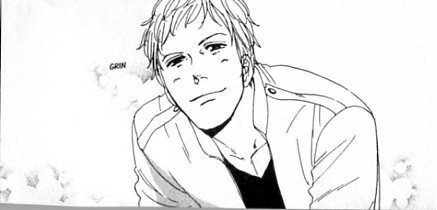
In the last story, “Riverside Moonlight” – it’s just a few pages, so more of a vignette, really – Minamida is freaking out because he’s just had a wet dream about an ugly guy he works with. Again, we’ve all been there. Actually, the guy doesn’t look bad – more of a bear than a troll. But Minamida obviously isn’t usually into bears. Just takes one, though.

I think it’s worth looking through this book just for the art. It made me stop, over and over, to analyze the nuances of expression after expression. And if you like your yaoi touchy, ill-tempered, and cross, with a twist of twisty, I think you’ll be into it. I was so enamored I ran straight to Amazon and ordered Black-Winged Love, Yamashita’s other manga that’s available in English. (Dining Bar Akira came out in August, and Black-Winged Love, October. Huh. Nothing useful to say about that – just, huh.) You might be hearing more about that later.

Dining Bar Akira

Torturing Children for the Honor of the Nation – A Comment

(or Torturing Children can be Ignored, but only sometimes)

This is a reply to some of Noah’s comments following his review of Lady Snowblood which can be found here. From the looks of things, this might be a manga themed week at The Hooded Utilitarian.

In his final comments, Noah writes:

“Well, there’s appalling morality and then there’s appalling morality. I don’t have any trouble with lots of things that are variously horrific, from Johnny Ryan to Female Prisoner Scorpion to slasher films.”

It’s difficult for me to mount an adequate defense of the manga of Kazuo Koike (and Lady Snowblood is somewhat typical of Koike) since I’m not really that much of a fan. In fact, I’m pretty much totally detached from his works in the same way I’m pretty detached from Alex Raymond’s Flash Gordon – interested enough to recognize him as an important voice in manga but not enough to recommend him to anyone with only a peripheral interest in comics.

Continue reading

Happy To Be Here

As I mentioned a week or so back, I’ve been reading a bunch of comics criticism recently. One essay I looked at was by Marc Singer. (I don’t know Marc personally, though we have some mutual acquaintances making it feel really weird for me to refer to him as “Singer”, which is why he appears here under his given name.) Anyway, the post I linked to is a pretty fabulous discussion of what went wrong, and what could have gone right, with Grant Morrison’s Final Crisis. It’s extremely entertaining, and is more or less grist for my thesis that writing about super-hero comics tends to be better than writing about art comics.

That isn’t exactly what I was going to talk about here, though. Instead, I wanted to comment on the end of Marc’s post, which is basically his farewell to blogging. I’ll quote it at some length.

One of the nicer things about comics blogging is that you don’t really have to do it every day; as long as Tom or Dirk links to your post, it doesn’t matter how badly you’ve let your readership atrophy. But that can be a trap, too. Comics blogs offer a guaranteed (if tiny) audience and absolutely no standards other than the ones you and your chosen peers set for yourselves. Not exactly a recipe for great writing, which makes the great writing it has produced that much more remarkable. But once you fall out of the habit for a while it begins to look a bit too cozy, a bit too comfortable.

The problem is not the subject matter, even when a subject disappoints as deeply as Final Crisis does, severing that last tether to the weekly conversation. The problem is the medium itself. If blogging is daily it is also ephemeral, yet the ephemera cling to life with embarrassing persistence; even the best-kept archives reek with the overripe tang of long-forgotten controversies that never mattered in the first place. (Paul O’Brien thinks comics are boring! Micah Ian Wright lied to me! How could CrossGen fail?) Not long after I started this blog I made an effort, haltingly at first, to purge it of such ephemera, to write only pieces I thought I could be proud of later. I’m still proud of many of them, but the consequence was a blog that rarely updated and still took more effort than a blog should take.

Some folks are able to turn their blogs into part of their professional development or, better yet, make blogging a profession unto itself. More power to them. Writing this blog has been incredibly valuable, as a laboratory for developing ideas and as a motivation to push my style in directions it otherwise wouldn’t have taken. But after a while it’s time to apply all that work to formats and venues that aren’t measured chiefly by their frequency. No matter how much time and energy I sank into it, blogging has always been a hobby for me. Time spent blogging is time not spent writing for some other format that demands better work and offers something more durable in return.

Obviously, Marc is a lot more positive about blogging than Gary Groth. But the two do share general attitudes in common, I think. Both argue that blogging is less rich than print (Gary says “shallow” if I remember correctly; Marc uses the less pejorative “ephemeral”.) Blogging, they say, is caught up in petty controversies and rushed judgments; print is more thoughtful and more durable. If you’re serious about writing about comics, more or less, you should probably write a book (or at least write for a magazine).

I sneered fairly vigorously at Gary, largely because he didn’t know what he was talking about. Marc, on the other hand, does know what he’s talking about. I still think he’s basically wrong in his evaluation of blogging, but he’s not being unfair or outright ignorant. Which means that to respond to him I can’t just sneer. I actually have to try to defend blogging.

So here goes. The main thing, maybe, that separates me from both Gary and Marc is that I don’t necessarily think that writing about comics in any venue is actually serious or durable or especially worthwhile from any objective perspective. Indeed, it’s a rare, rare, rare book that can be said to matter in the sense that the world would be a measurably better (or a worse) place if said book had not been written. Needless to say, most of those rare books involve theology or politics, not commentaries on sequential pictographs.

Now, that’s not to say that writing books is worthless. There are other perspectives than the objective one, and you don’t have to measure a work of art (which is basically what a work of criticism is) by its utility. You can measure it, for example, by the love that was put into it, or by the small group of people who are touched by it. Or you can measure it by its insight, or its formal competence, or its poetry, or what have you. But none of these criteria, it seems to me, necessarily privilege books over the Internet.

Now, it’s true that you can do some things in a book that you can’t do in a blog. They’re different genres of writing. If you want to write a lengthy study, and want to engage with an academic audience — for career reasons or just because that’s what interests you — it’s probably best to publish a book. I understand that. One of my regrets for this piece is that, while I read a lot of academic writing to put it together, few of those academics are going to read what I have to say and respond to it. It’s just in the wrong place to become part of the discourse. Which is unfortunate, but, you know, that’s the tradeoff I get for not finishing my Ph.D.

But because academics aren’t paying attention to it, does that mean that a piece of writing is more ephemeral, or less durable, or less good? I just don’t see it. I mean, yes, blogs deal with passing controversies and issues of the day. So did Shakespeare. So did Shaw. So did Swift. So did St. Paul, for that matter. That’s what writers do; they deal with issues of the day because, you know, your day is where you live. You don’t reside in some universal Platonic n-space, where you can write about only matters of broad import and forget the rest. I mean, Alexander Pope’s writing is almost entirely made up of petty sneers at literary rivals who have long since ceased to matter to anyone except those graduate students reading Alexander Pope’s poetry. Does that mean that Alexander Pope’s poetry is inferior to, say, a determinedly non-political poet like, say, Mark Strand? Not necessarily; it just means you have to read different footnotes.

I mean, if Marc didn’t want to get into blog troll battles, that’s certainly his right; there’s no reason to engage in such things if they don’t interest you. But, on the other hand, I don’t think it’s right to say that such controversies are less worthwhile than writing about the end of Final Crisis in some absolute sense. Four hundred years from now, are you sure anybody is going to recognize Grant Morrison’s name any more than they’re going to recognize Paul O’Brien’s or Colley Cibber’s? Write for yourself and the audience you’ve got, because that’s the *only* one you’ve got. Certainly, folks like Derek Walcott think that they’re writing for generations to come — which is one among many reasons why Derek Wolcott’s writing sucks so thoroughly and so consistently.

Another way people often denigrate blogging, I think, is by suggesting that it’s not as concentrated, or thoughtful, or ambitious as writing a book. Again, it’s true that ambitious blogs don’t look like ambitious books, but I don’t think the difference is necessarily one of quality or thoughtfulness per se. As a blogger, I’m currently in the process of writing at length about every single issue of the Marston/Peter Wonder Woman run. Economically, that’s simply not something you could do in print. Similarly, a collaborative work of criticism like Tom Spurgeon’s massive series of holiday interviews on comics of the decade would be much, much more difficult to organize in a print magazine than online.

The point here is that there are a lot of projects that are feasible in the blogosphere that aren’t possible in books, just as there are things possible in books that aren’t really doable online. It’s not, at least for me, a question of honing my skills in blogging so some day I can get down to the real work of writing books. Rather, blogging’s like any other artistic endeavor. You put in the genius and the time and the effort and the love that you’ve got, and that’s exactly what you get out of it. If Marc, or anyone, has other passions or other interests, or if the particular demands and concerns of blogging don’t line up with your own, then, of course, he or they should go do something else. There’s no shame in that. But, on the other hand, I don’t think there’s any particular shame either in staying with the blogosphere and what it has to offer. I know that, at least for me, blogging has been an incredibly rewarding experience — a chance to work with other writers I admire; to write and publish any number of pieces I’m proud of; to interact with a sometimes receptive and sometimes critical audience. I have gotten a couple of gigs out of it, too, but that’s really just been an added bonus. Whether I ever write a book or not, blogging has very much been its own reward.

Update: Corrected various embarrassing errors — proving the superiority or inferiority of blogs, depending on how you look at it.

Torturing Children for the Honor of the Nation

A little while back I read the first volume of Koike and Kamimura’s Lady Snowblood and was impressed with the craft but repulsed by the content. Basically it seemed to me that the work contrasted a nostalgic code of honor with a decadent modernity, and used that contrast as an excuse for vicious and racialized murder, rape, and the general fetishization of force and death. It made me understand more clearly than I had done before what strands of thought in Japan might have allowed that nation to reach an agreement with Germany during World War II.

A commentor encouraged me to try the Lady Snowblood movie from the early 1970s, suggesting that it avoided many of the problems of the book. So I’ve finally seen it…and the commenter was correct to some extent. Lady Snowblood doesn’t force a man to rape an innocent girl at knife point. The racial subtext — the positing of decadent Western modernity as a crime itself worthy of vengeance — is sort of, kind of still present, but it ends up way down in the mix.

But nevertheless…even for somebody like me who finds a lot to like in rape revenge films like “I Spit on Your Grave,” this movie is awfully hard to get behind — at least for a pansy liberal Westerner like me. The plot is built around the idea not of individual revenge, but of generational honor killing — the protagonist Yuki’s father was killed by a gang in front of her mother’s eyes; they then raped the mother. Mother then set out to revenge herself, but ended up in prison for life. So sheset about getting herself pregnant by sleeping with anyone she could, so as to have a child who would carry out her vengeance. Mom dies in childbirth, and Yuki ends up with a friend of Mom’s and a foster dad. Step-dad eagerly takes up the task of preparing the child for vengeance, explaining to her that she’s an inhuman monster devoted to killing and sets up a rigorous training program from the time she’s like 6 or 8 or something, putting her in barrels and rolling her down hills and beating her with sticks. So eventually Yuki grows up to be an inhuman killing machine just like her daddy and mommy wanted and we get to watch her chop a bunch of bad folks up. Whoo hoo.

The thing that really stuck in my craw here wasn’t the killing or the spurting blood, all of which is standard fare for rape revenge films and/or horror films and/or lots of movies I rather like. Instead, what disturbed me most was the treatment of Yuki by her parents (biological and foster). The idea that you would actually create a child solely and specifically to take care of your own random shit — as a parent I’m perhaps identifying overly here, but I just can’t support that. People aren’t things, or as Kant would say, people are ends, not means. Yuki always shouts “an eye for an eye” while doing her dirty work, but the actual economy of the film is one person’s death for somebody else’s unrelated life. The worst act of injustice here is not what is done to Yuki’s mom or dad — horrible as that is — but rather what is done to Yuki.

I guess you could argue that that’s the point of the movie — that is, it’s supposed to make us sympathize with Yuki and see the pointlessness of her honor and her revenge. I don’t think that’s what’s really going down, though. Nobody in the film ever even suggests to Yuki that maybe the revenge thing is not what it’s cracked up to be. Instead, everyone seems to more or less happily accept the idea that spending your life taking care of your broken mother’s unfinished business is a really good idea. Even the voice over narration gets into the act, telling us what a wonderful person Yuki really is beneath that unrelenting mask. And then there’s Yuki’s own internal monologue, in which Yuki says she actually remembers her Mom from when she was like five minutes old, and it’s those personal memories which drive her revenge.

The point ultimately seems to be that honor, and particularly family honor, is the only self you have. Your honor is your psychology, your personal motivation, your soul — that’s all there is to you. As such, the individual is, in fact a means, and the end is the family or the collective or, ultimately, the nation. And, again, that seems a fair approximation of fascism. As a mealy-mouthed liberal relativist embarrassed about his own Judeo-Christian heritage it’s hard for me to come out and say this, but — I think that’s evil, damn it.
_________________

For a more positive take on Koike and Kamimura, you can read Richard Cook on Lone Wolf and Cub here.

Update: Koike yes, but not Kamimura, as Richard explains in comments.

Update 2: Suat defends Lady Snowblood here.