Bite Marx

Since Melinda Beasi wrote about Twilight here earlier this week, I thought I’d follow up with this essay, which ran in an edited form at the Chicago Reader.
________________
Twilight fans always make a fuss about Team Edward versus Team Jacob, but they might as well be plumping for Team Effete Aristocrat versus Team Colorful Earthy Ethnic Stereotype.

As with all things Twilight, the tropes work not because of their subtlety, but because of the absolute ham-fisted earnestness with which they are deployed. Eclipse is the book where the Edward/Bella/Jacob triangle attains an apotheosis of melodramatic angst-ridden preposterousness. As such, it’s also arguably the book where the bone-headed stereotyping is most thoroughly exploited. What sets the tween heart racing is not that Bella has two boyfriends, but that she has two romance narratives to choose from — narratives of differing but equally venerable pedigree.

In this corner, there’s Edward Cullen. Edward is extravagantly cultured, and ridiculously wealthy. He composes classical ballads, writes in an immaculate hand, and buys his sister a Porche as an offhand gift. Like a real product of the upper crust, he lives with his brothers and sisters, who are all also paired up as husbands and wives. His family is, moreover, obsessed with blood, and has amorphous connections to Italy. He’s foreign, exciting, steeped in ancient traditions, and deeply, ludicrously white. He’s the noble prince come to whisk Bella out of her life and into a deliciously decadent life of luxury and romance. Meyer name-drops Darcy and Heathcliff and Romeo, but Edward has at least as much in common with Prince Charming.

And in this corner, there’s Jacob Black. Jacob is the opposite of upper-class. An Indian living on reservation land, he transforms simultaneously into a werewolf and a laundry list of invidious racial stereotypes. He’s literally hot-blooded — werewolves have higher than normal temperatures, just as vampires have lower than normal ones. Jacob also has massive self-control issues; whenever he gets angry or upset, he starts to shake violently and then turns into a giant deadly wolf. He’s also hairy, frequently bare-chested, and…good with tools! He also eats a prodigious amount — as opposed to the uber-cultured Edward, who doesn’t eat at all.

If Edward is the aristocrat who treats Bella like a delicate queen, Jake is the swarthy, sweaty working-class hero who won’t take no for an answer. Edward will barely allow himself to kiss Bella; Jake, on the other hand, literally overpowers her when he wants a smooch and she’s reluctant. With Edward, Bella always has to be careful; with Jake she gets to be a little bit wild — riding motorcycles, cliff diving, and generally getting in touch with her inner wolf/teen delinquent. If Edward’s the prince whisking away the scullery maid a la Cinderella, Jake is the virile commoner dragging the frigid aristocrat down into the sensual muck a la Titanic.

Romance as a genre has always been just about as obsessed with class as it has been with gender. Differences in social standing are both great drivers of plot (“I’ll never allow you to marry that piece of trash!”) and sexy in their own right. The boy next door (played in Twilight by Bella’s poor, ordinary, never-had-a-chance classmate Mike Newton) is dull — there’s nothing romantic about winding up with the person everybody expects you to wind up with. But a prince to pull you up to the castle or a gardener to drag you down in the muck — that’s an exotic tale to set the heart racing and the bodices ripping.

Meyer’s genius (if you want to call it that) is to have figured out a way to repurpose the same old clichés for an era in which not even tweens want to admit to fetishizing either those on the top of the social scale or those on the bottom. Edward is enchantingly attractive not because he has gobs of money and cultural capital, but rather because he’s an immortal mysterious vampire whose body goes all sparkly in the sun. Jacob is excitingly exotic not because Indians make better lovers, but because he’s an impulsive superstrong werewolf. And the two don’ t want to kill each other because of class or racial animosities (which would obviously be really distasteful), but because vampires don’t like werewolves. When Jacob calls Edward “bloodsucker,” it’s a literal description, not a Marxist critique. When Edward calls Jacob “dog,” it’s because he grows fur and runs around on all fours not — despite all appearances — because it’s a racial slur.

Ultimately, of course, the dog lies down with the bloodsucker; the alabaster prince and the dusky gardener both love Bella so much that they set aside their differences to defend her. Social harmony descends on a world which never had any class antagonisms to begin with. A triumph of tolerance and goodwill? Well, maybe not. Certainly, to see the same old idiocies revived and venerated under a thin PC patina is irritating. How many generations are girls going to be waiting for their prince, anyway? And when exactly are we going to stop shamelessly exploiting the minorities just so that we can tell ourselves how sexy they look down there on the dung heap where we have so summarily deposited them?

But, on the other paw…there is something to be said for that thin patina. If there are stupid fantasies to be disseminated, maybe it’s better to have them be clearly labeled as fantasies. Edward’s not a prince; he’s a vampire. Jacob’s not out of control because he’s an Indian, but because he’s a werewolf. That’s no doubt splitting hairs (as it were) — but those are hairs that I’d as soon see split as not. If there’s one thing that romance consistently tells us, after all, it’s that differences matter.
Bound to Blog: Wonder Woman #23

Wonder Woman #22 was probably the worst one of Marston/Peter’s run…so bad, in fact, that I wondered whether significant parts of it might not have been ghosted.

Issue #23 is much better. It’s not one of the series high points — and notably, like 22, it has three short stories rather than one long epic, a change which I presume must be related to Marston’s sickness (he actually died of cancer in May 1947, which is this issue’s cover date.) Still, whether Marston was writing shorter stories on his death bed, or whether these are leftover scripts that he had lying about unpublished (and they can’t be too old, because they’re post-war) the result is perfectly acceptable, if not great.

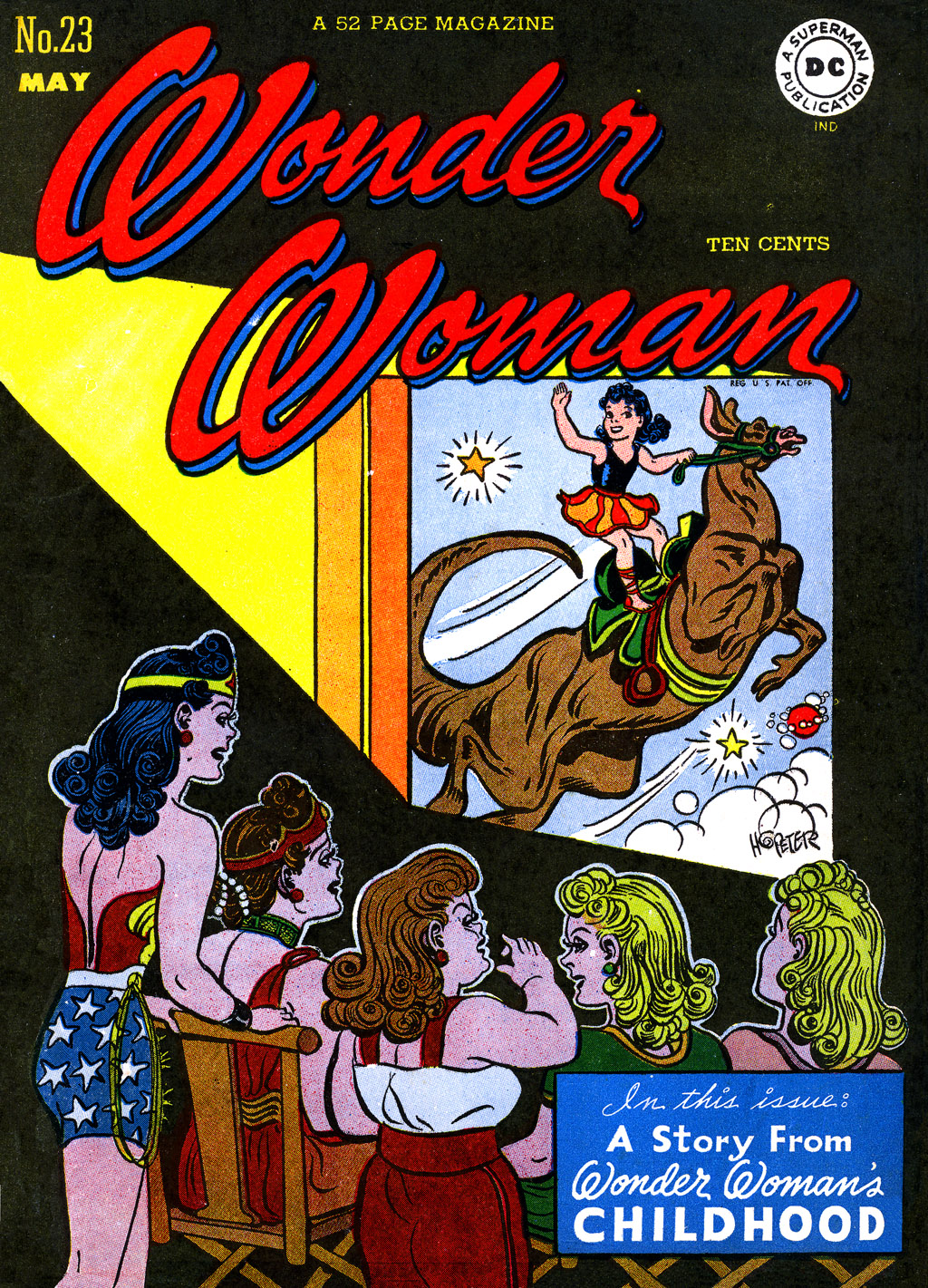
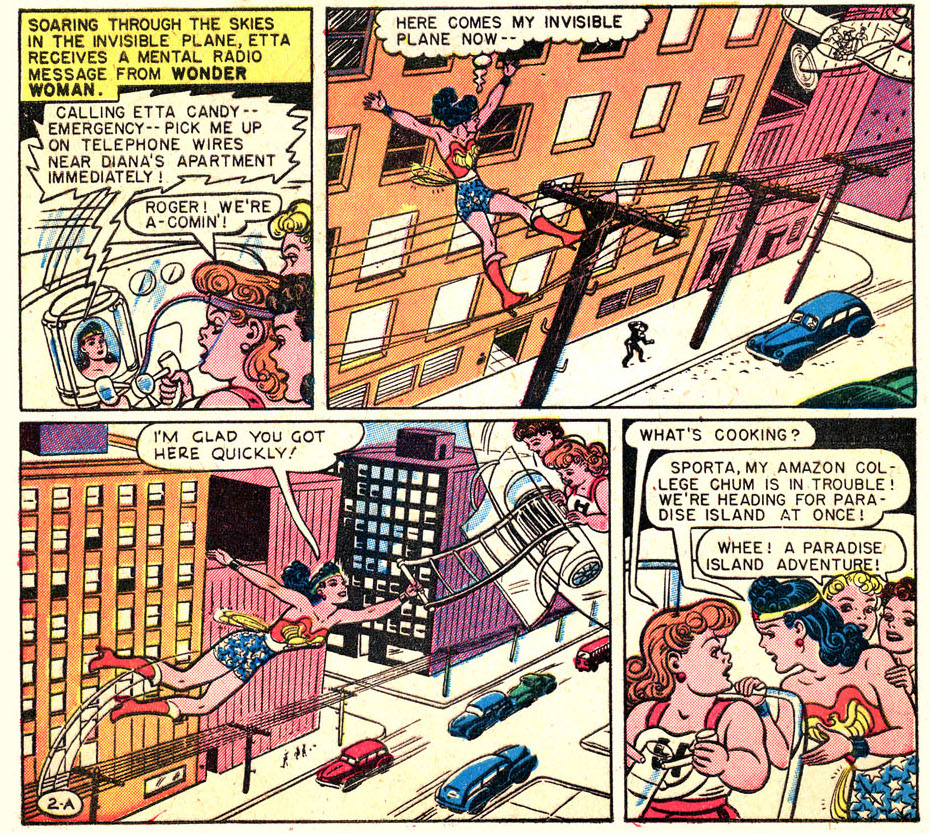
As the Holiday girl there in the lower right indicates, the first story is a paradise island adventure. All the more welcome since Harry Peter seems to be in fine form; that picture of WW sitting on the telephone wires waiting for her robot plane with the buildings slanting down vertiginously in the background is pretty fantastic.

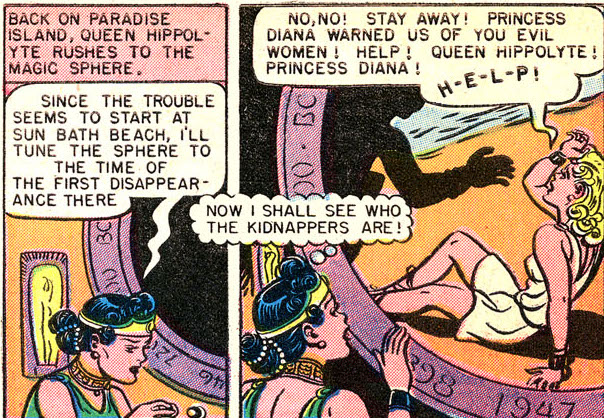
Anyway in this story Amazons are disappearing from paradise island’s beach. This gives Hippolyta a chance to watch as her viewfinder presents her with a Perils of Pauline moment:

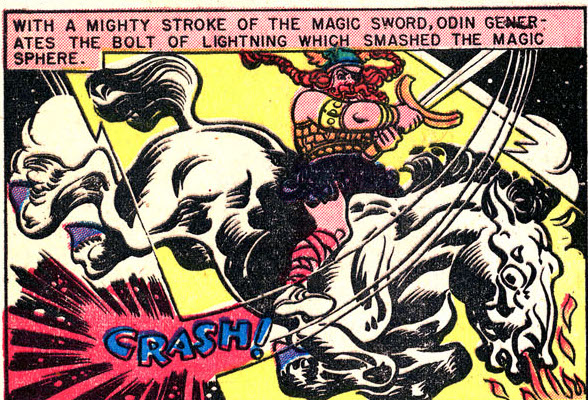
Anyway, the viewfinder breaks inopportunely, shattered by a bolt from Odin, whose Valkyries are flying down to Paradise Island to kidnap Amazons. Why you ask? Well….

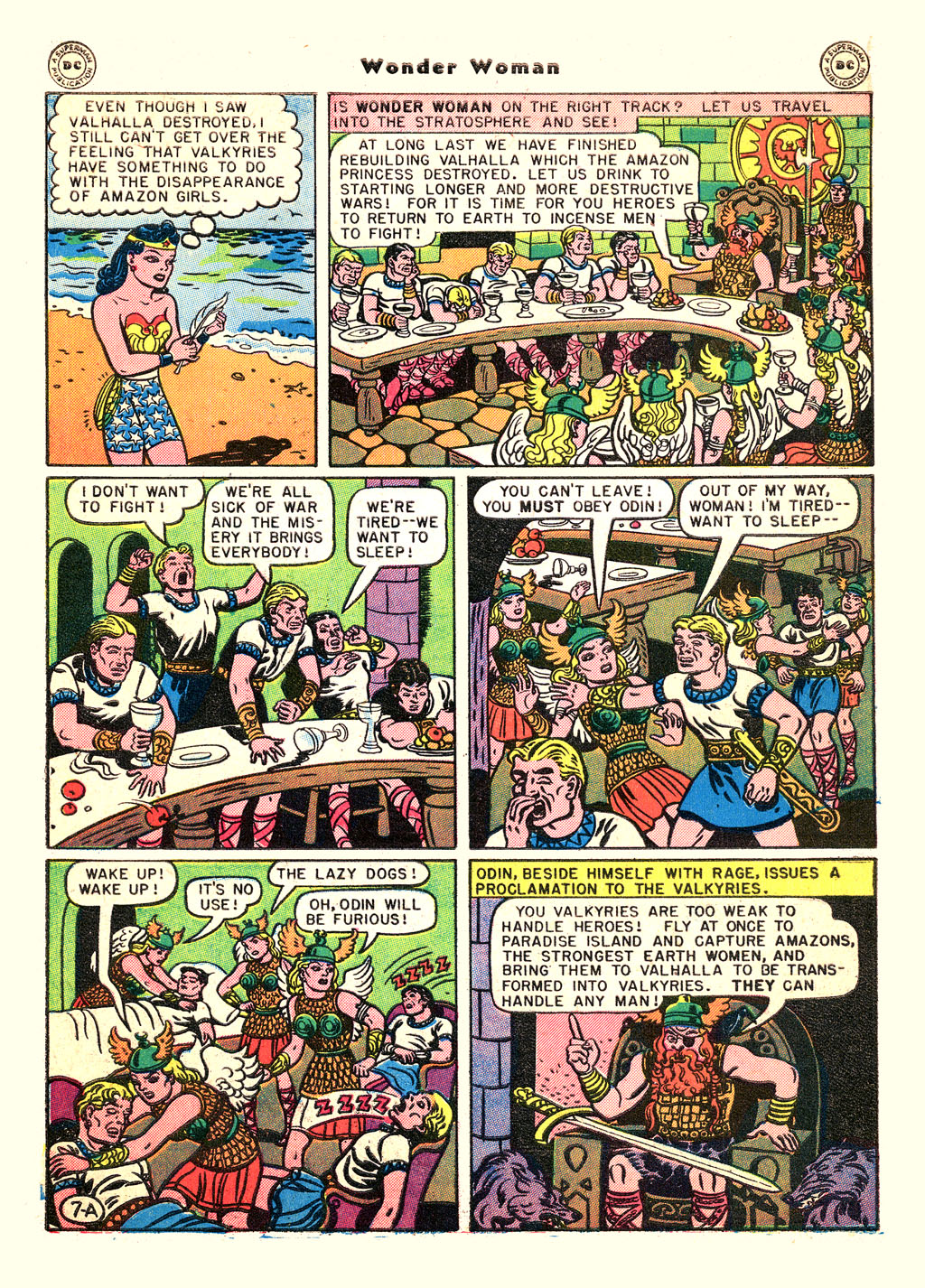
Odin has captured heroes (i.e. veterans) and wants them to go to earth to incense others to fight. But the heroes are tuckered out; all they want to do is sleep. Since his Valkyries can’t get the men to fight, Odin tells them to kidnap Amazons so *they* can get the heroes to go to war again.

As usual with Marston, the gender politics are delightfully convoluted. Obviously, the main instigator of warfare is the sadistic male patriarch, Odin. But the male “heroes” are shown throughout as being soft, manipulable, and not especially violent — they need a strong female hand if they’re going to be effective fighters. So in some sense it’s really women who are the embodiment of military virtues.

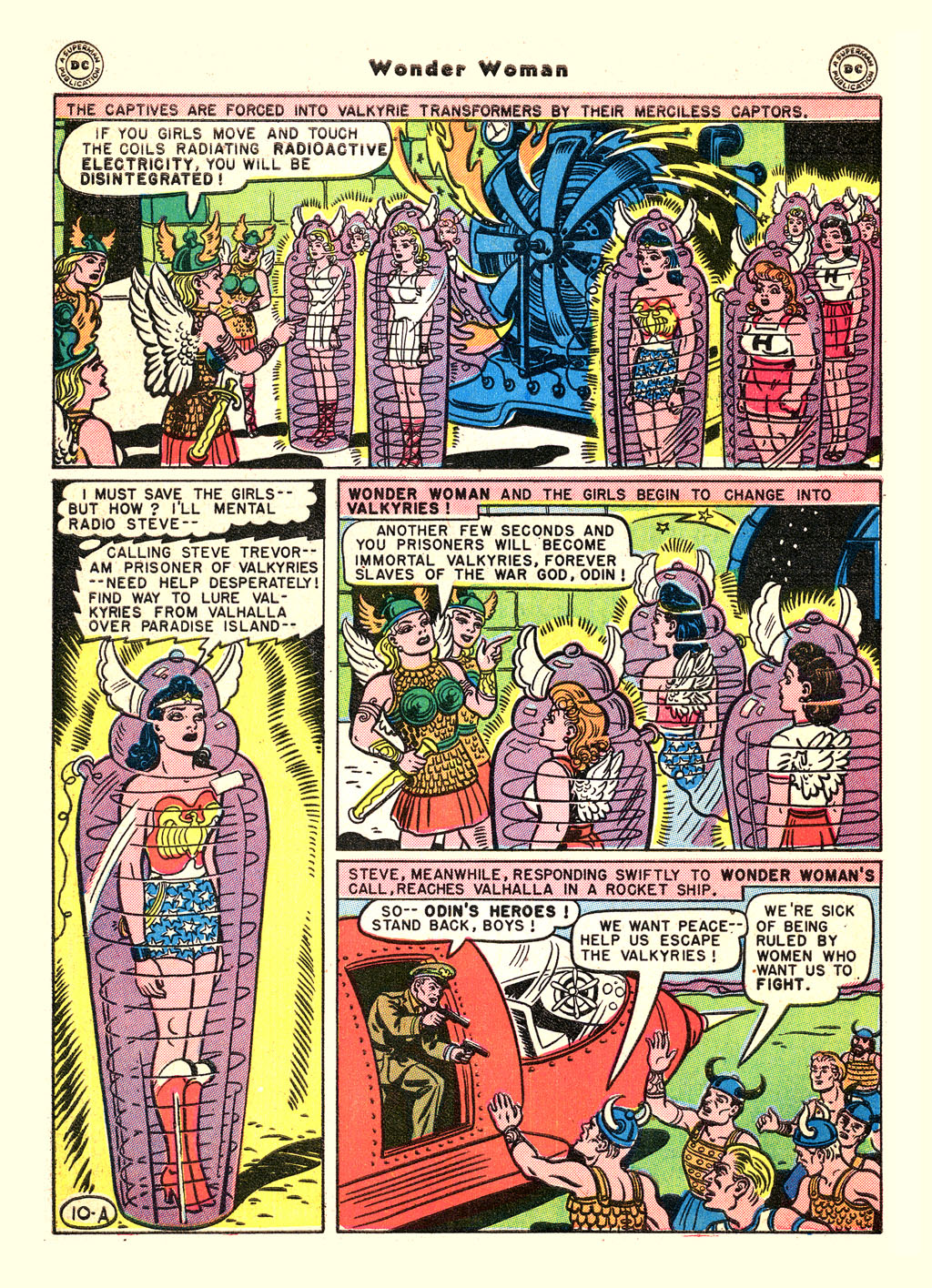
The funniest panel here is the bottom one, where the male heroes claim to be sick of being ruled by women “who want us to fight” — the implication being that they’re perfectly happy to be ruled by women who don’t want them to fight.

The rest of the page is interesting as well, though; the Valkyries have encased WW and Amazons and Holiday Girls in energy to trap them and turn them into Valkyries themselves. The purple energy happens in this case to look like the outline of Russian dolls…and of course, standing stock still in their various outfits, the transforming women look more than a little like dolls themselves (with special wing attachments!) I talked about the connection between Wonder Woman and doll stories before. In this case, the Valkyries eroticized dominance/appreciation of the Amazons is both about enjoying femininity *and* enjoying martial virtues. In fact, there’s barely an *and* there; for Marston, the more effectively militant you are, the more feminine you are (at least if you’re a woman.)

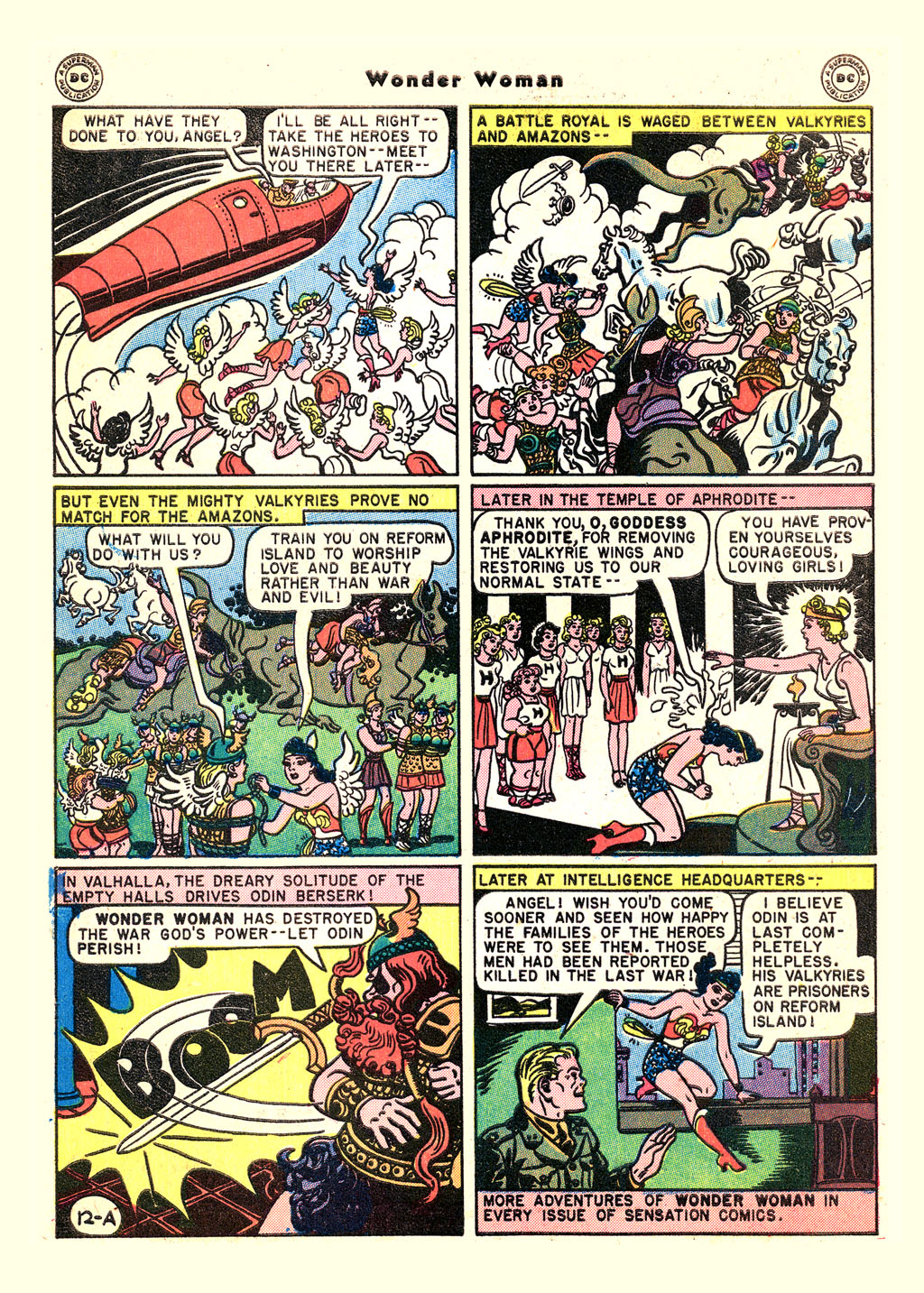
Which is why, in the middle right pane abovel, Aphrodite emphasizes that WW and the Holiday Girls are “courageous, loving girls” — the point being that courage and loving femininity go together. The natural conclusion is shown in the bottom left panel, where Odin, the supposed wargod, just gives up and offs himself (throwing down his phallic sword) when WW robs him of his Valkyries.

That page is pretty great in other ways as well, with winged Holiday girls and winged Amazons flying about with sky kangas and that magnificently phallic spaceship that Steve is piloting. I especially like the way the spaceship in the upper left panel mirrors the motion of the sky kanga in the upper right — as if the ubermaleness is just an image of, or subsumed within, the undulating sea of femininity. Maleness seems part of the harmonious whole of femininity rather than an opposition to it.

I also love that middle left panel; the scribbly sky-kangas and the valkyries being tied up here and tied up there, with scale all off-kilter so everybody looks like paper doll cutouts. This is definitely one of Peter’s most Henry Darger moments.

And as long as I’m gushing about Peter — check out this horse.

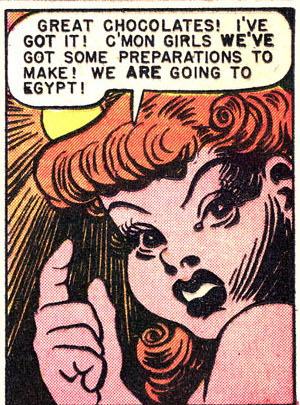
Or this bizarre backlit Etta as femme fatale from the second story.

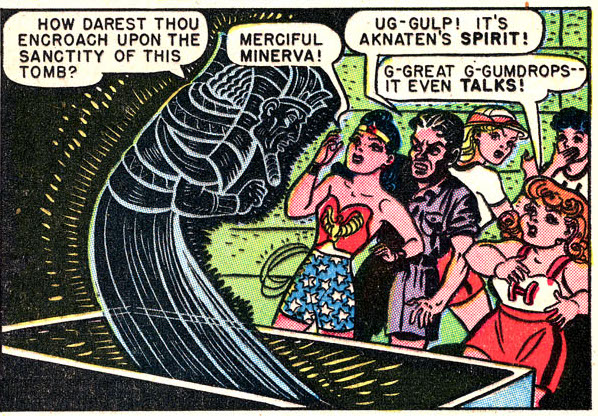
This weird Egyptian ghost rising from the tomb is pretty fantastic too….

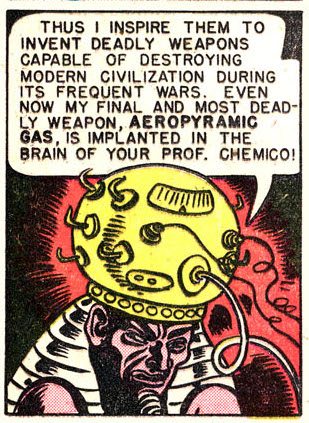
And how about this ancient Egyptian headgear?

Storywise there’s not a whole lot going on here; Marston makes some noises about the evil dangers of superweapons and generally suggests he doesn’t want the world to go to war again. It’s fine…but the art is definitely the main thing here.

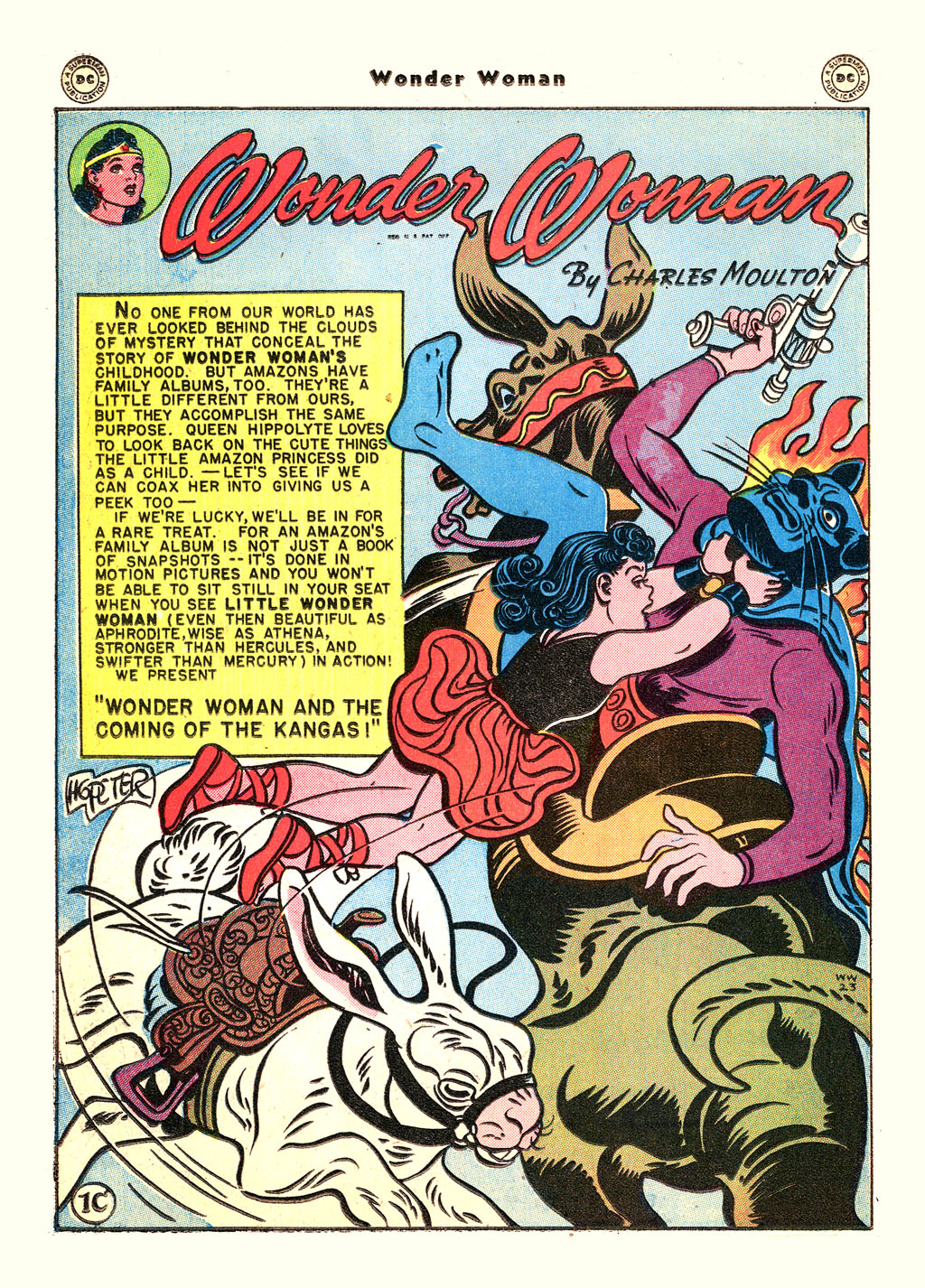
The third story is the most interesting of the lot. It’s a tale from WW’s childhood, explaining the origin of the giant sky kanga’s. Also, incidentally, it lets us know that before there were sky kangas, the Amazons rode on giant bunnies. What is the origin of the giant bunnies? That, alas remains a mystery….

As always, Peter’s animal drawings are something special. The lines of the giant bunny and the giant kanga flow sensuously; the whole page is filled with sensuous curves. And the sensuousness adamently includes the prepubescent Wonder Woman herself; her short frilly flared red dress placed in the center of the composition.

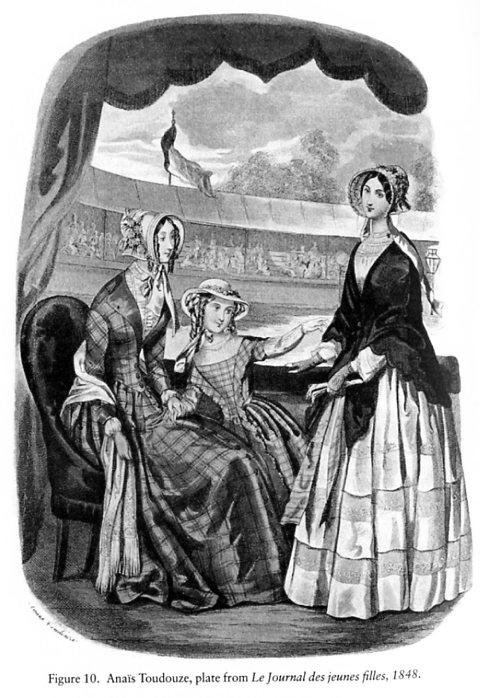
In Between Women: Friendship, Desire, and Marriage in Victorian England, Sharon Marcus argues that the eroticization of female children was a common iconographic trope of Victorian fashion illustration, as well as of Victorian society more broadly.

Victorian culture represented girls as epistemological paradoxes, so innocent that they could be intensively eroticized without raising comment. But unlike images and stories that eroticized girls for a mixed audience of men and women, fashion imagery displayed girls in erotic dynamics with adult women for the delctation of a female audience. In The History of Sexuality, Foucault argued that the intensification of family ties in the nineteenth century also sexualized them, and fashion plates show that in the process all cross-generational ties were eroticized, including those between adult women and girls…. Designed to be objects of an appreciative female gaze inside and outside the image, girls in fashion plates also embody a desire to look at and touch a woman, a desire figured as both self-abasing and self-important.

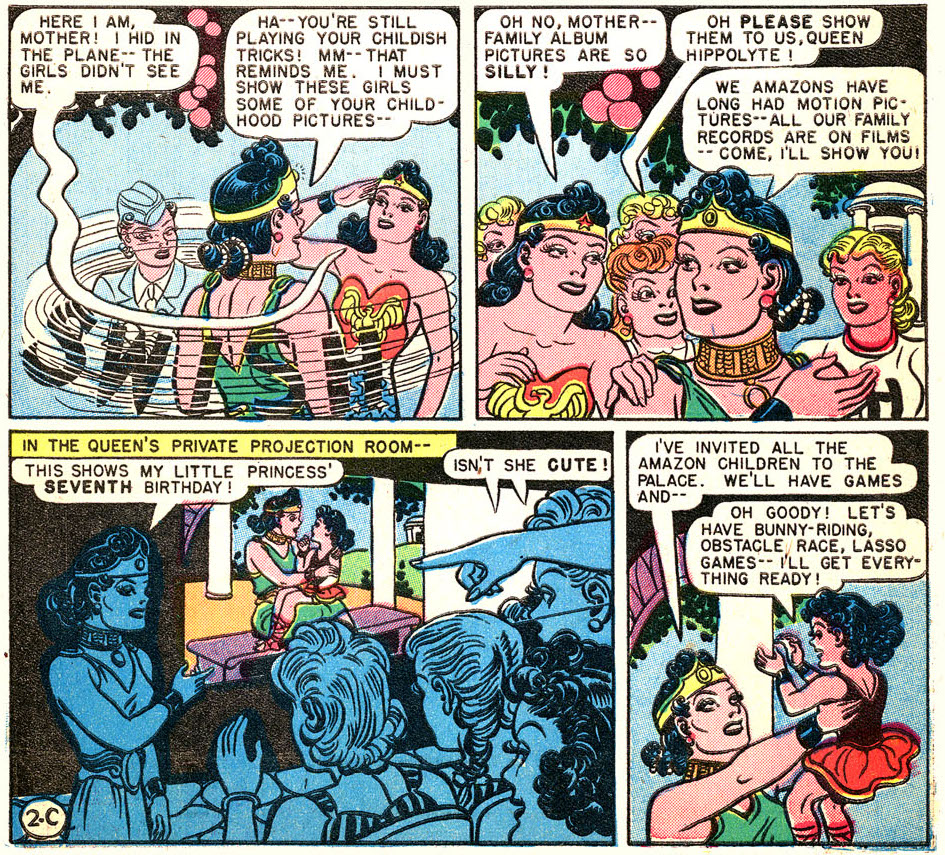
Marston reproduces this dynamic even more self-consciously than the fashion plates:

WW’s “childish tricks” (involving, essentially, disrobing at super-speed before her mother), lead Hippolyta to remember her daughter’s actual childhood. The eroticized affection between mother and daughter is then displayed (via film) for the delectation of an all-female audience.

In her discussion of the Victorians, Marcus follows her look at fashion illustration with an analysis of debates about corporal punishment in women’s magazines of the period. Said debates involved numerous women writing to the magazines to describe, in detail, their own experiences with corporal punishment — descriptions which dwelt on the removal of clothes, the physical sensations of whipping and being whipped, and other immodest details. All of this, according to one magazine editor “aroused…intense, not to say passionate interest.”

Here’s one letter which Marcus quotes.

I put out my hands, which she fastened together with a cord by the wrists. Then making me lie down across the foot of the bed, face downwards, she very quietly and deliberately, putting her left hand around my waist, gave me a shower of smart slaps with her open right hand…. Raising the birch, I could hear it whiz in the air, and oh, how terrible it felt as it came down, and as its repeated strokes came swish, swish, swish on me!

Marcus notes that “Corporal punishment is where pornography, usually considered a masculine affair, intersects with fashion magazines targeted at women.” She adds that “flagellation scenarios represented, interpellated, and excited women as well as men, and that the power differences inherent in scenes of discipline and punishment were erotically charged in any gender configuration.”

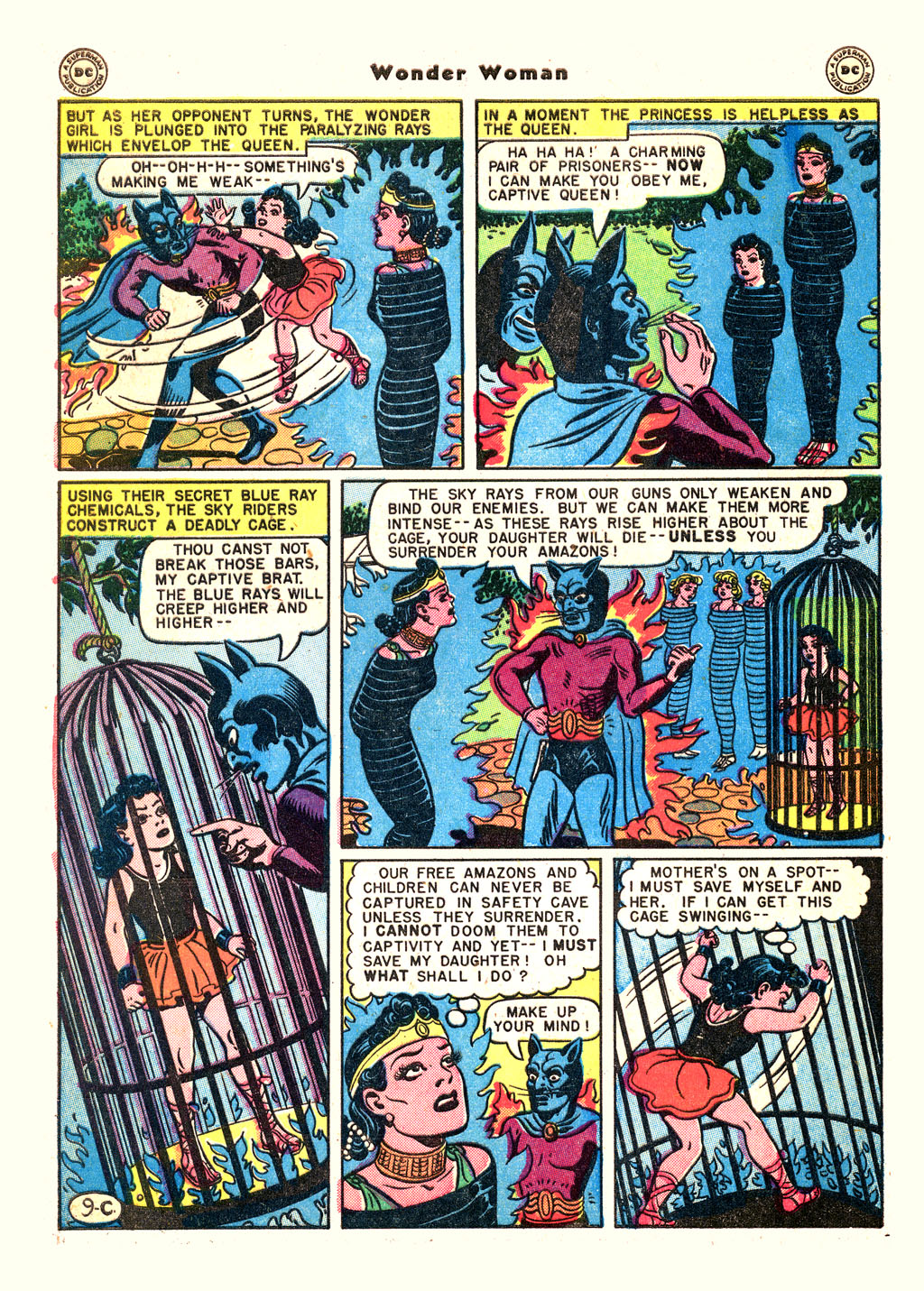
So here’s some scenes of the young WW being disciplined as little girls ought.

That upper right panel, in particular, eroticizes the adult mother and the child daughter in exactly the same way; both are bound side by side, with Peter’s stylized drawing and the wrappings deemphasizing the age difference; they look like different sized dolls rather than like mother and daughter.

Peter emphasizes the connection, and the parallel fetishization, of mother and daughter in other ways as well:

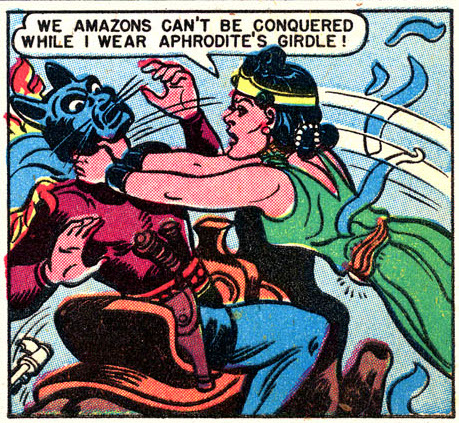
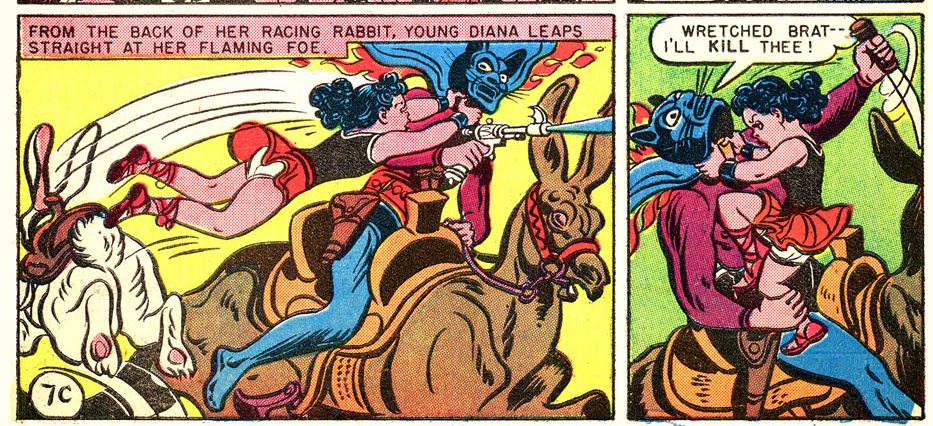
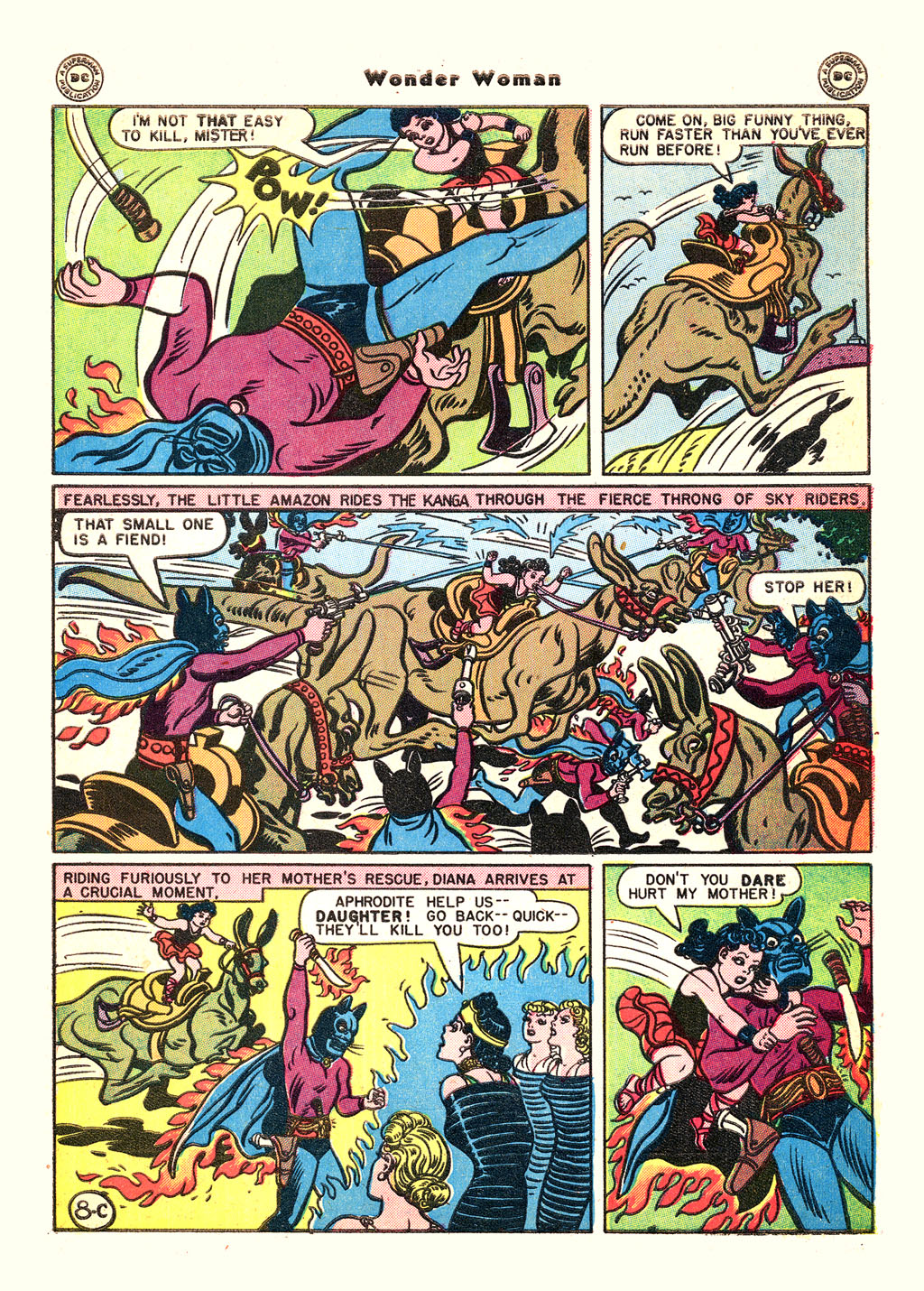
Mother and daughter both attack in the same way; leaping up to grab the antagonist by the neck. And in both cases, the attack is, I’d argue, fetishized; Hippolyta’s straight posed stiffness emphasizes the curves of her dress and of her breast. In the second sequence, Peter shows us, in both panels, WW’s underwear beneath that short miniskirt.

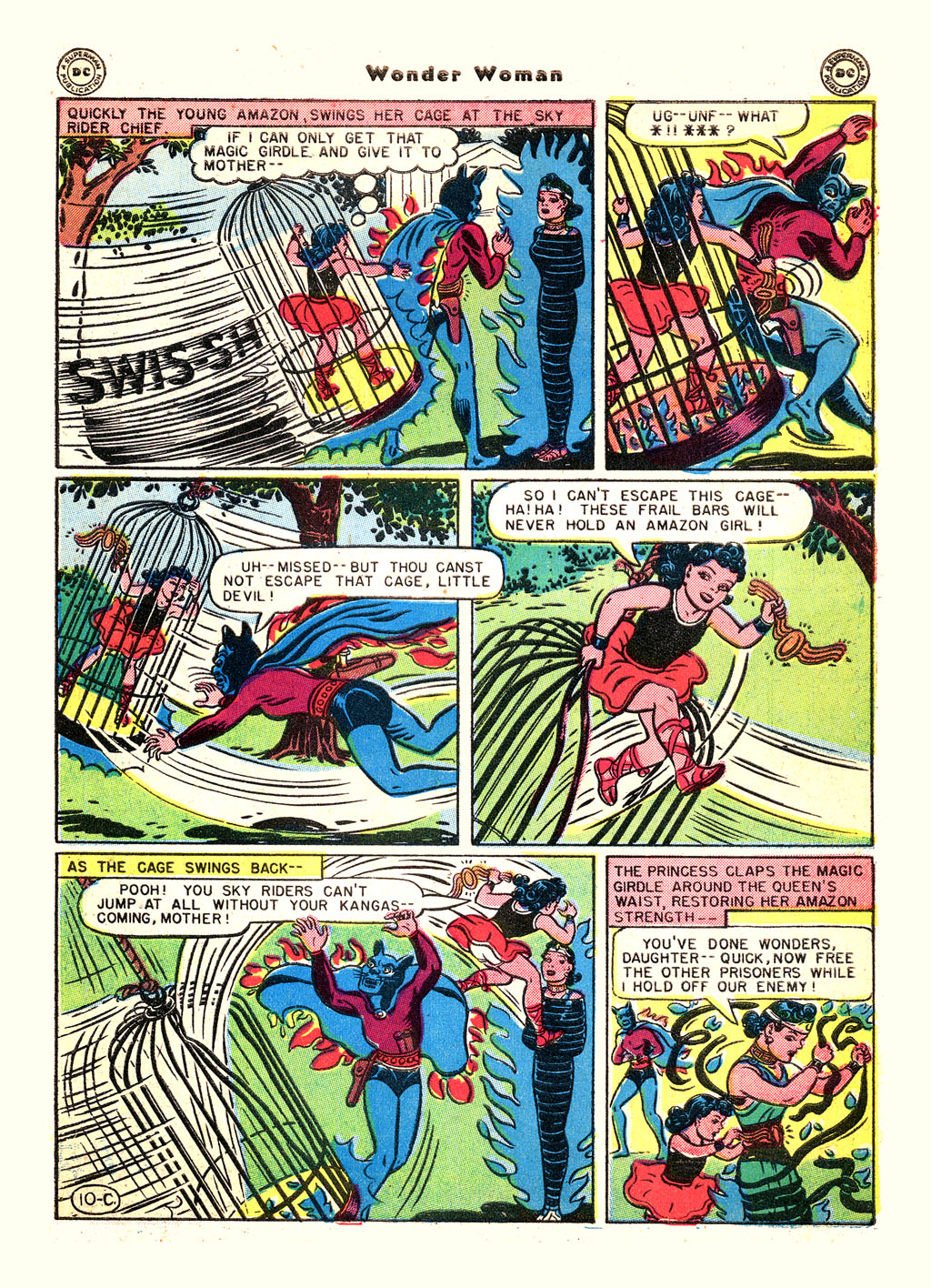
In addition, of course, any display of female power is eroticized for Marston, as is any display of female disempowerment. As with the corporal punishment fantasies Marcus describes, the woman empowered and the woman disempowered are both subjects of the fantasy. So it’s as exciting to see WW in the cage as to see her breaking out of it:

Note in the bottom left panel that we see her underwear again…and that her crotch is level with her mother’s face. The energized swoops of motion lines; the violent rescue of the damsel in distress — this is a typical erotic fantasy, not any the less so because it involves daughter/mother rather than hero/heroine.

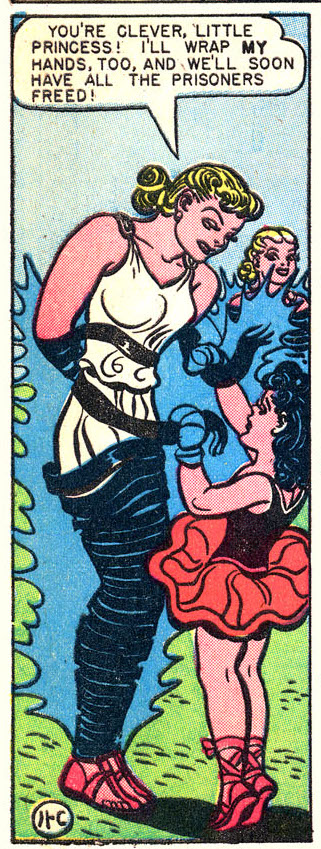
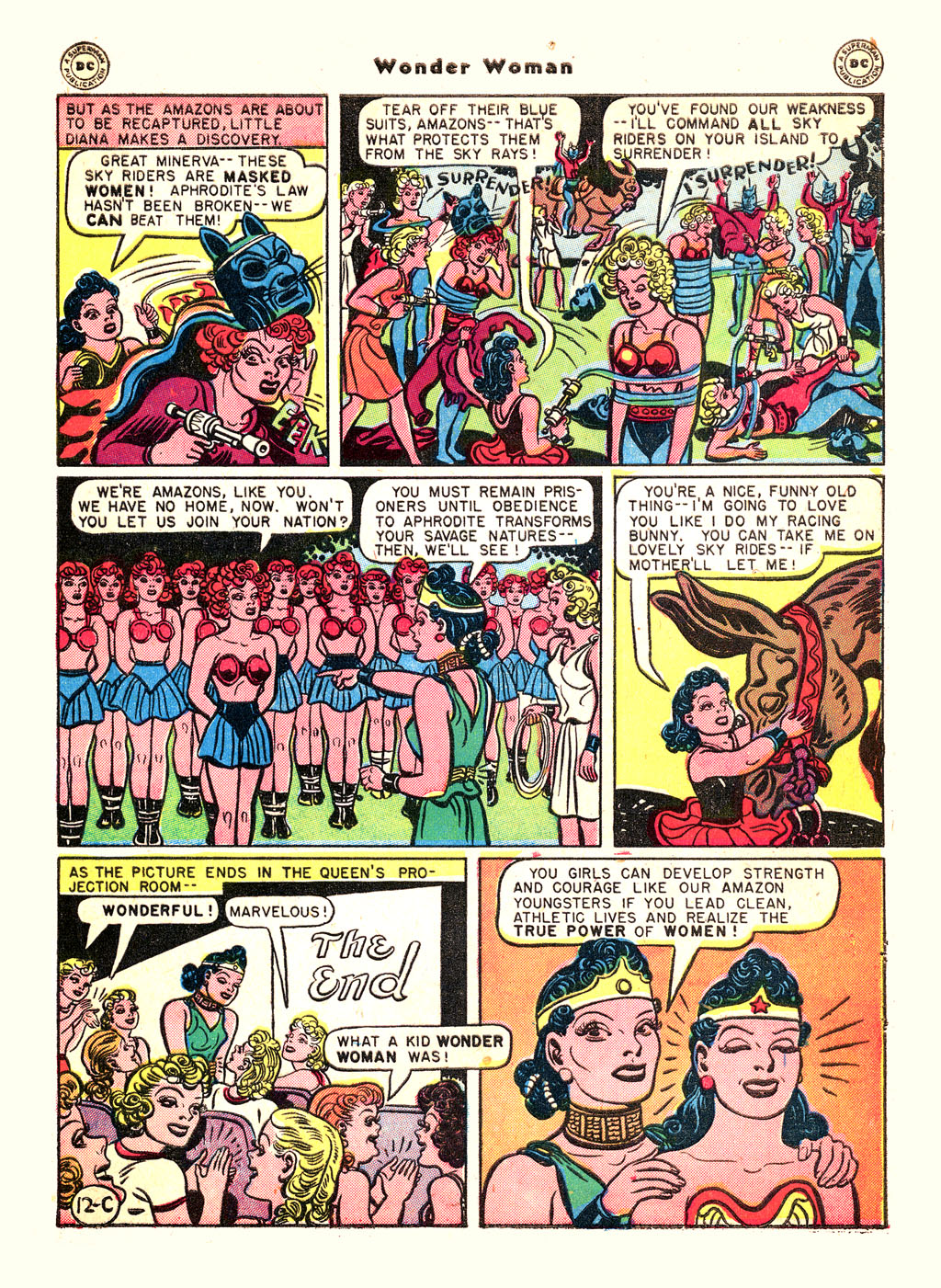
You see it again here; the Amazon being unwrapped is decidedly butch; her shoulder-width emphasized by the narrowing of her lower body caused by the wrapping. Young WW, with her dress flaring up as always, is decidedly femme. But in this case the femme is rescuing the butch, rather than the other way around — a role reversal which I’m certain Marston appreciated.

And speaking of role reversals:

The sky riders who the Amazons initially assumed were men are, as it turns out, masked women. Thus Aphrodite’s law preventing men from setting foot on Paradise Island is not broken. Or, to put it another way, men are not the defilers of Aphrodite’s virgin soil — women are. Inevitably, the sky raiders are stripped to their underwear and bound under the watching eyes of the Amazon. In defeat, the powerful men are feminized — though, since this is Marston, the feminization is actually their triumph, as they will now (eventually) become reeducated and made Amazons (better than any man!)

Marcus notes that the Victorians created eroticized images of and narratives about women for women. The fashion plates allowed women to experience powers and pleasures around control and consumption of female bodies that were, in other areas, reserved for men. In a somewhat analagous way, it’s worth pointing out that the eroticization of children in WW is meant to be consumed primarily, not by adults, but by children. The hints of adult pleasure, power, dominance, and submission, leavened with childish adventure and playfulness — the very things that made Frederic Wertham choke up his soup — were, I’d guess, exactly the features which appealed to children of every gender.

Plus, of course, sky kangas.

Doubly Good

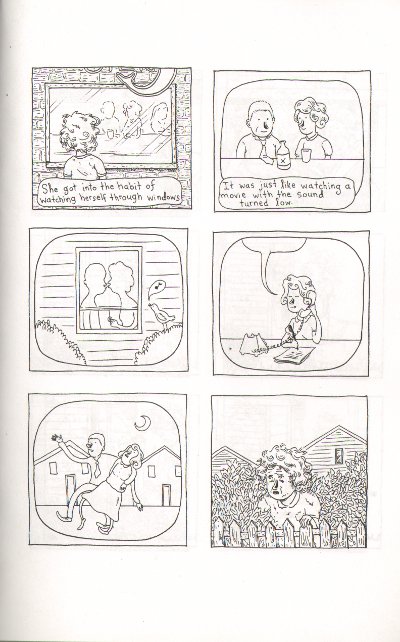
There’s a moment in Lilli Carré’s minicomic “The Thing about Madeline” where you really get that you’re reading a real story and not another installment in the Saga of the Mundane. It’s a little later than the point where that story actually begins: not where Madeline meets her doppelganger/self for the first time – that’s just a plot twist – but when Madeline the First gets “into the habit of watching herself through windows”:

Robert Stanley Martin correctly identified this moment as the place where the story’s main narrative idea slips from metaphor into dramatic irony, as the doppelganger is able to find the happiness in her life that Madeline could not. His review is so spot on I’m just going to link to it rather than trying to cover those aspects of the narrative myself.

But those panels also mark the place where the visuals take over doing that metaphorical work that the narrative leaves behind: the images of double Madeline continue to manifest the theme of alienation from oneself and one’s life while the plot (and facial expressions) hold up the ironic narrative.

What’s particularly beautiful and satisfying about this is not just that the visuals effortlessly carry significations that would become increasingly labored in prose. It’s also that the comic itself is now doubled right along with Madeline: the themes of alienation and happiness continue side-by-side formally in the same way that Alienated Madeline and her Happy Doppelganger populate the narrative. What this allows, then, is two separate story arcs: a literal one about Madeline and the Doppelganger, and a sustained metaphorical one about the relationship between alienation and happiness. Toward the end of the book, when Happy Madeline is visited by her own Alienated Doppelganger, the scenes from the beginning are recast – on a second read or in retrospect, it’s possible to see Happy Doppelganger and Happy Madeline as the same “character.” In that reading, self-alienation is always lurking and, as Robert points out, the easy moralizing criticisms of Alienated Madeline are much harder to make. The powers of circumstance and perspective get attention in a way they could not if the story had stayed more personal, eschewing that metaphorical strand.

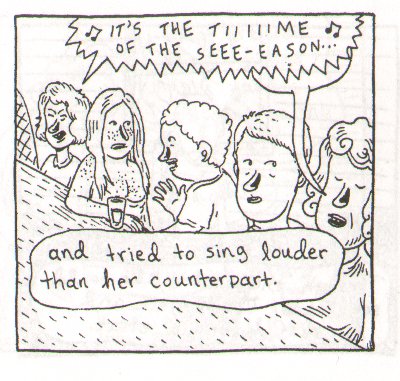
Carré’s work always balances very deftly on the line between ironic detachment and literary self-awareness, both traditional dramatic irony as well as the more formalist kind. Her characters often have these very distinctive noses that are a mashup of Mary Poppins and Raggedy Ann, and they alone are sufficient to make her drawing style immediately recognizable. In the case of The Thing about Madeline, this stylistic quirk works as support for the formal edifice: they mark the characters as “drawn,” and the effect of this signature is to anchor those characters to the visual plane of the comic. They restrict the universality of the characters and contribute to our sense of detachment from them.

That signature nose is absent from Carré’s most recent animated film, Head Garden, one of the selections for the 2010 SPX Animation Showcase.

Head Garden from Lilli Carré on Vimeo.

Instead, the face carries the metaphor, more directly. The facial features are less “cartoony” and more influenced by “art” faces like the ones discussed here and in comments. For me, the loss of this creative “signature” lets the animation breathe and allows the critical, slighly neurotic self-awareness of ironic detachment to mutate into the genuine double entendre that marks the best literary characterizations. The physical marker of style is less overt, but there is no loss of metaphorical sophistication (relatively at least; the animation’s metaphors are less ambitious than the mini-comic’s). The characters have become less “self-conscious”, although less well-developed in this less narrative piece, and I think because of this, the seams between the form and its significance are better hidden. I don’t think that’s just an effect of the film as opposed to comics. Identification with these characters is less detached even in still frames, despite the much more distant narrative characterization.

It seems to be a one-off, though; Nine Ways to Disappear maintains the signature style, as do Carré’s previous animations. (The nose is put to exceptional effect in What Hits the Moon; watch the way it sustains the character’s identity as her face ages around it.) But I think the comparison illustrates some of the limitations of too much “handwriting”: after awhile, it begins to feel like deliberate self-citation. Unless the handwriting is used in some meaningful way, it can interfere with other effects. Head Garden is still discernably Lilli Carré, but in the absence of that distinctively marked facial feature, her graceful but slightly awkward lines — like the talented too-tall girl in ballet class — get to take center stage. I hope to see a sustained story from her in the style of Head Garden sometime soon.

=========================================================

This review is based on the black-and-white mini-comic version of The Thing about Madeline. More information on the SPX Animation Showcase is available here.