by James Romberger
In “Man of Rock,” Bill Schelly’s recent biography of Joe Kubert, the well-respected graphic novelist and former DC editor says that he and Alex Toth knew each other well from “way, way back” in the 1940s when they were teenaged cartoonists. Kubert is two years older than Toth, which may have seemed like a lot to them then. He says that at sixteen Toth worked “like a dog–his intensity overwhelming.” While I don’t get the sense that Kubert and Toth were ever especially close as friends, they shared studios and social contacts, and both artists worked for early DC editor Sheldon Mayer. A talented artist in his own right, Mayer was a volatile editor. Toth recalled that Mayer tore up one of his early stories. Kubert says that he saw Mayer “verbally rip a guy apart…and take original pages and fling them right across the room,” but notes that he was not treated in this way, perhaps because he was “bigger.”
Both artists claim Mayer as a key formative influence. In later years when Kubert acheived editorial positions, his relationship with Toth changed as it became one of management and labor. Toth’s efforts for editor Kubert on two stories appears to be the key to their mutual disaffection. Neither party understood the other’s motivations, but as a result, a major Toth work was rejected to be lost to posterity, their friendship ended and in later years Kubert was criticized by Toth. Kubert’s own accounts of their conflicts are inconsistent.
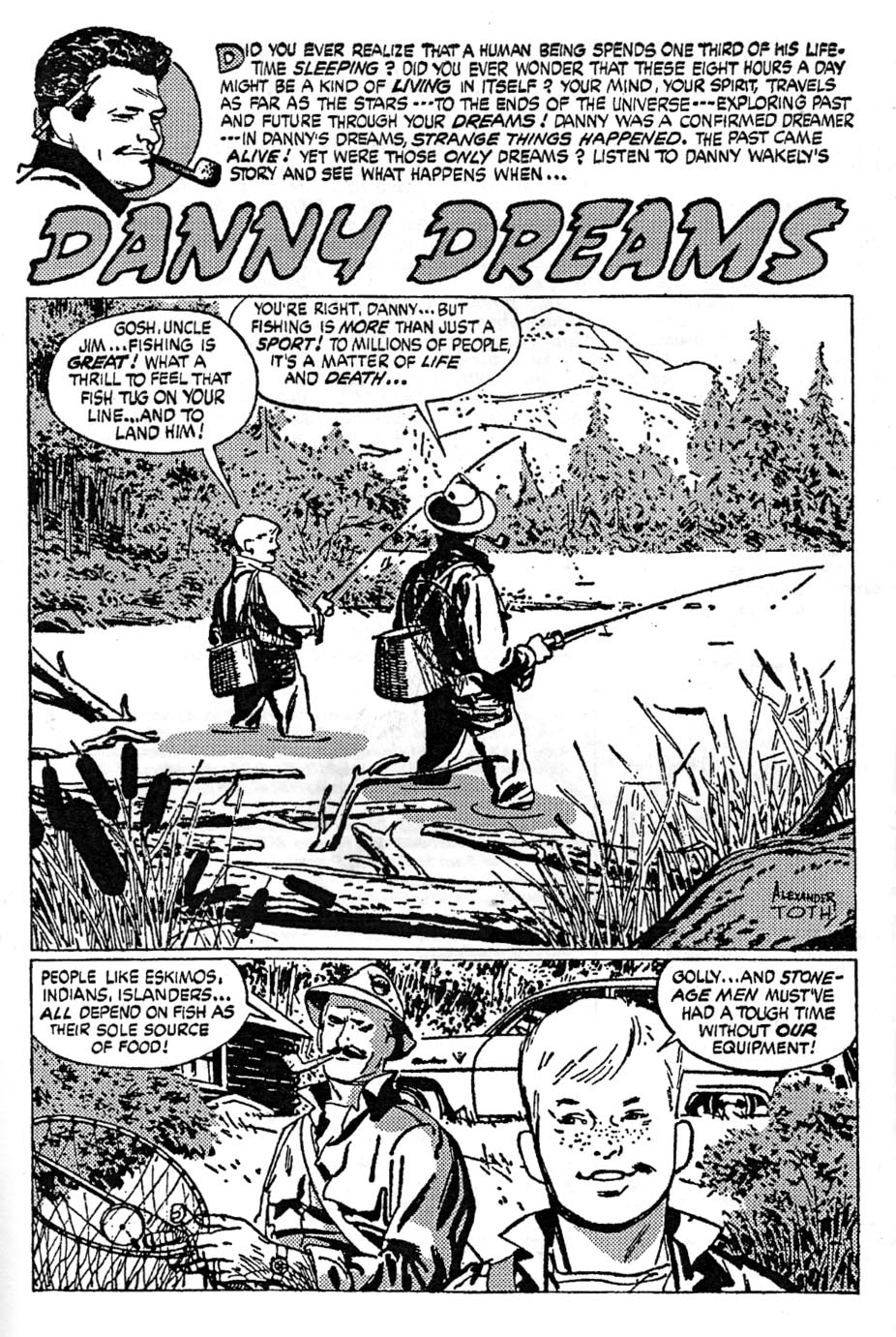
At St. John in 1954 Toth drew a 5 page story for editor Kubert’s title Tor Vol. 1 #3. Danny Dreams was done in a fertile period of discovery for Toth, contemporaneous with his early masterpiece The Crushed Gardenia, as he was formulating his mature pared-down style. Kubert says in a letter printed in 1999 in Toth: Black and White that the story was “drawn close to printed page size—beautiful tight artwork,” but in an interview done in 2006 for Alter Ego Kubert says he was “shocked” and “disappointed” with the work when he first saw it. Perhaps because the original art was so small, or maybe because its simplicity at that time was not what the more detail-oriented Kubert expected, he mistook the economy of line that marks Toth’s great later work for laziness. Or, perhaps it was because Toth omits the folds of most of the ears of the characters in Danny Dreams and draws them as empty curved shapes.
Danny Dreams: flat ears, small art. Tones by Bill Black.
Continue reading →