Last Saturday, at one o’clock in the afternoon, fifteen Seattle cartoonists packed into a sunlit room at the Phinney Ridge Community Center for a twenty-four hour annual ritual. Burdened with snacks, lap boards and drawing supplies, everyone seemed a little unsure at first confronting the empty room. But soon the mood changed as tables and chairs were pulled out and adjusted and windows and blinds were open to let in the last few hours of light.
For my part, I had built up quite a bit of excitement before the event. I would be participating in a group organized by local cartoonist Henry Chamberlain, and consisting of several cartoonists and illustrators whose work I was familiar with, including Jennifer Daydreamer, Tom Dougherty, Eroyn Franklin, Marc Palm, and David Lasky, whose story “Minutiae” is the best 24 hour comic I’ve ever read. So it was with much and excitement and a little trepidation that I began.
For this column, I’d like to return to the subject of comics criticism. A while back, HU hosted a Popeye roundtable, which raised some interesting general questions, but seemed to stop from lack of enthusiasm before it went very far. Not being in a position to contribute at the time, I would like to resurrect it for the purpose of raising a number of issues pertaining to how we talk about comics and art.
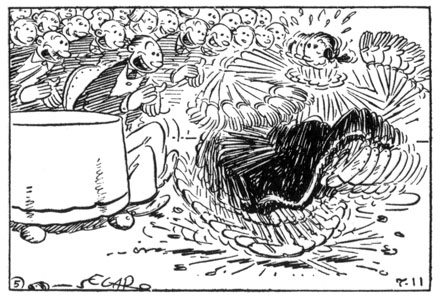
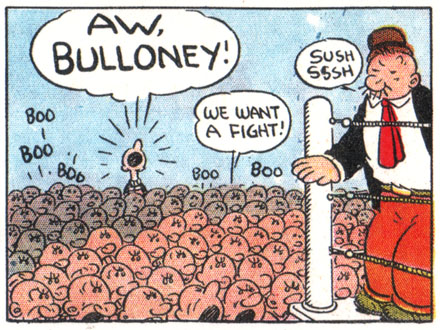
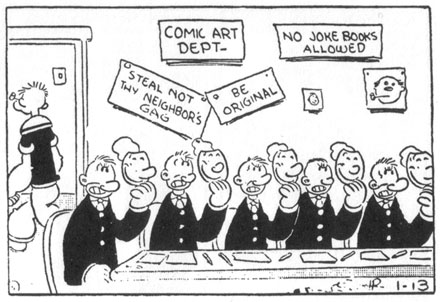
Noah in his ambiguous essay on E. C. Segar’s strip expresses frustration at what he perceives to be its shallowness:
Though I enjoyed the energy of the drawing, and the Sea Hag and Goon provided some evocatively creepy moments early on, the limited range of the humor, and its empty-headedness, quickly becomes numbing. Wimpy is lazy, Wimpy eats a lot, Popeye is noble, defends the underdog, and always wins.
Robert, in his piece, which references a series of earlier, excellent reviews on his own site, concludes that the strip is “largely of historical interest”, writing:
The challenge I gave the work was for it to transcend that description. It occasionally did; there were flashes of satirical and absurdist genius every now and then. “The One-Way Bank” storyline from Volume II and the finale of “The Eighth Sea” storyline from Volume III stood out, and I was especially taken with Volume II’s “The Nazilia-Tonsylania War” — its treatment of state and military folly ranks with Dr. Strangelove (almost) and Duck Soup. (No pun was intended with the name “Nazilia,” by the way.) However, Segar was generally far more enamored with farce and slapstick for their own sake than he was with satire. That greatly limits the appeal of his work, at least for this adult reader. Farce and slapstick that don’t connect with anything deeper are best in small doses; they tend to wear out their welcome fairly quickly.
So the strip is less than great because it is simplistically conceived and primarily concerns itself with slapstick and farce, only rarely ‘transcending’ these. For Robert, this happens when it becomes satirical, because that somehow connects ‘deeper’ than mere laffs.
This seems to me a holdover from modernist conceptions of aesthetic value that privilege the framework provided by the ‘high’ arts. Robert even spells out this bias:
No reasonable person would consider it on the level of Faulkner, Kandinsky, or Jean Renoir’s work, but it looks right at home when viewed alongside the efforts of Mae West, W.C. Fields, and the Marx Brothers. I have nothing against the popular-entertainment standard for determining “good” comics, by the way. If a comic entertains people, it’s doing its job. And if it’s entertaining people to the extent that it becomes a pop-culture phenomenon, which Segar’s Popeye certainly did, then it’s doing its job terrifically well.
…But it still isn’t as great as Faulkner, Kandinsky or Renoir. Invoking the consummate elitist Harold Bloom’s definition of the canon as what should be taught in our schools, Robert judges Popeye out. But why? He has himself conceded that it gripped more than one generation of readers and became a pop-culture phenomenon. Isn’t that worth teaching in schools? And what about those great humorists cited? Irrelevant to the understanding of our culture?
My intention here is not to claim that Popeye – or Thimble Theater if we want to be correct – is the equal of the best high art had to offer at its time (conversely I’m not saying that it ain’t either). What I am saying is that it will necessarily look impoverished when judged in the framework of high culture, and that I find such a yardstick unhelpful in assessing its qualities — qualities that clearly resonated widely and persistently. Although we have now for several decades described our times as postmodern, with everything that entails, the elitist legacy of modernity is amazingly hard to shake.
Noah recognizes this, essentially framing his dismissal of the strip as personal preference. He compares with another low-culture medium, which has received even less high-culture acclaim: television, concluding that,
…what is and isn’t considered art is really arbitrary. Comics critics have spent a lot of energy for the past decades trying to get comics accepted as high art. They’ve had definite (if not unqualified) success, and now even frankly pulp, unpretentious works like Popeye can be put up in galleries, given lavish reissues, and hailed as canonical examples of the form.
I would guess that someone like Noah, who spends a fair amount of energy as a critic acclaiming the qualities of some of the most commercial iterations of contemporary pop music, would be unsatisfied with the kind of high-culture point of view brought to bear on comics by some of its more assiduous critics at this current, mercurial juncture in their history.
Having long regarded hip hop as one of the most inspiring cultural manifestations of the last 30 years, I sympathize. It has been interesting to watch its fortuna critica in the cultural establishment as it has evolved: regarded initially as a fad, its staying power has come to be recognized and it is now classified as a legitimate musical genre, but it still isn’t considered an art form on the level of, say, rock music. “Gangsta Gangsta” by N.W.A simply doesn’t cut it when measured by the yardstick of “Like a Rolling Stone”, but it is undeniably a hugely resonant piece of work, every bit as influential on the generation from which it sprang.
Similarly, at the time of Thimble Theater, surely ‘no reasonable person’ would consider something like ragtime or jazz on the level of opera. Yet, today, these forms and their progeny are regarded as entirely respectable art forms, capable of greatness akin to that achieved in classical music. Music unites us in ways that other art forms don’t, and we seem to be more receptive to “shallow” qualities there than we do in literature, fine art, or even comics. Perhaps this is not so surprising, since music generally is less cerebral than those forms, making us appreciate — and intellectualize — our emotional and visceral responses to a higher degree.
And actually at least one perfectly reasonable person did consider ragtime and jazz, and with them a whole range of other popular forms such as vaudeville, the movies, and yes, comics, on the level of high culture. A cultural critic and New York correspondent of T. S. Eliot’s Criterion, his name was Gilbert Seldes (1873-1970). In his precocious defense of popular culture, The Seven Lively Arts (1924), he wrote:
If you can bring into focus, simultaneously, a good revue and a production of grand opera at the Metropolitan Opera House, the superiority of the lesser art is striking. Like the revue, grand opera is composed of elements drawn from many sources; like the revue, success depends on the fusion of these elements into a new unit, through the highest skill in production. And this sort of perfection the Metropolitan not only never achieves — it is actually absolved in advance from the necessity of attempting it. I am aware that it has the highest-paid singers, the best orchestra, some of the best conductors, dancers and stage hands, and the worst scenery in the world, in addition to an exceptionally astute impresario; but the production of these elements is so haphazard and clumsy that if any revue-producer hit as low a level in his work, he would be stoned off Broadway. Yet the Metropolitan is considered a great institution and complacently permitted to run at a loss, because its material is ART. (pp. 132-133)
Lest he be dismissed offhand as the kind of contrarian philistine such statements might evoke in us today, I hasten to supply the following; during a visit to Picasso’s studio in Paris, he was shown a fresh canvas by the master, which prompted in him a synthesis:
I shall make no effort to describe that painting. It isn’t even important to know that I am right in my judgement. The significant and overwhelming thing to me was that I held the work a masterpiece and knew it to be contemporary. It is a pleasure to come upon an accredited masterpiece which preserve its authority, to mount the stairs and see the Winged Victory and know that it is good. But to have the same conviction about something finished a month ago, contemporaneous in every aspect, yet associated with the great tradition of painting, with the indescribable thing we think of as the high seriousness of art and with a relevance not only to our life, but to life itself — that is a different thing entirely. For of course the first effect — after one had gone away and begun to be aware of effects — was to make one wonder whether it is worth thinking or writing or feeling about anything else. Whether, since the great arts are so capable of being practised today, it isn’t sheer perversity to be satisfied with less. Whether praise of the minor arts isn’t, at bottom, treachery to the great. I had always believed that there exists no such hostility between the two divisions of the arts which are honest — that the real opposition is between them, allied, and the polished fake. (pp. 345-346)
I think we could do worse than take a cue from Seldes’ notion of the ‘lively arts’ in our current reassessment of comics as cultural phenomena and art. About the comic strip:
Of all the lively arts the Comic Strip is the most despised, and with the exception of the movies it is the most popular. Some twenty million people follow with interest, curiosity, and amusement the daily fortunes of five or ten heroes of the comic strip, and that they do this is considered by all those who have any pretentions to taste and culture as a symptom of crass vulgarity, of dullness, and, for all I know, of defeated and inhibited lives. I need hardly add that those who feel so about the comic strip only infrequently regard the object of their distaste.
Certainly there is a great deal of monotonous stupidity in the comic strip, a cheap jocosity, a life-of-the-party humour which is extraordinarily dreary. There is also a quantity of bad drawing and the intellectual level, if that matters, is sometimes not high. Yet we are not actually a dull people; we take our fun where we find it, and we have an exceptional capacity for liking the things which show us off in ridiculous postures — a counterpart to our inveterate passion for seeing ourselves in stained-glass attitudes. (p. 213)
Seldes doesn’t mention Thimble Theater, and couldn’t have known Popeye (on account of he hadn’t been born’d yet), but he regarded highly its neighbor in the New York World, Krazy Kat, whose creator George Herriman he considered one of the two genuine artistic geniuses in America at the time (the other was Charles Chaplin). In his famous essay on that strip, he wrote:
With those who hold that a comic strip cannot be a work of art I shall not traffic. The qualities of Krazy Kat are irony and fantasy — exactly the same, it would appear, as distinguish The Revolt of the Angels; it is wholly beside the point to indicate a preference for the work of Anatole France, which is in the great line, in the major arts. It happens that in America iron and fantasy are practised in the major arts by only one or two men, producing high-class trash; and Mr Herriman, working in a despised medium, without an atom of pretentiousness, is day after day producing something essentially fine. (p. 231)
Granted, Krazy Kat has received greater high-culture recognition than any other strip of its day, and seems more effortlessly to accommodate a fine arts perspective, but I don’t see why one couldn’t formulate something along similar lines for Thimble Theater. Noah suggests that one might compare the strip with the cinema of Buster Keaton, which strikes me as particularly instructive:
Keaton’s work rightly occupies an important place in the cinematic canon, despite it being similarly resistant to the kind of interpretative framework that eschews slapstick. As the New Wave filmmakers recognized, however, his auteurial presence is acutely felt throughout his work, and it gives us a highly original, fatalistic and uncannily comic conception of depersonalized action in a world of strange, fickle serendipity.
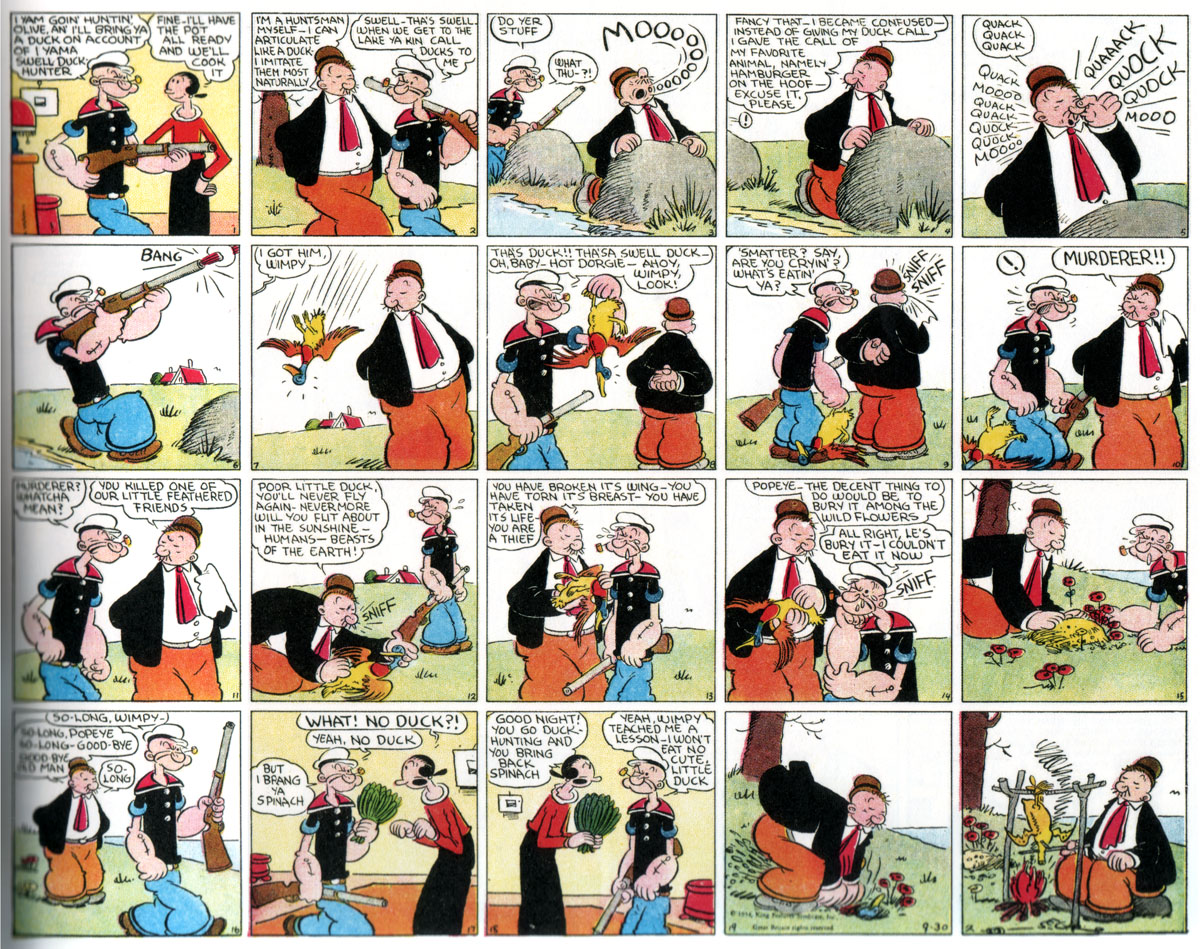
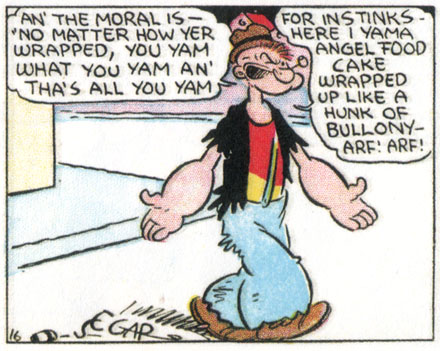
Now, let’s look at fairly typical, self-contained Sunday page from Thimble Theater (sep. 30th, 1934):
On the surface, it delivers a straightforward gag pitting, as is so often the case, Popeye’s morality against Wimpy’s lack of same. But Segar is anything but a utilitarian gang man; he proceeds like a cartoon behaviorist, generously packing in as much character detail and humorous instance to create a highly seasoned repast, all the while unfolding a strongly intuited moral ethos.
Watch his unaffectedly plump line and vernacular wit unfold across the page: Wimpy insinuating himself into the frame and the duck hunt, bodily/verbally; his mention of his favorite animal, “hamburger on the hoof”; the manner in which he splays his three surplus fingers while pressing his nose to quack (and, inevitably, to hamburger moo); his poker face registering the hit, turning to sniff; the derision on his face against Popeye’s soon-to-vanish irascible scowl; the silent burial bookending Popeye’s contrition, Wimpy empathetically yet efficiently settling the mound; the exchange: “WHAT! NO DUCK?!” — “Yeah, no duck”; the unchanged expression on Wimpy’s face as he kneels caninely to exhume the duck with speed, his coattails waving; it remains unchanged as he sits at the end, counter to the left-right flow, roasting the kill.
Clear in presentation, yet richly studied, this sequence is a perfect summation of the profane reality of Thimble Theater. A true comedic hero, Popeye is pugnaciously selfless in a world governed by selfishness. He always restores order around him (often, disturbingly, by violence), but is simultaneously given enough of a tragic edge — his morality is rarely reciprocated — to keep us involved. As with Keaton, there’s a fatalistic undertone to his and, by its frequent extension to the rest of the cast, the strip’s indomitable catchphrase: “I yam what I yam, an’ that’s all I yam!” It’s trenchantly inspirational and it is great fun, so why can’t it be great art?
Part of the answer, if one compares with cinema, is that it has taken comics much longer to expand its field beyond a fairly restricted set of idioms and genres, all of which are candidly low culture. It hasn’t had its James Agee, though people like Donald Phelps, R. Fiore and Art Spiegelman have done their best in recent decades; they haven’t had their Raymond Rohauer and have only recently begun experiencing comprehensive restoration and republication, and they haven’t had their new wave until now.
Which brings us to the matter at hand: this is a time of redefinition for comics, which is not only manifest in contemporary cartooning, but naturally extends back to encompass its history. Neglected by critics and historians, and forgotten even by most cartoonists, the classics now demand our attention for what they teach us about their time and the evolution of the form, but ultimately also as works of art. Though it is surely healthy to assess comics in the expanded field of cultural production being opened up as distinctions between high and low are collapsing, to not cut them any exceptionalist slack, it would seem ill advised to judge them according to antiquated systems of hierarchical exclusion.
PS — Because Noah mentioned them as part of his high-low concordances, I can’t help bringing in the Coen brothers here. While it is correct that they are becoming canonized as directors, it is remarkable that their best loved, and arguably best though not most critically acclaimed film, The Big Lebowski, is so unabashedly shallow. It totally fails the modernist test as a work of art, and yet there it is, and it’s glorious.
Squint, imagine some more punching, and it might almost play at the Thimble.
Oh, and I think I’m going to stop with the music downloads. It’s been fun, but there’s not a ton of interest, and I spend too much time on the blog as it is!
Nonetheless, I find the message in the videos I’ve seen frustrating. Yes, it’s good for kids to know that things will improve. But high school isn’t a force of nature. It’s not a hurricane, or even acne. It’s not unavoidable. If high school is making your life miserable beyond all endurance—so miserable that you’re seriously considering killing yourself—then maybe you shouldn’t wait two or three years for your life to get better. Maybe you should just drop out.
The remake follows through on the group dynamics to some extent—the guys egg each other on; they bring Matthew along to lose his virginity, etc. But it abandons the effort to make the men appear like just folks. Ironically, the director Steven R. Monroe gives one of his characters a video camera, and we see some of the rape through the lens. This is an obvious effort to implicate the viewer, but in fact, this version of the story is much less accusatory than Zarchi’s original.
That’s because, instead of seeing the rape as a result of standard male group dynamics, Monroe tries hard to de-collectivize the guilt. In Zarchi’s version, the men were typical guys, and the rape, too, was therefore typical—a possibility for any man. In Monroe’s version, on the other hand, the rapists are individual monsters, a much less frightening idea.
This is fascinating, in a Hey! -that’s-Barry-Manilow-defecating-on-my-porch! kind of way. Philadelphia studio musicians turn Gershwin’s mournful lullaby into a giant lounge turd, complete with smooth-jazz intro and half-assed crappy disco cheese funk. For the full effect, imagine Paul Robeson dancing in a conga line with a white shirt open to his navel. Or, you know, don’t.
An edited version of this essay first appeared in The Chicago Reader.
___________________________________________________
The last book but one I read was Jacque Derrida’s The Gift of Death, his late-career foray into deconstructionist theology.
To say that you recently finished reading a Derrida book for pleasure is obviously a fairly major throwdown (“Look at my brain!”) It’s also, though, somewhat uncomfortable — what sort of poseur reads Derrida for pleasure and then brags about it, anyway? In my case, the poseur-ness is only compounded by my motivations. I picked up the book because my brother (an English professor) had just mentioned his own Derrida reading, and I was feeling somewhat inadequate. Nor is this anxiety made any less shameful by the fact that the conversation with my brother occurred, not on the phone or in person, but in the comments section of my poncey comics blog. Said poncey comics blog being where I have most of my conversations with my brother these days. And yes, that’s embarrassing too.
I’m blogging my way through all the stories in A Drunken Dream, the collection of Moto Hagio’s stories out from Fantagraphics. You can see all posts about this collection here.
_______________________________________
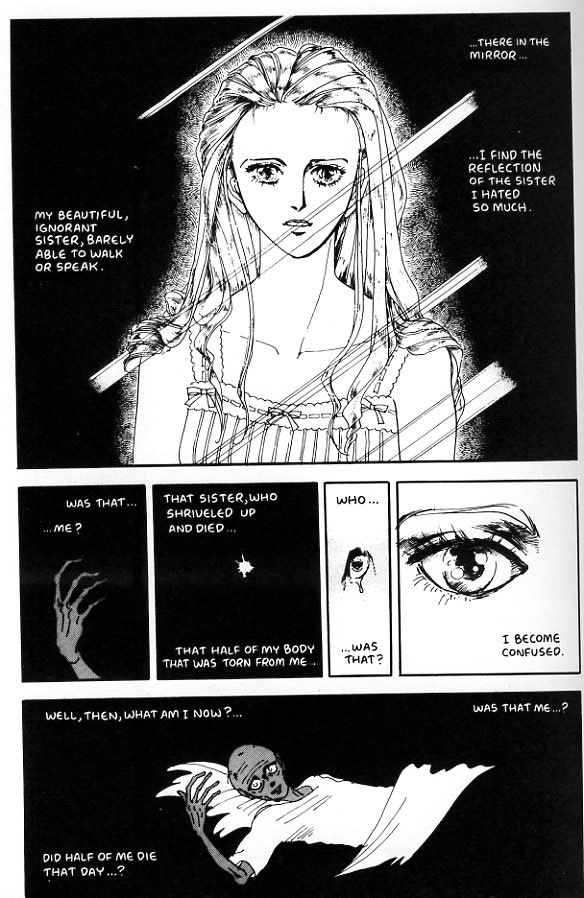
Moto Hagio’s “Hanshin: Half-God” is about Yudy and Yucy, conjoined twins. Yudy, who tells the story, is ugly, shrivelled, articulate, and competent; her twin sister, Yucy, is a beautiful, mute parasite, who sucks away both Yudy’s nutrients and the affection of parents, relatives, and passersby. Yudy has to help Yucy walk and bathe and perform even the simplest tasks; in return, the simple Yucy gives Yudy frequent fevers and bothers her while she tries to study genetics. Eventually, doctors decide that the twins will die if they are not separated; the only choice is to cut loose Yucy, who will die, allowing Yudy to live. Separated from her twin, Yudy grows into a normal young woman. The end.
Sort of. If that was the story, it would be a fairly straightforward, even banal feminist parable about casting off gender expectations in order to find your true self. Yucy, the delicate, helpless, beloved beauty, has to be destroyed before Yudy can grow up into a competent, independent woman. QED.
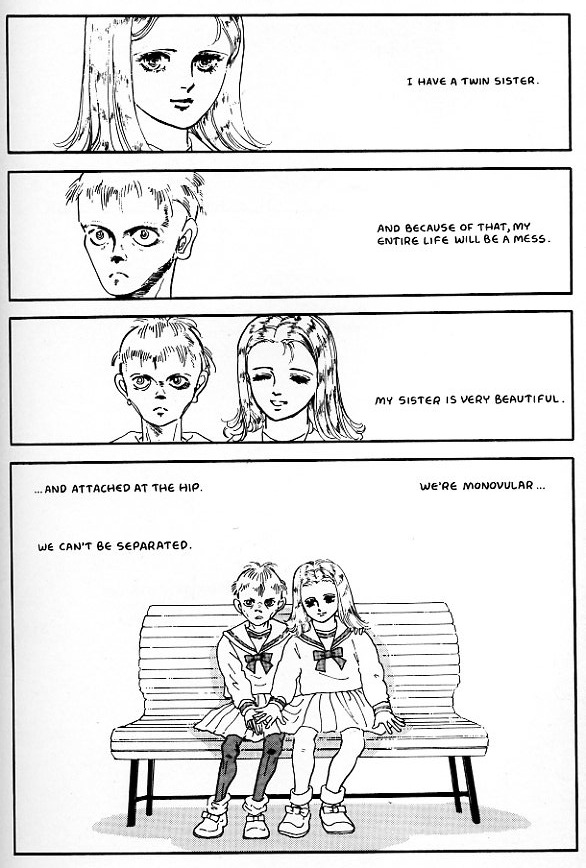
In this reading, Yudy and Yucy are different aspects of the same person…and there’s plenty of evidence for that in the art. For instance:
The first panel show Yucy off to the left against a blank background; then the second shows Yudy in the same position. In the third we see the two together…and only in the final panel on the page do we learn that they’re “attached at the hip.” The surprise reveal is, though, clearly rigged. If the two are attached, we shouldn’t be able to see them without each other. Particularly in the second panel, Yudy is placed so that we should see Yucy to her right — but all we see is blank space. The implication is that Yucy doesn’t exist except as metaphor…or perhaps, that Yudy doesn’t, since it’s Yucy we see first.
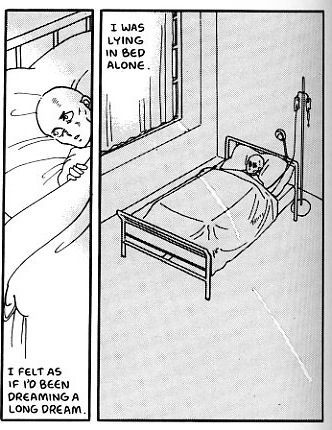
Again, just after the sisters have been separated, Hagio put in a tell.
“I felt as if I’d been dreaming a long dream.” The twin is just a fantasy; only when she is separated is Yudy living real life for the first time. The perfect girl she is supposed to be doesn’t exist.
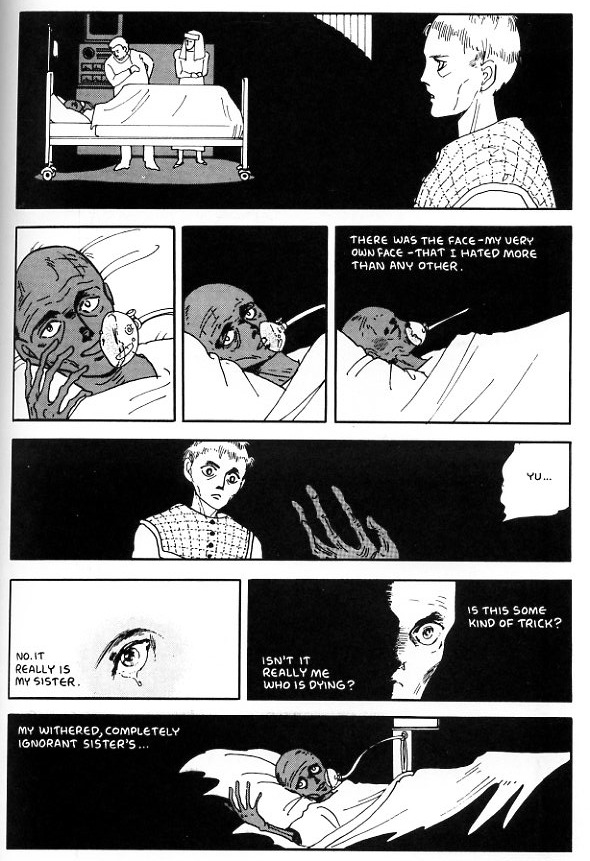
Except that she sort of does. Yucy doesn’t die immediately after being separated; instead she slowly wastes away. Yudy goes to visit her one last time, and is startled to see that her sister has turned into her own mirror image.
You could see this as still being about the escape from gender stereotypes — “Isn’t it really me who is dying? No it really is my sister.” Again, this could be a statement that the gender-normative self is not Yudy; that she has escaped other’s expectations. But the affect is off. Instead of joy or release, Yudy feels disorientation and grief. The self she has left behind is “really” a self; indeed, it now seems more like the real her than the her that has survived. As time goes on and she becomes healthier and healthier, Yudy begins to look like the sister who died, until finally she wonders which of them was killed:
The story is no longer about casting off an oppressive femininity. Instead, it’s about…what? Betraying the self perhaps…but how exactly? Has Yudy betrayed herself by turning into the femininity she thought she was rejecting? Or was the rejection of that femininity — which also encompasses childlike innocence — itself a betrayal? Or is it the loss of her pain which is a betrayal; leaving behind the helpless, shrivelled, wretched self to become a competent adult? If so, the bind seems double and unescapable; to grow up, one has to abandon one’s attractive weakness, but doing so is always a betrayal of that weakness. The child is not the adult, even moreso because the child is still there in your face. Or, perhaps, the conflict is not internal at all. Perhaps the bond that holds together Yudi and Yuci isn’t sisterhood or self, but love, and it’s the abandonment of that love for femininity which causes Yudi to both become more feminine…and to be haunted by the conviction that she has lost herself.
There isn’t any one “solution” to the story, of course. This is emphasized by the fact that there isn’t one Yudy, or even two, but many. In a recent post about doubles in comics, Caroline Small suggested that comics can do doubling in a way that is less “labored” than prose. I was skeptical about this — but Hagio’s story may have changed my mind. Because in “Hanshin,” the metaphorical uncertainty around Yudy and Yuci becomes an actual, concrete ambiguity. That is, when Yudy sees Yuci lying on the hospital bed, and wonders, “Is this me or is this my sister?”, the narrative insistence on ambiguous doubling actually obscures the concrete doubling — Hagio is, in this sequence, drawing the same person twice — or more accurately, six times.
Yudi and Yuci in Hanshin are just names, assigned as Hagio wishes to different iterations of the same body. In her confusion about who she is, Yudi is more, not less, aware of reality — she senses the arbitrariness of Hagio’s choices, the way that names and identities are linked, not as absolutes, but through arbitrary decisions.
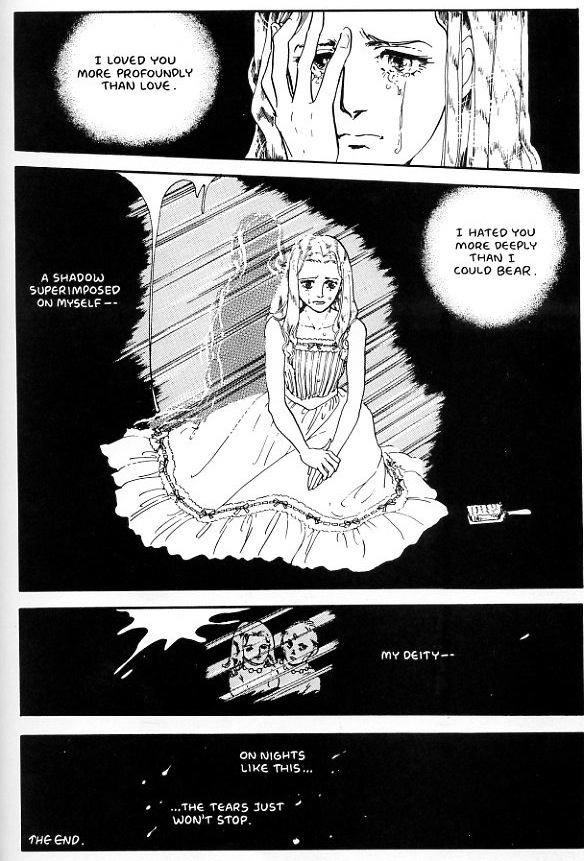
We “know” that is Yudi, but if Hagio changes the words, it could just as easily be Yuci who grew up. Which raises the question…who is talking here? Is that Yudi? Yuki? Or is it Hagio herself? “I loved you more profoundly than love. I hated you more deeply than I could bear. A shadow superimposed on myself….My deity —” Whose shadow? Whose deity? If one is drawn as two and two as one, who is doing the drawing? The same person who did the killing? Is the deity the one who is there or the one who is not, and how can you tell the difference? To create your soul is to split your soul; a god who has always already left half of herself behind.
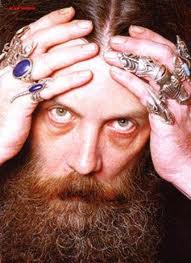
In case you missed it (as I did) Alan Moore gave a big interview a little bit ago to Bleeding Cool in which he talked about Watchmen and how he’s going to refuse to speak to various other of his collaborators because he’s a crank and, oh, incidentally, DC comics is run by what we would call disease-ridden rodents if doing so would not get us sued for defamation by capybaras with head colds.
As I said, I missed the interview, and didn’t actually read it in full until just now because, (a) I already knew that Alan Moore was a crank, and (b) I already knew that DC comics was a cess pit. So I felt I had the gist.
So let me suggest that anyone that just throws their hands up and says “Oh, that Alan Moore is crazy” isn’t just operating from a dubious moral position, they don’t know their history. Forget 25 years of Watchmen shenanigans for a second. If I had had just the experience Alan Moore had with ABC, where I had this giant, multi-pronged project with a publisher not DC in part because they were not DC and then found out one day when I felt I was too far along to back out without screwing over all my friends that my projects were part of a big sale to DC, I would suspect that company of bugging my phone and poisoning my water. If I had had the subsequent experience of being promised certain protections from aspects of DC editorial and then that falling through in absolutely pathetic and super-aggravating fashion over the stupidest of nonsense, I wouldn’t trust them to keep their word on a single damn thing. And that’s just one set of experiences for Moore when it comes to DC. People get more worked up in many industries when someone bogarts their parking space or makes them turn down a paid-for week in Disney World than Moore does here about 25 years of systemic dickery.
I agree that throwing up our hands and saying “Alan Moore is crazy” does a disservice to Moore, and much more importantly, to the issues raised in his interview and the meta-issue of how a creative person should conduct himself in public. Unfortunately, that denies him the insanity defense, which could be a useful excuse when he airily dismisses both his old friends (ex-friends?) and every comics writer in the new generation, whose work he hasn’t read.
Your argument that other people are crankier with less justification seems a bit desperate. Other people are serial ax murderers; that doesn’t mean we need to set the bar of acceptable behavior low enough to make one-time-only murder okay. Yes, we have all had bad-tempered moments, but the reason comics people care about Moore’s behavior in the first place is that his talent and career have made him a role model. And when role models fail, we should pay attention, because what happened to them could happen to us.
No one’s even mentioned that Moore has also airily dismissed the entire medium of film, several times, but oh it turns out he really just meant all the films that are playing now, which he hasn’t seen, and please won’t you watch his new film project which gets it all right?
Campbell also says:
I’ve never entirely understood the comics community’s addiction to tales of corporate betrayal. When an boulder doesn’t fall on you immediately, but waits for a few minutes and then falls on you, is that a “betrayal?” Because it seems to me that corporations in general don’t have a set of values to betray. They like money. That’s all there is to it. They pursue ethical behavior when it is profitable for them to do so, and individuals at the company are sometimes moral people, but a company is about as moral as a boulder, because it is a group of people with sometimes-conflicting values and opinions brought together by common profit. The basic failure to understand this, the continued attempt to anthropomorphize companies as if they were individuals you could trust or talk to, strikes me as a common failing of the artistic imagination.
Tom Spurgeon supplies an able rebuttal, with which I pretty much agree. I wanted to point out a couple of things from a slightly different angle, though.
First of all, Campbell suggests that Alan Moore is crazy. His primary evidence for this is that Moore dismisses old friends, dimisses comics writers in the current generation whose work he hasn’t read, and dismisses today’s films without having seen many of them. This is not how a “creative person should conduct himself in public.”
One does wonder which creative persons Campbell is thinking about precisely. Not Kanye West or David Boreanaz, I take it — or even Lady Gaga, presumably. Really, is there anybody out there who expects creative people to be beacons of propriety? I thought the expectation was that, on the contrary, creative people would be unpredictable and sometimes not especially nice, what with the driving ambition and the money and the fame and all. Hasn’t Campbell ever seen Behind the Music?
Anyway, while he’s no Varg Vikernes, it’s true that in his own small way Moore is a crank, and from all appearances a very difficult person to deal with. He believes he’s an actual wizard, for goodness sake. His habit of dropping friends is infamous, and he talks smack about his co-creators in public like he’s a rock star rather than a comic book writer. He lived in a polyamorous relationship for some time, and he writes underage pornography and even uses his real name while doing it. He’s a big, dirty hippie with a strong conviction of his own genius, and he’s a lot weirder than the average comics creator or fan. This is not news to even a small degree. In fact, I think it’s safe to say that Moore’s highly unusual career, including its very substantial achievements, probably has something to do with the fact that he comes at comics from an idiosyncratic perspective.
But — how idiosyncratic is it, really, to sneer at contemporary film without really being especially up on it? Or how weird is it to say, “comics today suck” without having read a ton of them? People do that sort of thing all the time. And there’s no reason not to, is there? If you disagree, you disagree, if you agree, you agree. He’s shooting the shit, the way most people do when they talk about art. What’s the harm?
Campbell actually explains the harm in a second post.
Bottom line: I don’t see how there is anything “reasonable” about dismissing large bodies of work, and indeed entire media, that one claims not to have consumed. I can’t help but see a parallel between that kind of closed-mindedness and the closed-mindedness that keeps many people from reading comics.
“The closed-mindedness that keeps many people from reading comics.” It’s the ultimate insidery comics insult. You’re one of *them*, Alan! One of those evil people who doesn’t want to read comics, who thinks we’re a bunch of juvenile morons who don’t know that underwear is worn on the inside! Traitor! Traitor! Traitor!
The main infraction, the “bottom line” that makes Moore not “rational” is the fact that he basically doesn’t give a shit about the stuff he’s supposed to give a shit about. He doesn’t want to read contemporary comics; he doesn’t want to go to the movies. He just wants to crankily complain about them. He’s dipped his toe in once or twice at some point, presumably, he discovered he didn’t like it, and, instead of gripping tighter and tighter in nostalgic ecstasy while searching, searching, searching for the one piece of gold amidst the variant covers, he just said “fuck it.” He’s (gasp!) not a fan. And we all know that if you’re not a fan, you must be insane. And also a bad person. QED.
What’s especially interesting about this is that Moore’s criticism of the comics industry’s practices and creativity is actually tied to fannishness as well. Moore basically argues that DC is screwing him over in substantial part because they’re not creative; they just want to keep recycling the same old properties rather than coming up with something new.
This recycling is, of course, at the center of the current mainstream comics industry. Moore has, more than anyone, shown that said recycling can actually be creative and exciting. But for all his magic, he’s never been able to convince fans of that old dictum, “it’s the singer, not the song.” The mainstream audience remains much more interested in the old moldering properties than it does in the creators who reanimate them. And mainstream companies remain much more interested in what to do next with Batman than they are with what to do next with Alan Moore.
This is why Campbell’s pragmatic ode to the unculpability of corporations rather elaborately misses the point. Tom Spurgeon points out that, “Both DC Comics and Drawn and Quarterly are companies, but one has a mixed record when it comes to how it exploits people and one has an exemplary record,” which is true, but even that’s not exactly the issue. Rather, the issue is that mainstream companies act the way they do because of their history and because of their relationship with their readers and their creators. The music industry is a bastion of nightmarish evil, but they wouldn’t have fucked over Alan Moore in the particular way DC fucked over Alan Moore because you don’t treat creative talent that way in the music industry. And you don’t treat creative talent that way because the creators are more important than any individual thing they create. Fans pay attention to the creators; they care about the creators, not the individual album or the character. Beyonce can make up an alter-ego named Sasha Fierce for one album, but no industry exec is coming along to say, you know, we’re going to take this character and have it record polkas whether you want us to or or not. They don’t do that because it would be fucking ridiculous, and fans wouldn’t stand for it. But DC does it to Alan Moore and fans not only eat it up, they sneer at the man himself when he dares to suggest that the folks they plan to get to write the polkas are soulless, talentless hacks. (Moore even seems to be dissing Grant Morrison! Sacrilege!)
Tom writes that, “I think a lot of this comes down to the fact that for whatever reason, Alan Moore didn’t conduct himself in a way that suited comics fans.” I think that’s right, and I think the reason it didn’t suit comics fans is pretty clear. Namely, it didn’t suit comics fans because Moore is declaring that he is not one of the club. Further, he is declaring that the club screwed him over. His work has been bastardized and his pocket picked precisely because of the insularity, backwardness, and lack of creativity of mainstream companies, mainstream creators, and mainstream fans.
And how do the fans reply to this accusation? By declaring — Fuck you, you dirty hippie, you don’t even read Batman, why should I care what you think? And, oh yeah, how dare you be paranoid or bitter, huh? If you can’t smile and cheer for the latest crossover, then just take your beard and your polyamory and go suck on a snake demon or something.
But, hey, leave those IPs behind when you leave, damn it. I need a Rorschach plush toy for Christmas.
I was playing Final Fantasy XIII recently, and I intended to write a straightforward review. Then I realized that was boring, so here’s a rambling essay instead…
The medium of video games encompass a broad range of entertainment, including puzzle games, racing games, musical performance simulators, and shooters. The latter category dominates American gaming in sales and typically boasts the most cutting-edge graphics.
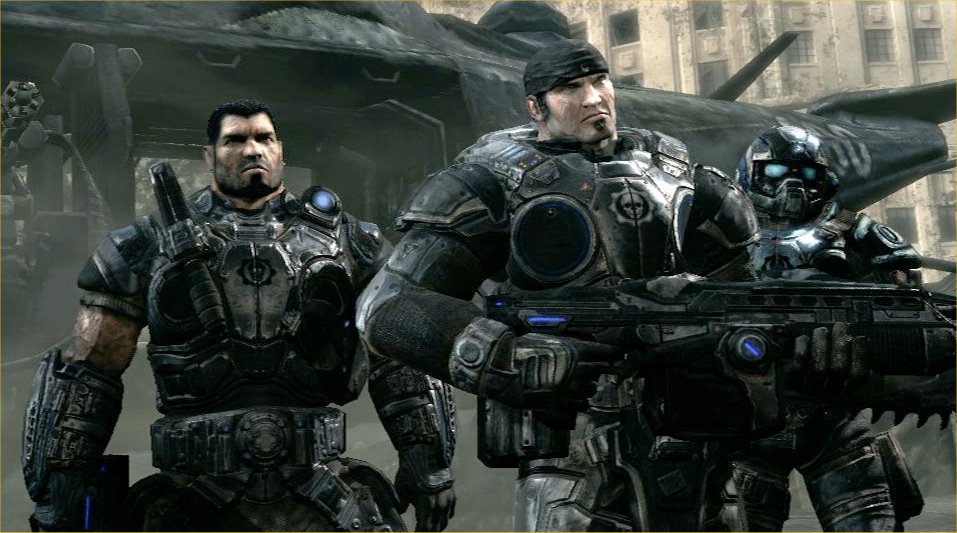
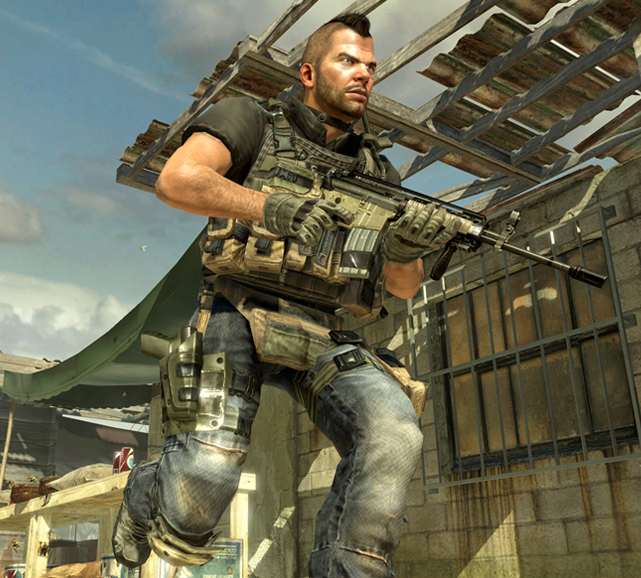
Shooters are designed to appeal to a specific audience with fairly narrow tastes. That audience is heterosexual men between the ages of 14 and 35, the same audience that goes to see every summer action movie and (in much smaller numbers) buys every superhero comic. This audience, of which I’m a part, seems to enjoy stories about rugged men doing violent things. Video game heroes are quite similar to the heroes found in most action movies: muscular, laconic, and packing enough firepower to wipe out a small country. Given these characteristics, it’s no surprise that many of these heroes are soldiers.
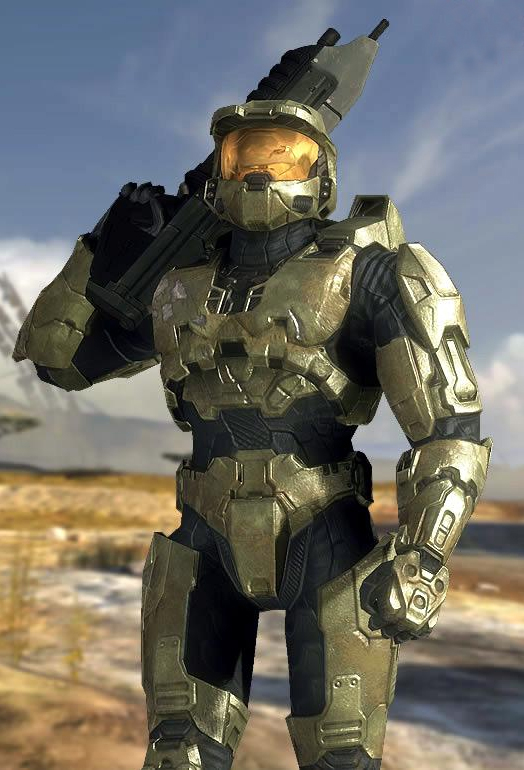
Master Chief of the Halo franchise
Dominic Santiago and Marcus Fenix from Gears of War
“Soap” McTavish from Call of Duty: Modern Warfare
The universes inhabited by these characters also reflect a masculine/military bias. Aesthetically, shooters often employ amazing technology to portray a very limited range of environments. It’s in the nature of shooters to take place in war zones. Whether the sterile, futuristic warships of Halo, orthe urban battlefields of Modern Warfare, or the post-apocalyptic wasteland of Gears of War, these are locations for combat, not to admire the view.
Thematically, shooters also tend to focus on male preoccupations, particularly male-male bonding, strength-of-arms, and technological fetishism. Needless to say, love and relationships (besides straight male friendships) are secondary concerns at best. Women are present in some of these games, but generally in a supportive role, and they only rarely get to participate in the action. (I’m aware that there are plenty of counterexamples, but I’m not saying all American games are X so much as I’m simply noting a trend).
Things are a little more complicated in Japan. Japanese game developers create plenty of games just like Halo, but they can also create games that are so different it’s hard to imagine them ever being produced by an American company. And I’m not even talking about oddities such as “Nintendogs.” One of the most successful games to come out of Japan this year was, on the surface, a typical adventure about a group of heroes who fight monsters and enemy soldiers. The lead character is a laconic bad-ass who wields a gun-sword (it’s like a gun … but also a sword!). And she wears a skirt.
Lightning from Final Fantasy XIII
In a different game, Lightning (or you can use her far more awesome Japanese name, Raitoningu) could easily be dismissed as just another heroine who’s really a “man with tits.” But that criticism doesn’t apply very well to Final Fantasy XIII.
Unlike the bleak war zones of American gaming, the universe of Final Fantasy XIII is sparkly wonderland. The world is pretty for the sake of being pretty, and it demands that the player occasionally take some time to admire the view. And the characters don’t wear functional body armor. Their outfits are elaborate, colorful, and almost oppressively cute. They appeal to the cosplay crowd rather than military enthusiasts. In other words, this game is kinda girly.
Vanille
Hope (who is a boy, just to be clear)
Sazh
Fang
Snow
The gameplay in Final Fantasy is primarily violent conflict, but it doesn’t treat violence as a purely male/soldier activity. Women can kill monsters, men can kill monsters, cute girls can kill monsters, even a boy named Hope can kill monsters.
Violence isn’t gender-coded, partly because the cast is evenly split between male and female, but also because gender isn’t neatly defined. This is a universe where women can be named Lightning and Fang and men can be named Hope and Snow. But it’s more than just unusual names. Lightning and Fang are the most stereotypically male characters in the game: tough, aggressive, and, in the case of Lightning, emotionally distant. The men are actually more emotionally open. Snow is obsessed with rescuing his fiance, Sazh wants to save his son, and Hope is initially out for revenge (later he starts preaching the power of friendship). But the developers at Square Enix weren’t content to simply flip gender roles. The girliest character in the game, Vanille, is still a girl. Final Fantasy XIII doesn’t have bright line rules on how men and women are expected to behave.
The story is also quite different from the typical American action/adventure. The female characters don’t simply revolve around a male lead, they have relationships with each other. And the story actually focuses on the relationships between the characters and and their gradual development into a pseudo-family. None of this is meant to suggest that Final Fantasy XIII is brilliantly written. The plot is repetitive. The dialogue is clunky, and it’s made all the worse by an occasionally awkward Japanese-to-English translation. Character drama aims at being moving, but it often falls short. But regardless of its failings, it’s a story that’s about more than just conquest and killing the bad guy.
The genre is also worth noting. Final Fantasy XIII is a role-playing game (RPG), not a shooter. RPGs can be action-packed, but they also give the player the ability to control the gradual improvement (“leveling up”) of the characters. This control, as limited as it may be, gives the player a greater investment in the characters and their story. And since RPGs are about role-playing, they tend to emphasize the interaction between characters and their interaction with the environment. In shooters, story, character, and environment are typically just window-dressing for the action. Speaking from purely anecdotal experience, I’ve noticed that RPGs, and the Final Fantasy franchise in particular, seem to be very popular among female gamers. I’d wager that the reason for this is the the greater attention paid to relationships and character interaction. (And before someone accuses me of unfairly maligning all American games, there are plenty of American RPGs that offer gameplay similar to Final Fantasy XIII, though I would point out that many of them still embrace the techno-militaristic aesthetic of the popular shooters).
I wouldn’t go so far as to describe Final Fantasy XIII as a feminist game. For all it’s gender-bending, the game still adheres to a traditional view of feminine beauty. And just like American superheroines, none of the women get to wear pants. Nevertheless, it’s a game that actually has women front and center, and it passes the Bechdel Test (in case Erica is curious). More importantly, Final Fantasy XIII doesn’t treat femininity as something to be mocked or ignored. Instead, it’s an attribute that’s essential to the game’s appeal, and perfectly compatible with kicking ass.