Utilitarian Review 8/13/10

On HU

This has been a chaotic week for me, and so things are a little out of sync. Thanks to both our readers and guest posters for bearing with us. And thanks to Caro for keeping the trains running on time.

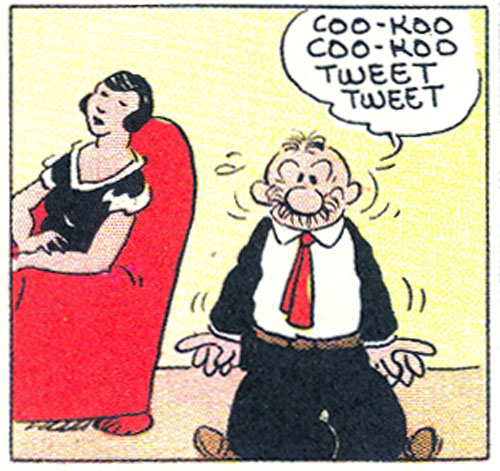
This week has mostly been devoted to our Popeye roundtable. There are going to be a couple more posts in the roundtable next week by Andrew Farago and Robert Stanley Martin.

Sunday incidentally will also see the delayed but much anticipated post in our series on Crumb’s Genesis by Matthias Wivel.

Utilitarians Everywhere

I have a post on Splice Today about my enthusiasm for the Bangles

That’s the point of pop music in some sense, though; it’s addictive. Not like heroin that’ll land you in prison with the cool kids, but like sucking down a bagful of jelly bellies and then feeling sick and ridiculous before going out and buying another one. And part of the addictiveness and the ridiculousness is, really, that it’s jelly bellies; they’re right out there. Everyone can do it. It’s not a subculture you can call your own; it’s pop—it belongs to everyone. The Bangles don’t give you any cred. Everybody loved them and that was the point, and now everybody’s moved on and if you still love them you’re either remembering your youth or (like me) you’re subject to a meaningless and harmless idiosyncrasy. The ingratiating hooks are there to be ingratiating. What else could they be for?

Also at Splice I have a short essay about E. Nesbit’s wonderful Book of Dragons.

At Comixology I writer about the Oprah comic book.

With comics, I’m never taken aback by lousy quality. After all, most things are lousy — maybe comics are a little worse than everything else, but not enough to squawk about. But the marketing confusion in even comics that have no point other than their marketing: I can never get over that. Why churn out this horrible Oprah Winfrey piece of dreck if not to make money? And how can you make money if you don’t even know who you’re trying to sell to? I mean, I bought this in a direct market store. What are they doing even selling it through the direct market? What venue could they find where folks would be less likely to pick this up?

Other Links

Tucker’s Comics of the Weak this week is one of his all time all times, I think.

And Tucker and David Brothers are blogging their way through some interesting looking Black Panther stories. Good week on the Factual Opinion!

Phooey From Me to You: Huh

Back in the day, I used to watch Popeye cartoons.  I liked them OK, although I enjoyed Scoobie Doo more.  Olive Oyl was feisty, and she didn’t wait around to be rescued.  She was a force to be reckoned with.  I never really liked Popeye himself, since he was kind of dumb and kind of violent.

I never got a chance to read Popeye in comics form as a kid, and that’s kind of a shame, I think.  As a youngun I would have really enjoyed the strange story lines and the occasional random slapstick.  The art’s pretty good and the ink is interesting.

As an adult though…  I’m going to admit upfront that I just don’t enjoy slapstick humor.  I like when bad guys get smashed because they’re bad, but I don’t find it funny.  I can’t watch reality TV because it makes me intensely uncomfortable and embarrassed for the people on the show.  I always hated the Three Stooges.  For me, Popeye was an uncomfortable read.  I just didn’t enjoy it much.  I could see why people loved it, because as I said, the stories do go interesting places and the art is pretty good, but I spent so much time cringing because Popeye beat up a cow or a random person.  It’s just…not for me.  I ended up thinking I’m such a girl, but that’s not really it.  It’s not about being a girl and not enjoying this comic.  It’s just not my kind of art.

Like Noah, I would read a bit and realize that what I really needed to do was scrub the bathroom.  Or do laundry.  Or weed the garden.  Get the oil changed in the car.  And once you’re starting to look forward to battling the garden slugs, it’s probably time to set down the comic, no matter how beautifully presented in the Fantagraphics book.

I wish I had something weighty to add, but I don’t.  I can see the appeal, and I didn’t hate it.  I just didn’t connect with it.

____________
Update by Noah: The whole Popeye roundtable is here.

Phooey from me to you: Who cares about Sappo?

For me, E.C. Segar’s Popeye remains, no matter what Noah says, not only one of the great comics of the 20th century but a great piece of Americana as well. It manages to combine hilarious slapstick, daffy absurdity, high adventure, sentimental melodrama and still create genuine emotion and care for the cast’s well-being. It deserves every ounce of acclaim and high regard it’s earned over the years.

But I’m not going to be talking about any of that today. Instead I’m going to be talking about Popeye’s less benighted comic strip brother, Sappo.

Continue reading

Phooey From Me To You: Masters of American Television

I organized this roundtable as an excuse to look at some of the E.C. Segar Popeye strips. I’d never read them, and many people love them, obviously, so I figured this was a good chance to catch up. After reading a couple of reviews, I tried the Plunder Island volume, often mentioned as the highpoint of the series.

And after reading through the Plunder Island strips, I can say with some assurance that, man, this is not for me. Though I enjoyed the energy of the drawing, and the Sea Hag and Goon provided some evocatively creepy moments early on, the limited range of the humor, and its empty-headedness, quickly becomes numbing. Wimpy is lazy, Wimpy eats a lot, Popeye is noble, defends the underdog, and always wins. It’s like Garfield meets Superman. And, you know, I don’t hate Garfield or Superman…but I’ve read enough of both to last me the rest of my life. Honestly, I couldn’t even finish the book. I got distracted by Kierkegaard, and then by Derrida — and when you’re procrastinating by reading Derrida, you know you really, really don’t want to be reading what you’re supposed to.

If I had read the whole book, I’d probably be really thoroughly irritated and be spitting piss and vinegar (that metaphor isn’t exactly right…but onward.) As it is, though, I don’t have much resentment built up. Popeye isn’t at all pretentious — punch, eat, mangled English, laff. I don’t find it that funny, but I can’t get mad at it either. As I said, I even appreciate the art in a generalized way (cute cows!) If people like this, I’ve got no beef (as it were.)

While I’m not that interested in the content of Popeye, the strip does raise some interesting issues. Specifically — well, as I said, this is a very unpretentious strip, which relies almost entirely on the most basic kind of repetitive gastronomic and pugnacious humor. Whatever the drawing’s charm, there’s none of the sweeping formal adventurousness of Little Nemo here. I guess you could compare it to Buster Keaton or Charlie Chaplain…but it seems to have at least as much in common with sitcoms; the same zany characters performing the same zany routines week after week in a timeless round of entertaining tedium.

Comics is often compared to film and literature and visual art, but it’s much less frequently linked to television. There are certainly many parallels between TV and comicdom, whether in method of delivery (they’re both among the few contemporary art forms that are serialized as a matter of course), or in material for adaptation (Buffy in one direction, Smallville in the other), or in creator overlap (Brian K. Vaughn, Joss Whedon, Dave Johnson.) But nobody wants to make a big deal out of it since nobody but nobody wants to be linked to television, a medium which has gone more than half a century without ever attaining even a morsel of aesthetic credibility.

People do wax enthusiastic about individual shows, of course, whether it be the Wire or Mad Men or Battlestar Galactica. But that enthusiasm is perpetrated with an amazing lack of ambition or anxiety. When people say that Lost is awesome, they rarely do so by saying “Lost is awesome — and worthy to be compared to the achievement of the Coen Brothers!” People love Joss Whedon, but nobody says he’s Quentin Tarantino, much less Orson Welles. Similarly, there’s virtually no effort that I’ve ever seen to solidify television’s bona-fides through canon formation. I’m sure someone has made a list of the best 100 television shows (here’s one, for example) but such lists don’t get tons of press and tend to be presented as much as personal preference as “this is what all educated people must be familiar with.”

Even the criteria for creating such a canon seems almost completely untheorized. What are the aesthetics of great television? What would a great television show look like? What issues would it address? How would a canonical television show distinguish itself from film, or from video art? Could great television be video art? Could there be a gallery show of television video art, the way there are gallery shows of comic art? What would that be like? What would be chosen?

Of course, some people will probably argue that there couldn’t be such an exhibit because television is a wasteland and the whole medium should be dropped in a well or eaten by bears. (Domingos, I’m looking at you.) But…I don’t know. I look at Popeye, which has good visual aesthetics and competent jokes and has been firmly placed in the comics canon, and I think — television could do that.

The classic Sesame Street animations are brilliant and weird; I don’t see how they’re aesthetically any less accomplished than E. C. Segar’s drawings, and they’re certainly more conceptually adventurous. The Batman TV series is visually bizarre; those giant freeze cones, the slanted villain hideout with the girl in the cage in the background — it seems infinitely more inventive than many of the comic book sources, and the dialogue and plotting is so arch it’s a wonder everyone’s eyebrows don’t just fall off. The Abbott and Costello routine does nothing in particular with visuals, but the escalating insanity of the dialogue seems, at least to me, much more manic and witty than the Popeye strips.

My point here isn’t that these are all superior to Popeye and therefore deserve to be treated as canonical culture. Nor is it that television in general should be seen as a (potentially) serious art form. Rather, I’m just saying that what is and isn’t considered art is really arbitrary. Comics critics have spent a lot of energy for the past decades trying to get comics accepted as high art. They’ve had definite (if not unqualified) success, and now even frankly pulp, unpretentious works like Popeye can be put up in galleries, given lavish reissues, and hailed as canonical examples of the form. And, of course, the critical zeitgeist has created room for more explicitly highbrow work by everyone from Chris Ware to Lilli Carre.

At some point, you do wonder, though…what if comics had taken television’s route? No anxiety, no ambition, no real critical battles over whether it could be high art or whether that would be a good idea. Would that have been categorically worse? The anxiety is certainly a spur…but it can be a cage as well. In any case, I don’t think I do comics in general any harm by saying, you know, it doesn’t really matter that much whether Popeye is or is not great art.

_________________
For a more enthusiastic take on (among other things) Popeye’s relation to artsy-fartsy comics, read Shaenon Garrity’s appreciation.

This is part of a roundtable on Popeye. All posts in the series can be read here.

Phooey From Me to You: Six or Seven Things I Know about Popeye

1. Popeye is old. I don’t mean the strip is old.  Everybody knows the strip is old.  I mean Popeye himself is supposed to be a senior citizen.  He’s a grizzled old sailor, with emphasis on the old, with extra old added on.  Although his official bio now describes him as 34, according to the Segar-era strips he’s in his sixties, and his father (more on him later) is pushing 100.  That’s why Popeye is bald and missing an eye.  Because of the oldness.

2. Popeye’s mythic origin is fundamentally flawed. In his youth, Fionn mac Cumhaill, the trickster hero of Irish folklore, gained his powers by tasting the flesh of the bradan feasa, the salmon of knowledge, which contained all the knowledge in the world.  When Fionn mac Cumhaill burned his thumb cooking the salmon and automatically stuck the burned thumb in his mouth, the knowledge flowed from the salmon into Fionn.  After that, Fionn mac Cumhaill knew everything and could access any information he needed by sucking on his thumb.

Popeye, in his old age, got his incredible toughness by staying up all night below decks rubbing the head of Bernice the Wiffle Hen, a bird with the power to bestow supernatural good luck on those who touched her.  All the luck flowed out of the hen and into Popeye, rendering the hen useless to would-be gambling kings Castor Oyl and Ham Gravy and transforming Popeye into an unstoppable demigod.

Later, as everyone knows, the story was changed so that Popeye gained his strength from eating spinach.  This introduced the crucial element of consumption that gives the core myth its memetic power, but in the process the totemic animal was lost.  It’s a shame we can’t have both, the animal and the vegetable, but everyone forgets about the hen.

3. Popeye is what happens to you while you’re busy making other plans. E.C. Segar drew Thimble Theatre for ten years before introducing Popeye.  It took him the length of the entire run of Calvin & Hobbes just to find his main character.  Popeye sidled in through the seedy back docks.  He was not the kind of hero you could plan for.  Who could have predicted that a cranky old sailor who looks like he smells funny—everyone in Thimble Theatre looks like he or she smells funny—would become the idol of millions, making Mickey Mouse shake in his polished red shoes and enduring for generations beyond?

If you are a writer, if you are an artist, you have to learn to open yourself to Popeye, to be ready if Popeye should happen.  But at the same time you have to know that Popeye will probably never happen.  Maybe there’s a hen you can rub.

4. Popeye is a dick. He’s a lot more heroic in the cartoons.  In the Segar strips, aside from sporadic and whimsical urges to aid the downtrodden, a.k.a. widders and orfinks what ain’t got none, Popeye devotes himself largely to being an insufferable cuss.  This is, after all, the guy who not only kicked poor Castor Oyl out of his own comic strip, but banged Castor’s sister just to show he meant business.

He’s consistently awful to Olive, of course.

Back in the day, Segar got complaints that Popeye was a bad role model for children.  He solved this problem as every similarly beset writer should: by creating a nearly identical but even more meretricious character to make Popeye look good by comparison.  Thus the strip gained Popeye’s father, Pappy, who looks exactly like Popeye with stubble.  Apparently aware that he lives in a crudely-drawn strip, Pappy sometimes disguises himself as his son by shaving so he can make time with Olive.

5. Bobby London got Popeye. None of the other legacy cartoonists really have.  They love Popeye, I’m sure.  They want to do right by Popeye, to pay just tribute to Segar’s creation, to be responsible bearers of the standard.  London, by contrast, used his run on the Popeye strip to see exactly how much he could get away with before an outraged syndicate, newspaper market, readership, and world kicked him out for the sake of common decency.  He probably made some people cry.  And that’s what Popeye is all about, Charlie Brown.

6. You can go to Sweethaven. The village built for the 1980 movie still stands.  Looks cleaner now, actually, judging from the photos.  It’s in Malta and is open to the public as a tourist attraction, complete with movie props, stage shows, and a movie theater showing clips from the film.

I like the movie.  It’s messy and mumbly and wanders all over the place, which suggests that the filmmakers got Popeye too.  The strange grimness of the musical numbers always makes me smile.  As far as superhero movies go, it’s higher on my list than Iron Man.

7. Popeye Ruined My Life. I found Thimble Theatre in the old Smithsonian Book of Newspaper Comics in my high-school library.  It was something I hadn’t seen before: a funny adventure strip, a gag strip with a story.  It had long stories, stretching for months or years, with pirates and gamblers and thieves.  I wanted to do that, and I did, and now I’ve been doing it for ten years.  Without Popeye.  All you can do is be ready.

Comic strips, unlike comic books, boast a genteel legacy.  The elegant stagework of Little Nemo, the bohemian poetry of Krazy Kat, the quiet philosophy of Peanuts, the Disneyfied poly-sci of Pogo…it’s all so very convincingly Art.  Even the rugged adventure strips are rugged in a pleasant, Brylcreemed, magazine-illustration way.  And then there’s Popeye, who cusses and fights and brags about cussing and fighting, who comes staggering up drunk from the lower decks inhabited by all those weird old Jazz Age strips with the blotchy art and spindly lettering and betting tips and Yiddish and plop takes and Nov Shmoz Ka Pop? I don’t know what kind of theater Thimble Theatre is, but Winsor McCay probably wouldn’t want to do his quick-draw act there.  Popeye hangs on, indestructible (because of the hen), the last of a tougher, smellier, funnier breed.

He also has a damn catchy theme song.

________________

Update by Noah: This is the first in roundtable on Popeye. You can read the whole roundtable here.

Utilitarian Review 8/7/10

On HU

Erica Friedman started the week by asking a bunch of creators and cartoonists why they made art.

For his first official column, Alex Buchet looked at some inaccuracies in Harvey Kurtzman’s war comics.

This is a delightful con wrap up by Kristy Valenti. The comments are even funnier.

Richard Cook continues his look at the Silver Age Flash.

I made fun of R. Crumb’s Genesis, particularly his floating bearded heads.

Vom Marlowe looked at the illustrated children’s book series Billy and Blaze.

Caroline Small compared Crumb’s Genesis to work by Howard Finster and Basil Wolverton.

I reprint an old essay about war in literature.

And here’s a random download mix with Thai music, funk, ZZ Top, and maypole dancing.

Utilitarians Everywhere

At Splice Today I reviewed Kelis’ new album.

Flesh Tone isn’t horrible. It’s just anonymous—which is perhaps even more depressing. Kelis’ distinctive, not-quite-ready-for-primetime voice is processed into bland submission, and the Neptunes’ unique production is replaced with third-drawer dance-floor dreck. The lyrical nuttiness of Kaleidoscope is entirely gone; instead we’re left with groaners like “Just like the sky on the 4th of July/you make me high.” The low point is probably “Song for the Baby,” the cheery sentiments and perky beat of which put Kelis dangerously close to Amy Grant territory. There’s a bitter irony too in “Scream,” where Kelis insists, “You’ve won the right to scream and shout.” Unlike on Kaleidoscope, Kelis does not in fact scream. She barely whimpers.

Also on Splice, I talk about Kierkegaard, Abraham, puritanism, and aesthetics.

This shouldn’t be particularly surprising. If there’s one tendency in Protestantism that’s stronger than the loathing of aesthetics, it’s the veneration of the same. The Bible, after all, is a series of tales. Kierkegaard sneers at aesthetics because he takes them so seriously. The problem with stories is not that they’re stories, but rather that they’re not the one story. It’s because he loves the tale of Abraham so elaborately that Kierkegaard denigrates other narratives as sentimental balderdash. Sci-fi jelly creatures attacking—that doesn’t have the terror, the sorrow, the human interest and moral power of Abraham walking to the mountain to slay his son. Away, then, with the jelly creatures! Puritan philistines are just particularly foul-tempered critics; their iconoclasm is just one long bad review.

Other Links

Roland Kelts is writing some interesting stuff about the fate of manga in the U.S. over at tcj.com.

And in my continuing pursuit of blog amity: Jeet Heer’s piece on Harvey Pekar is balanced and thoughtful.

Caro put me onto this really pretty great Newsweek article about Lily Renée

Derik Badman has a thoughtful assessment of Ben Schwartz’s Best American Comics Criticism.

Bombs in NeverNeverland

I wrote this almost twenty years ago for a course on representations of war when I was a junior in college. It touches on some issues raised in the comments section of Alex Buchet’s recent post on war comics, so I thought I’d resurrect it. I think I still agree with the main points, though the prose would probably be a trifle less earnest if I wrote it now. But, for better or worse, here it is.
_____________________________

“All children, except one, grow up,” writes J.M. Barrie at the beginning of Peter Pan. In many ways, the fictional constructions of war created by Tennyson, Kipling, Remarque, and Zola, appear to be attempting to deny this insight; appear to be attempting to suggest that war provides a return to an idyllic youth and innocence which allows the men who participate in it to escape from the mores and constrictions of adult society and return to an idealized childhood in which manners and restraint are cast away and replaced by simplicity and exuberant enthusiasm. War, for these authors, is an arena in which adventures can occur; in which heroism and enthusiasm triumph over the stodgy grind of day to day life. One can almost hear the cavalry in Tennyson’s “The Charge of the Light Brigade” declaring, with Peter Pan, “I’m youth, I’m joy” as they thunder towards the artillery guns, can almost hear Peter’s cocky self-assurance in Kipling’s breezy assumption that “of course” the British forces broke the “Fuzzy-Wuzzies”. The soldiers of which Kipling, Tennyson, Remarque and Zola speak have no fear, they have no doubts. They live, like children, in their own world with their own rules, in their own “NeverNeverland” separated entirely and forcibly from the reach and understanding of adult society.

Yet, despite this separation, the soldier is not ostracized, not attacked or unaccepted by the society which he seemingly rejects. He is not, in fact, a threat to civilized society, but is rather a delightful dream, an idea with great appeal both to the emotions and to the imaginations of people of the time, as the popularity of Charles Gordon demonstrates. Thus Kipling’s “Tommy” is a man (or, perhaps more correctly, a boy) who should be admired and loved even though he does not really fit the mores and norms of society, even though, as Kipling puts it, his “conduck isn’t all your fancy paints”. It is, in fact, Tommy’s separation from fine society which make him an attractive figure; his very simplicity, the very fact that he does not want luxuries but only wishes to be treated “rational”, composes his glamour. Tommy does not want “better food”, but only to be accepted by society without having to conform to its rules. He wants (and appears to receive from Kipling) to be given the freedom not to conform and to be admired for his very possession of that freedom; wants, like Peter Pan, to receive unconditional affection and yet to never have his mind cleaned.

It should, of course, be impossible to be at one and the same time independent and dependent, impossible to be heroic for the sake of the sympathy and admiration which that heroism brings. Only if one is capable of a total lack of self-reflection and self-awareness is this contradiction resolvable; it is only through his total naivety that Peter Pan is able to both expect admiration and receive it. Through war, Kipling, Tennyson, Zola and Remarque appear to suggest, through becoming a soldier, this simplicity can be (re)gained, this idealized childhood can be (re)found. Soldiers, like children, are, for these authors, not concerned with whether what they do is correct or incorrect, they do not agonize–they simply are. The soldiers whom Zola describes are “Like children and savages, their only instinct…to eat and sleep in this rush towards the unknown with no tomorrow”, Remarque’s Paul notes that “The national feeling of the tommy resolves itself into this–here he is.” The soldier is unthinking; in fact, thought is his enemy, his destroyer. The self-reflection which connotes adulthood, the loss of innocence and unselfconsciousness, results, in these fictions, in age and death. When the soldier begins to think, as Lapoulle does after killing Pache, he is destroyed. As Remarque’s Paul says, “we [the soldiers] are in a good humour because otherwise we should go to pieces.”

Remarque, of course, is contending that it is the horror of war, not of adulthood, which makes this jollity necessary; that to think about war would cause madness, insanity. But in many ways Remarque’s novel makes a statement not that war is too awful to think about, but that it is, in fact, aging which is the greatest horror. It is for this reason that the older men in the War are not as tragic as the men of Paul’s generation, for the older men have no youth to lose. For Remarque, the tragedy of the war is a loss of childhood, is the fact that through the war, Paul discovers death and sexual initiation (“the curse of a soldier” as Kipling writes), fear and vulnerability. Yet all of these discoveries are, in fact, not unique to wartime; as Paul himself realizes, they are instead the necessary adjuncts of adult life, the manifestations of a superficial society which delivers coffins punctually before a battle and places you under the arbitrary control of a postmaster. The war is the extension of civilian societies cruelties and artificialities, stupidities and absurdities. But even as it is so, the war also provides a means of escape, a strategy of resistance, a means whereby youth can be retained through “the finest thing that arose out of the war-comradeship.” Through this camaraderie, the trappings and foolishness of civilization, the unnecessary clutter of the school room, can be shrugged off and subsumed in the contentment of a good meal tasted among good friends. Paul relishes the experience of sitting with his comrades on their makeshift toilets not in spite of the primitiveness of the facilities, but because of it. Remarque views culture and civilization with suspicion, and finds in war a way to sidestep them, to return to the idyllic childhood which Zola describes the young intellectual Maurice finding in the arms of the simple peasant Jean when “Maurice

…let himself be carried away like a child. No woman’s arms had ever held him as close and warm as this…Was this not the brotherhood of the earliest days of the world, friendship before there was any culture or class, the friendship of two men united and become as one in their common need of help in the face of the threat of hostile nature?

Through his relationship with Jean, Maurice regains infancy; he is tended too, sheltered, cared for. War in The Debacle provides Maurice with a way to return to simplicity, with a means of becoming both noble and tragic. He becomes one of the “poor boys, poor boys” to whom his sister refers; he becomes innocent. In its creation of an arena in which life becomes more simple and true, war also, then, absolves of guilt even as it confers naivete. The soldier makes a sacrifice for crimes he did not commit. Like the men of the Charge of the Light Brigade, he goes unquestioningly to his death, following orders to the last. The betrayal of the soldier by civilians and generals is made all the more poignant because the soldier has done nothing wrong; has, in fact, placed his whole trust and hope upon civilian assurances of glory and easy victory. The betrayal is, in fact, like the betrayal which Peter Pan experiences at Hook’s treachery on the rock in the lagoon, the betrayal of a child’s total trust by a parent’s unfairness, after which, Barrie writes the child “will never afterwards be quite the same boy.”

It is this betrayal which Paul feels has robbed him of his youth when he says that, “I am young, I am twenty years old yet I…see how peoples are set against one another, and in silence, unknowingly, foolishly, obediently, innocently slay one another. [italics mine]” Remarque claims, then, both that the soldiers have lost their innocence, and that they retain it. Remarque says that their parents have failed them, and yet he still conceptualizes them as children. They have discovered that the world is unfair, and yet Remarque, through Paul, still perceives them as innocent. Paul repeats over and over that his generation is lost, it is useless, it is old and destroyed, but he never once decides to stop fighting, and even pushes Himmelstoss forward when the former drill master falters. Self-consciously martyred, Paul cannot solve, but can only revel in his troubles, just as Mr. Darling revels in his sojourn in the kennel.

Mr. Darling is, of course, not really comparable to Paul. He is not as young, nor in as much distress; he was not in the trenches of the First World War. Yet, in a deeper sense, Mr. Darling is very much like Paul, very much like Maurice, very much, for that matter, like Charles Gordon. He is a man who wishes more than anything to be admired, as Paul and Maurice did when they joined their respective armies, but who, through that very wishing, has condemned himself to an unadmirable existence. He is a conceited fool, a whining incompetent, a desperately contemptible figure when placed beside the apogee of unconscious grace and youthful innocence which is Peter Pan. And yet, while no one would want to be Mr. Darling, no one can wish to be Peter Pan either, because the very wishing dooms the attempt. One either has “good form” or does not have it. To have good form is to be young, unconscious, free. But “All children, except one, grow up.” And that one, as Barrie surely knew better than anyone else, was not real.

This is, I think, Barrie’s central insight, is the reason that Peter Pan , if it does not really oppose war, offers a way to oppose war that none of the other pieces of literature we have studied manage to suggest. For if, in fact, childhood is unattainable, if simplicity is gone, then the attempt to recapture that simplicity and childhood through war is not only misguided, but is actually dangerous, futile, and pitiful. Barrie loved children, he loved childhood. But he knew that he was not a child, and that he could not become one by travelling to some foreign field with a rifle and a battalion of comrades. Childhood games played by adults are not touching or cute; they are pitiful and even terrible. When Mr. Darling pours the medicine into Nanna’s bowl, he does not appeal to the reader in the same way that Peter does when he plays the game of question and answer with the pirates. Similarly, Peter’s comment that “to die will be an awfully big adventure” is charming and witty only when uttered by Peter’s naive voice. Kipling’s effort to capture what appears to be a similar sentiment sounds incredibly cold-hearted and callous, advising as it does that a soldier wounded on the field of battle and facing imminent mutilation ought to “Jest roll to your rifle an’ blow out your brains.” On the other hand, the French mutineer’s letter telling his sweetheart that, “I love you, and I don’t want to die”, is touchingly painful, and would be just as out of place in Peter Pan as would Kipling’s injunction. Real horror (though apparently Kipling, whose brain may itself be scrambled in some anomalous fashion, does not know it is real horror), and real fear are not part of the world which Barrie describes.

This is, of course, because Barrie’s world is not real. NeverNeverland is named so for the obvious reason. Tennyson, Zola, Kipling, and Remarque, in attempting to locate it within the context of reality, in attempting to suggest that NeverNeverland is obtainable within a historical rather than an imaginary framework, trap themselves within the very mundane existence that they wish to escape. In trying to escape adulthood, in trying to leave behind their responsibilities, they succeed only in making Mr. Darlings of themselves, only in placing themselves in a continuum where they refuse to face their problems because they wish so badly to transcend them. Tennyson cannot feel outrage or shock at the death of the Light Brigade, Zola can create only shallow caricatures in the place of real characters, Remarque can not move past self-pity and gruesome imagery to register any deep and meaningful moral objection to the carnage he witnessed, and Kipling appears to have buried any decent human compassion at all beneath a glut of imperialist fervor. Each is left romanticizing stupidity and horror in the hope that in doing so they can rediscover the childhood that they have lost.

Barrie offers no alternative to this quest. He, too, cannot turn from childhood, cannot stop seeking Peter Pan. But he knows, as Tennyson, Kipling, Zola, and even Remarque do not seem to, that the quest is futile, knows that Wendy and John and Michael and the Lost Boys must grow up eventually, must take up a mundane existence no matter how boring or dull it appears. And once it is recognized that war is not a return to some idealized NeverNeverland of childhood, then perhaps a convincing opposition to it can begin to be formulated.