The Best Superhero Movie Ever

This originally appeared over at Splice Today.
______________________________

So what’s the best superhero movie of all time? Perhaps you love Dark Knight because Heath Ledger is dead now and Morgan Freeman taught us about the dangers of surveillance technology. Or you may love Spider-Man because it drips with pathos and daddy issues. Or maybe you like Robert Downey, Jr.’s charm in Iron Man, or, if you’re old school, Christopher Reeve’s charm in Superman. Or maybe you’re just cranky enough that when someone asks you “What’s the best superhero movie ever?” you answer with a waggish sneer, “There are no best superhero movies ever!”

Continue reading

The cycle of criticism

There has been a recent discussion of the nature of manga criticism and where it can be found (and if it can be found).  I have maintained that, yes, it does exist and can be found, whereas others have other views.  As part of that discussion, I want to explain part of the issues as I see them, in finding the criticism and where it happens and how, and decided that instead of cramming it into a comment (not doable), I would take the time and do as full an explanation as I can.
Continue reading

Toth vs. Kubert

by James Romberger

In “Man of Rock,” Bill Schelly’s recent biography of Joe Kubert, the well-respected graphic novelist and former DC editor says that he and Alex Toth knew each other well from “way, way back” in the 1940s when they were teenaged cartoonists. Kubert is two years older than Toth, which may have seemed like a lot to them then. He says that at sixteen Toth worked “like a dog–his intensity overwhelming.” While I don’t get the sense that Kubert and Toth were ever especially close as friends, they shared studios and social contacts, and both artists worked for early DC editor Sheldon Mayer. A talented artist in his own right, Mayer was a volatile editor. Toth recalled that Mayer tore up one of his early stories. Kubert says that he saw Mayer “verbally rip a guy apart…and take original pages and fling them right across the room,” but notes that he was not treated in this way, perhaps because he was “bigger.”

Both artists claim Mayer as a key formative influence. In later years when Kubert acheived editorial positions, his relationship with Toth changed as it became one of management and labor. Toth’s efforts for editor Kubert on two stories appears to be the key to their mutual disaffection. Neither party understood the other’s motivations, but as a result, a major Toth work was rejected to be lost to posterity, their friendship ended and in later years Kubert was criticized by Toth. Kubert’s own accounts of their conflicts are inconsistent.

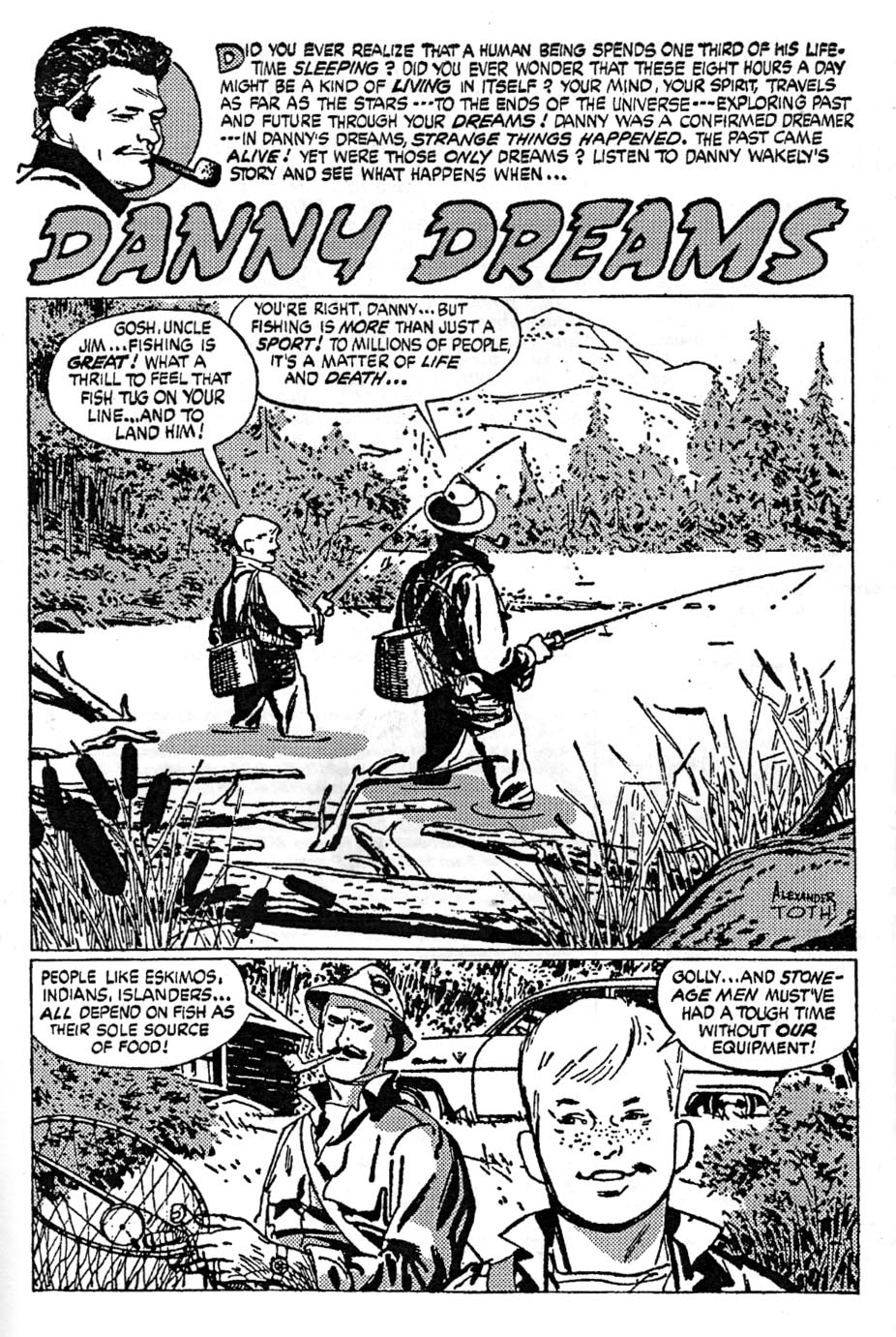
At St. John in 1954 Toth drew a 5 page story for editor Kubert’s title Tor Vol. 1 #3. Danny Dreams was done in a fertile period of discovery for Toth, contemporaneous with his early masterpiece The Crushed Gardenia, as he was formulating his mature pared-down style. Kubert says in a letter printed in 1999 in Toth: Black and White that the story was “drawn close to printed page size—beautiful tight artwork,” but in an interview done in 2006 for Alter Ego Kubert says he was “shocked” and “disappointed” with the work when he first saw it. Perhaps because the original art was so small, or maybe because its simplicity at that time was not what the more detail-oriented Kubert expected, he mistook the economy of line that marks Toth’s great later work for laziness. Or, perhaps it was because Toth omits the folds of most of the ears of the characters in Danny Dreams and draws them as empty curved shapes.
Danny Dreams: flat ears, small art. Tones by Bill Black.

Continue reading

Criticizing the Critics: Moto Hagio’s A Drunken Dream

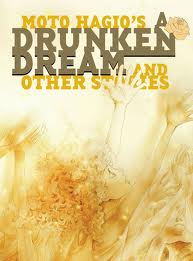
Over the last couple of months, I’ve written five lengthy posts about A Drunken Dream Fantagraphics’ collection of stories by the great shojo manga-ka Moto Hagio. I’ve spent so much time on this book for a number of reasons. Hagio is a central figure in the history of shojo, a genre in which I’m interested. Matt Thorn, the volume’s editor and translator, is one of the most important manga critics around,so anything he does is worth thinking about carefully. And, finally, this is meant to be the first in a series of reissues of classic shojo tales by Fantagraphics. That’s an exceedingly worthwhile project, and I wanted to draw attention to it.

To finish up my series, I thought I’d look briefly at what other critics have said about A Drunken Dream.

I certainly haven’t been alone in seeing this book as important. Deb Aoki at About.com gave it 4.5 stars and said it was “a long overdue glimpse into Hagio’s 40-year career. Melinda Beasi picked it as her book of the week, calling it gorgeous. David Welsh in a discussion of the best manga of the year similarly, if more somberly, commented that on best of the year lists, “Moto Hagio’s A Drunken Dream and Other Stories (Fantagraphics) didn’t seem to make much of an impression outside of dedicated manga readers, which is disappointing to me as a dedicated manga reader.”

So…many stars, pick of the week, should be on best of lists. Check, check…check! Sounds good! Long awaited collection by a manga master, critics love it — there must be a lot of juicy articles out there discussing why the book is so wonderful, right? Right?

Continue reading

Elfquest Re-read: Issue #1 and Youthful Fannishness

I was introduced to Elfquest about 1980 in Bobbie’s Books, the local used bookstore which doubled as Bryan, TX’s only comic store at the time. I wandered over to the wall racks holding comics near the register, and started poking through them.  I owned all of three comics at the time, purchased as some sort of three-pack from a local bookstore that had recently folded. There was one Disney comic, a forgettable superhero comic, and one science fiction horror comic sandwiched between them that weirded me the hell out. All I remember is one panel of some sort of bubbly goo, found on a distant planet by the protagonists. It unsettled me enough that I hid the comic underneath a pile of stuff in my room, and would occasionally pull it out to look at it when I’d screwed my courage up–I remember a distinct feeling of nausea when reading it. Why it was packaged with a Disney comic, I’ll never know.

Anyway, it’s a wonder that I was looking at the comics rack at all. I remember even then not really liking the mainstream superhero art styles of the 1970s (still don’t!). But the owner of the store noticed me, handed me Elfquest #1, and said, “You want to read this.”

Continue reading

Monthly Stumblings # 7: Aristophane [Boulon]

Les soeurs Zabîme (the Zabîme sisters) by Aristophane [Boulon]

Can you imagine yourself in Kupe’s lighthouse (that ideal comics library filled with books that don’t exist in Dylan Horrocks’ Hicksville)? I do sometimes, but, even if I wholeheartedly agree with Kupe’s point of view (which is: “The official history of comics is a history of frustration. Of unrealised potential. Of artists who never got the chance to do that magnum opus. Of stories that never got told – or else they were bowdlerized by small-minded editors…”) my particular lighthouse has a few books whose content does exist, but isn’t available. Books like Santiago “Chago” Armada’s Sa-lo-mon, or Rafael Fornés’ Sabino, or James Edgar’s and Tony Weare’s Shannon Gunfighter or Isepinal and the Apaches, or Héctor Germán Oesterheld’s and Francisco Solano López’s Amapola Negra (Black Poppy), or Martin Vaughn-James’ The Park

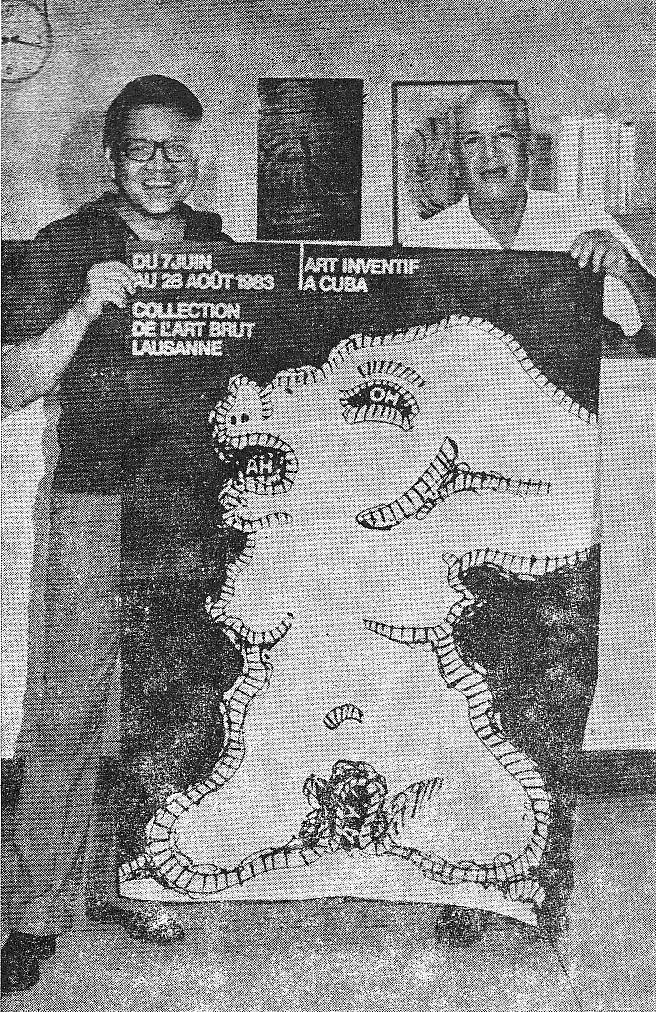
Cuban artists “Chago” Armada (left) and Samuel Feijóo (photo published in Signos # 32, 1984). The drawing is Armada’s.

Continue reading

Utilitarian Review 11/26/10

On HU

Slightly short holiday week this time out.

Kinukitty reviewed the semi-historical yaoi Maiden Rose.

For our Sequential Erudition series reprinting academic articles on comics, Ariel Kahn discussed the role of the gaze in young adult graphic novel.s

Sean Michael Robinson looked at some old books about the art of drawing.

And for the holiday, Alex Buchet posted a gallery of Thanksgiving comics.

Utilitarians Everywhere

At Splice Today I have a short review of The Disappearance of Alice Creed.

Also at Splice, a short review of Ke$ha’s new album Cannibal, vagina dentata and all.

At Madeloud I review some semi-recent mash-ups.

Other Links

Sean Collins’ review of High Soft Lisp touches on some issues that came up in this blog’s discussion of Gilbert Hernandez.

And Charles Hatfield enters the lists on behalf of Joe Sacco against an army of trolls. I don’t really like Joe Sacco’s work much, but Charles is definitely fighting the good fight on this one.