Comments Become Posts – Yesterday’s Thoughts on Literary Comics

Long-time and frequent readers of HU will recognize the ongoing friendly disagreement I have with Matthias Wivel about the degree to which literary things — literary theory and its literary lessons, literary experimentation and its literary insights — are important for comics. I almost said for “literary” comics, but that of course would have begged Matthias’ question, which is in part why comics need to be literary at all.

Toward the end of the lengthy theoretical discussion that erupted in the comments section to his remarkably rich interview with Eddie Campbell (much of which we unjustly ignored in the comments!), Matthias wrote:

I don’t dislike Krauss; in fact I think some of her work is pretty great, but yes, I have at times found her unneccessarily laborious, caught up in linguistic issues that may have been relevant at the time, but now just get in the way of her otherwise good observations.

Is there a way of applying her method to less obviously linguistic insights in visual art? Probably, but my point all along has been: why is that so important?

Caro, you have a real preference for whatever theoretical insights any given work of art may give you, and I am not at all opposed to that — I find that stuff as fascinating as the next man, BUT there are so many other equally valid and compelling ways of experiencing and talking about art, ways that you can frame in exact theoretical terms, but which to my mind don’t necessarily benefit from it.

Art isn’t theory.

In the question about the importance of literary methods and insights to comics (I’ll limit myself here to the discussion of comics, rather than art in general, which Krauss herself has addressed quite often!), there’s more at stake than theoretical answers to ontological/epistemological questions, as interesting as they are. There are practical issues of the artistic scope that comics can and has engaged with as well — and scope not only has implications for understanding — and imagining — the potential of the art form but also for appealing to broad audiences with diverse artistic tastes. I wrote a lengthy response to Matthias about the importance of engagement between comics and literature/literary theory, and Noah asked me to move it from a comment to a post. So here it is (with only minor edits from the comment version).


Matthias, I remember that you’ve made this same basic argument before with regards to literature itself — in the same way that art isn’t theory, comics aren’t literature, and so on and so forth. It’s a sort of medium-specificity that insists on boundaries — and while I GET it, I think those boundaries may be more limiting than they are valuable, for any purposes other than pedagogical.

For my own purposes, as you say, there’s certainly an aesthetic preference at work here — but there’s also an aesthetic agenda for those boundaries to become more permeable. Not permeable so that there’s no possibility of ever deploying the distinction to good effect, but permeable so that there’s more possibility of deploying the mixture to good effect.

It’s partly, as I think we’ve discussed, the fact that theory isn’t a “way of experiencing and talking about art” it’s a way of experiencing and talking about the world — one to which visual art has yet to make its fully evolved contribution. I believe that’s a contribution that needs to be made, considering the impact and reach of theoretical vantage points not only for “talking about art” but also for talking about all kinds of other things, including politics, and identity, and the politics of identity. If the vantage point of art is insufficiently represented there, that is an exclusion — even if it is one that’s largely self-inflicted. Participating in that conversation should in no way prevent all the other ways from experiencing and thinking about art from continuing on apace, as not everybody will be inspired by theory in the same way that not everybody is inspired by aesthetics. Surely there’s room for all of the above?

But it’s also that such an engagement with language/linguistics/literature in particular is more important for comics and important in a different way than it is for visual art. It becomes, to me, a question of broadening the field of comics sub-genres — in English-language comics, at least, currently there are a) a couple of unique genres, the fully visual-narrative and visual-metaphorical ones; b) the comics versions of genre fiction, SF, romance and heroic stories; c) plenty of autobiography and memoir; d) biography; e) journalism; f) children’s stories. Then, there are those few cases that qualify as literary short stories (although those trend toward the visual-narrative and visual-metaphorical genres, for various reasons many of which, I think, are subcultural). There are also a handful of experimental comics (which, as you know, I’m extremely fond of, but that is a very new and nascent genre.)

But there’s very little in comics that’s comparable to — let’s call it “Booker fiction,” the kind of fiction that gets nominated for and wins the Booker prize. (Although Booker books are not really homogeneous and my bias against current American letters is showing; “Pulitzer fiction” just suggests a somewhat different scope and approach to me.) Booker fiction is very engaged with theory — not just contemporary theory but traditional poetics. It also tends to care deeply about literary aesthetics and a range of pleasures that come from prose.

You’ll probably come back with the argument — as you have before — that Booker fiction is a literary genre and that comics doesn’t need to model itself on something so outside. But the question “why shouldn’t it take that genre as a model?” is equally valid. There’s no consistent argument that Booker fiction shouldn’t serve as a model for comics — unless comics is also going to reject all the other literary genres right along with it: popular genre fiction, the literary short story, biography, memoir…

I find the possibility of comics engagement with fiction at the Booker level especially compelling considering that Booker fiction’s engagement with theory and form — both questions and the mechanisms for getting at those questions — is at a point where it needs fertile new terrain, and “the illustrated book” is extraordinarily fertile. Books like Fate of the Artist point in that direction for me, and I think it’s tremendously inspiring. It’s a different direction from the one folks like Warren Craghead and Jason Overby are exploring, and — as marginal as experimental comics is — truly ambitious, truly literary comics are vastly more rare.

At this point, though, I generally have the sense that there are several pressures working against comics producing a work that’s really truly comparable in scope and ambition to a Booker novel. The biggest obstacle is auteurism and the DIY insistence on self-expression, which lead people who don’t have a lot of literary background to resist collaborations drawing on varied expertise (the kind of fecund collaboration, for example, that Anke F. has with Katrin de Vries). Hipster ennui — that classic mix of self-importance with complete and utter lack of seriousness — saturates art comics culture and generates a contempt for complexity and intensity that works against any meaningful engagement with literature. (The hipster problem also severely damages American prose letters and is to some extent at fault in the problem Elif Batuman identified in the LRoB essay we talked about here.) Hipster-fic generally ends up being either irony or what Mike called “me-comics”.

But I also don’t think we should discount the role of disciplinary distinctions here. Art education plays into this as I’ve mentioned before: because English is more valued at the middle and high school level than art, literary people often have much less drawing training than art people have in writing. But this can also lead to a lack of understanding among art people about the differences in the way a trained literary reader will approach, say “The Fortress of Solitude” from the way that same reader will approach “Midnight’s Children”, or the fiction of, say, Umberto Eco. It’s a failure of American education that we don’t equip our students to read those books the way they’re meant to be read before the time when students have to specialize, so that those reading protocols are such specialized protocols. But it nonetheless remains true that those books do demand reading protocols that only highly trained readers have — most people writing comics and writing about comics, even the best writers in comics, aren’t highly trained readers. There are precious few people in art comics who are palpably sophisticated readers by the standards of fiction readers — because a lot of those protocols just aren’t mastered, if they’re even taught, until graduate-level study in literature.

Similarly, the academic art world sometimes seems hermetically sealed: unlike literature departments which (at the graduate level) embraced their “cultural studies” sister departments to the point that traditional literature almost vanished entirely, the “department of art” is very separate — methodologically and institutionally — from departments of visual culture (which tend to be, really, part of that greater diaspora of literature).

But this separation of the disciplines becomes a problem for comics which draws on the media and discourses specific to both. One response has been to claim comics exceptionalism — the only discipline you need to know anything about is comics themselves. But that’s obviously bullshit: comics scholars tend to know art or they tend to know literature, and each enriches their insights in different ways. This is why I brought up Noah’s oft-expressed annoyance at the banal content of many comics: it’s just exasperating to hear people make “literary” claims for a book like Asterios Polyp. It’s a perfectly good pedagogical tool and an interesting experiment in visual device, but by even the middlin’ standards applied to literature, it’s pretty run-of-the-mill as fiction. It’s equally exasperating to read comics criticism that examines a really pedestrian, obvious narrative, something that’s probably intended for diversion and fun, in lofty formalist, new critical terms — the type of review that explicates literary devices which are completely on the surface of the work. It’s like someone writing a piece of student criticism about a student essay. This doesn’t happen nearly as often in professional and semi-professional reviews of prose books. The expectation is that people who read Bookforum understand literature and there’s no need to spell out, or often even point out, the formal devices at work in a book. (And of course, here I’m talking about the semi-professional comics critics, not random people writing about books they love or hate on their personal blogs.)

A great deal of the writing in (and about) comics is — at its absolute best — BFA-level writing. And I’m not talking about prose-craft — I’m talking about the sophistication of the engagement with ideas.

So when claims are made about comics-as-literature, the impression is often that comics people don’t know very much about literature, let alone theory. But the bias against theory seems to be part and parcel of this dual belief that literature and literary structure basically work the same way that art does but just in a different medium, and that what you learned in college is all there is to know about literature. That’s a misperception due almost entirely to these overly-strict boundaries. I do think it’s extremely important for comics that those walls come down.
The Tyranny of Comforters

This was first published at Splice Today. I thought I’d reprint it since it touches on some issues raised in this comments thread.
____________________________

Usually we think of empathy as a generous emotion; a gift of love. Just as often, though, it can be a crabbed, demanding, jealous thing — an insistence that others act like, think like, and even be oneself.

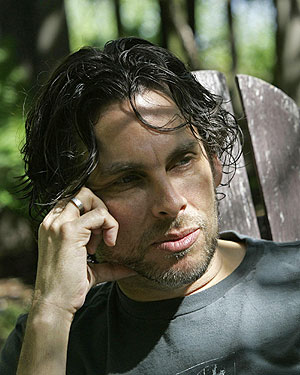
Michael Chabon is a writer of literary fiction, which means that in many ways, even more than a politician, he is a professional empathizer. Last week he was plying his trade as a guest-blogger for Ta-Nehisi Coates. As a matter of course, he wrote about the Tucson shooting, and specifically about Obama’s speech.

His post on the subject was mostly about the distance he felt from the speech, the audience, and indeed, from the nation. He began the post by declaring, “I’ve been thinking about the president’s speech all night and this morning, how something about it left me feeling left out.” He acknowledges that he was moved by Obama’s vulnerability and his exhortation to live up to the memories of the victims, “And yet…”, he says:

Was it all the weird, inappropriate clapping and cheering? Or the realization that I am so out of touch with the national vibe that I didn’t know that whistling and whooping and standing ovations are, when someone evokes the memory of murdered innocent people, totally cool? I never would have thought that I’d spend so much of that solemn Wednesday thinking—first on publication of Sarah Palin’s latest piece of narrishkeit about the blood libels, then all through the memorial service—please, I beg you, can you not, finally, just shut up? It was distancing. Distracting. As he joined in, at times, with the applause, the president’s hard, measured handclaps, too close to the microphone, drowned out everything else in my kitchen right then, and seemed to be tolling the passing of something else besides human lives. I don’t know what. Maybe just my own sense of connectedness to the cheering people in that giant faraway room. I didn’t feel like applauding right then, not even in celebration of the persistence and continuity of human life and American values. And then I was ashamed of my curmudgeonliness. Those people, after all, many of them college students, were in a sports arena; architecture gives shape to behavior and thought. Maybe if the service had been held in a church, things would have played differently.

Chabon then goes on to sneer (empathetically, thoughtfully) at Obama’s final image in the speech; the moment when he suggested that Christina Taylor-Green, the nine-year-old killed in the shooting, might be jumping in puddles in heaven.

I tried to imagine how I would feel if, having, God forbid, lost my precious daughter, born three months and ten days before Christina Taylor-Green, somebody offered this charming, tidy, corny vignette to me by way of consolation. I mean, come on! There is no heaven, man. The brunt, the ache and the truth of a child’s death is that he or she will never jump in rain puddles again. That joy was taken from her, and along with it ours in the pleasure of all that splashing. Heaven is pure wishfulness, an imaginary solution to the insoluble problem of the contingency and injustice of life.

Chabon concludes by noting that the image was okay after all if you inverted it and saw it as a metaphor for loss.

But I’ve been chewing these words over since last night, and I’ve decided that, in fact, they were appropriate to a memorial for a child, far more appropriate, certainly, than all that rude hallooing. A literal belief in heaven is not required to grasp the power of that corny wish, to feel the way the idea of heaven inverts in order to express all the more plainly everything—wishes, hopes and happiness—that the grieving parents must now put away, along with one slicker and a pair of rain boots.

So. That’s Chabon.

As for me, I spent most of “that solemn Wednesday” without any expectations in particular. As somebody without any connection to any of the victims, I didn’t even experience it as especially solemn. I didn’t watch, and don’t intend to watch, Sarah Palin make a fool of herself, because I know she’s a fool already, and why would I want to be irritated? I’ve enjoyed reading a number of pundits make fun of her, though (this is probably my favorite.)

I didn’t watch the president’s speech on Wednesday, either. In fact, I’ve been more or less avoiding news about the speech and about the people shot, because I find hearing about people getting shot upsetting. Especially young children — not because I’m empathetic or thoughtful, but because, like Chabon, I have a kid (he’s 7) and thinking about him dying makes me feel sick. I skimmed a transcript of the speech a day or so later. And I watched the video today because I was thinking about this article and felt like I had to.

The speech itself — well, it made me cry. I don’t know if that’s a testament to the president’s eloquence particularly. I cry pretty easily, and a bunch of people murdered for no reason is sad.

The cheering didn’t bother me. It’s odd, really, to think of it as an occasion for aesthetic approbation or denigration. People express grief in various ways. It seemed mostly like they were trying to let Obama and each other know that they were a community. Or maybe like Chabon says, they were just brainwashed by the architecture into behaving inappropriately. Whatever. I noticed that Giffords’ husband was clapping. I don’t feel I’m in a place to judge him.

As for rain puddles in heaven; yes, it’s trite. But it seems a little duplicitous to think of that triteness as causing Christina Taylor-Green’s parents more pain. If my son died, it’s not clear to me what anyone could say that would make things any worse or any better. Besides, you spout trite nothings when someone’s loved one dies, because what else do you say? A polished prose style is a lovely thing, but that doesn’t mean it’s an adequate response in all circumstances.

This, indeed, seems to be the cause of part of Chabon’s dyspepsia. Artists, especially successful artists like Chabon. receive such fulsome praises that I think they can occasionally mistake themselves for priests. Which is maybe why he felt qualified to proclaim with such certainty that heaven isn’t real and that death is just absence. To suggest otherwise is a stylistic error — rectifiable only by transforming the clumsy words of the President through the magical gifts of a real writer.

But I’ve been chewing these words over since last night, and I’ve decided that, in fact, they were appropriate to a memorial for a child, far more appropriate, certainly, than all that rude hallooing. A literal belief in heaven is not required to grasp the power of that corny wish, to feel the way the idea of heaven inverts in order to express all the more plainly everything—wishes, hopes and happiness—that the grieving parents must now put away, along with one slicker and a pair of rain boots.

Job’s comforters are a standing reminder that most people will engage in condescending assholery if offered half a chance. No reason that a lauded author should be any different, I guess.

Still, it’s worth analyzing the exact nature of the assholery. Job’s comforters were jerks because they believed that Job was suffering for a reason. His injuries were his fault or they would lead to a greater good. The comforters believed they could read tragedy. They were its interpreters.

Chabon isn’t coming from exactly the same place, but there’s some overlap. He too, believes that the tragedy should speak to him. He is irritated when he is excluded. Why doesn’t the President move me, he asks? Why doesn’t the event address me? Why this talk of heaven when I’m not a believer? Why don’t all these people who I am not interested in — why don’t they all, as he puts it, “shut up”?

The answer to all of these questions, of course, is fairly straightforward. That answer is: “It’s not about you, Michael.” Even your empathy, however well expressed, doesn’t make it about you.

Of course, lots of people who weren’t immeditately affected feel personally connected to the shootings. I do too, to some extent. But it’s important to recognize that that extent is limited. The separation Chabon felt from the people in that arena wasn’t because the people in Tucson are gauche, or because Obama is a Christian. If those things matter at all, it’s only as symbols of the way in which each person is different; a mystery, one to another. Art and love and religion bridge the distance partially and sometimes, but not entirely, and not on demand. God perhaps can love and know each individual, but for a human to try to do so starts to look like blasphemy. Even if, or perhaps especially if, you don’t believe that God exists.

Robert Binks and his art ( part 1 )


Robert Binks is a Canadian illustrator and cartoonist with a fresh, wry and humane touch. His drawings and art pieces are still delightful  thirty and even sixty years after their creation.

His illustrations for the Ogden Nash collection The Old Dog Barks Backwards (1972) can be seen in four posts gathered here. As a result of these posts, Mr. Binks got in touch with me and sent along more of his works, which I will be presenting over the next few weeks. I’ll note that everything Mr. Binks produced for himself is © Bob Binks. Works that he produced for the Canadian Broadcasting Corp. are © CBC/Bob Binks.

Mr. Binks wrote me the following:

I retired 20 years ago after a 35 year career as a graphic designer at the Canadian Broadcasting Corporation. During those years I also free-lanced for 2 Toronto newspapers doing editorial art and had an agent in New York where I illustrated several books including  The Old Dog Barks Backwards.

A personal endeavor I have enjoyed all my life and continue to do, is making Xmas and birthday cards for my friends and relatives.

Since retirement I continue to be productive in art — fine art painting, small ironic wood constructions and clay creations.

We’ll be seeing samples of all the above during the next few weeks.

Born in 1926, Mr. Binks studied commercial art at a Toronto technical school, then fine art at the Ontario College of Art. In 1947 he became a display designer at Eaton’s, a department store giant that was a Canadian institution. Ten years later, at age 30 or 31, he joined the Canadian Broadcasting Corp, where he spent the rest of his professional life.

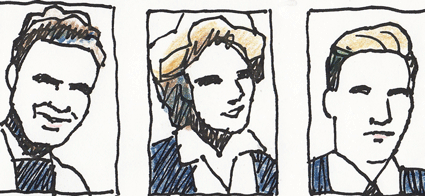
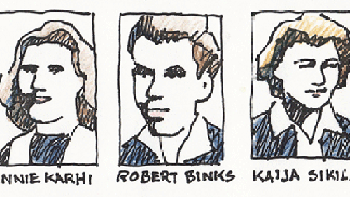
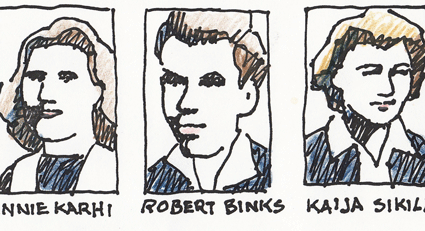
His work combines simplicity with unexpected detail and craft. These student caricatures from his days at Central Technical School provide an example:


As you see, they’re from the same set as the self-caricature that opened the post.

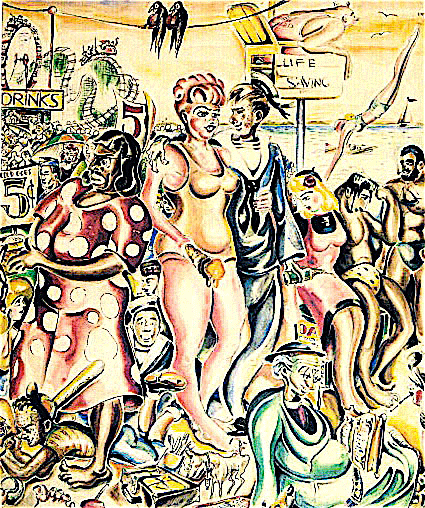
Now a far less characteristic work, but an interesting one. Mr. Binks produced this beach scene at age 14, during his second-year illustration course at Central Tech. He was trying to be like the painter Paul Cadmus (1904-1999) and made a good job of it:


Most of Mr. Binks’s work is, to put it mildly, not much like that of Paul Cadmus, who was a bitter moralist and who specialized in elaborate, pyrotechnically designed  canvases that are heavy with detail. The best Binks-Cadmus parallel I can come up with is that the two reverse each other. Mr. Binks produces clear, appealing works that show more detail than expected. Cadmus produced improbably dense works that communicate themselves with surprising clarity and speed.

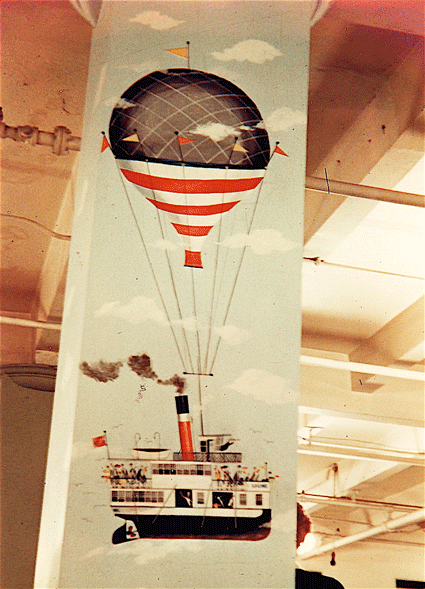
At age 22, Mr. Binks painted columns in the women’s wear department at Eaton’s. A display from his time at the department store provides an example of his clear but subtly detailed work:


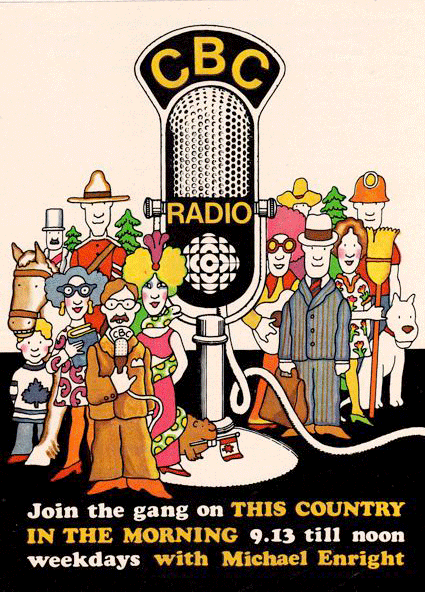
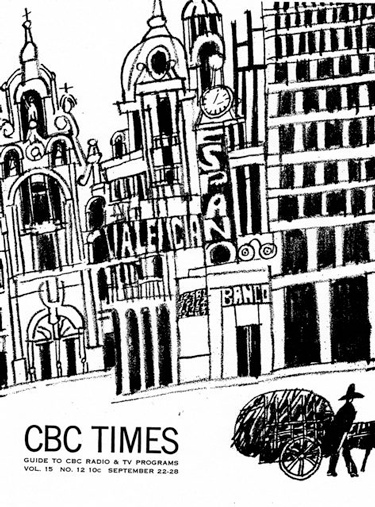
From the 1970s, we have some CBC work that shows a Binks trademark: the combination of simply outlined figures with involved but bold composition. From left foreground to right foreground, the artist turns a series of squiggles — dress pattern to hand-mike cord to snake to giant-mike cord — into a sort of meta-squiggle. It coils toward us where the reporter is standing with his hand-mike, then coils away, passing from snake to giant-mike cord:


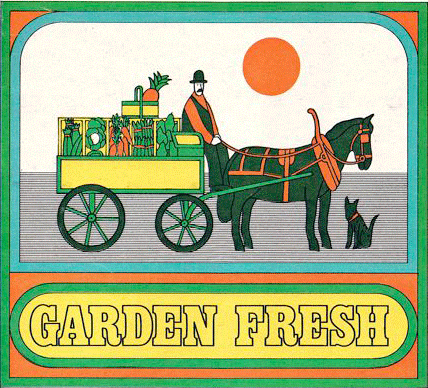
Below is an item done freelance for the recipe page of the Globe and Mail. Mr. Binks tends to amplify the effect of the texture in a given work by creating high, narrow rectangles jammed with detail. In this case the cart’s vegetable bins do the job:


Below we see the same trait, only more so. This picture makes texture its centerpiece; usually texture is more of an accent, from what I’ve seen.


Here we have a page from a mod dictionary that Mr. Binks illustrated. The pictures remind me of his work in the Odgen Nash collection. His strengths come together very nicely here. The illustrations have the simplicity cartoons need, but with a good deal of weight to the drawing:


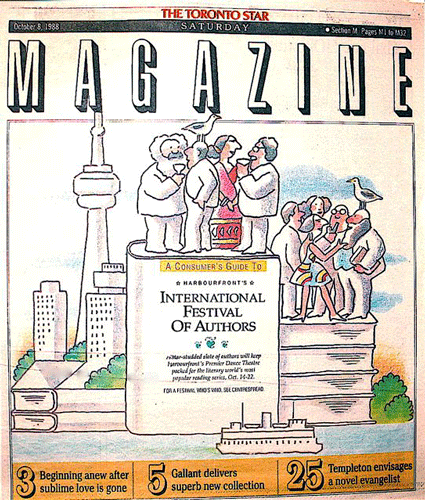
Another favorite, this one from the cover of a Toronto paper’s weekend magazine supplement. I like the nimble but unobtrusive way Mr. Binks handles the three interlocking compositions of cityscape, the first group of authors, and the second group of authors:


Again, the drawing still works as a cartoon. The composition is involved but clear, and it doesn’t produce a brushback effect, as when the reader’s jaw is supposed to drop a little and she/he to stand abashed at the sight of improbable ability. I find the drawing cuddly in a way, comforting. For example, take the tourist boat chugging along in the foreground.

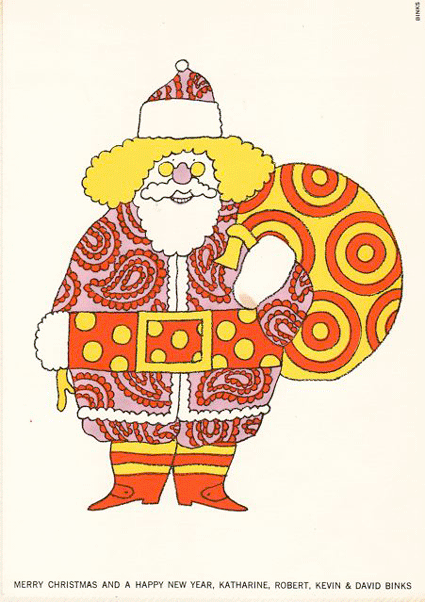
To close, a Christmas card Mr. Binks designed for his own use. The paisley Santa and his colors grab me:


The card has pulled off a neat trick, which is to survive the pop art ’60s without having become dated. I love the way the raspberry, gold and tan patterns look trapped against the white.

Unfortunately I don’t know how to analyze the card’s use of color and patterns, beyond saying that Mr. Binks sometimes uses contrasting patterns to kick up a drawing’s effect, and that here he adds high-contrast colors and a white background. The result is a caricature that jumps out at you, a trippy Santa Claus whose trippiness doesn’t rely on the usual signifiers of psychedelia (beyond paisley, anyway).

Next week we’ll have some intensely involved line work and a sequence about a cow traveling by subway. Hope you can make it!

The Wire Roundtable: Cherchez la femme

The Wire may or may not be the Greatest TV Show Of All Time, Now And Forever, In Any Language And Genre, In The Whole World, And Throughout The Whole Extent Of Spacetime — but one thing’s for sure. It’s definitely The Most Praised Show Of All etc. Time, Entertainment Weekly and the Guardian have all labelled it the greatest, as have lots of other folks with and without column space. Metacritic.com assigned the fourth season an aggregate score of 98%, which is higher than the rating for God Himself; more strikingly, it’s even four points higher than the score for Kanye West’s most recent album.

The Wire‘s legion of enthusiasts regularly point to a couple of features that merit especial praise: the show’s realism; its panorama of an entire society at every level; its giving voice to the marginalised and disempowered. Realism: swearing! Panorama: Drugs! Unions! Politicians! Schoolkids! Settling old grudges Journalists! The marginalised: Black people! Gay people! Gay black people!

In interviews during and after the show, creator David Simon consistently claimed the highest ambition for the show and its themes. In particular, the show would

with each season, slice off another piece of the American city, so that by the end of the run, a simulated Baltimore would stand in for urban America, and the fundamental problems of urbanity would be fully addressed.

First season: the dysfunction of the drug war and the general continuing theme of self-sustaining postmodern institutions devouring the individuals they are supposed to serve or who serve them. Second season: the death of work and the destruction of the American working class in the postindustrial era, for which we added the port of Baltimore. Third season: the political process and the possibility of reform, for which we added the City Hall component. Fourth season: equal opportunity, for which we added the public-education system. The fifth and final season will be about the media and our capacity to recognize and address our own realities, for which we will add the city’s daily newspaper and television components.

Throughout the whole show, however, there’s one group of marginalised and disempowered that is not given proper representation; one type of individual that gets eaten by institutions but is not explored; one group which has historically faced, and continues to face, massive inequalities of opportunity.

That’s right: I’m talking about the ladies.

Simon identifies The Wire‘s great theme as “institutions devouring the individuals they are supposed to serve or who serve them”. And throughout all five seasons, the show develops this theme in detail, in a variety of institutional contexts and with a variety of individual players. Institutions fuck over McNulty, Daniels, Bubs, Wallace, D’Angelo, the Sobotkas, Bunny, Randy, Bodie and plenty more besides.

But, from Snot Boogie’s sad demise at the very start to the much-exploited homeless guy at the end, The Wire is singularly unconcerned with how women fare in these institutions, the fates they face, the options open to them.

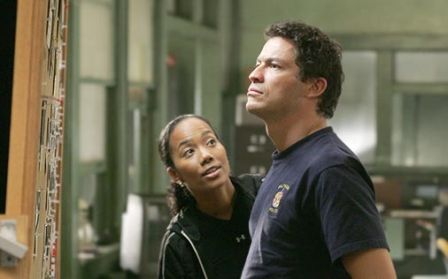
Consider: by my count, over the course of five seasons, thirty-seven cast names appear in the opening credits. Of these, four are women. These are the actors playing Beadie, Kima, Pearlman, and (!) Alma Gutierrez. Beadie is in the credits only for season 2, despite playing a sizable role in the final season too. Shardene and Snoop never make the credits. By contrast, Burrell, Rawls, Sydnor, Clay Davis, Clarence Royce, Maurice Levy and Chris Partlow do.

Chris Partlow makes the cut and Snoop doesn’t.

(This gender imbalance is presumably, totally unrelated, in any way whatsoever, to the fact that ten out of the eleven writing credits throughout the show are men)

Or consider: of those thirty-seven cast members, the relationship status of three of the women are plot points. Pearlman fucks McNulty and then Daniels; Beadie fucks McNulty; Kima struggles with her (de facto) wife and child. Alma gets nothing, but that’s only because she has no internal life to speak of or, really, any kind of life to speak of, beyond learning at the feet of the great David Simon Gus Haynes.

Sure, much is made of who the guys are fucking, too — McNulty and Omar in particular. (And, of course, if Pearlman is fucking Daniels, then Daniels is fucking Pearlman too). But, for a lot of the male characters, it’s simply not an issue. They may be married or have a girlfriend, but it doesn’t matter much to their character. Prez has a wife onscreen for all of one scene, as I recall; Bodie, Herc and Carv take dates to the movies and that’s about it; Marlo and Avon are mostly asexual; Rawls’ sexuality is a throw-away gag (well, two gags, if you include the graffiti in the homicide toilets); and who the hell knows about Royce, Davis, Burrell, Levy, Sydnor et al. The point isn’t that the show isn’t interested in who the guys are fucking; it’s that the show is much more interested in who the women are fucking.

And once you get beyond the “main” cast — even if you include a couple of extra characters not in the opening credits, such as Shardene, Snoop, Prop Joe, Jay Landsman and the like — it gets even worse. Most of the tertiary female characters are WAGs, would-be WAGs, one-night stands, or mothers. Going down the cast list, if we skip the few women who actually do appear in the opening credits, we get: Snoop; Marla Daniels, who’s fucking Daniels at first and then she’s not; Cheryl (you know, the one with her coupons); Theresa D’Agostino, who fucks McNulty and then tries to fuck Carcetti; Grace Sampson, who used to fuck Cutty; Donette, who fucked D’Angelo and then Stringer; Elena McNulty — look, it’s too depressing to go on.

The biggest missed opportunities comes in season four, with the introduction of the school. Here you have an environment with a lot of women and a lot of girls, the powerful and powerless. Maybe they couldn’t fit in a new major character as a teacher, given that they already had Prez undergoing his learning journey and growing into his new role. Maybe there wasn’t any need. But surely — surely — they could have made one of the four kids that we track a girl?

For the point of season four is, in part, to show the options available to black children in marginal environments. Randy, the budding entrepreneur who ends up traumatised by his glancing contact with crime. Michael, the child of abuse, who’s recruited to crime by way of protecting his family. Namond, who’s too weak for the streets and lucks into a way out. And Dukie, poor Dukie whose fate seems sealed from the moment we see him.

We see what the boys can do, what can become of them, what few roles are offered by the system — the systems — that surround them. But what are the fates for girls? Do they become dealers, junkies, citizens? What specific options do they have that the boys don’t have? Questions not answered by the show; worse, they’re not even asked.

The show isn’t altogether clueless on gender. There’s a nice bit in season four when all the neighbourhood mothers converge on Cutty, as one of the few eligible bachelors going. Or the bit in season one when D’Angelo lets his casual misogyny slip to Shardene. And the instigating incident of season two — the dead sex slaves — suggests a show not entirely uninterested in how women are used by power. But is that enough for a show that aims to reveal an entire society, and how that society grinds down its members? Is that enough for the Greatest TV Show Of All Time?

Or, to quote the great Bunk Moreland: Happy now, bitch?
_________________

The entire Wire roundtable is here.