Krazy as Muse: Walter Darby Bannard and the Comics of George Herriman

Walter Darby Bannard is an abstract painter. He was a longtime friend of the critic Clement Greenberg and the painter Jules Olitski, and you could place him squarely in that camp, however you might label it: modernist, formalist, Abstract Expressionist. Conventional wisdom about this style of art has been rendered worthless for reasons beyond the scope of this essay, but it holds that it is concerned with pure essence of painting, excluding all content, referring only to its heroic self.

As a practitioner, it’s a different story. One doesn’t worry about purity. One casts one’s line in the creative waters and tries not to complain about the species of fish that comes up as long as it’s edible. The process entails more humility than heroism, more idle musing than grand inspiration. Bannard’s work took a significant turn two years ago when his line reeled in Krazy Kat.

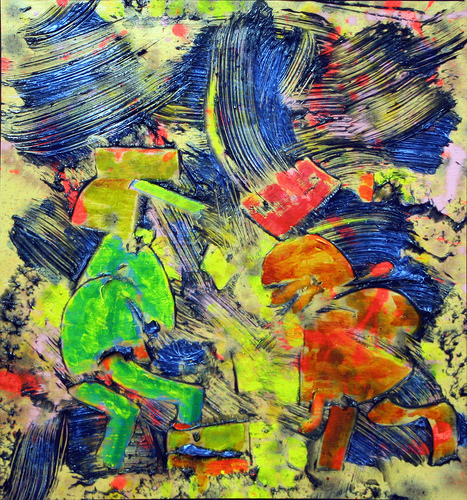
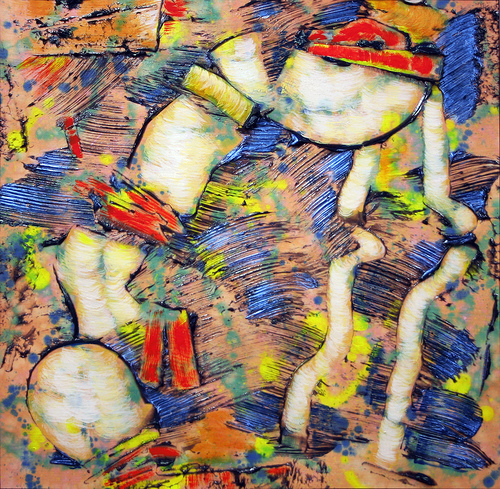
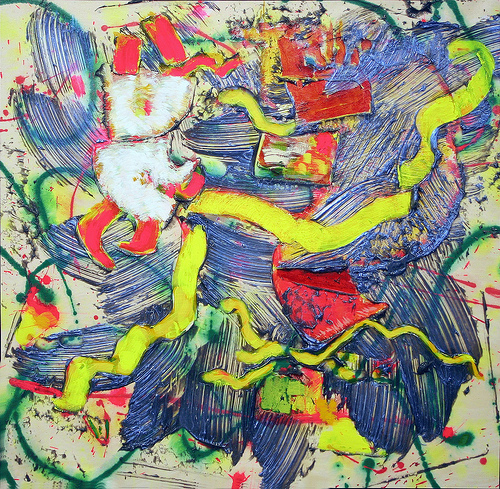
Bannard calls his current painting method “brush/cut/fill.” He begins by stretching canvases on the floor and staining them with thinned acrylics. Next, he applies high volumes of paint dispersed in gel medium using large brushes, even brooms. While the paint is wet, he cuts into it with squeegees, opening spaces and exposing the stained backgrounds. Finally, he fills these spaces with foreground elements by various means, brushing, pouring, or slinging the paint as necessary.

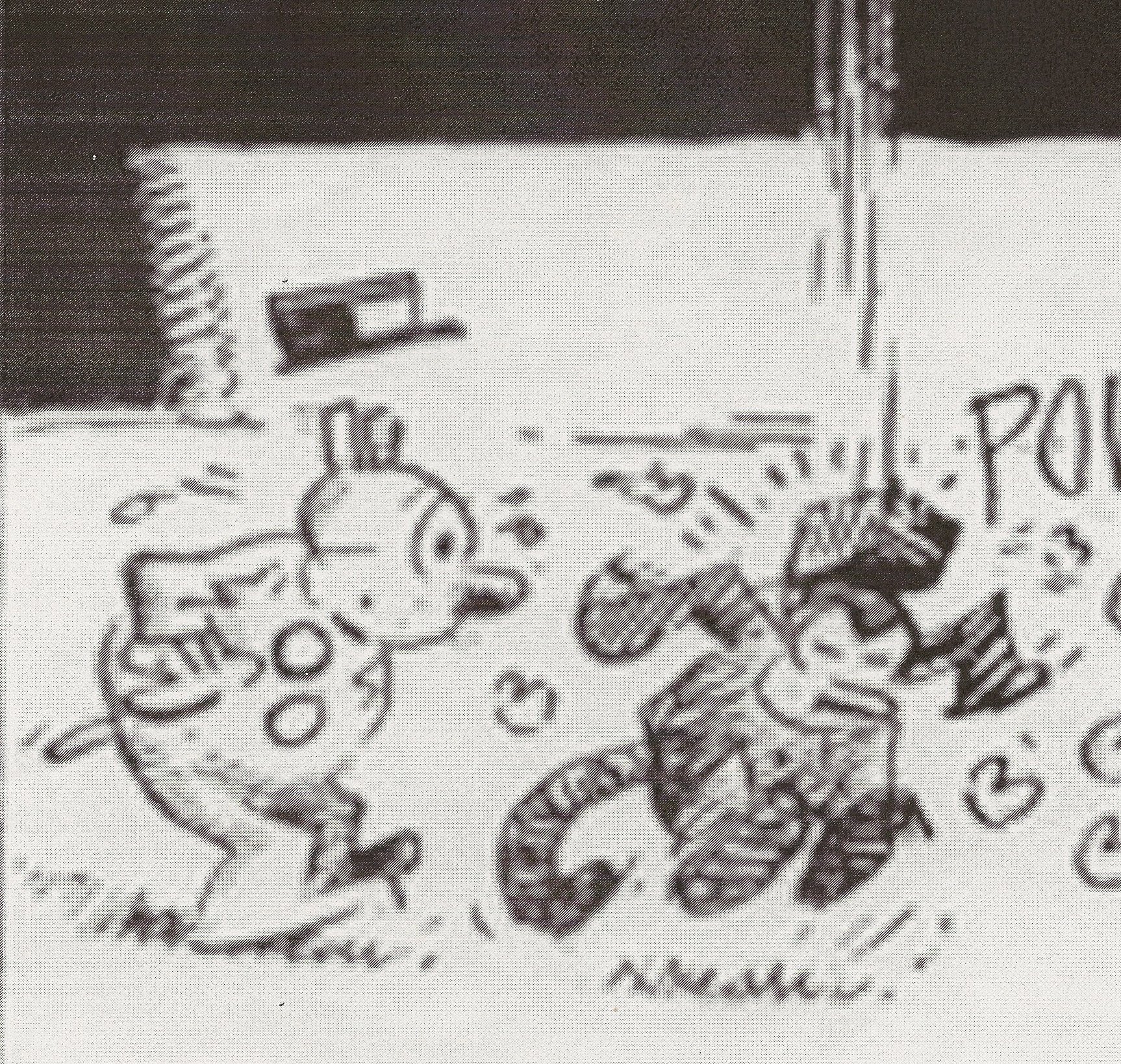
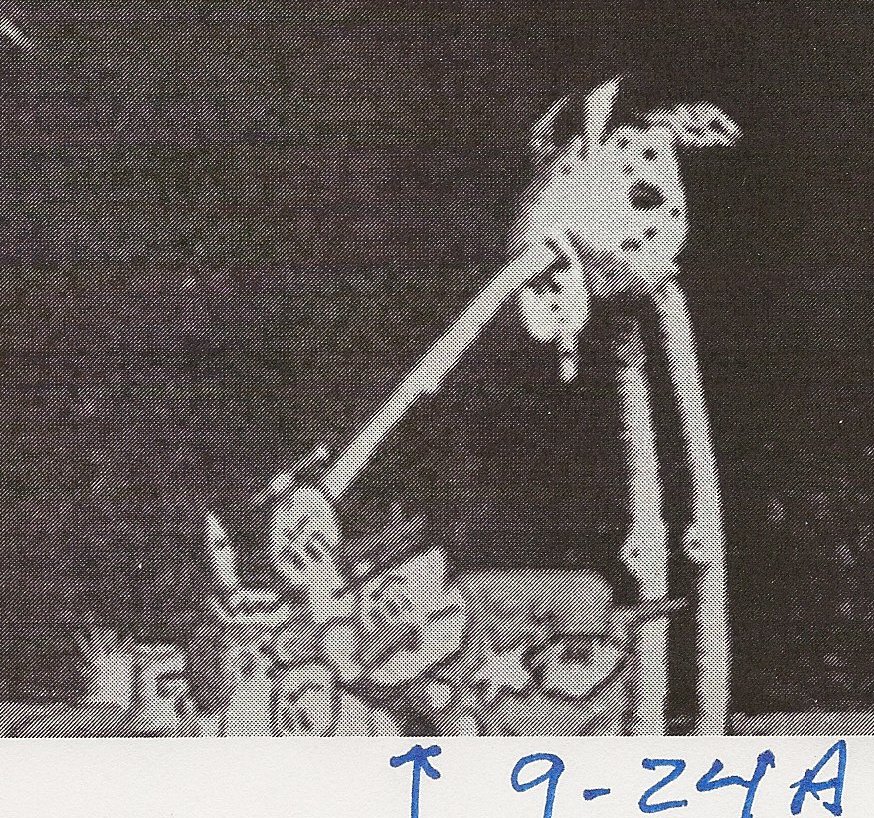
“When I evolved this brush/cut/fill method a couple years ago, the forms started looking organic and figurative because the method just made it so,” says Bannard. “I was not comfortable with this, but I tried to go with it. I began to feel that I needed some kind of centering element, like a landscape painter has landscapes, just to narrow the range of forms. I got the idea to look at Krazy Kat again in the spring of 2009.” Bannard went on the Internet and to the library, printing out and photocopying George Herriman drawings that caught his attention. By June, Krazy Kat characters began to show up in the paintings, albeit in a highly abstracted form.

Why Krazy Kat? “I have loved Krazy Kat since I was a young kid, when it was current in the funnies. I love the drawing, the weird forms and landscapes, and the eccentric color. It was a kind of surrealism that got to me much more than ‘art’ surrealism ever did. In fact, cartoon techniques always interested me more than ‘art’ techniques, aside from heavy stuff like Impressionism, Cubism and some Abstract Expressionism. I love skills and all the drawing tricks and gimmicks and technical things. When I was a cartoonist in college I made a real study of them, when I should have been studying for courses.”

It proved effective. “I struggled somewhat with this new figuration in my painting, and Krazy Kat gave me something I found affecting and could use as a formal reference. There is surrealism that really works and is full of humor in Steinberg and Herriman and Miro and a few others, ‘literary’ without being annoyingly ‘meaningful,’ even in Tanguy, although he was a lousy painter.”

Such inspirations, however useful, have a finite lifespan. Bannard has moved on. “The Krazy Kat references seem to have faded away early last year and now I don’t look at them at all. The paintings have gotten more abstract, through no deliberate process, but once again, just by letting them go where they will go.”

All paintings are 2009,copyright Walter Darby Bannard, acrylic on canvas.

Gasoline Alley- Nostalgia for the Unknown


A String of Moment (Context)

Take the days, all of the days, and cut away all but what pleases you. Those moments of pleasure are strung together now, one by one, a trail of memory stretching uninterrupted from one year to the next. Together for the first time, they are new again.

Are you surprised at how much has been spent at the same task? Or did you cut all of that away, leaving only the odds and ends, a collection of punchlines for jokes never stated? There’s little variety or excitement in obligation. Just row after row of perfectly formed boxed filled with perfectly on-model cats gorging themselves on perfectly inked lasagna. Ack!


A Stranger Comes to Town

I have it on good authority that serial newspaper strips are not built in a day. Popeye, for instance, didn’t hitch his wagon to Thimble Theatre until more than nine years into its run. Gasoline Alley didn’t take quite that long to get going, at almost a year and a half into the strip. Allegedly it was Frank King’s editor who suggested the change, which seems ludicrous on its surface. “Let’s see—we’ve got this gag strip about men hanging about a garage discussing their flivvers and occasionally enacting a repair or two. How are we gonna make this appeal to women as well?” Well, why not add an orphan, and make him an infant for good measure?

It seems so crass, so misguidedly commercial, that it is both impossible and perfectly natural that it was really a demand from on-high. Ludicrous, but also functional. Previous to baby Skeezix’s arrival King’s observational abilities, and his eye for nuance, were primarily turned towards the ostensible subjects of the strip—the hardware, the gadgetry. The cars are lovingly discussed, examined, used and abused and eventually sold or discarded—another model on the horizon to discuss and dissect. But with Skeezix that great eye turned towards the people of the story, including this little infant who at first is so helpless, but who will eventually stand, walk, talk and play.

This innovation, this device of incredible power and utility that is the source of so much of the richness of the strip, the aging, seems to be, ultimately, an accident of Skeezix’s infancy.


Wading/Changes

I’ve read the first three volumes of Drawn + Quarterly’s Walt and Skeezix, collecting in total six years of the strip. I’ve watched Skeezix go from an infant in the arms of the confused and reluctant father Walt to seeing him run and play and talk with his newly-extended family—Walt, his wife Blossom, their maid and Skeezix’s caretaker Rachel, and their dog Pal. The deepness of this experience of shallow time, the slow accumulation of event, creates a very strange feeling of completeness, of reality, even through the melodrama, through the broad characterizations. The effect is that of reading a daily diary, dipping into the stream of days, wading, until it is a thing of itself, each one indistinguishable from the other.


History Without Intention

When Skeezix first arrived on Walt Wallet’s doorstop, what was the world like? America in 1919. Tell me. How did the air taste? How did the buildings look? How did people travel? How did they court? What did they wear? What did they swim in? What did they do for fun? Where were the hem lines, who were the heroes, and how was justice served?

The intimacy of scale encourages an inhabiting of the environment, an environment that would have largely been invisible to his readers at the time as it may have been largely familiar. After six years I feel as though I know this place in a way that would be impossible otherwise.

But what is the place that I know? Is it the unnamed town that Walt and his family inhabit? Is it all of small-town America? Or is it King’s imaginings of this place, his simplifications, his fictional yearnings and need for dramatic situation?

In 2041 will someone write a introspective retrospective on the recently unearthed T.J. Hooker, discussing all of the things they learned from the show about California in the 1980s?


Things I Learned From T.J. Hooker

  1. In the early eighties motor vehicles were extremely dangerous. If one were to roll over, it will in a matter of seconds burst into flame and then burn.
  2. In the early eighties policemen routinely fought vehicles in hand to vehicle combat, including but not limited to cars, trucks, forklifts, ¾ scale trains in amusement parks, planes and school buses. If any of these vehicles were to roll over on their backs in the course of this combat, they would very shortly burst into flame.
  3. In the early eighties certain police officers had extrasensory powers of perception that enabled them to discern, almost immediately and with no externally visible evaluation or investigation, the true nature of the various criminals they confronted, and whether such criminals were good people set upon a bad path, or irredeemable scum that should be punished by all means possible.


To Unwrap and Enfold

Has there ever been a book series so well-loved, so nurtured and cared for and sensitively addressed, by its designer? Ware’s designs for his own books are virtuoso pastiches of styles long past and fallen from favor; his work on the Krazy and Ignatz series seems showy and ostentatious, not so much supporting the work within but wrapping it like a confectionist, and occasionally smothering it. But the Walt and Skeezix books use his great powers of pastiche and adaptation and put them solely in the service of the books themselves, the color and the scope of the scenery bridging the gap between the intimacy of scale of the dailies and the grandness and lush color of the Sundays.


Changes Again

When I bought these books, only a few years ago now, I was a married high school art teacher; I kept them on the lower shelf to the left of my drawing board, near the closet that we had to keep closed, so that our cat wouldn’t climb inside to nest in our belongings. The Walt and Skeezix volumes were her favorite books—she would play with the slim red ribbon that hangs from the binding of each volume. Now she’s dead, buried in the backyard, and I’m no longer married. Nor am I a high school teacher. As for the books, they were boxed up and put into the basement when I cleared out all my stuff out of the work room. Maybe I’ll sell them when I move out. I don’t think I would keep them now even if I could afford them—there’s just no place for them now.


So What Exactly Is It You Do? You Know, For A Living?

I read almost four year’s worth of these strips before it suddenly occurs to me—what does Walt do for a living? Does he have a job? If so, how does he get all of that time off for his cross-country jaunts? Maybe he’s independently wealthy—he’s certainly well-off enough to take care of his family and have plenty of dough left over for buying a new car, purchasing land or investing in one of Avery’s schemes. And yet he talks continually about money being tight, about having to save and manage and scrimp.

Is it that King felt the details of a profession would bog the strip down and leave it with less latitude for geographical change and impulsive spectacle? Is the grind of a profession a step too far toward realism and true monotony? Or perhaps King’s relentless observation had prepared him to thoroughly examine only a single man’s day to day work—his own.

It’s not immediate, but this realization fundamentally changes the way I perceive the strip. Or it could be the increasingly complex dramatic plot lines. But whatever the cause, the spell is broken. A friend of mine has her first child. I find the occasion surprisingly moving, greeting the news with a wave of elation and jealousy and confusion. I briefly consider buying her the first volume of Walt and Skeezix  on remainder, and then think again, write a song instead.

Today

I did not draw. I did no work for money, had no goals, no expected outcomes. I played music, then biked to the house of a new friend, played more for sheer experience. Later we road down to the lake, wandered the park, climbed a concrete embankment, and swam in the chilly water until the sun went down around us.

It was blinding behind the trees. I didn’t think to draw it.


Utilitarian Review 7/16/11

On HU

Featured Archive Post: Erica Friedman discusses the solution to the scanlation solution.

Nadim Damluji discussed Tintin and the Case of the Arab Henchmen.

I talked about the positive aspects of American financial collapse, sparking a debate about economics in the comments.

Matthias Wivel argued for the formal, visual, and thematic successes of Chester Brown’s Paying For It.

I still didn’t like Paying For It that much.

David Bitterbaum talked about sex and violence in Ellis and Ryp’s “No Hero.”

I talked about gender, romance, and tragedy in Weeds and the Wire.

Robert Stanley Martin reviewed Ron Rash’s short story “The Ascent.”

I reviewed the Republican presidential candidates.

James Romberger discussed Basquiat.

Utilitarians Everywhere

I look at the release of campy B-movie sort-of-classic Oblivion.

Other Links

At TCJ, Sean Michael Robinson interviews Mahendra Singh.

Darkness Blazed My Name: Basquiat’s Poetics

Whoever would not understand me would not understand any better the roaring of a tiger. Aimé Césaire

I never knew Jean-Michel Basquiat, although we were of the same time and place and had friends in common, but I recognized his abilities the moment I saw his work. I can still recall how his painting resonated from the wall in a closely hung group show at CHARAS in the early eighties. It rivaled the intensity of the Alice Neel portrait across from it. Although his paintings have singular appeal in terms of their brilliant coloring alone and their marks always feel fresh, there is much more going on than just a painterly surface. They articulate a position in regards to art and history, often elucidated in a textual form where what is obscured or erased is given the same weight as what is visibly spelled out.

Basquiat’s work emerged in the early 1980s as his contemporaries in Graffiti achieved their too-brief moment of American Art world acceptance, but even when he was spraypainting on the street he did not share that movement’s form and goals. The graffiti entity SAMO created by Basquiat and his friends Al Diaz and Shannon Dawson wrote poetic sentences on the streets of Soho, with a obliquely critical tone directed at the wealthy people who lived and shopped there. Basquiat’s work was never about the evolution of illuminated lettering forms that characterizes aerosol art. The late theorist of weaponized letters Rammellzee commented that his friend’s writing was “unreadable…(he) crosses out words, doesn’t spell them right, doesn’t even write the damn thing right.” Nor does Basquiat have common ground with the decorative confections of his friends Keith Haring and Kenny Sharf, despite that he is most often placed in their context by Art pundits.

Instead, his paintings relate better to the guerilla subversions practiced by another of his East Village peers, David Wojnarowicz. Basquiat and Wojnarowicz were both subject to inversion of identification. As Wojnarowicz’s multimedia works expose and excoriate a culture that refuses to accept or acknowledge his homosexuality, Basquiat’s paintings layer and refashion the racist cultural signifiers imposed on him that did not reflect his image. Like Wojnarowicz, he used his art to highlight the disparities, omissions, and lies in the histories of Art and Civilization. According to bell hooks, to reach his goals Basquiat “assumed the role of explorer/ colonizer,” he “journeyed into the heart of whiteness. White territory he named as a savage and brutal place.” Our mutual friend the painter Stephen Lack says, “Jean-Michel gave his paintings great import.” Once ensconced in the pantheon, Basquiat pursued the purposes of information dissemination. His messages were radical but effectively composed within specific referents to pass through the filtering apparatus of white art appreciation as guided aesthetic missiles.

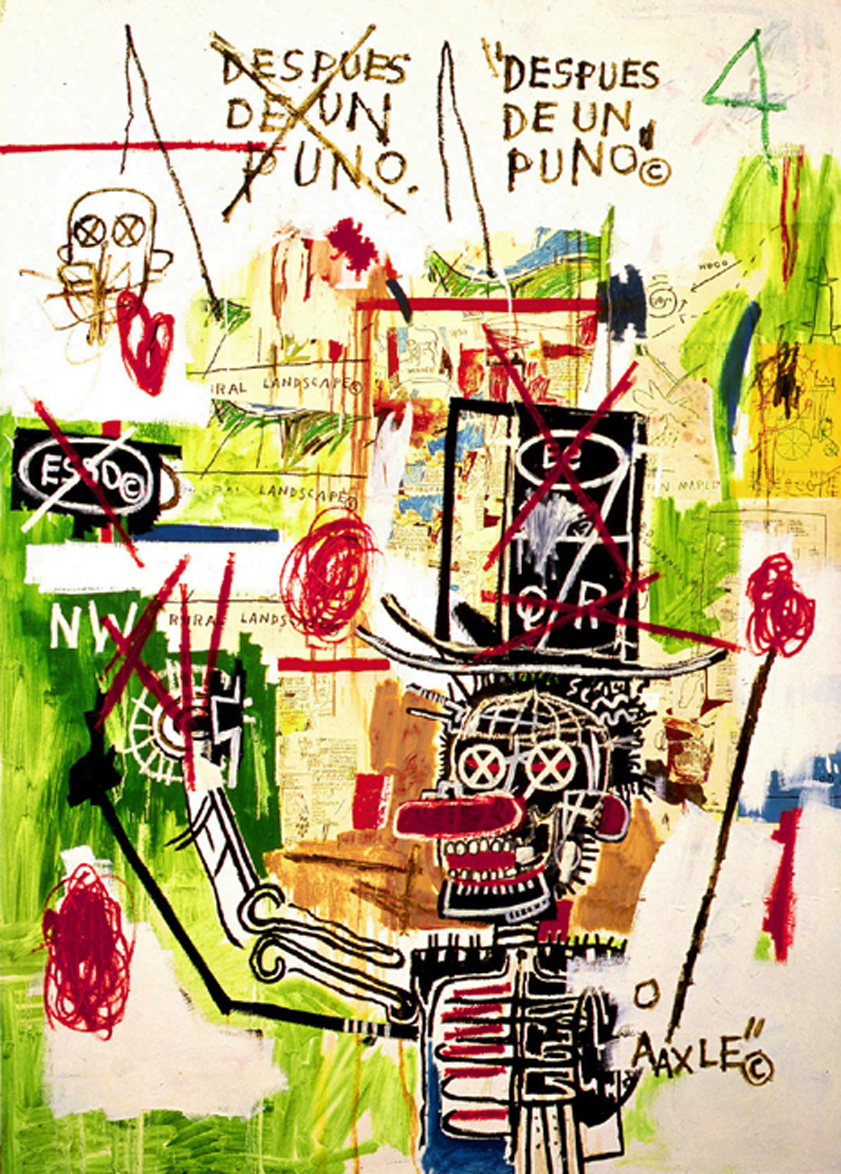
The textual aspects of Basquiat’s works incorporate a sophisticated multilingual approach. His use of Spanish relates in poetical terms to the linguistic claims of the Nuyorican movement, in that he deliberately use languages and the purposeful obscuring of written text to address, or privatize his words from, specific aspects of his audience. This paradoxical offering and withholding of understanding is seen in the painting “Despues De Un Puno,” where the text prominent in the piece is intended to block comprehension, as in comments he was known to make in Spanish to acquaintances in the presence of presumably ignorant patrons. Conversely, Basquiat does not close off the option of expansion of language. Typically his text operates in the opposite direction too, in order to self-proclaim his multilingual fluency and expand the linguistic possibility of his reach. On the interchange of language, the fluid switching between Spanish and English within a sentence seen in bilingual Puerto Ricans, Juan Flores writes, “rather than compensating for monolingual deficiency, code switching often signals an expansion of communicative and expressive potential.” As such a code switcher, Basquiat is able to draw from a wider reservoir of signifiers with the languages at his command.
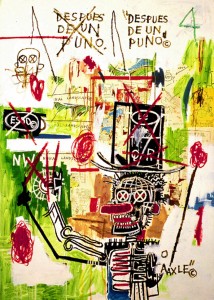
 

Basquiat, Despues De Un Puno, 1987

Basquiat knows the history of the conqueror and the actualities of his current position within it, how it relates to his body. His quoting of corporate symbology and recurring impositions of trademark and copyright symbols speak to issues of ownership: of the land, of his ancestors, of himself, his body and the products of his brain and hand. His methodology is a form of layering of textual and visual signifiers that resembles the approach of other artists of his generation such as Wojnarowicz and Christof Kohlhofer, whose images consist of a profuse visual and textual “namedropping” invested with a multitude of sub-signifiers of shared experience. Basquiat communicated directly with the art world using their referents, their signifiers. In his paintings Basquiat links the significance of words or phrases set in proximity to each other in their context within the pictorial field. This allows associations to be followed by the viewer/ reader in a type of narrative of assimilated ideas. Basquiat contexualizes the Diasporan experience with the Western canon as Aimé Césaire did with Shakespeare’s “The Tempest,” while he also bridges the gap between visual and textual signification.

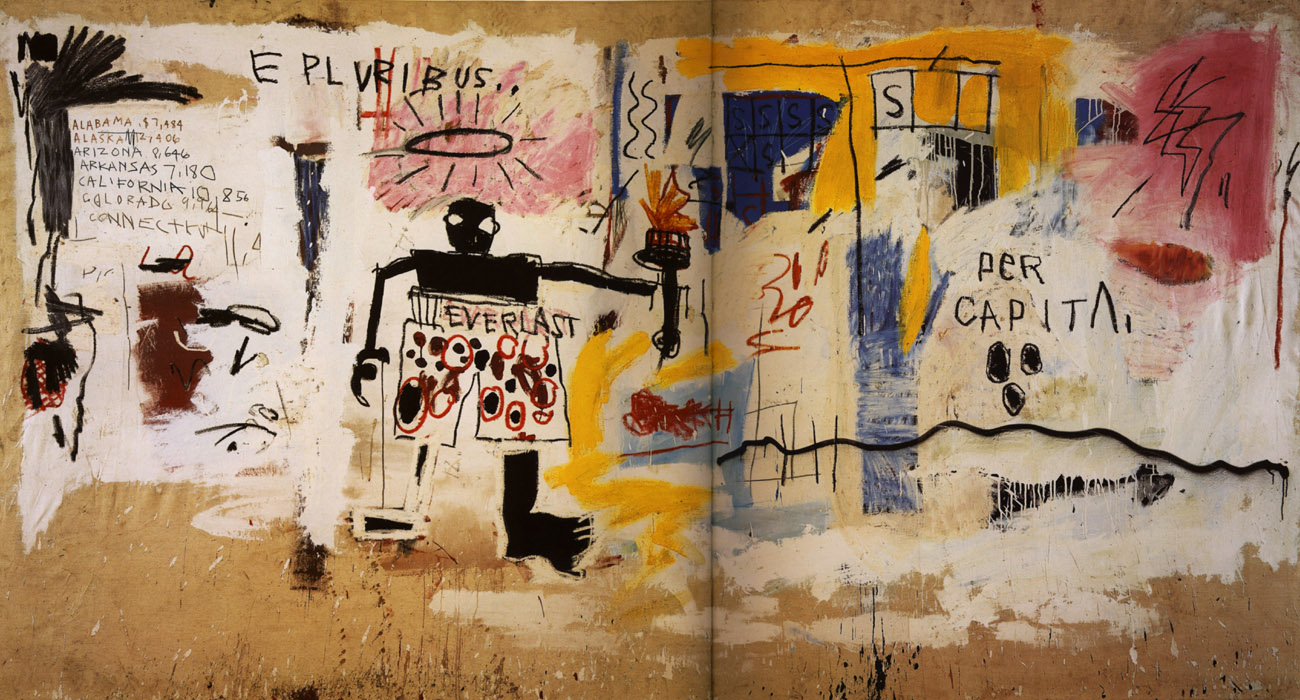
In the relatively spare piece “Per Capita” large lettering in Latin dominates the background field or storefront space. Basquiat uses Latin like other poets to point to his scholarship and to place himself amongst the great classical poets, but perhaps also like Elisabeth Barrett Browning, who as a marginalized female poet uses a Latin header on a poem to demonstrate her equality to the male Victorian poets, Basquiat claims equality across racial lines. He affirms that he knows the canon and claims a stand on even ground. Further, the work is surmounted on the left by the inscription “e pluribus,” or “out of many” (sans unum or “one”) as on coins and currency and on the right by “per capita” or “per head.” In this way he points to the way white classicism hides the ugly truth of people counted like numbers, in a nation built with slavery.
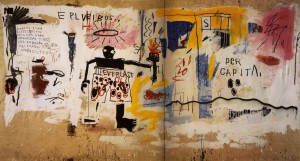
 

Basquiat, Per Capita, 1981

Down the left side are listed the names of states and figures in dollars. The highest amounts are tallied by predominantly white states, Connecticut and Alaska and the lowest to states with large African American populations such as Alabama. This listing taken with the title might indicate a sliding scale of income or funding allocation for each individual in the respective states. It might also reflect a type of ordering that allays the anxiety of those who are displaced. On a pictorial level, the painting depicts a boxer with a halo holding the torch of liberty. The shrunken, attenuated black figure with blank eyes wears oversized shorts with the logo “Everlast” emblazoned on it conspicuously. It is typical of the ambiguity and self-ironizing of Basquiat’s work. “Everlast” places the black male as enduring forever as the champ, who can withstand a pounding as well as deal one out, yet in the end still answer to the sponsors and handlers who see him only as a commodity. Basquiat points to the endurance of people of color as they are used by the dominant culture. The text qualifies the terrible skepticism of the piece with extreme brevity.

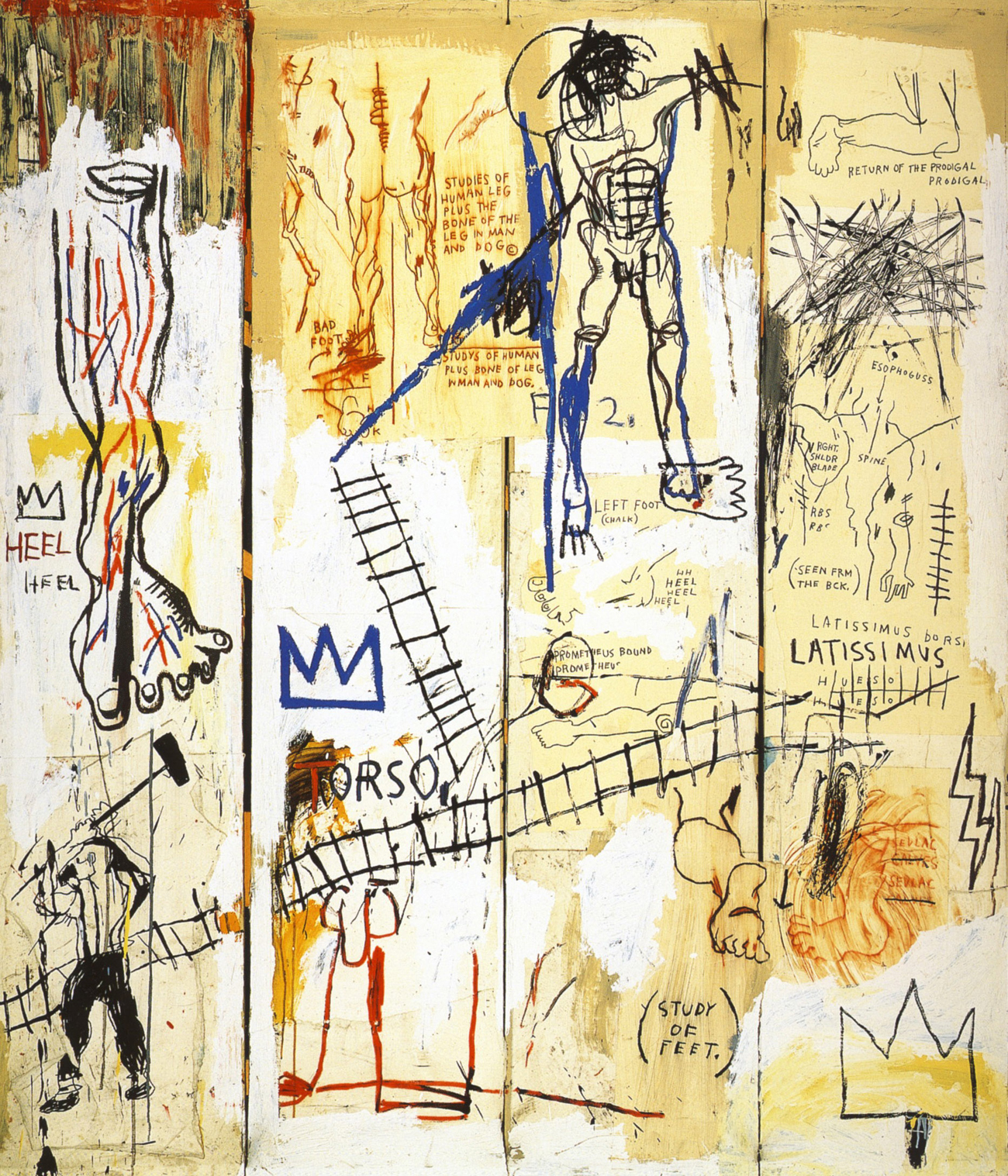
In “Leonardo Da Vinci’s Greatest Hits,” on four vertical strips of canvas Basquiat arranges distorted renditions from “Gray’s Anatomy” and Leonardo’s notebooks with an emphasis on legs and feet. The title suggests that Da Vinci also was pressed by his patrons to produce on demand and even repeat his most popular works, his “hits.” Basquiat refers to “the bad foot, the left foot” and with “Return of the Prodigal” he identifies as the bad son. “Heel” is repeated, which might define as being under a heel, or down at the heel, a heel in the sense of bad, a villain, or a flaw or weakness as in an Achilles’ heel. In the bottom left is a muscular figure with a mallet like John Henry, building the railroad tracks that the whole is crossed with, “hits” to make tracks perhaps as references to drugs, tracks that mark a slave to a habit, marks which take on the form of text themselves, used semantically to represent history. They unify the piece and lead on one path to Latin again with “Latissimus”, muscles of a strong back, on the other track to “studies of human leg plus the bone of the leg in man and dog.” A dog can be trained to “heel.” Perhaps the influence of Césaire’s line, “that it is enough for us to heel the world, whereas the work of man has only begun” is here as Basquiat feels the inherited burden. Yet perhaps it also recalls the anxiety caused by the sense of alienation from the body as a legacy of slavery.
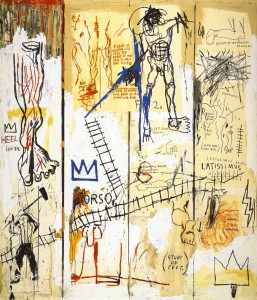
Basquait, Leonardo Da Vinci’s Greatest Hits, 1983

The sense of the physical body is also in the piece as he refers to Shelley’s poem, “Prometheus Unbound” about the bringer of fire Prometheus’ emancipation from torment as “Prometheus Bound,” prefiguring release and again locating himself within the framework of revolutionary poets, but here insisting himself as both Prometheus the bringer of fire, a metaphor for the fire of his message and a reference to freeing himself from the long suppression, now pushed back into even earlier times. The poem cements the images of fighting back and rebellion together with flight and escape. The flight might be seen like Prometheus to claim his due or perhaps as away from the brutalization of exploitation. Basquiat trades in ambiguity and this is a hallmark of his work.

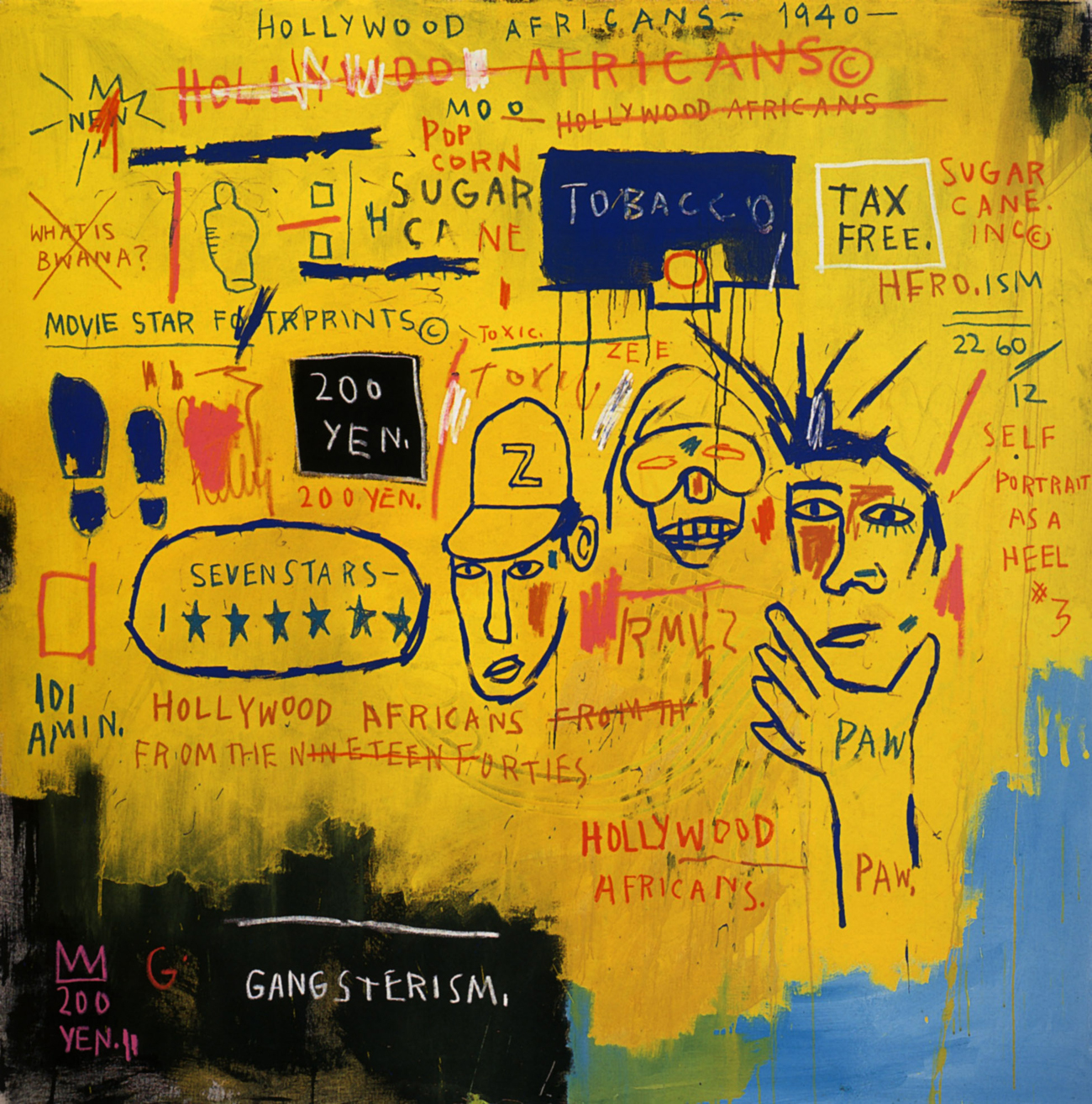
Correspondences can be found throughout the text of Basquiat’s work, as in “Hollywood Africans,” a caustic piece painted mostly yellow with the footprints and portraits of his writer friends, Toxic and Rammellzee, with his own likeness simultaneously valorized as “hero.ism,” villianized as “heel #3” and animalized with “paw.” There were few Africans in Hollywood that were not racist representations of savages and servants. The reader is asked, “what is bwana” in the form of a question as in the TV game show “Jeopardy” and crossed out. Basquiat is ventriloquizing white concerns, it’s not real. The lines of races and assimilation are crossed and blurred. Seven stars is too many, it’s pop, it’s corn, Idi Amin may be a black dictator in the real Africa but the sugar cane in Haiti is incorporated and copyrighted to be exploited, it all adds up to the sum of white on black “gangsterism,” it’s real and the piece is priced at 200 yen.
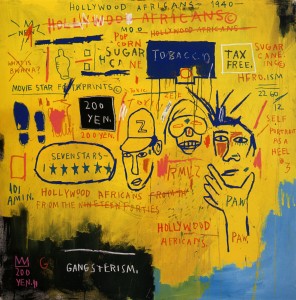
 

Basquiat, Hollywood Africans, 1983

Belying the portrayal of him in Julian Schnabel’s film biography as a mumbling, bumbling junkie, the volume of work Basquiat produced in his short life is that of a dedicated painter, with little time for anything but work. Stephen Lack suggests that when Basquiat’s dealers requested that he switch from painting in acrylics to make more valuable products in the medium of oil, the prolonged drying time of oil paints adversely affected the artist. Lack posits that Basquiat then had to wait for a layer of pigment to dry before adding successive layers, depriving the work of spontaneity and the artist of his most valued rush, the more immediate pleasures and gratifications of creating large-scale works quickly in fast-drying acrylic. And, the paradoxes of his position and the fickle and judgmental nature of celebrity in the art world overwhelmed him. Frances Negron-Muntaner observes,

While Basquiat envisioned commodification as a way out of the racialized body to the extent that it socially valorized him, the requirements of steady output undermined his independence and relationship to painting, making the artist fatally aware of his shameful status as a racialized subject, even under privileged conditions.

Basquiat had truly believed that he would be able to scale the heights on his abilities and worth, but the tipping point was reached when the critical reaction to his collaborations with Andy Warhol hurt him. He was othered, treated as a novelty brought to life by Warhol’s divine intervention. He could not accept the sidekick role, could not be subordinate—it was he who had invigorated Warhol with his love and energy. It was now clear that in order to continue he would have to subsume himself and his art further into a system which did not regard him as an equal.

In less than a decade, Jean-Michel Basquiat sealed his fame with a large body of work and sacrificed himself in the process. He felt the oppressions of millenia, he internalized the damage done no less than did the tragic Puerto Rican poet laureate Julia Burgos. Like Burgos, in the end he died alone, and although they didn’t cut his limbs off to fit him into a pauper’s coffin as was done to her corpse, he was also dismembered. Parts of him are in many public and private collections. His art stands as a painterly, eloquent, accusatory text, a litany of sure marks which express the weight of centuries of dislocation, testimony and evidence presented against the culture that ate him.

It’s as if I’d like to return,
and yet can’t discover why, now where to.
Julia Burgos

____________________________________________________________________


Thanks to Marguerite Van Cook, Frances Negron-Muntaner, Stephen Lack and Sur Rodney Sur.

Meet Your Candidates, America

This ran at Splice Today in a somewhat edited form. It’s out of date, but maybe still funny.
___________________

Like most of my fellow citizens, I don’t know much about the Republican candidates running for President. So, what the hell, I volunteered to watch the Monday night New Hampshire debate for Splice and see what I thought of the field.

Two hours later, I had discovered, to my sorrow, that the debate was two hours long.

What did I learn about the candidates? Well, in no particular order:

Tim Pawlenty has the earnest, lean intelligence of Gilligan after being hit on the head by a coconut. He insisted repeatedly and forcefully that just because he had occasionally done mildly sane things in the past did not by any means indicate that he wasn’t as completely insane as anybody else on the stage, so help him God. Yes, he had supported the proposition that abortions should be allowed in cases where the mother had been raped by demonic ravening acid-blooded beasts from beyond the stars, but if you’ll look at his record you’ll see that he had actually passed legislation making Minnesota the state in which it was most difficult for women raped by demonic, ravening acid-blooded beasts to obtain an abortion. Which is why most industrial jobs in Minnesota are performed by salivating aliens (legal aliens, of course!) fed almost entirely on the blood of UAW workers.

Newt Gingrich carried himself remarkably well considering the fact that his entire campaign staff lined up to resign one after the other on camera during the course of the debate while a retinue of circus clowns took turns slapping him in the face with three-day old haddock. He said NASA should be defunded so that private enterprise could invent warp speed and we could ship gay people to Pluto where government could constitutionally prevent them from marrying. He also said something about billions in health care savings through not paying crooks which sure sounded like bullshit, but I wasn’t really paying attention because everyone knows already he’s going to lose.

Michelle Bachmann has personally birthed a quarter of the population of the United States, and has provided foster care to the rest. As a personal favor to all her children, she announced her official candidacy right there on the debate, causing moderator John King to almost have the decency to be embarrassed at what he’s doing with his life. Bachmann said the debate taught her about the goodness of the American people, who did not, it is true, rise up as one to beat her to death with her own smarm. Presumably though that was less because of altruism and more because most of them weren’t watching.

Mitt Romney was not able to attend, so he sent in his place a coiffed, starched penguin which screeched, “Obamacare! Obamacare! Obamacare!” every time the clowns assaulting Newt Gingrich threw it a haddock. When it was asked about sharia law being implemented in the United States, the penguin did a spit take, covering the other candidates in fish guts. This was probably the most statesmanlike moment of the debate, and almost made me proud to be an American.

Herman Cain did a live demonstration of his business acumen and ability to multi-task by making a pizza at the podium while simultaneously battling hordes of disloyal American Muslims. Later he consulted experts and, on their advice, called the moderator a meany.

Rick Santorum admitted, when pressed, that he was more authentic than Mitt Romney, less irritating than Michelle Bachmann, and more admired by his own campaign staff than Newt Gingrich. He also pledged to cut the capital gains tax to zero for all manufacturers and to recoup the revenue through exorbitant sin taxes on google searches.

Ron Paul was Ron Paul.

Of Wires and Weeds

I’ve been obsessed recently with the Showtime series Weeds, about soccer-mom-turned-pot-dealer Nancy Botwin. I’ve compulsively watched the first three and a half seasons in the last couple of weeks. Thanks a lot, Netflix instant.

Anyway, I had Weeds on the brain when I read this post by Alyssa Rosenberg about how the dealers on the Wire don’t get to have any romance.

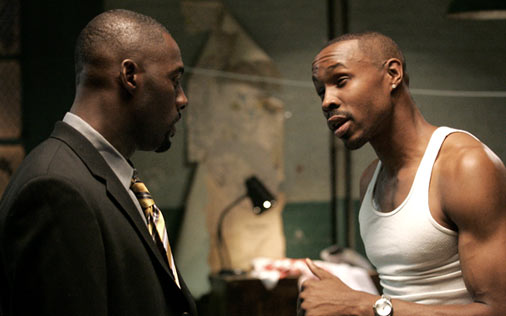
But with the exception of D’Angelo Barksdale (who ends up as more of a neutral character), the main members of the drug crews either don’t have long-term relationships or those relationships aren’t a major way of exploring who they are as people (there are exceptions for minor characters, like Bernard, whose girlfriend Squeak leads him into trouble). Avon Barksdale has an ex-girlfriend who Wee-Bay kills, but we don’t see him in any sort of relationship with a woman — probably the most important woman in his life is his mother. Wee-Bay is explicitly non-monogamous, and what relationship he has with his son Namond’s mother mostly concerns Namond’s well-being. Chris Partlow and Michael Lee are both victims of sexual abuse, which motivates murders they commit, but isn’t something we see them work out in intimate relationships. There are interesting possibilities in Snoop’s gender expression, but the show only really explores her as a soldier. I don’t even want to think how Marlo Stanfield would treat a woman he actually dated, much less had sex with and then executed after she turned out to be a spy.

I’m not sure what this disparity means. Does running a drug crew mean folks have less time or inclination to pursue steady relationships? Is it commentary on the crews, suggesting that as they’re peddling one means of social dissolution, they’re engaging in others? Whatever Simon’s intentions, weighting relationship questions and subplots to the police means we get a smaller part of the human spectrum when we look at the crews.

I think Alyssa’s point is correct — the drug dealers are not granted romantic sub-plots. I think the reason is because, for Simon, drug-dealing is an intensely male world. There are some women involved, like Brianna and Snoop, but they’re obviously exceptions, and both have something of an asterix beside them (Brianna is involved because she’s Avon’s sister; Snoop is deviant in multiple ways, not least in her gender presentation.)

The maleness of the drug world means that romantic male-female relationships play a secondary role; the most intense focus of interest for the men is homosocial. For instance, we never see Bodie with a girlfriend — but we do see that he has a big old crush on Stringer Bell. The crush is tied up in Bodie’s ambition and in his desire to be a man; it’s composed of part admiration, part envy, part lust (for power, for money), and it’s the lever that impels Bodie to kill his friend Wallace. I don’t think it’s an accident either that Poot, who is defined in part by his interest in women, eventually gets out of the game.

The main focus of homosocial tension in the Wire, though, is between Avon and Stringer Bell. For both, their partnership is the defining relationship of their lives, and at several points that relationship is explored not just through business, but through sex. The clearest instance of this is when Avon gets out of jail. He’s interested in making time with an attractive woman at his coming home party, but Stringer keeps cornering him with business talk. Finally, Stringer drops a frustrated Avon in a luxury apartment. Avon stands and fumes for a couple of seconds…and then Stringer reappears, the attractive woman and a bonus attractive woman in tow. The whole sequence is a sexual tease, and the teaser is Stringer. He uses the women he’s bought for Avon to seal their partnership and friendship with sex.

The homosocial possibilities of Avon/Stringer slash are contrasted in the Wire with Omar’s much-more-than-possible homosexual relationships. Alyssa doesn’t mention Omar — but he’s a striking exception to her discussion of drug dealers and romance. Which is to say, Omar is very much defined by his serially monogamous romantic relationships. These relationships are all with men — and the suspicion is that they are possible because they are with men. Romance with women is not possible in this world; but men are a different story.

The parallels between Omar’s relationships and the other drug dealers’ relationships calls into question the heterosexuality of the entire milieu, a fact of which the other drug dealers seem nervously aware. Both Avon and Stringer initially want to kill Omar because he robbed them — but what really pisses them off is that he’s gay. Avon ups the bounty on Omar when he learns that he’s a “cock sucker”. And as for Stringer, while it’s never made explicit, it seems clear that part of the reason he uncharacteristically participates in the torture of Brandon, Omar’s lover, is because Brandon is gay. The killing of Brandon, and Omar’s reaction to it, ultimately ends in Stringer’s own murder. Male-male love is the only kind on offer in the world of the gangs — but it’s a love steeped in disavowal, which ultimately leads to tragedy and death.

Weeds presents a very different view of the drug trade. Where the Wire’s dealers are manly men thinking about other manly men with whom not to have sex, the world of Weeds is decidedly matriarchal and up to its orifices in intergender fornication. There are certainly a lot of men involved in dealing, from Nancy’s drop-out son Silas to the agressively psychotic thug U-turn to the more quietly psychotic DEA agent and thug Peter, to the quietly honorable grower Conrad. But they one and all — tough or weak, dumb or competent — drop to their knees if a pretty girl points at her bits. In this show, it’s the women who wear the phallus — sometimes literally, as when Nancy’s brother Andy finds himself unexpectedly sodomized with a large black dildo by one of his girlfriends.

Women make dumb choices out of lust in Weeds too — dealer Heylia James lets her iron competence slip for a few episodes when she falls for a Nation of Islam minister, for example, and Nancy’s increasingly compulsive sluttishness get her into trouble on more than one occasion (most flagrantly in the first couple of seasons when she mistakes scumbag Peter for a nice guy.) But overall, the women on the show are the ones who display a modicum of responsibility and resourcefulness, and who manage to use their sexuality rather than letting it use them. Heylia’s Nation of Islam minister helps her escape a drug bust; Nancy gets Peter to use his DEA office to protect her…and eventually it’s Peter who gets killed (set up by Heylia) not Nancy.

One of the more emblematic moments of Weeds occurs when Alejandro, a rival, violent pot dealer, demands to meet with Nancy after threatening her and her children. Nancy drives out to confront him in an alley, the two get in each other’s faces…and next moment Alejandro is (consensually) fucking Nancy on the hood of a car. Post-coitally, Nancy informs him that he was a good lay, and then sticks a B.B. gun to his dick and tells him to stay away from her or she’ll castrate him. Afterwards, Nancy is extremely upset (“What are you doing?” she asks herself)…but Alejandro turns into a puppy dog, sending her gifts and cheerfully becoming her minion in the drug business even though she tells him she’s not screwing him again.

It’s not entirely clear whether Nancy slept with Alejandro to get the upper hand or whether it was just a case of rampaging hormones. She does tell Alejandro the rutting was unexpected, but she’s certainly capable of lying, to others and to herself. In any case,the point, reiterated throughout the series is clear — men think with their dicks, and their dicks are a lot stupider than women’s cunts.

There’s a tendency to assume that because the Wire’s a gritty serial it must be more realistic than a situation comedy like Weeds. The Wire shows the drug business as a male world, so that’s the way it must be. I’m not so sure though. Weeds seems to get other things closer to right than the Wire does; for example, it’s more on target about police corruption. Moreover, in the freakonomics series where drug dealers commented on the Wire, one argued that the maleness of the show was one of its least convincing features.

“Women,” said Tony-T. “Where I come from, women run most of the things [that the show] talks about. It’s the women that have the power in the ghetto. This show totally got it wrong when they made it all about men. Women are the politicians; they can get you a gun, they got the cash, they can get you land to build something on.”

What’s perhaps more interesting than which is more true to life, though, is the fact that both the Wire and Weeds share the broad assumption that women in control is odd, unusual…or, in other words, funny. When Stringer Bell says something is “just business,” it’s chilling — a sign of his cold, calculating lack of emotion. When Nancy says that a relationship is just business (as when she declares that her relationship with Peter is just a business relationship) it’s generally at least half a joke — she’s covering her ass, or lying to herself, or otherwise shucking and jiving. Because, presumably, nothing with women is just business.

You can see this idea played through in the one woman in the Wire who tries to run a drug business: De’Londa. De’Londa is a controlling, castrating, shallow bitch, who treats her child with unfeeling ruthlessness. She’s a lot like Weeds’ Celia, in other words…and like Celia, the ruthless woman in control is played much more for laughs than are the ruthless men in control. De’Londa is wrong and ridiculed not because she’s evil (lots of people on the Wire are evil) but because she’s a woman and a mother.

In other words, Weeds is a comedy because it’s a matriarchy and a matriarchy because it’s a comedy, just as the Wire is a tragedy because it’s homosocial, and homosocial because it’s a tragedy. Man’s world is serious and scary; woman’s world is funny and sexy. Stringer Bell can no more fall in love than Nancy Botwin can be a tragic Shakespearean hero. Their genders put limits on their genres.
_________________
Update: Alyssa points out that she did mention Omar; she attributes his romance to his neutrality, or as she says: “Characters who aren’t affiliated with the crews like Omar Little, who has multiple long-term relationships throughout the series, or Cutty Wise, who eventually begins dating a nurse, are allowed significant romantic attachments.” Sorry Alyssa!

Super-Violence and Sexual Dysfunction

Many writers have, “that story”; the one where superheroes are taken to their logical conclusion in an orgy of tyranny and blood. Alan Moore did it in, “Miracleman/Marvelman,” Mark Millar has done it to varying degrees in, “The Authority,” and, “The Ultimates,” Frank Miller with, “The Dark Knight,” and the list goes on. “No Hero,” by Warren Ellis and Juan Jose Ryp is another take on this concept — with sexual dysfunction thrown in.

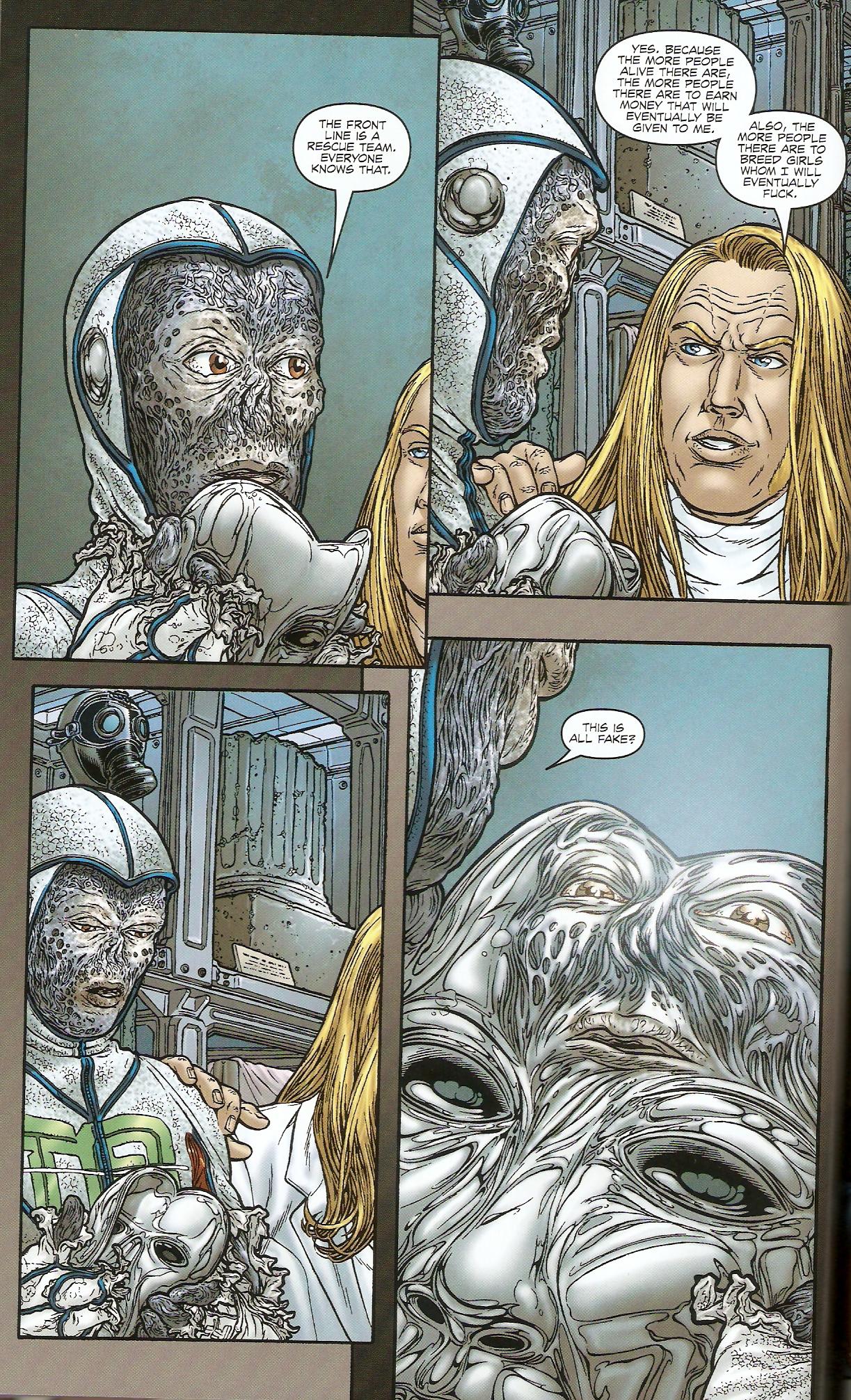
“No Hero,” was a mini-series published by Avatar comics and collected as both a trade and hardcover. It is set in an alternate universe where the world was exactly like ours until June 6th, 1966, when a man named Carrick Masterson announced he had created super humans through his discovery of a drug called FX7. The series is mostly set in the alternate present, and focuses on a superhero organization organized by Carrick called Frontline, made up of people who have taken the drug.

As the series begins, Frontline is in trouble; the heroes are getting killed off in oddly precise ways despite it supposedly being incredibly hard to kill them. To replenish their ranks, Frontline approaches a young vigilante named Joshua Carver. Carver takes the pill that makes him a hero — and at this point we get some of the most bizarre imagery ever put to paper in a superhero comic courtesy of artist Juan Jose Ryp who is really a beautiful illustrator (good enough that Marvel comics snatched him up to pencil a quite dreadful Wolverine comic).

Carver’s transformation leaves him a hideous mess. His skin is falling off to be replaced by some hard purple material and he’s become, “castrated.” Another hero named Ben/Redglare tries to comfort him but Carver starts to freak out and break everything before realizing he can do so because he has powers at which point he’s…happy. Either Carver was so desperate to achieve his ideal of a hero he was willing to sacrifice a huge aspect of it, or something else is up.

After rescuing people from a plane crash Carver is let in on the big secret, Frontline orchestrates a lot of problems and runs the world. Carrick admits that, “It does people good to have super-powered heroes. It makes them think they’re incapable of doing anything for themselves. That forms the basis of a society that’s useful to me. Yes Joshua, we do save people. It’s good for business.” For Ellis, a world with heroes is one where some jerks who are more powerful than us run everything.

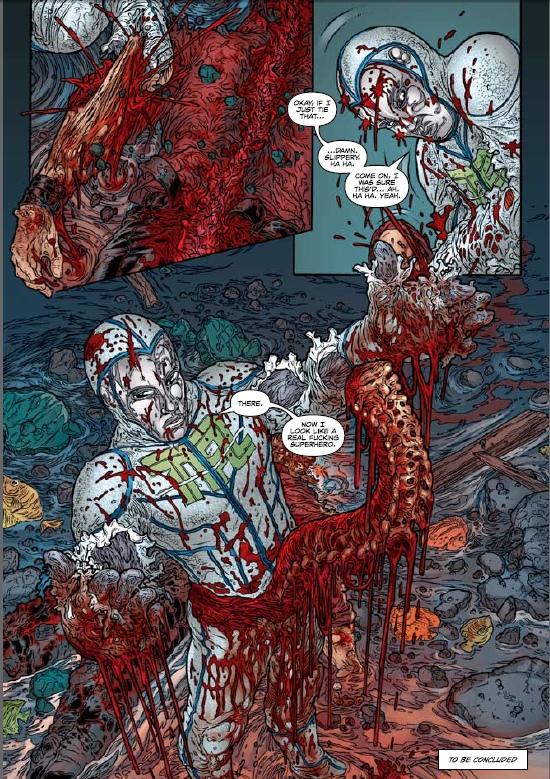
It turns out that Joshua was a plant via the US Government, and he is working with a bunch of other world agencies to take out Carrick. In depicting the conflict, the comic becomes the most gory thing I have ever read. Perhaps the high point (or low point?) of the carnage is when Joshua literally rips a man apart, takes his spine, and wears it like a strap-on penis, declaring, “Now I look like a real fucking superhero.”

We learn later on that Carver had parents who were murdered by a serial killer and he was raised by this killer before the FBI found him and made him their own personal monster used to catch other monsters. Carver became a deformed and hideous creature because FX7 shows what is inside you, and what was inside him was hideous. His serial killer father “father” was someone who did terrible sexual things to him and this resulted in Carver being incredibly sexual dysfunctional—why would he want a penis when he saw one used to do so much harm?

The advertising tagline to “No Hero” asked “How much do you want to be a super human?” The phrasing is telling; “super human”, not “super hero.” The characters here aren’t heroes. In fact, Ellis pretty much concludes that only the completely fucked up would want to be superheroes in the first place. It isn’t that super powers corrupt; it’s that only the corrupted want super powers.

The super-hero as a representation is a male ideal; strong and muscular, able to beat up the villain and save the woman all by the end of the issue (or in this era of decompressed comics, multi-issue story-arc). Yes, there are some female heroes and this formula gets switched up, but you can still look at many heroes as the perfect man—strong, smart, and able to save the day.

In some contexts (like James Bond, for example) the perfect man would have perfect bits, enabling a perfect series (and perhaps even a perfect storm) of sexual conquest . But American comics has a strangely stunted development when it comes to sexuality —its perfectly fine to show as much violence as you want, but dare show an exposed breast and you’re looking at a Marvel Max rating or Vertigo label.

In “No Hero,” Ellis suggests that the sexlessness of the super-hero is a feature, not a bug. To want to be a super-hero is to want to gain powers…and to lose your penis. Superheroes — and those who want to be superheroes — replace their sex with violence.