Tucker Stone and I are going to be doing a blog crossover hootenanny on Darko Macan
and Igor Kordey’s Soldier X. Tucker’s first post is right here. There will be more throughout the week.
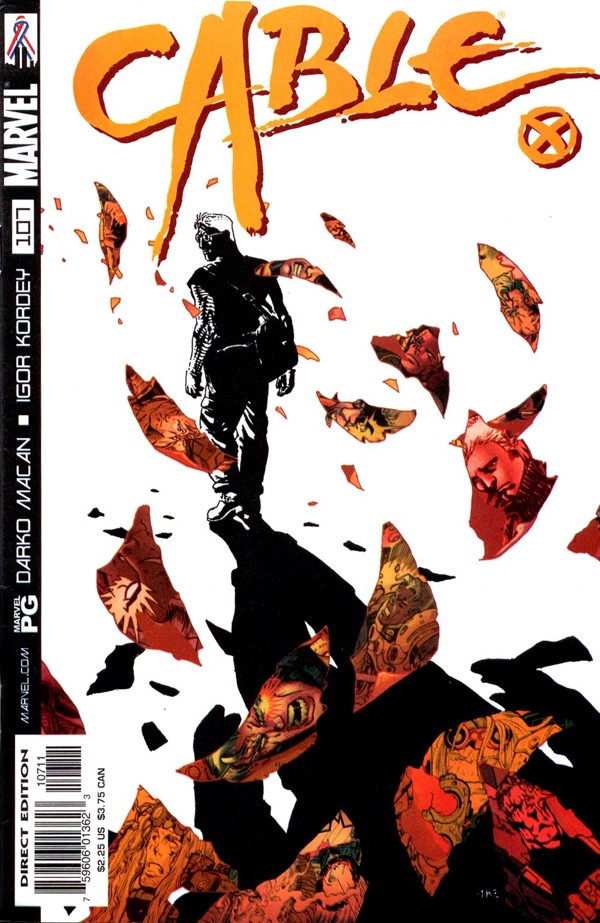

Tucker Stone and I are going to be doing a blog crossover hootenanny on Darko Macan
and Igor Kordey’s Soldier X. Tucker’s first post is right here. There will be more throughout the week.
[Contains images which are NSFW but safe for Japanese children everywhere. All images read from right to left and are taken from the Chinese reprinting of The Left Hand of God, The Right Hand of the Devil]
“Whatever is fitted in any sort to excite the ideas of pain and danger, that is to say, whatever is in any sort terrible, or is conversant about terrible objects, or operates in a manner analogous to terror, is a source of the sublime; that is, it is productive of the strongest emotion which the mind is capable of feeling. I say the strongest emotion, because I am satisfied the ideas of pain are much more powerful than those which enter on the part of pleasure.”
It is probably safe to assume that the success of the comics of Umezu Kazuo (if mostly in Japan) is predicated on the extreme violence, the lurid monsters, and the somewhat peculiar situations he gets his young characters into.
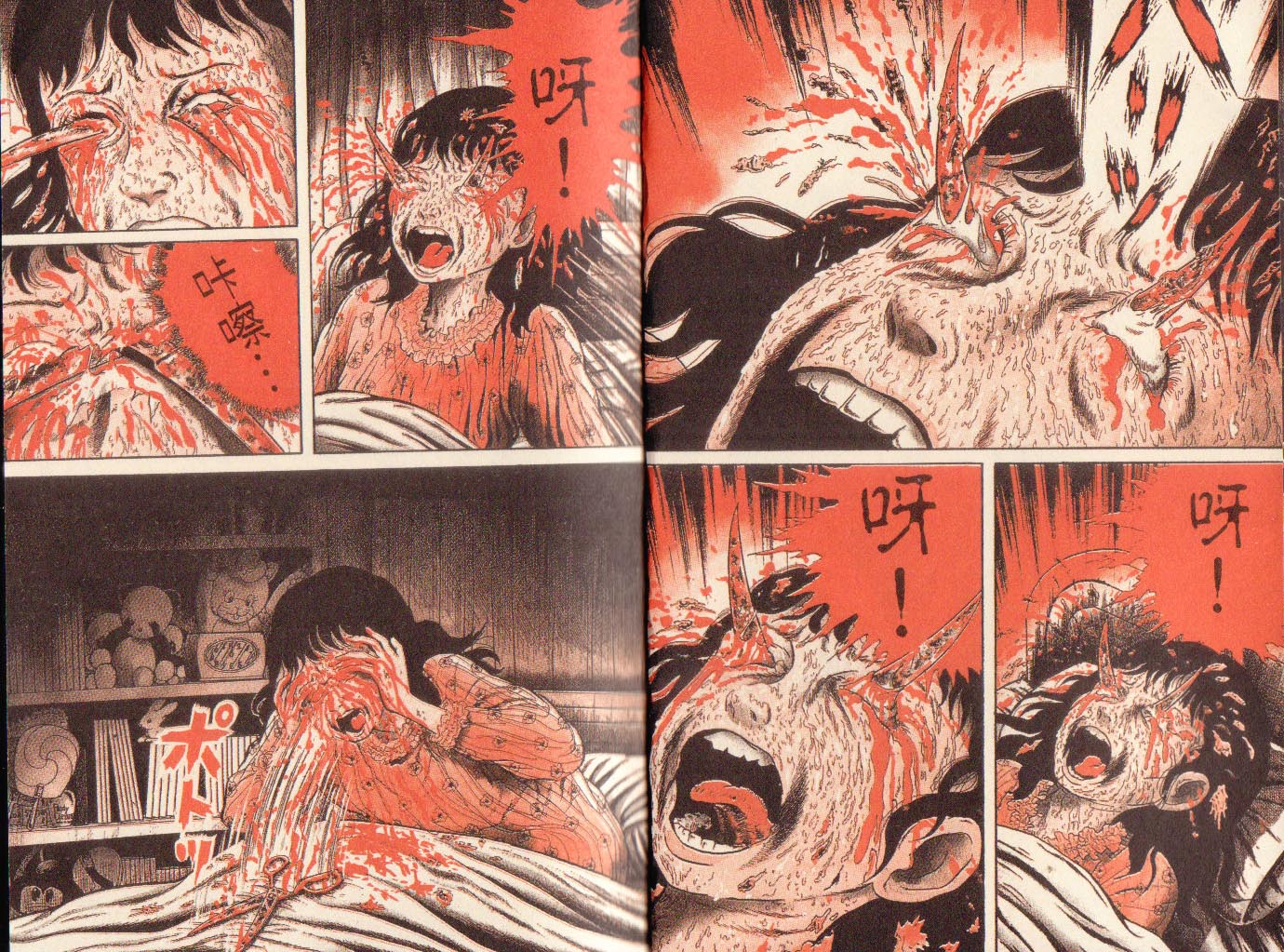
But underpinning all of this is Umezu’s deep understanding of childhood uncertainty; a child’s nagging suspicion of the “big people” who govern their world: the teacher who deserves only to be strangled…
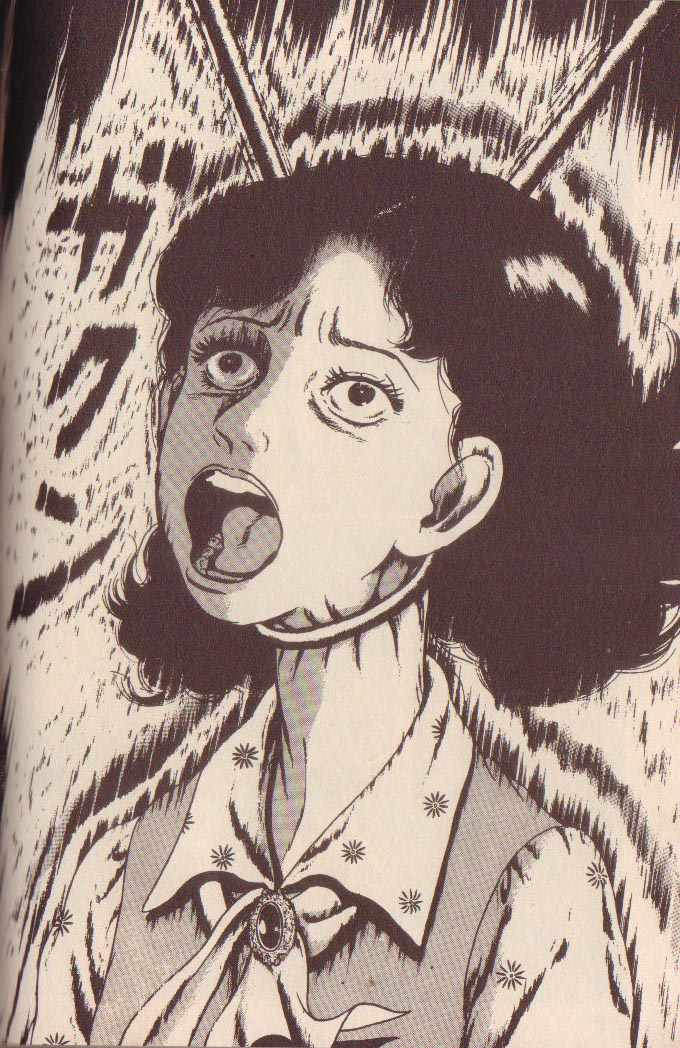
…the loathsome neighbor who waits ready to poison and defile innocence.
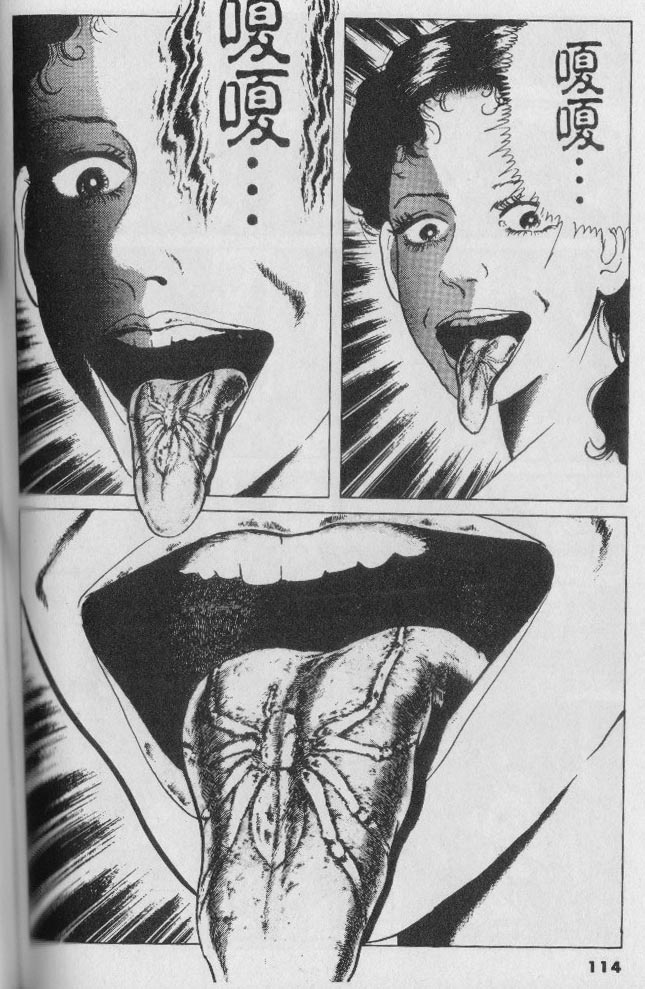
Manga like The Drifting Classroom present adults as diabolical and feeble minded beasts. If the hero’s mother seems homely and pleasant enough, she remains otherwise distant and separate, like some countermanding and occasionally comforting God; only present in the mind but never in the flesh. These adults cannot be relied upon, and we often find them debilitated and trussed up in bed. In The Left Hand of God, The Right Hand of the Devil, for instance, the protagonist’s parents lie injured and exposed to their children; together yet withheld from copulation:
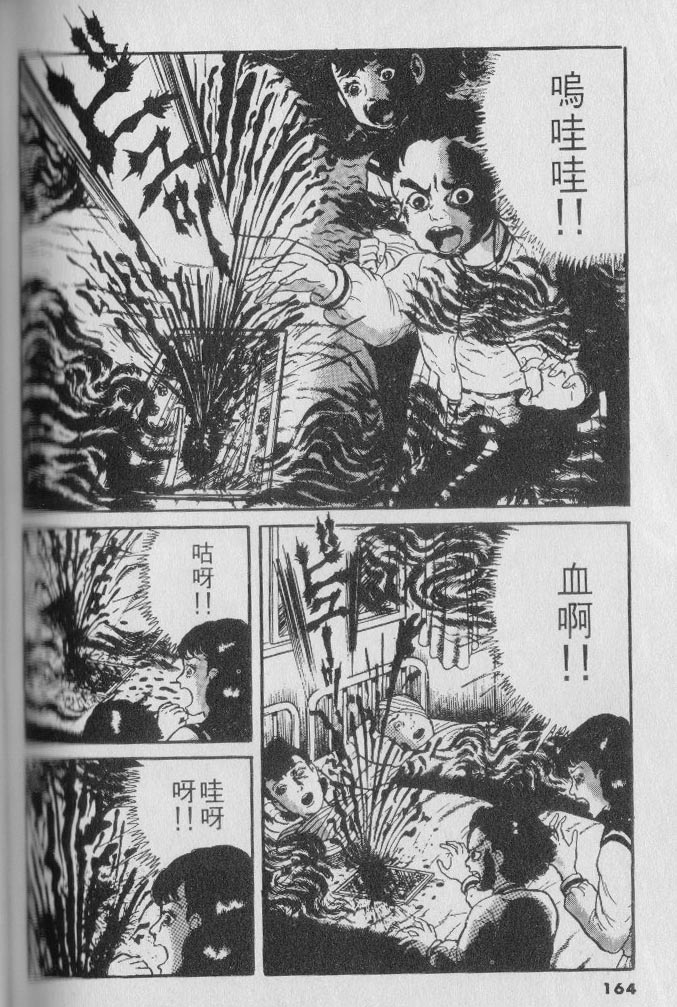
This short but vicious part of Umezu’s oeuvre is persistent in its suggestions that parents are absolute savages; far more to be feared than the demons lurking beneath a tall, oppressive bed; or behind a fence hoping to pull unsuspecting children like callow fish from the pavement.
In the first chapter of volume 4 of The Left Hand of God, The Right Hand of the Devil, a well-dressed girl rejects a ratty doll left on the pavement as bait and is allowed to pass unharmed by a lurking psychopath. A younger and less sophisticated girl shows more sympathy and retrieves the doll, cradling it with tenderness and affection. Her slow, gruesome dispatch at the end of a murderer’s hook is quite inevitable.
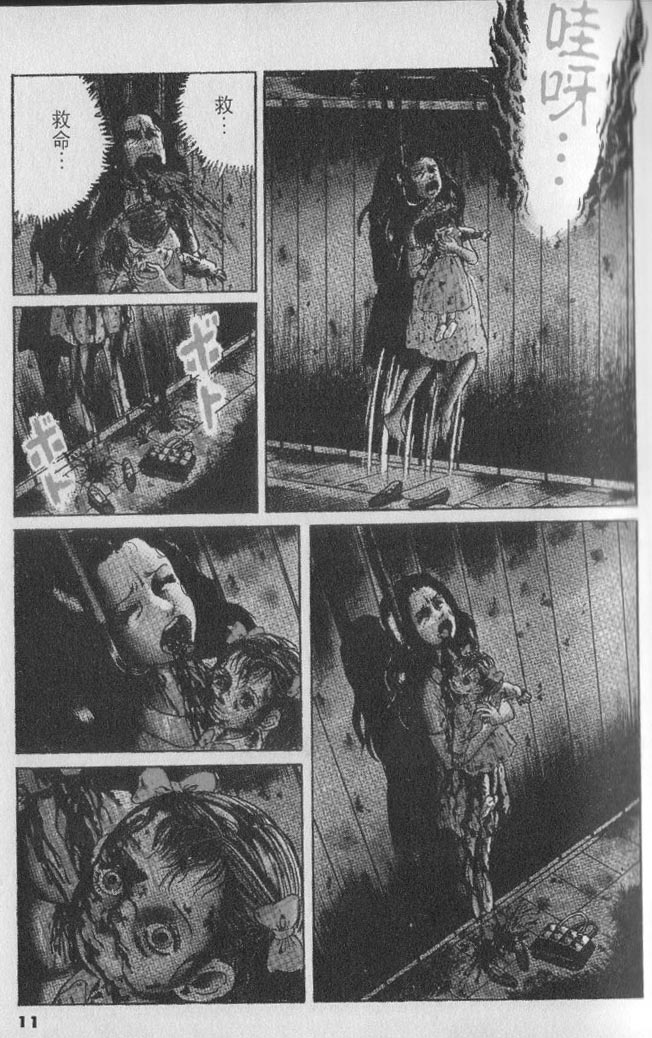
If there is a lesson to be learnt from these opening scenes, it may be that only those who cast aside childish things will be spared, the earnestly naive are annihilated or served up as dinner:
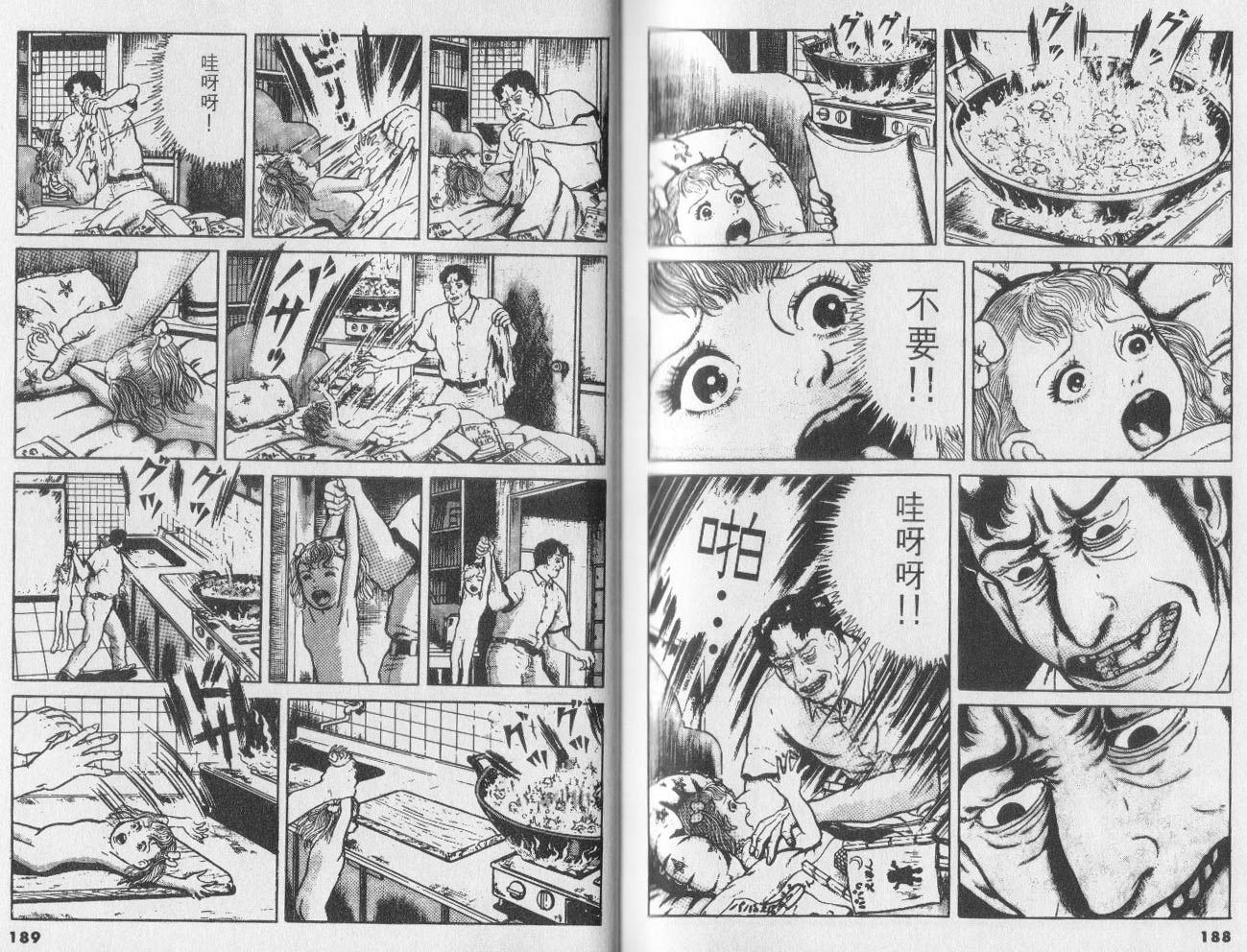
The children in Umezu’s stories are always on the edge of fear; that fear of aberrant birth and of unnatural parenting despite all evidence to the contrary — a dividend of that familiar combination of parental love and torment. These manga were once bought with money provided by their young readers’ parents; the very humans presented as being on the edge of reason in Umezu’s manga; here questioned indirectly for allowing their children access to the material in question.
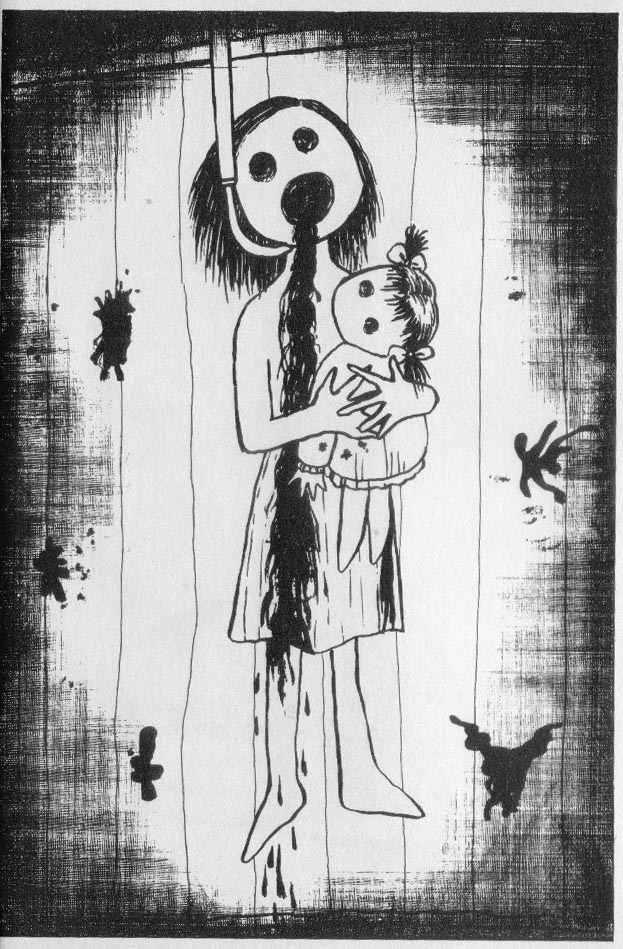
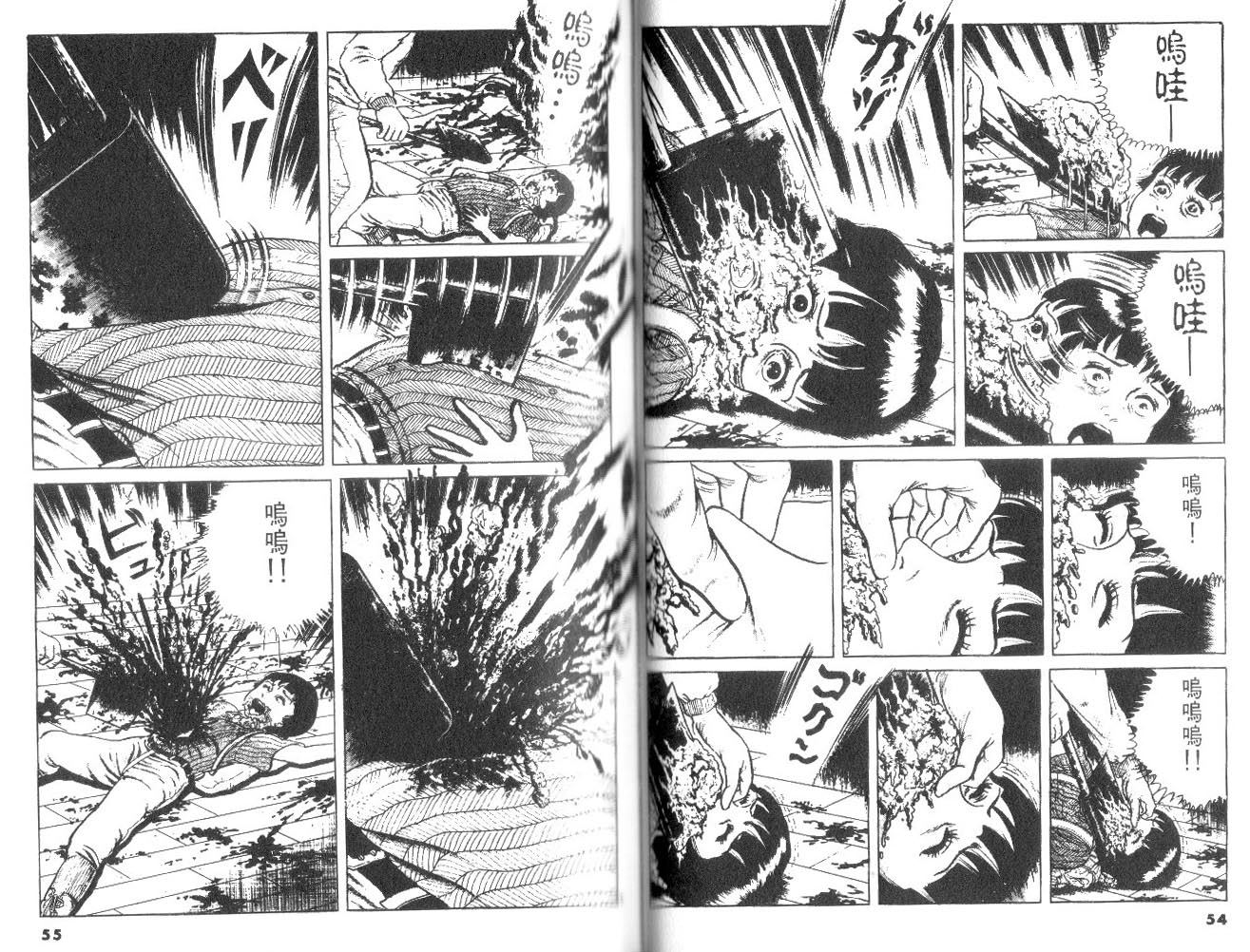
The theme of parental neglect is reiterated as we progress through this fourth volume. An episode where children are force fed blood-soaked cupcakes may seem like a morality tale on the subject of greed, but this distant memory of Hansel and Gretel is also a rebuke to parents for presenting their children with “poisoned fruit”. This attempt by Umezu to associate death with sweetness is a faint echo of the modern Japanese version of the water torture — the dripping leftovers shoveled down the victims’ tender throats till their stomachs bulge and their intestines sliced open to reveal the products of their engorgement.
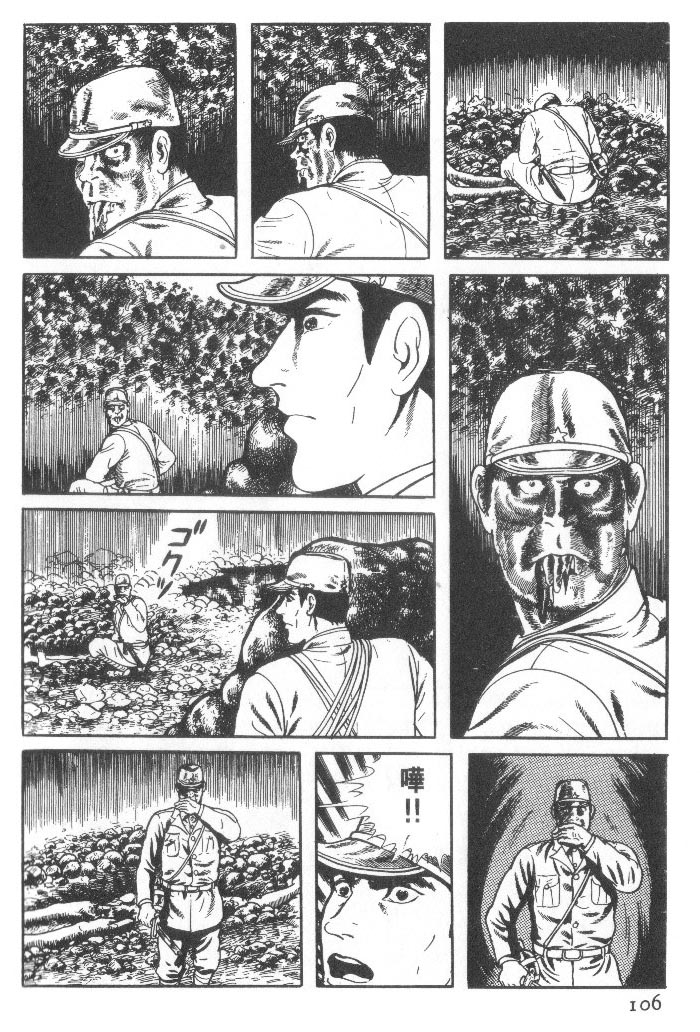
Their heads are then severed and stored as trophies — all of this deadly reminiscent of the Japanese army during their trek down and across China and Southeast Asia.
Whether all this is the product of a feverish mind or of careful planning is hard to ascertain. The lighthearted manner in which Umezu carries himself in interviews acts to deflect any criticism based upon sexual innuendo or base perversion. Sometimes though, the evidence simply cannot be ignored.
Umezu’s foray into the hypersexualized industry of child idols in the final book of The Left Hand of God, The Right Hand of the Devil has an undeviating perspective on female murder. The common or garden deaths are reserved for the men of his tale. A male medium is crushed by a crane, and the protagonist’s father knocked over the head by a falling rock.
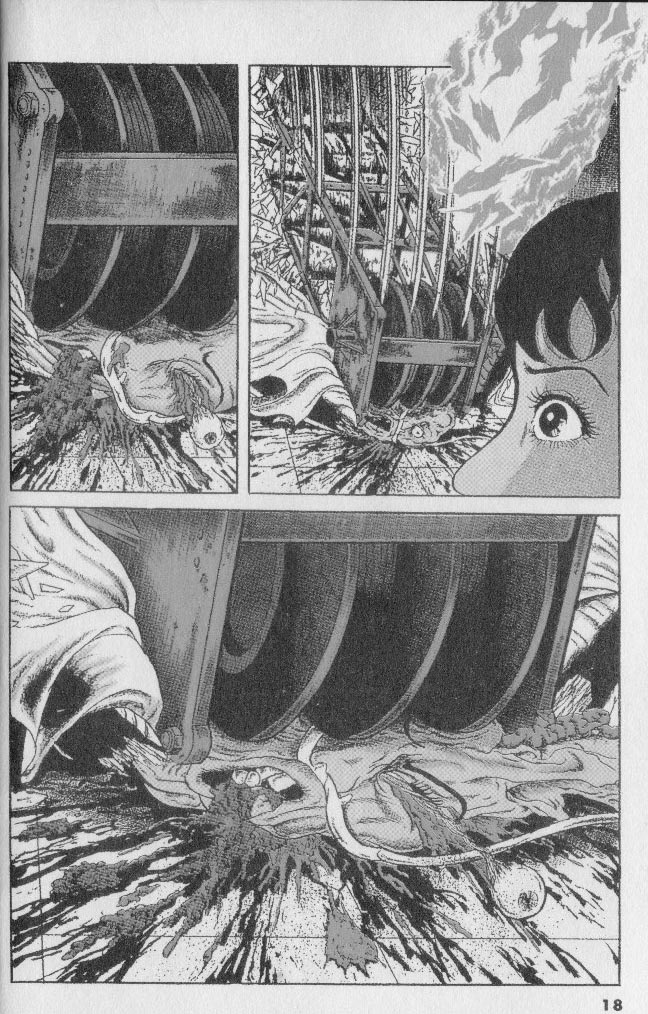
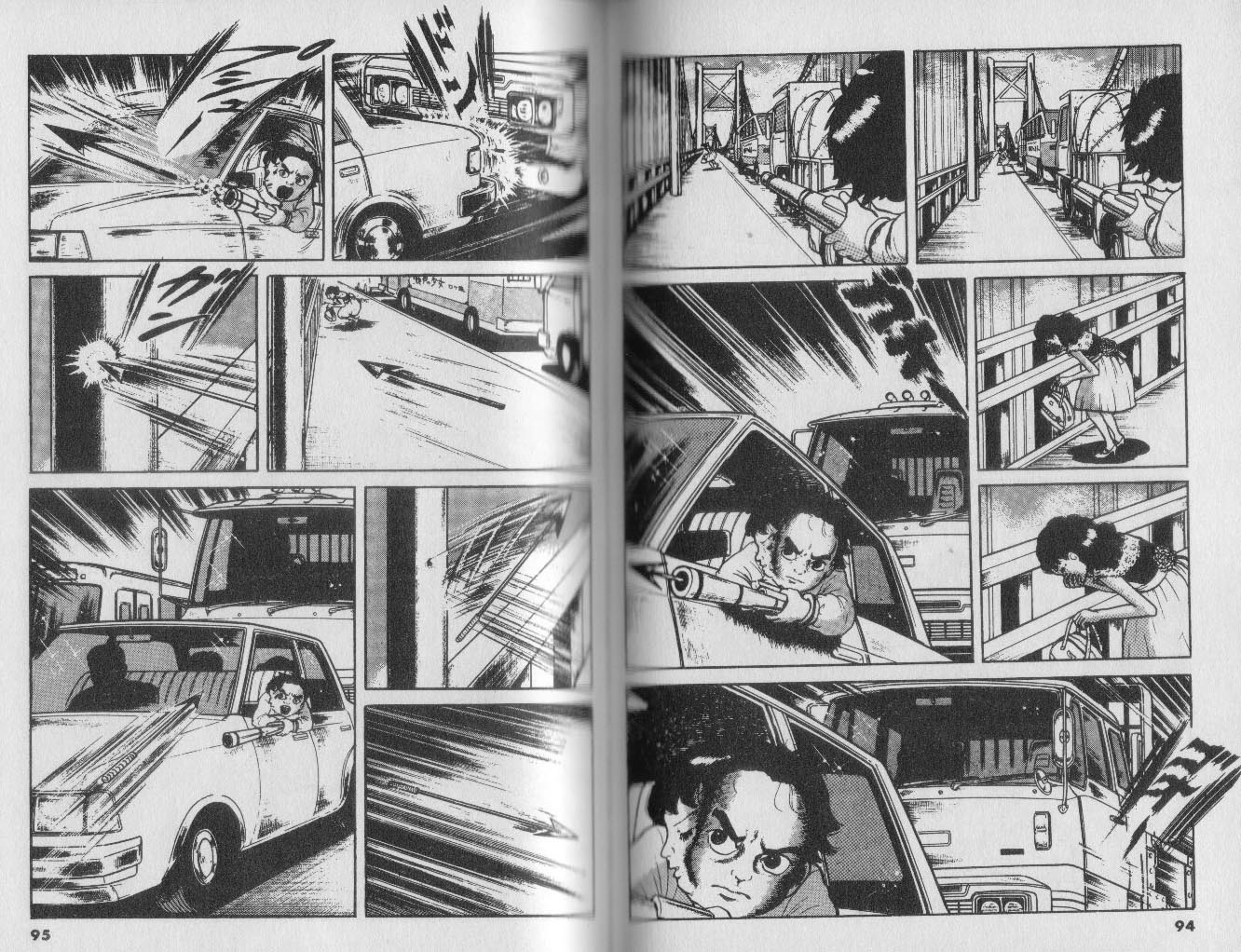
Not so the protagonist’s mother, who is accidentally pierced by a deflected harpoon during the young hero’s attempt to kill the demon possessed girl of the story.
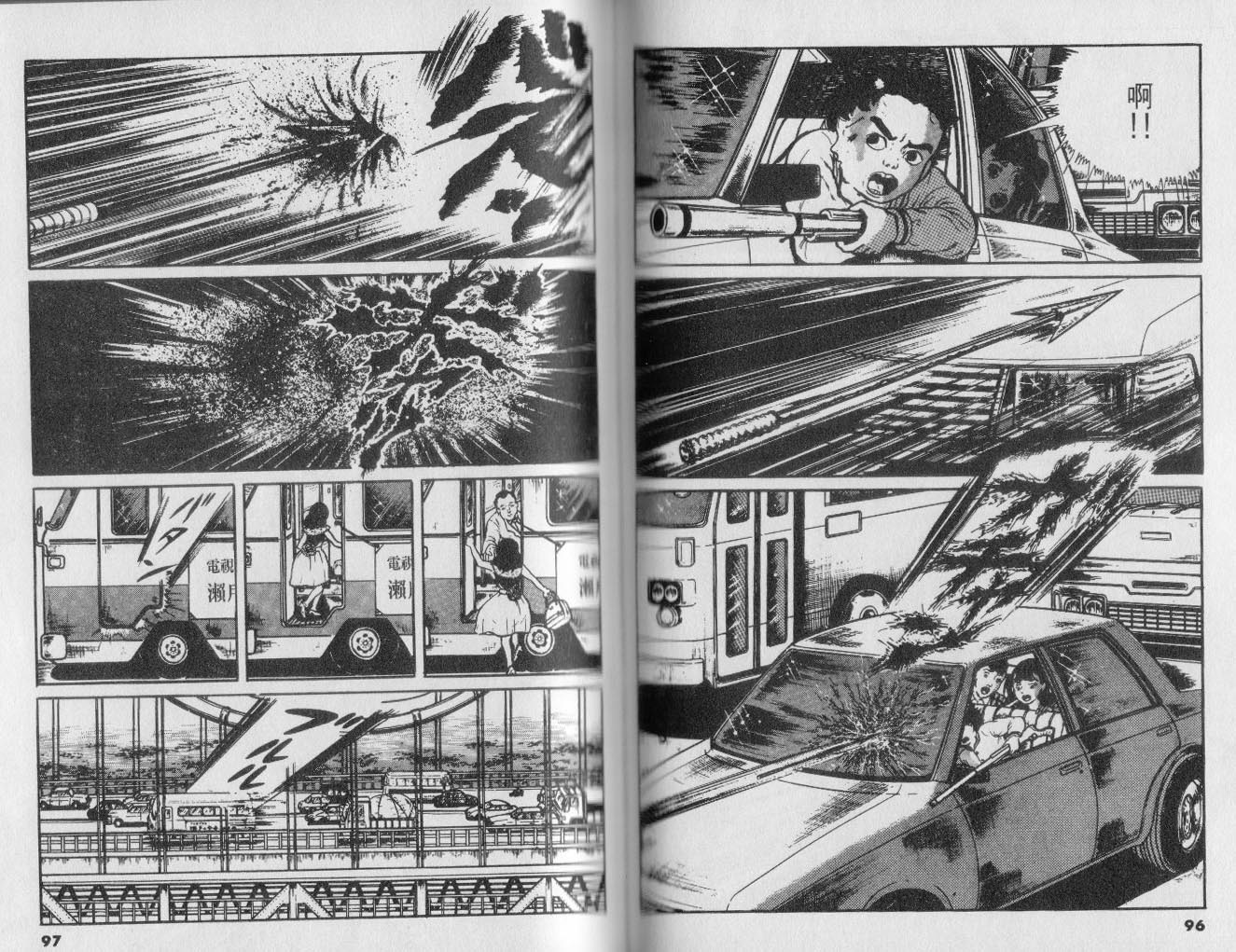
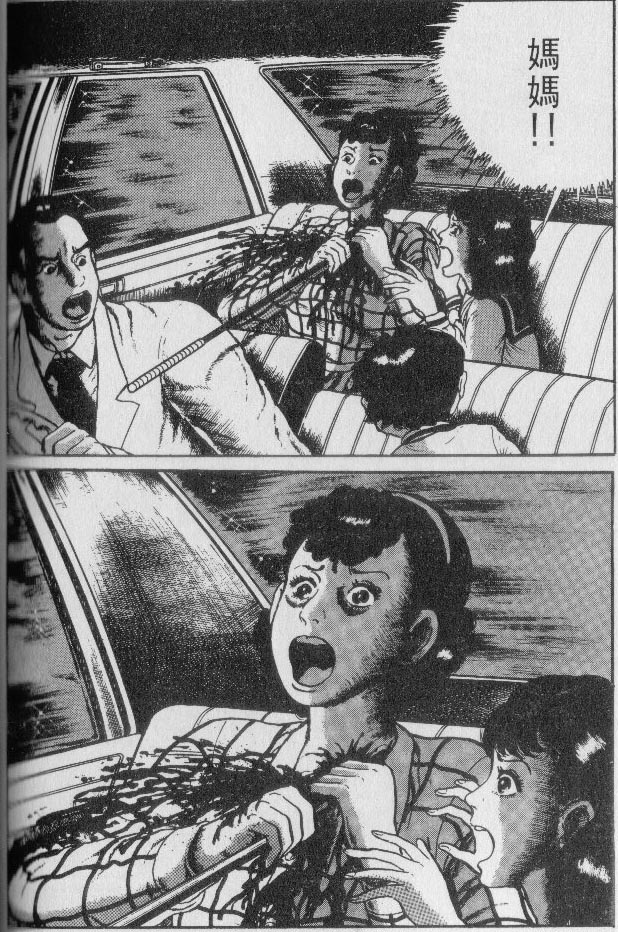
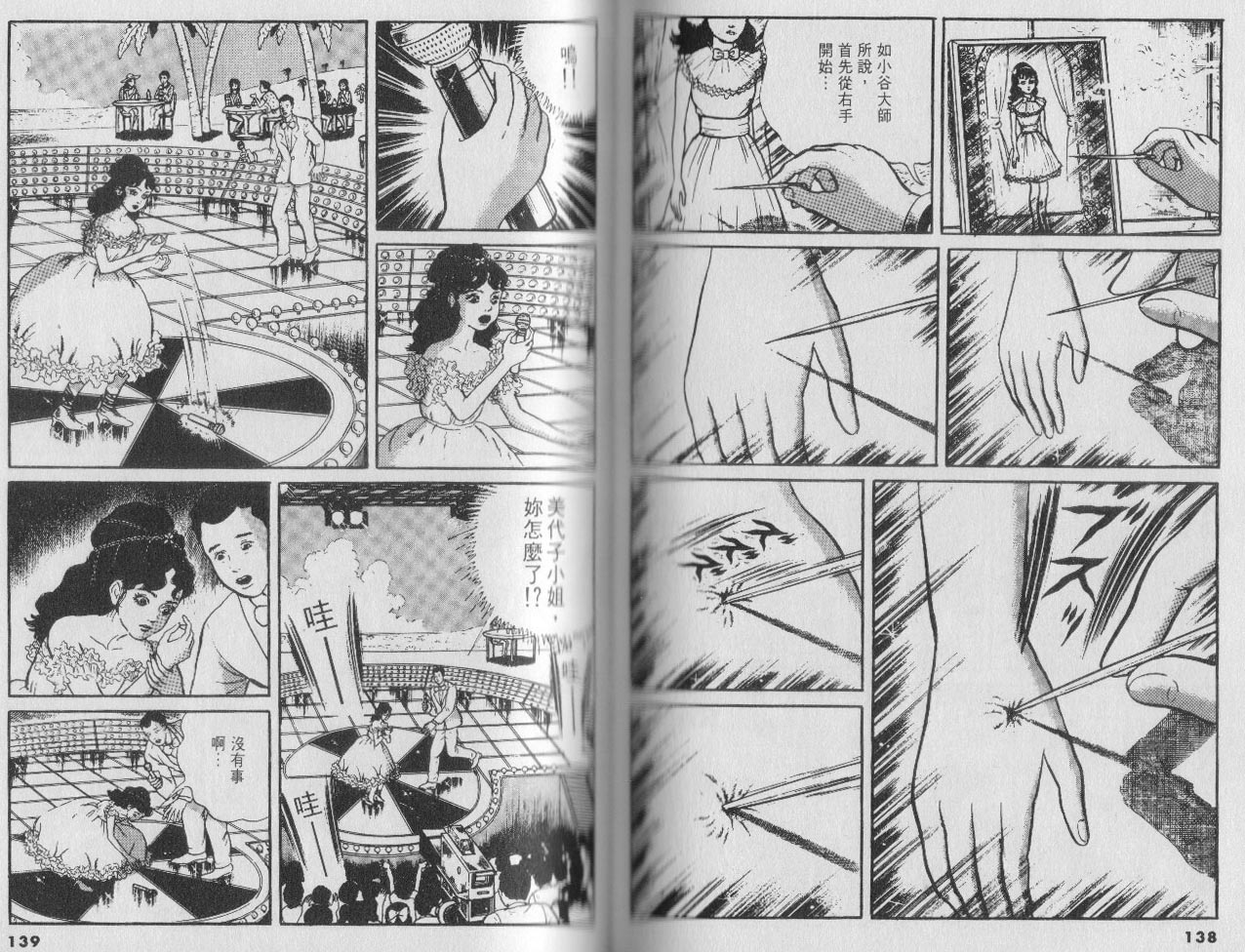
That girl is later seen introducing a hypodermic needle into the belly of a fellow idol and competitor….
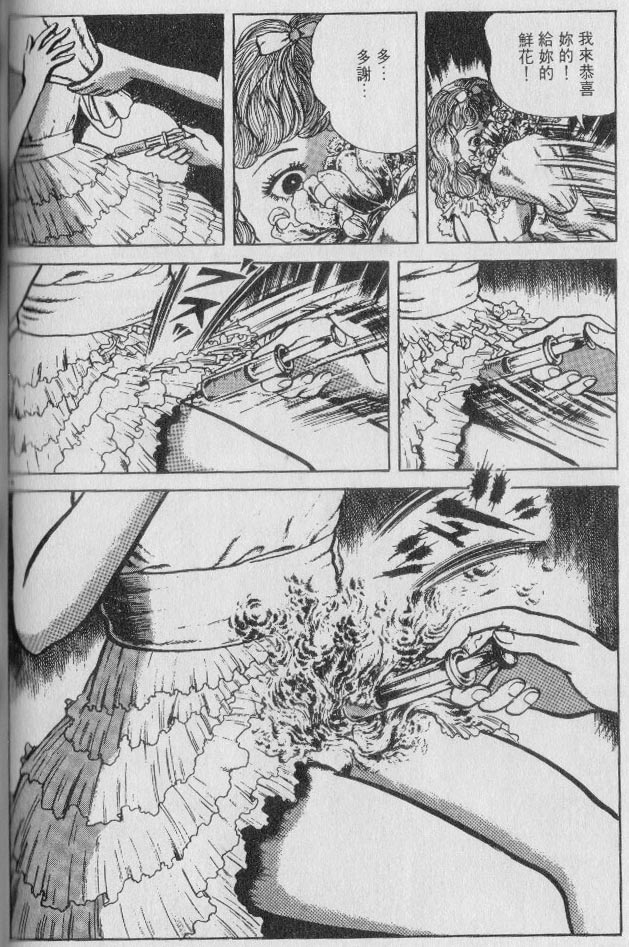
…deflowering her competitor with an acrid flow which brings corruption and a swirl of furious inking to her pubis. Here we see her doubling over in pain as she is suffused by a cramping evil; a tainted contraction.
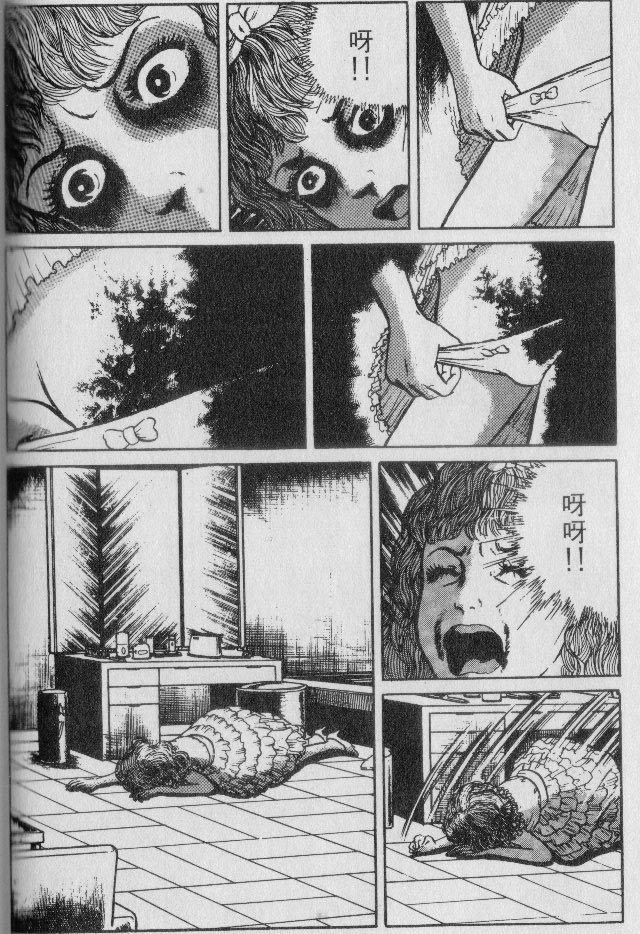
The demon girl’s comeuppance comes as she is ritually pierced with needles even as she is meeting the man of her dreams: both a ritual violation and a premonition of things to come.
When the demon is expelled from the young girl, it decides to inhabit the body of a lab monkey, that primal substitute for man now made intelligent. The drawing which it creates to the amazement of all is a vision of its master, a reflection of the author himself.
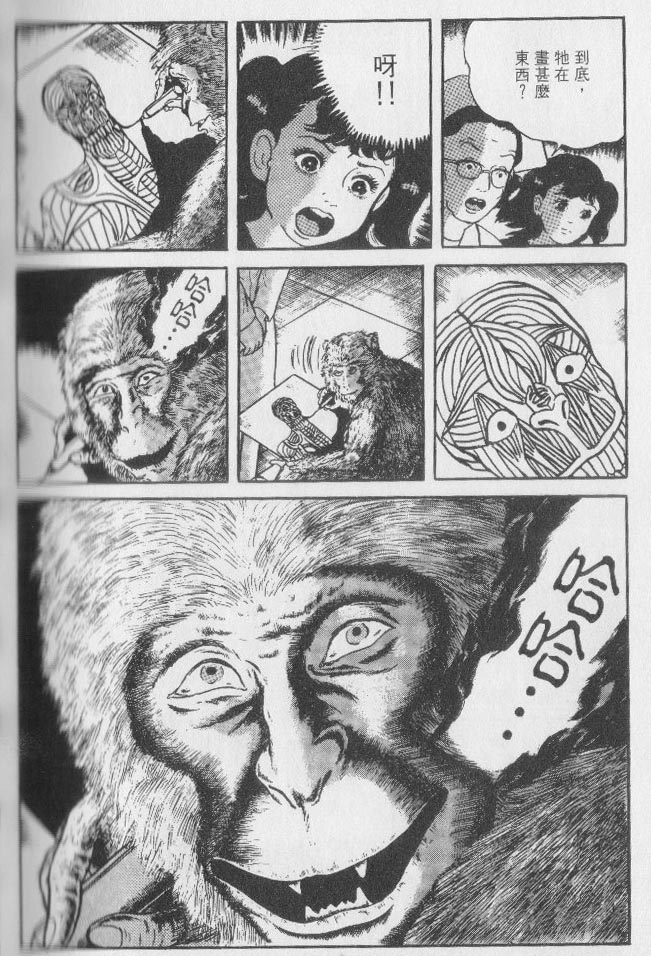
Now stripped of all pretense; the grinning apotheosis of Umezu’s views on human action, invention, and manipulation.

Photo of Umezu Kazuo
News
Next week we’ve got an exciting blog crossover event happening…and at the end of October, beginning of November we’ve got not one but two roundtables. So keep your internet pointed here, true believers!
On HU
This weeks’ Featured Archive post discusses the Amish battle against the superheroes.
We started the week out with Erica Friedman on Yamazaki Mari’s cross-cultural public bath manga Thermae Romae.
I talked about men, feminism, Die Hard and Y: The Last Man.
I discussed my mild disappointment with Bob Haney and Ramona Fradon’s Metamorpho.
I have a brief piece on Perotin, Juliana Barwick, and solipsistic oneness.
Sean Michael Robinson talks about the fallout of becoming an internet meme.
Ian Scott explains why Dave Sim’s Judenhass is a mess.
A free pop crap download mix for your listening pleasure.
And Nadim Damluji provides a survey of contemporary Arab comics.
Utilitarians Everywhere
At Splice Today I review Steven Glain’s State vs. Defense and wonder why American’s are such craven cowards.
I review the botched genre product of Colombiana.
And I discuss Amen Dunes’ latest album Through Donkey Jaws, and discuss the deadend pop avant garde legacy of the Beatles.
Other Links
Forbidden Planet on the HU best comics poll.
Alyssa Rosenberg on superheroes and marriage.
Heidi needs to switch to Green Lantern websites.
Michael Fiffe talks about indie creators and superhero work at the Factual Opinion.
The Atlantic looks at the legacy of Thelma and Louise.
At Comixology, Tucker Stone talks about the DC relaunch.

Since around 2006, the Middle East has played host to a small and steadily growing scene of locally produced comics. Distinct from the rich history of children’s comics in the region (the likes of which I have touched on in the past), this contemporary comics’ culture has seen the output of comics that are explicitly intended for an adult audience. This new crop of independent Middle Eastern comics spans familiar western formats such as graphic novels, monthly issues, and anthologies, while addressing topics ranging from religion to politics to sex. The survey I’ve compiled here is not complete, but it is a start at cataloguing the wonderful dialogue that is happening right now with comic art in the Arab world. My hope is that what follows can serve as a space for others to add to, comment on, and maybe encourage some space shaving on bookshelves.
Lebanon:
Samandal (2007 – Present)
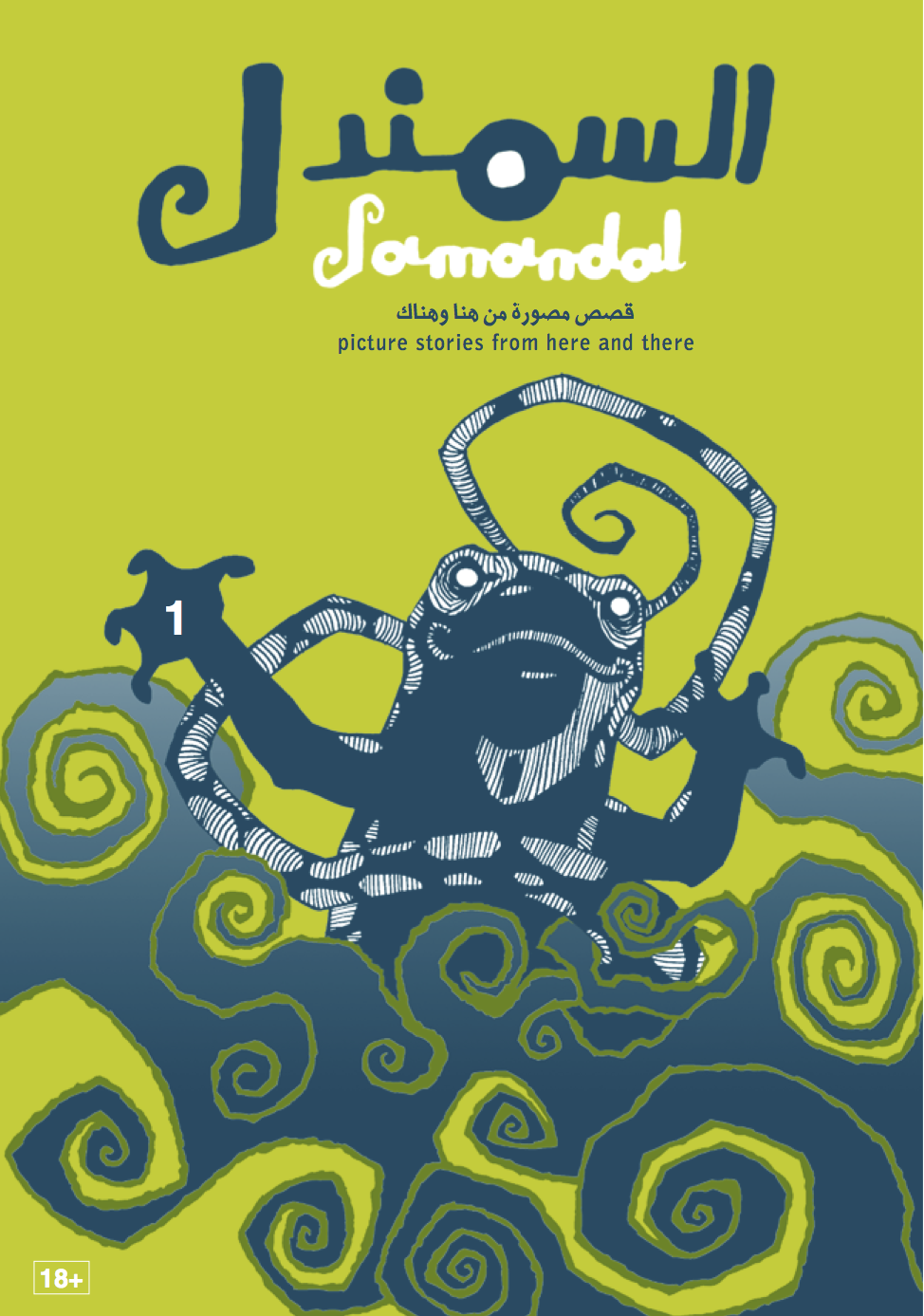
Creators/Editors: Omar Khouri, Tarek Nabaa, Hatem Imam, Lena Merhej, and Fadi Baki (as Fdz Bx)
Website: http://www.samandal.org/
About: If there is a ground zero for this recent wave of Arab comics than Samandal marks the spot. Samandal started in 2006 as a fully-realized and fully-packed comics’ magazine for “picture stories from here and there.” Each subsequent issue — currently up to 11 — has been a sizable collection of comics from local artists in all three of Lebanon’s official languages (Arabic, French, and English). The quality varies, but Samandal at its best features comics that are better than many of its global counterparts. It’s hard not to be excited when reading an issue of Samandal: at its core it is a comics’ anthology that captures the vibrancy and complexity of the country which it was created in. It is no surprise this successful DIY effort has since inspired so many others in the country and region to take a stab at making comics.
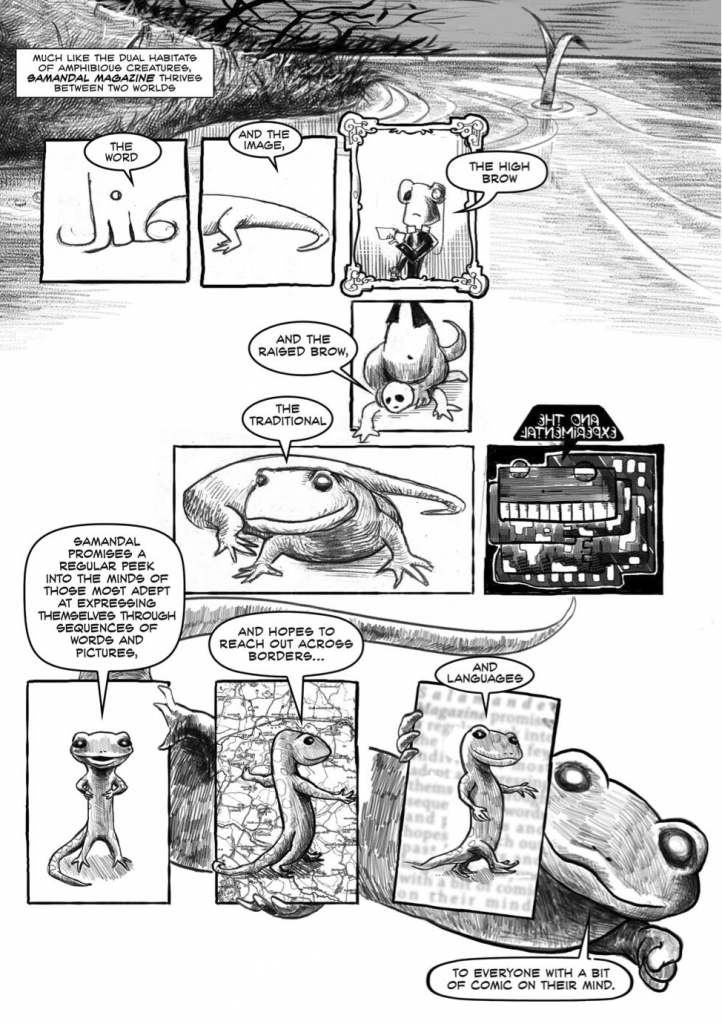 In the premier issue the staff offers an answer to “What is Samandal?”
Supplementary Links:
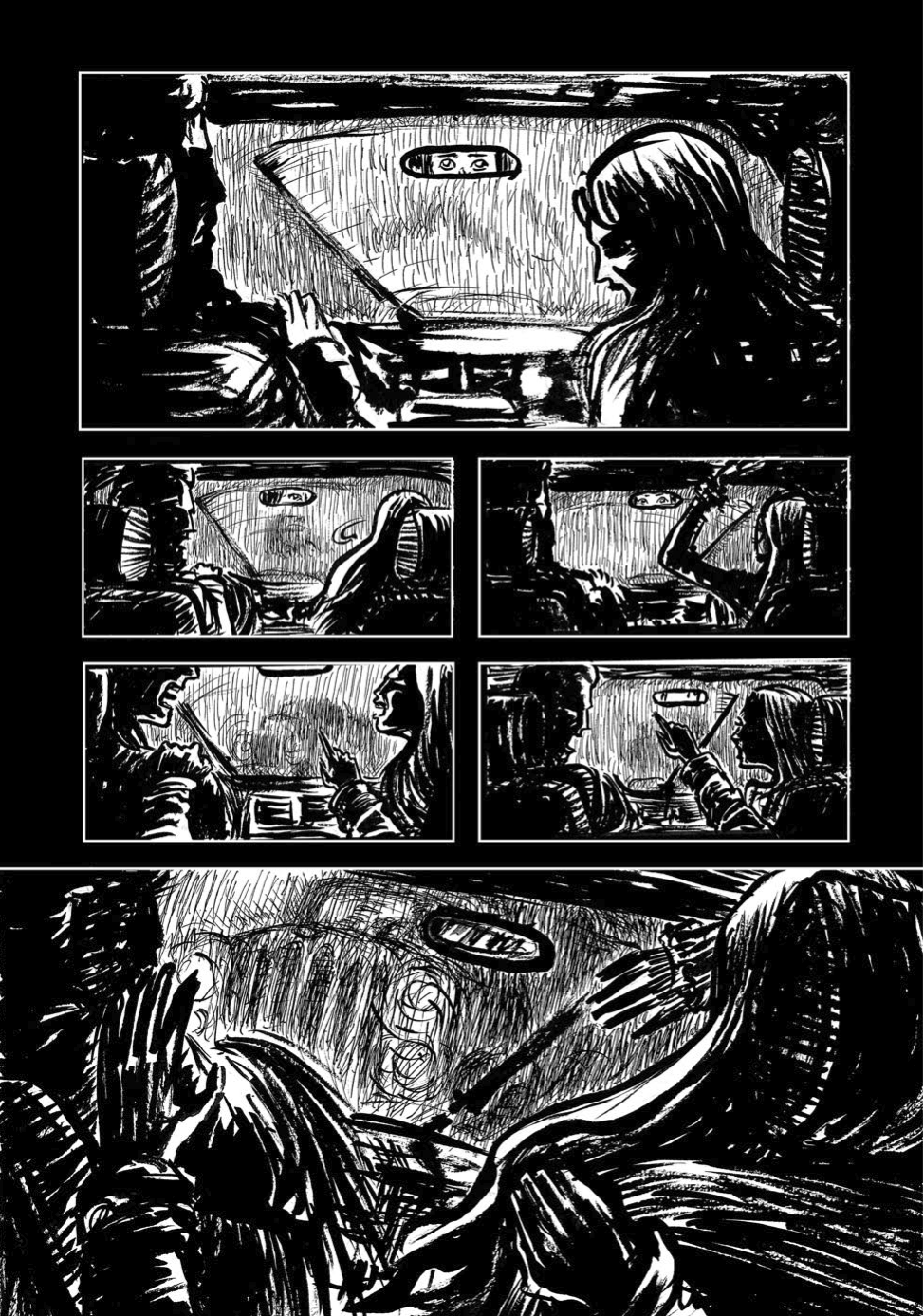
A page from co-founder Omar Khouri’s “Salon Tarek el Khurafi” in Issue One
The Educator (2007-2010)
Creator: Fouad Mezher
Website: http://fouadmezher.blogspot.com/
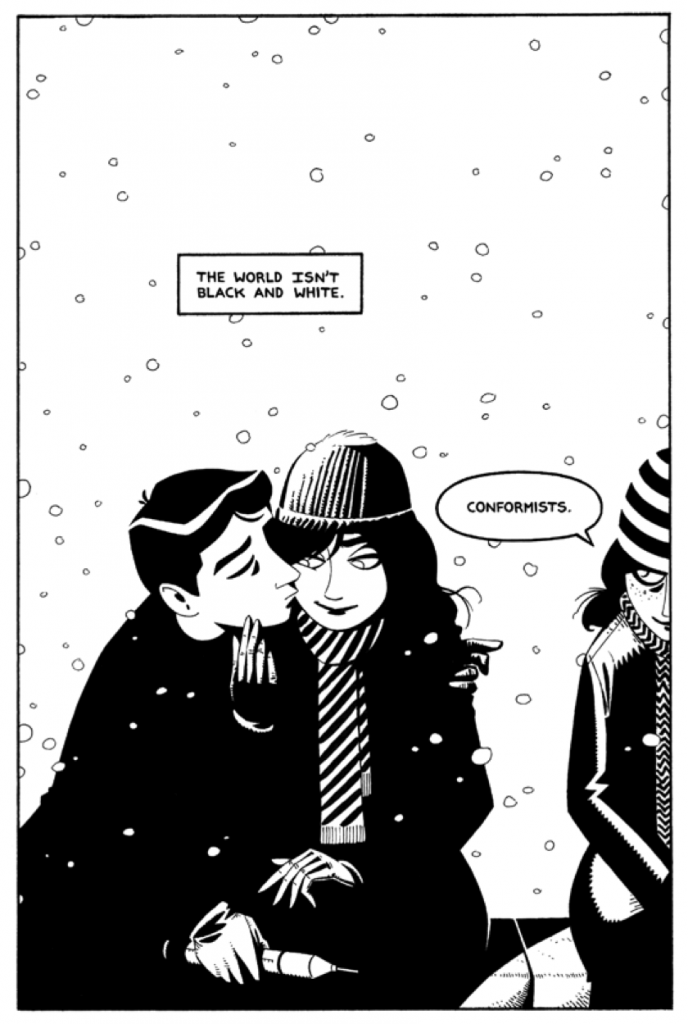
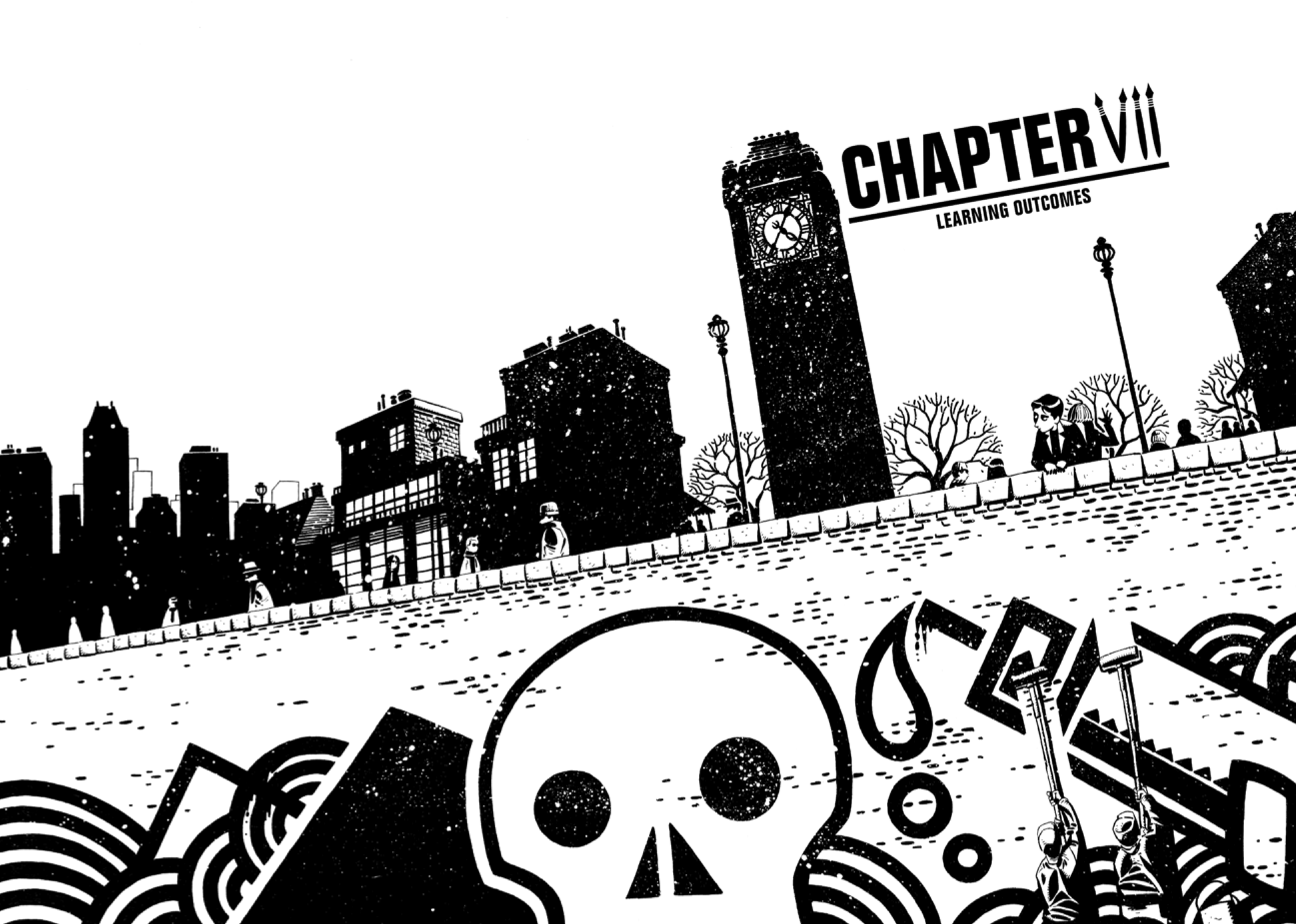
About: The best longer form comic to emerge from the depths of Samandal is the work of Fouad Mezher in The Educator. The story of how straight-laced John Fawkes finds love and a cause in the backdrop of a totalitarian academy seams simple enough at first blush (ha) but one of Mezher’s greatest talents is embedding a seemingly straightforward action comic with commentary about Lebanese politics. Put differently, imagine if Vertigo knew how to do subtlety and refrain from being overly-preachy and you would have something resembling The Educator. This charming (and violent!) comic is also notable for using the high contrast black-and-white approach masterfully for capturing the pseudo-Lebanese landscape.
Mezher’s follow up to The Educator, a comic about an Arab-American girl who becomes a superhero called Enigma, is currently one chapter in and looks like an extradroadinarly promising follow-up.
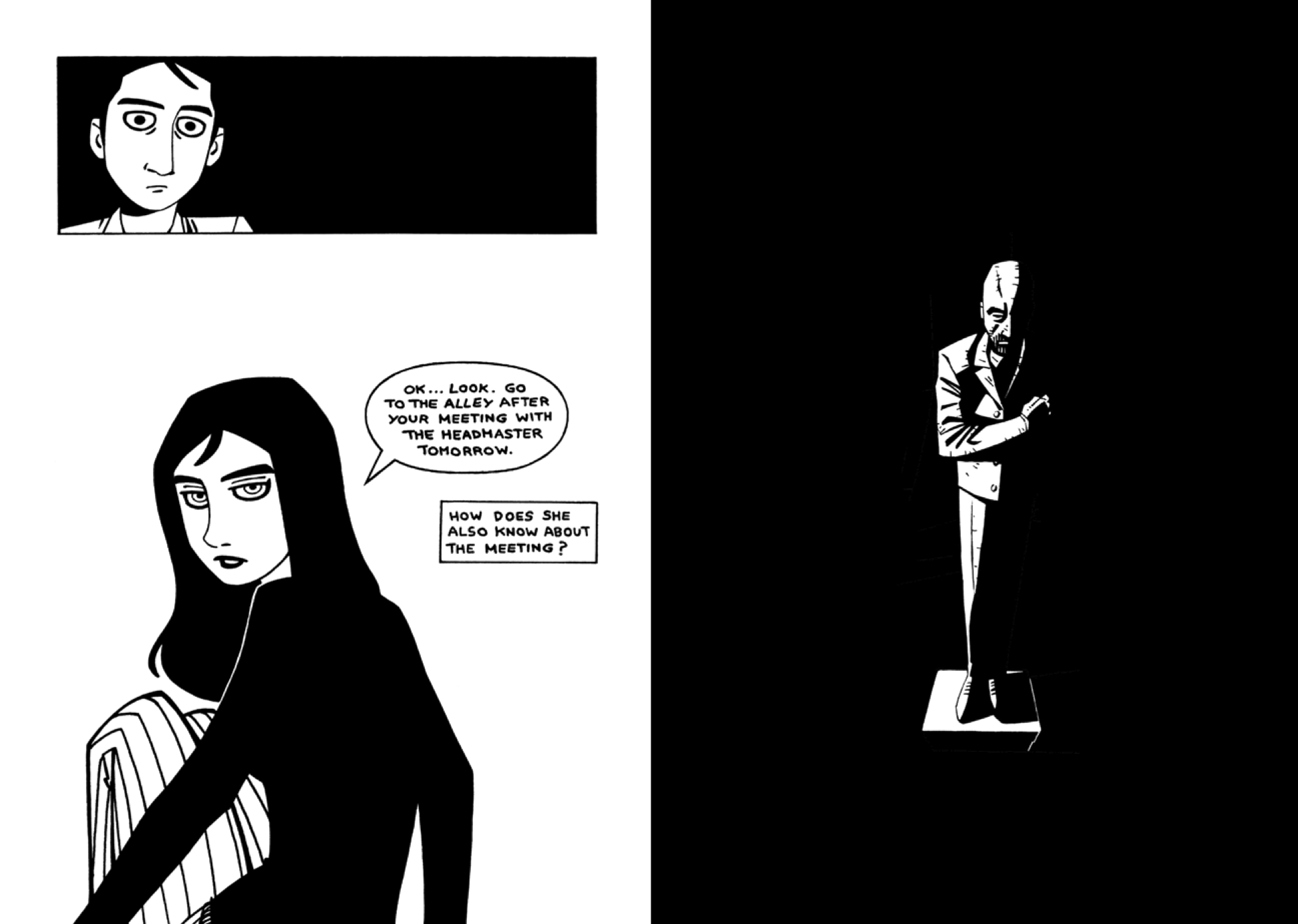
More black-and-white goodness from The Educator.
Malaak, Angel of Peace (2006 – Present)
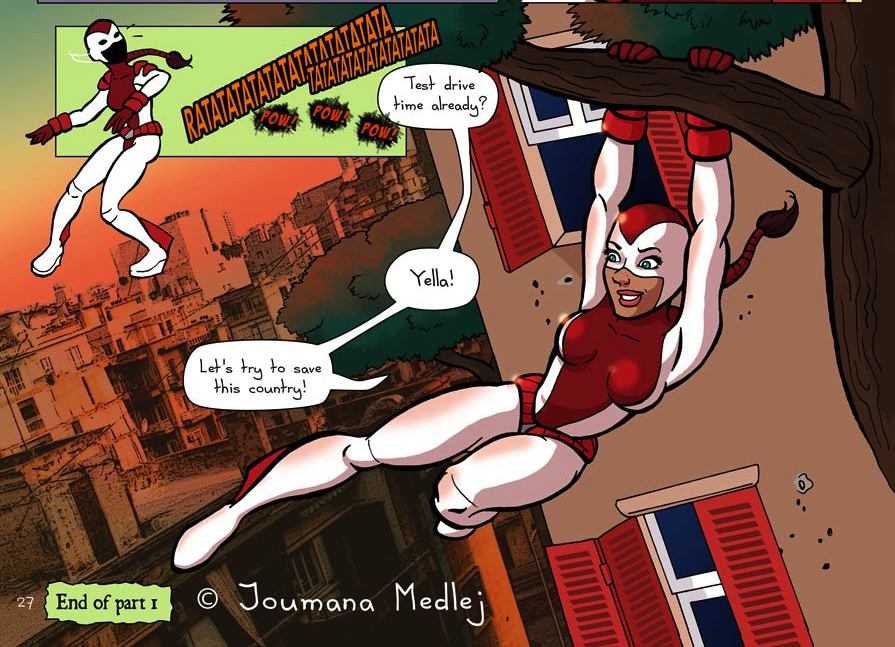
Creator: Joumana Medlej
Website: http://www.malaakonline.com/index.html
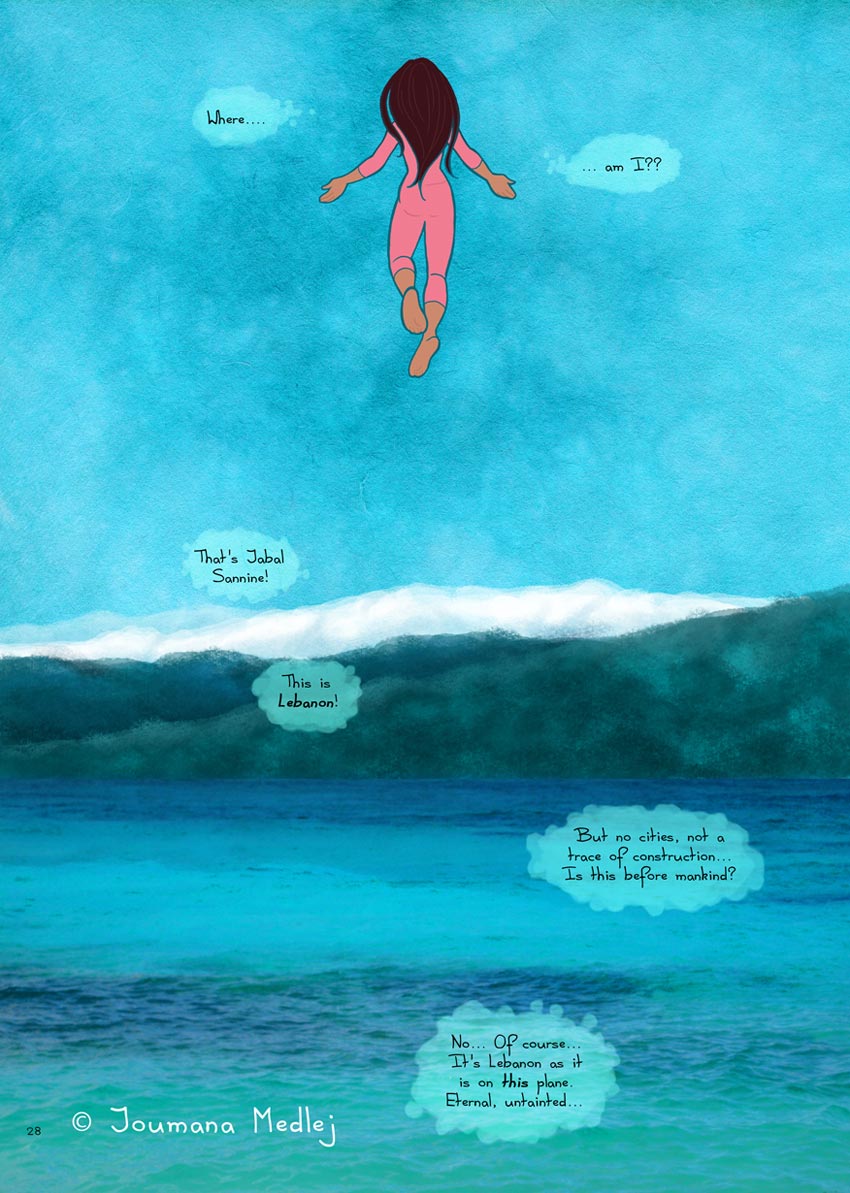
About: Malaak: Angel of Peace is a prime example of how Arab artists are using a long-established medium to convey a very different kind of message. I’m not usually crazy about superhero comics, but then again superhero comics aren’t usually about measuring the human cost of sectarian violence. As a fellow Lebanese who is discouraged by the political bickering of the country (and region) almost always, it is nice to read Medlej’s clever response to inflammatory rhetoric in the form a superhero who champions the people. In my opinion, the series (currently in its fifth volume and all available for free online) greatest success is the way in which Medlej wonderfully captures Beirut in her pages. From the backgrounds to the people to the dialogue, this is a comic with a distinct point of view from an author who is a keen observer of her surroundings.
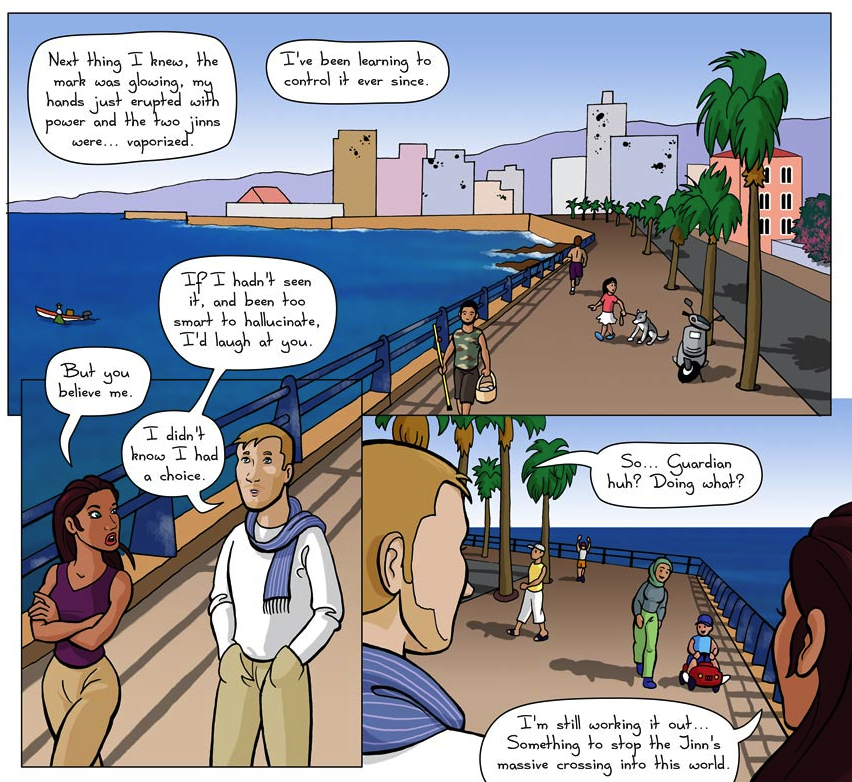
Also, it needs to be mentioned that Malaak is pretty great at fighting.
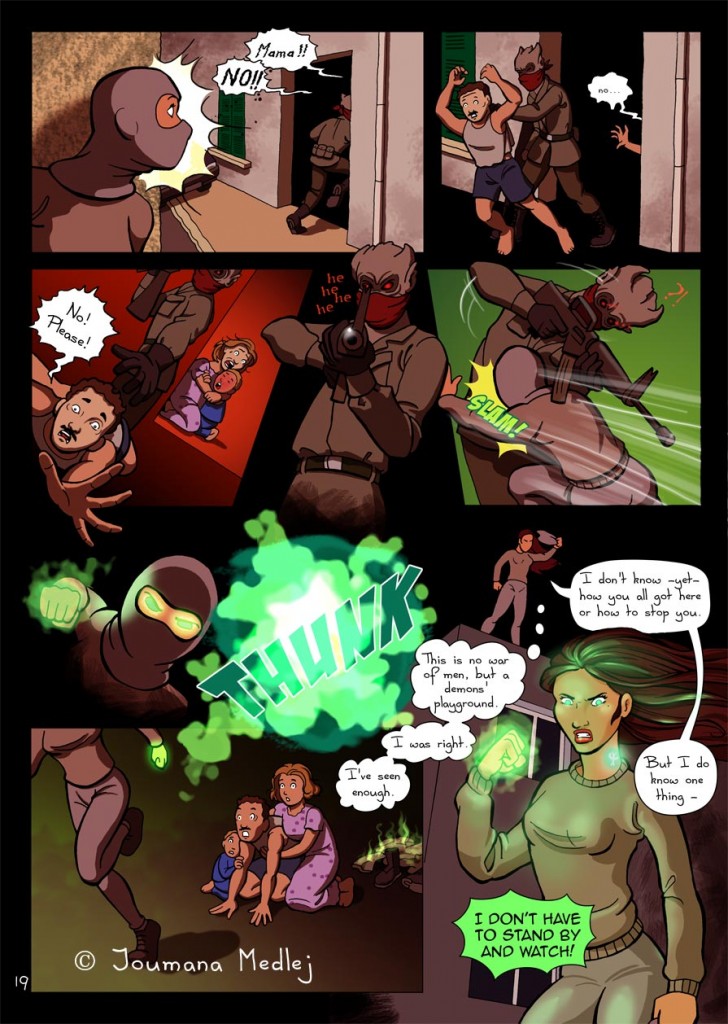
As a parting thought I feel comfortable recommending Malaak based solely on the sublime and beautifully executed dream sequences. Proof:
Supplementary Links:
Mazen Kerbaj
Websites: http://mazenkerblog.blogspot.com/ and http://www.flickr.com/photos/kerbaj
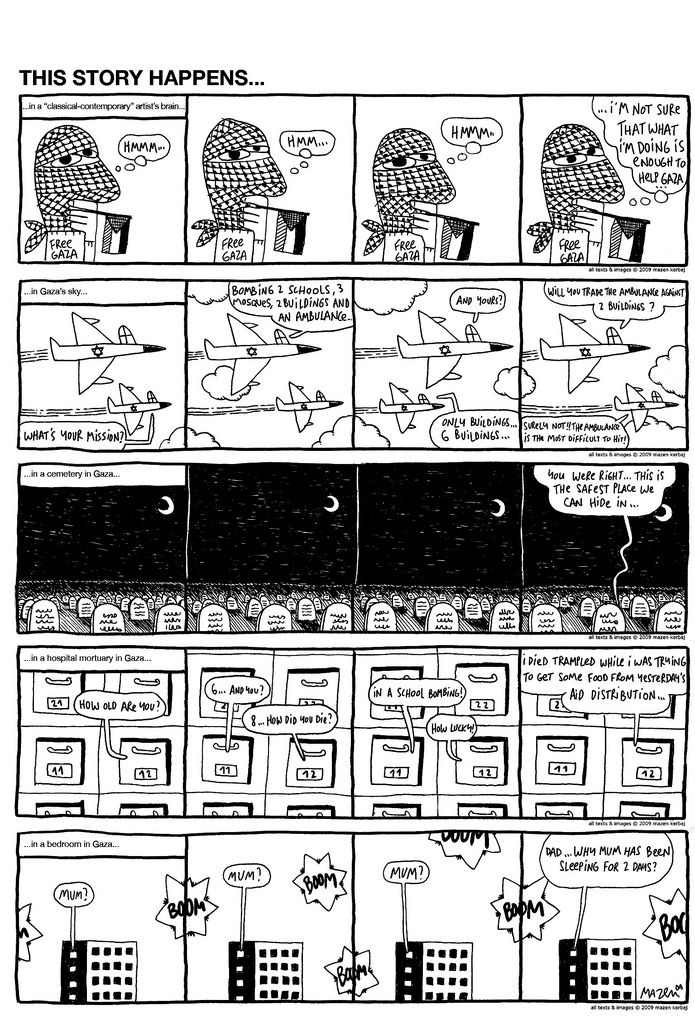
About: You can’t really talk about Arab comics without talking about Mazen Kerbaj. Although he hasn’t produced a proper collection of comics to my knowledge, he has been an active practitioner since at least 2000. Kerbaj’s comics skew towards the political (above, obviously) as he bridges the gap between the older generation of Middle Eastern political cartoonists (dating back to 1920s) and the newer Samandal-influenced crop. I find his straightforward approach to comics to be highly effective, almost like a millennial Handala.
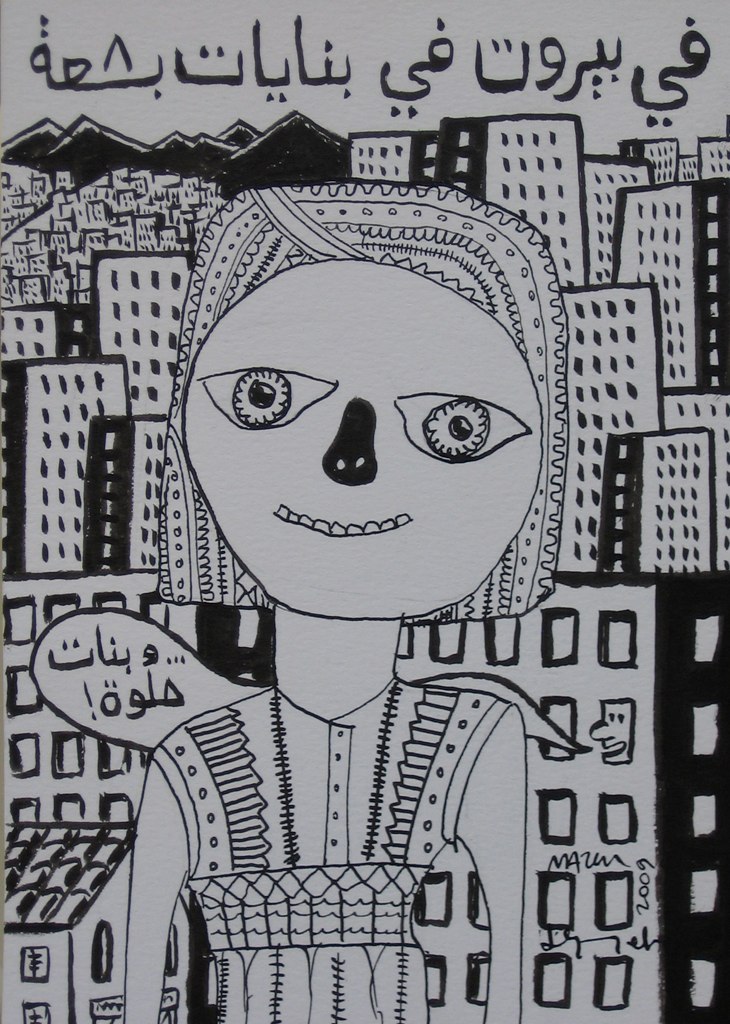 Translation: In Beirut there are ugly buildings, and beautiful women! (It’s funny because those words are similar in Arabic. And because it’s true.)
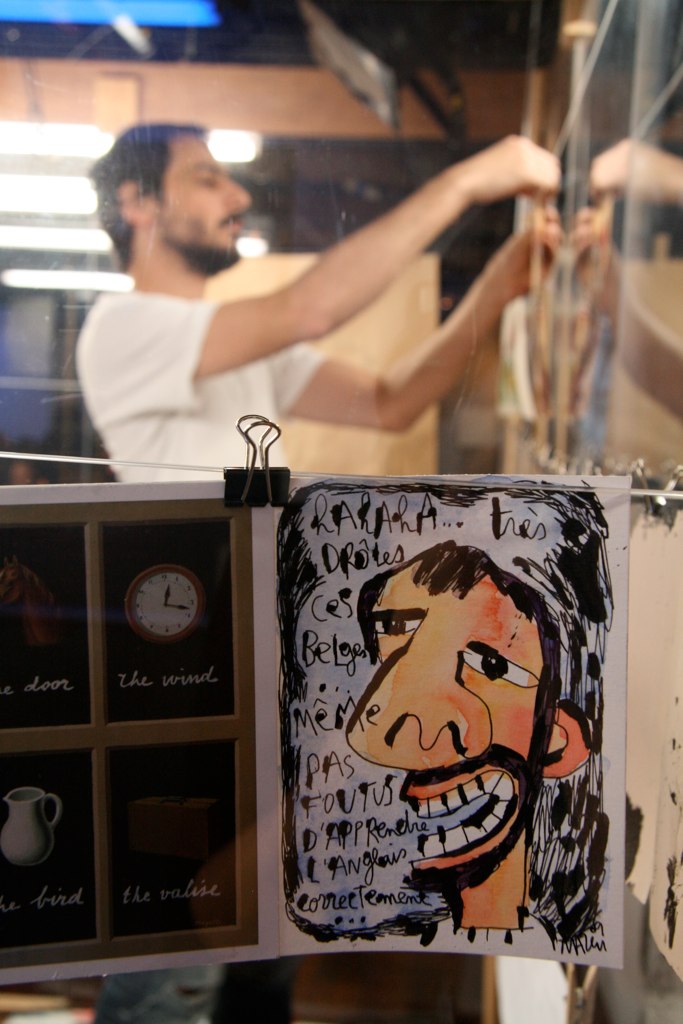
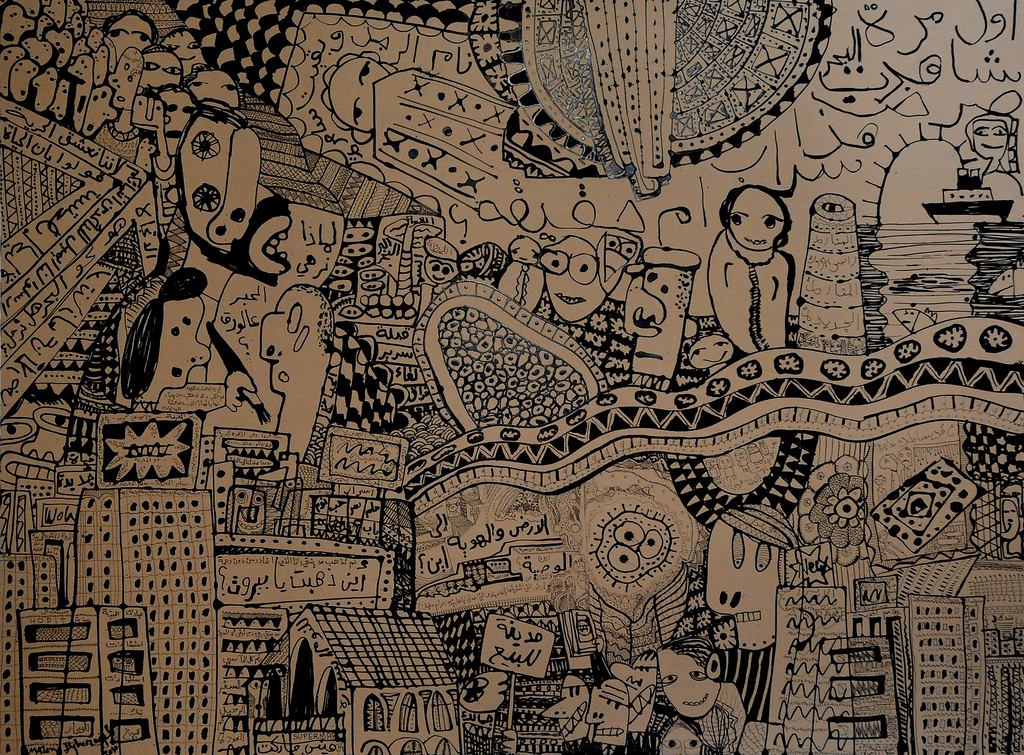 All Photos From Kerbaj’s extensive Flickr Feed.
Egypt:
Metro (2008)
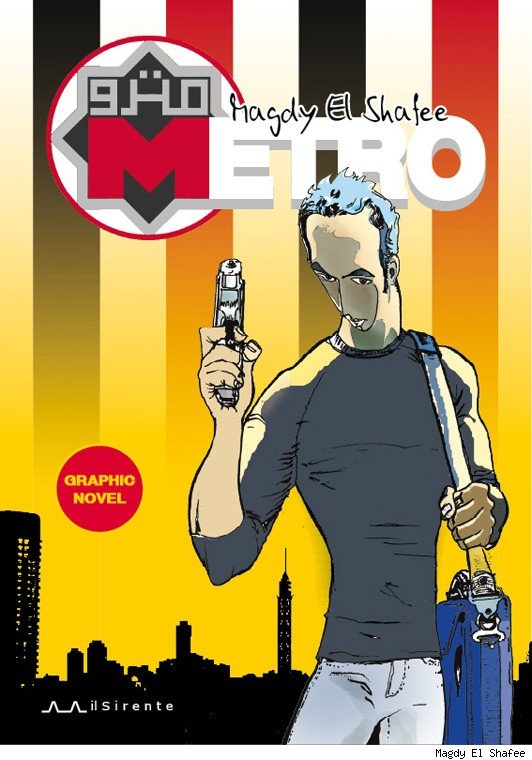
Creator: Magdy El-Shafee
Publisher: Mohamed El-Sharkawi
Website: http://www.magdycomics.com/
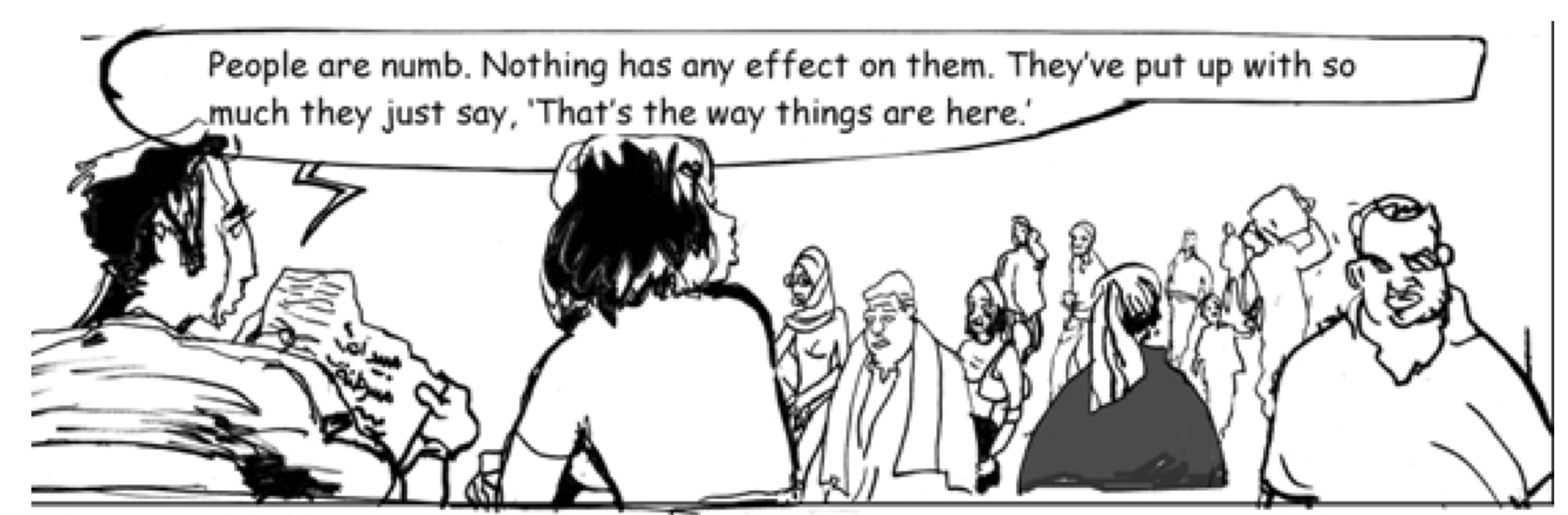
About: Because of the recent media attention Magdy El-Shafee’s Metro has garnered, you may already know about this comic that was published in Arabic by El-Malameh Publishing House. Billed as “the first Arabic graphic novel,” Metro tells the story of a young software designer named Shihab who decides to rob a bank in order to pay back a massive amount of debt he owes corrupt officials. The comic paints a scathing portrait of Mubarak-era Egypt (known for last the thirty years as “Egypt”) where all police are corrupt and Egyptians themselves are too complacent to change anything. It should come as no surprise then that during the era of Mubarak’s police state control this revolution-friendly comic was banned soon after its release. El-Shafee and El-Sharkawi were slapped with fines for “distributing graphic pornography” (there is a sex scene in the comic), but not before police raided and confiscated the majority of El-Sharkawi’s offices. Just this past year an unshaken El-Sharkawi tried to open a comic book store only to be thrown in jail and have the property taken away. In my opinion, the story surrounding this comic most certainly eclipses the comic itself.
Supplementary Links:
TokTok (2011)
Creators/Editors: Andil, Tawfi2, Shennawy, Makhlouf, Hisham Rahma, Khaled Ab3ziz, Mona Sonbol, and Anwar.
Website: http://toktokmag.com/
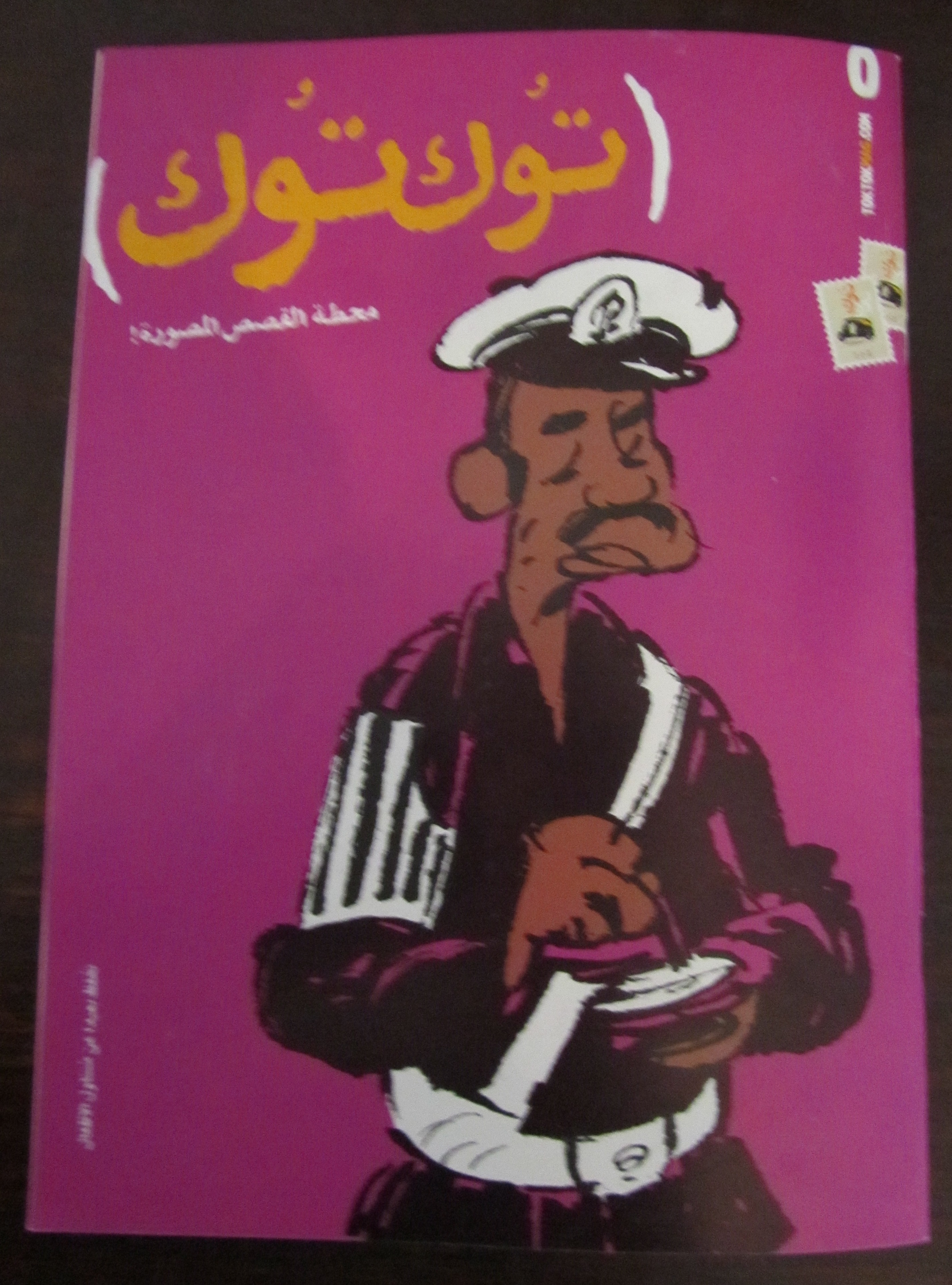
About: Egypt’s response to Samandal comes in the form of this new comics’ magazine. As the creators describe the Arabic-only magazine, “TokTok is different from traditional comic books, which are usually made for children. It’s a monthly review that aims to produce a bustling mass of comic strips in a free, contemporary spirit, drawn and edited by its own artists.” Despite the whole revolution thing happening shortly after the release of their first issue, Toktok is back on its monthly rate with this Summer’s release of issue three. The first couple of issues look promising!
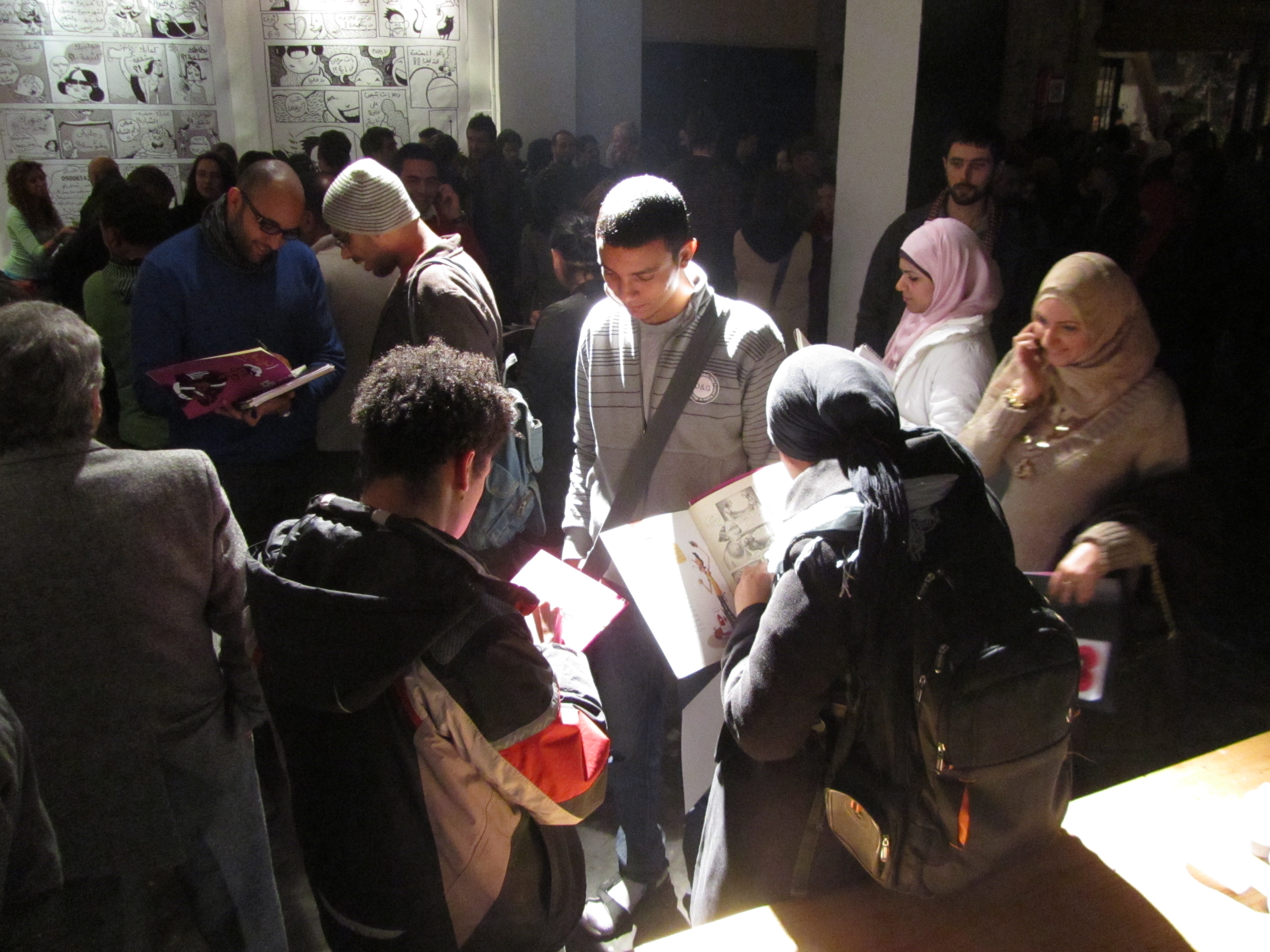 From the very well attended TokTok release party. Photos by me.
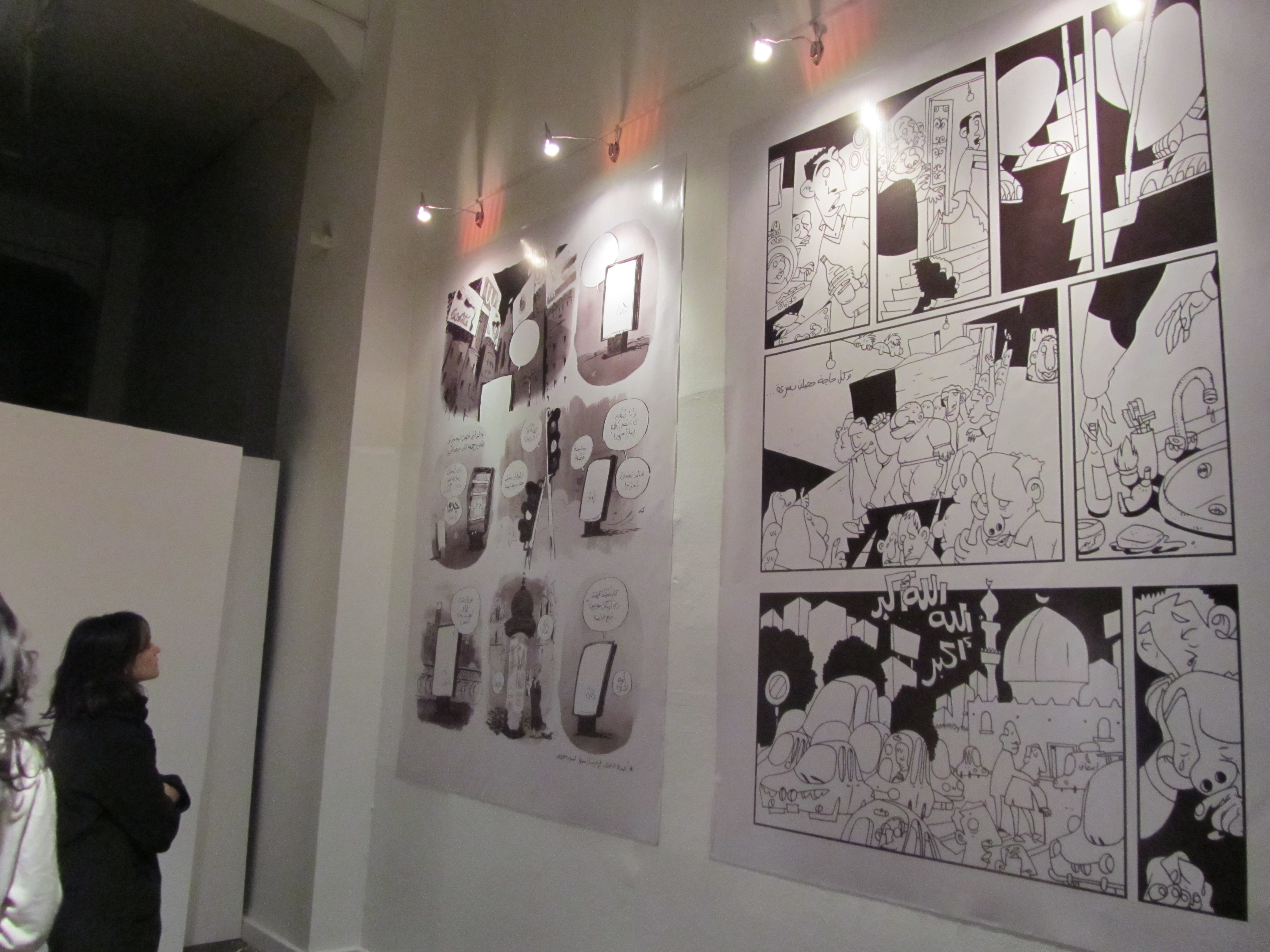
Supplementary Links:
Ruins of the Future (2009)
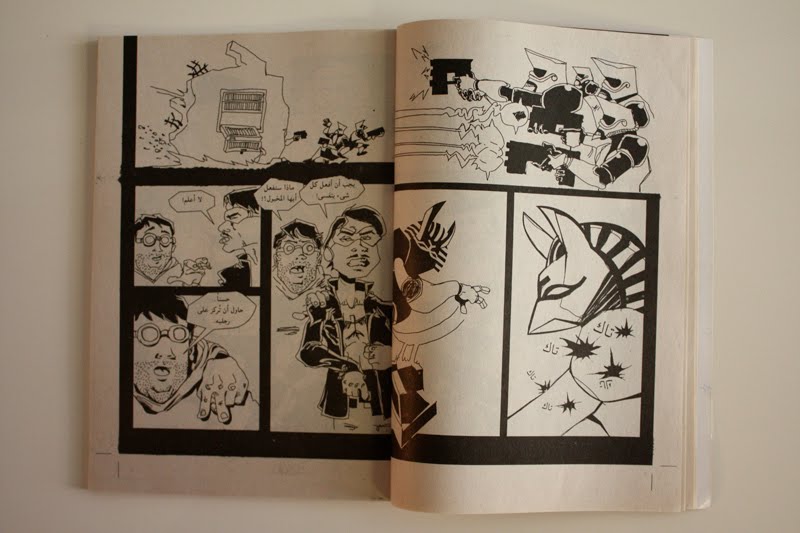
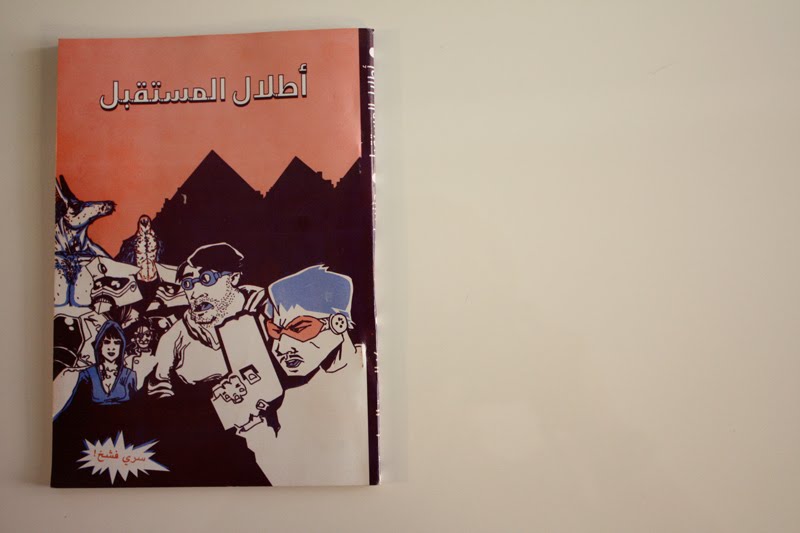 All photos from Ganzeer’s blog
Creator: Ganzeer
Website: www.ganzeer.com / http://ganzeer.blogspot.com/2009/12/archives-ruins-of-future.html
About: Although I haven’t gotten a chance to read Ruins of the Future for myself, it sounds pretty amazing. From what I gather from Ganzeer’s blog it a science fiction graphic novel set in the pyramids. As he writes, “Upon noticing that all scenes at the pyramids in Egyptian movies either take place in the past or present, but nothing in the future, so the idea was suggested to borrow a bit from Egyptian novels, the only source of science fiction in Egypt, and look up some scenes that take place at the pyramids, and see if a full-fledged sci fi graphic novel can come out of it.”
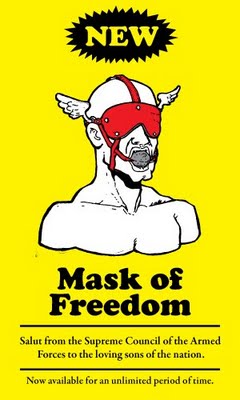
Since the release of Ruins of the Future, Ganzeer has strayed away from pure comics while venturing into some pretty amazing illustrative work. Most recently his street art has become a critical component of the revolution. A great example is this “Mask of Fredoom” sticker that Ganzeer has been passing out around Tahrir Square:
Supplementary Links:
The United Arab Emirates:
Gold Ring (2009 – Present)
 Creator: Qais Sedki
Website: http://www.goldring.ae/main.html
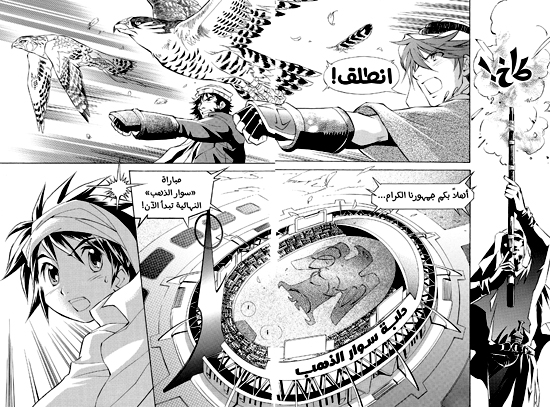
About: A highly buzzed about comic created by an Emirati software engineer turned comics creator by the name of Qais Sedki. Gold Ring marks another “first,” this time the first Arab-language Manga. Because of the UAE’s proximity to Asia it makes sense Dubai was the the first place to use the Manga format to tell a distinctly Arab story. And what a story it is, from the press release: “The story revolves around Sultan, an Arab boy who watches the Gold Ring falconry competition with his friend Ziad. At the competition they find a caged falcon. Sultan convinces his friend to release the falcon into the wild. The next morning, the falcon is at Sultan’s doorstep. Sultan calls the bird ‘Majid’ and trains her for an upcoming falconry competition.” The comic currently has one volume out, with an English translation of the first and a second Arabic volume on the way soon.
Supplementary Links:
Kuwait:
The 99 (2004 – 2011)
Creator: Dr. Naif Al Mutaway
Website: http://www.the99.org/
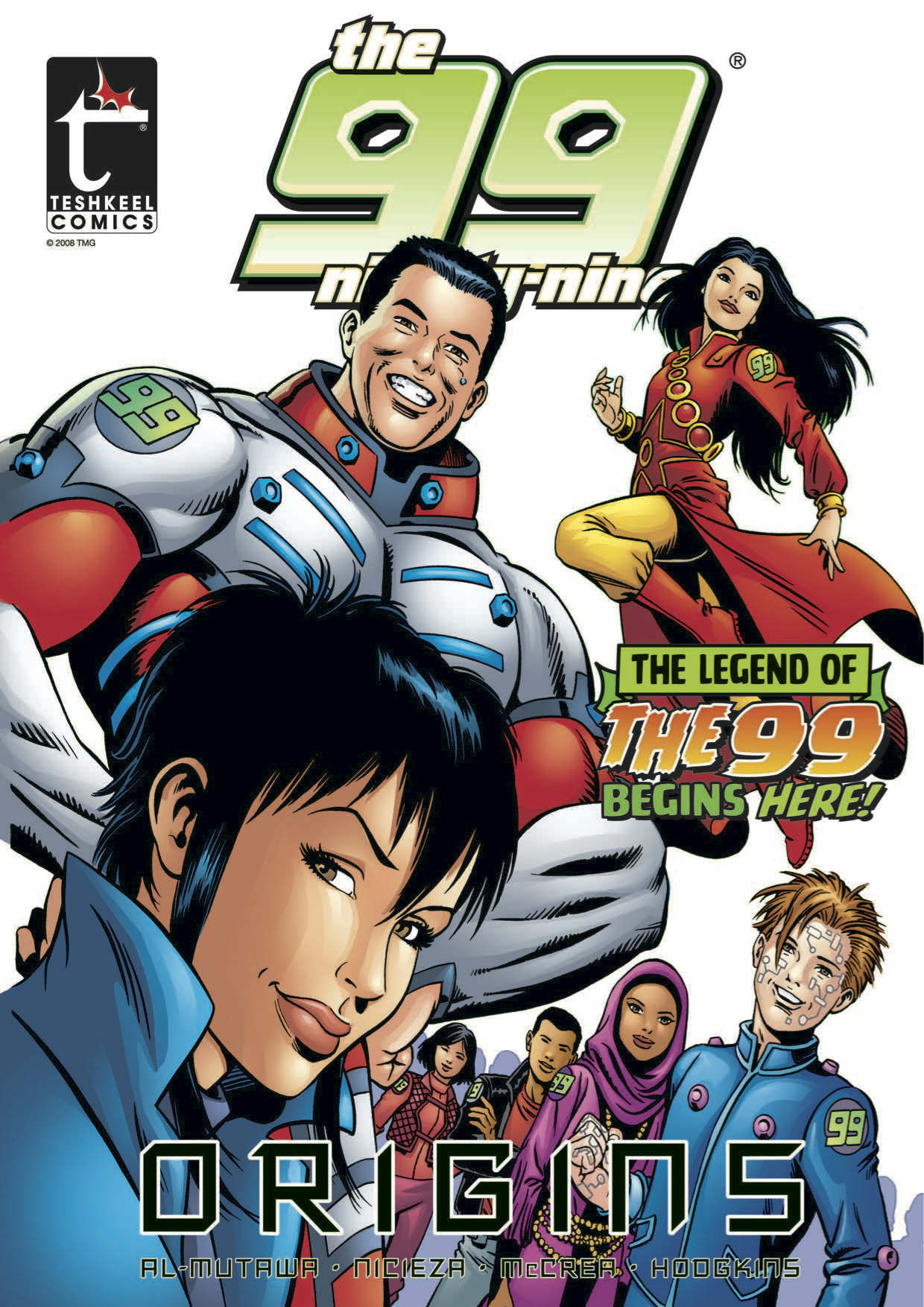
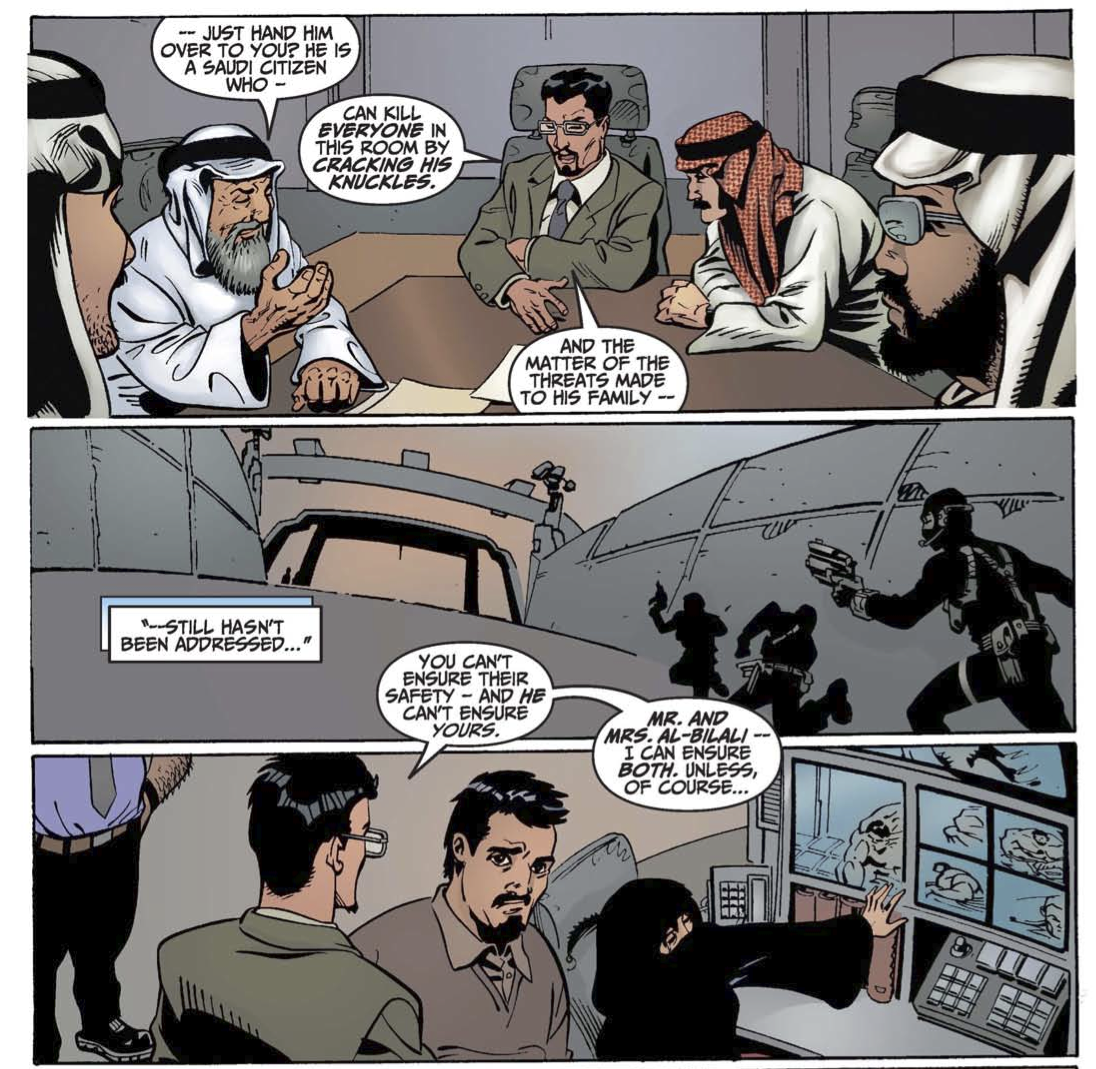
About: This is certainly the most well-known Arab comic outside of the Middle East, no doubt attributable to the media savvy of its creator Dr. Naif Al Mutaway. And when I say widely known, I mean that even President Obama gave it a shout out in a speech. The 99 is the tale of superheroes whose powers are based on the 99 attributes of Allah. Although this is a particularly Islamic set-up, Dr. Al Mutaway recruited Marvel/DC vets such as Fabian Nicieza, Stuart Moore, June Brigman, and more to give it that distinct superhero polish from the get go. The ties to the American comic industry are further exemplified by a recent cross over event which saw members of The 99 fighting crime alongside the JLA. Since its premiere and wild success in the Middle East, the comic has spawned a theme park, a television show and there are future talks of developing it into a movie. In fact, as of this year The 99 has halted production as a comic book.
Supplementary Links:
What the title says. Download Pop Crap here. Playlist is below.

1. Early Mornin’ — Britney Spears
2. Last Time Lover — Spice Girls
3. (And She Said) Take Me Now — Justin Timberlake (feat. Janet Jackson)
4. Strawberry Bounce — Janet Jacksonh
5. Get It Poppin’ — Jojo
6. Dreamer — Hilary Duff
7. Feels So Good — Melanie B
8. Press Pause — Danity Kane
9. My Girl — Christina Aguilera (feat. Peaches and Le Tigre)
10. Glamorous — Fergie (feat. Ludacris)
11. Starting Over — Jennifer Lopez
12. I Stay in Love — Mariah Carey
13. Afraid — Nelly Furtado feat. Attitude
14. Set Adrift on Memory Bliss — Backstreet Boys
15. Not With You — Cassie
As somebody who didn’t get reacquainted with comics until six or seven years ago I came pretty late to Dave Sim’s Cerebus series. It might have been old news for everybody else by then but it was new to me.
The best part of twenty years previously, I had dismissed my once beloved Asterix albums (plus the illicit stash of Commando digests that I had so painstakingly acquired and smuggled past the watchful eye of my decidedly anti-militaristic mother) as the stuff of childhood and exiled them to the attic.
I hadn’t entirely lost touch with comics since then – I’d borrowed Maus and Watchmen at some point, I’d acquired a handful of old Gilbert Shelton undergrounds and a set of Ben Edlund’s The Tick somewhere along the way, and I was vaguely aware of a few of the alternative comics that were around – but they weren’t really something I thought about a lot or sought out. I had a whole bunch of other things to spend my time and money on.
At least, that is, until the fateful day came that, poking around in the dusty corners of a second hand bookshop for something different to read, I found a pile of cheap, old, graphic novels and decided to buy a few of them on a whim. The three books I picked up that day were an old Love & Rockets collection (Music For Mechanics), the first (and only) colourised volume of Akira that Mandarin published in the UK and the second of Sim’s Cerebus “phonebooks” – High Society. I was blown away by all three. In fact, I was so impressed that I’ve been reading comics and reading about comics and filling up my house with comics and boring other people to tears talking about comics ever since.
That copy of Music For Mechanics prompted me to throw myself into thirty years worth of Love & Rockets collections and that messed about with edition of Akira ensured I’d go on to pick up all of Otomo’s work in English and then lament that there wasn’t more of it to adore.
My love affair with Cerebus, on the other hand, was rather shorter in duration. I picked up a few more volumes – everything from High Society to Melmoth, I think – and it was still pretty good. I don’t think I enjoyed any of them as much as the first I read but I never stopped appreciating Sim’s technical abilities and I was set on working my way through the lot. Gradually, though, looking for info on the internet and perusing old mildewed copies of The Comics Journal and picking up on things on message boards and whatnot, I was confronted with, well, with Dave Sim. Intrigued, I investigated further.
Oh dear.
I didn’t really want to give Sim my money anymore. And I didn’t really want to read Cerebus any further – didn’t want to sully the memory of that first eye-opening, rainy weekend, curled up in front of the fire next to my precious stack of used bookshop finds with the knowledge of the misogyny and homophobia and religious obscurantism that I now knew followed those earlier volumes.
So I forgot about Cerebus and got on with trying (with varying degrees of success) to filter a century’s worth of comic book treasure from a century’s worth of comic book dross.
A few years later, however, I heard about Judenhass and decided to give Sim another chance. I wanted to see how Sim’s art had changed since midway through Cerebus and how it would work in a non-fiction context and I guessed its subject – anti-Semitism – was such that Sim’s more…outré…ideas wouldn’t be likely to get a chance to present themselves. Also, the nice man at the comic shop said it was awesome.
Sadly, the nice man at the comic shop was wrong and Judenhass turned out to be a well meant but bizarrely misconceived work that disappointed on pretty much every level.
Sim opens by telling us that many of the most important figures in the history of comics have been Jewish and that, consequently, it’s particularly incumbent upon creators in the comics field to remember and record the Holocaust.
He’s right, of course, that many of the great names in comics – or at least American comics, which I think, to Sim, are the only ones that matter – were Jewish and he emphasises the point with a page given over to portraits of Will Eisner, Stan Lee, Jack Kirby and various of their peers along with a reminder that “but for geographic happenstance and the grace of God”, those men could just have easily been the ones in the gas chambers.

There seem to me to be a couple of problems with this. The first is simply that by framing his work in such a way, Sim seems to be limiting the target demographic of his work to those mostly middle-aged superhero comic fans who are immersed in the history of the form. It’s hard to imagine Palestine or Persepolis, let alone Maus, reaching so wide an audience as they did if they had they set out to appeal specifically to the mylar and backing board brigade.
The second problem is that the idea that people involved in a field in which Jews have traditionally prospered are the ones who need to be particularly aware of anti-Semitism seems to me to be a little counter-intuitive. I’m not saying that comic creators shouldn’t cover the Holocaust, of course – and there are a number who have done so over the years – I’m just not quite sure why it should be more important that cartoonists do so as opposed to artists working in any other medium.
Moving on, Sim tells us that the victims of the Holocaust included non-Jews but that we must, nonetheless, not fall into the trap of seeing it as anything other than an exclusively Jewish issue.
Indeed, he writes that attempting to embrace the other groups that suffered in the death camps under the Holocaust banner “points to a central and malignant evasiveness on the part of non-Jews”.
Are the Third Reich’s other victims any less deserving of remembrance? And does remembering them make the horror of what happened to Europe’s Jews any the less shocking? Doesn’t what has happened since 1945 in Cambodia and Rwanda and Bosnia and, dare I say, Israeli-occupied Lebanon indicate that “never again” should not be a phrase exclusive to Jews?
Having laid down his condemnation of those who would embrace non-Jewish victims, Sim chooses not to answer any of these questions – one is merely left with the impression that anything other than absolute exclusivity in victimhood would, in and of itself, be anti-Semitic.
It doesn’t seem to occur to Sim that there are Jews who are more willing to reach out to those fellow sufferers than Sim himself is. Just as the anti-Semites damn the Jews en masse, Sim defends them en masse – there is never any indication that we are talking about a diverse group of individuals with divergent opinions, beliefs and attitudes, some of which may not line up with his own.
Following the introductory pages the bulk of the book consists of text boxes over backgrounds comprised of drawings painstakingly but counter-productively traced from Holocaust photographs (sometimes accompanied by rather stiff head and shoulders portraits from Sim’s rogue’s gallery of prominent anti-Semites).
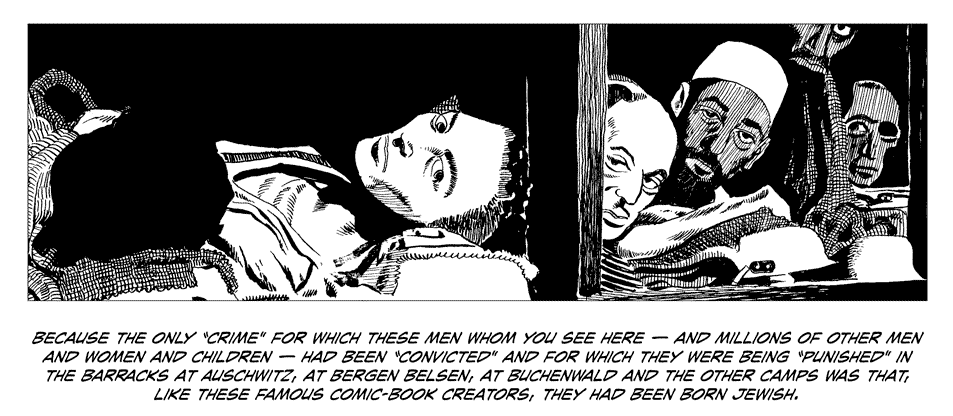
I say “counter productively” because Sim’s drawings lack the impact of the photos they’re taken from. Those photographs never cease to draw a visceral response, no matter how many times you’ve seen them. They are truly horrifying, truly moving, each and every time. I didn’t get that reaction from this artist’s rendition. There’s some very well done composition, some effective use of repetition but the images themselves don’t provoke as they should. Rather than trusting to his considerable skills as a cartoonist Sim seems to be on a quest for absolute accuracy (“photo realism”, in his words) but that obsession has robbed his panels of life and the familiarity that most readers will have with Sim’s reference materials only emphasises the difference. The relentlessness of the imagery – the vast majority of the work is an endless succession of tangled piles of corpses and walking skeletons – goes some way towards compensating but ultimately it feels like Sim is trying desperately to pummel his own (obviously heartfelt) emotional response to the imagery into your skull. Repeatedly.
So, what of the contents of those text boxes accompanying the art? After a few pages of anti-Semitic phrases and sayings taken from various languages at various times, Sim devotes the rest of the work to a chronological series of quotes and historical events from around the world, ranging from 70BC to 2007. By this point, though, he’s only left himself 28 pages to work with (excluding the end notes) – this is a very slim volume for such a big subject – and there’s very little text per page. The result is that we get next to nothing in terms of context. There’s no explanation of the roots of anti-Semitism, no exploration of how it was harnessed and promoted by the Church, no information given on where insidious myths about Jews originated from or how they developed, nothing about how the treatment of Jews has compared and contrasted with that of other religious and ethnic minorities through history, nothing about the ups and downs of the pre-Israel relationship between Judaism and Islam. It’s all incredibly lightweight.
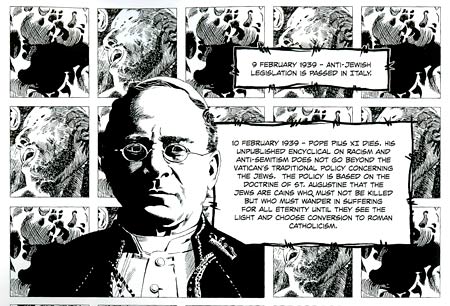
As with the art, the quotes resemble the drip-drip-drip approach of the Chinese water torturer and just as the art makes you think you’d be better off looking at photographs, the text makes you wish you were reading a prose book on the subject – something with a bit of heft to it, something with a bit of depth.
Uncomfortably (for me at least), as the quotations enter the 20th Century, Sim begins to sometimes conflate Zionism with Judaism (or, more particularly, anti-Zionism with anti-Semitism). I don’t think it ever occurred to him that there might be objections to the concept of Zionism, or to the state of Israel and its actions, that aren’t rooted in hatred of Jews (let alone that Jews themselves might hold those objections).
Indeed, one of the last quotations he offers up, entirely out of context, originates from an anti-racist campaigner and academic arguing not against Jews but rather in favour of an academic boycott of Israeli universities in protest over Israeli breaches of international law. How is that anti-Semitism?
Sim devotes about as large a portion of the text to President Truman’s procrastination over the establishment of Israel as he does to the Final Solution, which seems a strange weighting.
His position seems to be that Truman’s initial resistance to the idea of a Jewish state in Palestine was anti-Semitism pure and simple and that the eventual reversal of his position was him finally seeing the light. Sim himself seems unsure as to whether or not the words he puts in Truman’s mouth belong there or not, writing in the end notes that he found a key passage “suspect” but decided to use it anyway, the better to make his point.
In any case, the reader is left in little doubt that the foundation of Israel was right and proper and that any that argued otherwise – or protest its actions today – belong, incontestably, to the same line of thinking that gave us Auschwitz. Moreover, the impression given is that Israel was Truman’s to found or not found, as simple as turning a light switch on or off – nothing is said of the reservations of the British government then running the Palestinian protectorate, let alone of the Palestinians themselves.
In his end notes, Sim expresses his wish that Judenhass be used in schools as teaching material. Sadly, I don’t think it’s remotely fit for the purpose. Sim claims school children “in this age of diminishing attention spans” aren’t capable of concentrating for more than the 25 minutes he thinks it would take them to read his book. But what academic use is a scattergun assemblage of quotations without context or elaboration? What use in the modern world is a book for a general teenage audience that attempts to suck the reader in emotionally with the presumption that all kids not only read superhero comics but also know (and care) who created them 60 or 70 years ago?
Moreover, putting its other problems aside, speaking as somebody who lives and works in an inner city area where a substantial proportion of the population is made up of first and second generation Muslim immigrants, I really don’t think I could reasonably recommend this book to any of the local teachers or school librarians I come into contact with (despite the fact that some of the Muslim kids they teach are the only people I ever hear bandying about anti-Semitic remarks and so should, in theory, be just the people to benefit from it). In order to begin to tackle the prejudices so many of those kids were raised with, they need a book that teaches them that “Jew” and “Israeli” are not synonymous, not one that encourages them to think that they are.
I’m grateful to Sim – along with los bros Hernandez and Katsuhiro Otomo – for bringing comics back into my life. But if Judenhass and the brief preview of Glamourpuss I saw when it was first getting started are any indication, I’m rather afraid that the quality of his comics output has now descended to the same level as that of his philosophising.
So I’m afraid it’s a case of “so long, Dave – it was fun to begin with but now I think we should see other people”. And this time I mean it.