Superficial

This first ran in the Chicago Reader a ways back.
____________________

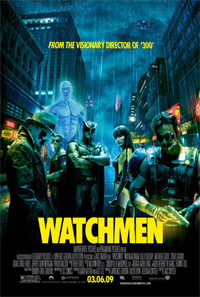
Superpowers create more problems than they solve, and we’d probably be better off without them. That’s at least one message of the 80s comic book Watchmen—especially if we understand that writer Alan Moore and artist Dave Gibbons were thinking about geopolitical superpowers as much as masked guys in tights. The original 12-issue series, published in 1986 and ’87, takes place in an alternate universe where superheroes walk the U.S. of A. Bob Woodward and Carl Bernstein have been killed by a vigilante called the Comedian, and as a result Richard Nixon is serving out his fifth term as president. Thanks to the superhero Dr. Manhattan, who can transmute elements, grow 50 feet high, and wander around buck naked (after all, who’s going to stop him?), the U.S. has won the Vietnam war and holds a decisive advantage over the Soviet Union. America is the world’s undisputed dominant power—which, to the two British creators, seems like a decidedly mixed blessing.

Of course, the cold war ended for real four years after the series concluded. We now know, more or less, what a world dominated by the U.S. looks like. Yet even after two decades, Watchmen doesn’t seem quaint or outdated; on the contrary, it seems more prescient with each passing year. In the comic, American dominance leads to paranoia. At home, fear of masked vigilantes has fueled McCarthyite rioting and forced most superheroes into retirement. Overseas, a cornered USSR walks the world up to the edge of nuclear holocaust.

The story focuses on six superheroes, one of whom—the Comedian—has been murdered. These characters are hardly laudatory examples of unfettered American power. For the most part they don’t like each other, and they certainly don’t work together. The Comedian was an amoral thug who reveled in his own brutality. Rorschach is a neofascist, homophobic nutcase who uses black-and-white morality to justify his extreme violence. Dr. Manhattan is so powerful that he’s become detached from humanity, alternating terror and beneficence with a chillingly casual disinterest. The wealthy philanthropist Adrian Veidt, aka superhero Ozymandias, is a liberal one-worlder whose compassion is so aggressive it’s indistinguishable from ruthlessness: his crazed plot to save the world involves killing half the people in New York City. For him and all the other heroes, saving the world is less about helping others than about indulging their own messianic delusions, sexual hang-ups, and self-aggrandizement. As the U.S. has demonstrated for the past eight years or so, when you add moral grandstanding to great power you get not great responsibility but a huge fucking mess.

Given the continuing relevance of Watchmen, I had some hope that the movie adaptation would serve as a corrective to the supposedly tough-minded but in fact mushily sentimental The Dark Knight. Alas, Watchmen the movie is itself nothing but sentiment. The pointed message of the comic is buried under a ritualized nostalgia for the source material. Director Zack Snyder tiptoes through the story with a deadening reverence, faithfully reproducing this bit of dialogue from Moore (“The superman is real—and he is American!”) or that bit of imagery from Gibbons (the Comedian crashing backward through a window amid a spray of shattered glass) but never pausing to develop a vision of his own. The result is oddly hollow and disjointed; the actors move like sleepwalkers from one overdetermined tableau to another.

One of the most telling characters is Rorschach. In the comic he’s repulsive and ludicrous—a tiny man with lifts in his shoes, he suffers from major sexual problems, and his disguise is a street person whose placard reads “The end is nigh.” The backstory makes him both more likable and less admirable; the moment in the comic when he threatens his landlady is uncomfortable, but the next panel, where he spares her because of her child, who reminds him of himself as a boy, is extremely poignant. Snyder alludes to some of this—we glimpse Rorschach in civvies, wandering around with his sign—but it never coheres. Viewers new to the story might not even realize this nutty doomsayer is the vigilante’s alter ego. All we’re left with is another cool-as-shit dark hero, kicking ass in glossy martial-arts sequences, doing the dirty work of justice.

Certainly Moore thought his vigilantes were cool as shit, but he was also ambivalent about their morals and the implications of their might. By contrast, Snyder issues a few bland caveats, but his veneration of the source material ultimately bleeds over into thoughtless justification of the heroes. This accounts for the main plot change. In the comic, Ozymandias unites the world by destroying New York City and making the catastrophe look like an alien invasion. But in the movie, Ozymandias (Matthew Goode) unites the world by fingering Dr. Manhattan (Billy Crudup) as the one who destroyed several American cities. The horrific spectacle of New York under attack—which, obviously, now has an eerie resonance—is rather cravenly skirted. And as in The Dark Knight, a superhero scapegoats himself to unite a sinful humanity. The super-Christ exists, and he’s American!

Snyder tips the story to validate the superheroes in other ways too. Moore was careful to include a number of civilians in the comic, most prominently a cranky white news vendor and a young black comics reader. In the movie, these two characters die in each other’s arms as they did on the page, but that’s the first and the last you see of them. They’re cannon fodder for the special effects, not characters you care about. As a result Watchmen focuses on the choices and sacrifices of the superpowered—the superman’s burden, if you will—rather than what those choices mean for everybody else.

Toward the end of the story, the philanthropist Veidt claims he’s made himself feel the death of everyone he’s murdered while trying to build a new utopia. In the comic, Moore forces the reader to experience these deaths and wonder if they’re justified by the possibility of world peace. When you take that question seriously, others come up as well. What makes Veidt so certain the human race is going to destroy itself? What right does he have to play God? Veidt sneers at Rorschach for his “schoolboy heroics,” but in the comic there isn’t much daylight between Rorschach’s fascist vigilante justice and Veidt’s evangelistic UN peacemaking. Both impulses fuel our heroic American fantasies, at home and abroad. As long as that holds true, Watchmen can’t be a simple exercise in 80s nostalgia, no matter how hard Zack Snyder tries to turn it into one.

Utilitarian Review 6/8/12

News

Did I mention that Jones One of the Jones Boys has joined us as a contributing writer? He has!
 
On HU

Our Featured Archive post this week was my massive interview with Johnny Ryan.

I talk about Katana, superheroine without cheesecake.

Alex Buchet on Prometheus and Ridley Scott’s fever dreams.

I argue that Before Watchmen is a shitty idea because of labor practices, not copyright.

Isaac Butler explains why Prometheus is no good. (Lots of spoilers.)

Domingos Isabelinho on M.S. Bastian, Isabelle L., and Lego concentration camps.

Ben Saunders in praise of Bendis and Ultimate Spider-Man.

Ryan Melcher on color in Heath and Murray’s “Hearts and Minds.” This post is a response to an assignment by Phillip Troutman. We’ll have more papers from his class over the next few weeks.
 
Utilitarians Everywhere
At Splice I write about men in Pretty Woman.
 
Other Links

Robert Stanley Martin on The Shark King.

52…eh.

Comic book publishers and desperate marketing gambits.

Dominic Umile on the Green River Killer.


The Color Question

Editor’s Note: This is part of a series of student papers from Phillip Troutman’s class at George Washington University focusing on comics form in relation to Scott McCloud’s theories. For more information on the assignment, see Phillip’s introduction here.
_______________________
 
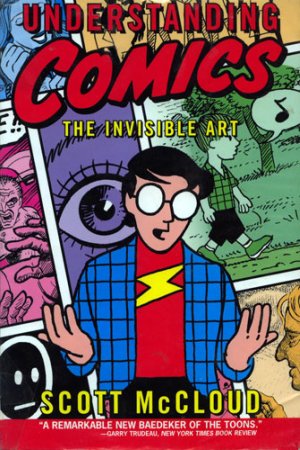
Color remains a question rather than an answer in comics: Some artist’s embrace it, while others continue to ignore it. Whatever its use, color plays an important role in forwarding the message of the artist. Yet such a message is ambiguous. In his analysis Understanding Comics, Scott McCloud notes that color promotes comics by reaching toward reality, making a panel appear to be a much more relatable image to the reader, who lives in a world beyond black and white. Mirroring life itself, which is far from flat, colored images add an extra dimension to the page. But is this the true purpose of color in comics? McCloud suggests otherwise; however, due to the brevity of his designated chapter, he never explains why. Indisputably, comics serve to simplify life, easing the ability to communicate some sort of integral message to the reader. Breaking the fourth wall, color magnifies the author’s claim. Minute tidbits of otherwise unseen details reveal themselves through the additional lens of color.

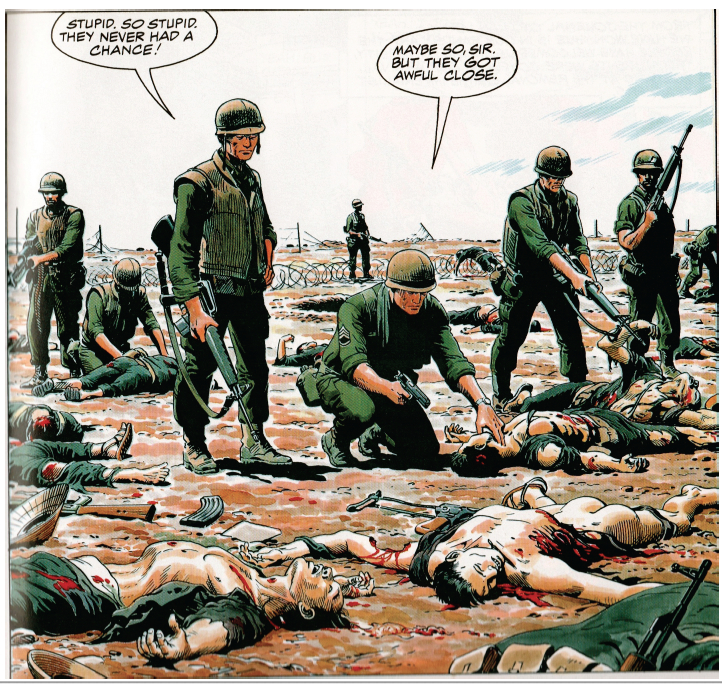
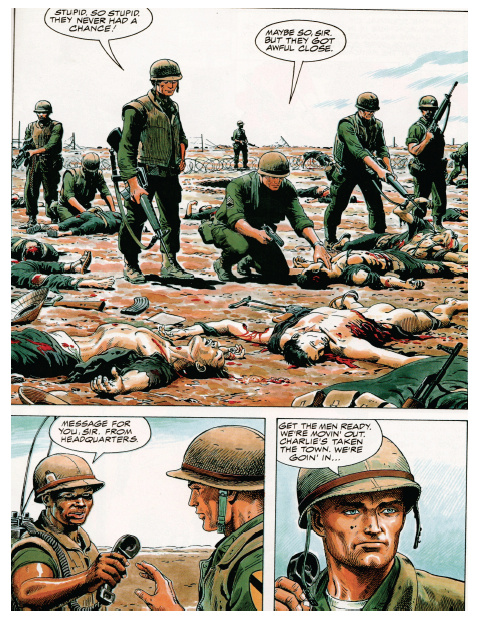
The following image derives from Doug Murray and Russ Heath’s “Hearts and Minds: A Vietnam Love Story.” The panel displays the death and destruction caused by the detonation of a grenade during a battle in the Vietnam War.

Throughout my analysis, I will revisit this image in order to touch upon the overlooked meanings that color specifically reveals.

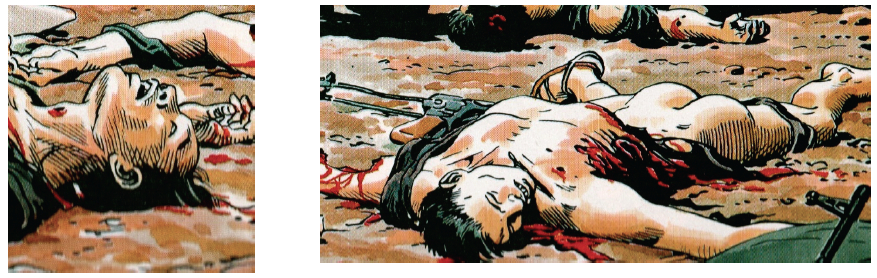
Color magnifies important details that forward the cartoon’s claim. Though images may appear more realistic, the purpose of color remains for graphics to appear more simplistic. Noting the simplicity of cartoons, McCloud emphasizes that, overall, cartooning is a form of “amplification through simplification” (30). Comics pride themselves in exaggeration, which empowers a point rather than detracts from it. In this sense, color is yet another mouth for exaggeration. Heath’s image exhibits excessive exaggeration due to the use of color. Studying certain features of Heath’s panel, readers must digest uncomfortable truths that the artist is emphasizing. For instance, the two Vietnamese corpses expose gruesome depictions to readers.

In the first image, color contrasts the white bone protruding from the dead man’s neck from the background. Clean and crisp, this bone appears as though it is out of place. Looking as though it were a plastic piece in the board game Operation, the bone could easily slide back into the dead man’s body. Though, in reality, this bone would be muddled with blood and dirt rather than in this immaculate condition. Instead of showcasing visual reality, color emphasizes a statement: Another man’s bullet pierced a bone through another man’s throat. The same argument is displayed in the second image. Here, color bolds the blood that pours from the man’s dislocated torso. Yet this blood is pure red. In reality, such blood would not beam from a corpse; it would be dirtied and dried. Color again simplifies reality, highlighting to readers what happens during war.

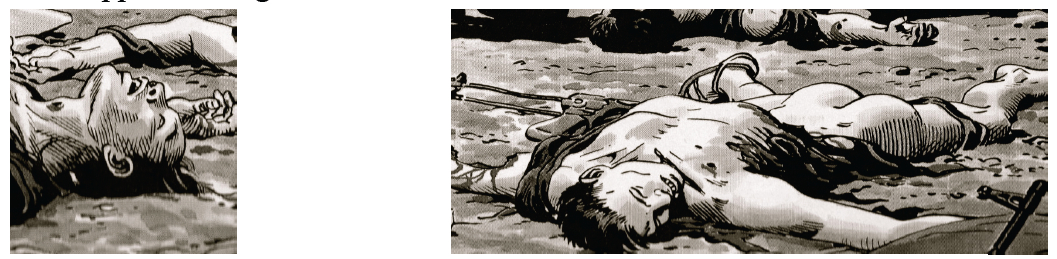
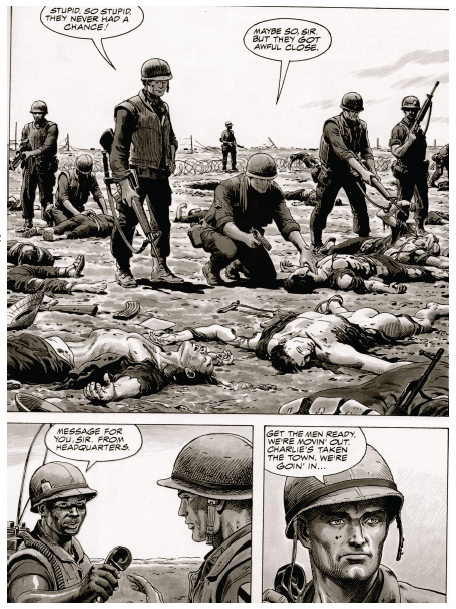
When the same images are displayed in black and white, such an effect is lost. Though readers may understand that the two men are dead, they do not see death’s marks etched in the corpses. The bone is barely visible, and the blood blends with the shading. The colored images are blatant to readers, who inherently understand what each detail represents. Such a technique attests to McCloud’s claim about drawing style: “By stripping down an image to its essential ‘meaning,’ an artist can amplify that meaning in a way that realistic art can’t” (30). Heath’s color truly “strips down” the panel to its bare essentials.

By simplifying a panel to its bare essentials, Heath presents color as an icon. As McCloud defines the term, an icon is an image that represents a person, place, thing, or idea (27). Cartoonists rely on icons to transmit a clear and obvious message to readers. In the case of this panel, the clearest example of an icon is the color red, which represents blood. Readers immediately connect the image of blood with its more powerful meaning: carnage. Heath chooses to depict such carnage through the visual device of an icon, and such an icon is displayed through color.

Beyond functioning as an icon, color breaks the flow of sequential art, emphasizing the subject matter of an image rather than the panel transitions on the page. Referring to the purposeful placement of juxtaposed panels, sequential art stresses the movement from one panel to the next, which, in turn, unconsciously forwards the plot. Looked at as an abridged filmstrip, sequential art carries readers from one important scene to the next. Yet, color seemingly cuts this artificial current.

The selected image comes from a page with three separate panels. Despite the wholeness of the story, color slows the sequential flow of these transitions. The first panel encompasses over a half of the page, warranting some sort of inherent importance in its size. Obviously, the artist wants readers to not only look at this image, but to study it in detail. Despite its size, readers may easily browse from one panel to the next. However, Heath installs color to prevent such an easy transition. After reading this page in its entirety, readers are inclined to revisit the first panel due to its colorful graphic content. The secret to such a phenomenon lies in the highlighter-like quality of color.

For example, moving left to right in the first panel, the focus shifts from the line of soldiers to the sprawl of bloodied corpses. Bold outlines of blood and flesh segment each corpse from the next, hinting that each image has a different story to tell. In fact, each body could be a separate panel. In the panel, four separate Vietnamese bodies are macabrely drawn: An American soldier tests the pulse of a clearly lifeless Vietnamese shell; another American soldier picks at a mangled corpse with his gun; and the final two corpses, torn and shattered, lay brutally close to the reader at the front of the panel. Subject-to-subject transitions would individually highlight each corpse and its features; yet, Heath decides to include multiple scenes in one panel, separating them by color. By choosing this method, color simplifies four possible panels (one panel for each corpse) and gift-wraps them for the reader. Realistically, each corpse deserves its own panel in order to communicate its graphic content, but color simplifies such reality into a single cartoonish image.

By segmenting sequential art, color also simplifies the significance of McCloud’s illustrious gutter. McCloud defines the gutter as the space between panels where closure occurs in reader’s minds. Through closure, McCloud suggests that the message of the comic is conveyed to readers. Such a claim raises the possibility that closure could be misconstrued: Reader’s could interpret a different idea than the artist intended from the panels. Color counteracts such discrepancy. Creating its own sense of closure, color illustrates the artist’s message clearly to the reader. Revisiting the panel sequence, I have manipulated the colors to a black and white format.

Reading the page, readers find that it is naturally much easier to follow the storyline in black and white. The first panel describes the recent conflict, and the gutter to the bottom left panel suggests to readers that such a massacre is a daily display for soldiers, as the sergeant plans to move out to another town. But, in color, such a transition is not so smooth. Color isolates the first panel, giving the gutter transition between the first and second panel a much different meaning. Studying the images in color, readers realize that the comic is exposing the absurdity of death through battles in war. The gutter seemingly empowers this statement, as it quickly introduces another future conflict that promises to be just as gruesome. Murray and Heath seem to be showing readers the horrifying realities of war. Graphic imagery, highlighted by color, communicates a “War as Hell” message to readers, who must digest an unnerving panel. Such closure can only be deduced when the panels appear in color. Without the red blood and displaced flesh, which are both only noticeable through color, the comic’s philanthropic message is lost in translation. Clarifying these important details, color simplifies Murray and Heath’s message. Rather than using words to communicate a difficult idea to readers, Murray and Heath rely on the simple but powerful effects of color.

Rather than making comics more realistic, color is highlighting the simple message of the images. Comic artists utilize color to highlight their ideas rather than bring them closer to reality. Magnifying minute details, colors strip down panels to their bare essentials, successfully forwarding the message of the artist. Manipulating the flow of sequential art, color simplifies complex depictions into a single panel. And, transforming the gutter, color clarifies a complex idea through universally understood graphics rather than confusing words. As viewed in a single page of Murray and Heath’s “Hearts and Minds,” a war related comic promises to introduce many ideas to readers. With so many themes floating throughout the comic, some sort of technique should aim to clarify and polish the author’s intended message. With that said, color in comics aims to simplify ideas so that readers better understand the artist’s message. Highlighting death and the absolute brutalities of war, color serves as a trail-marker for the artist, who only hopes to easily communicate some sort of message.

When an artist prepares to finalize his product, he must ask himself the color question: Could color simplify life more so than the comic already does? Heath’s artwork answers such a question. Indeed, even with color, simplification proves to be the root goal of comics. Color thereby is not so much an aesthetic choice to the artist as much as a literary tool.

Comics Criticism 101: An Introduction

This essay was written in my first-year composition course at the George Washington University. University Writing Program faculty draw on a variety of disciplinary backgrounds (my Ph.D. is in American history, with current research on abolitionist visual rhetoric) to teach students to “enter the conversation” of academic research—to do detailed analysis and to engage existing scholarship rather than simply regurgitate it. This particular assignment arose out of the cross-fertilization that Craig Fischer argues is emblematic of comics scholarship, where academics, fans, practitioners, and popular critics seed each others’ ideas and produce more interesting work.

I had been teaching a “five-page paper” version of this exercise, where students analyze specific visual elements of a chosen comic or graphic novel in order to develop a claim in response to Scott McCloud’s Understanding Comics. This served as an introduction to comics (McCloud is great for that) but also to claim-making, because, as a foundational text, McCloud is the perfect foil: authoritative, comprehensive, and eminently fallible. Students always find interesting exceptions to his rules, new categories of panel transition or image/text interaction, and concrete ways to develop his vague generalizations.  But the papers still felt academic in the pejorative sense: they represented a school genre that addressed only the professor as audience.

To move away from that, I consulted the Comix-Scholars Discussion List, fishing for ideas about formal criticism in the blogosphere: hence Noah. Noah was very interested in the project, helped me rethink the genre of comics criticism, and very kindly loaded me up with examples, many of which went onto the assigned reading list as a diverse set of models we read and discussed in class. Students now have a broader range of rhetorical choices to make regarding introductions, integration of images, organization, descriptive language, and analytical tone—not to mention examples of how to make a claim that might matter to someone outside the classroom.

As a final gesture, Noah asked me if he could publish some of the best examples students produced. I am most grateful for his generosity and I hope you enjoy the ones we’ve selected. The students are excited about sharing their work and, I trust, will be watching the comments closely. Please welcome them to the conversation.

_____
Phillip Troutman is Assistant Professor of Writing at The George Washington University, trout@gwu.edu

Bendis Still Sends Me

It’s easy to knock corporate super-hero comics.  There’s the relentless, unthinking sexism; the apparent paucity of fresh concepts; the tendency to confuse horrific violence with thematic sophistication (and the related inability or unwillingness to address younger readers); the summer crossovers that so often and so transparently put sales figures ahead of internal coherence or aesthetic quality; and the frequent reboots, which may once have been justified as a way of shedding the weight of unwieldy continuity, but now smack of greed, desperation, and cluelessness in about equal measure.

These various problems can be diagnosed as symptoms of a fundamental disrespect for the comic book audience at the corporate level.  But creators, too, are often subjected to this same disrespect, even as they continue to labor within the constraints of the current system.  Probably no one reading this needs to be told about the historic injustices that have arisen out of the “work-for-hire” production model; nor is it hard to imagine the chilling effect that this model must have over time for even the most successful practitioners of the genre.  (Indeed, it’s probably no coincidence that many of my personal favorite writers and artists often seem to do their best work when engaged with creator-owned projects; by comparison, producing comics under a “work-for-hire” contract must feel like swimming with weights.)

The writers and artists who do manage to produce work of consistent quality within the corporate system, on a monthly basis, sometimes for years on end, have therefore beaten some long odds, in my opinion.  And perhaps in such circumstances it is all the more important to offer commendations when commendations are due.

I am here, then, to sing the praises of Brian Michael Bendis and his various co-conspirators for their work on Marvel’s Ultimate Spider-Man.

First, and for the tiny handful of you who might not know this (“Hi, Mum!”): Marvel’s so-called Ultimate universe was initially conceived back in 2001 or so, as a way of re-starting the adventures of the most well-established Marvel characters from their origin stories — with a clean-slate, as it were.  The official reasoning was that creators would no longer be tied to decades of prior continuity, and that this would also encourage new readers to jump on board.  Less often acknowledged, but probably equally important was the opportunity to jettison aspects of the older narratives that had simply dated.  For example, in the 1960s, Stan Lee’s default “origin story” involved some sort of inadvertent exposure to radioactivity.  But radioactivity is a less mysterious concept today than it was sixty years ago.  We don’t expect it to give us superpowers; we do expect it to give us cancer.  Consequently, in the Ultimate universe, corporate and government sponsored experiments in genetic mutation — almost always carried out at the behest of the military — have taken up the plot function that was once fulfilled by radioactive “isotopes.”  (And there’s probably a whole essay of the cultural studies type that could be written about the political and cultural implications of this particular shift of emphasis within the superheroic fantasy, but I’m not going to write it.)

Within the current continuity of this Ultimate universe, a teenager named Miles Morales has recently taken up the webbed mantle and power-and-responsibility mantra of Spider-Man.  Miles resembles his predecessor, Peter Parker, in many ways — he’s intellectually gifted, ethically centered, and terribly young to be a hero — just thirteen years old, in fact.  But unlike Peter Parker, who was obviously Caucasian, Miles is the child of an African-American father and a Hispanic mother.  Marvel’s decision to re-boot one of their flagship characters as a person of color has generated a fair degree of media interest, and even seems to have ruffled the feathers of a few right-wingers and white-supremacist types.  I’ll say a bit more about that, but for now I just want to note that this is just one of the reasons that I like the comic.  Here are some others.

1) It is a great “all-ages” book — or a great 10-years-old-and-up book, at least.  This is important, because there are just not that many quality genre comics that can engage both younger readers and adults out there these days.  In fact, most of my favorite current genre titles (Casanova, Criminal, The Sixth Gun, Scalped) are not appropriate for kids at all.

It is ironic that great comic books for younger readers should nowadays be so very hard to find, given the original target audience for the medium; but perhaps it should not be much cause for surprise.  Quality children’s literature has always been unusual, after all — which is partly why works like Alice In Wonderland or the Oz books or Where The Wild Things Are become objects of veneration.  The really good stuff is rare as hens’ teeth.

I’m not saying that Bendis’s work on Ultimate Spider-Man is an achievement to be ranked alongside Carroll’s or Baum’s or Sendak’s.  That would hardly be comparing like-with-like, after all.  I’m simply saying that there are only a tiny handful of quality monthly genre titles that can engage an adult audience while remaining appropriate for younger readers — and Ultimate Spider-Man is one of them.  (If you are looking for others, Atomic-Robo and Princeless are also pure, joyous fun, but of course neither of them are superhero books.  In fact, it really would be hard for me to name another superhero title with the “all-ages” appeal of USM right now.)

2) While it is easy (and often appropriate) to be cynical about any gesture made by Marvel or DC towards traditionally marginalized members of the readership, I think Bendis’s decision to take one of Marvel’s most recognizable characters and recast him as a person of color is not only entirely commendable, but has also been (thus far) very well handled.  Yes, Marvel and DC can always create “new” non-Caucasian heroes, but the fact is that if the marquee, iconic figures are always white, well … the marquee, iconic figures are always white.

And yes, it is possible to belittle or undermine this move by saying it’s “only” the Spider-Man of the Ultimate universe that we are talking about — as if that makes this a less “real” change.  But even leaving aside the silliness of arguing which version of Marvel universe is more “real,” I think that the people who are inclined to say this have not been following the comics for some time, and therefore don’t realize that the Ultimate universe has now been established for well over a decade.  For a lot of readers, the Ultimate Marvel Universe IS the “real” Marvel universe.  What’s more, the recent Marvel movies owe at least as much to the characters as they are presented in the Ultimate line as they do to the regular 616 line.  So this is not the equivalent of a “what if” or “imaginary” story in which someone other than Peter Parker gets bitten by that magical spider.  It’s a much bigger deal than that.

Nor can the invention of Miles Morales be written off simply as an attempt to boost flagging sales with a headline grabbing plot twist.  While comic book sales in general are apparently regarded as dismal, Ultimate Spider-Man has (I believe) been the most consistently successful Ultimate title.  It’s certainly the longest running — and I’ve personally enjoyed it more than almost any of the Spider-Man books published in the 616 universe for the last decade.  (I’ll admit that Bagley’s art put me off for quite a while.  But I gradually got over it, and eventually came to appreciate his considerable storytelling skills, even though I still generally dislike the details of his faces and figure work.)  So this wasn’t a “hail Mary” pass, or a last ditch effort to save a dying title.  On the contrary, it appears to have been a thoughtful, considered, and even potentially risky move, given the relatively high profile of the book in question.

When we first meet Miles and his parents it is at a “lottery” for places in an elite private school.  They are surrounded by other anxious parents and children, and the importance of this lottery for these families — as a possible route for their children out of the broken public school system, and into the middle class — is made very clear.  When Miles’s number comes up — in a nice touch, the same number is marked on the genetically modified spider that will later bite him, and give him powers — his mother embraces him weeps in relief: “You have a chance. You have a chance.”
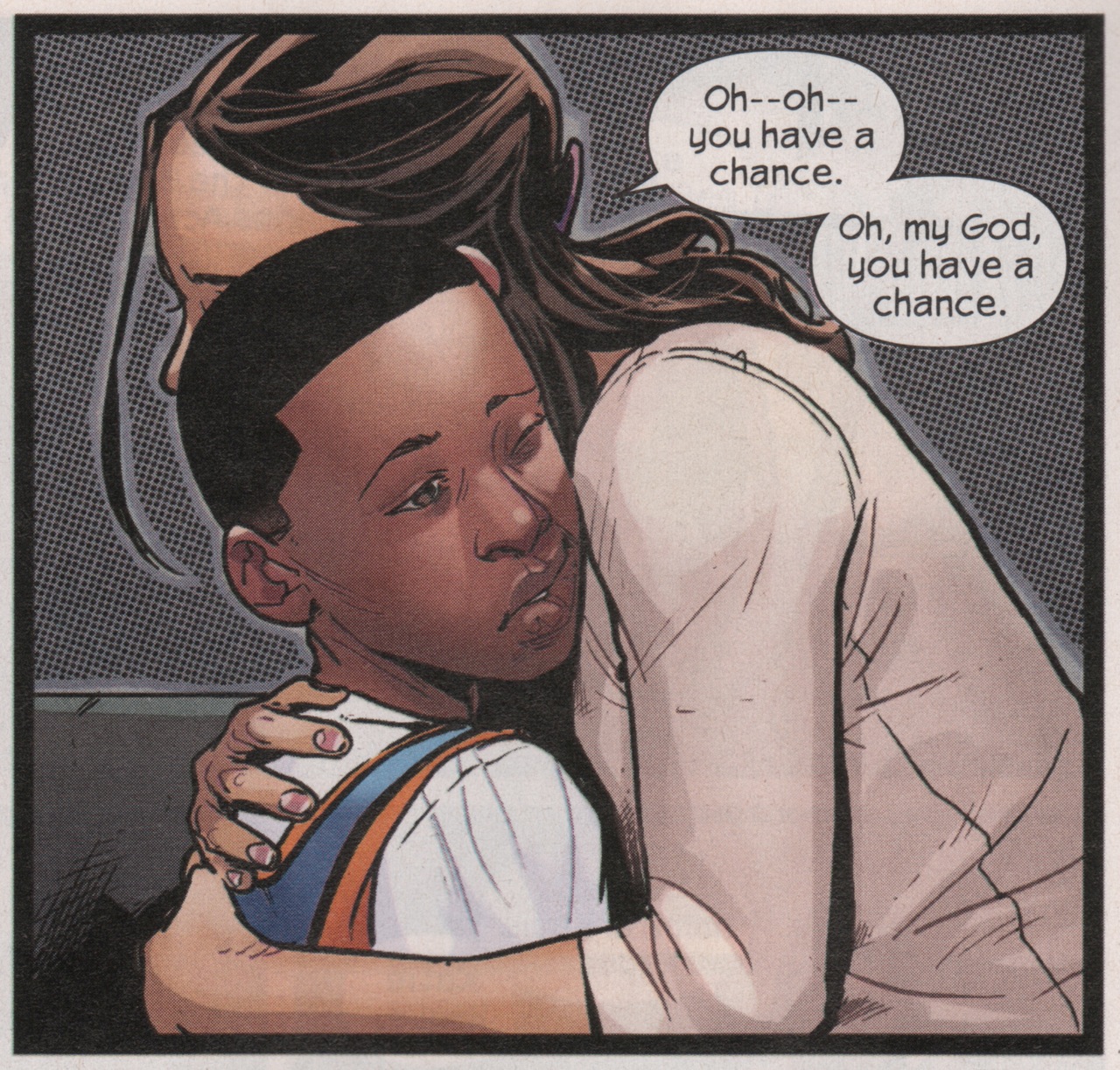
By means of this “school lottery” subplot, then, larger themes of race- and poverty-based exclusion have been placed at the center of the new Spider-Man’s origin story. This doesn’t make USM a political tract.  But it suggests that Bendis understands something very important.  He understands that the history of racism — and the attendant problem of the representation of race in various forms of media — is not simply rectified by a change in the hero’s pigmentation.  Miles Morales’s experiences also need to be different from Peter’s — and not just because he is a different person, but also because he is a person-of-color living in a culture where race relations are vexed (to put it laughably mildly).

Those who haven’t read the title, please don’t get me wrong.   Miles’s race is not THE only or even the central issue in the comic; but it is part of the fabric of his experience — just as it should be.

This is tricky stuff to pull off, in any medium, in any genre.  So far it seems to me Bendis is getting it absolutely right.  He deserves praise for that.

4) Finally, the mere creation of Miles Morales seems to have genuinely pissed off Glenn Beck.  Of course, Beck is the king of manufactured outrage — but if Bendis did manage to get under Beck’s toad-like-skin for even a minute, that only makes me want to cheer him on.

So, to come back to my initial observations: it seems to me that there’s a lot of instinctive critical hostility out there online (and also in academic circles) among comics critics when it comes to the superhero genre, and some of it  — maybe even most of it — is justified.

Nevertheless, I can’t help feeling that some of this critical hostility is misplaced — almost like what some philosophers would call a category mistake.  Perhaps the confusion originates in the confused status of the genre itself, as something that began as a form of children’s entertainment, and which therefore gets into all kinds of difficulties when it aspires to “adult” sophistication. But just as it makes no sense to criticize Wall-E for not being Vertigo, similarly, it makes no sense (to me) to attack superhero comics for being superhero comics.  (For being badly drawn or badly written, yes; but for conforming to certain well-established genre conventions, no.)

To put it another way: I don’t expect a Bendis superhero comic to deliver the kind of introspective reflections on parenting and childhood that I expect from, say, the new Alison Bechdel book (which I recently purchased and am keen to read).  I don’t expect his representation of high school to mirror that of an autobiographical cartoonist such as, say, Ariel Schrag.  But within the established conventions of the superhero genre, I find his work consistently entertaining, and often brilliant.  And I think he deserves the highest praise not only for his current work on Ultimate Spider-Man, but also for his previous decade of scripts for the title.

In fact, over the course of his long USM run, Bendis has written some of the only superhero comics that have given me the same “fall-into-the-page” experience that I used to get from the genre when I was a kid (and none of the comics that I read as a kid still work for me THAT way — even when I can find other things to appreciate about them).  Inspired by the latest issues, then, I recently re-read some of those earlier comics from the run — Bendis’s version of the Peter Parker era.  In all honesty, I wasn’t planning on writing critically about these comics, or even thinking too hard about them.  I was too tired for anything that I felt would be more “demanding” — I was just looking for a bit of escapist fun, after a long day teaching (both Hamlet and Watchmen, as it turns out — though not in the same class, I’m sorry to say).

I picked the Venom arc — Venom being a character I never liked in the original Spider-Man universe (an antipathy apparently shared by Bendis himself), but found myself enjoying in his Ultimate incarnation. In Bendis’s revision, the Venom project is something that Peter Parker’s father was working on before he died — a piece of medical research that Richard Parker ends up not owning because (get this) he produced it under a “work for hire” contract for an evil corporation.  The temptation to read this as a self-reflexive commentary on the exploitation of comic book creators is surely irresistible. The story arc ends with a sequence in which Richard Parker speaks from beyond the grave to his son, Peter, via an old VHS tape.  He talks about the feelings of impatience and creative ambition that first led him to sign this flawed “work for hire” contract, and acknowledges that not owning his ideas sucks.  But he also insists on the importance of taking responsibility for one’s own mistakes.  He concludes by telling Peter how much he loves his family — and how having a family at all finally helps him deal with the frustrations he has encountered in the world of his work.  Peter, who has just endured a particularly emotionally punishing series of adventures, is depicted listening to his father with his head bowed.  It’s not the portrait of a winner.  On the contrary, Peter seems utterly crushed.  But as readers we cannot help but nod in assent when Richard Parker expresses hopeful pride in his young son, and faith in the kind of man that his son will become.
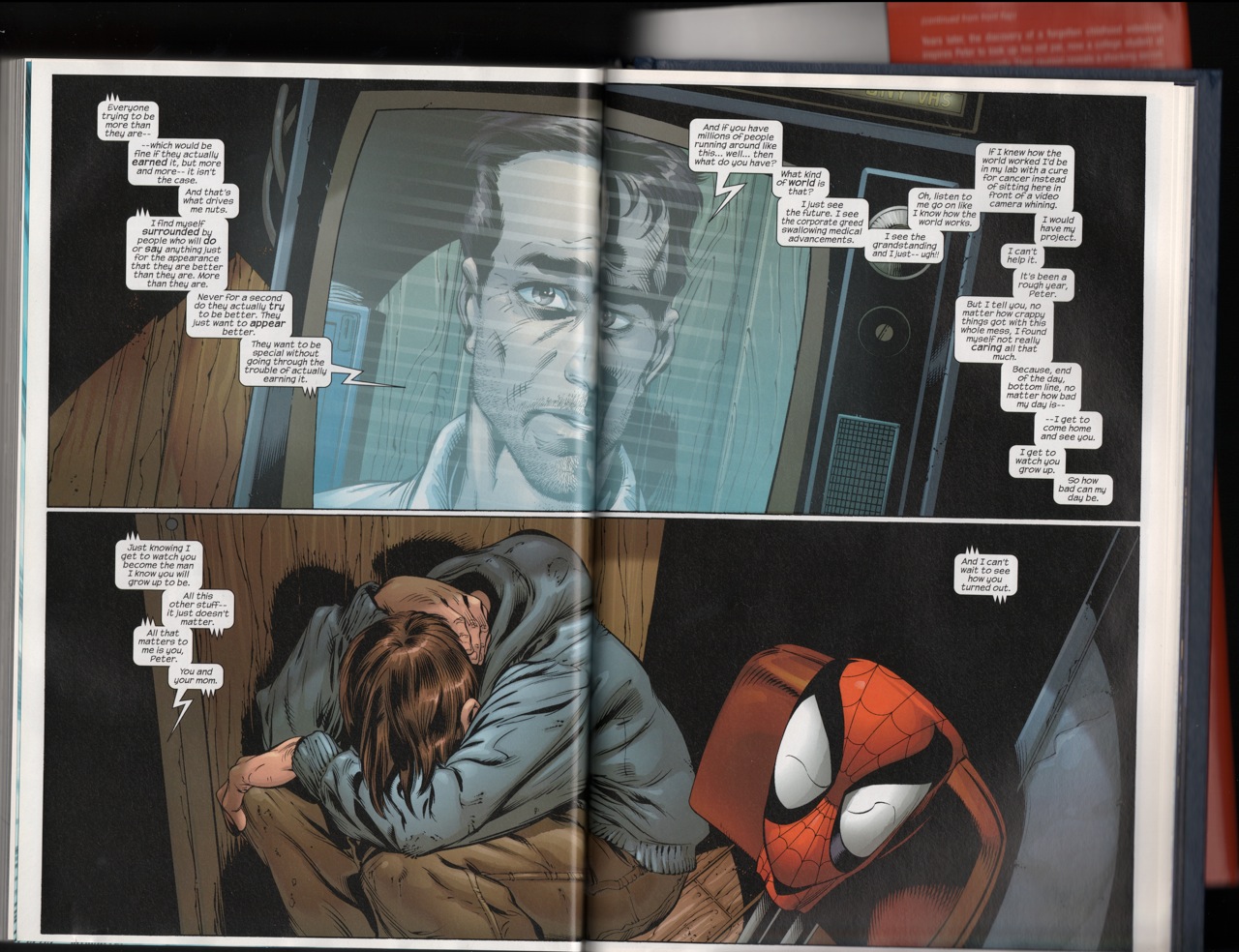
The emotional tone of this moment is complex.  It poignantly and powerfully evokes our admiration for the hero not in his moment of triumph, but in the depths of his despair.  And it moved me to reread this sequence.  Indeed, it moved me as much as anything I had encountered earlier that day in the classroom, teaching the works of Shakespeare and Moore.

The critical cliché would be to claim that at moments like this in his Ultimate Spider-Man run Bendis has “transcended the genre.”  But fuck that.  I LIKE genre work, and I wouldn’t patronize any great genre writer with this supposed compliment.  Brian Michael Bendis doesn’t need to transcend the genre to transport me.

Monthly Stumblings # 16: M. S. Bastian, Isabelle L.

Bastokalypse by M.S. Bastian and Isabelle L.

Is context everything? Maybe not, but it means a lot…

Simply put Bastokalypse is a book depicting genocide and war. So far so good (or not, of course… nothing is simple, as Sempé would put it…), the problem is that the authors, M. S. Bastian and Isabelle L., use the derisive ironic expression typical of comical comics as transformed by the Gary Panter, Mark Beyer ratty line aesthetic school (aka Art Brut).

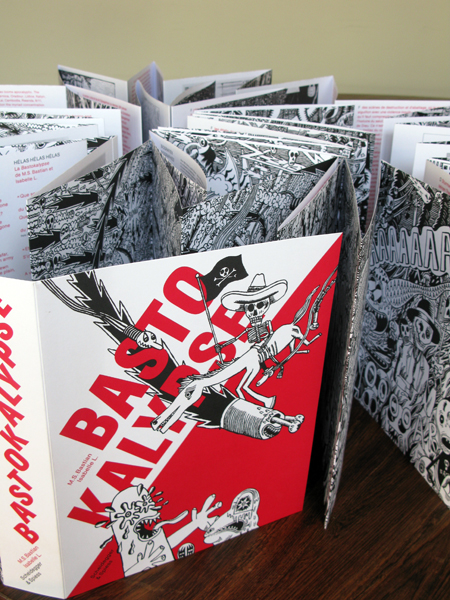
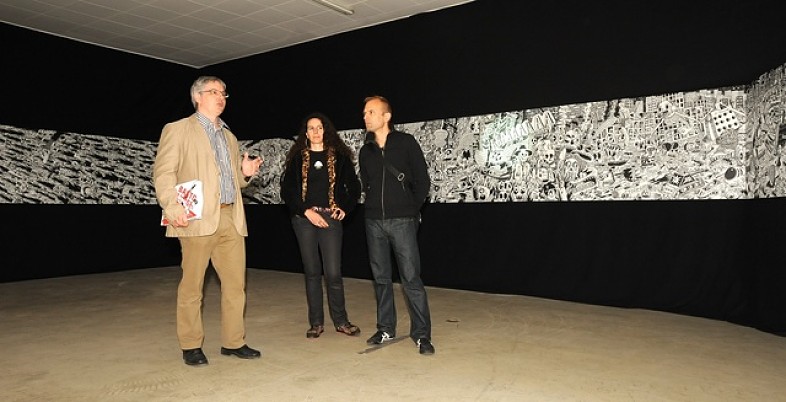
What’s the difference between Bastokalypse and Zbigniew Libera’s Lego Concentration Camp art piece, then? (The comparison is not mine: being a orihon, concertina bound book – see below -, Bastokalypse has a long drawn strip on one side and an essay about the iconography of violence by Konrad Tobler on the other; Libera’s toys are part of a long list of references summoned by Tobler; more about this later.)

Bastokalypse by M. S. Bastian and Isabelle L., Verlag Scheidegger & Spies, 2010.

 From left to right: Goch Museum director Stephan Mann, Isabelle L., M. S. Bastian, 2010 (Bastokalypse is on display in the background). (See also here.)

 Zbigniew Libera’s Correcting Device: Lego Concentration Camp (1996).

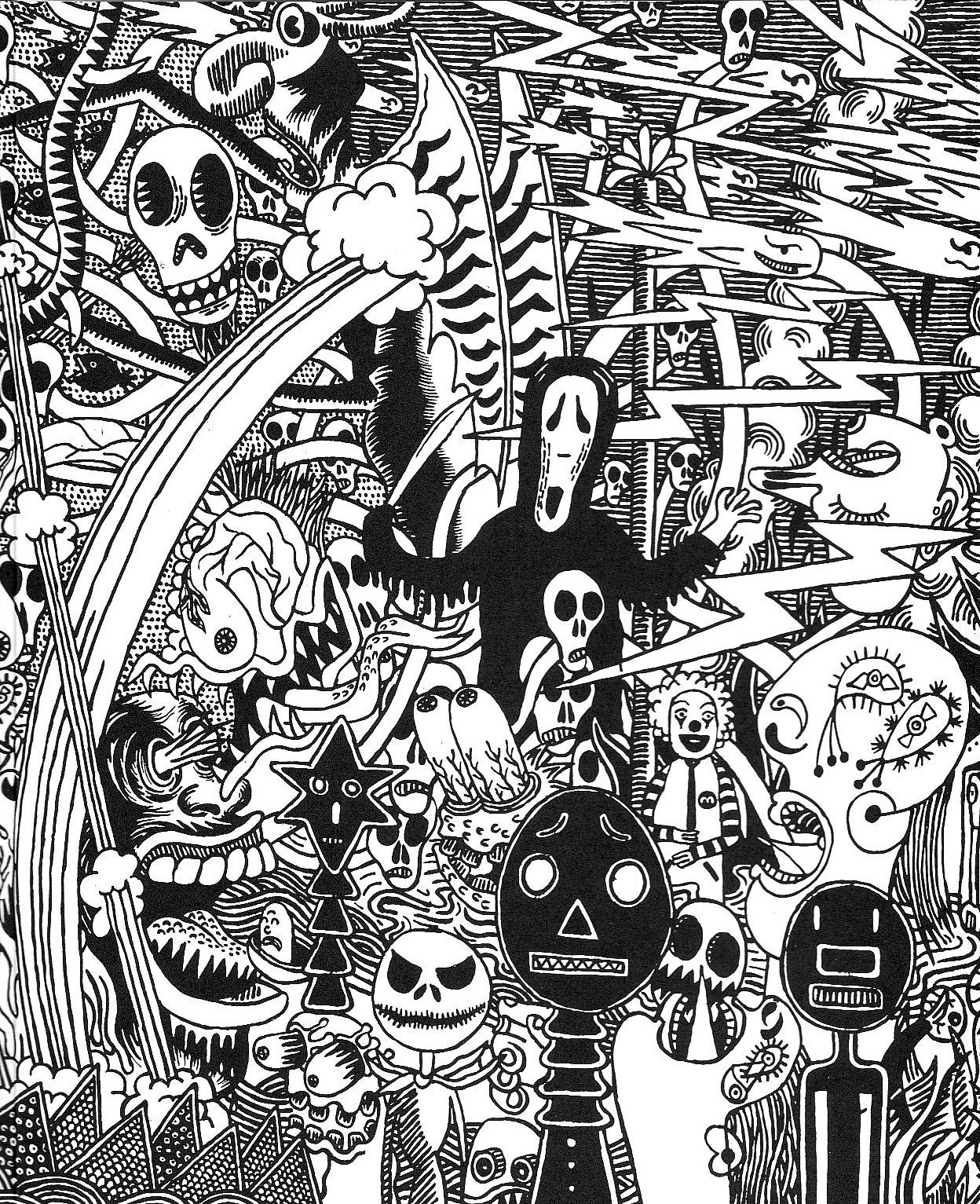
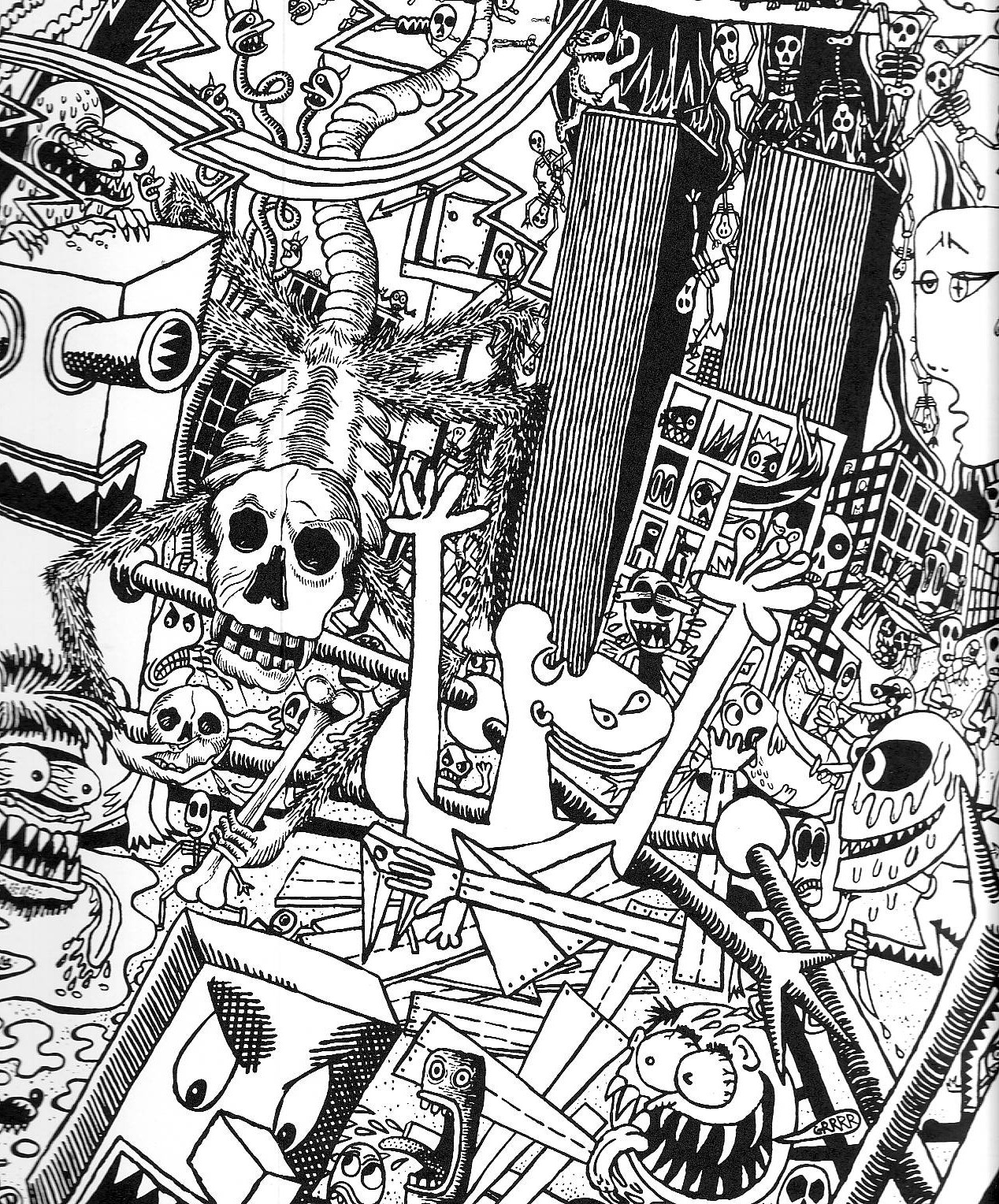
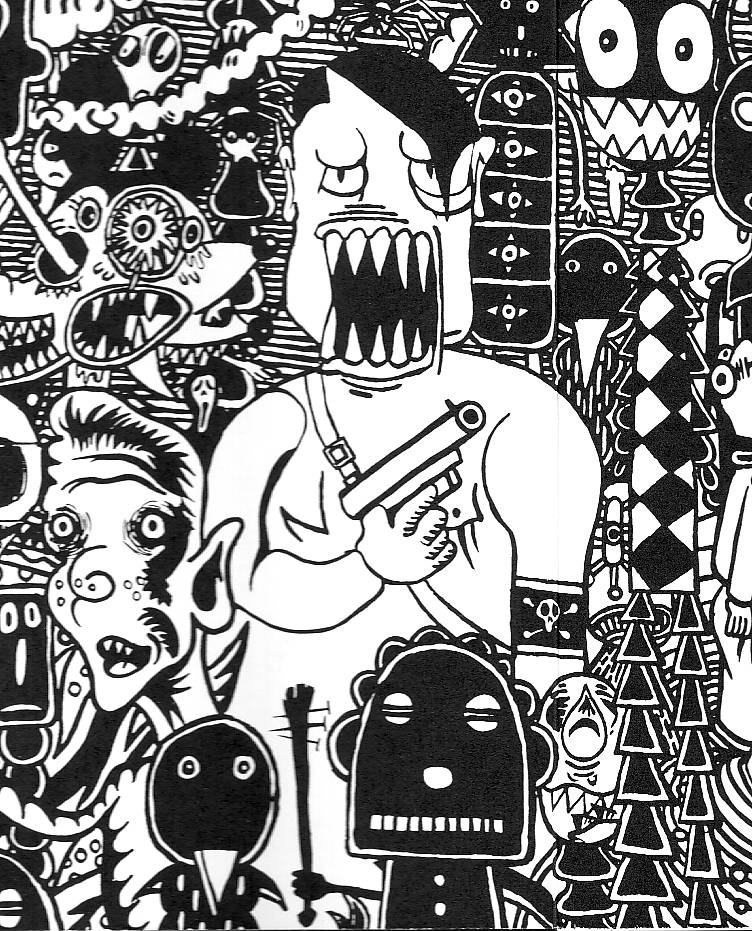
As a gallery comic Bastokalypse is a continuous sequence of black-and-white paintings: 32 canvases (3 ½ x 5 ½ feet each), forming a continuous 168 feet long drawn strip. The book has 32 action packed double-page spreads in baroque, claustrophobiac, horror vacui, nightmarish, compositions. Numerous cultural references  collapse the difference between high and low: from Ronald McDonald to Pablo Picasso’s Guernica, from Gary Panter’s Valise to Jacques Callot’s La Pendaison (The Hanging Tree) and Otto Dix’s Der Krieg (The War)…

Pablo Picasso, Mark Beyer, Ghost Face, Jack…

Picasso again, José Guadalupe Posada, 9/11.

On the other hand, here’s how Stephen C. Feinstein described Zbigniew Libera’s Correcting Device: Lego Concentration Camp:

Each unit of the seven-box set contained a different aspect of a concentration camp. The larger boxes showed the entire concentration camp, with buildings, gallows (one showing an inmate being hanged), and inmates behind barbed wire or marching in line in and out of the camp. An entry gate similar to the stylized “Arbeit Macht Frei” entry point at Oswiecim is included, although without the German inscription. The guards, in black shiny uniforms, came from the regular LEGO police sets. The inmates came from LEGO medical or hospital sets. A second box showed a crematoria belching smoke from three chimneys, with sonnderkammando [sic] or other inmates carrying a corpse from the gassing room. The smaller boxes depict a guard bludgeoning an inmate, medical experiments, another hanging, and a commandant, reminiscent of something more from the Soviet Gulag than the Nazi concentration camp system, as he is bedecked with medals and wears a red hat. Some faces on both inmates and guards are slightly manipulated with paint, to make mouth expressions turn down into sadness for the inmates, and upwards in some form of glee for the guards. The last box is one full of possessions, the type of debris painted by other artists and inspired by the vast array of loots collected by the S.S. in the Kanada warehouses at Birkenau.

Libera calls his Pop cum Conceptual Art projects (i. e.: toys) “Correcting Devices” because he supposedly wants to correct the wrong info given to children about the world. José Cardoso did a brilliant analysis (in Portuguese, though) of this particular Libera work. He did it using as theoretical framework the visual rhetoric findings of the Belgian mu group. He basically concludes that, with a few changes (the suppression of the vivid colors, typical of the Lego construction toys, for instance) Libera’s Lego Concentration Camp functions in the interpenetration rhetorical mode: two distant spaces meet in a third space where both may co-exist at the same time. This third space is constructed by the viewers according to their interpretation. Said rhetorical mode is often used to provoke laughter, for instance, in Monty Python’s famous Greek vs. German philosophers soccer match.

Interpenetration in Bastokalypse exists between all the aforementioned serious historical and cultural references and a tradition of comical caricature dating back to newspaper comics and animation during the first half of the 20th century.  This tradition was revived and transformed during the second half of the same century by the underground and alternative movements.

The way in which we represent the Shoah has been a matter of debate for decades, of course. Libera’s Correcting Device: Lego Concentration Camp was, as expected, polemical from the beginning. Stephen C. Feinstein:

During May 1997, Libera was invited to display his other pop art pieces in the Polish pavilion at the Venice Biennale, but was asked by Jan Stanislaw Wojciechowski, the curator, not to bring Lego. […]  He wound up withdrawing from the exhibition.

I don’t know the reasons why people found the Lego concentration camp offensive. Maybe they associate a toy with children’s puerile pleasure trivializing (and, in a way, mocking) the Holocaust? Anyway, nothing seems to shock people much these days. In more recent times a set was purchased by the Jewish Museum in New York and  the Museum of Modern Art in Warsaw acquired Libera’s concentration camp from a Norwegian art collector for $71,800. The consensus seems to be that Libera’s piece is a criticism of the manipulation of young people by educative systems. Also, the Lego connection is a criticism of corporate culture.

I’ll bring to the table another decisive factor, in my humble opinion, of course: Libera’s work is part of a high art tradition that legitimizes it and narrows the set of possible interpretations. In other words: it brings with it all the weight of what French sociologist Pierre Bourdieu called cultural capital.

Does Bastokalypse share the same privilege? The publishers and curators who support Isabelle L. and M. S. Bastian’s work surely try: galleries in Switzerland (Labo and Papier Gras) specialized in the exhibition and support of the comics avant-garde and graphic art in general function like other more mainstream gallery venues.  Konrad Tobler’s essay tries to give the work a theoretical frame that includes it among many illustrious and not so illustrious (in a post-modern mish-mash) forefathers.

Do they succeed? I’m not so sure. I, for one, view Bastokalypse as an interesting and impressive effort (ten years in the making), but also as a message that’s undermined by its own expression collapsing in the process. Is M. S. Bastian’s and Isabelle L.’s irony completely intended? If not, they delude themselves, if it is I can’t accept it. Call me square if you will or whatever, but I will say it just the same: in the name of the victims.  Comparing Bastokalypse with Francisco de Goya’s Los desastres de la guerra (The Disasters of War) or even with Jacques Tardi’s C’était la guerre de tranchées (It Was the War of the Trenches) doesn’t save it from being inconsistent (the comparison with Art Spiegelman’s Maus is more apt though: both books come from the same place; the difference is that Maus’ (in)expression is a lot more distanced). To end this post in a positive note: I don’t exactly dislike the Posadesque, dance of death, carnivalesque, derisive feel of it all. In the end we’re nothing: Bastokalypse blows up our feelings of self-importance. I may not exactly like it, but, with a few exceptions, that’s what comics have done best for decades…


Adolph Hitler, Mark Beyer, a mutant Mickey Mouse, and one of Charles Burns’ goons (M. S. Bastian and Isabelle L. avoided the controversial depiction of the Shoah).

Isaac Butler on A Good Prometheus, SPOILED

Yesterday I goaded Isaac Butler into writing a SPOILER-FILLED review of Prometheus in comments. I’m going to put it here, because I feel strongly that it is the mission of HU to SPOIL all of everyone’s art forever. So, you know, you’ve been warned. (And if you want a non-spoilery review, check out Alex Buchet’s from yesterday.

Okay, here’s Isaac Butler. Spoilers ho.

Aw screw it, I can’t sleep.

Okay, this is going to be ALL SPOILERS.

Keeping in mind that on a visual and directorial level, I was quite taken with the film, I think that it really doesn’t work on a screenplay level. The screenplay suffers from many problems, but the four biggest are that it’s predictable, that it sinks under the weight of demands outside of telling of a story, that it crams too much content in for its running length and that it ultimately doesn’t makes sense logically.

I don’t care whether Earth being seeded is plausible or not. On almost all things, I’ll grant them their basic premise, and I actually thought that, were the film longer (or a mini-series) this would provoke some interesting religious and philosophical inquiry, the way Battlestar Galactica sometimes was capable of as it pitted genocidal monotheistic robots again polytheistic somewhat more sympathetic humans.

And I know that Alex acknowledges above that there are logical problems etc. with the film, so this is less any kind of counterargument to this post than simply an explanation of why the screenplay-level problems sank the film for this particular viewer. This was one of those instances where I enjoyed the ride but almost immediately afterward, the film fell apart.

Anyway… Let’s start with the logical problems. The biggest one is the film’s premise. The premise of the film is that the aliens who seeded Earth left behind a map to lead us to them. But the twist at the end is that Noomi Rapace et al did not discover their homeworld, but rather discovered essentially a moon-sized Trinity site, a place where they designed and developed extermination weapons that were meant to wipe out all mankind.

So why– back when they liked us– did they leave us a map to their weapons testing facility? I say “back when they liked us” because the film makes it clear the downed alien spacecraft were going to fly to Earth to deliver their payload of spongy penis and vagina monsters. So they didn’t need us to come there to exterminate us. They were going to come to us.

So why does the map go there? The film doesn’t even bother with attempting an answer, it just kind of hopes that you don’t realize that happened. At the end, Noomi and Michael Fassbender’s Head set a course for wherever the aliens came from, so we have it double-confirmed at the end that this planet isn’t their home world. This one particularly rankles me because it’s fixable with like two lines of dialogue “Why did the map lead up to the testing site?” “I don’t know. But I’m going to find out.”

That’s the biggest of the film’s story-level problems, but it’s not the only one. Logan Marshall Green’s character chooses a horrific, painful death via flamethrower when we already know the air on the planet’s surface is toxic due to high carbon dioxide levels and would like deliver a much less painful death in under two minutes. The medi-bay that Noomi Rapace uses to remove the alien from her body is configured for a man even though it’s in a woman’s cabin. (This actually turns out to likely be bungled foreshadowing as to Guy Pearce’s presence on the ship. Bungled because we already know that he’s on the ship as we’ve seen Michael Fassbender communing with a hidden person in cybersleep and Guy Pearce’s Mr. Weyland is the only other character in the entire film and it doesn’t take a rocket scientist to put two and two together. )

Then there’s the characters who don’t behave the way people actually behave. Noomi Rapace’s lack of ever telling anyone “Oh hey, this expedition we’re taking right now is being lead by a robot who is probably not on our side, given that whole trying to force me into hypersleep with an alien fetus monster inside of me.”

Next are the extra-screenplay demands. The film is both a sequel and, clearly, an anchor-film for a new franchise within the Alien Universe. As the third act happens, the film gets taken over by these demands. In particular, there’s a total fan service moment when the chair-gun-thing finally appears and this– rather than anything having to do with character or story– is treated as the emotional climax of the film. The entire staging of the final major action sequence is done so that the ship will be in the right position to be investigated by Sigorney Weaver et al to investigate it in a few years. At the same time, all human and android presence in the ship or on the planet has to be eliminated as well. At the same time, no summer blockbuster can be self-contained unless you’re Christopher Nolan and so it has to have an open ending.

But one of the major problems with the screenplay is simply that it’s got too much content for its running time. I’m all with Alex Buchet on finding the thematic content of the film really interesting. But there just isn’t enough time to explore it, develop character, set up the scares and the action and move the plot along. As a result, everything gets short-changed.

The final problem is the film’s predictability. This is partially not the writers’ fault. After all, the trailer gives away that an enemy spaceship eventually takes off out of the ruin. But there isn’t a single story beat that you can’t figure out from about five minutes into the film. I found myself relieved when Michael Fassbender was going to put Noomi Rapace into cold storage because I thought for a moment they were going to pull a “Psycho” and take out the headlining actor partway through the film. It turned out this wasn’t the case.

I love Ridley Scott, I really do. Alien and Blade Runner are two of my favorite movies and while Gladiator is a totally ridiculous and campy swords and sandals epic… well… so are all the other swords and sandals epics. I’ve enjoyed his minor efforts like Matchstick Men, his competent hackwork like American Gangster and I think The Duelists and even Legend are pretty aces. And the work he does here is admirable. The terrifying segments really are terrifying. There’s some really interesting integration of visual design and theme. Michael Fassbender is wonderful.

But sadly the screenplay just doesn’t work beyond getting you from point A to point B. Compared to Hampton Fancher’s Blade Runner screenplay or Dan O’Bannon’s Alien screenplay it’s just junk. A far better version of this movie was made a few years ago. It was called “Sunshine,” and Danny Boyle directed it and it bombed hard in the States.

Okay, this was a bit rambly but as I said it’s two in the morning over here and I’ve taken some Tylenol PM. Cheers all…