Utilitarian Review 6/7/12

On HU

Featured Archive Post: Caroline Small on Cocteau vs. Ware.

Ng Suat Tong with the 2nd quarter nominations for best comics criticism.

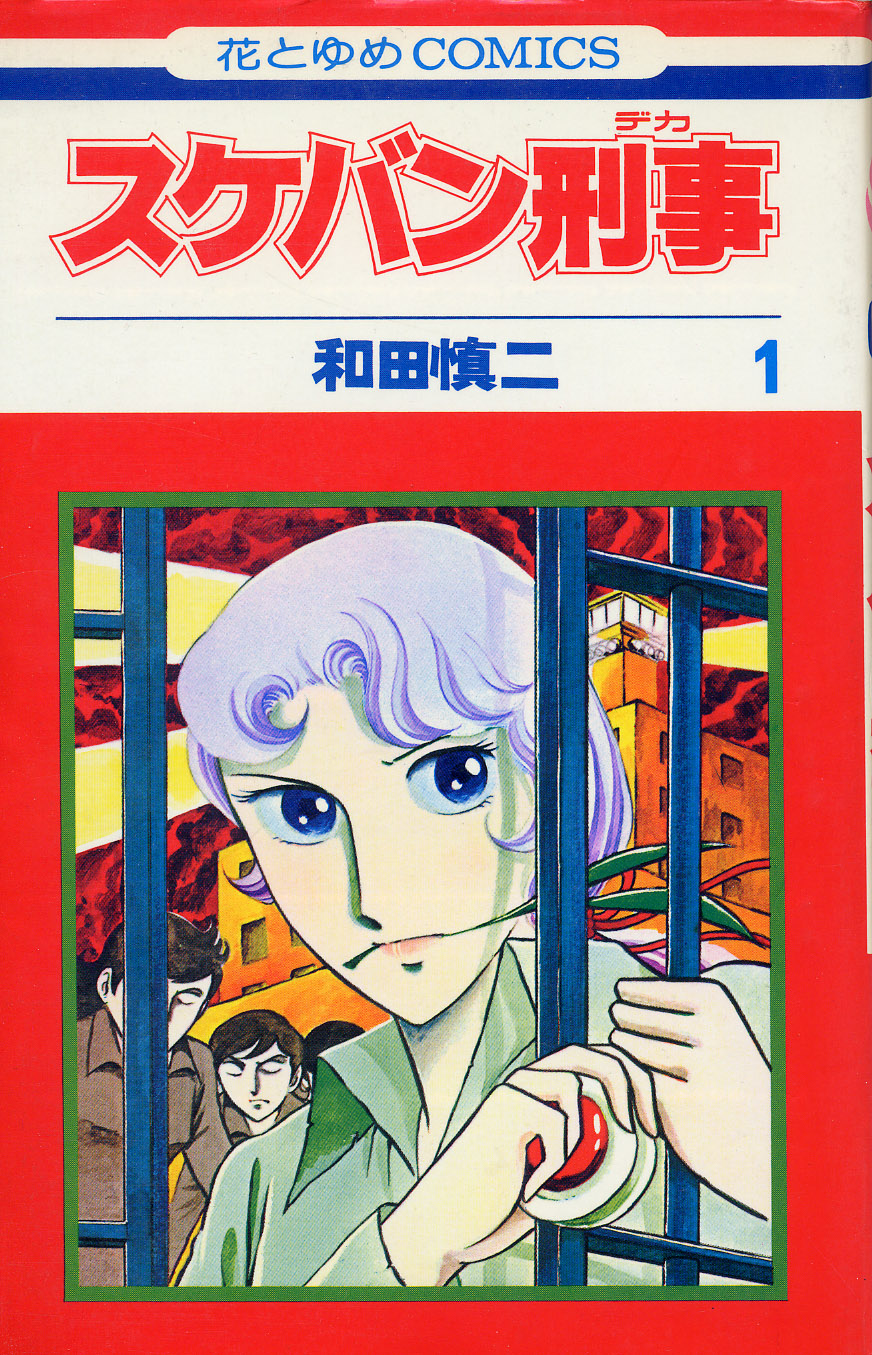
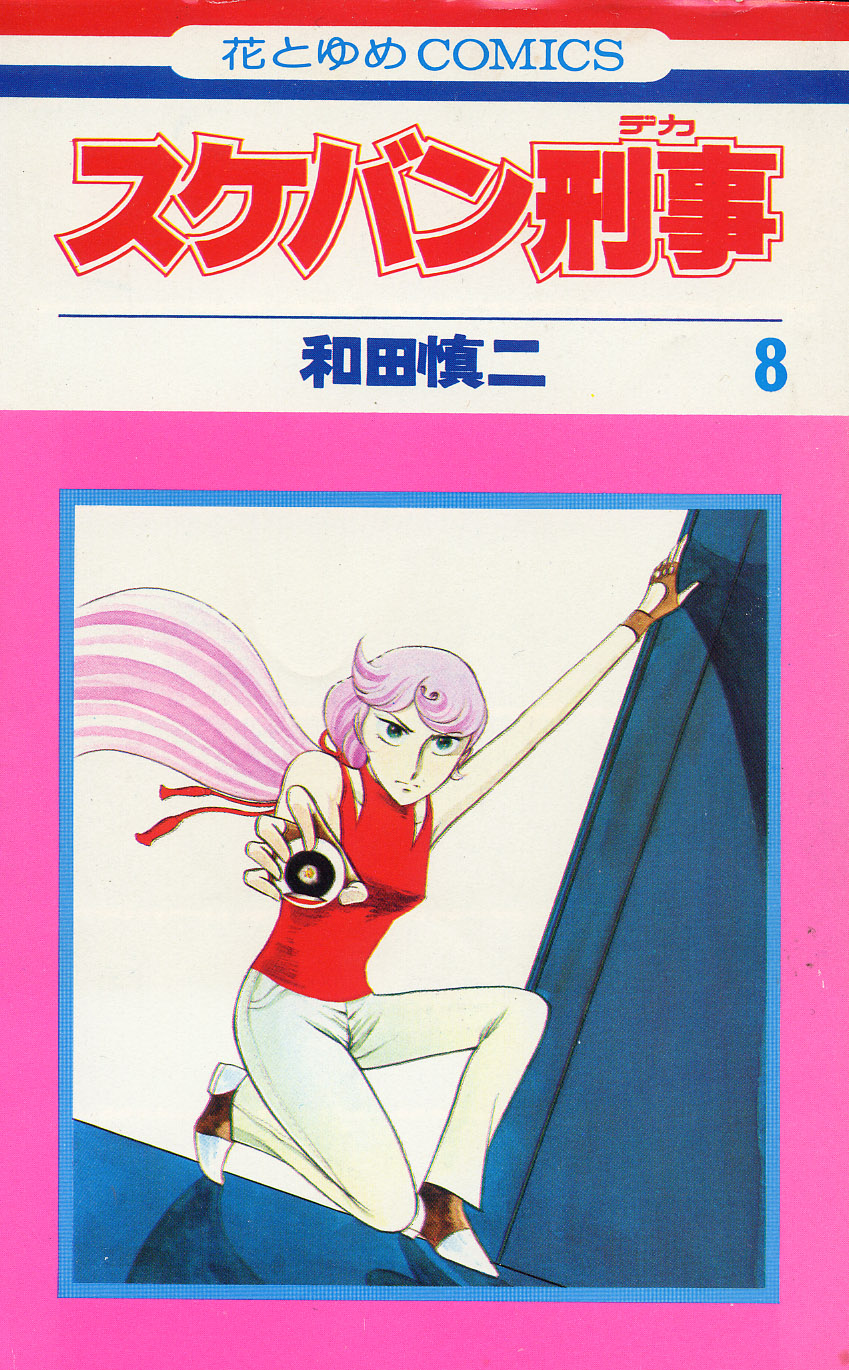
Erica Frideman on Sukeban Deka, hooliganism, high school crime and giant snakes.

Me on Frank Miller’s Wonder Woman, Marston/Peter’s Wonder Woman, and strong men.

Jones, One of the Jones Boys on Johnny Ryan vs. P.G. Wodehouse.
 
Utilitarians Everywhere

On Splice Today I sneer at Liberals sneering at Creationists.

Also on Splice I blame the Founding Fathers for Mitt Romney.
 
Other Links
 
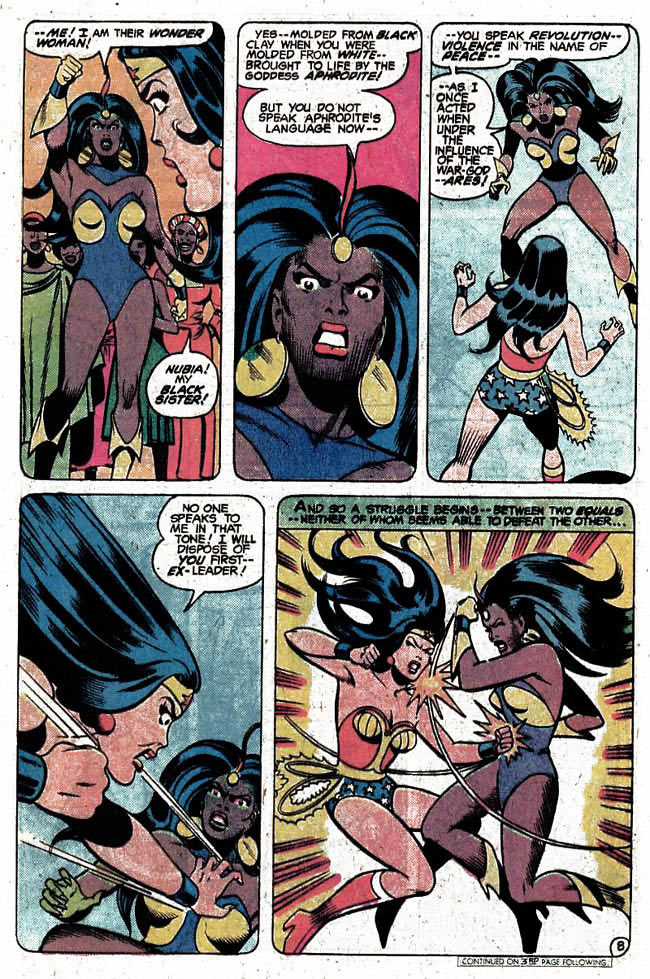
Robert Jones, Jr. on Nubia and Wonder Woman.

N Plus One Magazine on why universities are parasitic leeches that must be destroyed.
 

Boobs Pooter versus Bertie Wooster

Compare and Contrast Cage-Match to the Death: Joltin’ Johnny Ryan and PG “Wehrmacht” Wodehouse

Ten Rounds!

1. Both men are humourists (duh).*

2. Both have mainly made their living from serialising their work, a standard career-path for humourists in their respective times and markets.

3. Although known primarily for their work for adults, both artists have also produced work for children.

Wodehouse started his career writing allegedly comical stories about various misadventures at boys’ schools — specifically, the kind of not-quite-Eton public school that many of the characters in his later grown-up books would have attended, the kind of school where the upper-classmen have “fags” (younger students who perform menial domestic duties for them, like cooking and cleaning), where in summer the students care only about cricket (rugby in winter), where one student is always trying to cadge a fiver off another since he’s already spent his own allowance for the term betting Smythe that he couldn’t balance three copies of Liddell and Scott on his head while singing “I Do Like To Be Beside the Sea-Side”,** and where the Classics Masters have an imperious eye and brook none of the nonsense that inevitably arises. Wodehouse’s early work is for completists only and, even for them, it’s a struggle. He certainly hadn’t developed his wit in those early years; indeed, it would take more than another decade of writing grown-up humour for Wodehouse to start being even routinely amusing, let alone bust-a-gut LOL-worthy. As far as I know, he wrote specifically for children only at the start of his career; his juvenilia being thus being restricted to, well, his own juvenilia.

Ryan, on the other hand: if he’d written that last paragraph, he would have already made a dozen jokes about “fags” that would certainly not be considered suitable for the eyes of children, at least not by any reputable publisher. Nonetheless, Ryan has drawn gags for the now-defunct Nickelodeon Magazine (nearly every single issue, according to Wikipedia), MAD Magazine, and other kid-oriented outlets. It’s not as outlandishly unlikely as you might first think: just take out all the gags about the Holocaust, the KKK, AIDS, hookers — okay, so maybe it is a bit of stretch. But Ryan is first among his peers in plumbing the lower depths of scatological humour, and that sensibility translates well to kids’ humour. You just get rid of any jokes about “adult themes” like the Holocaust, and replace all the references to dicks and pussies and fucking and shit and piss and all that with references to boogers and farts and spew and, well, you’ve just designed yourself the perfect engine for making kids laugh, the very Platonic Form of What Makes Kids Laugh.

Which, I guess, in a way means that Socrates, having escaped from Plato’s Cave to contemplate the Forms themselves, was contemplating not just the Form of Beauty or the Form of the Good, but also the Form of A Unicorn Dressed in Farts Eating A Booger Pizza.

4. Both men work in a more or less blatantly unrealistic fantasy-world.

Wodehouse’s work is not overtly fantastic — there’s no unicorns riding around in Blandings Castle, not even a unicorn dressed in farts. But Wodehouse’s world is almost as far removed from reality: his characters have no more real connection to the greater world than the characters in Seinfeld. When the plot demands it, one character will have to work for a living, but only as the plot demands it. No one dies in Wodehouse, except offstage and generally some time in the past. Bertie Wooster, for instance, is an orphan but his parents appear to be long dead and of little concern to anyone. There are no serious problems for anyone, no real heartbreak or emotional turmoil or physical disability. When, in reading one of his many, many, many books, I came across a character who had not only served in the First World War but whose service was actually a plot-point, my monocle popped out and my wife clutched at her pearls — this sort of thing, essentially, does not happen in the world of Wodehouse. Even if we grant that Wodehouse’s world is, strictly speaking, a realistic one in the sense that there’s no magic qua magic, we can at least say that his world is not a naturalistic one.

Ryan’s world is much more overtly unrealistic, a world with very different physical laws than our own. Boobs Pooter shoots himself and becomes a ghost; he then invades the body of a woman, and fills her mouth with all-too-unghostly cum and then her breasts with shit. Aliens shoot tentacles down from the sky that enact hideous bodily transformations on humans. A missile-rocket visits a normal suburban family to demand a threeway with the pater and materfamilias — which he gets. A nurse makes a rope out of faeces, which she uses to swing around, hanging from the ceiling, like “Spiderman Woman”. Characters die in one strip to reappear in the next one along. Ryan’s world is the world of cartoons, where all the physical laws of our world always apply, except when it’s funnier for them not to.

Ryan, to be sure, does have some strips without Spiderman shit-rope, masturbating ghosts or even farting unicorns — strips which break no laws of nature; but even those tend to be non-naturalistic. For example, there’s a strip where Loady McGee tricks Sinus O’Gynus into thinking that the hot new look for the season is to glue a kid onto the end of your dick

— by the way, federales, please do not arrest me —

but, actually, Loady is just using a midget actor to trick Sinus. Now, nothing there violates the laws of physics, say, so it “could happen” (philosophers would say that it’s nomologically possible) — but, of course, even if the world could work like that, it doesn’t. I can’t think, offhand, of too many Ryan strips that feature people behaving “plausibly”, in a way that someone might actually behave in the real world. Certainly there are some: for instance a bit in the Jokepocalypse where one paramedic laughs at the other one for having hurt feelings, and the all-time classic 100% Anal Rape — where the whole gag is basically Ryan’s deadpan depiction of the victim’s post-event trauma — but this is more the exception than the rule. Ryan isn’t really interested in making a naturalistic or even realistic strip, not when there’s a (if not strictly unrealistic, then at least highly implausible) fart joke to be made.

5. Each has a very different sense of corporeality.

Wodehouse’s characters might as well not have bodies. They like their food, certainly — a particularly skilled chef plays an important role in several of the Wooster novels. And they occasionally get food poisoning, or sunburn, or a cold, or whatnot, and older secondary characters might complain about aches and pains, but only as the plot demands it. They certainly don’t need to shit, and they don’t need to piss, and above all they have no sexual activities whatsoever. Indeed, they appear to have no sexual desires at all, or even sexual organs for that matter. The idea of, say, Lord Emsworth jerking off is almost literally inconceivable. It is as though someone were to try to describe to you the letter “h” having sex with the number 57 — one feels that something must have gone seriously awry somewhere in his understanding, or his grasp of the English language; he has made a sort of category mistake.

Ryan, of course, would quite happily draw the letter “h” having sex with the number 57, but only if he could also draw Hitler licking the resultant creampie.

(Look it up, kids)

(Hey, speaking of not getting myself arrested: if there are any kids reading this, Jesus Christ, go tell your parents not to let you read this post)

6. Both men get a lot of humour from parodying the banality of their contemporary culture, contemporary narrative art in particular.

Wodehouse is nonspecific in his parody, his targets not so much individual artists and their work so much as general styles — the cliche of sentimental novels, mostly, but sometimes mystery novels or Hollywood gangster movies and the like.

Ryan goes personal; indeed, right for the personal jugular. He abridges Craig Thompson’s much-praised Blankets to three panels: boy meets girl, boy is reminded of “awesome piss-fight” with brother, boy breaks up with girl. [NB: this is actually a pretty accurate summary of the book]. Shitzo taunts Ivan Brunetti to just go ahead and kill himself already. Art Spiegelman’s father owns up that he was never in a concentration camp, and the numbers on his arm are just lotto numbers that have never been washed off. R. Crumb narrates a slideshow for his comics adaptation of The Book of Genesis: “uh…and here you see another drawing of Jews with big beards…wearing robes…” [NB: this is also a pretty accurate summary]; scientists fill a rocket with “liquid who gives a shit!” and blow up Crumb and his audience. And so on.

Cartoonists ribbing other cartoonists is nothing new, of course. Witness e.g. Wally Wood’s loving pastiche of newspaper strips in MAD, or Al Capp’s Dick Tracy parody, Fearless Fosdick. There’s probably some cave out there somewhere, as yet undiscovered by archaeology, where some neolithic cartoonist painted bison and hunters in way that totally zinged some other neolithic cartoonist’s painting of bison and hunters.

But Ryan’s parodies, potshots and piss-takes feel different from this. They’re cruel, vicious, bilious — and frequently very, very funny. Perhaps his most vicious swipe at his fellow cartoonists — that is, if you don’t count the already mentioned strip where he encourages the morbidly depressed Brunetti to follow through on the extended suicide note that was Schizo; or his unauthorized sequel to Paying For It, in which Chester Brown dresses up as a “whore” and is beaten, maimed and sexually assaulted, but still comes out of the experience thinking “OMG! Prostitution 4 Life!” — other than these most vicious swipes, and probably a couple of dozen other most vicious swipes, his most most vicious swipe is a strip called The Day The New Yorker Came to Town. In this strip, a take-down of the literary pretensions of art-comix-ers, Art Spiegelman cuts off his own nose to give the New Yorker a blowjob, R. Crumb sticks his adam’s apple up the New Yorker’s arse, Chris Ware gives the New Yorker a “tit-fuck” with his “brain-balls”, Seth (who, earlier in the strip, had pissed his pants at the prospect of a visit from the New Yorker) and Adrian Tomine snack on the New Yorker’s nuts, and poor old Ivan Brunetti, too ugly for the New Yorker, has to settle for sucking off a book of New Yorker dog cartoons.

Now that’s what I call comedy.

8. The main similarity between them is that they were incredibly prolific, with a similar, but not quite identical, effect on the quality of their work.

As it says in the bio at the start of so many of my copies of Wodehouse books, he wrote over 90 books in his life, as well as various plays and musical comedies. I’ve read somewhere between 50 and 60 of them (I’ve lost track, myself).

Ryan has produced hundreds upon hundreds of pages of comics. At times during the 00s, he was simultaneously drawing Blecky Yuckerella — a weekly strip for the “alternative press”, contributing gag cartoons to kids’ magazines, creating his own one-man anthology Angry Youth Comix, and churning out a one-page gag strip on the web each and every week. These last strips seem to have been entirely improvised; they’re often just one non-sequitur after another, as if the result of a game of exquisite corpse played by a gang of toilet-minded imbeciles with Tourette’s syndrome.

Because there’s so damned much of it, a lot of the art created by Johnny Ryan or PG Wodehouse is not very good. Much of it is hackwork. To be sure, due to Ryan’s peculiar sensibilities, his hackwork looks different from what other hacks might produce; but once you’ve seen a dozen vaginas spewing out leprechaun-turds covered in Holocaust-juice, you’ve seen them all. Much of Ryan’s and Wodehouse’s work is not worth reading at all, not even by connoisseurs and devotees.

But, both men, when they’re on, are among the funniest in their chosen medium. I came very close to including Take A Joke, the final collection of Ryan’s Angry Youth Comix (plus miscellanea), in my Top Ten for the Hooded Utilitarian poll — there’s an awful lot of jokes that miss in there, but Ryan has learned the valuable lesson that, if you throw enough of them out there, some of them are bound to hit. And when Ryan hits, he hits hard.

The difference between their prolificity (???) is that Wodehouse is much more consistent. Most of Wodehouse’s books from the mid-1920s on are pretty solid; even when a particular book isn’t hysterically funny, it can be relied on for a couple of amusing bons mots on every page. It’s mostly his early work that is consistently mediocre.

Ryan, on the other hand, is all over the shop. Take A Joke alternates between some of the best humour strips I’ve ever read — e.g. Home Early, The Day the New Yorker Came to Town, 100% Anal Rape, the ending to Graveyard Goofs — and lame button-pushing non sequiturs, like the multi-gag pages originally drawn for Vice.

9. Because they are so prolific, both artists exploit the combinatorial possibilities of rearrangements and variations over just a few basic elements. It would be easy enough to program a random generator to create “new” work by Ryan and Wodehouse by using a handful of variables.

For Wodehouse, the key elements are setting, plot and character. The setting will be [a country manor in a small English village or, much less often, a trans-Atlantic liner/a sea-side resort/New York]; the plot will involve one character who [wants to/doesn’t want to] marry another and who can only do this by stealing [a valuable antique/an incriminating manuscript/a pig], but in their way stands [a jealous suitor/an incognito detective/a rival thief/a hostile prospective father-in-law]; other characters will include [an imperious aunt/a nosy policeman/someone, anyone, in every book, in some kind of disguise/a mischievous but creative interloper who ultimately saves the day with an ingenious scheme].

For Ryan, the variables are: pudenda, impolite bodily functions, non-missionary sex acts, various hot-button topics (9/11, racism, rape…), and a banal or incongruous context. Just throw these together willy-nilly and you’ve got the premise for a Ryan strip, or a one-panel gag, or at least the ending to an improvised strip: a blind date who is half-man/half-shit! Hitler-piss, the only son of Christ! Erotic art-collecting squirrel! Captain America’s juicy pussy, better than Atlantis pussy! Joe Sacco interviewing his own balls about the smell of his farts! God’s giant cock shitting on Louis Riel! Harvey Pekar’s ball cancer running out on him because he and his “fucking friends and […] fucking comics are so boring that [ball cancer] just can’t take it any more!” [NB: this, too, is pretty accurate…] Luba’s haemorrhoid punching a Mexican in the face! A mountaineer riding an off-road tampon! The US President imposing a new tax on baby rim-jobs! A woman so turned on by a passer-by in a shit-wig that she begs him to “do [her] in the butt right now, right here on the sidewalk!!”, but the guy has to go glue his dick back on, at Ye Olde Dick-Glue Shoppe! A giant statue of The Cleveland Steamer! ” Sweet Chubby” Cheeks and Li’l Bloody’s Silly Putty, “made from 100% real homosexual corpse scrotums! So you know it’s good!” A woman indignantly defending her right to breastfeed her beaver as “the most beautiful & natural thing a woman can do!” Martians that love nigger shit, faggot ass and gook splooge (which turn out to be Martian words for, respectively, ice cream, nuts and hot fudge)! Sherlock McRape investigating the strange case of a woman hit in the belly by a jar of jelly while watching Hitler’s robonic testicloids on the TV news! A man on a pogo stick bouncing from vagina to vagina! An “awesome new game” called “Mommy, my faggot has diarrhea!” A Ku-Klux-Klansman stripper jumping out of a wedding cake at a KKK wedding! A man who wakes up married to Retarded Hitler, who in turn goes nuts when offered grape juice because, naturally, he wants to “Exterminate the juice!”. The award ceremony for the 2005 COBBY Funniest Baby-Boner-in-the-Ear Gag of the Year Award! Hopey Glass strumming on Maggie Chascarillo’s electric asshole with her tongue!

You get the picture.

Using a simple structure to generate indefinitely many gags is one thing Wodehouse and Ryan also have in common with another highly-prolific humourist: John Stanley. Stanley created or co-created several thousand pages of Little Lulu and Tubby strips, not to mention hundreds of pages of other comics, and he too worked a million variations off a few basic themes: Lulu tries to join the boys’ gang, Lulu outsmarts Tubby with a dose of his own medicine, Lulu tells Alvin a story about that ol’ Witch Hazel, Tubby tries to impress Gloria and outdo Wilbur van Snobbe… If you want to churn out comedy by the barrel, this is evidently the way to do it.

10. PG Wodehouse is the pinnacle of English-language comedy — his musical dialogue, precision-tuned farce, and above all his inversions and manipulations and play with language and cliche.

But Wodehouse never drew a parody of Marvel Super-Villain Team-Up starring the Red Skull and Art Spiegelman. Advantage: Johnny Ryan.

***

Final Score: Tie

* For this piece, I’ve passed over Ryan’s more recent work, in which he often turns away from humour into straightforward horror or action. To talk about that material would be another post altogether.

** Self-indulgent autobiographical note: the only thing I got out of reading Bryan Talbot’s excruciatingly boring Alice in Sunderland was learning that the Liddell of Liddell and Scott, that faithful companion of my youth, was the father of Alice Liddell aka Alice in Wonderland. Small world.

Image attribution:

Boobs Pooter sketch, Johnny Ryan at Comic Art Collective

Photo of Ian Carmichael as Bertie Wooster, at Hot Guys in Period Costume

Frank Miller Hasn’t Even Seen the Venus Girdle

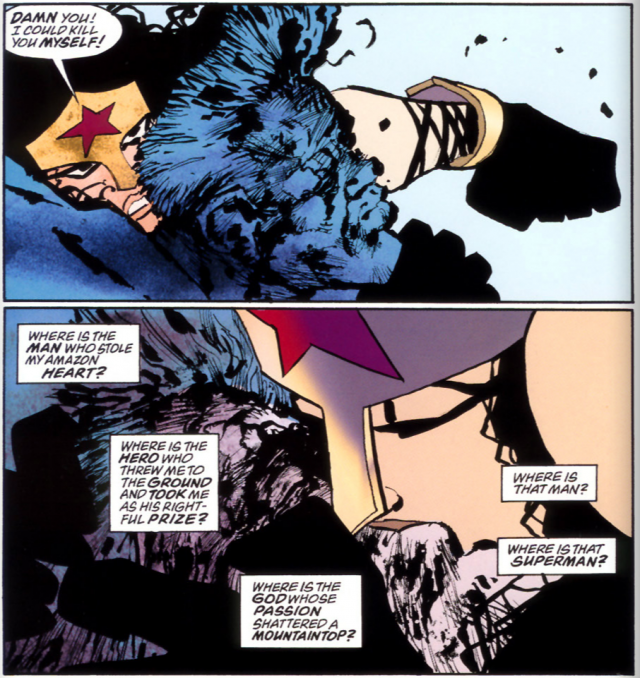
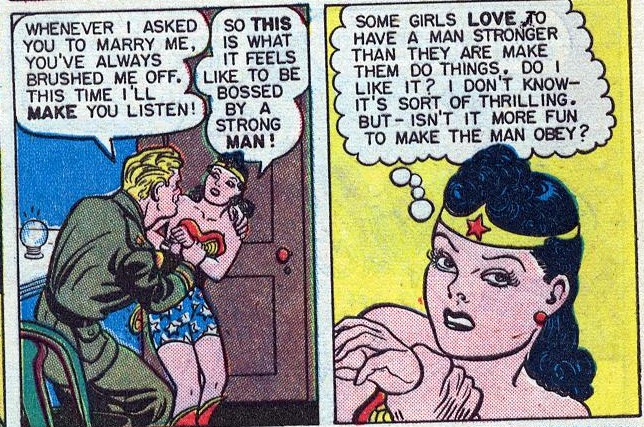
Cameron Kunzelman has a longish post up in which he tries to figure out what’s special about Wonder Woman as a character. Among other things, he talks about this sequence from the mess that was Frank Miller’s DK2.

As this suggests — and as the rest of Kunzelman’s discussion shows — Miller’s WW is largely defined by her relationship with Superman. Sometimes she mocks him, sometimes she fights him, and ultimately (as we see here) she is conquered by him. The whole point of having the strong woman woman there, for Miller, is to make the strong man stronger through his domination of her. Shortly after this scene, Superman grabs her and fucks her and she declares that he’s made her pregnant (“Goodness Mr. Kent, you could populate a planet!”) If you’re feeling flaccid, dominate the castrating bitch and soon you’ll be uncastrated. Wonder Woman’s the phallus which means (a) she can’t have the phallus, and (b) owning her is to own the phallus.

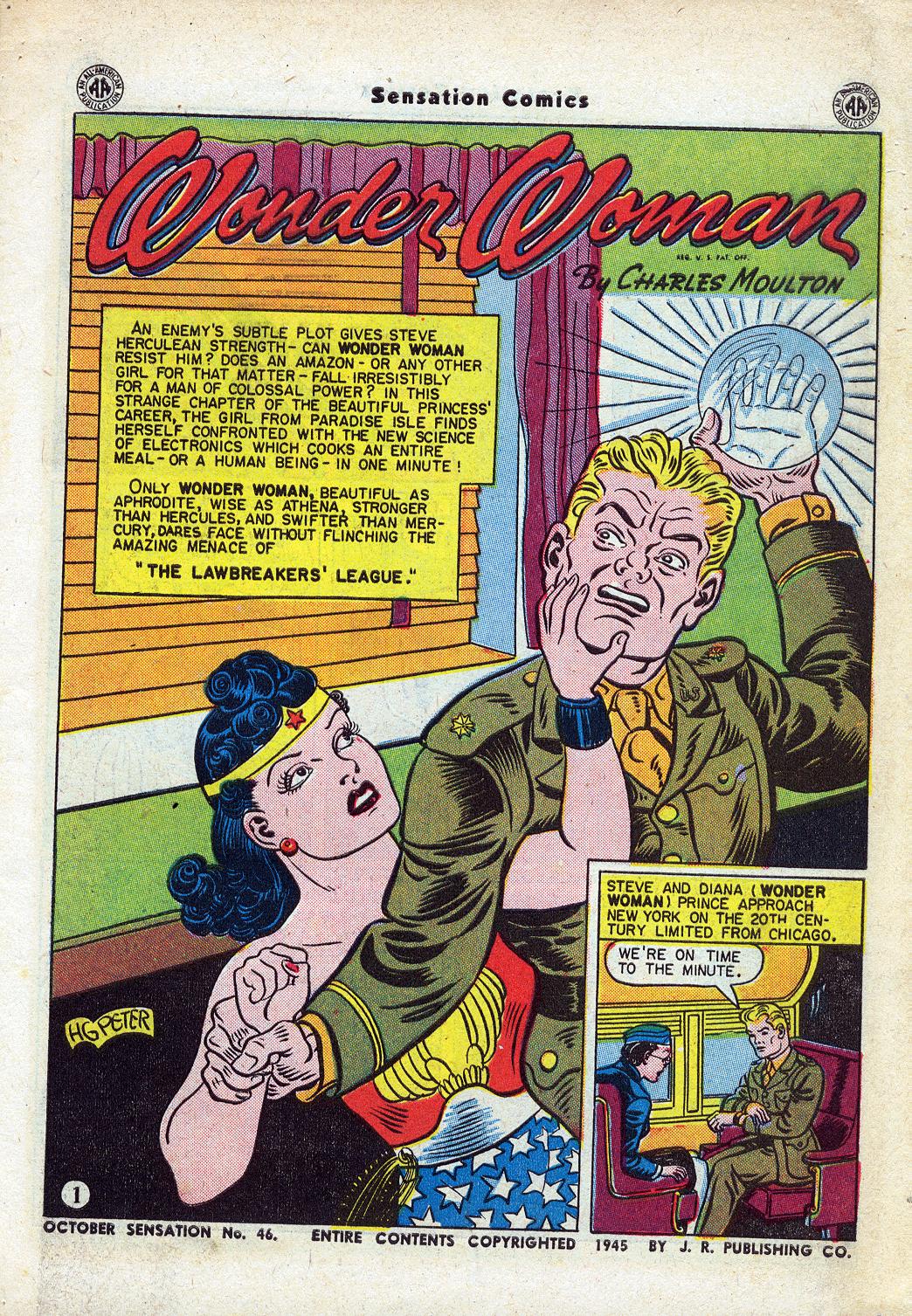
That’s not exactly where Marston is coming from, obviously. For Marston, strong women aren’t there to highlight the dominance of strong men. On the contrary, it sometimes seems like just the opposite is true — strong men only exist to be dominated by strong women.

That’s from Sensation Comics #46. In this issue, like the text says, “An enemy’s subtle plot gives Steve Herculean strength!” A scheming female gangster figures that if Steve is stronger than Wonder Woman, he’ll get her to marry him, and then she’ll stay home and cook and clean rather than fighting bad guys. So she gives Steve an electrical (ahem) ball which makes him uberpowerful.

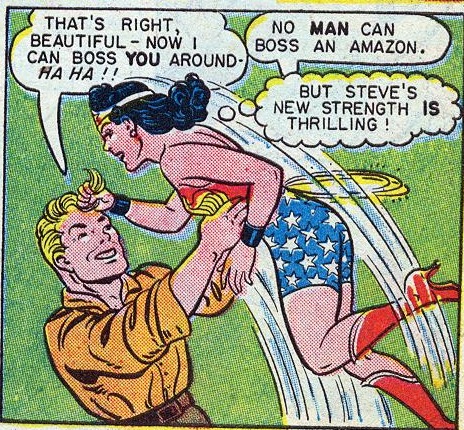
The plot works to some extent; as Wonder Woman says, Steve’s new strength is “thrilling.”


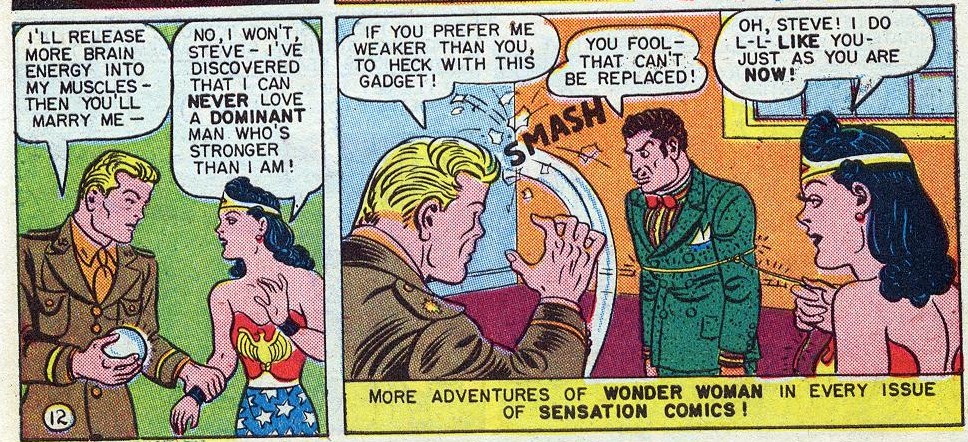
Ultimately, though, Wonder Woman decides that she doesn’t want a stronger man…


and so Steve does the right thing.


In some sense, this is, as I suggested, simply a reversal of Miller — in DK2, the strong woman submits; in Marston, the strong man does. Male/female is not a purely reversible binary, though; the two terms have long histories of meaning and inequity which aren’t simply substituted when you flip them. Men on top and women on top are different in more ways than just the positions of the bodies.

Specifically, Miller’s fantasy of men-on-top is about love as a seizing of power; love and force go together, so that when Superman fucks Wonder Woman, he literally sets off an earthquake. The power of the love is attested by its violence. Men on top express real love by seizing and destroying.

Marston disagreed. “Love is a giving and not a taking” he wrote in his psychological treatise. And so Steve expresses his love not by grabbing Wonder Woman and taking her as his prize, but rather by submitting. With women on top, love is giving up power, not seizing it; embracing weakness, not asserting strength. And where Miller’s version of love involves male dominance and excited female submission, Marston’s version of love-as-renunciation seems more reciprocal. Or, at least, Wonder Woman’s reaction to Steve’s weankness is not a swaggering assumption of mastery, but a blushing admission — “I do l-l-like you, just as you are — now.”

In this regard, I think this image is interesting:


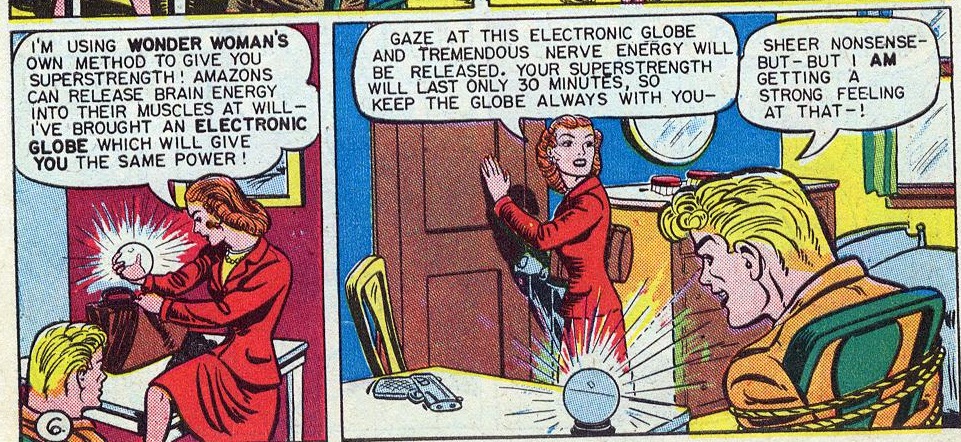
That’s the sequence where Steve first gains his superstrength. The ball is given to him by a woman, obviously. In the first panel, she sits on the desk with her suggestive red dress, her legs spread — and Steve’s gaze seems directed at her crotch rather than at that glowing ball. At the same time, the women explains that the ball will do for Steve what Amazon training does for Wonder Woman. Thus, Steve’s strength is, both narratively and iconically, something taken from women — to be stronger is to be feminized. The point is further emphasized in the next panel, where Peter draws the usually chunky Steve with an almost bishonen grace — his blonde hair poofing out flirtatiously in front, his eyebrows curving eloquently, his lips unusually full.

In Miller, male strength emphatically enforces typical gender norms; Superman’s phallus turns Wonder Woman from battling Amazon to mother, and all is right with the world. In Marston, on the other hand, male strength feminizes…which doesn’t change the fact that when Steve submits out of love, he is also following a feminine ideal. Men on top reads gender straight; women on top, on the other hand, makes everything queer.

It’s probably needless to say that Miller’s version of the character seems to me in just about every way more conventional and less interesting than Marston’s. But more than that, I think Miller’s handling of Wonder Woman really suggests pretty strongly that Kunzelman is wrong when he says at the conclusion of his essay that “Wonder Woman is special.” After all, there’s nothing special about women-as-phallus; there’s nothing special about women as cog in male psychodrama. There’s nothing special (certainly not in Miller’s work) about fetishizing female strength in order to more fully fetishize the strong man who conquers it. Marston/Peter’s version of the character is touched by unique genius, of course. But that genius inheres in their writing and in their art, not in some random corporate property with a particular color scheme and appellation. If creators want Wonder Woman to be special, they need to make her special. Miller — and the vast majority of people who have worked on the character since Marston/Peter — haven’t bothered.

Hooliganism, High School Crime and Giant Snakes

In 2010 I wrote a post about one of my three favorite manga/anime/TV/Live action movie series, Hana no Asuka-gumi. Asuka is indeed a righteous girl gang series, but it is not the oldest, nor the most successful. That honor has to go to what is one of the most awesomely outrageous series ever made, Sukeban Deka.

Life has not been kind to Asamiya Saki. At 16, she is doing time in a juvenile detention center for various crimes, when the police come to her with a nefarious deal – her mother is on death row for the murder of her father. If Saki works for the police to infiltrate high schools and root out criminal organizations, they’ll take her mother off death row. Saki agrees and becomes the Sukeban Deka – the Deliquent Detective.

The manga series, which ran from 1976 – 1982 in the pages of Hana to Yume magazine, was the first, the darkest and in many ways the craziest, of the three massively popular gang girl series. The manga spawned a live-action TV series that ran for three seasons from 1985-1987, in which the name “Asamiya Saki” becomes a title passed down through generations from the first Asamiya Saki to her successors. These were followed by two live-action movies in 1987 and 1988, in which two of the actresses that played Saki in the TV series reprise their roles. In 1991, an anime OVA, which covers the first arc of the manga was made (and for the finale alone, as Saki fights the evil high school crime leader on a burning oil tanker in the middle of the ocean, it’s totally worth seeing.) And, finally, in 2007 the series was resurrected for a brilliant homage/finale, distributed in English as Yo-Yo Cop, in which the original TV Saki, Yuki Saito, makes a cameo as the new Saki’s mother. All but the manga and TV series are available for purchase in English and I can’t stress strongly enough that you should at least see Yo-Yo Cop, because it’s pure genius.

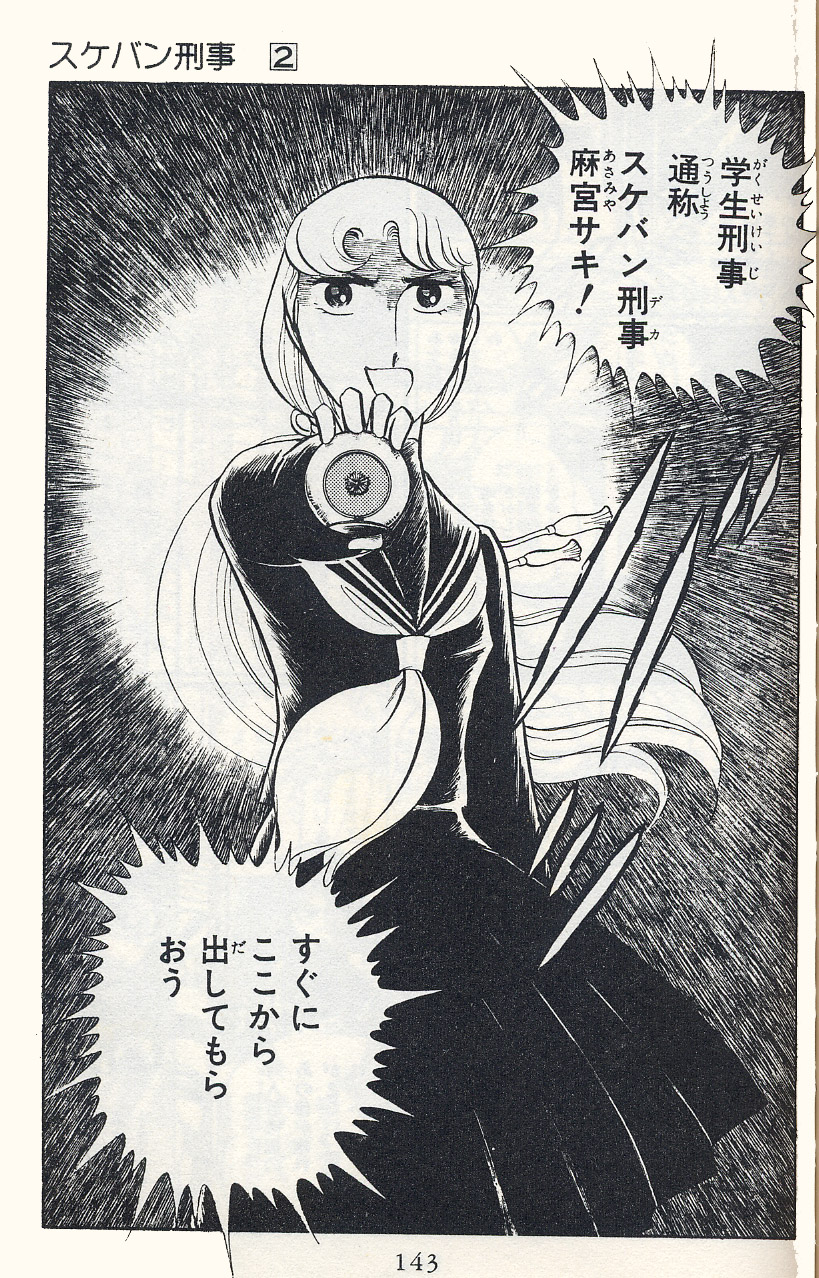
Once Saki agrees to work with the police, she’s told that they can’t actually release her from prison…she has to escape on her own. With the help of her jail friends, Saki escapes and makes her way to the police, where she is given a Yo-Yo as a weapon (since minors can’t carry weapons, a proscription that Saki occasionally breaks when needed.) In the Yo-Yo is the Chrysanthemum seal, which Saki displays to let the bad guys know she is an official representative of the police. (Much as the protagonist of Mito Koumon displays the Shogun’s seal to let the bad guys know they were caught red-handed and by whom.)

Saki is taken under the wing of a half-Japanese, half-American named Jin who acts as mentor and boss. Jin and Saki eventually fall for each other, but they are never actually a couple in the course of the series.

As Sukeban Deka, Saki is enrolled in various schools long enough to draw the attention – and eventually the wrath – of the local criminal bosses. Saki takes down the gang, then the bosses and transfers away to the next school. In the course of the 22 volumes of the manga, Saki loses her memory, ends up on the west coast of the US for a while,  and then the east coast of the US for a while, until she regains her memory. Towards the end, Saki is transferred to one last post – in a juvenile detention center, rather than a regular high school. And this time, her enemy is not another student, but the evil warden himself, who raises giant snakes. Saki defeats the warden, of course. The final arc is the darkest, as she faces an adult criminal overlord. She wins, but at the sacrifice of…well, everything. Jin and she are finally united in death.

And death it is, as Wada Shinji makes perfectly clear on the last page. There will be no sequels of this series, as there were of Hana no Asuka-gumi or continuations as there were with YajiKita Gakuen Douchuuki. In fact, when the resurrections of those series brought girl gang manga back into the limelight a few years ago, Sukeban Deka was re-released as is, with no new material created.

The art style Wada used rode the line between shoujo and shounen at a time when it was massively unpopular to do so. Saki might be shown with “shock!” eyes, or with a murderously intense expression, and action shots were quite common. This style left its mark on many a mid-80s series, including Asuka and YajiKita . It’s not unfair to say that we might never have had a Revolutionary Girl Utena, or PreCure if we had not first had had Sukeban Deka.


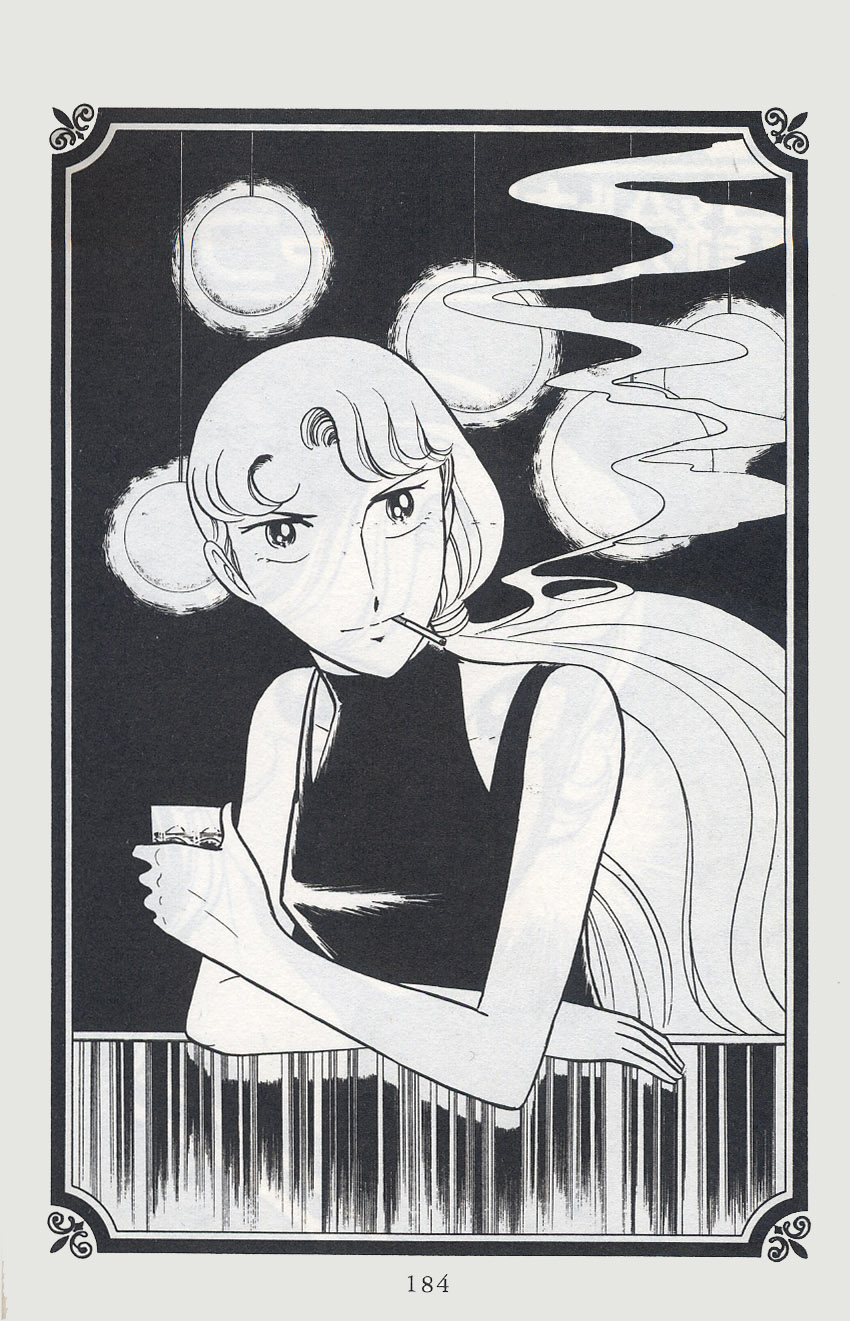
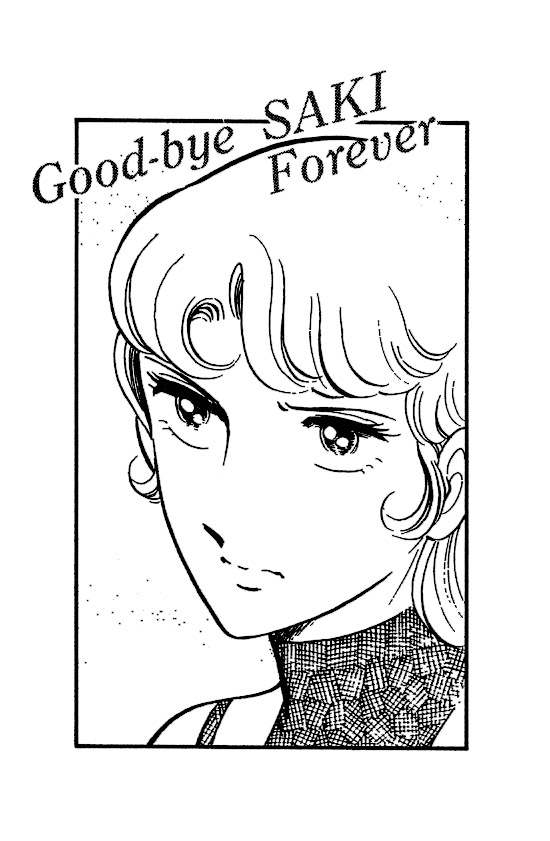
My collection of obscura includes a Saki figurine and a Sukeban Deka Yo-Yo. But it’s this one still from the manga that is my most prized possession of Saki. This image of 16-year old Saki on her off hours, drinking and smoking will never again be replicated in today’s sanitized manga world. Sukeban Deka is a paean to a world that is lost, a world that contained high school crime syndicates, gang girl violence and giant snakes.

Good bye Saki – forever.

Best Online Comics Criticism 2012 – 2nd Quarter Nominations

(Honoring online comics criticism written or published in 2012. A call for nominations and submissions.)

This is part of a semi-annual process to choose the best online comics criticism.  The first quarter nominations can be found here.

When I survey the field of comics criticism, it sometimes occurs to me that  the popularity of a piece is frequently inversely related to the amount of effort and thought put into writing it. Why then do individuals continue to produce long thoughtful articles? The truth is that they don’t or rather not with the kind of frequency the form actually needs, and especially not when the work is done gratis. But putting these things aside, perhaps it is in the nature of these writers to go to such lengths. We can put some of this serious writing down to a sense of personal endeavor, academic training, and the intense hobbyist with a competitive spirit.

There is also the question of critical communities. If a community favors the latest costume changes, creative team shifts, and the latest news from the big two then news hungry one-upmanship will probably be the norm.  If the central idea of a community is to contribute to a critical project centered on comics (social, aesthetic etc.), then the tone of the articles will follow suit. The quality of the articles will be dependent on the taste and discipline of the editor and the commitment of a core team of writers; both these factors engendering a critical climate in which only writing of a certain quality is to be expected of all who contribute. A piece meal promotion of more elevated writing will depend far too much on the individual writer’s proclivities and drive to sustain quality (a central problem with an earlier incarnation of TCJ.com.) This is especially true for comics criticism where amateur sites have a disproportionate influence and editorial influence severely curtailed.

Reiteration: Readers should feel free to submit their nominations in the comments section of this article. Alternatively I can be reached at suattong at gmail dot com. Web editors should feel free to submit work from their own sites. I will screen these recommendations and select those which I feel are the best fit for the list. There will be no automatic inclusions based on these public submissions. Only articles published online for the first time between January 2012 and December 2012 will be considered. I have included some Hooded Utilitarian articles in the selection, mainly from people who I have little to no contact with. Readers (but not contributors) of HU should submit their own nominations for this quarterly process.

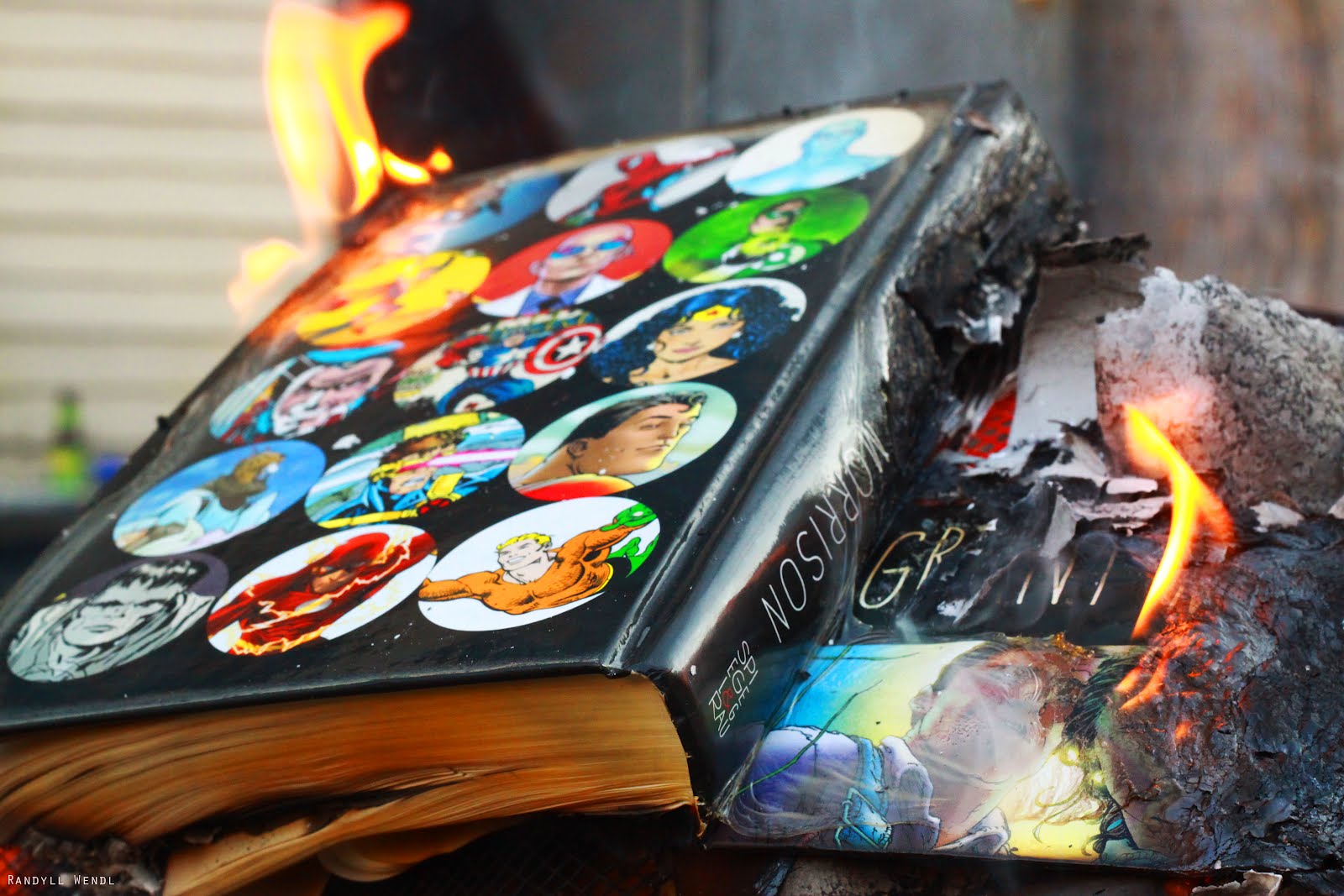
[Matt Seneca burning some pompous rubbish…apparently]


Sarah Boxer on Krazy Kriticism. At one point in her article, Boxer writes:

Now that Krazy Kritics have gotten their dearest wish — all of the SundayKrazys published in book form — what will happen to Kriticism? Will it yield to real criticism?…One essay in Yoe’s collection, Douglas Wolk’s “The Gift,” offers a ray of hope. Wolk finds something new to analyze in the strip — its peculiar pace: “The real comedy of Krazy Kat is almost always slower than its surface humor, which is appropriate for a strip whose central joke is miscommunication on a grand scale. The one way you can’t read it for pleasure is quickly.”

While Boxer offers a nice survey of Krazy Kat criticism, this revelation seems more like stating the obvious than anything novel.  Not that stating the obvious isn’t useful but it should be correctly labeled as such. Her more interesting point, I think, is that Krazy Kat lacks development, a claim which I think is not indisputable but worth discussing.

Steven Brower on Kirby’s collages.

Robb Fritz – Moves Like Snoopy. Fritz’s article doesn’t have the beauty of language which I usually associate with nostalgia-tinged pieces and a lot of the interest in it stems from the collection of quotations from various sources. You can certainly see the seams where the research was fitfully stitched in. It didn’t work for me but that doesn’t mean it won’t work for some.

Kelly Gerald on Flannery O’Connor and the Habit of Art. This is actually an excerpt from the afterword to an upcoming collection of cartoons by Flannery O’Connor. I suppose this only goes to show that people put in an effort when they’re in print (and presumably paid for it.)

Lee Konstantinou on Metamaus (“Never Again, Again”)

Bob Levin on Manny and Bill, Willie and Joe.

Farhad Manjoo on Editorial Cartoons.  The news that editorial cartoons are “stale, simplistic, and just not funny” is about as fresh as the idea that superhero comics suck. Manjoo’s insights into the inferiority of  Matt Wuerker’s (Pulitzer prize winner) cartoons are also not particularly challenging. Furthermore, the suggestion that political cartoons should be excluded from the Pulitzer PR game is somewhat nonsensical. If the Pulitzer committee was seriously interested in offering prizes only to the best works of American literature and journalism in any one year, they would put serious consideration into adopting and liberally using a “No prize this year” category. As it is, they don’t. Nonetheless, I’m putting this here simply because someone outside the comics reading room finally noticed the obvious. It should also be noted that he does offer some other poor alternatives to political cartoons.

Hannah Means-Shannon – Meet the Magus Part 1 (The Birth Caul) Part 2 (Snakes and Ladders). This article is a bit of a departure for Sequart.org, a site which focuses largely (but not exclusively) on medium to long form articles on superhero and mainstream titles.

Evie Nagy on Tarpé Mills & Miss Fury (“Heroine Chic”).

Meghan O’Rourke on Alison Bechdel’s Are You My Mother?

Katie Roiphe on Alison Bechdel’s Are You My Mother?

Matt Seneca – Why You Hate Grant Morrison (Life on Earth Q Part 3). This piece was recommended by Noah but, in my opinion, it’s not Seneca doing what he does best. It has a kind of novelty appeal since Seneca hardly ever does negativity but he still needs a few more practice swings to get used to the feel of the hatchet.

Jason Thompson on Shigeru Mizuki. As evidenced by the poll 2 years ago, Thompson’s articles for his House of 1000 Manga column are a big favorite in the manga blogging community.

Kristy Valenti on Astro City and the White Man’s Burden.

Chip Zdarsky – Who Writes the Watchmen? From the first quarter of 2012. Nominated by Jones.


At The Hooded Utilitarian

Eric Berlatsky on Los Bros Hernandez (Parts 1 and 2).

Corey Creekmur – Remembering Locas. This is from the tail end of March but wasn’t included in the previous listing. Nominated by Jeet Heer.

Sharon Marcus – Wonder Woman vs. Wonder Woman

Andrei Molotiu – Built by a Race of Madmen. From the first quarter of 2012. Nominated by Gary Verkeerts.

Katherine Wirick on Watchmen: Heroic Proportions.


At TCJ.com

Prajna Desai on Bhimayana.

Jeet Heer – Crumb in the Beginning

Ryan Holmberg on Tezuka Osamu and The Rectification of Mickey.

Ken Parille – Six Observations about Alison Bechdel’s Graphic Archive Are You My Mother?

Dash Shaw on Jeffrey Brown’s Cat Comics.

Kent Worcester on British Comics: A Cultural History.

The Jack Kirby: Hand of Fire Roundtable (Parts onetwo, and three). Organized by Jeet Heer and starring Glen Gold, Sarah Boxer, Robert Fiore, Doug Harvey, Jeet Heer, Jonathan Lethem, and Dan Nadel. I have no doubt that this roundtable will be on many people’s short list of best comics criticism for the 2012. It’s messy, sometimes incoherent, occasionally funny and, towards its close, reasonably informative. Some of the participants are true blue Kirby experts which makes it all the more disappointing they weren’t pushed in the right direction or milked more thoroughly.  As James Romberger suggests in the comments of the third section of this roundtable, this should have been extensively edited so as to ensure a sensible flow of ideas (not to mention the excision of ridiculous amounts of noise). Personally, I would have preferred fully worked-out essays as opposed to a mailing list discussion.

I had hoped that TCJ.com would expend its energies on topics and comics which have had 1/100th of the exposure Kirby’s comics but I think that would be asking too much. There has been a consistent devotion to the comics of Kirby in The Comics Journal since its inception and TCJ.com and Jeet et al. merely extend this tradition. The lack of a balancing voice in the exchange is also telling. Sarah Boxer’s dissent (in the third section of this debate) while amusing hardly constitutes a proper reassessment of Kirby’s influence and real worth.