Voices from the Archive: Melinda Beasi on the Bechdel Test and Nana

Erica Friedman did a post way back when on the Bechdel test. It prompted a fun comment thread, including a lengthy discussion by Melinda Beasi, which is reproduced below.

I’m glad you brought this topic back here after the conversation on Twitter. I think, in retrospect, why I reacted negatively to Mo’s personal taste being included as a criteria for the test, is that suddenly a test that I personally looked to as a guide for helping me find works I might enjoy (lists of manga, books, movies, etc. that fulfilled the letter of the test were popular when I was a regular on LJ) had essentially shut me out. Because while I always prefer stories containing strong female friendships and a significant female presence–the kind likely to emerge from following the letter of the test–by adding in Mo’s taste, nearly all the work I liked best was eliminated or at least deeply in question. So where was my list now? If the women I most identified with and most enjoyed reading about suddenly weren’t interesting enough for Mo, I felt thrown out along with them. It was as though after all the youthful years I spent being viewed by my peers as “not feminine enough” to be an acceptable girl were being followed up on with years in which I would be viewed as too girly to be an interesting woman.

Obviously, that’s an extreme (and inappropriate) reaction. Why should I care what Mo thinks of my books? I know why I like them and, whether she would read them or not, I gain strength and insight from the women within their pages. And it may be that I was simply mistaken to interpret the test as a guide for finding stories about women that might interest women. Perhaps it really is just intended to identify stories of interest just to women like Mo. So maybe what I’m really looking for is a different list. I, too, am interested in books where female characters are engaged with each other on issues other than the men in their lives. I think, though, that because the reality of my life differs so much from Mo’s, I’m looking for something a little different in my fiction.

I actually don’t think you’re wrong at all when you suggest that women are still socialized to be needy and that our fantasies are influenced by the expectations set up for us. This is our reality. This is my reality. So when I’m looking for characters I can identify with in manga, I’m going to find that in women who struggle with exactly those things.

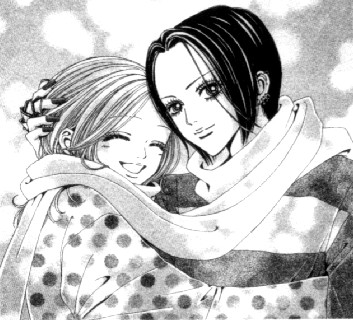
For instance, one of the characters I identify with most is Nana Komatsu (aka “Hachi”) in Ai Yazawa’s NANA. While I’ve got a career drive that better resembles her friend Nana Osaki’s, like Hachi, I can measure my past in increments of ex-boyfriends. I’ve struggled, as she does, with being hung up on men, with needing to feel loved (even when it’s false), with needing to keep my real thoughts and feelings secret for fear of losing that love, and so on. I’ve come further than she has (*maybe*, that’s probably more appropriately discussed over beer) but while she’s a woman Mo might find tiresome, she’s one *I need to read about*. She’s relevant to my life. Not the life I maybe wish I had, but my actual life. What I love about NANA is that while Hachi struggles with these things, what the real story is about is how, ultimately, the relationship that Hachi and Nana have with each other is more real and more satisfying than their tumultuous relationships with men. Do they talk to each other about the men in their lives? Certainly. They also talk about their careers, their personal hopes and fears, each other, and everything else under the sun. These women reflect myself back to me, but they also provide a blueprint for female friendship in which I can find hope and inspiration. I can’t undo the person I am or the broken things in my own past. I can’t erase the way I was socialized or what that made me. So for me, seeing that addressed on paper is important. It’s what makes something more than fantasy for me as a reader. And because so many women still struggle with these things daily, I think these stories are important as stories for women, if not perhaps as stories for women like Mo. In my world, these women are heroic.

All that said (and perhaps to get around to your actual point), Blindmouse’s recent Top 12 Fictional Female Friendships inspired me to try to put together my own list focusing exclusively on manga. But when I sat down to write it, I had trouble coming up with more than five. Though I could think of many, many strong, inspiring, heroic women in manga, I could think of just a handful who actually appeared together in the same story. Perhaps that should not have surprised me, but it really did.

Araki Hirohiko at the Louvre (pt. 1)


“I can’t tell if it’s a gay manga disguised as a battle manga or an adventure series disguised as a fashion magazine.” –fan reaction to Jojo’s Bizarre Adventure

Araki Hirohiko is an immortal vampire, and also the author of long-running Shounen Jump manga series Jojo’s Bizarre Adventure. According to Wikipedia, Jojo is “Shueisha’s second longest running manga series at 106 volumes and counting (only Kochira Katsushika-ku Kameari K?en-mae Hashutsujo, with over 170 volumes, has more)”. I can’t do a better job of summing up this series than Jason Thompson, one-time Jojo editor, so I suggest you go over to House of 1000 Manga to read his summary/review. The quote above pretty much nails it, though I’d also add that Jojo is a horror manga disguised as a superhero comic – or vice versa – an especially strange combination as the two genres are opposites. (Superheroes are a fantasy of absolute power while horror is a nightmare of absolute powerlessness.)

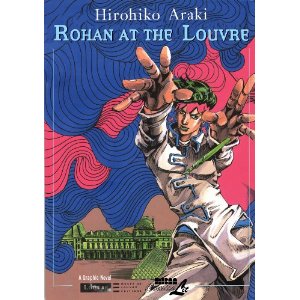
Recently, the Louvre Museum in Paris published a standalone short story set in the Jojo universe.  This book is titled Rohan at the Louvre, in the manner of a museum exhibit.  Plot-wise, it’s a horror short story with side-trips into other pulp and literary genres.  Art-wise, it’s like 50 pages and full color!

Lots of people have written about Jojo before: it’s artsy enough, strange enough, and superhero-inspired enough to be right up HU’s alley. With the recent book out (in English!), however, now’s as good a time as any to revisit the series. In other words, even though Jason already said it all, I’m going to say it all again. I’ll be talking about Jojo proper in this entry, and the recent book, Rohan at the Louvre, in another entry tomorrow.

I.

Though it’s considered a single long-running series, Jojo is divided into distinct arcs with different characters, different plots and different artistic/literary/pulp antecedents, each starring a different member of the Joestar family.  The first arc is set in Victorian England and stars the heroic Jonathan Joestar, a buff young man in the vein of early 20th century U.S. pulp comics (i.e. highly muscular and highly anatomically incorrect). In an arc inspired by Victorian Gothic horror, he is locked in a private psychological battle with the evil Dio Brando, his adopted brother, taking place largely in their father’s large country mansion. However, when their  father dies, the comic takes a turn toward Edwardian pulp adventure, as Dio becomes an immortal vampire, takes over a castle in Scotland, and converts a number of people (including, if I recall correctly, Jack the Ripper) into his zombie minions. Jonathan Joestar must then learn the mystical arts of Hammon, or ripple-energy, from a mysterious wandering Italian, while fighting off subvillains including an evil Fu Manchu-ish Oriental. In an iconic scene, he defeats Dio and clutches his severed head as they both sink to the bottom of the Atlantic.
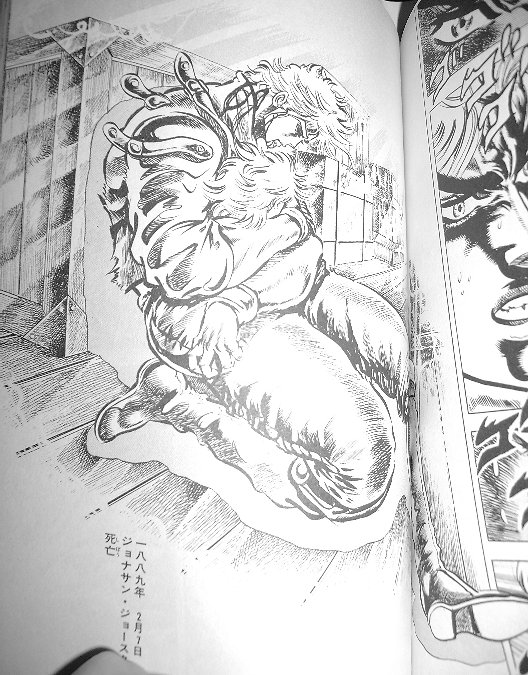

Forever embracing, Jonathan Joestar and the severed head of his evil adopted brother.

II.

In the sequel arc, Johnathan Joestar’s grandson, Joeseph Joestar, a buff young man in the vein of influential Japanese battle manga Fist of the North Star (e.g. with three-dimensional shaded muscles which are relatively more anatomically correct), travels around the U.S. fighting Nazis and Aztecs, in a series inspired by Indiana Jones and the 40s pulp comics that inspired Indiana Jones. In this arc, the three ancient Aztec Gods who created the mask that turned Dio into an immortal vampire awaken from their slumber, disturbed by Nazi scientists. Joseph must use his strength, wits, and good looks to defeat them in honorable combat, along with reluctant ally/eventual best friend Caesar Zeppeli, the grandson of the wandering Italian of the previous arc. In contrast to the strong and righteous Jonathan, Joeseph Joestar is righteous and devious, delivering speeches about honor while finding a smarter way to win.

III.

Following this arc, Joeseph Joestar’s grandson, Jotaro Kujo, a half-British-American-half-Japanese high school student and buff young man in the Tom of Finland vein (i.e. muscular, smoldering, uniform-wearing, and continually provocatively posed) is forced to travel to Egypt in order to defeat a reanimated Dio Brando. This arc introduces the concept of Stands, or companion-spirits which are physical manifestations of psychic powers. Araki has said that he invented Stands in order to add visual interest to his drawings of psychic energy battles, and that they should be read as an artistic convenience or metaphor. This arc was heavily inspired by Araki’s own trip through India and the Middle East, reading at times like a battle manga, at times like a horror manga, and at times like a travelogue. In one chapter, the heroes might roundly and straightforwardly defeat a villain who has been attacking from a hidden location using a long-range power, delivering a dramatic speech about how his cowardly actions can’t be forgiven. In the next, they might fight off an entire village of zombie-fied Indian villagers without questioning the morality or logic of the horror-movie set up.

This hybrid-genre, adventure-horror, macho-slash-homoerotic-posturing arc is Jojo’s most influential, spawning a TV series and a videogame, as well as inspiring the designs of a number of fighting game characters (and the fighting game convention of travel to new location, fight, travel to another new location? Or did that come first?  Whatever the order of inspiration, you can check this page for a list of Street Fighter characters based on characters in Jojo’s Bizarre Adventure). This arc is also the favorite of mangaka-collective CLAMP, who not only got their start with Clamp in Wonderland, a doujinshi (self-published comic) featuring the lovechild of Jotaro Joestar and best friend/fellow beefcake Kakyoin, but who have also been basing their stoic badass protagonists on Jotaro ever since. (One theory goes that CLAMP’s Wish is essentially Jotaro/Kakyoin fanfiction.)

IV.

In Jojo’s fourth arc, we are finally introduced to Rohan, the main character of Rohan at the Louvre. The balance between horror and adventure in Arc 3 was occasionally uncomfortable, as readers were asked to consider the unrighteousness of some transgressions by the villains while ignoring others as necessary scaffolding for the comic’s horror and gore. This is corrected in Arc 4, in which a more modestly buff Josuke Joestar, the surprise son of an aging Joseph Joestar, as well as a hot guy in the vein of 1970s Japanese working-class manga (i.e. with the same exaggerated Greaser hairstyle as Ryunosuke Umemiya of Shaman King), must investigate a series of strange happenings in his rural Japanese town. Going back to Araki’s roots as a horror artist, this arc is a mixture of horror and comedy. The lighthearted tone and small-town setting – the smaller stakes – allow Araki to draw endless pictures of exploding intestines without compromising the genre conventions of a normal Shonen Jump battle manga, which in the usual way of things would require a certain number of semi-serious speeches about hard work, friendship, loyalty, etc.  Compared to the globe-trotting, super-villain-besting antics of the previous arc, this one sticks closer to home, going in for quieter, more refined psychological portraits of e.g. its illegitimate child of a single mother protagonist (and cleaner, less heavy art).

Rohan, the protagonist of Rohan at the Louvre, is introduced in this arc and immediately leaves a strong impression. You might be getting the impression that Jojo’s Bizarre Adventure is an extreme, comedic, violent, and somewhat strange comic. This is all true. Additionally, it’s a comic where many characters are very powerful and intelligent. Rohan, the author-avatar, is no exception:
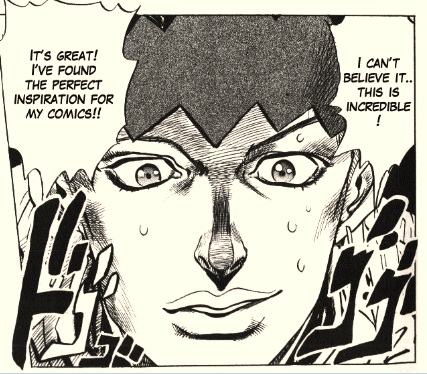

Kishibe Rohan, Araki’s self-insert character who is also a mangaka for Shounen Jump

Rohan is powerful because his Stand allows him to open other people up like books, to read their thoughts and memories, and then to write instructions on their “pages” which they must follow even when these instructions defy physical laws. In other words, he can pretty much make anyone do anything. He also has the ability to alter people’s memories and to draw 20 pages in a split-second so that he’ll never miss his weekly publication deadline. Personality-wise, he’s arrogant, distanced, intense, and easily irritated – kind of a frightening person, really.  It’s lucky for us that he’s not a villain.
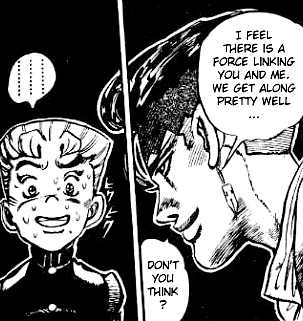
To be clear, Rohan is not the most powerful person in this comic by a long stretch.   There are people who can alter the laws of time and space in Jojo.  Still, he’s pretty powerful!  When he is introduced, Rohan’s powers only work on the first person to see a completed page of his manga, and then only if that person understands his art.   Like all limitations, this is something he eventually forgets all about.  With his trademark arrogant humility, he describes his abilities in Rohan at the Louvre as follows: “A trifling matter, of little to no consequence – indeed, I can literally read people like books”.

The next arc of Jojo is a turning point for the series, so I will discuss it even though we’ve already caught up with the backstory:

V.

Though it started out as almost a pure pulp adventure comic (albeit a very strange one), with each iteration the comic has become more prone to digressions into horror and comedy – or maybe just a bit smoother about those digressions, so that they feel more integrated into the overall tone.  After all, Jojo was always pretty unserious, even when it was serious; and always pretty horrific, even when it was righteous. The characters also become slimmer: in the manga’s current run, they are toned like runway models or teen pop stars or soccer players, rather than like bodybuilders.  They are also, increasingly, avant-guard and fashionable; and the major turning point for this change is Arc 5.

Arc 5 is set in Italy and is probably inspired by classical art and sculpture, as well as by European high fashion. This arc focuses on the adventures of Giorno Giovanna (GioGio), the son of Arc 3’s reanimated Dio Brando and an anonymous woman. Since the immortal vampire Dio survived his trip to the bottom of the Atlantic by attaching his severed head to the body of his adopted brother Jonathan (did I forget to mention this?), Giorno is a half-villainous and half-heroic character, a mobster whose goal is to be the ultimate Gang Star. Giorno is probably actually the “strongest” character in Jojo, with powers that eventually include rewriting the rules of physical reality.

A friend of mine who visited Italy in part due to Jojo’s Bizarre Adventure swears that you can see the influence of classical renaissance art in (especially) the proportions and convoluted poses of the characters in this arc. Additionally, perspective becomes the subject of many drawings as strange mirror worlds, shapes, and cubes dominate the surreal landscape.
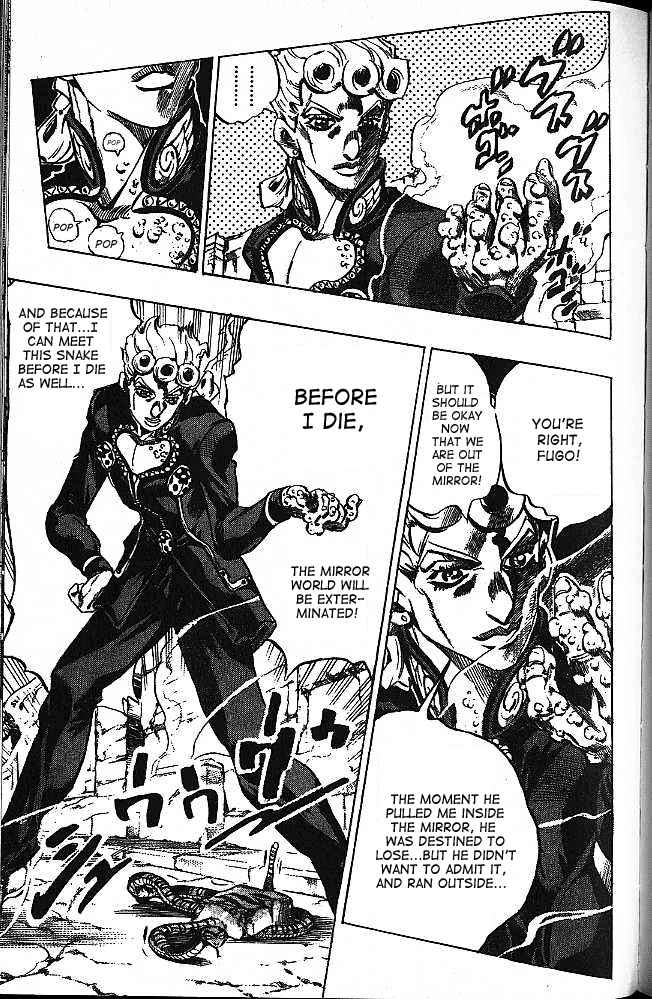

Giorno inside the mirror world

While the Stands in Arc 4 had powers which leant themselves to horror (e.g. the chef whose food was so delicious and healthful it made everyone’s intestines burst out), those in Arc 5 often have visually interesting and complex powers relating to the manipulation of space and time. This allows Araki to show off the skills he’s picked up since starting Jojo. For instance, there’s a villain whose superpower is to turn his enemies into cubes, while one of the heroes, Bruno Buccelati, has the ability to create zippers on any surface which open up portals into a subspace dimension. Araki’s interest in the manipulation of space was evident in the previous arc, as well – e.g. Rohan can open people up like books, a villain can turn people into paper – but is more fully developed and central to the action here. Somewhere along the line, Araki seems to have picked up an interest in physics and in using Stand powers to explore (and then exploit) physical laws.

In addition to the focus on art, perspective, and the manipulation of space, Araki also plays with the manipulation of time, with several characters possessing the ability to speed up, slow down, skip ahead, skip behind, pause, or rewind time. I’m just going to leave this picture here for my fellow Jojo fans:
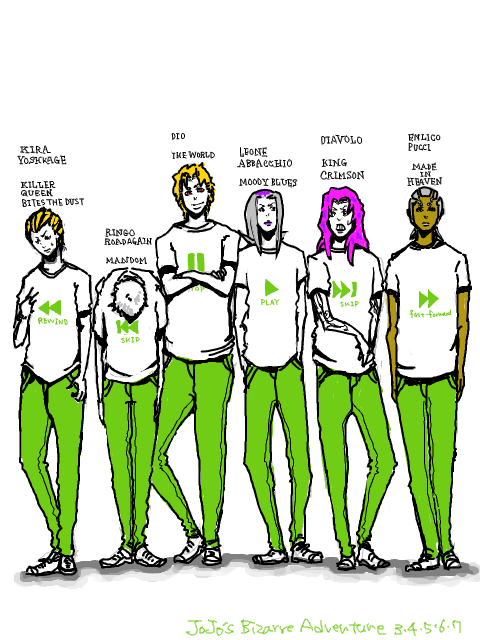
Now that you’ve seen it, you can’t unsee it, can you?

VI etc.

Arc 6 is set in a woman’s prison and continues Araki’s interest in melding horror, high fashion, and pulp, in addition to being possibly the result of a personal/editorial challenge to DRAW MOER WOMEN. (The protagonist, Jolyne Kujo, is Jotaro’s estranged daughter.)  The arc immediately following is Steel Ball Run, a series reset in which Jonathan Joestar and Dio Brando, rather than being the children of a British Peer, are American cowboys competing in a trans-continental horse race. In a nod to the increasing psychological sophistication of Jojo, the heroic Jonathan is now a cripple, ruling out acts of physical heroism, while the villainous Dio, while still coming from a bad background, is now a complex and occasionally sympathetic character rather than one who is simply and irredeemably evil. More surprisingly, Johnny is not the arc’s main protagonist (that would be Gyro Zeppeli, a younger/hotter version of the wandering Italian from way back in the beginning). However, the characters still have great fashion sense:
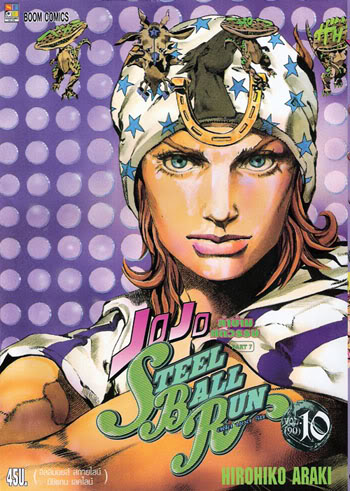

Steel Ball Run’s Jonathan Joestar in his stars-and-stripes ensemble

That’s all of the (completed) arcs of Jojo so far.  Tomorrow: Rohan at the Louvre!

Update: And the post on Rohan at the Louvre is up.



Monthly Stumblings # 17: Marco Mendes

Diário Rasgado [torn diary] by Marco Mendes

(1) Politics

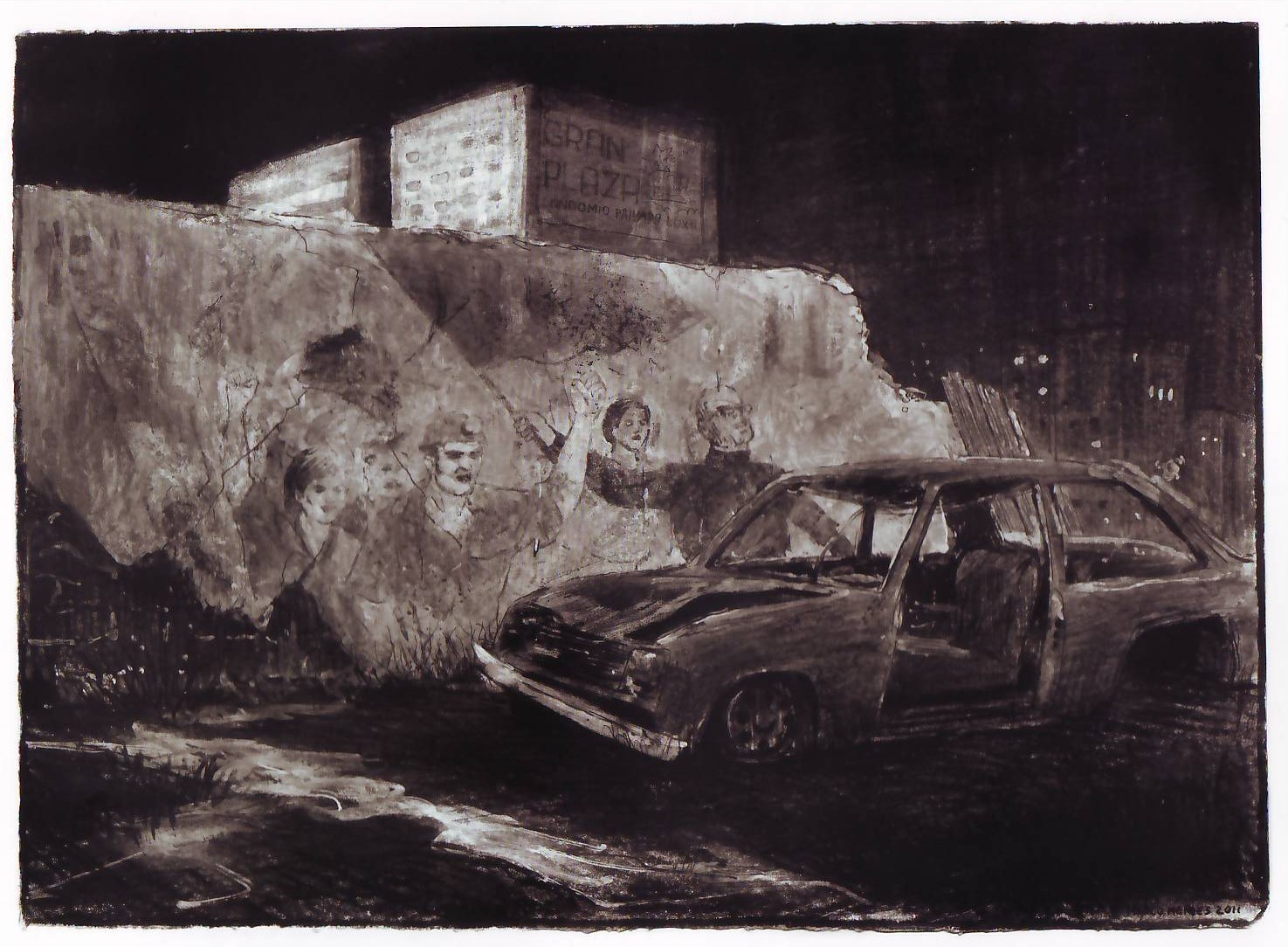
 Marco Mendes, Diário Rasgado, May 2012.

What do you see above?

A dark, moonless night… two buildings on the middleground, more on the background on the right hand of the drawing… a wall and what seems to be the remains of a wooden door… a mural (or graffiti, if you prefer) on said wall… a wrecked car…

Examining the mural we can see people in some kind of demonstration. The one on the right is waving a flag…

If the sky is pitch black what is the light source? Most probably an out of frame street lamp. This is, unmistakably, the inospitable landscape of the human beehives: proletarian suburbia, the projects…

So far so good, right? My point though is that images aren’t as universal as some people seem to think. In order to fully decode them some context is needed. In this particular case you may also have guessed that this is political art… And highly sophisticated political art at that. Marco Mendes is a Portuguese comics artist and this is the last, and, not the most powerful, by any means, image of his uneven (more on that later), but great book Diário Rasgado

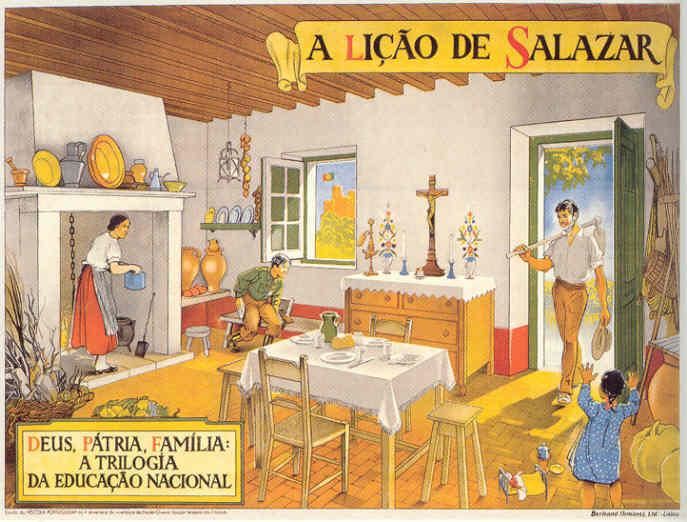
Going back to the image above lets concentrate now on the wall. What’s it doing there? If we go back a century or so Portugal’s economy relied mostly on backward agriculture. Portugal’s Industrial Revolution was insipid at best. Forty eight years (1926 – 1974) of a right wing conservative regime didn’t help to change anything. On the contrary: Salazar, the dictator, was an extremely religious fellow who wanted a country culturally stuck on the ancien régime. The popaganda of his time spread the image of an idylic rural community life (pretty much like the apple pie visions of America).

Jaime Martins Barata, Salazar’s Lesson: God, the Fatherland, Family, the Trilogy of National Education, 1938.

The above watercolor is a perfect example of Salazar’s ideology: after a day’s (or a morning’s) work the rural worker (using an archaic tool) comes back to his patriarcal, poor, but highly organized and clean, happy home. At the center of everyday life, holding the boat and assuring law and order, were the Catholic and State religions (look through the window at the Portuguese flag on top of a Medieval castle representing our glorious forefathers). Needless to say, such popaganda did hide a grim reality of exploitation, hunger, and gender inequality.

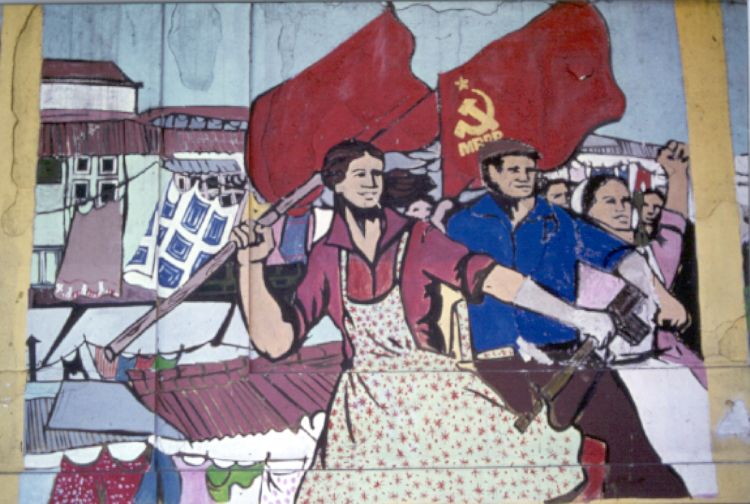
But I digress, maybe?… What about the wall in Marco Mendes’ drawing, then? It’s there because in the above described rural Portugal some wealthy families owned farms around the main cities. In time those farms were dismantled and invaded by greedy real estate entrepeneurs. Projects for the rich and not so rich multiplied like mushrooms because of a complete absense of planning policies (not to mention political corruption). Poor rural workers fled hunger-ridden rural areas hoping for a better urban life and each one of them needed a place to live after all (it’s a well know story everywhere). Maybe that wall is a standing mute witness to those old days when beautiful farms were part of the urban landscape.  Because of the mural on it it’s also a witness to radical changes in Portuguese society after the Revolution of April 25, 1974.

Anonymous political mural in Lisbon, 1977. Photo copyright Yves Benaroch.

Marco Mendes used a bit of a poetical license in his drawing because the murals of the revolution didn’t survive. Maybe there’s one or two still around, who knows?, but I don’t think so. I can’t imagine one in 2012 at least. For a couple of reasons: a left wing mural, reminincent of the Maoist one above has a different reading in Beijing and Lisbon. It can only mean what I think it means in Diário Rasgado, shattered hopes, because we are suffering by far the worst dictatorship that ever existed: the dictatorship of the financial markets, the dictatorship of the wolves disguised as lambs; the dictatorship of the Plutocracies disguised as Democracies. In Beijing the image could mean the exact same thing with a crucial difference: the people could say with propriety: beware with what you wish for!… Even if no one believes in future times of milk and honey now, the fact is that many Idealistic people did back then just to slowly fall into the (as Luís de Camões – 16th century  – put it in one of the best poems ever written) “disarrangement of the world” again…

Two final notes: the woman on the mural above should liberate herself (getting rid of the pinafore apron) before trying to liberate others; Marco’s drawing is a Deleuzian image-time linking the past and the future (time is cyclical): the wrecked car may be warning us that popular upheavals, like the ones that happened all over France in 2005 and the UK in 2011, are bound to happen in Portugal.

(2) Autobiography?

Well… not exactly…

It’s true that the title of Marco’s book mentions a diary… Plus: the characters who appear in the book are the personas of Marco, his friends (Miguel Carneiro, with whom Marco co-founded A Mula – the mule – art collective among them) and girlfriend, Lígia Paz, but that’s almost it… Marcos’ private life certainly inspires him, but that’s true for every artist, so, there’s almost no autobiography in Diário Rasgado (the exceptions being the stories including his family, his grandfather, mainly). Maybe Lynda Barry’s autobiofictionalography is what I’m talking about, after all… It doesn’t really matter though… We’ve long past those maverick days in which autobio meant being a mature and serious artist.

Marco Mendes’ first book (a mini-comic), Tomorrow The Chinese Will Deliver the Pandas (June, 2008),  was published in English with translations by Pedro Moura and Elisabete Pinto. There’s an imediacy in his first work that, as Lígia Paz put it in “The Introduction [to said mini-comic] Marco Made Me Write”:

In [Marcos’] comics work, the exploration goes to the rhythmic possibilities inherent to the format, the drawings are more explosive, emotional, and surprisingly funny. There is a vivid concern in letting words and events flow, in a continuous and frequently corrected, scratched, and unaltered text, as if there is no [erasing] rubber.

The drawing is sketchy and the little vignettes describe what happens in a house where bohemian art students live. The language is often coarse. Unfortunately some homophobia (still pervasive in Portuguese society), ableism and misogyny rear their ugly heads in Marco’s friends’ and girlfriend’s jokes. A light humor and a friendly atmosphere is the general tone of these early strips (Lígia Paz, again).

There was a house […] with a mythical living room: the setting of multiple parties, a ping-pong table, a famous sofa where so many have slept and [have] been portrayed, not to mention the walls, covered with drawings and several forms of confessions. […] In all the rawness of his social realism, without tricks or self-complacency, the representations and portraits of the surrounding friends are also a testimony of our current times and of his generation. There is also a very clear sense of sharing, identity and belonging to a community, united by common values, experiences, and eighty cent beer.

Lígia also mentions the “distance between the portrayed individual and the fictional character.” Which, methinks, is revealing and should be used to describe autobio artists. As Arthur Rimbaud put it: “je est un autre” (“me is another”).

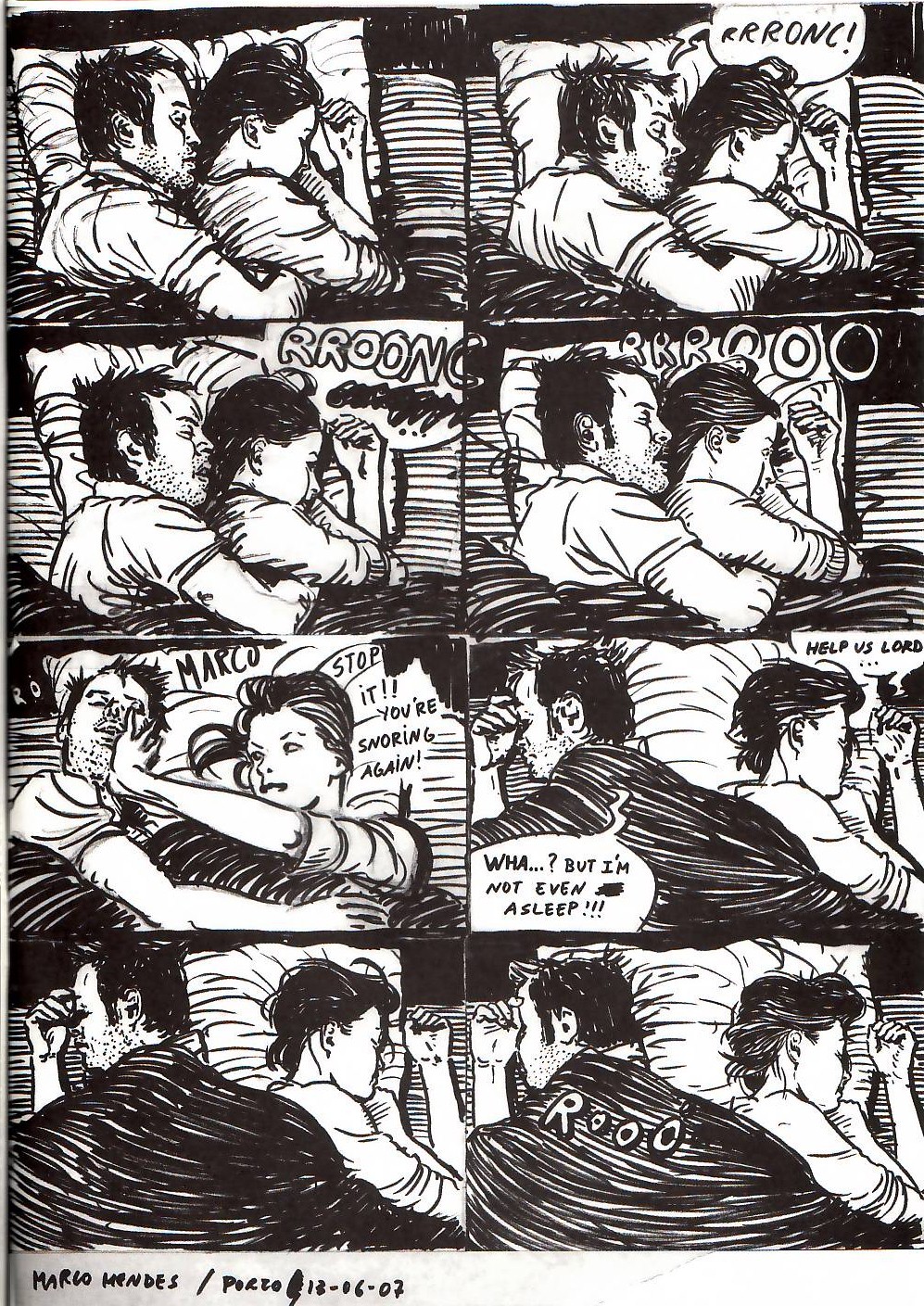
Marco Mendes, Tomorrow The Chinese Will Deliver the Pandas, June 2008.


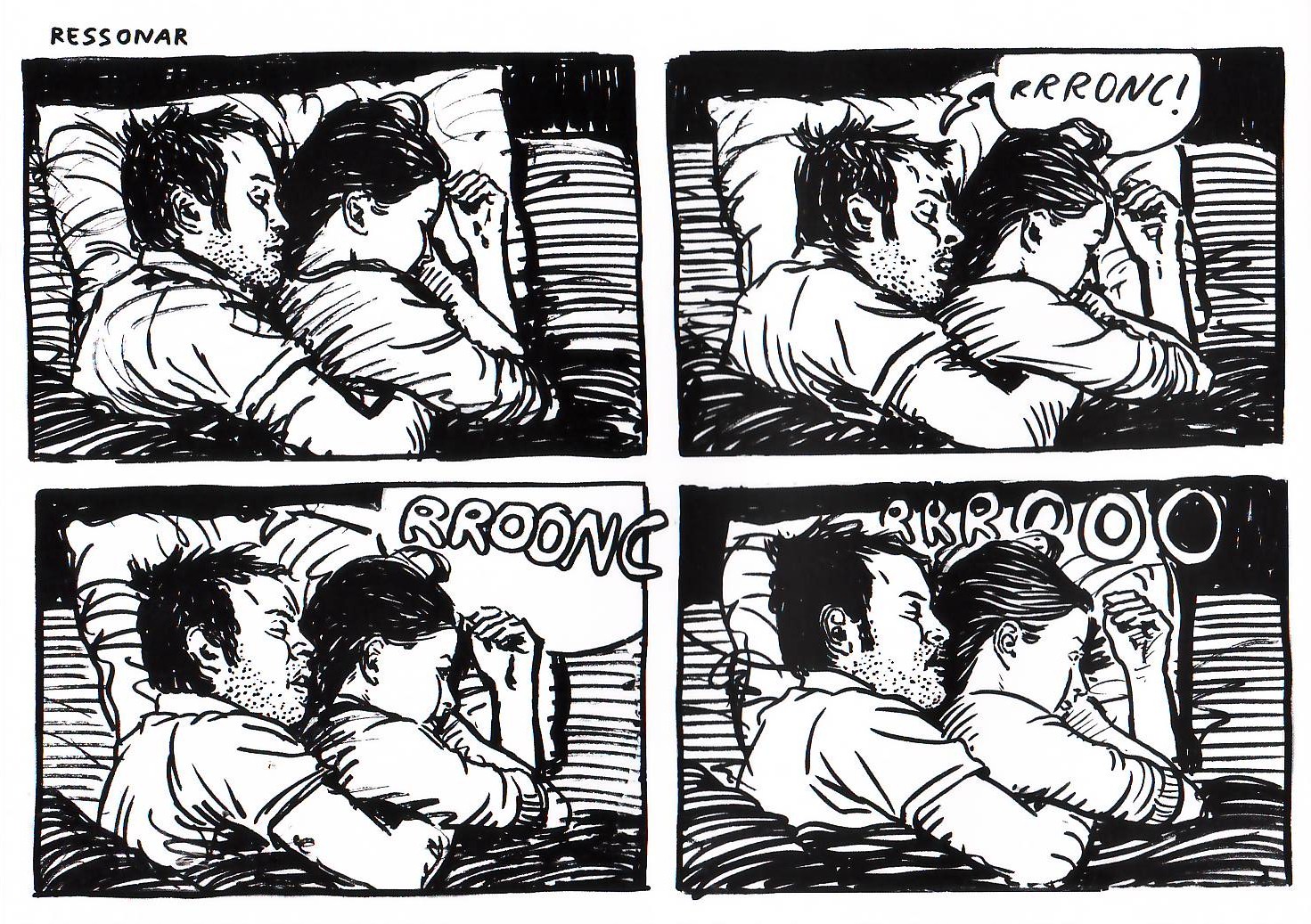
 Marco Mendes, Diário Rasgado, May 2012.

The small but significant differences between the two versions of the same page above are also symptoms of two different editorial policies. The first page (which can also be seen in Marco Mendes’ blog) is more messy: there are no gutters, graphic noise wasn’t cleaned up. The original layout was destroyed in the book version (the page was cut in half to become two landscape formatted pages); everything is a bit more clean.  It’s the difference between a DIY punk aesthetic and a more professional, slicker look.

And yet… Even as early as 2007, there are quiet, melancholy moments in Marcos’ oeuvre. His better work to date, done in the last couple of years, was created in that tone. (To be perfectly candid about it, even if I find Marco’s earlier work fine enough this post wouldn’t probably exist without the quality leap that are his amazing, more recent, color, mostly wordless, pages.)

Asked  what genre interested him more, humor or drama, Marco answered: “They’re both too close. I see no way of separating them.” What we can infer from his words is that Marco Mendes is attracted to pathos (see below)… Even so, pure drama also happens, but Marcos manages to avoid sentimentality…

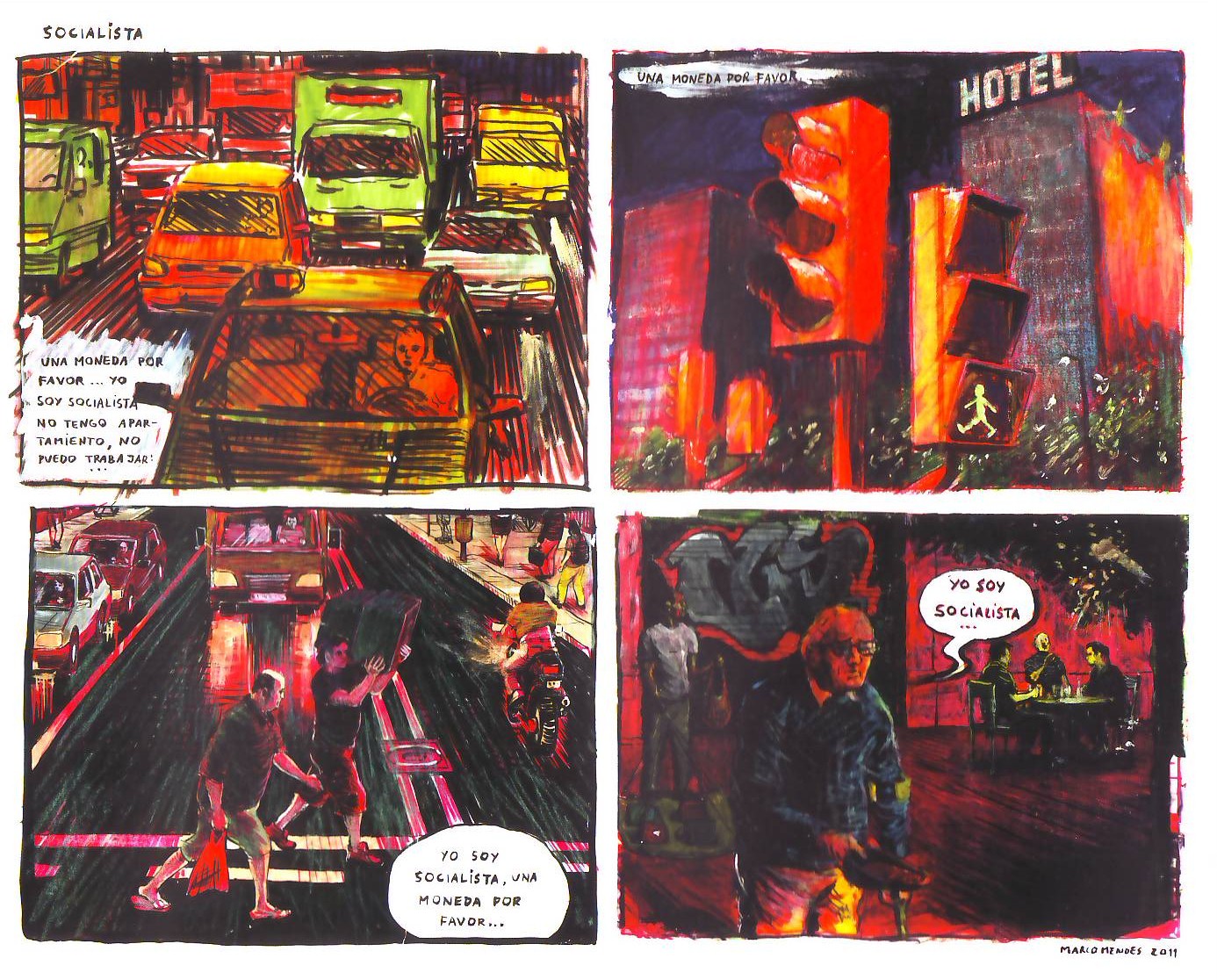
 In Barcelona: “Socialist: ‘Give me a coin/ please… I’m/ a socialist/ I have no/ apartment, I/ can’t work…’ /’a coin please’ /’I’m/ a socialist, a /coin please…’/ ‘I’m a socialist…’,” Diário Rasgado, May 2012.

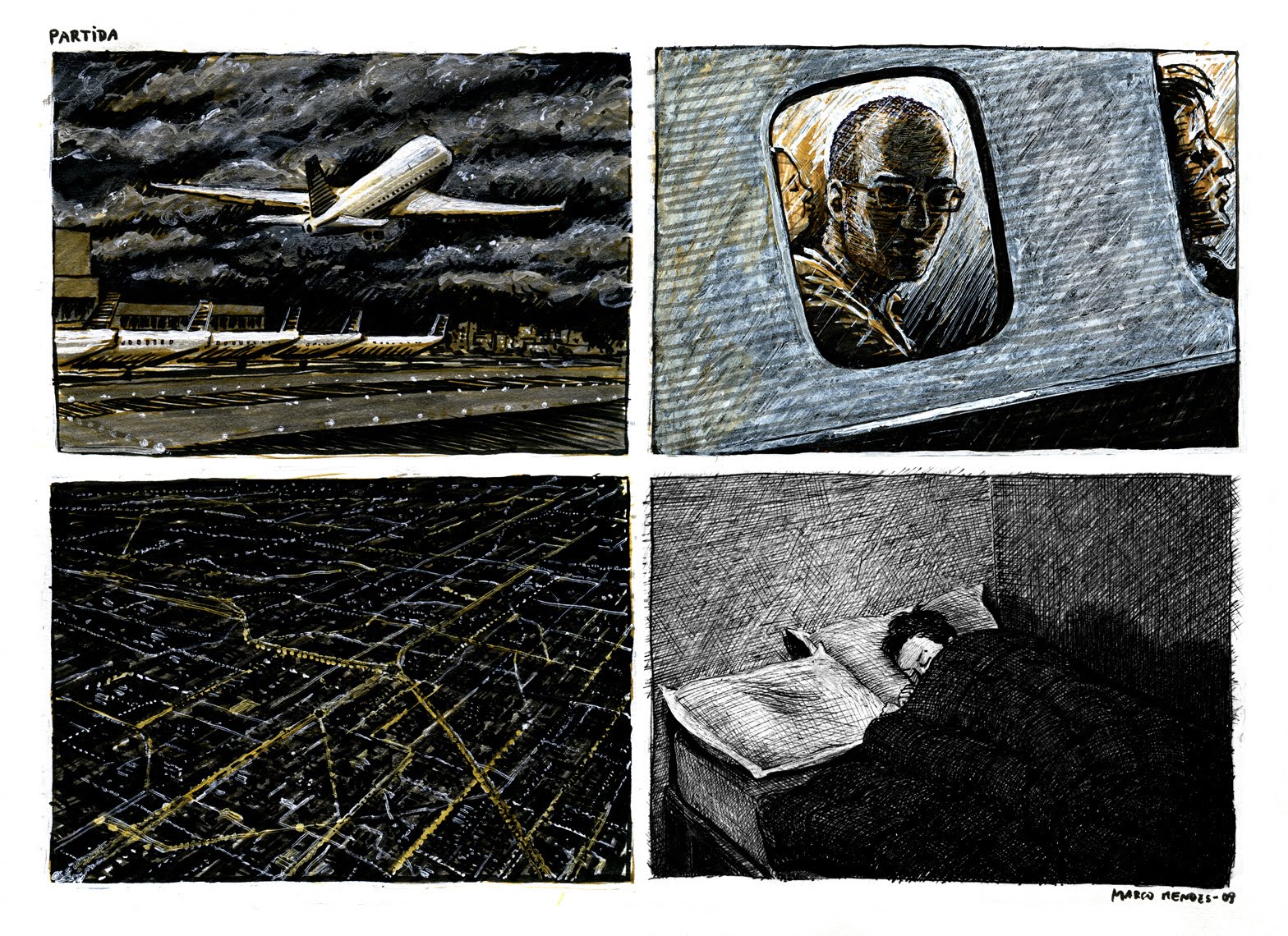
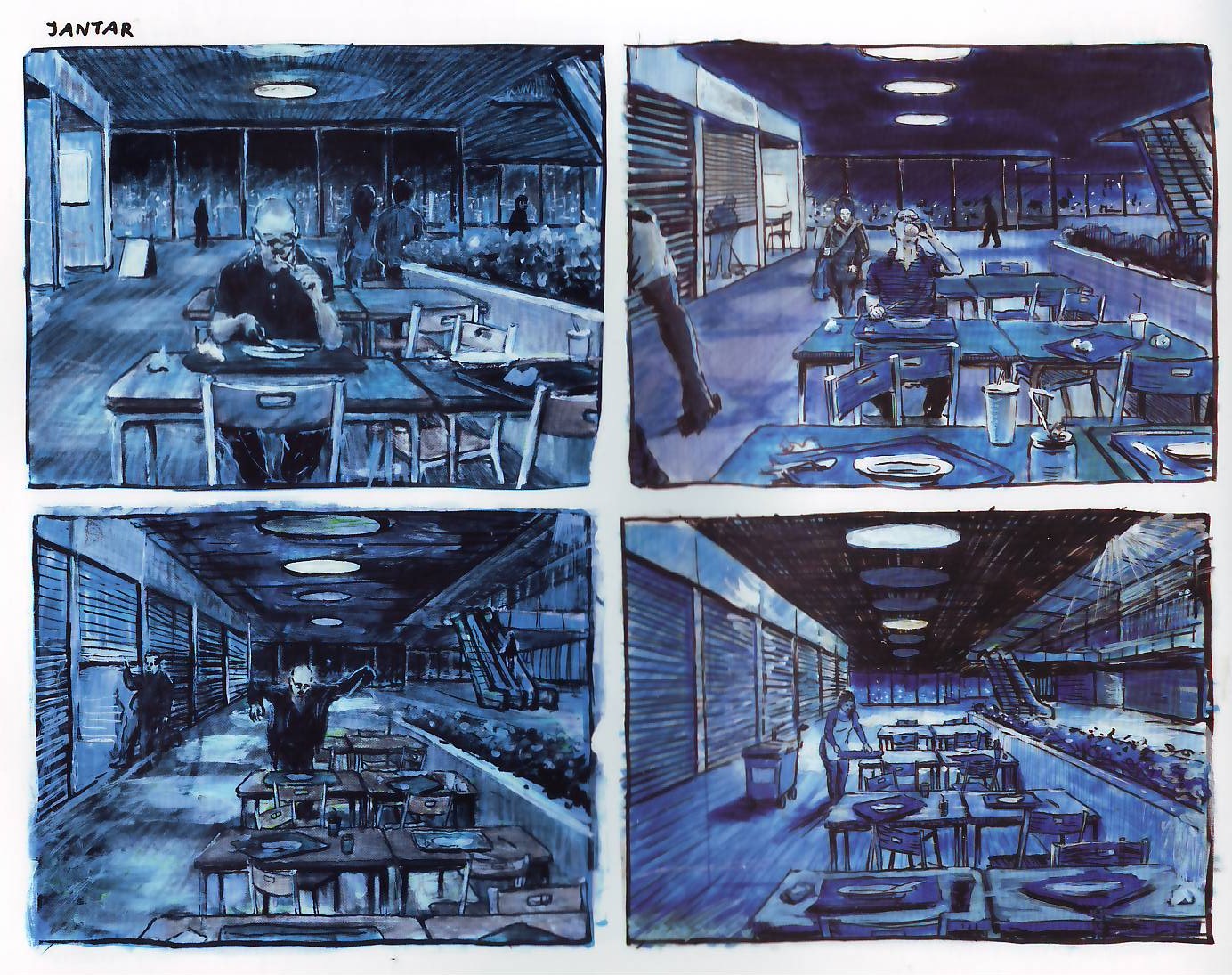
Melancholia: The ending of a long distance relationship: “Departure,” blog post, September 16, 2010.

At some point Marco started to mostly use a regular layout of four panels in which the last one is a kind of punch line. He prepares it by developing a situation which he then procedes to twist a bit at the end (a process that’s akin to Usamaru Furuya’s four panel comic Palepoli). In “Socialist” above he used a palette of warm slightly sickly colors and changing points of view to convey movement and disorientation. (Other times the city is a cold pale blue – see below.) Since Edward Hopper is one of Marcos’ biggest influences I can’t think of many comics artists who can convey as well as he does the feeling of loneliness in a big city. The self-deluded beggar, thinking that he’s entitled to a coin because he’s a socialist is one of those things that, I suspect, can’t be created from scratch (life has a lot more imagination than we do)… I may be wrong though, of course…

In “Departure” Marcos used the visual idea of shadowing the face of his character to convey his state of mind. Between him and his girlfriend we know who lost the most emotionaly when they broke up…

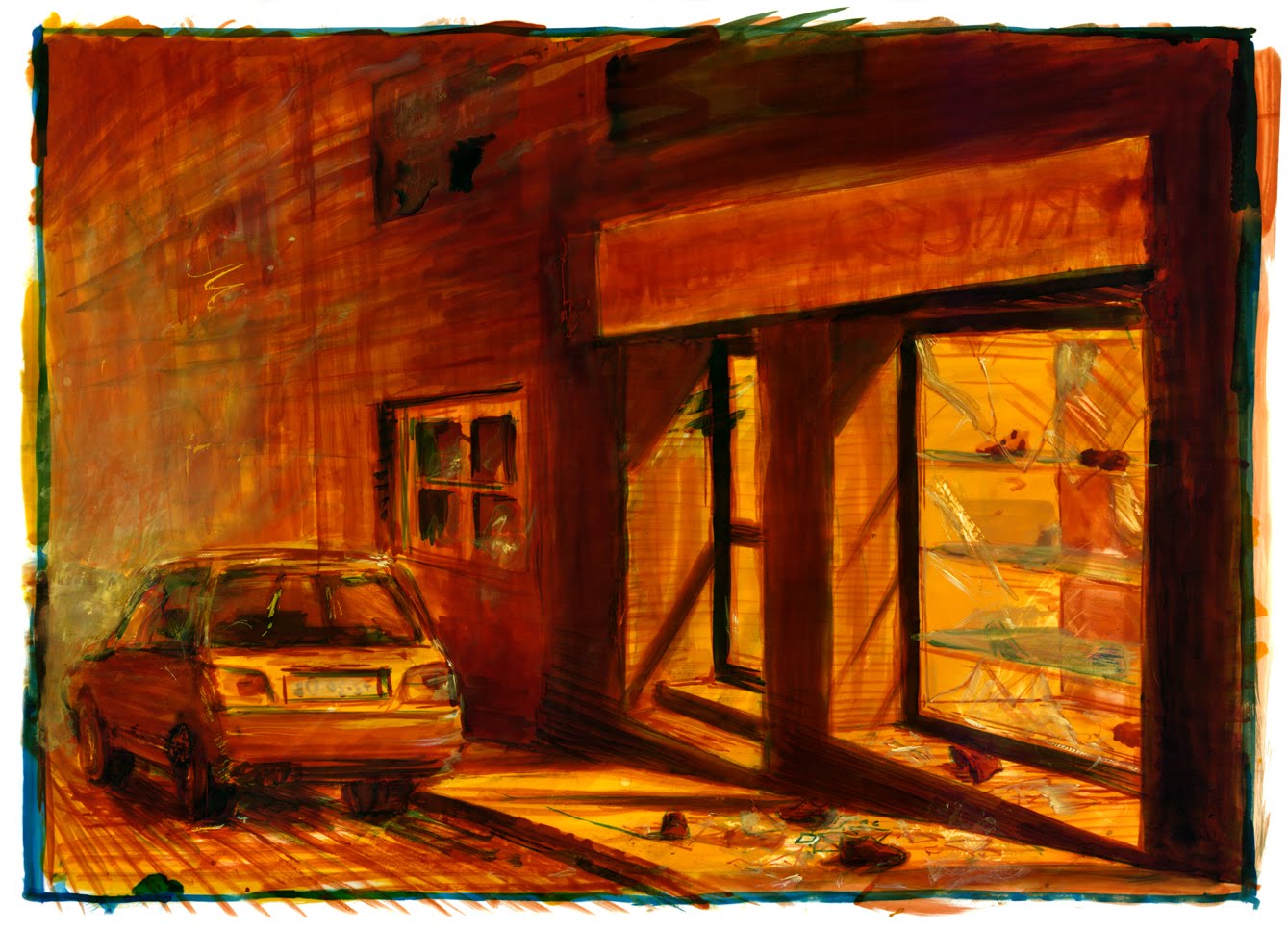
Marco Mendes, “Mutiny,” blog post, December 19, 2011. An Edward Hopper inspired shoe shop after a riot: another example of urban pathos?

A zoom out, but can we really escape these non-places? Marco Mendes, Diário Rasgado, May 2012. 

Meta-Dumb

This first appeared on Splice Today.
__________________________

Source Code marks a watershed moment in Hollywood’s assimilation of Philip K. Dick. From direct lifts like Blade Runner and Total Recall to bastardized second-hand derivations such as The Matrix, PKD’s obsessive relationship with reality and that reality’s breakdown has become a staple of Hollywood sci-fi.  At one time, a sci-fi movie meant ray guns and spaceships and hyper-warp-drives and green-skinned girls who needed to be taught the meaning of love. And I guess they can still be about those things, more or less…but generally everybody prefers it if the green-skinned girl is a mental projection of an android locked in a magic matrix. Heroism is best when sprinkled with paranoia, and technobabble is always improved when leavened with facile ontological speculation.

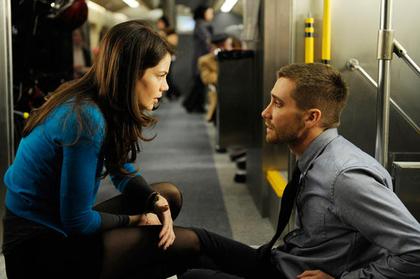
And so Source Code. This movie is not based on a PKD novel or story. It’s just a dumb Hollywood film, and a dumb Hollywood sci-fi film is now a sci-fi film that includes PKD as part of its DNA. Director Duncan Jones has nothing to say about being or reality—not even something stupid to say, like The Matrix. The PKD elements in this film have no meaning. They’re there for the same reason that Michelle Monaghan is playing a blandly spunky nonentity named Christina and for the same reason that Jake Gyllenhall has that stubble and raffish smile. None of it is intended to make a point or prompt a thought. It’s included solely because it’s what you want from your movies.

Not that I hated the film. After all, I’m a lot like everybody else. I think Michelle Monaghan is cute, and, what the hell, Jake Gyllenhall too. Moreover, there is something breathtaking in the film’s self-referential glorification of its own rampant insubstantiality. The pseudo-scientific explanations are delivered with an insouciant bone-headedness; someone babbles about parabolic logic and after-images in human brains and then, hey presto! Our hero Colter Stevens goes back to relive the same eight minutes in somebody else’s life before a Chicago commuter train blows up. Why? How? Is he reliving the actual destruction of the train? Is he reliving a memory? Who knows? Who cares?  The point is…err? What exactly is the point?

Diagetically, who knows? Extra-diagetically, though, the movie is mostly about patting itself on the back for its own wonderfulness in being a movie (starring Jake Gyllenhall!) Like an actor, Colter takes over someone else’s life (Sean Fentriss). Like a movie star, inhabiting another person doesn’t change his appearance at all; he still looks and behaves like the same Gyllenhall we know and love. And, as in all movie-making, the same scene is redone over and over again; Jake goes back on the train to relive the same eight minutes and back on the train to relive the same eight minutes and back on the train to relive the same eight minutes, all at the orders of the vaguely sinister, crippled (crippled=sinister!) director figure Dr. Rutledge (Jeffrey Wright.)

There are various ins and outs and you learn The Shocking Truth About Colter at one point and there are moral dilemmas and whatnot. But! Eventually Gyllenhall/Colter/Sean gets the scene perfectly right by (a) saving the world as per the action/adventure genre, and (b) acting all cute/nutty/in-touch-with-his-feelings and thereby sweetly connecting with the girl of his dreams as per the romantic comedy genre. The gratuitously preposterous manner in which the happy ending is dropped from a great height upon our protagonists is not a mistake or an oversight. It’s the film’s entire purpose.

PKD saw the gaps in reality as disturbing and ominous—a sign of our distance from God and truth. But Hollywood doesn’t fear unreality. On the contrary, ersatz pasteboard is Hollywood’s glory. Reality isn’t real, you say? That just makes it so much the easier to jury-rig the requisite inspirational conclusion! For Source Code the plot hole is the basic blueprint of existence. It’s the idiocy that assures us that—for half an hour at least, and in the movie’s own words—“everything is going to be okay.”
 

Speak Truth to Power!

Earlier this week I suggested that while the Nadel/Hodler tcj.com has many virtues, it continues to suffer from cliquishness. Sean Collins tweeted a reply:

The Hooded Utilitarian accusing Nadel/Hodler of cliquishness is always, and will always be, absolutely hilarious.

A couple of people asked Sean for clarification politely, and I asked for clarification less politely, because I was pissed off (Sean annoys me like few people on the internet, as I’m sure he’ll be pleased to hear.)

However, he declined to expound…so that leaves it up to HU readers, I suppose. How are we cliquish — or, less invidiously, what should we be covering that we aren’t? What aren’t we doing that we should? Or what are we doing that we shouldn’t? Let me know below…and if no one comments, I guess I’ll just assume I’m perfect!

Utilitarian Review 8/3/12

On HU

Featured Archive Post: Jason Overby on the Concerns of Comics.

We’re very sad to say that Erica Friedman is retiring as a columnist here at HU. Her goodbye post is here. Be sure to check her out at her own place as well.
 
On HU

I talk about homoeroticism in the Big Sleep.

I responded to Dan Nadel’s editorial about the unundergroundness of Kickstarter.

Eric Berlatsky on Dark Knight, Spider-Man, and Avengers films.

Matthias Wivel on Degas, motion, time and comics.

L. Nichols on reacting to comics.

Kinukitty on celebrity news and Stephen Ira Beatty.

Peter Little on the Dark Knight and the crisis of the ruling class.
 
Utilitarians Everywhere

At the Atlantic I talk about Om and extreme new age metal.

At Splice I talk about Mitt Romney’s tour of lesser nations.
 

And also at Splice, I talk about Toya’s great forgotten album.
 
Other Links

Melinda Beasi on privilege and loving yaoi.

Slate on the evils of anonymous comments.

And, for contrast, an article about how real names don’t increase civility.

Alyssa Rosenberg with a lovely piece on Doonesbury.

Interview with Anthony Heilbut about gayness and gospel.

The Dark Knight Rises: Nightmares of a Ruling Class in Crisis

As for his appearance in The Dark Knight Rises, Bane is a force for evil and the destruction of the status quo,” Dixon said. “He’s far more akin to an Occupy Wall Street type if you’re looking to cast him politically. And if there ever was a Bruce Wayne running for the White House it would have to be Romney.”
–Bane creator, Chuck Dixon

Echoes of the Arab Spring, European and Asian strike waves, the Occupy phenomenon and a host of new popular upsurges haunt the psyches of a global ruling class attempting to navigate the ever unfolding crises which continue to spiral outward. It is in this light that the newly released Dark Knight Rises, third in the Dark Knight series, is a stunning, if terrifying reflection of the deepest anxieties of a ruling class with few options, fewer ideas, and no shortage of increasingly threatening social contradictions menacing its psyche.

The plot itself is predictable-but with notable twists. The film’s villain Bane, long incarcerated in a prison pit he describes as,”hell,” has nurtured a revenge desire against Gotham City. His rage, however, is not only driven by personal experience-he has adopted an ideological conception of Gotham as representative of the causes of a myriad of injustices embodied by his life of incarceration and brutality. The mission of Bane’s large insurgent force? Destroy Gotham with a nuclear weapon.

Early on in the film, a small crew of armed men, led by the anti-hero Bane, bursts onto the Nasdaq trading floor, randomly firing weapons, and taking the entirety of the trading floor hostage. While they attempt to tap into the trading circuits on the floor itself, Bane stands over a trembling trader. The trader, in a vain attempt to dissuade Bane and his crew, tells him,”There’s no money to steal here!” to which Bane hisses,”Then what are you people doing here?”

Noteworthy also is the recurrence of Bane’s populist themes during the pursuit of his goal. Recruiting from orphaned and homeless youth, Bane has trained a small army in the sewers of Gotham City. Midway through the film, Bane lures thousands of police officers into the sewers, detonating explosives and trapping them underneath, unleashing his insurgency on the city.

Soon after, we see Bane at the steps of a prison in the heart of the city, the site where, we are told, the forces of organized crime have been held on lengthy sentences under the,”Dent Act.” To establish the Dent Act, Gotham’s incorruptible Police Commissioner Gordon knowingly allowed Batman to be framed and publicly scapegoated. In a nod towards former NYC Mayor Rudy Giuliani’s,”tough on crime,” policies, the Dent Act is heralded as bringing an era of unprecedented social peace and stability in Gotham City, and thus justifying the dishonesty behind Batman’s downfall. The foundational myth of Gotham’s “peace” is not just a lie, we come to see, but a total inversion of the truth.

Standing on the steps of the prison, Bane appeals to the citizens of the city. Encouraging them to rise up against those who have robbed them, oppressed them, and imprisoned them, his men blow open the doors of the prison and he urges Gotham’s citizens to set the prisoners free. We next see hundreds of armed prisoners, still in their orange jumpsuits, surging through the open doors of the prison into the streets of the city.

As official order is derailed, and at Bane’s urging, we see the poor and impoverished ransacking luxury hotels, pulling the wealthy from their homes and cars. We see police officers and the wealthy dragged before barbaric people’s tribunals where guilt is already determined-the only ruling to be made is whether the sentenced to death by execution or sentenced to exile (a trial by ordeal) across a partially frozen bay surrounding the now isolated island of a city.

Bane and his actions represent the deep seated anxieties of a ruling class in crisis. Unable to resolve the global economic crisis themselves, they nonetheless reject popular movements -the attacks on Wall Street, the striving from the excluded, imprisoned, and forgotten for power. All of these are seen not as possible forces for freedom and the resolution of the crisis, but instead as demagogic, Machiavellian, and terroristic threats only capable of producing destruction and barbarism. Bane is not a product of the actions of masses-by the film’s authors, the initiatives of the masses are a manipulated, controllable product of the actions of Bane’s armed vanguard.

Although Bane espouses notions of democratic urges against wealth, decadence, and the oppression this crumbling system doles out, he is clearly painted as sadistic, brutal, and opportunistic. He has no genuine interest in human freedom. In the end, he himself is only a pawn of an entirely misanthropic leadership whose sole goal-even if it means their own destruction-is the destruction of everything Gotham is-including the very masses Bane pretends to appeal to and whose power he momentarily unleashes. In the trembling subconscious narratives of official society, the possibilities of the unleashing of that social force are reduced solely to acts of barbarism against their former oppressors, but are incapable of offering a vision towards freedom.

The police, by and large, play a contradictory role throughout the film. We are introduced to Police Commissioner Gordon as he prepares to acknowledge his prior role in allowing the film’s hero, Batman, to have wrongly been defamed in order that he may pass his”Dent Act.” Throughout the film, the police as a force are easily led into traps and rendered useless. They attack civillian populations they are charged to assist, and are utterly unable to resolve the social contradictions which Bane manipulates to tear Gotham apart. Even in their redemption — leading a,”return to order,” rebellion against Bane and his mobilization of the marginalized, — they are only useful as auxilliaries. Even then, they are so inept that as the film closes and order is returned. the city’s one honest officer, Batman’s unacknowledged,”Robin,” throws his badge into the river in disgust.

Who is Batman in this context? The dream of a technocratic solution to a problem of social contradictions. Bruce Wayne, though orphaned, is a child of privilege. A billionare, who in his forties is still waited on hand and foot by his caretaker butler, Bruce Wayne’s finances are bouyed by his ownership and investment in military technologies developments. Alongside his superhero role, Bruce Wayne funds philanthropic and,”sustainable energy,” projects in vain attempts to mitigate his own unresolved anger (and his rage shines as a stand-in for the repressed social conflicts his very wealth is rooted in.) Bane, his nemesis, draws his recruits from the same orphanages that the failing Wayne Foundation ceases to fund as its finances become imperiled. Throughout the film we find Bruce Wayne, a man whose body has been so traumatized from his vigilante acts of years past that he must walk with a cane, is redeemed physically, returned to superhuman prowess by technological adaptions to his human form. When he is incarcerated and almost killed by Bane, he escapes and makes his way back to Gotham just in time to participate in the,”law and order,” rebellion led by Gotham’s resurgent police force. In the midst of it, he seeks out the head of his technological development firm-knowing Batman alone is useless without his expensive military toys.

The flipside? Although Bruce Wayne has developed a revolutionary source of, “sustainable,” nuclear energy, he has hidden it from the outside world for distrust of the existing social structure’s ability to manage it. It is this very technology which Bane steals and transforms into the nuclear device which threatens Gotham’s annilhation. The ruling class’ implicit understanding of the limits and failures of their dreams of a technocratic solution to the crises of ecology, economy, and culture, are vivid, however, in the moments when Bane’s insurgency takes control of Batman’s arsenal of weapons and toys, employing them against the former ruling order in Gotham City.

The ruling classes’ terror is vividly painted; the possibilities of liberation are more confused. For example, though the filmmaker appears unable to understand her potential as representing a liberating social force, Anne Hathaway’s Catwoman takes the stage as a working class hero. As a gifted street fighter and cat burglar, she finds herself unknowingly in a bargain with Bane’s agents. Her goal is a piece of software which can erase the electronic history of a person permanently — their credit, their debts, their arrests, all electronic record of their ever existing — giving them a blank slate.

In exchange for the promise of this program (and she assumes, a new freedom), she pulls a heist on Bruce Wayne himself. Obtaining employment in the Wayne property as a servant, she breaks into Bruce Wayne’s private grounds. Beyond her assigned recognizance role on Wayne himself, she takes a valuable pearl necklace for her own keeping. When caught, she justifies herself to Wayne by saying she only takes from those who have more than they could ever use for themselves. She then leaves Wayne with a warning that his class will soon face their own reckoning.

Throughout the film, we see two mutually existing conflicting conceptions of the world. At times, Catwoman engages in acts of solidarity with poor and oppressed people; at other times, she acts solely in her own self interest. She even sells out Bruce Wayne despite her developing sympathies for him. It’s only at the moment of total social upheaval that she casts off all self interest, using her considerable talents and skills, risking her own life when she could easily guarantee her own safety, to assist the civilian population of Gotham City in escaping the nuclear threat about to engulf them.

Between the lines of Dark Knight Returns grim, dystopian reflection of a bankrupt official society we also see nods towards its own failures and brutalities. Hints of Katrina can be seen as police open fire on civilians attempting to cross bridges to flee Bane’s bomb, we hear Commisioner Gordon refer to Gotham as a,”failed state,” and see agents of the U.S. Security apparatus acknowledging Bane as a less than ideal but negotiable,”warlord,” over Gotham.

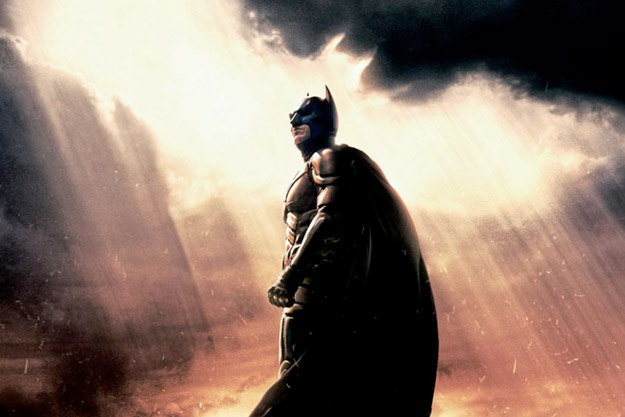
In The Dark Knight Rises, philanthropy, technology, and institutions all fail to mitigate intolerable social crises. In this context, Batman represents the sad clamoring of the ruling class for a hero that even they don’t truly believe in.