If you read celebrity blogs (and fully 23.7% of Kinukitty’s brain is occupied thus; dlisted is one of my favorite things in the world, right up there with Twix, Fresca, and peace, love and understanding), you might have recently become aware of Stephen Ira Beatty. I think the Daily Mail started it, and it spread to the National Enquirer, and so on, and so on. Stephen has popped up in this context before, but this video seems to have spread further than anything else.
This could be a coincidence, or it could also be totally wrong; I did some half-assed research but did not employ science or anything. Assuming it’s not wrong and there is a reason (because, really, why not?), I can’t help thinking it’s because Stephen Ira Beatty is tremendously appealing. Also thoughtful, intelligent, educated, and well spoken – and sure, all those things are fine, but really, the adorability helps. And, in my mind, it’s exciting that habitual readers of the Daily Mail, the National Enquirer, TMZ, etc. are watching a video of a trans man chatting about being trans.
He got all the publicity because he’s the son of Warren Beatty and Annette Benning, of course, not because people want to better understand transsexuals or because he has interesting things to say, and that does suck. What also sucks is the circus sideshow tone of some of these posts – child of famous attractive heterosexual people is transsexual! Can you believe it?!!? All noted. (Here’s Stephen’s take on that.) But still – that’s an awful lot of people who probably never think about this stuff taking a moment to acknowledge it and, possibly, having a wow, that guy is pretty cool moment.
Said video, which made the rounds in mid-July, is of Stephen chatting about being transgendered and stuff. He started transitioning at age 14, and he’s 20 now, which I find mind-bogglingly splendid, and also really very encouraging. His parents are rich, and apparently at least somewhat open minded, which obviously put him in a better position to address his gender dysphoria than most people are in. (For instance, if you follow Dispatches from Tanganyika (which is damned hard to spell), you’ll read about how Billy Martin – formerly Poppy Z Brite – has had to sell off possessions to pay for his testosterone, and he still had to stop taking it for a time.) That doesn’t make Stephen any less impressive; it’s just worth nothing. Looking back at my own 14-year-old experience, which was muddled and unpleasant and thoroughly lacking in resources for fixing anything, I can only say damn, Stephen, you kick ass.
And Stephen’s blog, Super-Mattachine, is charming and interesting and well written. His most recent post is a review of queer porn movie Speakeasy (available here, along with a lot of other great stuff, including the marvelously titled “The Genderfellator.”) There’s some interesting introspection and discussion of the movie (Speakeasy, I mean; there’s a trailer here if you’d like to take a dip), including an acknowledgment of the cerebral nature of the review, which he clarifies by saying “A++, would fap again.”
The name of the blog, by the way, refers to the Mattachine Society, a pre-Stonewall gay rights group (founded in 1950) and its newsletter, The Mattachine Review. According to group founder Henry Hay, via Jonathan Katz, Gay American History (Crowell Publishers, 1974), via Wikipedia, the name references a French medieval and renaissance masque group called the Société Mattachine. These societies (again according to Wikipedia) were “lifelong secret fraternities of unmarried townsmen who never performed in public unmasked, dedicated to going out into the countryside and conducting dances and rituals during the Feast of Fools, at the Vernal Equinox. Sometimes these dance rituals, or masques, were peasant protests against oppression – with the maskers, in the people’s name, receiving the brunt of a given lord’s vicious retaliation. So,” Hay said, “we took the name Mattachine because we felt that we 1950s Gays were also a masked people, unknown and anonymous, who might become engaged in morale building and helping ourselves and others, through struggle, to move toward total redress and change.” Which is interesting, dontcha think? Also interesting (and also from Wikipedia), the Mattachine Society’s goals were “to unify homosexuals isolated from their own kind; educate homosexuals and heterosexuals toward an ethical homosexual culture paralleling the cultures of the Negro, Mexican and Jewish peoples; lead the more socially conscious homosexual to provide leadership to the whole mass of social variants; and assist gays who are victimized daily as a result of oppression.”
I had heard of Stephen before I saw the afore-mentioned video on dlisted, etc., but I didn’t start Googling him frantically. And, not to get all earnest and shit, I appreciate having another opportunity to find out more about him. He dislikes the celebrity media, which has outed and hounded him, so I suspect he might not find my enthusiasm in this particular case worth the candle. He would have a point there, obviously. He seems like a tolerant guy, though, so maybe he’d see a silver lining here, too.
(Also, I don’t know about you, but I’m pretty upset about Kristen Stewart cheating on Rob Pattison – why, Kristen, why? Apparently she can’t act – I don’t know because I only saw her in the first Twilight movie, and I thought she banged “glum teenager with not ideal decision-making skills” dead on – as it were. I don’t care about that, though. I just like to look at pictures of her in Us and shiver at the pointy perfection of her nose.)
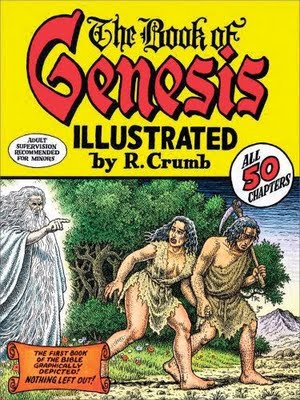
When the people I talk with say ‘this comic had minimal impact on the comics world’ they don’t just mean ‘oh it wasn’t talked about on the 2 or 3 comics blogs i read.’ They are primarily talking about how none of the comics people they talk to in real life are talking about these books. Or, at least not talking about them in the “wow, I’m really excited about this book” sort of way. I feel like this excitement is something that is often missing when I hear conversations (real life, not just the internet) about comics like “Wilson” or “Genesis.”
Maybe this excitement (or lack thereof) is something to think about? Something to talk about? Maybe excitement is the wrong word, because strong feelings against something can also be a big motivation for change, for thought. Maybe it’s just the lack of people demonstrating strong feelings one way or another. A lot of times I feel tired of the comics scene because people just act like they’re too cool to care.
I can’t divorce myself from the creation aspect of things, seeing as that’s what I spend the majority of my time doing. But I know that for me, what I’m excited about either at the time or in my past has a lot of bearing on what I produce. Sometimes it is wanting to explore an idea. Sometimes a technique. Sometimes I am so angry I want to just make something better, something that states my view of things. But strong feelings are the reason I make art and the reason my art changes.
I remember a while back Frank talking about jazz, how he was missing the interplay in the comics world, the building off of each other. Sometimes I feel the same way. Not necessarily that we (as creators) should only play from/with the past, but maybe that we should play more off of each other as peers. Maybe we should talk more about what we’re excited about and how it’s influencing our art, whether it’s in the comics scene or not. Maybe we should not be afraid to say that we disagree something without worrying about stepping on toes.
Maybe if we talk more about our influences, our excitements, our ideas, then we can make a space for comics in the greater sphere of creativity instead of an maintaining the idea of an insular world that is only influenced by itself.
I noted in response that ““If there’d been stronger feelings about the Genesis comic on this blog, we would have had fistfights.” L. Nichols replied:
Sure. But that’s just this blog, one blog, a blog with a history of people who like to get in long arguments about comics. I was more talking about people in real life. What’s the number of times I’ve heard Genesis being mentioned in real life by real life comics artists? I talk to comics people all the time and I’ve heard MAYBE one or two of them talk about Genesis. I’ve heard more non-comics people talking about it than I have any comics people I know!
I was more trying to say that people aren’t excited enough about comics to REACT to them in their work. I mean the type of excitement that wakes you up in the morning, keeps you up at night. The kind of excitement that makes you want to go draw “Exodus.” Or maybe the kind of excitement where you’re SO upset about Genesis that you just have to react some way against it in your own work. Excitement on the creation side of things.
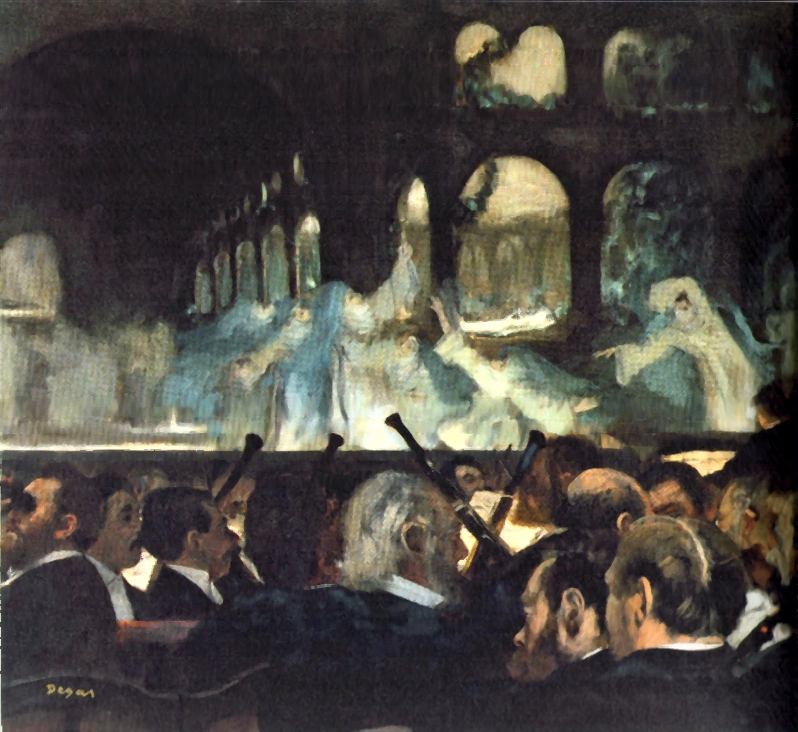
Ballet Scene from Meyerbeer’s Opera “Robert le diable”, 1876, oil on canvas, 76.6 x 81.3 cm.,
London, Victoria and Albert Museum
Last year’s Degas show at the Royal Academy in London was an eye-opener. Premised on an obvious idea that nevertheless has yet to be fully examined, it presented the artist’s work on subjects relating to the ballet with focus on contemporary interest in the understanding and truthful depiction of movement.
Juxtaposing Degas’ work in drawing, painting, sculpture, and photography with the photographic, cinematic, and sculptural studies of human and animal locomotion of Eadweard Muybridge, Étienne-Jules Marey, Paul Richer, and others, the exhibition made the case not so much for direct axes of influence (as the Burlington Magazine’s confused reviewer assumed, for instance), but rather of a general confluence of interest between them.
Conspicuously missing from the show, however, was one of the quintessential nineteenth-century forms dealing almost obsessively with the depiction of movement: comics. This is hardly surprising: despite the show’s progressive approach to the study of nineteenth-century art, we have unfortunately not yet reached a stage where the specific and highly charged connections between popular and high culture of the period are fully recognized.
Pointing fingers at an otherwise stellar show only goes so far, however. More interesting is how it laid bare new ways of understanding the language of comics as it developed in Degas’ time, and how its fresh perspective on his art, when seen from a comics standpoint, illuminate further the epistemological insights of his art.
As the show emphasized with a stunning display of pastels hung in the penultimate room, Degas was ever an artist in the grand tradition of the renaissance, fastening raw human experience in color, his dancers timelessly moving to the tune of history. The paragons are clear: Raphael, Titian, and Veronese, through Watteau and even Goya, all found in Degas a modern interpreter.
This, in part, is due to his investment in contemporary media and form—his boundary-challenging work in photography is but one example of this, while the exhibition suggested other parallels, one of which — a short fumetto in which Degas acted out a vaudeville skit with a couple of friends — touch directly upon the language of comics.
Years earlier, in his attentive depictions of stage performances, he touched initially upon sequentiality as a means of depicting movement, and more fundamentally conveying subjective experience. Not only is his Ballet Scene from Meyerbeer’s Opera “Robert le diable” of 1876 (see above) framed to suggest his particular point of view from the front stalls, it depicts in a brushy swathe the sensation dancing movement across the stage. Simultaneously a snapshot depiction of the large, costumed ensemble on stage and a suggestion of movement from back to front and left to right, it proposes a dynamic and novel solution to the centuries-old problem of conveying the passage of time in a single image. This strategy of employing individual figures to suggest a general pattern of movement was later employed to great effect in single panels of comics, most famously by Hergé in several of the Tintin books.
From the color version of Hergé’s “Le Crabe au pinces d’or” (1944)
It would seem that such innovations developed from the old problem of how to represent the passage of time with one image. This has been essential to narrative picture-making since antiquity, but reached new levels of sophistication in the high renaissance when the single image became increasingly divorced from the narrative series of medieval and early renaissance art. How to suggest the before and after? How to pose a figure to indicate previous or future action? Acutely aware of this tradition, Degas crucially achieved a synthesis of this knowledge with the aesthetic of photography. His figures are often posed in ways only the mechanical eye of the camera could otherwise see, but are simultaneously tweaked to achieve the illusion of movement that is mostly absent from snapshot photography.
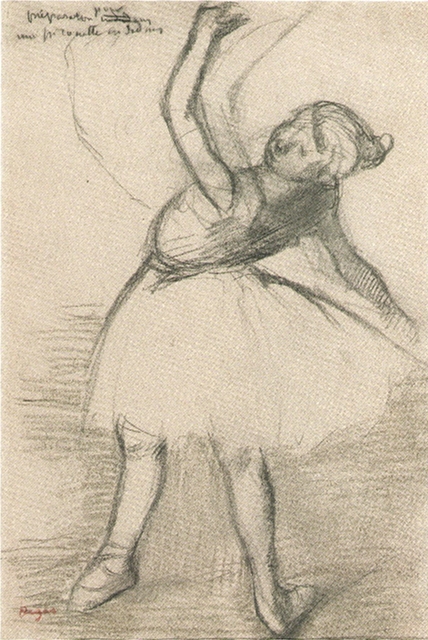
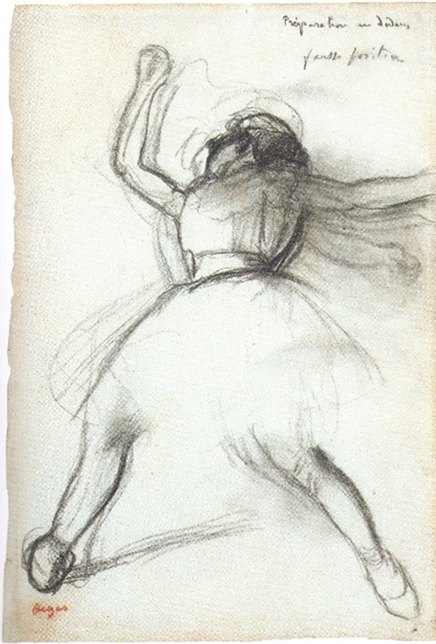
Left: preparation for an Inside Pirouette, c. 1880-1885,
charcoal and black crayon on paper, 336 x 227 mm., Belgrade, National Museum;
Right: Dancer (Préparation en dedans), c. 1880-85,
charcoal with stumping on butt paper, 336 x 227 mm., Trinity House
This is evident from his astonishing on-the-spot sketches of ballerinas practicing from the 1880s. Drawn in something approaching real-time, the artist’s hand following the motion of his model, these sketches are fundamentally different from the sequential, or chronophotographical experiments of Marey and Muybridge along with which they were displayed in the exhibition. Although their ambitions are similar, the photographers achieve the illusion of movement through juxtaposition of individual photos frozen in time, whereas Degas’ knowledge of temporal illusion conveys an almost bodily sensation of the movement suggested.
In one sketch, the dancer torques her body in preparation, motion lines of the kind later so familiar to comics readers conveying the movement of her right arm, and judiciously applied vertical hatching between her feet helping further to suggest the determined circle she is beginning to describe. Another sketch conveys vigorously the imminent discharge before a pirouette. By drawing his models in positions tweaked beyond the anatomically possible and energizing them through motion blur, Degas achieves an effect of action-through-time impossible in photography.
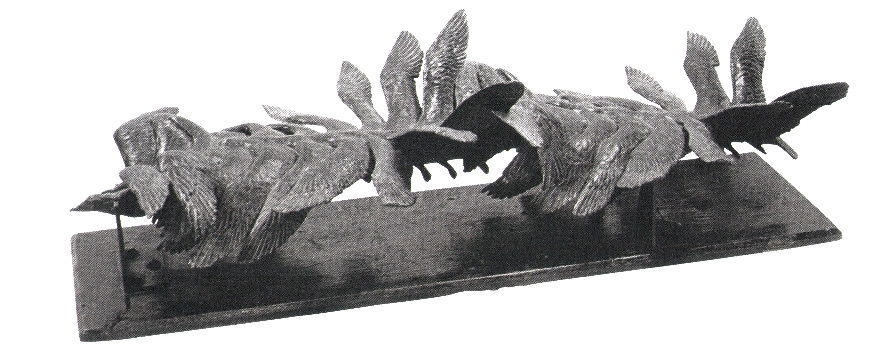
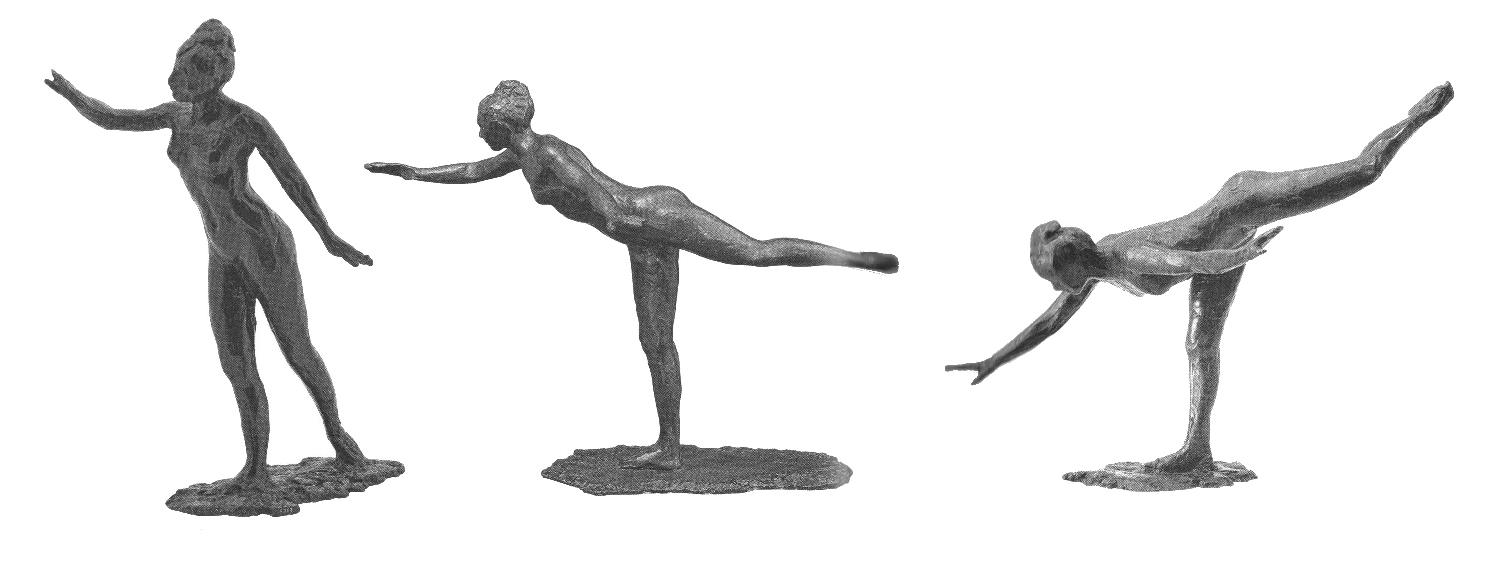
In the same room, Marey’s fascinating sculptural renditions of birds in flight — transposed from photography, fusing duration in bronze — were shown alongside Degas’ bronze studies of female nudes in motion, well-known but rarely arranged as they were here, sequentially performing three steps of the grande arabesque. The connection to comics is apparent, and it would have made sense to place the similar experiments by contemporary cartoonists of combining narrative single drawing with sequence to describe movement and action.
Étienne-Jules Marey, Flight of a Gull, 1887, bronze, 16.5 x 58.5 x 25.7 cm., Beaune, Musée Marey
Grand arabesque: First, Second and Third Time, c. 1885-90, bronze, 48.5 x 24 x 34.5/ 42.6 x 29.2 x 61.2/ 43.2 x 33 x 50.8 cm., Glasgow City Council/ Sterling and Francine Clark Institute/ Norton Simon Art Foundation
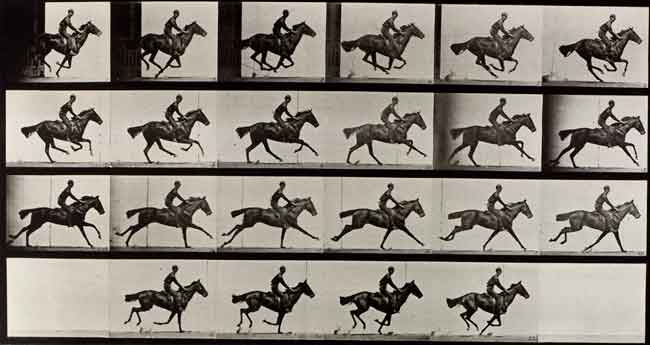
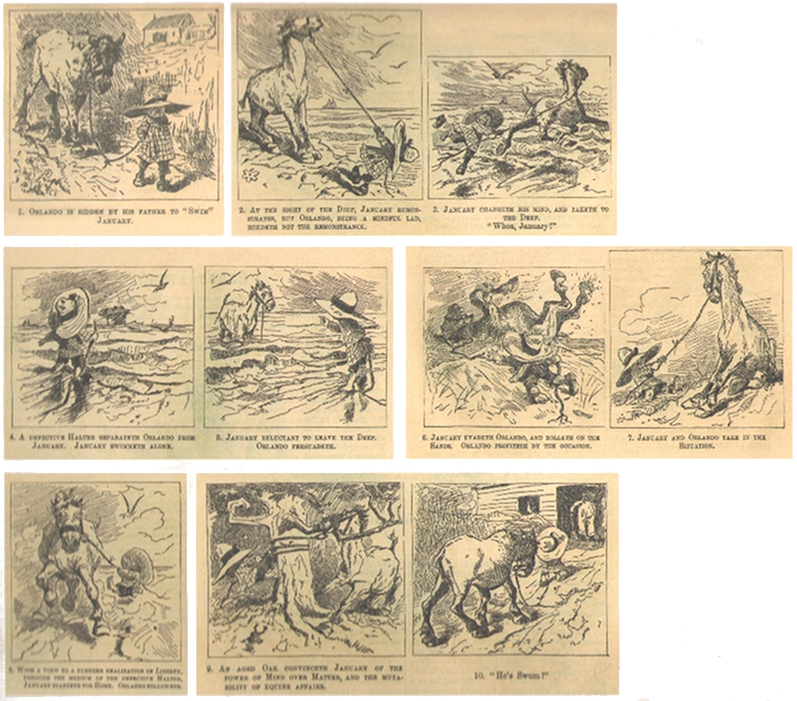
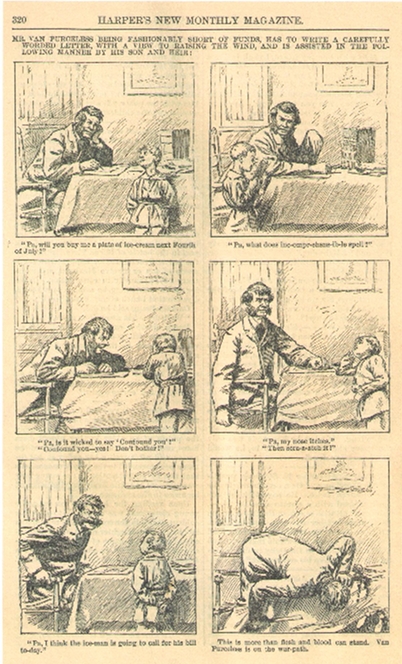
Among the most accomplished in this respect is the American cartoonist A. B. Frost. Immediately attentive to the discoveries of chronophotography, he lampooned it in his early 1880s cartoons. But as Thierry Smolderen has shown us he also learned from it in a way that helped transform the sequential grammar of comics.
Eadweard Muybridge, Horse in Motion, Plate 625 from “Animal Locomotion,” Philadelphia in 1887.
A.B. Frost, “Orlando and January”, Harper’s New Monthly, September 1881
The natural movements of a horse in motion became the occasion for visual comedy, but the subtlety of a body’s motion moment-to-moment also opened cartoonist’s eyes to the narrative potential therein, resulting in sequences with only minor but no less crucial changes from panel to panel—something that would have been unthinkable earlier, not the least because the laborious wood-engraving process necessary for printing the comics generated an imperative for variety.
A.B. Frost, from Harper’s New Monthly, January 1880
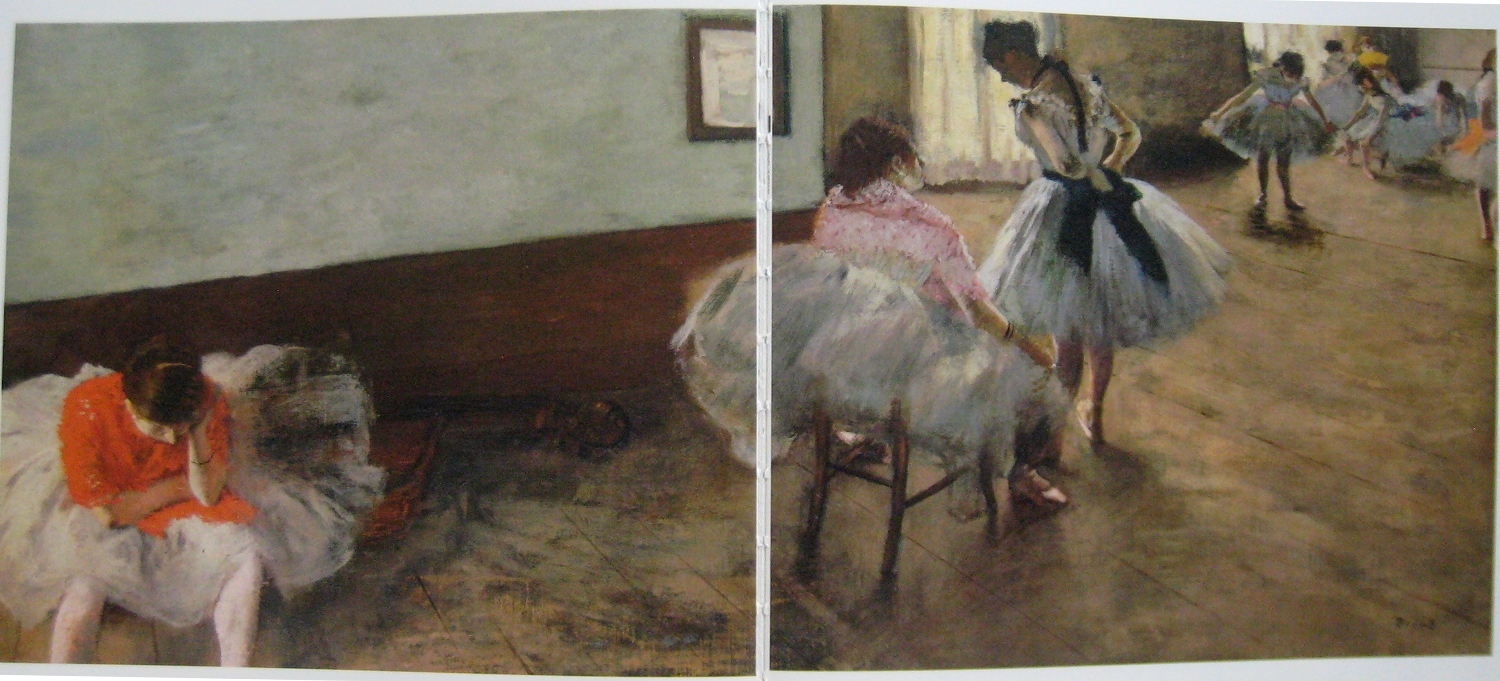
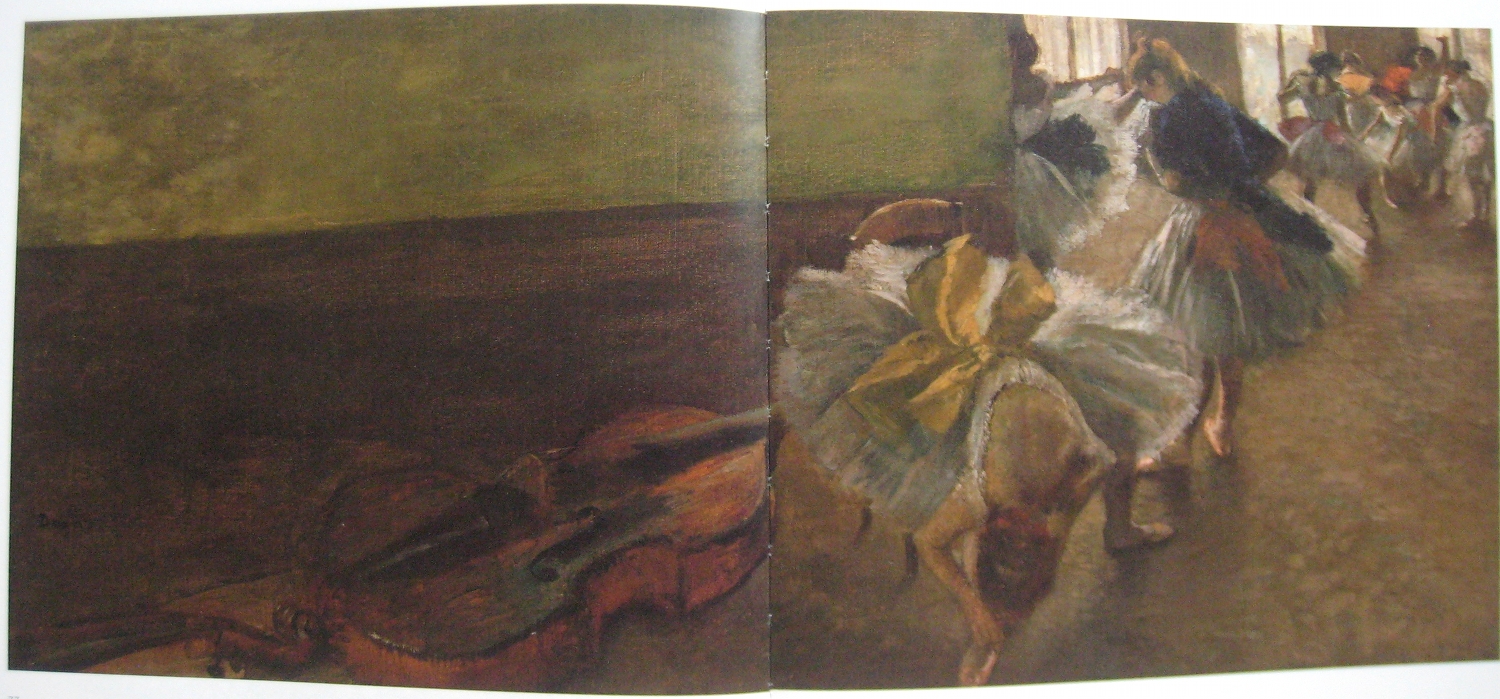
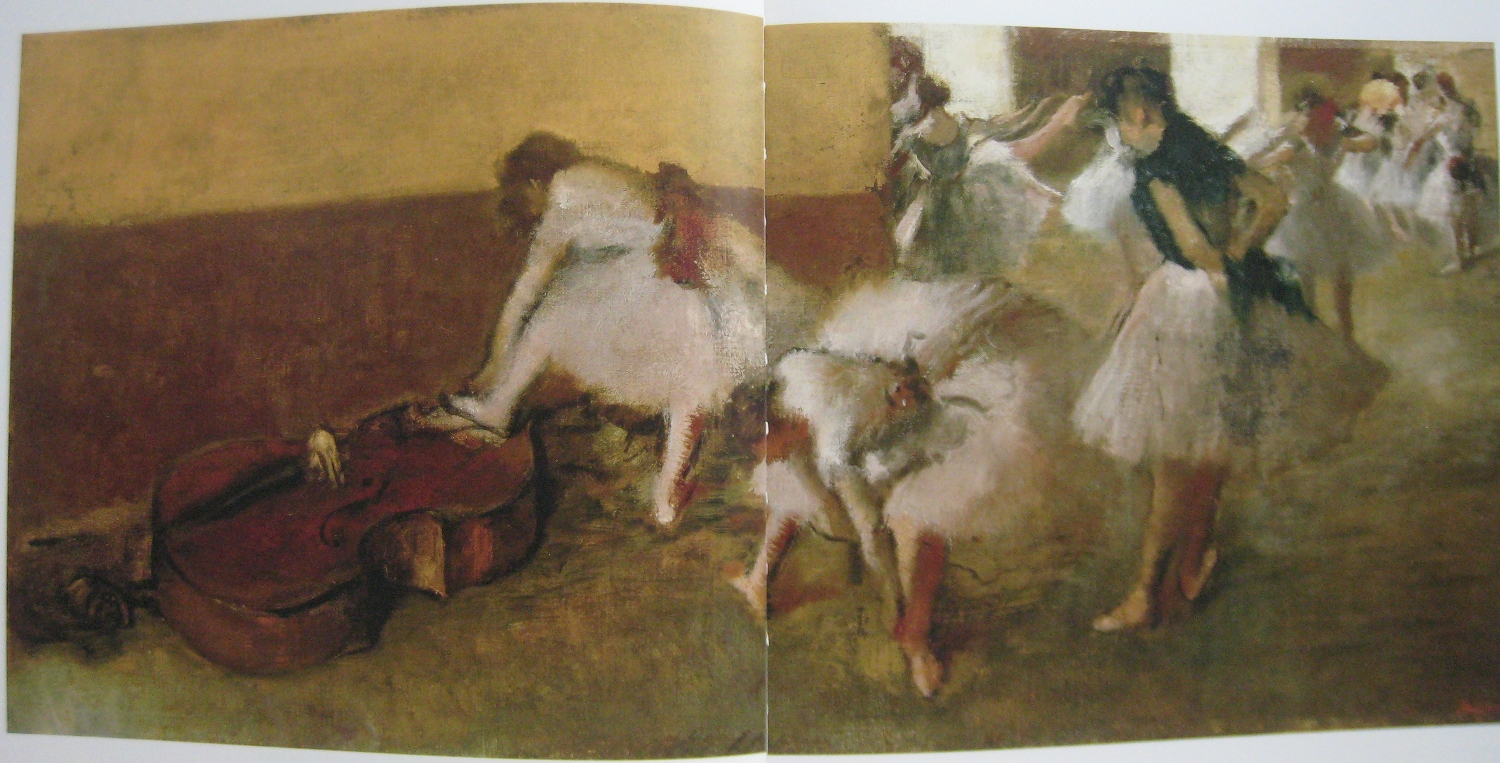
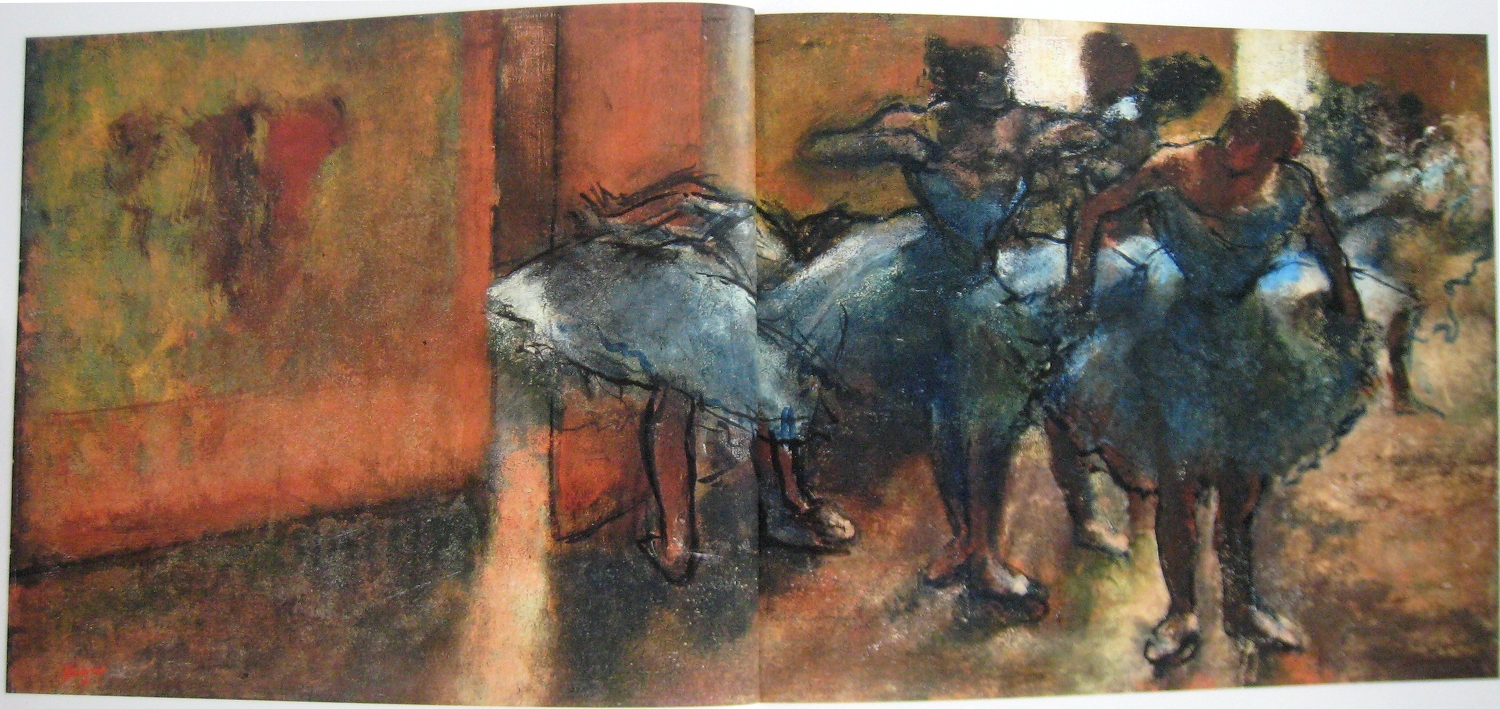
Surely these discoveries also inform Degas’ series of widescreen rehearsal studio interiors. Degas painted almost a dozen of these canvases over a period of around twenty-five years, all set in roughly the same space — initially adapted from a real dance studio, but clearly turned into a malleable architectural framework for him to experiment with. The exhibition presented five of these works, proposing a link to the contemporary vogue for the panorama, but it seems more appropriate to understand them, again, in terms of representing movement, or perhaps rather time.
The Dance Lesson, c. 1879, oil on canvas, 38 x 88 cm., Washington DC, National Gallery of Art
Dancers in the Rehearsal Room with a Double Bass, c. 1882-85, oil on canvas, 39.1 x 89.5 cm., New York, Metropolitan Museum of Art
Dancers in the Green Room, c. 1880-94, oil on canvas, 41.3 x 87.6 cm., Detroit Institute of Arts
Dancers in the Foyer, c. 1889-1905, oil on canvas, 41.5 x 92 cm., Zurich, Fondation E.G. Bührle Collection
Panoramas may have provided Degas with his unusual formatting, but his clearly articulated, subjective point of view is far from the Archimedean ambitions of that form. Having been executed over such a long stretch of time, it was certainly not a tightly planned series, but when taken together they nevertheless represent inspiringly the passage of time on several levels. A profound take on the impressionist penchant for series, Degas here paints the years passing. Seasons change with the light while his brush technique expands and flowers, achieving heightened tactility and depth of glow. The figures are animated initially through snapshot posture and motion blur, but later also through the dynamic pulse of their loosened outline. These young dancers flick through the space in a way akin to fast-motion in film — and of course to the by now commonplace technique in comics of setting action against a fixed backdrop, panel-to-panel.
From “A Clockwork Orange”, directed by Stanley Kubrick (1971)
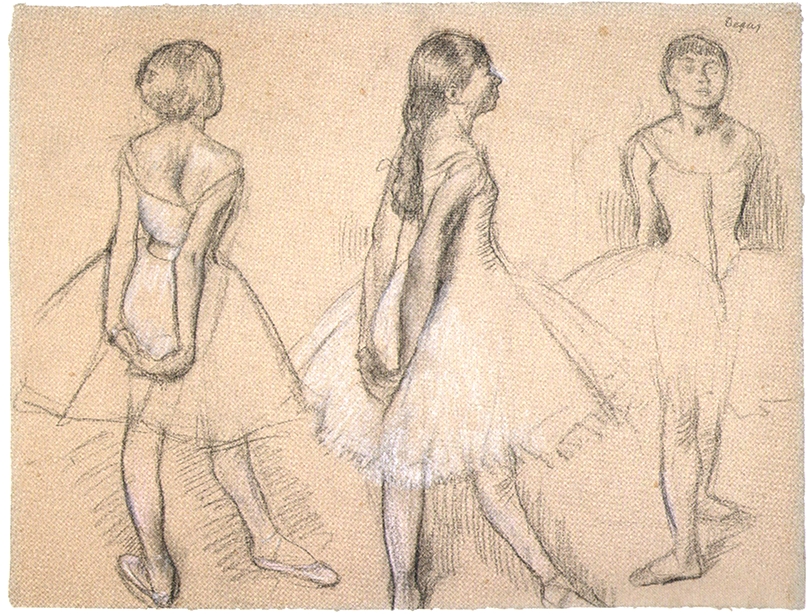
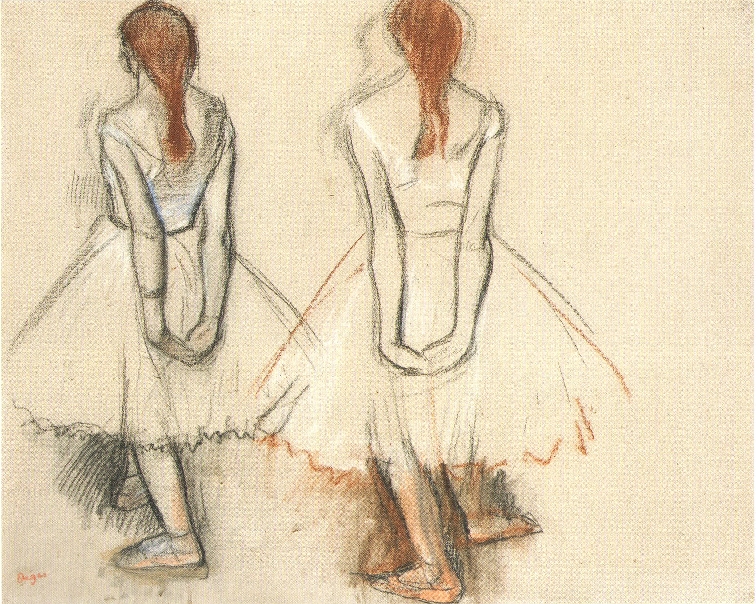
The conceptual set piece of the exhibition, however, was no doubt the display of sketches for Degas’ most famous sculpture, the Little Dancer Aged Fourteen (c. 1922). In preparation for the work, Degas made a 360-degree survey of his model. Juxtaposed, these drawings form a number of broken sequences conveying the sense of circling the little dancer, again and again. Of course, artists had made studies from multiple angles before, but it is the systematic approach — similar finish, same distance to the subject, the sheer number of sketches — that gives this series of sketches its temporal character. It is not just about seeing in the round, but about the locomotive, bodily way we experience the world, forming our impression from a multitude of fragments processed in time.
Three Studies of a Dancer, c. 1878-81, black chalk with white heightening on pink paper, 470 x 623 mm., New York, Morgan Library
Two Studies of a Dancer, 1878-79, charcoal, pastel, and wash on paper, 472 x 585 mm., private collection
There is something fundamental to Degas inquiry into time and space as articulated by movement here. The show suggested how he reached these insights by situating him in a context obsessed with inquiry into these phenomena, as someone who by virtue of his classic orientation and unique eye was able to probe their epistemological significance. It has become almost common knowledge how early nineteenth-century pictorial arts anticipated photography, and it is evident how photographic and other pictorial techniques and approaches, such as those practiced by Degas, anticipated film. What remains unacknowledged, and as mentioned was entirely ignored by the curators here, is to what extent the same phenomena were explored in comics, a medium in which Degas can be said to have worked with as great sophistication and insight as anybody else in comics history.
Edgar Degas and the Ballet: Picturing Movement was shown at the Royal Academy, London, September 17–December 11, 2011. Catalogue by Richard Kendall and Jill Devonyar, London, Royal Academy of Art, 2011. The paragraphs on Frost are heavily indebted to Thierry Smolderen’s eye-opening book, Naissances de la bande dessinée (Brussels: Les Impressions nouvelles, 2009).