This is the index to the 5th anniversary Hooded Utilitarian roundtable in which contributors write about the worst (or most overrated, or disliked) comics ever. Except for the introduction and conclusion, the index is organized in order by contributors’ names, and will be updated throughout the roundtable.
UPDATE: A subject index which lists all comics (and other things) hated in the hatefest is now here.
___________
Welcome to the 5th anniversary celebration of the Hooded Utilitarian. It was five years ago today that I put up my first post on this blog. It’s been a pretty amazing run since then, and I am incredibly grateful to all the friends, writers, colleagues, commenters, and readers who have kept the blog going for all this time. Thank you.
_______________
Okay, that’s enough with the love. Through much of this month, we’ll be running a roundtable titled Anniversary of Hate, in which contributors will write about what they believe is the worst comic ever — or the most overrated, or the one they personally hate the most, as the case may be.
Anniversaries are usually supposed to be a time of congratulations and good cheer. So why, you may wonder, have I chosen to poison a happy event with bitterness and contumely? Why be a divider and not a uniter? Why hate?
There are a bunch of reasons that I’ve chosen this celebration for this occasion. The first, and perhaps the most important, is that once it occurred to me, I had to go through with it. After all, what’s the point of having a blog if you censor your cranky, or (for that matter) your ill-advised ideas? Besides, lots of folks think of HU (rightly or wrongly) as a place of spiteful animadversion and mean-spirited contrarianism. It would be wrong to disappoint.
I can, however, also come up with some marginally less flip rationales. Indeed, I think the need for justification is a kind of justification in itself. No one, after all, would ask, “why love?” if I asked people to write about their favorite comics.
Criticism tends to be biased towards positivity. In the first place, people simply prefer to spend their time with comics they like. Certainly, for this project, several potential contributors begged off because they couldn’t face rereading a comic they loathed. Along the same lines, negative criticism can have unfortunate personal and career implications for folks who work in the comics field — again, I had a number of writers decide they couldn’t contribute because they didn’t want to offend friends or colleagues. And even where such practical considerations are not an issue, many writers simply prefer to avoid negativity, either because they find engaging in it personally depressing, or because it seem cruel, especially when the target lacks stature or has long since been buried in the slag heap of history.
I understand all those arguments against hate (and I certainly fault no one for turning down the invitation to participate in this particular orgy of animadversion.) But at the same time, I think it’s worth occasionally pushing back against the logic of praise. There is, after all, a lot of bad art in the world. Rushing to insist that the glass is ¼ full (or 1/12 full) can leave you ignoring the vast bulk of the nothing that’s there. And that, in turn, can give you a skewed view of the state of the good art, as well as of the bad.
Perhaps more importantly, a refusal to criticize is almost always a de facto endorsement of the status quo. Good and bad are relative terms — and that means that they are always relative to something. Canonical comics are canonical because they fulfill certain criteria — because, say, they are about important subjects like the Holocaust, or because they show a certain kind of mastery of a certain kind of technique, or because they are works of individual genius, or what have you. To question those criteria, to envision a new canon, or a critical landscape in which canons are less important, requires not just positive advocacy, but negative questioning. That’s why Domingos Isabelinho’s longstanding effort to bring attention to what he considers undervalued works has also required him to do a fair amount of sneering at what he considers overvalued ones. (Update:Though note Domingos’ caveat in comments below.) As Arlo Guthrie once said, you can’t have a light without a dark to stick it in — and you can’t imagine a better way if you refuse to see the flaws in the way you’ve got. Which is why the antipathy to negativity can itself, I think, be profoundly depressing. When you’re angry or unhappy, there’s nothing quite as dispiriting as people lining up to demand that you be of good cheer.
I also think that it’s worth giving folks a chance to write about what they hate simply because hate is as likely as love to provoke, or inspire, great criticism. Whether it’s James Baldwin’s epic deconstruction of The Exorcist, or Laura Mulvey’s brief, brutal takedown of Hollywood cinema, or Mark Twain’s hilarious backhand to James Fennimore Cooper, or Jane Austen’s vivisection of the gothic novel, many of the greatest, most insightful, most beautiful examples of critical writing we have are negative. That’s a tradition worth honoring.
Finally, I suppose I hoped that an Anniversary of Hate would prevent me from getting too comfortable on my laurels (to the extent that I have any.) Five years is a really long time in blog years — long enough to get old and fat and complacent, anyway. But if I’m going to be old and fat and complacent, by god, the least I can do is to be crotchety as well. As we hobble towards elder-blog status, I do hope that somewhere, somehow, we can still provoke some unsuspecting young surfer to mild irritation — and perhaps even, on rare occasions, to hate.
_______
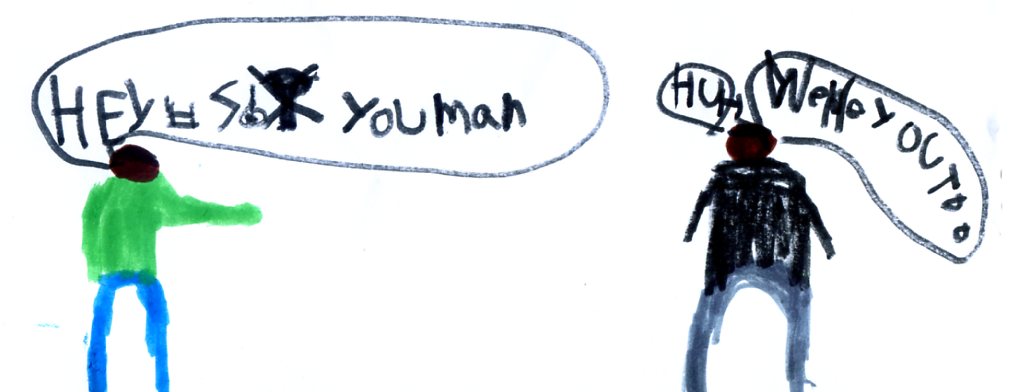
Hatefest illustration by my son. He was 3 when I started the blog; now he’s 8.
This first appeared on Madeloud.
_____________________
The old sixties Batman TV show with Adam West and Burt Ward is best known for the Batmobile, Bat Shark Repellent, and Bat Overacting. However, the show also featured a number of high profile musical guest stars. Here then, are some of the greatest Bat-cats ever to swing through stately Wayne Manor and environs.
Liberace
“The Devil’s Fingers/The Dead Ringers”
Episodes 49 and 50
October 19 & 20, 1966
Liberace was too perfect a choice to be contained in a single Batman villain guest spot, so he did two at once, portraying both piano maestro Chandell and Chandell’s evil twin brother Harry. The plot starts off strong as Chandell declares, “Listen for a moment; I’ll toy idly with the keys, and set the mood.” He then launches into a highland air, instantly summoning a trio of criminal Scottish lassies toting inhumanly piercing bagpipes. From there the plot only get sillier, featuring attempted murder by piano-roll puncher, the lassies transformed into Burmese dancing girls, and Bruce Wayne deducing the whole evil scheme when he realizes that Chandell made a mistake in a C-minor chord (“Holy impossibility, Batman!” as Dick Grayson says.) Oh, and we get to watch that ladies’ man Chandell seduce Aunt Harriet. And he utters the immortal line “I’ll cast off my criminal skin like a molting butterfly!”
While it’s fun to watch Liberace play himself as Chandell; watching him adopt a tough-guy, cigar-chomping persona as Harry is brain-meltingly preposterous, and somehow even gayer than gay — it’s like he’s wearing butch drag. Not to be outdone in flamboyance, Bruce Wayne spends a certain amount of the episode literally camping, and then he and Dick fake their deaths by incinerating themselves in a flaming closet.
Chad and Jeremy
“The Cat’s Meow/The Bat’s Kow Tow”
Episodes 63 and 64
December 14 & 15, 1966
Gentle moderately popular sixties British folk duo Chad & Jeremy appear here as insanely popular, dangerously wild sixties British folk duo Chad & Jeremy. However, in a daring plot twist, the dangerously wild sixties British folk duo Chad & Jeremy reveal to Bruce Wayne’s Aunt Harriet that they are in fact gentle and civilized, sipping tea and declaring, “Really we hope to go back to school as soon as we can to complete our education… Just think of it: every record our fans buy brings me closer to becoming a brain surgeon!”
Alas, their fans are not so cultured, and they screech, holler, and throw up their hands when their idol’s voices are purloined by Catwoman (an incandescently yummy Julie Newmar.) Catwoman’s dastardly plan is to hold the voices for ransom, demanding twenty-two million dollars from Britain since “Chad and Jeremy pay so much income tax to their native land,” and that if they stopped the entire economic structure of the world would collapse.
In other highlights, Chad & Jeremy provide jovially irreverent interviews like the Beatles and seek out hair salons. They also perform a few verses of the sunnily inoffensive “Distant Shore,” and almost all of the peppily inoffensive “Teenage Failure.” “Aren’t they great, Alfred?” the enraptured Dick Grayson asks. “Well, they do sway, don’t they?” replies the stoical Butler.
Also in this episode…Batman and Robin climb down the side of a building past the window of Hawaiian singing legend Don Ho.
Leslie Gore
“That Darn Catwoman/Scat Darn Catwoman”
Episodes 74 and 75
January 19 & 20, 1967
Leslie Gore was not only a teen pop sensation; she was also the niece of Howie Horwitz, the producer of Batman. On the strength of that connection, she got to wear a skintight pink outfit, pink cat ears, a pink bowtie and (improbably) big pink mittens as Catwoman’s evil protégé Pussycat. Pussycat comes on to Robin so strongly that the Boy Wonder’s voice jumps an octave, a scene all the more amusing since we now know that Gore was far more likely to have had eyes for Julie Newmar than for Burt Ward. Perhaps, though, Pussycat was under the influence of cataphrenia, a drug which reverses all a person’s moral and ethical standards, as Catwoman helpfully explains.
In any case, though Pussycat has turned to a life of crime and frequent flirtatious moments with Catwoman (and a couple with an ethically-inverted Robin), she still sometimes wishes she could pursue her dream to be a rock and roll singer. And, in fact she performs a wow-that’s-obviously-lip-synced version of the hit, “California Nights” for Catwoman’s henchmen in front of a giant green cathead with a glowing purple mouth.
Ethel Merman
“The Sport of Penguins/A Horse of Another Color”
Episodes 98 and 99
October 5 & 12, 1967
Teamed up with the Penguin (Burgess Meredith), the famously stentorian Ethel Merman elocutes her way through the role of Senora Lola Lasagne, a.k.a. common crook Lula Schultz. Merman doesn’t actually sing, though she does seem ready to burst into bombastic warble when she declaims “I am Senora Lola Lasagne!”
Eartha Kitt
“Catwoman’s Dressed to Kill”
Episode 108
December 14, 1967
“Funny Feline Felonies/The Joke’s on Catwoman”
Episodes 110 and 111
December 28 & January 4, 1967
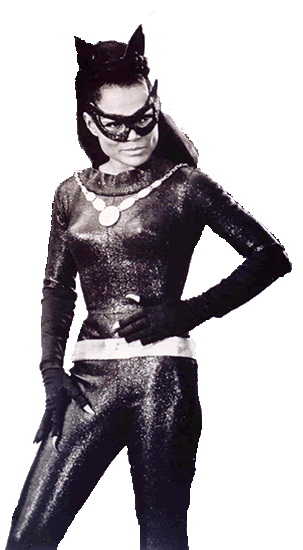
Singer and actress Eartha Kitt stepped into Catwoman’s whiskers for the third Batseason, appearing in one stand-alone episode and a two-parter with co-villain the Joker. Where Julie Newmar played Catwoman as luxuriantly playful, Kitt was downright feral — when she widened her eyes and hissed, you really believed she wanted to pounce on and devour some flying rodents. She also threw herself into the vocal tics more enthusiastically than her cat predecessors, embracing lines like, “Rrrrr, I glow with the thought of that garment,” and rolling her rrrrs through words such as “Spaarrrrrk plug,” “perrrrsuaive,” “perrrrrturbring,” “perrrrrfidious,” and of course, “perrrrrhaps.” Despite such verbal shenanigans, Kitt never actually sings, though she does recite some doggerel verse (prompting the Joker to comment “Oh your voice has a nice lilt, Catwoman!”), as well as lapsing into a foreign tongue for a moment in homage to her big exotica hits (“That’s the first time I ever heard a cat purr in French!” enthuses the Joker.)
Incidentally, Orson Welles called Kitt, “the most exciting woman in the world.” You might think he was exaggerating…until you see her in that skintight black Catwoman suit.
I finished Chris Hedges’ “When Atheism Becomes Religion”; read Joseph Conrad’s short novel “The Shadow Line”, reread the first chapter of Giorgio Agamben’s “The Kingdom and the Glory: For a Theological Genealogy of Economy and Government” and confirmed that I really don’t particularly want to read the rest; read Stanislaw Lem’s “Return From the Stars” (which I reviewed this week); and am now reading Henry James’ “Portrait of a Lady,” which is awesome.
Before I begin, I’ll admit that my two favorite shows are Better off Ted and Terriers. Both were cancelled, given the run-around and are apparently only popular with critics and people who are late to everything. And no, I haven’t watched much Archer. I’ll get to it.
The idea that “women aren’t funny” has been around for a long time. Christopher Hitchens theorized that this had something to do with brain chemistry and the evolutionary value of humor. Men need to impress women and they do it through humor. Women, on the other hand, have no need to impress men since men already find women pants-droppingly funny. “Men have to pretend, to themselves as well as to women, that they are not the servants and supplicants. Women, cunning minxes that they are, have to affect not to be the potentates. This is the unspoken compromise,” he writes. Leaving aside the obvious heteronormative bullshit embedded in that comment (as well as all evolutionary psychology), it raises an interesting dichotomy: humor at someone else’s expense and humor at one’s own expense. Popular culture and talking heads seem to agree that women’s high sex status makes them unfit for humor at other people’s expense (too mean, too cruel, coming from the Goddess on her Throne) and therefore the only funny woman is a woman that is self-deprecating to a fault. TV, by and large, reflects that popular prejudice but it is indeed changing. It mostly agrees with the premise that ladybrains are wired only to play damsels in distress, emotional melodrama queens and non-threatening straight foils. All of these archetypes are, after all, women who have lost their pedestal and are therefore capable of humor.
The women of Community, for instance, are flawed but not self-deprecating, certainly not in the way that Tina Fey’s Liz Lemon, Queen of self-deprecating humor and the reigning Champion of the Thunderdome, is self-deprecating. Liz Lemon has stains on her shirt. She’s a woman. That is funny. Liz Lemon, a slob who could do better, is a clear example of the sort of TV woman who is funny because of the dissonance between her status and her reality, at least for the five people who watch NBC programming. Tina Fey’s character is made ugly in order to be funny. Our expectations of attractive women demand this. Even Tina Fey’s uproariously funny Sarah Palin impression relies on the “attractive woman being less than perfect” trope to some degree. In this case, the ugliness of Ms. Palin’s ignorance was enough but the riff still requires that trope for its power. As TV grows up, we see that it is possible for women to both be attractive and funny and self-aware. Community’s Annie, played by the consistently excellent Allison Brie, is not only given actual jokes where she isn’t just a foil but she remains attractive, even when the sexualized parts of her (her boobs) are transferred into the vessel of a monkey that lives in the vents and hoards stationery. The Monkey is literally called Annie’s Boobs. Annie’s Boobs are funny on their own, divorced from Annie, and form the basis of unrelated subplots. In this way, the show allows us to see the real Annie, boobs and all, be funny while still allowing for the kind of humor that is, apparently, only the province of adolescent males.
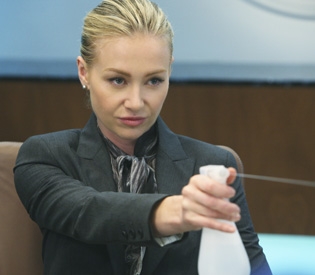
Only two women on TV, however, are/were playing women with power being funny without apologizing for it. It is no surprise that they are the best female comics on TV. I enjoy Sarah Silverman but she’s a little too complicated for this piece so pardon her exclusion while she bangs Jeff Goldblum in front of Nick Kroll. One, obviously, is Amy Poehler’s Leslie Knope, a high-strung bureaucrat/elected official managing the Parks and Recreation department of Pawnee, Indiana. Not only does she not apologize for power, she wants more of it. She risks her comfortable niche to run for elected office. And, what’s more, she’s good at her job and sincere about her intentions. Those are both things that she should not be able to do under prevailing theories of humor. A sincere, hard-working bureaucrat, of whatever gender, is a mindfuck. The other, and my favorite, is/was Better off Ted’s Veronica Palmer, played in the most insincere way by Portia DeRossi.
Veronica works for Veridian Dynamics, the archetypical evil corporation that subverts all the things people love. Can you think of something suitably evil? An octo-chicken, perhaps, with its extra drumsticks? A motion sensor that ignores black people? Weaponized pumpkins? Nicotine-flavored ice cream? Veronica is a woman whose unapologetic attractiveness is intimidating, which makes her the perfect boss for the cubicle drones she commands. She is in total charge of her sexuality, a point made clear not just by her subordinates dropping trou at a moment’s notice, but by her affair with the magician Mordor. While she worries that having people know about her double life as a magician’s assistant might harm her, ultimately when she performs, she really does perform. She doesn’t turn her sexuality into the joke in the end but instead, turns our gaze into the joke. There is not an Evolutionary Psychologist/Pseudo-scientist alive that can explain why Portia De Rossi/Veronica Palmer is fucking amazing. She is the ultimate Goddess on her Throne, out of reach and cold. And still funny. And she never does tell you where she hides the dove.