Eric Berlatsky on Girl With the Dragon Tattoo

I only occasionally get my brother to write for HU. I did manage to annoy him sufficiently to get him to post two lengthy comments, though, so I thought I’d reproduce them here (with a few edits for coherenece.)

Eric started out with a response to my comment that the film Girl with the Dragon Tattoo “strongly suggests that [Lisbeth would] be healthier/happier/normalized if Mikael followed through and did save her.” To which Eric says:

Sure…and if my aunt had balls—

Just the opposite, I think, it suggests that Mikael can’t follow through and save her, because such salvation isn’t possible in those terms. Sure, “if” he saved her, she’d be saved…but he can’t, so she won’t be…

In general, I’m not sure where you get this notion that the film “strongly suggests” that she’ll be normalized if he sticks it out. Where? Are there other examples of damaged women being saved by older sensitive men? Lisbeth being saved by her previous ward? Hardly…eventually, circumstances intervene and she has to fend for herself…which is to say, there is no such thing as permanent salvation. In the serial killings? No sensitive man saves the daughter/rape victim. Rather, her SISTER saves her (and her sensitive uncle ignores her in her hour of need–suggesting perhaps that men, even sensitive men, can’t really be trusted)…and then she forges an independent life by herself. And who clears the way for her to return to “life” as herself?—Not a man, but Lisbeth, who kills the serial killer, etc.

Actually, insofar as any saving is done in the film, it’s by Lisbeth….both of herself and of Craig. She extricates herself from the abuse with the counsellor/parole guy and from whatever abuse was going on with her dad. She saves Craig from de rigeur serial killer and from Craig’s economic/journalistic enemy. She even has “normalized” herself to a great degree (got herself a job, leading an independent life, etc.). It’s only if you’re willing to read bisexuality, tattoos, etc. as abnormal that you can say that she isn’t a normal functioning member of society (I’m not willing to do that, for the record). In fact, she is the most competent, effective, efficient figure you’re going to find. If anything, she’s a “Mary Sue”–men (and women) want her, and women (and men) want to be like her (nobody wants to undergo what she does…but everyone would like to be able to react to such trauma with such resources, force, efficiency, resiliency, etc). She (at times, anyway) may feel like she needs to be saved….but the film doesn’t really give that indication. She’ll save herself (and does), thanks very much.

Maybe your claim is that’s it’s also a fantasy for older men to be saved by (and still sleep with) such figures? But more often isn’t being saved by a woman somewhat emasculating? Even in 2012?

Or maybe the only male fantasy being fulfilled in the film is the one revolving around younger attractive women being willing to have sex with (or throwing themselves at) older, less attractive men (though Craig is a sex symbol in his own right, right?).

I agree that the sex fantasy is a real and sexist one…but the notion that the movie suggests that Lisbeth needs saving by a man (or that such salvation is likely/possible) is much more tenuous—in fact, largely nonexistent.

And a second post here.

I think the movie’s fairly confused, basically. The book (as I understand it) is more complex on these issues and the movie tries to follow the book’s plot for the most part, without having the wherewithal to get us inside the possible complexity of Lisbeth’s (or Mikael’s) mind. Even basic things are unclear. Like when she set dad on fire…Was this an act of “madness” (as she at one point implies), or was it an act of self-defense and perfectly justified (as I think much of the movie implies).

I’m not trying to make this movie some kind of ideal treatment of women’s rights, consciousness, and liberation—I’m just pointing out that the claim that was made (that it’s a fantasy of man saving woman and curing her of homosexuality) doesn’t make sense in terms of what actually happens in the film.

I would also say that pointing out that something is a trope, “successful career woman unhappy in love” doesn’t tell you much…since those tropes can be played in a variety of ways.

Such a trope can mean, “Being successful at work will make you unhappy in love, ergo you should forego your career, and allow men to control the public sphere”–

Or

the same trope can be played to blame a sexist/patriarchal society for putting too much of a burden on women… That is, it’s society that makes happiness both at work and at home a near impossibility for women…so society should change.

Admittedly, you see the latter far less in popular culture, but the same basic narrative can tell very different ideological stories.

I would say in “GWTDT”–there are lots of tropes, but what exactly they “mean” isn’t particularly consistent…as the movie itself isn’t consistent. Sometimes it’s empowering to women, sometimes exploitive.

Lisbeth’s “unhappiness in love” is clearly not because she’s a successful career woman, but because she’s been abused by men (including her own father) her whole life and is emotionally damaged. So…it’s not her public sphere efficiency that fucks up her private life….it’s men who fuck up her private life, from beginning (dad) to end (Mikael). It’s not Broadcast News (a much better movie, btw). The narratives of the two movies are far from identical up to the final shift…so the comparison doesn’t really work in any significant way. We might say that GWTDT gives the illusion that men have ultimate power over women…but we could also say that the film shows a very powerful woman capable of overcoming all of that patriarchal social hegemony. That is, it’s somewhat contradictory.[…]

Again, I don’t want to be the “defending GWTDT guy”— I actually don’t think it’s all that great, or liberating, or whatever…. It’s just not quite so clearly about the “guy saving girl” narrative that you (were) claim(ing). Now it seems that the claim is different?

My understanding is that in the books, the relationship between the two continues to be vexed, and that Lisbeth has a number of sexual encounters with both men and women, retaining her bisexuality. I don’t know enough about these to suggest whether or not the reader is meant to see her return to women as a symptom of her “failure” with Mikael, or whether she simply continues to be bisexual, as she always was, but it’s an interesting question. Of course, it tells us basically nothing about the meaning of the film.

Finally (I hope):

“It’s a reiteration that romance with a man is something she needs (as a woman) to be normal/happy/fulfilled, but can’t have.”

You’re free to read it that way, I guess, but since so much of the film revolves around the wrongs done to women by men–and especially the wrongs done to Lisbeth by men—and even the sins of omission made by otherwise nice guys—I think the notion that the story says: “All will be cured by the presence of a penis,” is far too simplistic. There may be currents of this in the film, but there are also strong countercurrents, which makes the film more interesting in this regard than you suggest (though not so interesting, really, as a murder mystery/serial killer story). The villains are all men here, and the male “protagonists/heroes” are basically impotent and accomplish nothing of value (Craig and Christopher Plummer). Only Lisbeth is an effective agent. Craig’s only real effective move is asking her for help. Plummer’s only effective move is asking Craig for his…and only because it leads to Lisbeth.

Perhaps all of the “feminist” elements come from the book’s plot and all of the “sexist” elements come from Hollywood, but I doubt it. My guess is that the book is similarly vexed and contradictory.[…]


Palm Oil Will Save Us

Tired of reading about the evil fat cats in their pin stripe suits cackling over heaps of stolen money while the world (well, mostly Europe) burns? Wish Bankers went about things with a bit more love, honour and respect? Try us! We’re a community bank with social responsibilities; we are an Islamic Bank.

We don’t believe in interest because it is an exploitative practice, whereby money creates money. We view money not as a commodity itself, but merely a measure of the value of a commodity; how can a measure create more of a measure? Likewise, we believe that any investment must be an investment in the real economy, into a business, with equivalent liability for both profits and losses. Finance cannot be a zero sum game of short selling and credit default swapping, but should rather be a system of investment and profit whereby growth and success brings wealth to the entire society, rather than simply the financial institutions themselves. By encouraging such socially responsible financial practices, we aim to move towards a new economic system built on Islamic principles such as brotherhood, unity and responsibility.

At this point what are you thinking? Naïve? Utopian? Maybe you’re thinking it makes a bit of sense as the world in general lurches from unexpected crisis to unexpected crisis, from subprime to financial to sovereign debt and onwards to who knows where. Either way, it’s worth pointing out that the Islamic Finance Industry, which takes this as its creed, is currently worth around $1 trillion, and represents around 90% of personal banking done in Saudi Arabia, 24% in Malaysia and 22% in the UAE, to name just the biggest markets. That value is growing too, and growing fast. The list of non-Muslim entities which have raised funds through Islamic compliant structures include German authorities, Norwegian (and many other) corporations and, recently, the state of South Africa. Whatever you think about the vastly simplified statement of purpose I jotted down above, this is a minor phenomenon only if you’re in the West (or South America).

So, given the grand ideas suggested above, does the rather impressive spread of Islamic Finance herald a new economic paradigm of social responsibility? Ummm….no, not even close. Don’t get me wrong, the original ideas of Islamic Finance, which stem from the Islamic Economics movement of the 40s, do aim for a new economic system to replace both capitalism and communism. The original Islamic Economic theorists believed that the self-interested Homo Economicus of capitalism was simply a self-fulfilling prophecy driven by capitalist institutions which encouraged and rewarded self-interest at the expense of social awareness. They believed that by creating new institutions, and new modes of transaction, which discouraged such heedless wealth accumulation and provided individuals with the ability to do business ethically and responsibly, they could encourage the emergence of a ‘Homo Islamicus’ which would transform the economic paradigm. You’re not going to be surprised how that turned out though.

The central problem for Islamic Banks was, and still is, that they remain businesses. As the number of ‘natural’ Homo Islamicus’ is understandably tiny, the survival of the Banks means competing for customers with conventional banks on business terms. In particular, while customers might take a small loss for the sake of Islam and society, it appears they won’t take a huge one, so the Banks find themselves competing on price and features with their conventional rivals. Business inevitably trends towards homogeneity, with the original and traditional Islamic transactional concepts largely replaced by ones which are less alien to conventional practices. Modern Islamic Financial products now have an end result which is increasingly similar to their conventional equivalents, despite their Islamic labels.

The fact is that competition is the by-line of capitalism, and to compete with capitalism is the paradox of competing with competition itself. It’s simply a flawed proposition. Islamic Banks may have aimed to subvert the capitalist paradigm from within, but the result is exactly the same as virtually every other time an opposition to capitalism has arisen, assimilation. Capitalism absorbs opposition and turns rebellion into a commodity to support itself.

An inevitable question then, is why on earth are Islamic Banks doing so well? Why are countries from Kazakhstan to the UK looking at Islamic funding if it so closely resembles conventional finance? Why are major multinational Banks like HSBC and Standard Chartered opening up Islamic Finance divisions?

Well, essentially because despite the similarity of the end result, Islamic Finance does go to extraordinary lengths to ensure that things are still Shariah compliant. Each Bank is overseen by a committee of Islamic scholars who show little compunction in shooting down any attempts to circumvent the religious restrictions, leading to ever increasingly complex financial engineering to simulate simple transactions (insider tip: it involves gallons and gallons of palm oil – seriously). People may not care enough about this to take a significant economic loss, but they still care. They don’t care about alternative economic systems, but they have a certain interest in being able to conduct their day to day business safe in the knowledge that nothing they’re doing contravenes their ethical values.

In many ways, the experience of Islamic Finance gives both the depressing and hopeful sides to capitalism. On the one hand there is the assimilation and neutralisation of the latest attempt to forge an economic system which doesn’t thrive on inequality and instability. On the other hand though, Islamic Finance is an example of a community and ideology taking ownership and imposing its own symbolism, rhetoric and indeed restrictions on its economic activity. The shape of finance might remain broadly the same, but its language doesn’t, and that’s not necessarily an irrelevance.

Imagine that the Islamic Economists were right, that the problem with capitalism doesn’t ultimately stem from its structure, but from the individual attitudes which encourage it. Then note that the overwhelming trend in economics is in south-south trade, trade between regions such as the Middle East and South East Asia, between countries with natural affinities for Islamic Finance. In the future it’s almost inevitable that ever increasing levels of economic activity, even for our western corporations, will take place with companies who prefer to use financial products which at least ostensibly label themselves as ethical and responsible. Perhaps it’s not impossible to imagine a future where those ideas begin to assume an importance beyond rhetoric in the minds of those business practitioners. Perhaps ideas might be as insidious as capitalism itself.

Perhaps the Islamic Economists were on to something. Perhaps.

Monika Bartyzel on the Hollywoodization of The Girl With the Dragon Tattoo

Sometime commenter on HU Monika Bartyzel had an thoughtful post about the softening and sexualizing of Lisbeth Salander in the Hollywood version of “Girl with the Dragon Tattoo.” I talked to her a little about it on email, and she kindly agreed to let me publish her further reflections. So here they are:

I appreciate the book. As you’ve already seen with Twilight, I can read around certain issues if I find something compelling or interesting. I so completely appreciate his [Stieg Larsson’s] intent and the path he takes that any literary questions of value/etc are irrelevant to me. The only thing that did really weigh on me was supposed to – it was hard work to read about repeated abuse to one woman, but I think it was entirely necessary to make the environment palpable, especially to those who would deny it…while also noting that even with just a sliver of what Lisbeth experiences, the audience sees it as too much. It adds weight.

As for similar problems – do you mean in her characterization or the film? Yes, the film is dense and not structured in the usual way (again, I don’t mind that). As for her – it’s similar yet very different. It basically boils down to privilege and how stories are filtered. Larsson saw a rape and wrote from the vantage of being emotionally impacted by the continual violence against women that he saw. Fincher is coming from sexy Hollywood of flash and lust.

So through Larsson and on the page, Lisbeth’s vulnerability is more about the men than about her (though her body is slight). She has things happen to her that she can’t control, so she reacts in an entirely different way to the world than we do. For her, in the book, she feels like she’s given a lot to Mikael and has deep feelings for him (love? No idea. She cares for him, but there’s no base of comparison). So when he walks off with his long-time paramour, she’s hurt and writes him off. But she wasn’t womanized. She wasn’t a romantic fool. There was never a moment of dual intimacy. To her, she’s sharing a lot; to him, she’s cold, aloof, and fascinating, but not warm. It’s a look at her struggle to find the balance between who she became due to her terrible life, and the human feelings and impulses she has. Some say that it’s ludicrous that she’d even like Mikael, but it’s not. He’s the second kind man in her life, the first who isn’t a father figure. He isn’t a misogynist, he’s smart, fit, and comes to her in a place of warmth and kindness that immediately gets under her skin because no men have this obvious, inherent respect for her.

Fincher takes the vulnerability of a girl whose legal and human rights are continually ignored and thrusts her into a two-part personality of the soft girl who just wants to be loved and the hard girl who will kill if she’s crossed. So to him, her sneers are sexy, rather than sad or unfortunate. He makes her obviously romantically interested in Mikael. He makes her share dark secrets and openly trust him. He makes her the emotional hero and
Mikael the man who broke her again. He takes away the context around Lisbeth so to understand her, you fill in the blanks, and since she’s been infused with more classic Hollywood portrayals, the blanks are filled in with assumptions that defeat the purpose. The biggie for me: In the book she’s attacked by drunk guys and her computer is broken. No one helps her and it helps to set up how men continually try to prey on her. In the film, it’s just a thief, and she’s just a tough ass-kicker. It glamourizes it at the expense of the painful truth.

You can read Kinukittys’ discussion of the film here. Richard Cook’s take on the book is here.

Gluey Tart: Valhalla, I Am Coming

I saw the new version of “The Girl with the Dragon Tattoo” movie on Christmas Day (you don’t force your seasonal observances on me and I won’t force mine on you), and of course I had mixed feelings even before the opening wails of Trent Reznor and company running “The Immigrant Song” through the random industrialization machine signaled the puzzling (and oily) James Bond intro. (Not all that inexplicable, really; it was, you know, edgy. Man.) (And apparently I shouldn’t be so offended, since Wikipedia tells me that marching bands commonly play “The Immigrant Song” at high school and college football games. We will never speak of this again, all right?)

I mean, I know Daniel Craig is Bond, but this is a different huge, high-profile franchise. And the damned thing was way too long, anyway. It made me cranky even before I found out it was a serial killer movie. To which I say – really? A serial killer movie? (Yes, yes, it was a serial killer book before it was a serial killer movie; I don’t care.) I love murder and evil as much as the next person, but serial killer plots are where writers turn when their ideas have abandoned them and all they have left is to sit at the kitchen table, alone, hating their mothers. (I know, some people like serial killer movies. Whatever.)

Anyway. I didn’t go to see this movie for the plot (although a serial killer seems egregious even in a movie you fully expect to suck). I went, obviously, because I have a huge crush on Rooney Mara. I am perfectly happy to watch Daniel Craig for hours at a time, as well. I felt OK about this, at the time, because Rooney wants me to stare at her, enthralled, for the duration of the film. And I’d read her bloviating about how vulnerable the character is, and what a triumph this is, so I thought I knew what to expect. I mean, a vulnerable female character – what next? A brilliant, insightful, shockingly attractive, effortlessly sexy male journalist?

I began to feel uncomfortable in the role of voyeur, though. Mara’s character, Lisbeth Salander, couldn’t be more vulnerable. Steig Larsson took pains to fuck with her in every way he could come up with, and the actress sold it and then some. She was bad ass – so bad ass, in fact, that she made Daniel Craig pretty much superfluous. Which is saying something. (He has it all – acting, looks, ill-humored comments in interviews.) The extravagantly unpleasant abuse Larsson heaps on Lisbeth is unnecessary, at least in this version, because Rooney Mara nailed it. Her portrayal is so good she could have just showed up and solved the mystery, and we’d still get it.

But then we wouldn’t have gotten to see the rape scenes, and that would be a shame, wouldn’t it?

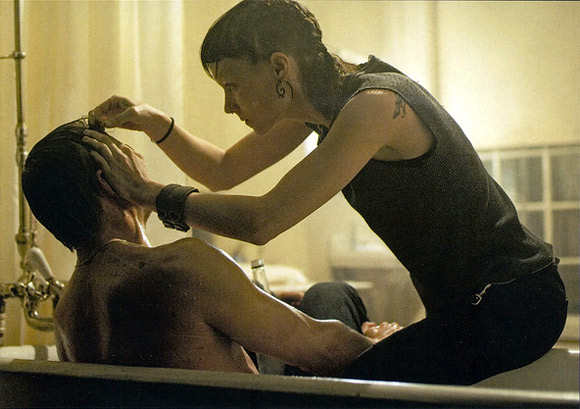
I’m also accustomed to women suddenly taking a sharp left turn without signaling to inexplicably fall in love with some asshole, largely in service of the ego of the writer/director/male movie-going public, but when Lisbeth Salander does it, that’s just wrong. I was actually offended. It wasn’t that I couldn’t see a beautiful woman in her early twenties going for a man who’s over 40, rumpled, and kind of ordinary (except for his keen intellect, indefatigable sense of justice, and blinding yet low-key charm), even one who isn’t played by Daniel Craig. My issue is that this woman set her father on fire, people. We just saw her get brutally raped. No penis is magical enough to magically fix her issues with men.  I do not buy it to a degree that destroys all the disbelief I’d managed to suspend. It is more unlikely than the serial killer. It is more unlikely than everything. It is wrong and stupid.

I have two related problems. The movie makes it clear to us that Lisbeth sleeps with women because she’s damaged. To which I say, fuck you, movie. Bisexuals are fucking sick to death of being tormented and confused. Please accept that some people like both men and women and move on, all right? How often do I have to explain this to you? Also, the woman Lisbeth picks up is much better than the stupid journalist, anyway. When he shows up at Lisbeth’s apartment and seems vaguely threatening, the girl asks Lisbeth if she wants her to stay. That is sweet. On the other hand, we have the 40+ year-old man macking on a woman almost as young as his daughter, and he knows she’s fucked up, on top of it. And the movie doesn’t seem to think this is horrible and creepy. I’m pretty sure we’re supposed to find it romantic. Fuck you again, movie.

I actually enjoyed the movie, mostly, even though it pissed me off (if I only liked things that didn’t piss me off, I wouldn’t like much) and made me wonder about myself for wanting to stare at Rooney Mara/Lisbeth Salander under these circumstances. It is not the first time I’ve had these concerns. And regardless of how wrong or not wrong this might be, I’m proud to say Lisbeth really did save the day. She totally rode in on her motorcycle and saved Daniel Craig’s ass, and then, as an encore, she took care of the slippery businessman who had tried to ruin Craig’s career at the beginning of the movie. Lisbeth is as cool as Clint Eastwood (in a spaghetti western sort of way, not Every Which Way but Loose or Pink Cadillac or some shit like that), and women don’t get to be Dirty Harry very often.

The Gold Ring

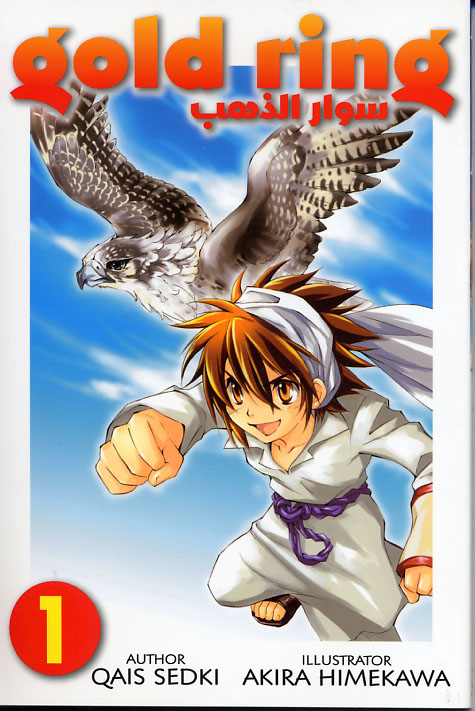
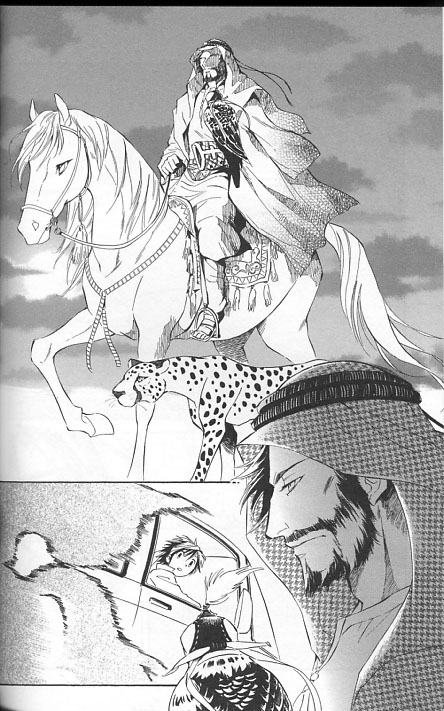
Qais Sedki knew that manga was popular in the United Arab Emirates (UAE) and felt that it was time for a good manga story with heroes Arab children could turn to for inspiration. Manga, especially kids’ manga, is chock full of good, old-fashioned stories, full of guts and hard work and inspiration and heart. So, Sedki decided to create an original Arabic-language manga, and bring it to the UAE. That manga is Gold Ring.

In order to give the manga a genuine “manga” feel, Sedki worked with an experienced team of artists, who draw under the name Akira Himekawa, to illustrate and produce the manga. Jason Thompson and Mikikazu Komatsu did an interview with Himekawa last year when the book debuted in the UAE. Himekawa are probably best known in America for their work on The Legend of Zelda manga.

I was very pleased (with many thanks to Mikikazu Komatsu and Akira Himekawa!) to be the recipient of the first volume of Gold Ring. Even in Arabic, it was instantly apparent that this  was a manga that any young  fan would find approachable and entertaining. It follows young Sultan, a boy who lives in a small town with his mother and his dream to win the Gold Ring, a falconry tournament. For American readers, this is probably about the same level of exotic as  a Pokemon contest. The book is indeed not dissimilar to Pokemon, with many of the same conventions in storytelling.

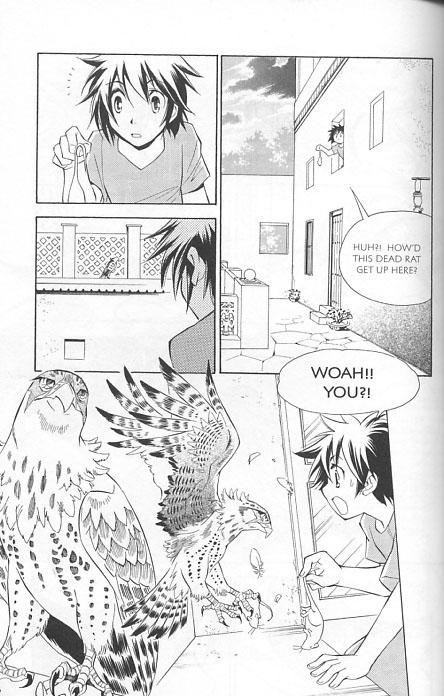
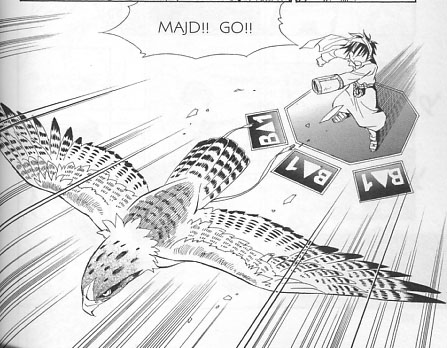
Sultan is instantly likable in a typical kid sort of way. He’s caught trying to sneak in to the Gold Ring arena with a friend, but they escape on his 4-wheeler. When his friend catches a falcon to sell, Sultan gives away his quad in order to save the falcon and let her go free. (Quality 1 of all the best shounen manga heros – they must  have a kind heart.) In what is an absolutely adorable scene, the falcon returns his kindness by bringing Sultan a dead rat. Sultan and Majd (as the falcon is now known,) become friends and Sultan starts to tentatively train her. (Quality 2 of the best shounen manga hero – he and his sidekick are not master/slave, but friends.)

Sultan is introduced to a Bedouin who is a master at falconry, but dislikes the Gold Ring competition, as it devalues the art of falconry. But, because Sultan is a dear friend’s son, and because Majd and Sultan have a visible bond of love, he will – of course – teach him. Sultan has some natural skill and Majd is exceptionally intelligent, so they master basics quickly and are ready for the Gold Ring Trials in time. (Quality 3 of the best of shounen heroes – he must have some natural affinity for the skills he needs, but must have them honed through competition with stronger opponents.)

Anyone who has ever read any popular shounen manga knows what will come next. Sultan isn’t truly prepared, but he and Majd reach down into their hearts and find the strength and skill to succeed and make it into the Gold Ring competition! And, they are told, that they did it the old-fashioned way, with hand signals and hearts and mind as one, rather than using that bane of good old guts…technology.

And so we await volume 2, to see how Sultan and Majd do against their stronger opponents in the tournament. Already, we don’t like the reigning champion and can’t wait for him to be defeated. What will follow is undoubtedly a typical boys’ manga series as Sultan and Majd face enemies and turn them into allies with their combined powers of friendship and heart.

As I said, even in Arabic, the natural charm of this manga was instantly apparent to me. Now I’ve had the pleasure of reading it in English, and soon, so will you. According to  Qais Sedki on Twitter, the English-language edition will be available for pre-order on January 26, 2012.

If you’re looking for something deep, dark, an expose’ on Arab religion or political conflict, you won’t find it here. In Gold Ring, people are happy, quests are personal, accountability is individual. This is a child’s world, an ideal world. The Bedouin is master of his world, there are no hardships or want. War has no place here. We don’t learn much about Sultan’s mother. Is the death of her husband a hardship? Is she being pressured by family members or money issues? We don’t know, only that to Sultan, she seems a happy person and a good mother. (I’m inclined to believe this since, in shounen manga, having only one parent is par for the course, but that parent is always positive and supportive – even when the child is unaware of this.) Sultan has several stand-ins acting as positive male role models for his late father, Suroor, the Bedouin, Hassan, the Gold Ring staffer and his Uncle, all of whom encourage him in his dreams.

So, while you will find an idealistic portrayal of life, what you will also find here is a tremendous example of the best qualities of a shounen manga translated with skill and love into a likable kids’ book, whether that child lives in Middle America or the UAE.

When I was first given the Arabic edition, I was asked whether I thought it would sell in America. Clearly, there are some people who will not like it on principle. Common phrases, such as Inshallah, are left whole in the text, even in the English translation. It’s sadly not hard to imagine that causing some sort of pointless kerfuffle during a reelection year for a mayor or freeholder of somewhere. But, as a story told for children, about a child and his animal best friend, with the shounen manga sensibility first and foremost, I said then, and still feel now, that it has a solid chance here in the US market. The translation is good, there’s no sense of awkwardness in the sentences. There is a short glossary of falconry terms in the back and in-margin translations of  common Arabic phrases. If there was a single thing to complain about, it would be the font used. The Arabic fonts were more natural – and more artistic – where the English font is blocky and quite dull, with no emphasis or artistic flourishes.

For typically shounen-manga style idealism, and a genuine and approachable look at manga through UAE eyes, I recommend Gold Ring.  After all, who wouldn’t love a story about a Boy and his Falcon?

Skritch Skritch Draw Draw

This piece first ran on Comixology.
_________________
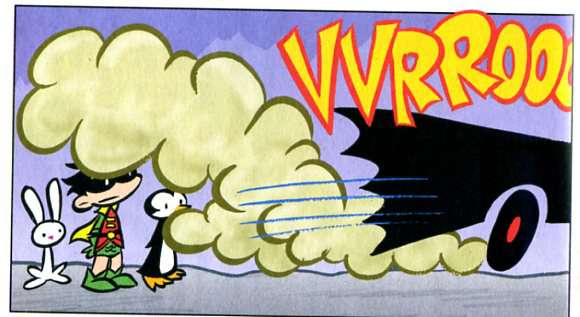
No western comic has better sound effects than Art Baltazar and Franco’s kiddie superhero title Tiny Titans.

As you’d expect, the comic has lots of standard issue sound effects. The Batmobile goes

Beast Boy changing into a dog goes

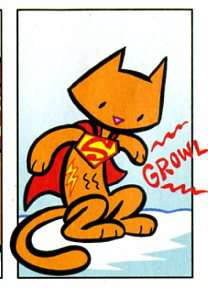
Streaky the Super-Cat’s stomach goes

And so forth.

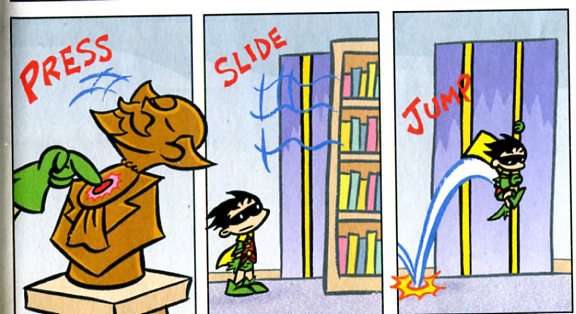
But Baltazar and Franco also make extensive use of less familiar sound effects. So when Robin presses, slides, and jumps, it goes:

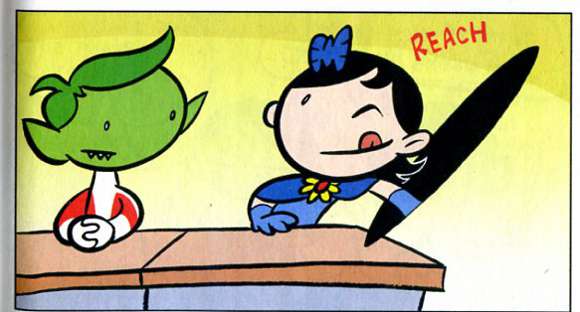
Or when Raven reaches, it goes:

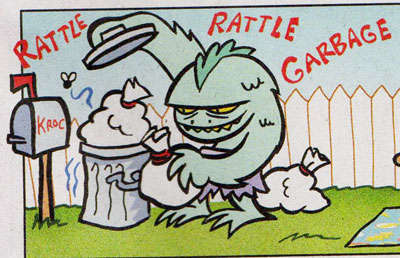
Manga pioneered the use of this sort of effect; a sound that isn’t so much a sound as a stage direction. Baltazar and Franco have made the technique a central part of their world, and it’s one of the consistent joys of reading their comics. Part of the fun is the child-like logic of the thing. Of course, if you reach it sounds like “reach”. Of course, if Killer Croc is rustling through the garbage, it will sound like:

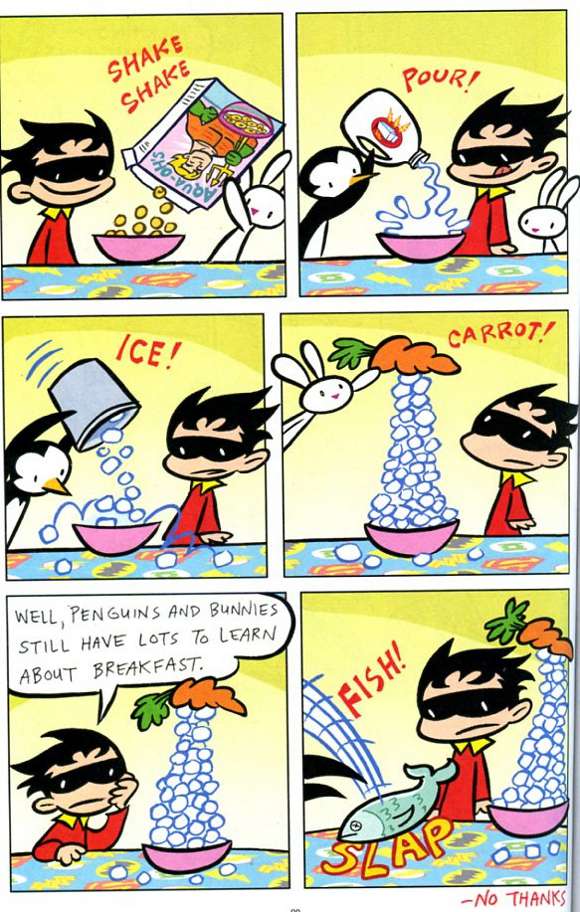
The sound effects are also used to emphasize or escalate jokes. For example:

The first two panels use appropriate sound effects; “Shake Shake,” for the cereal, “Pour!” for the milk. But then things begin to go awry…and the sound effects emphasize the goofiness. The ice in the cereal bowl is so wrong it goes “Ice!” the carrot is so incongruous in its carrotness that it has to scream “Carrot!” And the sound effects get the final punchline too. Poor Robin is slapped not only with the image of the fish, but with the word (“Fish!”) as well.

The sound effects do more than just add humor though. You can see this by looking again at that page above, especially at the first couple of panels. If you think about it for a second, you’ll realize that the first two panels aren’t actually traditional sound effects either. They’re not nouns (“Fish!”) but they’re not onomatopoeia either. Instead, (like Raven’s “reach”) they’re verbs. They label the action.

In comics, of course, there isn’t actually any action; no one moves. Usually, motion is conveyed through motion lines (as in the last panel, with the penguin slapping down the fish) or through the sense of time passing from panel to panel. Here, though, the motion is also created by the sound effects. They’re the analog to those clunky text boxes which would tell you that Spider-Man raced across the city, except that the text boxes have been streamlined and incorporated into the picture. The still image isn’t only an image; it’s also a word. And words come off the page; they go in at your eye and wander around your brain and come out as an idea. Which means that if an image is also a word, the image moves.

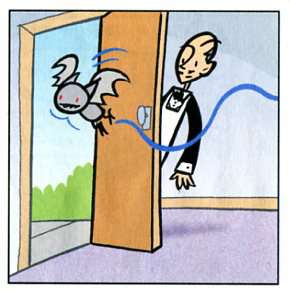
For Tiny Titans, then, sound effects end up as a substitute for animation. This fits naturally into artist (and letterer) Baltazar’s overall style. Tiny Titans, with its thick outlines, and simple figures, looks in some ways like an animated cartoon. Yet, at the same time, it’s unambiguously illustrational — much more so than a lot of slick, anonymous mainstream superhero art for adults. In the picture below, for example:

You can see Balthazar’s hand in the way the door curves out of true, or the slanting lines of the floor and doorjamb at impossible angles to each other, or in the bat’s delightfully wobbling motion line. It’s a drawing that’s not afraid of its drawingness. The charm is in the imperfection.

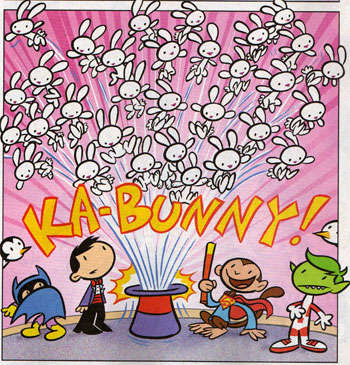
Similarly, Balthazar’s sound effects draw attention to themselves; they’re story-telling devices, and so they point to the storyteller. Again, the images are energized, or moved, not just by sequence, but by something like language — a conspiracy that goes back and forth between creator and reader. It’s a picture of a story, or a story of a picture. Which, for kids or adults, is hard to resist. Especially with bunnies.

Looks like We’re in for Heavy Concepts

Franklin’s blog on Friday alerted me to this post by Nathan Schreiber. Schreiber’s point — about the art world being dominated by elites while the book world isn’t (as much) — ties into the conversation Franklin and I were having on Thursday.

But what really struck me about Schreiber’s post is that it was just really nice to hear someone in comics say something really positive and affectionate about fiction, because it just doesn’t happen all that often. Franklin quotes a Facebook post from Schreiber:

My post was really an expression of frustration with comics trying to climb further into the art world. Because I think comics are “stories” and while stories can be art, I think they’re stories first and art second. The art world is full of ambiguities, dominated by concepts over content, and is controlled by elites where the world of stories, well, it just makes more sense. There’s more or less universal recognition of what a good character is, a tight plot, hell, even mood.

Although he’s not necessarily talking about literary fiction (and I haven’t seen this Dash Shaw to know whether I agree with his evaluation), this comment vaguely acknowledges something extremely important that comics (and probably fine art too) should listen to: great fiction writers retain their craft even as they layer in more and more conceptual complexity. Nabokov, Pynchon, Delany, Woolf, Swift, Chaucer — there’s no shortage of concept, but there’s also plenty of craft. The craft enables the concept: the more solid the prose is, the more concept can be layered in. And sometimes the concept also illuminates the craft.

There are worthwhile exceptions, usually experimental ones — nobody’s ever going to claim that Burrough’s The Soft Machine is even a remotely good example of the writerly craft, but it’s an overt experiment, a conscious effort to figure out how to do something new and challenging. But he — and writers like Pynchon who followed him — made a successful effort afterwards to reintegrate craft with the formal and conceptual lessons learned from the experiment.

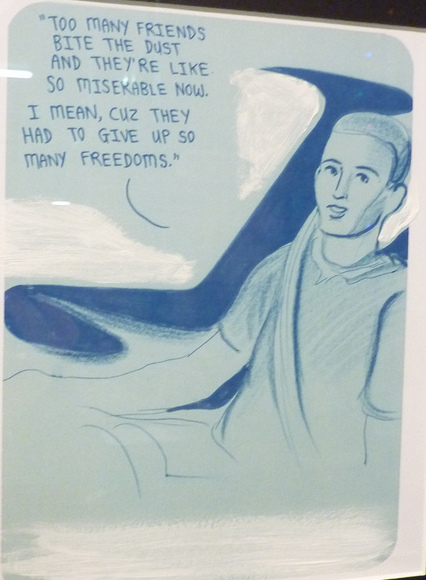
(It’s possible the caption under this Dash Shaw image in the Schreiber post is sarcastic, but it also doesn’t seem that far-fetched to claim an interest in concept for Shaw.)

There are some really brilliant avant-garde cartoonists who are on really exiting trajectories toward merging experiment and craft, like Jason Overby and Warren Craghead, and I’d like to see more cartoonists follow their lead and incorporate their insights and build on them to make new insights and eventually get to the point that cartoonists are making graphic fiction that’s as strong conceptually as literary fiction.

To do that, though, people have to get past this knee-jerk notion that craft and concept are an either/or choice. A lot of indie/alt cartooning has turned punk and underground ways of seeing the world into a fetish for harsh, angry expression and just plain ugliness, as though ugliness itself is sufficient to make a work edgy — as if ugliness is somehow inherently more meaningful than beauty. Like scatology and mundaneity, ugliness in indie comics is often a shortcut, a way of giving the illusion that something significant is going on when it really isn’t. Comics critics have mostly embraced this extremely facile way of thinking about concept as mere symbolism. In the alt comics subculture at least, I do think some of it comes from the mild contempt for writing that so many people seem to think is necessary in order to appreciate art. Maybe more of it comes from the fine art world as Franklin so often suggests. I’m willing to consider the assertion that in truly non-narrative work, an allusive, symbolic, suggestive use of concept can be successful, but I stick to the opinion that in narrative work, concept needs to be crafted so that it works with the narrative in interesting ways.

Ugly or otherwise, though, a lot of the work — in fine art or comics — that claims to be so “high concept” doesn’t really strike me as actually being all that high concept. It’s more “heavy concept” than “high concept.” Blunt, poorly wrought, overdetermined concepts weigh art down; elegant ones elevate it. I don’t think there’s a forced choice between beauty and concept; there is an aesthetic aspect to the conceptual constructs of an artwork as well (Pale Fire, which really is high-concept, is a great example, as is, say, Grünewald’s Crucifixion). But the artist just has to be willing to spend a lot more conceptual energy than most cartoonists — most artists period — are willing to do.

Postscript (added 1pm ET)

I want to be sure it’s clear that of course there’s a good bit of subjectivity involved in saying that this one thing is ugly and some other thing is not. There’s not an absolute standard. I find Ariel Schrag’s work a little aesthetically harsh, for example; Noah finds it really beautiful.

So I don’t want that pithy encapsulation up there about ugliness as a shortcut to be interpreted as a critique of any particular specific comic. It didn’t arise out of a specific reading — more an overall experience of seeing too much scatology, too much ugliness, too much mundaneity and not enough richness, not enough concen with beauty. Not from any specific cartoonist in any specific instance, but in the aggregate. The collective drive for and commitment to those aesthetics overall within indie comics often seems to be standing in the place of a drive for and commitment to more meaningful conceptual engagement.

In general, it raises the question of whether ugliness and rawness can simply be substituted for beauty and craft without any loss to the artform overall. Can you operate from a belief that ugliness is beautiful without transforming where you end up, collectively, at the end? I don’t really think you can — I think ugliness and rawness have semiotic content; I think they signify in a different way from beauty and craft. And I think their potential as such to hold a richness of meaning is more limited. But I also think — and this is the point of the post — that questions of how ugliness and beauty become meaningful, and what kinds of meaning they make, and what work is necessary to connect form and concept are discussions worth having.