Couple R&B tracks. Here’s Changing Faces with G.H.E.T.T.O.U.T
And Olivia with Woop-T-Woo
What have you been listening to?

Couple R&B tracks. Here’s Changing Faces with G.H.E.T.T.O.U.T
And Olivia with Woop-T-Woo
What have you been listening to?
This first ran in Splice Today.
_____________
You’d think Pam Grier’s life would make for a fascinating memoir. Raised working class and rural, subjected to racial discrimination throughout her childhood and raped twice, she nonetheless, through sheer determination, smarts, and astonishing good looks, managed to carve out a career as an actor. Her iconic presence in some of the most successful and influential blaxploitation films made her perhaps the screen’s first female action hero. And along the way to semi-stardom, she dated luminaries like Kareem Abdul-Jabbar, Freddie Prinze, and Richard Pryor, survived breast-cancer, and hobnobbed, it seems, with everyone who was anyone, from Sammy Davis Jr. to Fellini.
So, like I said, there seems to be a lot worth reading about there. And Foxy: My Life in Three Acts certainly is affecting in parts. As the father of a six-year-old, I found Grier’s account of being raped at that age actually nauseating. Less somberly, Grier’s discussion of one of her visit’s to the gynecologist has to be one of the top gossip anecdotes of the year so far. In her account, Grier explains that the doctor discovered “cocaine residue around the cervix and in the vagina” and asked Grier if her lover was putting cocaine on his penis. “ Grier responds, “That’s a possibility…. You know, I am dating Richard Pryor.”
Then she admits to the doctor that during oral sex her lips and tongue go numb because, apparently, Richard Pryor did so much coke that it made his semen an opiate.
And yet, despite such moments of interest, the memoir overall is surprisingly flat. Anecdotes are dutifully hauled out — here’s Grier with her church choir at ground zero of the Watts riots; here she is singing with a drunk John Lennon. But the memoir stays on the surface; you get little sense of Grier’s inner life, ideas, or passions. Her discussions of racial and sexual prejudice are for the most part innocuous boilerplate. There are some hints that she has ambivalent feelings about the exploitive elements in her early roles, but those issues are never really explored. She’s politely reverent towards most of the stars she comes across, from Paul Newman to Tim Burton.
Part of the failure here is no doubt the fault of co-writer Andrea Cagan, whose prose never rises above competent. But the main problem is Grier’s personality. In a couple of places in the book Grier notes that she’s a “private” person — which is, like much in the memoir, a significant understatement. Grier is not merely private; she is fiercely, even remorselessly, adamant about protecting her personal boundaries. When one of her first serious romantic interests, the sexy, talented, wealthy, Kareem Abdul-Jabbar, tells her he loves her and asks her to become a Muslim so he can marry her, she takes her time…thinks about it…and finally says no. When the sexy, talented, wealthy, but frighteningly coked-up Richard Pryor wants a serious relationship with her, she takes her time…thinks about it…and eventually walks. In 1977, Freddie Prinze — with whom she’d broken up two years previously — called her to say that he had bought a gun, was thinking of using it on himself, and needed her to come help him. Though she was staying only a few blocks away from his hotel, she refused to go see him. Three days later he committed suicide. Grier notes that she was “heartbroken” and, for a while, guilty, but ultimately concludes “I wanted to save his soul, but I knew that only he could help himself, and he hadn’t really wanted to.”
My point here isn’t to condemn Grier for callousness — on the contrary, all the decisions above seem absolutely reasonable. Abdul-Jabbar, while possessed of many fine qualities, seems to have been a controlling asshole. Similarly, Richard Pryor was, clearly, one of the most catastrophic train wrecks of the decade, if not the century. And even the phone call from Freddie Prinze — your ex with a megacocaine problem calls you up to tell you he’s got a gun and is feeling paranoid, please come over? I don’t think you can be faulted for saying, “you know what? No.”
A U.S.A. Today blurb on the back of Foxy declares “Pam Grier is a survivor.” When you read that, you think of her fierce characters in Coffy or Foxy Brown — fighters who took on incredible odds and beat the system. The thing is, though, in real life, survivors aren’t like that. If you take on incredible odds, you usually lose. Somebody who is going to survive has to pick her battles very carefully — and realize that usually, the best defense is actually just defense. Again and again throughout the memoir, Grier protects her safety and sanity not by embracing violence or revenge, but by refusing to do so. When she is date-raped at 18, she doesn’t tell her family because she fears that if she did, her male relatives would kill her attacker and end up in jail. As an adult, when her cousin and best friend, dying of cancer, asks Grier to read out-loud in church a manifesto attacking her abusive husband, Grier refuses. “I couldn’t open so many wounds and deal with the aftermath,” Grier writes. “I refused to be the one to read the letter and stir the pot — a decision I regret to this day.”
Again, I’m not judging — these are incredibly difficult choices, made under extreme duress, and I don’t think anyone but Grier is in a position to decide whether she did the right thing, or whether there was even a right thing to do. The point, though, is that in most every instance, Grier’s instinct is to avoid stirring the pot — and stirring the pot is exactly what you want to do in a book like this. The most successful celebrity memoirs — such as Jenna Jameson’s riveting and surprisingly insightful 2004 How to Make Love Like a Pornstar — are shameless both in their self-revelation and in their skewering of others. Pam Grier, despite all those exploitation films, doesn’t appear to have a shameless bone in her body. The qualities that allowed her to get where she did — her reserve, her poise, her dignity — are the very things that make Foxy so underwhelming. Still, even though as a reader I was disappointed, I can’t really find it in me to wish that the memoir was better If you have to choose one or the other, after all, a successful human being is surely preferable to a successful book.

On HU
I talked about The Interrupters and violence in Chicago.
Our music sharing post featured Ms. Jade and lots more.
Alex Buchet reaches America with his series on the prehistory of the superhero.
Subdee on Homestuck dealing with its fans.
Chris Gavaler on the Western voyages of Sinbad.
Me on Hulk vs. Jeff Koons.
Chris Gavaler on a tea party superhero.
Utilitarians Everywhere
At the Atlantic Cities I interviewed Daniel Hertz about the inequality of violence in Chicago.
At the Atlantic I reviewed a new documentary about Muscle Shoals.
At Splice Today I wrote about:
— how the shutdown is really not very much like the Civil War.
Other Links
Jeffrey O. Gustafson compares Adventure Time 19 to Solaris.
Mikki Kendall on violence and segregation in Chicago.
Corey Blake wonders if Comixology should go public.
Jonathan Bernstein on Republican party dysfunction.

Garry Gianni’s portrait of Solomon Kane
To me, the Tea Party is right up there with the Brotherhood of Evil Mutants. So I certainly don’t mind watching their superpowers wane as they impotently wage war through shutdowns and debt defaults in their never-ending battle against their arch-nemesis, Obamacare.
But I do feel a personal connection to the Tea Party now. Or at least to one member of their roster. I recently reconnected with an old high school friend via (what else?) Facebook. Our cyber reunion wasn’t entirely Friendly. In the decades since we’d crammed Pre-Calc in his suburban basement, John has converted to an aggressively libertarian brand of fundamentalist Christianity (or, as he prefers to term it, “Christianity”). His profile picture is Obama photoshopped as Stalin. I accused him of melodrama, but he remains appallingly literal in his belief that the President’s re-election constituted a Socialist coup and collapse of the American experiment. Our email exchanges have since petered. But I will honor John and his right wing cohorts with an unlikely declaration:
The first American superhero was a Tea Party superhero.
“Oh! Lord of Hosts,” cried a voice among the crowd, “provide a Champion for thy people!”
That’s Nathaniel Hawthorne, 1835. Thy people are his pre-Revolutionary New England ancestors under the tyrannical yoke of King James and his New World minions (AKA the Governor of colonial Massachusetts and his nefarious redcoat guard). In answer to the cry of oppression, Nathaniel conjures the Gray Champion!
“Suddenly, there was seen the figure of an ancient man, who seemed to have emerged from among the people, and was walking by himself along the centre of the street, to confront the armed band. He wore the old Puritan dress, a dark cloak and a steeple-crowned hat, in the fashion of at least fifty years before, with a heavy sword upon his thigh, but a staff in his hand, to assist the tremulous gait of age.”
I know, a shaky old guy, not very superheroic, but hang on. He has superpowers: “while they marvelled at the venerable grandeur of his aspect, the old man had faded from their eyes, melting slowly into the hues of twilight, till, where he stood, there was an empty space.”
Yep. He can apparate. Hawthorne gives us an origin story and mission statement too. “Whence did he come? What is his purpose? Who can this old man be?” whispered the wondering crowd. Glad you asked: “That stately form, combining the leader and the saint, so gray, so dimly seen, in such an ancient garb, could only belong to some old champion of the righteous cause, whom the oppressor’s drum had summoned from his grave.”
That’s right. He’s supernatural too. And while immortality is a nice trick, his real powers are rabble-rousing and monarch-busting: “ his voice stirred their souls,” and before “another sunset, the Governor, and all that rode so proudly with him, were prisoners, and long ere it was known that James had abdicated . . .”
The tale ends as any good comic book should, with the promise of further adventures: “whenever the descendants of the Puritans are to show the spirit of their sires, the old man appears again. . . . His hour is one of darkness, and adversity, and peril. But should domestic tyranny oppress us, or the invader’s step pollute our soil, still may the Gray Champion come . . .”
That’s good news for John and any like-minded Tea Partiers. Hawthorne places his supernatural do-gooder at their namesake event, the dumping of 342 chests of East India tea into Boston harbor. The old guy makes rounds at the battles of Lexington and Bunker Hill too.
I doubt John has read “The Gray Champion,” though I’m fairly sure The Scarlet Letter was on our high school English syllabus. I won’t declare Hester the first superheroine, but she is the first character in fiction to sport a letter on her chest, beating Joe Shuster’s Superman by nearly nine decades. The “A” starts as punishment, but Hester embroiders her own meanings into the symbol, and eventually the town rechristens her “Able” and “Angel” in appreciation of her selfless if not quite superheroic service.
The Gray Champ has her beat though. Midwife to the poor is noble and all, but the Tea Party would rouse our whole land from its sluggish despondency. According to my high school Friend, the harsh and unprincipled administration of Obama lacks scarcely a single characteristic of tyranny, violating the rights of private citizens, taking away our liberties, and endangering our religion. These, apparently, are evil times. Hawthorne agrees:
“‘Satan will strike his master-stroke presently,’ cried some, bemoaning the deformity of any government that does not grow out of the nature of things and the character of the people. On one side the religious multitude, with their sad visages and dark attire, and on the other, the group of despotic rulers. Pray and expect patiently what the Lord will do in this matter!”
A literal Godsend, the returning Gray Champion would probably forgo street protests and broadcast his message nationally. Though he might have trouble claiming a share of camera time. Would even Fox News have room for a bearded Puritan between the soul-stirring voices of Glenn Beck, Sean Hannity, Bill O’Reilly, and Karl Rove?
He might launch his own website instead, but my friend John already shares regular posts from Political Outcast, Vision To America, and Conservative Byte. The last includes a photoshopped Emperor Obama in a crown and kingly regalia. A commenter adds: “’Dictator’ Obama has infiltrated the entire system of government with radical muslims, gays and completely ignorant self serving idiots pushing their own agendas.”
In fact, who needs the Gray Champion in the age of Facebook? The reason we have the second amendment, shouts John on his homepage, is TO DEFEND OURSELVES AGAINST OPPRESSORS LIKE OBAMA. “Government of the people is GONE. People will only be ignored so long, then they will act. God help us all.”
Meanwhile, the venerable stranger, staff in hand, drew near the advancing soldiers, and as the roll of their drum came full upon his ear, the old man raised himself to a loftier mien, while the decrepitude of age seemed to fall from his shoulders, leaving him in gray, but unbroken dignity. Thus the aged form advanced on one side, and the whole parade of soldiers and magistrates on the other, till, when scarcely twenty yards remained between, the old man grasped his staff by the middle, and held it before him like a leader’s truncheon.
“Stand!” cried he.
The eye, the face, and attitude of command; the solemn, yet warlike peal of that voice, fit either to rule a host in the battle-field or be raised to God in prayer, were irresistible. At the old man’s word and outstretched arm, the roll of the drum was hushed at once, and the advancing line stood still.
At least that’s what happens in a black and white world of pure good vs. evil. Our world, however, is considerably Grayer.
Unless you’re member of the Tea Party.
Last week I wrote about an old Hulk comic in which our green protagonist crushed a female artist who wanted to appropriate him for her gallery, proving that comics are virile and manly and can kick Lichtenstein’s effeminate posterior.
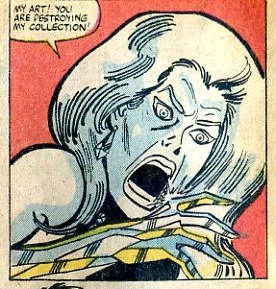
So Hulk wins the battle against high art there…but in comments, Ng Suat Tong pointed me to another tussle where the victory is not so assured.

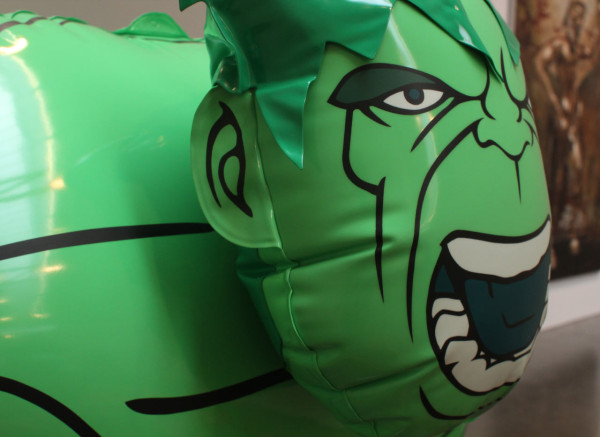
That’s “Hulk (Wheelbarrow)” a sculpture by Jeff Koons.
When I suggest that Koons has here defeated the Hulk, I mean that literally — at least in terms of the narrative of the comic I discussed last week. Again, in that issue, Bill Mantlo and Sal Buscema presented us with an evil temptress/Circe/high artist who turned her male victims into glass. She intends to do the same to the Hulk, and keep him forever in her gallery as a glass sculpture. Hulk is too big and green and pulpy to succumb to her blandishments, whether they involve sex, magic, or the granting of high art validation. So he destroys her and her house and escaped. And then, 20 odd years later, Jeff Koons gets him and puts him in a gallery anyway.
The trasformation is a little different though. Hulk isn’t turned into graceful, fragile, feminized glass. He’s a plastic inflatable — a giant toy. The act of transformation, then, is not actually transformation — it’s simply relocation. Putting the infantile, virile Hulk in a gallery turns him, instantly, into refined prettified high art, with flowers. Koons’ assault on Hulk is even more cruel and insidious than the villainnesses. The glass Circe, at least, felt that Hulk had something she wanted; she acknowledged the value of his virility by wanting to touch it with her glass creating hands and make it her own. But Koons doesn’t even have to make Hulk his; he just has to pick him up and put him in his place. If there’s any value in Hulk, it’s not in his strength, but in his ridiculousness and incongruence. He’s cheap, plastic ephemera. His incongruous worthless is his worth. He’s not a totemic real to be stolen; he’s just a ridiculous prop to be mocked.
Or so you might think. In fact, though, the Hulk is not a plastic inflatable. He’s bronze. Koons made the metal statue, then painted it to look like an inflatable. The Hulk is not a piece of plastic crap; he’s a virtuosic sculpture made to look like a piece of plastic crap.

In terms of the comic, its as if the villain had turned Hulk not into glass, but into an exact replica of the Hulk indistinguishable from the original. Except secretly made of glass. Or, for another comic-book analogy, you might remember the Harvey Kurtzman Plastic-Man, in which the imposter Plastic-Man is accepted as the real Plastic-Man since anything made out of plastic is fake. By that logic, Koons’ imitation plastic Hulk is more real than the real thing, since a kid’s fake plastic Hulks (in comics or outside them) are the real ersatz thing. Or, to put it another way, the Hulk in the gallery, by virtue of recognizing the fakeness of the Hulk in the comic, is more real than the original.
In Harold Bloom’s terms, Koons’ is a “strong” reading of the Hulk. Geoff Klock in How To Read Superhero Comics and Why points to writers like Frank Miller as “strong” rewriters, troping against the accretion of supehero continuity, so that the Dark Knight becomes, in some sense, the only Batman, “‘the powerful reading that insists on its own uniqueness and its own accuracy….[Miller] compels us to read as he reads, and to accept his stance and vision as our origin.'” Where Miller makes Batman more real and powerful and cool and coherent, though, Koons’ strong, bronze reading of Hulk is parodic. The metal Hulk insists on the actual Hulk’s transient blow-up crappiness. The amazing virtuosic reproduction of pop detritus emphasizes that it is detritus. The amount of genius and talent that Koons has put into his Hulk deliberately underlines the hackish ineptitude of Mantlo and Buscema. They ineffectually try to reproduce high art; Koons methodically and perfectly reproduces low art. There couldn’t be a much more devastating demonstration of the justness of that high-low hierarchy.
Or that’s one way of reading it, anyway. It’s worth pointing out, though, that Harold Bloom would really probably hate Jeff Koons, and vice versa. You can see Koons here as parodying the Hulk by employing the virtuosity of high art, but you could just as easily see him as employing the Hulk to parody the virtuosity of high art with its cult of “strong” Bloomian artists. Or, for that matter, you could see him as simultaneously parodying both; the serious metal sculpture disguised as a kid’s blow up doll seems to implicate both the Hulk’s hyper-masculine worship of physical power (via the ridiculous big green muscles) and the traditional art world’s hyper-masculine worship of genius (via the ridiculous virtuosity and heaviness.)
For Koons, then, high art and low art aren’t opposed. Rather, they’re both engaged in the same project of constructing a powerful ersatz masculinity — the dream of inflatable muscles made out of bronze. Koons thinks that’s funny. But he doesn’t just think it’s funny. Surely there’s some affection in those (Blooming?) flowers, picked fresh for the exhibit, and placed in a wooden wheelbarrow that is not an inflatable, nor bronze, but simply a wooden wheelbarrow. The superhero and the superartist — beneath all that roaring and posturing, they just want to give you pretty things. In the gallery or on the comics page, when Hulk smash, it means “I love you.”
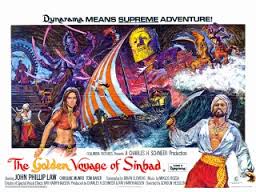
I turned seven the summer of 1973. Sinbad, the sea-fairing adventurer from One Thousand and One Nights, turned 1,207—or at least Huran al-Rashid, the 8th century caliph who would have reigned during his voyages, did. Sinbad’s a lot older if you think he’s just a Persian reboot of Odysseus, which I don’t. It’s not clear how he anchored in Arabian Nights, since Scheherazade almost certainly didn’t spin any tales about him. Ditto for Aladdin and his lamp. But the first 1880s translations (same decade that gave the Victorians Sherlock Holmes, Dr. Jekyll, and the Ubermensch) happily include both heroes. The 1940 Green Lantern was originally named Alan Ladd (get it?), but Sinbad didn’t make it to the realm of superhero comics till Marvel adapted his low budget Hollywood adventure, The Golden Voyage of Sinbad.
My aunts took me. Which probably means I was marooned in their tiny Pennsylvania smallville while my parents were off on their own voyages. I recently streamed the film online, surprised as always by my unfaithful memory. Did I really not notice the Stonehenge replica at the center of the lost island of Lemuria? Or that the King Kong-derivative “natives” were green? Sinbad also barters himself a love interest, AKA sex slave (a disturbing staple of mid-70s fantasy and scifi films—the elite apartments in Soylent Green came with human “furniture” the same year, as did the elite houses in Rollerball two years later). Our virtuous captain, of course, doesn’t exercise any of his property rights, and there’s even a marriage proposal before the credits.

Hindsight also provides certain pleasures—like watching a bunch of pasty white guys evoke Allah every third sentence. Or realizing that Doctor Who is playing the evil sorcerer (the BBC was so impressed with Tom Baker’s performance, he replaced the retiring Jon Pertwee the following year). That evil sorcerer, by the way, is oddly sympathetic, the way Baker writhes and ages a decade or two every time he employs his apparently hard-earned magic—like animating the figurehead on Sinbad’s own ship to battle him. How cool is that! His little flying homunculi were niftier in memory though—as I suppose is true of all Ray Harryhausen stop motion claymation.

The best is when Baker animates the six-armed Kali statue in the natives’ temple (though why exactly are faux Africans worshipping the Hindu goddess of Time, and, oh yeah, why are they green?). I should also mentions there’s a rather rudimentary plot device of finding a missing puzzle piece that will, I forget exactly, unlock the Fountain of Something Or Other. So Sinbad and Baker are racing each other in an overarching A Plot, which is subdivided into episodic B Plots, such as battling evil cyclopean centaurs and sailing around foggy soundstages.
It’s at this point that I turn to my nearest aunt and whisper: “The puzzle piece is inside the statue.”
She probably thought I was nuts (like that time I reflected a flashlight beam onto her bedroom ceiling while making what I imagined were UFO noises), until Kali tumbles and, yep, there’s the golden puzzle piece shining in the rubble.
She was pretty impressed, as was I, still am, though I can’t say I was much of a boy Sherlock. Things I wasn’t noticing at the time include Watergate, the civil rights movement, and my parents’ impending divorce.
I’d shrug it off as a lucky guess. Except it’s the same plot maneuver I encounter several hundred times a semester. How often does an episodic B Plot shatter against an overarching A Plot? More specifically, how often does a storyline sail out of a sub-adventure to continue its main voyage? My first year comp students navigate this map three or four, sometimes five and six times every essay they draft. A body paragraph is just an adventurous subpoint in an overarching thesis. Before exiting to the next island of green natives, shatter Kali to show why you dragged us there in the first place (ie, repeat a central element of the thesis in the last sentence). When you finally row ashore your concluding paragraph, assemble the golden key pieces and unlock the Fountain of the Passing Grade.
I realize that’s a particularly Western way of writing an argument. A Chinese essay, for example, might reflect different norms, so called “high context” ones, where inference and implicitness are an adventurer’s main magic tricks. That means a thesis isn’t necessarily stated or the map to get there isn’t drawn linearly. If Sinbad submitted such a tale in my WRIT 100, I’d have to send him back to Lemuria for revising. But if he’d grown up in my subdivision of Pennsylvania, he’d already know how the puzzle pieces work.
By what age do kids absorb such cultural nonsense as plot formula and argument structure?
I’m guessing seven.
I was hardly reading but I was already a little claymation homunculus. I’m not suggesting Tom Baker was employing me for nefarious ends. I’m just saying cultural magic seeps in deeper and faster than we might think. And some unstated sub-claims might sneak in with it. Like, oh I don’t know, women are furniture, and beware swarthy men (Baker wore make-up). Which is also why it’s sometimes worthwhile to analyze nonsense like The Golden Voyage of Sinbad.
Sinbad, by the way, made at least one more sojourn into the Marvel multiverse. He teamed up with the Fantastic Four for Chris Claremont’s astonishingly ill-timed Fantastic Fourth Voyage of Sinbad in 2001, on newsstands when the World Trade Center tumbled and shattered. Since then I haven’t noticed many cultural representations of good-looking white guys giving thanks to Allah.

When popular webcomic/sprawling trans-media megatext Homestuck last appeared on this website, we* talked about the enshrinement of internet memes and other pop culture ephemera, the love-hate relationship with low culture, the large and active fandom that sometimes found itself reflected back in an epic narrative. We* also talked Homestuck’s strong logical structure – in which computer and card games, programming logic, and light-dark dualities, among other things, propel a story that’s largely about creation and destruction. (The creative process, in other words.)
All of those things are as true as they ever were, and, in a recent arc, you can see them play out – without knowing anything about the larger story! I thought I’d highlight this arc for you guys because I enjoyed it a lot. It starts here and ends here, so it’s about 55 pages (or panels) long.
First, some shots of the protagonist looking skeptical and offering skeptical commentary on the on-screen action:

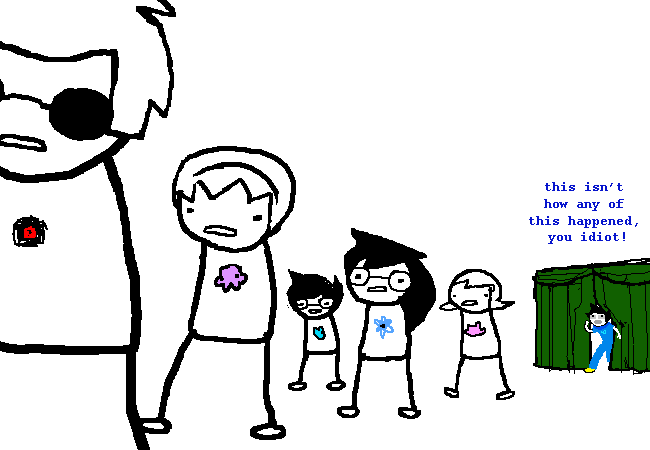
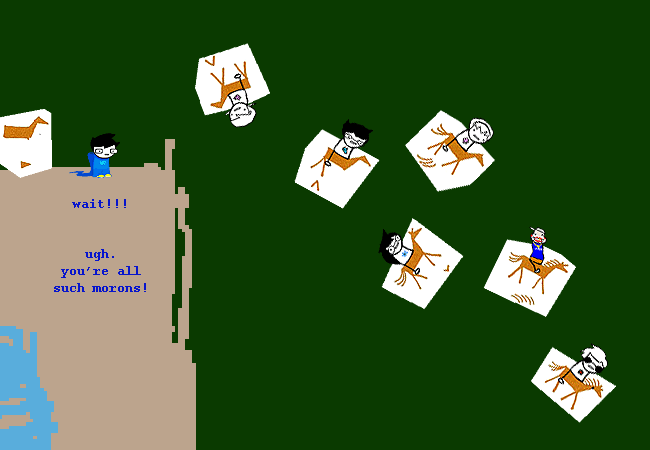
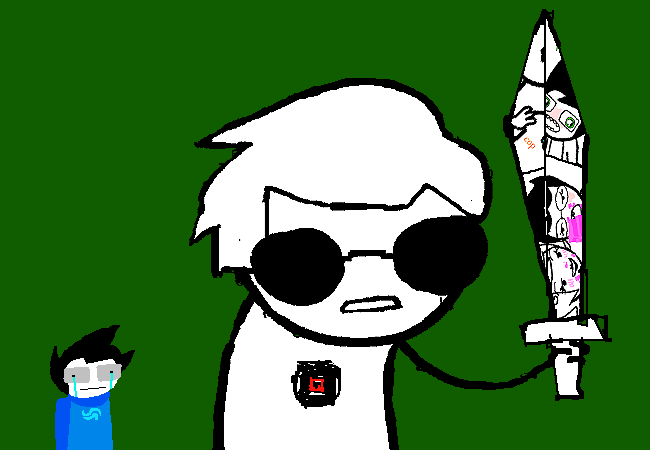
The main thing you have to know to make sense of this is that a major series villain is the creator of the story you are reading on your screen. He turns out to embody a lot of the worst fannish impulses – and what’s even worse, to make bad, clichéd fanart.
And on top of all that, he’s a lazy artist – maybe even a plagiarist!
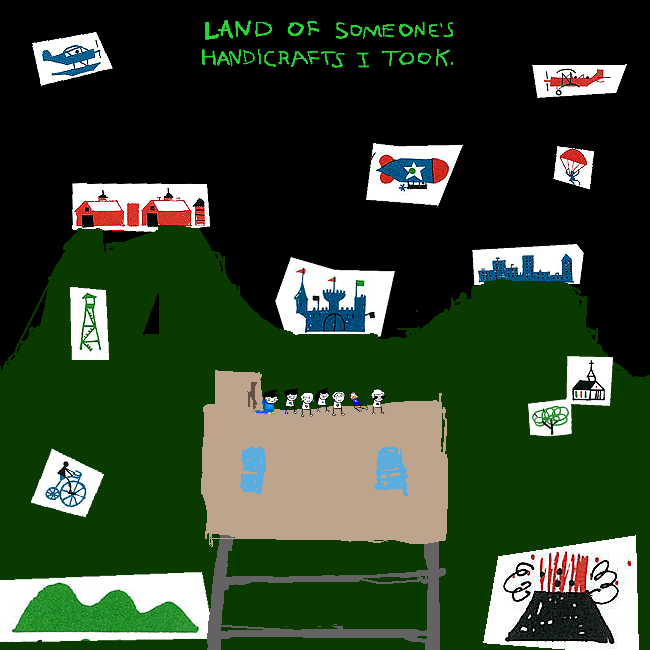
The original protagonist of the series, meanwhile – the guy in blue – has developed the superpower of being able to pop in and out of the narrative, disrupting the logic of inevitable doom I talked about in my last post. Since he exists outside of the framework of the story, he’s able to offer on-screen commentary on the action. Somehow or other, thanks to his powers, he’s found himself in this parody comic the villain is creating. (Don’t ask me how, I don’t know either.)
So far, so not-so-unusual-for-snarky-webcomics. This kind of meta-commentary isn’t even unusual for Homestuck, which divides its narrative arcs using images of screens and curtains and has several characters that exist “on the other side of the screen” and “behind the curtain” (including the author himself).
For that matter, the purposefully bad art isn’t new to Homestuck either: there’s already an absurdist comic-within-the-comic drawn “ironically” by one of the characters… which you can purchase it in a deluxe limited-edition hardcover here.
Another way you can tell John is outside the narrative, however, is through the shift into three-dimensional perspective, through which we can directly observe the crude artificiality and flimsiness of the (literally) two-dimensional story being created by the series villain.
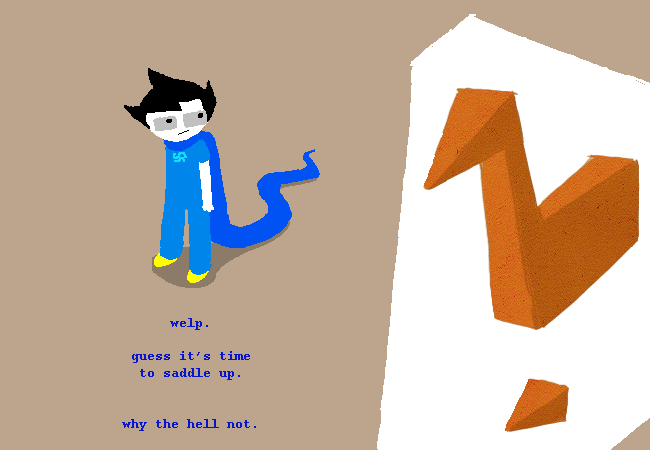
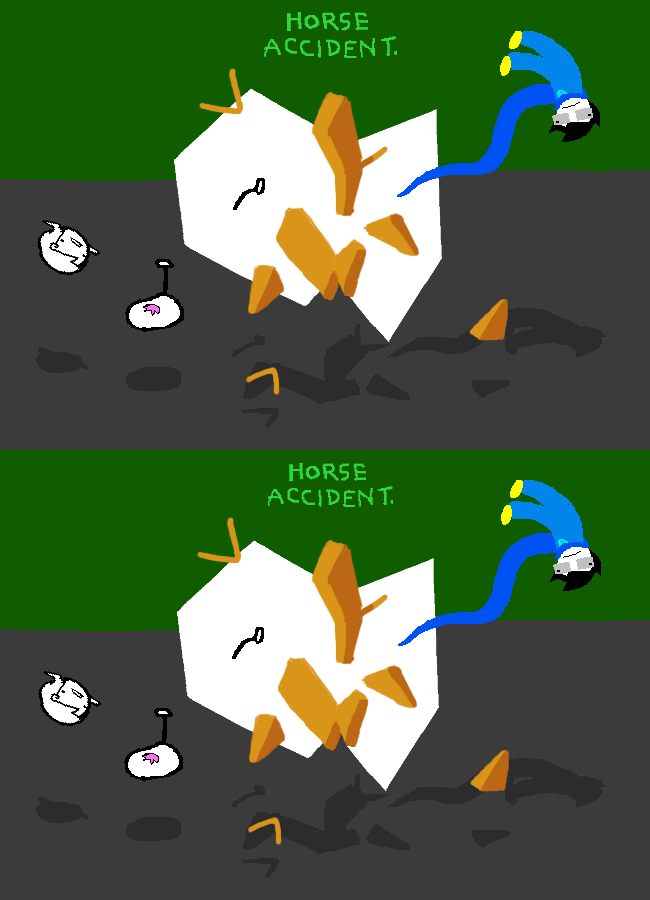
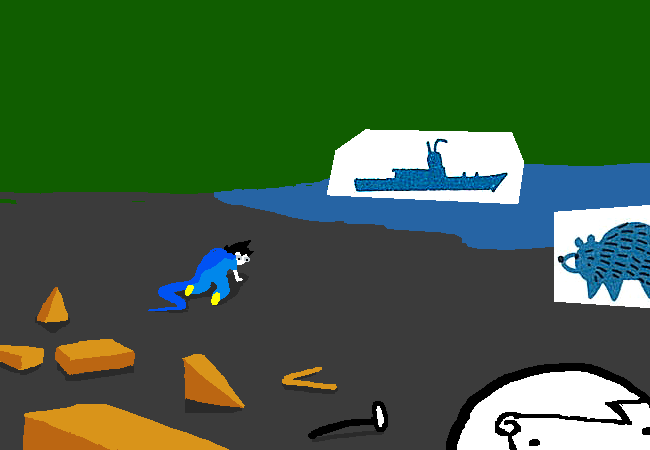
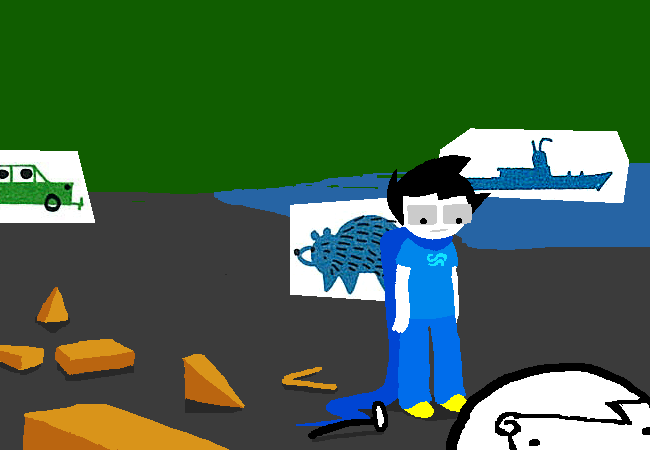

And so on, with apologies to Andrew Hussie for pulling out so many images in a row.
Appropriately for a meta and self-referential comic, we also get some explicit commentary on the way some fans take an interesting piece of art and make it less interesting through their own (gross) interpretations.
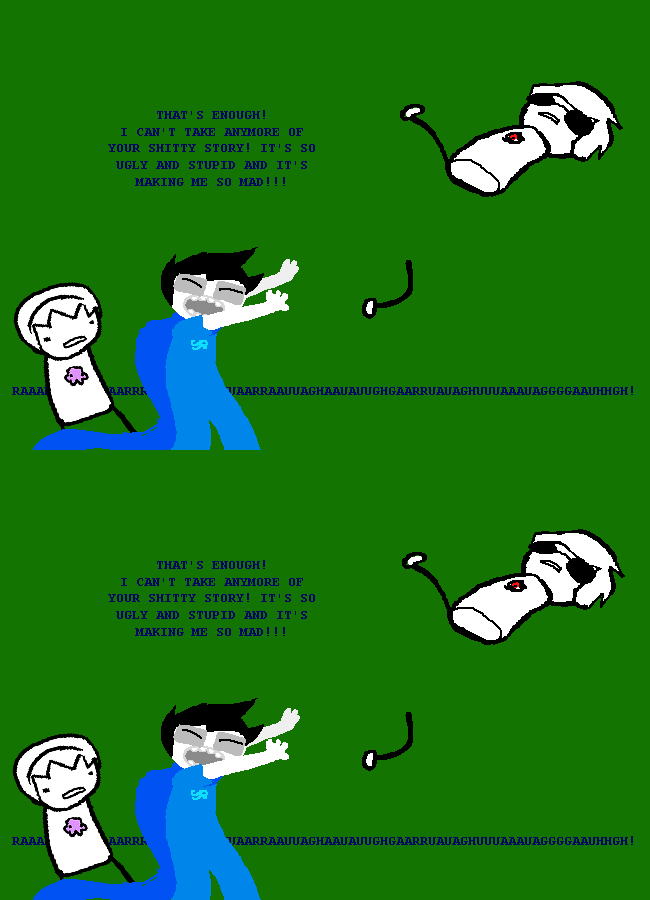
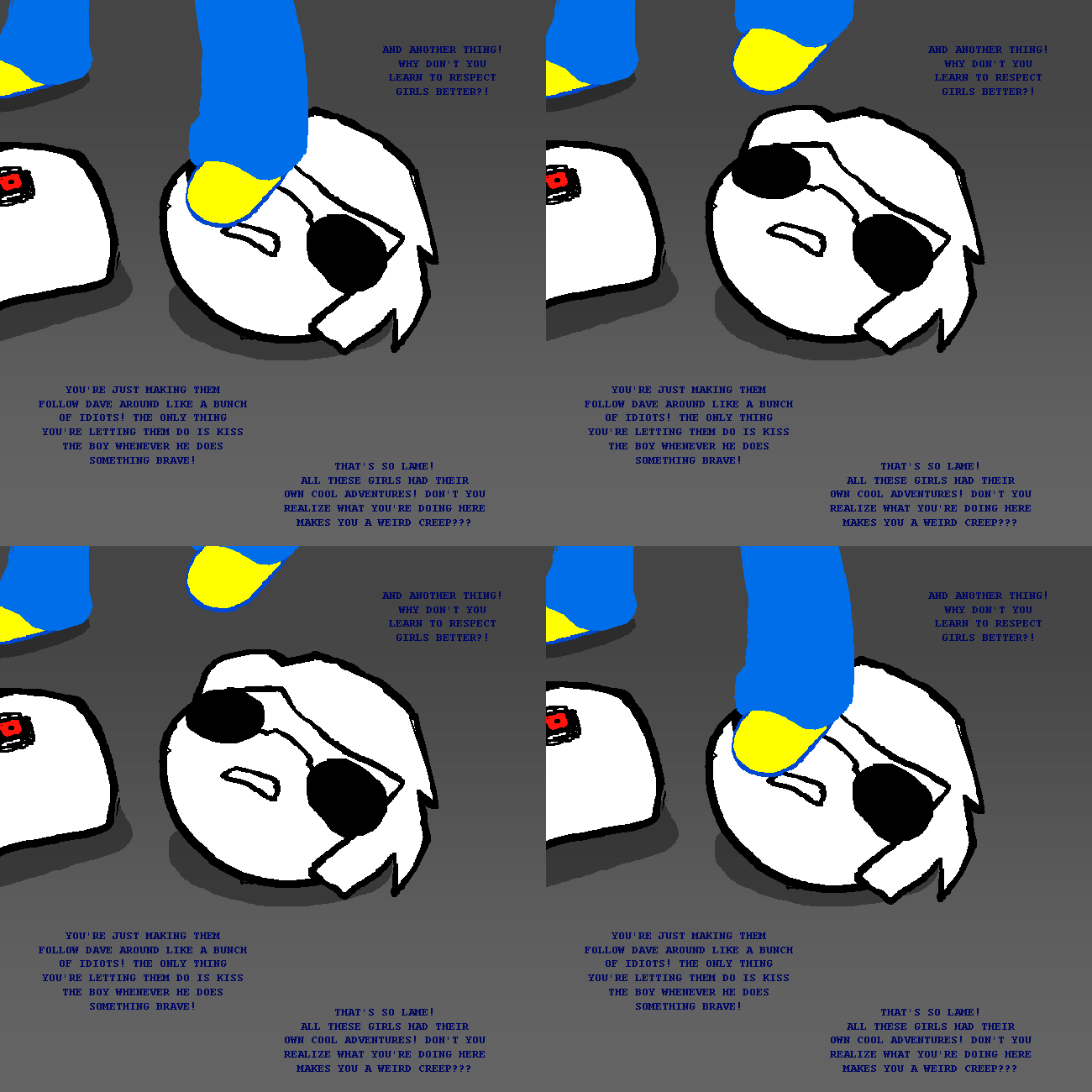
Really, with stuff like this on the page, there’s not much left for critics to do.
But on the subject of female characters – and before you start to think that the author-fan relationship has gone irrevocably south – rest assured: the evil villain character responsible for the art in this section – who on top of all his other faults, is a bad artist – has a twin sister who represents everything that is good, or at least harmless, about fannish participation. (She’s a cosplaying fanwriter who just wants to meet the people she’s been reading (and writing) so much about, befriend them, and help them towards a better ending.)
Sadly, compared to her evil somehow-competent-despite-his-stupidity brother, she’s not very effective… but who knows how the comic will play out.
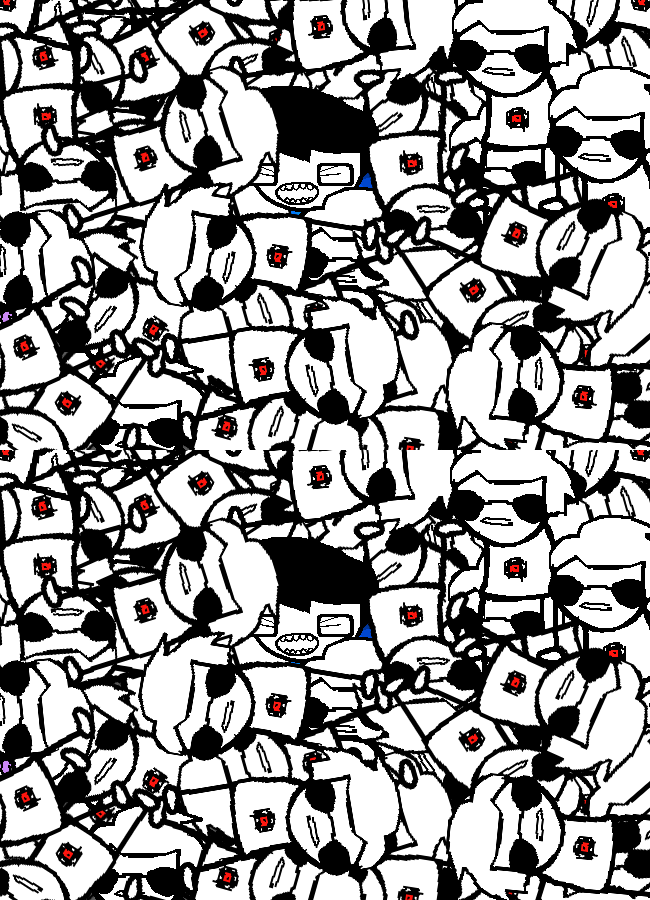
I believe in you, dude!
*”We” meaning me, of course, since as far as I know I’m the only fan around here. Actually, I want to ask: Did any of you guys reading this website take the plunge and start in on Homestuck?