Film to Comics: Lessons from Daniel Clowes’ Justin M. Damiano

Justin M. Damiano was first published to limited notice in The Book of Other People (ed. Zadie Smith; full comic at link) in 2007. Its existence was jogged back into my memory by James Romberger’s recent review of The Daniel Clowes Reader where he calls it:

“…a classic that needs to be read by anyone who writes criticism on the internet.”

This wasn’t the way I remembered the story and I read it again to see if I had been blinded to its treasures on my first read through.

A number of critics have taken Justin Damiano to their bosoms, elevating the specific into a judgement of the whole or at least a comment on a significant number of online critics. At The Guardian, Peter Bradshaw suggests that:

“…mature, contemporary Damiano isn’t a cynic or a loser: he has transferred his idealism from the world of relationships to that of the cinema, and being an online critic, answerable only to himself, he is perhaps freer to express this pure, unapologetic idealism…Is Justin a sad sack for believing that this transcendence is to be found in the cinema rather than human relationships? Maybe – but not necessarily, and it isn’t clear that Clowes is inviting us to assume this.”

Another critic, Brian Warmoth, opines that:

“Clowes’ ability to distill the bitter side of humanity in menial activities and everyday labor or interests is extremely keen…It’s also about the rifts between critics and artists that can sometimes encompass shared ground.”

Part of this boils down to a presumption of antagonism—that artists are supposed to have a very low opinion of critics and criticism in general. It is easy to slip into this diagnosis unless one looks closely at the details of Clowes’ exposition, most of which holds very little water and specificity for critics. To suggest that Clowes was presenting a critique of critics in general here would be to do him a disservice and may even imply that he is a person of shallow intellect. Naturally the title of the anthology begs the question, “What other people?” It might be that the ultimate “other” for an artist is not his audience but his critics, but this wouldn’t be that much of a leap of the imagination for Clowes who has engaged in scathing criticism for years in the pages of his comics. Clowes isn’t so much an artist chastising critics but a practicing critic contemplating his own art.

Taking James’ premise as true, however, what exactly are the lessons we (as online critics, silent or otherwise) are supposed to glean from Justin M. Damiano?
Justin 00

(1)  Critics have a overweening sense of self-worth.

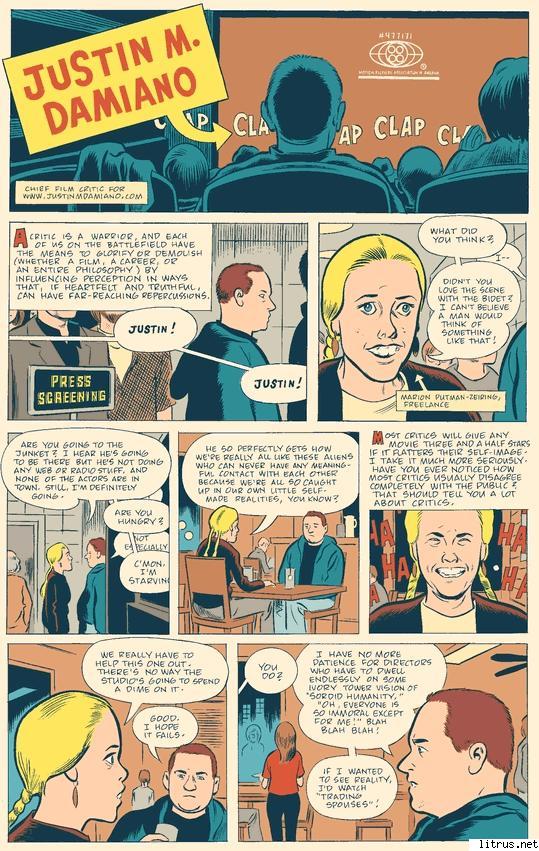
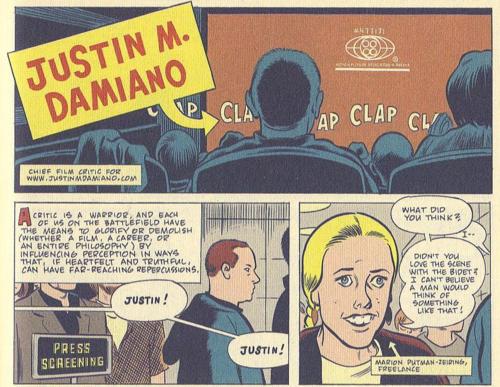
Translation for comics-kind: A comics critic is a (part time) warrior, and each of us on the battlefield have the means to glorify or destroy (whether a comic, a career, or an entire philosophy) by influencing perception in ways that, if heartfelt and truthful, can have far reaching repercussions.
Justin 01

This sounds insightful (and damning) until you start replacing the word “critic” with other words like, “artist”, “cartoonist”, “director”, “journalist”, “politician”, and “pop star”. Basically anybody with access to the wider media through talent, money, or both. In this day and age, this would mean a television program, a newspaper, a studio, and, yes, a popular blog. There is very little doubt though that the comics critic is the dung beetle of this august list of movers and shakers.

(2)  Critics enjoy toilet humor (or perhaps playful metaphors).
Justin 00a

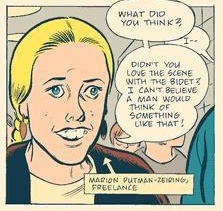
Well, they sort of do, and they’ve also shown some fondness for bidets apparently. A clear reference to Duchamp and his porcelain urinal but also a self-referential finger pointed at Clowes himself—a very arch critic in many stories in Eightball and a florid user of metaphor.

(3)  Critics are self-absorbed and insular.
Justin 02

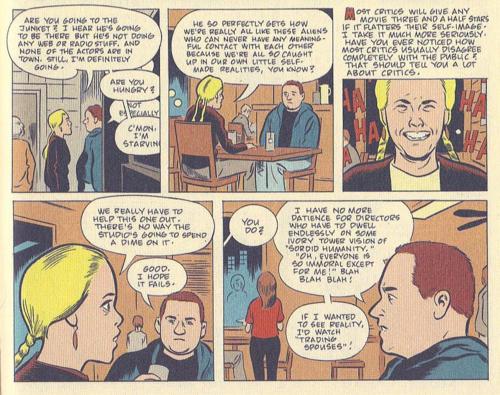
“He so perfectly gets how we’re really all like these aliens who can never have any meaningful contact with each other because we’re all so caught up in our own little self-made realities, you know?”

There’s an interplay between panels 2 and 3 on this page.  The blonde girl, Marion, is the target of Justin’s irritable internal musings:

“Most critics will give any movie three and a half stars if it flatters their self-image…Have you noticed that most critics usually disagree completely with the public? That should tell you a lot about critics.” [emphasis mine]

That latter point is quite contrary to experience as a simple survey of the top 5 movies of the last two years will attest:

Top 5 movies by domestic gross 2013 with Rotten Tomatoes (RT) score
Iron Man 3 (RT 78%)
Despicable Me 2 (RT 76%)
Man of Steel (RT 56%)
Monsters University (RT 78%)
Fast and Furious 6 (RT 69%)

Top 5 movies by domestic gross 2012

Marvel’s The Avengers (RT 92%)
The Dark Knight Rises (RT 87%)
The Hunger Games (RT 84%)
Skyfall (RT 92%)
The Hobbit (RT 65%)

Of course Clowes doesn’t mean any old critic. He means critics like Justin M. Damiano who is shown throughout this page in an act of self-condemnation, hurling stones at others while he sits in his own ivory tower of arrogance and recalcitrant elitism—the stuck-up loner with delusions of grandeur; the keyboard warrior of  “modern alternative film criticism.” For all intents and purposes, this would include well over 50% of all comics critics.

But what exactly does “flatters their self-image” mean? One presumes that it means that critics tend to prefer movies which align with their own vision and experience of existence. Damiano suggests that critics should instead acquire a taste for other aspects of humanity as presented on film—those which run counter to their own beliefs. It should be stressed that we are specifically talking about “taste” and not action here, for Damiano is never shown acting on his preferences in art. Thus a critic with Randian principles should be able to develop empathy for the works of Vittorio De Sica. Similarly, a critic who abhors violence and misogyny should be able to appreciate and enjoy glorifications of the same. Since Marion is portrayed as a typical online critic, some might see this a proposition put forward by Clowes but this may not be the case. If Damiano is seen as a negative indicator (in some instances), it could also be taken as an admonishment of the critical community as a whole.

Marion’s comment that the film depicts human as “aliens who can never have any meaningful contact with each other” proves to be Damiano’s own “defect”—the very reason why he prefers “escapism” in film. The cinema becomes a brothel of whispered dreams and vicarious experience, a panacea for his lack of human contact. This explains his boredom when faced with Godard’s Le Mepris (a film about estrangement), a movie which probably mirrors all too accurately his own life. This isn’t so much Clowes needling critics so much as Clowes poking fun at himself, for his comics have consistently portrayed “sordid humanity” and immorality.

(4)  Critics are mercurial and careless – “Good I hope it fails.”

But are they significantly more so compared to the general public?

(5)  They don’t suffer fools gladly – “Well watch it again!”
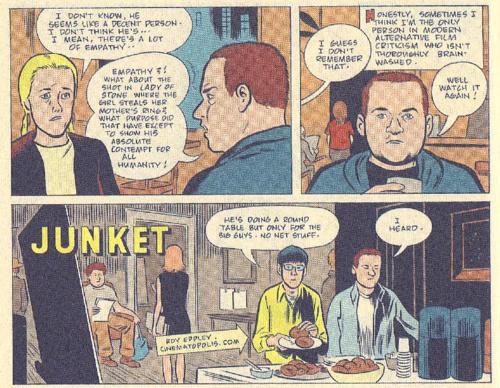
Justin 03

(6)  They are frequently jealous of access.

See point 4.

(7)  “Every critic, even the most most mainstream hack, thinks of himself as a “rebel.” But in a culture of self-indulgent experimentalist navel-gazing, a real rebel believes in truly subversive ideas like “escapism” and “universality.” 
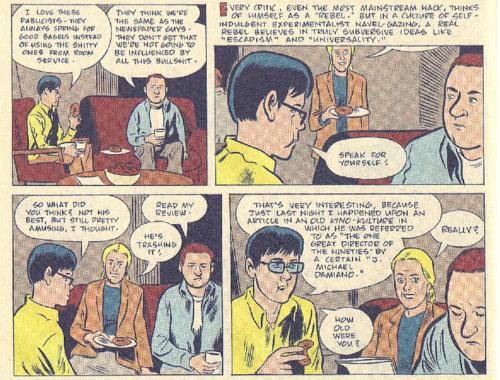
Justin 04

This isn’t as straightforward as it sounds. Damiano suggests that every critic considers himself a “rebel,” which would make him a rebel himself. Rather than promoting “bidet” art, Justin has taken his beliefs one step further and is rebelling against rebellion—championing “escapism” and “universality.” In other words, the act of criticism is seen here not so much as an act of connoisseurship but a process of self-promotion and self-aggrandizement which has little relation to “taste” or the object beheld.

At this point, alternative comics criticism and film criticism diverge, at least in the American sphere. The gradual migration of superhero fans into alternative comics has led to a renewed interest in objects of times past and the assimilation of tropes and techniques associated with superhero comics and other forms of commercial art. Further, this might be an area where comics have a leg-up according to Justin Damiano’s injunction. The 5 nominees for Best Continuing Series at the 2013 Will Eisner Awards were Fatale, Hawkeye, The Manhattan Projects, Prophet, and Saga—all firmly lodged in the realm of  of “escapism.”


(8)  Criticism is autobiographical and self-revelatory.
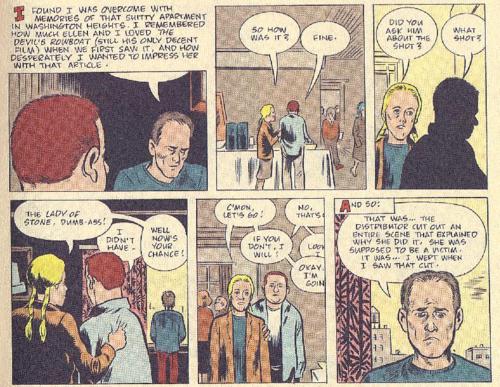
Justin 06


“I remembered how much Ellen and I love The Devil’s Rowboat…and how desperately I wanted to impress her with that article.”

In the first panel of this page, Damiano’s thoughts completely obscure the words of the director who bears a vague resemblance to a balding Clowes (well, it could also be Gary Groth).  One might say that his own thoughts take precedence over the ideas of the director being interviewed; a point further emphasized by the revelation that a favorite scene of his from an earlier film of that director was quite unintentional (the result of a distributor cut).

This seems like a knock on critics but it actually suggests that criticism is as much an act of creativity as the production of a film or comic—a metatextual comment on the object being read. The real mark of bad criticism in my view is “objective” synopsis. I wouldn’t read criticism if it all read as if it was produced by a machine (or a marketing agent).


(9)  Critics are frequently loners with poor social skills.
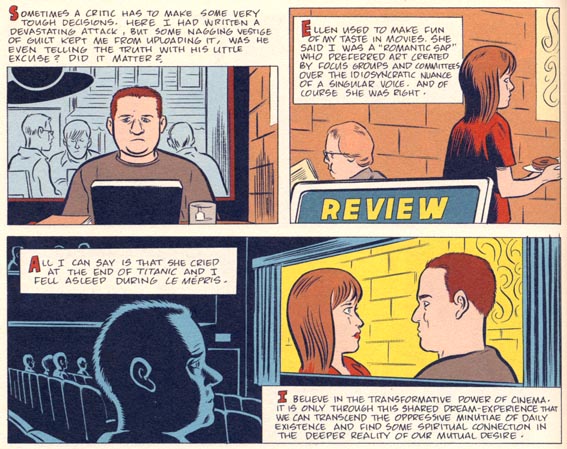
Justin 07

“I believe in the transformative power cinema. It is only through this shared dream-experience that we can transcend the oppressive minutiae of daily existence and find some spiritual connection in the deeper reality of our mutual desire.”

Justin is  looking at a pictorial representation of a cinema screen which is actually the fourth panel of the comics page. This is probably a reference to Clowes’ own migration to and from comics and film.

Clowes’ cynicism is so thoroughly ingrained into his comics that the somewhat ambiguous but treacly conviction stated here would quickly arouse the suspicions of his long time readers. One imagines that some people feel the same way about the films they see, but this seems like a specific interjection clarifying the state of mind of our protagonist, a point reasserted on the page following where he thinks:

“When Ellen finally left, she said she felt as though she didn’t even know me. She said I lived entirely inside my own head.”

The escapism which Justin seeks in the cinema (and art) has become a substitute for any real real connection. Any warmth in expression (the bottom panel bears his least contemptuous face) or speech is reserved for the figures he sees on the cinema screen. He has nothing but distaste for the people he interacts with in the pages of this comic.

It seems to me that whatever observations Clowes makes about critics are simply a side effect of using a film critic as the main character of his story. Any bitterness or acute observation is restricted to the first half of the story and forms the bedrock for his elaboration on the protagonist later in the tale. The further one delves into Justin M. Damiano, the less it reads like a standard exposè on the failing of critics, and the more it feels like a story about a man who just happens to be a film critic. In this way, it has many similarities to one of Clowes’ earlier works, “Caricature”, which constantly straddles the line between reality and illusion in its portrayal of a caricaturist—a competent loner working the crowd and his sexual proclivities.

But even more than in that work, Justin M. Damiano turns in on itself, becoming a moment of self-criticism and reflection; a careful dissection of his own comics. The “other” of the collection’s title (The Book of Other People) is not so much his critics or his audience—they remain anonymous and unknowable.  The “other” is the person that he can never hope to become.

 

Why Shelby Lynne Is Not Death Metal

leprosy+death_halifaxcollect.net

This ran a while back on Splice Today.
____________
I’ve been obsessed with death metal recently — Decapitated, Disincarnate, Dismember, Deicide, Demilich, and of course Death — best fucking band names in the world of music, and that’s just the ones that start with “D”. I love that listening to death metal on an ipod is like collecting every word in the dictionary that could possibly be considered morbid and gross and putting them together almost at random. And yes, I’m sure there’s a band named “Morbid Gross” out there somewhere, and their singer sounds like he’s gargling knives and the music is like being bashed upside the head with a decaying goat tied to a spinning helicopter rotor because — that’s what death metal is damn it! Just ask Carcass or Cancer or Cannibal Corpse or Kreator.

The other thing I’ve been listening to is the new Shelby Lynne album, Tears, Lies, and Alibis, which obviously has nothing to do with death metal at all. It has so little to do with death metal that it’s kind of fun to sit back and count the ways that it is not like everything else I’m listening to. You can hear the lyrics. They are sensitive songs about love and heartache rather than vile despicable ruminations on nuclear winter, incest, and stripping the flesh from the rotting Christ with your teeth. And, to get a little more meta, it’s always clear as clear can be why a death metal album is death metal, but it’s not at all clear what Shelby Lynne is supposed to be. Folk? Pop? Country?

Country’s where she’s usually filed I think, and that’s actually the best explanation of her genre incoherence. Because, if death metal revels in fiendish formal consistency, country has long been defined more by who’s doing the dancing than by what they’re dancing to. Music by rural whites for rural whites, country has borrowed variously from jazz, rockabilly, rock, pop, soul, blues, and whatever else happened to be around, just so long as it wasn’t too up to the minute. Death metal (or for that matter, bluegrass) is what it is; country is who is playing it and listening to it.

What this means is that fans of country — even more than fans of pop, perhaps — aren’t especially fans of a particular musical style. Listening to country means listening to an amalgamation. As a result, there’s a great deal of emphasis on personality. Death metal performers (and, for that matter, bluegrass performers) are relatively hidden, obscured behind their technical mastery and their unholy obeisance to the tropes of their genre. Country, though (or for that matter punk) is all about charisma — your stories, your voice, your sexiness, your humor. If death metal is anonymous assault, country is personal seduction.

Which maybe helps explain why I’m not so into this Shelby Lynne album. Not that I don’t like country — overall I probably like classic country more than death metal, truth be told. But…well, Lynne just isn’t that charismatic. She’s got all the technical bits down, no doubt — her voice is rich and full, with a touch of plainspokennness that comes across as sensuality. The songwriting is unimpeachable, from the Beatlesesque “Rains Came” with its woodwind accents ,to the swinging soul come-on of “Why Didn’t You Call Me,” to the earnest folkisms of “Family Tree.” It’s all done with professional polish and even moments of inventiveness. If it were death metal, I’d thrash my head to it happily.

But it’s not death metal — and as a result it’s roteness is kind of a problem. Country has no solid formal grounding to fall back on, so mere competence, or even hyper-competence, just isn’t good enough. George Strait or Leanne Womack or Lyle Lovett or K.D. Lang, to cite some artists comparable to Lynne, all manage, at various points, to be funny, or weird, or eccentric or heartfelt. I don’t necessarily adore everything any of those singers have done, but they do put their own stamp on their material. You’d have to go a long way to find someone who could put as much rueful pathos as George Strait does into the couplet “Oh she tells her friends I’m perfect and that I love that cat/But you know me better than that.” It’s hard to think of anyone who could sound as simultaneously ridiculous and heartbroken as Leann Womack does when she declares “I’m the fool in love with the fool who’s still in love with you.”

There’s no comparable moment like that on Shelby Lynne’s album. Yes, she has a great voice, but various people have great voices, and it’s hard to see how this album would be changed if one of them sang it instead of her. When you listen to a country album, you’re kind of always asking, “Who are you? And why should I love you? “ If Shelby Lynn were Morbid Angel or Malevolent Creation or Massacra the answers would be, in order, “no one” and “I will feed your corpse to the pit”. But she isn’t, and so the answers instead seem to be “I’m not sure,” and “because I’m a little bland.” Which is why I’m turning off Shelby now and going back to listen to Sodom or Slayer or Sepultura— or, hell, maybe even to Strait.

The Future Will Be Repeated

This first ran on Splice Today.
_________

ZIQ290_Bangs

 
Chicago juke is supposed to be dance music. Listen to Bangs & Works Vol. 1 (A Chicago Footwork Compilation), though, and you’ll be hard pressed to believe it.  The album sounds like Philip Glass being hit in the head with a turntable. Repeatedly. Repeatedly. Repeatedly. Repeatedly. And he says shits fuck, shits fuck, shits fuck, shits fuck, shits fuck , shits fucked up.  That shit is fucked up.  That shit is fucked up. That shit is fucked up.

The repetition is addictively flattening. This is music as endless bland trance, everything reiterating into a meaningless blur.  Hip hop is about the clever dexterity of the samples and the wordplay;  jazzy individualistic improvisation.  This…this is droned out and faceless; incongruous samples like “The Lion Sleeps Tonight” run round and round for two minutes till you want to strangle yourself or go into a coma; random profane phrases spit out and spit out again and spit out again till they don’t even register as offensive. The whole comp is sexless, the beats coming in rapid bursts like balls bounced on the ground and then stopping again, utterly impervious to funk.  Compared to this, nerdy electronica swaggers and Xenakis swings. “Ima dog Ima dog Ima dog Ima dog Ima dog,” one track insists, but really it should be saying, “Ima cas Ima cas Ima cas Ima castrated robot.”

Check out actual videos of footwork  competitions online and “castrated robot” starts to seem even more apropos. The dancers look like Michael Jackson in a sped up film, their legs pounding and racing in time to nothing. The music’s there, but it’s fractured loops seem divorced from the motion of the performers; they might as well be dancing to a leaf blower or a boiler. The technical facility is amazing, but it seems to occur in a vacuum. Passion is bled away and all that’s left is motion and sound, spinning on automatic, like a projector running after the film has run out, the loose end of the last reel stuttering on and on until the projectionist wakes up to turn it off.

It’s hard to imagine this style ever going pop.  Maybe one or two tracks on the comp suggest a path; DJ Trouble’s “Mosh Pit” has a repeating classic rock guitar riff, for example, and something that comes within spitting distance of an actual beat.  But it’s telling that Kid Sister, a thoroughly awesome Chicago pop artist who occasionally name-checks juke,, sounds way more like the early eighties than she does like the stuff on Bangs & Works.

Still, who knows?  Afrika Baambata must have seemed like he was coming from another planet to boring middle-aged white people like me when he first appeared on the scene.  Maybe bloodless spastic trances are the future.  For that matter, it’s a little miraculous, and not a little inspiring, that they’re part of the present.

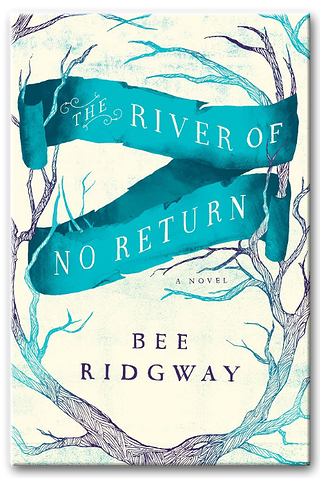
The River of No Return

Bee Ridgway’s novel starts with a jolt and doesn’t stop shocking you until it reaches its electrifying end (which is only a semicolon of an end, really – I am waiting on the edge of my seat for the sequel to come out).

Perhaps the most shocking part of Ridgway’s novel is the identity of the author. For to the world she may be Bee Ridgway, but to me, she is Professor Bethany Schneider, leader of many of my college seminars. Even as students, we were mesmerized by Bethany’s storytelling power. She is a legend on campus at Bryn Mawr College, and we would wake up at the crack of dawn on registration day in order to assure ourselves spots in her class. We looked to her not only for literary direction, but also for guidance in our feminist politics, and for help with wrestling our anger at the world’s injustices into well-crafted prose.
 

1369428994-river_of_no_return

 
But we never guessed that she’d come out with a novel that places itself squarely in three different genres of fiction: romance, science and historical. And yet, maybe I shouldn’t have been surprised. Because though the novel is something of a thriller, it is also deeply grounded in radical and feminist politics.

The River of No Return opens with the death of Julia Percy’s grandfather, the Earl of Darchester, in the year 1815. We then jump forward in time to an idyllic New England farm, where we meet Nick Davenant, who turns out to have leapt ahead in time himself. The fun really begins when Nick returns to 1815 to resume being Lord Nicholas Falcott, Marquess of Blackdown (and Julia’s neighbor). Intrigue takes the form not only of romantic banter between our hero and heroine (racy in the most heart-stopping and breath-quickening ways!), but also of Nicholas being given the responsibility to save The Guild, the society of time travelers, from doom. Nestled into these overarching dramas are the subplots concerning Nicholas’s two sisters, Arabella and Clare. Here, I think, is where the novel truly shines. The desire to follow what happens to Nick and Julia is unstoppable, but the small crevasses into which Ridgway packs these supplemental stories are equally rich.

For instance, I don’t know of too many time travel novels that focus on discussions of women’s rights and the relationships between various socioeconomic classes across the centuries. I sincerely appreciated that these subjects were not ignored in The River of No Return. Clare, for example, assumes she is going to inherit her family’s property when her brother disappears. Without giving too much away, Clare’s plans for the estate might be deemed downright socialist in a modern context, not to mention the fact that she might be one of the only women of 1815 with a thorough understanding of Mary Wollstonecraft.

One of the more entertaining anecdotes in this vein is when Nick encounters in the nineteenth century a woman he had slept with previously, while he had been living in the twenty-first century. The shock of this brings up for Nick several questions about how he should be treating women, and Ridgway’s reflections on courtship across the centuries is nuanced and hilarious.

The River of No Return moves along at breakneck speed, so much so that it can sometimes be overwhelming. I found myself needing to re-read the complicated passages about the rules of time travel in order to understand them.  But one thing is for certain: if you open it, it will suck you in until the very last page, so make sure to have some time on your hands before reading the first.

Utilitarian Review 8/30/13

Batman-Adam-West-batman-5193248-1024-768

On HU

Featured Archive Post: Caroline Small interviews Nina Paley about copyright and culture.

The real realism of Killer Elite.

Five haiku by me.

Chris Gavaler on time and timelessness in comics and politics.

James Romberger reviews a whole slew of recent comics.

Subdee compares Pacific Rim to the manga Attack on Titan.

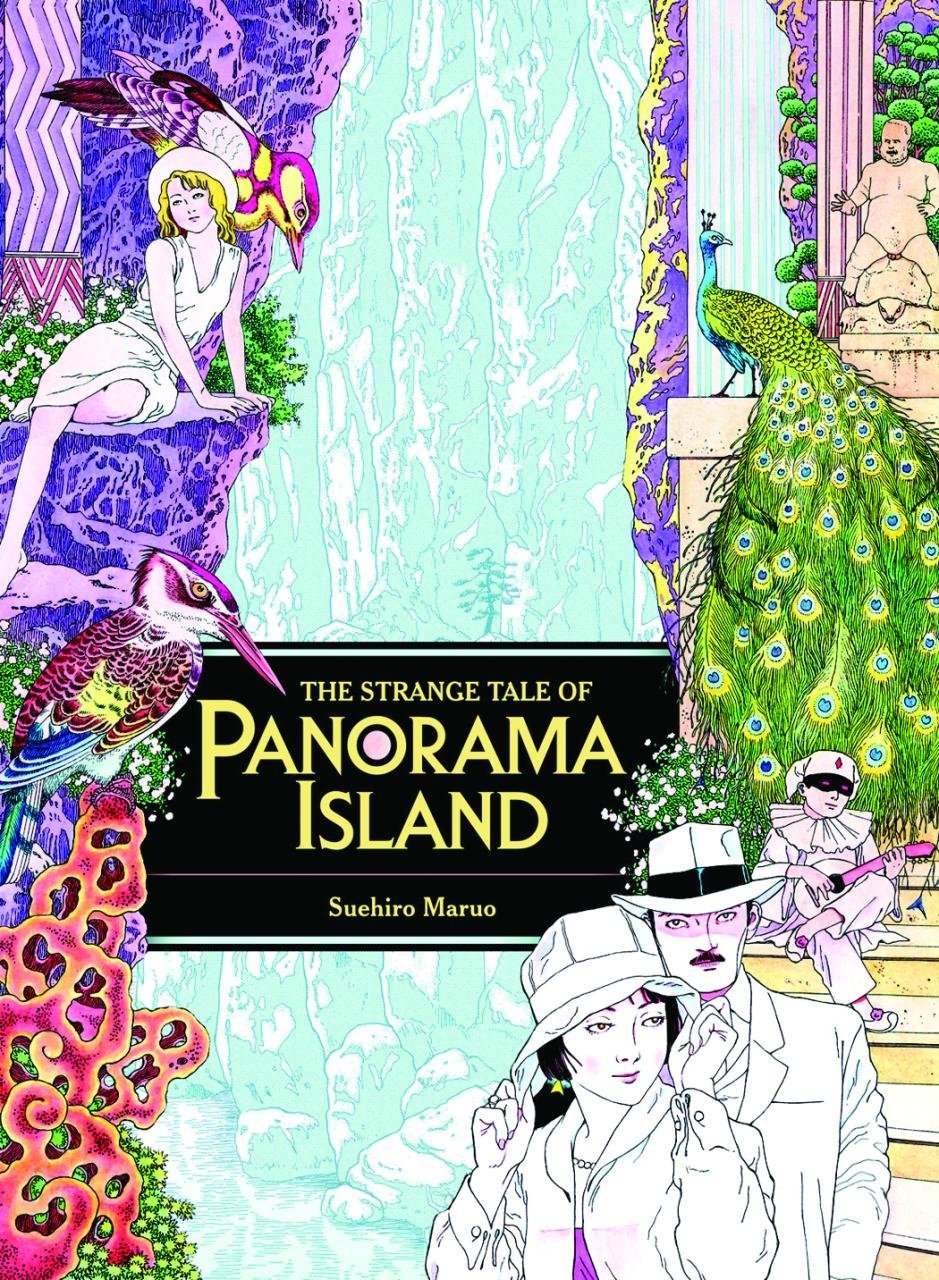
Ng Suat Tong with a review of Suehiro Maruo’s adaptation of Edogawa Ranpo’s The Strange Tale of Panorama Island.

I provide a tour of some great muppet musical performances.
 
Utilitarians Everywhere

At the Atlantic I wrote about:

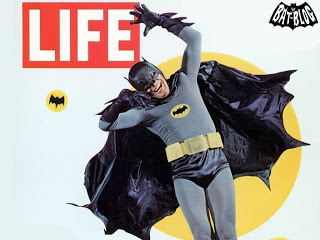
— how doofus Batman is the best Batman.

Miley Cyrus, Janis Joplin, and minstrelsy.

And more on Cyrus and Joplin and exemplary white people.

At Splice Today I write about

wishing school would start and I could be bored.

how I wish Jonathan Chait would stop encouraging us to go to war in the Middle East.

 
Other Links

Alex Pareene on how Roger Ailes is a paranoid nutcase.

Jessica Hopper on black metal. She sort of conflates all black metal with the fascist kind a bit, but it’s an interesting article nonetheless.

Jacob Canfield is pretty amazing in this tcj comment thread on indie titles and racism. Darryl Ayo has some great things to say too.

In fact…that whole thread is just really heartening for anyone who cares about comics. Yes, there are some folks who are defending obvious, stupid racism, in the same old we-love-Crumb-and-all-his-progeny vein. But there’s also just a ton of folks explaining why it’s time to move on from that particular dead end. Frank Santoro’s response to what is basically some pretty harsh criticism of his post is extremely balanced and respectful. It’s a serious discussion with a lot of smart people saying a lot of smart things about a topic that matters, in the best tradition of the Comics Journal. It made me really happy.

Muppet Music

Mahna

This originally ran on Madeloud a long time back.
__________

There’s nothing quite like a plush floppy critter singing — which of course explains the breakout success of John Denver. It also, to perhaps a lesser extent, accounts for the marvel of musical treasures which was the Muppet Show. Below are some of the highlights.

“Mahna Mahna”

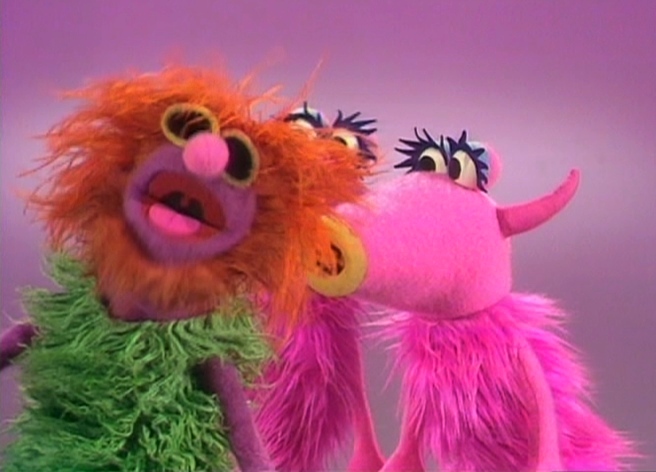
“Mahna Mahna” debuted on Sesame Street in a prototype and then went big time on the Ed Sullivan show in 1969 with the familiar shaggy muppet and the cowlike pink Snowths. “Mah-na Mah-na” (with hyphens) was originally composed by Italian Pierro Umiliani for his Swedesploitation film, Sweden, Heaven or Hell. In the Muppet version, scandalous Scandinavian sex is replaced by scandalous scatting as the irrepressible be-sunglassed beat muppet provokes the Snowths snouts into escalating moues of disapproval. The skit was reprised as the first number on the first episode of the Muppet Show, a version which includes poor Kermit being mahna mahnaed by telephone.
 

The Mahna Mahna singer does a similar act in “Sax and Violence,” a skit also featuring saxophonist Zoot.

“You’ve Got a Friend”

Vincent Price, in perhaps his scariest role of all time, wears a hideous green jacket, terrifying neckware, and a hairstyle-that-should-not-be to lugubriously desecrate Carole King’s “You’ve Got a Friend.” Henson and company break out a whole murder of endearingly ugly muppets, but, as is his wont, Price emphatically steals the show. His expression of sweetly demented joy at :41 is almost as irresistible as his plodding off-key singing. Indisputably the best version of this song ever recorded.
 

“I’ve Got You Under My Skin”

This is another performance from the excellent Vincent Prince episode. A giant orange monster and a small frightened muppet duet on Cole Porter’s “I’ve Got You Under My Skin” while the former attempts to eat the later. Perhaps the best thing about the skit is that the violence in the song comes so naturally; you listen and realize, yeah, this…this is a creepy stalker song. “Don’t you know little fool/ you never can win!” the monster declares, and the poor tiny muppet trembles. As well he should, because that’s a really unpleasant way to declare your undying affection to the weird beak-nosed darling of your dreams.
 

“Orange Blossom Special” and “Jackson”

Johnny Cash does a medley of two of his biggest hits, assisted by Miss Piggy standing in for June Carter Cash. The buck-toothed hayseed muppet puffing like a train is pretty great, but of course the duet is the main thing. Johnny swivels his hips in a unhealthily lascivious manner when the pig makes her appearance resplendent in purple hat and green scarf. She reciprocates by heartlessly drawing attention to his coiffure (“go comb your hair!”) which looks like one of her fellow muppets has crawled up on his scalp and expired.


Cash’s performance of “Ghost Riders in the Sky” with Gonzo as cattle-herder is pretty great too.

“In the Navy”

After a brief selection of soothing flute music from the Peer Gynt Suite, we launch into the Village People classic performed by marauding Viking pigs. The usual Muppet Show protocol is to have the puppet-performed numbers voiced entirely by people who can’t sing. This skit, however is distinguished by being voiced almost entirely by people who can’t sing — there’s one guy there who can actually belt it out. You can hear him at 1:37 — “Can’t you see we need a hand!’ he declaims with some almost professional vibrato while everyone around him stomps forward like they’re in a skit involving marauding Viking pigs and nobody cares whether or not they’re on-key.


“Rockin’ Robin”

Of course, the “nobody can sing” dictum doesn’t apply to house-band the Electric Mayhem in general, or to Janice in particular (here voiced by Richard Hunt.) Though you might miss it behind the goofy interpolations and the cadaverous looking shuffling robin, this tune is actually a strikingly effective arrangement of this Jackson Five classic. The slick Motown R&B delivery system gets changed into a swinging jump blues, with some tasty bass and a soulful drum/gutbucket saxophone interchange. Plus you get to hear Animal yell “Tweet! Tweet! Tweet!”


Janice also sang “With a Little Help From My Friends,”. It’s even sillier…but still manages some musical integrity, I think.

Loretta Lynn

Loretta Lynn’s version of her it-sucks-to-be-a-woman lament is adorned with some of the most disturbing muppets ever created. Giant leering toothy monster muppets are cute…but these human muppet babies with their twisted little apple faces and gaping contorted mouths…eesh. If this were more widely marketed it could single-handedly solve the population crisis.


The baby muppets were featured in a number of other skits as part of Bobby Benson’s Baby Band, always to nightmarish effect.

“The Gambler”

It’s a little hard to believe how thin Kenny Rogers’ voice sounds on this — it was a sad twist of fate which caused him to attain stardom before the Auto-tune. The Gambler needs no vocal enhancement, though; he appears to be simultaneously channeling John Wayne and William Shatner. The old adult-sized human muppets aren’t as viscerally horrifying as Loretta Lynn’s babies, but there is something profoundly wrong about the scene where the Gambler’s spirit steps out of his hand-sewn body and begins spectrally shuffling while his withered seat mates launch into a shaky chorus. The skit is also notable for the muppets’ human hands, and for the fact that what they do with those hands is smoke and drink. You can be Disney isn’t going to let that happen again anytime soon.
 

“Bohemian Rhapsody”

Over the last couple of years the Muppet Studios have put together a number of viral videos. A split screen “Ode to Joy” featuring multiple Beakers was a major success, as was this everyone-and-their-chickens production of Queen’s “Bohemian Rhapsody.” Admittedly, for fans of the old show, the relatively slick production values are a little hard to take — and of course with Henson gone many of the voices don’t sound like they should. In addition, the recycling of favorite skits, from “Mahna Mahna” to Beeker meeping seem a little forced. But everything is forgiven for the segment where Animal calls plaintively, “Mama? Mama? Mama mama mama mama mama mama mama!” He’s such a sad and lonely psychopathic beast-creature. Even Freddie Mercury would have shed a tear.


There’s endless more clips worth watching; Beaker fronting the Electric Mayhem on “Feelings”; the epic Animal vs. Buddy Rich drum battle; Joan Baez singing “Will the Circle Be Unbroken” to a family of rats; Marvin Suggs and the Muppaphone; while being manhandled by monsters Alice Cooper performing “School’s Out”. You can surf from skit to skit endlessly on Youtube…or if you want an unbeatable catalog of all things muppet, check out the amazingly thorough Muppet Wiki.

Island of Sex, Panorama of Empire

A review of Suehiro Maruo’s adaptation of Edogawa Ranpo’s The Strange Tale of Panorama Island

Synopsis (spoilers throughout)

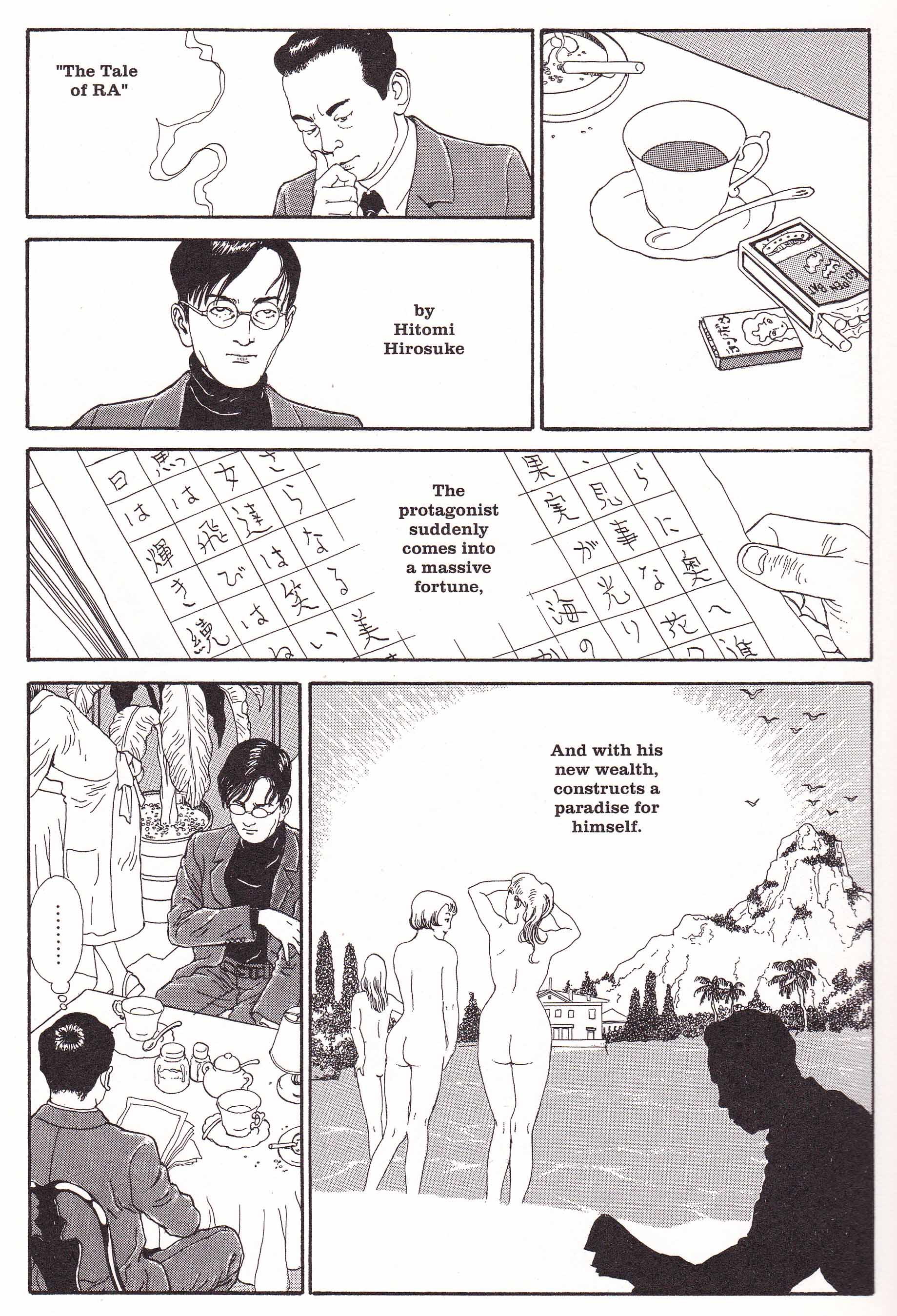
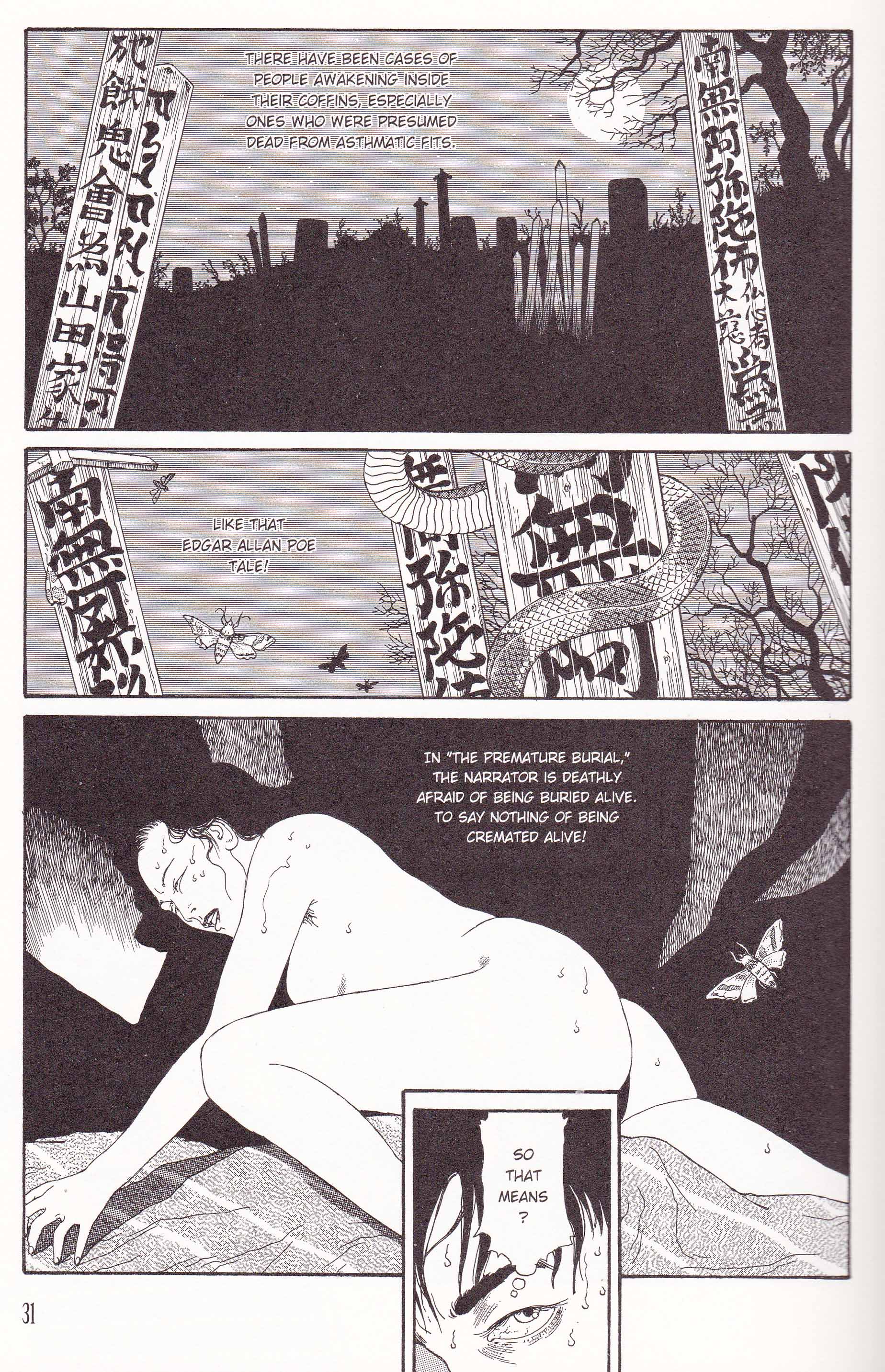
An unsuccessful author named, Hitomi Hirosuke, has visions of creating the ultimate work of art, a Utopian panorama of existence. He hatches a plan to impersonate a university friend (a millionaire named Genzaburo Kodoma) who is not only his physical twin but who has also recently expired due to a seizure (epileptic in the novella, asthmatic in the manga). Hirosuke first feigns his own suicide, then digs up his friend’s grave, disposes of the corpse, and presents himself as a risen victim of an unintended live burial (he is initially mute in the novel but is completely articulate in the manga).

Over the next few months, he manages to seize control of the Kodoma empire and initiates his plan to build his Utopian society—Panorama Island. The only person who suspects his dissemblance is his wife, Chiyoko. He is drawn to her but also finds her unworthy of his attentions (and possibly dangerous) in view of his greater project. He soon decides that he must kill her. Hirosuke arranges for them to travel to the island when it is near completion, and in an extended passage presents her with its wonders. Torn between the life of vulgarity and excess he has created and his strange attraction to Chiyoko, he finally strangles her and buries her remains on an island resembling Böcklin’s Isle of the Dead (a concrete cylinder in the novella). He hides her disappearance and continues a decadent life style on the island, exhausting the Kodoma fortune before finally being confronted with his misdeeds.

*     *     *

Panorama Island 00

Suehiro Maruo has long been held to be one of the masters of the Japanese “underground” ever since his introduction to American audiences in Comics Underground Japan (ed. Kevin Quigely). His “Planet of the Jap” from that collection is a violently ironic tale of the Japanese conquest of the United States. Propagandistic slogans (lifted from educational songs) proclaiming the superiority of the Japanese race  are presented alongside images showing the brutalization of American women.  In his compendium of ero-guro tales, Ultra-Gash Inferno, Maruo offers depravity as the only solace for humanity.

We find these aspects of Maruo’s artistry straining for release in all corners of The Strange Tale of Panorama Island (1926-27). The manga is an adaptation of Edogawa Ranpo’s novella of the same name. Ranpo (the pseudonym of Hirai Taro) was one of the key figures in Japanese mystery fiction but his novella (recently released in a new English translation by Elaine Kazu Gerbert) is less concerned with crime then with modern mechanistic entertainments (the panorama and the cinema), the siren call of art, and the obscene depths of the human soul. Ripe ground then for Maruo and not for the first time. His story, “Putrid Night” (1981, collected in Ultra-Gash Inferno) is clearly a bestial homage to Ranpo’s famous anti-war story, “The Caterpillar” (1929). The story concerns a quadruple amputee (“a large , living parcel wrapped in silken kimono”) tended to by his long suffering wife. Not only does the text deny (with a kind of black humor) anything to do with the glory and honor of war but, for the purposes of this review and as a reflection of a common theme which will soon become clear, Ranpo writes the following concerning the wife:

“…like two animals in a caged in a zoo, they pursued their lonely existence…her crippled husband’s greed had infected her own character to the point where she too had become extremely avaricious…[she] also managed to find a secondary source of pleasure in tormenting this helpless creature whenever she felt like it. Cruel? Yes! But it was fun—great fun!”

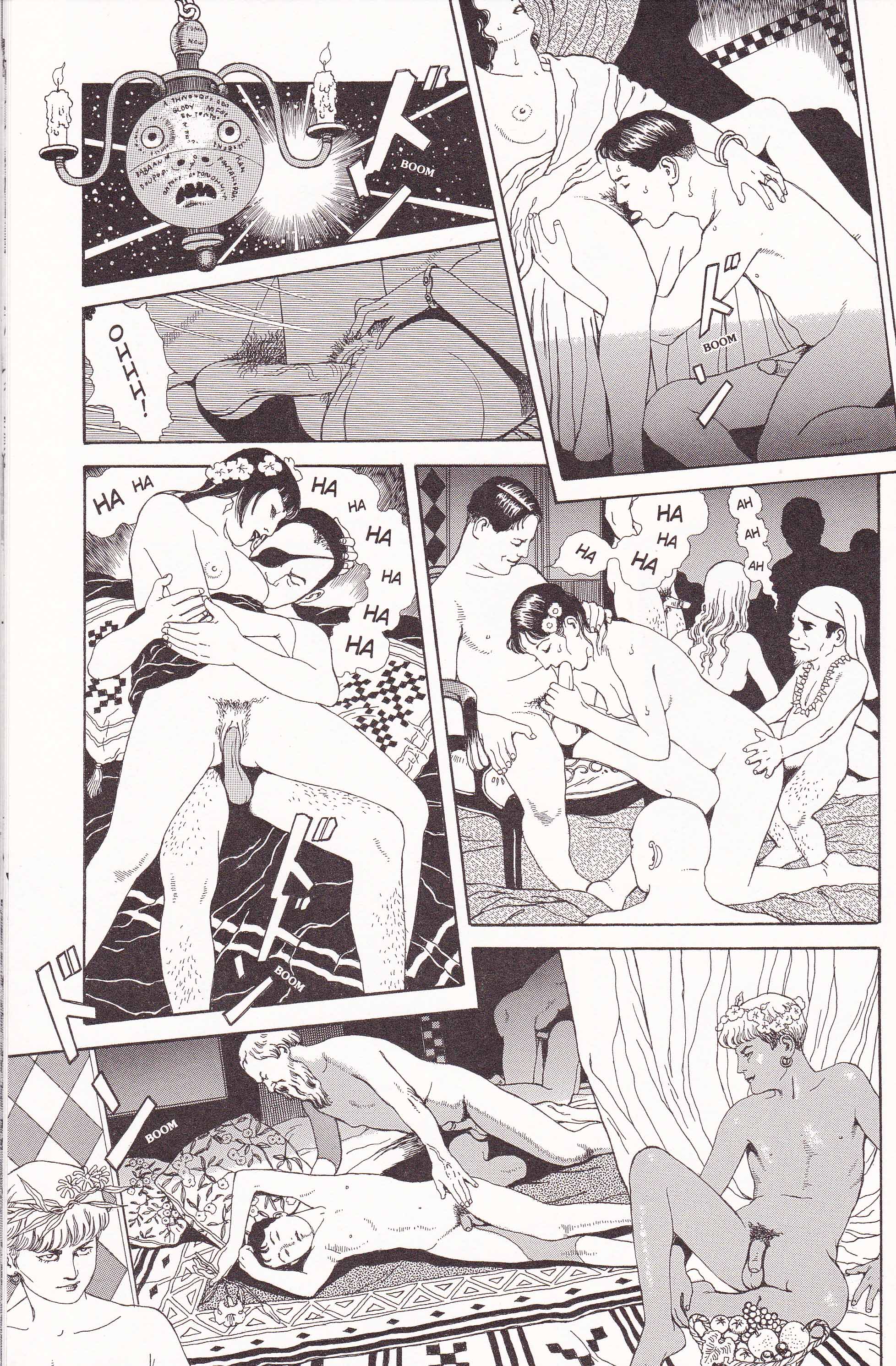
As with the short homage by Maruo,  it should be made clear that the manga being reviewed isn’t a completely faithful transcription of Ranpo’s Panorama Island. In many ways, it is a rather different object. Certainly the sequence of events and the skeleton of the plot remain largely intact but there is a distinct difference in emphasis between manga and novella. Read in isolation, the manga overwhelms with its Caligulan decadence and florid imagery. Read alongside the prose work, it shows a preference for narration and wonder over psychological and philosophical depth.

The dream sequence which opens the manga sees Hitomi Hirosuke imagining the strange vistas that will fill his novel, “The Story of RA,” and eventually his creations on Panorama Island. The manuscript which ensues is submitted to an editor and the conversation he has with him replaces the internal monologue which fills the first part of the novella. The stuff of captions not being much in favor in manga publishing, the internal musings and meanderings of the protagonist’s mind in Ranpo’s prose are largely made flesh through conversation and suggestion in the manga.

Panorama Island

This alteration plays down the deus ex mechina ending of the prose work where the protagonist is confronted by a manuscript and an editor-detective which the readers have not hitherto been apprised of. In fact, Hitomic Hirosuke’s surprise at being confronted with “The Story of RA”  at the end of the novella  is as absolute as the reader’s. Ranpo submits this final chapter—this unwinding of deception and evil—with an air of knowing and fatalistic resignation:

“Reader should we here announce the happy ending of this fairy tale? Could Genzaburo Komoda, who was actually Hitomi Hirosuke, continue to immerse himself in the pleasures of this extraordinary land of panorama like this until he was one hundred year old? No, no, not at all. After all, it’s the pattern of in old-fashioned tales that right after the climax an intruder bearing a “catastrophe” is always on hand.”

As Gerbert (Ranpo’s translator) explains, this has everything to do with Ranpo’s predilections—his fascination with the kineoramas of  time past and his desire to recreate these childish amusements:

“… a taste for playacting and theater animates [Ranpo’s] stories. They are often presented as if on a stage, with a dramatic buildup leading to a surprise ending that is presented abruptly, as if to the clatter of wooden stage clappers signaling the finale of a show.”

The dream sequence which opens the manga also makes flesh the mysteries with which Ranpo will later titilate his readers. One might say it almost circumvents the awe readers are meant to feel as Hirosuke (disguised as Genzaburo) leads his wife through the nearly finished island of his dreams; this surprise being a part of that darkened space before entering a room filled with the panoramas Ranpo is recreating, a form of entertainment which reached its height in the early 19th century in Japan—a tradition re-enacted today in movie theaters and amusements parks throughout the world.

This final unveiling of the villain seems almost a secondary concern,  as is the actual construction of Panorama Island which Ranpo dismisses in the course of a single paragraph:

“Thus a whole year of struggle in every sense went by. To speed up the telling of this story, I’ll leave it to you readers to imagine the troubles Hirosuke experienced…[ ]…I’ll just say that in the face of the power of money the word ‘impossible’ does not exist, and leave it at that.”

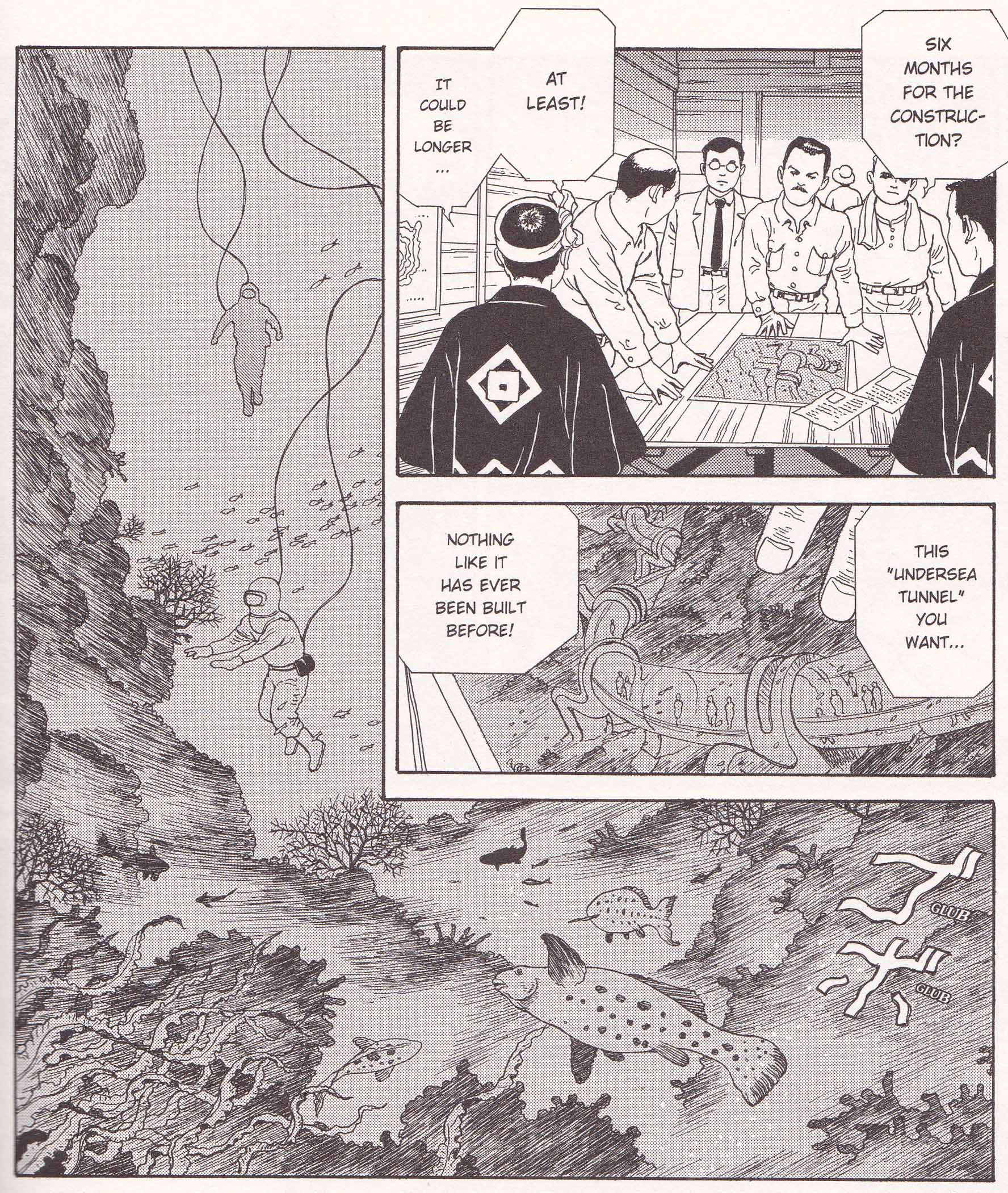
This may have been a side effect of the stories original serialization but this giant ellipsis is filled up quite thoroughly by Maruo in imagined scenes of construction and the hiring of specific workers for the island amusement. In so doing, the narrative threads are closed tight, the act of creation emphasized over psychological intensity and dread.

Panorama Island_0014


“…no such combination of scenery exists in nature as the painter of genius may produce. No such paradises are to be found in reality as have glowed on the canvas of Claude. In the most enchanting of natural landscapes, there will always be found a defect or an excess- many excesses and defects. While the component parts may defy, individually, the highest skill of the artist, the arrangement of these parts will always be susceptible of improvement.”

The Domain of Arnheim (1846) by Edgar Allan Poe


In the novella, the author is almost at pains to reveal the antecedents of his work; not only Edgar Allen Poe’s “The Domain of Arnheim” which provides inspiration for the descriptive flourishes in the work but also the Utopias imagined by writers and artists over the centuries; societies which have not only been expressions of human yearning but an unguarded divulgement of the creator’s ethics and desires. These utopias have rarely been places of “ideal perfection“, all too often embodying the stuff of nightmares. The only correct modern reaction befitting Thomas Moore’s “first” Utopia might be one of horror and perhaps recognition for it was a state of slavery, territorial confinement, and unapologetic expansion as dictated by the purely selfish motives of population growth and the aura of superiority of its leaders.

As Gerbert tells us in her introduction, the protagonist’s own name (Hitomi Hirosuke) is a play on the Japanese characters meaning “person” (hito) and “see” (mi)  as well as “wide” (hiro). This is a counterpart to the meaningful names given by Moore to his characters in Utopia. In fact, the first fifth of the novella dwells extensively on Hirosuke’s tortured idealism, a burnished twin of his final descent into iniquity. Manchuria (latter day Korea) was just such a dreamworld brimming with promise—an undiscovered country conquered, colonized, and transformed following the First Sino-Japanese War. Gerbert notes the public fascination with that land at the time of the work’s serialization:

“Ranpo, in his novella, transformed the expansionist vision of Manchuria into a literal panorama spectacle, complete with a ‘gory battle frightening to behold.’ As few other Japanese writers managed to do, he conveyed the way in which mechanized visions of the twentieth century fed dreams of greatness, and how those dreams might lead to destruction and death.”

Panorama Island_0010

The most famous Panoramakan was located in Asakusa and destroyed in the Great Kanto Earthquake of 1923. In The Edogawa Rampo Reader, Seth Jacobwitz describes Asakusa as:

“…a famously disreputable and squalid place even before the hard economic times brought on by Japan’s increased militarism and the Great Depression…for Rampo these were not only locales where tradition butted up against modernity, or high culture encountered low, but contact zones where the firm lines separating the quotidian, bourgeois realities of daily life from the the realm of dreams and unconscious desires terrifyingly blurred and disappeared.”

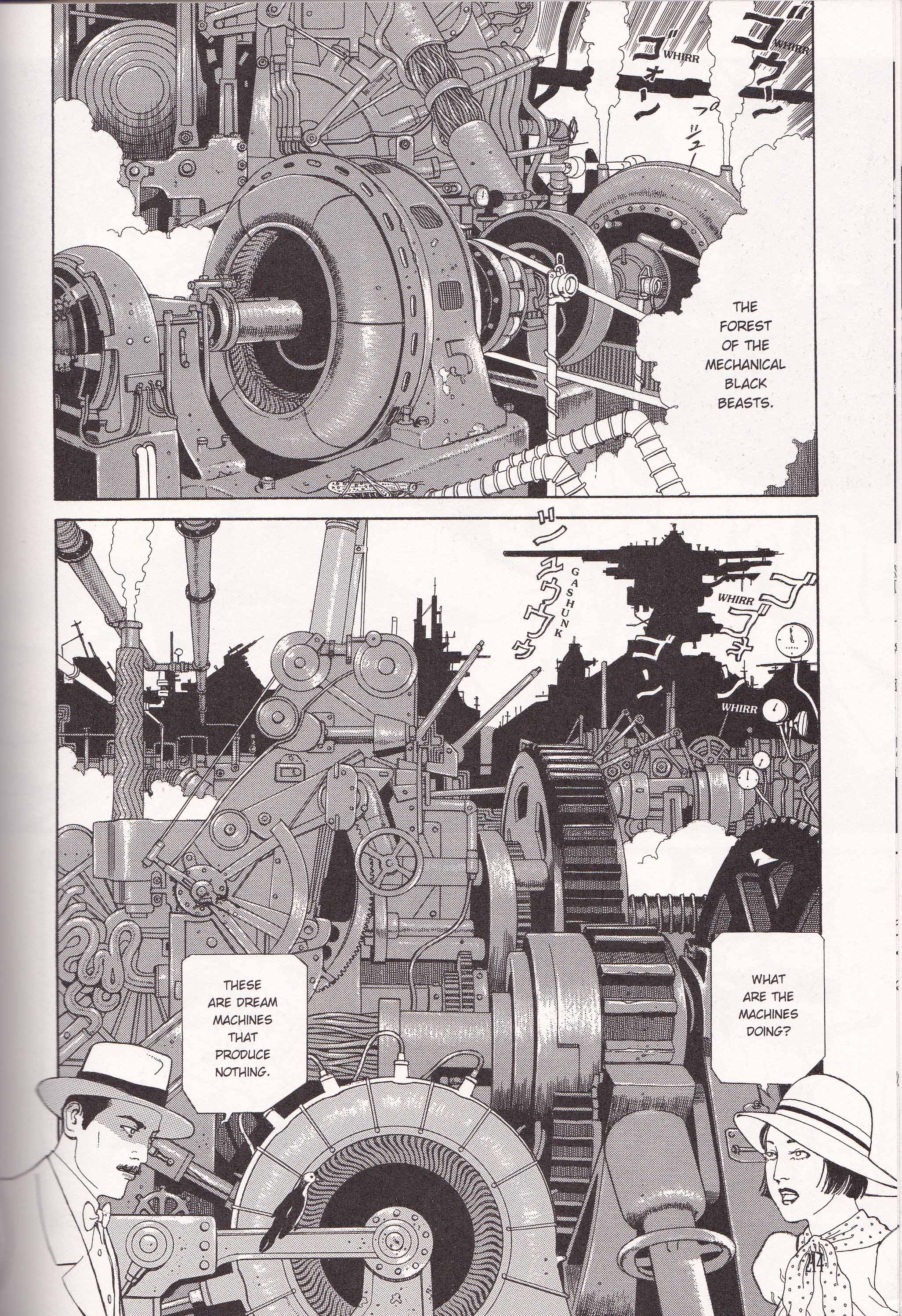
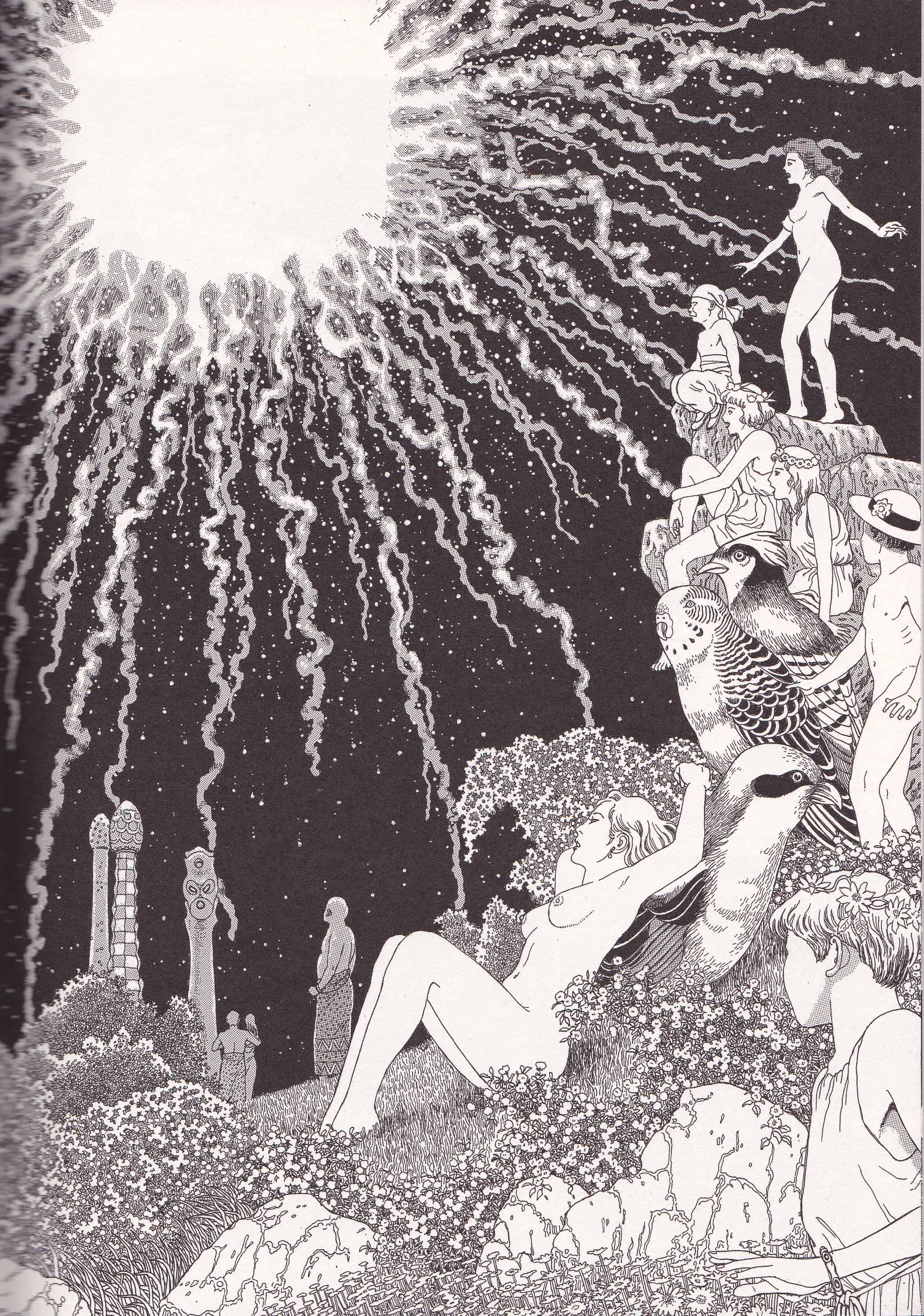
Maruo transcribes both the mechanistic fantasies—the “dream machines that produce nothing”—and the Manchurian wonderland ripe for harvesting in the climax of the manga. It is in such scenes that the comic excels, making tangible the half imagined; not only placing Hirosuke in the banal depravity of a prostitute’s den and the rigid conformity and poverty of early 20th century Japan but opening our eyes to the unbridled fantasies of capitalistic excess.

If the protagonist (in the novel) had once declared an admiration for William Morris’ socialist utopia, then these feelings have been utterly suppressed by rampant greed and an egoistic gluttony. The novella is littered with instances of Hirosuke’s hypocrisy, on the one hand suggesting a preference for Morris’ socialist News from Nowhere and then dismissing the young peasants who discover him in his feigned helplessness (i.e. as a recently “resurrected” Komoda) as a bunch of foolish simpletons:

“He became aware that he was being stared at like some unusual sideshow attraction by sniveling, runny-nosed children with peasant faces, and as he visualized the comical scene, he grew all the more anxious and angry…He couldn’t help despairing. He couldn’t very well get up and scold them…The whole thing seemed so stupid that he felt like dropping everything and getting up in front of the children and exploding in laughter.”

A situation played for humor and irony since he very nearly comes from the same stock and is inserting himself into the highest level of Japanese society

One would expect the sybaritism and licentiousness of Ranpo’s tale to be of primary interest to Maruo and this is very much the case. While Maruo excises Ranpo’s improbable image of the happy couple straddling naked servants in the guise of swans, their thighs chaffing against naked flesh as they navigate a man-made river (perhaps this was considered too fantastic), he is altogether more relentless in depicting Hirosuke’s panorama of nudity and libido.

In the manga, sex becomes an indelible counterpart to artistic intent from the outset, in fact it becomes a presentiment of death (note the Death’s-head Hawkmoth beside the prostitute in the image below). Hirosuke’s dalliances with prostitutes precede an encounter with Genzaburo’s wife whom he fixates on.  He seems almost struck with lust at the sight of her and almost immediately put his plan of deception into action. This scene doesn’t occur anywhere in the novella. Where Ranpo posits artistic desire and greed as the primary motives, Maruo suggest base sexual appetite as an equal accomplice.

Panorama Island_0001

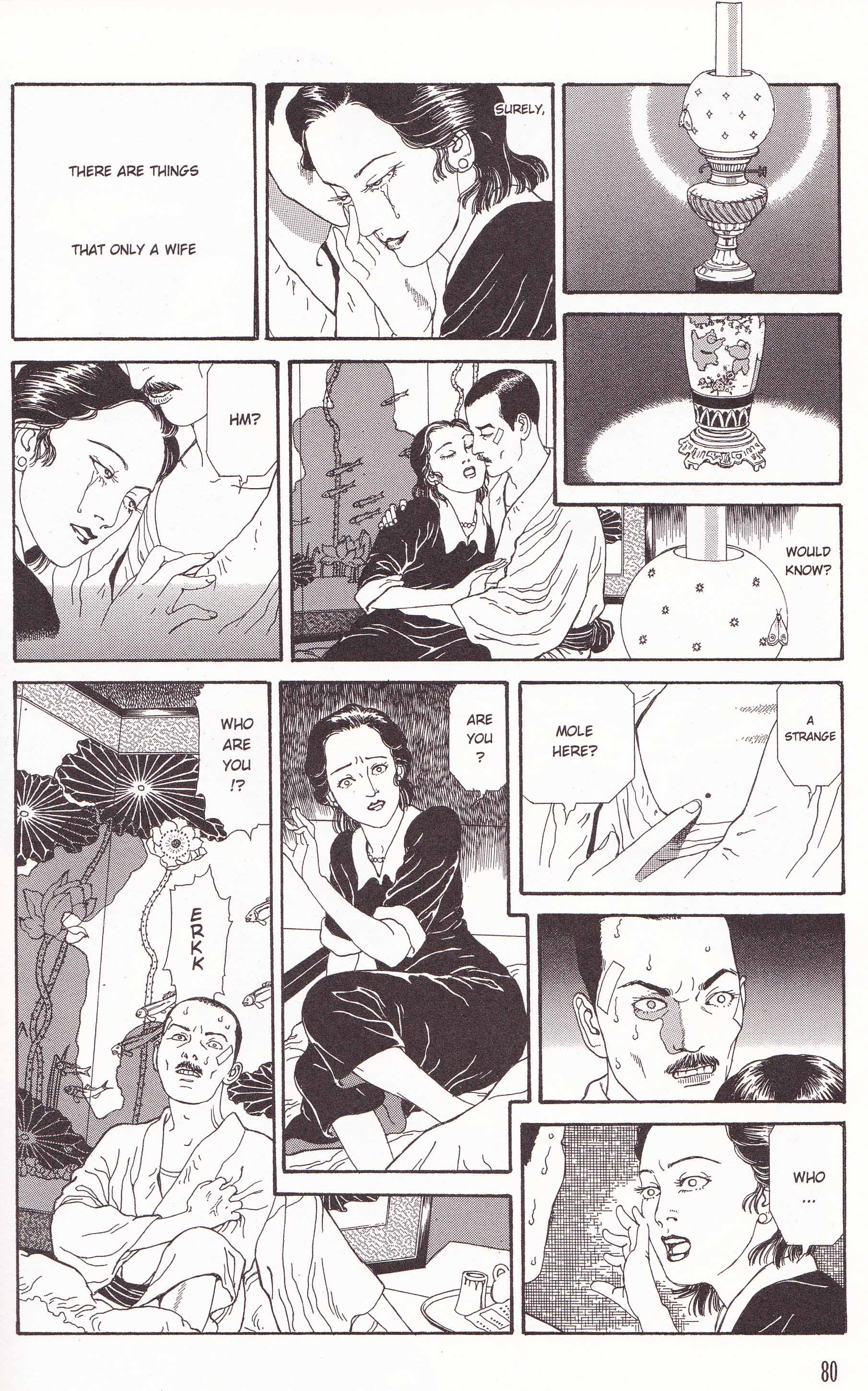
What lies under the surface of Ranpo’s novella is given physical form in the manga. The protagonist of Maruo’s adaptation is vigorous and voracious in his relations with his wife, hardly fearing discovery (and that is exactly what happens in their first encounter):Panorama Island_0003Ranpo’s Hirosuke, in contrast, is characterized by a calculated celibacy, an enforced impotence—a manifestation of his artistic obsession. He abstains absolutely from his wife, ostensibly to avoid detection during intimate contact but inadvertently reveals himself in some unknown way during a drunken stupor. Some bodily deformity or defect of a more sexual nature finally reveals him as an impostor to Chiyoko. The passage in question is left intentionally ambiguous by the author:

“Just seeing her eyes, he understood everything. A distinctive part of his body had been different from the dead Genzaburo’s, and Chiyoko had discovered it the night before.”

Whether this is as simple as Maruo’s mole (see image above) or something of a more sexual nature is anyone’s guess. When Hirosuke finally strangles his wife under an orgasm of thunderous fireworks, it seems almost like a case of erotic asphyxiation. He buries her in an unfinished black pillar (in the novella)—a rather heavy handed symbol of his sexual inadequacy—pouring wet cement over her corpse but leaving tell-tale strands of her hair sticking out of the final stiffened mix. This inescapable, almost fatalistic, sloppiness is the final evidence needed for his exposure as a fake and a murderer.

If Poe’s (of whom Ranpo was a great admirer) taphephobia is counterintuitively a longing for the womb, then Hirosuke’s escape from the tomb is the obverse of this situation—a desire for release from sexual repression and the attainment of romantic gratification. Chiyoko is the stye in his eye which once removed results in unbridled carnality.

Panorama Island_0015

Comics as a form has a way of making obvious the carefully hidden aspects of pure prose but Maruo exacerbates this aspect by insistently giving play to Hirosuke’s licentious feelings and actions. One should also consider the demands on visual imagery in modern day horror fantasies; more precisely, an upping of the ante with each passing year. The prose work is characterized by gruesome detail at precise moments, especially where Ranpo dwells in loving detail on the disinterment of the deceased Komoda which the protagonist plans to impersonate:

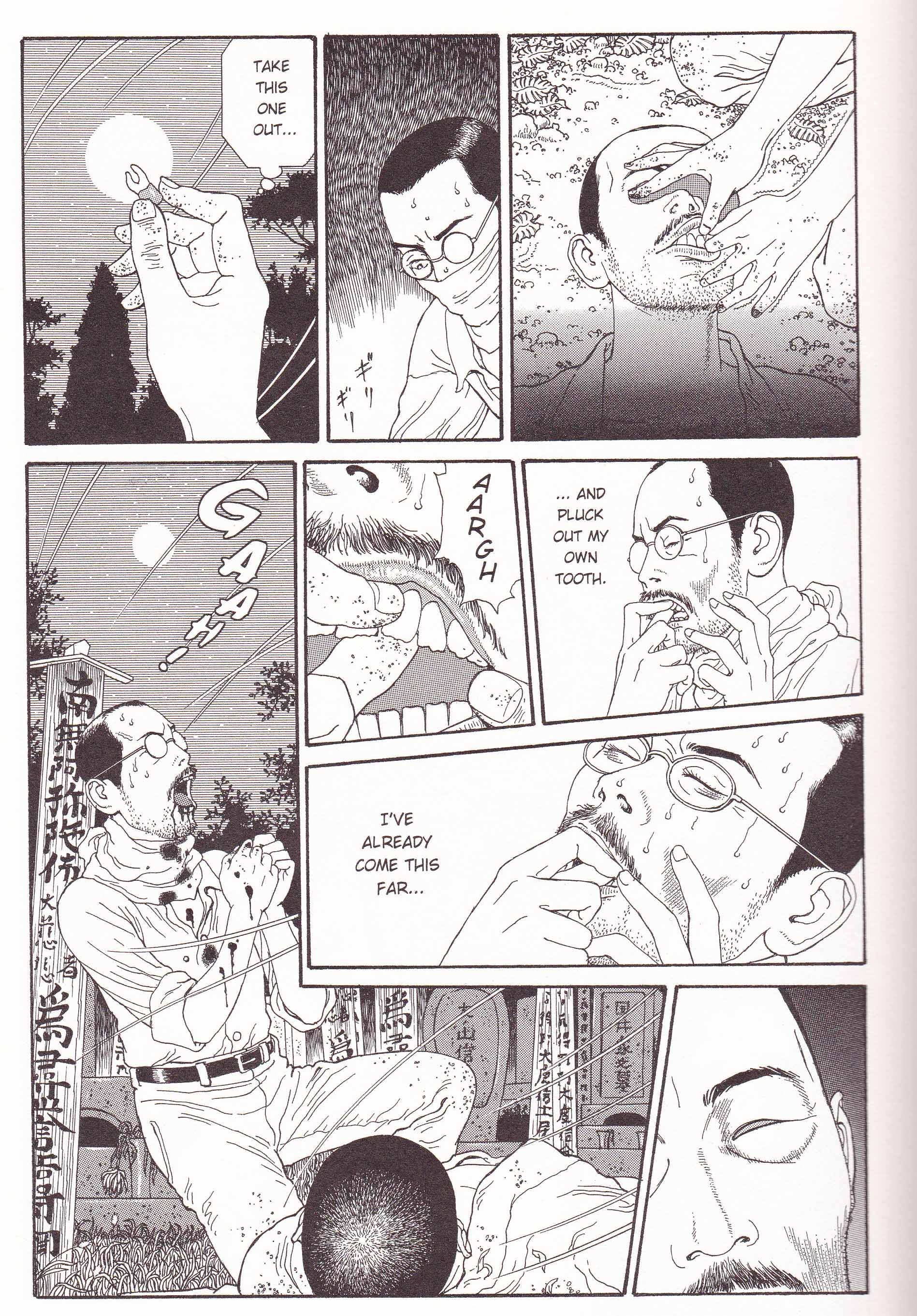
“Strangely, he realized that Komoda’s mouth was stretched to a size of ten times larger than it had been while he was still alive. It was open to the point where the back teeth were completely exposed as in the mask of an open-mouthed female demon…[ ]…Although he tried, again and again, to lift Komoda’s decomposing body, it slipped off his fingers each time…When he finished the job, the fine skin of the dead body clung tightly to the palms of his hands, like gloves made of jellyfish, and wouldn’t come off no matter how vigorously he shook his hands.”

Here Hirosuke’s encasement in the decaying skin becomes a metaphor for his own duplicity which soon takes on the decomposition of a rotting carcass. Yet Maruo eschews this, instead presenting readers with an even more violent and  improbable episode where he extracts his own incisor with his fingers to mimic the dead Komoda.

Panorama Island_0002

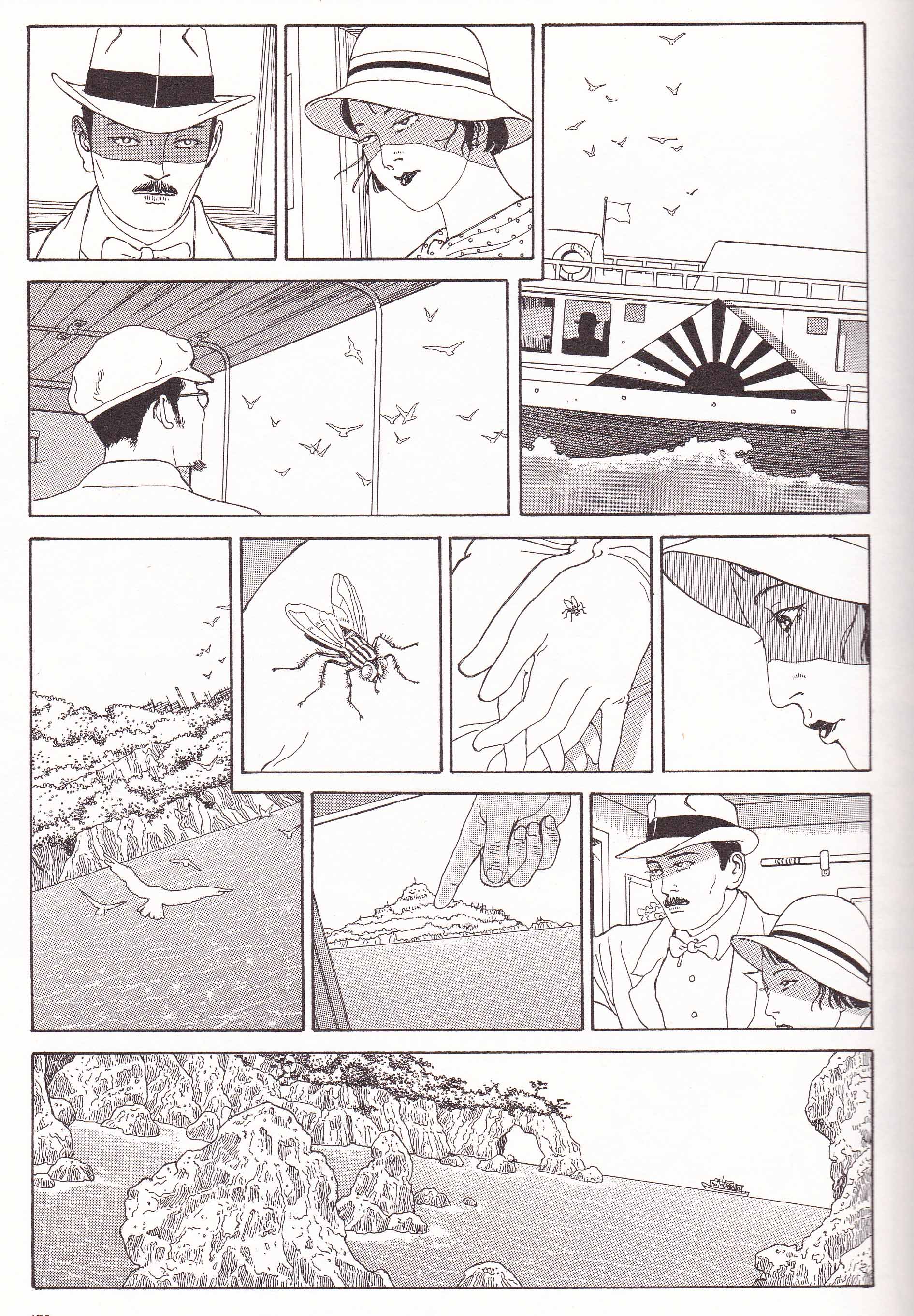
This is not to say that the manga is without moments of insight, subtlety, and interpretation. The glorious spectacles which Maruo reimagines and illustrates towards the close of his comic represent a high point in his cultivated debauchery. At a deeper and more sophisticated level, as the couple travel to the island, Maruo presents his readers with a scene which does not appear in the novella:

Panorama Island_0007

A Japanese battle flag is painted on the side of the steamer, and a fly occupies the center of the page. The latter is a note of corruption and a presentiment of the heroine’s death. It is also silent commentary on the direction the Japanese nation soon will take in its search for power, resources, and hegemony. In this Maruo adds an additional layer of meaning to Ranpo’s text, one gleaned from the passage of several decades since the book’s publication; decades  filled with horrors perpetrated and suffered by the Japanese state. He forces a comparison between the pure and beautiful Chiyoko (that essential soul of the Japanese people) and her final fate at the hands of a madman.

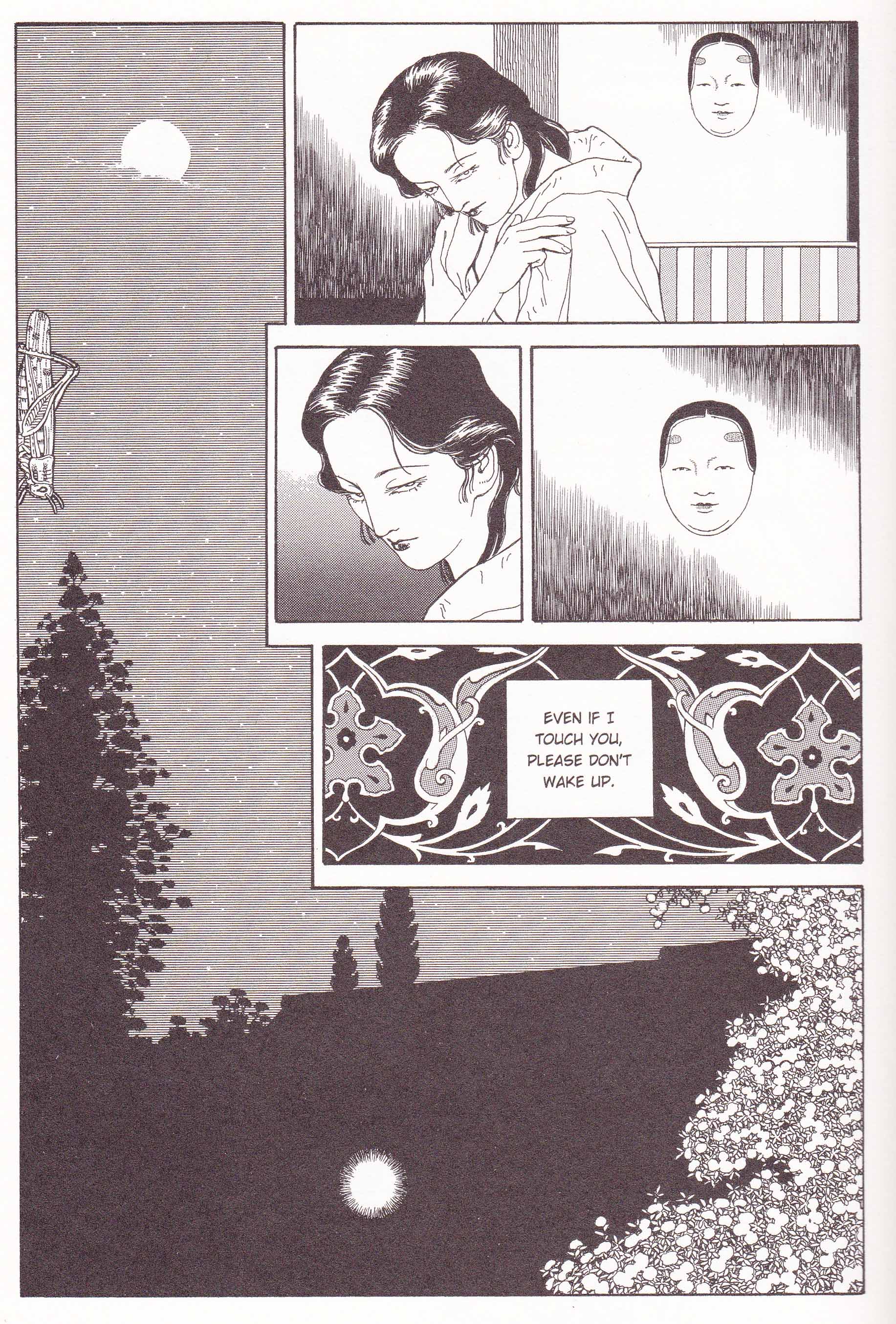
Where Ranpo spends several paragraphs describing the push and pull of Hirosuke’s obsession with Chiyoko, Maruo allows the persistent image of a Noh mask (depicting a young woman) to haunt him throughout the palatial surroundings of his new home—both a proxy for the visage of Chiyoko and an echo of the body he has disinterred

Panorama Island_0004

This is encapsulated in an exquisite page where Chiyoko first looks weary and frustrated, and then, with barely bridled longing, out at the reader (just like the subtle head positioning of a Noh actor; see above). A silent cicada crawls down the edge of the frame—both a sign of resurrection and of impending sexual ecstasy.

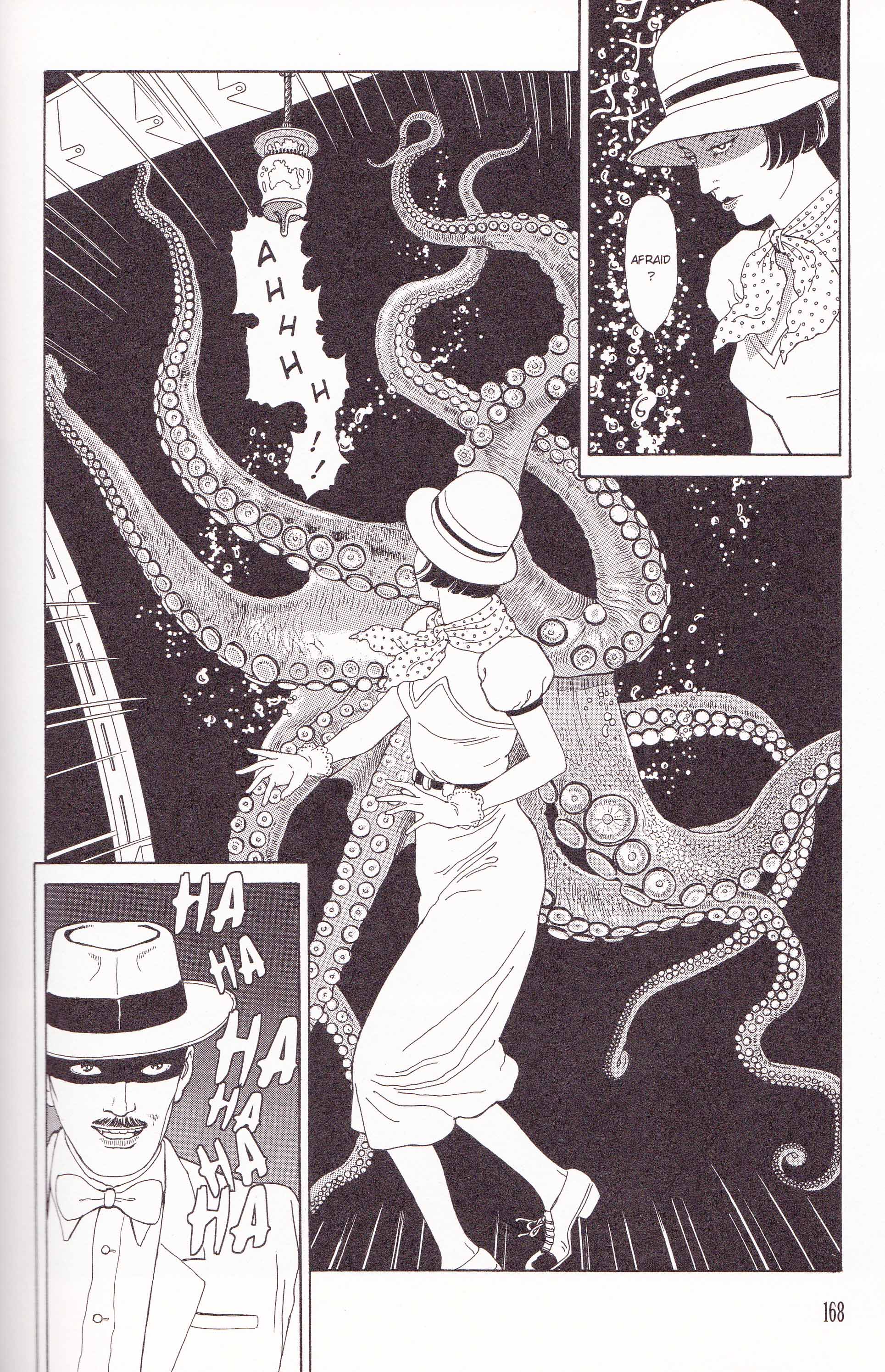
Throughout her tour of Panorama Island, Chiyoko is at once attracted, repulsed, and seduced by all that she sees. She is of no stable state of mind. A critical point in the book is reached when Chiyoko sees a monster “plowing its way through the bubbles” towards her position in an undersea tunnel.

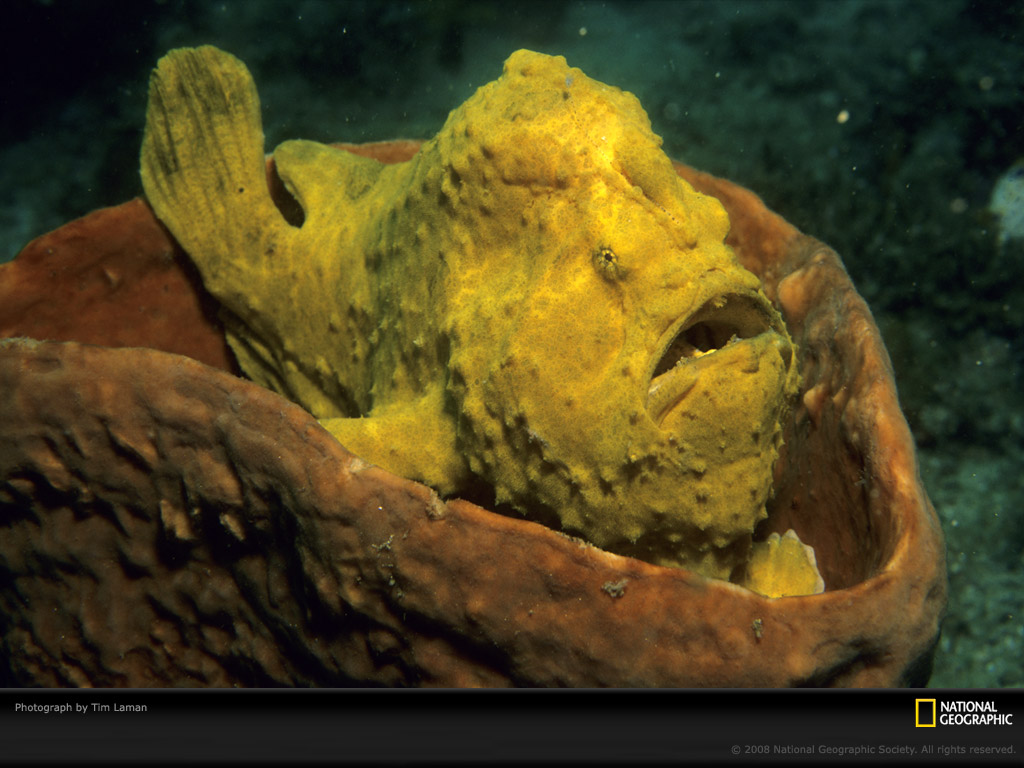
“She felt as if she were being pulled by a magnet. She didn’t have the strength to move away…it looked as if the monster was all head. Its mouth opened just above its short legs, and its small eyes resembling those of an elephant adjoined the protuberances on its back. Its rough and uneven skin was covered with a multitude of bumps topped by ugly black spots.”

frogfish

It turns out to be nothing more than a “frogfish”  magnified through the glass of the tunnel.  The monster is the outward expression of Hirosuke’s soul, kept hidden for fear of discovery by his friends and relatives—a natural manifestation of the protagonist’s perfidious character. Chiyoko’s immediate revulsion and then attraction to the sight of this twisted shape is the irresistible yet fatal call of the abyss of technological accomplishment.

This section of the novella is altered in Maruo’s adaptation—no longer stressing the personal excrescence of the protagonist but giving us a tentacled monster with Chiyoko at its heart, perhaps even covering its vaginal maw.

Panorama Island_0008

Where Ranpo’s work alludes to a personal and artistic failing, Maruo highlights the contamination brought forth by modernity.

All this suggests that the correct approach to The Strange Tale of Panorama Island would be to first read the manga and then the novel which in many ways is more lurid and certainly more cerebral. In this it reminds me of Fritz Lang’s The Ministry of Fear which while enjoyable in itself suffers from a lack of logical progression and, ultimately, depth of meaning when compared to the Graham Greene novel of which it is an adaptation. The forms and settings of Panorama Island take shape with Maruo’s pictorial representations, sometimes sticking in the mind with their magnificent flourishes, at other times losing in translation that prescient, alluring, and terrible picture of a nation falling into the inferno.

Panorama Island_0011

Further Reading

A review by Sam Costello at Full Stop.

“Maruo’s artistry also allows him to provocatively expand on the original novel’s themes of developing modernity. For instance, Chiyoko’s distress stems from a distinctly modern problem: the sense of being too observed. Eyes are a visual motif throughout the book…As Hirosuke and Chiyoko enter the island via a clear undersea tube, Maruo arranges tiny fish to appear like sets of eyes lurking in the dark water. Later, the giant feathers of a peacock are dotted with eyes. The island is thick with statues, all of which seem to leer at Chiyoko. In our YouTube age, being seen isn’t shocking — judging by reality TV and social media, not being seen is more terrifying — but when motion pictures were just 30 years old and photography barely more than 50, it’s easy to understand feeling queasy and disturbed at the revelation of this panopticon. Chiyoko seems particularly unsettled because she isn’t the viewer; instead, she’s part of the panorama, forced into playing a dehumanized role similar to a statue.

Maruo’s work also derives strength from its visual nature when illustrating the tension between modernity and tradition that the panorama — both the exhibit and the island of the story — embodies. For instance, in more than one scene, 30-something Hirosuke wears a modern suit while negotiating business deals with kimono-clad, middle-aged men. This costuming choice more effectively conveys, in just a few panels, the liminal state of the 1920s Japan in which the story occurs than pages of description would.”