Utilitarian Review 8/6/16

Upcoming

I managed to sell 50 copies of my ebook on Fecund Horror in my first month. I promised if that happened I’d watch It Follows and write about it…which is what I’m planning to do on Monday. So watch for that over on Patreon (it’ll be free.)

I also need to write another vampire essay this month. Maybe on Let the Right One In?

Also, as a benefit for $10/mo subscribers, I’ve offered to let people commission essays. I’ve only had two folks take me up on it so far; so over the next month or two I’m committed to writing about Mark Millar’s comic Nemesis and the film, Dude, Where’s My Car?
 
Patreon

I posted my essay on Lair of the White Worm and obvious penises for $2/mo subscribers.

I am going to publish a book called Your Favorite Superhero Sucks probably in early September. My son drew an awesome cover for it which $1/month subscribers can see here.
 
Utilitarians Everywhere

At Playboy I wrote about the Suicide Squad and the dream that the people we imprison will love us anyway.

At Quartz I wrote about the virtues of teaching children to curse.

At Splice Today I wrote about

John Ford’s The Last Hurrah, Trump and how you can’t tell the fascism from the democracy.

two great banjo albums by Kaia Kater and Nathan Bowles.

Utilitarian Review 7/30/16

Screen Shot 2016-07-29 at 8.57.53 PM

 
News

Artist Ganzeer said nice things about my ebook Fecund Horror.

And a print version of the book is now available on Amazon.

Patreon

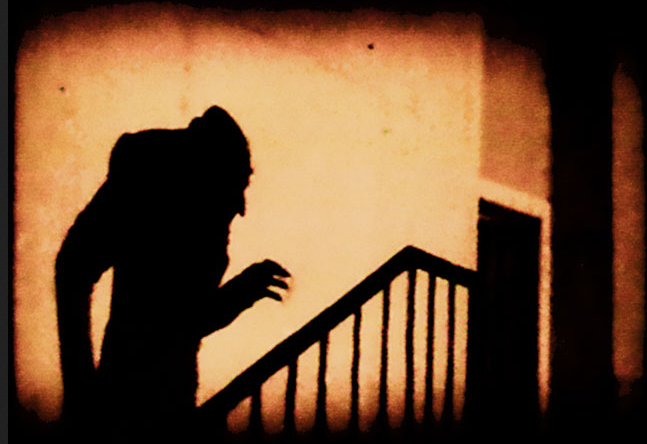
I write about the 1922 film Nosferatu and why Loki from the Avengers is a vampire. (also why he’s Jewish.)

Next week I’m going to post a piece on the wonderful 1988 film Lair of the White Worm and why obvious penises symbolize vampires, or maybe the other way around. I put up the beginning of the essay here. pledge $2/month and you’ll get the whole thing delivered to your inbox on Monday.
 
Utilitarians Everywhere

Al Fanar Media translated my article on poor academic writing into Arabic.

At the Guardian I wrote about

—the crappy new Killing Joke cartoon and the perils of updating old comics or movies.

—why violence against women is different from violence against men in pop culture. Not that it’s worse; it’s complementary.

At Quartz I talked about lessons that progressives can take from Sanders’ successes and failures.

At Splice Today I wrote about

My Son John, and why paranoid anti communism is a relief after Frank Capra.

—why concerns about desistance seem overblown (there’s a good criticism of my piece in comments on the site, so you should read that too.)
 
Other Links

Gabriel Sherman has a terrifying article about Ailes’ long history of sexual abuse.

Bridget Phetasy says sexually liberated women deserve respect.

Interesitng and nuanced interview with a woman who is detransitioning.

Utilitarian Review 7/23/16

Screen Shot 2016-07-22 at 11.23.47 PM

R.P. Boo at Pitchfork

 
News

After more than 9 years, HU is going on hiatus. Lots of nice memories of the site in comments.

And Heidi at the Beat took a moment to be a jerk in my direction one last time.
 
On HU

Featured Archive Post: Domingos Isabelinho on Geneviève Castrée, who died last week.

mouse interviews Colin Spacetwinks on the history of furry.
 
On Patreon

On Bava’s Wurdulak and devouring your own children.

On Kevin in Ghostbusters, and why it’s men need incompetent, ditzy heroes.

I listed my 12 favorite films.
 
Utilitarians Everywhere

I went to Pitchfork and reported back to the Reader on what I found:
Day One.

Day Two

Day Three

On Splice Today I wrote about

Captain America and amnesiac Nazism.

All the King’s Men and Hollywood’s post-racial populism.

The End, For Now

Hey all. I wanted to tell you that HU is going on semi-hiatus, at least for the summer, and possibly for good. We’ll see what happens, but my family is moving in the next couple months, which is taking up a lot of time. In addition, for my own writing, I’m trying to focus on developing my Patreon and on writing ebooks. I’m not sure either of those projects are ever going to be self sustaining, but I’d like to give it a fair shot—and I don’t feel like I can do that if I’m also trying to keep the blog going.

This space won’t go dark completely; I’ll continue to post the Saturday roundups every week. And I’m sure I’ll have the occasional thing I want to say that I can’t place anywhere else which will end up here. But there won’t be daily posts or guest posts, at least for a while.

The blog started back in September 2007; so it’s been going for almost 9 years now. That’s an eternity in blogging. It’s been an incredibly rewarding experience hosting HU. I’ve made many friends, had tons of great conversations, and been lucky to publish wonderful articles by smart folks on topics I never would have known about without this blog.

Despite a viral post or two over the years, HU has never been what you’d call popular, even in comics circles, and I expect it’ll pass away for the most part unremarked. It’s been an amazing experience for me, though. I never could have thought when I started it that it would last so long, or mean so much to me. So to all of you who read, or commented, or posted here, thank you.

Utilitarian Review 7/16/16

Screen Shot 2016-07-15 at 10.48.29 PM

Fecund Horror

My ebook, Fecund Horror, is out! Please consider buying a copy if you haven’t, so I can write more and then you can buy those and then I can write more, like an aesthetic ponzi scheme, but without the ethical problems.

Matthew Brady put together this great list of every movie I mention in the book, to whet your appetite.

And Phil Sandifer said nice things about the book. “I’ve been enjoying the hell out of the book, which takes the tired “trashy exploitation films have something interesting to say” angle and finds fresh new life in it, suggesting that the genre works by “looking wrong” at the world, and that this is a generative and, well, fecund angle to take. It’s a delightfully odd collection, hitting obvious things like I Spit On Your Grave and also totally weird things – the title essay culminates in an enthusiastic paen to the subversive potential of a piece of erotica about wasps that lay mind-controlling eggs in people’s brains.”

On HU

Chris Gavaler on Kirby layouts vs. Steranko layouts.

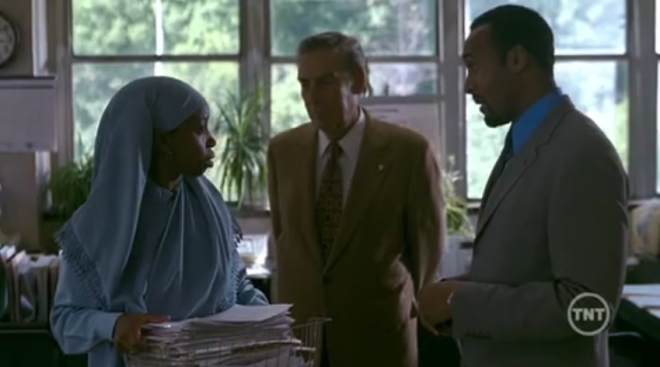
Jimmy Johnson on a Law and Order episode that doesn’t suck.

Petar Duric on Attack on Titan, Saga, and a better American war canon.
 
Utilitarians Everywhere

At Random Nerds I wrote about the joys of writing exploitaiton ebooks.

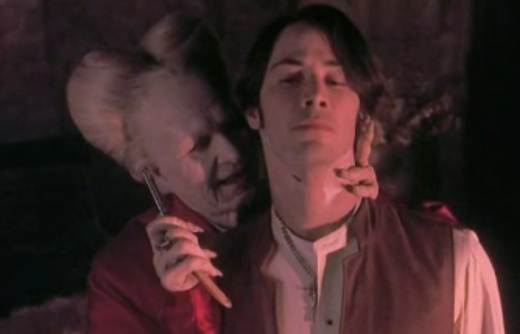
At Patreon, for $2/month subscribers I wrote about how Keanu Reeves is perfect as Jonathan Harker in Coppola’s Dracula, precisely because he is such a stiff.

At the Chronicle I wrote about why most academics will always be bad writers.

At PLayboy I argued that more black women police officers might reduce the number of police shootings.

At TNR I wrote about why police aren’t at the forefront of the gun control movement.

At the Guardian I wrote about Frank Cho, William Marston, and whether Wonder Woman should be sexy.

At Quartz I wrote about

—the sexual assault charges against both Bill Clinton and Donald Trump.

the new Ghostbusters, which is less sexist and better than the first.

At Splice Today I wrote about

— the documentary Pervert Park, and how treating sexual offenders as monsters doesn’t help victims.

the Great McGinty and the dream of unambitious politicians.

For the Chicago Reader I wrote a brief piece about the music of singer/songwriter/indie genius Mobley.
 
Other Links

This open letter about conflicts on the left over racism and sexism has been circulated a lot.

Brianna Wellen on the fact that Pitchfork doesn’t book many female-led acts.

War in Pieces

The United States has a war canon. That’s a pretty uncontroversial statement. We can even populate this canon in a trivial way by just listing off war movies. American Sniper. Eye in the Sky. Zero Dark Thirty. The Green Zone. Saving Private Ryan. And the list goes on, with movies as well as written work from Tom Clancy to James Fenimore Cooper.

But there is not a whole lot of room in that canon for movies that make the audience really uncomfortable with war. Eye in the Sky is a major exception, but even that movie depicts war as the moral backdrop against which brave soldiers prove their dedication by making the difficult, but necessary decision to risk murdering a child. You know, to keep us safe
.
Regardless, these movies, and many more, all depict war as the backdrop against which mere mortals become heroes. Almost always, they do this by demonstrating their masculine willingness to kill civilians (American Sniper, Eye in the Sky), or by demonstrating their masculine willingness to torture (Zero Dark Thirty). The Green Zone presents an exception in that Matt Damon spends the film invalidating the justification for going to war in Iraq. But it is still a story about a white guy demonstrating his heroism with the Middle East as the backdrop for his journey.

The American war canon is, therefore, largely designed to whet the audience’s appetite for war, as a system and an action. So what if you were to construct a war canon that dulled the audience’s war appetite, a war canon antithetical to the one we are saddled with now? Setting aside the fact that such war canons already exist in other nations, where would we start if we wanted to construct a new one?

I argue that the manga/anime (I discuss the anime) Attack on Titan, the comic Saga, and the webcomic Gone with the Blastwave form a solid base from which to start. Of the three, Attack on Titan is the most comprehensive and forcefully crafted, but all three depict war as a hellish landscape (metaphorically and literally) from which you escape only if you are lucky, whether you are a civilian or a combatant.
________

The anime, Attack on Titan, provides an excellent position from which to start, as it directly confronts the subjects of trauma and class during wartime, and presents a direct challenge to the American notion of heroism in war. When substantiated by, and viewed in tandem with, Saga and Gone with the Blastwave, Attack on Titan forms the solid base for a new war canon that acknowledges war as a hellish landscape from which combatants and civilians alike escape only of they are lucky.

The most stark and obvious of the three is Gone with the Blastwave, which depicts a handful of soldiers navigating their way through a city that is so drenched in radioactive fallout that the soldiers only survive because they wear full-body protective gear and gas masks that obscure any identifying features. The only way to tell them apart as they traverse a gray, rubble-covered, otherwise featureless landscape is by tiny emblems on their helmets. In this way, the environment literally created and mirrored by war itself dehumanizes those involved, stripping them of their identities and forcing them to some disgusting lows to survive.

GWTB doesn’t even ennoble this struggle for survival with a reason for the war’s perpetuation. The faceless soldiers fight a meaningless conflict against equally faceless enemies, themselves having no ideology or allegiance accept to fight and to escape. Saga achieves the same fatalistic effect by relegating the origins of a galaxy-encompassing conflict to long-lost historical memory. The war goes on because those people over there shot me, so fuck them.

In this way, Saga’s depiction is equally bleak, despite its forcefully colorful artwork. The rationale for the persistence of this galaxy-spanning war is that it has always happened. An interplanetary system of violence naturally reproduces itself through hatred and trauma, and so the only response the average citizen can muster to the question, “Why do we fight?” is, “To win the war,” followed by a fatalistic shrug, “Meh…works for me.”
 

Screen Shot 2016-07-13 at 1.20.09 PM

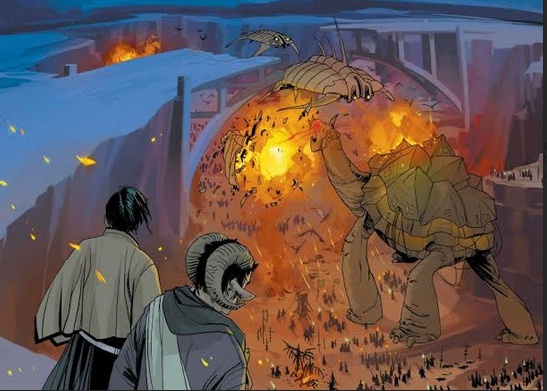
The conflict rages on, because fuck the enemy.

 
Of course, the central conceit at the heart of Saga is that two new parents from opposite sides of the conflict fall in love, and resolve to raise their child away from the war. The panel above represents the war as a literal barrier to parenthood, blocking the nascent parents’ path to safety, where they can raise their child. The whole thrust of the series is these parents, Alana and Marko, trying to escape the war, literally and figuratively, for the sake of their child. When they eventually find a safe place to settle down, away from combat, they are then faced with the demons they brought back with them. Alana is driven to narcotics in order to endure her trauma and the soul-crushing nature of the work she takes to make a living. Marko is haunted by the specter of his own history of violence, on and off the battlefield. In both cases, the parents are chased from the battlefield by demons that repeatedly threaten to endanger their family, as bodies and as a community. As their favorite author, Oswald Heist, notes in a kind and sagely voice, “In the end, nobody really escapes this thing.”

This truism makes Attack on Titan especially tragic, as the main character, Eren Jaeger, hinges his entire motivation on his desire for freedom. Eren lives in a society that is hemmed in by huge, 50-meter walls, which serve to protect the last vestiges of humanity from the Titans, bloodthirsty, man-eating giants. The Titans devour and crush humans, creating a literal embodiment for the way in which war figuratively devours and crushes humans. Eren becomes a soldier in order to slaughter the Titans and bring an end to the fear and captivity of living behind walls. He learns to use “omni-directional mobility gear,” designed with a grappling hook-and-gas power mechanism to allow humans to swing around vertical environments like Spiderman, enabling them to fight the Titans with some success. By any measure, these soldiers learn to move and fight in ways that are nigh superhuman. In the lead-up to Eren Jaeger’s first battle with the Titans, he and his fellow cadets talk trash to each other and boast about how they will beat the Titans back with ease. The bravado is so intoxicating that it is a genuine shock when Eren and his fellow cadets are almost immediately decimated by the Titans, eaten alive in a matter of minutes.

This turns out to be merely the beginning of the carnival funhouse of horrors that is the Battle of Trost District. A young woman tries to revive her clearly deceased sweetheart in the middle of an empty street. A central character wears a look of visceral shock as he stumbles around the city after watching his friends get eaten alive. A group of cadets cowers inside a building as the Titans roam outside, staring into the windows, while one calmly cleans a rifle and blows out the back of his head in front of them. And amidst all of this, vital officers and support personnel all lose the will to fight, leaving the majority of the cadets out in the cold against their monstrous adversaries. Where the arc starts with vibrant colors and blue skies, the main body of the arc paints the scenery in dull, muted grays, as the once cocky and macho cadets wear looks of fatalistic resignation. In short, this is not an environment that breeds heroes. It devours them whole.

So when one of the cadets, Jean Kirschtein, takes the lead, he makes ruthless decisions that prioritize the survival of the majority over heroism and nobility. As he watches a comrade get caught and eaten by Titans, he freezes in place, and when two more of his comrades heroically enter the fray to save the very same comrade, they get caught too. Jean can do nothing but watch his friends get devoured as he grows roots in a high place away from the Titans’ reach. That is, until he takes command and orders the remaining cadets to use the Titan feeding frenzy as a distraction in order to grapple past them to safety.

What follows is a high-octane, pell-mell sprint to safety through a mass of Titans that continue to swat and chomp Jean’s comrades, and he uses every death as an added distraction to aid his own flight and the flight of his remaining friends. Upon landing in a safe place, he kneels in shock and asks himself, “How many friend’s deaths did I use?” We never get an answer, but we do witness a later conversation between Jean and Marco Bodt, a talented and friendly comrade, who praises Jean’s ruthless decision. When Jean castigates himself for weakness, Marco says that he thinks the fact that Jean is not strong helps him appreciate how the weak feel in battle. Marco goes on to say that it is this “weakness” which led Jean to a decision that kept Marco, and many others, alive. The sweet, sensible, and affable Marco tells Jean that his outwardly ruthless and cowardly decision was actually the compassionate and brave response needed to save his friends.

But the escape that Jean engineered is only temporary and superficial. When the battle ends and the cadets are no longer in danger of outright death, they have to deal with the trauma of combat. A particularly illustrative scene shows Jean aiding in the triage and cleanup after the battle, and finding Marco’s body, cleaved in half as if by a giant maw, laid down in an isolated corner of the battlefield. Jean is visibly shaken and worn by the realization that the friend who praised his leadership and character suffered a lonely death at the hands of a monster, with no friends to aid him, or even witness his demise. It is a brutal and blunt reminder of the lingering effects of war.

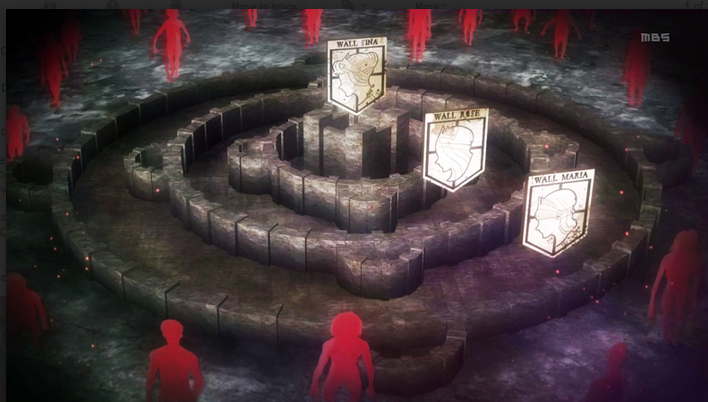
However, the war lingers much further beyond the battlefield than the triage tent. Attack on Titan extensively demonstrates the effect the war against the Titans has on society, namely the class stratification aided and abetted by the military hierarchy. One scene has a member of the landed gentry, living near the center of human territory, far away from the danger of the Titans, attempting to brow-beat a high-ranking commander, Dot Pixys, into abandoning the perimeter towns to the Titans, instead pulling his forces back to protect the noble’s lands. While this effort fails, the landed gentry, the clergy, and the merchant class nonetheless form a powerful block that clearly benefits from a stratified society, with wealth clustering in the center of human territory, and the poor scattered about the fringes. This structure is aided by the military, which depends heavily on the patronage of the merchant class for its supplies and food. Moreover, military politics threaten to squander multiple strategic opportunities to fight back against the Titans, with the military police serving the interests of the merchants and the nobility by suggesting conservative strategies, which prioritize the wealth of that class. In the midst of all this, the military is the only way for the poor to access a comfortable life in the interior, with upward mobility by other means relegated to the dustbin of utopianism.
 

Screen Shot 2016-07-13 at 1.31.35 PM

Guess where all the rich people live.

 
Brian K. Vaughan and Fiona Staples depict essentially the same scenario in Saga, except it is less symbolic and more concrete. Vaughan’s narrator, Hazel, goes on a lengthy aside to discuss the society in which her mother grew up, saying about military recruits, “Many of those who answered this call [for military service] did so out of a genuine sense of duty. Others were merely looking for adventure. Some were trying to escape a bad situation. Almost all of them were poor as shit.” When a poor man named Dengo kidnaps a royal heir of the Robot Kingdom, an ally of one of the warring sides, an intelligence operative tells the Prince that is the heir’s father, “If you’re lucky, he’s hiding. If you’re not, he’s trying to start a revolution. And trust me, that’s the last thing you poor bastards want. The whole point of having enemies abroad is getting to ignore the ones back home.” In these cases, and in Attack on Titan, constant warfare plays cover for class stratification, and the military serves to weaponize the poor against a foreign enemy in the interests of the political class and the wealthy.

Which brings us back to the original point of this piece, that being why these three works could form a fruitful basis for a new American war canon (in spite of the fact that two of the three works were not originally made by Americans). Saga and Attack on Titan both depict societies dominated and consumed by warfare, and GWTB mirrors this by crafting war into a literal, toxic environment against which the protagonists set themselves. In all three cases, the protagonists’ main concern and goal is survival, in the short and long term, actions can be judged as heroic only against that goal. In other words, all three works depict their protagonists struggling concretely and in the abstract against a totalizing militaristic system that presents itself as the main obstacle to their own safety and happiness. As Eren notes in a conversation with Dot Pixys, humankind has a common enemy in the Titans, and yet they still squabble over property and class. Ozymandias’ alien tentacle monster has descended from the sky, and humankind has decided to carry on as usual.

In all three works, participation in the war machine is a Pyrrhic venture at best, and a Sisyphean one at worst. In all three, the protagonists struggle against the totalizing militaristic system in which they live, as much as they do against, “the enemy”. Most importantly, in stark opposition to the predominant American war canon, all three aggressively ask the question, “Why do we fight?” and force the audience to acknowledge the unsettling, blindingly obvious answer, “I don’t know.”


That Time Law & Order Kinda Got It Right

This post first appeared on cico3.
______
 
Law & Order ran a simple formula. Roughly the first half of each episode followed a police investigation (order) while the latter half followed a prosecution (law). One frequent addition to this formula was adding in “ripped from the headlines” stories. This ensured that topical politics were commonly part of the franchise though normally covered only superficially and from a center-right perspective. Yet on occasion Law & Order put out an episode that really captures something sharp, perhaps unintentionally. One such episode is “Burn Baby Burn” which aired on 22 September 2000 and examines an ex-Black Panther who kills a cop in self defense.

“Burn Baby Burn” builds on public sentiment after the NYPD murder of Amadou Diallo in 1999 and acquittal of the cops who killed him earlier in 2000, followed by the NYPD killing ten more people, mostly Black and most notoriously Patrick Dorismond, prior to the episode’s airing. But the headline that most guided the episode was the killing of two cops in Georgia for which former Student Nonviolent Coordinating Committee leader and Black Panther Jamil Al-Amin (formerly H. Rap Brown) was arrested and later convicted.

The episode opens with two young Black men finding a white cop shot dead in a hallway outside an apartment. The cop had accidentally gone to the wrong address as part of following up with a witness. Detectives Ed Green (Jesse L. Martin) and Lenny Briscoe (Jerry Orbach) arrive on scene to investigate. The apartment is rented to Selina Watts (Sandra Daley). Watts is a Black Muslim woman who works at an anti-eviction group in Harlem led by Lateef Miller (Clarence Williams III), an ex-Black Panther. Miller is suspected to be the shooter and is taken into police custody by Green at a mosque in Harlem after Friday prayers.

selina watts

Green and Briscoe question Selina Watts

Miller and his lawyer Leon Chiles (Joe Morton) initially focus on how the police in general and the NYPD and dead officer specifically are racist, and hint they might be framing Miller (this is never explicitly accused). After Green and Briscoe find evidence linking Miller to the site of the shooting, Miller and Chiles switch tactics and present an affirmative defense where Miller killed the cop in self defense. They contextualize this in a long history of racist policing. In response Assistant District Attorney Jack McCoy (Sam Waterson) presents Miller as long advocating the killing of police and attributes the shooting to Miller’s supposed prejudice against white people. The jury finds Miller’s claim of self-defense convincing and acquits him of the murder charge.

The improbability of the result notwithstanding, this is an interesting and quite good Law & Order episode. Much of the time Black liberation and civil rights activists on the various Law & Order shows are portrayed as cartoonish hucksters, people interested in self-promotion whose advocacy for rights and liberation is at least in part disingenuous. “Burn Baby Burn” does not do this. The closest it comes to sloppy white caricatures of Black liberation is in an early scene right after Miller is arrested where he appears in court and shouts that because he is a political prisoner, the Geneva Conventions do not allow for the hearing. Either the writers did not know what the Geneva Conventions are or they wanted Miller to appear nonsensical. Miller’s quiet, measured narration (from Williams III’s truly terrific performance) throughout the rest of episode show the initial courtroom performance to be unrepresentative in a throw-away scene.

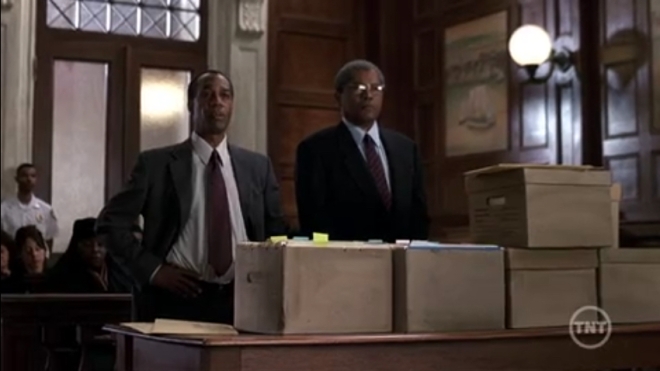
The episode lays out Black grievances against racist policing in depth exceedingly uncommon on Law & Order or any other police show, The Wire notwithstanding. After Miller and Chiles switch to the affirmative defense the judge holds a hearing to consider their request to introduce new evidence of the history of police racism. Miller and Chiles are shown partially obscured by many large boxes representing the evidence. The scene begins with the following exchange:

Judge: What evidence are you seeking to admit Mr. Chiles?

Chiles: Evidence of police violence against African-Americans: Abner Louima, the Amadou Diallo murder–

Assistant District Attorney Abbie Carmichael (Angie Harmon): The police in that case were acquitted.

Chiles: Heh. Not in my client’s neighborhood. The Michael Stewart murder, Eleanor Bumpurs, Rodney King in LA, the Fred Hampton assassination in Oakland [sic].

affirmative defense

Chiles and Miller behind boxes of evidence of racist police brutality

Cop shows simply do not offer long, historical contexts for police racism. Just as importantly, the episode offers this alongside unambiguous portrayals of police racism and police brutality against Black people. In one example, a white cop points his gun at an older Black bartender and shouts, “If you’re lying to us I’m gonna kick your Black ass!” Det. Green confronts the cop outside afterwards.
 

Cop: Oh aren’t you a big shot? What are you playing Al Sharpton in front of the brothers?

Green: Hey man I’ll take you anytime. Anywhere.

Cop: Oh like we don’t know who’ll wind up all jammed up outta that. Certainly not the brother.

Green: You say ‘brother’ like that one more time and I swear to god I’mma stomp your ass into the pavement! [Emphases in original]

racist cop

Cop threatens an elderly Black bartender

This is also perhaps the best character episode for Green. In the exchange above Green has demonstrably justified rage as a Black man against racism, something uncommon in cop shows. He later tells Lt. Van Buren (S. Epatha Merkerson) that, “Lateef’s like a living legend, you know what that makes me.” Green is referring to what James Baldwin described in his 1967 essay, “Negroes Are Anti-semitic Because They’re Anti-white.” Baldwin writes, “We did not feel that the cops were protecting us, for we knew too much about the reasons for the kinds of crimes committed in the ghetto; but we feared black cops even more than white cops, because the black cop had to work so much harder–on your head–to prove to himself and his colleagues that he was not like all the other niggers.” Van Buren assures him, “Oh I know you’re not buying that.” Green kind of shrugs, as if he’s partially thinks this is true. Later in the episode this idea comes back when, after the initial case is not going well for the prosecution, Green says, “I didn’t come all this way to let this guy go.” The episode’s context suggests that “all this way” refers to Green working semiconsciously towards racist ends. Green is caught between being a Black man who would be targeted by the police as part of the general criminalization of Black people and being a cop, a position that does the targeting. This is true in all of Green’s episodes but it is virtually never acknowledged, much less explored.

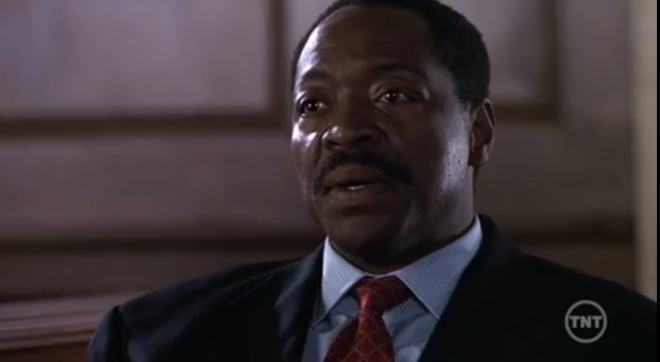
One of the episode’s most powerful segments comes during Chiles’ questioning and then McCoy’s cross examination of Miller’s former Panther colleague Rolando August (Chuck Cooper). August lays out the history of police violence against the Panthers noting everything from surveillance to infiltration to disinformation to harassment to murder.

Chiles: What impact did these events have on you.

August: They left me pretty cynical about the police.

Chiles: Even after thirty years?

August: Not much has changed. You recruit a bunch of white, high school kids from up in New Paltz to come down and keep order in the hood. That’s how you end up with forty-one shots in some poor Black guy coming home from work.

McCoy tries to isolate Miller by asking why August had not been in touch with him in recent years.

McCoy: “Was that because you no longer wanted to associate with a person who was still committed to violence?”

August: “I promise you sir, his fear of cops is my fear of cops. And his anger is my anger. Every time a police siren pulls up behind me I still get a feeling in my gut they’re gonna pull over, and mess with me!”

McCoy: “Does that mean you could see yourself shooting a cop who came to your door?”

August: “It means I’m tired of being messed with.”

rolando august

August tells McCoy he’s “tired of being messed with.”

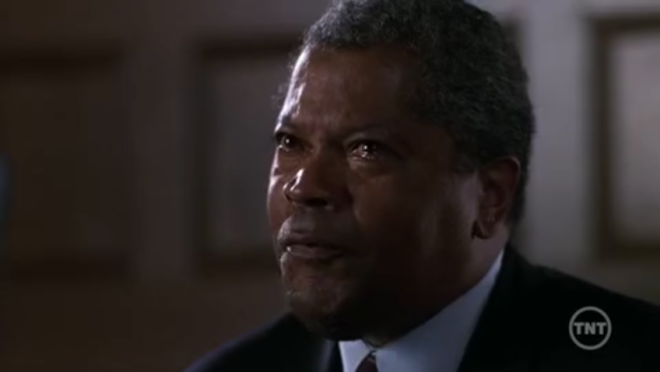
Miller testifies to Chiles about the circumstances of the killing. McCoy’s cross examination consists mostly of gaslighting Miller. Miller asserts that he could see racism in the cop’s eyes and McCoy accuses Miller of something akin to that famous unicorn ‘reverse racism’. Miller, in tears, responds shouting, “It’s my life’s experience!”

lateef miller

Miller is cross examined by McCoy

Chiles then begins his closing argument.

I think you have a very good picture of what the world looks like to Lateef Miller; a man whose suspicions of the police were nurtured by the racism that existed and still exists in this country. A worldview shaped by the political foment of the sixties and then crystallized by current events; a never-ending list of African-Americans that have been attacked or murdered by white police officers.

The jury turns in its vote to acquit. Afterwards, McCoy chats with District Attorney Nora Lewin (Dianne Wiest).

Lewin: Don’t beat yourself up too badly over this one Jack.

McCoy: A guy shoots a New York City police officer in the line of duty and I can’t convict him.

Lewin: Enough of the jury identified with his fear of cops.

McCoy: Used to be fear of cops didn’t justify shooting them.

Lewin: Used to be a lot of things.

It’s worth noting again how uncommon all this is on U.S. television. I suspect the writers still intended to portray this as someone getting away with a murder they should not have. And the show still privileges the points of view of the police and prosecutors. Yet the episode offers context enough for any reasonable people to conclude, “Yes, he was right to be, as a Black person, afraid for his life from the police.” Lewin in the middle of the episode said that Chiles and Miller were “hitching [their] wagon to the anti-police sentiment in the city.” And the episode amply laid out the reasons for that sentiment.

The episode aired to over 18 million viewers initially, this during NYC Mayor Rudy Giuliani’s reign of “broken windows” policing that was much lauded in the local and national media even with the temporarily increased scrutiny that came with Diallo’s murder. In today’s environment with an audience (including white people) significantly more skeptical of prisons and racist policing, thanks mostly to prison abolition groups and authors and more recently the #Blacklivesmatter movement, this episode might read differently than it did at the time. It might read more like it would have in 1968. Miller, a fictional ex-Black Panther, successfully used self-defense to justify his killing of the cop and this is presented alongside descriptions, portrayals and critiques of racist policing. This invokes the Black Panther Party itself which was, after all, originally called The Black Panther Party for Self Defense.