Laughter can topple tyrants. Or it’s nice to think so anyway. When the little child guffaws at the naked emperor, we like to believe that said emperor will blush, admit the error of his ways, and put some pants on, rather than, say, hanging the child from the nearest lamppost and covering his own royal unmentionables by bathing in the blood of anyone in the surrounding throng who happened to utter a sympathetic giggle. When John Stewart gets off a particularly pointed jibe, we like to think it matters to somebody, rather than that it’s just going on to dissipate affectlessly into the virtual ether. Philosopher Simon Critchley may say, “I…want to claim what goes on in humour is a form of liberation or elevation that expresses something essential to the humanity of the human being,” but in that initial nervous “I…want to claim,” and in the over-enthusiastic resort to italics he reveals, perhaps that this statement is as much hope as certainty. He adds, “By laughing at power, we expose its contingency”…and then, with fetching inevitability, he starts to talk about the emperor’s new clothes, that parable for skeptics which we are, of all parables, not to take skeptically. [Critchley 47-48]
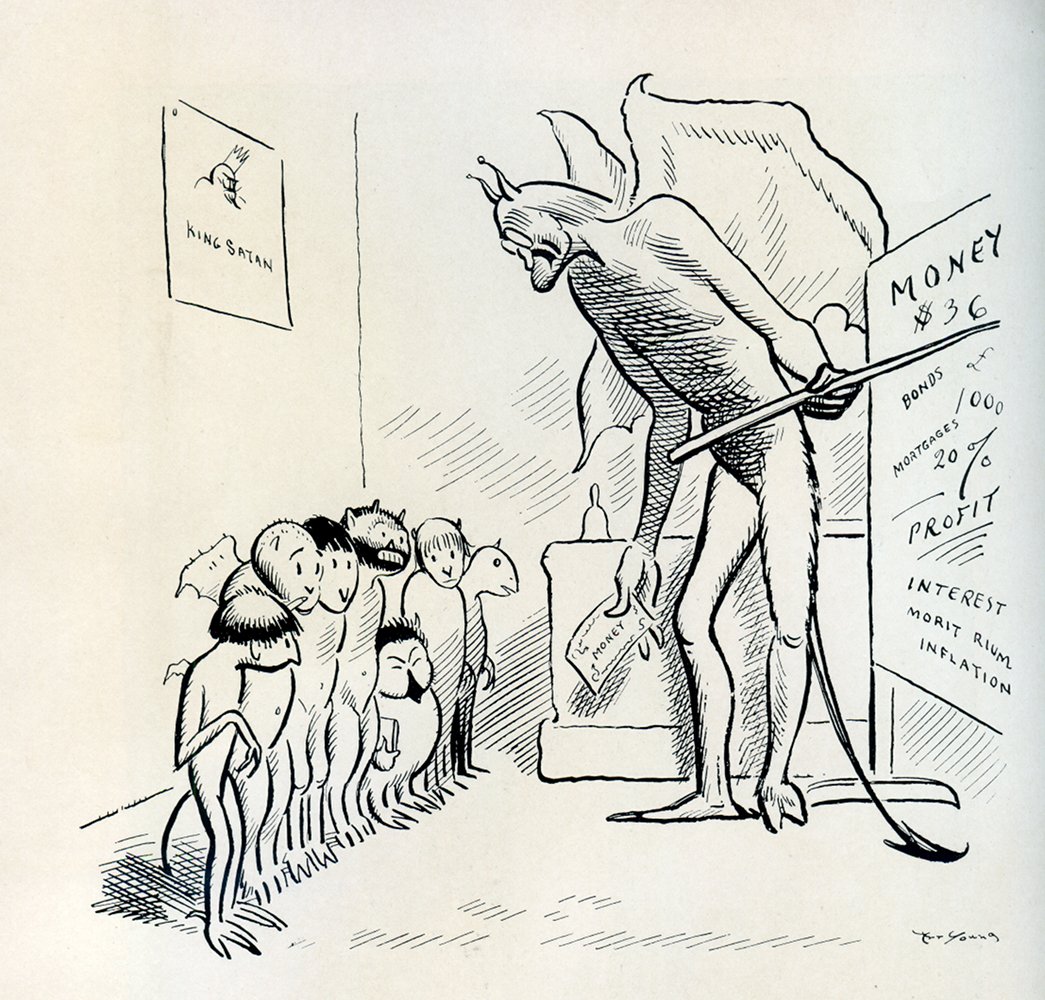
Art Young’s Inferno certainly participates in the hope that the jester might threaten the Khanate. Inspired semi-ironically by Dante and Doré, The Inferno is a description of Young’s journey through Hell, circa 1934. This was actually Young’s third book exploring the pit: the first two were Hell Up To Date from 1892; the second, Through Hell With Hiprah Hunt, from 1901. Both of these were cheerful and non-threatening, focusing on devising witty punishments for modern sins. Unfeeling editors are consigned to red-hot wastebaskets, unattentive husbands are dressed in drag, hobos are forced to bathe, and justice is more or less inoffensively dispensed.
In 1906, however, Young became a convert to socialism. The Inferno, written during the Great Depression, is, then, not a light-hearted fantasy about a just universe, but rather a Marxist panegyric, which explicitly uses its humor to castigate the status quo. As I wrote in a 2006 article for The Comics Journal:
Young reports that “Big Business organizers and Bankers” had been going to Hell in such numbers that they had managed to take over. Satan retains a ceremonial role, but the real power is now vested in an All-Hell Congress controlled by business interests. The new overlords have no interest in punishing the unjust; rather they want to “make money out of Hell.” To this purpose, they establish schools which are “operated like factories to produce standard size thought” and hospitals to which “poor sinners are sometimes grudgingly admitted.” The sophisticated Hellions have even, Young notes, “learned to use the word ‘sorry.’ A gentlemanly Hellion tears out the heart of his brother, spits on it and says, ‘I’m sorry.’” [Berlatsky 133]