When I think of Gilbert Hernandez, I don’t exactly think of lusty, go for broke cartooning. What he does do is write these potboiler scripts where the characters are put through the wringer. It’s more for the service of the storyline that for the sake of unleashing the id. And yeah, like I said, he does experiment quite a bit but the final results are quite often mixed. It usually feels quite dry to me. For me, real unrestrained cartooning would be from the likes of Crumb, Gary Panter, a lot of the Zap Comix guys, Fletcher Hanks, Jack Cole, Kirby. That said, though, I did like his surreal story from last year’s Love & Rockets #2, probably the only experimental piece of his I’ve ever liked.
Nonetheless, you make the same mistake as Daryl when you object to his work being judged to the same standards as literary novels. He’s been making literary novels for twenty five years. And the results have been no better than mixed.
We’re coming to the end of our multi-week roundtable on Charles Hatfield’s book Alternative Comics. Yesterday, Charles wrote a post defending Gilbert Hernandez from…well, mostly from me and Robert Stanley Martin. In this post I’m going to try to clarify my position somewhat, and also try to tie this discussion into why I thought it was a good idea to do this roundtable in the first place.
_______________________
Charles spends much of his post defending Hernandez’s use of fetish and pin-up imagery. He says:
I’m not going to argue that Gilbert’s above or beyond the pinup. Essentially I’m arguing here that Hernandez approaches self-parody, that the aesthetics of that passage, indeed of Poison River as a whole, are baroque, self-reflexive, and frankly decadent (in several senses), and that what he is doing with the Maria-fetish can best be understood in terms of the book’s overall agenda. Arguments like these—that such excessive, disturbing, and arguably self-mocking elements have some value other than masturbatory or shock value—depend on the arguers’ shared knowledge of the larger context of the work, so I don’t know how to explain or defend my argument to one (Noah!) who admits not having read the work in question. We’re at an impasse.
The page that this debate has centered on is here:
So, let’s start by looking at that page for a second. Then, if you would, answer this question. Suppose Gilbert Hernandez put that page up for sale at auction. Do you think the price would be higher or lower if Maria’s breasts were half the size?
This is I think my penultimate post about the Moto Hagio’s collection of stories A Drunken Dream. You can read the whole series here.
_________________
Drunken Dream concludes with two entirely forgettable sentimental ghost stories: “The Child Who Comes Home” and “The Willow Tree.” Both exploit familial grief — respectively, dead child and dead mother — and an emotional twist-ending in the service of tear-jerking emotional catharsis. Unfortunately, as has been a problem before in this volume, Hagio has neither the space nor the inclination in these stories to create fully realized characters, and so the grief and pathos come across as both generic and unearned. These are probably the dullest stories in the volume. Some of Hagio’s work is actively stupid and irritating , but these really feel like she’s just filling the form in. Ambiguous death, twist, catharsis. That’s a wrap.
So yeah; not a lot to say. Except…I’ve been thinking a little about feminist film gaze theory and how it would work in comics. So I’m going to try to read “The Willow” through Laura Mulvey’s classic 1975 essay “Visual Pleasure and Narrative Cinema” and see what happens. Maybe it’ll even get me to like the story better; who knows?
______________
Mulvey’s essay is based in Lacanian and Freudian theory. I’ll quote from second paragraph.
The paradox of phallocentrism in all its manifestations is that it depends on the image of the castrated woman to give order and meaning to its world. An idea of woman stands as lynch pin to the system: it is her lack that produces the phallus as a symbolic presence, it is her desire to make good the lack that the phallus signifies….. To summarise briefly: the function of woman in forming the patriarchal unconscious is two-fold, she first symbolises the castration threat by her real absence of a penis and second thereby raises her child into the symbolic. Once this has been achieved, her meaning in the process is at an end, it does not last into the world of law and language except as a memory which oscillates between memory of maternal plenitude and memory of lack. Both are posited on nature…. Woman’s desire is subjected to her image as bearer of the bleeding wound, she can exist only in relation to castration and cannot transcend it. She turns her child into the signifier of her own desire to possess a penis (the condition, she imagines, of entry into the symbolic.) Either she must gracefully give way to the word, the Name of the Father and the Law, or else struggle to keep her child down with her in the half-light of the imaginary. Woman then stands in patriarchal culture as signifier for the male other, bound by a symbolic order in which man can live out his phantasies and obsessions through linguistic command by imposing them on the silent image of woman still tied to her place as bearer of meaning, not maker of meaning.
So to summarize the summary (as much for my benefit as anyone else’s): woman=castration. This symbolic difference is the basis for symbolization itself; it’s the difference that enables or creates meaning. Woman exists only to embody this difference; she is the non-meaning (castration) which enables meaning (the phallic father’s realm of law and language.) Woman cannot take up the law and language herself; she can attain mastery only vicariously through a child who acts as a substitute phallus. (Ideally, the woman will give this phallus up to the world of law; alternately she may try to retain it, preventing it from entering adulthood and the world of law.) The phallic law rules, and what it rules or regulates is non-meaning/castration/woman. Woman is then by definition silent and controlled.
The rest of the week was devoted to a roundtable on Charles Hatfield’s Alternative Comics: An Emerging Literature. Contributors include me, Caroline Small, Ng Suat Tong, HU columnists Matthias Wivel and Derik Badman and guest poster Robert Stanley Martin. Lots of discussion in comments too.
And we’re not done yet! We’re going to focus on other things for a couple of day while Charles Hatfield gathers his thoughts, and then at the end of the week he’s going to do two or three posts in response. So stay tuned, as they say….
The truth is that the video isn’t really about lusting after the teacher at all. Instead, it’s about lusting after a childhood in which you lusted after the teacher. The short film is focused on adults imagining how cool they could have been in high school if they had known then what they know now—and, simultaneously, on kids imagining themselves as being adults. The Van Halen band members are portrayed both by the real Van Halen and by a group of kids dressed like the adults. The video unabashedly blends both identities, with the adults sitting right beside their younger selves in class and the kids lip-syncing the lines in the voices of their grown-up doppelgangers. The hot teacher is just an accessory; a convenient stand-in for the real passions, which are between male adults and their younger iterations. The adults want the rebelliousness and goofy energy of youth; the kids want the sexual opportunities and confidence of grown-ups. And both achieve their dream not by sleeping with the teacher, but by rocking out.
You can probably see where this is going. No doubt you’ve already intuited not only the existence but also the main character traits of Keith the pastor, who “spent much of his time listening to the delicate problems of others, and offering advice to others” and had therefore “become a wise and astute observer.” Probably you’ve also guessed that Boyette is a bad, bad person (did you figure out he was a sex offender from the fact that he looks at the pastor’s wife’s chest? You did? Bonus points!) If you’re especially perspicacious you may even be able to reconstruct from TV movies past the hollow schlop-schlop of pop theology and pop psychology flopping about like two half-dead fish in a bucket. “It’s human nature. When faced with our own mortality, we think about the afterlife. What about you, Travis? Do you believe in God?”
I have a short review in the Chicago Reader of an enjoyable art show at Columbia College called Post Human/Future Tense.
Another short review of a quite bad book called Cute Eats Cute.
The comics blogosphere and comics academia can seem both unaware and mistrustful of each other. This is the case despite the fact that there are many people who work in both worlds. Probably it has something to do with the fact that traditional publishers are understandably wary of making their texts accessible online; probably it has something to do with a fan culture’s understandable skepticism of the ivory tower.
In any case, I thought it would be nice to buck the trend at least a little by devoting a roundtable to an academic work. After some discussion, we decided to read Charles Hatfield’s Alternative Comics: An Emerging Literature, one of the most respected academic publications on comics of the last decade. The choice seemed especially pertinent since Charles is a blogger as well as an academic; he writes with Craig Fischer at the wonderful Thought Balloonists. (And Charles has graciously agreed to weigh in himself at the end of the roundtable.)
__________________
Alternative Comics turns out to be an excellent book to bridge the comics/blog gap in that its concerns, interests, and enthusiasms are ones which map closely onto the online world (or at least the art comix parts of it). Specifically, the book focuses on history, on formal elements, and on authenticity, especially as the last relates to autobiographical comics. Alternative Comics also, and somewhat to my surprise, engages in a good bit of advocacy — Charles definitely sees himself as validating comics as art and (more specifically) as literature for an academic audience.
The part of Charles’ discussion I found most compelling was the formal. Charles sees comics as “An Art of Tensions,” defined by how it negotiates between competing ways of making meaning: image vs. text, single image vs. image in series, seriality vs. synchronism, sequence vs. surface, and text as experience vs. text as object (loosely narrative vs. style.) Most of these contrasts will be familiar to comics readers, but Charles’ exposition of them is unusually clear, and his application to particular cases is very nicely handled. For instance, here’s a discussion of seriality vs. synchornism (events happening one after the other vs. events happening at the same time) in a page from Mary Fleener’s “Rock Bottom”:
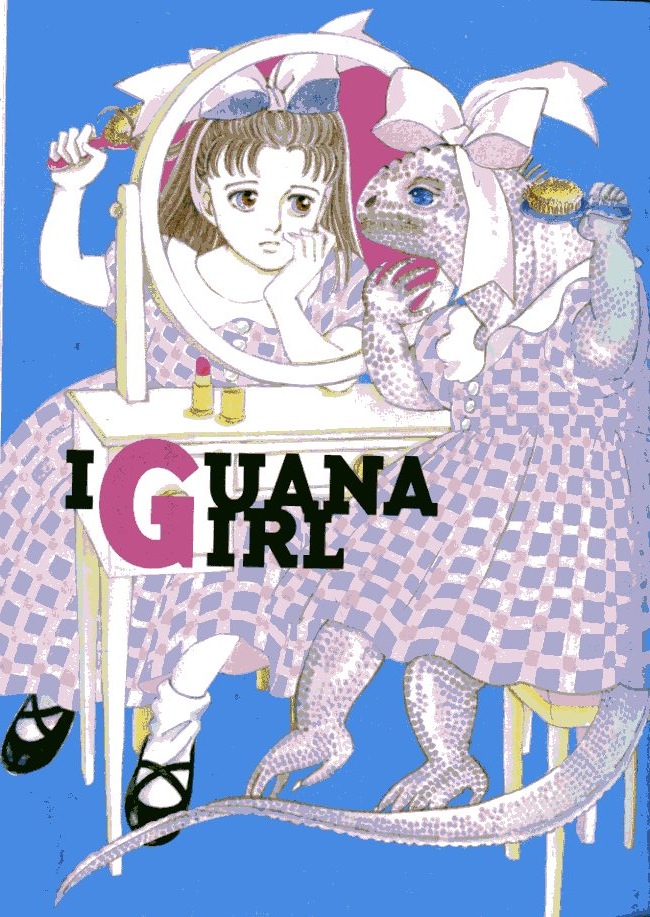
I wrote a longish essay about Moto Hagio’s story Iguana Girl.
Jones (One of the Jones Boys), did a two part guest post on visual aliens — characters drawn in a different style from their surroundings. Part OnePart Two
I’m blogging my way through Fantagraphics’ Moto Hagio collection, “A Drunken Dream.” You can read the whole series of posts here.
_________________________________
In reviews of Drunken Dream, “Iguana Girl” is generally pointed out as the highlight of the collection along with Hanshin: Half-God. The two stories are similar in a lot of ways; both involve sisters, one beautiful, dumb, and beloved, the other (our heroine) homely, smart, and despised. And both are engaged with ideas about self-image, femininity, gender, and identity.
Hanshin, as I said in my review, is more a poem than a story. It raises questions deliberately to leave them unanswered — the narrator’s self is ultimately her lack of self. The identity she finds is that she does not know who she is: herself, her congenital twin, or the space left between her and her sister when they are separated.
“Iguana Girl”, while using a more arresting gimmick than “Hanshin,” ends up being a more conventional (and to my mind a less interesting) story. The plot focuses on Rika, a child whose mother sees her as an iguana from the moment of her birth. Rika’s perceived ugliness makes her mother hate her; she much prefers her second daughter, the lovely (and rather dumb) Mami. Rika sees herself as an Iguana too, though everyone else sees her as a beautiful girl (and eventually as a beautiful young woman).
The problem here is the same one that dogs many of Hagio’s stories — a lack of characterization resulting in glibness.