Hooded Polyp: Earthy Anecdotes

In Caro’s recent post she argues that Asterios Polyp fails to deliver a kind of literary complexity.

The result is the reiteration – on the level of performance if not assertion – of a hierarchical division between “the literary” and the “graphical”: a dichotomy that is aggressive and dismissive in precisely the same way as Asterios’ treatment of Hana. It is completely uninformed about how literary fiction works. It creates a destructive incoherence at the center of the book.

I’ve probably bashed Asterios Polyp enough for one lifetime at this point. But I thought it might be interesting to look at a couple of examples of works that I think demonstrate the kind of literariness Caro is looking for.

I’ve been rereading Wallace Stevens recently, and I’m quite taken with this poem, the first in his first collection:

Earthy Anecdote
Every time the bucks went clattering
Over Oklahoma
A firecat bristled in the way.

Wherever they went,
They went clattering,
Until they swerved
In a swift, circular line
To the right,
Because of the firecat.

Or until they swerved
In a swift, circular line
To the left,
Because of the firecat.

The bucks clattered.
The firecat went leaping,
To the right, to the left,
And
Bristled in the way.

Later, the firecat closed his bright eyes
And slept.

As with a lot of Stevens’ poetry, nobody seems all that certain what the fuck this means. I’ve seen various efforts to parse it as some sort of allegory (the firecat means “change” was one particularly painful example.) But none of them are very convincing. Even the relation of title to poem seems maddeningly obscure. How is this earthy? Is there some sort of bizarre sexual double entendre known only to Stevens? That seems fairly unlikely — and yet, no other explanation presents itself.

The confusion here is, I think, on one hand simply a result of looking too deeply, or of coming at the poem from the wrong perspective. A lot of Stevens’ writing seems to me to be inspired not by abstruse epistemological theories or Romanticism, but by children’s poetry. “Earthy Anecdote” makes most sense if read not as allegory or complicated symbol, but as nonsense verse. Dr. Seuss’ battling tweetle beetles aren’t symbols of the futility of martial endeavor. They’re just goofy fun for kids. Similarly, the clattering bucks and the firecat are entertaining images. It’s fun to say “bucks went clattering over Oklahoma.” (Go ahead, try it. I’ll wait.)

At the same time…Stevens was also, and undoubtedly, inspired by abstruse epistemology and Romanticism. And he was writing verse for adults, not kids. Starting his first volume of poetry off with a bit of extravagant silliness is a fairly dramatic line in the sand — even if the line is curved. It’s a certain kind of statement; an elliptical declaration of love for the earthy, clattering bucks rushing about in glorious, purposeless panic — metaphors in frantic search for a meaning. In that vein, perhaps you can see the firecat as Stevens himself, leaping here and there to goad his images (and perhaps his readers) into a lather, before closing his bright eyes in self-satisfied pleasure. Or, alternately, Stevens might be the bucks, thrashing this way and that in an effort to avoid a meaning which is always leaping to thwart them — and which, in lazy triumph, curls around the poem at the end despite every horse’s best efforts.

None of these explanations are “right”, I don’t think. Rather, the point of the poem is the pleasurable possibilities of the point of the poem. That’s how the modernist puzzle works; the poem is playing with its own interpretation. Form and content (buck and firecat?) aren’t separated, or even separable; the content of the poem is its own metaphors. The reader doesn’t so much understand the poem, as shuttle about inside it. It’s a joke where the punchline is that the form of the joke is the punchline.

There are not a ton of comics that play these kinds of shell games with meaning, form, and content. But one example that does spring to mind for me is Yuichi Yokoyama’s Travel. In my review on Comixology I wrote:

Yokoyama had wrong-footed me. I was looking for realism, and so I found the epistemological uncertainty frustrating. But the book isn’t realism — or not exactly. It’s pomo; Yokoyama’s tongue is in his cheek the entire time. Take the scene of ducks flying over the plane as hunters shoot at them. The footnote points out that the hunters all miss, and indeed, you can see the ducks traveling in a perfect V, not even disturbed by the shells exploding in pristine, regimented bursts all around them. The demands of narrative (somebody shoots, somebody hits) are sacrificed, with a wink, to the exigencies of layout. It’s as if the hunters and the ducks are not adversaries at all, but part of some single great mechanism, controlled by one guiding hand. As, of course, they are.
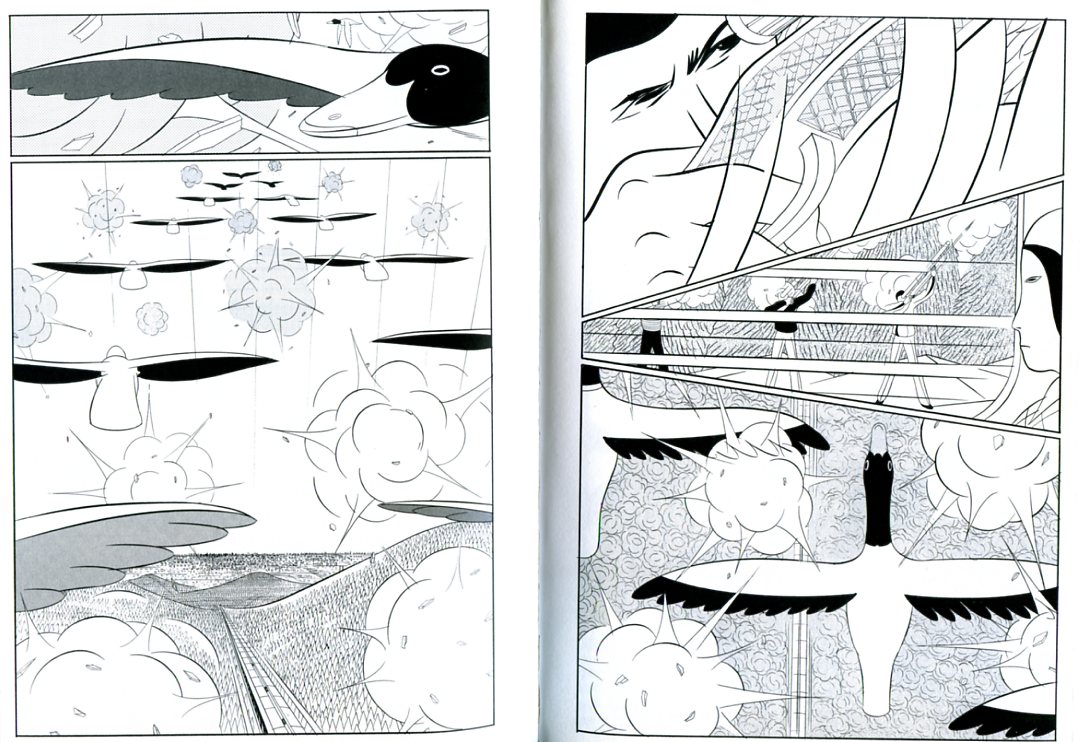
In Travel, as in Stevens, the sleight-of-hand manipulation of the tropes of the medium, the formal elements of the work, are themselves the content. As a result, modernist works like this are like two facing mirrors; absolutely flat surfaces leading into infinite depths.

I’m not saying that this is the only kind of worthwhile art by any means. I don’t want all art to be playful modernist puzzles anymore than I want all art to be slasher films or shojo. Still, Stevens and Yokoyama are great, and I wouldn’t at all mind seeing more comics that followed in their hoofprints.
Talking Polyps

I thought we’d take a pause in the middle of our Asterios Polyp roundtable to highlight some of the points that have come up in comments.

Craig Fischer had a fascinating comment on Mazzucchelli’s use of word balloons:

You can see how appealing and effective Mazzucchelli’s word balloons are by comparing them to the balloons in most contemporary mainstream comics, which look ugly to me: resolutely rectangular, filled with text that looks like it was generated by computer.

Mainstream creators have struggled with personalizing captions, especially when the text moves across panels and the speaker is unseen in the second panel.

Kurt Busiek will sometimes write one panel where a character says something like, “If we can’t stop that dinosaur…” This panel is then followed by another that (1.) visually eliminates the speaker (showing, say, only the rampaging dinosaur); but (2.) continues his/her speech (“…we’re all DEAD!”) in a caption.

Alert readers realize that the words in the second-panel represents the character continuing to talk. But Busiek and his collaborators have tried to insert other cues to eliminate any ambiguity about who’s speaking. One solution: characters are assigned different colors, and their captions are always in that color.

When Busiek wrote THE AVENGERS, he sometimes included the logo of the speaking character at the beginning of the caption box. For instance, a little shield appeared at the beginning of the caption if Captain America was talking but was unseen.

All of this really cluttered up the visuals, though–sometimes you’d have five different logos and colors for the captions littering a single page–and was nowhere nearly as elegant as the balloons in ASTERIOS POLYP.

Suat compares Asterios Polyp and Born Again (scroll down in comments for my response.)

What’s also interesting is that Born Again is filled with hoary cliches: damsel in distress, betrayal and redemption, the hero’s “rebirth” etc. Exactly the kind of thing which Noah decries in his review of AP. How many times have we seen the noir hero pull himself up from the gutter? (Darwyn Cooke’s Parker must be the most recent example/adaptation in comics)

And yet Born Again seems less tiresome in that respect when compared with AP which is similarly choked with cliches (or archetypes, whichever way you want to look at it). Does genre work at a different level than work of more serious intent? Does it appeal to some subconscious craving particularly in the male mind? I imagine that some of Born Again’s success must be put down to its pacing and the detailing of emotions(the later of which is lacking in AP possibly by choice). But is it only that extra twist of lemon in the plotting and the characterization?

Sidenote: You can actually see some of the dry brush work mentioned by Derik (re: the rocks in AP) in Born Again. I presume it became an even greater aspect of his art following his sojourn in Japan. Born Again would appear to be a steep learning curve for Mazzucchelli – you can see him improving as an artist right up to the final issue.

Robert Stanley Martin provides a choice Mazzucchelli quote

Here’s Mazzucchelli’s account of his collaboration with Miller on Born Again, from TCJ #194:

Frank was writing full scripts, but we were also discussing the stories. In fact, it was Frank’s idea to list our credits on the book as just reading “by Frank Miller and David Mazzucchelli,” not broken up into writer/artist/whatever. He asked me if that would be okay with me, because he didn’t want there to be any confusion. And as far as I was concerned it was perfectly acceptable, because the way we were working, there were ideas going back and forth where it would have been difficult to draw a clear line of demarcation–this came from one person, this came from the other person. Frank had the ideas for the stories, and he would call me up and we’d talk about it. And we’d hash it out and I’d have ideas of my own: “Well, what if this happens? And how about if we show it this way?” or whatever. And then he’d write a full script and then we’d have another long discussion about the script and then I’d draw from that. In fact, as I recall, everything that happens in the first three issues or so Frank initially wanted to put into the first issue. But because of discussions we had, we ended up expanding that, so that it was much slower, more densely packed.

And Daniel BT highlights the fact that the roundtable has been awfully cranky.

Anyways, one thing that bothers me about all this reviewing about Asterios Polyp is that nobody seems to ENJOY the comic. Rather than point out the innovations in the drawings, they’d rather point out how superficial the story is, how one-dimensional the characters are, and how unlikeable the main character is. I don’t like Woody Allen that much either, but I prefer Asterios better, since he’s not as neurotic, even when the spotlight keeps shining on him.

Lot’s more chatter in comments, and three more reviews to go (by Caroline Small, Robert Stanley Martin, and Matthias Wivel) before the roundtable winds down.

Utilitarian Review 6/5/10

On HU

Most of the week was devoted to the ongoing Asterios Polyp roundtable. Derik Badman, Craig Fischer, Vom Marlowe, Richard Cook, and me have all had our turns; Caroline Small, Robert Stanley Martin, and Matthias Wivel are still to come.

Also this week, Erica Friedman talked about condescension in comics.

Utilitarians Everywhere

On Splice Today I reviewed Prince of Persia.

So, okay, it’s true—this is a big, dumb, Hollywood action-adventure vehicle with nothing in its head except things blowing up, sword fights and pretty actors staring soulfully into each others eyes for a moment before more things blow up.

I’m okay with that.

Also on Splice Today, I talk about hook up culture, teens, and how the Atlantic Monthly is turning into an exploitation rag.

If you want to know whether girls have become more or less promiscuous, you don’t look at what they’re reading or listening to, or even at what big sex scandal occurred in which random college or prep school. You look at teen pregnancy rates. You can find out in less than 120 seconds that teen pregnancy rates fell in virtually every state between 1988 and 2005. After 1995, teen pregnancy rates nationwide declined every year for a decade, hitting their lowest point in 30 years in 2005, smack dab in the middle of Flanagan’s hook up decade. It’s true that the next year, in 2006, rates rose by three percent, and preliminary findings suggest they may have risen again in 2006. Even so, rates remain historically low; in 2006 teen pregnancies were only 71.5 per 1000, as compared to, 83.6 per 1000 in 2000, 99.6 per 1000 in 1995, and 116.9 per 1000 in 1990. To suggest, as Flanagan does, that teens were especially promiscuous in the past decade and a half is simply wrong. On the contrary, teen pregnancy has apparently declined for more than a generation, the growth of the Internet notwithstanding.

Other Links

Dara Lind explains why Facebook sucks.

Alyssa Rosenberg talks about MIA and Courtney Love.

Tucker Stone and Benjamin Mara have a long, thoroughly entertaining discussion about The Rise of Arsenal, of all things.

Hooded Polyp — Stupid Spaces

Asterios Polyp takes an impeccable sense of visual design and layer upon layer of sophisticated allusion to tell a clichéd, tedious, poorly imagined, ruthlessly uninsightful story. It’s like listening to a musically brilliant opera with the book taken directly from a TV movie of the week, or (to take an analogy perhaps closer to my heart) listening to classic Slayer perform a John Updike novel. You can’t but be impressed by the technical skill and control…but it’s hard not to feel that, skill and control notwithstanding, a person who could expend such time, energy, and passion on such vapid idiocy must be, on some level, a fool.

Of course, with a book this intricate and complicated, it’s always possible that the person who doesn’t get it is the fool. I know what I’m supposed to do with this book; I’m supposed to start googling all the names that have flagrant double-meanings; I’m supposed to read and reread looking for connections, following up secret paths. How is the theme of doubling worked through the book? How do the different styles link to different moods and themes? Why does the guy who pokes out Asterios’ eyes at the end seem to recognize him? When exactly did Asterios give up smoking and what does it mean?

I figured out a few of these answers despite myself — but, man, overall, I so don’t care. And I don’t care because, with all the twists and turns and clever games and beautiful drawings, this is, at bottom, a character study, and Mazzucchelli’s characters are all as tediously second-hand and tired as his designs are inventive and new. Asterios Polyp, the character, walks out of the massive towering edifice of literary fiction via rote Hollywoodization, and he’s as utterly devoid of interest as he was the first thousand times I saw him. Hey, look, it’s a Successful Professor Whose Intellectualism Has Disconnected Him From Life. And there’s his younger, also brilliant, but more tentative wife — and…wait! He’s driving her away through his callous self-absorption! Didn’t see that coming. And now he’s undertaking a spiritual journey which involves interacting with common people and/or ethnic minorities! And, look, he learns his lesson and spiritual renewal is his — and happy, happy love! Yay! The end. And if I want to see it all happen again, I can just rent The World According to Garp.

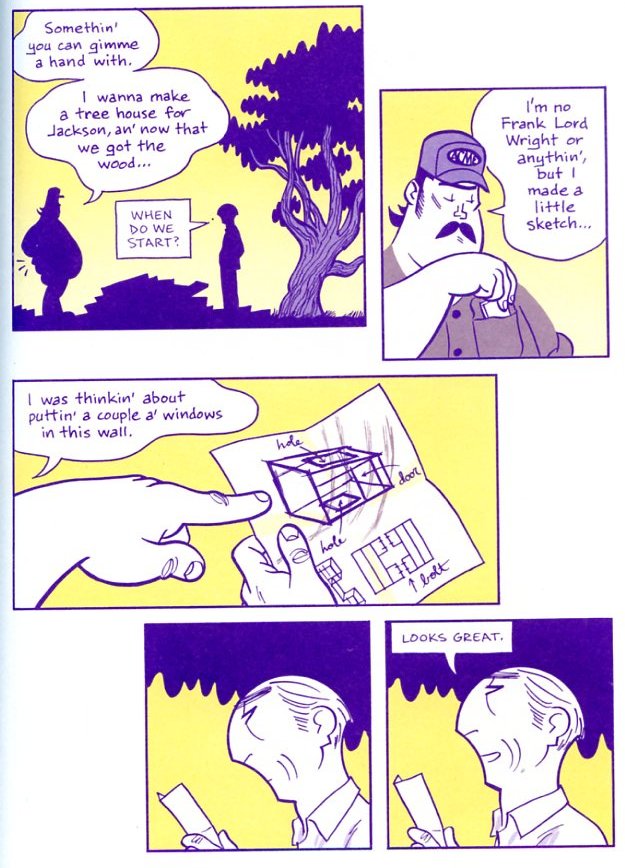
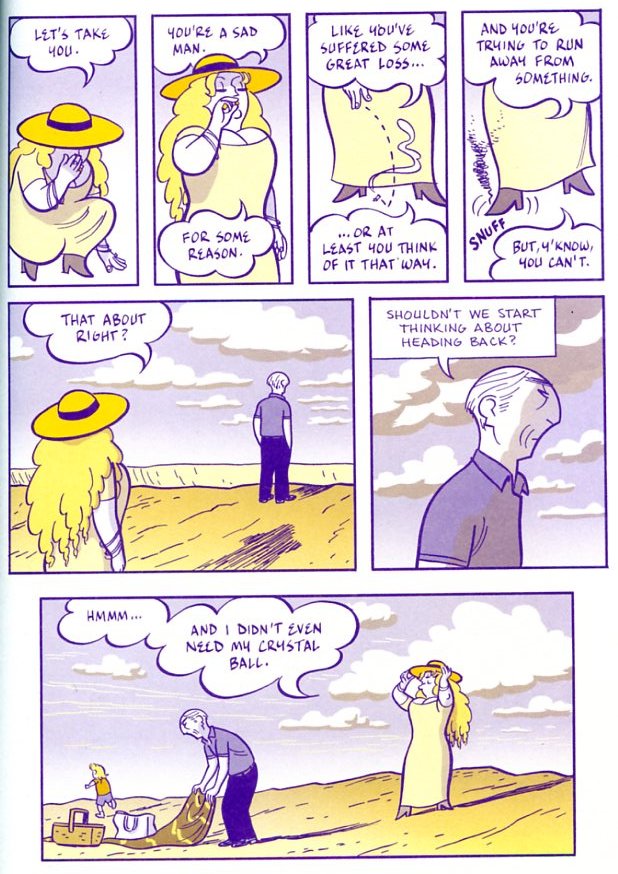
I don’t know. Here are a couple of moments of emblematic shittiness.

That’s our hero, Asterios Polyp, the great snobbish architect who has never built a house, committing himself to help his working-class boss and landlord build a rickety little treehouse for said boss’ adorable son. Can you savor the gentle irony? Do you feel the tear in your eye? Can you hear the inspirational music from various Kevin Costner vehicles welling up to play over the heartwarming montage?

Here’s the boss’ wife, who is into new age nonsense (which we shouldn’t just reject as nonsense because we’ve already been informed that too much rationality is bad bad bad) looking deep into Asterios’ soul and seeing the wounded longing therein. It’s like his heart is just like that giant hole in the ground they looked at a few pages ago, which is a big ironic irony, because Asterios’ heart isn’t a hole at all. How could it be when he got it spackled over with moments of trenchant revelation borrowed from every half-assed rom-com script of the past quarter century?

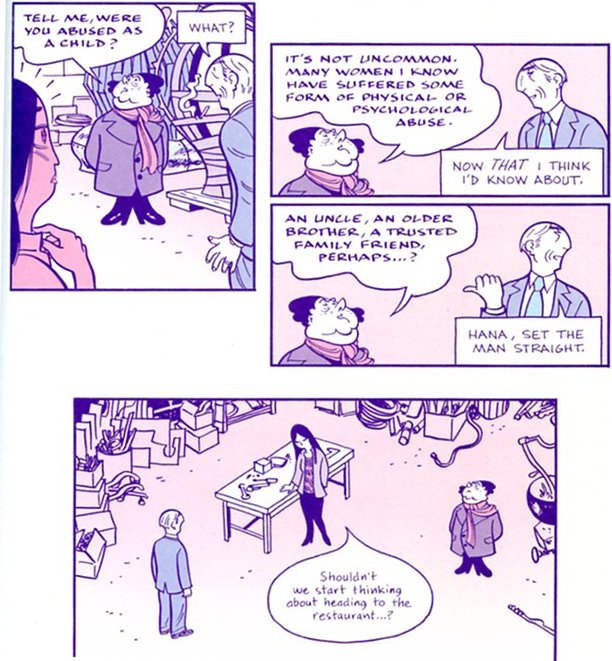
Look! His wife is the victim of sexual abuse! That adds emotional depth, doesn’t it! Hey, this book is really about something, damn it!

Matthias Wivel suggests that the story appears “reductive” because Mazzucchelli leaves out most of the connections; we don’t learn more about Hana and Asterios’ relationship because the point is that we’re to fill it in ourselves — figuring out the spaces in the architectual plan for ourselves. It’s a generous reading, and may well be what Mazzucchelli had in mind. The problem is that the plot and characters he’s given us — the frame in which we are to perceive the spaces — have little of genius, or even elegance. Instead, what he has erected is made out of shoddy, second-hand, thoroughly pissed upon fragments of mediocre pop culture detritus. Which is to say, the problem I have with Asterios Polyp is not, alas, that Mazzucchelli doesn’t give me enough. He gives me plenty.

__________________
This is the first post in a roundtable on Asterios Polyp. Derik Badman will weigh in tomorrow,(He’s now done so) and we’ll have various other Utilitarians and guests posting through next Monday.

Update: You can read the whole roundtable so far here.

Utilitarian Review 5/29/10

Asterios Polyp Roundtable

In the coming week (and a few days) we’re going to have an extended roundtable on David Mazzucchelli’s Asterios Polyp. Besides the usual Utilitarians, columnists Matthias Wivel and Domingos Isabelinho are also planning to weigh in — and we’ll also have guest posts from Derik Badman and Craig Fischer. So please check back!

On HU

I started off the week by explaining why I wasn’t that into Urasawa’s Monster.

Domingos Isabelhino devoted his first monthly column, called “Monthly Stumblings”, to Pierre Duba’s Racines.

Vom Marlowe pointed and laughed at the art in Brave and Bold #33. Several commenters protested, and I did a follow up post speculating on visual tropes in super-hero art.

Richard Cook provided a history of Wonder Woman’s panties in covers.

Caroline Small looked at Barbarella the movie and why it should not be a target for feminist ire.

Suat sneered at Gantz.

And finally Suat expressed some skepticism about the excesses of the market for original comic art.

Oh…also, here’s a download of some semi-schlocky country weepers.

Utilitarian Everywhere

Former Utilitarian and current comics creator Miriam Libicki has been doing some guest blogging over at Jewish Books. You can see her talk about her creative process here.

Columnist Matthias Wivel is over on the tcj.com mainpage talking about the Komiks.dk festival in Copenhagan.

At Splice Today I talk about the best super-hero movie of all time.

Why is it the best superhero movie of all time? If you saw the TV show you know the general outlines. Adam West does not have foam-rubber pecs like his bat-successors, but he does have a cute little paunch which is clearly outlined in his skintight bat-costume, said paunch sitting unashamedly atop his shiny external bat-underwear. It seems Robin has poured a quart of rabid bees down his green short-shorts and is bravely fighting the pain by punching his fist into his palm while imitating a (much) skinnier William Shatner. And, of course, there’s the Batmobile, Bat Repellant Shark Spray, Bat Knockout Gas, and all other kinds of Bat ephemera, each carefully labeled for those who otherwise might confuse the Bat Repellant Whale Spray with the Bat Ladder.

At Madeloud I provide an introduction to black metal.

Whiteface corpsepaint, church burning, ungodly screams, and the odd unpleasant foray into fascism — from the outside, black metal looks fairly foreboding. But while that image isn’t exactly wrong, it is a little misleading. Some black metal performers have really and truly been associated with extreme excesses and ugly ideologies (Varg Vikernes, we are looking at you). But, if you can put that aside, the music is in general quite accessible — in some cases, even pleasant. If you enjoy shoegaze or indie rock or ambience, a lot of black metal will sound like a slightly satanic twist on some familiar tropes. Here are some places to start for those ready to immerse yourself in surprisingly friendly evil.

Also at Madeloud, I review the latest releases from folk black metal horde Blood of the Black Owl and indie folk band The Clogs.

Other Links

This is an adorable illustration of Lovecraft’s Shadow Over Innsmouth.

I enjoyed this part of Kristian Williams’ massive discussion of Oscar Wilde illustrations.

Even though I have no idea what House of M is, this is still a great post about the X-Men by Tim O’Neil.

Feminist Hulk Smash Patriarchy on Twitter!

What’s Wrong With This Picture?

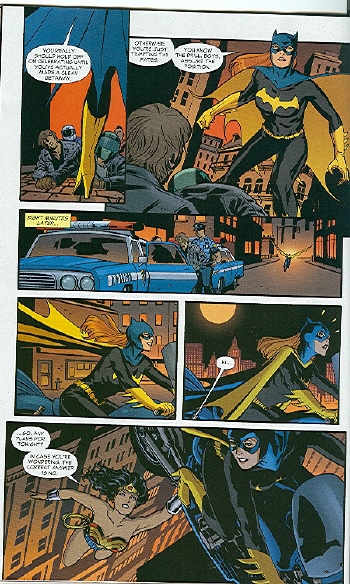
Vom Marlowe posted earlier today talking about the visual mess that is Brave and Bold #33 Among the pages she pointed out was this one:

Vom said:

I stared at this page and tried to figure out what the heck is happening. Finally, I decided that her bike flies between panel 4 and 5, although I don’t know why. Apparently so we can see Wonder Woman hanging onto the middle of the bike? I don’t even know.

David Brothers felt this reaction was disingenuous.

The Batgirl thing is similarly dishonest. We see street in the background, and then we see skyline. Two plus two: Batgirl is higher now than she was before. Next panel: the reason why.

This isn’t hard. This isn’t being steeped in continuity with no lifeline. This is basic stuff that is in almost every comic book ever made. You can find yellow pee lines in Peanuts. Done in Schulz’s style (thin lines, with maybe sweat marks around the lines), of course, but it’s the same effect. How did Wonder Woman lift the bike? By getting low to the ground and scooping it up, I assume, same way everyone has ever lifted everything.

I was talking this over with another non-superhero comics reader, and she said that she too couldn’t make heads or tale of the Batgirl sequence either. Whereas, I — who have read way too many superhero comics — parsed it instantly. I presume David’s experience was more like mine, which may be why he just assumed that others’ confusion was a put on.

This seems pretty interesting to me. I can’t necessarily point to anything in that sequence and say “well, this is why I followed it”, but I do wonder if there are tip offs you don’t necessarily even know you’re getting when you’re familiar with an art form or genre. I think things which “feel” natural and obvious can really not be at all.

In thinking about it more: the panel/panel/pull back and reveal move — that seems like something that’s done a lot in modern superhero comics. In this case, it’s done really confusingly; among other things, I think the horizontal movement of the panels works against the fact that the action is vertical. That is, from the panels, it looks like Batgirl is going side to side, but she’s supposed to actually be going up. I think this is in theory intended to make the reveal more surprising. In practice, though, it messes with the visual rhythms; it doesn’t feel from the panels like she’s going up at all, so even when you’re told (via the skyline) that she’s going up, you kind of have to convince yourself.

Rotating the angle of the bike messes with the rhythm too; the camera isn’t so much pulling back as it is swooping out and swinging around, though all in a single leap. It’s disjointed and clumsy; its like Cliff Chiang, the artist got to the bottom of the page and didn’t have enough panels, so he just cut out bits and hoped it would work.

And for me it does work — not in the sense of being a stylish or pleasurable progression, but in the sense that I can follow what’s happening. And I think I can follow what’s happening because I’ve seen it so often before. I mean, this is clearly somebody who loves Watchmen too, and who’s used to seeing comics imitating film movement more-or-less poorly, the way superhero comics these days tend to. I can follow the page better than VM not because I’m especially visually ept or because VM is pretending not to get it, but because it’s using tropes so familiar to me that I can parse them even when they’re not deployed very skillfully.

Another interesting thing about this to me is that, if I were reading this comic on my own, I don’t think I’d even notice that the tropes weren’t used very well. I’d read that page, understand it, and just go on. In some ways, being familiar with the tropes makes you see the comic less clearly. I can follow the images, but I wouldn’t have actually seen what they was doing if Vom (and David as well) hadn’t pointed it out to me.

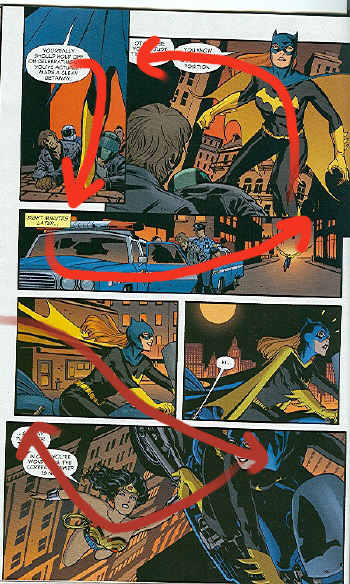
Update: Telophase has a mess of fascinating comments (starting here) explaining the different ways in which manga and western readers read comics. Basically, manga readers look for clues in the art first, then if that doesn’t work go right to left; western readers go left to right first, and if that doesn’t work look for clues in the art. Telophase kindly marked up the page above to show how a manga reader (going left to right of course!) would parse the page.

The visuals at the bottom of the page end up to be particularly nonsensical, which might help explain why VM had such trouble figuring out what on earth was going on.

Monster and Paragon

I just finished the first volume of Naoki Urasawa’s Monster, and that’ll probably be the last one I read. Partly, I’m annoyed by the conspicuous and painful contrivances — I mean, how many times can simultaneous brain surgeries on a poor person and a rich person be required in the same German city in the same week, anyway?

But while the melodrama is over-determined, the real problem is that the book is glib in other ways. The point of the first volume is the various moral dilemmas faced by Dr. Kenzo Tenma, a amazingly accomplished Japanese brain surgeon living and working in Germany. The stumbling block is that the book never really contemplates for an instant presenting Tenma as anything but a moral paragon, which rather undercuts the efficacy of said dilemmas. Really, Tenma’s big bad sins in the first volume are to (a) be mildly ambitious, and (b) to spout off out loud to an unconscious person about how he’d like to kill the folks who wrecked his career and life. Those are barely even sins, and the rest of the time we see him running himself to exhaustion to save lives, neglecting his own career advancement and romantic life, and generally being a paragon of virtue.

Having such a strong moral beacon in the central role pretty much vitiates the ethical questions that appear to be the heart of the book. In Middlemarch, as a contrast, the doctor, Lydgate, is both really likable, morally upright — and actually swayed by money and romance to do some fairly awful things. Because Lydgate is a flawed human being, his choices are much more involving; the fact that he occasionally falls makes his occasional triumphs — and those of others — have an actual weight and beauty.

Tenma, on the other hand, comes across as a hollow prig; the dilemmas he faces have to be ridiculously contrived, because he simply, and improbably, isn’t subject to normal human failings. The result is sententious and irritatingly stupid; every demonstration of Tenma’s nobility just makes me want to say, “give me a fucking break.”

Adding to the annoyance is a fairly strong suspicion that part of the point of the manga is to allow the Japanese to pat themselves on the back for their purity and general moral superiority. The giant noses of all the Caucasians are fun to look at, but the standard noble-Japanese-struggling-to-retain-his-purity-in-corrupt-old-Europe thing is a lot less enjoyable. Nor am I all that taken with the hoary idea that serial killers have something important to tell us about the human condition/human morality/our inner selves. I’ve seen that film, thank you, and as far as I”m concerned Kevin Spacey and Anthony Hopkins can be sealed in a concrete container and dropped in the Mariana Trench where they can overact at each other and various species of deep-sea fish for all eternity.

I know lots of folks have liked Monster, and it’s certainly possible that things get less stupid at some point later in the series. And the art is quietly skillful in a Tezuka vein. But I think I’d much rather pursue the trashier Gantz, which manages to be a lot more thoughtful and truthful about morality by the simple expedient of not idolizing its central characters.