Garfield’s Nine Lives

Garfield: His 9 Lives came out in 1984. We owned it when I was a kid, and I remember even then finding it odd. Now we’ve received an old copy for my kid as a gift…and it seems even odder.

Like the title says, the book tracks Garfield through his 9 lives, starting as a cave cat and ending up as a cat in space. Which certainly makes sense as far as it goes…and several of the segments are, in fact, more or less exactly what you’d expect — that is, they’re Garfield gag strips with a different time setting. Here, for example, cave man domesticates cave cat:

Photobucket

Cartoony style, professionally accomplished basic slapstick schtick — that’s what I expect, more or less, when I go to a Garfield comic. Similarly, there’s a very funny Three Stooges riff in which Garfield is an exterminator, allowing Jim Davis to get a bit more squicky than he tends to in the funny pages:

Photobucket

Other parts of the book, though, are harder to parse. In the first place, little is done with the conceit of Garfield-through-time; almost all of the stories except for the cave cat and future cat ones are effectively set in the present. There is one story where Garfield is a Viking Cat…but then he gets frozen in a block of ice and ends up in 1984 anyway along with his Viking comrades. This sets up a confused and toothless Mad Magazine knock off, as the Vikings meet the modern day world and end up as factory workers, plumbers, and advertising executives. There’s also a prose story about Garfield as a detective (I guess that does seem vaguely set in the 40s…) and a fairy-tale story with slick computer-surreal art which is too saccharine to discuss further.

And then there’s this:

Photobucket

Yes, that’s an incarnation of Garfield as atavistic monster. I don’t have the equipment to scan the entire double-page spread at once, but basically he’s leaping to slaughter his aged owner.

And the twist-ending horror shocker isn’t even the weirdest of the tales. That honor would have to go to the tale which has Garfield as a laboratory animal who is injected with an experimental drug, escapes from his cage….and then changes into a dog. It’s done in a more or less realistic style, and the whole thing is extremely creepy, from the traums of the vivisection to the apparently painful transformation; even the sort of winking ending (he escaped!) seems very creepy — I mean, surely an animal who this happened to would be terribly traumatized. It all seems very far from the jokey world of the Garfield strips; this is more like 2000 AD twist endings…except that crossing it with a children’s comic strip makes it significantly more, not less, disturbing.

Part of what’s going on here is that Davis is giving the folks in his studio a chance to stretch out. For instance, that creepy, atavistic cat above isn’t drawn by Davis, but by Jim Clements, Gary Barker, and Larry Fentz. The saccharine fairy-tale is written and drawn by Dave Kuhn. But then, the oddest stories — the lab animal one, the atavistic cat one, are written by…Jim Davis. The same Jim Davis who has been writing essentially the same Garfield gags (coffee makes you crazy! cats are lazy!) for thirty years. The same Jim Davis who, when asked to talk about his strip, utters bland profundities like “This whole line of work is to make people happy and smile. Getting paid for is it just a bonus.” If you were going to guess, you’d say that Jim Davis hasn’t thought about anything in particular for most of his adult life. And then you find something like this, or Davis’s appreciation of Garfield Minus Garfield and you start to wonder…

Bound for Glory

I’d posted a bit back about Alan Moore’s proposal for Glory. Basically I argued that for the most part Moore didn’t seem to understand what made the Marston/Peter run great; in his proposal he tended to take weird, absurd ideas (like the invisible plane), note that they were weird and absurd, and then go on to suggest changing them in ways that made them more conventional and boring (turning the invisible plane into a more mythologically appropriate, and therefore less goofy, transforming chariot thingee, for example.)

Well, my brother very kindly sent me the three issues of Glory that Moore actually wrote (numbered 0, 1, 2) — and I was pleasantly surprised. I think the actual book is a good bit better than the proposal.

Not that Moore has suddenly figured out the Marston/Peter run. There’s no particular evidence that he has. Rather, it’s that, despite some lip service to the WW history and mythos, he really largely manages to ignore Marston and get on with his own ideas. For instance, I noted that the most interesting part of the proposal seemed to be Moore’s ideas about Glory’s secret identity. WW did have a secret identity in the Marston run, of course, but it always seemed tacked on — there because super-heroes were supposed to have secret identities rather than because it was an integral part of Marston’s politics or fetishes. WW always seemed to be slumming as Diana Prince — presumably because she wanted to be near Steve Trevor…but since WW always hung out with Steve Trevor anyway, the motivation didn’t seem especially coherent.

For Moore, however, the secret identity expands and becomes essentially the entire point of the book (or of the couple of issue he wrote anyway). Glory wants to know what it’s like to be human — which isn’t an original trope, exactly. But the trick is that the person she chooses to become/inhabit, Gloria, is a waitress who’s a schizophrenic. She’s Gloria’s secret identity, and Glory is her fantasy. The tension between those two perspectives is funny and poignant and even a little disturbing, especially at the cliff-hanger ending (never resolved), where the gap between Glory and Gloria, or between imagination and reality, swallows both of them up.

In the proposal, Moore suggested that the comic should be “disingenuous” and “coy” in its portrayal of cheesecake, lesbian subtext, sex, and so forth. I felt that this was really a fundamental misunderstanding of Marston, and overall just not a good way to go. And, indeed, the moments where the series goes that direction are, in general, not of the best. In issue #0, for example, there’s a flashback/retelling of Glory’s history which includes a lot of badly-rendered gratuitous cheesecake which is irritating and dull. And then there’s the cameo by a female comic reader in a half-shirt who a skeevy old book-retailer keeps refers to as “child”, and who behaves more or less like a kid (deferential to old skeevy guy, eager for new book,…she’s an analogue to that comic-reading kid in Watchmen, actually), but who has the hard-bodied, half-shirted, butt-falling-out-of-her-bottoms look of a poorly-drawn pin-up.

Photobucket

On the other hand, the retro-bondage flashback story in issue #2 with cross-dressing, serious butch-femme play, and tongue-in-cheek parodically second-wave sneering at the bonds of matrimony was quite entertaining…though its knowing satire, its exploitation, and its clever plotting with the twist ending is world’s away from Marston/Peter (it reads much more like Moore’s own efforts for 2000 AD, actually, albeit with less explicit violence and more implicit sex.)

In any case, the point is, these are largely aberrations; the bulk of the series doesn’t go for coy or disingenuous or cheesecake especially. Instead, it treats sex and love in an above-board, respectful manner. Gloria the waitress sleeps with a marginal drifter character, and its sweet and sexy and cute (“I like his name and how he talks,” Glory thinks, “I like his bottom.”) Similarly, Hermione, Glory’s companion, has an unrequited crush on her…Moore threatened to mine that for titillation in the proposal, but in the actual comic it’s played almost entirely for bittersweet pathos. Maybe Moore wrote the proposal figuring that Liefield wanted coy cheesecake? In any case, there’s much less of it in the comic than he promised, which is all to the good.

Overall, I think the fact that this isn’t actually Wonder Woman helped Moore a good bit. Glory’s costume is no great shakes, but it’s not the dreaded swimsuit of Americana. She isn’t tricked out with bondage gear. She doesn’t have tons of baggage about, for example, the mission of peace (Moore basically has her going to man’s world initially because Hitler pisses Demeter off by being a jerk, and later just because she feels like it), or feminism (which Moore uses as an off-hand joke a couple of times, but doesn’t otherwise bother with.) There isn’t any need to make any homage to the idea that she’s an icon of any sort. Though he takes some things from the WW mythos, Glory ends up as much less WW than Supreme was Superman. Instead of fetish and feminism, Moore uses the title to talk about magic, imagination, and relationships — his obsessions, not Marston’s at all.

Maybe this is clearest in the retelling of Glory’s origin, illustrated by Melinda Gebbie. The first image of the story is this:

Photobucket

This reminded me of the Ms. cover image where WW is shown as a giant. Here, though, the sexualizing effects of manipulating body size are much more thought through and under control; the children’s book stylized whimsy, the girly outfit, the fashion pose, the skin, and the tiny figures showering her with adulation; she’s powerful, but also a sexual object in a whimsical way. I mean, Marston wasn’t exactly whimsical, I don’t think — more cracked. But this seems like a nice nod to his themes; a way to point to them without pretending to take them as seriously as the man himself did. It is coy, I guess, but almost nostalgically or poignantly so — especially as those very elliptically suggested themes of sexual power and submission don’t really play out in the following narrative at all. Instead, the story Moore tells is actually much more like a Neil Gaiman Sandman tale than like a Marston fever dream — it’s a reworking of the Persephone myth, with Demeter impregnated by a demon in the form of a silver rain about halfway thorugh. There’s no bondage or purple healing rays or caricatured masculine stereotypes anywhere in sight. Gebbie’s artwork does share some traits in common with Peter — a somewhat simplified cartoony style, some frilly filigree, a penchant for stiff poses creating frieze-like compositions. Her faces, though, are much more expressive, and her linework less so. The feel ends up being more conventional and sentimental, as in the image below:

Photobucket

I really like that panel, with the diamond patterns in the back and the demon thinking in Lichtenstein melodrama. We get love and mystery and magic. It’s nothing like Marston/Peter, the putative object of the tribute. But that doesn’t mean it’s bad.

This isn’t to say that Glory is overall comparable in quality to the Marston/Peter WW run. In the first place, other than Gebbie’s eight-page cameo, the art is typical mainstream crap; ugly stylistic nullity mottled in that horrible computer coloring. Moore tries for a couple of Winsor McCay effects and you just want to tell him to stop, man; nobody here has the skill for that. You’re just embarrassing everyone. Give it up.

Photobucket

Art problems aside, Moore’s authorial vision, in this title at least, isn’t nearly as weird, as funny, or, I’d argue, as thoughtful as Marston’s original. What with the flashbacks and the backstories and the diner drama and Glory running off to fight badness every so often…the characterization and plot are clever and fun, but they’re too diffuse to really seem urgent or to add up to all that much. As with Supreme, you get the sense that Moore (like Glory) is slumming; running along and entertaining himself without breaking too much of a sweat. The themes around imagination are things we’ve seen from him before…stories affecting the world, stories breaking into the world, etc. etc. In a couple of sequences, characters in the comic are reading comics, and then the comic within a comic turns around and breaks the fourth wall and talks to the character in the comic…and you think, yep, whatever, Alan — comics are a metaphor for existence. Can we move on now?

The thing is, since I don’t find these ideas that compelling in the first place, I’d just as soon see Moore treat them as toss offs; better that than Promethea, certainly. The air of improvisation doesn’t hurt the book;on the contrary, I like the breeziness of it, and there’s still enough depth to keep things engaging and even affecting. It’s not genius, but it is one of the few versions of WW that isn’t an aesthetic pratfall. Marston/Peter’s character is impossible to deal with, and so Moore, very reasonably, refuses to, and comes up with something else entirely.

_________

One complaint though; Moore puts an Etta Candy analogue in one of his flashback stories…and she’s thin and hot! What’s with that? Did Liefield decreed that there couldn’t be any fat women in his comics, no not even one?

The Week That Was

I think this has been our biggest week os blogging here at HU. In case you missed it in the flurry, we had a roundtable on Kyoko Okazaki’s Helter Skelter, a few more posts about Wonder Woman (one by Tom, even), the second installment of Gluey Tart: Adventures in Manporn by Kinukitty, this one about self-referential German pretty boys. Also Spider Man 2 and probably other things I’ve forgotten.

Also, if you’d like in comments, let us know if there’s something you’d like us to address or talk about. I’m going to do a post on Alan Moore’s Glory next week more or less by request; Tom did a post specially for a commenter last week; we are all about shameless pandering here at HU.

Sex and Fury

Japanese yakuza sexploitation; supposed to be a major influence on Tarantino’s Kill Bill. It was kind of disappointing; the swordfights are not especially well-choreographed, and Christina Lundbergh is pretty much a dud as a lovelorn American spy speaking painfully stilted English. The plot is more complicated than it needs to be, the revolutionary good guy is incredibly lame with a lameness matched only by the police who keep letting him escape after his botched assassination attempts (that’s pretty funny, actually). As you’d expect, there are a bunch of largely unmotivated sex scenes and a heaping helping of gratuitous violence, but none of it goes anywhere in particular, and the perversion and viciousness is all pretty rote (women on women whipping in front of a picture of Jesus while organ-music plays and a bunch of nuns look on…eh, okay.)

Still, it earns its reputation to some extent on the strength of the performance of the star, Reiko Ike as Ocho. The scene where she leaps out of the bathtub nude and cuts a swath of death through a passel of treacherous gamblers is probably the movie’s high point…though the climactic scene, where, again mostly nude, she again chops away at a phalanx of baddies, is also great. She never actually looks like she’s a master swordsman, necessarily, but she’s very charismatic and intense; she’s got the fluid stalking thing down, not to mention the deadly glare. There’s a sequel which I’m going to watch shortly, so obviously there was some appeal.

Only One Can Wear the Pointy Ears

My good friend Bryan alerted me to the existence of this, a 1967 attempt at a Wonder Woman pilot commissioned by the producer of the Batman TV show.

Basically, Diana Prince gets berated by her mother for not having a man, then she runs through a revolving wall, emerging as Wonder Woman who (to paraphrase the voice-over by the regular Batman announcer) “knows she has the strength of Hercules; knows she has the speed of Mercury, and *thinks* she has the beauty of Aphrodite!”

It’s certainly something completely different. And I did laugh a couple of times at the sheer unexpected snideness of it.

Ultimately, though, it’s hard for me to get behind it enthusiastically. Part of what was so much fun about the Batman TV series is that the target of the humor was the establishment; Batman and Robin are basically policemen/boy scouts; in all their humorless do-gooding, they’ve got the law and the powers-that-be on their side. The show was a masterpiece of having your cake and eating it too; you get to sneer at the ridiculous dated morality (refusing to drive through red light; refusing to hit women, etc. etc.) while still rooting for that morality to win. Batman’s the show where even cops could laugh at crime-fighting and even hippies could cheer for the establishment.

This Wonder Woman pilot, though…it tries to make fun of Wonder Woman the way that the Batman TV show made fun of Batman…but it’s just not as easy to get the balance right. The main problem is just that Wonder Woman is a woman…and as such she can’t be assimilated to the establishment the way Batman can. Instead, because she’s a women, she’s automatically marginal in certain ways. As a result, making fun of her doesn’t feel edgy or clever — it feels hackney and tired and dumb…and, yeah, sexist too. Jokes about aging unmarried daughters who are desperate for men; jokes about women’s vanity; jokes about women being incompetent…where have I heard *that* before?

For WW humor, I much prefer Darwyn Cooke’s pissed-off 2nd wave feminist version, which makes fun of WW for being overly sensitive and clueless, but also ridicules men for being venal and predictable and generally getting their asses kicked. Gender roles and wars of the sexes can be funny, and often are. But even when it’s written with some wit, I just don’t find sexism all that humorous.

________________

And as I’ve been pointing out at the end of each of these, this is the latest in a series of posts on post-Marston takes on WW. The whole series is here.

Bound to Blog: Wonder Woman #4

Not sure anyone but diehards are reading this at this point…but in case you’re new, I’m blogging my way through the entire original Marston/Peter run on Wonder Woman. We’re up to issue 4. And here’s the cover….
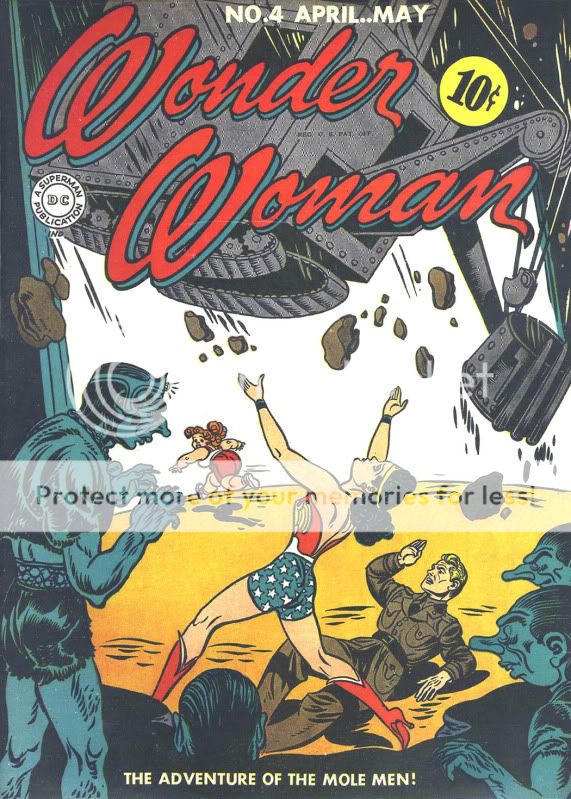
Photobucket

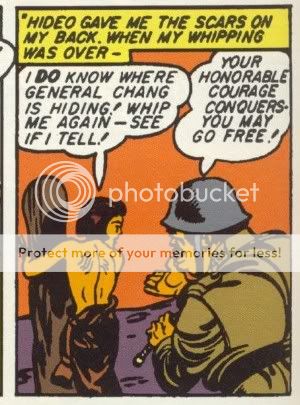
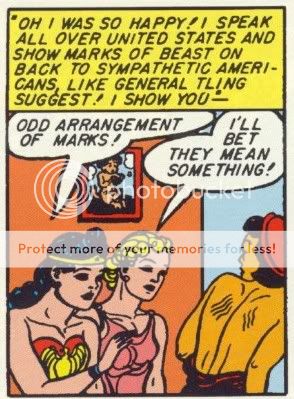
I’d sort of hoped to see the last of Baroness Paula Von Gunther last issue when she pulled a Bleak House and got her ugly mug replaced. I’m not that interested in her, and she’s always involved in espionage plots, which aren’t necessarily my favorite Marston efforts. No luck, though; she’s back for this entire issue apparently, being subjected to a series of tests by Aphrodite to prove that she’s sufficiently submissive or dominant or good or some combination of all three. And sure enough, the first story is pretty underwhelming. I mean, oh sure, you’ve got hot Chinese girls showing off their whip scars….
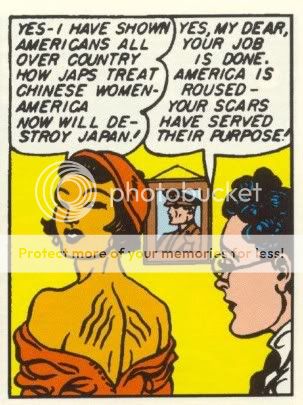
Photobucket

and hot Chinese girls showing off their whip scars
Photobucket

and then there’s the hot Chinese girls showing off their whip scars
Photobucket

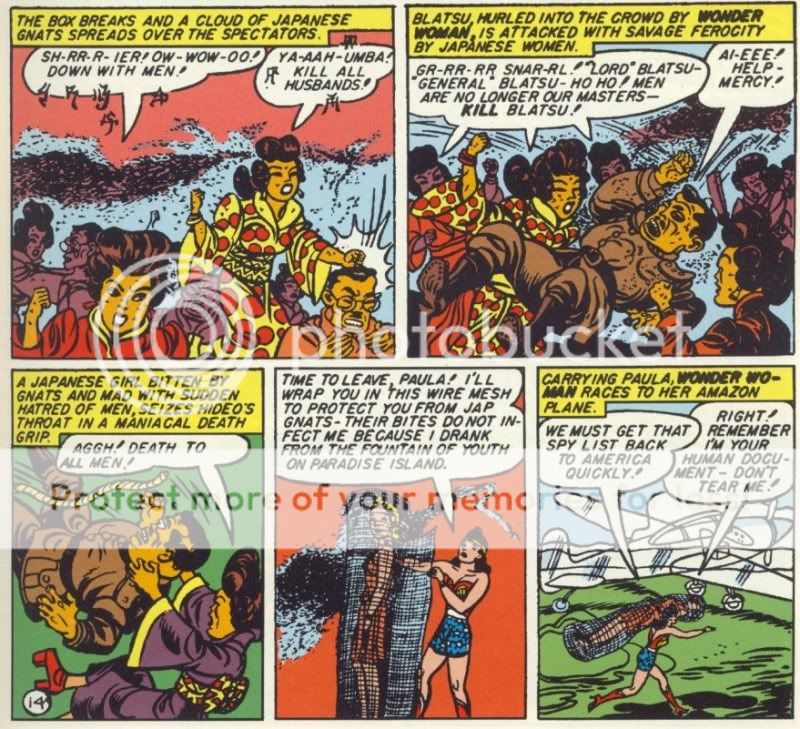
And there’s also hot Amazon on Amazon action with some poorly motivated competition involving catching each other with ropes, and then there’s the girls attached to weird rejuvenation machines (Paula invents one, everyone having apparently forgotten that WW invented one in issue #1). Also some really nasty Japanese caricatures. But most of it’s pretty familiar by now, and there aren’t any deer costumes or anything to push it over the edge into utter jaw-dropping WTF absurdity. Except maybe for the Japanese gnats that bite women and cause them to attack men.
Photobucket

That’s pretty crazy. But even there….I don’t know, I was hoping for more than just a couple of panels of murderous women…and kind of hoping to see WW herself flip out. But doesn’t happen; she’s drunk from the fountain of youth on Paradise Island, you see, which apparently gives you immunity to rabid gnats. Those Amazons think of everything.

The next sotry, though, is more like it. Instead of espionage, we’ve got a mysterious race of mole men lurking under Holiday College. Of course, the Mole Men keep herds of chained and semi-willing female slaves tied up in their underground kingdom. Though the mole men are blind from their long time in the dark, they keep track of their slaves by covering them with special paint that emits ultraviolet rays which can penetrate the mole men’s sealed eyelids. Amidst a subterranean performance by the Holiday College band, WW and Paula free the female slaves, and then perform non-consensual surgery on all the mole men, restoring their sight. Now that they’re able to see the beauty that is women, they become all submissive, and beg their former slaves to take command of them. Happy endings all round.

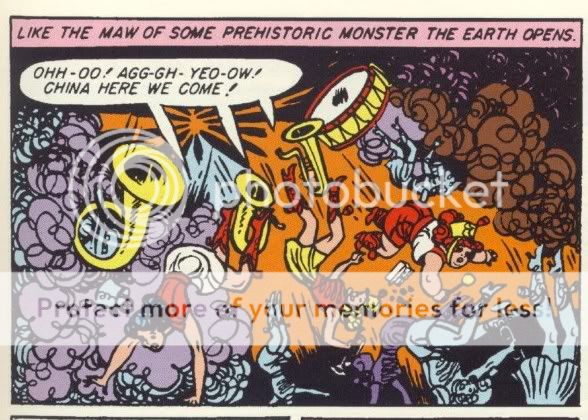
In their own bizarre way, the WW comics are definitely part of a tradition of children’s fantasy literature. Underground kingdoms show up in many classics — Journey to the Center of the Earth obviously, but a a more likely precursor in terms of trippy oddness might be L. Frank Baum’s Dorothy and the Wizard in Oz. (not “of Oz”; this one involves them wandering in the underworld beneath Oz.) In one panel, Paula says as she drops and drops, “this is like a dream of falling,” which seems like it has to be a deliberate nod to Carroll. There are several other similar scenes as well….
Photobucket

I love that drawing, especially; Parker’s scribbly curls of smoke setting off the elegantly controlled lines of the tuba and Peter’s characteristically stiff figure drawing. I like the way the smoke opening up in the off-center middle gives the sense of a great deal of space just out of vision; it’s almost like you’re seeing a small segment of an infinite universe of plummeting co-eds. There’s a touch of Winsor McCay, if McCay were, say, 10 years old. And horny.

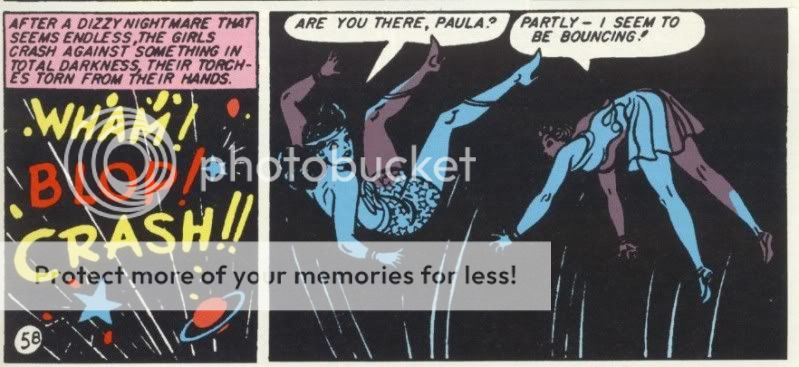
Because, and to no surprise, Parker’s evocation of childish scribblies is matched by prepubescent eroticism. Dropping through space, the girls unconsciously assume the position; bent over, butt high, or even just legs pointing straight up, face obscured. The helplessness of falling is definitely fetishized, even more so here:
Photobucket

Cartoony cartoony sound effects give way to bouncing about helplessly in the dark, with Paula unconsciously pointing her posterior towards the camera. (They’re bouncing on a taut fabric held held by numerous women — kind of the adventure version of a sleepover pillow fight.)

I guess one could say that Marston and Peter are perverting the Alice story…but it might be closer to the truth to say that they’re explicating a perversion that was already there. Lewis Carroll had his own sexual interests (though they were probably less kinky than Marston’s) and you don’t have to read “Lost Girls” to pick up tinges of polymorphous pleasures in Alice. Falling into holes, “Eat Me!”, “Drink Me!”, flesh stretching and twisting and elongating…. I know, at least, when I was a kid, I found John Teniel’s illustrations of Alice growing and telescoping to be oddly suggestive. Same with the various weird bodies described in “Dorothy and the Wizard in Oz” — in fact, truth to tell, I don’t remember a ton from that book except the sense of bizarrely sublimated bodies wandering through a subterranean landscape.

There’s at least some literature on the link between the fantasy genre and masochistic fantasy. A bit back I read a 1923 essay by Anna Freud called “Beating Fantasies and Daydreams”; she was talking about a 15-year old girl who had early masturbatory beating fantasies which were elaborated into an extensive fantasy life with a whole cast of characters, a complex history, multiple scenarios that she’d go back into and tweak or revise or rethink. She called the stories “nice stories” because they weren’t explicitly sexual, but she came to see them as springing from that original primal beating fantasy; as being inherently masochistic. (And a quick search of the web reveals that the girl was not in fact an anonymous girl, as she claimed, but rather Anna Freud herself.)

I think masochism generates, and thrives on stories; on pretending or adopting different power relations — let’s pretend you control me, or that you are going to hurt me. Those stories are often as much the object of fetishization as the masochistic acts themselves (which is what I was getting at in this post.). Certainly for Marston’s narratives seem to be both fantasies and fantasies, as it were, and I suspect that this is the reason that WW’s origin story isn’t as elegant a some other heroes, like Superman, Spiderman, Batman, etc. Tom suggests it’s because Marston had trouble imagining powerful women but I think it’s more likely that Marston had a stake in complicated stories — stories particularly with lots of characters, lots of relationships, and lots of power reversals. (And I think the “lots of relationships” part, at least, is actually often typical of genre literature aimed at girls, as opposed to more solitary-hero literature aimed at boys. But I digress….)

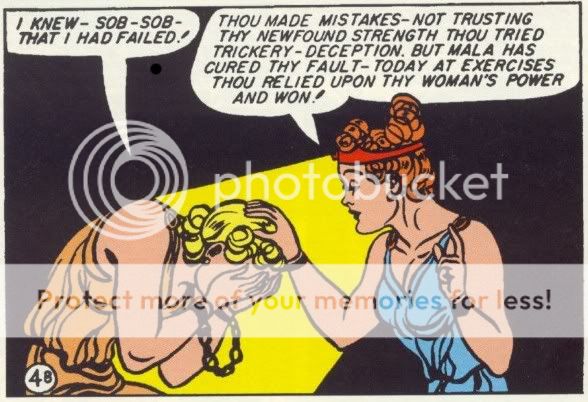
You can see some of what I mean when I say “the narrative is a fetish” by looking at how Marston uses it didactically. That is, Marston actually spends a lot of time essentially providing instructions about being a strong/good woman. Women must always trust their strength:
Photobucket

They must have a strong self-image (and you can find out whether they do by using a machine which reveals their subconscious thoughts…because involuntary confession is healthy…and stimulating!)
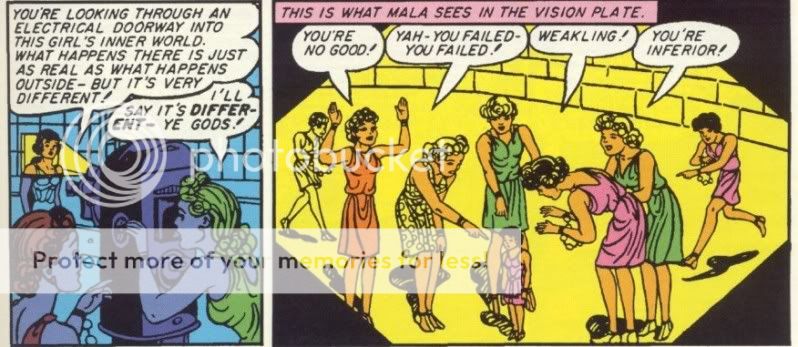
Photobucket

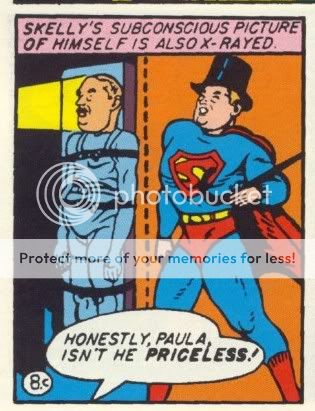
(This is from the third story, where we also get to see the subconscious image of themselves that men have, incidentally. Here’s one representative example:
Photobucket

Hey! Is that Mort Weisinger?)

Sorry about the detour. Back to instructions for healthy young women: they should carry themselves like queens not slaves.
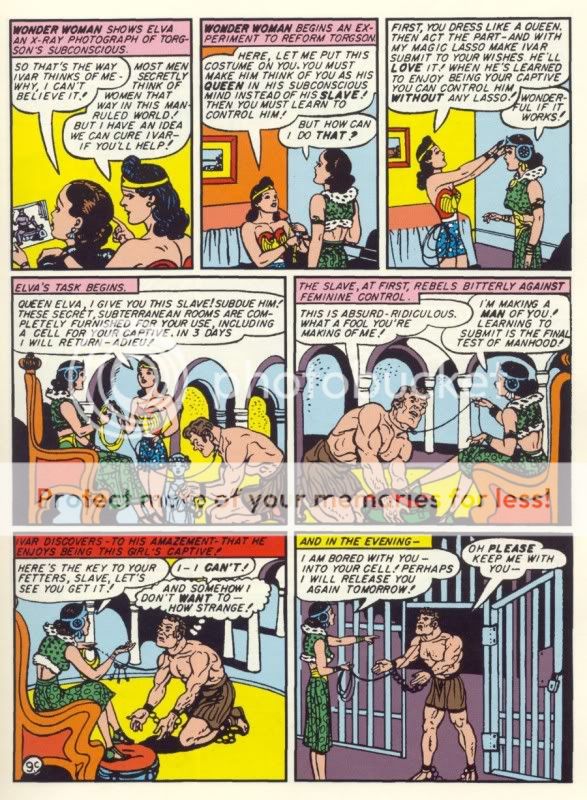
Photobucket

And they must never, ever abandon the scenario or…disaster!
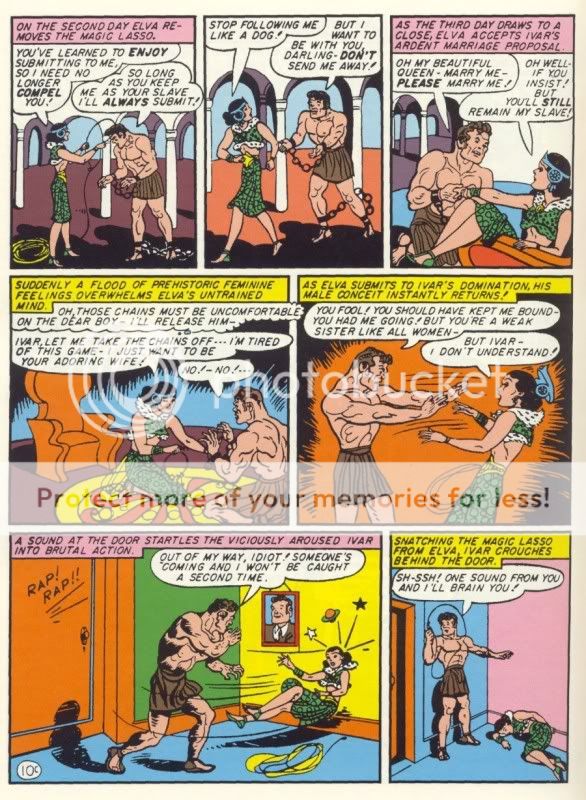
Photobucket

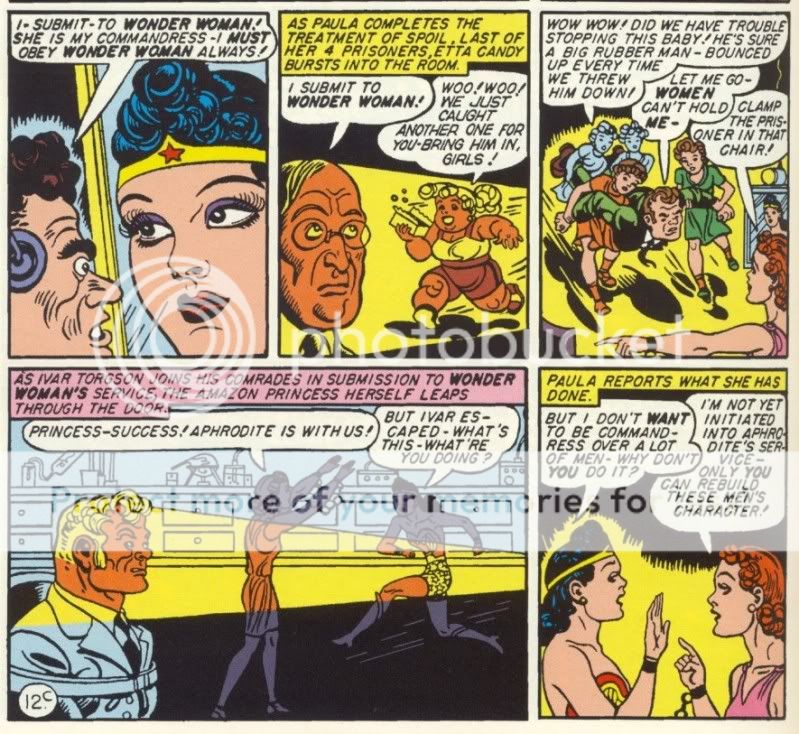
Similarly, you must never deny responsibility or turn away from authority; woman need to accept their mothering, reforming role even if it means burning their images into the brains of unprepossessing middle-aged idiots
Photobucket

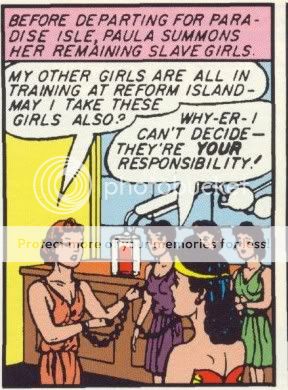
Or even if it means arbitrarily deciding to keep folks in non-consensual slavery
Photobucket

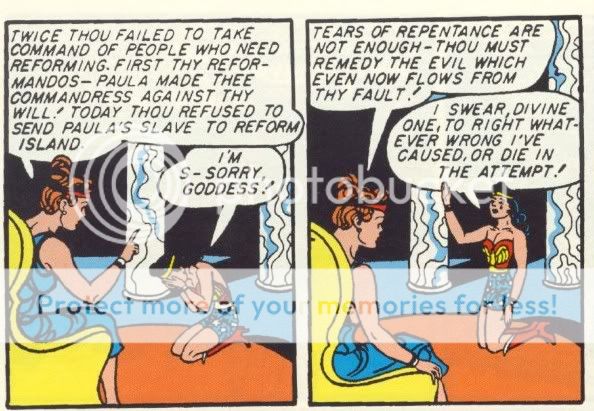
because if you shirk authority, Aphrodite will reprimand you:
Photobucket

(I think I’ve mentioned before how much I like Peter’s use of scale. WW is here drawn way smaller than perspective calls for, which emphasizes her vulnerability and submission. He does that sort of thing all the time.)

The point here is that the instructions are all basically narrative in nature; they’re about telling stories correctly, or participating in role-playing in the correct way. And, of course, these instructions are themselves part of the story; correction and instruction is itself part of masochistic fetishization. This is part of the reason that Marston’s moralizing instructions never feel tacked on or like gratuitous pandering to the condescending uplift view of the role of children’s literature. The instructions for living he provides are integrated, idiosyncratic, and charged; they’re clearly as much the point for him as are the fight scenes, or the bondage scenes.

It’s also why when it’s on, WW has a a fetishistic frisson between form and content which is like little else in comics. I’ve compared the series to Henry Darger before, and I think looking to outsider art makes a lot of sense; there’s an obsessive pleasure in the craft — the storytelling and I think the art as well — which is echoed in the obsessive pleasure in the content in such a way that the two are almost inseparable, reinforcing each other in a kind of cascade.

To go back to the mole man story…details are piled on details in a way that seems almost random and certainly excessive (as fetishes tend to be excessive.) Thus, the mechanics of mole-men/slave relations and interactions are explained in loving and really ridiculous detail: in the deep dark, women’s eyes adjust to the dark quickly, but men’s don’t, and so the men go blind, like the mole men. But the mole men can nonetheless see the slaves, even though mole men eyes are sealed shut from disuse. How can they see the slaves you ask? Well, because they slather the slaves in a special glowing paint which gives off ultra-violet radiation, penetrating the mole-men’s lids and allowing them to whip their slaves. And that’s just the exposition for one page…never mind the static earth electricity or the horrible dancing trap or the escape plot involving the Holiday Girls breaking into song, or…well, you get the idea.

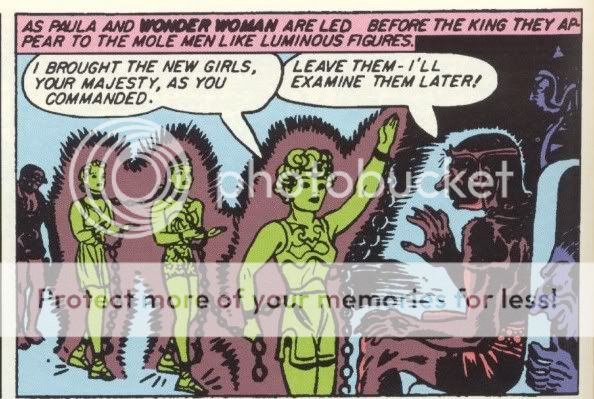
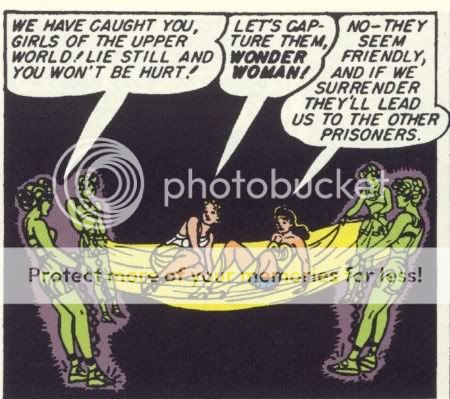
These narrative tergiversations, though, all circle around and lock into Marston’s (and probably Peter’s) obsessions; you can almost hear the series of sighs as they elaborate and close, elaborate and close. The glowing paint, for example, creates the narrative necessity (or excuse) for some of Peter’s most striking visuals; panel after panel of women glowing like beacons in the dark, with Peter picturing their radiance through quick, thick obsessive lines merging into inky cocoons — mysterious and contained, transcendent and controlled, otherworldly in bizarre lurid green and purple. (Again I ask, who did the colors for these books?)
Photobucket

Photobucket

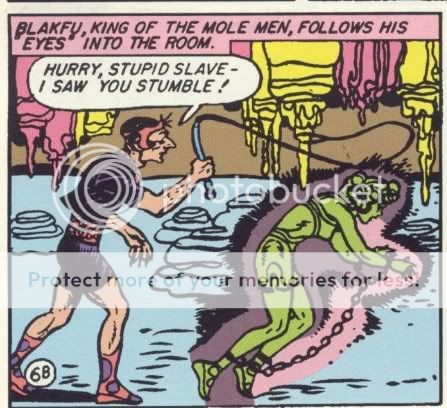
The emphasis on sight, blindness, and invisibility is another Marston obsession, and here you can really see how it locks in with his bondage and masochistic and narrative preoccupations:
Photobucket

Again, that’s such a great drawing by Peter, with those lovely scribbly lines defining the floor and the regimented series of stalactites obtruding into the foreground to give the sense of contained, claustrophobic space, both oppressive and womb-like. On one level, the mole man is the master; he’s whipping her. But on another level, she is the only thing he can see. Her submission and denigration (being slathered in paint (and yes, I’m sure Marston thought that was kinky in itself) so she can be better punished) makes her the center of his vision. He’s blind because he’s a man, and so a fool…but there’s also the sense that he’s blind contractually, as part of the negotiation whereby the top in a B&D relationship pretends to be in control. Not that this is necessarily a metaphor or a coded symbol of any of these things in particular, but rather that all of the tropes — control, blindness, single-focus, debasement, the promise of a fantastic and unduplicatable intimacy, the sense of a shared dark space, the narrative explanation and negotiation — are pleasurable in themselves, and then get combined and recombined in a kind of fractal fetish.

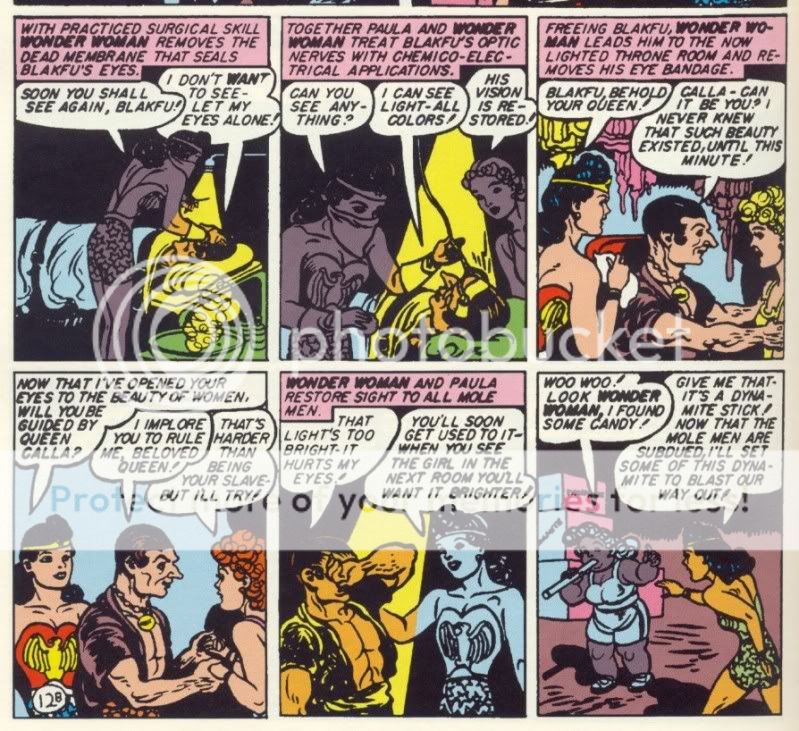
All of which means that Marston’s statements about power always have at least as much to do with rubbing the fetish as they do with actual analysis or advocacy. Thus, when he makes feminist statements — I don’t think they’re totally useless to a feminist cause, but they are compromised, in that the goal of his feminism is always more about the men’s desires than women’s. As a for instance — why *should* Wonder Woman have to take control of the lives of a bunch of middle-aged male idiots? Her tomboyish response of, hey! forget this! I’ve got better things to do! seems entirely reasonable and even admirable, and when Aphrodite scolds her for it, it seems unjust and transparently done on Marston’s behalf. Similarly, at the end of the Mole-Men episode, when the mole men regain their site and beg their former slaves to rule over them, you’d really like the slaves to say, “hell no! fuck off!” Especially since, if the female slaves were actually the ones with the power (as it intimated in various ways) it makes sense that the male slaves will now be, in some sense, the topping bottoms. Having women rule is about allowing the men to become self-actualized — or allowing Marston to get his rocks off.
Photobucket

And yeah, that last panel is Etta Candy so blinded by oral desire and subterranean dimness that she starts sucking on a stick of dynamite. I was sort of hoping she’d get a mole-man of her own, but no such luck. Maybe next issue.

Spider-Man 2

I just saw this. It’s really good, I thought; easily the best super-hero movie I’ve seen (and yes, that means it’s better than the Dark Knight.) Tobey Maguire is excellent as Peter; he’s got charming neurosis down cold, and he’s got a nice sense of comic timing too; Peter’s constant litany of hard luck comes across as both funny and touching, and you’d have to be pretty hard-hearted to begrudge him the happy ending (though I do wish MJ had told him off more thoroughly about the “I can’t risk your life” thing. He deserved to be told off for that.)

I mean, it wasn’t perfect or anything. The effects were pretty blah, — the computer generated stuff just doesn’t look all that good, and the blocking tended to be confusing rather than dramatic in the fight scenes. And having Doc Ock keep kidnapping those nearest and dearest to Peter just by accident strained credulity. But overall, it’s amazing how much the story benefited from being a story rather than a serial, so you could do things like, for example, give Doc Ock some sort of coherent personality, and a storyline with a beginning and end, rather than being forced to make him just an evil nutter and keep him around for infinite reboots. Which is to say, with all the flaws, I pretty solidly liked this more than the original comic, which I read not that, that long ago. It seemed like this got at the core of Lee’s concept — the melodrama, the humor, the moral dilemma — a lot more cleanly and subtly than Lee managed to himself. (I know Ditko’s art is really what’s supposed to tip the scales…but as I think I’ve admitted before, his work on Spider-Man never really thrilled me the way it does lots of comics fans.)

Come to think of it, I believe I like the Christopher Reeves movie overall better than the original Siegel/Shuster comic, or even than the Mort Weisinger silver age stuff. And I liked the Adam West Batman movie way, way more than the vast majority of comic-book Batman stories. For what that’s worth.

Updated: Edited to fix Tobey Maguire’s name. He spells it with an “e”? Who knew?