Nominations for the Award of Most Clueless

Over at Icarus comics, Simon notes that manga didn’t get too many Eisner nominations. He argues, though, that manga fans shouldn’t be bitter; they should just create their own awards. Precocious Curmudgeon agrees. (Thanks to Brigid for the links.)

Simon’s point is that awards are more about industry promotion and celebrating creativity than they are about objective quality…and that manga is big enough and independent enough to promote itself.

This is certainly correct…for manga. Manga doesn’t need the Eisners. I do wonder, though, whether it’s true that the Eisners don’t need manga. Or, to put it another way — manga has opened comics up to some vastly underserved demographics. It’s inaugurated entirely new genres. It’s helped to change distribution models. It’s vastly changed what comics in America are, and who reads them.

So you would think, maybe, that the industry might want to celebrate that. Maybe comics might want to use their awards show as a chance to point out to the world how things have changed, to embrace new readers, to paint itself as dynamic and exciting and forward looking and inclusive.

But of course the Eisners aren’t all that interested in doing that. And the reason is that the old institutions of American comics still haven’t come to terms with the changes in manga. They’ve watched the demographics expand without being able to figure out how to take advantage of it; they’ve adapted to some of the distribution changes but haven’t been able to embrace even those whole-heartedly.

So while the lack of manga at the Eisners isn’t a big deal for manga, I think it is maybe a big deal for the Eisners, and for the industry they represent. In short, it’s a sign of a a big, fat failure on the part of American comics. As is so often the case, a snub says more about the quality of the perpetrator than it does about the object of scorn.

Update: Brigid offers a polite dissent, pointing out that many of the Eisner judges are quite aware of manga, and suggesting again that manga needs its own awards. She also suggests that the Eisner’s should maybe expand to include more manga categories in the meantime…which they should, and which, if they did it whole hog enough, would preclude the need for a separate set of manga. If you’re the Eisners, why not create a whole parallel set of manga categories? You’ve got a leg up to begin with, so why not become the prestigious award for manga as well as for comics? Again, that seems like a great way to seem, and for that matter, to actually be, relevant to a whole new group of comics consumers.

Brigid also offers a mini-apology of sorts for the fact that manga fans (and she herself) aren’t necessarily all that into Western comics. I don’t think any apology is ever necessary for matters of taste like that; there isn’t any moral duty to read one comic or the other. With an institution like the Eisners, it would make sense for marketing and industry reasons for the awards as a whole to be more open to manga, but that’s really a different issue than saying, “this judge should like manga more” (especially since, as Brigid notes, many of the judges like manga fine.)

Update 2: And as long as this seems to be generating some interest, I thought I’d point out a couple of other recent manga posts which might be of interest: Kinukitty kicks off her column “Gluey Tart: Adventures in Manporn” with a review of prettyboy assassin manga Blank Slate; I talk about the Japanese Superman; and, from a bit longer ago, Bill Randall talks about perfect girlfriend’s and Sungiku Uchida’s bizarre manga Minami’s Sweetheart.

Throw another update on the fire: Lots of interesting responses from Precocious Curmudgeon, Heidi and Simon.

By the by, everybody who has posted on this knows more about the Eisners and more about manga than I do. Just in case that wasn’t already clear….

Bound to Blog: Wonder Woman #2

As I said last week at about this time, I’m trying to blog through all the issues of the Marston/Peter run on Wonder Woman. I’m hoping to post about one issue every Thursday and this is the second.

And yeah, I know this is Wednesday. I jumped the gun; maybe I’ll do it Wednesday or Thursday, depending? We’ll see, I guess.
______________
Photobucket

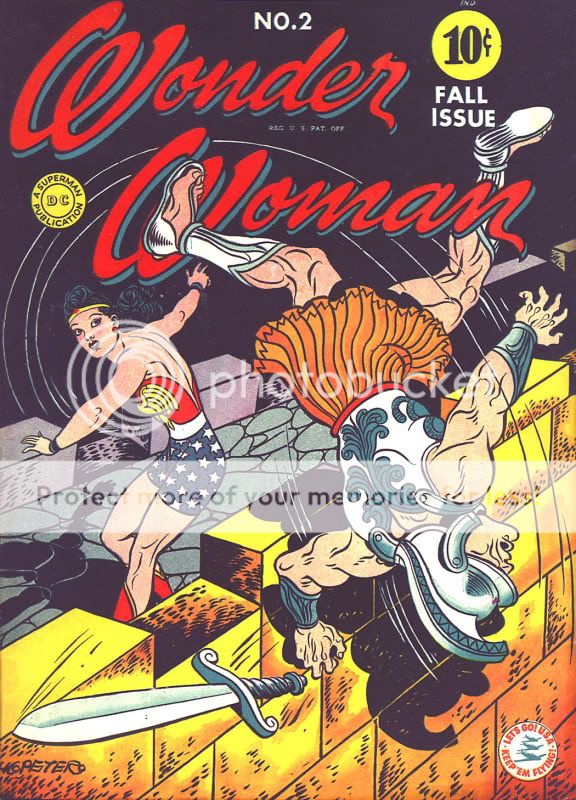
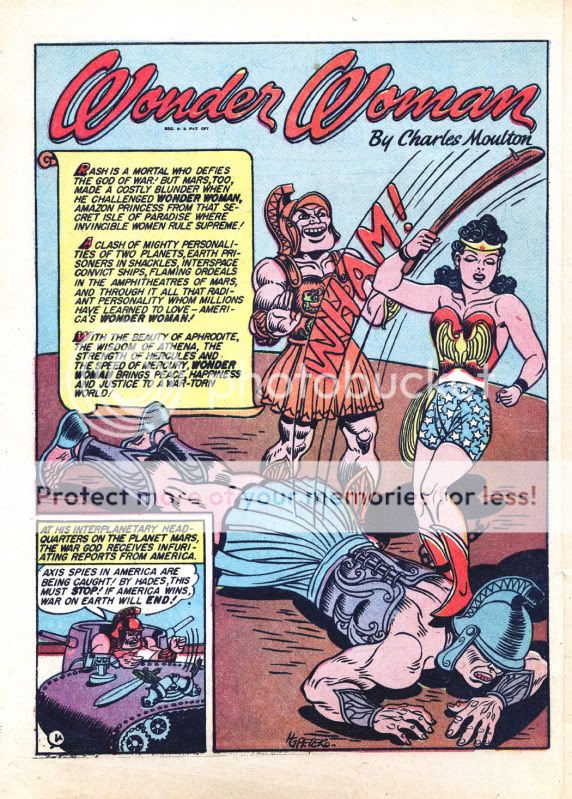
So I do love that cover, but it’s nothing compared to the initial splash page:
Photobucket

Thank you sir, may I have another?

It’s probably wrong for me to admit this, but I’ve danced around it before, and I might as well just come out and say it — I often find Peters’ soft-core efforts quite sexy. There’s something about the unabashed flowery femme of the designs and the stiffness of the figures that I definitely find appealing. He must have too, surely; WW is usually seen as all about Marston’s sexual obsessions, which I’m sure it was, but Peter must have had a fair bit to do with the goings on as well. In this drawing, for example — was it Marston who suggested that the big, tough Greek warriors should be wearing such frilly kilts? And the armor he’s got with all the filigree — and the colors! Ares (standing in the background yucking it up) really looks like he’s wearing a red dress. Peter has decided to make the God of War a transvestite. I don’t know…maybe it could all be Marston turning in incredibly detailed scripts a la Alan Moore…but I’m skeptical.

Anyway, unlike the last effort, this is essentially a single story — which means it’s virtually as long as a mini-series, clocking in at more than 60 pages. Even with a short story about Clara Barton and a prose piece, that’s a hell of a lot of pages…was this thing monthly? No, it says “Fall” on the cover, so I guess it must have been quarterly. Though Peter was also drawing WW’s adventures in Sensation Comics at the same time…it’s a lot of drawing, anyway you look at it.

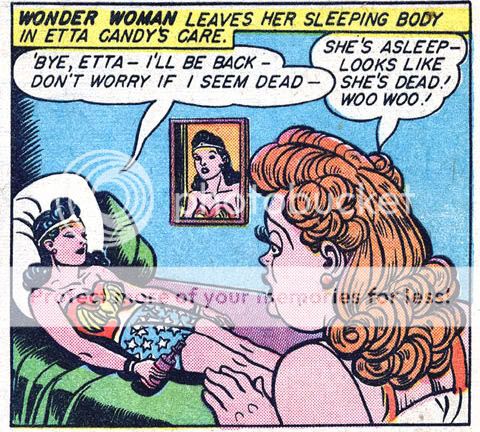
So what is the plot of this gigundus story? Well, Ares is pissed because WW keeps catching Nazi spies. This pisses off Ares because, as he says in that little inset panel above, “If America wins, war on Earth will end!” So Ares sets out to capture Wonder Woman, throw her in chains, make her his slave…you know the drill. He does this by arranging for the capture of Steve Trevor’s astral form. (How this works is a little unclear…but onward!) Steve is then taken to Mars, because Mars is where you live if you’re the God of War. WW leaves her body in the care of Etta Candy:
Photobucket

With those “woo-woos” WW whooshes up to Mars, where, after wearing a lot of chains and engaging in a series of healthy tests of strength, with some light spanking thrown in for good measure, she frees Steve and travels back to earth. Enraged, Ares sends a series of minions to recapture her: the Earl of Greed, the Duke of Deception, and the Count of Conquest. After many trials (by baseball, among other things) WW defeats them all, even Ares — ending war on earth! Okay, not quite; I guess he’s still got minions around or something. There will be more issues, in any case; they promise.

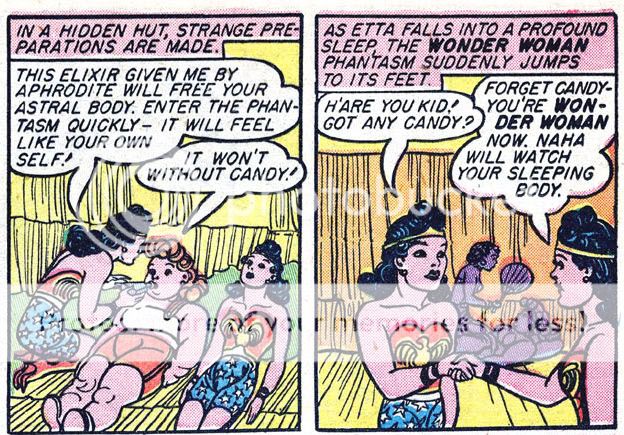
Since we’ve raised the weighty and altogether unfortunate profile of Etta Candy — it’s really worth pointing out what a completely bizarre character she is. It’s not just the “woo-woos!” and the fact that practically every speech bubble she’s given has to mention at least once how much she likes candy. That would just make her the comic relief. But what’s really strange is how important she is to the plot. As we saw above, Etta tended WW’s body while our hero was off on Mars. Etta’s far more than just a passive helper, though. In the battle with the Duke of Deception, for example, the Duke creates a fake Wonder Woman duplicate body (no, I don’t know why. Don’t ask silly questions.) Wonder Woman manages to capture the fake body…and then puts Etta’s mind in the duplicate body.
Photobucket

And in the final battle against Ares, when WW is tied up and helpless, she sends a mental radio message to Etta who somehow goes astral, brings acid (astral acid?) and frees WW.

In other words, plot-wise Etta isn’t really comic relief; she’s the indispensable assistant — even the cavalry. It’s *her*, not Steve Trevor, who gets to save Wonder Woman. Wonder Woman seems to treat her more or less as an equal, and Etta seems to see herself that way as well — Etta certainly, and bizarrely, doesn’t seem to see WW as someone to envy or aspire to — when her brain is placed in that slender, perfect body, all Etta can think about is how much she wants to go back to eating candy.

Obviously, it’s a bit of a leap to see Etta Candy as some kind of feminist icon. But…I don’t know. Compared to some of her later iterations (sex kitten cameo on the animated movie; loyal sidekick and romantic interest for Steve in the Perez run), fat, self-confident, and (perhaps mystifyingly, but still) competent doesn’t seem too bad.

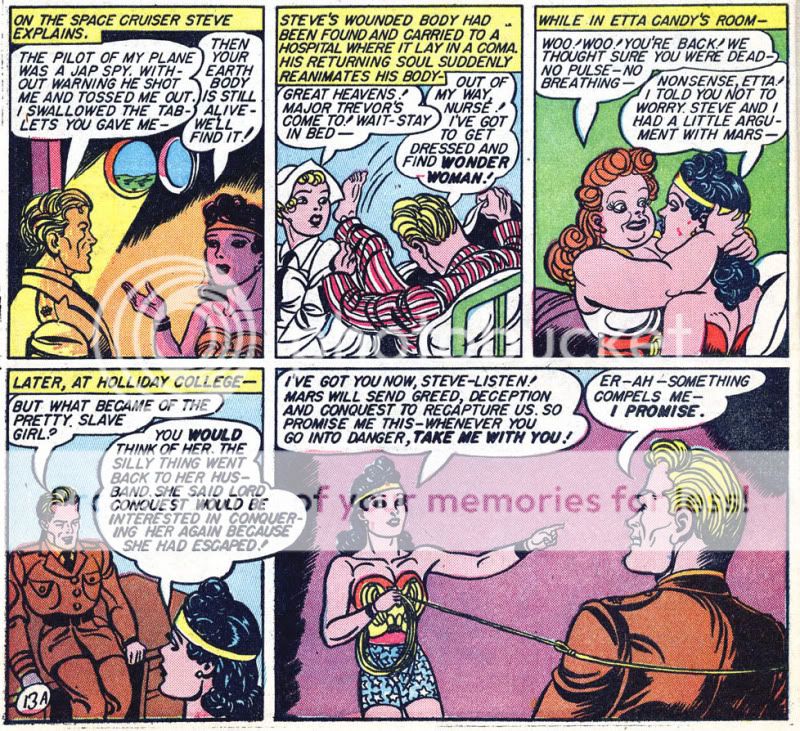
Certainly, she seems to have it all over Steve.
Photobucket

As you can see, in the last page of the first section, when they’ve escaped from Mars, it’s Etta who actually gets to share an embrace with WW. In the next panel, Steve expresses a very natural confusion about what the hell happened to a slave girl who helped them escape from Mars — and WW positively condescends to him. “You *would* think of her!” Silly man; you’ve only got one thing in your pretty little heads! But don’t worry, Steve, your little friend trotted back to her consensual B&D relationship with, ahem, the Count of Conquest! Now you silly little thing, let me tie you up and explain to you that you must never, never leave the house without an escort. You just have to have a firm hand with these men or the little dears will get themselves into trouble. Now let’s just settle things between us women, Etta. Could you fly to Mars with a bottle of acid, sneak into the dungeon of the God of War, and burn through my chains please? By tomorrow? And don’t tell Steve…he worries so!

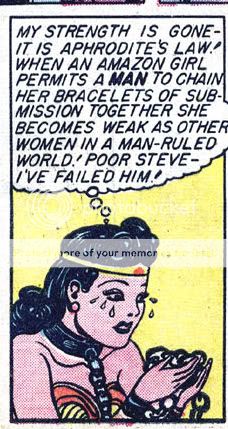
You may be wondering why on earth Wonder Woman needed to get Etta out to Mars anyway; why not just break her chains herself?

The answer is that Wonder Woman allowed her bracelets to be chained together by a man, which robs her of her powers:
Photobucket

Oooookay. But…what about this?

Photobucket

There’s Wonder Woman from earlier in the same issue. Looks to me like her wrists are changed together, right? And she’s looking pretty super there (incidentally, note that Peter appears to have gratuitously drawn in visible nipples on the woman WW is defeating. He does that occasionally.)

Of course, Marston isn’t a stickler for continuity. Still, what’s different between *this* binding and the other one?

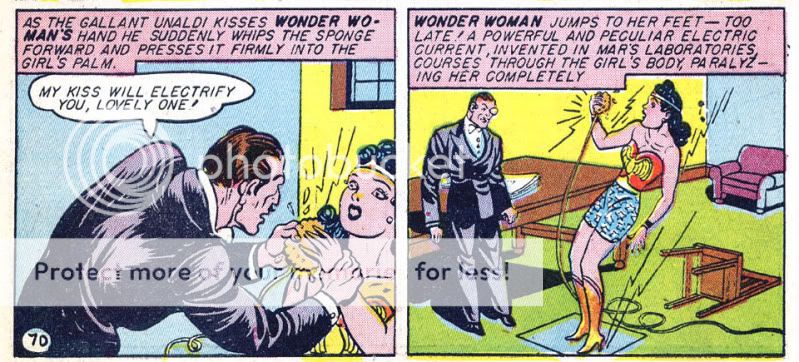
The answer seems to be that in the instance where she lost her powers, WW was bound by a dark, handsome Italian.
Photobucket

As the Count of Conquest’s minion explains:
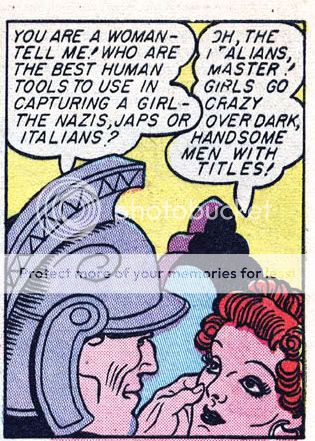
Photobucket

WW, in other word, is being punished for the weakness of allowing a man to hold sway over her (though she certainly never seems to be that interested in the guy…but I guess Marston holds his women to a high standard in these matters.) When she tearfully regrets failing Steve, the suggestion is that she’s been unfaithful. This is emphasized by the fact that she’s embarrassed to explain to Steve exactly what happened….
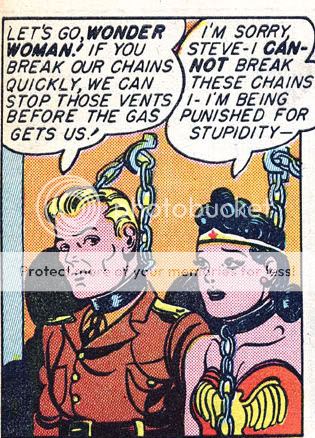
Photobucket

Again, though, what’s interesting is that the particular drama of unfaithfulness which is being suggested is one in which WW takes what is essentially the male role; she falls for the dark, seductive femme fatale, betraying the helpless, noble woman at home.

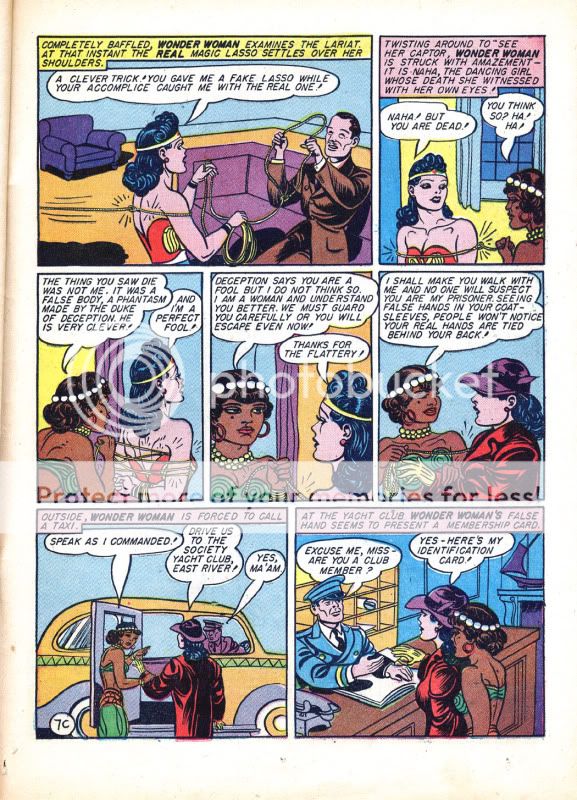
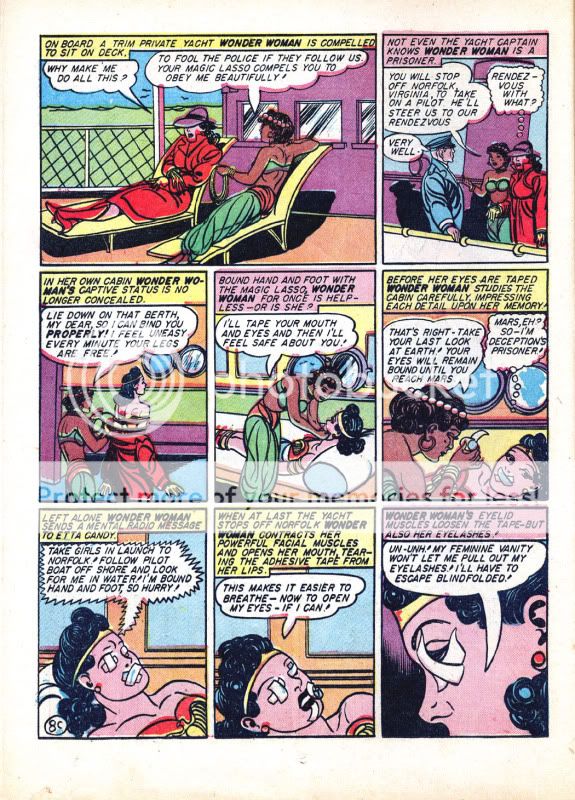
I’d be remiss if I didn’t point out that there’s an actual feminine femme fatale in the book as well — and by all appearances she is also bent on seducing Wonder Woman — or at least in luring her onto a cruise ship and engaging in…well, no surprises, really.
Photobucket

Photobucket

Leading her around with her hands secretly tied under her coat, huh? You have to wonder if Marston was trying that one at home. (Bonus points for fetishizing the exotic minority…and for implying that said exotic minority wears her colorful, diaphanous, scanty ethnic attire whereso’er she goes.)

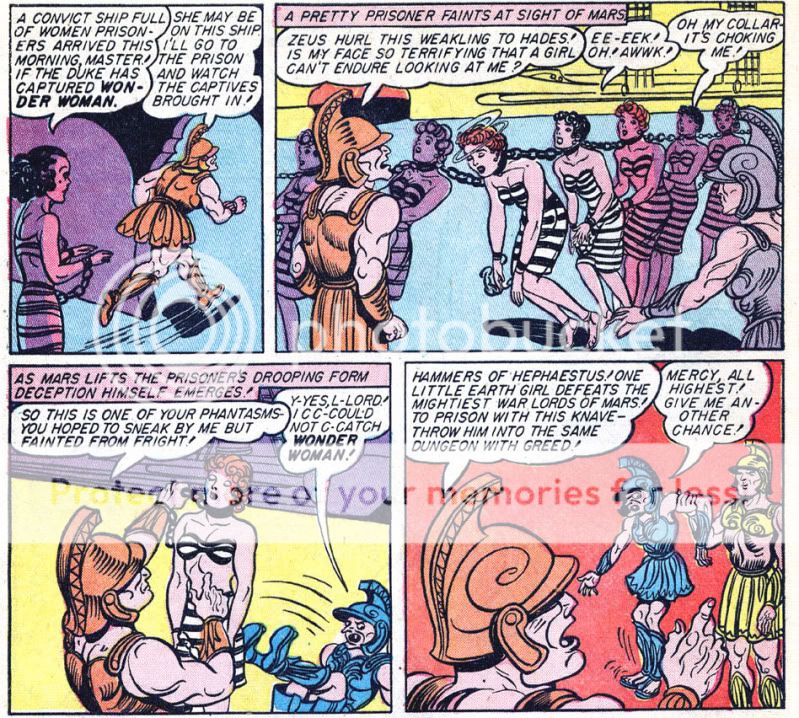
Oh, and last time I promised cross-gender body swapping. Here you go:
Photobucket

That’s Deception sneaking around in the body of a slave girl. Real women wear chains; real men wear tutus.

_____________

So I thought I was done, and then I keep thinking of more things I wanted to say. Stupid brain.

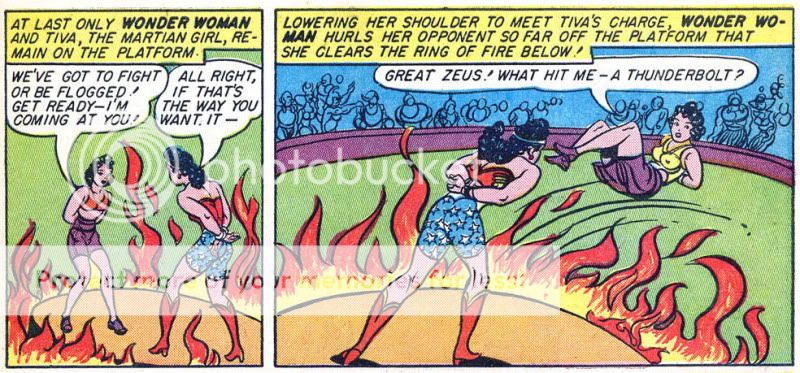
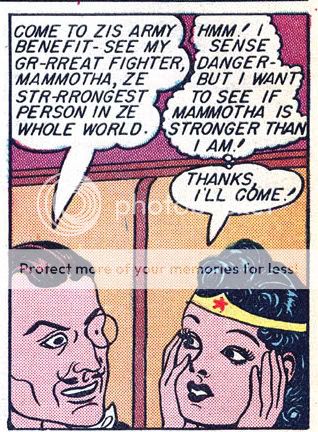
In terms of WW’s apparent need to avoid submission to, or even perhaps romantic relationships with men — there’s definitely something going on with a kind of butch tomboyishness, and perhaps a hint of a (cross-gendered) Peter Pan as well. There was a bit of that in the first issue as well; when Diana says she wants to leave Paradise Island to follow Steve, her mother says that that will mean giving up her “birthright” of immortality. That is, there’s a suggestion (thought it doesn’t seem to be much worked through) that Paradise Island is, like NeverNeverLand, a kind of metaphor for childhood, and that WW is a kind of magical and eternal child (she is made out of clay after all.) Again, in the second issue, we see WW has a real weakness for contests of strength:
Photobucket

She’s like a kid, unable to resist the opportunity to prove that she’s the strongest.

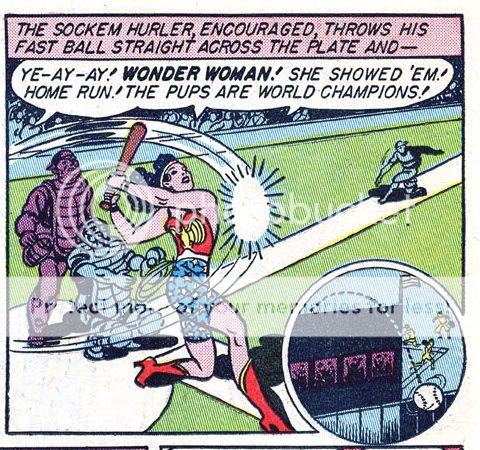
There’s probably something of that in all early super heroes…Superman certainly is a kid’s fantasy. It’s just that that’s really remained a part of Superman to some degree, but the corresponding meme for Wonder Woman has gotten a little lost, I think. Wonder Woman is a pretty sober character now; she’s more about standing up for women or peace or whatever, and maybe less about just beating the tar out of the boys at baseball. Which seems kind of too bad.
Photobucket

All right, that’s it…except, man, look at this Hitler caricature.

Photobucket

That is one gloriously saggy-faced ubermensch. And in the second panel, Marston has him so nuts he’s chewing the carpet. Literally. That cracked me up.

Manporn Ho! — and Further Ho!

A couple of comments on my initial post about our new manporn column have expressed a certain amount of levity at the prospect. Obviously, manporn is somwhat funny in and of itself. I thought that I might explain a bit more briefly about why I want such a column on this site.

Basically, I think yaoi is pretty fascinating. It’s a genre that for the most part didn’t exist in the U.S., but which obviously has a large appeal. As such, I think it’s worth thinking about and talking about — especially since the critical reaction to it from most other corners of comicdom tends to be disbelief and ridicule.

So…Kinukitty is very funny, and I expect the column will be as well. But I don’t think yaoi is intrinsically any more ridiculous than super-heroes or alt comic autobio, or whatever. Yaoi is more unfamiliar, of course…which is the reason to have a column about it.

Update: Kinukitty’s first review of Blank Slate is now online.

Manporn Ho!

Eagle-eyed blog watchers may have noticed that we have added a fifth hood to our utilitarians (or perhaps a fifth utilitarian to our hood? Yes, that probably sounds better.) What was I saying?

Right. We are very pleased to welcome the delightful and talented Kinukitty to our roster. Kinukitty will be writing a column entitled “Gluey Tart: Adventures in Manporn” focusing on yaoi, shonen-ai, and related pretty boy topics. The column will be (at least in theory) weekly, and should appear every Thursday (which is tomorrow.)

For those of you who must, must, must find out more about Kinukitty instantly, you can go to her livejournal wherein is archived her own personal manporn slash effusions. You can also hop over to the Gay Utopia and read her essay about why young girls need more manporn plus another piece of slashy goodness on the same site.

Kinukitty will have more to say on her own behalf tomorrow. Give her a nice welcome then, won’t you?

The Japanese Superman

I did a couple of posts about Matt Thorn’s classic essay, The Face of the Other, in which he explains:

I have given presentations on manga to Western audiences many times, but regardless of the particular themes of my talks, when the floor is opened up for discussion I am invariably asked the same question: “Why do all the characters look Caucasian?” You may have asked yourself the same question.

I answer that question with a question of my own: “Why do you think they look Caucasian?” “Because of the round eyes,” or the “blonde hair,” is the common response. When I ask then if the questioner actually knows anyone, “Caucasian” or otherwise, who really looks anything like these highly stylized cartoons, the response may be, “Well, they look more Caucasian than Asian.” Considering the wide range of variation in the features of persons of both European and East Asian descent, and the fact that these line drawings fall nowhere remotely within that range, it seems odd to claim that such cartoons look “more like” one people than another, but I hope you will see by now that what is being discussed has nothing to do with objective anatomical reality, but is rather about signification.

Still, this can be a hard sell;a cartoon character with wide eyes looks white to us; it’s hard to believe they look Japanese to the Japanese. As commenter awb says:

The article seems to be telling me not to believe my lying eyes. I think he is saying that people are trained to accept the western european look as “standard” or even preferred and because Japan was never dominated by a western society the see themselves as the “standard” and therefore their manga is reflective of that. But, jeez, they don’t look asian! Yes, there are some Japanese without the folds on their eyes and those with frizzy hair but is he telling me the vast majority don’t?

After a whole thread of my constant nagging, awb did eventually (and perhaps just to shut me up) agree to accept Matt’s expert opinion that the Japanese see the manga characters as Japanese. But…it’s not that easy to shut me up. And, moreover, I’ve thought of a really good example to explain how it is possible for the Japanese to see the round-eyed manga characters as Caucasian. So, I give you….the Japanese Superman.

Photobucket

Photobucket

Photobucket

Photobucket

That’s the original Joe Shuster version of Superman, of course. And if you’ll look closely, you’ll see that…he looks Japanese. He’s got dark hair. He’s got narrow slanting dark eyes. Shuster’s ideal man is Asian. An inferiority complex, perhaps?

No, of course not. Even though Superman iconographically “looks” like he could be Asian, we see him as white, because of the context and because our iconographic default is “Caucasian”, even when, as in this case, the signs actually point somewhere else. In Japan, it works the same way, but in reverse; Japanese is the default, and if you want to represent, say, a Caucasian, you have to take some specific steps to get there.

So why is Superman stylized like that? I don’t have any idea, really…but I’d like to think it’s for the same reason that manga characters look “white”. That is, there’s iconographic influence. Tezuka borrowed his iconography from Disney; it’s not impossible to believe that Shuster got some of his iconography from a generalized Art Nouveau illustrational milieu, which was in turn heavily indebted to Japanese prints. Those older prints represent Japanese faces in a way similar to what we still (perhaps influenced by those very prints?) think of as iconographically Asian.

Update: In comments, Tom undoes my elegant theory with a tiny little squiggle. Darn it.

Update 2: But…Mitch defends the Japaneseness of the design. Phew!

Nowhere Man, Somewhere Dragon

In this post a few days ago I compared these two pictures:

Photobucket

Photobucket

That first, with the dragon, is from Dokebi Bride, a Korean manwha by a young creator named Marley. The second image is from All Star Superman, drawn by Frank Quitely, one of the most respected mainstream illustrators currently working.

As I said in the previous post, both of these images are meant to be awe-inspiring, or viscerally impressive. And as I also said, Marley’s drawing really impressed me, while Quitely’s didn’t as much (I don’t hate it; I just don’t love it either.)

Anyway, I was thinking a bit more about these two images, and it struck me just how almost iconically west vs. east they are. In the first place, of course, Superman’s a Western symbol, and the oriental dragon is an Eastern one. More than that, though, is the way these two symbols work, and how they’re integrated into the stories.

Superman in general, and in this image in particular, is about individual triumph and modernity — individual triumph *as* modernity in some ways. (See Tom’s essay here for his take on this. Quiteley’s image, with its retro-modernist vibe and workers-of-the-world referencing, is positioning Superman as savior and worker — as salvation through work, you could even argue. It’s the apotheosis (pretty much literally) of sacrifice figured as massive effort — man puffed up through sheer sweat and muscle to take his seat at the helm of the universe.

(There’s a socialist/constructivist tinge to the design as well too, referencing Siegel’s design sense and the character’s initial quasi-socialism (beating up mine owners and the like. It’s kind of an interesting reminder that capitalism and socialism are *both* modernist and *both* puritan; both fetishize effort and progress in very similar ways. They’re more different inflections of the same idea than they are true opposites.)

Okay, where was I?

Oh right. So the point is that Quiteley’s image is about the bittersweet triumph over adversity; man attaining Godhead through superforce and sacrifice; an effortful Christ. The awe or reverence is the glow of triumph (though laced with some melancholy, since Supes has to keep the sun going forever, more or less.)

In Dokebi Bride, on the other hand, the awe has a very different inflection. Obviously, the dragon isn’t human, and, indeed, it dwarfs the woman in the frame. The point here is not mastery over nature (Superman controlling the sun through work) but the untameability of nature. The summoner here is actually a nascent capitalist; she wants to gain individual glory through demonstrating her summoning skills, and/or just through putting on a good show. The dragon is not amused:

Photobucket

This isn’t to say that the dragon is evil, or necessarily inimical to human beings; on the contrary, he has a close, even loving friendship with the the main character’s grandmother, who is the village shaman. Nor is the dragon all powerful; in fact, he’s weak and tired and old. But even an old dragon is a lot bigger than you and your dreams of glory, and fucking with him is a really bad idea.

It’s also interesting, I think, how nostalgia is worked through in these images. Both are definitely nostalgic; Quiteley’s is nostalgic for a more innocent modernism — a moment when progress to a super-future seemed possible. Marley’s is nostalgic for a rural Korean past and mythology; a countryside and a spirituality that are dying out. Both reference these nostalgias thematically (it’s what they’re about) and through their art styles; in Quiteley’s case, by reference back to the art nouveau/constructivist milieu of Siegel (and Winsor McCay, I think); in Marley’s, to innumerable examples of traditional art and printmaking.

The way the nostalgia works, though, is pretty different. Quiteley’s nostalgia, is, I would argue, kind of adrift. For all the talk about Superman-as-myth, the truth is he’s not Christ; his roots in our culture go back only 70 or 80 years, and he doesn’t actually stand for anything in particular except hitting bad guys and being kind of entertaining. Nostalgia for Superman isn’t really nostalgia for any big idea so much as nostalgia for a favorite toy…and, indeed, Quiteley’s image could almost be a toy box, or a figurine. Superman seems packaged, a commodity fetish, which points to its own possession (or the loss of its possession in a nostalgic past.). The drawing is deliberately set nowhere, in a kind of suffused emptiness; it’s an eternal frozen moment of nostalgia for one’s own wonderfulness, that goes nowhere and comes from nowhere.

Marley’s drawing, on the other hand, is a nostalgia for a particular place and a particular time. It is *this* fishing village in Korea that her grandmother is tied to (literally; she is possessed by a spirit that won’t let her leave.) The dragon is powerful, but it only rises *here*. For there to be wonder, there has to be a particular landscape, a particular time. The way the earth moves can’t surprise you if you’re able to fly off and turn it yourself.

The point here is that super-hero comics very rarely have a strong sense of wonder. With all the spectacular feats, you’d think they would — but somehow they all end up as tricks; they’re fun and goofy, or I guess more recently bloody, but they don’t actually inspire awe. And I think it’s because of something Tom said, “Superman keeps the universe our size.” Super-heroes are there to make things more manageable. Awe — a sense of vastness, of human insignificance or vulnerability — is antagonistic to everything they stand for. If Superman saw that dragon, he wouldn’t be scared or impressed — he’d just punch it in the snout. (As Wonder Woman did in a similar situation..) There’d be big explosions! There’d be excitement! There’d be action! But there wouldn’t be a moment where you said, “oh my god,” and felt rooted to one particular spot, and overwhelmed.

Abstract Nursery Rhyme

This is cross-posted at the Abstract Comics Blog.

I did this as an illustration for a nursery rhyme/poem I wrote. You read down for the first verse, then flip the image to read the second. I’ve included both orientations so you don’t have to stand on your head (or upend your laptop.)

Photobucket

Photobucket

The poem reads:

The birds fly up,
The birds fly down.
The birds fly underneath the ground.
In layers of silt, beneath our feet,
Their feathers rustle, deep on deep.

John walks up,
John walks down.
John walks to another town.
Dust in his mouth, dust in his shoes,
Birds overhead, in ones and twos.