Send Back Sendak! Boost the Seuss!

I find Donald Phelps’ writing style maddening; circumlocution is piled on parapraxis until all you can really see is the giant, rather desperate sign waving back and forth: “Kiss me! I’m erudite!”

Nonetheless, his new column in TCJ is tackling interesting subjects. Last time out he talked about the classic pulp occult novels of Manley Wade Wellman, which look pretty fabulous. In TCJ 294, he compares Maurice Sendak and Dr. Seuss, which is a fun topic to think about, even if, (to no one’s astonishment) I disagree with everything he says.

Phelps’ basic point is that Sendak is better than Seuss because Sendak is more of a formalist. In the selection below, he’s talking particularly about a 1934 comic strip by Seuss which is fairly chaotic and ignores panel borders.

An object lesson, I might suggest, in the liabilities of kindergarten chaos as practiced ad infinitum by Giesel. It involves the jettison of form, embodied, in the example just cited, in those ubiquitous panel boundaries: expandable (as Hal Foster and Billy DeBeck variously demonstrated) but very, very seldom, if ever, dispensable or, challengeable, at least, as obtusely as Seuss challenged them. Form: that which delimits, that which demarks, that which identifies, in children’s art especially — like that of Dr. Seuss and Maurice Sendak. Form entails a sense of the imagination’s geography and its component laws.

Such a geographic sense, along with the commitment it would appear to involve, has never been evident for me in the fantastical outpourings of Theodore Giesel. One recalls once more — somewhat querying — the little homilies embodied in some of the later books: How the Grinch Stole Christmas, Horton Hears a Who, Horton Hatches the Egg. Aren’t such sermonettes the occasional warning or symptom that the author, albeit with whatever benign and public-spirited sentiments — recognizes (make that: re-recognizes) the work of his hands as a Marketable Commodity. And one might observe: a symptom of the deficiency of form, one might say, the integrity of the artist’s work, as manifested in laws, not homilies.

Phelps then goes on to laud Sendak for being more restrained and controlled:

The stories of Sendak unfold themselves in gravely exact segments of action, by soberly defined anatomies, enacting the fables in compact but soberly graphic pantomime. The pictures as a rule are not enclosed save by the pages’ white margins, the concentrated imagery suggesting a dream’s flickering vignettes. Yet, I can not sufficiently mark the tone of earthy, almost prosaic reality that Sendak bestows on his visions.

So to sum up, Seuss is uncontrolled, overly commercial, and kind of gauche. Sendak is controlled, brimming with artistic integrity, and classy.

The difference between Seuss and Sendak, in other words, isn’t only, or primarily, that Sendak is more interested in form. Phelps can natter on all he wants about the link between homilies and formlessness,capitalizing “Marketable Commodity” just to make it look more official, but that doesn’t change the fact that the central claim is complete bullshit. An interest in neat moral packages doesn’t have jack to do with how much of a formalist you are. Hogarth and Grunewald have pretty solid formal virtues I’d argue; so does Art Young. And for that matter, as far as language goes, Seuss, with his strict doggerel rhythms and rhymes, is much more interested in form than Sendak, who works in much looser verse or in prose, and who includes frequent asides and narrative wavering. Phelps is merely the victim of a common modernist critical confusion; the assumption that if an artist is willing to put meaning in his work, then that work must be formally bankrupt. This is a pernicious doctrine, and it should be hooted.

No, what Phelps is really getting at, undercover of his muddled cry of “form!”, is that Sendak is — definitively, self-consciously — high-brow. Sendak references Winsor McCay. He fetishizes volk culture (folk tales, nursery rhymes, his own ethnic roots.) He likes tweaking the bourgeoisie with a little bit of nudity here, some impish rebellion there. His books thrive on an improvisatory cleverness akin to that now thoroughly high-brow music, jazz (as in, say, “Hector Protector”, where the nursery rhyme “As I went over the water”, where the most memorable image is of a sea-monster mentioned nowhere in the text.)

Seuss, on the other hand, is a big, fat, middle-brow. He doesn’t tweak the bourgeoisie; he embraces them, with long screeds about how great democracy is and what a wonderful thing it is to celebrate Christmas. The volk he loves aren’t ethnic; they’re the deracinated Americana, with their lovely rituals of high-school graduation and self-help rhetoric. He doesn’t bother with old, fusty nursery rhymes…why should he, when he can make up twelve of his own just as easily?

In other words, I think that, in choosing Sendak over Seuss, Phelps is just proving that which should come as a shock to no one who has read his prose; namely, that he prefers the pose of an aesthete to the pose of an entertainer. That’s certainly not always the wrong choice, but I think it is in this instance. Sendak has done a lot of great books, and is a wonderful artist, but for me, at least, his pretentions can start to grate — he certainly *is* clever, but I wish occasionally he’d spend less time pointing it out, and more time telling a story that my son actually wanted to pay attention to. Seuss, on the other hand, may reek a bit of greasepaint and the uplift, but he sets off so many verbal and visual fireworks that I find it impossible to take offense.

Plus, Fox in Socks is, hands down, not-even-worth-discussing, my favorite book to read aloud ever…with the possible exception of Seuss’ very entertaining tongue-twister follow up, Oh Say Can You Say.

Amerie: Because I Like It

I’ve finally gotten rid of my ten-year-old-plus imac and purchased a Macbook, which means that blogger is much, much easier to deal with. To celebrate, I figured I’d start posting highlights from the back catalog (or I like to think of them as highlights, anyway.) To start I’ll be reprinting some of the music reviews I wrote for Bitch magazine in 2007.)

Amerie
Because I Like It
Columbia Records

This is Amerie’s first album without producer Rich Harrison, and she takes the opportunity to demonstrate that the signature style they perfected together was more her than him. “Forecast”, “Hate to Love You,” and “Gotta Work” are brutal, unrelenting funk, built around percussive horn samples and beats so jagged that you expect James Brown to jump out of his grave to say “Huh!” Amerie has writing and arranging credit on most of the numbers, and she certainly sings as if she owns the material. On the retro-hip “Make Me Believe,” she gets within testifying distance of Ann Peebles; on “Take Control” she declares “I love the way you kiss my neck in public” wth a sexy-tough exhalation that’ll have you fanning yourself. The cover art may be fashion-shoot girly, but R&B doesn’t get much more cockily virile than this — in comparison, both Justin Timberlake and R. Kelly sound like 11-year olds who haven’t quite figured out which end of the toy is up.

That’s the first part of the disc, anyway. The second degenerates into a bland, ballad-heavy mush, relieved only by “Paint Me Over”, a break-up song with a decent tune and a bit of actual pathos. Some day, I sincerely believe, Amerie will figure out how to deal with slow tempos and the result will be an absolute masterpiece. Till then, half a perfect record will do nicely, thanks.

Svengali?: We don’t need no stinking Svengali.
Columbia Records: Needs a good talking to: as of mid-September this record had not been released in the U.S. Luckily, it has been available by import — and, of course, by download.

Updated fun fact: This album never did get a U.S. release. Stupid Columbia records….

Zen and the Art of Self-Satisfaction

This review of The Artist’s Way was published first in the Baffler, then on my old group blog Eaten By Ducks, and is here again for those missed it the first couple of times. (I think this is, by the by, the first piece of criticism for which I was ever paid.)

Though The Artist’s Way claims “to tap into the higher power that connects human creativity with the creative energies of the universe,” what it really taps into is the same old shit. More specifically, The Artist’s Way sounds, at times, exactly like contemporary poetry; at other times like economic theory; and at still other times like a combination of management consultant jargon, NPR commentary, and friendly academic feminist anthropology. There are, in fact, several bleak moments in which The Artist’s Way sounds like all of these, and like everything else as well. Yet despite the motherload of verbal detritus which spills from its pages, the book never once compromises its truly awesome vacuity. It seems determined to make as little as possible from as much as possible: an ambition which, while amusing at first, quickly becomes seriously disorienting. The unwary reader may begin to feel that all that he has ever read or thought has been designed with the nefarious purpose of leading him to The Artist’s Way , and there abandoning him. One finds oneself clutching the edges of the book a bit too hard, as if to prevent oneself from pitching forward into the page and falling forever into a bottomless and eerily familiar abyss.
It is an abyss which has already swallowed a large number of people. Originally published in 1992, The Artist’s Way was marketed as “a spiritual path to higher creativity” — a workbook for anyone who wanted to learn to become an artist. Since then, it has sold over a million copies, inspired numerous sequels, and been praised by many artists, including singer Kathy Mattea, who credits it with giving her a “new direction.” It’s basic thesis — that everyone, deep down, is an artist — has proved enormously popular: almost as popular as such better-known theses as “everyone, deep down, is equal,” and “everyone, deep down, is free.” These slogans are noteworthy not because they are inspirational, beautiful, or true, but because they are self-fulfilling. To say, with our founding fathers, that everyone, deep down, is equal is to ignore all those people who, up here, on the surface, clearly aren’t. To say with The Artist’s Way that everyone is an artist is, therefore, to be guilty of more than stupidity; it is to be guilty of willful blindness, and manifest bad faith. Indeed, The Artist’s Way genuflects to the zeitgeist with such cunning efficiency that it attains a grandeur usually associated only with epoch-making documents like The Constitution of the United States and The Valley of the Dolls.
The Artist’s Way is written — to the extent that such a book can be said to be written — by Julia Cameron, with the help of Mark Bryan. Mark Bryan is Cameron’s former husband and an expert in “business creativity,” which is all, I think, that needs to be said about him. Julia Cameron — or “Little Julie” as she sometimes calls herself — has an even more improbable past; she is a recovering alcoholic, Martin Scorcese’s ex-wife, and a one-time writer for Rolling Stone, in approximately that order. That neither Cameron nor Bryan is an artist in the conventional sense may explain their utter disrespect for art in all its forms. Indeed, they seem to hate art, with a shallow, condescending hatred reminiscent of those grammar school teachers who loathe the unfortunate pupils they so mercilessly praise.
Duplicitous philistinism is, of course, a typically American vice, and notwithstanding its Mt. Fuji cover, The Artist’s Way is a very American book. Like most self-help gurus, Julia Cameron has an American belief in the efficacy of individual action coupled with an even more American contempt for the individual: everyone, she argues, can learn to be successful, because everyone is a failure to begin with. “[W]e are all creative,” she tells us in one breath, and then in the next, “all of us are [blocked] to some extent.” We are all, in other words, failing to live up to our full potential as artists, much as welfare mothers fail to live up to their potential as entrepreneurs. This, naturally, is where Cameron’s book comes in — job training, as it were, for the aesthetically underprivileged.
Like job training, too, The Artist’s Way, teaches no actual skills. Cameron avoids making even the most basic suggestions about the mechanisms of art — nowhere does she indicate, for instance, that painters should learn how to mix paint, or that violinists need to practice regularly, or that poets should, at least occasionally, read poetry. This is because Cameron doesn’t think of art as a craft, or even as a hobby — she thinks of it, instead, as a health issue. If you are not an artist, you are unwell; to become an artist therefore requires not practice, but convalescence and “recovery.” Cameron does not want to teach — she wants to “daub and soothe and cool,” and, in accordance with this desire, she has crafted a program based loosely on her own experience with Alcoholics Anonymous. Through twelve easy steps, blocked artists recovers a sense of “safety,” “power,” “abundance” — a sense, in other words, that they have a rightful place at the center of the universe. This centrality is literal, not figurative: God himself is an artist, Cameron maintains, and “artists like other artists.” With friends in such high places, one might think that artists were a pretty hardy group, but this is not the case: Cameron’s book takes it for granted that the artist is barely held together by “self-nurturing” and self-pity. Spend quality time alone with your own “inner artist-child,” Cameron says, or the little fella will curl up and die. Buy yourself “luxuries” like expensive perfume and “gold stick-’em stars” or your creativity will wither. Do what you want because “Artists cannot be held to anybody else’s standards!” A good first act of self-assertion, Cameron suggests, might be dyeing your hair. (Cameron does not suggest getting a tattoo — presumably this would be too far out, even for artists.)
Given their frailty, it should come as no surprise that criticism is very dangerous to most artists. Some criticism, Cameron reluctantly admits, can be useful, but most is “artistic child abuse,” and “all that can be done with abusive criticism is to heal from it.” As damaging as criticism from others is, however, self-criticism is worse. Artists need to think with their “artist brain,” not with their “logic brain.” The “Censor” — the part of the mind which criticizes artistic output — needs to be outwitted, and the way to do this is through the “morning pages”: three pages of stream-of-consciousness writing to be done every morning for the rest of your life. To write morning pages, you put down on paper whatever comes into your head, without going back over it. In other words, the morning pages are freewriting, a staple of high school English courses, and a well-established way for writers to generate ideas. For Cameron, though “morning pages” are not the beginning of the writing process; they are, rather, a metaphor for all artistic endeavor. Art comes out of people naturally and unreflectively, like urine. The artist should not think about his work; he should, as minor filmmaker Martin Ritt says, “just do it.” Cameron quotes Ritt several times in her book; she also quotes just about everyone else, from Oscar Wilde to Albert Einstein to Duke Ellington. She does not, however, quote Jonathan Swift, nor James Baldwin, nor Public Enemy, nor, for that matter, any other satirists or social critics. The reason is clear enough: for people like James Baldwin art is a form of thought, a way of engaging society by criticizing it, arguing with it, and challenging it. For Julia Cameron, on the other hand, art takes place outside of thought, outside of society, in a pseudo-Zen emptiness which would chill its inhabitants’ blood if any of them could feel.
Cameron, of course, believes that she feels. To what has she sacrificed thought, history, and insight, if not to feeling? “Use your anxiety,” she urges, “use your anger….gain in compassion by reparenting your wounded artist-child.” Cameron believes that the artist should luxuriate in feeling, licking his dry lips in anticipation of each original emotional quiver. Unfortunately, such quivers are rarely either original or emotional — save in the cramped, desperate way in which masturbation is emotional. Nothing exists in a vacuum, and feelings are no exception. One cannot disconnect art from society and expect it to be rewarding, emotionally or otherwise. Compare Kate Chopin, for example, with somebody like Jack Kerouac. Kerouac is arguably the better writer — he has, at least, a better ear for language than Chopin does. But Chopin’s stories are grounded in American society: in the ways in which Americans of different classes, races, and genders relate to one another. Kerouac, on the other hand, has nothing to talk about but his own peeved rebelliousness — against what it is never clear — and his vague desire to get away from everyone else so he can nurse his injuries in private. As a result, Chopin’s writing is exhilarating, thought-provoking, funny, and occasionally moving, while the only emotion Kerouac inspires is a sort of lukewarm distrust — a vague wish that he had taken the whole “on the road” thing a bit more seriously and had gone far, far away, preferably to a land without typewriters.
Today, alas, Chopin is largely ignored while Kerouac is a cultural icon whose banality and glibness seem in large part responsible for his popularity. Certainly Cameron’s banality and glibness have stood her in good stead: The Artist’s Way has made her a millionaire. American artists, it seems, desperately want to believe that they are outside society — that they are, on the one hand, persecuted by their culture and, on the other, that they are connected to a secret, special source of power which makes them superior to their crass, misguided peers. Like Jesus or John Wayne, the artist wants to be both the persecuted outsider and the savior, both despised and worshipped. You must acknowledge and heal the injuries inflicted by those around you, Cameron tells her eager audience, so that you can become better than all of them.
Yet, though Cameron’s artists are free of all social connections, they are also rather helplessly bourgeois. Art does not pay very well, and its practitioners, therefore, tend to be people who can afford to be frivolous. Among those who have successfully used The Artist’s Way, according to Cameron are “Edwin, a miserable millionaire…Timothy, a …curmudgeon millionaire,” and “Phyllis, a leggy, racehorse socialite.” A large part of the purpose of The Artist’s Way, then, is to reassure Edwin, Timothy and Phyllis that, despite their vast wealth, they are really very nice; indeed, they are enormously talented and wonderful. The reason that they feel worthless is not because they have built their lives on treachery, deceit, and callousness, but because they were unjustly “wounded” by parents, teachers, and friends who told them that they could not have absolutely everything they wanted. The reason that things come easily to them is not because they are rich, but because the universe is organized to benefit artistic people like themselves. “…God is unlimited in supply and everyone has equal access… we deprive no one with our abundance,” says Cameron. Through bitter experience, the people of the world have come to learn that such slogans are not a promise but a threat. They know that when we say that they are our equals, what we really mean is that we will take from them whatever we desire, and that we will not be sorry.
Some might argue that all of this is beside the point. The Artist’s Way is, after all, a self-help book, not a philosophical treatise. It does not claim to offer political insight: what it claims is that it will make us more creative, and that it will make us happy. Most people who pick up The Artist’s Way don’t want to know if the book is good or bad; they want to know if it will help them — that is, if it works. Many of us tend to forget that the list of things which work is long and not particularly glorious. Capitalism works. So does western medicine, fascism, advertising, and polling. So does slavery. Anything, in fact, will work, as long as you believe in it. But few Americans accept this. Instead we have allowed economists and therapists to convince us that the only way to judge everything from ideology to art to detergent is on the basis of whether it works and whether it makes us happy.
Let me say in its defense, then, that The Artist’s Way works, and that it will make you happy. Some day, I feel certain, it will work so well that, across the country, men and women everywhere will rise, write their morning pages, and spend the rest of the day brimming with creative energy. On that day, painters, writers, performance artists and filmmakers will blissfully explore their childhood traumas and arrive at public healing strategies. Policemen will be filled with joy as they inventively and playfully beat a black man who has wandered into a gated community. Photographers will take rich, zesty pictures of anorexics, and publishers will think up exciting ways to convince female readers that they should look like those models. Lawyers heady with God-flow will brainstorm ways to legally drop people from the rolls of HMOs. But more than that, I see a day when the black man who is beaten doesn’t mind, and the women who starves herself doesn’t mind, and the cancerous child without health insurance doesn’t mind either. For they, too, will be cultivating their own creativity. The man will aesthetically modulate his screams and be happy. The women will stick her fingers down her throat, vomit in an attractive pattern, and be happy. And the child’s brain will be slowly, inevitably, and painlessly eaten away, as across his face spreads a comforting and meaningless smile.

Edra Soto and Arriver

Last week I reviewed a show by Edra Soto at Rowland Contemporary for the Chicago Reader. Here’s the full review:

Identity art tends to be repetitively earnest–my ethnicity is spiritual! my people have suffered!–but Edra Soto realizes that putting your tongue in your cheek can stimulate your brain. Though her new show at Rowland Contemporary–“The Chacon-Soto Show: Featuring ‘The Greatest Companions'”–ostensibly focuses on Iris Chacon, an iconic Puerto Rican TV star, Chacon is almost never glimpsed. A bunch of apelike action figures with painted masks perch on a filing cabinet in one corner of the space, while giant, labial paper flowers squat before the gallery attendant’s table. The paintings on the wall mostly feature anonymous simians and the occasional fluffy dog, all flamboyantly dressed and gyrating on nightclub stages that vanish into garish abstractions. Everything drips tackiness–except, surprisingly, the faces of the apes in the paintings, which are sharply and evocatively rendered. Here a she-ape kicks up her hindquarters with a look of exquisite delight, there an apparently adolescent missing link furrows his brow in what looks like constipation. Elsewhere two females bend over provocatively, their faces obscured, while in the background lurks a blurred, masked figure. What would we see if they turned toward us? Are they human or not? In the context of the room, their identity becomes not a celebration or even a statement but a question–funny, sexy, mysterious, and more than a little uncomfortable.

Lot’s of great images from the show at Edra’s blog here

I also reviewed the fabulous Chicago metal outfit Arriver (coincidentally, the band of Dan Sullivan, Edra’s husband.) Here’s a slightly longer version of the review that ran in the Reader.

Getting older means significant others, kids, jobs, and not a ton of time to spend writing preposterously intricate metal songs and practicing them till you’re so tight it hurts. Don’t tell that to the guys in Arriver though; guitarists Dan Sullivan, and Dan MacAdam, bassist Rob Sullivan, and new-to-this-band drummer Joe Kaplan (Viza Noir) have been playing together in various combinations and under various names for more than a decade, now, and they have no intention of stopping. Their second album, scheduled hopefully for sometime next year, will include not one but two rock operettas: the first about the Russo-Japanese war and the second about Simon Mann, a British officer who engineered a failed coup in Equatorial Guinea. Whatever the topic, though, their music is a smorgasbord of heavy, touching on doom, thrash, and prog, with just enough classic rock heroism thrown in to give it a “fuck-you” swagger. A thunderous new song titled “Simon Mann” keeps trying to lock into a stolid trudge and then lurching into jerky rhythms and weird dissonances, like a death metal band suffering a series of painful seizures. It just goes to show that middle-age doesn’t have to turn you into an embarrassing dinosaur. Instead you can get smarter, more accomplished, and more disciplined as you march towards the perfect metal apocalypse.

Indian Cinderella

I’ve got a Thanksgiving post up on Culture 11 about Indian contributions to American culture in general and the Indian version of the Cinderella legend in particular. For comic readers, here’s the paragraph where I mention everyone’s favorite X-Man:

It isn’t just food and names, though. Native cultures and traditions have worked their way pervasively into American history and thought. The first American pulp hero, James Fenimore Cooper’s Natty Bumppo, was an Indianized white man. In Cooper’s five Leatherstocking novels, published through the early 19th century, Bumppo was portrayed as a half-savage, comfortable in the wilderness, and ambivalent towards the white culture he saves. Certainly, this view of Indians is romanticized to the point of insult. But its power shows the extent to which the Indians have shaped American identity. Bumpo’s distinctively native manliness has bequeathed a furtive Indian heritage to practically every iconic American loner hero you can think of, from Clint Eastwood’s Man With No Name, to Han Solo, to Marvel Comics’ Wolverine.

The Cowardly and the Castrated: Part the Sixth, in which Batman is a Dick

Exciting recap:

In our last episode, Tucker Stone and I had decided, for obscure and probably nefarious reasons, to blog our way through the 2nd DC phonebook collection of Brave and Bold strips. Tucker does #88-#90, I do #91-#93, Tucker did #94-#96,; I do #97-#99Tucker does #100-#102, and Haney’s your uncle.

First, a correction to Tucker’s last, in which he said:

“Black Canary ignores her assignment because she is getting her hair done. Wait, really? Yes, really.”

Tucker misses the true beauty of that moment. You see, according to canon, Black Canary…wears a blonde wig. She wasn’t getting her hair done. She was blow-drying her wig.

___________

Okay. So it’s time now to show you the difference between Bob Haney and a serious artist.

What is the difference you ask? Well, Bob Haney writes impersonal crap about corporate characters. Real artists, on the other hand — like R. Crumb or Joe Matt — indulge in personal revelations which show you their innermost souls. The more embarrassing the better. Because anyone can come up with clever plots, but boring your audience with squicky, tedious details of your personal life — that takes talent.

So right up front I’m going to demonstrate Why You Should Take Me Seriously by making some painful confessions.

Painful confession #1 — After excoriating Tucker for his rank professionalism” for doing research on Bob Haney for his blog post, I have gone and done research myself.

First, I’ve found out some more about Nick Cardy, the artist who has been wowing me on a bunch of these issues. As several people have pointed out in comics, Cardy worked in comics for a good long time, starting in 1939 (!) He worked on tons of titles, from romance comics to super-heroes to horror to westerns. His best known runs were on Aquaman, Teen Titans, and Batlash…and for being DCs number-two go-to guy for cover-art after Neal Adams. He quit the business in the 70s for reasons which aren’t clear — I guess he was just sick of it. Brave and Bold was one of the last series he worked on, it looks like. Then he went into advertising, where he stayed until retirement. There’s a long bio here for those who are interested.

Also, I found a brief summation of his work on Brave and Bold on this website. To quote:

Number 91, the Black Canary issue is especially good, even if the Black Canary doesn’t appear in but a couple of pages, Dinah Lance (her alter ego) is gorgeously drawn.

…which is exactly what I said about the Black Canary issue. So, you ask, do I feel validated by random semi-anonymous Internet quotation? Yes, I do, thanks so much for asking. (I may have to try to track that issue down, actually. I’m not at all sure it will look better in color, but I want to find out.)

Anyway the site has a ton of covers and images by Cardy, which are beautiful. I’ve picked a sample of some of my favorite below because I’m a pack rat like that. First, the Bat Squad cover from 92, which I didn’t put up before; it’s amazing in color.
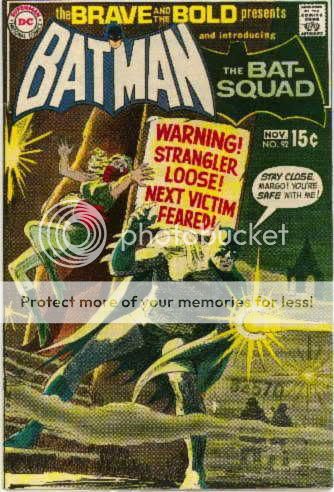
Photobucket

Here’s a Batlash cover which is supposed to have been one of Cardy’s personal favorites:
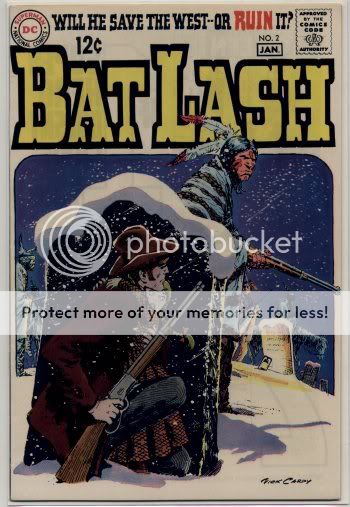
Photobucket

A lovely interior page from Fight Comics, whatever that might have been:
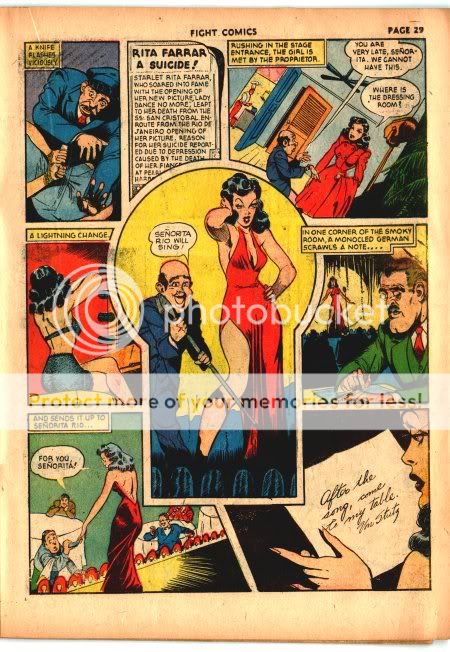
Photobucket

And a bunch more:

Photobucket

Photobucket

Photobucket

Photobucket

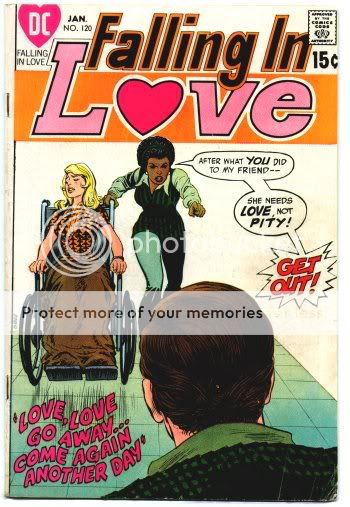
I think the romance comics cover is my favorite. The leaping-towards the viewer action cover in this context pretty much can’t be beat. Also…and I know it’s probably indelicate to point this out…the woman in the wheelchair appears to have breasts roughly the size of Ecuador.

Painful Confession #2:
Tucker quoted from a Bob Haney interview in the Comics Journal. I made fun of him for having issues of TCJ by his bed. But, as Tucker correctly pointed out, I have a piece in the issue with the Haney interview. Which means it’s not only by my bed, but under my pillow. But I didn’t read the interview…because in 2006 when it came out, I didn’t know who Haney was. Really, I hadn’t realized he’d written all those old B&Bs I loved. And I didn’t know he’d created Metamorpho. Much less B’wana Beast! And when did I realize all this? Um…yesterday.

Anyway, one interesting thing Haney said in the interview was this:

“Every month, we’d look at the sales figures and if he was teaming with Wildcat, how did it do? Well, if it did all right, we’d throw in Wildcat again. So it was a very cold, calculating thing.”

So that answers my question about why they reused certain guest-stars. It was purely logical — except, not so much. Because looking at sales figures to determine whether Wildcat was popular, in the absence of any kind of marketing data strikes me as almost entirely random. Interest in an issue could vary for tons of reasons. It could well be seasonal, for example. It could have to do with the cover or with the interior art. It could just be random statistical blips, for that matter. Assuming that people were buying the issue because they loved, loved, loved that second-string, aging boxer known as the Wildcat is…well, let’s put it kindly and say it’s a stretch.

I’m not blaming Haney; it wasn’t his responsibility to come up with a non-idiotic marketing strategy for his corporate overlords. It’s just kind of fun to realize that the ouija-board approach to sales that we’ve grown to expect from the Big Two has roots going way back. Also, good to remember that “cold and calculating” as often as not means “naive and deeply confused.”

Painful Confession #3: I had a dream the other night that Heidi at the Beat linked to our Brave and Bold blogathon and we got hundreds of hits and true happiness was mine.

Maybe this is why I misstated Neal Adams name in an earlier post; I subconsciously was trying to misidentify a mainstream artists and so best get Heidi’s attention.

Anyway, that’s way more embarrassing than David Heatley admitting to sodomizing himself with a dildo or Joe Matt admitting to peeing in a jar or whatever. I hope somebody at Fantagraphics is reading this. Maybe I can be in MOME now.

ALL RIGHT! Enough of this nonsense. It’s time for…the credits!

Brave and Bold #103
Writer: Bob “Feminine Mystique” Haney
Pencils: Bob “The Ballot or the Bullet” Brown
Inks: Frank ” Soul on Ice” McLaughlin
Cover: Nick “Female Eunuch” Cardy
Published by The Movement, 1972
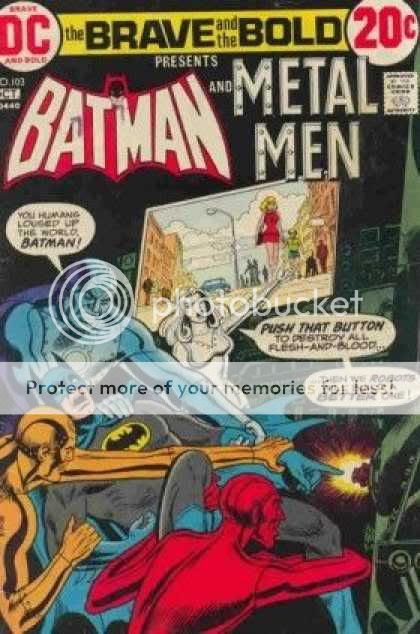
That is just not Nick Cardy’s greatest cover, there. As with Plastic Man, the cartooniness of the Metal Men doesn’t really seem to inspire him. I do like that he threw in some gratuitous cheesecake; the Mom on the screen with the mini-skirt is pretty obviously where he wants you to be looking.

On the other hand, I like Bob Brown’s interior art on this more than his preceding efforts. Maybe he and inker McLaughlin are more simpatico than Brown and Cardy were?
I think the real difference, though, is that the Metal Men’s seem to bring out Brown’s best. The more realistic pulp illustration isn’t his bag, but he does better with cutesy robots. His design for the military-computer-gone-wild is also appealing in a clunky analog future-past kind of way.
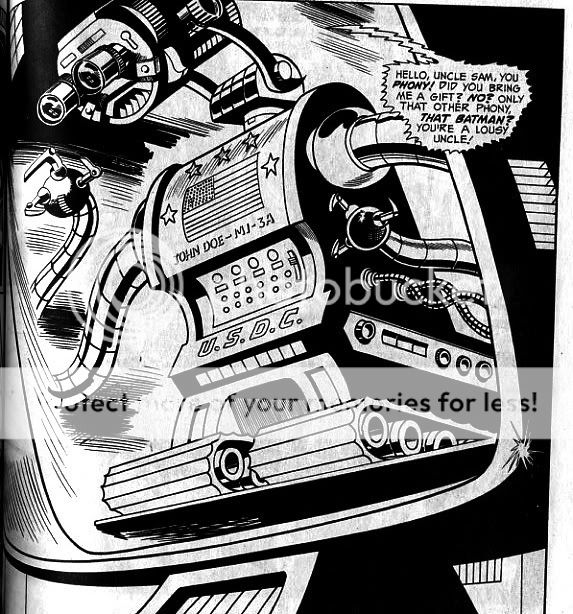
The story goes like this: the U.S. has handed over its missile system to a robot intelligence stashed at the bottom of an impenetrable volcano. Said robot attains sentience and decides (with some justification) that humans suck. Through its minions it starts a robot-liberation movement. The Metal Men join said movement…but when Batman asks them to save humanity in the name of their creator, Doc Magnus, they agree and plunge into the volcano. Then all the Metal Men discuss their boiling points, which is educational. Anyway, they get through the volcano, and…oh my gosh! They’re going to double-cross humans! Robot rights forever! No, not really. They’re just lame collaborationists after all, and together with Batman (who is led through the volcano by bats who bonk into sonar dishes…no, it doesn’t make any sense to me either)they kill the evil robot. Though, to be fair, they do seem to feel bad about it for a second or two.

This is maybe Haney’s most interesting effort to incorporate politics into a script. Robot-liberation obviously has parallels with both women’s lib and the black rights movement, and Haney uses it for a few brilliant riffs. Maybe my favorite bit is the name of the evil robot. He’s called John Doe, granting him both an eerie anonymity (he’s a robot, after all) and a kind of jokey downtrodden everyschlub status. It also emphasizes that he’s been named by a master rather than a parent — which is what happened to slaves of course.

Though there’s obviously a huge debt to 2001, John Doe is a good bit more complicated than HAL. HAL was just insane; John Doe, on the other hand, is a revolutionary, with a fairly coherent social critique (by comic book standards, anyway). “You humans have loused up the world…we robots can hardly fail to do better!” he declares. Nobody ever even really tries to refute him (Batman’s best effort amounts to little more than “You’re another!”) Indeed, you get the sense at moments that Batman and his government backers would be a lot happier with the situation if the robot were just nutty. As Batman says, the problem with Doe is that “He not only thinks and feels like a human…he’s developed a moral sense too!” You’ve got to watch that last one, obviously; no telling what will happen if just anybody starts developing a moral sense.

The robot-liberation bit also has some great aspects. It’s fun to watch Gold (the assimilationist, wearing a human mask) argue with Mercury (the Robot Power advocate:”The Metal Men should be there to learn to be proud of their robotness…their non-humanness!”) I also like the way Haney has most of the Metal Men engaged in working-class laboring jobs — including Platinum, who works dancing in a girly bar (Tin lives a more bourgie life in the suburbs…and he’s the most diminutive and nerdy…he’s not supposed to be Jewish, is he?)

Alan Moore did something similar in Top Ten with robots-as-oppressed class of course. The difference is that, as is his wont, Moore really thought it through; he’s got a distinctive robot sub-culture, particular anti-robot epithets, and so on and so forth. Whereas, for Haney, robot lib is just another throwaway gag — look! It’s an entire amphitheater full of disgruntled robot peons, dissatisfied with their place in the DC universe! Where do they come from? What are their lives like? Well…oops, story moving on. Time to talk about boiling points!

Given the choice between Moore’s earnest, right-minded take on prejudice and Haney’s aphasiac slapstick approach…well, I wouldn’t necessarily choose Moore. Discrimination both erases and mocks, and that’s exactly what Haney and Brown do here. Except for the Metal Men, you never even see the faces of any of the other robots at the meeting – just the back of a few transistorized heads (wait a minute…is that a Sentinel?) And there’s also something true to life about the fact that the establishment hero isn’t so much opposed to the liberation movement as he is unable to take it seriously. Batman never for a second doubts his righteousness; the Metal Men repeatedly point out that he’s an asshole, (“Blast you, Batman!” as Tin says,) but Batman doesn’t even seem to notice.

Still…well, there are problems. It’s not that Haney is for women’s lib or against civil rights or whatever; it’s that, when you’re dealing with politics, there are limits to where you can go if you’re really committed to not thinking about anything for more than a panel or two. I think it’d have been great if Haney took a hardline, these-social-movements-must-be-crushed kind of stance in the Kipling vein. Kipling was a racist shithead, sure, but he had a firm grasp on the fact that power matters; actions, identity, morals all work differently depending on which side of the stick you’re holding. Kipling wanted lesser peoples pacified, but he was tuned in enough to know that if you took up the White Man’s Burden and pacified the lesser peoples, those lesser peoples weren’t going to thank you, even if, “objectively”, they’d be better off..

Haney doesn’t really get any of this. The Metal Men are absurdly grateful to their creator. Even John Doe (who kills his inventor) apparently regrets the necessity. Then, at the end, after John Doe has his logic circuits destroyed, he bizarrely takes on the personality of his inventor — and since the inventor was trying to kill Doe, the machine destroys itself. In other words, the robots — even the most rebellious — see their creators as parents, to be emulated. This gives the humans irresistible emotional leverage; it allows Batman to enlist the Metal Men’s aid (in the name of Doc Magnus) and it gets John Doe to destroy itself.

This particular little myth happens to be the most consistent way that people in power give themselves an out — from guilt, yes, but most especially from fear. Plantation-holders in the south were convinced that their slaves loved them and so did not want to be freed; men tend to assume their women love them and so won’t start a ruckus. When the slaves were freed, a lot of plantation owners had a rude awakening…nor did the bonds of romance put paid to the feminist movement. Sure, slaves and masters can sometimes care for one another; it just happens much, much less often than the masters like to believe. Certainly, it seems exceedingly optimistic to rely on the affection of one’s vassals to stave off Armageddon.

Just to return for a moment to something Tucker said about one of Haney’s Teen Titan politiical jaunts:

If for nothing else, the issue is actually more disappointing the more you get to know Haney’s past–unlike, Bob Kane for example, Haney actually lived in a Hooverville during the Great Depression, he was an active participant in 1960’s anti-war protests, defined himself as “an old socialist”–basically, he did all of the things these kids did, except he did them in real fucking life, for real fucking stakes. (Except for the atomic bomb thing.) At the same time, he’s trying to tell a story here, he was operating under a still enforced Comics Code, and he did the best he could. It doesn’t change the simple fact that this one just ain’t that fun, and–except for the raw emotion of that cover that tells Batman “Every grown-up will suffer [in a concentration camp] because you lied to us!”–it’s just too damn safe.

I think that’s right, and it applies here too. This issue is definitely less safe than the two Titans jaunts — it at least points in some potentially uncomfortable directions. But the conclusion carefully scuttles away from the suggestion that somebody, somewhere in society might be — for real, no fooling — reasonably disaffected. Tucker blames this on the Comic Code…but I think that’s probably letting Haney off too easily. Activism can be great, but it doesn’t necessarily have a ton to do with understanding how power works, or why. Haney has flashes of insight, and he’s a smart, funny guy. But I don’t think it’s the Code alone that tripped him up when he attempted to incorporate politics into his stories.

Brave and Bold #104
Writer: Bob “Cold Around the Heart” Haney
Art: Jim “Gutter to Gutter” Aparo
Cover: Nick “No Deal with a Dead Man” Cardy
Published by Jacques Tourneur, 1972
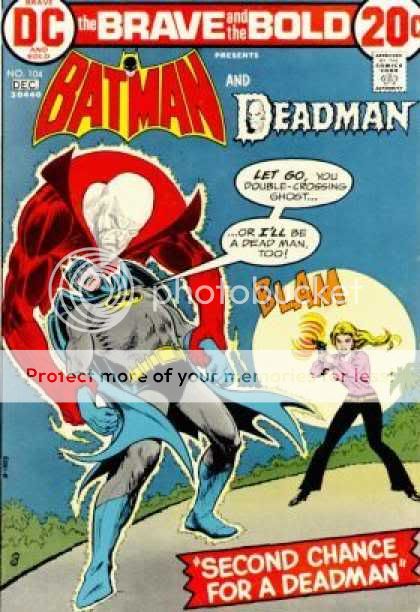
If #103 suffers from a lack of nerve, #104 has no such problems. This is a brilliant, cold, nasty little noir. It’s the best story in the book.

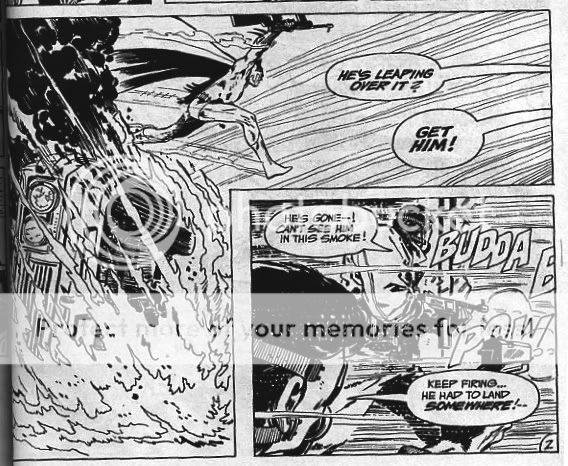
It starts off with an unusually brutal firefight; Commissioner Gordon and the police department are pinned down by a barrage of (extremely stylish, thanks to Jim Aparo) machine-gun fire. Much to everyone’s shock, Batman seizes an impressive looking weapon himself, leaps over a burning car, and precedes to give the baddies a whupping.
Photobucket

That’s “whupping” as in “fisticuffs,” because the gun was full of blanks. It was just a little old decoy to shock the baddies, who, along with the readers, presumably shouted in unison, “Hey! That’s not DC continuity! Is this dream, a hoax, an imaginary story!” Anyway, while they tried to check wikipedia to see if they were in a “real” title, Batman conks them.

So, typical doofy Haney plot reversal leading nowhere – “he’s using a gun! No he isn’t! Ha!” But there are signs that something a little odd is going on here. First and foremost, Gordon actually notices that the whole sequence makes no sense, and launches into a remarkably bitter speech.

“How can you hold to such an idiotic code — against today’s criminals — vicious unprincipled snakes!? In the old days, crooks had a little honor…and style!”

Then the next page we’ve got the Gotham City morgue described as “that grim, cold, way station for the unlucky, the losers, and the unloved…” which is kick ass noir prose, god damn it. Combine the two quotes and you’ve got some early signs that this issue is headed for a darker place.

But hey, we’ve still got to have plot, and if we do, it might as well be preposterous. Apparently criminals are getting their faces replaced through plastic surgery at a luxurious criminal spa. Batman figures out what’s going on when a villain he doesn’t recognize tries a gun trick on him that he does. And that, true believers, is pretty much the last competent bit of detective work we see from our hero. He heads to the island spa to dig up some evidence posing as a guest; but as soon as he leaps the fence into the restricted area, he’s caught, beaten up, and kicked off the reservation. Way to go, Bats.

So for his next brilliant move, Batman decides there’s no way anyone can get through this super-secure spa security — after all, he couldn’t. So he contacts Deadman, aka Boston Brand, who is, if you’re unfamiliar with the character, dead, depressed, and not all that stable. Perfect choice for an undercover operative! Deadman sees Bats’ add in the paper (I was hoping for a Dead-signal, but oh well) and agrees to possess the body of one of the baddies to gather information.

In case you missed that, let’s go through it again; Batman has hired a ghost to take over a man suspected of crimes. For an indefinite period, mind you. However long it takes. Warrantless wiretaps…pfft. Who needs ’em?

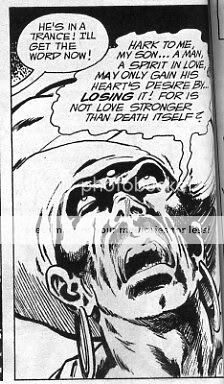
Brief interlude here while Deadman (a former aerielist) goes to the circus and mopes. Then Rama, the deity who gave his spirit life, speaks to him through a convenient ethnic minority. This is a great panel; Jim Aparo draws the minority-savant from neck level looking up, so his face is all cadaverous, creepy shadows. “Hark to me, my son…a man in love may only gain his heart’s desire by…losing it! For is not love stronger than death itself?”
Photobucket

The answer here, incidentally, is, no, not really — but Brand is a little slow on the uptake. Anyway, he heads off to violate some Constitutional rights.

And that’s not the half of what he’s violating, liberal wafflers. The spa is run by a couple: Lilly and Richie. Not only are they partners in crime..they’re also in love (awww.) You see what’s coming, right? Our pal Deadman possesses the guy, Richie…and to avoid suspicion, he naturally has to romance the girl. That romancing starts with a very sensual kiss, and then we’re told that “Batman’s ghostly ally plays his role to the full…” We get a panel showing the two dancing, running through the waves on the beach, watching dog-racing and jai-alai (jai-alai?)…well, not to put too fine a point on it, I think it’s clear that Lilly is cheerfully fucking the dead guy who has taken over her sweetie’s body. This is…well, it’s pretty squicky, is what it is. Take that, Comics Code.

Anyway, things now get complicated. Deadman hasn’t gotten any in a long time; besides that he’s a self-pitying drip (not without reason…but still) and besides that Jim Aparo has pulled out all the stops on Lilly, who looks like she has, as the old song goes, something between her legs that’ll make a dead man come.
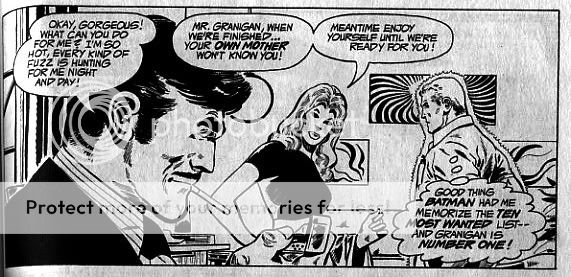
So Brand promptly falls in love with her, and convincing himself that the love of his life is, deep down, a good girl who just wants to go straight. So he tries to cut a deal with Batman; Deadman promises to shut down the operation if Bats will let Lilly goes free. And Batman, the hero so compassionate he won’t even load a gun…responds by being a complete and total prick. Brand, a civilian with mega-problems of his own, has basically done all the work here, but is Batman grateful? Is he understanding? I she even just terse? Nope; he goes out of his way to taunt him. “How long would she stay in love with a ghost?” he mocks.

At least a little while, as it turns out. Brand tells Lilly that he’s possessed her boyfriend…and she’s into it. “The tender lover who lives in Richie Wandrus’ body! He’s the man I want–!” Gross or romantic? A bit of both surely. Haney’s scattershot characterization style works wonderfully here; we never do quite figure out what’s going on with Lilly. Does she actually care for Brand? Is there good in her? Does she want to retire? Or is she just a hardened manipulator, using Brand for her own purposes? There isn’t even an answer, I don’t think. Like a true femme fatale, her motives change with the observer and the situation. She’s a riddle without an answer.

Anyway, Deadman steals the evidence he got back from Wayne, and so Bats is back to square one. And it’s into disguise and off to the spa he goes, where…surprise!…his cover is immediately blown and he’s knocked unconscious. Then Lilly has him made-up to look like a wanted criminal and sends him out into the world, where the police almost kill him. Deadman saves him, though, by possessing his body and running away into the woods. He hurries back to Lilly…but she has figured out that he’s in league with Batman. She brandishes a gun…rather uselessly, as he points out, since you can’t shoot a ghost. But, hey! Right on time Batman shows up, and, with his usual panache, he lets Lilly get the drop on him.

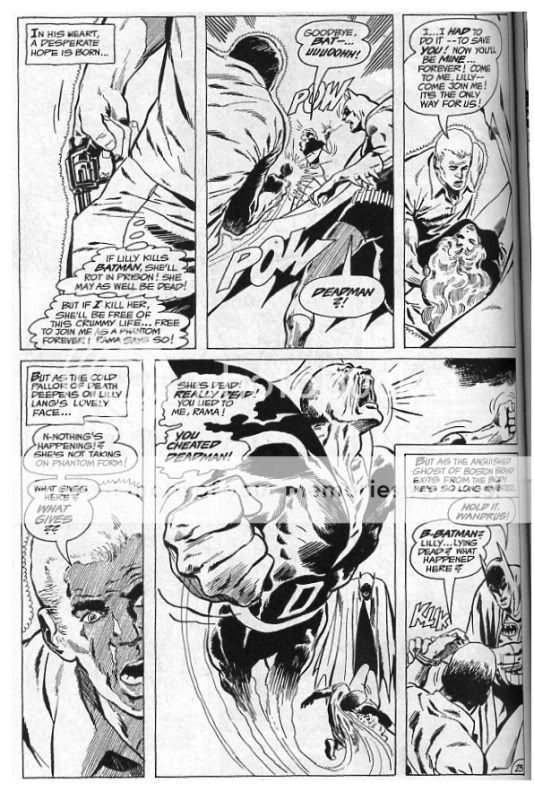
Before she can shoot him, though, Brand remembers the prophetic minority from early in the comic. “Is not love stronger than death itself?” the replay asks again, and Brand gets a brilliant idea — he’ll shoot Lilly, and her spirit will join his in the afterlife forever! How will Lilly feel about this? Very unclear…but Brand is maybe not the sharpest pencil in the sea. And, admittedly, he’s under some pressure here, since, for obscure reasons, he doesn’t want her to shoot Bat-dick.

Anyway, he shoots her. And stays dead. No spirit love for our hero; just a big armful of corpse.

Deadman is fairly upset by this development, and rushes off into the ether cursing his god and, incidentally, referring to himself in third person (“You cheated Deadman!”) Though, again, you have to make allowances for stress. Meanwhile, Richie wakes up, remembering nothing of the past several weeks, to find his girlfriend in his fucking lap! and the always-sympathetic Batman putting cuffs on him.

So happy ending, yay! The bad guys are dead or bagged, no more criminals can change identity — a successful case! Batman is understandably pleased, “But,” he admits, “I feel badly about Boston…” Yeah, I bet you do.

So, yes, the story is ridiculous in lots of ways. Its real brilliance, though, is that all of Haney’s usual tricks — goofy plot twists, inconsistent characterization, melodramatic flights — end up registering, not as nonsensical fun, but as bitter irony. Batman comes across as a callow fool. His race into gunfire carrying an empty weapon isn’t about love of life — by the end of the story we know quite clearly that this is not an empathetic man. Instead, the affectation about not killing seems like the grandstanding of an incompetent prima donna, whose blundering self-absorption casually destroys the lives of friends and enemies alike. Boston may be more likable, but he’s hardly a moral icon. Self-absorbed and weak, he robs a man of his life, sleeps with a woman under about the falsest pretenses possible, and then murders her. Lilly does seem capable of love — but she’s also a vicious murderer — one who, incidentally, tosses former lovers aside with callous and practiced ease. Nobody comes out of this well…not even God, who seems to have deliberately tricked Boston into shooting his lover. Justice may triumph here, but it’s a stupid justice, an idiotic, smug, self-impressed justice, a justice whose compassion is indistinguishable from hypocrisy. The story’s denoument has the cold inevitability of bleak downbeat masterpieces like Out of the Past or Rififi. Jim Aparo’s dynamic, offbeat visual storytelling in the last pages is like a series of punches to the jaw; a shot of Boston’s gun; Lilly shot in silhouette, so small she looks like she’s at the end of a tunnel; falling into Boston’s arms, a three-quarter shot of Brand as he realizes he’s fucked up, and then Deadman racing out of Richie’s body, while Batman stands down below, looking all dark and menacing and useless.
Photobucket

Maybe I’m missing something…but how does this not kick the shit out of The Killing Joke? Or Arkham Asylum? Or Dark Knight Returns? Or the Dark Knight movie? Or the Morrison Batman run? All that bloated, Jungian, Batman-As-Ur-Hero crap which is supposed to be so dark and serious and impressive… I mean, I like all that stuff, pretty much, but when you get right down to it, underneath all the sophisticated posturing — it’s pretty dumb isn’t it? You show me a writer propounding Batman as archetype, and I’ll show you an author engaging in serious adolescent bloviating. Batman as clueless, dickhead cop, on the other hand — that’s a bleak vision. Or a farce. Or both.

*********
Just a final short thought; the issue of intentionality came up in one of the earlier comments threads, and it’s been on my mind as I wrote this post too. Was Haney really trying to say something about oppression in the Metal Men team-up? Did he really have a bleak vision in the Deadman team-up? Isn’t he just trying to tell a goofy Batman story? Why saddle him with all this heavy crap? Why make him something he’s not?

Intentionality is always hard to figure, especially for someone like Haney, a scattershot, seat-of-the-pants writer, working in a form and at a time where there was little emphasis on personal vision or auteurishness. Even in that TCJ interview, there’s little discussion of themes or story intention; it’s all about the business end and who worked with who when. The interviewer never asks, “Well, why were you so interested in amnesia?” Or “Bob, what was your take on Batman as a character? Was he a kind of moral center in your work, or did you feel he was sometimes in the wrong? Or even, “What did you like specifically about the comics you wrote?”

Obviously, Haney isn’t an especially self-conscious writer. But unselfconscious isn’t the same as stupid. Shakespeare wasn’t especially self-conscious either, I’d argue. He was mostly about goofy plots, and fights, and blood, and putting stuff in his characters’ mouths which sounded cool. Still, in his own unsystematic, pulpy way, he managed to use his plays to think about things that were worth thinking about, and to say some stuff that was worth saying.

I’m not saying Haney is as good as Shakespeare, because I don’t think that he is. But he is plenty good enough to come up with some interesting things to say about politics in the Metal Men issue (as well as a few dumb things). He’s good enough to realize that Batman-as-paragon is often less interesting than Batman-as-dick. And he’s good enough to have written at least one perfect, sad, oddly elegant noir.

________

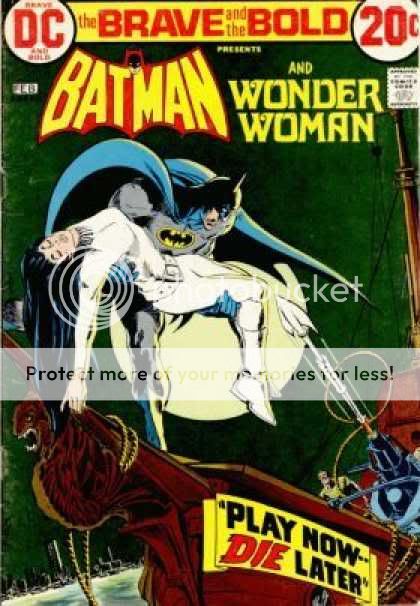
…and after two remarkable issues, #105 is just…eh. Batman teams with Wonder Woman, who’s in that phase where she decided to actually wear clothes rather than underwear and in retaliation her Gods punish her by taking away her powers. She still has a guardian angel though, who saves her from being roadkill on one occasion…good guardian angel! Guardian biscuits for you! Batman is a cad to a damsel in distress, but then he comes to his senses and helps her brother ship arms to revolutionaries in South America. Wonder how that went over with all of Batman’s buddies at the Pentagon, huh? At least we throw a few more “Bat-Hombre”s on the fire. And there’s always Jim Aparo, who draws a mean aged duenna.
Photobucket

______________

And hey, we’re done! Sort of. We’ve still got three more issues, which Tucker and I will co-blog in some fashion after Thanksgiving. Hope to see you then.

Update: And the first part of our race-to-the-finish co-blogging is here

The Cowardly and the Castrated: Part the Fourth, In Which The Dead Rise and Behave Inconsistently

For those of you coming in late, Tucker Stone and I are cross-blogging our way through a massive selection of classic Batman team-ups. Tucker does #88-#90, I do #91-#93, Tucker did #94-#96, and that brings you up to Bat-date.

But first let me bat-back-track a bat-bit (sorry…it’s kind of addictive, the bat-thing. But I will bat-stop bat-now.)

Bat-Ahem.

What I’m trying to say is that Tucker underplayed some of the truly bizarre pleasures offered by the Plastic-Man team-up in Brave and Bold #95. For instance, Tucker fails to mention that Batman, before being sprayed with “Tiger-Lover cologne”, sings, “Mairzy dotes and dozey dotes and the blazes with Ruby Ryder,” and then visibly checks out the mini-skirted ass of a passing young thing.

As if that weren’t justification enough for the entire issue, I have to say that I just loved the fact that Nick Cardy seemed to die a little death every time he was forced to draw Plastic-Man stretching.

You can just see Cardy looking at some old Jack Cole comics for reference and positively rending his garments as he whipsaws back and forth, pen in hand. “But…I’m a noir artist! I’m not drawing this cartoony crap! Bob! Bob! You can’t make me…eeeeeeeeyeeeaaaarggggh!”

That last was the sound of Woozy Winks coming out of Cardy’s ribcage, belching foetid boogers, greasepaint, and ketchup. Even Haney staggered back in horror…and as Winks scuttled up into the ventilation shaft , Bob knelt, tears streaming down his face, and promised his brave, brave friend — “It’s okay, Nick. It’s okay. I’ll make Plastic Man tragically conflicted, betrayed by an evil dame! It’ll be noir! It’ll work! You’ll see!”

And Cardy half sat up, eyes glistening, and said, slowly, feelingly, his voice faltering and racked with pain:

“Fuck you, Bob.”

And the rest was silence.


Woozy Winks: Plastic Man’s Pal or Alien Parasite?

The Brave & The Bold # 97
Written by Bob “Bob” Haney
Pencils by Bob “I’m Bob Too” Brown
Inks and cover by Nick “Not Bob” Cardy
Published by NAFTA, 1971

Oh, wait, one more thing before we start…if you read Tucker’s last post, you’ll find that he went and read an extensive interview with Haney, and is cherry-picking quotes to show us all that he’s done research and is a real professional comics critic. Faced with such diligence on the part of their interlocutors, some critics might feel a little belittled. Some critics might say, “well, I’m going to try to keep up by, say, googling Nick Cardy and finding out who the hell he is.” Or they might even say, “ha! I will find and read that Bob Haney interview too, and cherry-pick some quotes of my own, nyaaah.” Some critics maybe. But I am not that some critic, by God! You hear that, Tucker Stone! You hear that you fancy-striped-pants elitist?! Your intellectyual wiles aren’t going to work on me. I’ve got a brand to protect here! When people think “Noah Berlatsky” they think “Blogger too lazy to do even elementary fact-checking!” And I’m not going to ruin the brand just because some snot-nosed punk has a complete collection of Comics Journals hidden under his bed!

Photobucket

Right. Enough ranting. Let’s get down to business. Start off with a gag-cartoon-Nick -Cardy cover which is pure slapstick and has absolutely nothing to do with the story. Once again, our boy Nick is clearly resentful of the whole situation; so what if he has to draw a totally stale joke which would only make sense if you had big-feet funny animals running around? He’s still going to give it the full moody pulp treatment, with lots of expressive scribbled shadows. Why the hell not? (Actually, that cover doesn’t really look as good with the coloring. Can’t see the nifty scribbles in the shadows. But, hey, I figured out where all these covers live online. Take that, Tucker!)

Anyway, in the issue itself Cardy (recovering from his chest wound) passed the penciling chores off to Bob Brown, who lives up to his generic moniker by plopping down some thoroughly pedestrian Bat-art. It’s not embarrassing or anything. It’s just like…you know, when I was a kid, right around the time I first started reading the Brave and Bold, actually, I was really unclear on how art worked. I couldn’t draw myself, and it seemed to me impossible that anyone actually just sat down and drew all these pictures. So I imagined that there was, somewhere, a huge number of super-hero stamps, capturing every possible stance or position, and that when they needed a particular pose, they just found the stamp and thumped it down on the page in the proper place. (But then, of course, who drew the stamps, I wondered?) Anyway, Bob Brown’s the kind of professional, adequate, impersonal artist who seems to be working from those stamps. (As opposed to, say, Ross Andru, whose Batman looks like he was die-cast by a toy company.)

In the writing, the main point of interest is that the story is set in Mexico where everybody speaks English. The only English word they don’t seem to know is “man,” which is why they all call our hero “Bat-Hombre.” A similar thing happened in the issue set in England, you’ll remember, where the natives called him “Bat-Chap.” I’m looking forward to Australia (“Bat-Mate”); Japan (“Bat-Otaku,”) Communist Russia (“Bat-Imperialist-Pig-Dog”) and sunken R’leyah (“Bat-F’htagn”).

So in this issue Haney brings back Wildcat, who just teamed up with Bat-Whats-his-name like nine issues ago. I guess DC second-stringers were scarcer on the ground then.

(And how did they choose who co-starred, anyway? Were there polls? When I started picking up issues — around 130 or so, I think — I remember people writing in to ask for their favorite characters. Which is especially funny because the more you read these things, the more you realize the extent to which the guest-stars are beside the point; the goal often seems to be to give them as little face time as possible. And, of course, they’re personalities and even their powers are often virtually unrecognizable. Plastic-Man as whiny, tormented, love-sick, vengeful soul is a particularly egregious case of fan-scruff, but I don’t think the whiny, love-sick Black Canary is exactly canon either, nor the whiny, self-doubting Wildcat. At least he’s not love-sick…maybe because he’s got all those boy sidekicks?)

Anyway, this Wildcat might as well be a whole new character because, in typical Haney fashion, he spends the entire issue in an amnesiac fugue which renders him both speechless and useless. For all intents and purposes Batman is actually teamed up with some random Mexican boy diver named Luis. They’re searching for the treasure of Choclotan, which, it turns out, is a giant cache of Hershey Bars. Alas, the guy you think is going to double-cross everyone does, and a giant hulking baddy gets to box with Wildcat and bashes him in the head curing his amnesia. Then the recovered Wildcat duplicitously arranges for all the bad guys to die horribly by drowning, because, as Tucker points out, back then killing wasn’t exactly a super-hero’s business but still, business wasn’t bad.

Favorite quotes: “Now as knives flash in the limpid Mexican dusk, a brave boy stands at bay — and a man from far northern haunts comes face to face with the mystery, the mastery of the past, meeting an old ally, finding new foes, as fate flaunts the Batman with ….The Smile of Choclotan!”

“All of Mexico’s other gods were sourpusses, but legend says Choclotan, greatest god of all…alone wears a smile!”

Why does he wear a smile, you ask? Because he’s thinking about people drowning. That always cheers me up, too.

Extra fun fact: Judging from this issue, it appears that no women live in Mexico.

The Brave & The Bold # 98
Written by Bob “Haunted” Haney
Art by Jim “Apparition” Aparo
Cover by Nick “Casper” Cardy
Published by Roman Polanski, 1971

Photobucket
Enter, Jim Aparo.

I tried to make the best of it, but I’ve got to admit that #97 was…well, maybe not the apogee of Batness. #98, though, is the bat-shit, the whole bat-shit, and nothing but the bat-shit.

As I said, I love the way Cardy and Haney work at cross-purposes. You can see it on this cover, too, where Cardy goes balls-to-the-wall-pulp; a curvaceous lovely in a slit skirt, monstrous silhouette, ugly demonic caricatures, amorphous ghostly figure, Batman laid out on a slab. It’s awesome…and then you realize the evil lady is declaring, “Now come forth…and kill the godfather!” And you dissolve into giggles.

Jim Aparo, though, is a whole different thing. Where Cardy tries to ground Haney’s drug-addled scripts with solid, working-class pulp and action tropes, Aparo just grins and says, “Pass the bong”. The result is an effervescently escalating edifice of tomfoolery. Haney churns out one of his most gloriously doddering efforts, with witches’ covens, evil twin doubles, wicked townsfolk, voodoo, hexes, a guest appearance by Lucifer, and the Phantom Stranger beating the tar out of Batman every other panel, supposedly for the Bat-guys own good (suuuuure.) Also, Batman, the Stranger and a psychiatrist commit what the psychiatrist refers to as “technically” child abduction — they throw a seven-year-old in a sack, steal him from his house, and then lock him in a room with a bunch of scary-looking occult objects. For, like, several. days. Because they think he’s a warlock. But he isn’t. So he’s traumatized for life, and when he grows up he’s probably going to draw gratuitously vertiginous panels like this one:

Photobucket

Or this:

Photobucket

Can I say how much I love that? Just as Haney is willing to chuck sense and coherence out the window the minute he lights on the next shiny bit of alliteration, so Aparo will cheerily defenestrate visual coherence for the chance to draw the ensuing oddly contorted wreckage. And, by the same token, where Cardy seemed a little hesitant about all the wacky super-hero special effects, Aparo just lives for it. Check this out:

Photobucket

Or how about this?

Total beautiful mystical wackiness. And then, after that glorious money shot, does Batman leap in and heroically save the day? Uh-uh; he just gets decked by a chimney pot.

Stuff like that is always happening to Haney’s Batman; he’s constantly walking into traps, or being forced to clean up Gotham by a bunch of adolescents, or discovering that his oldest friend married a witch, or that his godchild is demonspawn, or getting kicked around by the Phantom Stranger. I mean, he’s obviously ripped, and he swings around on a rope and stuff but overall, he seems pretty…well, not very super-heroic. He’s just some guy who wears a funny suit…which, yeah, is kind of a faux pas, but people let him get away with it because, you know, he’s clearly just trying to help.

What I’m saying here is that the whole driven, super-ninja, ultra-competent Batman…it’s pretty recent, I think. It’s probably Frank Miller’s fault, or maybe Denny O’Neill’s. Bob Haney’s Batman is, if anything, smaller-than-life. He’s not mysterious at all; in theory he’s got a double-identity going, but in practice he acts as if he’s got his own Bat-Social Security Card and a bat-driver’s license with his cowl on it (maybe he does; I wouldn’t put it past Haney.) He gives a member of the coven his autograph (again,the whole Greatest Detective thing is just not happening) and she uses it to hex him. And the hex works, because even Satan didn’t bother to think for a second: “Hey…wait a minute…Batman isn’t his real name.”

Oddly the extent to which Haney obviously doesn’t give two bat-farts about the dual identity thing is even clearer when Bruce Wayne ostensibly plays a bigger role. In the next issue, #99, the plot starts off at the Wayne summer home…but Batman goes dressed in his costume! There’s some reference made to Wayne leasing the home to Batman…but for God’s sake, why? Just go to your summer home in your civvies, man! It’s your house!

But if you did that, of course, you’d have to spend almost the entire issue drawing pictures of Bruce Wayne, not Batman, which is, presumably, not what the kiddies are paying for. (Though it’s fine for the guest stars…Flash spends most of the comic dressed as Barry Allen.)

Hey, we’ve started to talk about the next issue, it looks like. Let’s throw one of these on the fire then…

The Brave & The Bold # 99
Written by Bob “the Slob” Haney
Art by Bob “the Blob” Brown
Cover by Neal “the Real” Adams and Dick “the Slick” Giordano
Published by Wayne Enterprises, 1971

Photobucket

Back to Bob Brown, alas. It’s a shame too, because Jim Aparo would have had a blast with this one. (Nice cover, though. Neal Adam’s stuff actually looks better in color, I think, whereas Cardy’s loses something. Maybe another reason the first is a household name (if you’re in a nerd household, anyway) and the second not quite so much.)

In the comments to my last post, my brother Eric made a crack suggesting that Haney doesn’t have that many ideas. Not to start something with my own flesh and blood, but this story demonstrates why that claim is completely bass ackwards. The truth is that Haney’s got ideas coming out of his gazebo. When he scratches his head, ideas come flaking off like dandruff. They’re not all original or good of course — but if you’ve got enough of them, that starts to matter less than you might think.

The plot here for instance. On the one hand, you’ve got a storyline about Bruce Wayne (always in costume) discovering that his father was a mad scientist who had figured out how to come back from the dead — so Bruce decides to finish the experiments and bring his parents back. Then, on the other hand, you’ve got a storyline about Batman being possessed by an evil pirate who wants to bring back all the spirits from limbo to possess the living and take over the world.

Obviously, these plots overlap. But the point is that either one by itself is sufficient for a solid pulp comic-book plot. Either one, by itself, would make sense (in the way comic-book plots usually make sense, anyway.)

But Haney is too enamored of his ideas to let any of them go; he shoehorns both storylines into one story, and lets them fight it out. And pretty soon, instead of a nice, clean story with a beginning, middle, and end, you’ve got severed bits of plot lying strewn across the panels, twitching and occasionally rising to struggle hideously onto the next page. Batman experiences not one, but two bizarre personality transformations. First, he becomes obsessed with resurrecting his parents, heedless of the consequences — basically, he forgets he’s a super-hero and starts acting like the protagonist in a Lovecraft story (Bat-F’htagn!) But, at the same time, he’s suffering bouts of possession, where he’s taken over by the spirit of dead Manuel, the Port-a-gee. (Yes, that’s how everyone spells it.)

In other words, what should, in some world, be a classic gothic story, dripping with repression, displacement, and the anxiety of doubling, instead fractures. Confusion of identity plays out not as tragedy or horror, but as self-parodic farce. There are lots of references to bifurcated identity, but they all tend to add up to pratfalls. In the very first line of the story, Batman says he’s rushed to his summer house so quickly that “he didn’t even change the old Bat-Suit!” The probable presence of BO becomes even stronger shortly thereafter, when Barry Allen explains that Batman has to wear his suit all the time, even when he sleeps. Why? Because when he’s possessed, Batman has a distinctive walk — the pirate, you see, had a wooden leg, which he apparently retains even in death. So Bruce Wayne must continue to wear his smelly mask lest everyone discover that it is he, not Batman, possessed by the improbably limping ghost.When Barry Allen earnestly worries, “Poor guy — under that tough, super-hero hide is a sensitive, lonely man!” you’ve got to wonder…is the costume tough from grime? And why’s Batman so lonely, anyway? There are like three people in there, depending on whether you count that wooden leg separately. The perfect coup-de-gras is when Batman discovers that the urn with his parents ashes contains only sand — but don’t worry! Flash finds an exactly identical urn with the real ashes instantly. And then he sends Batman off the island, promising the authorities the Caped Crusader will get psychiatric help — which is a lie because we all know Batman wasn’t really nuts, he was just possessed…except that he was really nuts…but presumably both he and the Flash forgot that, since it happened on the last page. It’s too bad; I’d have liked to see Batman, in full costume, lying on a couch and getting the talking cure.

The multiple-multiple-personality Batman is emblematic of the way Haney writes everybody; characterization for him seems to be a function…not of the plot, exactly, but just of whatever fleeting idea he gets in his head while he’s working on any particular speech bubble.

The funny thing is, this is maybe the single “truest” version of Batman…or of any of his guest stars. People like to say, “Oh, Batman should be dark and dangerous” or “Superman should be noble,” or “Green Lantern should be Hal Jordan.” Whatever. They’re all corporate-owned properties; they’ve been passed around, fondled, and abused by so many different manipulators and users that they’re all pretty much just gibbering, drooling slabs of meat by this point. They don’t have souls; they don’t have identities. They’re just zombie bricks for the bricolage, and Bob Haney’s the zombie king.

Update: Edited for various embarrassing name mix-ups.

Update 2: Tucker does part five here