A Pundit in Every Panopticon

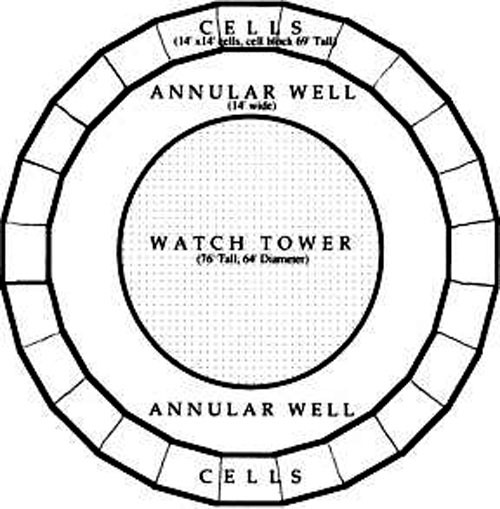
panopticon-diagram

Heidi MacDonald posted a piece yesterday talking about comics crit in general and (to some degree) HU in particular. As Heidi says, this is part of a longer conversation (on HU and elsewhere) about the present and future of comics criticism.

I don’t have much to say specifically to Heidi’s post (except maybe that the modernist anti-narrative devices of the Sound and the Fury have very, very little to do with Michael DeForge’s pop art inspired pomo sensibilities.) But Heidi seemed to be struggling a little with defining HU, for better or use. I’ve been thinking for a while about talking in some detail about what I’m trying to do here, and what specifically I think HU’s goals are. This seemed as good a time as any to talk about that.

Before I start, I should say that I don’t think most of HU’s goals are especially different from what a lot of other sites are doing, or are trying to do. There isn’t a claim to uniqueness here, nor even to doing anything better than any number of other people.

So, with that in mind, here are some of the things that I think about while editing HU.

1. Not all middle-aged, het, cis, white guys like me.

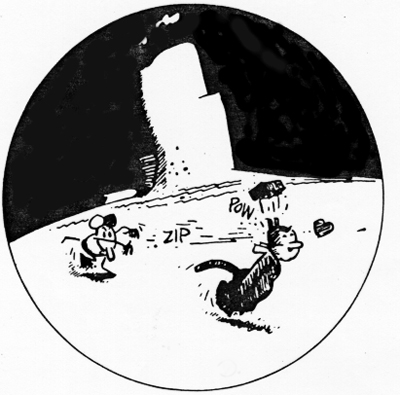
I talked about this at some length in regards to women comics critics here, and I’m not going to repeat that whole argument. But just to reiterate; I want HU to represent a diversity of views, not just mine. Part of that involves getting folks to write who don’t agree with me (as, for example, Jeffrey Chapman on the greatness of Maus.) Part of it involves letting folks pursue their interests, even in things I’m not personally invested in (like Robert Stanley Martin’s < a href="https://www.hoodedutilitarian.com/2013/01/jim-shooter-a-second-opinion-part-one-the-best-job-he-can/">Jim Shooter posts or PenciPanelPage’s Krazy Kat roundtable.

But a big part of it also involves actively trying to get people to write who have different life experiences, and so approach art and aesthetics from different perspectives. I’ve actively worked to try to get folks who aren’t exactly like me to post here, and I think that’s important to making HU welcoming and (hopefully) relevant.

Sort of alongside that, HU tends to take seriously the idea that gender, race, and the treatment of marginalized people in general is a legitimate lens through which to think about art. Not that that’s the only thing people write about here by a long shot, but it’s something the site is interested in and talks about.

2. Die, news hook, die.

HU doesn’t care about news. Folks will sometimes write about recent films (as here) but keeping up to date on the latest releases is something I’m actively not interested in doing. There are a bunch of reasons for that — other sites do it better; I have to pay attention to news hooks in my day job and I’d rather do other things here; etc. etc.

The main reason, though, is that, as an entirely volunteer site, I don’t need to chase page clicks. Moreover, since I’m not paying anyone, I feel like the least I can do is give folks an opportunity to explore whatever it is they’re interested in exploring. The site is driven by folks’ individual passions (or passing fancies) rather than by the news cycle. That also means that people can take as long as they want to finish something (like Emily Thomas’ long and long-gestating piece on the Nao of Brown.

3. Not Just Comics

As regular, or even casual, readers have probably noticed, HU doesn’t just cover comics — and doesn’t even necessarily make that much of an effort to cover comics primarily. We’ve had several roundtables on film, for example, and folks write on books and television and video games and real honest to goodness literature and what not.

Again, this is partially just my personal preference; it’s my blog, and I want to write about whatever I want to write about, even if that doesn’t happen to be comics. But I’m also interested in seeing comics as part of the arts more generally, and the best way to do that (for me) is to treat them as just another art. So in part I want the site to be about other things because I don’t just care about comics, and in part I want it to be about other things because the way I want to care about comics is to care about other things too.
_______

So there’s my statement of purpose, such as it is. If it seems appealing, you should write for us! My email is myname at gmail; I’m always looking for new writers and new topics. We’ll probably have some reprint post or other up tomorrow, but in the meantime, have a good holiday, if they’re celebrating where you are. We’ll be back to our regular schedule on Friday, I think. As always, thanks for reading, and leave us a comment if you’re so moved.
John Grisham Still Writing Terrible Clichéd Crap

This appeared way back when on Splice Today.
____

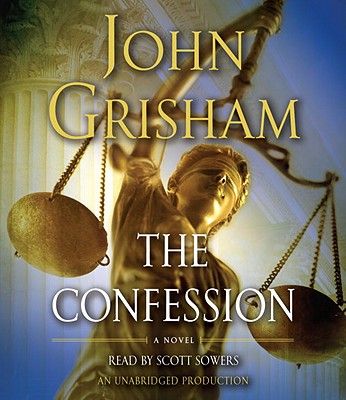
It’s been years since I read a John Grisham novel, but the first chapter of The Confession took me back to that time when I swore never to read another Grisham title. From clichés like, “It had been so long since he had touched a woman,” to fumbled metaphors like, “Her interest in the inquiry had suddenly lost steam,” the prose has the painfully flaccid zip of Raymond Chandler lobotomized with a Wal-Mart weed whacker.

The story is simple yet leaden, and Grisham pushes against it with a mammoth obliviousness. Some random guy staggers into the church reception room and the hot receptionist/pastor’s wife asks him for information and then he explains his name is Travis Boyette and he’s an ex-con and you can almost hear Grisham chuckling at his own cleverness because he’s gotten all that information out there in the course of the narrative itself without having to write explication and that must mean he’s a damn fine writer, right? And shortly thereafter he proves he’s an even better writer because…brain cancer! Boyette’s got it—but he doesn’t show any sign of pain till right after he tells us he has brain cancer because if he said he had a headache earlier it would tip us off.

You can probably see where this is going. No doubt you’ve already intuited not only the existence but also the main character traits of Keith the pastor, who “spent much of his time listening to the delicate problems of others, and offering advice to others” and had therefore “become a wise and astute observer.” Probably you’ve also guessed that Boyette is a bad, bad person (did you figure out he was a sex offender from the fact that he looks at the pastor’s wife’s chest? You did? Bonus points!) If you’re especially perspicacious you may even be able to reconstruct from TV movies past the hollow schlop-schlop of pop theology and pop psychology flopping about like two half-dead fish in a bucket. “It’s human nature. When faced with our own mortality, we think about the afterlife. What about you, Travis? Do you believe in God?”

Travis sort of does and sort of doesn’t, phrasing his concerns in the unforgettably colorless argot of a criminal trapped in a PG-13-rated book written by an author who has, apparently, never seen an R-rated film, much less The Wire. “Damned headaches,” Boyette mutters, because that’s just the kind of filth you expect from career sex offenders. In moments of great stress, he has even been known to resort to a double negative.

From such sure signs we know that Boyette is indeed the worst of the worst. Still, the remorseless demands of plot insist that he feel remorse, and he drops hints that he can clear the name of an innocent on death row. Keith and his wife join hands and turn their faces towards the thick remainder of the book. They are hopeful and unafraid, for they are vacuous imbeciles…and besides, they only have to live it, not read it.
 

Confession-1

In the Shadow of Mediocre Page Design

Jed Perl very satisfyingly tore into Art Spiegelman over at the New Republic, pointing out that he is incredibly pompous and can’t draw worth a damn. That led to a chat on facebook where I claimed that Spiegelman’s page design was pretty much crap, and was told I was wrong by various folks.

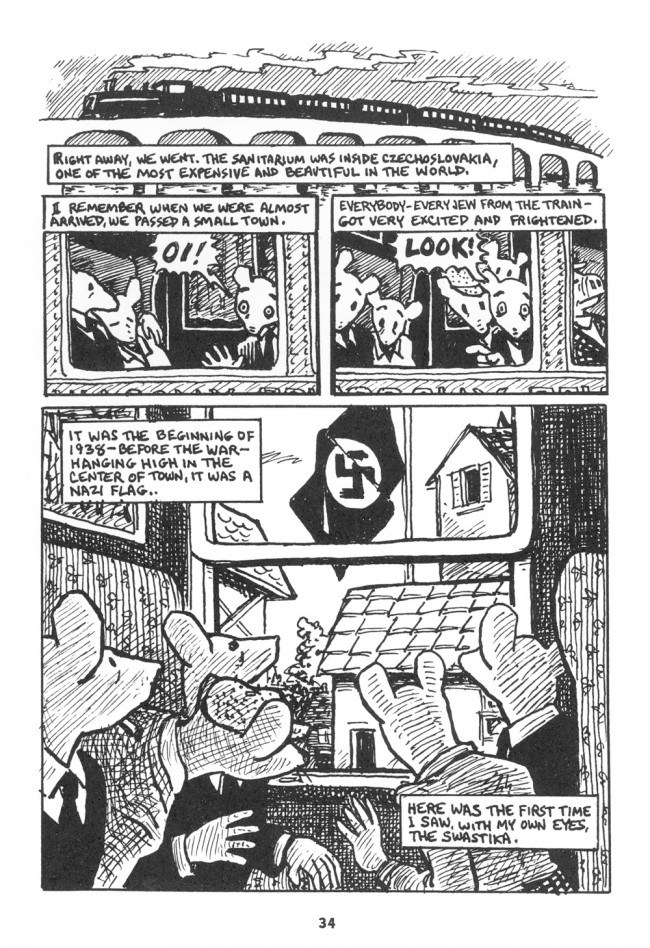
So what the hey, Dan Nadel was gushing over at tcj about the same Jewish Museum Spiegelman show that underwhelmed Perl. Here’s one page Nadel singled out to illustrate his piece.
 

11-page-from-Maus-I-650x948

The train on top of the bridge is bung up against the panels below, so that it looks like some sort of cap perched atop the panels. The sense of motion is really confused too.The train goes from right to left up top, and but in the next row of panels the direction of reading makes it seem to go left to right. Spiegelman tries to fix this by shifting the image leftward in the second panel so you can see the next window, but that doesn’t so much create leftward motion as it just makes the motion of the page even more or a mess, especially since the window borders and the panel borders are exactly parallel, and so tend to visually distract get confused with one another.

I can’t for the life of me think of an explanation for why Spiegelman wanted to make the top of the page look like a decorative hat, or why he’d want to have you thinking about which direction the train is going in. I guess, though, you could argue that the confusion and clutter of the panels at the top is supposed to make the swastika pop. But that ends up feeling cheap; the top doesn’t work by itself, and setting everything up for a big reveal seems manipulative. That’s only intensified by the way the flag folds in such a wannabe but not actually lifelike way — Spiegelman’s melodramatic touch a la the splash of red in Schindler’s List.

Maybe the ham-fisted clutter and the transparent melodrama are supposed to be ham-fisted and transparent, undermining identification and foregrounding the comicness of the comic. Spiegelman deliberately combines incompetence and glibness to show us that this isn’t really a true image of the Holocaust, but a poorly designed and manipulative representation of the Holocaust. Maus is so great because it’s so self-consciously mediocre.

Utilitarian Review 11/23/13

On HU

Featured Archive Post: Domingos Isabelinho on Shannon Gerard.

Richard Cook on Journey, the video game.

Eric Berlatsky on queerness and Krazy Kat.

Alex Buchet discusses superheroes and transhumanism in a coda to his prehistory of the superhero series.

Jacob Canfield reviews Benjamin Urkowitz’s Real Rap.

Osvaldo Oyola on Dan Slott’s She-Hulk as meta-comic.

Roy T. Cook for PencilPanelPage asks, Why does ignatz throw from right to left?

Chris Gavaler on the first mutant, from the age of eugenics.

Me on Krazy Kat, artifice and the comics canon.
&nbsp
Utilitarians Everywhere

At the Atlantic,

—I talked about recent allegations against Brian Wood and sexism in comics.

— I talked about testing in the Japanese school system and why we shouldn’t see education as about economics.

— I argued that selfies are art.

At Splice Today

—I praised the fuddy-duddy music of Don Williams

— I bitch about he stupidity of evolutionary psychology trying to explain bitchiness
 
Other Links

Jane Doe with a brief insight into the relationship of trans identity, race, gender, and violence.

Jed Perl very satisfyingly sneers at Art Spiegelman.

Danielle Paradis on that Lily Allen video.
 

spiegelman583,0

A Picture of Krazy Kat

Last week Eric Berlatsky (that’s my brother!) left a comment on the PPP Krazy Kat roundtable in which he argued that one of the hallmarks of the strip is the way that settings and backgrounds are so unstable. “Everything “behind” the characters is constantly changing and in flux without any rhyme or reason,” he says. ” “Instability” seems to be the watchword of the strip, with the possible exception of the “solidity” of Ignatz’s brick itself.”

Eric talks about this in regards to the strips’ social positioning; the queer BDSM Kat/Ignatz/Pup triangle, and/or Herriman’s own fluid, possibly closeted or masked relationship to African-American identity. However, it seems to me that it could also be read formally rather than culturally.

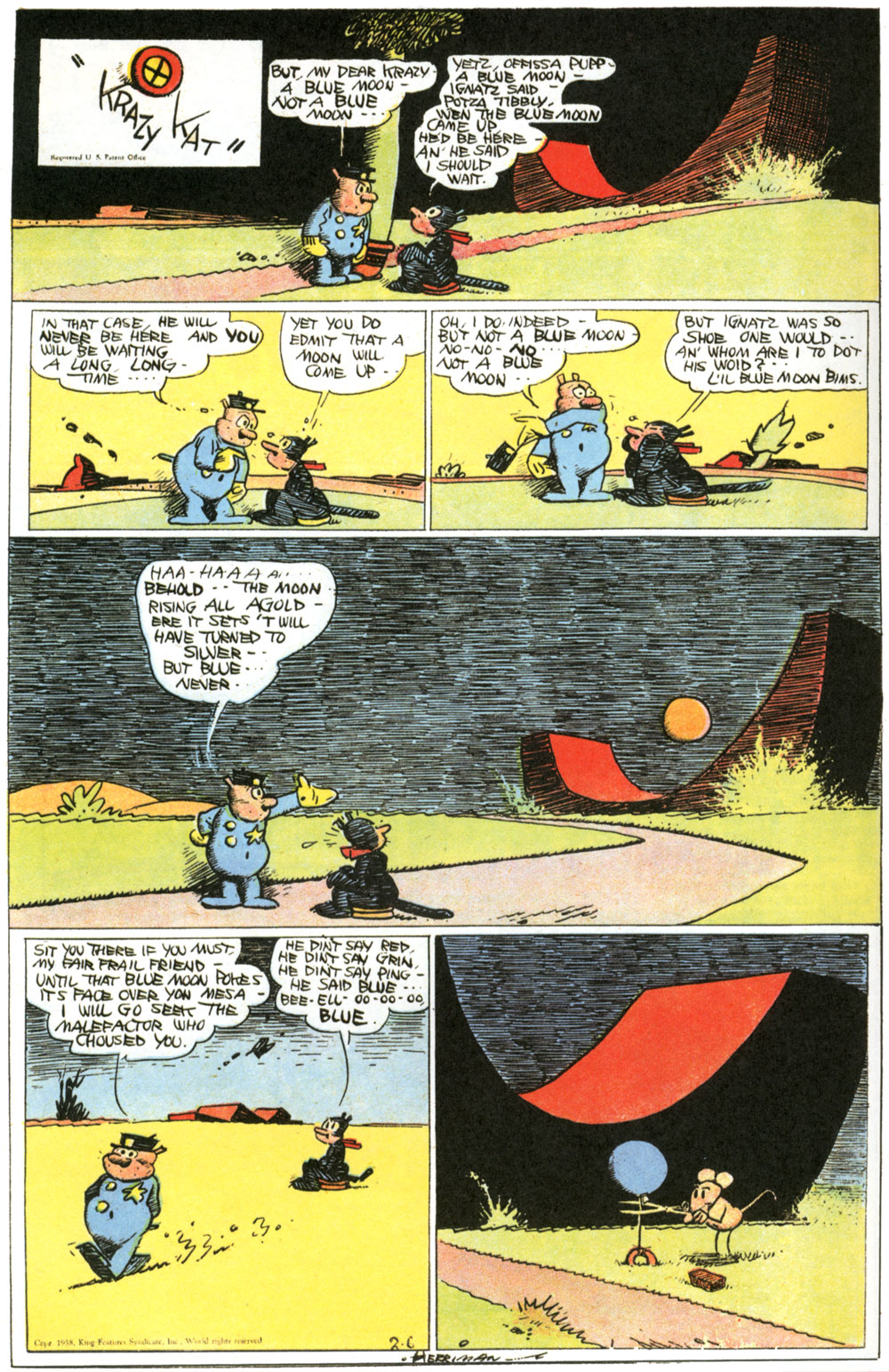
For example, take this strip I pulled from the internet at random:
 

KrazyKat_2-6-38_lg

 
As Eric says, the background here shift insistently. In the first panel, Krazy and pup are positioned at night beside a tree on a straight road, with a curved rock formation off in the distance. The two panels below seem to be in daylight (the color of the sky blurring into the color of the ground from the panel above(. The tree disappears, and there are different rock formations (and what looks like a volcano) off in the distance. Then, in the next large panel, we see the (formerly straight) road curving off towards the obelisk, from behind which a gold moon rises. The sky is no longer the solid black of the first panel, but is instead a mass of cross-hatchings, almost ostentatiously referencing the hand that drew it. All this time, Officer Pup is explaining, with much assertion and repetition, that the waiting Krazy will never see a blue moon; declaring his faith in a natural order even as the world around him haphazardly shuffles trees and roads, creativity sliding out from under the rotund figure of law and order, who looks not unlike a big blue moon himself. Finally, Pup exits, and as Krazy lurches into quasi song (“Bee-Ell-oo-oo-oo Blue”) we see behind the monument (or did the monument just move over?) where Ignatz prepares to launch an ersatz blue moon balloon. Surely Krazy here is the reader, not so much gullible as eager to be gulled, while Ignatz is Herriman, the artist arranging and rearranging the props for the delight/confounding of all us waiting Kats. The arrangement of the two moons, one above the other on the page despite the alteration of all other visual cues, is perhaps the tell; the real paper moon is as fake as the fake paper moon, or perhaps even slightly more fake, since the blue acknowledges its artifice.
 
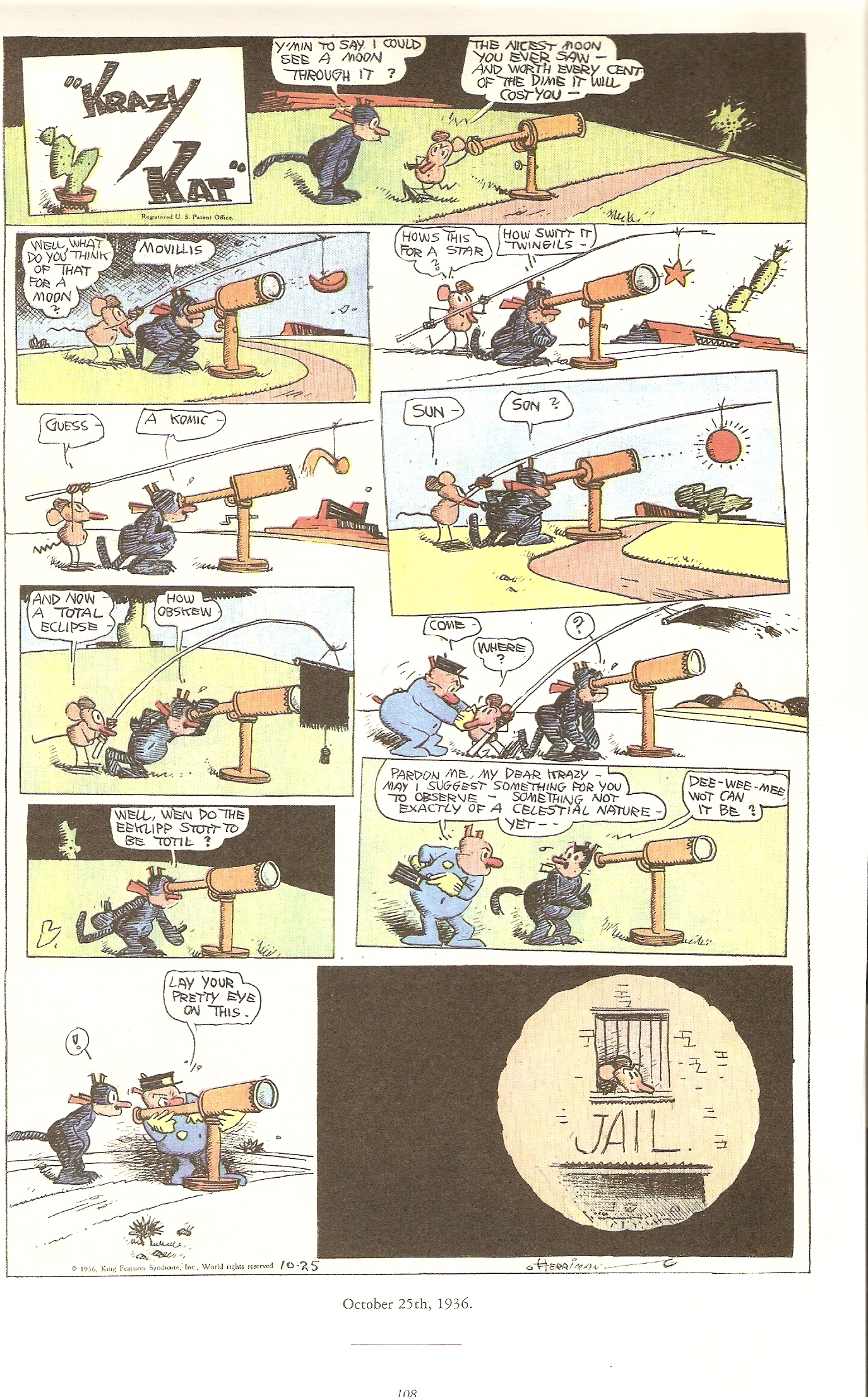
Stumbling on such a clearly self-referential strip wasn’t an accident I don’t think. Here’s another I picked out.
 

0007tfeq

Again, Kat as reader, Ignatz as creator, with the changing delights before the lens mirroring the giddy changes in background, as day swaps for night, trees replace rock formations, and the road arcs one way and then the other. Krazy even guesses that one misshapen piece of tschotskes is a “Komic”, in case we missed the joke. And then, the final turn-around, officer pup calls an end to the proceedings and the comic, returning to one of the strip’s most stable iconic images; Ignatz locked up in the dull jail, the world all bricked up and stolid till Ignatz (or Herriman) gets out to draw the next page.

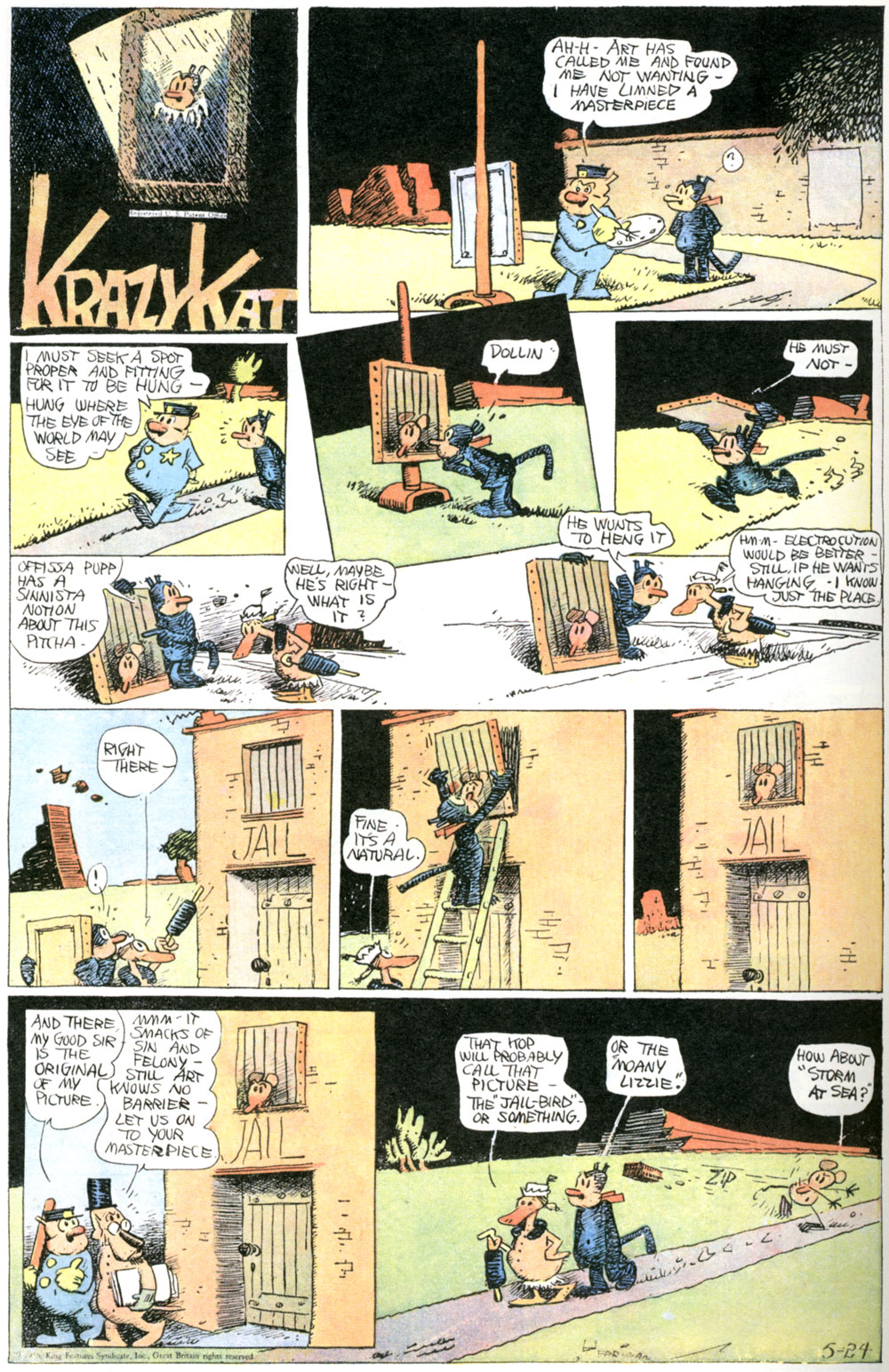
And then there’s this:
 

KrazyKat_5-24-36_lg

 
That center second line panel tilts to create a straight frame within a crooked frame, a deliberate drawing of a drawing, created this time by Pup and placed in its jailhouse place by Krazy — even the creator is unstable, and who is creating who. In the final row, the left-hand panel is inset, like a painting against the black sky, so that the prison wall with the fake Ignatz painting looks itself like a cardboard facade. Krazy and the duck walk towards the fake painting on the fake drawing, burbling garbled names of masterpieces, while Krazy throws that brick against the left to right run of the reading. Roy T. Cook suggested that the brick’s reverse zip “highlights the artificiality” of Ignatz’s action. Everything, in short, is what it shouldn’t be; the genius of the artist is to krazily wrong all rights.

Adrielle Mitchell talked in her post about the way that George Herriman reshaped the comics canon; in comments Alex Buchet points out that Krazy Kat is in many ways in the high art canon, much loved by people like Juan Miro and Gertrude Stein.

Given that, perhaps Krazy Kat’s place in the canon is in some ways to create the notion of a canon,or to make a strip which demands a kind of canonicity. Art presents itself as art through the assumption of individual afflatus — the vision as meme. Krazy Kat, in the insistence of its artifice, is almost(?) a parody of avant garde brio, virtuosically creating a new world with every panel. Herriman makes a space for comics creator as genius because he drew himself as genius, high art in a blue moon.

Eric Berlatsky on Queerness and Krazy Kat

6a00e554e97d5c8834017ee3d8606c970d-800wi

 
Eric had a great comment on Adrielle’s post, so I thought I’d reprint it here.

Noah, when I did a survey of Krazy Kriticism some 5-7 years ago, there wasn’t very much gender/queer stuff, though certainly Krazy’s gender ambiguity were mentioned. My guess, though, is that there is more of that out there now as comics criticism has ramped up in academic circles. I definitely tried to explore that (and the racial elements) in my classes on Krazy. Most interesting to me is how the instability in these “social” areas are reflected by the instability of the settings, backgrounds, etc. of the strip. Everything “behind” the characters is constantly changing and in flux without any rhyme or reason. “Instability” seems to be the watchword of the strip, with the possible exception of the “solidity” of Ignatz’s brick itself. I think M. Thomas Inge talked about the whole strip as a battle between imagination and materiality (Krazy imagines Ignatz loves her, so there is nothing he can physically/materially do to overcome that notion). Inge talks about this, and then that seems to apply to so much of the “comics canon” (to bring things back to the Eliotic realm). Snoopy’s imagination, for instance, vs. Charlie Brown’s “real life” of disappointment and misery. Obviously, Calvin and Hobbes is about the transcendence of the imagination, etc. Even (many/most) superhero comics are all about the “power fantasy” vs. the reality of the disappointing secret identity. Of course imagination vs. reality is such a broad “theme” as to be legible anywhere and in anything. Still, it does seem like a powerful current in Krazy and in the comics canon in general. Things like gender and race then can be considered in that context. Is “gender” simply something we imagine, or is a bedrock reality? The same question might be asked of race, and, in fact, Krazy puts these things in conversation with one another. The earlier discussion about Herriman’s “race” and self-identification also feeds into this. Is there a “truth” to the question of Herriman’s race, or did he “imagine” himself into whiteness, etc. etc. These kinds of things make Krazy a fun strip to think about and talk about (also, the fact that it’s funny).

The whole Krazy Kat roundtable so far on PencilPanelPage is here.

Utilitarian Review 11/16/13

On HU

Featured Archive Post: Brian Cremins on representing music in comics with Gil Kane and Bob Dylan.

Annie Murphy on women and exclusion in comics.

Chris Gavaler on Thor vs. the Dark World of DC.

Ng Suat Tong argues that Michael DeForge needs better critics.

Caroline Small argued that comics criticism needs more critic-practitioners.

Kristian Williams talked about the morality of Watchmen, Fail-Safe, and Arendt’s Eichmann in Jerusalem.

Ng Suat Tong responds to Kristian’s post by asserting that Ozymandias is less of a bastard than John F. Kennedy.

For our first PencilPanelPage post, Adrielle Mitchell talked about Krazy Kat and the comics canon.

I talk about why I try to get women writers on HU.

 
Utilitarians Everywhere

On the Atlantic I wrote about

—Lily Allen’s crappy new video, the impossibility of parody in pop, and how you should buy Valerie June’s album.

Leigh Moscowitz’s new book, The Battle Over Marriage: Gay Rights Activism Through the Media, and assimilation as dialectic.

At the Dissolve I wrote about the mediocre political documentary Caucus.

At Splice Today I wrote about

—my son explaining conceptual art.

—a great documentary about bees dying off

 
Other Links

This is a really depressing piece about treatment of women in the comics industry.

Ariel Chesler on men’s reproductive rights and fatherhood (the linked Anna March piece is worth reading too.)

Danielle Paradis on Joss Whedon redefining feminism.

Our own James Romberger is an Eisner Award judge.
 

414747135_640