Monsters, Kids, and Hillbillies

omni140lgcv

 
Various Artists
The World Is a Monster
Omni Recording Corporation

The World Is a Monster is a compilation of Columbia records post-war hillbilly and honky tonk. The tracklist eschews hitmakers for lesser-known artists — and in doing so, demonstrates fairly clearly why the lesser-knowns were lesser known. With one or two exceptions, nobody here comes anywhere near the consistent genius of Columbia’s biggest star, Lefty Frizzell. Indeed, compared to Lefty Frizzell’s easy swing and brilliantly laconic phrasing, an unassuming, declarative singer like Johnny Bond sounds exactly like the also-ran he is, while even a decent Hank Williams impersonator like Frankie Miller seems decidedly unnecessary.

Just because Lefty’s not around, though, doesn’t mean this set isn’t worth getting. On the contrary, the lack of first-rate singers leaves the compiler free to concentrate on that second-rate genre for second-stringers, the novelty song. Virtually every track here is a delightfully transparent gimmick. Undoubtedly the highlight is, “Ugly and Slouchy,” the Maddox Brothers deranged, cackling, red-hot proto-rockabilly ode to homely women (“There’ll never be no fear of them wolves hangin’ round.”)

Unassaible as that peak is, though, there are plenty of worthwhile challengers. Neal Jones’ “I’m Playing It Cool” stomps its way through Dear John letters, gambling losses, and stolen property with an off-key yodeling attack that would have made even Ernest Tubb wince appreciatively. Jimmy Dickens (probably the biggest name in the set) faces a similar gauntlet of troubles in “Me and My Big Loud Mouth,” while Jimmy Murphy’s “Here Kitty Kitty” is a double-entendre hillbilly jump blues with some tasty harmonica. And then there’s George Morgan’s “A Shot in the Dark,” with the electric guitar miming the “Peeew!” of Cupid’s arrow, and the cowbell ringing to emphasize the “Bullseye!” My seven-year old loves that one because he gets to mime the pistol shots.

My son’s enthusiasm is fairly telling, I think . In a lot of ways, novelty records are children’s music. And it’s that children’s music which eventually conquered all with the advent of rockabilly and a whole genre devoted to manically bouncy goofiness. There are some other traditions here too — Carl Smith with the convincing weeper, “There’s a Bottle Where She Used to Be;” Jack Rhodes with his cheerfully menacing “Eternity,”; Freedie Hart with his tragi-ballad “The Wall.” But listening to this you can easily hear distant echoes of Elvis or Carl Perkins or Buddy Holly or Chuck Berry. The world may be a monster, but the kiddies are going to inherit it.
__________
This first appeared on Madeloud way back when.
Perverse Iron Frechman

This piece first ran on Comixology.
______________

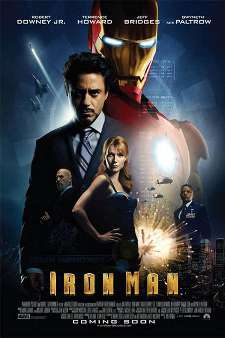
iron_man_posterI’m the last person in explored space to see the first Iron Man movie. I watched it this month and am pleased to report that it hasn’t dated a moment. We’re still wandering around Afghanistan haplessly blowing and being blown up; arms traders are still sexy/cool; bad boys with hearts of plutonium still get the girl; Gwyneth Paltrow is still frighteningly thin and brittle, with little flecks of poisonous spittle flicking out from behind her girl-next-door façade. Also, random Westernized foreigners with doctorate degrees are always happy to sacrifice themselves for the callow American so that said callow Americans can continue to be callow but with a mission; black guys are sidekicks; male womanizers are rakishly hot/forgivably flawed, but women who open their legs are trashy bitch sluts. Also Americans save all the brown people. Or maybe kill them. It’s hard to tell.

You probably know that though. After all the film is two years old. And superheroes are, what, going on 80? There’s been some finessing of the template, of course. Semi-socialist Superman beat up crooked industrial robber barons on behalf of the working man. In the post-Marvel age of superhero realism and relevance, Iron Man beats up crooked industrial robber barons on behalf of crooked industrial robber barons who have had a change of heart. But the main point is truth, justice, the American Way, and uber-violence on behalf of peace. The gods are us and we like to hit things — but in a good cause.

It’s not just sanctimonious Americans who find this sort of thing appealing, though. Perverse Frenchmen want to be superheroes too. Or at least that’s what I’ve gleaned recently from reading some of the poems of Georges Bataille. Bataille, like Robert Downey, Jr.’s Tony Stark aka Iron Man, is obsessed with sex and pleasure — surely Stark, for example, would appreciate a poem titled “I Place My Cock…” Like Strark, too, Bataille dreams of being more than human:

the glory of man
no matter how great
is to desire another glory

I am
the world is with me
pushed outside the possible

I am only the laughter
and the infantile night
where the immensity falls

I am the dead man
the blind man
the airless shadow

like rivers in the sea
in me noise and light
lose themselves endlessly

I am the father
and the tomb
of the sky

the excess of darkness
is the flash of the star
the cold of the grave is a die

rolled by death
and the depths of the heavens jubilate
for the night which falls within me.
(from “The Tomb,” trans. Mark Spitzer)

The poem almost makes more sense if you decide it’s about Iron Man than if you don’t. Even all the talk about death — “I am the dead man/the blind man/the airless shadow” — fits, since Stark is essentially a walking corpse, his heart powered by the same technology that runs his suit. His weakness is his strength as he pushes outside the possible, in a hyperbolic apotheosis of noise, light, and self-dramatization.

In another poem Bataille declares, “I fill the sky with my presence.” And that does seem to be the point for ecstatic modernity, whether pop dreck or snooty highbrow philosophizing. Presumably it’s Nietzsche’s fault that God is dead and all we’re left with is the will to power of arms traders and self-proclaimed radicals. Or maybe Jung’s right and it’s just a mythopoetical heroic something — though it seems telling that we’ve only recently decided that we require one hysterically hyperbolic hero with a thousand faces rather than making do with all the dinky little heroes with one face each.

In any case, theirs is undoubtedly a thin poignancy in the desperation on display. It’s not enough to be Robert Downey, Jr., not enough to be Robert Downey, Jr. and a genius — you’ve got to be Robert Downey, Jr. and a genius and have enough fire-power at your fingertips to make Afghanistan right. Or, if you’re Bataille, it’s not enough to fuse romantically with nature, you have to actually fuck nature to death and tramp on her corpse before stabbing yourself in the eyes with Christ’s nails. When Paltrow, as Stark’s assistant Pepper Potts finds her boss fooling around with his armor, Stark laughs it off by commenting wryly that it’s not the most embarrassing thing she’s ever caught him doing — but I’m not so sure about that.

Tom Crippen had an article in The Comics Journal sometime back in which he referred to Superman as Siegel and Schuster’s “big dumb dream.” That dream is alive and well, but I’m not so sure it was Siegel’s and Schuster’s, or at least not theirs exclusively. Superheroes are just one, somewhat popular way to wrap the world around man or man around the world like some clunkily gaudy suit of CGI armor. As Bataille says, “the universe is within me as it is within itself/nothing separates us anymore/I bump against it in myself.” You can hear the dry “thunk” of his head on the inside of the helmet before he powers up and goes off to deface some idols or beat up some bad guys, whichever comes first.

Utilitarian Review 3/16/13

On HU

Featured Archive Post: Qiana Whitted on Blues Comics.

Chris Gavaler on the silence of Black Bolt and the silence of Clarence Thomas.

Peter Suderman interviews me briefly about imperialism and pop culture.

Betsy Phillips on Jake Austen and Yuval Taylor’s Darkest America, about the black tradition of blackface minstrelsy.

Michael Arthur interviews the artist Corinne Halbert about basements, lust and foxes.

I argue that Anne Bronte also liked assholes.

Vom Marlowe on Yun Kouga’s Loveless #10.

Jog on Akshay Kumar and subversive Bollywood.

Friday music sharing post featuring psychy Stones vs. grungy Stones.
 
Utilitarians Everywhere

I talk about the ethics of mashups at the Center for Digital Ethics.

At the Atlantic

— I talk about Stephenie Meyer’s the Host and the invasion of the lovey-dovey body snatchers.

—I argue that Stephenie Meyer is a feminist, just like she says.

—I argue that we’re in a good place when even not very insightful political hacks like Rob Portman support gay marriage.

At Splice I discuss research suggesting that C-sections are often performed without medical reason.

And also at Splice I got to talk about my favorite Pink Floyd album.

You can now read my article on Junji Ito in Italian.
 
Other Links

David Brothers on Spider-Man turning fifty.

Chris Orr argues with me about rom coms (there’s some back and forth in comments too.)

Very satisfying takedown of Bob Woodward.

As a freelancer who writes for the Atlantic, this hurts. (HT Caro)
 
This Week’s Reading

I finished Stephenie Meyer’s The Host, read Kathryn Tanner’s “The Economy of Grace” about applying theology to economic matters, read the 1983-84 Peanuts volume.
 

images

Anne Bronte Also Likes Assholes

brontessm

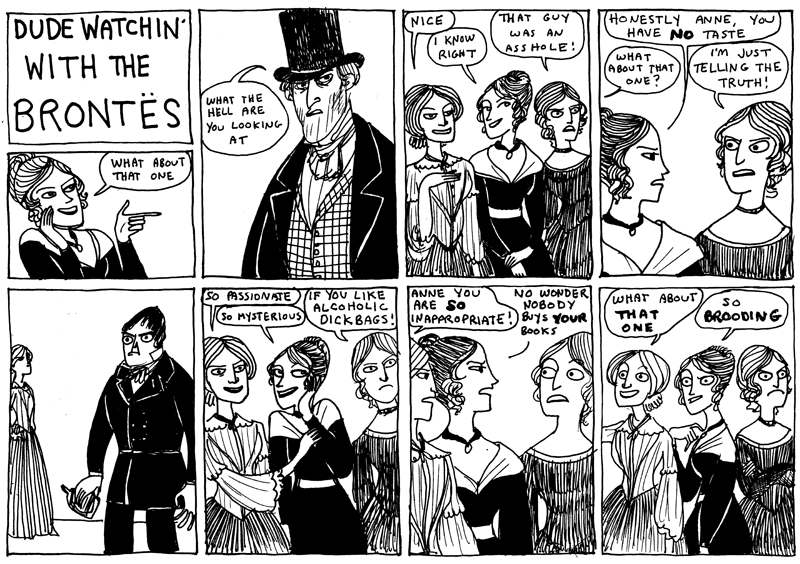
I think the above cartoon by Kate Beaton is the first piece of Anne Bronte criticism I ever saw. At the time, I hadn’t read any of Anne’s novels, but the cartoon certainly made me think I should.

Well, I finally have…and as it turns out, I’m not sure I entirely agree with Beaton. The cartoon is obviously focused on The Tenant of Wildfell Hall, which is centered around the abusive marriage of Helen and Arthur Huntingdon.

Certainly, in comparison to the brutish protagonists of Jane Eyre or Wuthering Heights, Arthur is much less romanticized — or really not romanticized at all. He is not brooding or exciting, but (as Anne says in the cartoon) an asshole dickbag, whose good looks and charm conceal wells of selfishness and cruelty. He’s a drunkard, a cad, and an adulterer, who treats his wife with indifference and contempt (leaving her alone for months at a time so he can carouse in London) and then terrorizing her when she protests. He deliberately tries to get his young child to drink and curse to amuse himself and his friends. His low point comes when he discovers that Helen is planning to leave him and support herself by painting; he storms into her room, takes all her money, and destroys her painting materials.

Much of the novel, then, is a harrowing description of a domestic tyrant, and an unflinching portrait of the powerlessness of married women at the time. Helen has no rights to divorce her husband, even though he is basically parading his mistresses in front of her; she can’t take the child away from him, though he is deliberately, and basically out of spite, attempting to corrupt him. Moreover, her early attempts to reform her husband founder precisely on the disproportion of their power; she has no means under law or custom to influence him; she can’t even make him stay in the same house with her, or make decent efforts to conceal his adultery. The romantic notion that a good woman can save a bad man (very much in play in Jane Eyre, for example) is shown to be not so much spiritually as logistically impossible given the status of women at the time.

So far as Arthur Huntingdon is concerned, then, so good. But, unfortunately, the book feels compelled to present us with another suitor for Helen. And so we get Gilbert Markham, the epistolary narrator of much of the novel. Markham is a gentleman farmer, and the most eligible young bachelor in the neighborhood into which Helen moves after escaping from her husband. She and Gilbert quickly strike up a relationship, which eventually ends in married bliss after Huntingdon obligingly drinks himself to death.

And again, this is unfortunate because, contra Beaton, Gilbert is kind of an asshole. Oh, he’s vastly superior to Huntingdon; he’s not a drunkard or a monster. But that’s a pretty low bar. Without Huntingdon for comparison…well, he doesn’t come off so well. He’s conceited, petulant, and selfish; he toys with the affection of a neighboring clergyman’s daughter, and then tosses her aside when he decides that Helen is more interesting — and when said clergyman’s daughter is upset and resentful, he blames it on the failings in her character and essentially accuses her of being a shallow designing flirt.

Nor is his treatment of Helen much better. He sneaks onto her property and oversees her embracing another man, Frederick Lawrence. Rather than asking her to explain the situation, he rushes off and refuses to speak to her. He also loses his temper and a few days later assaults Lawrence, seriously injuring him and confining him to his bed for several days.

So, to sum up, Gilbert is a jilt, a sneak, and a thug, petulant, cruel, and thoughtless. And yet, he’s supposed to be the good guy!

Of course, Gilbert’s courtship of an sympathy with Helen, and his discovery that Lawrence is Helen’s brother and that in assaulting him he behaved like a total poltroon — all those things are supposed to make him a better, less impulsive, more caring person, and a fit husband for Helen. But that’s not a contradiction to the assholes-are-cool-so-marry-one narrative. Rather, it’s the same narrative over again. You’ve got your infantile ass with anger management issues, and instead of saying, you know, I don’t really want to marry an infantile ass with anger management issues, you end up saying, hey! It’s a fixer upper! Awesome!

There’s at least one other fixer uppers in the book too — one of Huntingdon’s carousing buddies ends up being transformed into a doting husband through the power of his wife’s love (with a little nudge from Helen.) One might be an accident, but two starts to look like carelessness. It’s great that there are some levels of brutality and drunkenness that Anne is willing to be repulsed by…but I think Beaton goes a little too far when she ask rhetorically:

Anne why are you writing books about how alcoholic losers ruin people’s lives? Don’t you see that romanticizing douchey behavior is the proper literary convention in this family! Honestly.

Anne’s perfectly capable of romanticizing douchey behavior. She’s perhaps tweaking the family literary convention, but she’s not rejecting them. If you want a guy who treats women with respect, you need to read Jane Austen or E.M. Forster or maybe watch Say Anything. With the Bronte’s, the best you can hope for is a slightly smaller asshole.

Imperialism and Pop Culture — Peter Suderman Interviews Me

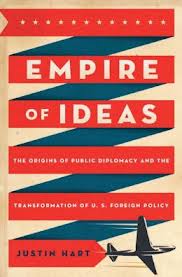
imagesI recently had an article in the print edition of Reason on Justin Hart’s Empire of Idea, a book about America’s efforts to influence world opinion. Peter Suderman interview me for a profile to run beside the article…but of course, I was over verbose, so most of my responses got cut. Peter, though, has kindly gave me permission to run the whole thing here instead.

Peter Suderman: What makes America so susceptible to foreign policy blunders?

NB: I think America’s tendency to stumble into foreign policy quagmires probably has a lot to do with the fact that we’re just everywhere. We’ve got a finger in every pie (and/or a foot on every neck, if you want to be more confrontational about it.) I think there’s just a
very strong ideological commitment to leading the world/solving all the world’s problems, which is partially expressed through spending tons and tons and tons of money on weapons — and once you’ve got all those weapons, there’s a huge incentive to use them, which reinforces the ideology, and you buy more weapons, and on and on and on.

PS: Do you think there’s a disconnect between U.S. policy/government elites and less-well-connected citizens when it comes to foreign policy? Or are they basically in sync?

NB: There are obviously a lot of Americans, of all walks of life, who enjoy the image of the United States as a superpower, and who identify with the US projection of power. On the other hand, there’s also a substantial number of folks who want us to be doing less. Obama won the Democratic primary basically as the less-imperialism candidate. But then, of course, in office, he’s projected force as enthusiastically, if thank God less incompetently, than his predecessor. So…I’d say that elites are more unified in their support for imperial adventures. Those adventures draw at least occasional substantial opposition from the public, but that opposition seems difficult to translate into elite action (except in cases of transparent policy failure, like Iraq).

PS: You’ve written an awful lot about pop-culture. Does pop-culture contribute in important ways to how America sees itself in the world? Are there particularly relevant, insightful pop culture portrayals of America’s foreign policy outlook?

NB: I think pop culture both reflects and can contribute to how America sees itself, or what America does. I guess the most obvious recent example of that is 24, which became a touchstone for pro-torture arguments.

I think Alan Moore and Dave Gibbons’ comic Watchmen is an extremely insightful look at America’s foreign policy. It was written in the 80s, obviously, but it’s still really relevant, I think. It’s about the allure of power and of saving others, about the utilitarian calculus of sacrifice that goes along with it, and about the way that that utilitarian calculus ultimately founders on the fact that no power is ever enough power, and that, however many bombs you have, the future really isn’t under your control. Ozymadnias’ piles and piles of dead bodies are meant to be a sacrifice on the altar of the new future — but the book strongly suggests that they are, really, just piles and piles of dead bodies. The fact that it’s the liberal one-worlder who turns out to be the mass murderer while the right-wing fascist nutball is repulsed by the violence is a nice reminder that imperialism can be centrist as well as extremist .

PS: What do you think America could have done to avoid being linked with
European colonialism? Or was that linkage inevitable?

NB: America has long had an isolationist strain; it seems at least possible that that could have had more of an influence than it did. Counterfactuals are hard to figure, though.

Reason ran a photo of me with the article as well…but looking at it again, I don’t think I can bear to reprint it. It’s just hard to avoid looking willfully smug in author photos, I guess. So if you want to see my shame, you’ll just have to pick up that issue of Reason.

Utilitarian Review 3/8/13

News

Tom Spurgeon reports that Kim Thompson has been diagnosed with cancer. I had my first online troll battle (via email) with Kim way back when. I hope he beats this thing and is around for many more. You can find the address to send well wishes at the link.
 
On HU

Featured Archive Post: Jog on Alan Moore and his collaborators.

Me on Darkest America, a book about the black blackface tradition.

Me on Nate Silver and the morality of prediction.

Alex Buchet on the cartoons of bandleader Xavier Cugat.

Kailyn Kent on gallery art and comic book splash pages.

We started organizing our upcoming music roundtable.

I argue that film Boromir is better than book Boromir.

Domingos Isabelinho on Jochen Gernet. Watch Betty and Veronica race to the war!

Jacob Canfield on poetry about the Legion of Super-Heroes.

Our Friday music sharing post, featuring Brooke Valentin’s The Thrill of the Chase.

 
Utilitarians Everywhere

At the Atlantic:

— I talk about Julia Stiles’ YouTube series Blue, and the obsession with the secret lives of prostitutes.

— I review the Suuns new album — indie rock for the state fair.

— I review the documentary It’s a Girl, about sex selective abortion in China and India.

At Splice

— I argue that if you’re not going to moderate comments, you should just get rid of them.

— I review Tweet’s lovely new ep.

images

 
Other Links

Slate on Shirley Jackson.

C.T. May on Isaac Hayes and the alternative minimum tax.

Felix Salmon tells internet freelancers to abandon all hope.

Molly Westerman on how her son fell in love with a girly book series.

The Producer of the film It’s a Girl responds to my review.
 
This Week’s Reading

I finished Anne Bronte’s Tenant of Wildfell Hall (which was a bit disappointing.) Read Christine Yano’s Pink Globalization about Hello Kitty’s global reach for a review. Started Stephenie Meyer’s The Host, also hopefully for a review.