Too True

My reviews for Madeloud are largely buried and unsearchable, it looks like, so I thought I’d start reprinting some of them here, starting with this one.
________________

I like contemporary pop. I like classic country. I should be able to reconcile myself to contemporary country pop. Right? I am trying. I’ve recently renewed my affection for George Strait, and belatedly discovered the charms of Leann Womack and Sara Evans. All those folks, though, have at least a cowboy boot and a half in the tradition; they’re neo, not new. Even their slickness ends up being charmingly corny and old-fashioned. Leann Womack looks about as dowdy as a major star can look on the cover of her first album; seated and leaning forward awkwardly on a big Sears-worthy comfy chair, big dangly cross earrings vying for attention with the big buttons on her aggressively modest black jacket.

Miranda Lambert doesn’t wear big buttons. Nor does she mess around with neo cred. She may be on the country dial, but she’s pop from her perfect toes to her exquisite collarbone — the latter of which is featured prominently on the cover of Revolution. I’ve got no objection to that — pop stars are supposed to be pretty, after all. It’s part of their appeal. And it’s not like Lambert doesn’t have anything else going for her. On the contrary, like Christina Aguilera and Beyonce, when Lambert won the genetic lottery, she didn’t do it by halves — her voice is almost as much of a marvel as her physique. Her twang is lodged in her every phrase like a burr, adding swagger to the uptempo stompers and sultry insinuation to the ballads. I’d be happy to sit back and listen to her sing the phone book, as the saying goes.

Unfortunately, she isn’t singing the phone book here. Instead, she’s singing the sort of songs you’d expect to hear on country radio — and try as I might, I just can’t hack it. “Dead Flowers,” for example, could be an affecting, vividly imagined ode to lost love — if somebody would just for God’s sake shoot the drummer, who thumps along like he’s wearing hip boots on his arms. “Heart Like Mine,” has a couple good one liners (“I heard Jesus he drank wine/ and I bet we’d get along just fine,”) more or less obscured by the music’s all-too-earnest efforts to be sweeping and inspirational in a “get your lighter out” mode. It’s almost like listening to Boston’s “More Than a Feeling,” if you tried to substitute denuded country filigree for any musical ideas or actual personality.

Such is the whole album. It’s not reverent and backward-looking, like the neo-traditionalists, but it’s not gimmicky and bizarre like the best pop from Abba to Ciara. Instead, the Revolution exists in this weird aphasiac past, where retailing indifferently performed rock clichés from the seventies, eighties, and nineties is somehow supposed to be arresting or entertaining. Not everything’s a disaster — the opening song, “White Liar,” for example, is a perfectly pleasant Waylon Jennings knock-off by way of Steve Earle. “Virginia Bluebell” is a decent trudgy ballad. But country radio needs to sell out a lot more thoroughly than this if it’s ever going to win me over.

Ed McMahon vs. The Man

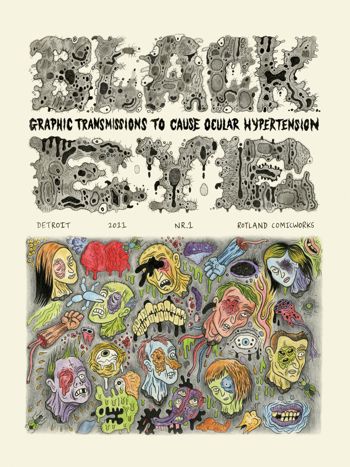
A while back, editor Ryan Standfest asked me to contribute to his black humor comics anthology Black Eye. I wrote a piece for him, but it turned out not to be what he was looking for, and he decided not to print it. The rejection did spark an interesting back and forth about black humor, faith, and other issues.

Black Eye has since been released, and Ryan kindly sent me a copy. The below is less a review than a way of continuing our conversation.
____________________

“It is our duty to give our readership whatever they wish to choke down, hoping it gets lodged in their throats….Sometimes you just have to go for broke,” Ryan Standfest writes in his preface to his anthology Black Eye. In doing so, he neatly encapsulates the dilemma facing the dangerous avant-garde. That difficulty being that the dangerous avant garde has been around, now, for more than a century. Artaud, arguably, was scary. Crumb, maybe was shocking. But if you’re preparing the same recipe Artaud did, are you really creating something your readers can’t digest? If you’re walking in Crumb’s footsteps, are you really going for broke? Or to put it another way, how can you shock the bourgeoisie when shocking the bourgeoisie is by now so thoroughly bourgeoise?

Black Eye has a lot of lovely work, and managed to freak out Canadian customs officials. But it never really manages to figure out how to get around the central dilemma of the unoutrageousness of third-hand outrageousness. The more it rages against the machine, the more overdetermined and reverent it seems.

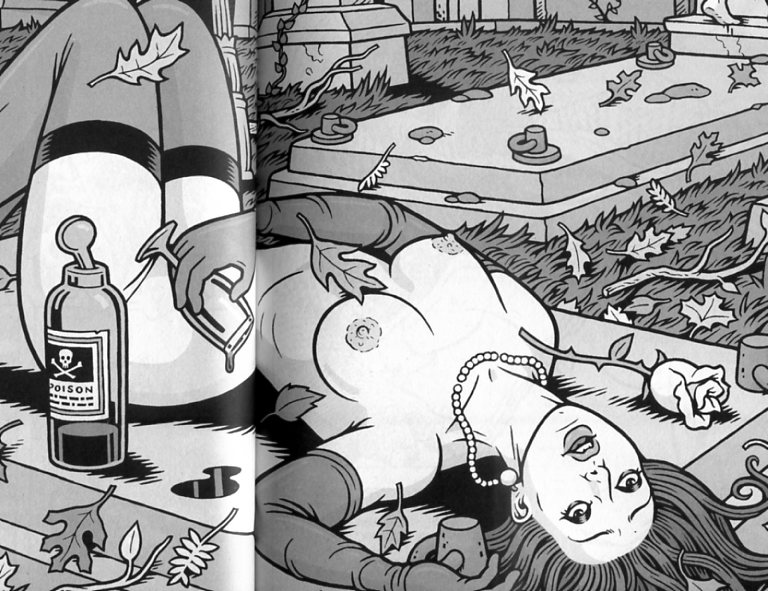
For example, Michael Kupperman’s advertisement for All-Purpose Animal Groinologues, which will allow you to correctly reference various vertebrates’ reproductive organs for important business presentations, is up to his usual standards of hysterically goofy humor — but it fits comfortably into a genre of comics advertising satire that long since passed through pointed and on into nostalgia. Similarly, Danny Hellman’s two-page spread showcases his usual strikingly clear and accomplished graphic style…but the image of a nude woman dead in a graveyard, tits visible and nether bits carefully covered, seems less like a brutal fist in the face of hypocritical contentment, and more like the sort of casual misogynyist imagery underground-influenced comics artists draw because that’s the sort of casual misogynist imagery comics artists draw. Similarly, Onsmith’s one-panel gags are little more than reiterations of frat-boy gross-outs without the inventiveness of Harold Ramis or the Farrelly Brothers, much less Crumb. Shooting dogs is funny, peeing on homeless people is funny, chopping up women is funny, necrophilia is funny all just in and of themselves because, damn it, being a black humorist means rotely following the tropes of your forbearers without ever having to add an iota of your own imagination. More successful is Gnot Gueddin’s surreal tale of butt-faced fisherman, demonstrating that you can water down Kafka a lot and still get something fairly entertaining. And then there’s Roland Topor’s “100 Good Reasons to Kill Myself Right Now” which is mainly amusing because it reminds you that, oh yeah, those goofy French! They are so cute with their berets and their wine and their nihilism! Oh, by the nose of Gerard Depardieu, that is dark!

Detail from Danny Hellman’s Black Eye centerfold

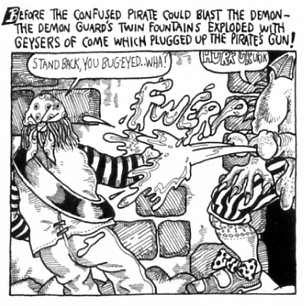
But Black Eye’s difficulties are perhaps most clearly summarized by its essays. All written by prominent comics scholars, the pieces are careful, well-written and, inevitably, devoid of the bite that they claim to champion. Ken Parille defends Ditko from the moral animadversions attendant upon his objectivist philosophy by summoning up Crumb and Lenny Bruce and declaring that like them “Ditko attacks the status quo, ridicules government and religion, exposes hypocrisy, and, most importantly, sees irony and humor wherever he looks.” Jeet Heer, in similar vein, insists that S. Clay Wilson is not a misogynist or a narrow moralist but that his comics, which occasionally depict homosexual sex, are, therefore, “A Visual Stonewall,” which, like the gay rights movement “speaks to…the new spirit of freedom.” Whether or not you agree with the aesthetic assessments, the intention is clearly hagiographic; you’re supposed to reverence Wilson and Ditko for their brave irreverence. All the idols have already been toppled, and there’s nothing for the nascent black humorist to do but idolize those who did the toppling.


Panel from S. Clay Wilson’s “Star Eyed Stella from Zap Comix No.4, 1969, reprinted from the original art in Black Eye in conjunction with Jeet Heer’s essay

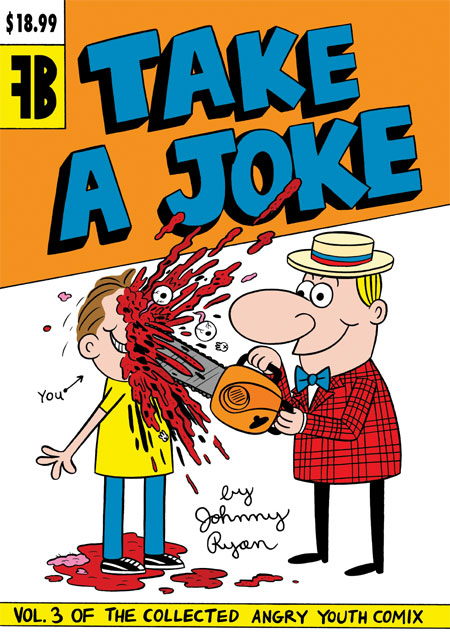
It’s instructive to turn to perhaps the most aesthetically successful contemporary comics black humorist, Johnny Ryan. Ryan’s Angry Youth Comix #12, reprinted in his latest anthology Take a Joke is devoted to “Boob Pooter’s Jokepocalypse.” Pooter, for those unfamiliar with Ryan’s work, is a world-famous comedian dressed in a cheap suit who specializes in hyperbolic offensiveness. In the Jokepocalypse, for example, he sprays people with Holocaust juice, turning them into lampshades; cuts off a soldier’s hand and sticks it in the soldier’s ass; launches a fleet of horribly destructive pity-fuck missiles; frees the breast cancer odd couple from the “cancer bags” of the President’s wife; goes back in time to kill Abraham Lincoln before he can sign the Emancipation Proclamation, resulting in slavery never being abolished; and kills a KKK member in order to cut him open and fly around in his corpse.

Pooter is, in other words, an anarchic black humorist, spitting in the eye of the proper and ejaculating blood upon the PC. Moreover, Pooter is not merely treated to hagiography, but is in fact deified. Pooter isn’t just some comedian; he’s a comedian with godlike powers. For one of his jokes in AYC #13, Pooter shoots himself in the head, comes back as a ghost, enters a woman’s body and masturbates until ghost sperm comes out of her mouth. In AYC #14 a (now-living) Boots elaborately ruins a man’s life, and when the man enacts revenge by killing him, Boots survives through a dizzyingly improbable series of disguises and substitutions, in which it starts to seem like Pooter is everyone and everyone is Pooter. He becomes a kind of immortal, unkillable demon, murdering and torturing in the name of cheap laffs and shallow boredom.

In some ways, Ryan’s use of Pooter is similar to Chris Ware’s use of God in some of his early Acme Novelty Library Work. For Ware, God (in tried and true black humor fashon) is revealed to be a megalomaniacal pissed-off superhero spreading brutality indiscriminately throughout the world. The difference, though, is that God for Ware acts out of sadism and cruelty — not out of a desire to make people laugh. Pooter’s a comedian, which means that he is, fairly directly, a stand-in for Ryan himself. Ware’s “God” satirically reveals the cruelty of the world; it’s a bleak joke on the ogre father. Ryan’s Boobs Pooter satirically reveals the cruelty of Ryan, who doesn’t so much want to upend the ogre-father as he wants to become him. Thus, while cruelty may be fun, it’s not exactly liberating. Pooter, isn’t a revolutionary; he’s a fusty stand-up man, beloved by even the President of the United States — sort of a mean-spirited Ed McMahon. Black humor, for Ryan, isn’t sticking it to the man in the interest of freedom. It’s sticking it to the man in the interest of taking his place — with the understanding that the man is all the more the ogre-father because he’s really just a bored dick.

If you gave Boobs Pooter Black Eye — with its lushly printed Onsmith/Paul Nudd cover, its witty Momma /Medea mash-up by R. Sikoryak, its lyrical surreal comic by Lilli Carré, and, yes, its thoughtful and enlightening essays by Heer and Parille and Bob Levin—if you gave Pooter this anthology, he would vomit Holocaust juice on it. That’s not Black Eye’s fault; Pooter’s a soulless cretin. As such, he defecates, not just on the staid squares, but on the anarchic rebels, until they’re both so slick with feces that you can’t tell the difference between them. Contemplating the mess, it’s hard to see black humor as a romance with daring heroes who courageously upend all values. Instead, it starts to smell a lot like just another stupid laff.

Country Race

This piece first appeared on Splice Today.
_________________________

Much of the best American music is the offspring of miscegenation. Whether it’s African-Americans in New Orleans repurposing white band instruments; or Elvis combining country and R&B just as his hillbilly forbearers did for generations; or mash-up artists deliriously merging together white and black; segregation has traditionally, and gloriously ended at the borders of the recording studio.

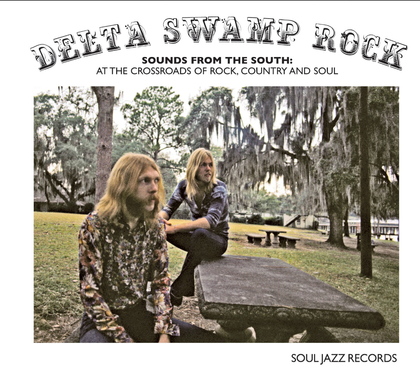
SoulJazz’s two-disc compilation Delta Swamp Rock: Sounds of the South, At the Crossroads of Rock, Country and Soul provides another satisfying instance of musical cross-breeding. Expected country rockers are represented—Lynyrd Skynyrd and the Allman Brothers show up on several tracks. But the comp spreads its net wider, too, focusing especially on the scene around the famous session players at Muscle Shoals, Alabama, but also reaching out to Memphis and Nashville, with some surprising results. Cher, of all people, delivers a soul-soaked, down and dirty vocal for “Walk on Gilded Splinters,” recorded in Muscle Shoals. Area Code 615, a group of Nashville session musicians, provides “Stone Fox Chase,” a bluegrass-meets-blues-funk rave-up that was later sampled by Kool G. Rap and others. Dan Penn, known for writing hits for James Carr and Aretha Franklin, here sings his own Stax-ready, Memphis-recorded “If Love Was Money.” Linda Ronstadt on “I Won’t Be Hangin’ Round” is encouraged by a chorus that seems to have strolled out of a black church; Waylon Jennings’ “Big D” sidles up to funk, and the whole album is soaked in blue-eyed soul.

SoulJazz’s eclectic, thoughtful choices throughout the two discs emphasize the oft-ignored fact that the South, at least as much as the north, has been a locus of racial integration and racial borrowing. This comp makes sense of the fact that the couple who won the case for racial intermarriage in the Supreme Court, the Lovings, came, not from New York or LA, but from rural Virginia. It’s a reminder that some of the first integrated sessions ever were Jimmie Rodgers recordings.

And yet. While SoulJazz has provided a testament to the South’s proud and little-known history of color-blindness, it’s also highlighted the South’s much better known, and sadder, history of segregation. In its extensive liner notes, SoulJazz mentions several times that the Muscle Shoals scene, steeped as it was in soul music, nevertheless represented a step back in terms of race. The Memphis-based Stax, where so many soul hits were recorded, had as its house band Booker T. and the MGs, an integrated band. Muscle Shoals was inspired by Stax’s example… but its musicians were all white.

The Allman Brothers band did have a black drummer, Jai Johanny Johanson. But the other pillar of the Southern rock movement, Lynyrd Skynrd, was not only all white, but flirted with segregationist rhetoric, unfurling a Confederate flag during their live performances and giving a bump to George Wallace on their hit “Sweet Home Alabama” (not included on the comp.) The fact that African-American Merry Clayton sang back-up on that track intensifies the cognitive dissonance, but doesn’t exactly excuse it. As SoulJazz says, “Walking the line between southern working-class pride and simply reinforcing southern stereotypical bigotry could be a tricky business.”

The sad part about Delta Swamp Rock is that it chronicles a moment when maybe the South could have figured out how to separate bigotry and working-class pride once and for all. There is no doubt that the musicians represented on this comp, and the scene they were part of, loved black music… and indeed, no doubt that they saw it, not as black music, but as Southern music, an integrated tradition that was simply theirs, without the painful fetishization and authenticity-mongering that has so often marred work by non-Southern musicians, from Janis Joplin to the Rolling Stones. Bobbie Gentry’s rough vocals drip, not with black accents, but with Southern accents. She sounds like a black singer, at times, not because she needs black vocal tics to validate her, but because she comes from the same part of the world.

But then there’s the question—if you come from the same part of the world, if this is your tradition, and if that tradition is color-blind, why are the people you surround yourselves with so overwhelmingly pale? The tradition SoulJazz chronicles here was eager to integrate music, but its willingness to integrate musicians was much more nervous. A drummer here, a back-up singer there, but overall blue-eyed soul remained separate from just-plain soul. American R&B attained its current, not insubstantial level of integration through the urban bricolage of hip-hop, rather than through the rural byways of country. White Southern identity remains, to this day, white—defined by a sideways avowal of a rebel segregationist past, rather than by an embrace of its rich and honorable integrated culture. Delta Swamp Rock makes the case that things could have been different, and points to some of the painful reasons why they weren’t.

Avatar the Last Airbender: a very fun American anime! (kind of)

So a couple of weeks ago, I came down with a bad cold.  When this happens, I try to be strong, but usually I end up congested, cranky, and bored. Surrounded by books, mugs of half-drunk tea, boxes of kleenex, and my aging but fierce dog weighing down my feet lest I try to do anything shifty like get up and wander around, I laid in bed, grumbling quietly and bemoaning my fate.

Then I decided to poke halfheartedly through my streaming Netflix queue.

Lo and behold, it suggested Avatar, which several of my friends had been trying to get me to watch.  I stared at the first episode with bleary eyes, and thought to myself, You know, this isn’t half-bad.

Several hours later, I’d downed half the first season.

There’s a lot to like about this series.  It’s written for kids and aired on Nikelodean, but don’t let that fool you.  In this universe, actions have consequences.  Some characters fight, become injured, and later die.  Bad things happen. But, unlike a lot of action-packed stories, there’s depth and humor, great characterization, the chance for mistakes and then redemption.

All that said, what the heck is it about?

Katara, a teen girl, is from the Water Tribe.  She and her brother, Sokka, live at the pole and go out fishing among the icebergs.  Katara is a waterbender, which means that she has an ability to manipulate the element water if she makes certain movements, but she doesn’t know how, because her tribe has been devastated by war.  There are four people–Earth, Air, Water, and Fire, and everyone lived together peacefully until the Fire Nation got a wild hair and attacked everyone.

So, Katara’s tribe has only old folks, kids, and her and her brother left.  Katara and Sokka go out fishing, and while they’re hunting, they find the lost Avatar.

The Avatar was supposed to keep the peace, because he can use all of the elements.  But 100 years ago, the Avatar vanished, and war swept the world.

Katara and Sokka find the lost Avatar, Aang, who ended up trapped in a big iceberg.  They decide to travel with Aang to help him master the elements and restore peace to the land.

But really, that’s kind of a cool, but standard plot.  The characters are what make it great, though.   Each of the characters who personify their elements show that element.  Katara is kind and brave, and she sees the best in people .  She’s water, so she reveals wisdom.  Aang, the Avatar, has mastered Air and shows air qualities like humor but also flightiness.  The Fire Nation character, Prince Zuko, is impulsive, but also passionate.  Each of them has qualities that can be advantages of disadvantages.

The world building is thoughtful and cool. Each of the different elements is controlled by a different martial art.  Water is controlled by Tai chi, for instance, whereas Fire is controlled by Northen Shaolin kung fu.  Watching the different elements battle against each other is quite beautiful.  The different elements live in different dwellings, so you eventually find varying kinds of benders in different climates.

I won’t spoil the story, which I still haven’t finished myself, except to note that you might want to check for plot points in advance if you want to avoid sad or depressing stories (if you’re showing it to a kid, for example).

But OK.  I’m just going to be honest for a moment.

The real reason I love Avatar is that it has the coolest creatures of any show ever.

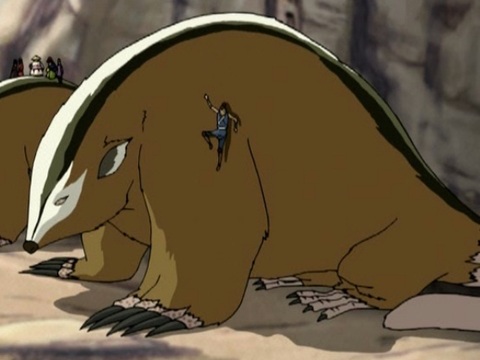
Flying bison! Bat eared flying lemurs!  Badger moles! Saber-toothed moose!  I often find myself asking, if I could only have one cool awesome animal from Avatar, which would it be?  This has entertained me for hours.  Should I get a dragon, or a ostrich-horse?  Would I enjoy a flying koi or one of those swamp alligators?

Also?  There are fox spirit librarians who scour the world for books and scrolls and knowledge and stories and take it to a hidden library deep within the earth, which is run by an owl.  How is that not awesome?


Utilitarian Review 9/17/11

On HU

Celebrating Edie Fake’s win for Outstanding Graphic Novel at SPX, our featured archive post this week is Edie’s contribution to our illustrated Wallace Stevens roundtable.

James Romberger talked narrative and visuals in Caniff’s Terry and the Pirates.

Tucker Stone and I finished up our blog crossover with a conversation about Macan/Kordey’s Cable X (and check out Igor Kordey’s response in comments.)

As part of Pussy Goes Grrr’s Juxtaposition blogathon, I reprinted my discussion of I Spit On Your Grave and its remake.

Joy DeLyria on the Bible as fandom.

Meg Worley on Wilfred Santiago’s In My Darkest Hour.

Marguerite Van Cook on the dangerous sublimity of looking at comics.

Utilitarians Everywhere

At the Chicago Reader I recommend Keith Herzik’s awesome show at the Hyde Park Arts Center, coming in October.

At Splice I review George Strait’s new album.

Also as Splice, I talk Lindsey Buckingham and cocaine.

Other Links

Pussy Goes Grrr has a juxtaposition blogathon, where contributors compare two or more films.

Matt Seneca on the DC relaunch.

C.T. May on Paying For It.

The Greatest Fandom Ever Sold

You’re probably familiar with it, even if you’ve never heard the word for it.  “Fandom” refers to the subculture of people who are fans of any topic.  Being a fan is more than simply liking something, and usually more than a hobby. Fans devote considerable time and energy to their fandoms, sometimes even creating works based on it.  While people can be fans of anything from baseball to crochet, some of the most involved fandoms are the fandoms surrounding fictional works, particularly science fiction and fantasy.  No doubt you’ve encountered at least one of these fandoms: Harry Potter, Lord of the Rings, the Bible.

In some sense, these fandoms have always been with us.  Before the internet, fandoms were widely dispersed networks of people who communicated by means of mail and conventions—meetings for fans to gather and discuss their favorite fictional works.  The first science fiction convention was held in the 1930s, and modern science fiction and fantasy fandom evolved from that.  Another milestone was the 1970s, sometimes called the “New Wave”, when large amounts of people became interested in science fiction and fantasy.  One of the most popular fandoms—and the fandom that influenced so much of what came after—is another thing that you’re probably familiar with: the Bible.

Between 1967 and 1969, three books were published, called the Torah (Teaching, or the Five Books of Moses), the Nevi’im (Prophets), and Ketuvim (Writings).  These three books together formed one book—a fantasy novel about the history of the world and a group of people in itThe book is traditionally called the Tanakh.1

 While a small group of people became highly invested in the Tanakh, publishers did not feel that they were selling enough copies.  It went out of print after three years.  Usually, that’s the end of the story: a book is published, a show is made; people like it for a while, and then it’s forgotten.  But fans of the Tanakh were extremely loyal.  They lobbied for republication of the book, and when that failed, they took matters into their own hands.  For decades, they held conventions and produced fanzines—collections of fan works published in bound form, and sent to fans with subscriptions.  Fan works included art and fan fiction, stories based on the characters and situations in the original novel.

While the public seemed generally aware that Tanakh fans existed, the fandom was largely ignored.  Sometimes there was an outside interest in the conventions and fanzines; outsiders periodically commentated on the inexplicable nature of Tanakh fandom.  Sometimes there was even ostracism, or outright condemnation: Tanakh fans were criticized for taking the book so seriously—particularly since Tanakh was very different from mainstream literature.

As a result, Tanakh fandom remained small, but loyal.  Though marginalized, it became highly organized; fans created their own traditions and jargon, building on the original text even as they celebrated it.  Tanakh fandom laid the foundation for much of fandom as we know it, but the biggest way it has influenced not only fandom, but modern culture, is the spin-offs.

In 1987, there were enough Tanakh fans and enough lingering interest to justify the creation of a new series set in the universe of the original series, called the Testaments.  The Testaments are two books, generally called the Old and New.  The Old Testament is basically a “reboot” of the original series (à la Moore’s Battlestar Galactica in 2004, or Moffat’s recent Sherlock), while the New Testament is a sequel.  The sequel incorporates references to favorite characters, including God and Satan, while introducing a next generation.  At the center of the next generation is a character called Jesus Christ.

The Testaments were a huge best-seller.  Many fans of the Tanakh became fans of the Testaments as well, and many new fans were introduced to the universe through the updated works.  Even people who aren’t “fans” in the obsessive sense of the word enjoy the Testaments.  Furthermore, even people who have never read The Testaments or even actively dislike them, generally have a little knowledge of the universe.  Basically, they were the Harry Potter of the late 1980s; the Testaments have been adapted into several feature length films, and have become integral to modern pop culture.

Fans of the Testaments are more often fans of the New Testament than they are of the Old Testament, though the re-imagining of the original text is highly respected.  Christ, however, was the main draw for many fans, and Christ-based fandom remains one of the strongest and most active fandoms today.  While a large population has read and enjoy the New Testament, and a large percentage of that would call themselves fans, there is a small, extremely active contingent of Christ fans who almost make rabid look tame.

In the last decade, these fans have received more attention than ever before.  For a long time, fandom was peripheral enough that not only was it easily ignored, but it was difficult to observe.  With the advent of modern media, particularly the internet, it has become possible to view fandom without being a part of fandom.  The past fifteen years have seen a plethora of documentaries, articles, and scholarly work on these fandoms, while the fandoms themselves have grown, becoming highly organized and active.

Due to this, much of the practices that otherwise would not have been exposed to the public are now common knowledge.  Documentaries such as Christies2, released in 1997, detail the behavior of active Christ fans.  Some fans saw Christies as exploitive, but most agree that Christies treated the subject fairly.  From the outside, many of the actions of Christ fans may seem strange or aberrant, but to those in the fandom, such actions are natural expressions of their love of a text.

One of the most common forms of said expression is the fannish gathering.  Gatherings don’t always have to be conventions; it can be as simple as a couple of fans getting together to watch a television show or discuss a book.  Although there is not an episode airing weekly to watch, weekly gatherings are a staple of Bible fandom, as they were in Buffy the Vampire Slayer when the show was airing.  Instead of watching television, however, Bible fans come together to discuss the book, read passages, and even sing songs and play games–as fans do at Harry Potter parties.

Different fans participate in fandom in different ways, but for many, it’s the feeling of community that is as important as the text that draws them together.  There would probably be Bible fans in a vacuum, but it’s definitely the case that sharing ideas and associating with like-minded people not only brings the fans who participate pleasure, but sustains the fandom itself.  Some fans do not consider those who do not participate in gatherings active members of the fandom.

One of the largest types of fannish gatherings is the convention.  Conventions are held year round by various branches of fandom, but the biggest ones recur annually at roughly the same date each year.  While conventions are traditionally hosted at one venue, Bible fan conventions have become so large that they are held all over the world in many different places.  Large numbers of fans turn out for these events.  Some are highly devoted, and some are just people who enjoy the text and want to be a part of something.  For some people, it is much like a holiday.

One thing you may see at a convention or fannish gathering is something called filk.  Filk is music based on a fandom.  Much like fan fiction, filk uses characters and themes from the stories, and weaves it into something new.  While new filk songs are being written and performed all the time, some are so traditional that any Christ fan you ask knows the words.

Another thing you might see at a fannish gathering is cosplay, which often goes hand in hand with LARP.  Cosplay is a portmanteau of “costume play,” and refers to people who dress up according to a particular fandom.  While traditionally, people dressed up as characters they like, more often in Bible fandom people will dress in garb merely inspired by the universe.  You may have even seen someone in cosplay; one traditional costume is a black suit with a white collar.  Some people take cosplay to the extreme and remain in costume at almost all times.

LARP stands for live-action roleplay.  In roleplay, like cosplay, people can “be” certain characters they like, not just by dressing like them, but by acting how they think they would act.  While people can discuss how they think characters might act, they can also act it out, using props and sets made to look like things and places from the fandom text–thus the term, “live action”.

LARPing was not always a part of Bible fandom.  In the early days, dressing up and acting out parts was restricted to something called morality plays.  Morality plays could be performed at fannish gatherings and conventions.  Most fans are no longer interested in that type of performance, although the performance of the birth of everyone’s favorite character, Jesus Christ, is a tradition at some conventions.

For some fans, however, LARPing is essential to the fandom.  A central scene in the New Testament is when Jesus Christ eats his last supper, and tells his friends that the bread and wine is actually his flesh and blood.  Some Christ fans act this out almost religiously; they have stand-ins for Christ offer them wine (or juice) and crackers to represent the bread and wine, and eat it at least once a week.  While many people outside of fandom—and many fans within the fandom as well—consider this behavior extreme, the fans who practice this tradition see it as an essential part of being a fan.

A central aspect to some fandoms is what was called “the Game” in Sherlock Holmes fandom.  Some fans believe Sherlock Holmes was a real person.  More often, fans are aware that Sherlock Holmes was an invention of Sir Arthur Conan Doyle, but they are still interested in thinking of Holmes as having existed.  To this effect, they try to gather as many “facts” as they can about Holmes’ actual life.  Using Doyle’s texts, they pull details about when Holmes solved which cases, when he was born, and when he died.

While many Christ fans know the events of the Testaments to be fictional, they still think of Jesus as a real man.  Although most Christ fans are not as concerned as say, Holmes fans about getting dates, etc correct, a central part of LARP—and the Christ fandom as a whole—is the “reality” of Christ.

Another thing you will see in fandom is the “Big Name Fan,” or BNFs.  BNFs are fans who are well known in the fandom for one reason or another, whether it is for holding gatherings, writing copious quantities of fanfic, or perhaps even having some influence on the industry that owns the copyright on the text.  While not every fan is familiar with a particular BNF, enough people have heard of them that they are considered by some to hold a lofty position in fandom.  Some are even considered to hold a certain amount of power, as though they have some influence over fannish interpretation of the text.

The BNF in some circles of Christ fandom is a man known by the handle “Holy Father”, AKA the Pope.  Other circles of Christ fandom decry the Pope.  Others don’t understand why he’s famous, and never read his meta3 on the Testaments.  But there are some who regard the Pope as an authority in the fandom, feeling that only his interpretations are correct.

This and other disagreements between fans can lead to something called fandom wank.  While “wank” was initially a term used in fandom to refer to works and comments that were self-congratulatory and aggrandizing, these days the term can also to refer to various kerfuffles that happen in fandom.  It may seem strange, or even silly, that disagreements about a book can lead to such heated debate and sometimes even downright nasty verbal abuse, but many fans take fandom seriously.  Wank can occur over anything from disagreements about the details of Christ’s “real” life, to differences of interpretation, to lack of respect for BNFs, fanfiction, and—as is most common in Bible fandom—disputes over canon.

The success of the Testaments inspired a slew of other spin-offs, including new re-imaginings, such as the Qur’an in 1993 and the Book of Mormon in 2009.  There have also been an abundance of unauthorized sequels, and many, many fanfics, some published, some only famous online.  One of the most divisive issues in Bible fandom is which of these text is “official”, and which is merely an interpretation—in other words, which texts are canon.

The term “canon” is derived from religion; it has been used for centuries to refer to the Star Trek works which are considered scripture.  (For instance, The Original Series and Next Generation are canon; Spock, Messiah! is not.)  The first use in a fannish context was in reference to Sherlock Holmes; works by Sir Arthur Conan Doyle were considered canon, while pastiches by other authors were not.

In fandom, “canon” refers to the material accepted as “official” by the fandom.  This leads to wank because fans disagree as to who may dictate what is canon.  Certainly publishing companies may claim such and such a work to be canon, but some fans prefer to decide their own canon.  Disagreement over canon has even resulted in factions who refuse to communicate, or allow each other at each others’ conventions.

Perhaps obviously, fans take their fandoms seriously–sometimes too seriously.  In some ways, fans take their love of fiction to an extreme level, giving it much of the same importance they might give to real world issues.  If fiction were so formative as some fans make it out to be, surely we would not be fighting wars in the Middle East between Kirk lovers and Picard worshippers.  People would be able to marry whomever they wished, and mothers would always be free to make choices about their lives and health, if fairytales and fantasy were really an essential component to people’s lives.

In the scheme of things, it’s difficult to feel that a little fictional story about gods and monsters is important.  And yet, a fan would say that  those things which are blatantly untrue–the fable, the farce, the fantasy–have the power to give us perspective.  Whether that perspective would bring reality sharply into focus, or whether it would instead continue to obscure the truth in the chaos that is reality depends on the nature of the canon and the fandom.  A fan would say that fiction, fantasy, falsehood–the blatant fabrication of the fairytale–has a profound influence on some people’s lives and their perception of the world.  It is often said that fiction can be an escape, but a fan would say that  fiction is also a framework by which some form themselves and their thought, at times more comprehensible than our insane reality.

Bible fans make this claim, many believing whole-heartedly that the themes and morals of the book are relevant.  Some even claim that the Bible could teach us a thing or two about what our society could become, explaining that the Bible has underlying messages about peace and love of fellow men.  That the Bible may influence how people live may seem ridiculous to us, and yet many Bible fans, despite the unusual extent of their obsession, are often well-intentioned, thoughtful people.  By taking to heart what’s in the text, they try to live better lives.

The sense of community offered by fandom has also changed lives.  Extremely different people from all walks of life come together due to a common interest, and some fans have even united in order to work at charity events, or raise money for areas torn apart by natural disaster.  Many people are less lonely due to their participation in fandom; fandom gives them a family, and makes them feel loved.

While fandom may seem strange, even irrational, it is only human.  In some ways, a fan’s need for fiction is more comprehensible than another man’s attempt to explain the ugliness of our world using only fact.  Perhaps, in light of this, it is story-telling that is man’s greatest endeavor, and his most powerful weapon.

*

1(Tanakh is an acronym of the three books.  Acronyms are a common shorthand of most fandoms; Lord of the Rings fans call Lord of the Rings LOTR; Harry Potter fans HP, etc.  While the comparison between the Tanakh and Lord of the Rings is obvious, the sequence of LOTR’s three books forms a linear narrative.  The Torah, Nevi’im, and Ketuvim are far less sequential.  However, just like LOTR, the Tanakh is considered one book as a whole, though the Torah is by far the favorite among fans.)


2(N.B. Some Christ fans do not enjoy the word “Christies”, feeling that it is derogatory and dismissive of the text, or that it lumps them in with fans whose behavior is extreme.  They prefer the term “Christers” or “Christians.”  In this essay, the term “Christ fans” has been used exclusively in order to avoid offense.)


3“Meta,” the pretext which means “on” or “about”, is used in fandom to refer to thoughts and interpretations of the text.  Meta can be discussed or recorded, and often appears in the form of essays, or in the case of the Pope, edicts.




I Spit on Your Quietism

This piece first ran on Splice Today. I’m reprinting it here as part of the Juxtaposition Blogathon at Pussy Goes Grrr.

____________________

If I were going to remake I Spit on Your Grave, the notorious 1978 rape/revenge thriller, I’d add more women. Not necessarily to the rape, but definitely to the revenge. The reason’s fairly simple: I think it would make the movie more feminist.

This is hardly at odds with the intent of the original. Director Meir Zarchi has said that he made the film after encountering a young rape victim and attempting to aid her despite police indifference. The film’s infamous 25 minute rape scene captures that sense of blunt, hopeless outrage — it has to be one of the most harrowing depictions of violence in film. Jennifer (Camille Keaton) attempts again and again to escape, only to be captured and recaptured, humiliated and brutalized until she’s little but a traumatized, naked slab of blood and terror. Meanwhile, the four rapists talk and joke among themselves, urging each other on with taunts or threats. It’s clear throughout that they’re much more interested in each other than they are in their victim. She’s just the excuse for extended male bonding and one-upmanship, a convenient non-person onto whom to safely displace and act out the real male-male passions. As Carol Clover writes in Men, Women, and Chainsaws, “the rapes are presented as almost sexless acts of cruelty that the men seem to commit more for each other’s edification than for their own physical pleasure.” Clover also notes that one of her male friends “found it such a devastating commentary on male rape fantasies and also on the way male group dynamics engender violence that he thought it should be compulsory viewing for high school boys.”

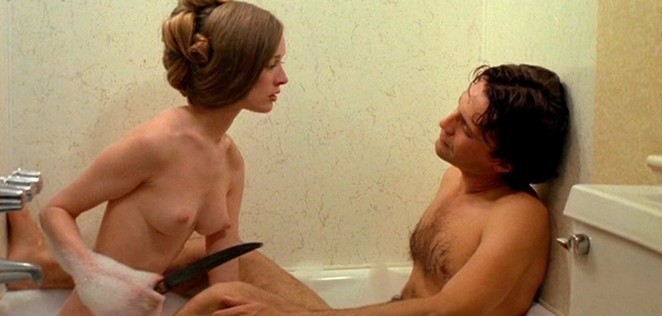
While I Spit on Your Grave is very aware of how men relate to each other, however, it has virtually nothing to say about how women interact. Its vision of female, and, indeed, feminist empowerment is entirely individual. Jennifer fights the patriarchy herself — abetted by the abject stupidity inflicted upon men by their own hierarchical obtuseness and sexism. Jennifer avoids death because the rapists deputize the mentally retarded Matthew (Richard Pace) to do the dirty work of killing her, and he wimps out. Weeks later, after she recovers, she is able to murder her assailants in large part because they are ideologically incapable of believing (a) that she is able to kill them, and (b) that she didn’t want to be raped in the first place. She seduces Matthew, fucks him, and as he cums she slips a noose around his neck and strangles him. She then finds Johnny (Eron Tabor) at the gas station, convinces him to get in a car with her by flipping her hair winsomely, and then drives him out to the middle of nowhere and forces him to take off his clothes and kneel at gunpoint. He starts to explain himself…and he’s so stubbornly obtuse that he thinks he’s swayed her, and actually allows her to seduce him again. So Jennifer takes him home with her, maneuvers him into a tub, tells him she killed Matthew (he doesn’t believe her) and then, under pretense of giving him a handjob, cuts off his dick.

Finally, she climbs aboard a motorboat with Stanley (Anthony Nichols), fools him into thinking she’s going to kiss him, then pushes him into the water and disembowels him with the motor blades. (The final rapist is the only one who doesn’t get seduced; he’s so upset at seeing his pal menaced with the motorboat that he rushes into the water, where Jennifer kills him from the boat with an ax.)

There’s obviously some satisfaction in seeing the men hoisted by their own…bits. But it’s a bitter pleasure. To get her revenge, Jennifer has to turn herself into the sexual thing the men imagine her to be. It’s notable that while the rape itself is probably about the least arousing half hour ever filmed, the seduction scenes have a queasy erotic charge. Jennifer caters to men’s desires only to cut them off, but she’s still catering. It is, then, not the men, but Jennifer who completes her degradation. The loss of her self is the price of her victory — though it’s not clear what other option she has. Men are despicable — and they are also, in this world, effectively all there is. Jennifer wins, but it’s man’s game she wins at. There isn’t any other.

Of course, feminism offers some other options — most notably sisterhood. Nor is it unheard of for rape-revenge (or rape-revenge inspired films like Tarantino’s Death Proof) to explore female relationships . So if you had to do a remake, and you wanted to throw in some clever plot twists for the jaded exploitation viewer, adding female relationships to the plot seems like it would be an unexpected but not unprecedented tack. Why not see what happens if, say, you had Johnny’s wife (who gets a notable ball-busting walk-on in the original) find Jennifer after the rape and take her side? Or perhaps more realistically, you could have Jennifer come out to the cabin with her sister, her mother — or perhaps with a girlfriend? Certainly, gay rights would have some of the polarizing power today that feminism has in the ‘70s. As such, including lesbian themes in order to ramp up both the exploitation and the political edge would be perhaps the best way to stay true to the spirit, if not the letter, of Zarchi’s original.

It probably goes without saying, but this was not the path taken by the actual 2010 remake of I Spit on Your Grave.

In fact, the remake takes the opposite approach; instead of an additional revenger, it adds an additional rapist. At one point in the remake Jennifer (Sarah Butler) maces one of her four attackers and manages to escape into the forest. She runs into the town’s sheriff (Andrew Howard), who takes her back to her cabin…where the other rapists reappear. Instead of running them in, the sheriff rather inexplicably joins them.

As I noted above, the original film took some care to show that male bonding and rivalry were central to the rape. The men’s mean-spiritedly jovial desire to “help out” sad sack Matthew by using Jennifer to deflower him; their need to impress Johnny, the way they only expressed their emotions for each other (whether affection, dislike, or envy) through aggression and humiliation — it’s those interactions which powered their misogyny and violence. And the film also took pains to show these impulses as unremarkable. In a scene before the rape, where the men chatted with each other, they didn’t appear dangerous.. Indeed, they seemed like naïve adolescents, wondering (mostly, but not entirely in jest) whether really sexy women shit or boasting about their plans to visit New York or Los Angeles. It was only in retrospect later in the film that their casual abuse of one another and their casual jibes at women appeared ominous.

The remake follows through on the group dynamics to some extent — the guys egg each other on; they bring Matthew along to lose his virginity, etc. etc. But it abandons the effort to make the men appear like just folks. Ironically, the director Steven R. Monroe gives one of his characters a video camera, and we see some of the rape through the lens. This is an obvious effort to implicate the viewer — but in fact, this version of the story is much less accusatory than Zarchi’s original.

That’s because, instead of seeing the rape as a result of standard male group dynamics, Monroe tries hard to decollectivize the guilt. In Zarchi’s version, the men were typical guys, and the rape, too, was therefore typical — a possibility for any man. In Monroe’s version, on the other hand, the rapists are individual monsters — a much less frightening idea.

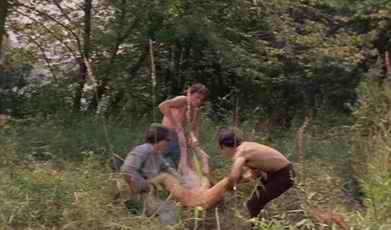
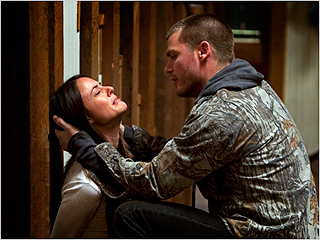
In the original (top), the rape is about the interactions between the men. In the remake (bottom) it’s about individual sadism.

Thus, for example, in the first film, when Jennifer first meets Johnny at the gas station where he’s an attendant, he’s nondescriptly polite with the distant friendliness of the perfect service employee. In the remake, on the other hand Johnny (Jeff Branson) is a lecherous jerk right from the get-go. Monroe even makes sure Jennifer (Sarah Butler) humiliates him explicitly (though accidentally) to add an additional personal motivation. This is carried through into the rape itself, in which Johnny devises elaborate humiliations for Jennifer — humiliations which are predicated on his commanding her to, for example, drink booze or show her teeth like a racehorse. There are no such commands in the original, and, indeed, there can’t be, since the rapists barely talk to their victim.. The rape, in other words, becomes about Johnny’s wounded vanity and his investment in elaborate sadistic games, rather than about the way the men perform for each other. In fact, in the first film, when Stanley starts to yell personal insults at Jennifer and generally to treat her as if she’s a person to be dominated rather than a piece of meat to be used, the rest of the men get more and more disturbed, and finally pull him away.

The remake turns Johnny into a sociopath; Matthew (Chad Lindberg), on the other hand, is given a conscience. His mental deficiency, the fact that he isn’t as much man, is, in Monroe’s version, a sign that he is not as evil or irredeemable as the others. There was no such shilly-shallying in the first film; there, Matthew’s incapacity simply made him less able to rape, not less eager to do so. When confronted by Jennifer in the second half of Zarchi’s film, Matthew does apologize and claim that the assault was not his idea…but Johnny and Stanley do the exact same thing when Jennifer comes for them.

Again, for Zarchi, the culprit is all the men and the way they interact, suggesting that violence against women is a systemic, social sin. For Monroe, though, Matthew really is sorry, while Johnny, even up to the moment of his gruesome demise, expresses no sorrow, feigned or otherwise. In the remake, the crime is a crime of individuals, which means some are more guilty than others and some (like Matthew or, the men in the audience) are less guilty.

Where the group dynamics completely come apart, though, is with the introduction of the sheriff. As I said above, his actions are inexplicable. We never even see him with the other men before the rape. He does mention that he’s known them since they were boys — but he’s in no sense their peer. We quickly learn (through a cell-phone call mid-rape) that he has a loving pregnant wife and a daughter in the honors program. He’s got, in other words, a lot to lose — and he’s willing to throw it all away for what? To have sex with some random city girl? To impress some subordinates?

In the first film, where it’s Johnny who has a wife and kids, Zarchi confronts this issue directly: Jennifer actually asks Johnny if he loves his wife while she’s seducing him. In response he says, “She’s okay. You get used to a wife after awhile, you know?” His family is a routine; it doesn’t particularly touch his inner life, to which, in any case, he seems to be only tangentially connected. The sheriff, on the other hand, is shown to be deeply invested in his child and his wife — he’s a doting middle-class family man. The idea that his spouse or daughter might find out about the rape sends him into a panicked rage. So what could possibly have led him to participate in a felony with a number of extremely untrustworthy accomplices?

We don’t know the answer to that question because the movie doesn’t tell us. And it doesn’t tell us because it doesn’t really care what his motives are. He joins in the rape because he’s the villain and, more, because it’s surprising. The sheriff is a plot device — a contrivance. Which means the real fifth rapist here is, in some sense, the director, who throws logic and coherence to the wind for the sheer pleasure of a cheap thrill.

Cheap thrills are what exploitation is supposed to be about, of course. But, while you certainly couldn’t say that Zarchi had a light touch, you also never felt that his hands were on the scales. This is part of the reason that the first I Spit on Your Grave had such an indelible, inevitable power. There weren’t plot twists or clever reversals; there was just sex and violence and their remorseless attendants, rape and revenge. Zarchi’s world fit together. Men were rapists. Rapists destroy women, and also themselves. QED.

Monroe, on the other hand, doesn’t believe any of that. His men don’t die because they’re rapists; they die because they’re in a movie and Monroe can do whatever he wants, damn it. In the remake, Jennifer doesn’t outthink the men because they’re sexist idiots and then dispatch them efficiently. Instead, she kills them because the script calls for her to turn into an avenging, unstoppable force of destruction — a petite Jason. From the moment she escapes her assailants by diving into a river and improbably disappearing, she ceases to be an actual person and becomes, like the Sheriff, a contrivance. Her revenges are much more elaborate than in the first film, but the rituals of torture aren’t her triumphs (or her degradations): they’re the directors’. A vision of essentially communal, and therefore political, justice has been replaced by individual punishment. Karma becomes deus ex machina.

It’s not really a surprise that a 2010 remake lacks the political charge of its 1978 prototype. The last thirty years or so have been rough on radicals, and while feminism has certainly made advances, the vision of apocalyptic, violent gender justice which inspired the rape-revenge films now seems both naïve and distasteful. As Terry Eagleton put it in his 2003 book After Theory, “Over the dreary decades of post-1970s conservatism, the historical sense had grown increasingly blunted, as it suited those in power that we should be able to imagine no alternative to the present.”

Perhaps the best demonstration of why a 2010 I Spit on Your Grave was bound to suck can be seen in another movie; Michael Haneke’s Funny Games. This film (in both its 1997 Austrian original and its 2008 American shot-for-shot remake) does not suck. It’s also not technically a rape/revenge. Instead, it’s a negation of the genre.

The brutality in Funny Games is flagrantly, explicitly unmotivated. In I Spit on Your Grave, humiliation and aggression is linked to gender politics — and also to class. The men in I Spit on Your Grave are hillbillies who resent Jennifer’s affluence, freedom, and economic power. This is shown most clearly in the 1978 film when the rapists, as part of their abuse, read sections of Jennifer’s novel-in-progress out loud, mock it, and then destroy it. Her work is, to them, not work at all, but a ludicrous affectation. (“I really despise people that don’t work,” Johnny says at one point, “they get into trouble too easily, you know?”) The movie does not suggest that these class antagonisms justify the rape, but it does show that they facilitate it. Economic imbalances, as any Marxist knows, are linked to violence.

In Funny Games, on the other hand, there are no economic gaps. At the beginning of the film, a comfortably upper-class family arrives at its lakeside vacation home. There, mom, dad, and son (Anna, Georg, and Georgie in the original) are trapped and systematically tortured by Paul and Peter two well-scrubbed young men with a passion for golf and sadism. The two torturers refuse to say why they are brutalizing their victims; when asked, they propound a series of more or less ridiculous scenarios (I was a poor child! I had sex with my mother!) which are clearly supposed to be bullshit.

Just as the film teases the viewer with reasons, it also teases them with rape — the two sadists force Anna to strip to her underwear, but never precede any farther than that. Most of all, though, it teases with revenge. Anna makes repeated attempts to escape and to turn weapons against her assailant. In the most startling of these moments, she actually manages to grab hold of a rifle and shoot Peter dead. At which point Paul finds a remote control and uses it to rewind the film to the moment before Anna shot his companion. He then casually takes the gun away from her

This flagrant breaking of the fourth wall can, of course, be seen as a way of (here it is again) implicating the viewer in the onscreen violence — of exposing our own sadistic and/or masochistic investment in tales of torture and brutality. And it does, certainly, show very nakedly the kind of narrative contrivance epitomized by the sheriff in the 2010 I Spit on Your Grave. Diagetically, it is the evil characters doing these things to these people we care about. But really it’s the director doing it for our amusement, which calls into question whether we in fact care about anything.

The use of the remote control is, though, not primarily an accusation of complicity. It’s an accusation of naivete. We in the audience are hoping the rape-revenge narrative will play out; that justice will be done. And the film mocks us for that — or (what is effectively the same thing) pats us on the back for knowing that such narrative justice is only a convention, not the truth.

Paul (Arno Frisch) knows the score in the original Funny Games

My hope that I Spit on Your Grave might have more of a feminist consciousness in a remade version was, then, clearly idiotic. The climate even for a film as vacillatingly feminist as the original I Spit on Your Grave has, it seems, evaporated. In current iterations of rape-revenge, violence is disconnected from causality, which means that it can call forth no real retribution. Some random God-surrogate pulls the strings and people suffer and that’s that. The best that can be offered as a political vision is a land in which people turn off their televisions to avoid political visions. Only suckers still believe that you can rise up against your oppressors and disembowel them with an outboard motor.