Gilbert Hernandez and the “Pornography” of Images

Don’t play with me, cause you’re playing with fire…

I hadn’t expected that a roundtable on my book Alternative Comics would become a referendum on Gilbert Hernandez’s work. But something like that happened last week, thanks to the one-two punch of Noah and Robert and their comments about my book’s investment in Hernandez, followed by vigorous point-counterpoint in the comments section, followed by Suat’s considered response to and extension of Noah’s critique of Hernandez in the form of a smart retake on Hernandez’s Human Diastrophism—a retake I’m inclined to disagree with, but articulated well.

The page in question: from Poison River

Continue reading

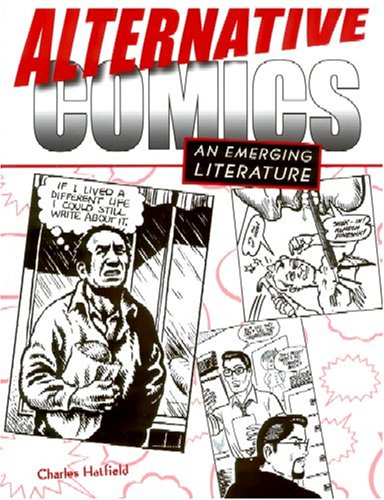
Alternative Comics: An Afterword

Alternative Comics cover

Last week several HU stalwarts and guests put a great deal of energy into their analysis of, and conversations around, my book Alternative Comics: An Emerging Literature (2005). I want to thank everyone for weighing in and taking on the work. I’m gratified by your sustained attention to Alternative Comics, even in those instances where you took issue with it. It’s great to see that the book can inspire such intense discussion, and, man, have I learned a lot from the spirited back-and-forth.

Tomorrow I plan to post in response to our exchanges on Gilbert Hernandez. And, in the weeks ahead, I hope to respond at length to Caro’s excellent and important post (from my POV the most thought-provoking of all, and one that will definitely inform my work, going forward). In today’s post, though, with your indulgence, I’d like to offer something different from a point by point reply or analysis. I’d like instead to give a personal afterword to the book, an autobiographical and critical reflection that will (a) sketch out the book’s history and context, and (b) consider the prospects for its future reception and use. I want to do this because the circumstances that drove me to write Alternative Comics have changed so very much since—not just on a personal level, but within the comics studies field—and because I want to show how a project like this fits into a working and teaching life, one that, inevitably, presses onward after the project is done.

Along the way, I’ll consider whether “alternative comics” even continue to exist in the same form as they did when I began the book, and whether the terms used to organize my thinking in the book can remain relevant.

I don’t presume that my circumstances are (or were) typical, since I’m a slow writer and Alternative Comics took a long time to get out the gate, but, given last’s week discussion and the changes fast overtaking comics and comics studies, I’d like to share with readers how the work emerged, under what pressures, and why. I hope this will go some way toward demystifying the processes that result in books like mine.

Continue reading

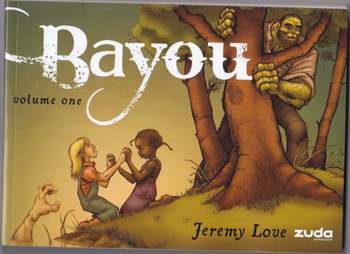
Bayou Vol 1, Jeremy Love

This is a beautiful and haunting comic. It’s kind of what I had hoped and expected to feel after reading Swamp Thing, to be honest. Not the parts about racism, but the parts about the feeling of the swamp as a powerful life force that cannot be controlled and that contains far more life in far stranger ways than we can admit to ourselves. A life that can tell us odd stories and take us on strange journeys.

Continue reading

Worship the Martyr, Ignore the Man

I’m a lapsed Catholic who loves reading about the history of the Catholic Church. For the past few days I’ve been reading “The Big Book of Martyrs,” a comic written by John Wagner (creator of Judge Dredd) in collaboration with over two dozen artists. Back in the 90s, it was published as part of a series of reference-lite comics under the “Factoid Books” label. The comic consists of about 50 biographies of Christian martyrs (the vast majority Catholic, with a few Orthodox mixed in), each only about 3-4 pages. Needless to say, these snippets can provide only the barest details, but the brevity is also a blessing. Reading 50 full-length biographies would be a time-consuming chore, especially if they were all written in the dry, indifferent manner of a reference book.

While “The Big Book of Martyrs” could never be seriously compared to a scholarly work of history, it did at least inspire me to do further research on a few obscure martyrs that I had never heard of before. And for all its limitations, the book serves as an adequate introduction to Christian martyrs, and the comic format makes it a quick and accessible read.

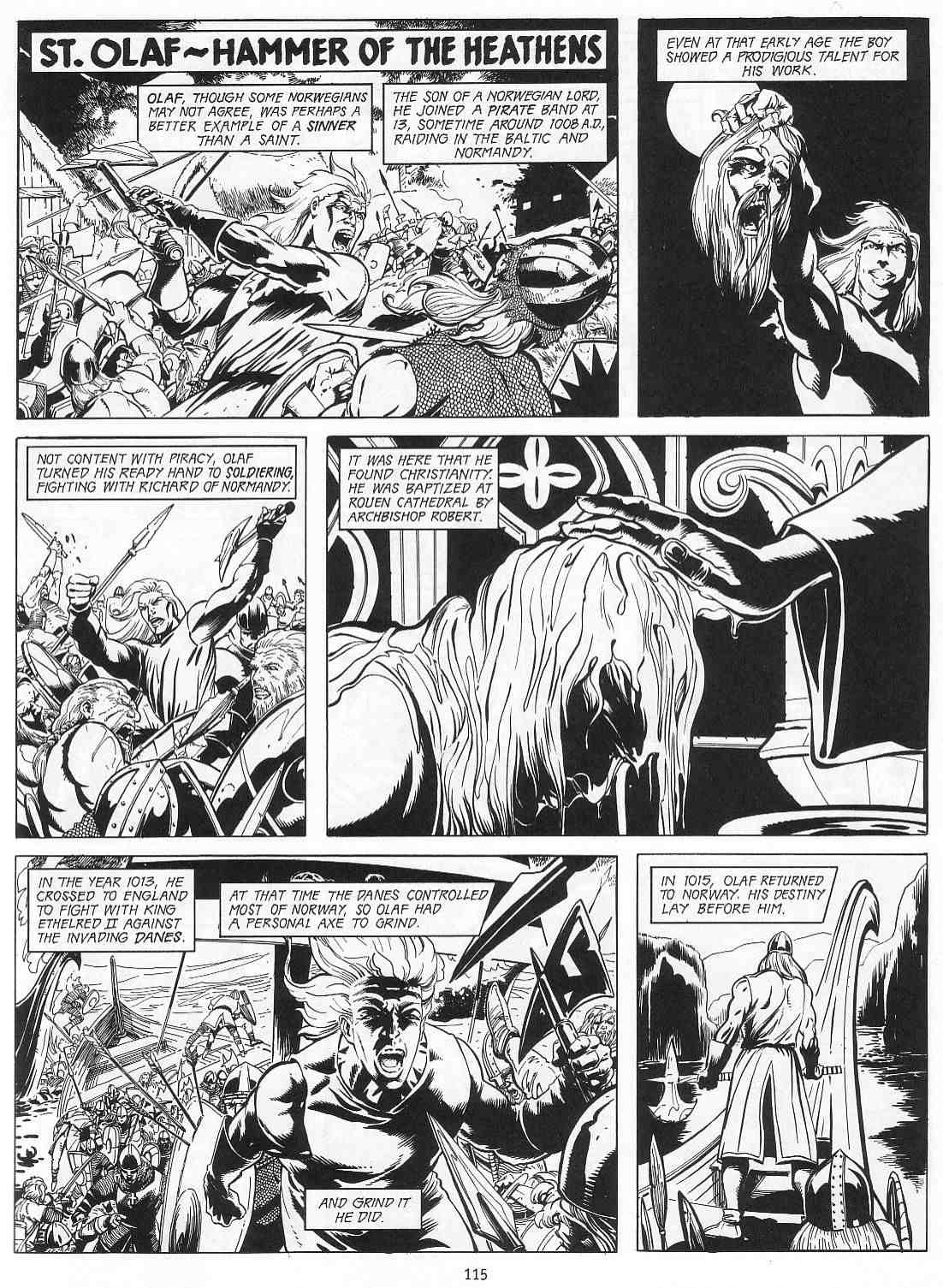
But I don’t intend to write a full review of the comic, at least not for this week. I’d rather talk about one of the more entertaining martyrs, St. Olaf of Norway (995 to 1030 AD).

Artwork by Rafael Kayanan

Continue reading

Moto Hagio: Who Watches the Watchwoman?

This is I think my penultimate post about the Moto Hagio’s collection of stories A Drunken Dream. You can read the whole series here.
_________________

Drunken Dream concludes with two entirely forgettable sentimental ghost stories: “The Child Who Comes Home” and “The Willow Tree.” Both exploit familial grief — respectively, dead child and dead mother — and an emotional twist-ending in the service of tear-jerking emotional catharsis. Unfortunately, as has been a problem before in this volume, Hagio has neither the space nor the inclination in these stories to create fully realized characters, and so the grief and pathos come across as both generic and unearned. These are probably the dullest stories in the volume. Some of Hagio’s work is actively stupid and irritating , but these really feel like she’s just filling the form in. Ambiguous death, twist, catharsis. That’s a wrap.

So yeah; not a lot to say. Except…I’ve been thinking a little about feminist film gaze theory and how it would work in comics. So I’m going to try to read “The Willow” through Laura Mulvey’s classic 1975 essay “Visual Pleasure and Narrative Cinema” and see what happens. Maybe it’ll even get me to like the story better; who knows?
______________

Mulvey’s essay is based in Lacanian and Freudian theory. I’ll quote from second paragraph.

The paradox of phallocentrism in all its manifestations is that it depends on the image of the castrated woman to give order and meaning to its world. An idea of woman stands as lynch pin to the system: it is her lack that produces the phallus as a symbolic presence, it is her desire to make good the lack that the phallus signifies….. To summarise briefly: the function of woman in forming the patriarchal unconscious is two-fold, she first symbolises the castration threat by her real absence of a penis and second thereby raises her child into the symbolic. Once this has been achieved, her meaning in the process is at an end, it does not last into the world of law and language except as a memory which oscillates between memory of maternal plenitude and memory of lack. Both are posited on nature…. Woman’s desire is subjected to her image as bearer of the bleeding wound, she can exist only in relation to castration and cannot transcend it. She turns her child into the signifier of her own desire to possess a penis (the condition, she imagines, of entry into the symbolic.) Either she must gracefully give way to the word, the Name of the Father and the Law, or else struggle to keep her child down with her in the half-light of the imaginary. Woman then stands in patriarchal culture as signifier for the male other, bound by a symbolic order in which man can live out his phantasies and obsessions through linguistic command by imposing them on the silent image of woman still tied to her place as bearer of meaning, not maker of meaning.

So to summarize the summary (as much for my benefit as anyone else’s): woman=castration. This symbolic difference is the basis for symbolization itself; it’s the difference that enables or creates meaning. Woman exists only to embody this difference; she is the non-meaning (castration) which enables meaning (the phallic father’s realm of law and language.) Woman cannot take up the law and language herself; she can attain mastery only vicariously through a child who acts as a substitute phallus. (Ideally, the woman will give this phallus up to the world of law; alternately she may try to retain it, preventing it from entering adulthood and the world of law.) The phallic law rules, and what it rules or regulates is non-meaning/castration/woman. Woman is then by definition silent and controlled.

Continue reading

Overthinking Things 11/07/10

It is the future.

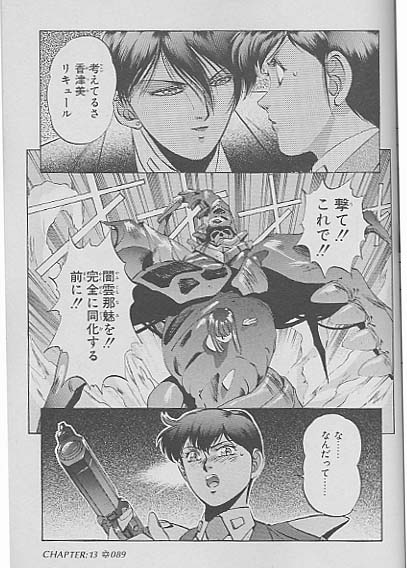
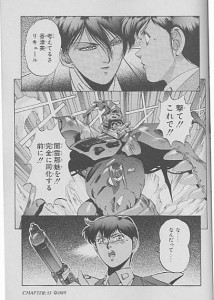
Acid rain has become too toxic for humans to bear. The city of New Tokyo is too crowded, humanity piles on top of humanity in crowded layers of existence. Billboards float through the air and drive by on streets. The police are a corporate entity, run for the benefit of the zaibatsu who own them. And humans are being hunted by creatures from another dimension known as Lucifer Hawks.

Silent Mobius follows a special squad within the police hierarchy, the Attacked Mystification Police, AMP. The women of AMP all have skills that no police exam can test. Shinto priestess Nami, artificial intelligence expert Lebia, esper Yuki, cyborg Kiddy, sorceress Katusmi, led by the incredibly powerful Rally Cheyenne, combine forces to protect humans from the Lucifer Hawk – and rectify the mistake that allowed them access to our world in the first place. “Our world,” I say, even though this dystopian, Philip K. Dickian vision of the future has not quite yet come to pass. This is classic speculative/science fiction.

What makes Silent Mobius work is that the people in this series are people. They are, despite the unrealistic setting and even unrealer powers displayed, people we might know. The humanity of the characters – the utter normality of their behavior in extraordinary circumstances – is what makes this series so exceptional.

Created by Asamiya Kia, Silent Mobius was serialized from 1991-2003 in Comic Dragon. The manga was collected in 12 volumes, had a 26-episode TV anime series, two movies, several volumes of “gaiden” or supplementary stories, and a number of Drama CDs. Silent Mobius was a spectacular example of a series that successfully crossed readerships and genres in Japan – and in America. The English manga, first put out by Viz is currently being re-released by Udon Press.

Artistically, Silent Mobius combines dystopian future scifi with an aesthetic that has largely passed from the world of manga – characters that look like the adults they are. The Lucifer Hawks are rendered as complicated shapes that don’t *quite* make sense – there’s a quality they have of making them hard to “see” that fits their extra-dimensionality.
Continue reading

Utilitarian Review 11/6/10

On HU

The rest of the week was devoted to a roundtable on Charles Hatfield’s Alternative Comics: An Emerging Literature. Contributors include me, Caroline Small, Ng Suat Tong, HU columnists Matthias Wivel and Derik Badman and guest poster Robert Stanley Martin. Lots of discussion in comments too.

And we’re not done yet! We’re going to focus on other things for a couple of day while Charles Hatfield gathers his thoughts, and then at the end of the week he’s going to do two or three posts in response. So stay tuned, as they say….

Utilitarians Everywhere

At Splice Today I look at fetishizing the teacher in pop music, from Van Halen to Ke$ha to Ina unt Ina.

The truth is that the video isn’t really about lusting after the teacher at all. Instead, it’s about lusting after a childhood in which you lusted after the teacher. The short film is focused on adults imagining how cool they could have been in high school if they had known then what they know now—and, simultaneously, on kids imagining themselves as being adults. The Van Halen band members are portrayed both by the real Van Halen and by a group of kids dressed like the adults. The video unabashedly blends both identities, with the adults sitting right beside their younger selves in class and the kids lip-syncing the lines in the voices of their grown-up doppelgangers. The hot teacher is just an accessory; a convenient stand-in for the real passions, which are between male adults and their younger iterations. The adults want the rebelliousness and goofy energy of youth; the kids want the sexual opportunities and confidence of grown-ups. And both achieve their dream not by sleeping with the teacher, but by rocking out.

Also at Splice Today, I review the first chapter of John Grisham’s new novel.

You can probably see where this is going. No doubt you’ve already intuited not only the existence but also the main character traits of Keith the pastor, who “spent much of his time listening to the delicate problems of others, and offering advice to others” and had therefore “become a wise and astute observer.” Probably you’ve also guessed that Boyette is a bad, bad person (did you figure out he was a sex offender from the fact that he looks at the pastor’s wife’s chest? You did? Bonus points!) If you’re especially perspicacious you may even be able to reconstruct from TV movies past the hollow schlop-schlop of pop theology and pop psychology flopping about like two half-dead fish in a bucket. “It’s human nature. When faced with our own mortality, we think about the afterlife. What about you, Travis? Do you believe in God?”

I have a short review in the Chicago Reader of an enjoyable art show at Columbia College called Post Human/Future Tense.

Another short review of a quite bad book called Cute Eats Cute.

And an essay at Madeloud about musical guest stars on Sesame Street.

Other Links

Bert Stabler has a lovely essay up about The Monstrosity of Christ, by John Milbank and Slavoj Zizek.

Poking around the internet looking for discussions of comics and the gaze, this is what I came up with.