Zombie: A Mindless Affair

I’m going to be in an art show on October 23. Here are the details:

Zombie: A Mindless Affair
Curated by: Edra Soto

Also Project Wall Space:Irene Perez
ZOMBIE ARTISTS:
C Through Outfit (Erik Brown, Catie Olsen, Carl Warnik and Dawn Reed)
Deborah Boardman
Nate Lee
Jason Mena
Mindy Rose Schwartz
Amanda Browder
Derek Chan
Christopher Simkins
Christopher Smith
Ann Toebbe
Harold Mendez
Paul Nudd
Noah Berlatsky
Vladimir Kharitonsky
Dan Peters
Gretel Garcia
Susannah Kite Strang
Rachel Hewitt
Corinne Halbert
Bert Stabler
Beatriz Monteavaro
Miguel Cortez
Edra Soto
Candace Briceno
Death by Design Co. (Teena McClelland and Michelle Maynard)
The Wiener Girls (Sydney Croskery and Katey Rafanello)
Betsy Odum
Jen Thomas and Bobby Lively
Chris Hammes
Andrea Jablonski
Jeff Libersher

ABOUT: Zombie: A Mindless Affair

Celebrations that invite us to observe a historical occurrence are still strongly practiced in contemporary culture. Halloween, as celebrated is America, profoundly depicts the strongest features from gothic and horror literature, film, TV, and graphic arts. Among the repertoire of traditional characters, the zombie distinguishes itself for possessing the biology and behavior of a normal human being, yet lacks consciousness. This exhibition uses the vernacular of the mythological zombie as a starting point to engage in ideas of death, mindlessness and symbolisms for the occult and inexplicable. The term zombie also intends to address issues referring to the mindless self in a social spectrum: leading and following; acts of automatism and fanatic behaviors.

From 6:30-7:00pm on opening night:
Join author Scott Kenemore, artist Mindy Rose Schuartz and collaborators Teena McClelland and Michelle Maynard from Death by Design Co. in conversation. They will talk about the darkness that enlightens their work. Screening of the film made by Death by Design Co. immediately after the conversation. Moderated by Edra Soto

Opening Friday October 23 from 6pm-10pm
October 23 – November 21, 2009

ANTENA
1765 S. Laflin St.
Chicago IL 60608
www.antenapilsen.com
antenapilsen (at) gmail.com
_______

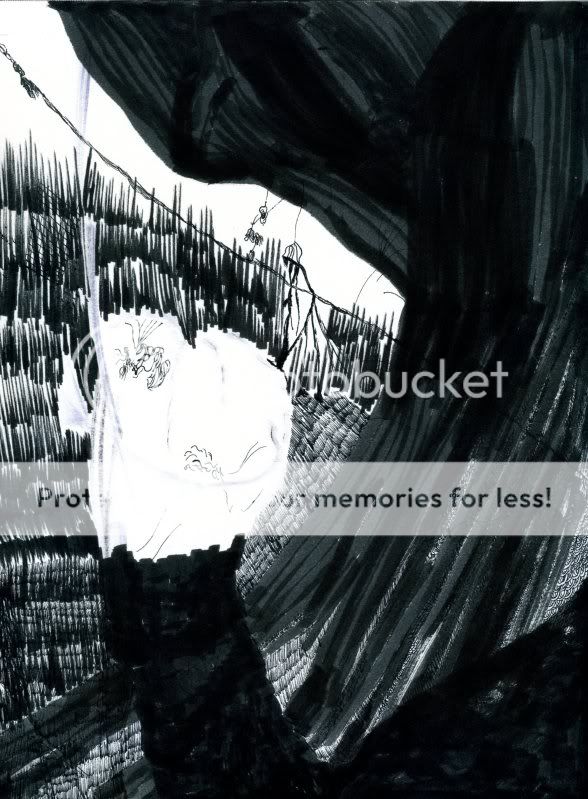
And, hey, here’s the piece I’m showing for those not in the Chicago area (it’s better in person…no, really! Trust me!)

Music For Middle-Brow Snobs: A Yoke of Oxen

Psychy droniness and such.

1. Fathmount — A Yoke of Oxen (Anthology of Experimental Chinese Music)
2. Michio Kurihara — The Wind’s Twelve Quarters (Sunset Notes)
3. Mariah Carey — H.A.T.E.U. (Memoir of an Imperfect Angel)
4. Magic Hour — Jonathan and Charles (Will They Turn You On Or Will They Turn on You)
5. Sonic Youth — The Diamond Sea (Washing Machine)
6. Nadja — No Cure for the Lonely (When I See the Sun Always Shines on TV)
7. Burmese — Lady Killer (A Mere Shadow and Reminiscence of Humanity)
8. Li Jianhong — Sod (Anthology of Experimental Chinese Music)
9. Artur Rubinstein — Chopin: Mazurka #26 in C Sharp Minor (Chopin: 51 Mazurkas)

Download: A Yoke of Oxen.

And if you missed it you can get last week’s thrash mix here.

Update: At least one person has said the download isn’t working. If you’re having trouble as well (or, for that matter, if you’re not), please leave a comment to let me know.

No Past, No Present, No Future

Zot! 1987-1991: The Complete Black and White Collection
Scott McCloud
Harper
black and white/ 575 pages
softcover/$24.95

Zot! is timeless. The story of a super-powered, improbably good youth from a dimension very close to ours, its landscape is the landscape of nostalgia — a funnybook past of futuristic wonder which becomes brighter and more exciting the more it recedes. Zot is all the super-hero comics from your childhood as you remember them, rather than as they actually were — with the excitement and the goofy villains and the action; without the fusty clubhouse odor, or the grinding, bleary sound of middle-aged men pandering to children, and doing it badly. Alan Moore and Frank Miller made super-heroes more adult by giving them sexual hang-ups and nasty dispositions. Scott McCloud, contemporaneously, made them more adult through a self-conscious, insistent wonder — the very insistence of which introduced a kind of adult uncertainty, an acknowledgment of illusion and eventual loss.

The Moore/Miller, R-rated path to super-hero maturity is still very much alive in comics like Marvel Zombies, or, for that matter, All-Star Batman and Robin. Zot!’s take, on the other hand is — still, and somewhat surprisingly, very much alive. In its quiet way, Zot! was, if not an inspiration, then at least a forerunner of a whole school of intelligent-naif storytelling. There’s a little bit of McCloud in the Morrison/Quitely All-Star Superman, certainly. And Alan Moore’s Tom Strong even looks like Zot, down to that skin-tight red shirt.

Moore and Morrison both justify their fetishization of the funnybook past through complicated — or, if you prefer, batshit crazy — theories about the mystical significance of fictions. For Moore, dumb super-hero adventures are, literally, magical; for Morrison they’re analogues for the structure of reality. McCloud likes to talk about his formalist and system-building tendencies too – in the volume’s copious notes, he eagerly explains that his characters are based on the Jungian functions of the human mind. But, compared to the Kabbalah-spouting, pomo paranoiac crankiness of his successors, he’s just a piker — or, more accurately, just a humanist. There’s no shamanic, theological reference point for McCloud. Zot!’s too-perfect-to-be-true, sunlit future-past is a story with literary ambitions, but not with cosmological ones.

As a result, McCloud can sometimes be what Morrison and Moore almost never are: low-key. Especially in the black-and-white comics collected here, heroic fantasy has never looked so much smaller than life. Arch-enemies come back from the dead to attend a New Year’s party; friends catch up on small talk while super-battles are waged just off-panel; everybody on earth, it seems, takes interdimensional portals completely in stride. The art, too, is winningly erratic, with detailed, cross-hatched backgrounds populated by frankly stiff figures. In the notes, McCloud frets about his artistic limitations, but to me, at least, the amateurishness is charming, and sometimes more than charming. A half-page picture of Jenny (McCloud’s normal-girl protagonist) asleep in the water, with a diving Zot reflected in the pool that covers her lower belly, is sensual and clunky — sensual, in fact, because it’s clunky. The sexuality of the image is displaced by the mediocrity of the draftsmanship; Jenny really doesn’t look real enough to reach out and touch, and that distance infuses the image with an awkward poignancy.

McCloud’s technical limitations don’t always serve him well, of course. Especially when Zot’s world drops out and we’re stuck on earth, the author’s weaknesses as a storyteller are sometimes painfully apparent. Bereft of super-villains, we’re stuck with nerds with hearts of gold, evil jocks, the closeted lesbian, the alcoholic mother, the divorcing parents, the jerky older brother who comes through in a pinch. Reading the second half of the volume is like going through a YA problem-novel checklist.

When Zot is on its game, though, the amazing and the mundane, the clichéd melodrama and the pedestrian detail, are constantly wrong-footing each other. Zot’s comic-book world and Jenny’s more realistic one bump one another off-course, so that the reader can look at, and appreciate, both from unfamiliar perspectives. The best example of this is probably the moment when Zot, Jenny, and some other friends watch the New Year’s celebration on Zot’s earth. The year changes from 1965 — to 1965. Nobody on Zot’s earth realizes that the new year is the same as the old; only Jenny and the folks from her (or our) world notice that time is essentially standing still. It’s an odd and unsettling metaphor for the way super-hero comics constantly erase their pasts in order to maintain their eternal futuristic presents; a kind of mini-ret-con. Zot’s world suddenly seems much less substantial, its goodness and excitement built on amnesia. But where Grant Morrison would embrace this meta-fictional insight, McCloud just leaves it there; the characters are curious about the oddity of a world without history, but that’s about it. No further apocalyptic revelations follow; it’s just another inexplicable fact about Zot’s world, like space-travel or invisibility. It’s fun to think about, but it doesn’t have to lead anywhere in particular.

The anti-climax of this revelation is nicely done, and certainly fits with McCloud’s general tone. But at the same time, there’s an audible “thunk” as he lets the issue drop which reverberates uncomfortably backwards and forwards through the book. The contrast between history and historylessness seems like it is, or should be, at the core of the series. The past is what gives weight to moral actions; without it there’s no right, no wrong, and no love. Zot’s lack of memory, his innocence and self-certainty should, logically, also be his cruelty and uncanniness. Various characters do pay lip service to Zot’s egotism, but again, McCloud never really follows up — there’s never a moment when Zot does something that could actually be construed as mean. The closest he comes is when he agrees to do a Cola commercial for money. But then he apologizes. And gives all the money to charity.

McCloud does try to “educate” Zot — the hero fails several times in the course of the book, and each occurance is treated as an emotional end-of-innocence. One instance, in which a young girl is introduced and then gratuitously killed off in order to give Zot an excuse for rampant emoting, is particularly unfortunate. But unfortunate or not, none of these episodes really makes any difference; Zot comes back each time as cheerful and self-confident as ever. Moreoever, not only does Zot seem unaffected by his experiences, but the book does as well. The reader is supposed to accept Zot as a moral innocent even as his past is silently and continuously erased.

The difficulty here is not that Zot isn’t sufficiently real. It’s that he’s insufficiently unreal. He’s stuck with the cheerful verisimilitude of Superman, when he needs a bit more of the creepy unhumanness of Peter Pan. McCloud toys with this perspective only once, when Zot asks Jenny casually if she’d like to have sex. The scene has an eerie, prelapsarian tinge — a hint that total innocence has some very disturbing implications. But the comic quickly pulls back; Zot’s just a nice, forthright kid, y’all. He even carries around condoms! Everything’s safe and above-board here.

Zot’s perfecttion should, in short, have a dark side. McCloud isn’t willing to give him one and as a result the series goes subtly but decisively out of whack. A major theme of the last half of the book is that Jenny wants to go live permanently in Zot’s world. This is presented as a terrible idea — running away from her problems, turning her back on the beauty of the world, etc. etc. etc. But all of these counter-arguments sound a lot like special pleading. The fact is that running away is a sound strategy for dealing with one’s difficulties; it’s not foolproof or anything, but on the whole it works better than holding on to them. And if Zot’s world is just a kind of egalitarian paradise — like Sweden with rocket cars — then why not move there? Jenny can even visit home whenever she wants. What, exactly, is the big deal?

Perhaps the big deal has to do with losing your past, and therefore your soul. In his concluding notes, McCloud remarks that Zot! is “a world where looking back and looking forward are one and the same. The far flung future, the distant past, and every moment in between.” That sounds like fairie; eternity is flattened out, nostalgia suffuses reality, and all the happy, super boys never grow up. To be out of time is to be dead. Zot! circles around this insight and then, with a whoosh of rocket boots and an impish smile, it flies away.
________________

This review first appeared in The Comics Journal.

Gluey Tart: I Shall Never Return

I shall never return
I Shall Never Return, by Kazuna Uchida, 2007-2008, Deux Press

I don’t know. This five-volume series is like a love affair that you try to describe to someone a few years later, and you open your mouth to explain your actions, and nothing comes out because you’re just thinking, no, I was into that person, I’m sure of it, but the details somehow elude me. And yet, I can give you a plot summary for any episode of Star Trek: The Next Generation. So what I’m saying is, it’s not you, I Shall Never Return. It’s me.

I’m pretty sure. This is “a true masterpiece of early yaoi,” the back cover tells me. It was originally published starting in 1992 (through 1995 or so – I seem to have misplaced Volume 5, God knows what happened to it, but surely nobody really cares anyway – what’s a year or two among friends?), and it does have an old-school feel about it. Which is fine. It doesn’t feel particularly dated to me, either in look or content. I’m sure the disaffected young hottie turning tricks because he just doesn’t care what happens to him theme played a little fresher seventeen years ago – I mean, it had to – but I’m a fan of that particular yaoi cliché, so no harm, no foul, either way.

It’s a very small story, for five volumes. And I’m OK with that as well. I never met a good obsessive bit of character development I didn’t like, and if there’s one thing this series does, it’s develop it some characters. Convincingly, even. I’m not going to say much about what or how because I don’t want to give it away, and details won’t help you decide whether you want to read it or not, anyway. There’s a torrid romance between two high-school age boys, with some love triangle action that gets resolved one way or another. Normally I think nothing of providing spoilers, but it wouldn’t be right for this story because there are a number or moments where things could go either way, and the fun comes in wondering what path the character will pick, and how you feel about it. I will say that the ending won’t leave you depressed and sad and cranky and casting about for some stale bit of forgotten chocolate at the back of your desk drawer.

Looking back over our days together, I Shall Never Return, what I appreciate most is that your characters are genuinely sort of complicated in a real-life-ish sort of way. They make unexpected choices, some good and some not so much. And the two main characters love each other. Not in a swoony and completely unrealistic-outside-of-yaoi way (and I’m not putting that down, either), but in a kind of believable real-people-making-real-life-choices sort of way that maybe isn’t exactly swoony but does feel good, especially because the feeling good thing isn’t a foregone conclusion. (Sort of like the love story between Wharf and always-surprisingly-no-matter-how-many-times-you-see-the-reruns stacked Deanna Troi.) (Look, I wove in a Star Trek: The Next Generation reference!) (Also, I ask you, why should the Germans get to have all the hyphenation fun?)

I cared enough about the characters and was curious enough to see where their lives would take them that I wound up reading all five volumes of this series. This isn’t so unusual, in itself. What kind of a Gluey Tart would I be if I weren’t good for five volumes? Damn straight. Here’s the weird thing, though. I bought them one at a time. This may not sound at all weird to you. That would mean you potentially have a healthier and less obsessive relationship with manga than I do. I buy the first one, and if I show signs of liking it about a quarter of the way in, I take steps to get the rest of the volumes in the series immediately. (Sometimes radical steps, in the case of an older series that I came to late and had trouble tracking down used copies of; there was a tense time there getting hold of volume four, although I see that I eventually wound up with two of them – but that is my way, and I’d like to try and think of it as charming). But with I Shall Never Return, I bought one book at a time. I’ve never done that in my life, but for some reason I kept thinking each volume might be the last one I’d want to read. Which never was the case, even with the last one.

So, I don’t know what my problem was. Is. Maybe I was in the mood for yaoi craziness instead of a mostly small-scale and quiet romance. I recommend it to you, though. You’re less shallow than I am. I think you can really make it work, and it deserves that.

Frank Miller’s Not Dead, But That Doesn’t Mean We Can’t Dance On His Grave

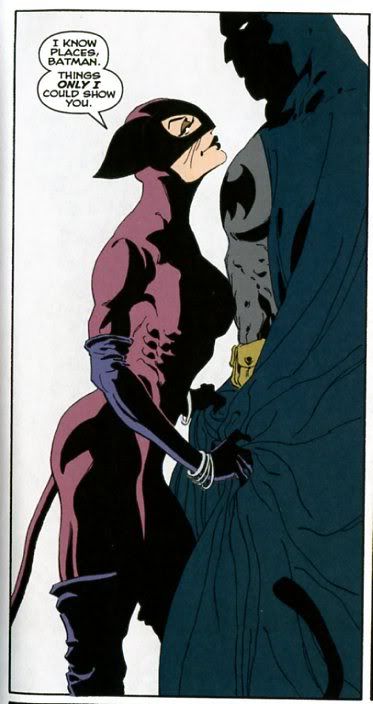
I’ve been sort of half meaning to read the Long Halloween for a while. I’ve seen some of Tim Sale’s art before…mainly when he did that Comics Journal cover a little while back, I think. Anyway, I like his work; he has a nice clean design sense, with good use of blacks and dark areas especially. His character designs are striking too; he manages to be cartoony in a way that doesn’t seem to come either from manga or from humor comics. Instead he seems more directly influenced by art nouveau…or perhaps it’s just Frank Miller. I don’t necessarily love everything he does. I find his Catwoman design kind of meh, for example; the purple suit seems overly angular and drab, and I don’t share his obsession with abs for all.

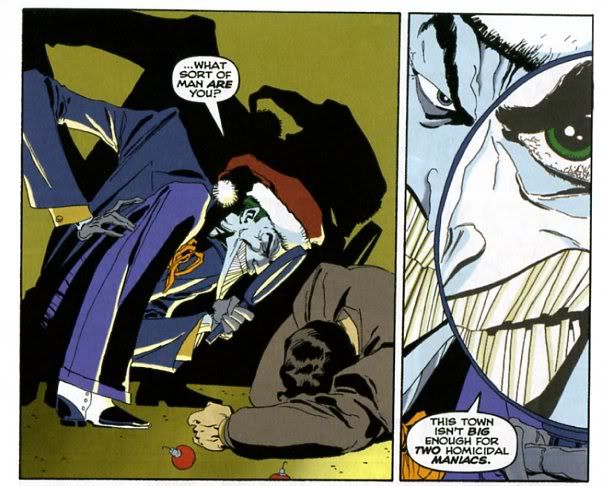
But even so, the panel is competently blocked and consistently stylized. It’s professional, damn it. And some moments are in fact inspired, like this Joker as Christmas- Grinch sequence…

The way the Joker’s body is all folded up in that first panel, and then the veins in his eye shot through the magnifying glass…that’s fine storytelling. It’s worth looking at.

And then there’s the story. I think that, maybe, if you really want to appreciate Dark Knight, you should read The Long Halloween. It’s easy to look back at Frank Miller’s writing and sneer at the grim and gritty Batman, the hard-boiled repetitive dialogue (“this would be a good death”), etc. etc. But, damn it, there was a ton of humor and energy there as well; his Joker, for example, was genuinely, viciously funny (dressing Selina Kyle up as Wonder Woman — what the hell? or calmly stating “I’m going to kill everyone in this room” — to which the David Lettermen analog gives the pitch-perfect response, “Now that’s darn rude!”) And his Batman had a real voice and inner life — stolen from all those pulp sources, of course, and over-the-top, but still, in part for those reasons, memorable and even nuanced. I loved that moment at the end of the book where he tells Robin to sit up straight for example; he’s both this grim avenger and this crotchety father figure. He’s perfect, and the perfection is played as a cantankerous tic. Certainly, the book is dark in that people get killed and there’s blood and it’s for grown-ups, more or less. But it’s not dark in the sense of being dreary. It’s filled with ideas and weird jokes and satire and a lot of love for the characters and for imaginative possibilities.

The Long Halloween, on the other hand, has no imaginative possibilities to offer. Forget Miller’s occasional forays into society and politics and mortality — Jeph Loeb doesn’t even have anything to say about Batman or his rogues gallery. Sale makes sure everyone looks great, but that can’t hide the fact that the designated writer has the proportional spunk and gumption of an actuary on quaaludes. The Scarecrow wears straw and the Mad Hatter speaks wiTh FuNny caPs — that’s about as much personality as Loeb can offer. They might as well all just stand around telling each other, “Um…die, Batman. I’m really nuts. No, no, I am. Die.” Except that would be marginally entertaining, wouldn’t it? Instead the Joker laughs and the Catwoman does her Catwoman ooh-I’m-ambivalently-evil thing, and Batman wanders around stiffly, sticking out his muscles, muttering the same few lines over and over (“I believe in Harvey Dent.”), and painfully clanking forth some insight from the old Frank Miller scripts he probably reads before going to bed (don’t wear the costume in the day — check. Got that in Year One. Thanks.) The mafia guys are similarly lackluster,the third-hand Godfather cliches played with so little sense of irony that the best joke in the book ( instead of the good-guy mafiosos refusing to move into drugs, they refuse to move into super-villains) just sort of sits there looking confused and pitiful.

Plopped down in the middle of such dreary, derivative schlock, the book’s iterated tagline, “I believe in Gotham City,” comes across as neither inspiration nor bittersweet aspiration, but as callow fanboy special pleading. Because you know what? This is going to come as something of a shock, but…Gotham City? It’s not real. You want me to suspend disbelief, you need to put in some effort and some genius. Because simply asserting that your little corporate fan-fic fantasyland has profound meaning makes you seem like some kind of aesthetic mosquito, battened desperately on the decaying carcasses of past minimally talented Batscripters. Suck mightily as you will, though, that juice is gone. All you can get out of those corpses is a dry slurping noise, which sounds mighty empty as it echoes about in your doddering edifice of piffle.

And of course since no character in the entire exercise has anything like an actual personality, the inevitable twist ending comes across as utterly gratuitous. Oh my God, the killer is — Harvey Dent’s wife! That’s so profound because, like, she was such an utterly boring, stereotypical whiny wife throughout the whole book, and now…she’s still an utterly boring, stereotypical whiny wife, but with a plot arc cribbed from Scott Turow.

Oh, wait, did I spoil the end? Sorry. Guess you won’t want to read it now.

Maybe you could just look at the art?

Music For Middle-Brow Snobs: Thrash by Thrash

Thrash and related bits, like the title says.

1. Slayer — Piece by Piece (Reign In Blood)
2. Slayer — Necrophobic (Reign in Blood_
3. Bathory — War (Bathory)
4. Testament — Do or Die (The Legacy)
5. Metallica — Whiplash (Kill ‘Em All)
6. Morbid Angel —Bleed for the Devil (Altars of Madness)
7. Napalm Death — Siege of Power (Scum)
8. Napalm Death — Control (Scum)
9. Celtic Frost — Suicidal Winds (Morbid Tales)
10. Wasted Youth — Bucket Head (Black Daze)
11. D.R.I. — War Crimes (Dirty Rotten LP)
12. Van Halen — On Fire (Van Halen)
13. Unexpect — Another Dissonant Chord (In a Flesh Aquarium)
14. Dead Kennedys — Forward to Death (Fresh Fruit for Rotting Vegetables)
15. Sepultura — Territory (Chaos A.D.)
16. Meshuggah — Vanished (Destroy Erase Improve)
17. Frost Like Ashes — Shattered Gods (Tophet)

Download: Thrash By Thrash.

For last weeks electrodisco download is available again for those who missed it.

Gluey Tart: Future Lovers

future lovers

Future Lovers, Saika Kunieda, 2008, Deux Press

Cover: Do not like. Everything else: Love, love, love.

I guess I could stop right there and call it a day, but that would be lazy. Even I see that. And despite lazy being my middle name (Kinu L. Kitty, as it says on my driver’s license), this two-volume series deserves better and, by God, I resolve to rise to the occasion. Or at least say something remotely coherent.

(brief pause as I contemplate the existential implications of the endless whirring of the blades of the ceiling fan)

This one does everything right. Except the cover. The art is good, and the faces are so expressive, I was done in by that alone. The stories are well told, kind of silly and harebrained and a wee bit angsty for spice, and utterly romantic in a big, goofy grin-inducing way that is the hallmark of really fine yaoi. This leads us to the third item on the checklist, the sex. Which can be fine, glorious, even, as long as the art is good – the story itself doesn’t have to be there for the sex to work. But when it all comes together, you have something that makes you stop and stare, thinking about what you’re reading and appreciating what you’re seeing, something that makes you reorganize your brain a little bit to make room for something you’ve learned about life. You want to read it again before you’ve finished it the first time. That was kind of sentimental, wasn’t it? Sigh. That’s the thing about falling in love. Ask REO Speedwagon.

The characters in the first story just got me. There’s a complicated, sly, sexy uke (who is small and blond and gay) and a big, uncomplicated lug of a formerly straight seme. (Let’s call them Akira and Kento, since those are their names.) There are angry grandparents. There are hilarious screwball comedy complications, and there is the word chorkle. There is romance and very, very hot sex.

I went back over some of the sex scenes several times and stared at them for minutes a shot, trying to figure out why they work so well. So I could tell you about it. The things I’m willing to do for you guys, huh? Here’s what I came up with, as it were. The drawing is deftly done. Skillful and clever about the details it reveals, whether that’s Akira’s flushed, upturned face (cliched? yes – but a favorite for a reason, in the hands of a good mangaka), or Kento’s hand clutching desperately at Akira’s hair after they fall into bed.

The story is filled with revealing touches. The facial expressions are priceless, constantly and fluidly shifting along every nuance of surprise, horror, jealousy, desire, and love. The reactions are played broadly for a sort of zany sitcom feel – sort of like “Three’s Company,” if “Three’s Company” had been any good.

future lovers

(Spoilers ahead.) The characterizations are also rich. Akira tells Kento that he was only attracted to him because Kento looks like his lover who died three years ago. And then they run into said lover, with his terrifying wife and three kids. Not dead at all. And he looks like a doofus. Akira also does little things to spite Kento’s much-loved grandparents, and he’s moody and kind of bitchy, but also pretty sweet, sometimes. Sort of like a real person. And Kento is believably kind of a well-intentioned but emotionally clumsy guy’s guy who is, at the beginning of the story, firmly stuck in a self-centered and juvenile worldview. And they fall in love and make each other better people. It’s funny and exaggerated, but the real power is in how real Kunieda makes these characters.

The second story, “Winter Rabbit,” isn’t as good as “Future Lovers.” It’s shorter and less well developed. The drawing isn’t as good. It’s more hackneyed, and the characters don’t feel as well thought out. It isn’t a washout, though. The characters don’t do exactly what you expect them to, and the well-worn finish – the two characters get together at the end and promise to live happily ever after – plays a little less trite and a little more kinky to me because the couple in question were raised as brothers. (That’s a fairly common yaoi plot device and I don’t think it’s meant to seem as odd as I find it.) Also, the snow rabbit – that is quality cuteness.

future lovers

The author’s notes at the end of Volume 1 deserve a shout-out, too. These are the best author’s notes I have ever read. She discusses men’s underwear and asks why in the 21st century would a man wear white briefs, and then goes on to discuss what kinds of underwear her characters would wear. This is all illustrated, by the way. Then she moves on to a meditation about men’s body hair: “Characters that I think would have underarm hair, leg hair and chest hair really trouble me.”

future lovers

Chorkle.