Category Archives: Blog
Nonexistent political cliche
I can’t believe no one ever thought of this:
Like a shoe store in an earthquake.
Victory
On line at the Cafe Depot today, the woman ahead of me was talking on her cell phone so hard she couldn’t follow what was going on. When she was fumbling around for her money, and still talking, I got mad and reached over to touch her shoulder. Me: (level but stern): “You’re taking my time. Stop talking.”
Bust Interview With Miriam
Long interview with Miriam in Bust. Mary Sues, soldier fetishes, geopolitics, and more! Check it out.
The Pin-Up Art of Dan DeCarlo
This is a review of Alex Chun’s “Pin Up Art of Dan DeCarlo.” I think it may have run on the Bridge Magazine website at some point in a rather different form…but that website’s gone, and nobody read it anyway, so that’s okay.
_________________________________________
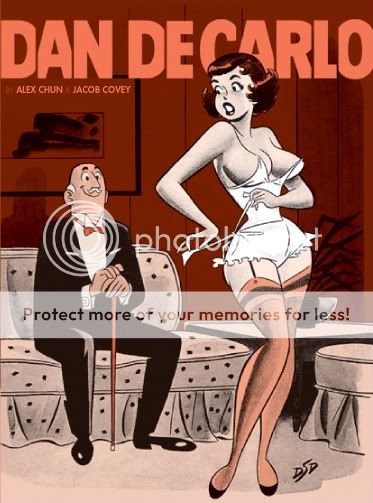
It’s hard to believe that one book could be so thoroughly dated in so many different ways. The cover sums it up — a man who looks disturbingly like Riverdale’s Mr. Lodge gazes lasciviously at a lingerie-clad young woman who looks disturbingly like a (very) bosomy Veronica. That is just so wrong.
Nonetheless, Dan DeCarlo’s later, more famous work on Archie Comics is only a small part of why these illustrations, drawn for men’s magazines in the ‘50s, are hopelessly time-bound. Today, according to all the polls, the hipless, androgynous Angelina Jolie is the sexiest woman in the world. Beyonce and J. Lo are considered full-figured because you can find their rear-ends with military-issue radar.
Be assured that no such technology is needed in studying DeCarlo’s women. Breasts swell and sag with the weight of flesh, not silicone; thighs press firmly and meatily together, hips and butts strain against fabric, threatening plentiful wardrobe malfunctions. And the wardrobes! Today, many of these women would be considered fat, and would dress accordingly, in loose clothes, solid colors — anything to make them look thinner. DeCarlo on the other hand, lovingly shoehorns his women into skin tight dresses, and then — to show that more really is *more*– adds horizontal patterns to emphasize the curves. The overall effect is — well, I can’t describe the overall effect. Let’s just say that in trying to take it all in I may have stretched my eyes permanently out of shape.
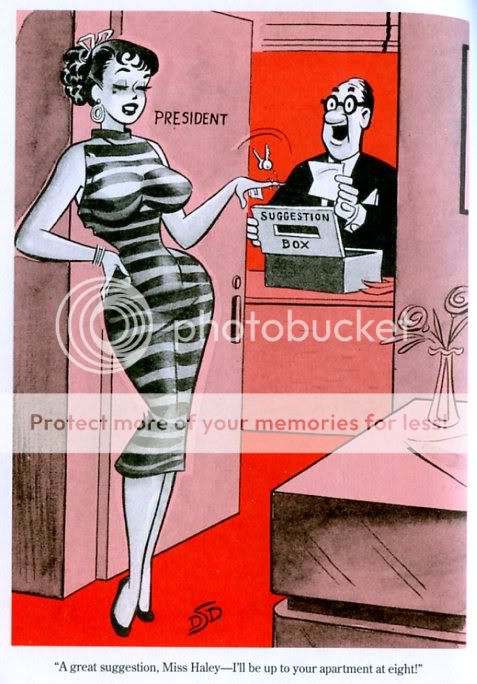
DeCarlo’s men don’t meet the standards of present-day smut either. In these days, when herds of free-range pretty boys roam unchecked through reality television, even porn actors aren’t allowed to be repulsive. Or at least, they aren’t allowed to be as repulsive as DeCarlo’s males, who are, in general, old, bald, pear-shaped, or all of the above. DeCarlo does occasionally draw young studs, but there’s no effort to eroticize them. The perfunctory washboard abs of one Archie Andrews look-alike, for example, are more than offset by a pose which suggests that a snapping turtle has crawled into his gratuitously unflattering swim trunks.
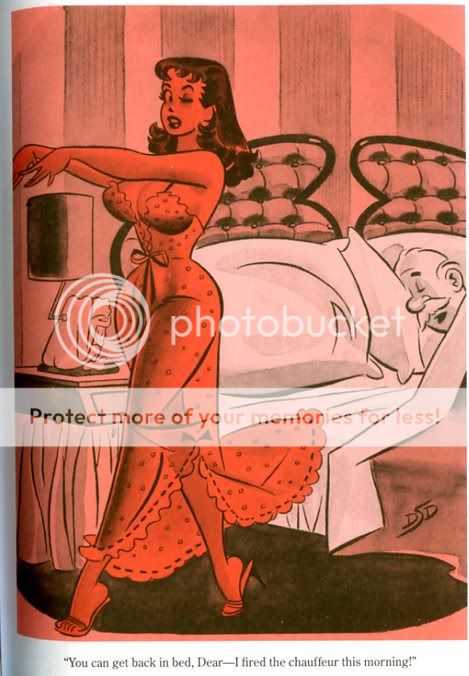
Even DeCarlo’s sexual situations are passé. Of course, the hoary gags — mostly based on the idea that people having sex is ipso facto funny — aren’t that far removed from current sit-com fare. And sure, feminine professions — secretaries, nurses, artist models, strippers, and so forth — continue to be fetishized. But can you imagine a book of smut produced today that made no reference to those twin pillars of modern advertising: lesbianism and oral sex? Or one which made no reference to prostitution (as opposed to more respectable gold-digging)? For DeCarlo, deviance begins and ends with light spanking — a practice so tame that it has pretty much completely disappeared from erotic iconography.
Finally, though, DeCarlo’s book seems out of place in today’s marketplace simply because kinky illustration has lost its footing in the mainstream American marketplace. FHM, Maxim, and the other lad-mags use celebrity pics, not cartoons. Playboy did still have drawings, the last time I checked, but they seemed merely one more sign of that magazine’s chronic irrelevance. It’s possible that the growing popularity of manga may change all this in the near future, but, for now, cartoon sex still seems like some other cultures’ hang-up. If you want to make it yours, however, this volume is a great place to start.
Update: More on pin up art, by both DeCarlo and Jack Cole.

Fan Girls vs. Fan Boys
There’s an interesting roundtable organized by Brigid Alverson on fanboy sneering at fangirls in relation to the expectation that Twilight fans will be showing up at Con. Tom (who will never live down his admission that he doesn’t like manga) is ribbed, and I get his back and natter on in comments, as I am wont to do.
Update: Much more on Twilight and fanboys and fangirls here.
Sequential Samurai Attack
I’ve been looking through a Dover collection of Utagawa Kuniyoshi’s samurai prints. Kuniyoshi was one of the last great classic Japanese printmakers; he worked during the1800s. This book, 101 Great Samurai Prints, includes two series. The first, “Heroic Biographies from the ‘Tale of Grand Pacification'” depicts samurai involved in the battles for the unification of Japan in the 1500s. It’s a very pulpy series — a lot of the pleasure comes from “holy shit!” moments of preposterous battles, grotesque toughness, and so forth.
Here for example, is a samurai hiding among corpses to surprise his enemies:
And here a samurai fights a wild boar:
This samurai is squeezing the life out of three opponents:
And this one is my favorite I think; it’s an underwater battle (notice the fish.)
The second series included in the book is “The Faithful Samurai,” which is a very famous revenge narrative. It’s very different in tone from the other series. Stylistically, it’s much less aggressive; the situations are less outlandish, and even the clothing is less elaborately patterned and individualized; all of the samurai here pretty much wear some variation on a black and white robe (though there’s still plenty of patterns besides the robe; it’s really only less elaborate in comparison to the first series.)
In addition, while the Pacification series above goes for jaw-dropping set pieces, this series is more focused on, of all things, humor. Most of the climactic fight scene takes place inside a residence, and Kuniyoshi appears to have just thought this was hysterical. Many of the scenes show samurai struggling to defeat common household objects, like kindling wood:
Alternately, we see samurai hiding behind kimonos:
or chatting with the household dog:
Even the outdoor scenes are mined for slapstick. Here’s a samurai being assaulted by a pine tree:
These series were executed about the same time (in the 1840s), so the issue here isn’t a change in taste. And obviously they’re similar in content. Kuniyoshi just decided to treat them differently…which suggests that each of these series was expected to be seen as a whole, with individual themes and ideas.
It also struck me looking through these that the relationship between narrative and image here is a little odd. These series both work off of well known legends. A more familiar western way to handle a retelling would be to have someone write out a version of the story, and then have the illustrations come out of the text, illustrating the story. Here, though, at least as far as I understand it, the text here isn’t a retelling of the story. Rather, the words tell about particular incidents, or give background on the individual samurais. The illustrations can be of particular incidents, but they don’t necessarily have to be, and even when they are, they’re not necessarily in context (the fight with the pine branch, for example, didn’t happen during the famous raid; it was an incident from the history of the samurai, or an anecdote he liked to tell.) Each series then doesn’t so much help tell or illustrate a story as it creates a particular take on a legend; narrative gilds the picture, rather than vice versa. It’s historical painting…except, since it’s a series, there is some sense of sequence, or at least of multiple views of the same incident. It’s not comics, but it does integrate stories and multiple images in a way that maybe points to something that you could see turning into comics. It’s clear enough, anyway, why comics found such a receptive audience in Japan; there have obviously been popular, aesthetically validated picture narratives over there for some time.


