President Obama Enters HU Debate

We’ve been hassling about faith and nonbelief here and here at the HU (and special thanks to commenter John Hennings for his Christian point of view on the matter). President Obama’s address at Notre Dame yesterday is being excerpted on the liberal blogs (here’s James Fallows), so of course I’ve stumbled across it. What appears to be a key passage:

… the ultimate irony of faith is that it necessarily admits doubt. It is the belief in things not seen. It is beyond our capacity as human beings to know with certainty what God has planned for us or what He asks of us, and those of us who believe must trust that His wisdom is greater than our own.

I guess Obama would be an agnostic theist, but God forbid anyone should hold me to that. Touching on the faith-vs.-reason debate between Noah and eric b. (I think), Obama would appear to identify religious belief with faith: “the belief in things not seen.” But, hey, maybe not!
Full text and video at the Huffington Post.
While I’m here, I might as well give John’s comment for easy reference: (UPDATE: actually, two comments. John followed up with an answer to my question about the context for Christ’s “closet” statement, a remark that, taken on its own, appears to forbid prayer before others. John also tells us a bit about the history of National Prayer Day, concluding “it’s difficult to promote prayer without coming across as self-righteous and Pharisaical, or maybe even becoming so (just a little bit?).” My guess: the people making a fuss about Obama and Prayer Day would have to work their way up to being Pharisaical. But now … John.)
  

I’m a Christian. I entered this fascinating discussion late. I’d like to take it back to the quoted text (Matthew 6:5-6). The common interpretation of this scripture by those who read it in context is that Jesus is forbidding praying for the purpose of looking pious to others, not necessarily all public prayer. The quote is from the Sermon on the Mount, Jesus’ longest continuous monologue in the Gospels. Among other things, the Sermon on the Mount repeatedly calls people to exercise a purer morality, one that comes from a righteous attitude of the heart. In other words, intent matters as much as action. This was revolutionary in an age and a place where the Pharisees, the leading religious sect, were advocating strict compliance to an externally visible, rules-based religion, and using social opprobrium to enforce it. A tendency toward Pharisaical legalism and its accompanying hypocrisy is endemic to humanity and probably all religion. We want to reduce God to a genie in a lamp. If we follow the rules, we get what we want. The God Jesus is talking about wants a real relationship, and He (for lack of a gender-neutral personal pronoun) wants to help us become better than what we are. It’s the difference between an ATM machine and a parent, or between a prostitute and a loving spouse. Correcting this fundamental mistake and enabling real connection with a loving divine creator were what Jesus’s life, death, and resurrection were all about. It’s also why He got so enraged about hypocrisy.

I think communal prayer can be an effective and even instructive part of worship, and it is hugely beneficial to spiritual intimacy and fellowship in smaller groups, as when “two or three are gathered together.” However, trying to please people instead of God is a constant danger in prayer and almost every other aspect of worship or life in general. Consequently, it’s one many of us talk about a lot, like teachers harping on drugs in schools.

Apparent contradictions in the Bible can often be resolved by looking at the text in context — often the immediate context, but sometimes scripture as a whole. That said, Noah makes an excellent point that as in science, there are some things even the most knowledgeable people of faith (e.g., Ravi Zacharias or Norm Geisler) don’t fully understand and can’t adequately explain. I like Noah’s comparison to the mystery of gravity; one of my other favorites is the dual wave/particle nature of light, since it reminds me of the Trinity — a mystery so puzzling that Christians came up with a name for it. It sounds much more impressive to say “Oh, that’s the Trinity,” than to say “We really can’t explain why Jesus talks about God the Father and the Holy Spirit in third person sometimes and first person others, why He claims to be God, and yet He talks to God, and doesn’t contradict Jewish monotheism, etc. It’s a real puzzler.”

Part 2!

First, thanks for the kind words. After all that about pleasing God and not people, it’s ironic that I‘m happy to have pleased you, but I respect your opinions, so I guess it makes sense.

 Now on to Tom’s questions.
My argument (with some borrowed bits) that Christ wasn’t forbidding all public prayer goes like this: First, it’s consistent with the rest of the chapter, starting with verse 1: “Be careful not to practice your righteousness in front of people, to be seen by them. Otherwise, you will have no reward from your Father in heaven.” Second, He himself prayed in front of others in Matthew 11, Matthew 27, and Luke 9, although the first two were VERY brief, and in the other, we don’t know what was said. He also strongly implied that group prayer was okay in Matthew 18, verses 19 and 20: “Again, I assure you: If two of you on earth agree about any matter that you pray for, it will be done for you by My Father in heaven. For where two or three are gathered together in My name, I am there among them.” I know one of these was already referenced, but I think the two verses quoted together strengthen the case. Side note: I am walking right past the theological questions this passage raises, like to whom those verses apply and what it means to be gathered “in His name” – at least for now. I have to go to work eventually.

Finally, the Acts of the Apostles (also written by physician/historian Luke) describe the Apostles and other early Christians as praying both privately and communally. There are recorded instances of the Apostles and early believers holding each other accountable on points of doctrine. Consequently, one would not expect this to go without dispute if at least some of them understood Jesus as totally forbidding prayer in front of others. Paul even called Peter on the carpet once. It wasn’t related to prayer, but it was about trying to please people instead of God (Galatians 2). 

Finally, in the interest of full disclosure, I should point out that the Gospels portray Jesus as habitually slipping off and praying in private. So He practiced what he preached, to the point frustrating the Apostles and others attempting to track Him down.

… the annual National Day of Prayer and national days of prayer in general are intended to promote prayer, especially prayer for the nation. Congress and occasionally the President have been proclaiming them since 1775, although not unanimously. They’re based on the idea that prayer makes a difference in the real world, and until they were made annual, mostly associated with times the U.S. was in a jam. They’ve always been ecumenical and therefore respecting no particular established religion. Also, they’re resolutions, not laws that people have to follow, so most have not had Constitutional issues with them. Being seen as a supporter of prayer was probably also the right answer politically for most of our history. The history of national days of prayer and their more recent promotion by the evangelical community can be viewed on these sites (http://www.religioustolerance.org/day_pray2.htm, andhttp://www.ndptf.org/about/index.cfm). The problem with all this, obviously, is that it’s difficult to promote prayer without coming across as self-righteous and Pharisaical, or maybe even becoming so (just a little bit?). Jesus managed to do it by living as unpretentious, sincere and unselfish a life as one could live (which must have made the occasional claims of deity simultaneously jarring and more credible). If we had more credibility, as we once did, this would be more accepted. It still is accepted on a peersoanl level from Christians with whom people have personal experience and a relationship of trust. 

Time

I just used the official CPI calculator,  a great site. My salary in 1989, namely $37,000, would now be equal to $63,628. I can’t believe the difference. So much time has gone by.

Why newsmagazines love the word “ironic”

WHEN NBC hired Ben Silverman in May 2007, he was the hottest executive in the television business, the man who had a hand in bringing reality shows and “The Office” to America. He also happened to be taking a job he had dreamed about as a junior high schooler hooked on television: the top programmer position at NBC.

That’s the lead for a New York Times profile headlined “NBC Hired a Hit Maker. It’s Still Waiting.” The reason for the headline is that, after his hire by NBC, Mr. Silverman has gone from being hot to proving sort of a dud.

Incredibly, I did a word search to see if the article mentioned Fred Silverman. Not so incredibly, there was no such mention. But, 29 years before the hiring of Ben Silverman, NBC hired Fred Silverman as its president. Fred Silverman was hot because of his success as president of ABC; then, at NBC, he unleashed a string of duds, and in 1981 he got kicked out. (He did some good stuff too, as Wikipedia points out, though at the time I think Brandon Tartikoff got all the credit for Cheers and Hill Street Blues.)
The parallels are amazing. Silverman … Silverman. Hot, hired by NBC, not hot … Hot, hired by NBC, not hot. And the two hirings are almost exactly 30 years apart! The only flaw is that Silverman 1’s hotness derived from the kind of show critics describe as “pablum” (Charlie’s Angels, Laverne and Shirley), whereas Silverman 2’s hot period includes The Office, your prestige sort of comedy, alongside genuine crap vehicles like The Biggest Loser. 

The other drawback, of course, is that the parallels add up to a king-size “so what.” But there they are and there’s no denying they’re kind of goofy. A decent newsmagazine could stick the word “ironic” in there and get itself a nice paragraph. 

Again with the Sullivan

He does a feature called “The View From Your Window” where readers send in pictures of what they see outside their homes. This time, Montreal.  That’s my town and I don’t even recognize the view. I believe the steepled building behind the trees is one of our many churches, but which and where? They are now mainly used as parking garages and Buddhist temples because of the Quiet Revolution.

Doonesbury’s Alex and Leo: Sweet or What?

UPDATE 3:  Going by comments, people who read this post may think that by Garry Trudeau’s “track record” I mean some pattern he has involving brain-damaged characters. Well, no. The track record business refers to the point raised in the post’s first paragraph, namely that I think Trudeau often takes the easy way out when he involves his characters in difficult matters. Examples would include Joanie Caucus’s longshot transition from housewife to congressional legal counsel (and wife of Rick Redfern) in the 1970s, and the triumphant arrival in the dumped Mike Doonesbury’s life of a young, beautiful and brilliant second wife in the 1980s. 
This is Update 3 because I thought of a couple more trivial updates first and stuck them at the end of the post.
And now let us return to our starting point: Alex and Leo … sweet or what?
*************

I guess it could be both. I still have a weakness for Doonesbury, though the strip is decades past its great days. Now comic geeks take notice of it only to roll their eyes, or such is my impression. Garry Trudeau has something of the feel of an Aaron Sorkin or Frank Rich: he does what he does smoothly, but you (okay, I) feel that he leaves out a lot when playing moral arbiter or heartfelt human chronicler.  He had the same faults in the old days, but his virtues were a lot stronger then, by which I mean that he was really, really funny.

Now Alex, Mike Doonesbury’s little girl, is romancing Leo, a boy who got blown up in the Iraq war. Leo is fighting back from very grave handicaps, chiefly aphasia.  Alex has her dad’s face and her dad is not good-looking; neither is she. Would Trudeau have assigned her to a victim of brain damage if she were pretty? Well, maybe, I don’t know. I’m inclined to doubt it because of Trudeau’s track record and because I haven’t seen any strips addressing why the two like each other. Aside from being a couple of nice kids, they don’t have much in common.
Caveat: I read Doonesbury on most days but not all days, so my data set is limited.  
UPDATE:  Ah yes, now about Alex being “cute.” And if that link is outdated, just find the Doonesbury strip for May 16.
UPDATE 2:  Yep, the link is outdated. Still, the one today (May 17) is pretty good: Roland Hedley Burton and his tweets.

Gluey Tart: Restart

restart manga
Restart, by Shouko Hidaka
Digital Manga Publishing, 2008

“A drunken night of sex sparks the beginning of their relationship, but Tadeshi’s growing insecurity over the younger Aki’s meteoric rise to stardom gets in the way of love. Clearly, it’s not all glitz and glamour in the tumultuous world of modeling.” So sayeth the dust jacket.

I had a strange relationship with this book before I read it. I accidentally bought it twice (and Borders wouldn’t let me return the second copy, damn them to hell), and caught myself thinking about buying it four more times before I remembered. And that wouldn’t sound at all strange if you a) knew me and b) saw my four terrifying, teetering “to read” stacks. The point is, part of my brain clearly wanted to read this book.

It was right, of course. I’m confused about many things, but the kind of yaoi I like is not one of them. I’m torn here, by the way. Should I launch into a summary? Or tackle the cliché question? The former, I think.

restart manga

The major point of Restart is willowy, elegant-looking boys with long, messy hair. Or at least long, messy bangs.
I always award bonus points if one of the main characters has that little quasi-updo thing going, too.
I would say that’s just me, but it can’t be. It has to be a bit of a fetish for other yaoi fans, too; it occurs too often not to be. Because Japanese men are more fashion-forward and groomed than American men, but really, the incidence of the little half-ponytail in the wild is not extensive.

restart manga

The semi-random means of bringing the willowy, elegant-looking boys together is a misunderstanding that almost destroys their nascent relationship (let’s spin the wheel – oh, one of my favorites! They get drunk, have sex, one of them doesn’t remember it the next day, and they pine for each other until the mistake is cleared up), but finally resolves into a new connection, followed by meaningful makeup sex. There are longing looks across the room. There are resentful musings. There are hurt feelings and confusion. Followed by meaningful makeup sex.

restart manga

The sex can occur on- or off-screen; surprisingly, I don’t much care which. It’s always tricky, approaching the initial sex scene in a book by a mangaka you haven’t read before. Everything can be fine up to that, but there are just a lot of deal-breakers – I can be in love, love, love with everything about the story, and then, oh, God, the sound effects say “slurp.” You know. And then there’s how the genitals are, er, handled. They can’t show them in Japan (although some mangakas do anyway, always a pleasant change of pace), so there are conventions to let you know what’s being put where. There’s the ghost penis, where one of the characters obviously has his or his partner’s equipment in hand, but the hand is empty. Or there’s the partially rematerialized penis – think Star Trek, where everybody is kind of a shimmery cloud before they fully beam in. As far as where the penis is inserted, you often get a kind of cut-away; fingers are inserted into – nothing. And sometimes you just have to laugh. Laughing is enjoyable and, I understand, can help you live longer, but it isn’t always right for the big sex scene. Restart gets it right. There are a couple of sex scenes (actual, not implied), but it’s all about the romaaaaaaaaaance. Charged expressions, well-positioned hands (not a given), meaningful eye contact. And it starts in the bathtub, which just pleases me.

restart mange

TMI? Well, that’s the thing, when you’re talking about porn. Yaoi isn’t just about sex, but it is about sex. So while literary criticism is relevant, it isn’t really as relevant as whether it, you know, works. If it’s hot. That’s a combination of plot, story-telling, the quality of the art, and if it hits your favorite kinks – which can be the most important part. And that brings us back to cliché.

Those of you who are familiar with yaoi will recognize the getting drunk and having sex that is immediately followed by a misunderstand aspect of Restart whether you’ve read it or not. (I’m talking about the main story here, which comprises five chapters; there are two others, both enjoyable, but filler) It is not an original plot device. It is, in fact, a well-worn plot device – so much so that I actually think of it as a subgenre rather than a cliché. I don’t have a problem with that because the drawing is lovely, the story is sweet, and, most important, the romance works for me, and the sex works for me. That’s why I read yaoi; I want romantic porn. If the book succeeds on that level, it succeeds.

Yoshihiro Tatsumi Looks as Sharp as his Comics, in Non-Moldy Reissues

Judging from the pictures from TCAF. This post departs from my courtly ways; apologies in advance.

So more than once I read the many words Brandon from Are You a Serious Comic Book Reader? dropped about the graphic design of Drawn & Quarterly’s Tatsumi reissues. I guess he’s having an off day: gems like “the act of reissuing is a mix of hubris, fan boy exctiement [sic] gone wrong in the best and worst way, and opportunism” and “imperialist takeover” stand in for his not liking the design. Which is “twee and minimalist,” aimed at the “New York Times crowd” and the bad people who enjoy the Shins, Wes Anderson movies, and Neutral Milk Hotel. Those dreaded hipsters lurk in his argument, recalling someone’s glib quip that Tatsumi was hipster manga, when it’s really manga for smoke-cured old men.

Executive summary: Huh?

Anyway, let’s enjoy the graphic design in the Japanese versions of Tatsumi’s work. Maybe they’re twee and minimalist, aimed at those horrible cityfolk who read the Yomiuri, watch Le Pavillion Salamadre, and wear scarves. In the spirit of Tom’s fine series of Golden Age covers.

For context, here’s A Drifting Life, colonized by Tomine and the Canadians:


Here’s the same, pure as the finest vending machine sake:

Here, Seirinkogeisha’s recent versions of Tatsumi’s short stories:
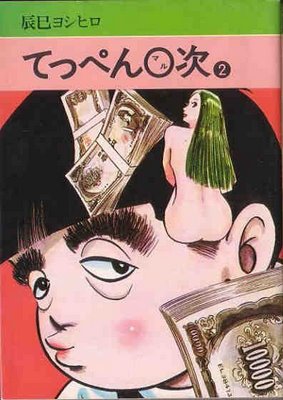
And here’s a period cover to an ancient series of his I’ve never read and know nothing about save that it’s from around ’78:

Looks awful. Money makes the man.

And an old collection:
“The Crowd with the Blues,” more or less, from Napoleon Books. I don’t have a date, but it’s at least 20 years old judging from the design. The only word I can really make out on the blue wrapper is “sex.”

Finally, we’ve got Chip Kidd, who’s really damn good. They’ve got Tadanori Yokoo, who’s a legend. Here he drags Shonen Magazine from the gutter to the gallery:

Click to see it bigger. These are from the late 60s, early 70s. The cover on the left is from Tomorrow’s Joe, and its design doesn’t strike me as all that different than Tomine’s version of Tatsumi’s work. More garish, still using the source art as springboard for graphic strategies not inherent to cartooning. See also his baseball calligraphy cover, which stunned readers and artists when it hit.

As always, I hope I made some points.

Nicked from all over. Here’s some links:

Postscript: Tatsumi did up the great saint of Shingon Buddhism with Sachiya Hiro? Who knew?