The Thing About Condi

She’s a jerk. On the smallest, most immediate level, the sort I can appreciate, she’s a fake and a bully. At Harper’s, Scott Horton posts about her torture-heavy Q&A session with students at a Stamford doom. Horton addresses the mismatch between her remarks and publicly known facts. But what gets me is the cheap way she tried to muscle one of the kids asking her questions. It’s not enough that she cherrypicked an isolated finding in a report about Guantanamo (where it called the prison’s physical facilities “a model medium security prison”) and ignored the damning stuff in the same report (treatment of prisoners was “mental torture.” She had to pretend the kid hadn’t done his/her homework.  After trotting out the “model medium” finding: “if you didn’t know that, maybe before you make allegations about Guantanamo you should read.” When she, in effect, blames the Supreme Court for keeping Guantanamo’s inmate indefinitely detained — because the court wouldn’t allow Bush’s people to put the inmates before kangaroo tribunals — she tries to make the student into a stooge by quizzing him:


RICE: Those trials were stayed by whom? Who kept us from holding the trials?

STUDENT: I can’t answer that question.

RICE: Do your homework first.

Oh, thank you, ma’am. She’s playing “look over there,” trying to make the student’s alleged ignorance into the topic of the moment.

The Bush people weren’t just jerks in a grand, world-historical sense. They were jerks at the molecular level too. Cheap bullies and flim-flam artists, whether they were political hustlers or the provost of Stamford.

Transcript of Q&A is here.

Media Empire Redux

I have an long essay about the Friday the 13th series up on the BrightLights Film Journal now. Here’s a quote:

In that vein, perhaps my favorite eye-for-an-eye moment in the whole series is one of the first; an idealistic counselor in the first movie is picked up on the road and starts nattering about how she’s always wanted to work with children. “I hate it when people call ’em ‘kids,'” she opines. Moments later she doesn’t care what they’re called because — her throat’s been slit! I guess your smarmy semantic quibbles look kind of silly now, don’t they, you vacuous little chit? Huh? Don’t they?! Maybe it’s just because I’ve worked as an educator for 15 years, but I can’t really describe how satisfying that sequence is. School reformers and earnest do-gooders of all kinds — put them to the scythe, Jason! Similarly, in part 5, when the porcine and infantilized hillbilly biker is riding his motorcycle around shrieking for his mother like a little whiny brat, and Jason finally, finally, finally chops his head off . . . I mean, who wouldn’t give the decapitator a high five — or at least cheer from a safe distance? If you’ve ever wished a parent would get their kid to just.shut.up. in a restaurant, I think you understand the impulse.

Also on the same site, a slightly longer version of my review of a book about Jack Hill.

And I have a brief, snarky review of Jeff Brown’s new book here in the Chicago Reader’s Spring Books issue.

Dreamwork

I began reading comics intensely as intellectual escapism from grad school. My other escape was film theory. So I had many elaborate, comics-form dreams starring Eisenstein.

Last night I mixed the two again, dreaming an R. Fiore column in The Comics Journal. In just a couple of short pages of copperplate prose, no plosives, he eviscerated all the Journal‘s writers for not liking Mel Gibson’s movie The Passion of the Christ. Gibson’s poor treatment at their hands was a case of “wholesale intellectual fraud,” he wrote. Then he cut the writers down, one by one.

Since I’d regularly sniped at Gibson in my column, calling his movie “a pornography of violence” and such, I skipped ahead to see Fiore take me down. Seeing my name in the last paragraph, I flipped back to finish the article. But my eyes got stuck in a loop in the second-to-last column, going over the text without seeing anything.

So I set it down and started on the new Kevin Huizenga book. It’s a new direction: movie reviews as comics short stories. After reading his cheerful take on that Mayan Gibson movie, I skipped to the book’s end. He starts to use empty pages as he goes on, two or three tiny panels hovering over nothing garnished with type at the very bottom (Helvetica Neue, mind). Then the same problem; I couldn’t finish the book for strange reasons.

So I looked over my shoulder at an old pen-and-ink drawing of mine. It didn’t look half bad.

***

The seeds for this weren’t Rick Veitch’s dream comics, which I admire, nor Iou Kuroda’s movie review comics, which I don’t. Most likely one seed was Fiore’s long, precise dismantling of once-columnist Bart Beaty’s book. The Comics Journal: They Eat Their Own.

The other seed has been watching the comments threads for Noah’s posts on fanfic and Wonder Woman. I know little about either, so I just watch, impressed with Noah’s modulation of snark and patience as 700 Anons drive-by to tell him he sucks. Social media! Were I more of a business ninny, I’d start quoting Seth Godin’s latest while huffing venture capital.

Except that as tribes go, this blog’s more of a confederacy.1 I know that whenever I post something, likely the first comment will be from one of my comrades, taking apart whatever I said. Three of us write for the Journal, which means precious little in terms of sharing a critical lens.

Talking about which, I need to pick at Noah’s argument here in lieu of full review today.

1 J. K. Toole jokes, go to town.

Right Once Again

Specter jumped parties after all; Newt and some fellow ne’er-dowells put the matter in perspective here.


I made an impulsive prediction that Specter would go Democrat here, then foolishly backtracked in the face of news reports, as seen here.

The Hill tells us:

Reid also pledged to campaign for him, one of several concessions he made to woo Specter.


Getting Harry Reid to campaign for you is a good thing? I mean, I like the guy, but I’m one of the few.

From the same article:

He [Specter] would continue to oppose card-check legislation, a high priority of organized labor, unless it was rewritten, he added. 

So we get one used senator who votes the wrong way. Ah well. Still, the turnabout reminds us once again of the O’Reilly principle: nowadays being an anarchist is better for public image than being a Republican. Which is all right by me: anarchists haven’t done all that much harm.


Garfield’s Nine Lives

Garfield: His 9 Lives came out in 1984. We owned it when I was a kid, and I remember even then finding it odd. Now we’ve received an old copy for my kid as a gift…and it seems even odder.

Like the title says, the book tracks Garfield through his 9 lives, starting as a cave cat and ending up as a cat in space. Which certainly makes sense as far as it goes…and several of the segments are, in fact, more or less exactly what you’d expect — that is, they’re Garfield gag strips with a different time setting. Here, for example, cave man domesticates cave cat:
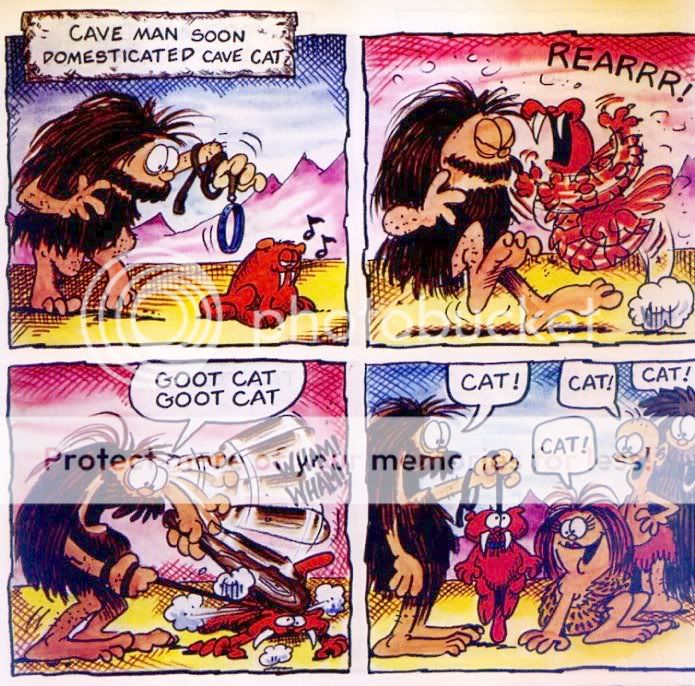
Photobucket

Cartoony style, professionally accomplished basic slapstick schtick — that’s what I expect, more or less, when I go to a Garfield comic. Similarly, there’s a very funny Three Stooges riff in which Garfield is an exterminator, allowing Jim Davis to get a bit more squicky than he tends to in the funny pages:
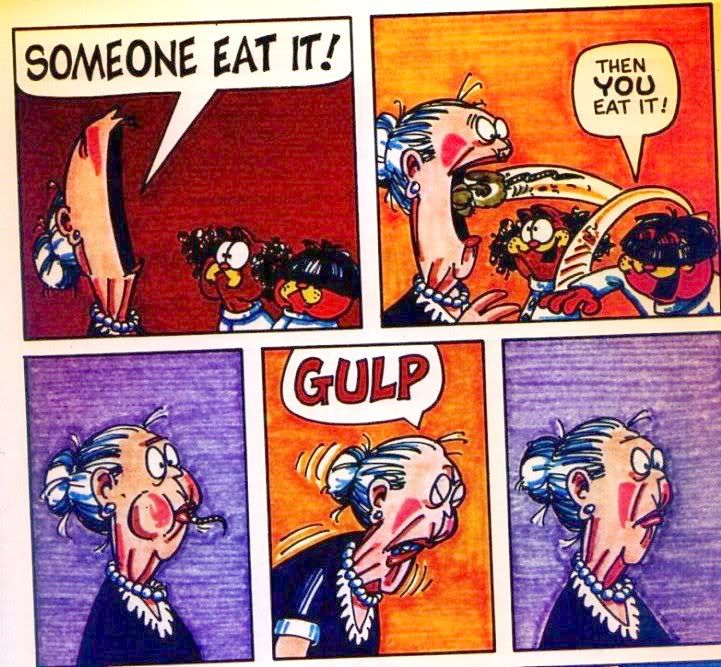
Photobucket

Other parts of the book, though, are harder to parse. In the first place, little is done with the conceit of Garfield-through-time; almost all of the stories except for the cave cat and future cat ones are effectively set in the present. There is one story where Garfield is a Viking Cat…but then he gets frozen in a block of ice and ends up in 1984 anyway along with his Viking comrades. This sets up a confused and toothless Mad Magazine knock off, as the Vikings meet the modern day world and end up as factory workers, plumbers, and advertising executives. There’s also a prose story about Garfield as a detective (I guess that does seem vaguely set in the 40s…) and a fairy-tale story with slick computer-surreal art which is too saccharine to discuss further.

And then there’s this:

Photobucket

Yes, that’s an incarnation of Garfield as atavistic monster. I don’t have the equipment to scan the entire double-page spread at once, but basically he’s leaping to slaughter his aged owner.

And the twist-ending horror shocker isn’t even the weirdest of the tales. That honor would have to go to the tale which has Garfield as a laboratory animal who is injected with an experimental drug, escapes from his cage….and then changes into a dog. It’s done in a more or less realistic style, and the whole thing is extremely creepy, from the traums of the vivisection to the apparently painful transformation; even the sort of winking ending (he escaped!) seems very creepy — I mean, surely an animal who this happened to would be terribly traumatized. It all seems very far from the jokey world of the Garfield strips; this is more like 2000 AD twist endings…except that crossing it with a children’s comic strip makes it significantly more, not less, disturbing.

Part of what’s going on here is that Davis is giving the folks in his studio a chance to stretch out. For instance, that creepy, atavistic cat above isn’t drawn by Davis, but by Jim Clements, Gary Barker, and Larry Fentz. The saccharine fairy-tale is written and drawn by Dave Kuhn. But then, the oddest stories — the lab animal one, the atavistic cat one, are written by…Jim Davis. The same Jim Davis who has been writing essentially the same Garfield gags (coffee makes you crazy! cats are lazy!) for thirty years. The same Jim Davis who, when asked to talk about his strip, utters bland profundities like “This whole line of work is to make people happy and smile. Getting paid for is it just a bonus.” If you were going to guess, you’d say that Jim Davis hasn’t thought about anything in particular for most of his adult life. And then you find something like this, or Davis’s appreciation of Garfield Minus Garfield and you start to wonder…

Oh Christ. Just Fuck God in the Ass and Leave Him Bleeding

… a conscious effort to inscribe this “Trek” in the storytelling traditions popularized by Joseph Campbell, in which heroes must suffer loss and abandonment before they rise to the occasion. The filmmakers admit that this is a deliberate homage to their favorite films, like “Superman,” “Star Wars” and “The Godfather Part II.”


From the New York Times via The New Republic’s Plank blog. The article in question discusses what J.J. Abrams has in mind for his reboot of the Star Trek franchise.

The quote is stupid because, as the Plank item points out, Godfather II ends with Michael Corleone’s soul and family in ruins: he is corrupted and he is alone. The Godfather films aren’t about someone being tested and rising to the occasion; they’re about someone getting pulled in, just like it says in that goofy line from Godfather III  (you know, “they keep pulling me back in!”). Michael Corleone isn’t young Luke Skywalker or Clark. He isn’t callow and in need of challenge. From the start, he is a born leader, a paragon of competence and nerve, a decorated war hero and cool-headed tactician. He is the dream self-image of Mario Puzo, that poor shambling yutz who wanted to pretend he was hard, compact and capable. Corleone starts as a hero and always has the gifts of a hero, but he loses his way morally. This process begins, for all reasons, because he loves his father, who happens to be a Mafia chieftain. And that tragedy is the whole point of the Corleone story.

Doesn’t this matter? Can’t J.J. Abrams and the New York Times demonstrate some understanding of one of the most famous movies of our time? The story has nothing to do with Joseph Campbell. Nothing! If you want to feel important while talking about the Godfather films, just say “Shakespearean.” Go ahead, it feels good. You won’t be adding anything, but neither will you be demonstrating your ignorance.

UPDATE:  Another point.  Godfather II begins with Michael Corleone already in his father’s place, a man with wife, kids, and responsibilities. It’s in the first Godfather film that he’s a young man whose life is taking form. Mr. Abrams and the New York Times couldn’t even pick the right film to get confused about.