Nana 13-14: Economic Catastrophe Edition

I originally wrote this for another publication, which went belly up before they released an issue. Sad but true….
___________________________

Nana, Ai Yazawa’s rock-and-roll manga soap-opera , has a fairly simple premise — two young women, both named Nana, head to Tokyo to seek their fortunes. The narrative quickly accelerates, though, with an ever-expanding cast of characters, all portrayed with a dizzying intensity and depth.

Which is to say that, though you definitely don’t want to start reading Nana with volume #13, you definitely do want to start reading now now now so you can get to #13. This far into the series, every relationship has layer upon layer of meaning, with every new detail causing the committed fan to flap and sputter spasmodically. For example, in #14, we learn that rock-solid, reliable Yasu engages in the occasional indiscretion — and we know him so well that we (like his bandmates) are left (literally, in my case) with our jaws hanging open. Yasu…it can’t be! There…there must be some explanation! Surely, surely, it will all be explained in the next volume….!

Or, a little more subtly: it’s been clear for some time that Nana Osaki, the tough rock star, has an intense (albeit nominally platonic) crush on the ditzy Nana (“Hachi”) Komatsu. And it’s also been clear that Hachi’s often-cruel-but-never-heartless fiancé Takumi treats Nana O. as, to some extent, a rival. But in issue #13, for the first time, we see, in a flashback, that Takumi actually consciously knows how Nana feels about Hachi — a revelation which makes him seem both sweeter (he touchingly reassures Hachi that she and Nana will remain friends) and more cold-hearted (because if he knows how much the two women mean to each other, why is he such a dick to Nana?)

Did I mention that the art is amazing? Stylish clothes, beautiful poses, and faces so expressive they’ll tear your heart out. Nana’s stricken expression at the end of volume #14, her body stiffened in shock, contrasting pitifully with her cheery giant-heart-over-the-bustier jacket, while Yasu sits beside her his face drawn in sympathy…. That — that — right there! is reason enough to start reading at #1, and keep reading until the sad, sad day when Yazawa decides to stop writing them.

New Favorite Quote

Just found this at the top of Talking Points Memo.  Jim Cramer, cable tv’s excitable money man, says of bank nationalization:


We must take the debate out of the hands of the dreamer academics, and into the hands of practical business people, no matter how much we despise them for getting us into this fix in the first place.


The thought is kind of beautiful, in its way. 

It’s! So! Super!

A while back I talked about All-Star Superman and why I thought the first 8 issues or so weren’t as great as they were cracked up to be. Several folks argued that I’d be more impressed if I finished the series.

So I just reread issues 1 to 12 and…eh. It’s not terrible or anything, certainly. I appreciated Frank Quitely’s art more this time around than I have in the past. The series has a nice, bright, striking color palette, and I like the clarity of the linework and layout; there’s a touch of Winsor McCay there, I think. I still find his figure drawings and faces off-putting; his women in particular often look like uncomfortably slender fetish mannequins, and facial expressions seem rubbery and oddly unexpressive. But as far as mainstream art these days go, this is about as good as it gets, I think.

The story is fine too…Morrison keeps things humming along; there’s no shortage of nutsy throwaway ideas — using a gravity gun to warp time; descendents of dinosaurs living underneath the earth; Jimmy Olsen dressing in Kryptonian garb for a lark; underworlds, overworlds, shrunken super-doctors — it’s all good. And, of course, there’s Superman’s approaching cell-death hanging over the series, giving it weight and pathos.

Except…man, how much do I care about these folks at all? Jimmy Olsen for example; he’s hip, he’s incredibly resourceful, he’s got this sixth sense which warns him of danger, he’s got his signal watch — he’s just so cool! And, well, irritating. Same with the endlessly chattering Lois who won’t believe Clark is Superman; or with Superman himself, always rushing off to save someone or other, constantly forgiving everybody; or with, say, Lex’s gratuitously fetish-goth-garbed niece. Everything’s just. So. Awesome! and. Inventive! and Cool! “No one but me can save the world Lois! My cells are converting to pure energy, pure information. And I only have moments to save the world.” Tum ta tum! You feel like you need to utter a little inspirational horn bleat after every panel; it’s all characters making preposterously pompous little speeches and the racing off to be heroic. Everything feels like it’s at maximum volume.

Morrison’s always written like that. In stuff like Doom Patrol or even the Filth, I always felt it was thrown off tongue in cheek; making fun of the immensity of super-hero stuff, and often undercutting it with pratfalls or ridiculousness (like the silly Brotherhood of Dada, for example.) But as he’s moved into more mainstreamy work, that deflation has gotten lost. And…it’s not that he’s not clever. It’s not that he doesn’t have good ideas. It’s not even that there aren’t touching moments. I just hate the feeling that he’s tapping me on the shoulder every page yelling in my ear, “This is soooo great! This is Superman, booooy! Go! Go! Go!”

I’ve said this before, but…it totally vitiates everything that’s best about Silver-Age storytelling when you try to tell a story capturing the brilliant innocence of silver-age storytelling. Because a lot of what was fun in those Silver-Age stories was that they were really off-hand and not at all pretentious. Sure, a Silver Age story might have Bizarro in one panel and evolved dinosaurs in the next and then an intelligent sun on the next page…but that would just be the story. There wouldn’t be the winking about, wow, this is so cool. I felt like Alan Moore handled it better in “Whatever Happened to the Man of Tomorrow” by slowing the pacing down and being somewhat more bloody minded; trying to think how the silver age stuff might work out if you looked at it from an older perspective. It was an homage to the era, not an attempt to recreate it. Morrison though seems to be trying to go back in time through sheer puffery and volume and frantic pacing. And I think it’s significant that Moore’s message was that the world doesn’t need Superman (which is, as it happens, true), whereas Morrison’s message is that we do need Superman watching over us forever, at least as a kind of beautiful ideal. Which is basic fanboy aggrandizement — and also not true, even if you bellow it.

Also, the end? I really thought, from all the foreshadowing and what people had said about the series that, you know, he dies. But he doesn’t quite. They still think he might come back. It just seems…I don’t know. It seems kind of lame, really, with all the build up.

Again, I didn’t hate the book. It’s entertaining. There are a lot of wonderful moments (Clark Kent bumbling around while interviewing Lex Luther is lovely; reminded me of the Chris Reeves Superman movie, which I still think was pretty great.) And of course, it’s hard to resist Luthor’s eyes checking out the superpackage:
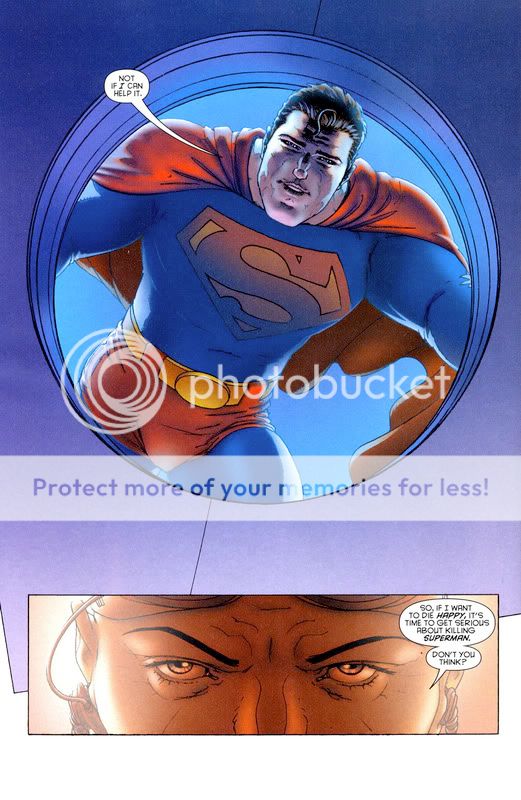
Photobucket

I know everybody goes on about the freshness of the series, the way it rejuvenated the character, and on and on. But it feels really decadent to me; definitely part of the zeitgeist, rather than an answer or alternative to it. I’d way, way, way rather read this than Marvel Zombies…but I don’t necessarily think they’re different in kind.

Is the War Over?

We were talking about another series of theme posts and I suggested “Are Comics Respected Yet?” It seemed like an obvious choice since, as I read the world, comics are now just starting to be respected and therefore find themselves in a touchy in-between state like that of blacks in 1965. A lot of ignorant goodwill is directed their way in a fashion that can be a bit galling. And for every ounce of ignorant goodwill they also encounter at least an ounce of open hostility.

Or so I thought. But, going by my co-bloggers’ response, I might be behind the times. Beacuse they were indifferent to the idea, which suggests that the status of comics is way more secure than I thought.

So is that the case?
And why did comics have such a tough time getting this far? My theory is that public literacy has been a hard-won battle pushed along by shaming techniques similar to toilet training. Not that I have any data on the question.
If anyone wants to comment, I’ll note here that I realize comics have always had better status in Japan and France than they do in the US.   

Copyright Insurgency

One of Noah’s Wonder Woman posts elicited this comment from Cole Moore Odell:

…it shouldn’t be controversial that some characters simply don’t work, or they don’t work past the idiosyncratic spark of their original creators. There’s nothing wrong with limited shelf life. Yet this simple reality is warped by trademark holders who have unlimited interest in making money off of limited concepts, and by readers who refuse to let ideas go, even in the face of continued creative failure. … the same can be said for most superheroes. Most popular culture, really.

Reading the WW essays, I got the sense of an original vision both odd and personal; later attempts at the character, not so much. But it has enough cachet that people want to keep trying their own version. It could just be positioning (“the first female superhero”). Readers who won’t let go, I think, shouldn’t be faulted. They see untapped potential. (The Cubs could win the World Series; it’s not the fans’ fault for buying tickets.)

And the corporation’s a facilitator, never an author, no matter what the law says. The law’s the most interesting thing here, I think. Totally arbitrary and usually absurd, Odell’s right that it warps reality.

Without going into a laundry list of Boggsian aburdity, I’ll point to the English scrum over Lost Girls. Moore & Gebbie used Peter Pan characters still under copyright in the UK & EU. The hospital that owned the rights objected, so M&G waited to publish there until the copyright expired. An amicable solution, but still:

Why on earth does a hospital own Peter Pan?

(Yes, I know there are reasons. I could have my reasons to leave my fortune to a dog.)

So, my big question: at what point can a work be said to have reasonably escaped its author and been taken over by the culture? It makes less sense to say one person hospital owns & controls Peter Pan than it does to say Peter Pan’s just out there somewhere. I think this question especially important to comics works, which rely more on “characters and situations,” as at least one comics copyright has it, than on any particular story. Certainly, the superhero genre’s founded on the character more than the situation.

(Uninteresting side note: yes, lots of money is involved. So? Granite mining is a cutthroat industry.)

Finally, this is silly:

Screw you, Sonny Bono’s ghost. Say I want to make creative use of the culture I’m in, works speaking in the language I grew up with. For a lot of people, pop’s the only language they have. And that language is owned & operated by companies. So I’m left with parody, the collective unconscious of the 1860s, or the lawless Mississippi kids who didn’t know they couldn’t remake Raiders of the Lost Ark. (Better than the original in every way, you can only see it through pirate versions as a legit release is a legal tangle.)

In film criticism, David Bordwell and Kristin Thompson started the practice of using film stills without asking permission because studios routinely asked crazy fees for reprint rights. Now everyone reprints stills without permission, so a murky legal precedent’s set even if no case has been tried.

So, shouldn’t organized fan-unrest be able to destroy copyright? “24-Hour WW Fanfic Comic Day.” Or cosplay sit-ins, I don’t know. It might be worth it just to have thousands of people dressed as Amazons, going about their business. Maybe Moulton’s ghost would be pleased, if not as much for “24-Hour Hogtie Day.”

How I Learned to Love the Wall

“…society secretly wants crime…and gains definite satisfaction from the present mishandling of it.” Photojournalist Susan Madden Lankford quotes this line from Karl Menninger in her book Maggots in My Sweet Potatoes: Women Doing Time, but she seems oblivious to the irony. Here, after all, is a giant coffee-table book filled with photographs and interviews with women in the Las Colinas jail in San Diego. Reading these women’s stories of drug use, molestation, neglect, prostitution, single-motherhood, and more drug-use; looking at into their weary faces — why would we do these things if there were not a “definite satisfaction” involved? As we flip through the pages, surely we are intended to feel not so much a guilty pleasure as a pleasurable guilt. Clearly the book is more upscale than, say Judge Judy, but with its fascinated voyeurism and its constant finger-wagging, is it really different in kind?

The target of the righteous indignation is, of course, somewhat different. Lankford is less interested in personal than in societal guilt. “How have we failed so many women?” she wonders. The answers she comes up with are familiar ones — basically, society doesn’t do enough to make sure that children are not neglected. The book is sprinkled with pull quotes from “Bruce Perry, M.D., Ph.D.” who rather gratuitously explains that being abused as a child tends to leave you fucked up. The conclusion is that these women need more attention – from parents, from society, from us.

Perhaps that’s true. But I can’t help thinking that maybe they could do with not more scrutiny, but less. Most of the women in Las Colinas are there on drug or prostitution charges. If drugs and prostitution were legalized, they would be…not happy, not healthy, but not, for the most part, in jail.

Lankford, of course, argues that the women actually enjoy jail on some level; she speculates that confined women secrete oxytocin, a calming hormone associated with sex and birth which may “make jail time more tolerable” and even “encourage recidivism”. It’s a telling foray into pseudoscientific balderdash. After all, if even the inmates derive subliminally sexualized pleasures from jail-life, can we be blamed for doing so as well?

Hey, Bartender! I Think You Kids Are Great

The comics hook is that I borrowed the title from an old Doonesbury, one dating to the distant era when the sight of a long-haired bartender at an old fogies function was worth a few gags. 

I spend a lot of time at the Cafe Depot and the Second Cup, two chain coffee shops with outlets here in Montreal. My message today: the kids working behind the counter are great. They’re hard working, cheerful, unflappable. They make shit, something like $8.50 an hour. The tips are worse. I’m one of the biggest tippers they’ve got, and I give them peanuts.
The schmucks get up at 5 in the morning, trudge thru Montreal snow and ice, clean toilets, deal with clowns counting out pennies to pay for a cup of coffee. Then the kids go off to study or play in their rock bands or whatever. I don’t know how they do it all; I wouldn’t have the energy. 
In the ’90s I worked at a newspaper in New York where kids the same age made $25 an hour and spent most of their time sitting around. And boy, did they bitch when there was something to do. (Yeah, Krajick, I mean you.) Maybe Montreal is better than New York, maybe constant work is better than idleness. Maybe, my favorite theory, the world is on an upward trajectory and the latest generation is the product of better child rearing than previous ones. Maybe not. But it’s nice to have something nice that you can take for granted. And now that I have written this post, that’s what I”m going to go back to doing.
One caveat: the pretty girls treat me like I’ve got a disease. But what else is new?