Manic Pixie Dream Edward

The entire Twilight Roundtable is here.
____________________

images-1The Manic Pixie Dream Girl, as Wikipedia will tell you, is a stock character in films whose purpose is to be free, free like a wind bunny who is free, and also to make the main male character childlike and happy and wind bunnyish as well. Think Zooey Descahnel in…well, just about anything.

The Manic Pixie Dream Girl is obviously a gendered trope. She’s got “girl” right there in her name…and in a lot of ways she’s a caricature of femininiity — childlike, innocent, cute, and, of course, sexy and sexualized. Ergo, there are no Manic Pixie Dream Guys. The manic pixies are always girls.

Or so you’d think. The truth, though, is that there are male characters who function much like MPDG. For instance, take the character of George in “A Room With a View”. Like a MPDG, George’s main function is to connect the main character, Lucy Honeychurch, to her own inner wonderfulness and passion. Before she meets George and his father, Mr. Emerson, Lucy is boring, conventional and worst of all insincere. The only sign that she has depths is her marvelous piano playing, which prompts one bystander to comment, “If Miss Honeychurch ever takes to live as she plays, it will be very exciting both for us and for her.”

Of course, she does eventually start to live as she plays…and the reason is George, her own MPDG, who leaps naked from pools and kisses her amidst violets and divests her of all her stifling armor of convention.

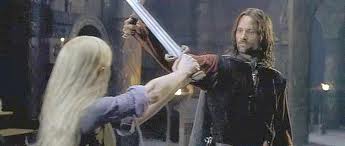
Still, the divesting, not to mention the armor, works a little differently than when the MPDG is a woman. Again, gender is central to the pixie dream girl trope; if you make the pixie a guy, he not only looks a bit different, he functions differently as well. In Yes Man, the MPDG’s goofy femme unconventionality frees Jim Carrey from his hidebound, sexless boringness — she teaches the stultified man the feminine beauty of having no responsibilities. In A Room With a View, the terms are shuffled a bit — a shuffling shown in part, perhaps, by the fact that we see much more of Lucy’s relationship with Mr. Emerson (George’s father) than we see of her relationship with George himself. Where Carrey gets to be a child, Lucy learns from, and gets strength from, a father. Deschanal inspires Carrey to let go of his life; George, and particularly George’s father, inspires Lucy to grab hold of hers. Similarly, in the Lord of the Rings films, Eowyn is attracted to Aragorn even more strongly when she learns that he’s old enough to be her grandfather, because what attracts her to him is in fact his mystical, hyperbolic fatherness; his stature and power and fighting arm, all of which she desires for herself, and so desires in him.
 

images

 
Part of the poignance of the Eowyn/Aragorn relationship — and a big part of the reason the MPDG has more emotional heft when the genders are switched — is because it’s pretty clearly a reaction to sexism. Eowyn speaks repeatedly and eloquently about her frustration with the limits placed on her as a woman — about how she longs to be a warrior and fight for her people and her king, but is instead continually shunted off to cook and tend to children and the elderly. For Jim Carrey, the MPDG is a sop to make up for the fact that his ex dumped him. That sop takes the form of fantasy woman who acts as his ego appendage, which tends to diminish sympathy inasmuch as it suggests that his ex maybe knew what she was doing when she left him in the first place. For Eowyn, on the other hand, the magic man is a sop to make up for the fact that she is trapped by sexism. It’s not a good solution, perhaps (as the film realizes) — but that only makes her predicament more tragic.

Another example of this is George Eliot’s Middlemarch, which is basically a brutal critique of the Manic Pixie Dream Guy — or, in this case, of the Somber Genius Dream Daddy. Dorothea marries Casaubon because she sees him as a kind of intellectual phallus — a quintessential father who can usher her into the male world of thought and meaningfulness. In the event, though, it turns out that he is not the phallus, but a selfish old man. A romantic partner is just a person, not a gateway to a new self. In Middlemarch, other people can’t transform you — at least, not all at once, and generally not for the better. Which doesn’t mean that Eliot condemns Dorothea. On the contrary, Dorothea’s essentially feminist wish to escape her limited circumstances as a woman is seen as entirely reasonable. Looking to a man to help her do that is obviously not ideal and doesn’t turn out well — but limited options lead to less than ideal decisions.

Bringing us to Twilight. Meyer’s story is often seen as anti-feminist because Bella gives up everything — her friends, college, her human life — in order to be with Edward.
I think, though, that this is a fundamental misreading of the series. Bella doesn’t give up her life for Edward. Rather, Edward exists for Bella, in the same way that Manic Pixie Dream Girls exist for the guys they save.

In fact, Meyer goes out of her way to reiterate again and again that Bella’s specialness precedes Edward, and in some sense calls him into being — just as Lucy’s passionate Beethoven precedes, and structurally necessitates, her encounter with George. Much of the first part of the first novel of Twilight is given over to descriptions of how out of place Bella feels among her peers. We also learn that she has always been able to smell blood like a vampire does, rather than like a human — and of course Edward can’t read her thoughts, and finds her scent almost magically appetizing. In short, Bella, like Lucy, has depths. When she chooses Edward, she does not turn her back on her wonderful, magical life — she picks it up.

Edward, then, is less a character than he is an embodiment of Bella’s desire for herself — a kind of projected self-actualization. Meyer’s genius for giving Bella not just what she wants, but what she wants to be, is, then, at the heart of the book’s considerable appeal. Edward is both (old, siring) father and young lover, both dark vampire and sparkly elf, both safe (he’s reluctant to even kiss her) and dangerous, both outsider and — with his weird, incestuous, close-knit Mormon family — insider. Most of all, though, he is power. And that power is specifically the power to get out of the boring conventions of tween high school girlness — the clothes shopping, the gossip, the high school interpersonal angst that Bella clearly loathes — and into adventure and danger and superpowers and magic. If the choice is between going to prom and being stalked by a vampire, Bella would much prefer being stalked by a vampire — as she says at the end of the first book, when she is disappointed that Edward is taking her to the dance rather than changing her into one of the undead.

Again, there’s genius in Edward’s pixie dream guyness, not least in the fact that he is clearly marked as fantasy or dream — as a sparkling elf, who literally carries Bella off into the magic woods. George grants Lucy her own inner passion; Edward does the same for Bella, while acknowledging more explicitly that this dream is her dream. George is a bit indistinct to the extent that he’s supposed to be real — Edward, in being a figment, is significantly more vivid.

This is not an unalloyed good by any means. Edward as wish has the striking, indelible energy of Superman or Peter Pan — or, for that matter, of the Manic Pixie Dream Girl herself. But Twilight is ostensibly supposed to be not (only) a fairy tale, but (at least in part) a romance. In that context, Edward’s transparent non-existence ceases to make him iconic, and just makes him tiresome. Edward as idealized portal to NeverNeverLand has at least the power of its own over-determined longing. Edward as actual lover, though, runs aground in the same way that MPDG romances always do. The MPDG, after all, is not a person in her own right; she’s a trope whose purpose is to help the main character self-actualize.

You can certainly see why young girls might respond to Twilight. Cultural products in which the male ego gets to annex all the world are almost as prevalent as male egos themselves. But cultural products in which tween girls are themselves and their lovers and superpowered sprites as well are much less common. Still, while I can see the charm, I have to say that rereading the first volume was not exactly painful, but not especially enjoyable either. For me, at least Twilight fails not because Bella is erased by, or loses herself in, Edward, but rather because there isn’t ever an Edward there at all. The only problem with that magic pixie too good to be true is that he isn’t true. For a romance to succeed, there need to be two people present. When Bella talks to Edward, though, it’s hard to escape the conviction that she’s engaged in a lengthy and self-aggrandizing monologue.

How Twilight is Allowing Women to Fulfill Fantasies of Sexual and Supernatural Empowerment… and Everyone Hates Them for it

The entire Twilight Roundtable is here.
____________________

There’s a good chance that many of you are here reading this article because you, like everyone else you know, incontestably hate Twilight. Do you ever wish it would just GO AWAY? Are are so sick of hearing about Edward and Jacob, that you want the whole thing to just disappear from existence? Well you are not alone. This article is, in fact, about hating Twilight but the twist is… I don’t hate it. Actually, I sort of like it.

But, I am sure that the odds are in my favour that you probably do hate Twilight, or you are at least annoyed with it in a way that unsettles you. But why? Is it because you don’t think the books are any kind of sterling literature? Is it because Bella Swan isn’t “powerful” enough as a female role model? Is it because you don’t like Kristen Stewart’s ever-glassy visage, or Robert Pattinson’s combination of glittering epidermis and hair gel? Is it a plot hole? Ask yourself right now, is there something about Twilight narrative that you specifically hate?

If the answer runs something to the tune of, “well, I don’t hate it or anything… I simply just don’t want to read or watch the damn thing,” good for you! But another hypothetical, if you’ll humor me: if tomorrow one of your good friends, maybe your partner, or boss, or child walked up to you told you they had read the entire Twilight series and actually really enjoyed it, would you still feel the same way about them? Any chance your respect for them would take a dip, if only marginally? Taking this one step further, is there any other book they could have claimed to have read and enjoyed that would have left the same affect?

I ask because it often looks as though the internet has regressed into a goddamn hunting ground for Twilight fandom. Not only are Twilight hate sites rampant, but Twilight hate memes are some of the most pervasive images circulating on social networking sites daily. People have become eager anti-fans of the series, creating an active subculture that manifests in hateful dialogue and value judgements on a seemingly arbitrary slice of a very large pop culture pie. Instead of putting effort into enjoying their own “things” they spend their time not enjoying Twilight. Loudly.

The majority of these memes fall into a few distinct categories:

1. I hate Bella memes: detailing someones hatred for Kristen Stewart or Bella, or an interchangeable mess of the two; because she isn’t a strong enough role model or she doesn’t react to things in a “proper” way. Usually measures her against other nerd-heroines Katniss, Hermione, or Buffy etc.
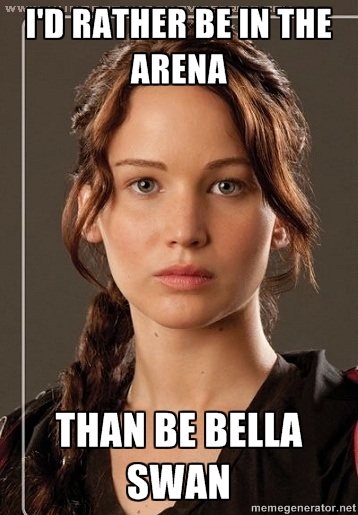
 

17247608

 
2. “Still a better love story than Twilight” memes: People illustrating their knowledge of the romance genre by juxtaposing the tag line against an image of something that either is or isn’t a good “love story”. Examples may be: a photo of a guys right hand, Tom Hanks and Wilson, the movie poster for dumb and dumber, a horse mounting someone etc. The most offensive memes of this category and ones that blend into type 3, implying that love story chosen for pictorial representation is invalid in some way. By choosing Broke Back Mountain as their example, this meme implies both that Twilight is a “worse” love story and that there is something repulsive about BrokeBack Mountain as well.
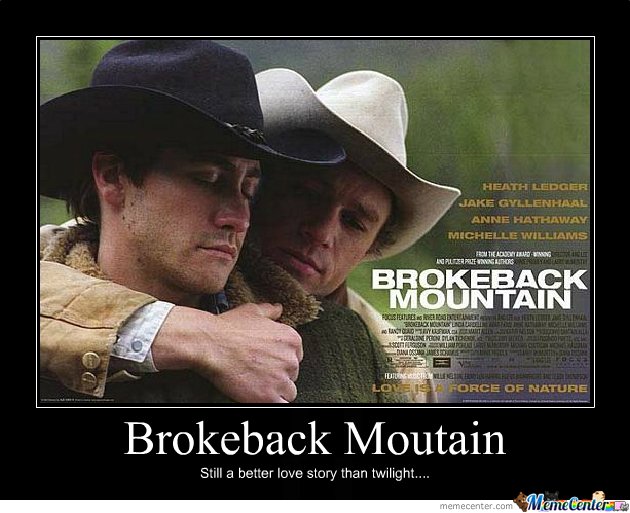
 

better-than-twilight_o_150921

 
3. One of the most offensives types is the “Still not as gay as Twilight” meme: If you stumble upon this cache of memes you may think this is a simple case of some ignorant person who doesn’t care about gay rights using the term “gay” as interchangeable with “bad”, but it is actually much worse than that. What is often happening in these memes is the creators are using images of people who are gay, or who are performing acts that could be interpreted as gay, and then adding on the tagline of “still not as gay as Twilight.” So what they mean is in fact, Twilight is bad, therefore gay is bad and in fact Twilight, somehow with it’s heterosexual love triangle is the “gayest,” and therefore the “worst.”
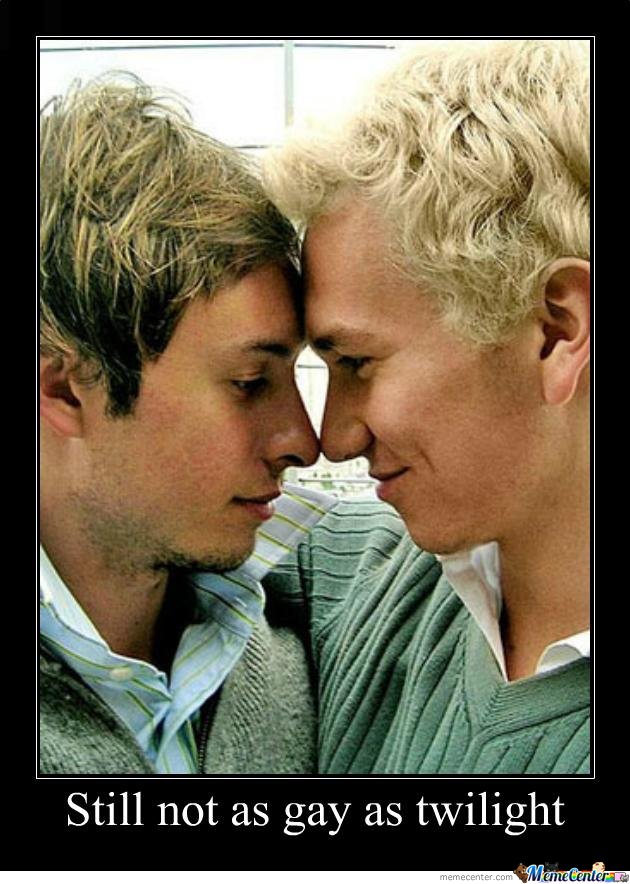
 

still-not-as-gay-as-twilight_o_95807

 
4. The last category of memes don’t have a unifying caption. They instead are memes that include a male figure who, either dumps, beats, or murders his girlfriend/wife/random woman when she mentions she has watched/read/enjoyed Twilight. A disturbing illustration of desire, hyperbolic or not, brings me to the point of this article.
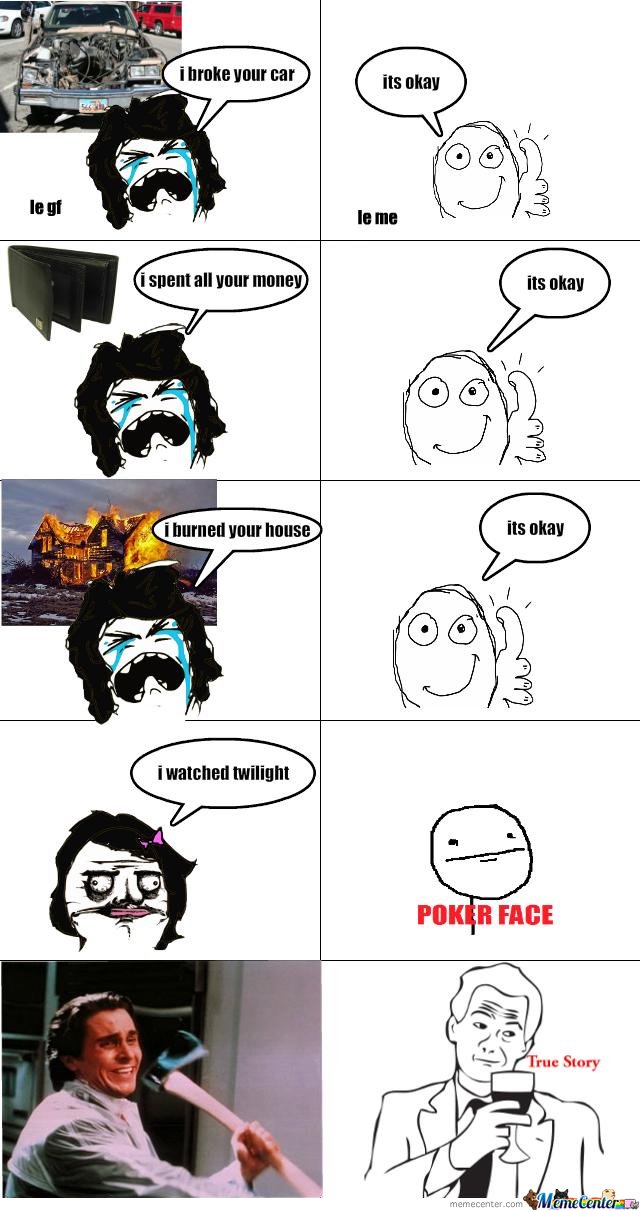
 

fuck-twilight_o_103297

 
These anti-Twilight memes and Twilight-hate culture on the whole have very little to do with Twilight, and a lot more to do with systemic sexism and rampant misogyny, and the whole mess could use a feminist perspective. I know, I just dropped the S, M and F bomb in one sentence but hear me out here: we live in a culture, that does not want women to embrace their sexuality, and it REALLY doesn’t want them to do it in a “geeky” way. The original phenomenon wrought by the Twilight books was simply a bunch of girls geeking out over a series of books subsequently turned into a successful film series. The story is no different than the phenomenon of, say, people geeking out over Harry Potter or Batman, and their inevitable film series. The only difference being, when it is women who are the distinct majority enjoying themselves, everyone else gets condescending, snarky, or even angry.

If you need proof of this prejudice existing in other fan cultures you can look at any examination of the fake geek girl problem that is supposedly plaguing society right now. For a notably recent example, take a look at the articles about the #1reasonwhy detailing why women are not welcomed in the gaming industry as creators or participants. It’s a long time coming, but it seems people are finally willing to call the lack of female presence in nerd subcultures out for what it is: sexism. Normally this sexism takes place in conversations about a women’s validity as a geek and therefore her exclusion from that culture. Conversely, this sexism in nerd subculture is much more difficult to name when it is directed at a grouping that is almost entirely female, where men may even feel excluded i.e.Twilight.

Let’s go back in time a bit to examine this further. Before the Twilight movies were released the books themselves were extremely popular among young adult (YA) and female readers. Most people at this point had likely never heard of Twilight. This was a time before Twilight was connected with its silver screen players Stewart, Pattinson, or Taylor Lautner, though word of the films’ production were widespread and the pop culture “aura” around it was entirely different. Twilight has been around since 2005 when the book made its debut and immense popularity. People read Twilight in the way they would have read any other YA series that was hot at the moment and visibly loved it, so Meyer continued to write more of the series. These books-turned-films remain popular because people enjoyed reading them. They read them, as I read them: as a consumer ignorant of the cultural impact the books would have, happily indulging in the fantasy/horror/romance narrative in the same way I would indulge in any other piece of pop fiction or television. Women were lining up outside of bookstores, cosplaying as vampires, speculating about the future of the series, which characters would live or die, and what team would win the battle for Bella’s heart. Utterly captivated by the world Meyer had built, these fans (predominantly women) were just geeking out.

Those on the inside of this culture, were also just enjoying reading, something that is unfortunately rare this day in age. For the most part at this point the Twilight culture was unknown and left alone, yet the first movie’s release signaled to the rest of contemporary pop culture that the series — and it’s fans — had successfully arrived. When outsiders looking in saw these large gatherings of Twilight fans outside of theaters, they were spectator to a group enjoyment that didn’t quite synch up, and met the source material with confusion, aggression, and hatred: a large group of females enjoying themselves. So they looked on them with the same hatred normally reserved for girls lining up for Justin Bieber concerts.

Twilight allowed for a entire movement of young women to revel in not only a fantasy world and fandom without fear of exclusion (like say worlds in comic and video game subcultures) and it also allowed them to revel in their sexuality, openly, by fantasizing about the imaginary Edward and Jacob. This reveling only became stronger when those fantasies saw a fleshed out actualization in the performances of Robert Patinson and Taylor Launter. Women everywhere had tiny intertextual nerdgasams upon the realization that Harry Potter’s Cedric Digory would be playing Edward Cullen.

Every action will have an equal and opposite reaction, so the groundswell enjoyment of the Twi-hards was abruptly stomped out by a larger cultural consensus that Twilight’s success indicated the end of times, or something equally as dramatic. This was partly the result of comic and sci-fi conventions being taken over by thousands of adoring fans looking to see whatever Twilight movie actor was there signing autographs. People were pissed off about the ways in which Twilight was somehow ruining their lives, so they started making memes about it.

For myself, the irony often lies in the memes that are confronting Twilight for being sexist itself.

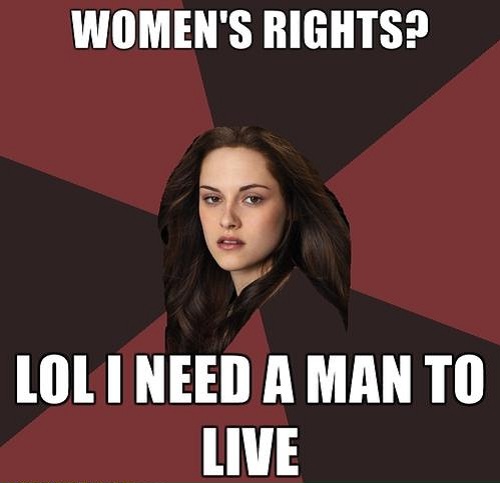
For example, one meme shows a photo of Kristen Stewart and reads, “Women’s rights? lol I need a man to live.” Disregarding the finer details of Bella’s character, her general independence, her lack of desire to get married, her refusal to obey Edward’s constant commands, and her place as the sexual aggressor in her relationship. In the novels, it becomes very clear to a reader that Bella, who is constantly kissed and caressed but never fully satisfied, is motivated to become a vampire in part because of her veritable dripping anticipation to finally get her freak on. It is easy to read these books as a story about a girl who is so horny over the fact that the sexiest man alive wants to be with her for some reason, that she will literarily give her own life to have sex with him. She doesn’t need a man to live, she wants to fuck a man, she wants to marry him, she wants to conquer him, and she wants to become immortal, all within her rights as a woman. The long-awaited build up to any actual sex over the course of the series has, hilariously enough, garnered the series the monicker “abstinence porn,” offering an enjoyment that is arguably more exciting than if the characters were just having sex all along.
 

twilight-musical-1

 
The majority of cultural examinations of Twilight seem to be a reaction that simplifies the novels and films by considering them “not feminist enough” to be consumed by supposedly naive young girls. Plenty has been said of the ways in which Twilight is not as feminist as, say, The Hunger Games or Buffy, both of which were pop culture sensations of a similar nature as Twilight that didn’t attract any of the mass hatred possibly, I would argue, because of the gender diversity in the fan base. Memes often frame Bella as a bad female role model, privileging female identification with characters like Buffy as a more positive alternative. You can read more about this here.

The irony I would cite in this beyond what has already been said about this type of meme, is that comparing Buffy and Bella makes very little sense considering that they are constructed for different purposes. Buffy is kind of like Superman: she has this gift, all these powers, she has super strength and a destiny to save the world. This kind of identification is usually a “look up to” connection as opposed to a “I feel so similar to” connection that readers may have with Bella. Bella essentially functions in the same way as a Peter Parker. He is a plain and boring studious type before he is bitten by a spider and granted his powers. Just a normal everyday guy who is granted superpowers. Fans have identified with Bella in the same way. There is a twofold desire that encompasses not only the sexual desire for Edward and Jacob but also the desire for superpowers, to become something, or someone more. Comparing Bella to Buffy to make a point about the degree to which Buffy and her readership are more feminist, virtuous and empowered is akin to a meme juxtaposing Superman and Spiderman and claiming that those who identified with Spiderman are inherently “lesser” men. I suspect that this specific type of meme, comparing female characters is likely often actually created by women attempting to make a point about empowering our gender, but the inadvertent effect involves a backwards girl hate.

Sometimes women do not fit our definition of what female “strength” should look like (especially when that strength often involves merely repurposing a traditionally masculine rhetoric of strength), but that does not make them weak. We see a similar problem in the mass treatment of Kristen Stewart by both fans and anti-fans of Twilight. It became trendy to critique her for the plainness that was so integral to her character in the novels. The cultural opinion surrounding Bella in the narrative is only compounded by the hatred and slut-shaming directed at Stewart in real life, citing her personal affairs, and using a completely unrelated element to admonish the storyline. The open, widespread condemnation the women in these narratives weak, or anti-feminist, or masochist, or submissive signifies to women who identify so strongly with these characters that the same must be true about themselves. Why can’t we look at these issues of female empowerment as a complex system of women who are still having difficulty coming to terms with their roles in their relationships, instead of simply pushing these women out of the feminist “us” camp and into the “them” camp where they will be considered lesser women.

The Twilight-hate culture is fueled from two sides. One side is the meme culture that I have been citing and the second is typified by articles such as this) which have decided to examine the series as an anti-feminist archetype, and seem to only be able to see the narrative through that lens. Instead of examining the way a narrative such as this is empowering for female sexuality, or examining the ways that these female fan communities allow women to express their sexual desires in a way they are not allowed to in day to day life, the anti-Twilight camp focuses entirely on Edward and Bella’s relationship. It simplifies the narrative into a tale of emotional abuse in which Bella is nothing more than a passive onlooker in her own life. Instead of examining Rosalie’s (One of Edward’s sisters) revenge fantasy in which she, as a vampire, goes back and kills a group of men who gang raped her as a human they focus on Edward “wanting to kill” Bella. Instead of examining Jasper’s description of his previous abusive relationship and how he overcame that, critics want to depict Edward as abuser. Instead of examining the ways that Bella outsmarts her supernatural enemies, detractors focus on the ways in which Edward physically saves her. Instead of examining the ways that a new depiction of feminism may be emerging in popular culture many are deeming Twilight as the death of feminism, or as one article put it “The Franchise That Ate Feminism.

I am not trying to argue for extreme literary complexity in any of these works. What I am arguing for is extreme cultural complexity. The simplistic nature you may see in these characters does not mean that our analysis of the series, and therefore its resulting fan culture, should be just as simplistic. Feminism is not dead, this is something I can guarantee you. For years I have been hearing claims that Bridget Jones, or Sex in the City, or Jersey Shore, or a variety of things were to be “the death of feminism.” Saying that Twilight’s anti-feminist nature will confuse our world’s young girls into abusive relationships or unwilling submission is in my opinion a regressive, sexist notion itself. It is implying that the women reading this narrative or any other cannot reason or deduce for themselves the degree to which they identify with any given fiction, nor ideal of sexuality. If young girls want to read Twilight, if they choose to read Twilight, if they choose to enjoy Twilight… and you tell them not to because it’s “wrong”, or you tell them that their enjoyment reflects their own weak intellect — well, that doesn’t bode well for feminism to me.

On this note Meyer herself says:

In my own opinion (key word), the foundation of feminism is this: being able to choose. The core of anti-feminism is, conversely, telling a woman she can’t do something solely because she’s a woman—taking any choice away from her specifically because of her gender… One of the weird things about modern feminism is that some feminists seem to be putting their own limits on women’s choices. That feels backward to me. It’s as if you can’t choose a family on your own terms and still be considered a strong woman. How is that empowering? Are there rules about if, when, and how we love or marry and if, when, and how we have kids? Are there jobs we can and can’t have in order to be a “real” feminist? To me, those limitations seem anti-feminist in basic principle.

Admittedly this isn’t the precise way I would define feminism, but I think what Meyer is saying here is very important. The key being that you don’t tell a “woman she can’t do something solely because she is a women” by placing acceptable “limits on women’s choices.” We need to allow girls and women to choose what they want to enjoy, and we also need to learn not to taint that enjoyment because we feel that women enjoying themselves threatens some higher, reserved ideal of feminism. If there is one thing that I am sure could be the death of feminism: it is us telling young girls that they are not feminists.

I think Twilight is one of the best things to happen to young female sexuality in the same way that I think that Fifty Shades of Grey is one of the best things to happen to adult female sexuality. We live in a culture that is overwhelmingly sex negative, particularly for women. If the only porn that women will consume is “abstinence porn” and its fan fiction, that is okay with me. Who CARES whether or not the writing in these novels meets some arbitrary level of lexical intricacy or allegorical nuance? Young adults are reading, and they’re privy to a literary artifact which offers a safe, enjoyable exploration of their perfectly natural sexual impulses. No one examines male pornography and critiques it for the quality of its “love story” or sentence structure; in the same light women should be able to indulge in media that is just as permissibly “bad.” I am just so so so happy that women are looking their sexual desires in the face and confronting it as a regular component of their lives in society. Bella and Anna are not the categorically defined “kick ass” females that we have BEEN TOLD are good role models. But if they are characters who plenty of women identify with on a mass scale, then we ought not to focus on the lack of empowerment as defined by their contemporaries, and instead recognize that women of our society identify SO strongly with these female characters regardless. Not because every woman who reads Twilight or 50 Shades is a submissive antifeminist who simply wants to be told what to do, but because women are starving for the type of sexual fantasy that men are allowed to indulge in guilt free everyday. What we can glean from this, also, is that the definitions of female empowerment should not be so static or rigidly defined because dominant character aspects in any one popular text. Female empowerment is not measured by a ratio of aggression, independence, intelligence, or even sexuality, or the mere sum of these parts; rather, the empowered feminist-positive ideal is a comprehensive whole built of of these aspects, but with varying degrees as our role models slip and segue through different contextual representations: Buffy and Bella are every bit as ideal because they are constructed so differently for their own respective universe.

Lev Grossman put it much better than I ever could way back in 2008 when he said:

What makes Meyer’s books so distinctive is that they’re about the erotics of abstinence. Their tension comes from prolonged, superhuman acts of self-restraint. There’s a scene midway through Twilight in which, for the first time, Edward leans in close and sniffs the aroma of Bella’s exposed neck. ‘Just because I’m resisting the wine doesn’t mean I can’t appreciate the bouquet,’ he says. ‘You have a very floral smell, like lavender … or freesia.’ He barely touches her, but there’s more sex in that one paragraph than in all the snogging in Harry Potter. It’s never quite clear whether Edward wants to sleep with Bella or rip her throat out or both, but he wants something, and he wants it bad, and you feel it all the more because he never gets it. That’s the power of the Twilight books: they’re squeaky, geeky clean on the surface, but right below it, they are absolutely, deliciously filthy.

Will we ever be able to return to a state of mind where we see our daughters reading Twilight the same way we would see our daughters reading superhero comics? Will it ever again appear to people as “squeaky geeky clean”?

Let me get one last thing straight: I fucking love memes. I think a well crafted meme is like a work of poetry, when the subtext is strong and the juxtaposition is subtle and surprising. A good meme and the laugh that accompanies it is revitalizing, like a good cup of coffee. But for every well constructed meme there are about 10,000 shitty memes. I would say that all of these memes above are not popular, not “sticky” as Malcolm Gladwell would put it, because of their content being smart or well assembled. They are instead pushed forward and propelled through cyberspace by hatred for a subculture of women. I say, instead of creating and sharing these hate fueled memes about whatever is the current pop culture thing you don’t understand, you instead spend more time creating memes about things you do like: poking fun at the intricacies of your favorite books, TV shows and films that you get, and think harder before laying down an easy critique of cultures you aren’t involved in.
__________________

Emma Vossen is a comics and sexuality scholar currently completing her PhD at the University of Waterloo. Her poetry is published in the upcoming Masked Mosaic anthology of fiction about Canadian comics. When she has time she writes about sex, feminism and comics at www.getsomeactioncomics.com

Discovering (and Subsequently Abandoning) Your Inner Butt

(Note: Please excuse the regrettable patched scans)

As someone who has worked on adventurous gritty lo-fi publications that are both free and priced, my experience is that, after some period of time of unsold boxes sitting around in your basement, the priced publications will become free. Which is why the recent revival of Chicago’s free Lumpen magazine is both an exciting development and an astute choice, and why a full-color comics issue is even more astutely exciting. The recent local success of collective celebrations of sequential creativity like Trubble Club and Brain Frame, and free-comics forebears Skeleton News and The Land Line, make it a great time for a newspaper and an art show glorifying the bipolar neurotic introspective banality and frantic psychedelic randomness of the underground aesthetic.

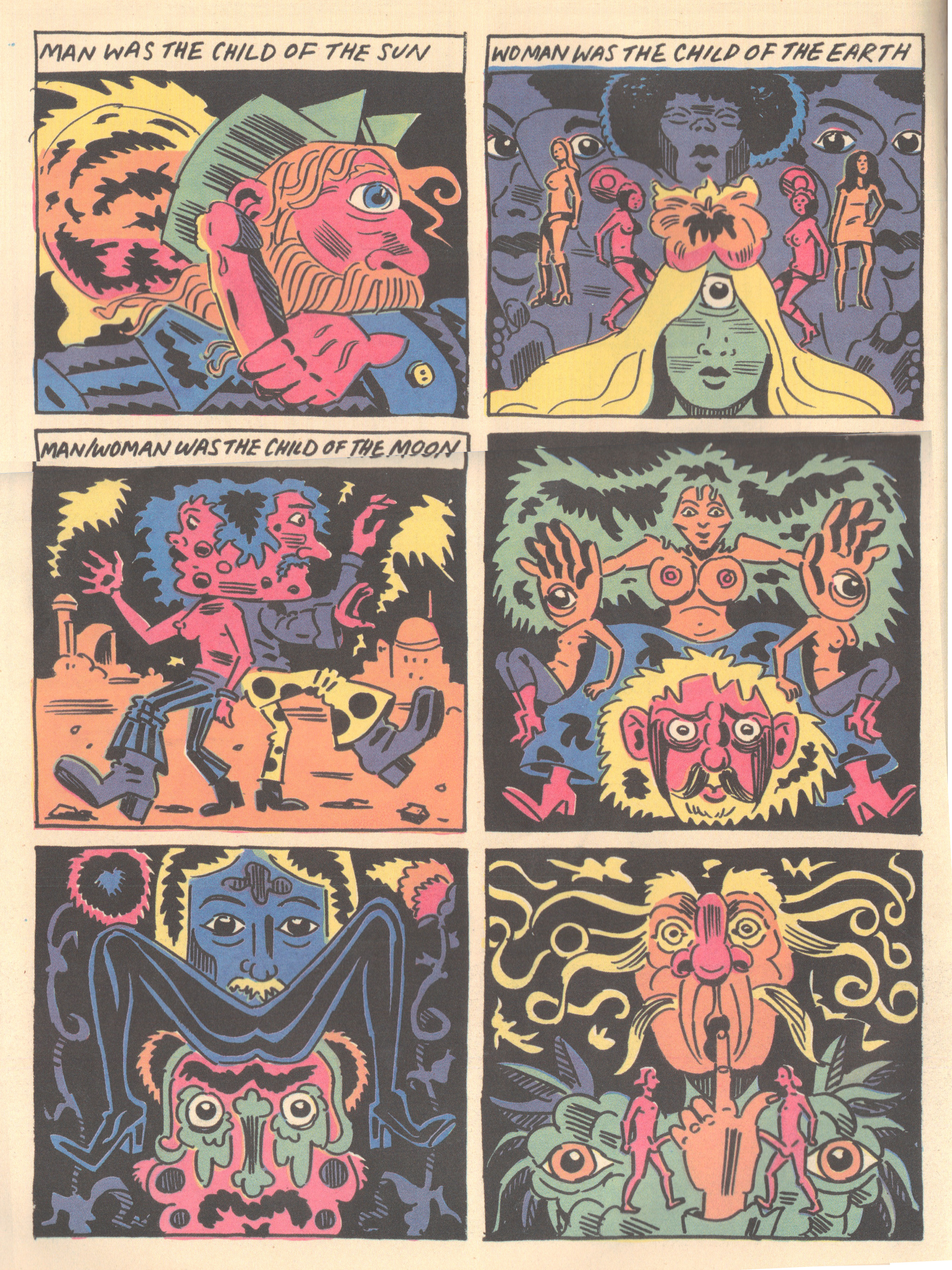
My preference, without question, is for the trippy-manic end of the spectrum, which is well-represented in this issue and exhibition. The perverse results of combining images with narratives (not that it’s a new thing) results in confusingly coded explosions of energy, from the Choju-Giga Scrolls to Little Nemo to Superman to Jack Kirby. Speaking of whom, Anya Davidson manages to carve out a unique niche in the collection with a page of vivid, klunky yonic-symmetrical panels of gendered monstrosity that borrow from equal parts Kirby and Gary Panter. While opting for a more spare and bold design sensibility than either of those two, Davidson’s simple meditation on difference is lent some creepy weight by the smudgy nonspecificity of a bygone comics era.
 

davidson
Anya Davidson

 
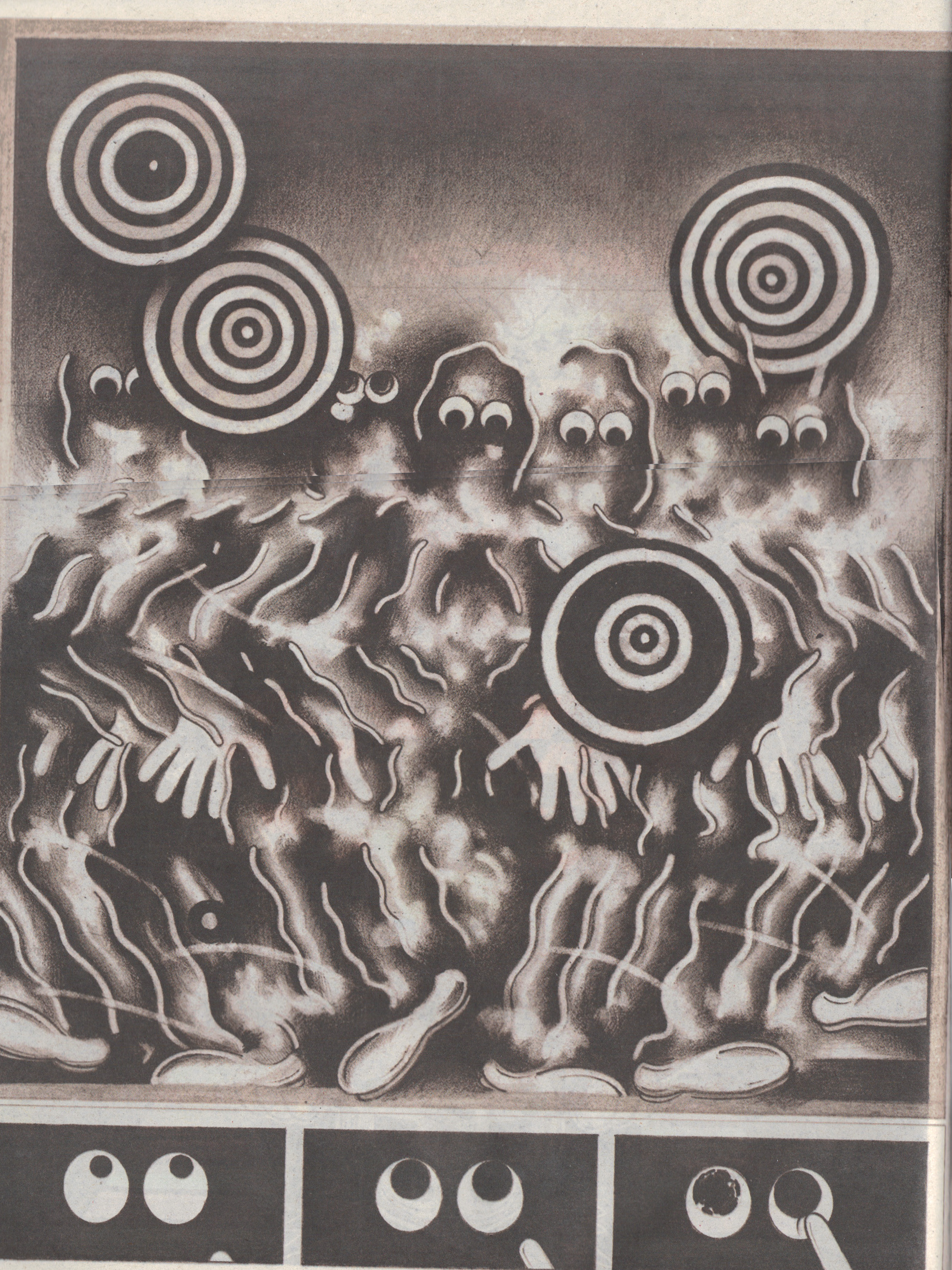
Along with Marian Runk’s and Keith Herzik’s dazzling contributions, the least narrative work in the collection might be Ryan Travis Christian’s hallucinogenic splash-page monochrome miasma of ghosts and pinwheels, supplemented by three panels of lysergically widening pupils being approached by a finger. The piece, like much of Christian’s work, reads like a disorganized scrapbook of Dumbo’s alcoholic nightmare, if it were a syncopated tale of undead minstrel vengeance conceived by Max Fleischer, director of the early shape-shifting Popeye and Betty Boop cartoons.
 

christian
Ryan Travis Christian

 
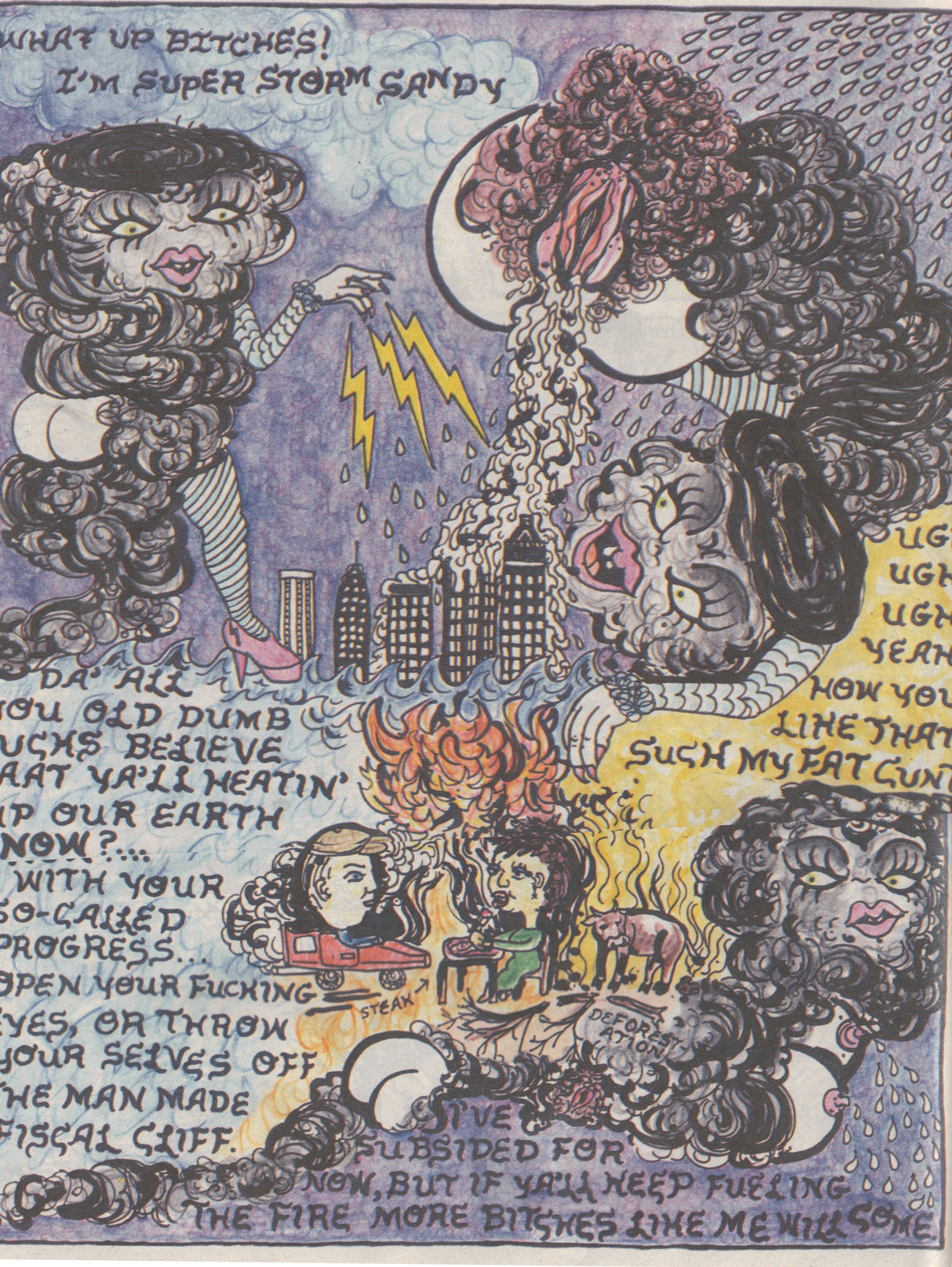
The polemic standout of the show was Coughs’ co-founder Carrie Vinarsky’s tribute to Super Storm Sandy, a scribbly stripper-cyclone hurling obscenities simultaneously at her human victims and progenitors like Lindsay Lohan on a bender and armed with crayons, while her giant vagina rains down mayhem on hapless Manhattan.

vinarsky
Carrie Vinarsky

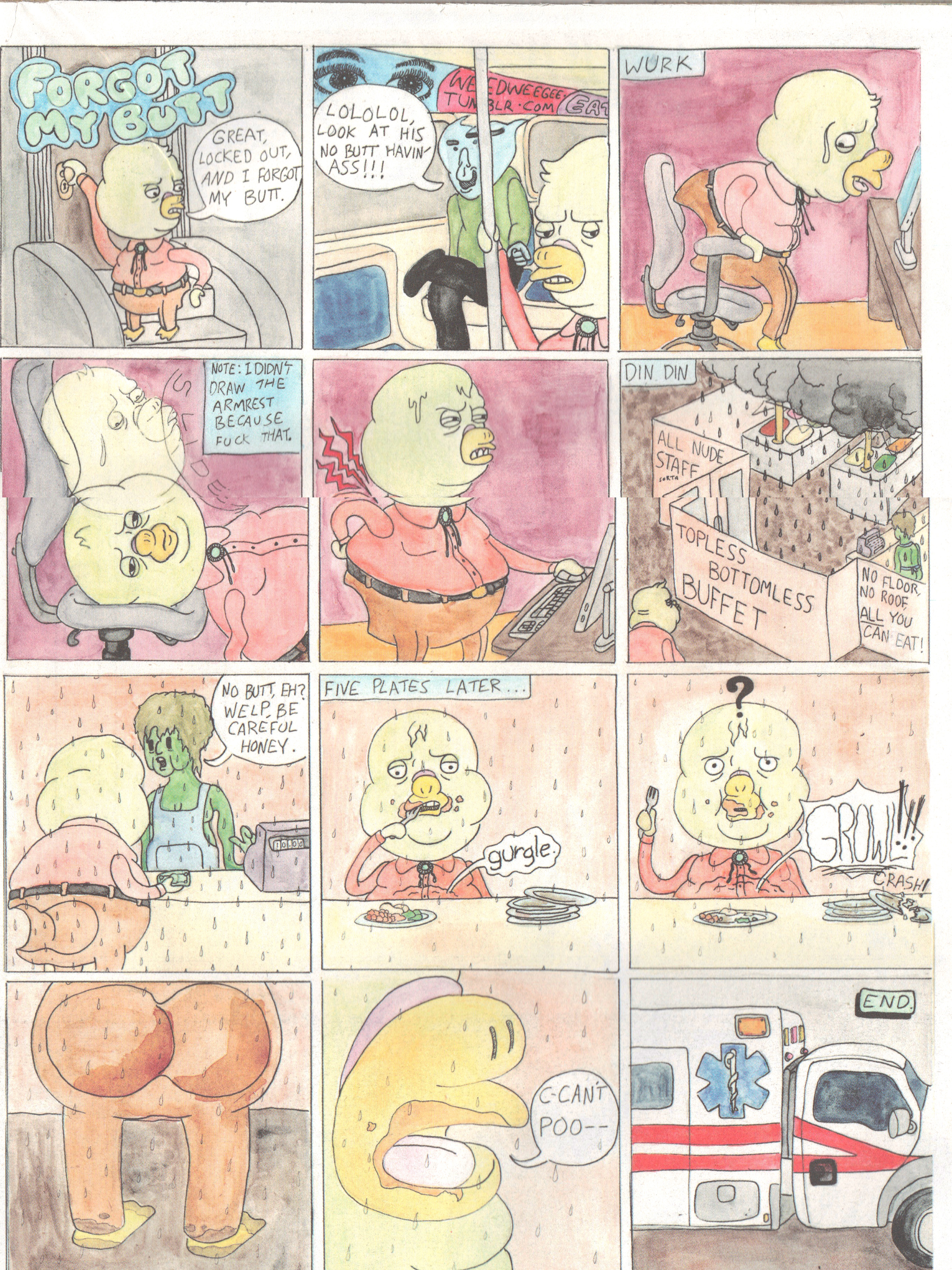
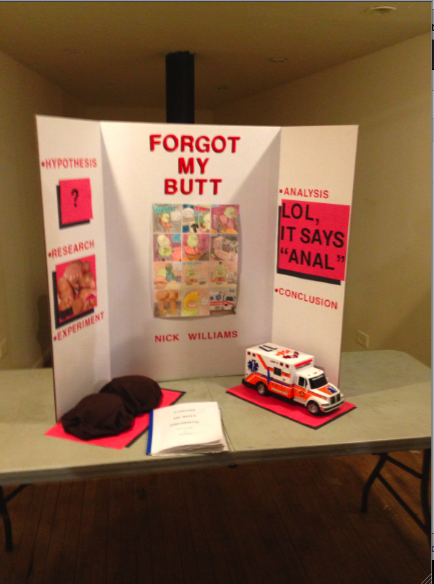
But perhaps the most memorable comic is, ironically, an ode to forgetting. In particular, to forgetting one’s own butt. Not satisfied with merely creating a poignant pastel vignette on the trauma of bottomlessness, Nick Williams also put together an incredible little half-assed (as ‘twere) science-fair display for the exhibition on the rigorous process of controlled testing that led to the groundbreaking butt-forgetting result. Sort of a Paper Rad knockoff of a Vonnegut ripoff of Kafka, this delightful fable implicitly mocks any appreciation of its genius. Which is quite refreshing, given underground comics’ knee-jerk reference for faux-Beckett-esque existential wankery.

williams
Nick Williams

In all, all free publications, but in particular this free publication, provide one of the few tangible artifacts of a time of universal and ubiquitous dissolution of aesthetic hierarchies (or even preferences), and the Lumpen comics issue is also an entertaining and visually appealing recyclable echo of coffee-table compendia a la Kramer’s Ergot. The future of analog picture-making techniques and physical formats are, I hope, not tied to the nostalgic conservatism of literary authenticity fetishism, but moving more and more into nonsensical eye candy and anti-poetic spouting. These are what images do best.

Picture 1

Voices From the Archive: Matt Thorn on Jack Kirby

Translator and manga scholar Matt Thorn replied to some of my thoughts on Jack Kirby a while back. I thought I’d reprint his comments here (I’ve added some markers just to make it clear who’s speaking.

[Noah:] He [Jack Kirby] draws awesome monsters, though. Which is no small thing, and which I really appreciate about him.

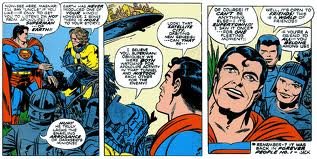
Matt Thorn:What you said. Kirby was much, much better (IMHO) at drawing the ugly and grotesque than at drawing the beautiful, which is probably why D.C. took the embarrassing step of having someone re-draw Kirby’s Superman. I prefer Kirby’s take, but the whole thing about Superman is that he’s all shiny and handsome and sparkly, right? Kirby’s Superman looks like a college wrestler with a chip on his shoulder. Which is very cool, but, yeah, not the image of Superman D.C. wants to convey (then or now). The Thing is probably the character that is most iconically Kirby in my mind. Grotesque, and yet sympathetic, and somehow just very cool, in a very anti-Superman kind of way.

[Noah:] Haney’s not subtle, and the quality varies obviously. But he’s way more attuned to a world outside his skull than Kirby is.

[Matt Thorn:] Noah, I think you nailed it there. Kirby seems unable to successfully step outside of the world inside his own skull. His half-hearted attempt to write “groovy slang” illustrates that he didn’t know much about or really care much about the world outside his skull, at least not after WWII. And that is of course fine. As others have noted above, many great artists are enormously successful at being what I controversially characterized as “self-indulgent,” and what Mike more generously characterized as doing work that is “personally meaningful to them.” Whether you see it as a feature or a bug, I think it’s fair to say that Kirby’s worlds are more or less self-contained, and while they may speak to “the human condition” at large, he was never one whose work really reflected the world outside his door.

Which, AGAIN, is PERFECTLY OKAY.


images-1

You’re No Lightnin’ Hopkins

This first ran on Splice Today.
____________

Years ago, when I was thoroughly obsessed with country, I was chatting with a similarly besmitten friend about the music’s roots. “Thank god for the blues,” he said. “If country had stayed just Irish music, I wouldn’t be able to stand the stuff.”

I think my friend probably spoke for a lot of roots music enthusiasts there. Not that Irish music is especially loathed. It’s more just ignored, or at most nodded to. Blues is earthy and driven and has, moreover, become so embedded in jazz and rock and R &B that is seems like it, all by itself, is the cornerstone of American music.

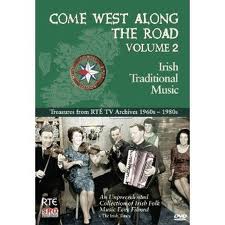
Irish music, on the other hand is just…not cool. You can see just how uncool in Come West Along the Road Volume 2, a DVD collection of traditional music performances taken from RTE, the Irish national broadcasting corporation. Taken mostly from the 60s, 70s, and 80s, most of the songs appear to have been videotaped directly from a wide variety of church basements…but that’s public television for you. Even public television can’t account for the McCaffrey Dancers exhibition dance from 1965, though. Put aside that they appear to be in a church basement. Put aside that the steady “plink/plink” of the piano is rivaled in dowdiness only by the dance itself, which consists of 12 well-scrubbed adolescents holding their bodies rigid while skipping here and there and here and there like neutered candy stripers. Put aside all that. And when you have done so, consider that the girls spend much time coyly holding hands with the girls and the boys coyly holding hands with the boys. Oh, yes, and the boys are wearing dresses. You just wouldn’t catch Howlin’ Wolf doing that, you know?

Irish music is, by most measures, and without too much argument, more fey than Howlin’ Wolf. Of course, most things are more fey than Howlin’ Wolf, but of those fey things that are feyer than Howlin’ Wolf, few are as thoroughly fey as Irish music. And when it’s not fey, it’s got a frightening glee club wholesomeness. Bobby and Peggy Clancy in a 1965 version of “Mrs. McGrath,” for example, seem like they’ve walked out of some remorseless folk-music parody, what with Bobby’s foot perched on a stoop, his aggressive collar sticking crisply from his modest sweater, and Peggy’s earnest toothiness. “A ring-dung-dah!” they sing with lilting, lobotomized cheer, “Oh Ted McGraw, were you drunk or blind/ when you left your two fine legs behind?”

There’s a tendency, or perhaps a temptation, to look at the feyness and the blank wholesomeness and chalk it all up (as it were) to whiteness. If the blues comes out of the black experience of suffering, then this music comes out of the white experience of never feeling much of anything; just chattering on obliviously through life worrying about whether the pants are pressed or whether those darn collars sticking out of the sweater right.

Except…well, in the first place, the Irish aren’t white. They became white when they came to the U.S., but back home they’re not conquering Europeans; they’re the people the Europeans conquered. Sweepstakes in suffering are always kind of pointless, and lord knows there are enough brutalized minorities in every part of the earth to go round, but as histories of bitter oppression go, the Irish’s is surely as impressive as anyone’s.

So when I watch this DVD, I’m essentially blinded by my own whiteness. What I see is people participating in the ridiculous denatured spectacle of soullessness; the bland feyness of not having any roots. That’s what ethnic Americans (such as my Jewish self) get in exchange for skin privilege; it’s the price of the ticket, as James Baldwin says. You give up your klezmer soul and you get to be a white American with all the benefits, such as they are.

But the musicians here haven’t done that. The authenticity markers are all wrong from my perspective, but that’s just because my perspective is screwed up. In most ways that matter, the music here is in fact quite close to blues. It’s a music that comes out of a community identity, forging joy out of hardship. “Oh Ted McGraw, were you drunk or blind/ when you left your two fine legs behind?” Ted’s Mom isn’t heartless. She’s just had bad luck before and is tough enough to take it with a smile.

Despite the relatively low profile of Irish music, white Americans have always fetishized oppressed white people, from Riverdance to Schindler’s List— that fetishization consisting precisely in pretending that said oppressed white people are, in fact, white like us. Maybe some similar self-delusion is why I’m so taken with this DVD…or maybe it’s just the music itself. Unlike my friend, I’ve never been super into blues, but Irish music really sends me. The wailing drone, repeated and repeated with slight variations — it’s just some of the most lovely music on earth.

On this disc, I think my favorite tune may be a short Irish song, Casadh Cam na Feadarnai, performed by Triona Ni Dhomhnaill on keyboards and vocal and Liam Rowsome on fiddle. There’s certainly a melody, but all the instruments — the fiddle, the electric piano, even the Gaelic syllables — seem more focused on percussion, the rhythms running around and over each other. The notation says it’s a song about a hag, and it does sound old and evil, a song to throw kids into pots by.

Or maybe the highlight is Martin Reidy’s unaccompanied version of “The Gal I Left Behind Me.” Reidy looks about 110. His ears are set so far back on his head they look ready to fall off, and he appears to have lost all his teeth. Every time he takes a breath his lips comes together with a wet pop. He sings sitting in what looks like (you guessed it) a church basement, on a bench, with two women beside him…one of whom, alternately perplexed and proud, may well be his granddaughter.

If so, she’s got every right to be proud; he gives a sterling ballad performance, his quaver adding poignancy to the high lonesome keening. That high lonesome is a sound I adore in American music too; it’s been passed on to singers like Almeda Riddle, Sara Carter, Kitty Wells, Emmylou Harris and (rather to my sorrow) Alison Krauss. Bob Dylan picked it up too, and Neil Young and that good British folkie Rober Plant and through him Axel Rose. It’s the music I grew up with, like blues, even if, like blues, it’s not my music really. But then maybe in another sense any music you love is yours.
 

images

Heart of Thomas, Heart of Tedium

[Those looking for background details and a synopsis of The Heart of Thomas can do no better than to read Jason Thompson’s review.]

Heart of Thomas_0001

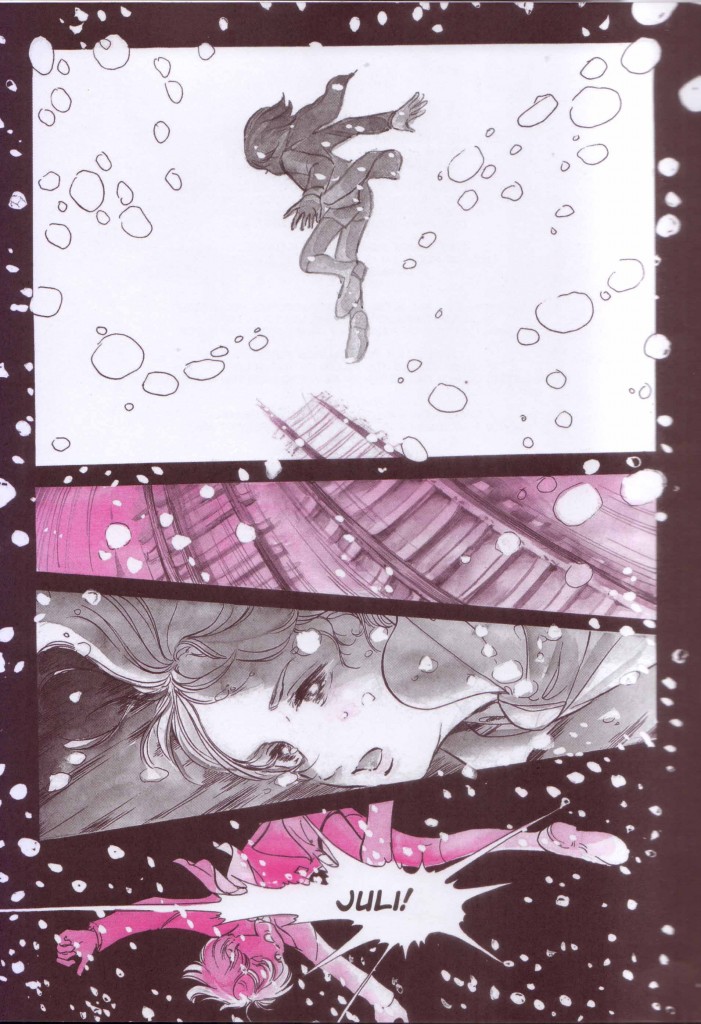
In the opening pages of The Heart of Thomas, the eponymous object of desire and remembrance, Thomas Werner, leaps from a railway bridge to his death.

But who is he? This intangible ghost of doomed naivete crushed by the morass of faithlessness and abandon which has inundated the boarding school which he attends. Perhaps, a metaphor for innocence lost, reborn in the form of his more resilient lookalike, Erich Fruhling—a boy who soon becomes an indelible memory of that life carelessly thrown away; a soul on the path of transmigration in an alien and barbaric Christian world of torment.

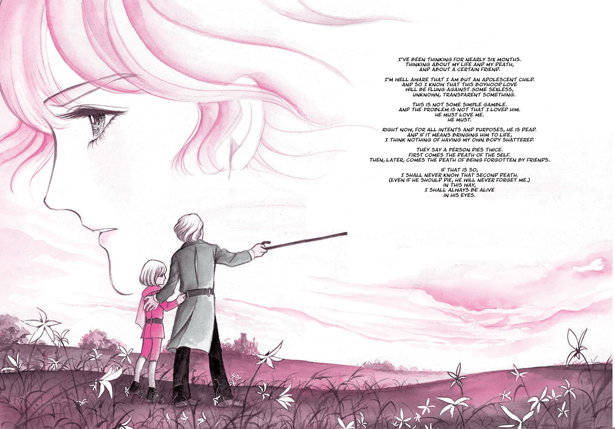
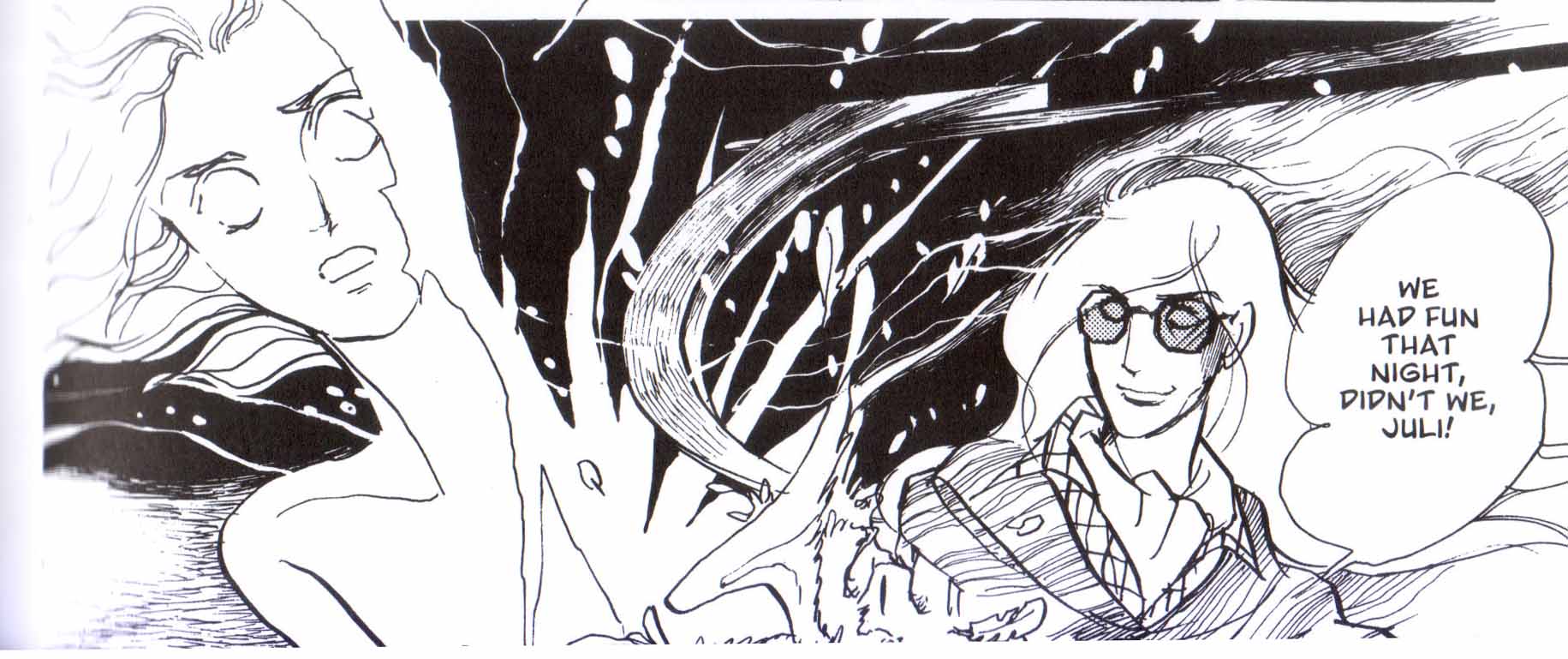
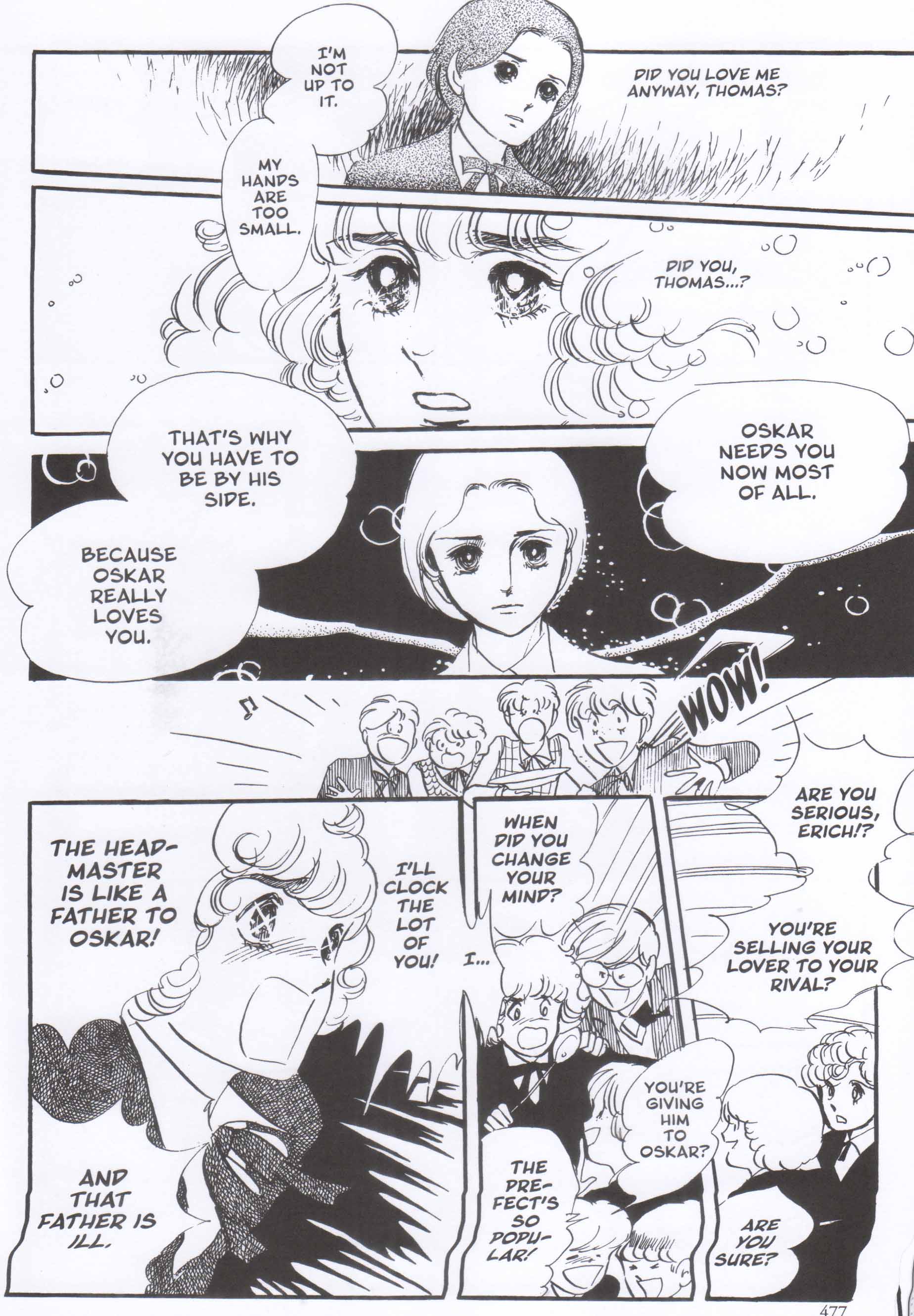
Of course, Thomas’ body isn’t subjected to any tragic or tangible mangling despite the suggestion that “his face was crushed.” Death in Hagio’s world is as chaste as the heated embraces and kisses which reach a crescendo towards the closing chapters of the manga. Even Goethe’s Werther (no first name, similar last name) had the presence of mind to die slowly and painfully 12 hours after shooting himself in the head. Mortality is nothing more than a stylized leap into an endless stream of romantic possibilities in Hagio’s manga. Thomas’ suicide is performed out of love for a senior student by the name of Juli, a distant and correct individual who like all suffering, misunderstood heroes, conceals hidden depths of anguish. The appearance of Thomas’ lookalike, Erich, quite early in the tale—strolling past Thomas’ grave as it were—presents Juli and his classmates with a second chance. He is nothing less than an angelic being. Even the school master seems enraptured by this unspoilt youth—like Hadrian lusting after Antinous. One might almost call it a process of deification. And as with his historical counterpart, Erich is subject to both adoration and recriminations. As Hagio asserts at the start of her story:

“They say a person dies twice. First comes the death of the self. Then, later, comes the death of being forgotten by friends. If that is so, I shall never know that second death. (Even if he should die, he will never forget me.) In this way, I shall always be alive in his eyes.”

Heart of Thomas_0007

These lines define the authoress’ purpose. The Heart of Thomas rests on a physical manifestation of this remembrance, as florid as a grief stricken emperor’s commerorations of his lover—as if memory had the power to evoke a second incarnation or avatar. Still others might see everything which follows Thomas’suicide as the fantasy of a collapsed mind, the tangled memories and imaginings of a dying brain hoping for a happy corrective to a tragically short life. Certainly, that Germany of the mid-twentieth century imagined by Hagio has no anchor in on our reality. It is an alien planet both to the Japanese and European reader alike—a dream which has no interest in the tradition of Mann, Grass, and Boll but rather adheres to the hysterical breathing, coincidence, and fainting spells of wish fulfillment and hallucination. If these young male students had breasts, they would be ripping their bodices from their angular bodies

In one early episode, Juli suffers one of his recurrent fainting spells, a neurotic turn resulting from an earlier psychological trauma. It is perhaps the only time you will see an individual getting mouth to mouth resuscitation while he is having a “fit”. The fraudulence of this medical act suggest it’s placement—if it isn’t clear already—for erotic effect. The penis is verboten but a number of alternatives are grasped with both hands. A teacher’s attempt to stroke Erich with his cane is nothing less than a metaphor for the sexual tensions within the school. When the reigning queens of that exclusive institution arrange to converse with and touch Erich at a tawdry but chaste tea session, he barely manages to fend off their ministrations. This high tea of the mildly depraved is a kind of half-baked, elementary school version of the Hellfire Club where “Do what thou wilt” shall be the whole of the law.

Heart of Thomas_0003

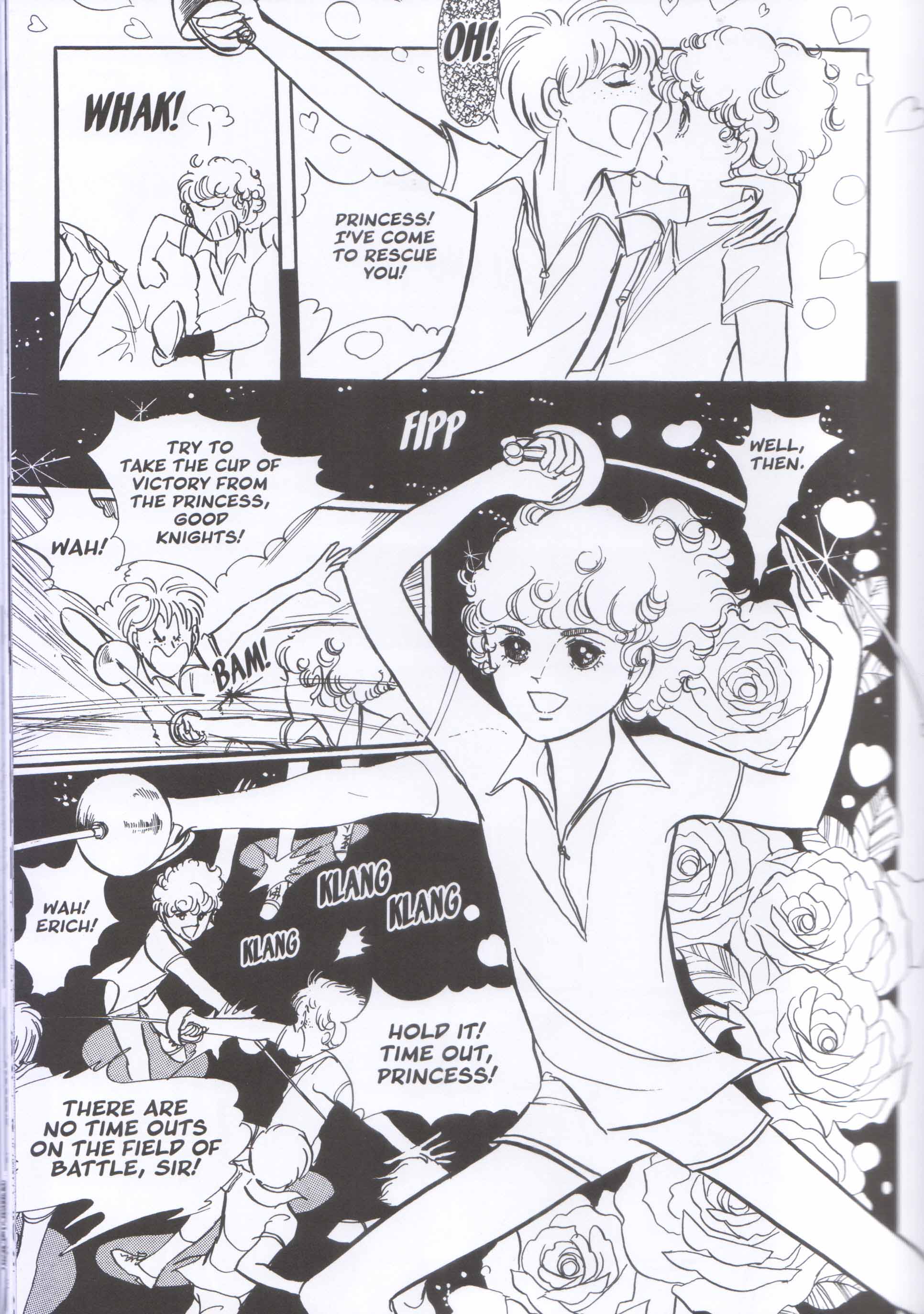
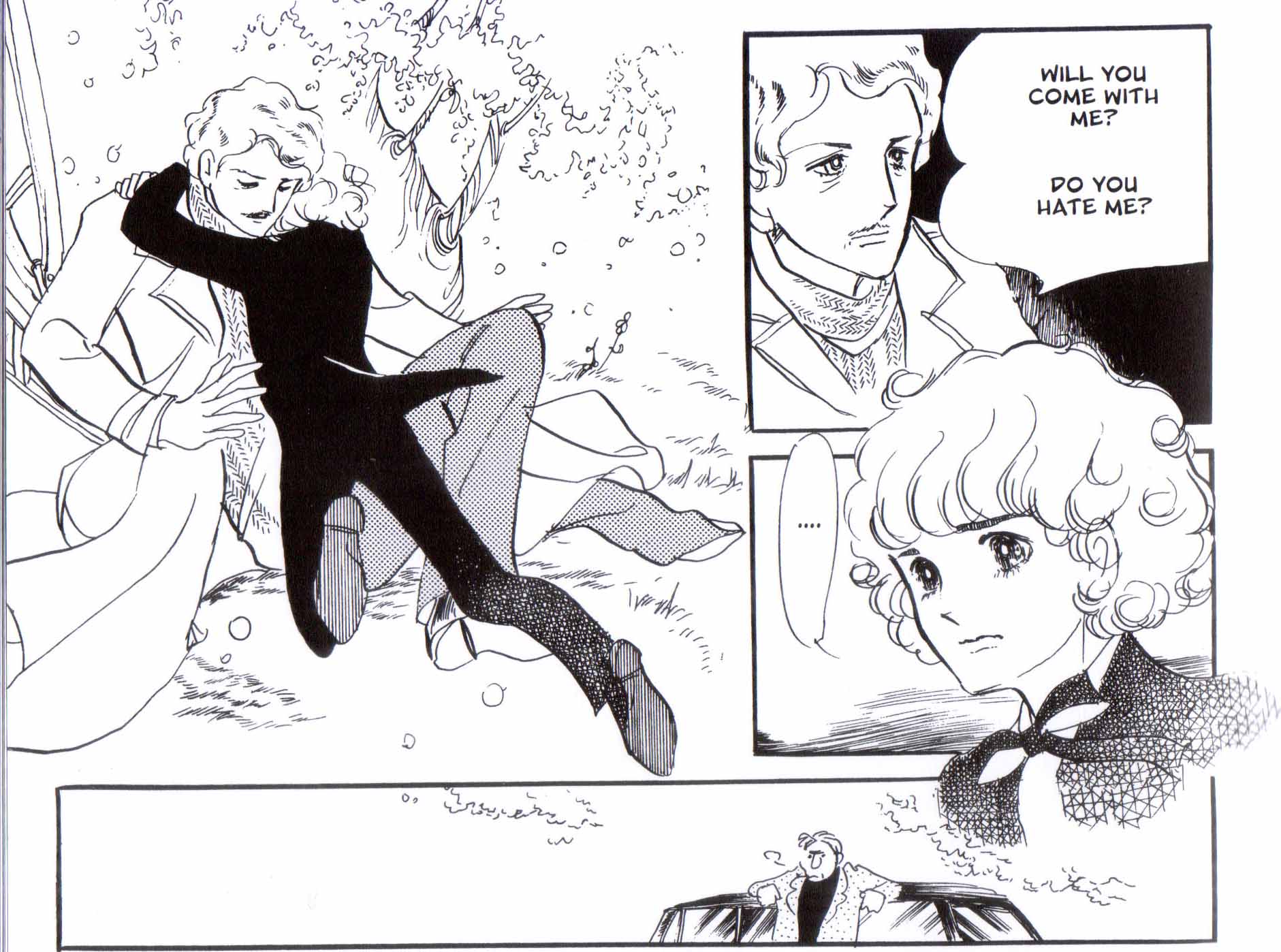
There is the pesudo-coitus—between Juli and Erich—of grasping with sharp objects: first in the fencing room and then, somewhat less subtly, in the bedroom with a pair of scissors. Later, Erich recounts a tale where he indulges in the predominantly male practice of autoerotic asphyxiation. These recurrent acts of strangulation are brought on by the sight of his mother kissing her lover—his mental torment (and patent mommy issues) relieved only by the death of his mother and a profession of fatherly love by his mother’s lover.

Heart of Thomas_0004

This incessant intermingling of pain, death, and love is Hagio’s idée fixe; and the purity of male love the panacea for all depicted ailments. The only exception to this gloss on idealized homosexuality (a fanciful and hopeful template for a paradigmatic relationship between the sexes) is Juli’s physical and likely sexual abuse at the hands of another student named, Siegfried—that swaggering, heroic betrayer of  Wagner’s Ring cycle here seen as lascivious, preening monster with an appetite for sadism and young boys.

Heart of Thomas_0005

Erich’s allusion to a meeting between Beethoven and Goethe suggests the essence of the relationship at the center of Hagio’s manga. Here is an excerpt from a Gramophone article concerning Goethe’s feelings after that fateful meeting:

“Shortly afterwards Goethe penned a more qualified verdict to his musical guru Carl Zelter: ‘His [Beethoven’s] talent astounded me; nevertheless, he unfortunately has an utterly untamed personality, not completely wrong in thinking the world detestable, but hardly making it more pleasant for himself or others by his attitude.’”

Erich is of course Beethoven in our boarding school equation. Juli’s rejection of his “untamed” sensuality—forged and broken through terror by Siegfried—is the root of all his troubles. When Juli tells Erich, “I am going to kill you,” it is not merely a prediction based upon his earlier role in the death of Thomas Werner but a sign of Juli’s repressed sexuality—a disease which manifests itself in the weird science of mild attacks of “anemia” which have no basis in medicine.

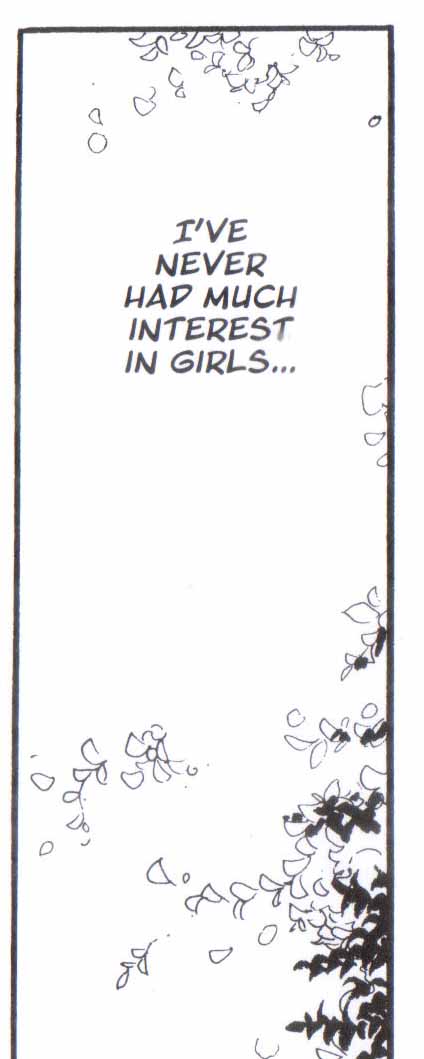
The reader’s mileage with respect to Hagio’s subtle eroticism will vary depending on his/her passion for the artist’s figure work and for characters with brittle foreheads in need of warm towels. Not that these aspects aren’t apparent to Hagio. There is, for example, that moment of epiphany when one of the characters complains that his fellow students feel that he has “a girl’s face;” an otherwise unremarkable statement except for the fact that just about everyone in that boarding school looks like a pre-pubescent (i.e. breast-less) girl. To be sure, readers of The Heart of Thomas should always assume that every woman in Hagio’s work is actually a man until proven otherwise. This isn’t a problem so much as a feature of the genre, the attractiveness of slightly feminine men (or in this case feminized yet adequately virile men) being the entire point. To imagine the alternative—consider going to an action movie in which nobody dies and no violence is performed. It just wouldn’t do.

Noah in his article at The Atlantic offers little in the comics’ defense except for the standard, “Well, it’s meant to be crap and succeeds admirably at it.” Not his actual words of course, but here they are for those so inclined:

“In a lot of ways, The Heart of Thomas is an Orientalist harem fantasy in reverse. Instead of a Westerner thinking about veiled maidens on cushions in some distant palace, the Japanese Hagio fantasizes about beautiful boys in an exotic Europe.

The genre of boys’ love, in other words, allows Hagio and her readers to place themselves in a position of power and aggrandizement that is rare for women—as the distanced, masterful position, letting his (or her) eyes roam across variegated objects of desire….Thus, the prurient fan-service which is usually doled out only to men is here explicitly taken up by women, who get to watch more exotic male bodies than you can shake a spectacle at.”

And on Juli’s emotional (and likely physical) rape:

“Instead, Juli’s rape emphasizes the universality of what is often presented as a particularly female experience. Similarly, Juli’s shame, his self-loathing, and his tortured effort to allow himself to love and be loved, are all character traits or struggles which are often stereotyped as feminine. The fact that Juli is male seems, then, not an aspect of otherness, but rather a way to underline his similarity to Hagio and her audience. If readers can with Siegfried experience distance as mastery, with Juli they experience an empathic collapse of distance so powerful it erases gender altogether…The boys’ love genre, then, freed Hagio and her audience to cross and recross boundaries of identity, sexuality, and gender.”

As Noah periodically ejaculates on this blog, this is a case where the criticism is of far more interest than the text; a situation where purpose is more interesting than result, intention far better than the delivery, and (presumed) effect more fascinating than the actual reading experience. And if, as Noah claims, Hagio is an “aesthete”, this does little to explain the inadequate metaphors, and the banal structure and prose which litters the narrative. The romance here is as invigorating as ice on genitals. Certainly, nothing works so well to preserve mood than a comic chorus commenting on every loving decision and every act of forbearance. At every turn, the manga engenders not so much an “empathic collapse” but a complete nullification of empathy.

Heart of Thomas_0006

The tacked on and thoroughly mangled Christian metaphors (angels without wings; Judas and Christ; a cursory mention of justification) serve only to highlight Hagio’s poor grasp of European culture and religion in general. Even worse is the “shocking” revelation (of abuse) which is anything but. I let out a mental gasp of incredulity when the a plot twist near the close of the comic had Juli threatening to retire to a seminary; a time honored old chestnut seen in both modern and period Asian dramas since time immemorial where women have retired to nunneries for one reason or another. The immense superficiality and unadorned derivativeness of The Heart of Thomas suggests that whatever dividends one might gain from it are largely skin deep. It is nothing less than a time capsule of high camp.

Heart of Thomas_0002


Apart for the tangy taste of forbidden fruit, is the love of one man for another any different than the much more familiar sight of a man and a woman pining for each other? As both the novel and film adaptation of Christopher Isherwood’s A Single Man suggests, the mere unfamiliarity of that object of affection is no hindrance to empathy.  But just as truly great heterosexual romances remain in short supply in the medium (I’d be hard pressed to name more than a handful in manga and anime), so too does this rule apply to gay love in comics. Yet, to demand these standards of The Heart of Thomas is almost certainly a mistake for the comic in question was originally created for the enjoyment of women and has as much to do with the day to day issues of romance and gay love as the women in traditional harem manga have to do with flesh and blood females. Any resemblance to the gay liberation movement of the late twentieth century is simply good fortune if not purely coincidental. Some will say that the manga deserves praise because of its daring sexuality for its time—it is nothing less a seminal work in the boy’s love genre—but such a statement would be a demeaning admission that the comic is merely of historical interest.

The main inspiration for the manga at hand was apparently the film adaptation of Roger Peyrefitte’s Les amitiés particulières (novel published 1943, and film adaptation,1964). The similarities between the film and the manga are certainly striking.

There is the setting and sexual orientation of the protagonists as well as their relative ages. The lovers at the center of the film also struggle with ideas of purity and impurity (“It wasn’t his purity I loved.”) to the extent of expunging their sins of romantic (homosexual) love at confession. As with the final note left by Thomas, the letters between the young lovers act as erotic talismans. In the film, the letters are linked to the legend of St. Tarcisius—a young boy who defended the Blessed Sacrament with his life. These pieces of paper become nothing less than the body and blood of Christ to the lovers (they are certainly held in higher regard). Then there is the younger lover’s (Alexandre) suicide by jumping from a railway bridge (in this case, while traveling on a train) and the confusion of accident and suicide made more pressing in the film than in the comic because of the intransigent Catholicism which hangs heavy over the events.

While the love affair depicted in the film is not entirely convincing, it is certainly far more effective than anything found in Hagio’s comic. Peyrefitte’s work is restrained and classical in approach, and altogether more serious and real,  especially in the interaction of the boys and a liberal minded priest named, Trennes. The priestly test commanded by Father Lauzon of the older lover (Georges; Juli’s counterpart) is nothing less than an act of temptation on the part of Satan. Hagio, of course, takes an alternative route. One might call it a disavowal of authenticity in setting, conversation, religion, and, perhaps, even sexuality—all of these becoming as putty and playthings in the authoress’ hand. A perfectly acceptable approach except for the decisive failure in delivery and communion.

The Heart of Thomas is in certain ways a sequel to the film, a fitful re-imagining of everything that could have been, but the final page of this book presents itself as a consummate evocation of my state of mind as I flipped through its pages.

Heart of Thomas

The work was not clever enough, not brazen enough, not idiotic enough, and simply insufficiently well wrought  to provide me with even a moment’s pleasure. It was, in short, interminable.


City of Irony: Jason Lute’s Berlin Book One

Jason Lutes’ Berlin: City of Stones is illustrated within an inch of its life. Painstakingly researched and precisely drawn, its pictures work overtime to breathe life into history and the fictional persons of its sprawling, yet relatively schematic narrative. The story opens with the arrival of Marthe Muller, an upper class, unmarried woman, who plans to take art classes in Berlin and escape the spectre of an arranged marriage. On the train, she encounters Kurt Severing, a jaded journalist who is struck by her innocence and her self-taught drawing skill, (and presumably how these inform each other.) The book orbits around their transforming relationship, while hopping through the private lives, memories and dreams of disparate citizens scattered throughout the city. Sometimes these characters are revisited, sometimes not. Some lives intertwine in mundane coincidences, others in large fateful clashes, like the violently suppressed Communist march on May Day 1929.

City of Stones attempts a faithful visual portrayal of post WWI Berlin in all its tumult, but misses the mark in spirit. Lutes rewards his characters for their impartiality, ignorance and doubt, and punishes those who embrace the frenzy of ideologies that was its zeitgeist. Marthe drops out of art school, declaring, “there’s a lot for me to learn, but I don’t want to know any of it… I can’t reconcile these things with what I see…. more what I feel. But for me [seeing and feeling] are not so far apart,” and this is treated like a heroic act. Her unfamiliarity with the figures of Trotsky and Stalin, while fascists and communists battle around her, is treated by Kurt as both revelatory and charming. But rather than remain two perspectives among many, Marthe and Kurt’s diaries become the book’s most authoritative voices, giving City of Stones its title and articulating its major themes. The only major character seduced by the communists, a weary and sensitive mother, is shot to death during the march that closes the book, while her husband is progressively vilified as a Nazi.  Oftentimes, Lutes’ breathtaking mastery of expression and body language is of more interest than the stock protagonists themselves. 

berlinmartheandkurt

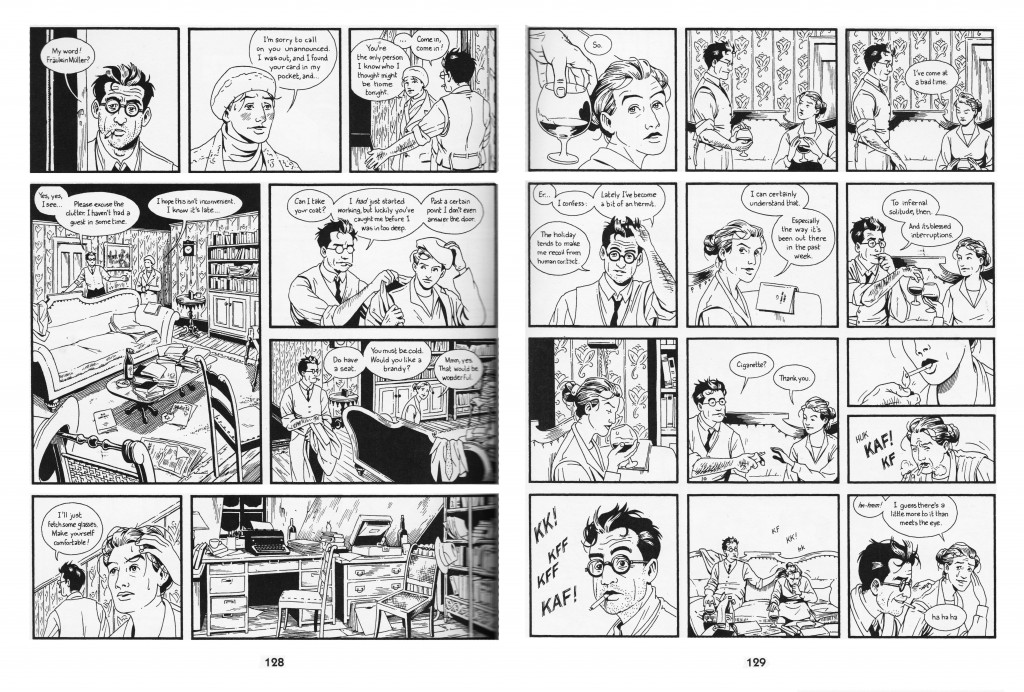
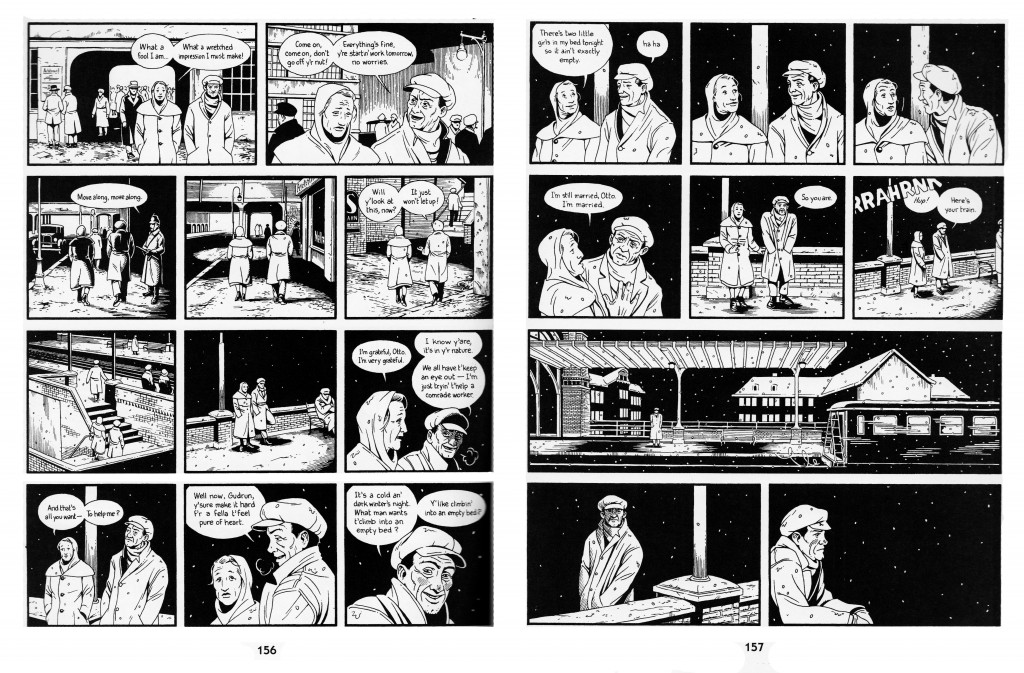
More powerful than the characters is Lutes’ recreation of the city in ink. When people walk, they pass through the city, individual block by individual block. Figures are rarely shown apart from their environment, which is rendered with startling specificity and care. Lutes makes good on his characters’ claims that the city envelops them; he often drafts the foreground and background with equal line-weight, which feels like a deliberate philosophical decision.

berlin_train

 On one hand, Lutes’ treatment of Berlin celebrates a crucial freedom the comic medium affords its creators; aside from time and training, everything is as equally ‘expensive’ to draw. Lutes is able to realize visuals that would have required a mammoth budget and manpower in any other medium. City of Stones is also less ‘comic-y’ than many books, as it doesn’t immediately participate in the ‘genre’ of comics or its concerns. (However, the romantic union of a drawer and a writer, and their self-exile from art-school and the rest of Berlin, suggests that City of Stones could secretly be about comics after all.)  Lutes doesn’t push the envelope on what comics can do, although he achieves some great effects, often in pursuit of cinematic pacing. It begs the question whether Lutes draws comics in order make something similar to film, while retaining ultimate control. This also leaves him with the responsibility to know and accurately represent the story world he has chosen, which in the case of Berlin, exists outside of Lutes. This ‘auterism’ is far from a bad thing: imagine the variety and ambition of comics produced, if more creators made comics for this reason. Its fair to assume many already do.

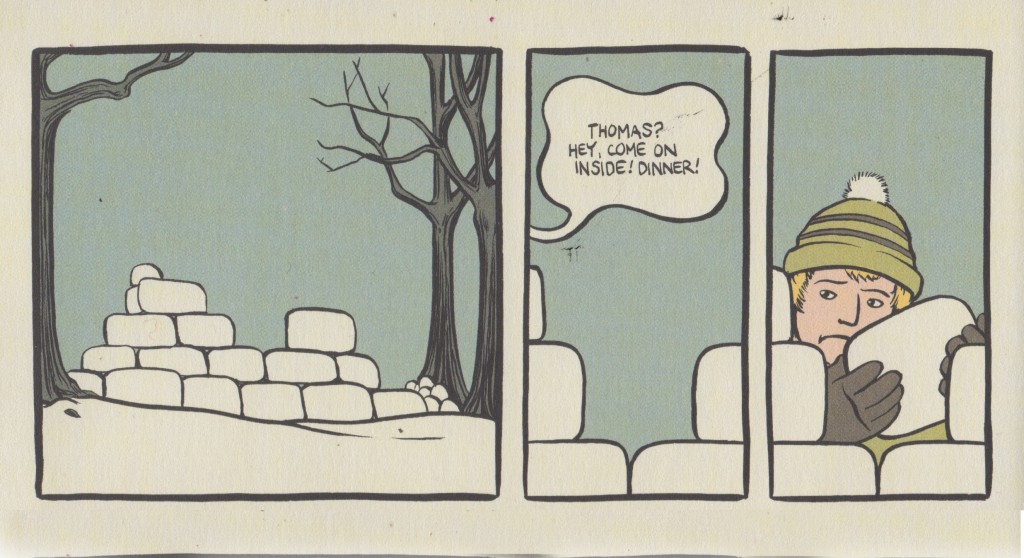
Yet Lutes’ choice neglects, or even rejects, another freedom of comics– the ability to select what is represented. While a camera necessarily records all it can within range, a cartoonist can obliviate a background, stylize its objects, and can render objects into icons or types. Comics resembles memory, where only the essential elements are remembered, or rendered. The act of rendering itself makes what is drawn relevant to the ‘telling.’ For example, in Paul Hornschmeier’s book Mother Come Home, a child builds a snowfort out of flat, immaculate snowbricks.

snowfort

Hornschemeier doesn’t describe the snowbricks, (crumbling, melting or made in various sizes,) and he barely describes the fort or the activity of building it, in favor of simply depicting the concept of ‘making a snowfort.’ Compared to speed lines, sweat bubbles, and the hundreds of symbols that have been developed in diverse comics traditions, this is a very minor shorthand– Hornschemeier is telling the reader that the child is making a snowfort, without going into detail of what that experience is like. This is left up to the reader, should he or she choose to dwell on it.

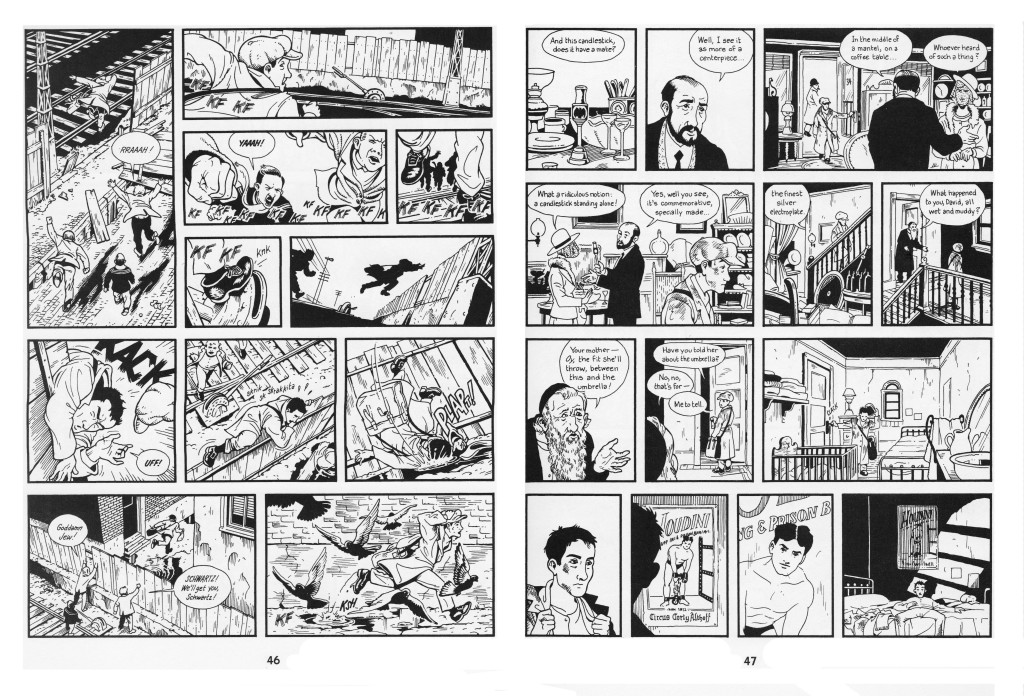
Alternatively, this freedom of selection resembles prose writing, where the  descriptions add to the fabric, effect and significance of the story, and where a gratuity of description is not appreciated. City of Stones avoids seeming overindulgent because the drawings don’t have to be actively read. They can be visually absorbed (or passed over, unnoticed). At these times, the comic acts more like a film than like a novel. Lutes commits himself to draw like a camera. There’s a tragic nobility here;  as a ‘rememberer’ of his narrative, it’s as if Lutes is trying to restore or break through to  the world outside of the plot, while working in a medium where this is impossible. By choosing a historical period, Lutes appears to reach for a place independent of his imagination, or the reader’s. Yet the more he reaches and renders, the less room he leaves for his reader to imagine a world outside of Lutes– or late 20s Berlin via Lutes. The act of reading switches over from an active reading to a passive reading, where his audience is not responsible for assembling a sense of the world themselves. This is facilitated by Lute’s tight reign over the pacing.

berlinhoudini

This core irony is joined by two others. While City of Stones frequently criticizes the cult of “New Objectivity” which beset post-WWI Germany, Lutes works to draw as objectively and as similarly to a camera as possible. Lutes draws with anatomical and perspectival precision, yet he heroicizes a character who refuses to learn to draw this way. Judging only from the first volume, it’s up in the air as to whether Lutes crafted Berlin so as to criticize this visual oppression, to showcase its inescapability, or to capitilize on it.

This review was written without reference to Lute’s interviews or other writing about Lutes, and without reading the following issues or second compilation of Berlin, which the New York Public Library has so far not made readily available. Its possible that the story’s development will make some of these critiques pointless– perhaps Marthe will get a massive comeuppance for her solipsism. More likely she will lose her innocence. The most tantalizing thread is whether Kurt’s noble political non-commitment will spill over into an ambivalence about Marthe, something City of Stones confronts with subtlety and bite. If only more of the narrative threads carried this sense of mystery. The reader watches so many characters think and do so many private things, in such specific streets and houses, yet the book never achieves real, raw intimacy. Perhaps Lutes tries to show too much for a book that is ironic at its core. Which would be a sad conclusion, because his quest to truly, earnestly represent Berlin is the book’s most remarkable quality.