Can Comics Critics Be As Vapidly Ignorant as Political Pundits?: Live-Blogging the Florida Debate

NB: Hey folks. Noah Berlatsky here. Richard Cook and I are going to be live-blogging the third presidential debate not too long from now. As I understand it, the debate is going to be about the rest of the world, which reportedly includes the Middle East, China, and also the Middle East. The President wins if he can utter the name “Osama Bin Laden” more than 30 times in 90 minutes. Mitt Romney wins if can get through an hour and a half without gratuitously insulting Canada or one of those other lesser countries.

I’m not exactly sure why anyone would look to a comics blog for political commentary…but if you have done so, for whatever inscrutable or despicable reason, please feel free to leave us your thoughts, groans, and screams of agony in the comments.
_____________________
RC: We’re not a comics blog anymore. We’re an online magazine.

NB: Ahhh…yes, I’d forgotten. Well, in that case, we totally deserve to be the web’s gateway to democracy. Proceed!

NB: So the debate moderator is Bob Schieffer, it looks like. That’s a perfect four-for-four on the white-people-as-moderators, right?

Maybe the people who organize these things need some binders full of people of color foisted upon them….

9:01NB: Here we go….

NB 9:02: The Cuban Missile Crisis. No mention that Kennedy would have nuked us all if he’d had the chance, and that we were saved by Khruschev, a better man than either of these folks we’ve got to vote for….

NB: 9:03: Mitt Romney appears to be saying that the hope of the Arab Spring was entirely squandered. Our hearts and minds go to the people in Benghazi, because whenever Romney talks about foreign policy he thinks of Vietnam, for some bizarre reason?

NB: 9:06 Barack Obama sure sounds a lot more serious than Romney. Maybe I just have an unusually low tolerance for Mitt’s sanctimonious bullshit though, I dunno….

NB: 9:11 Mitt Romney sounds completely at sea. And Obama sneers at him for claiming Russia is a threat. “I know you haven’t been in a position to execute foreign policy.” Ouch.

NB 9:13 Obviously Romney’s decided that “tumult” is his word for the day.

NB: 9:16 Obama’s argument that Romney’s flip-flopping is a bad way to conduct foreign policy seems like a pretty good argument. Romney sounds completely lost.

Whoops; we’re having technical difficulties. Shocker. Here’s what Richard’s been trying to write:

9:03RC: The audience has sworn a vow of silence. Good thing I’m a pundit.

9:09RC: So Romney’s plan is: kill terrorists, give economic aid, and promote Westernization. Not exactly a radical break from the norm.

9:12RC: I’m fairly certain the Muslim world would be fine if they got less American “leadership,” good or bad.

9:16RC: First genuflection to Israel. Take a drink!

9:20RC: Romney on Syria: “Exactly what Obama says, but with more enthusiasm!”

9:24NB: I wonder if Presidents are allowed to have any regrets in foreign policy.

9:27NB: Obama really sounds convincing in talking about the aspirations of Egyptians. And the argument that we need to do less nation building overseas and more at home is something I believe, anyway. Which raises the question of why the fuck we’re still in Afghanistan. But I guess it would be impolite to ask him that.

Why doesn’t Romney ask him that? Oh right, because he wants to invade more places, only harder and with more stuttering….

9:29NB: Romney saying that we’ve weakened our economy. Who did that? Will we get through the whole debate without mentioning the “B” word?

There’s nowhere on earth that our influence is greater today? What about South Korea? Oh right; not Middle East, not China, therefore doesn’t exist….

9:32NB: Romney’s saying that Obama should have endorsed the Green Revolution…except that doing that would have harmed the Green Revolution, because there was nothing the regime wanted more than to link the rebels to the US. Does he actually not know that? Or is he just lying?

9:34NB: Romney sounds a lot more confident on economic issues, that’s for sure. He’s still full of shit, but he sounds like he believes the shit he’s full of.

He sounds like he memorized that statistic about Latin America being as big as China.

9:38RC: So it’s turned into a domestic policy debate, probably in recognition that they really have little to debate about in foreign policy.

9:41NB: Obama bragging that our military spending has gone up every year he’s been in office. Why is that okay? Why are we spending more and more on the military when we’re in the middle of a budget crisis and an enormous recession?

9:42NB: Our navy is smaller than any time in 1917? Where does he get this bullshit?

The highest calling of the President is to preserve the fucking Constitution, not to protect the safety of the American people. God damn it.

“Fewer bayonets.” That’ll leave a mark.

9:42RC: I’m glad Obama pointed out that counting ships and planes is pointless. A stealth fighter is worth 100 WWII era planes.

9:45NB: Holy crap. He wants them to declare that an attack on Israel is an attack on the United States? What the hell? Why not just make Bibi commander in chief? That’d scare Iran, huh?

I’m glad we’ve got a moderator more hawkish than either of the candidates. Maybe he’ll ask why we aren’t stepping up our drone strikes too.

9:46RC: Second genuflection to Israel. Take a drink!

9:48NB: He seems to have memorized the phrase “crippling sanctions” as well.

The glib cheerfulness with which they contemplate the horrible suffering caused by those sanctions is more than a little nauseating.

9:51NB: Obama’s professorial thing works for him when it’s coupled to thoroughgoing scorn.

9:52RC: Romney just can’t get any traction. Obama’s foreign policy is exactly what Romney would like to implement. Except with more competence.

9:54RC: Ah yes, the apology tour.

9:54NB: Weakness, strength, weakness, strength. I’m strong, he’s weak, and to prove it I will now deck the moderator, whip out my tumescent stuttering policy, and…destroy!

9:55NB: Romney now promising that when he is President he will not go to the Middle East.

9:55RC: Wait, how are we going to indict Ahmadinejad? Under the International Criminal Court, an institution that the U.S. doesn’t support?

9:58RC: Hey, I agree with Romney! I don’t want to run hypotheticals about how we should committing ourselves to more wars in the Middle East.

10:00 NB: Obama sneering at Romney for not wanting to break international law. Then dragging out the 9/11 victims. That’s fairly nauseating, but I would imagine devastating.

10:03RC: I’m surprised it took an hour for Obama to remind us that he killed Bin Laden.

10:04NB: And Romney doesn’t get a chance to respond and then whines about it.

10:04NB: Romney is now explaining and defending Obama’s policy in Afghanistan.

10:06NB: Can I vote for George McGovern?

10:06RC: Regarding the 2014 withdrawal: I can respect that Romney doesn’t want to play the hypothetical game. But then he answers by making big promises that he can’t possibly keep.

10:08NB: Pakistan is important basically because they have nuclear weapons. Why on earth would any other nation want to get nuclear weapons? It’s a mystery….

10:10:NB: Is Romney convincing anyone that he knows jack shit about this part of the world?

10:11NB: Hey, he asked about drones. So now Conor Friedersdorfer knows that Romney isn’t on his side. What a surprise….

10:12RC: Wow, Noah was right. Schieffer is an ultra-hawk who thinks we should kick Pakistan to the curb. Even Romney thinks that’s crazy.

10:13NB: Attitudes about Americans would change more if we weren’t bombing fucking wedding parties, you duplicitous shit.

That last was addressed to our President, alas.

10:14NB: And now the China bashing portion of your evening….

10:17NB: I think terrorism is a better answer than a nuclear Iran in fact, though maybe Romney’s will go over better because people want to be afraid of Iran now? I dunno.

Whoops, there goes the tumescent policy again.

10:19NB: The recession is all China’s fault, apparently. I bet that’s a popular position on Wall Street.

10:19RC: There responses about China are almost reasonable … I’m stunned.

10:20NB: You just needed to wait a minute there, Richard. Now we’re having a trade war.

10:21NB: Obama again with the shipping job overseas. That is such demagogic bullshit. He manages to sound so sincere when he’s shameless….

10:23NB: I don’t think Romney talking about his plan for the auto industry is helping him here.

Government investing in companies worked pretty well in South Korea.

10:23RC: Obama can never miss an opportunity to point out what a tough guy he is. China will stop stealing our IPs because I built a base in Australia!

10:27NB: Again, Romney’s much happier burbling his lines about the economy. The idea of him as commander in chief is terrifying.

He loves teachers like he loves Big Bird.

10:29NB: We’re going to stop wars, except for the wars we’re not going to stop, I guess.

10:31NB: Christ, just listening to Romney’s oleaginous phrasing is like an ice-pick to the eye. How can people vote for him?

10:32NB: Bipartisan bullshit. And then the greatest generation. Gag me.

10:33RC: So my choices are a continuation of the past four years, or a continuation of the past four years with more empty bravado and some tax cuts for the top 1%.

10:33NB: Yep. The moderator says voting will make you feel big and strong. It’s like he hasn’t been watching the debate at all (and who can blame him.)
____________________

Give us a few minutes and we’ll have a wrap up….

NB: Well, that was pretty thoroughly depressing. I’d say the President won, though I don’t know if I’m entirely impartial because the timbre of Romney’s voice sets off my gag reflex. But be that as it may, he seems totally lost on foreign policy, stuttering and burbling and wandering off into irrelevancies. It doesn’t help that he’s got no real policy differences with the President, nor that his one-size-fits-all-plan (I worked in business, and so…magic!) sounds even stupider in foreign than in domestic policy. He did better when he could talk about the economy, where he’s got his nonsense down patter. But he sure didn’t sound like someone you want anywhere near the nuclear button.

Substantively, though, they’re both the same evil imperialists we’ve come to expect from America. Build a gigundus military, inflict hardship through sanctions, bluster and threaten, drop drones, bait China, repeat. I guess that’s what the people want. And perhaps therefore we deserve it, though it’s hard not to feel bad for the rest of the world.

RC: A few closing thoughts. People who complain about a lack of “bipartisanship” are clearly not paying attention to foreign policy. The two candidates were in agreement on every major issue, which obviously helped Obama. Romney came across as more cynical than usual largely because he couldn’t articulate a policy that differed from Obama’s in any meaningful way. So we hear more claptrap about the “apology tour,” or the lack of sufficient fealty to Israel, or the need to be strong, Strong, STRONG! Americans love chest-thumping jingo of course, but at a certain point it becomes transparently desperate.

More importantly, the bipartisan consensus on foreign policy is terrible. It celebrates an endless war on terror, shrill imperialist rants, and unchecked presidential power. What this debate needed was a voice that could attack Obama’s policies from the left. Gary Johnson or Jill Stein would have pointed out that Obama has assassinated American citizens (to say nothing of the foreigners who are designated as “militants” by virtue of being in the wrong place at the wrong time), waged an unlawful war in Libya, and essentially trampled on the Constitution. But voting for a third party candidate is considered “throwing your vote away.” Allowing the presidency to transform into a rotating imperial title is what serious Americans accept.
Comics Journalism…Why?

Reading Joe Sacco’s Footnotes in Gaza, I kept coming back to the same question. Namely — journalism as comics? Why? Sacco’s project — interviewing individuals in the Gaza Strip who were witnesses to two different Israeli massacres in 1956 — could easily have been presented as an agitprop book or as an agitprop documentary film. His methodology — the careful documenting of atrocities, the humanizing of the enemy, the nuanced by firm advocacy for the powerless — are all familiar tropes and tactics of left-wing investigative print and film journalism. Given that the content is familiar, what exactly does the comics form add? Why bother with it?

It’s a question that’s likely to make comics fans bristle. After all, to turn the question around, why should comics have to justify itself while other forms do not? Shouldn’t the success of the endeavor be more important than the medium?

Perhaps. And yet the question persists…in part because when you’re doing Joe Sacco’s brand of journalistic advocacy, journalism in prose and journalism in video have some major, easily apparent advantages over journalism in comics. Prose is unobtrusive and easily distributed; a Human Rights Watch report, for example, can provide facts and talking points with minimal fuss, and can also be readily quoted, linked, and copied, spreading a targeted, clear, footnoted message to as broad a range of people as possible. Film, on the other hand, can provide a sense of presence and urgency which is difficult to duplicate, allowing witnesses to speak in their own words with an authority and resonance that is very difficult to duplicate.

The advantage of prose or of film can perhaps be summed up as “authenticity.” Journalism’s goal is to show truth, and so spur to action. Prose and film are, for historical and formal reasons, often seen as at least potentially transparent windows on truth. Comics, on the other hand, foregrounds its artifice; as Sacco mentions in his introduction, everything you see on the page is rendered by his hand. And this is, incidentally, why Sacco is seen as an artist, rather than just as a reporter. Certainly, nobody that I’m aware of has ever referred to an HRW report as the work of a mature artist who has found his own style and voice, which is what friend-of-the-blog Jared Gardner called Sacco in his review of Footnotes in Gaza.

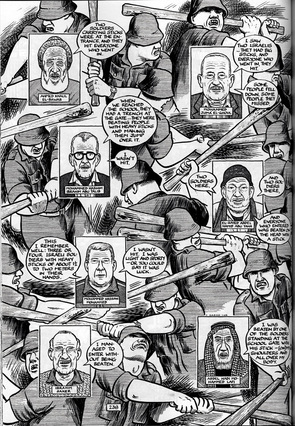
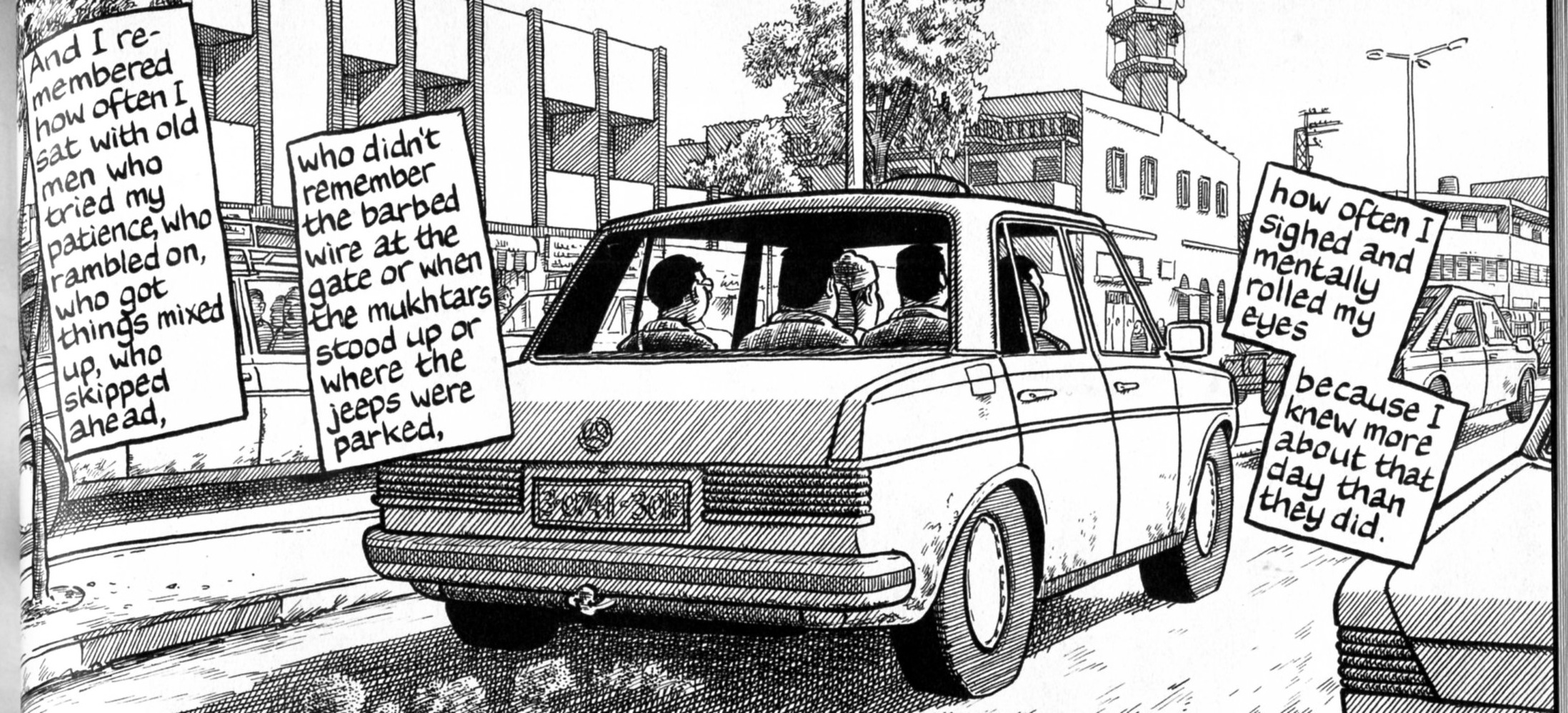
One upshot of making journalism comics, then, is to make journalism art, and to make the journalist an artist. The downside of this is that you then end up in a situation where the genius and sensitivity and angst of the journalist ends up pushing to the side the suffering and injustice which is the journalism’s putative subject. Sacco is certainly aware of this danger, and makes moves to undercut it, or problematize it, as on this second-to-last-page of the graphic novel.


However, I don’t think these gestures are ultimately successful. In this case, for example, indicting himself for insensitivity and hubris ends up validating his sensitivity and honesty, and also makes the book as a whole about his psychodrama and growth — about his experiences in Gaza, rather than about the experiences of those who are stuck in the place on a more permanent basis. In this context, contrition for selfishness still ends up as a way for the self to take up more space. The comics form has allowed/impelled Sacco the journalist to become Sacco the genius.

But while the artifice of comics journalism has its downsides, it has some advantages as well. Most notably, Sacco’s narrative is in no small part about the uncertainty of memory and of history. Comics, precisely because of its unfamiliarity as journalism, is less transparent; it demonstrates, almost reflexively, that journalism is not “truth,” but an effort to reconstruct truth.

Again, precisely because comics is a less familiar form for journalism than film or prose, it ends up emphasizing its own artificiality. Everything you see in Footnotes in Gaza is created and represented by Joe Sacco. His account always has a built in asterix. What he shows you is not what happened, but a collage stitched out of the words and memories of his interviewees and the fabric of his own visual imagination.


Sacco uses comics, then, to emphasize subjectivity. But…do you need to use comics to do that? Writers have been exploring the wavering, difficult nature of truth and of history for hundreds of years in prose, surely. Joseph Conrad’s narratives within narratives within narratives, or Paul Celan’s bleak koans hovering on the edge of comprehensibility, to cite just two examples, seem like more challenging and more thoroughgoing efforts to wrestle with the intersections of meaning, subjectivity, and historical trauma. For that matter, those Human Rights Watch reports I mentioned are usually pretty good about discussing the difficulty of gathering evidence and the conflicting testimony of witnesses. Do we really need the comics form to tell us that human memory isn’t perfect?

Indeed, the use of comics seems in some ways like a epistemological shortcut. Subjectivity can be linked to, or summarized as, the comics form, which is shown as obscuring the objective truth of reason and trauma. Comics may serve to call reportage into question…but it also, at the same time, validates or stabilizes the reportage. Thus, in that page above, the images of the Israeli’s swinging clubs are imaginative, or unverified…and their unverifiedness contrasts, or highlights, the more vouched veracity of the portraits, which are (at least probably) photoreferenced. And the referenced images, in turn, highlight the even greater veracity of the words, taken down from (presumably taped) interviews. Thus, while the comics form may initially appear to highlight subjectivity, it could instead be said to create a fairly clear hierarchy of representation, in which Sacco’s deployment of his research materials and his illustration signals the reader what is “truth” and what is less so.

This isn’t necessarily a weakness. You could argue that comics’ strength as journalism lies not in its artificiality per se, but rather in the ease with which it can evoke differing degrees of artifice; in the resources it has available for signaling truth or falsehood, or different levels of both. For example, one of the most interesting aspects of Sacco’s book is the way that he shifts back and forth between the 1956 atrocities and the ongoing violence on the West Bank. For comics, where still images evoke time, it is relatively easy to make two times equally physical and equally present.

Comics’ ability to show bodies discontinuous in time is used here to show trauma across decades; the self from the past is as real as the self in the present. That is, it’s not entirely real, but is composed of representation and memory, the present self made of a past self, as the past is made of, or created out of, the present.

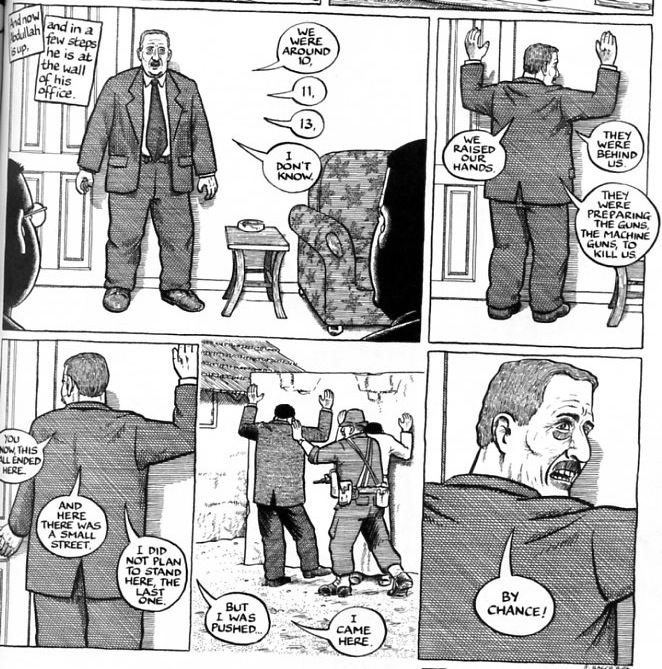
The problem is that Sacco’s manipulation of artifice and memory is not always so deft. In that page we looked at earlier, for instance:


The cartooning turns the Israeli soldiers into deindividualized, snarling bad-guy tropes, all teeth and slitted (or entirely obscured) eyes. Is this how the Palestinian’s are supposed to have seen them? Or is it how Sacco sees them? And is the acknowledgedly subjective nature of comics supposed to make us question this demonization? Or is it supposed to excuse it? Or, as perhaps the most likely possibility, has the impetus for dramatic visuals been catalyzed by comics’ history of pulp representation to create a pleasing collage of villainy from which readers are encouraged to pleasurably recoil?

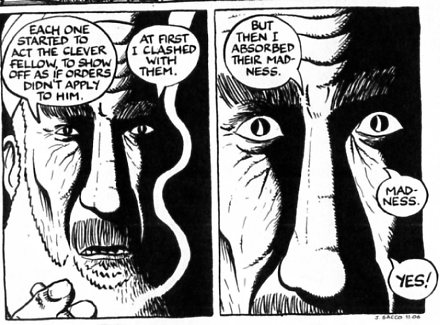
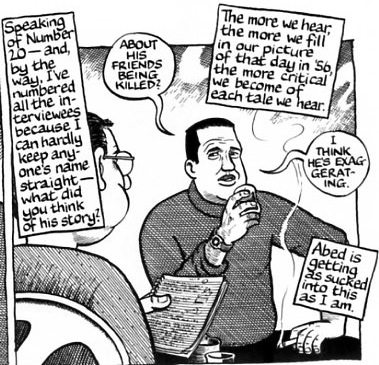
Or another example:


This is one of a number of times when Sacco zooms in on a grizzled Palestinian fighter, dramatically showing us his crazy eyes. As with the thuggish snarling Israelis, the formal contribution of comics here has to do less with emphasizing subjectivity and physicality, and more to do with the pleasures of pulp tropes. It’s Sacco’s own “Muslim Rage!” moment.

From this perspective, the advantage of comics as a form may be less the meta-questioning of the journalistic project, and more its unique ability to present itself as serious art while simultaneously coating its earnest reportage with a sugary dab of melodrama. One can debate whether this is ethically or aesthetically desirable, but either way it’s clear that Sacco’s comics provide something — a mix of high-art validation and accessible low-art hints of pulp — that is uavailable in prose or video long-form journalism. I don’t necessarily like Footnotes in Gaza that much, but I have to grudgingly admire its creator’s marketing instincts in finding and exploiting such an unlikely genre niche.

Pimp With a Heart of Gold

This first appeared on Splice Today.
__________________

The first scene of Pretty Woman (1990) is devoted to the ritzy lifestyle and rocky romantic life of financier Edward Lewis (Richard Gere). Edward is the guest of honor at a massive LA soirée for his obscenely wealthy business associates and friends. In quick succession, he breaks up with his girlfriend by phone, seeks affirmation from a now-married ex, and drives off with the hot car of his asshole-but-subservient lawyer, Philip (Jason Alexander). It’s only after this montage of privilege and pique that we turn our attention to the female lead, the prostitute-with-heart-of, Vivian (Julia Roberts.) The first shot of her we see, however, focuses not on her heart, but on her panty-clad ass, followed quickly (as she turns over in bed) by a close-up of her crotch.

Pretty Woman, and its treatment of women, was in the news this week when Miss Ohio cited Julia Roberts’ character as a positive role model for women. This sparked a predictable, and justifiable, backlash, encapsulated by Amanda Marcotte who pointed out that Roberts’ “character is functionally a warm-blooded dress up doll with no will of her own.”  Along similar lines, Crooks and Liars took the opportunity to quote Darryl Hannah, who in 2007 said that “[O]ne of the things I’m most proud of is refusing to take Julia’s role in Pretty Woman.” She went on, “Every time I see it I like it less and less. They sold it as a romantic fairytale when in fact it’s a story about a prostitute who becomes a lady by being kept by a rich and powerful man. I think that film is degrading for the whole of womankind.”

I don’t really disagree with either Marcotte or Hannah—Pretty Woman, as that opening crotch shot makes immediately clear, treats its main character as a body to be dressed up, eyed, manipulated, condescended to, and fucked. The film appears to grant Vivian’s every wish—riches, a perfect lover, a happy-ever-after ending. But in defining those wishes in such a limited way, and by robbing her of agency in their fulfillment, it ends up treating her with a systematic and remorseless contempt.

The problem is, sneering at Roberts (or at Miss Ohio) doesn’t so much undo that contempt as replicate it. To sneer at Vivian for being a “dress-up doll with no will of her own” is accurate, but it’s also a reiteration of the way the movie (more subtly but still) sneers at Vivian for being a dress-up doll with no will of her own. Similarly, Hannah’s comments seem powered by her disgust with prostitution—a disgust which is not at all foreign to the film, and which is indeed at the center of its own misogyny. Turning Vivian into a critical object for censure and revision simply replicates the mechanics of the film. You say she is vulgar and stupid? Richard Gere agrees with you! Let’s laugh at her pitiful yet charming efforts to eat escargot together, and then take her to the opera for some consciousness raising!

If you want to read against the film, then, I think you have to do it by taking your eyes off Vivian, and focusing instead on Edward. Admittedly, this is difficult to do, since Julia Roberts is appealing and funny and animated and Richard Gere has the proportional charisma and energy of a gray-suited slug.

Beneath that colorless exterior, though, there lurks a well of bland viciousness. Edward makes obscene amounts of money by buying companies, selling them off in pieces, and fucking over whoever gets in his way. His job is his life, not just in the sense that he works all the time, but in the sense that it defines how he sees everyone around him. He uses people as things. As I mentioned, one of his first acts of the movie is to break up with his girlfriend because she isn’t jumping through all the hoops he wants her to; shortly thereafter he drives off in his employee’s car without permission just because he feels like it. He dickers with Vivian over how much he’ll pay her to spend a week as his escort, and then gloats about how he got her for a bargain price—which is supposed to be cute and flirtatious, but given the power disparities and how much money he has, just ends up seeming like he’s a miserly asshole. And, of course, his business dealings are vile. At one point, he finds out that the shipbuilding company he wants to purchase has a defense contract in the works that will make its stock spike. So he calls his pal the Senator and tells him to hold up the contract in committee. It’s okay though; political corruption and naked influence peddling are charming when you’re cute like Richard Gere.

Of course, the film is aware that Edward is a dick. He had a bad relationship with his father and as a result has difficulty expressing emotions. The love of Vivian, though, is supposed to transform him. He takes a day of work; he smiles more; he decides to go easy in his business dealings. Instead of breaking apart the shipbuilding company and selling it for parts, he decides to invest in it. He is no longer a parasitic financial leech; instead he’s a patriotic enabler of America’s global imperialism. “I’m proud of you!” declares the elderly shipbuilder whose company Gere has decided to spare, and it’s a lovely father-son moment. Daddy issues resolved.

From this perspective, Pretty Woman isn’t really about Vivian’s retooling; it’s about Edward’s. Vivian gets new clothes, but she doesn’t really change as a person. The emotional dynamics of the film depend on her being the same charmer from the beginning to the end. That charm saves Edward and teaches him how to be a good man—which is to say, it teaches him how to exercise patriarchal power with a touch of generosity and emotion. He still is surrounded with sycophantic servants, but he treats them better. He learns the name of the manager of the hotel where he’s staying; he brings Vivian flowers, and will apparently take her to New York with him rather than just putting her up in an apartment in LA. Furthermore, the limo driver seems touched to see Vivian and Edward get together. Who doesn’t revel in the happiness of their betters, after all?

In the beginning, then, Edward purchases Vivian to be at his sexual and romantic beck and call. In the end, he’s learned that you shouldn’t treat people that way. So instead, he uses Vivian to make him slightly kinder and slightly gentler and to help him work through his issues with older men. Thus Vivian goes from being a blow-up doll for wanking to being a blow-up doll for emotional growth. Not exactly an inspiring career arc, but that’s hardly her fault. When pimps rule the world, everybody’s a whore—even, or perhaps especially, if we’re supposed to believe that the biggest pimp has a heart of gold.

The Penis No One Knows

I recently stumbled on this piece I wrote four or so years ago for a sex website which, as far as I’ve been able to tell, never used it. I still think it’s funny — so I figured I’d see if anyone else agreed.
_______________________

“Adam’s young bride was proud of her man, but she blanched at the thought of the ghastly White Worm.”
Bram Stoker, The Lair of the White Worm

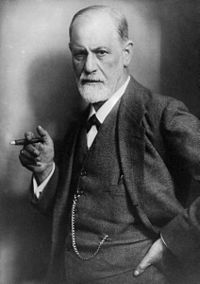
Nothing spurts out fanciful narratives quite like a penis. The best mythologizer of the privates, of course, was Freud who, one portentous day, stroked his beard, sat on the pot, looked nether-ward, and suddenly shouted, “Eureka! I bet Martha wishes she had one of these!”

Sure, Freud was a silly bugger — but phallic disinformation afflicts us all. To rectify this classic malady, read on.

Break You Off — That’s Just an Expression, Right?

Can you break an erect penis? Obviously, you’re hoping that the answer here is “no.” And, in fact, a penis has no bones, so you can’t damage it in quite the way you would an arm or a leg. Still, if you’re young, determined, unlucky, and, maybe, kind of dumb, you can, in fact, injure yourself in ways that will surprise you and make you go…ergh.

When you get an erection, two tubes of spongy tissue that run along the inside length of the penis fill with blood. These tubes are called the corpora cavernosa, and they are located in a tough sack made of tissue called the tunica albuginea. Now, let’s say you’re not only lusty, but also young, which means that you are especially rigid. And let’s say further that you’ve got a willing peasant girl spread out on a bed at the other end of your palatial throne room. You emit a lascivious grunt and begin to race towards her…but, unfortunately, in your haste, you fail to notice the second peasant girl sprawled on the floor…you trip over her…sail gracefully thorough the air…and smash erection-first into the decidedly unyielding flagstone floor.

At this point, the tunica albuginea will tear, and blood will start to leak out of the tubes. What you’ll hear is a cracking sound, and then you’ll probably say something like, “Zounds!” or, “Holy fucking fucking fuck!” because it’ll really hurt. Your erection will go down, and you and the peasants can then sit around watching your bruised and probably visibly bent penis swell and take on a meaningful shape as it adjusts to its new and complex reality. You can also consider what your life will be like now that you can no longer sustain an erection, or — if your injury is especially spectacular— pee. Alternately, you can get up off your butt and GO TO THE DOCTOR! RIGHT NOW! YOU JUST BROKE YOUR PENIS! RUN, FOR GOD’S SAKE! RUN!

Once you get your sorry, sorry dick to the hospital, you’ll need surgery to repair the tears in the tunica albuginea. In most cases, this should solve all your problems and allow you to live a productive, erection-and-pee-filled life. In other cases, you will need a transplant, usually using tissue provided by bonobo monkeys, or occasionally, by Robert Plant. No, that whole last sentence isn’t true. I don’t know what happens in other cases. Furthermore, I don’t want to know, and I doubt you do either.

I Love the Smell of Wood in the Morning

Lots of people think they know the secret of morning wood. “Oh, yes,” they will tell you nonchalantly as you and your stubbornly conspicuous thing shuffle bathroom-wards. “Morning wood. Caused by a full bladder pressing on the medulla oblongata of the lower reaches.”

In fact, morning wood is not caused by a full bladder. It doesn’t seem to be caused by alien transmissions or nanomachines, either. Nor by the Masons or the Trilateral Commission. What does cause it, you ask?

Well, um,…the same thing that causes nocturnal emissions! Yes, you see, while they’re asleep, any man without erectile dysfunction will just get an erection, and sometimes one of those erections is still hanging around when they wake up. In fact, this is one of the main ways that experts diagnose erectile dysfunction. If you’re having trouble maintaining an erection, your local upstanding erection expert will fit you with an elastic thingy (technical name elastic thingy) to wear on your penis to monitor its friskiness and girth. If, on a romantic night, the penis is sufficiently frisky and girthful, a computer dings and the expert knows that your dysfunction is psychosomatic; if the computer refuses to ding, the expert knows that there’s a plumbing prob….

What was that? What causes the nocturnal erections? Errr….

Okay, we don’t know! All right? The penis, it just goes up at night! Stop bothering us with this crap!

In other words, experts are baffled. They have given the phenomena a great name though: nocturnal penile tumescence. I don’t think we can really expect more from science than that.

Diet Like a Porn Star

“Some people think semen is low-carb,” my esteemed editor told me. “You should write about that.”

“What? Who cares? It’s not like you’re eating enough of it to…”

He fixed me with a gimlet eye. Over email. And you’ve never been gimleted by an eye until it’s been disembodied and sent electronically. Gross.

So, fine. Semen’s made of fructose and enzymes, and it’s not low-carb. Now you know.

XY Marks the G-spot

Long, long ago, when men were men, Neanderthals were Neanderthals, and butt plugs were carved out of flint, a tribal wise man named Ernst Gräfenberg discovered the female G-spot in the latest issue of Cosmo. Shortly thereafter, of course, some disreputable wag with a monosyllabic appellation — Ogg, let’s say — piped up with the inevitable query: “Erg! Ugh! Grunt? (snicker)” Or, translated, “Hey Gräfenberg! Screw the gals! Where’s our G-spot? (snicker)” To which Gräfenberg responded frostily (it being the ice age) “We don’t have a G-spot, okay? And if we do, I don’t know where it is. I only read Sports Illustrated for the interviews.”

Well, believe it or not, Ogg the Wag has the last laugh. The female G-spot remains a site of violent and sweaty theoretical exploration by scientists and feminists alike, but everyone agrees on the existence and location of the male equivalent. For guys, the G-spot is simply the prostate, right there at the back of the penis, bung up against the anus. To locate it, lie on your back with your legs elevated, and then gently push a well-lubricated finger into the anus. Two inches beyond the anal opening you should feel a bump about the size of a chestnut. Manipulate it and you too will wag like Ogg.

So there you are. You’ve now got more penis facts in your pocket than even Sigmund Freud, and some of them are even true. Whip ’em out to awe your friends, impress the ladies, or just for the pleasure of playing with your ever-expanding diction.
 

Spider-Man: Wordless Destiny

There were a lot of great story arcs written during the Silver Age of Comics, which most comics historians agree spanned the years 1956-1970. But the best one, in my opinion, “If This Be My Destiny,” was published as a three-part story in “Amazing Spider-Man” issues 31-33, cover-dated December 1965 through February 1966.

But before we can analyze exactly why the story was so special, we first need to identify who the key player was in its creation, layout, pacing and overall story.

Stan Lee was attributed as the “writer” of the story in the credits, but he, as I discuss below, had nothing to do with the story arc’s creation. For while he wrote the dialogue after the pages were laid out and drawn, he did none of the plotting, and had zero input on the pacing, basic character interaction, mood, and story direction. All of that was done by artist Steve Ditko.

The “Marvel Method” of creating comics during this period was peculiar in that regards, especially for Lee’s top bullpen artists Ditko and Jack Kirby. When the process was first implemented by Lee in the early 1960s – ostensibly to save him the time of writing a full-blown script – he and the artist of a particular comic book would have a story conference, work out a plot, and the artist would go home and draw out the entire issue. The finished pages would then be given to Lee, who proceeded to add the dialogue.

But by the mid-1960s, Kirby and Ditko were so good at creating and plotting stories that Lee himself admitted in a number of interviews that he often had little or no input for story arcs. In fact, he often would have no idea what the story for a particular issue was going to be about until after the pages were delivered by the artist.

Lee himself details this Marvel Method process in an unusually candid interview he did for “Castle of Frankenstein” #12 (1968), a magazine that covered popular culture from that era:

“Some artists, of course, need a more detailed plot than others. Some artists, such as Jack Kirby, need no plot at all. I mean I’ll just say to Jack, ‘Let’s make the next villain be Dr. Doom’… or I may not even say that. He may tell me. And then he goes home and does it. He’s good at plots. I’m sure he’s a thousand times better than I. He just about makes up the plots for these stories. All I do is a little editing… I may tell him he’s gone too far in one direction or another. Of course, occasionally I’ll give him a plot, but we’re practically both the writers on the things.”

This was also true with Ditko and his early Marvel Method process on “Amazing Spider-Man.” He and Lee would have a story discussion, after which Ditko would leave, pencil out the story and then, inside the panels, write in a “panel script” (suggested dialogue and narration). He would then bring the pages back to Lee and they’d discuss the story from start to finish. Ditko would annotate any changes outside of the panels, and then he’d leave the penciled pages with Lee. Lee would then write in the final dialogue and the book would be lettered. Ditko then picked up the lettered pages, and made any of the annotated changes during the inking process.

But Lee really had no long-term vision for Spider-Man. He never thought about what he would do with the characters from one issue to the next. He’d just say, “Let’s make Attuma the villain,” and Ditko would have to talk him out of it. The glue that really held the Spider-Man direction and continuity together in those early days of the character was Ditko.

Over time, Ditko received more and more story autonomy and character development latitude that by about issue #18, he was doing the sole plotting chores with no input from Lee. But it took time for Lee to give Ditko what was then unprecedented plotting credit, beginning with “Amazing Spider-Man” #26 (July 1965), and ending with Ditko’s last issue, #38 (July 1966).

As with many aspects of those murky creative days at Marvel, Ditko’s credits raise questions. For example, why did Lee agree to give Ditko plotting credit, but not Kirby, whose “Fantastic Four” and “Thor” plotting autonomy was apparently quite similar? And why did Lee, when he finally did start giving artist and plotting credit to Ditko, suddenly, after one issue, expand his own credits from “writer” (his standard credit line for the first 26 issues of “Amazing Spider-Man”) to both “editor and writer”?

Around the time Ditko began receiving plotting credit, a rift between the two arose and, according to several Marvel staffers, was so acute, Lee would not speak to Ditko. It was during this year-long communication blackout period that Ditko wrote his Spider-Man magnum opus, “If This Be My Destiny.”

Additional evidence that Lee had no story input during this period can be found in “Amazing Spider-Man” #30, which set the stage for Ditko’s historic three-issue story arc. In that issue, the villain is a thief named The Cat, but Ditko also introduced, in two different parts of the story, henchmen for The Master Planner – the surprise villain for the “Destiny” story arc that was to start in issue #31. Yet because communication between Lee and Ditko had ceased, Lee had no idea who the costumed criminals were and misidentified them as The Cat’s henchmen – which, upon close examination of the story, makes no sense. It’s not until the next issue that the error becomes obvious to Lee and he gets a better grasp of Ditko’s storyline.

So, now that we have a better understanding about who created what for this historic story arc, exactly what is it that makes Ditko’s “Destiny” so great from both a literary and artistic standpoint?

How does one go about measuring greatness? After all, there are no established standards for greatness in comics, or, for that matter, the two creative disciplines that are merged to create them: art and literature.

Some argue that great art or literature is timeless, and that it appeals to our emotions in a compelling and riveting way. Others argue that it is something that breaks new ground.

Ditko’s three-issue story arc easily accomplishes all three, and a lot more.

We can glimpse Ditko’s personal, objective views about what constitutes art from his recorded statements for the 1989 video, “Masters of Comic Book Art.” Ditko said that based on Aristotle’s Law of Identity, “Art is philosophically more important than history. History tells how men did act; art shows how men could, and should act. Art creates a model – an ideal man as a measuring standard. Without a measuring standard, nothing can be identified or judged.”

It’s clear to me that Ditko, through his stories and art in “Amazing Spider-Man,” was striving to do just that: mold Peter Parker/Spider-Man into a positive heroic model.

Throughout his career, Ditko has always been a creative, experimental, thinking-man’s innovator. It was evident in his costume designs, character portrayals, settings, lighting, poses, choreography, etc. – literally every aspect of the comic book creative process. For example, no one before or since has created anything like Ditko’s multi-dimensional worlds for his Doctor Strange character. And his creative depictions of Spider-Man’s costume, devices, movement through space, and overall look set the standard for every single Spider-Man artist who has followed. I’ve been a fan of his work for 45 years, and to this day, I still marvel at how Ditko was able to take the totally fantastic and make it seem like it could actually be real.

Ditko was innovative in other ways as well. Unlike many of his contemporaries back then, Ditko had an eye on continuity, and started meticulously planning story arcs and sub-plots many months or even years in advance. Such was the case with his slow and methodical development of the Green Goblin‘s secret identity over a multi-year period, and his tantalizingly slow introduction of Mary Jane.

Ditko’s development of his “Destiny” story arc in “Amazing Spider-Man” #31-33 was no different. Ditko planted the initial seed for the arc way back in issue #10, when Peter Parker provided blood during a transfusion of his seriously ill Aunt May. As regular readers eventually found out, Parker’s selfless act of kindness turned out to be a ticking time bomb for his frail aunt, who began suffering ominous fainting spells in issue #29, and again in issue #30.

As I mentioned above, the mature, heroic side of Peter Parker and Spider-Man had been building for many months before the “Destiny” story arc kicked in – a steady drumbeat that would soon reach a deafening crescendo. At the same time, Parker was enduring important emotional lows and highs. For example, his long relationship with Betty Brant had been pulled wire taut in the months preceding “Destiny,” and was at the breaking point. Likewise, Parker graduated high school in issue #28, and was about to go off to college and enter what he hoped was a new and exciting chapter of his life. But despite his emotional roller-coaster rides, it was clear to the regular reader that Parker was growing more mature, determined and focused both as a normal person and as Spider-Man. He was no longer the silent doormat for his boss, J. Jonah Jameson, his high school nemesis Flash Thompson, or any other negative influence in his life.

It was at this convergence of events where “Destiny” began, and the reader soon found out just how mature, determined and focused Parker and his alter ego would be under the most harrowing of circumstances – circumstances that would have the highest emotional stakes imaginable for the character.

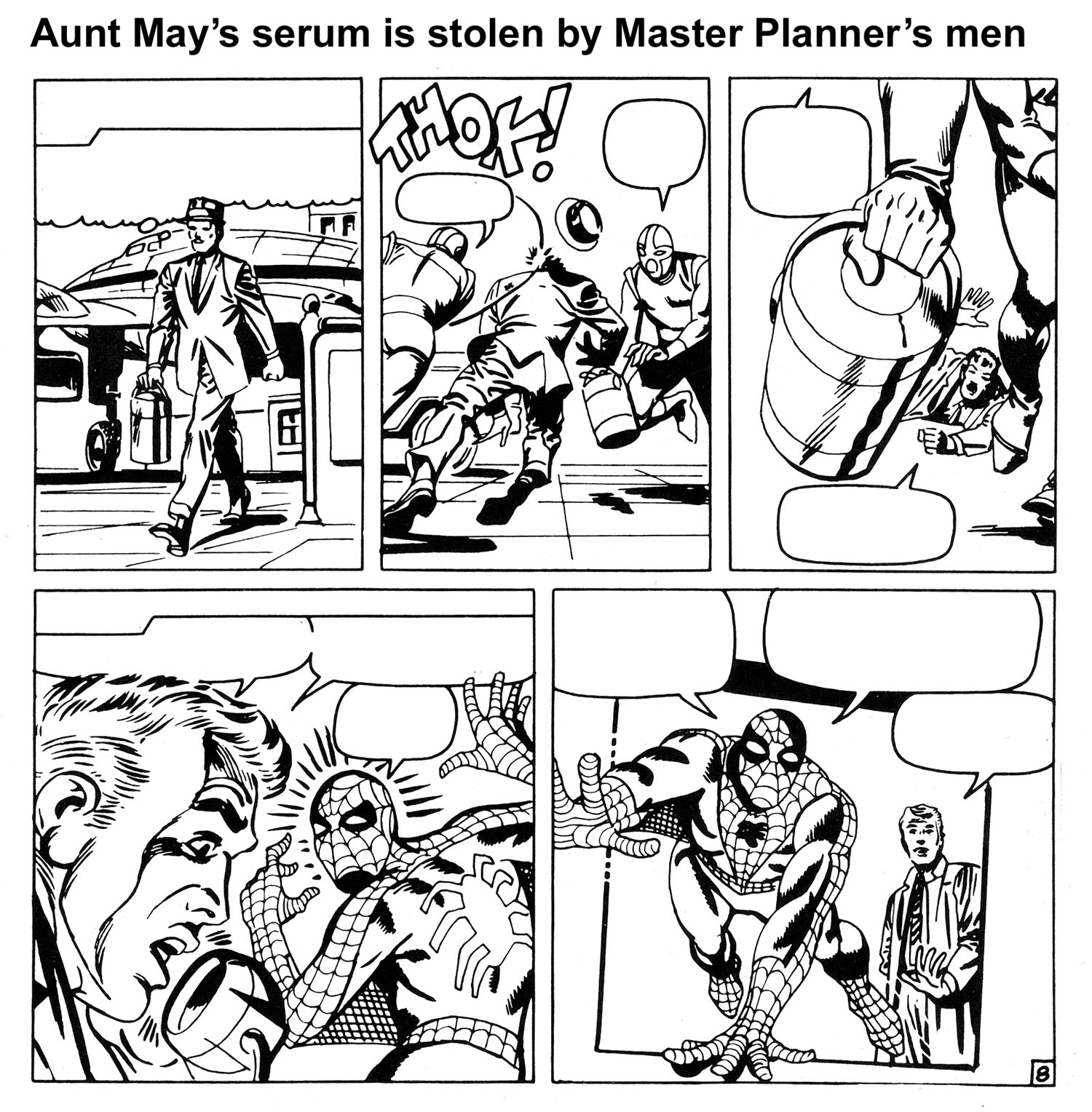
As the three-issue story arc opened with issue #31, the stage is set for what’s to come when Spider-Man stumbles across the Master Planner’s men fleeing, via helicopter, a location where they have just stolen some radioactive atomic devices. A battle ensues, but they escape. It is during this escape that the Master Planner’s underwater refuge – a key location later in the story – is revealed.

The scene shifts to Peter Parker’s home, where he waves goodbye to his Aunt May before heading off to his first day of college. The reader can see that she is gravely ill, but she’s doing her utmost to hide it from her nephew so he doesn’t worry. When Peter returns later that day, she can hide it no longer and collapses in his arms. Her illness is so serious, their family doctor admits her to a hospital. Peter is by her side until she falls asleep, and heads for home. Here the emotional roller-coaster starts its journey again as Peter tries to juggle college, lack of sleep, mounting bills, and Aunt May’s illness all at the same time. But Aunt May’s illness overshadows everything else and his new classmates find him aloof and distant.

As his money pressures mount, Peter changes to Spider-Man so he can look for news photo opportunities around the city – as taking news photos for “The Daily Bugle” is his only source of income. He gets a tip that a robbery will be taking place at the docks that evening, and when he arrives, he once more finds the Master Planner’s men attempting to steal a ship’s radiation-related cargo. Another battle ensues, and they escape again – this time into the water using scuba gear. As the issue comes to a close, an unseen Master Planner, in his underwater lair, mulls how Spider-Man is thwarting his attempt to use radiation secrets for nefarious purpose. But the final three panels are far more ominous: the doctors caring for Aunt May have finished their tests, and conclude that she is dying.

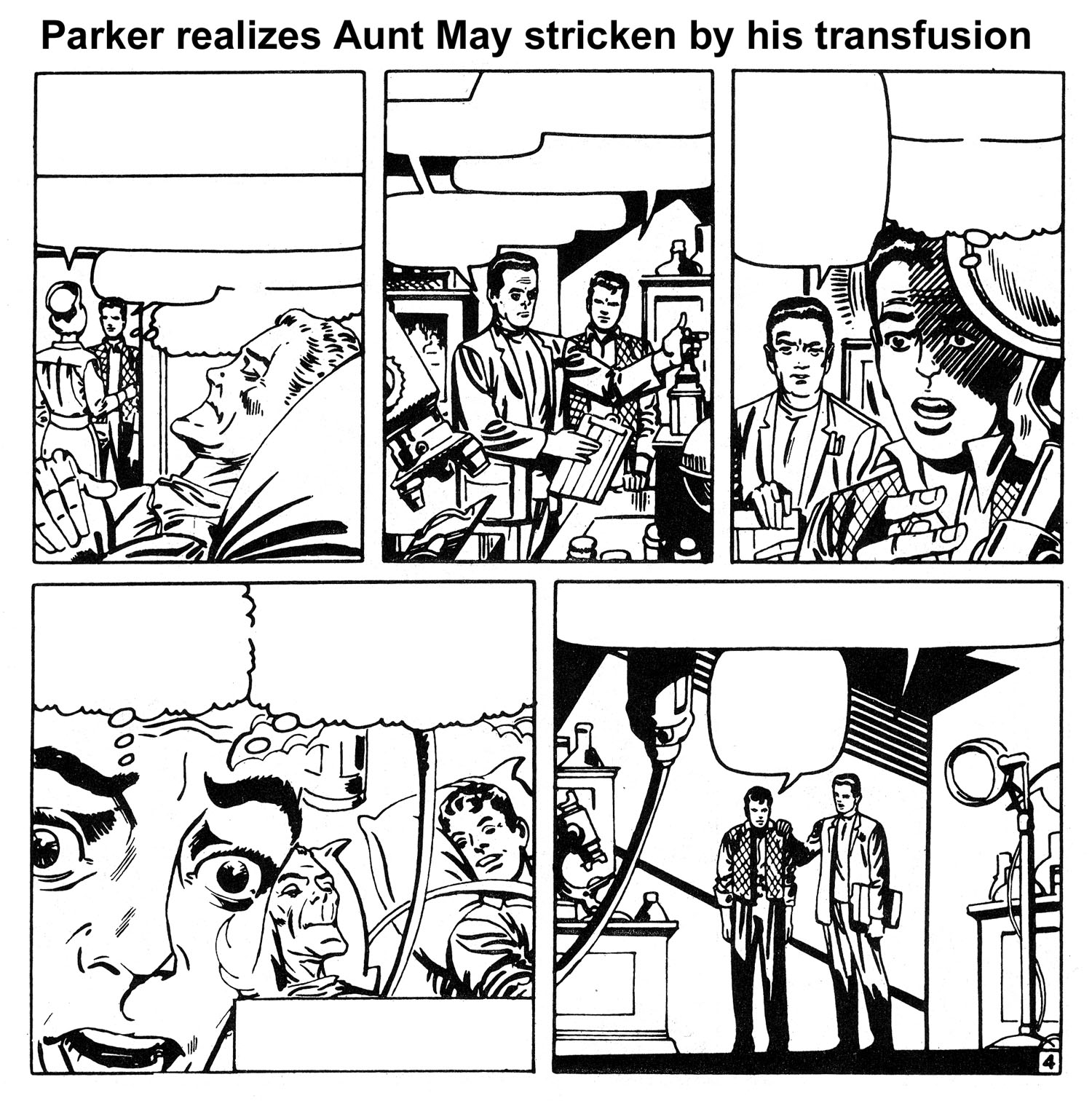
Issue #32, “Man on a Rampage,” opens in the Master Planner’s underwater hideout, and we quickly find out that he is actually none other than Dr. Octopus, one of Spider-Man’s most dangerous foes. The scene then shifts to Peter, whose relationship and money problems keep mounting. But things get even worse when he visits the hospital and the physician attending to Aunt May informs him that her terminal illness is being caused by an unknown source of radioactivity in her blood. Peter immediately realizes that the radioactivity must have come from his contaminated donor blood which Aunt May received during a transfusion many months earlier for a different illness.

And while the radioactivity is harmless to him, it is having a devastating effect on Aunt May. So not only was young Parker responsible for the death of his Uncle Ben when he first became Spider-Man, he may soon be responsible for the death of Aunt May. This emotional realization is perfectly portrayed by Ditko, along with Peter’s vow that he will not fail at saving a loved one again.

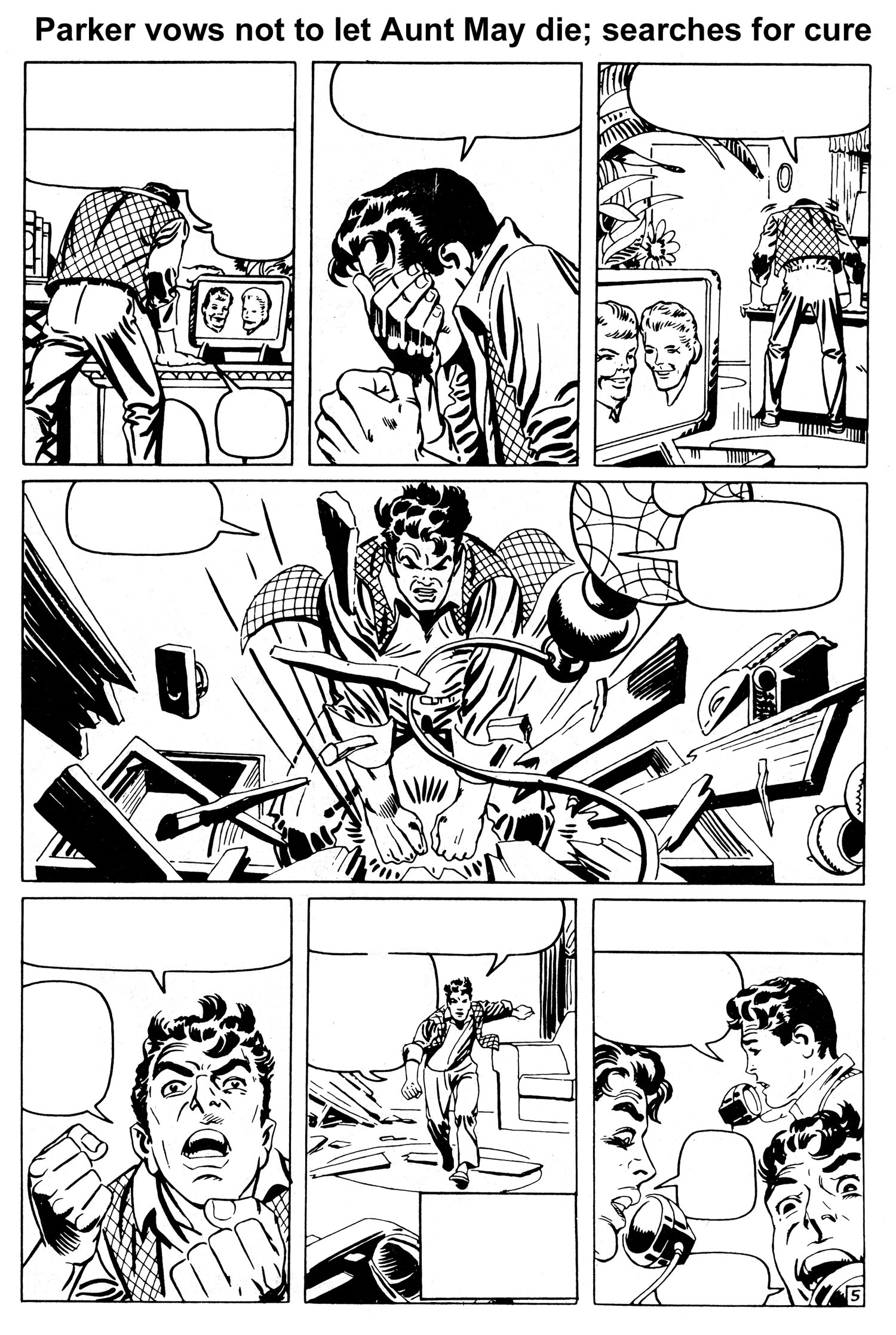
Parker then gets an idea. He tracks down Dr. Curtis Connors (aka The Lizard) – a blood specialist who he hasn’t seen since issue #6 – and, as Spider-Man, gives him a stolen vial of Aunt May’s blood, and begs him to see if he can discover a cure for his “friend.” Connors agrees and after some tests says that an experimental serum called ISO-36 might help – but it will cost money. Parker leaves, hocks all of his personal laboratory equipment, gets the money, and returns to Connors’ lab as Spider-Man. While they wait for every available bit of the rare serum to be express-delivered from across the country, Parker, a budding scientist in his own right, helps Connors with some preliminary lab research. Suddenly, Connors gets a phone call informing him that the ISO-36 was stolen by the Master Planner’s henchmen, and Spider-Man explodes into action.

In an effort to find the precious stolen serum, Spider-Man literally does go on a rampage, snatching up criminals and stoolpigeons, smashing down doors and rooting through every underworld nook and cranny across the city for any possible leads. As the clock ticks, we see Aunt May slip into a coma, Dr. Connors patiently waiting, and a desperate Spider-Man becoming more and more frantic.

Suddenly, after swinging into a blind alley, his Spider-Sense points him to a hidden trapdoor leading to the underground tunnel entrance for the Master Planner’s underwater hideout. Battling through dozens of henchmen, he slips through a sliding doorway into the tunnel. Alerted by one of his men that Spider-Man is searching for the stolen ISO-36, Dr. Octopus decides to use it as bait so he can kill Spider-Man, once and for all.

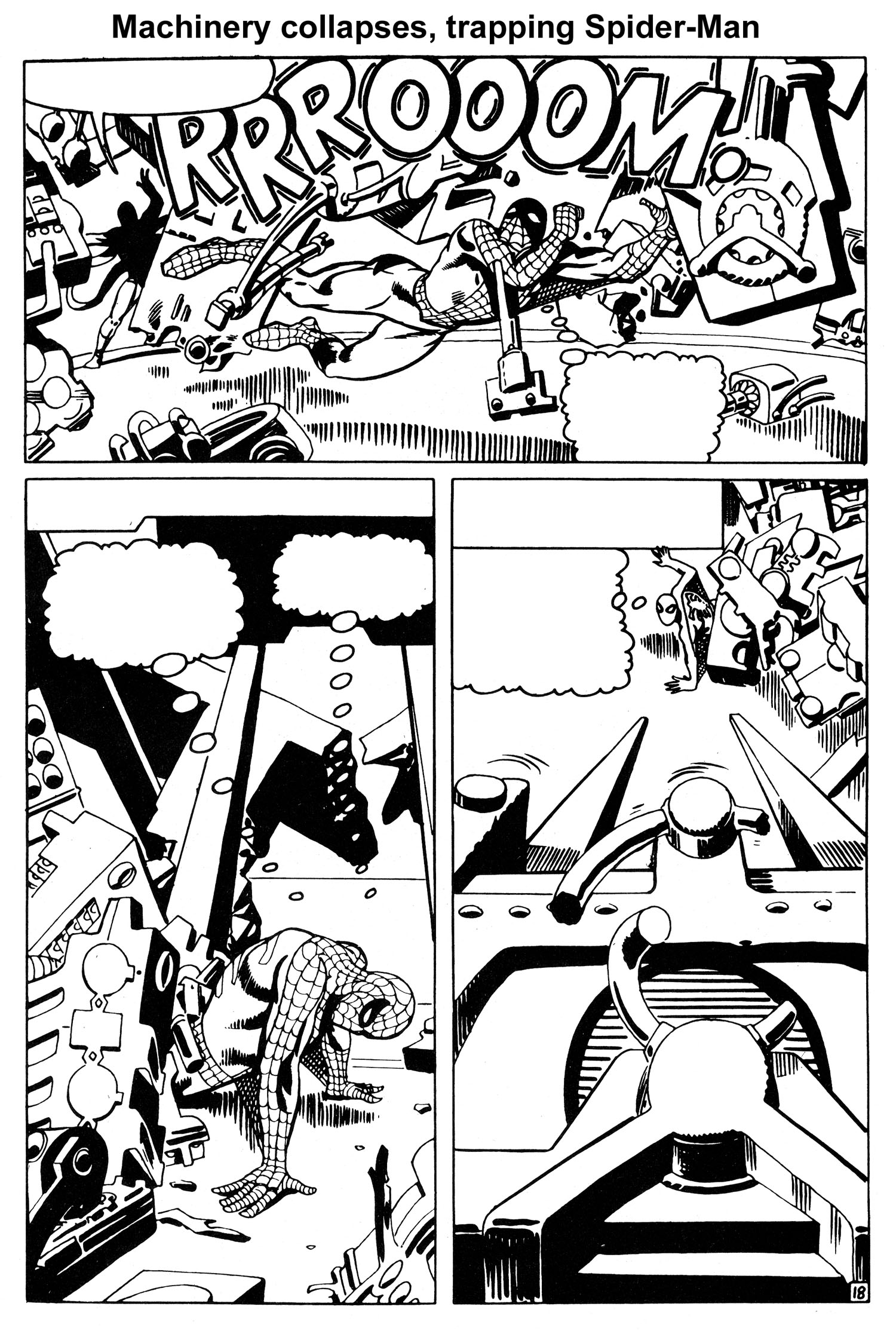
He places the serum in the middle of the cavernous domed main room of his underwater lair, and waits. Spider-Man enters, and despite a last-second warning by his Spider-Sense, the trap is sprung and a raging battle ensues. But Dr. Octopus soon finds out something is different this time, as Spider-Man is fighting like a man possessed. Startled, Dr. Octopus quickly shifts from offense to defense, and within minutes is no longer fighting, but trying to find a way to escape the madman he is facing. A main support beam is shattered during the fight, and as the machinery inside the dome begins collapsing, Dr. Octopus slips away. But Spider-Man is trapped.

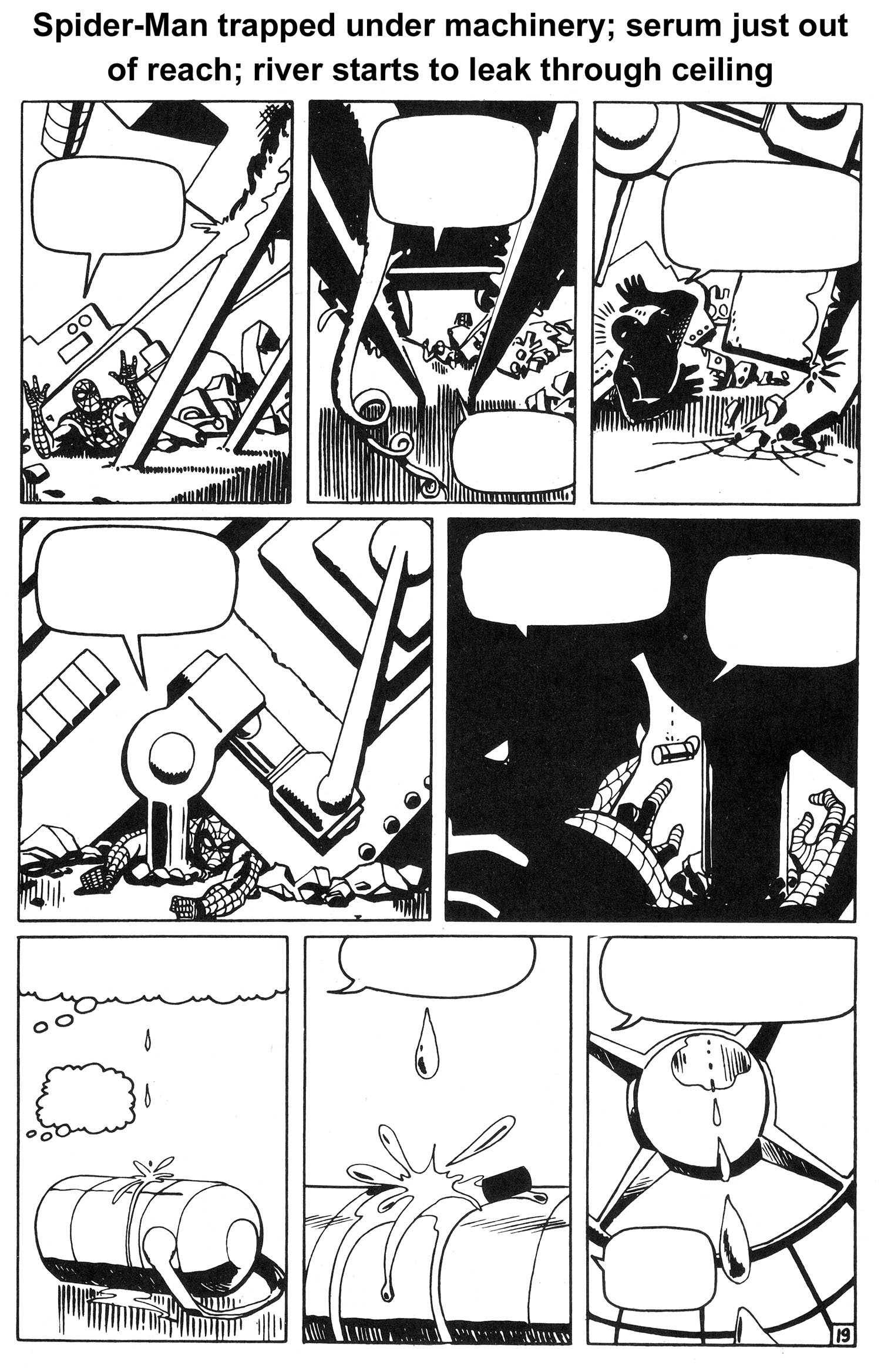
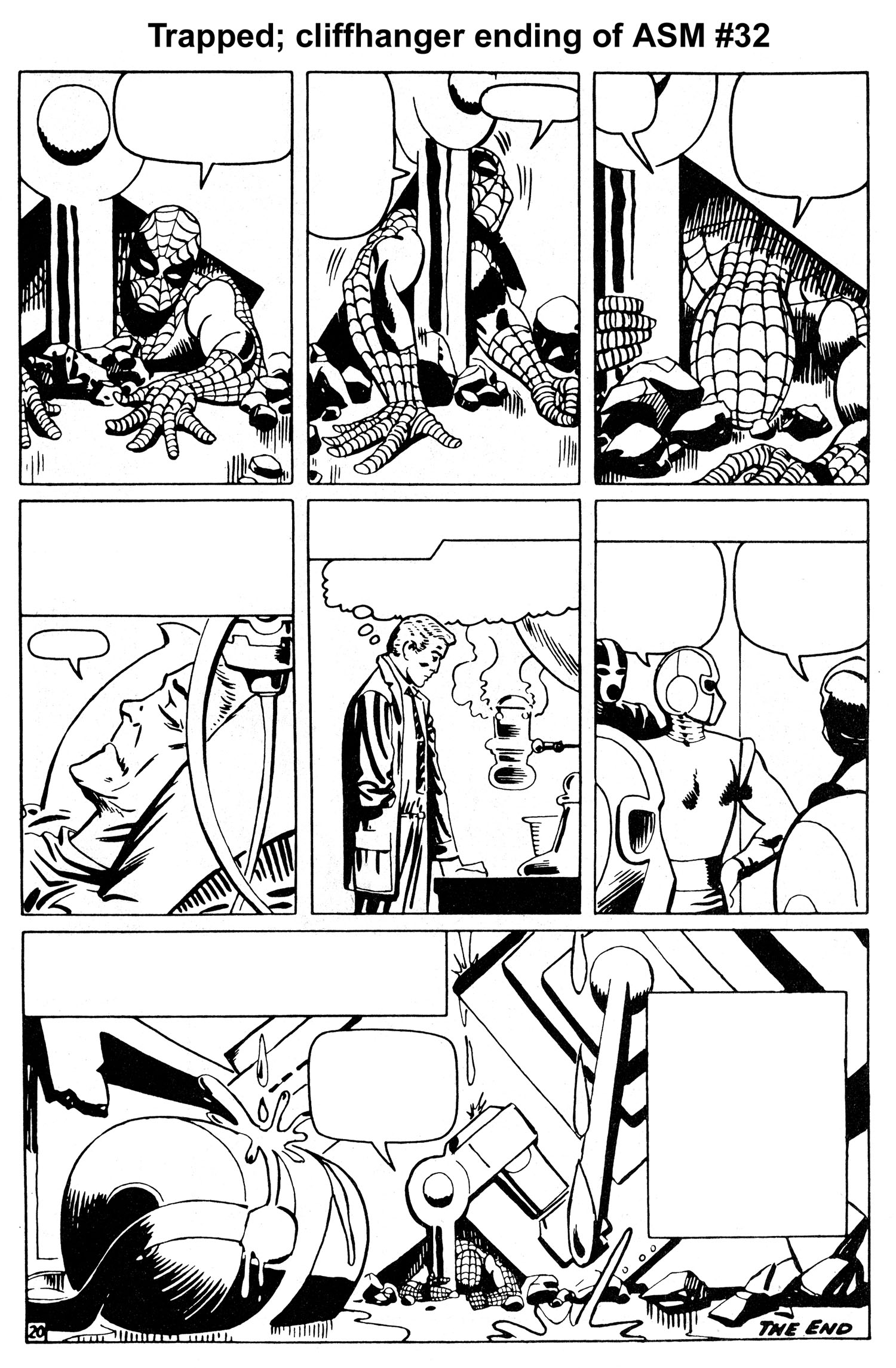
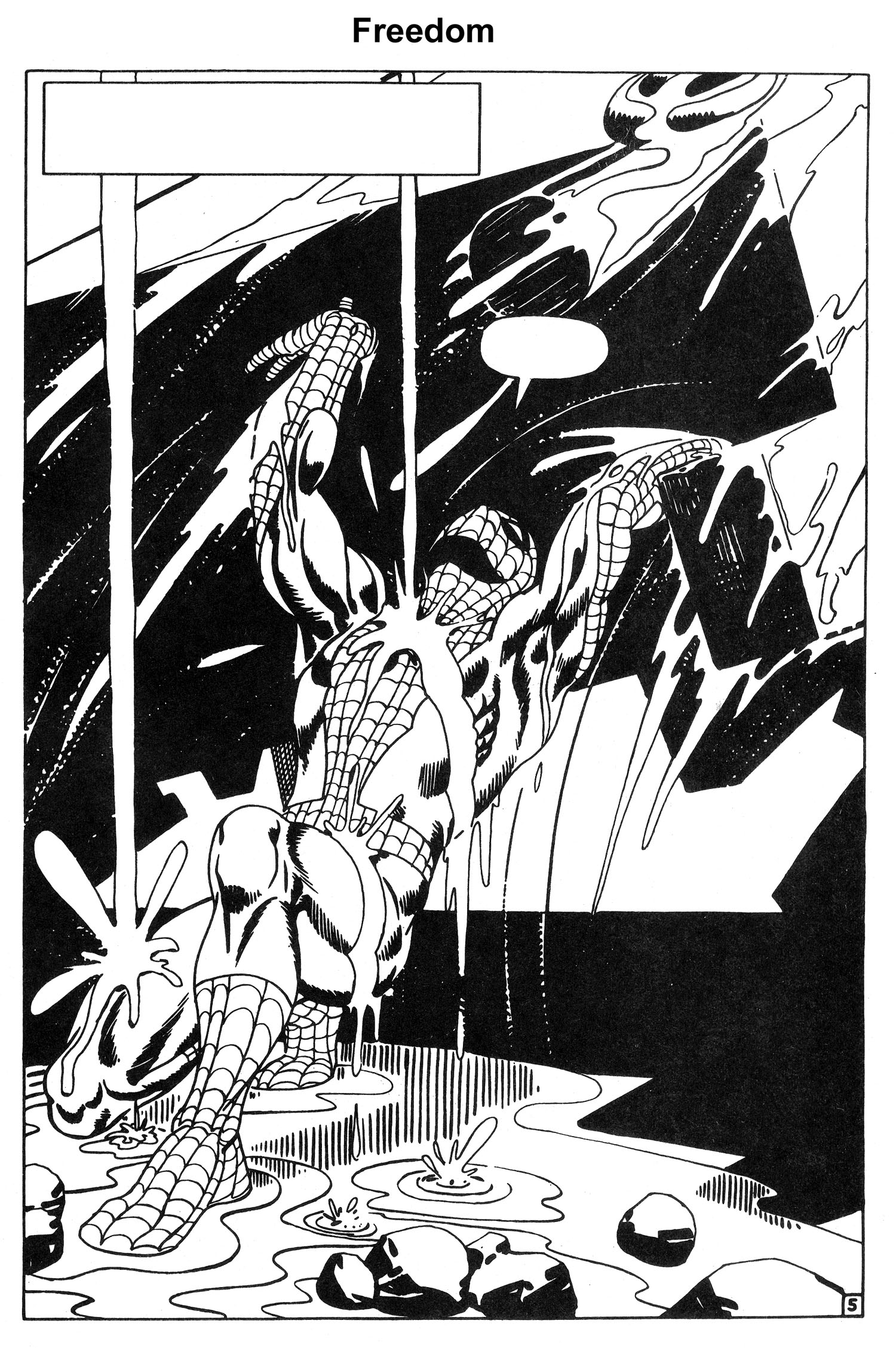
For the last three pages of issue #32 and the first five pages of issue #33, Ditko creates the most masterful bit of sequential art of the Silver Age, and possibly ANY age. It is an artistic tour de force that needs no words to convey the story. The drama, stakes and emotional tension of the main character could not possibly have been wound any higher as issue #32 came to a close. And I don’t think there was a sentient reader alive back then who wasn’t gnawing his/her fingernails to the bone waiting to find out what was going to happen in issue #33.

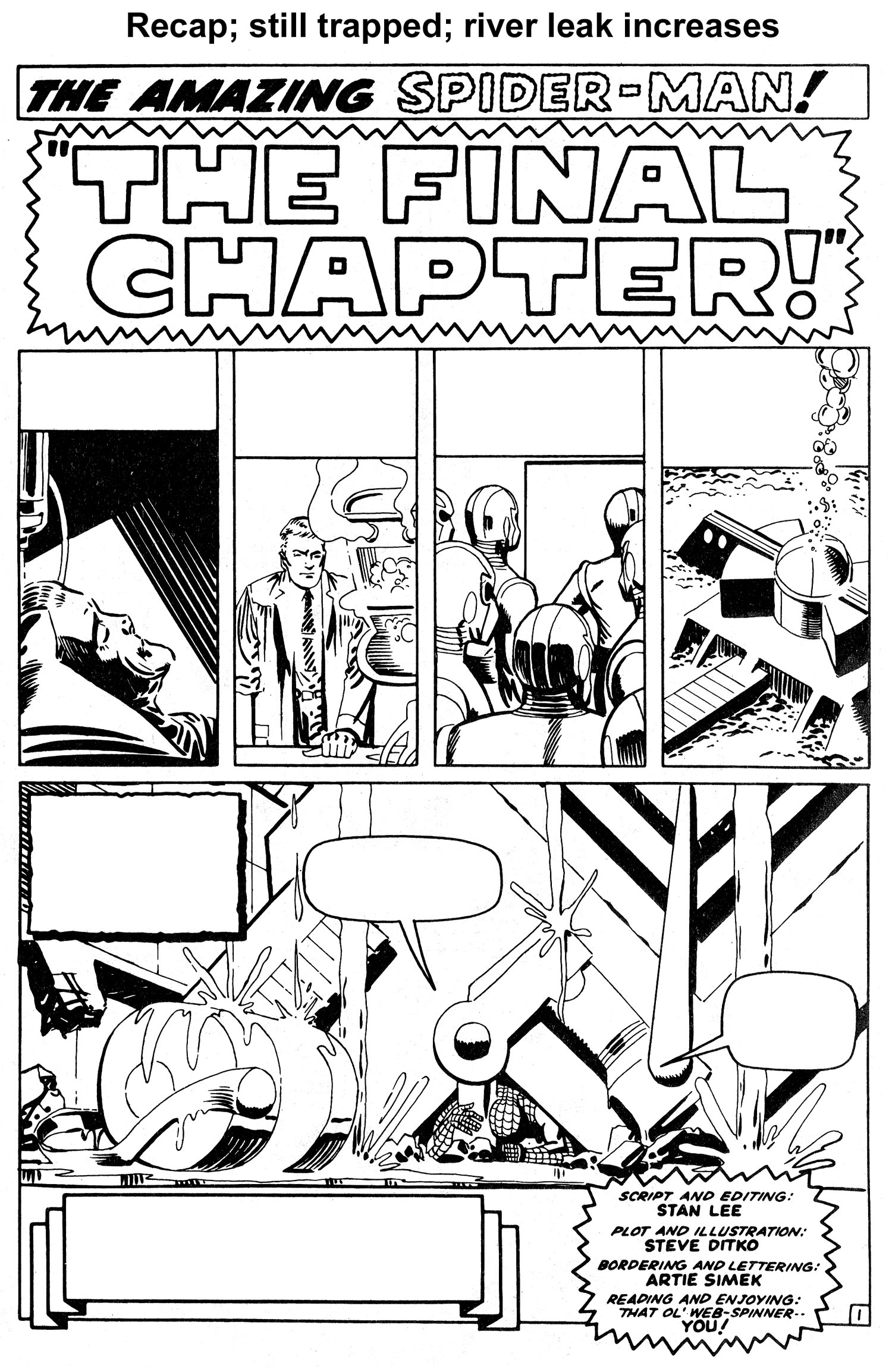
As issue #33, “The Final Chapter,” opens, the powerful visual sequence begun in the previous issue continues. After a four-panel recap, we see a hopelessly-trapped Spider-Man buried under the weight of an enormous mass of machinery as the main room of the underwater hideout of Dr. Octopus begins to flood. Aunt May is dying, and the serum he needs to save her lies on the floor in front of him, just out of reach.

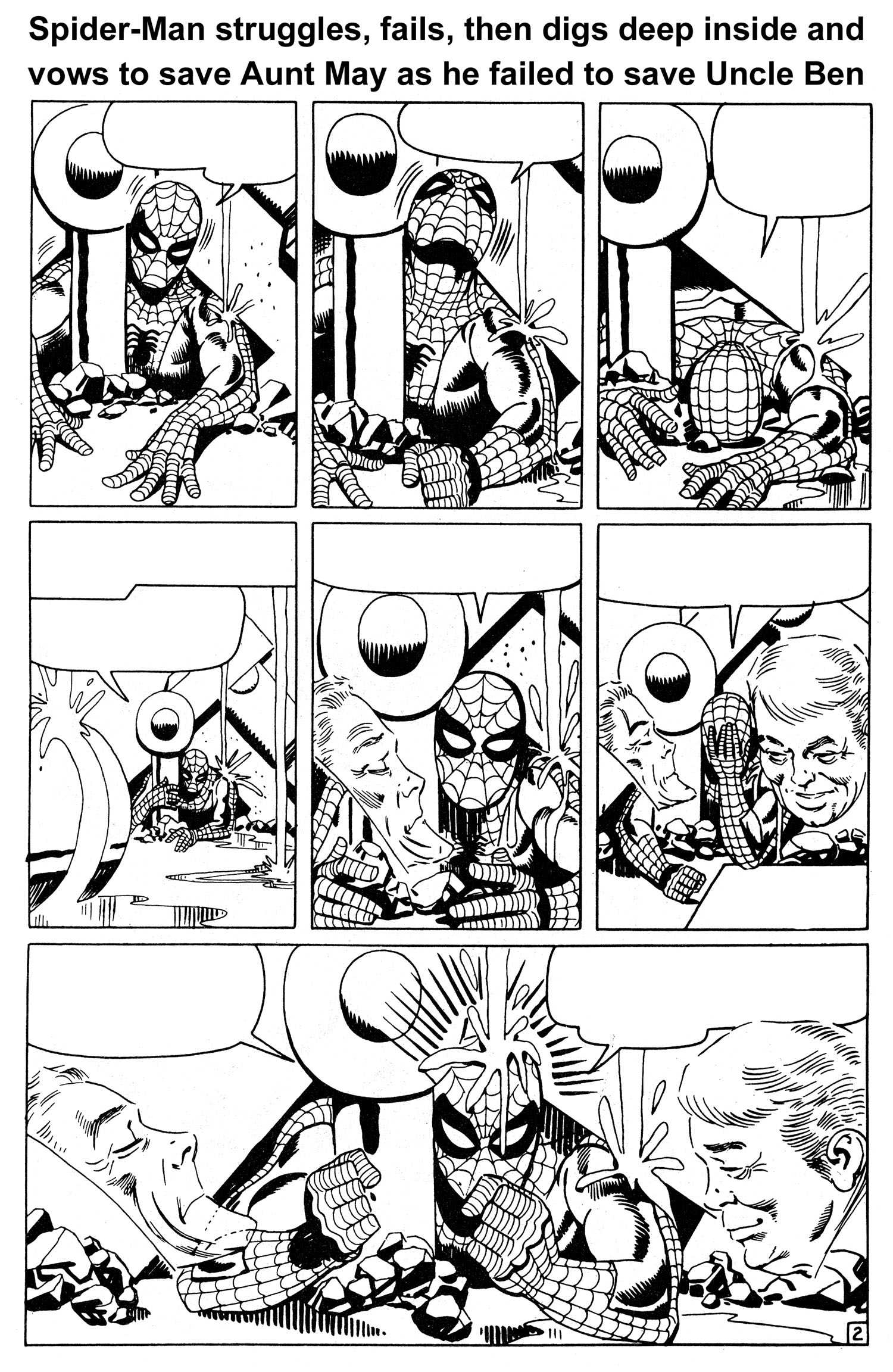
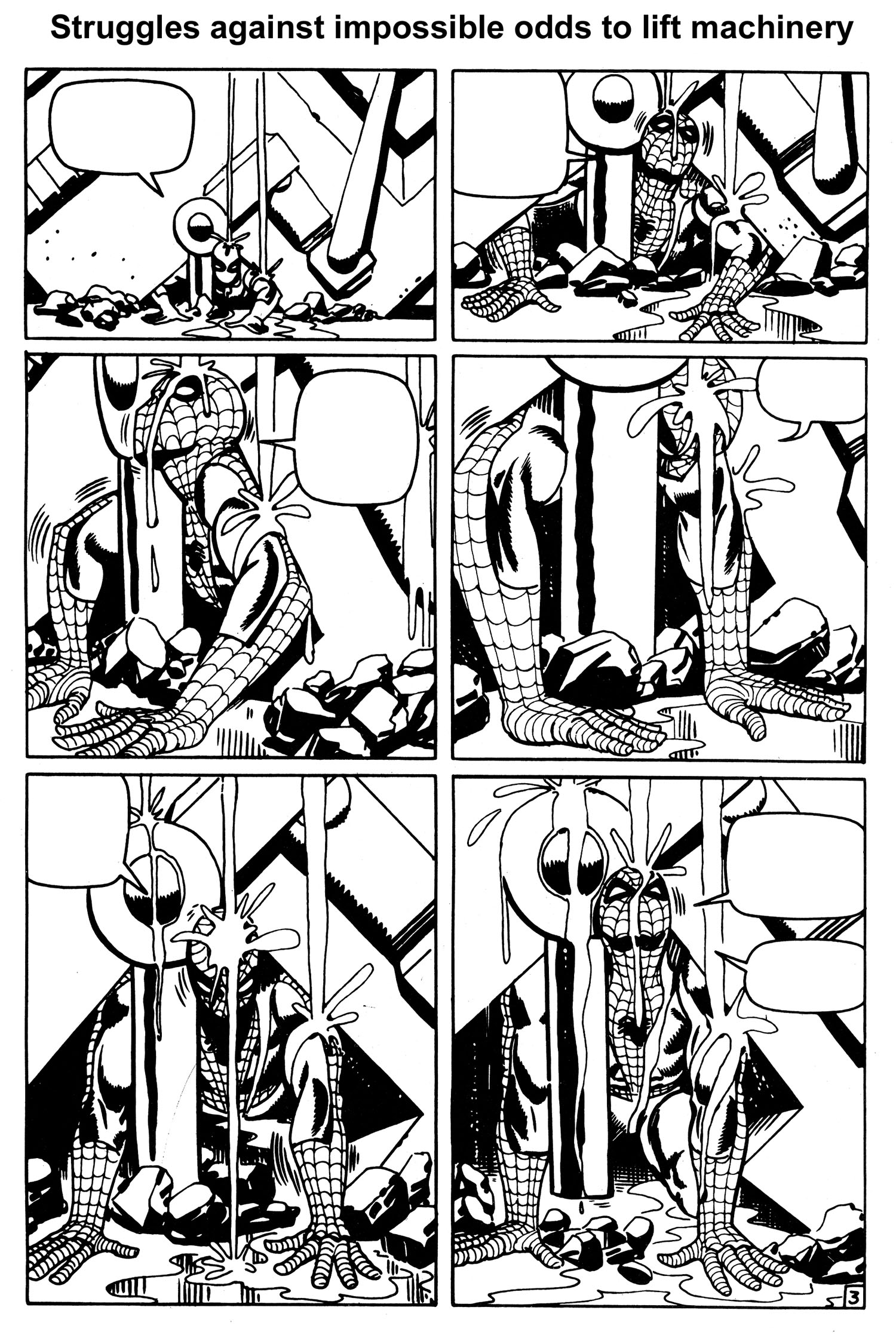
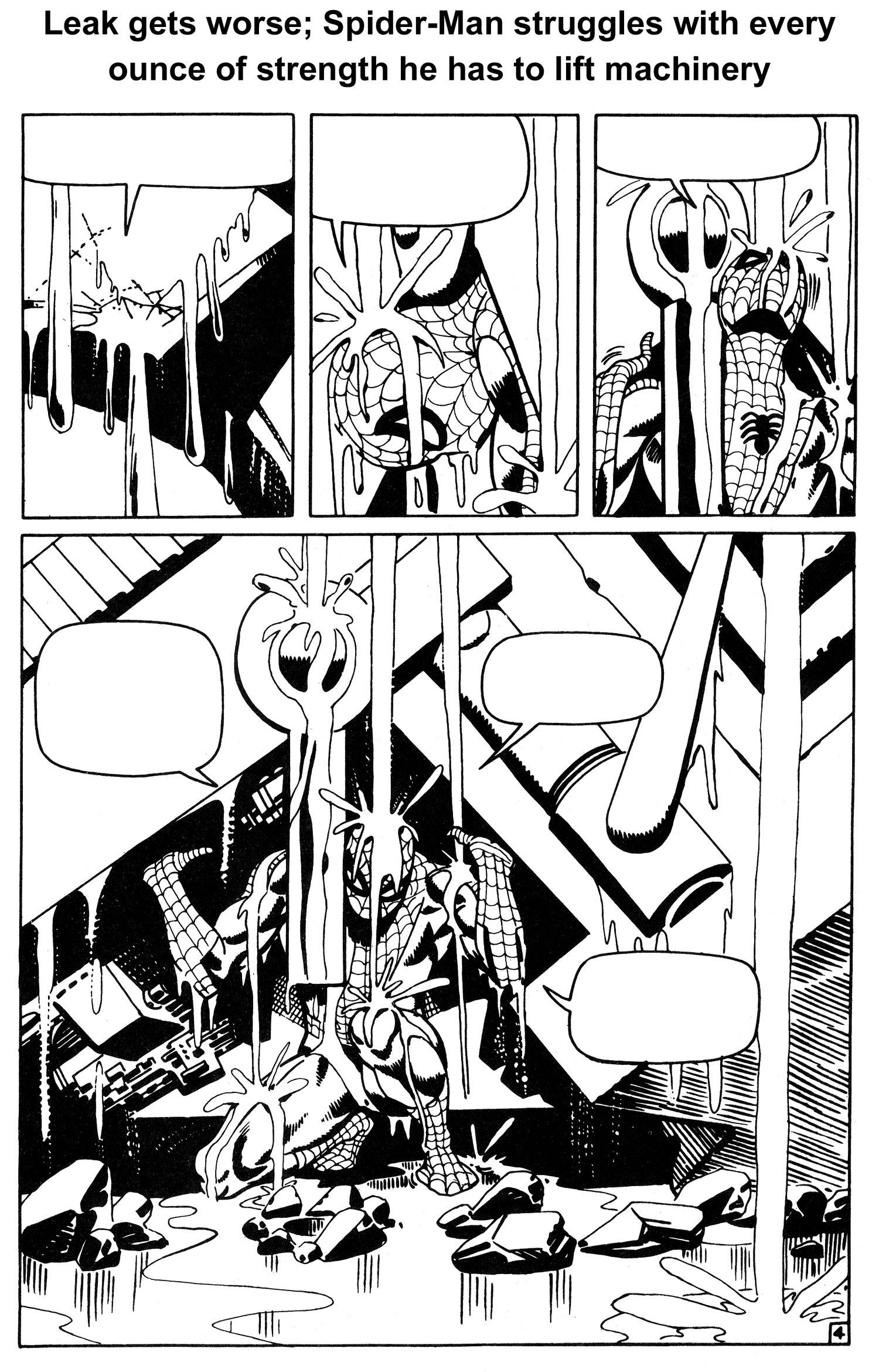
And just when you think it’s over for Spider-Man, and that he’s doomed to die, he once more thinks of Uncle Ben and Aunt May, taps a latent reservoir of sheer will and determination from his innermost being, and attempts one last time to break free. Ditko captures the agonizing struggle pitch perfectly, with sequential pacing that rivals that of the best comic book or film. And with one last mighty heave, he’s free (See Figures 7, 8, 9, 10 and 11).

But Ditko’s not finished. During the next 15 pages, Spider-Man must overcome even more physical and emotional adversity to save his aunt. But I’m not going to spoil the entire story arc. Grab a reprint of issue #33 and finish it yourself. You won’t regret it.

A few final points about the “Destiny” story arc and Ditko’s often underappreciated creativity.

First, the reason I showed wordless versions of the story’s pages was two-fold: to show how visually powerful Ditko’s storytelling abilities were, and to highlight just how crucial artists like Ditko and Kirby were to creating stories using the Marvel Method during the Silver Age.

Second, I want to make sure everyone understands just how much responsibility the artist had back then. In cinematic terms, Ditko not only co-wrote the screenplay, he was the storyboard artist, director, film editor, casting director, cameraman, cinematographer, production designer, costume designer, art director, stunt director, and set designer. Lee, on the other hand, co-wrote the screenplay, and did the “sound” editing.

So, while Lee’s dialogue certainly enhanced the story, Ditko was the creative force behind almost everything else. In that regards, if the story were a Corvette, Lee applied the paint job, pinstripes and some of the detailing, but Ditko designed the car, crafted all the parts, and assembled it.

‘Nuff said!

Cloud Hackery

Cloud Atlas
By David Mitchell

I approach contemporary science fiction with a certain wariness. Many of my friends are sci-fi/fantasy fans, and they are only too happy to recommend books. Invariably, whenever I read one of these books I’m left wondering, “Why did I waste my life reading that?” I’m not interested in reading another techno-military thriller, or a 20-volume “epic,” or a tedious story about a robot who contemplates the meaning of love. But after hearing multiple people praise Cloud Atlas, curiosity got the better of me. I’m glad to say that it wasn’t any where near as bad as I feared. I still didn’t like it , but I don’t feel like I’ve wasted hours of my life reading it. So that’s progress.

Cloud Atlas consists of six stories arranged in chronological order through the first half of the book, then the first five stories are revisited and concluded in reverse-chronological order in the second half. The stories are:

The Pacific Journal of Adam Ewing – circa 1850, a diary written by an American traveler who spends time on the Chatham Islands before sailing for home. Much of the story describes the impact of Western colonialism on Pacific islanders, particularly the Moriori, who were nearly destroyed by a combination of Maori invaders and European diseases. Ewing is a relatively decent man, but he unthinkingly embraces the prejudices of his era until he meets a Moriori stowaway named Autua. Ewing saves Autua’s life, and the latter returns the favor by saving Ewing from the villainous Dr. Goose who planned to rob and murder Ewing.

Letters from Zedelghem – a series of letters written in 1931 by Robert Frobisher, an aspiring composer who flees his debts in England and moves to rural Belgium. There, he finds a position as the understudy to a famous but ailing composer. Robert is a bit of a rake, and seems poised to exploit the composer and his lusty wife for all they are worth. But his fortunes turn for the worse after a falling out with his employer.

Half Lives: The First Luisa Rey Mystery – a crime story set in 1975 California. Luisa Rey is a journalist working for a trashy tabloid who stumbles upon a major scandal involving a dangerous nuclear power plant and a murdered whistle-blower.

The Ghastly Ordeal of Timothy Cavendish – a contemporary comedy about an aging publisher who flees his troubles and inadvertently ends up in a retirement community. The community is run like a prison and the aging residents are treated little better than criminals. Most of the story details Cavendish’s escape attempts.

An Orison of Sonmi-451 –  a dystopian sci-fi drama set sometime after a global nuclear war. Korea escaped destruction, but it is now ruled by a totalitarian-capitalist regime that relies on artificially-grown slave labor. Sonmi is one such slave, but she experiences an “ascension,” becoming fully self-aware and joining a rebellion. Sonmi is later captured and narrates the story to her interrogators prior to her execution (the orison is a recording device).

Sloosha’s Crossin’ an’ Ev’rythin’ After – a memoir by Zachry, a Hawaiian tribesman who lived in a primitive farming community long after a nuclear war wiped out most of humanity. Zachry assists Meronym, one of the last remnants of a technologically advanced society, in gathering useful information. Zachry is eventually saved by Meronym after his village is wiped out by a more violent tribe.

The stories are interconnected in several ways. All the lead characters except Zachry possess the same comet-shaped birth mark, and Mitchell has acknowledged that they are a single reincarnated soul* (Meronym is the last reincarnation). Each story also acknowledges the existence of the chronologically earlier story. Frobisher reads Ewing’s journal, Luisa reads Frobisher’s letters, Cavendish reads a book starring Luisa, Sonmi reads a book about Cavendish, and Zachry encounters the orison that recorded Sonmi’s confession.

And there are themes common to all six stories, particularly the universality of violence, conquest, and exploitation. Ewing is a witness to Maori and European imperialism, and he is personally the victim of deception and violence. Frobisher is exploited by his employer. Luisa is nearly murdered by the corrupt owners of the nuclear plant. Cavendish is cruelly treated by the “caretakers” at the retirement community. Sonmi is enslaved, manipulated, and finally executed by an oppressive state. And Zachry’s entire world is destroyed by a predatory tribe. But Mitchell also acknowledges a gentler humanity that can triumph over our baser instincts. Autua saves Ewing, just as Meronym saves Zachry several centuries later.

For Mitchell, the triumph of good over evil is dependent on story-telling. This is particularly evident in Sloosha’s Crossin’ an’ Ev’rythin’ After.  As they lynchpin story, it binds the chronological narrative to the motifs that reoccur in the other five stories. It largely succeeds in highlighting Mitchell’s themes about human predation versus the “ascension” of the human spirit. Much of the story involves Zachry and Meronym fighting or evading the barbaric Kona tribe. Also, while Zachry’s tribe is more peaceful, he himself repeatedly struggles with violent impulses. At one point, Zachry actually has a conversation with the Devil (Old Georgie) and barely resists the temptation to murder Meronym. And Zachry’s tale suggests the moral value of story-telling. Zachry is the only survivor of a brutal attack on his tribe, and he eventually re-settles with Meronym’s people, who record his memories. His spiritual struggles and moral triumph serve as a inspiration to the surviving humans.

This theme re-emerges at the end of the second half of the Adam Ewing story (which is also the end of the entire novel). Ewing narrowly escapes murder at the hands of a (white) doctor who embraces a nihilistic, predatory philosophy. Ewing is saved by Autua, a dark-skinned ex-slave. These events cause Ewing to rethink his entire worldview, and he decides to become an abolitionist. In his words, “If we believe humanity may transcend tooth & claw, if we believe divers races & creeds can share the world … such a world will come to pass.”

So there are plenty of ideas bouncing around the book, and its division into six stories allows Mitchell to explore those ideas in six different genres. In each story, Mitchell demonstrates basic skill as a genre writer, whether he’s writing faux-memoir, mystery, or science fiction. In theory, Cloud Atlas should be an exciting and challenging book. In practice, the book fails to live up to its pretensions, largely because Mitchell’s ideas are not as profound as he seems to think they are. To summarize the main points of the book: if people choose to be good, then the world will be a better place. And story-telling is an effective way to convey moral lessons. The obvious response to these points is “No shit!” People have been well aware of these insights for at least the past two thousand years.

A more interesting observation might involve asking why people continue to do immoral things despite the countless stories intended to teach a moral lesson. If Cloud Atlas is any indication, Mitchell’s answer would be that humans are naturally predatory (they have an inner Old Georgie) and so there will always be at least some people who are violent, cruel, and selfish. That’s partly true, but it elides the fact that many violent, cruel, and selfish people nevertheless consider themselves moral, and they may even behave with kindness in a different context (for example, in the treatment of their own family). A sophisticated view of morality would have to look beyond a simplistic predator/victim relationship.

I don’t see much moral complexity in Cloud Atlas. The “good guys” are always likable, POV characters. They may be flawed, but their flaws are surmountable or at least forgivable. Ewing starts off as a racist, but he has an epiphany and embraces racial egalitarianism. Luisa Rey pursues journalistic truth and saves lives. Sonmi achieves greater self-awareness and defies a totalitarian state. Zachry resists temptation. Even the self-absorbed Frobisher isn’t that bad a guy, and he ends up being rather sympathetic in his final days.

The “bad guys,” on the other hand, are a uniformly reprehensible lot with no redeeming qualities. Dr. Goose is a psychopathic murderer. The businessmen in Half-Lives are almost comically villainous. The “caretakers” encountered by Cavendish are petty tyrants. And of course there is an oppressive state and the violent Kona tribe in the last two stories. Because Mitchell leans toward a simplistic, good vs. evil dichotomy, he can’t offer deeper insights about human morality. And without these insights the stories can only be described as forgettable genre works.

For example, Half Lives was a crime thriller, so Mitchell could draw ideas from an enormous collection of works. But while Mitchell replicates the basic formula and rhythm of a crime thriller, he doesn’t create a particularly compelling or memorable story. It’s an “airport novel” with a few liberal biases: corporations are evil, nuclear power is bad, journalists are noble heroes, etc., etc. All that righteousness becomes rather tedious, and it weighs down what would otherwise be a decent plot. Nor does it help that Luisa Rey is a dull heroine who stumbles through her own narrative while side characters perform all the heavy lifting.

An Orison of Sonmi-451 had far greater potential, as it borrows concepts from Huxley, Orwell, and the other great writers of dystopian fiction. In one sense, it’s an extremely derivative story, and Mitchell openly acknowledged his inspirations (primarily Brave New World and 1984). Being derivative doesn’t necessarily have to be a mark against it, as writers are constantly stealing ideas from each other. But Mitchell only steals the surface of ideas, and he adds nothing new to the genre. Huxley was interested in the relationship between eugenics and class (mostly because he belonged to a a family of eugenicists), while Orwell was interested in propaganda, particularly the manipulation of language. Mitchell touches a little on eugenics and propaganda, but he does little more than regurgitate older ideas. He’s far more interested in writing a story about a heroic slave who triumphs over her oppressors, even from beyond the grave. Though she was executed, the novel suggests that Sonmi’s confession become public knowledge and inspire a slave rebellion. She even comes to be worshiped as a goddess in Zachry’s time. It’s so predictably uplifting I wanted to puke.  I’m not suggesting that the triumph of good over evil is objectionable per se, but it seems absurd to take the ideas of dystopian futurists and tack on a happy ending straight out of a Hollywood blockbuster.

Though the happy ending approach may explain why Cloud Atlas will soon be in a theater near you.

_________

*BBC audio interview