Feel Good Muppets

A version of this review first ran on Splice Today.
_____________________

Jim Henson’s televised 70s Muppet Show was an erratic blend of bad puns, pratfalls and surreal, drugged-out humor. An awkward Kris Kirstofferson cracking up onscreen as he sings a love song to a pig; Gilda Radner stumbling through Gilbert and Sullivan tunes accompanied by a seven-foot tall carrot; a giant monster warbling “I’ve got you under my skin” to the civilian he’s just ingested — it was 2nd-rate vaudeville on large amounts of weed performed by shockingly inventive puppets. The Muppet Show never managed the sublime fuddy-duddiness of Peanuts or the anarchically perfect rhythm of Monty Python, or even the occasional brilliant creativity of Sesame Street, but at its best it had a joyously random, unpretentious low-fi charm. I no longer think it’s one of the best television shows of all time the way I did when I was younger, but I still love it.

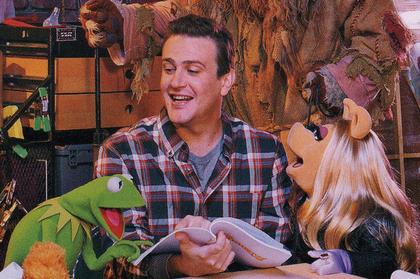
Which is why the recent film The Muppets made me want to vomit. The clunky sporadic brilliance of yore is gone; in its place is a big, slick, hollow juggernaut, slathered in nostalgia, sentimentality, and a hollow winking irony meant to substitute for humor or ideas. The film puts at the center of the narrative a boy named Walter, who was unaccountably born as a muppet. Out of place in the human world, he provides the pedestrian coming out narrative which has allowed liberal critics to fall all over themselves with enthusiasm. Plus, Walter talks all the time about how great the muppets are and how brilliant the muppet show was and OMG I love the muppets, muppets, muppets. Chris Orr at the Atlantic characterized this as a ” a tidal surge of joyful nostalgia,” but to me it just felt like I was watching a two-hour commercial for the two-hour commercial I was watching. Every gag — Fozzy’s stupid jokes, Gonzo’s “zaniness”, the Swedish chef’s funny accent — is refracted through its own smug self-satisfaction. Which I guess is supposed to distract us from the fact that, for example, Gonzo never actually does anything nearly as wacky as eating a rubber tire to the music of flight of the bumblebee, and Walter, our exciting new muppet, is visually boring as fuck, almost like he was designed by a committee of Disney executives rather than by Jim Henson.

As if Walter’s tedious coming-of-age weren’t sufficient, we also have to suffer through the by-the-numbers bildungsroman of his brother Gary (Jason Segal), who has to learn to commit to his girlfriend of 10 years (Amy Adams.) And of course Kermit and Miss Piggy also must declare their love for one another (as if there was ever any indication in the original show that Kermit liked, much less loved the pig). Even fucking Animal self-actualizes. Everyone learns life lessons and becomes closer together like a family and finds their real place in life, and there are whole scads of big musical dance numbers which are all slickly choreographed and filled with happy lyrics like “Everything is great everything is grand I got the whole wide world in the palm of my hand.” It’s funny, see, because it’s so overly cheerful, just like the original muppet show, and now we’re grown up and know better, but it’s still fun to pretend we think the world is all sweetness and light for the kiddies, right?

The only problem being that the original Muppet Show wasn’t saccharine at all. It was goofy and dumb. It wasn’t about people finding their true place in the world. It was about people falling into holes or transforming their hands into puppies or having random objects fall on them from the ceiling. It was empty-headed, often inventive, sometimes idiosyncratic fun. Period. And now Disney has taken it and transformed it into a paen to finding your own bliss which is utterly indistinguishable from every other wretchedly self-congratulatory paen to finding your own bliss that’s ever defaced a multiplex. Walter’s reverence is supposed to have given new life to his beloved Muppet idols, but instead it’s just buried them in the same old shit.

I’m actually glad I watched this: New Tricks (BBC)

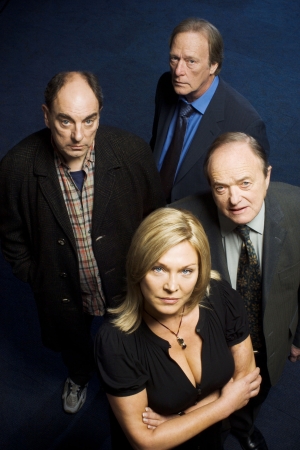
picture of the cast

As longterm readers of HU know, I refuse to pay for cable and generally rely on Amazon and Netflix instead.  This sometimes results in rather unfortunate viewing experiences, but this time, I was caught up, rapt, watching episode after episode, grumbling fiercely when the disk arrived a day later than expected and ordering whole seasons on Amazon with reckless abandon.

But why, you might ask, has this show seized the (ultra picky) Vom by the heart and held on?

Because it is good.  Really, really good.

The premise of the show is this: An up and coming cop named Sandra Pullman is put in charge of a small squad (called UCOS) of retired ex-coppers.  They take on old and unsolved cases, working for the police but coloring a little outside the lines.

There’s Sandra, who has given up her life to be a copper, a beautiful woman in a man’s world where they expect her to serve the coffee and get patted on the butt.  She’s very alone.  I love Sandra like burning.  She is also a very dominant woman–in the pilot, there’s a small brawl and you get to see Sandra punch several people out.  She’s stuck heading this team because she’d been on a big case and then screwed up publicly.  The brass reassigned her in a kind of lose-lose way–if she screwed up again, no big deal, you’re fired.  If she succeeded, they could take the credit for a new, exciting initiative.  The political machinations inside the police force (and in other aspects of life) is a major theme of the show. Sandra uses modern police methods (DNA testing, forensics, modern procedures) and has a very honorable, rule-following nature, as well as being tough and no-nonsense.  She is my very favorite.  She also happens to be smoking hot, which is a bonus.  My goodness she looks good when she glares.  *insert happy little VM sigh here*

There are three retired ex-coppers
There’s Gerry, who loves good food, gambling, and the pleasures of the earth.  He has three ex-wives and many daughters–he’s a bit of a chauvinist and most of the force assume he’s bent as a corkscrew, but he has more morals than most people, even if he sometimes screws up.  A bit Yohji-ish at times, if Yohji was paunchy and balding slightly.  He’s still friends with all his ex-wives and they all have dinner together, visit him in flocks at his bedside when he’s in hospital, and generally make his life….interesting.  When his loved ones get ill, he cooks at them.  (I can totally relate to this, as I have a strong urge to make casseroles, pies, or soup at people.)

There’s Brian Lane, who is neurotic as a shaved weasel and probably has more brainpower than the average building full of supercomputers.  He reminds me a little of the Pookster, actually.  He’s twitchy and sensitive, very smart, and kind of crazy.  But he is also the empathetic of them and has a way with witnesses that sometimes makes me cry.  He’s so gentle and kind, it’s hard to watch.  He can be tough, too, but he feels very deeply.  He is a recovering alcoholic and is deeply devoted to his wife, Esther, who takes good care of him, and to his dogs, first Scruffy and then Scampi.

Finally, there’s Jack Halford, who is Sandra’s old boss.  He’s the hard hitting Sam Vimes-ish character.  Brilliant at understanding how people work, he can get results when everyone else fails.  He knows people from way back and he’s quite tough.  He worked in internal affairs, investigating bent coppers for a while.  One his mottos from the pilot is: do you want to get results or do you want to look nice.  Jack is also a drinker and is deeply devoted to his dead wife.  He spends a certain amount of time sitting at her grave (in their back garden) drinking and talking to her.  She (silently) often provides the insights he needs.

All three of the ex-coppers are cynical bastards and I love them for it.  They’re Very Nearly Criminals quite frequently.  They lie, cheat, and make shit up.  They gamble (Gerry), drink like a fish (Jack), and act crazy (Brian).  One of the recurring in-jokes on the show is that they all record their conversations on secret tape recorders, which is against the law.  But only if you’re police, they like to gleefully point out.

It drives Sandra nuts.  They drive Sandra nuts.

But their encyclopedic knowledge of the criminals active in London and environs over the past decades, combined with their sneaky minds, gives them the ability to solve cases that have been dead and buried for thirty years.

The show is like any mystery TV series–one case per episode, but unlike some of the lesser shows, it continues to develop characters and themes over the course of the series, and also unlike American TV most of the time, criminals or others policemen or family members continue to show up from time to time, as appropriate.  Over several seasons, the mystery of who hurt Jack’s wife is solved, although the mystery of what happened to the man Brian Lane was watching on his last active case for the police never is.  Some of the mysteries do not end happily–the criminals get away, or the cops have their hands tied by procedure.

What’s so wonderful is that both sides of them, the modern tough Sandra and the cynical old men, learn from each other.  They care for each other, each others’ families (what’s left of them after being coppers drives people apart), and they create their own little family.

The mysteries themselves are generally clever and unexpected.  Since it’s a British show, the seasons are quite short, but there are eight seasons so far and they’ve begun working on a ninth.  Highly recommended.

Crumbface

We’ve had several posts on race this week, so I figured I’d finish up by reprinting this piece from Comixology. I think it’s one of Jeet Heer’s least favorite things I’ve written, if that’s any incentive.
__________________________

As cartoonists go, Robert Crumb is quite, quite famous. Still, there’s cartoonist famous and then there’s rock star famous. Which is to say that for all his notoriety and the cultural currency of “Keep on Truckin'”, the Crumb image that has been seen by most people is probably still his iconic 1968 Cheap Thrills album cover for Big Brother and the Holding Company featuring Janis Joplin.
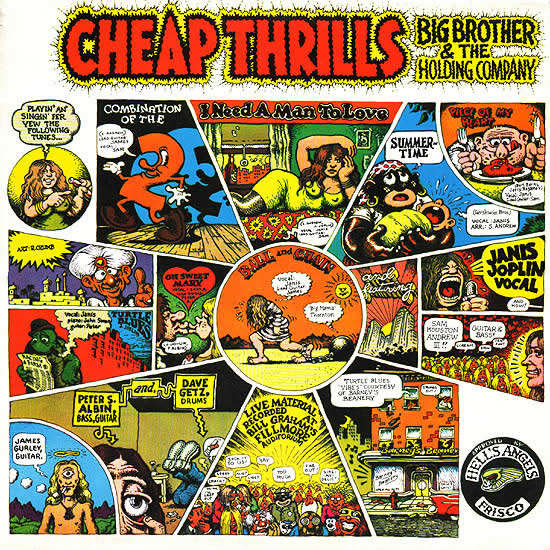
It’s somewhat unfortunate that this is one of Crumb’s defining images. Not that it’s bad. On the contrary, the inventive layout, with images radiating out from a central circle is pleasingly energetic, and the drawing, as always with Crumb, is great. Plus, cute turtle! The only thing is….

Well, it’s kind of racist.

Crumb’s oeuvre not infrequently delves into reprehensible blackface iconography. Sometimes, (as in his Angel McSpade strips) he seems to be trying, at least to some extent, to critique or mock the imagery. In the upper right of the Cheap Thrills drawing, though, he seems to use blackface simply because (a) that’s how Crumb draws black people when he’s drawing cartoons, and (b) racist iconography = funny!

The racist image in question is an illustration of Joplin’s cover version of the famous Gershwin tune from “Porgy and Bess.” The song itself, written by a Jew to capture the sound of African-American spirituals using elements from Ukrainian folk tunes, is one of America’s great cultural mish-mashes. Though its lyrics evoke the happy darky stereotype (“Summertime, and the living is easy…”) its mournful, heartfelt tune suggests a barely suppressed sadness — a weight of hardship hidden for the sake of love beneath a lullaby. My favorite take on the song is probably Sarah Vaughn’s effortlessly heartbreaking rendition. In comparison, Joplin’s hoarse bombastic reading sounds strained and clueless. The rendition is bad enough that it even becomes borderline offensive: almost the very minstrelization of black experience that Gershwin, through a kind of miracle, managed to avoid.

In that sense, Crumb’s image for the song could almost be seen as parody; a vicious sneer at Joplin’s blackface pretensions, caricaturing her as both a wannabe black mammy and as the whining white entitled brat looking to the exploited other for entirely undeserved comfort. As I said, it could almost be seen as that — if Crumb hadn’t thrown in another entirely gratuitous blackface caricature in the bottom center panel, just to show that, you know, he really is exactly that much of a shithead.

Given the grossness of the Cheap Thrills cover, it’s interesting that Crumb has, in the intervening years, gained a reputation as a particularly thoughtful interpreter of the black musical experience. His passion for 1920s-30s blues and jazz records is well known, and he’s done some cover art for blues releases. He’s also written comics focusing on blues history, perhaps the most lauded of which is “Patton” from 1984, a 12-page illustrated biography of legendary delta bluesman Charlie Patton.

“Patton” absolutely eschews blackface caricature. Indeed, it more or less eschews cartooning, opting instead for a more realist style which seems to draw from photo-reference for its portraits of Patton, Son House, Robert Johnson, and others. Walk-on characters, though, are also portrayed as individuals. A black man and woman contemplating buying a phonograph, for example, are humorous not because they’re exaggerated, but because they aren’t; their faces are fixed in ambivalent desire and nervousness as they try to determine whether this, right here, is going to break the bank.
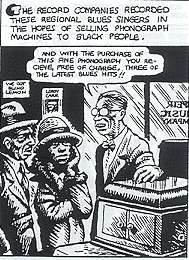
At the same time — it wouldn’t be quite right to say that Crumb dispenses with caricature. He just uses it more subtly. Some of his drawings of women in the strip are impossibly mobile, curving rubberlike to accentuate the more interesting bits:
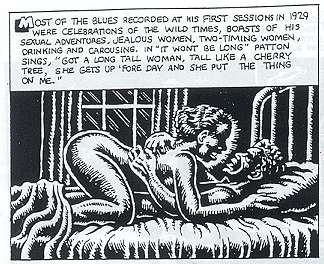
Crumb’s fascination with the female form is no particular surprise given his oeuvre. Here, though, it’s subsumed within a grander project of fetishization aimed at Patton himself. Crumb’s recounting of the bluesman’s life is matter-of-fact, but there’s little doubt that not just Patton’s musical genius but his shiftless, earthy, sex-and-violence drenched life is a huge source of attraction for the cartoonist. You can see it in the enthusiasm with which Crumb’s pen limns the posterior in that picture above, as well as in the gratuitously R-rated fight scene below:
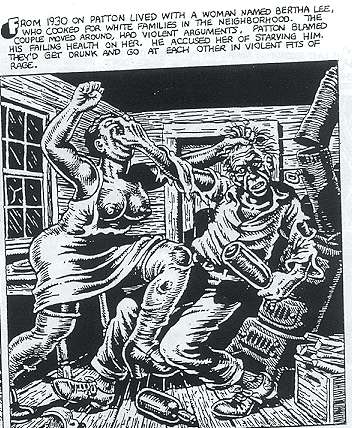
But I think Crumb’s fascination also comes out in subtler moments. There’s this passage for instance:

“The tin-pan alley blues barely touched the remote rural black people of the Delta region, where the real down-to-earth blues continued to evolve as an intense and eloquent expression of their lives.”

That statement may or may not be entirely true (the back and forth between rural and urban was arguably not quite as hard and fast as Crumb makes it out to be.) But the important point is that Crumb is making a distinction between Ma Rainey and Charlie Patton — and Patton is the one who is intense, who is eloquent, and who is “real”. In his appreciation of the form, then, Crumb has bypassed not only Janis Joplin but even Sarah Vaughn and her compatriots to arrive, at last, at the genuinely authentic expression of the blues.

In “Patton”, appreciation is not passive contemplation; it’s more like passion or desire. Crumb, for example, shows two consecutive panels of men appreciating the playing of seminal bluesman Henry Sloan. First Charley Patton looks at Sloan with an intense, almost needy fascination; then W. C. Handy looks at Sloan with a glance that holds more surprise, but no less yearning.
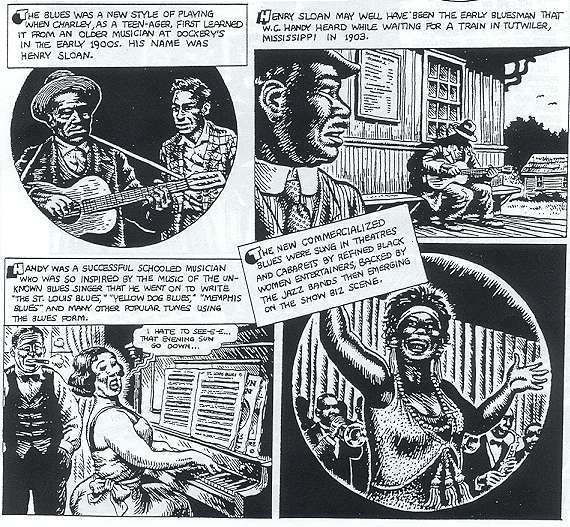
These meaningful stares are complemented a couple of pages later by this panel:
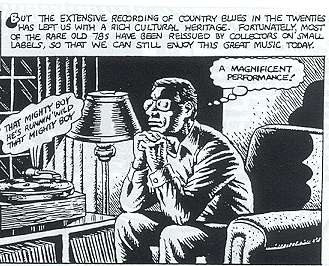
This doesn’t seem to quite be Crumb — his self-caricatures are generally instantly recognizable. But, at the same time, it clearly is Crumb; the white connoisseur who appreciates the “rich cultural heritage” of those African-Americans who (according to Crumb in the next panel) see the “old blues” as “too vivid a reminder…of an oppressive ‘Uncle Tom’ past they’d rather forget about.” Only the white listener can appreciate the lower-class, un-PC genius of the blues, undistracted by a history of oppression which regrettably (if understandably) blinds the music’s most direct heirs.

Of course, as we’ve seen, Crumb himself is responsible for at least one of the most widely disseminated modern examples of vicious Uncle Tom iconography in existence. Given that, it seems fair to wonder whether he isn’t protesting a bit too much here. Are black folks really disdainful of the blues because the music is not as uplifting as gangsta rap? Do they really see blues songs about violence, sex, and drinking as somehow Uncle Tomish? Or, you know, is the music just really old pop culture, and therefore not of particular interest to most people, as is generally the case with very old pop culture?

Perhaps the real question is not why black people don’t love the blues enough, but why Crumb loves it so much. After all, what is he getting from this story of authentic black people carousing and fighting and making great timeless art which only he and a select few like him understand?

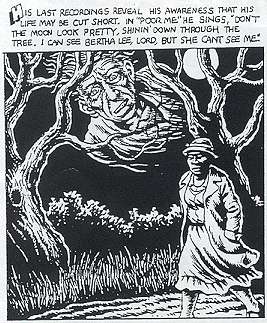
It’s not really that difficult a question, obviously. White American culture (and not just American), from Gershwin to Joplin to Vanilla Ice and Madonna (to say nothing of Elvis) has long been obsessed with adopting, miming, parodying, and exploiting black culture. Because they have been oppressed and marginalized, blacks have taken on a kind of totemic value; they and their culture are the ultimate expression of resistance to the man, of purity and heart in the face of a monolithic culture of indifference. Being black is being cool — and through his love of old blues, Crumb can be blacker than Janis Joplin, blacker than Bessie Smith, blacker than non-blues-listening African-Americans — blacker, in other words, than black. On the last page of the story, we see a ghostly Charlie Patton floating above his girlfriend Bertha Lee — and you have to wonder if that’s how Crumb sees himself, an intangible, unseen observer, both watching and inhabiting the long-dead African-Americans he animates and desires. We haven’t, after all, come that far from Cheap Thrills; it’s just that, instead of drawing blackface, Crumb has — circuitously and with less painful racist connotations, but nonetheless — donned it himself.
____________
Karen Green had a thoughtful comment at Comixology.

In fairness, Noah, the two gratuitously naked and/or nubile women you show in the Patton comic would likely have been gratuitously naked and/or nubile even if they were white woman. As a woman, I’m well aware of how Crumb prefers to depict us!

There’s no excusing the Cheap Thrills cover, however.

I think you’ve touched on something quite insightful, though, in concentrating on WHY Crumb loves the blues–especially to the extent that he loves it. There is clearly the love of the arcane, the elevation of self into a particularly rarefied aficionado. (And I would wager there are just as many African-Americans pursuing that arcane love of the blues as there are whites.) But there’s also a possibility that a man who grew up seeing himself as marginalized and miserable–regardless of how easy his life was in comparison to former slaves–might find something kindred in that music.

That possible sense of kinship is what makes the Cheap Thrills cover all the more distasteful. Like Al Jolson in blackface gleefully reading the Yiddish paper The Forvert in the film “Wonder Bar,” it’s as if Crumb has embraced that black experience but still wants to prove that he exists apart from it–a particularly unpleasant wink at the audience.

And I responded:

I’d agree that it’s hard to tease Crumb’s misogyny out from his racism. My point here isn’t that he’s racist rather than misogynist, but that his fetishization of women bleeds over and inflects his fetishization of Patton. (Through his emphasis on Patton’s sexuality, through the use of significant glances sexualizing the blues, etc.) I think you could argue that it goes the other way as well, though (that is, the fetishization of blackness as earthiness inflects his misogyny.)

Art doesn’t belong to anyone; there’s absolutely nothing wrong with white people being into blues. There is, as you say, though, something unpleasant in the way Crumb seems to want to set himself up as more in tune with “authentic” blackness than some black people — especially given his really unfortunate history with racist caricature.

_________
This is a belated entry in our roundtable on R. Crumb and Race.

Magicians and Architects

I recently visited my grandmother in Iowa. Now over ninety years old, her and my grandfather have finally moved out of their home of thirty years and into a transitional assisted care facility. Part apartment complex, part hotel and part hospital, the center provides a kind of gradated care, simply preparing meals and cleaning house for some residence, with more substantial help for others.

Before heading down for breakfast, I visited with my grandmother in her room and looked over some of her watercolors, which were hanging on the walls of her living space. Talking about her painting led to a brief discussion about technique, which in turn led her to voice the very familiar argument that art is something that can’t be taught, is in fact something inherent in someone. When I pointed out that she herself had learned from a teacher of some skill, she modified the statement somewhat, essentially saying that there was some kind of spark that could not be acquired like some techniques might be, and that it was this spark that was missing from most art.

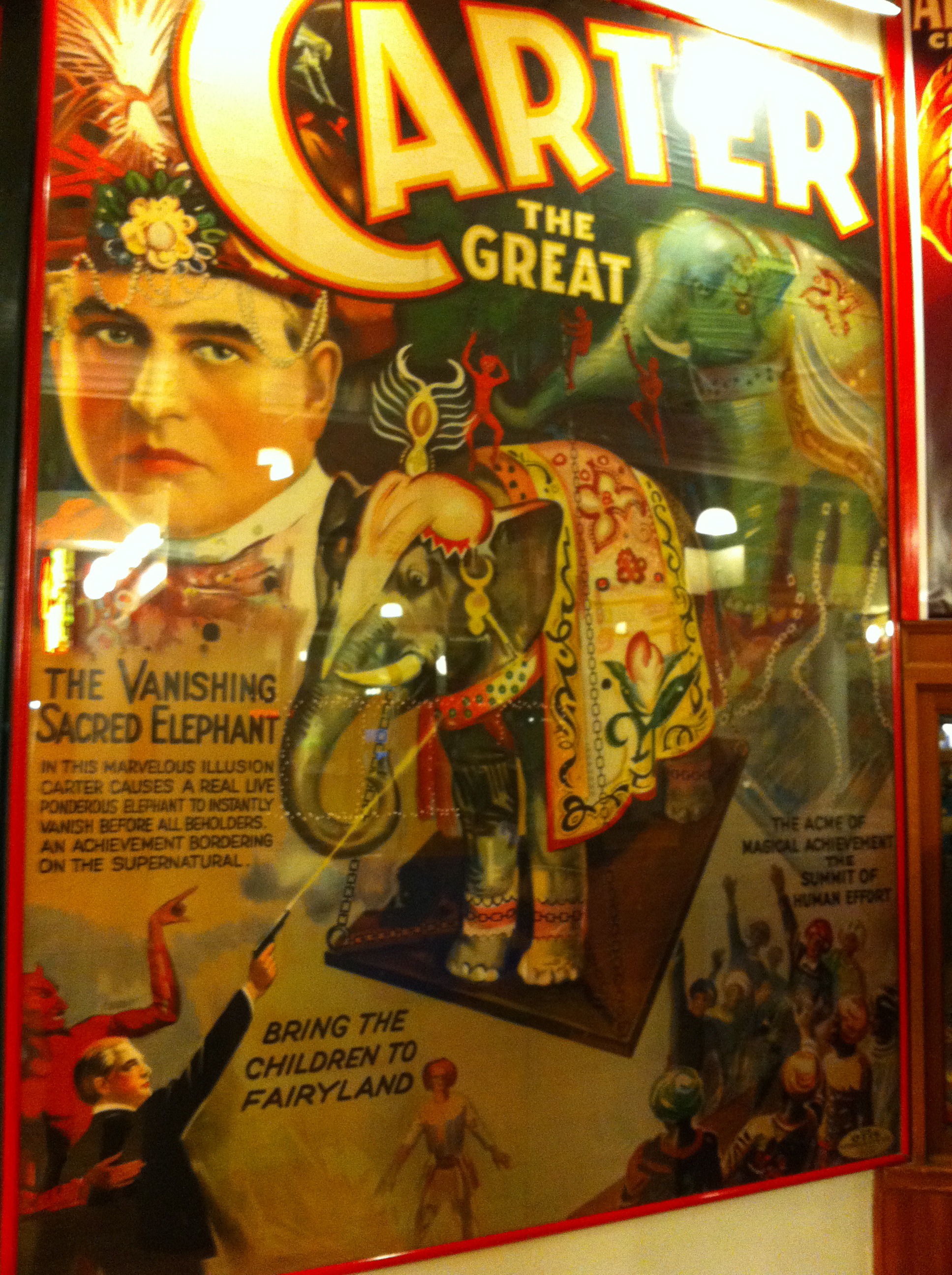
She warmed to the topic over our breakfast of rice crispies and room temperature eggs. “It’s magic that there’s not enough of,” she said and then gestured to the room around us. “Take whoever designed this place.” I looked around at the off-white room, saw the bland color, the plastic trim, the perfunctory decoration, complete with obligatory fake oil painting landscapes and little plastic flowers. “This place was designed by an architect.” She said the word with a disapproving shake of her head. “We need less architects, and more magicians.”

Instead of debating it any further, we ate our eggs and drank our watery grapefruit juice and moved on to other activities. But the division she suggested—and her judgment on the room where we ate—stuck with me for the rest of the day.

There’s something to that idea, I thought. But she has it exactly backwards.


She’s right in the sense that many, many things in our world are needlessly, almost willfully, functional alone, when there’s no compelling reason for them to be so. The room we sat in was oppressively dreary, oppressively utilitarian, with nothing but the most casual thought given to the look of the space itself. It doesn’t cost any more to build a beautiful, functional room than it does to build a dreary functional one. Similarly, a plate of eggs cost the same regardless of what temperature they’ve been served at, or whether or not they’ve been seasoned with a little bit of salt, onions, some paprika, and a hint of vinegar. I would indeed consider the eggs that my sweetheart is capable of making a kind of magic, especially when compared to what we shoveled in our mouths that morning.

But there are two things that significantly undercut the argument for magic, and the magician, or at least the magic metaphor. First, as you might have heard, magic is all about illusion, is in fact only presentation. A good magician is literally a presenter, a salesman, his creation content-less save the verve of his presentation alone. It’s a bit like non-representational painting in a way—when the subject of painting has been removed completely, the attributes of art themselves are the content, and these attributes themselves must be compelling for the painting to be successful by itself.

Secondly, the illusion of magic is, like any other technical skill, eminently teachable. Want to learn sleight-of-hand? It’ll take reading a page of directions, practicing in front of a mirror for a few hours, and more time to hone your patter. Of course, there’s aptitudes involved, and even physical limitations—dexterity, verbal skill, etc, and some magicians with only rudimentary technical skills will at the very beginning have a more convincing act than other magicians with a wider range of technical skill. But the basic skills themselves are accessible to almost anyone.

Compare this to the architect who designed the room in which we ate that dreary breakfast. Though the man may have lacked a certain surface charm or presentation to his work, his task was ultimately much more difficult than the task of virtually any fine artist. Specifically, his work had to be functional, in specific, demonstrable ways. The template that the room was most likely adapted from had to literally hold up the weight of the ceiling, had to protect the inhabitants from fire and earthquake and flooding, had to be open and spacious, had to freely circulate air, had to be easily cleanable, had to be built primarily with affordable materials and readily available modular parts.

What visual artists are ever tasked with so many requirements? Only designers of various stripes will ever have to deal with so many potentially competing requirements for their work, and certainly they will never have to deal with such heavy consequences to failure. An incompetently designed poster is unreadable, doesn’t impart information clearly, or at worst drives its potential audience away from the product it endorses. An incompetently designed building can mean discomfort or death.

In certain divisions of both North American comics and popular music there is a mistrust of the crafted, of the purposeful, a search for the authentic that manifests in a variety of ways. A comic might tell us of its authenticity by gritty subject matter that challenges some kind of conventions or taste, or by an appeal to truthfulness, or actuality (most common in autobiographical comics or even semi-memoir). Or it might manifest itself in a visual crudity, which is its own kind of claim to the authentic. Even more common is the appeal that reaches beyond the art itself, into the biography of the artist.

There is, in short, an overabundance of preciousness in much of the arts world. I can’t say that this is a recent trend, or even what may have caused it—but I can point to the anonymous nature of much of the great art of previous centuries, and the cult of celebrity that has sprung up to embrace the artist in recent history. Regardless of the cause, there’s no doubt in my mind that preciousness actively works against the ruthlessness necessary to create art as an architect—to create with a high level of function and intention. In my time teaching songwriting, it was one of my chief pieces of advice to novices—if you really want to improve, write about something you don’t care about at all. It’s harder to be ruthless, to acknowledge when something just isn’t functioning the way it was intended, when its something you feel strongly about emotionally. The same is just as true for a cartoonist—self-expression is a fine goal if a comic is literally intended only for one’s self, but the moment it has an audience other than the creator of the work, the function has radically changed.

On the other side of this divide lies the ultimate expression of the architect’s art alone, no magic and only function—pornography, romance novels, the action movie. Stripped of any artistry, or magic, these categories exist with clear functions, clear outcomes in mind. Did her heart race? Did he come? My grandmother would possibly find the comparison between her dining room and Pool Studs 4 less than useful, but for me the metaphor holds, and brings the argument back to her side of the divide. How much more interesting would a piece of pornography be if it were carried out with the artistry, with the presentation and verve, of a Melville or a Pynchon? What would a romance novel look like that violated that strict, stultifying formula, that dared interject a kind of artistry into the romantic recipe? What would an action movie look like that had all of the skill of its competitors, but had equal parts message and purpose, and even guts?

I recently re-watched Bridge on the River Kwai, David Lean’s 1957 Hollywood classic, and while it’s far from a perfect movie, it does an incredible job balancing these seemingly competing objectives. Here is a movie that performs its functions very well—it causes the heart to race, it builds tension and expectation over a tremendous amount of time and satisfies those expectations in surprising ways, and it does all of this while managing to say something larger in a meaningful and unique way, even indicting the audience’s expectations by violating them. Even more effective than Kwai are virtually any Kurosawa movie from the 1950’s, all of which were the Japanese equivalent of blockbuster genre movies, popular entertainments, that manage to each say something unique and important within that framework.

As we discuss the marginalized status of comics in contemporary culture, and the increasingly fragmented nature of the music and film industries, it’s worth thinking about this divide, and why and how it might be bridged. In the case of comics, the split is self-evident—genre comics that attempt something measurable, racing the pulse or inciting a sense of wonder, and incompetently pursue these goals without any spark of artistry or originality—or comics in which the spark is the point itself, yet often lack a functional, craft-centric grounding.

And maybe this is an argument for art makers versus art consumers—to be willing to be less precious, more ruthless with yourself and your work, or conversely, to be willing to suspend that ruthlessness at key times, letting intuition guide certain decisions.

For my taste, both as consumer and creator, I prefer work that is capable of straddling that divide, that is well-crafted, intentional, and simultaneously has that streak of verve and originality that comes across as magic. Planning, laying the groundwork, but willing to detour, to deviate when some impulse hits us, or something new seems on the horizon. Why shouldn’t we expect a little architecture with our magic?

Sundown Towns

As a belated acknowledgement of Martin Luther King day, I thought I’d reprint this piece. It first appeared in (I think) 2007 in The Chicago Reader.
______________

A couple years ago the city’s One Book, One Chicago program encouraged Chicagoans to read Harper Lee’s To Kill a Mockingbird. Those that did encountered a familiar portrait of American racism, which, as we all know, was a problem mostly in the south, mostly in the past, and mostly perpetrated by poor, uneducated white folk. The novel’s hero, Atticus Finch, is a respected white attorney in a small Georgia town who defends a black man falsely accused of rape. At the end we’re assured that most people are pretty nice once you get to know them, and left with a vague sense that the world will keep on getting more and more enlightened as long as high school students continue to read high-minded novels like this one.

As a corrective to this lyrical vision of race relations, the city should consider endorsing Sundown Towns, a new study by James Loewen, author of the best-selling Lies My Teacher Told Me, that methodically upends many of white America’s preconceived notions about race.

Sundown towns were incorporated areas that banned African-Americans from living in them, or even from staying overnight. Often, a sundown town would hang a sign or signs at the city limits declaring, “Nigger, Don’t Let the Sun Go Down on You in ________.” African-Americans who were on the city streets after dark might be harassed, beaten, or worse. Even black people on public transportation weren’t safe: whites in Pana, Illinois, are reported to have fired gunshots at African-American Pullman porters as trains passed through town.

Sundown towns aren’t exactly unknown in popular culture; William Burroughs, Maya Angelou, and Tennessee Williams all mention them. But Loewen’s book is the first systematic exploration of the phenomenon, and while the existence of such towns isn’t a shock, virtually everything else he’s found out might be. Sundown towns, he discovered, were located mostly in the west and midwest, not the south. They came into being relatively recently, mostly between 1890 and 1930, but some as late as the 1950s–and Loewen was able to confirm the existence of towns that threatened African-Americans after dark as recently as 2002. Anna, Illinois, population 5,136, is likely still a sundown town, says Loewen. It reported just 89 African-Americans in the 2000 census, most of them probably residents of the state mental hospital. Elwood, Indiana, which has zero African-American residents, an annual Klan parade, and a vicious reputation, almost surely is.

The biggest revelation of Loewen’s book, however, is not the location or continued existence of sundown towns, but their number. When he started his research he thought he would find about 50 towns in the U.S. with a history of sundown practices. But after conducting on-site interviews, he was able to confirm the existence of 145 in Illinois alone. Based on census data and statistical analysis (all carefully detailed in the book) Loewen believes that by 1970, when such towns were most common, there were more than 470 in Illinois. This means that a majority of towns in Illinois may well have been sundown towns. Statistics like these eventually led Loewen to the broader conclusion that when a state, a suburb, or a neighborhood is all white, then it is probably all white on purpose.

At first, this may seem ludicrous. When Loewen asked white interview subjects about small, all-white towns nearby, they would often suggest that African-Americans didn’t live in them because nobody in their right mind would want to live in them. Moreover, the association of African-Americans with cities is so strong that black people take it for granted as well; when I saw Aaron McGruder speak a couple years ago he scoffed at the idea of a black person living in the WB’s Smallville.

Yet Loewen shows conclusively that the historic concentration of African-Americans in cities was a matter of discrimination, not choice. Before 1890 blacks were not particularly urbanized. Shortly thereafter, however, during a period historians refer to as the nadir of American race relations, racism in the United States became much more vicious. The Klan made a triumphant nationwide resurgence; segregation and disenfranchisement solidified in the south. In the north blacks and other minorities, like the Chinese, were forced out of rural areas and small towns. The result was a phenomenon Loewen calls the Great Retreat, in which African-Americans fled to the cities and wound up concentrated in ghettos. This process was well under way when the better-known Great Migration of the teens and 20s spurred the unprecedented resettlement of blacks from the south to the north.

Sundown towns were generally restricted to the north and west, but sundown suburbs were a well-documented nationwide phenomenon. Redlining, steering, and restrictive covenants were standard in communities like the Levittowns of the 50s. Though they’re now less prevalent, not to mention illegal, such practices are still employed surreptitiously; Loewen reports incidents of steering in suburban Harrisburg, Pennsylvania, as recent as 2002. Violence against black home owners and their children has also been persistent, probably peaking during the 1980s.

The relative dearth of blacks in the suburbs–especially the wealthier ones–is often attributed to class. Statistically, blacks are poorer than whites. But Loewen argues that their exclusion from the suburbs is one of the causes of their relative poverty, not one of the effects. Until 1968 the Federal Housing Authority refused to underwrite homes built in communities that included African-Americans. Thus, African-Americans were excluded after World War II from what Loewen credits as “Americans’ surest route to wealth accumulation, federally subsidized home ownership.”

Black poverty isn’t usually blamed on the policies of white suburban home owners; instead, professors and pundits point to the excesses of the welfare system, or the failures of the welfare system, or the enduring impact of slavery on the black family, or what have you. All these explanations focus on how African-Americans live. Loewen’s book suggests, however, that if you want to understand racism in this society you must look at how, and especially where, African-Americans do not live. It isn’t what black people do but what whites do to exclude them that results in inequality. Whites won’t warehouse kids in crappy schools if the kids being warehoused are their own, they don’t want to fund massive police crackdowns if they themselves are likely to be caught in the dragnet, they don’t want to ignore fundamental flood preparedness if their homes are likely to be inundated.

Loewen does discuss some ways African-Americans can change discriminatory policies–by buying homes in mostly white communities, for example, or by supporting legislation to give federal fair-housing policies some teeth. Overall, though, Sundown Towns is not especially empowering: in Loewen’s narrative African-Americans tend to figure as victims rather than heroes.

This is largely a function of his topic. In many ways the history of racism in the north is less hopeful than that of the south. Twice the south has been the site of utopian social experiments, during Reconstruction and the civil rights era. Neither movement was wholly successful, but during both periods African-Americans were able to make important social changes because of their connections to white society. After the Civil War, African-American links with white Republicans, both north and south, gave them a voice in southern government. The Montgomery Bus Boycott was effective because African-American dollars were important to white business owners.

In the north, however, connections between black and white communities were, as Loewen reports, deliberately severed. It’s no accident that Martin Luther King Jr. encountered a harsher reception in Chicago than in Atlanta. Nor is it an accident that black leaders in the north tended to be isolationist. James Baldwin’s famous question, “Do I really want to be integrated into a burning house?,” could only have been asked by a northerner.

Loewen points out that whites who live in sundown towns see no African-Americans and thus tend to believe they have no race problems. Similarly, the north itself, where whites and blacks have historically been more separate, has long been able to convince itself that racism is somebody else’s sin. But 50 years after the Brown decision, separate is still not equal. Illinois was the land of Lincoln, it was a supporter of the Union, and it’s now the home of the nation’s only African-American senator. But it’s also heir to a brutal and ongoing tradition of racism and segregation. All our problems wouldn’t be solved if every person in Chicago read this book, of course. But it wouldn’t be a bad place to start.

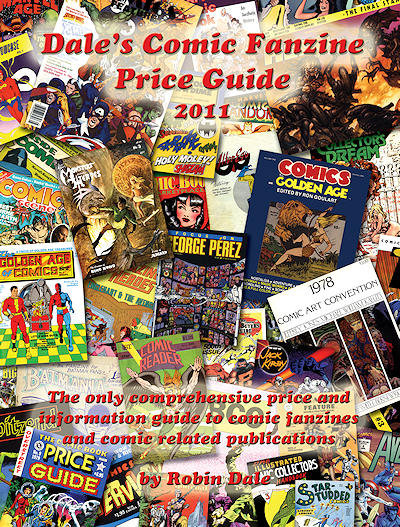
“Dale’s Comic Fanzine Price Guide 2011” Review: It’s Better Than Nothing

After years of false starts and publishing delays, “Dale’s Comic Fanzine Price Guide 2011” was finally published late last year.

I’ve been a comics fanzine aficionado and collector since the early 1970s, and have done quite a bit of research on the subject. I’ve even published a number of complete or partial indexes of key fanzine titles, such as “Star-Studded Comics,” “The Comic Reader,” and “The Buyer’s Guide for Comic Fandom” (now “Comics Buyer’s Guide). And while the TBG index only focused on the first 400 issues, it was a highly comprehensive, three-part, cross-referenced index that included 59 cover scans.

So, more than most, I have a pretty good idea just how difficult an undertaking “Dale’s Comic Fanzine Price Guide 2011” probably was. It speaks volumes that this is the first price guide in the 50-year history of modern-day comics fandom to revolve entirely around comics fanzines. Unlike professional publishers, comics fanzine publishers had highly erratic publishing schedules, frequently changed the names of their publications, sometimes had incredibly low print runs, and sometimes didn’t bother to provide even basic publishing information on the cover or inside of their publications.

That said, overall I was disappointed with this price guide for the simple fact that there is far too much information missing.

Yes, comics-related fanzines is a very tough collecting niche to create a price guide for. Yes, Dale had to make many decisions about what should and should not be included. But even giving him broad discretionary latitude, his price guide seems to have far too many glaring and arbitrary omissions.

For example, when I first started flipping through the book, I quickly noticed about a dozen or so 1970s comics fanzines I had personally contributed artwork to, or was familiar with because they were published by friends, were not listed. Those omissions prompted me to sit down and do a much more detailed cross-check between the “Dale’s Comic Fanzine Price Guide 2011,” and the comics fanzine index data I’ve been gathering on my own since the 1980s. To my surprise, there were literally hundreds of comics fanzines missing from the book – many of which were readily available to contemporary comics fans and well-publicized when they were originally published, and many of which I have in my personal collection.

Here’s just a random sampling of some of the fanzines that one would think should be in such an index, but were not: “Action Illustrated,” “Amazing Science Fantasy,” “APA-Five,” “Armageddon,” “Art & Story,” “Assorted Superlatives,” “Bumbazine,” “Captain George’s Penny Dreadful,” “Collector’s Corner,” “Comet,” “Comic Block,” “Comicaze,” “The Comicist,” “Comic Collector,” “Comic Courier,” “Comicdom,” “Comic Forum,” “Comic Hero,” “Comics Fandom Examiner” (Comics F/X), “Comic Lore,” “Comic Times” (the original version), “Comic Vendor,” Endeavor,” “Epitaph,” “Fandom Annual,” “Fandom Newsletter,” “Fantastic Fan Fiction,” “Fantasy Advertiser,” “Fantasy Fanzine,” “Fanzation,” “Fanzine Illustrated,” “(Irving) Forbush Gazette,” “Forum,” “Fulcrum,” “Funnyworld,” “FVP,” “Graphic Fantasy,” “Graphic Gallery,” “The Harvard Journal of Pictorial Fiction” (yes, this IS a fanzine), “Heroes Unlimited,” “Huh?,” “Marvel Gazette,” “Marvel Main,” “Marvel Mania” (the one that predates the later, slicker version), “Marvel Manor,” “Mask and Cape,” “Mindworks,” “Minotaur,” “Nucleus,” “Nova,” “Paragon Illustrated,” “Poor Richard’s Adzine,” “Qua Brot,” “Sensawunda,” “Spectrum,” “Spidey Fan,” “Stan’s Weekly Express,” “Tetragrammaton Fragments (the United Fanzine Organization club ‘zine regularly published since the 1970s), “Title,” “Touchstone,” “Train of Thought,” “Unpublished,” “Venture,” “What Th…?” and “Woweekazowie,”

Then there’s the seemingly arbitrary decision to list some slick fanzines/prozines such as “Anomaly,” but omit others. When the price guide’s scope is discussed in the introduction, Dale rationalizes his comics fanzine vetting process by stating that “Comics such as ‘Phase,’ ‘Star Reach,’ ‘Infinity’ and so forth are really more of an early independent or alternative comic than a fanzine.”

Really?

“Star Reach,” and unnamed fanzines like “Hot Stuf,” maybe. But “Phase” is as much a fanzine as is “Anomaly” or “Abyss” – both of which are listed in Dale’s price guide. And despite the fact that Dale says he won’t list fanzines like “Infinity,” “Infinity” is, in fact, listed on Page 98 of the guide.

Leaving out fanzines like “Phase,” “Nimbus,” etc., is not at all helpful to comics fanzine collectors simply because it is these fanzines that had larger print runs and might be more readily accessible. Face it, the average fanzine collector will never see a copy of “Xero,” but will pretty likely stumble across copies of “Phase” sooner or later.

There are also many problems in Dale’s price guide with cross-referencing omissions of various fanzines. For example, “Robyn (sic) Snyder’s History of Comics” is listed through volume seven, and at the bottom of the entry, it states that it becomes “The Comics.” Yet, even though the highly informative and respected “The Comics” is still being published today, and is on at least volume 22, there is no entry for the latter version of the title.

Another example of a glaring cross-referencing problem is the listing for “Comic Buyer’s Guide.” It doesn’t directly address the fact that this publication was once “The Buyer’s Guide for Comic Fandom.” It apparently assumes that fact is something everyone buying the price guide already knows. That’s a bad assumption. It also does not address page counts and section counts of the pre-Krause issues – something that is absolutely crucial for any collector or seller to know if they want to be relatively certain they are buying a complete issue. After all, who wants to pay $100 for the 100th issue of TBG, only to find out later that it is supposed to consist of four tabloid-sized sections and 80 pages rather than one section and 24 pages? And if you think that doesn’t happen, think again. I’ve seen eBay auctions of old TBG issues where a single cover section is listed and shown, but I know through my own indexing efforts that the issues being sold actually had two or more sections.

On the plus side, “Dale’s Comic Fanzine Price Guide 2011” lists many of the key classic comics fanzines – including most of the best-known publications – so it should be useful to most collectors in that regards. As for the actual pricing in the guide, I’d say it’s like any other price guide: Some of the prices seem too high, and some seem too low. Still, it does provide a decent baseline for pricing discussions, and one that’s long overdue.

In addition, the price guide contains an added and unexpected bonus: A price guide section for comics-related hardcovers, softcovers and trades. However, like the comics fanzine section that precedes it, what’s included and omitted in the book price guide section is a hit-or-miss proposition.

All-in-all, despite its shortcomings, I’d have to say “Dale’s Comic Fanzine Price Guide 2011” is a must for any comics fanzine collector or dealer – for the simple reason that a “snapshot” view of comics fanzines is better than no view at all.

Robert Binks: More Works by an Unassuming Master ( part 4 )

Hello! We come to the end of our second round of posts devoted to Robert Binks, illustrator and artist extraordinaire. Illustrations will be our focus this week, with a sampling of Mr. Binks’ freelance, private and on-staff work (for the Canadian Broadcasting Corp.).

As always, work done for the CBC is © CBC/Bob Binks, and Mr. Binks’ private works are © Bob Binks. Our previous posts can be found here, and scans of his illustrations for a book of  Ogden Nash’s poetry are here.

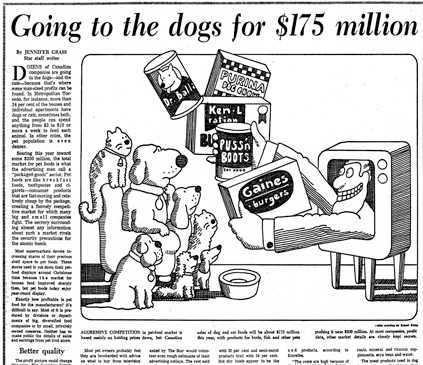
First, an illustration done for the Toronto Star newspaper during the 1970s:


The picture grabs the eye, as a newspaper cartoon has to, but it does the job in a way that’s quite unusual. The drawing is built around two sets of steps — the products rising up from the TV, and the animals making up the audience — that zigzag up from the lower right to the higher left. How often do you see that? And the shapes making up each group tend to get bulkier as the group rises.

More dogs, this time in a card Mr. Binks made for a friend who had lost a pet:


A pair of subtle, unorthodox touches: the tiny drop of the composition’s central line from left to right, and the spare but warm placement of color among the picture’s gentle grays. The red motto and polka dots are presented front and center, then left on their own until color reappears at the far right of the drawing, just where the gently dropping central line comes to rest.

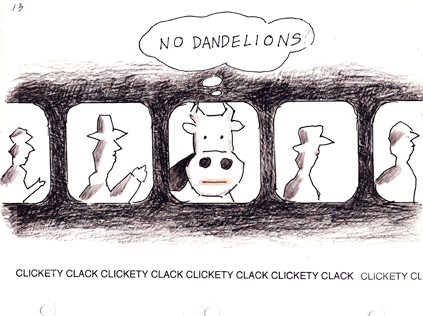
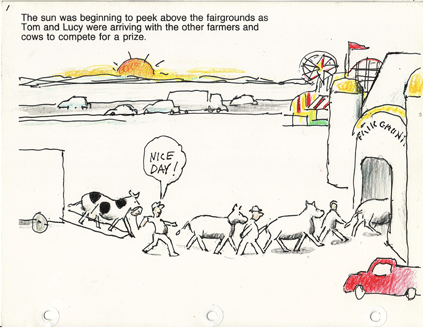
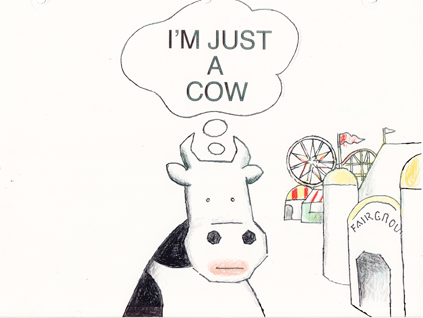
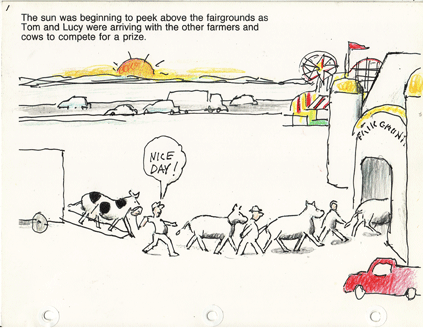
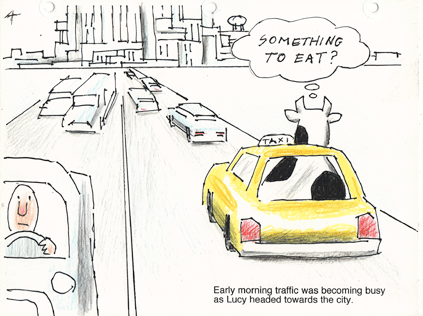
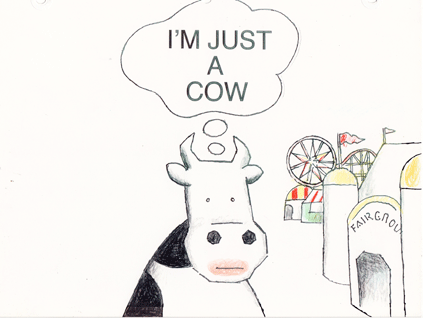
Now for six drawings taken from a group of nineteen. As we have seen before (that is, here, here and, if you scroll down, here), Mr. Binks finds something provocative about cows, and especially cows  juxtaposed with such unexpected settings as the typical modern metropolis. Or, as he puts it less pretentiously, “Recently I felt I just had to write and illustrate a cow story for my grandchildren. Again, the theme is about a cow and the big city.”

Below is a selection of illustrations from his privately made book and its story of one cow’s heroic odyssey:


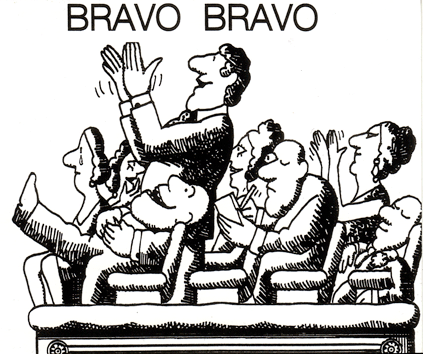
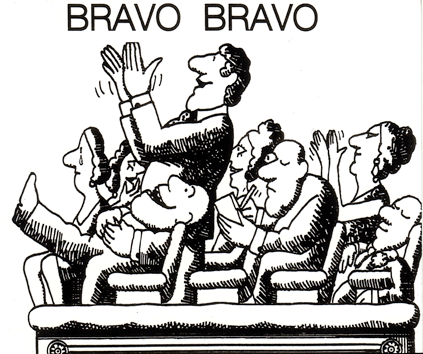
A triumphant sequence! Which brings us to our clean-up pair of pictures. First, from the Toronto Star, a drawing that Mr. Binks has also used for cards congratulating friends on their birthday:

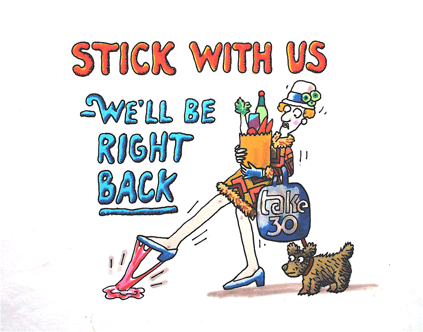
And a studio graphic that the CBC show Take Thirty used for station breaks:

That’s good advice, as we hope to present another Binks sequence a little down the road. In the meantime, enjoy a healthy and prosperous 2012.