“I’m Looking for a Weird Love, Baby. . .” – Romance Comics & the Strangeness of the Normative

This was originally posted on The Middle Spaces.
_________

When I discovered Weird Love #3 on the shelf at my usual comics joint, I didn’t hesitate to pick it up. I may still spend most of my comics dollars on superheroes, but I always look through the indie shelves for stuff to try out. Truth is, when it comes to indie comics I am much more likely to wait for the trade collecting individual issues, while there is something about the serialized nature of the Big Two comics that is part of their appeal to me. I know this is probably backwards since indie presses (when they’re really “indie”) could probably use my monthly money while I am just another sucker to Marvel and DC, but it is what it is. Let’s hope that my buying Weird Love when it comes out every other month is doing a part in keeping it around.

WeirdLove_4

IDW’s Weird Love #4, featuring the amazingly named “Too Fat to Frug.”

Anyway, I knew nothing about Weird Love, but I imagined (and hoped beyond hope) that it was some transgressive re-imagining of the romance comic genre, but what I found turned out to be even better. Instead, it was refurbished reprintings of rare romance comic stories from the 1950s and 60s. From a genre that—according to Michelle Nolan’s Love on the Racks: The History of American Romance Comics—once boasted over 140 different romance titles being published at once, editors Craig Yoe and Clizia Gussoni chose the strangest of them and delicately re-furbish the art from copies (since in most cases the original art is long gone). Upon reading the stories in Weird Love #3 (and the ones in issues #4 and #5, as well), I started to get the impression that what made them “weird” was not their transgressive aspects (if any), but the dissonance between their rigid adherence to idealized depictions of heteronormativity and the contemporary moment’s shifting social mores. What the stories in Weird Love soon made clear to me—and I went and sought out some of the classics of the genre in the form of reprints of Jack Kirby and Joe Simon’s Young Romance for confirmation—was that the heteronormative values these romance comics reinforce are really friggin’ queer. I don’t say queer to mean homosexual, as in the political and pejorative usages, but I mean strange. I mean, not adhering to the categories of “normal.”

That the ideal depictions of sexuality and heterosexual relations could change so dramatically in the last 5 or 6 decades underscores the socially constructed nature of sex and gender, the fluidity of what appear to be their ahistorical categories, and the inextricability of “normalcy” from adherence to social codes based on the simultaneous (in)visibility of sex that, in the words of Michael Warner in the introduction of Fear of a Queer Planet, “testifies to the depth of the culture’s assurance (read: insistence) that humanity and heterosexuality are synonymous.” (And I would add, white heterosexuality, but sexuality and race intersect in complex ways, beyond a simple blog post, so if I don’t get back to it, don’t think I forgot or didn’t think of it.) That the assumptions embedded in the stories were once (and to some cases still are to varying degrees) normative shows how strange heterosexuality really is.

WeirdLove5

The final panel to “Thrill Crazy” gives us the story’s moral, in case we missed it.

For example, Weird Love #5 includes a story entitled, “Thrill Crazy” (which originally appeared in Love Journal #11 from December 1951), in which Marsha’s desire to be popular leads her to drink alcohol and end up at a “necking party,” whose “unwholesomeness” made her “feel ashamed and unclean!” She witnesses her friend have a breakdown from the anxiety of running with that teen gang, and nearly succumbs to that fate herself. Lucky for her, in the end a “worthy man”—a hardworking local boy who warns that no good will come of the company she keeps and comes to her rescue on the night of the necking party—deigns to love her despite her having gone astray. In the end she learns that “just going to a movie” with him is an appropriate amount of excitement, and a lot safer for her virtue. These stories are knots of sexual contradiction. This is what I mean by the simultaneous visibility and invisibility of sex: the stories can only allude to and cannot ever name feminine desire for sex, but their built on that desire and the resistance to it that virtue demands.  The customs around heterosexual cultural practice are weird and sometimes even destructive, and the heterosexist assumptions that inform them harm straight people, too.

Consider, the Edith sub-plot in the most recent season of Downton Abbey. She has to hide away her child, because otherwise people would know that she had had sex before marriage with a man she planned to marry! It would ruin her and devastate her family! It is absurd, of course—especially when looked at in light of Edith’s pain at being separated from her child who may never know her. (That a family of what is essentially the peasant class, has to take in the aristocrat child is something else entirely­—gendered class exploitation). Everyone knows that people have sex and that sometimes (often) have it before being married, and yet it must remain invisible, despite underwriting our relationships and our very existences. In the era of the TV show, to say it is present invites condemnation. This is not to say that women are not still shamed and scorned to varying degrees for having children out of wedlock, but there is much much less insistence to pretend at “normalcy”—a curbed sexual desire equated with moral character—to the degree that you’d deny the very existence of your child. Still, none of the romance comic stories I have been reading would dare include such a racy topic as the unwed mother.

Too-Fat-To-Frug-DR

(from “Too Fat to Frug”)

Instead, Weird Love #4 reprints the incredibly titled story, “Too Fat to Frug.”  I can only assume the play on frug (to suggest “fuck”) was lost on the censor board because this comic has the Comics Code seal on it. In it, sexy go-go dancer Sharon’s inability to control her jealousy drives her man away and leads her to the kind of emotional overeating that “disturb[s]” her “glands” making her permanently fat, losing her dancing gig and the ability to attract any men of quality. “Luckily” for her, a nice chubby guy takes a shine to her, leading to the moral: Even fatties can find love. I mean, I think that is what I am supposed to take from it. Sure, one could read it as a positive body image supporting story, except that her fate is clearly cast as tragic. She’s a loser who has to make the best of her own failure. The story’s less obvious, but no less present, lesson is that if Sharon had learned to control her emotions and not second-guess her man’s ogling another woman, she might not have suffered her embarrassing fatness.

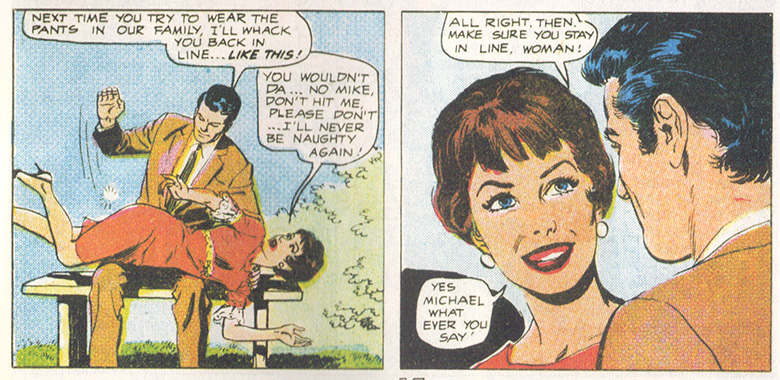
Another of my favorite Weird Love stories is, “You’re Fired, Darling” where Doris the office manager is forced to fire her boyfriend, Mike, who is terrible at his job. Despite his anger, he eventually comes to realize what she already knew, that he was a lot more suited to physical labor and working on a construction crew with his uncle, so he comes back to her­—but makes sure to give her a spanking to teach her a lesson her for trying to “wear the pants.” In the end, she expresses her relief to have Mike be “masterful” and take charge, so she doesn’t have to be in the anxious and “unnatural” position she was in as his boss. This kind of submissiveness—for which the women are grateful—is a common conclusion to these stories. Looking back from 2015 this idealizing of such submissiveness becomes a kind of peculiar fetish. The fact that this is normal desire is precisely what seems so strange in the present day.
 

Weird-Love-hdr-lg

 
Throughout these stories women tend to be infantilized, even as the constant reminder to guard their “virtue” reinforces their primary value as sex objects. This is notable in how even young girls are sexualized. They are either dangerously attractive for which they are to be blamed, or pityingly unattractive to the degree that even as a child it is noteworthy how difficult it will be for them to find husbands. The shape of heteronormative romance as traced in these stories is so contradictory and confining, that it is impossible to not imagine the broadly queer possibilities that lie all around it.
 

2-Faced-Woman-2

 
Of course, it also bears mentioning that the vast majority of these stories (if not all—the credits of these stories are lost in some cases) are written and drawn by men, but written in a confessional first-person, so these male storytellers are ventriloquizing the desires of women and their despair when their unwillingness to conform is punished, showing them the error of straying. Or, if a woman isn’t actually punished then—as in the classic “There’s No Romance in Rock n’ Roll (originally from True Life Romance #3 from 1956) —the protagonist discovers a real mature man whose very presence recasts the her early love, rock n’ roll, into childish noise! So while I call these strange attitudes towards heteronormative love “idealized,” I can’t claim that these attitudes were necessarily shared by women. Instead, they were thought by the male creators to be attitudes their female readership should identify with, both in the desire to rebel and to eventually righteously conform. Over and over again, the rebellious spirit of women is evoked in order to highlight the need for them to be tamed by their relationship with the right man.

The Simon and Kirby stories reprinted in the Young Romance anthology reinforce this and really are no less weird even thought they are not collected under the Weird Love title.

These comics—quoting Michael Warner again— “assert the necessarily and desirably queer nature of the world.” We don’t want to be trapped in static definitions of sexuality and gender, especially given the ways they intersect with all other aspects of life. The love depicted as ideal in these comics occupied a world without race until some Young Romance stories of the 1970s, and to my knowledge, none of them addressed gay love except in the most oblique terms. We need a queer world. A world that leaves room for non-compliance, non-conformity, for forms of loving that not only defy categorization, but break up and smash the categories that can sometimes be hidden within.
&nsp;

Swing-Panel I

t is easy to see why Lichtenstein was attracted to the isolated panel for his work. (from “Love, Honor and Swing, Baby!” – Just Married #67, October 1969 – and Weird Love #3)

Something I really love about reading these comics is just how nicely individual panels are suited for collected as examples of isolated absurdity that might otherwise go unnoted in so-called “traditional” forms of love. So many times, one weird scene defamiliarizes the heteronormative, making it so strange as to be laughable, worthy of mockery. As each issue of Weird Love comes out, I find myself going to the scanner to capture examples. (And you will occasionally be able to find more examples after this post is live on the We-Are-In-It tumblr).
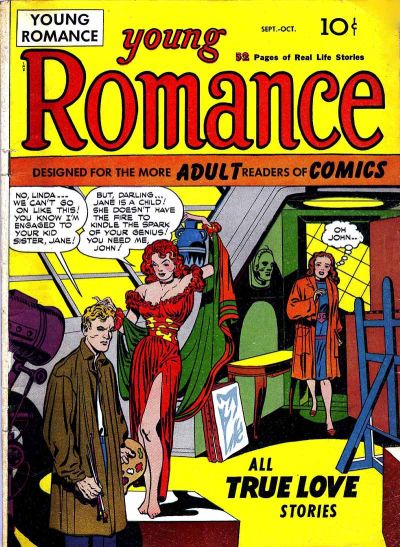
Young_Romance_Vol_1_1The history of romance comics has also reinforced for me how the market for comic books has shifted in the past and could continue to shift if the major publishers did not use the industry’s arrested state of development as an excuse for peddling the same old thing. Claims that they must play to the market ignore the relative lack of competition and thus how they shape that very market by what they offer. As comics legend Dick Giordano once explained, by the late 1970s the material in romance comics became too tame for “sophisticated, sexually-liberated women’s libbers” (his use of “women’s libbers” is highly suggestive of what he thought about this change). Feminine desire that matched what women might actually feel and experience could not be written to circumvent the Comics Code Authority at the time. But if that is the case, the question then becomes, now that the CCA is a thing of the past and mainstream comics are full of many things that the censor board once disapproved of, what keeps the Big Two from exploring that market again?

The jury is still out about the current state of the comics buying public but signs point to significant and growing numbers of women. Recent announcements by Marvel and DC seem to directly address this realization. But while it seems like the superhero cadre is playing catch up, I wonder if this shift in comics demographic will lead to a shift in the diversity of comic genres themselves. I am not trying to suggest that more women readers will lead to a return of romance comics (though I’d love to see what a modern romance comic might look like), but the fact that DC comics published Young Romance until 1977—not really all that long ago (in my fucking lifetime!)—demonstrates that difficult to imagine changes can happen in a relatively short period of time. I mean, who in the late 50s would have predicted the resurgence of superheroes on the horizon?

Furthermore, there is still a strain of romance influence that entered the superhero genre that can occasionally be seen in the cape and cowl titles. The influence is all over the place; from Superman’s Girlfriend, Lois Lane repeatedly paying for her obsession and schemes, to that splash page from Fantastic Four Annual #6, where Kirby draws the Richards with the radiance of the final “happily-ever after” panel of a romance story.  It is probably most clear in the drawing style John Romita Sr brought to Amazing Spider-Man when he took over for Ditko in 1966. There are even characters that still survive from the romance days. Patsy Walker, Marvel’s Hellcat, started out as a teen romance comic character, and when Marvel’s predecessor Timely Comics was cutting back on all their titles in the late 50s, Patsy’s three titles were still selling at phenomenal levels. I do not think it is overstating the case to say that Patsy Walker may be the most important character in the Marvel Universe, because without her success there may have been no comics division for Stan Lee and Jack Kirby to transform into what we know as Marvel Comics.
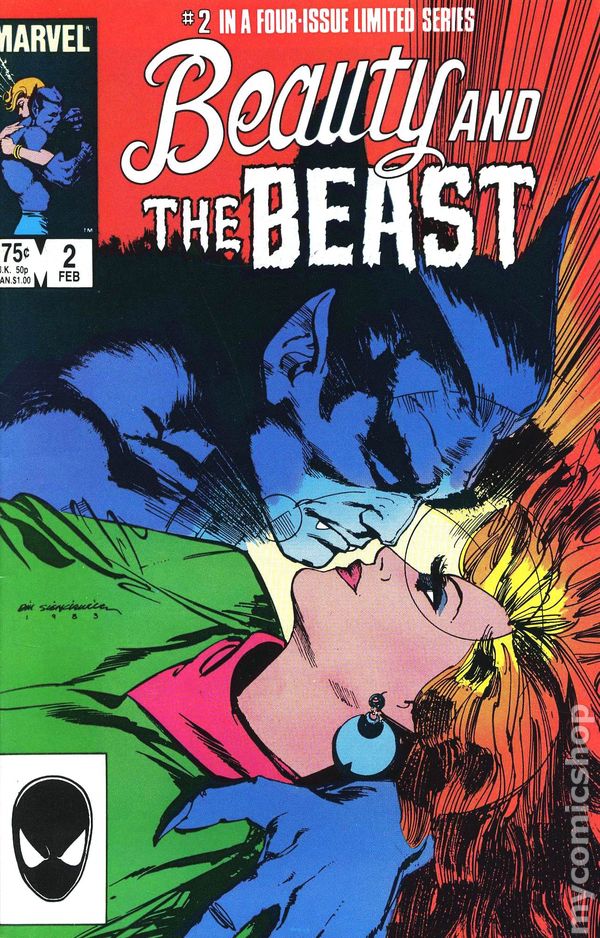
 

Bill Sienkiewicz’s cover for issue #2 definitely calls to the romance genre.

Bill Sienkiewicz’s cover for issue #2 definitely calls to the romance genre.

 
Another example of this influence is Jeff Loeb and Tim Sale’s Spider-Man: Blue from 2002-03 which focuses on the shadow the death of Gwen Stacy casts on Peter Parker’s marriage to Mary Jane.

But perhaps the best example is Ann Nocenti’s 1984 limited series Beauty & the Beast. The Dazzler-focused series especially strikes me as the kind that really could have indulged the freakier side of the superhero concept, but then again I was also very upset when Grant Morrison walked back Beast’s admission of sexual confusion. I long ago imagined him into a long-term “open secret” type gay relationship with Wonder Man, so his queer possibilities were a part of my understanding of the character since about age 10.
 

Beauty-Beast1

Beast acting beastly in Beauty and the Beast #2

 
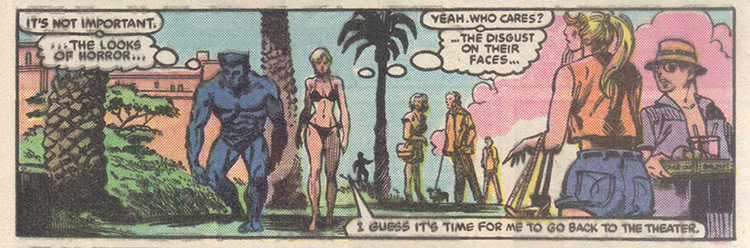
The first issue in particular has a structure that seems to pay homage to the romance comic stories of old. In it, Alison Blaire, the Dazzler, has been recently outed as a mutant, leading her to hang out with shady characters that party every day of the week in pursuit of revitalizing her career, further ruining her already ruined reputation. A full page montage covers the common romance comic trope of her indulgence and resulting indignity. The Beast, Hank McCoy, former X-Man and Avenger, fills the role of the love interest, acting as impulsively aggressive and entitled to Dazzler’s attention as any romance comic Romeo. The putative hero’s jerkiness is justified by the female protagonist’s straying. Wonder Man has a guest appearance in order to impugn Alison’s virtue and declare her lacking “self-respect.” Despite these problems, to me, Beauty and the Beast succeeds at doing what X-Men comics have long tried to do, make effective use of the mutant metaphor—not as a stand in for race or queer sexualities, but as stand in for the strangeness of these characters themselves, for the queerness possible within a cisgendered heteronormative framework. What is Beast if not a furry’s dream? How else are we to interpret the vicious whispers of strangers that see them together in public and judge them as immoral and disgusting, if not as a sign of the strangling confines of “the normal?”
 

Beauty-Beast3

Hank and Alison feel disapproval for their relationship wherever they go. (from Beauty and the Beast #3).

 
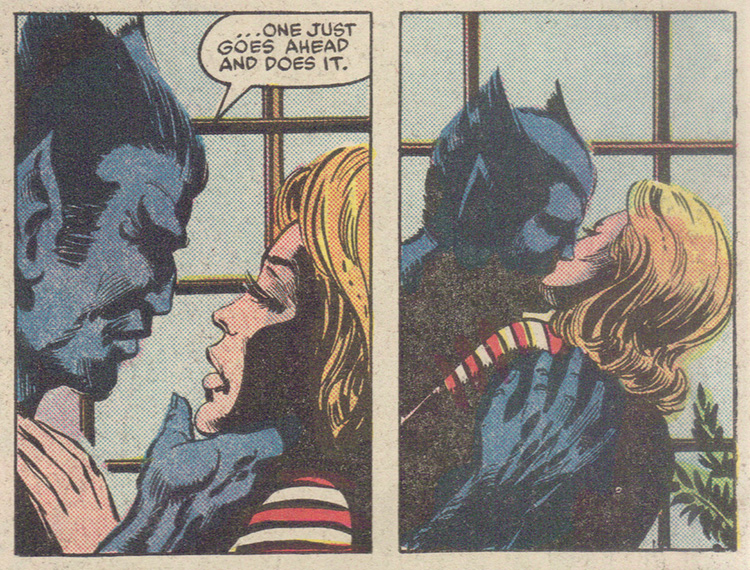
The Beauty and the Beast limited series (which, by the way, Rachel and Miles X-Plain the X-Men covered in episode 35: “Post-Disco Panic” of their awesome podcast) is very unevenly written and drawn, but highlights a line of force, a thread sewn through from the strange kinds of stories found in IDW’s Weird Love series to the bizarre relationships in a world of rock people, shape-changers, elastic men and invisible women. I think the world is ready for a romance-themed superhero comic. There has been some attempts at this (like 2009’s Marvel Divas, which, like the old romance comics was written and drawn by dudes and which I’ve only ever heard bad things about), but imagine a title given even a tenth of the kind of support bullshit like Age of Ultron or Axis crossover events gets. One can dream, I guess.
 

Beauty-Beast2-kiss

 
I am going to continue to delve into my new obsession. I think these old stories despite their frequent patriarchal foundations are important, not only because of their commonly beautiful art and storytelling, but also because they serve as a reminder of how strange the once most-accepted norms really are.
Hydra Infiltrates Marvel, Destroys Superhero Genre

marvel logos

 
Is Marvel Entertainment evil?

I compiled commentary from twelve experts, and the results are not good for superhero fans.

“I’m not going to head off and do a Marvel film,” director Peter Jackson said on the eve of his Hobbit 3 release. “I don’t really like the Hollywood blockbuster bandwagon that exists right now. The industry and the advent of all the technology, has kind of lost its way. It’s become very franchise driven and superhero driven.”

Since Jackson’s Lord of the Rings marked that technology advent, and since Jackson made all six of the Tolkien franchise films, that leaves superheroes as his only objection. He doesn’t like them. Or at least he doesn’t like Marvel—which, despite Warner Bros’ best efforts, is the same thing.

Even Marvel’s own Iron Man Robert Downey, Jr. sees the rust: “Honestly, the whole thing is just showing the beginning signs of fraying around the edges. It’s a little bit old. Last summer there were five or seven different ones out.”

Actually, there were only four superhero movies last summer, and though Marvel Entertainment produced only two (Captain America, Guardians of the Galaxy), the Marvel logo appeared at the start of the last X-Men and Spider-Man installments too. But you can’t blame Downey’s miscount. New York Times film critic A. O. Scott expressed a similar opinion after seeing Downey in The Avengers two year earlier: “the genre, though it is still in a period of commercial ascendancy, has also entered a phase of imaginative decadence.”

Alan Moore’s review was even more apocalyptic: “I think it’s a rather alarming sign if we’ve got audiences of adults going to see the Avengers movie and delighting in concepts and characters meant to entertain the 12-year-old boys of the 1950s.” Even The Avengers own director Joss Whedon acknowledges that audiences are tired of at least some aspects of the formula: “People have made it very clear that they are fed up with movies where entire cities are destroyed, and then we celebrate.”

And yet when a director attempts to shake-up the formula, Marvel fires them. Marvel’s Ant-Man went into production only because of Edgar Wright’s involvement, but when Marvel wasn’t happy with his last script, they rewrote it without his input, followed by a joint announcement that Wright was leaving “due to differences in their visions of the film.” Wright joined axed Marvel directors Kenneth Branaugh, Joe Johnston, and Patty Jenkins (as well as axed actors Edward Norton and Terrance Howard), all victims of similar differences in vision.

Is this the same risk-taking Marvel that hired Ang Lee to make his idiosyncratic Hulk? Is this the same Marvel that hired drug-addict Robert Downey, Jr. after Downey couldn’t stay clean long enough to complete a season of Alley McBeal? Is this the same Marvel that hired the iconoclastic Joss Whedon after his Buffy empire expired, his Firefly franchise flopped, and his Wonder Woman script never even made it into Development Hell?

Actually, it’s not.

Kim Masters and Borys Kit of The Hollywood Reporter explain:  “Marvel and Wright were different entities when they began their relationship. Marvel was an upstart, independent and feisty as it began building the Marvel Studios brand.”
 

marvel logo 80s

 
The Marvel I grew up reading, Marvel Comics Group, hasn’t been around since 1986, when its parent company, Marvel Entertainment Group, was sold to New World Entertainment. Technically, Marvel Comics (AKA Atlas Comics, AKA Timely Comics) ceased to exist in 1968 when owner Martin Goodman sold his company to Perfect Film and Chemical Corporation. The corporate juggling is hard to follow, but that next Marvel was sold to MacAndrews Group in 1989, and then, as part of a bankruptcy deal, to Toy Biz in 1997, where it became Marvel Enterprises, before changing its name to Marvel Entertainment in 2005 when it created Marvel Studios, before sold to Disney in 2009.
 

marvel studios

 
The real question is: at what point did Hydra infiltrate it?

I would like to report that the nefarious forces of evil have seized only Marvel’s movie-making branches, leaving its financially infinitesimal world of comic books to wallow in benign neglect. But that’s not the case.

Marvel comics writer Chris Claremont, renown for his 16-year run on The Uncanny X-Men, is currently hampered in his Nightcrawler scripting because he and everyone else writing X-Men titles are forbidden to create new characters.  “Well,” he asked, “who owns them?” Fox does. Which means any new character Claremont creates becomes the film property of a Marvel Entertainment rival. “There will be no X-Men merchandising for the foreseeable future because, why promote Fox material?”

That’s also why Marvel cancelled The Fantastic Four. Those film rights are owned by Fox too, with a reboot out next August. Why should the parent company allow one of its micro-branches to promote another studio’s movie? Well, for one, The Fantastic Four was the title that launched the Marvel superhero pantheon and its subsequent comics empire in 1961.  Surely even a profits-blinded mega-corporation can recognize the historical significance?

Like I said: Hydra.

This is what drove former Marvel creator Paul Jenkins to the independent Boom! Studios: “It bugs me that the creators were a primary focus when the mainstream publishers needed them, and now that the corporations are driving the boat, creative decisions are being made once again by shareholders.” Former Marvel editor-in-chief Roy Thomas agrees: “There is a sense of loss because the tail is now wagging the dog.”

Compare that to Fantagraphics editor Garry Groth: “I think it’s a publisher’s obligation to take risks; I could probably publish safe, respectable ‘literary’ comics or solid, ‘good,’ uncontroversial comics for the rest of my life. I think it’s important, personally and professionally, to occasionally get outside your comfort zone.”

Marvel Entertainment is all about comfort zones. Even for its actors. “It’s all set up now so that you’re weirdly kind of safe,” says former Batman star Michael Keaton. “Once you get in those suits, they really know what to do with you. It was hard then; it ain’t that hard now.” New York Times’ Alex Pappademas is “old enough to remember when Warner Brothers entrusted the 1989 Batman and its sequel to Tim Burton, and how bizarre that decision seemed at the time, and how Burton ended up making one deeply and fascinatingly Tim Burton-ish movie that happened to be about Batman (played by the equally unlikely Michael Keaton, still the only screen Bruce Wayne who seemed like a guy with a dark secret).”

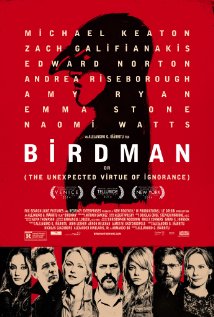
That’s the same Michael Keaton currently riding Birdman to the Oscars. How soon till Marvel’s Agents of H.Y.D.R.A. overwhelms that corner of Hollywood?
 

birdman

Human Behaviour

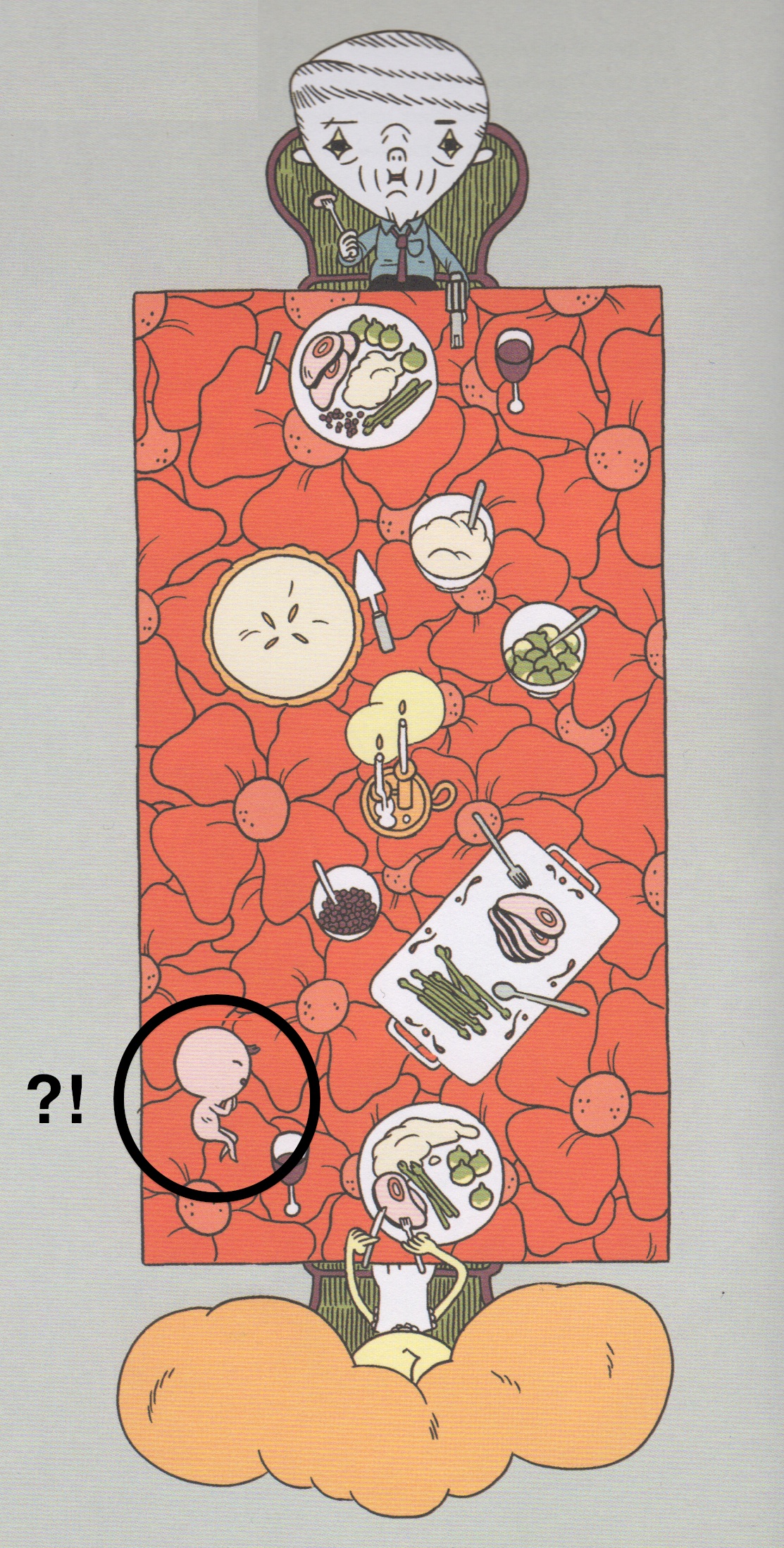
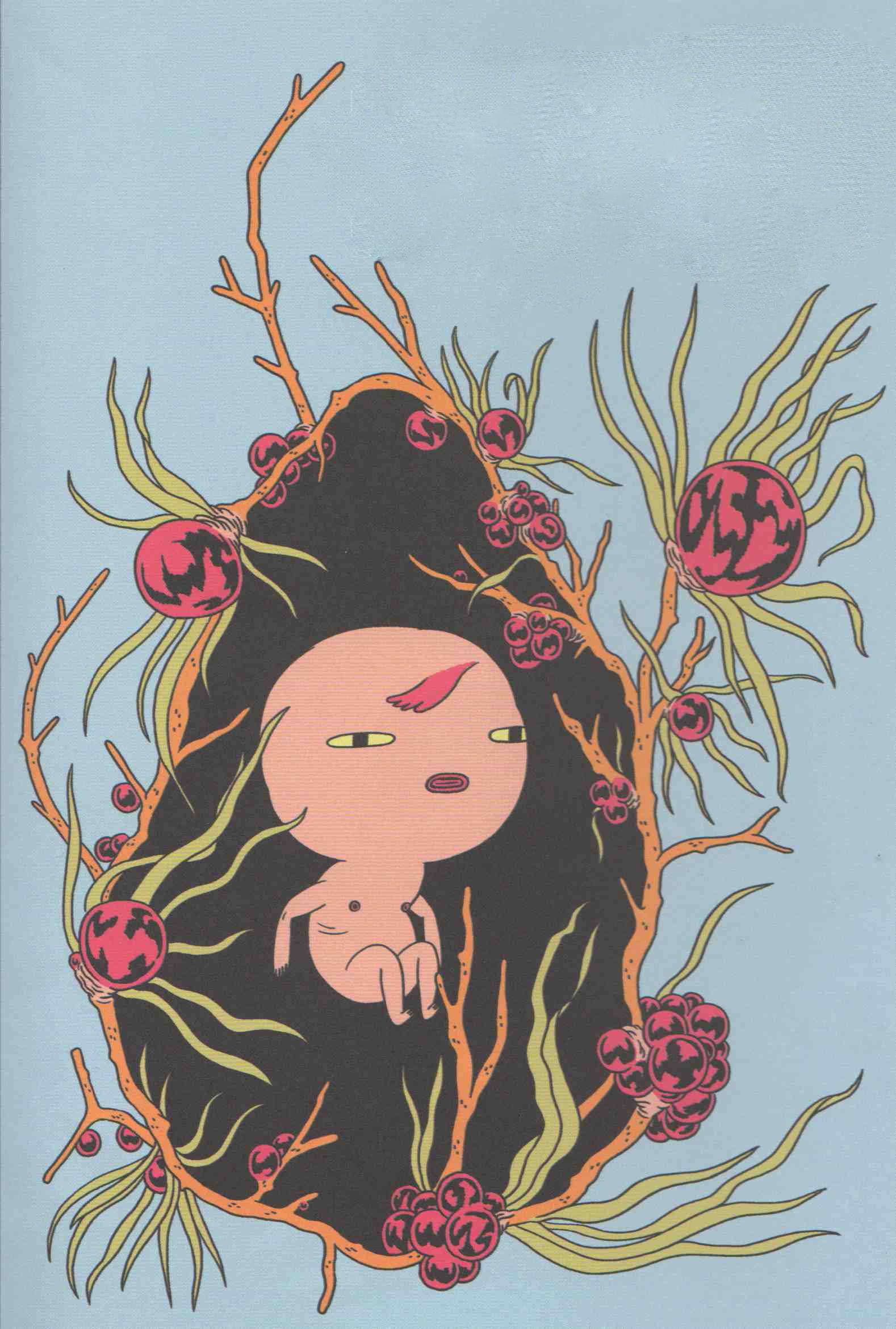
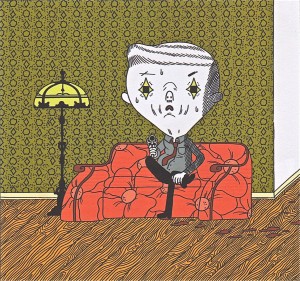
Like comics, folk tales and fables are sometimes mistaken for children’s stories. The pretty palette and cutesy end papers of First Year Healthy belie enough abandonment, blood, and weird sexual situations to match the original Grimm brothers’ tales. That’s not to say it comes stocked with shriveled villains and plump children with rosy cheeks. There’s a baby, I guess, but it looks like the kind of thing you might find on a dusty shelf, in a jar. A quintessential Michael DeForge character, you probably wouldn’t want to touch it without latex gloves.
 

baby_1


The fuck is up with this baby.

 
Question number one: what is this thing, anyway? Not the baby, I mean, but the book. I suppose in terms of genre it falls somewhere between faux folk and modern myth. Is it, as the synopsis on the back suggests, a “parable about mental illness”? I’m not sure that captures its central paradox, so let’s say a sinister fairy tale, or an inscrutable fable. Horror-barf meets early Björk.


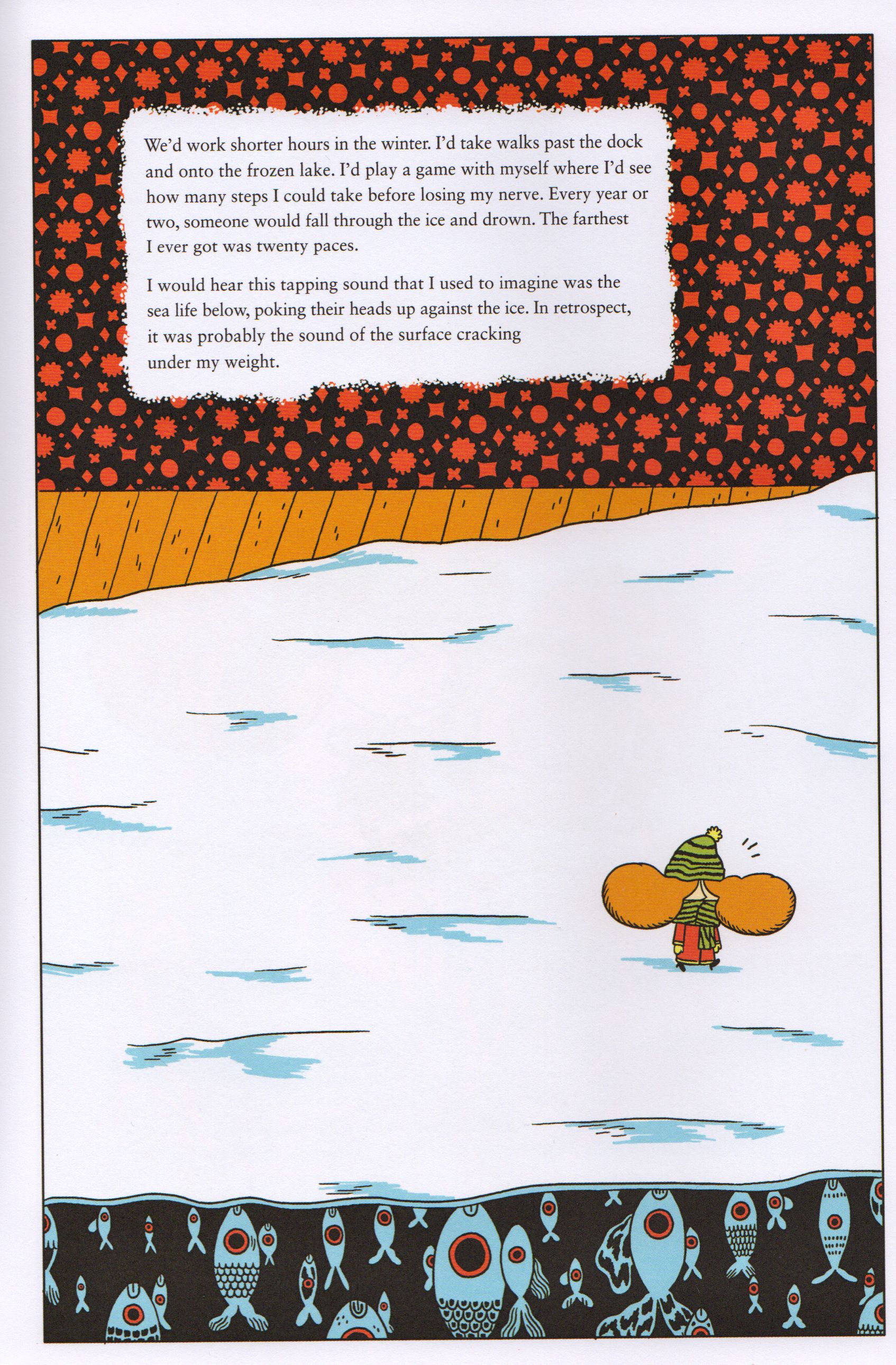
DeForge’s specialty is drawing charming things with a palpable sense of disgust, a sensibility that particularly suits First Year Healthy. A slender story with big illustrations and short typed paragraphs of text, it’s reminiscent of a Little Golden Book. Plot-wise, of course, we’re pretty far afield of the poky little puppy. This is the story of a troubled young woman—our narrator—trapped in a hostile landscape filled with joyless sex and uncaring neighbors. Her chief interests seem to be wound care and walking on thin ice. Mm-hmm, literally.
 

ice

“My hobbies include anything that sounds like a huge bummer.”

 
Our girl has recently emerged from an extended stay in a mental hospital. For what, we do not know, though we learn that her absence was long enough for her brothers to get married and have children to whom she has not been introduced. (Or is it possible she’s confused?) Her present-day life is full of intrigue, but it’s not exactly fraught. In fact, there’s something uncanny about the calm way in which she tells us her incredible story, which involves an orphan, several gangsters, and an enormous magic cat. All her observations seem to occur on a delay, as through a thick layer of static. Her flat affect hints at severe depression or even schizophrenia—or maybe she just doesn’t GAF.

The writing is well paced and strong, and the tension between it and the format, along with the wordless sequences with the magic cat, are probably what I would point to if someone were to get all Well, actually… about this book being not-comics. So far as I can see I stand alone in finding DeForge’s work aesthetically uneven. To me he’s at his best when he finds organic outlets for his inventiveness, like with the nightmare baby or the gray-faced gangster. The latter is the coolest thing I’ve seen in a while.
 

man

 
I like the artist’s weirdness less when it feels like affectation. Take, for instance, the opening image, an aggressively strange composition of some gore in a fish shop, or just the protagonist in general, whose inverse Cousin It situation is a bit much. (There are a million less ridiculous hairstyles that could’ve established a visual connection between the woman and the cat, who is—bear with me a moment—more or less her murder dæmon.) DeForge is more consistently successful with his use of color. While his tones here are earthy and muted compared to his penchant for neon, frequent shocks of pink and orange suggest that some things in our narrator’s world burn a little too brightly.

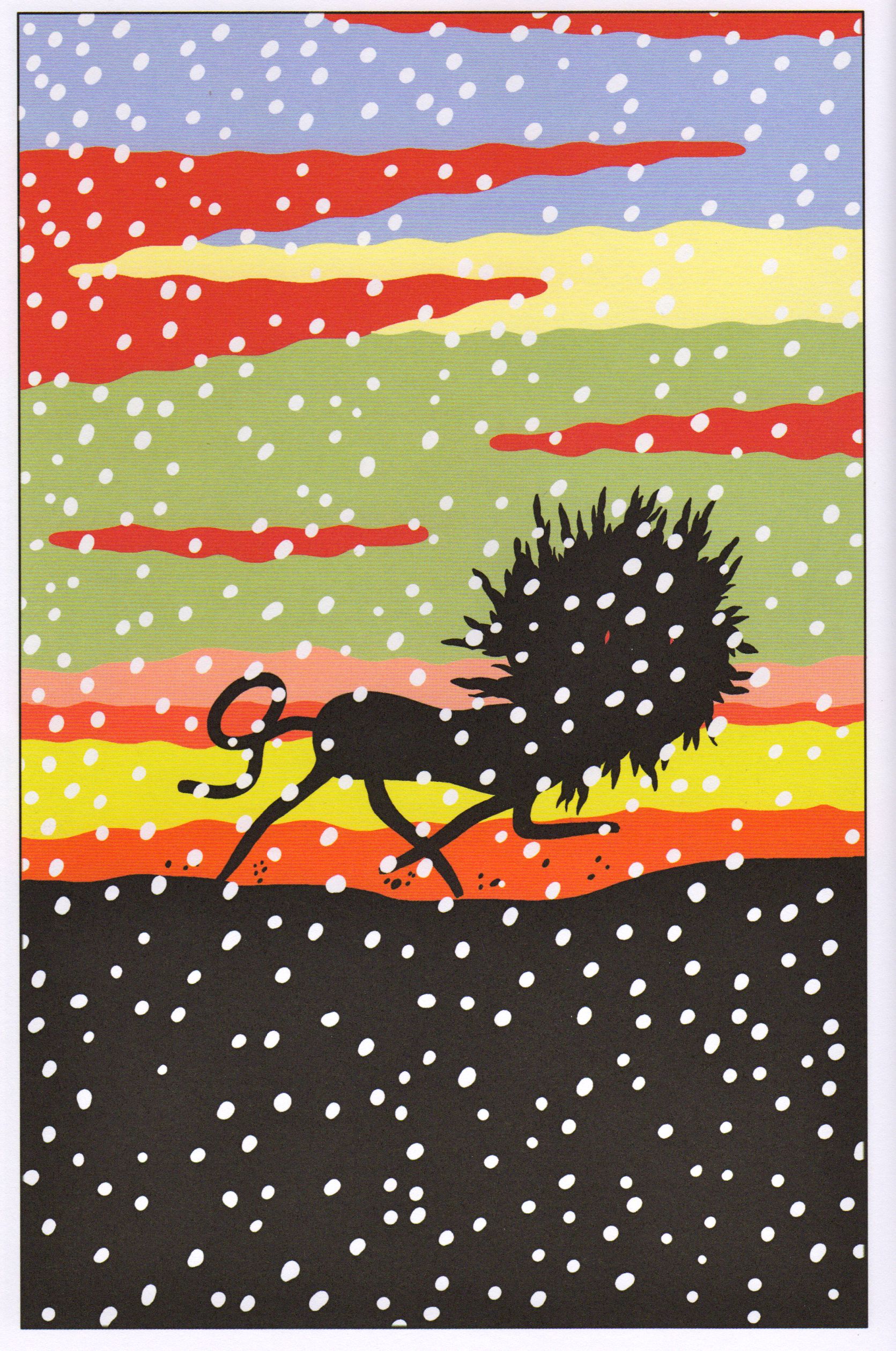
While it’s never clear how much of the story takes place in the narrator’s head, First Year Healthy doesn’t interrogate reality. The huge magic cat that silently lopes through these pages undeniably is. Many texts that explore mental illness are built around the anxious question of what is or isn’t real; that tension, and when and if it’s resolved, is what drives the plot. Remarkably, First Year Healthy is not about mental fragility. It is, rather, the story of a woman whose mind takes on a life of its own. It stalks her, but then again it eats her enemies. Is it a hallucination? Supernatural? Scary? Protective? DeForge’s answer seems to be whatever, and his utter lack of judgment is one of the things that makes this story so great.

Not for nothing, First Year Healthy is not just a portrait of mental illness; it is also a portrait of faith. Technically, it is a Christmas story (and therein are some iinteresting parallels), but what I see above all is a woman who is herself the most real and palpable thing in her universe. Her connection to the external world, and the people in it, is tenuous at best. Her closest personal relationship is with her boyfriend, who she refers to as “the Turk” in lieu of a first name. Her anonymous neighbors and nameless brothers barely register as beings in the story at all.

First Year Healthy’s focus on the narrator’s complex interiority makes it an interesting companion piece to the relentless biology of Ant Colony, DeForge’s full-length graphic novel from last year. Ant Colony’s glowing critical reception paid a lot of lip service to the young cartoonist as the next Great Pumpkin, but evidence of his genius in that volume was, to my mind, scant; its fresh look and flashes of humor couldn’t mask its Flea-grade nihilism and fundamental lack of depth. First Year Healthy is much shorter and sweeter, but beneath those trappings are big thoughts and surprising sophistication. Put another way, are we all just insects, fucking and fighting and oblivious to our own insignificance? Or is there meaning and magic in this hostile world for those who seek it? Of course the honest answer is a bit of both, but the latter makes for a more compelling story.

DeForge’s worlds are always weird but recognizable. They’re universal in that you’re meant to see yourself in them, but they’re always also Other. By design, Ant Colony explores the human condition from a sort of cold and alien vantage. First Year Healthy, which is set in the world of actual humans, is more warm-blooded. While its narrator is in many ways a familiar folk heroine—willful and self-reliant in the face of constant peril—her emotional detachment has a thoroughly modern feel. She’s brave but never spirited. Melancholy. Awkward. Alone. The strangeness of her life, which escalates quickly over just 30 pages, never fails to resonate. Like David Bowie, DeForge takes every flicker of sadness, self-doubt, insanity and total fucking loserdom you’ve ever felt and turns it into something unassailably cool.

Last month I went to see a Bowie retrospective at the Museum of Contemporary Art. It was called David Bowie Is—a perfect title, I thought, until I came to understand that the organizers approached the artist’s identity as a construct to be deciphered and explained. In breaking down Bowie’s influences, his context, and his impact, the exhibit failed to find his human heart. He is this, they told me. He is that. But the entire point of Bowie is that he can’t be reduced to a series of personas. He has always transcended any label you might wish to apply. To some degree the same is true for the rest of us mere mortals, perhaps especially when it comes to mental illness.

It’s one thing to make an old idea look new, or to make a new idea look old. It’s another to craft something unique out of what has been there all along. From David Lynch to Haruki Murakami, the weirdos who mean the most to me transform everything into something else—something other—the whole of which is greater than the sum of its parts. After weeks of thinking about First Year Healthy, I’m still not so sure what it means. Whatever. Should I someday come face to face with my own magic cat, I can only hope my first instinct won’t be to dissect it.
 

cat

Diverse Mediocre Genre Product

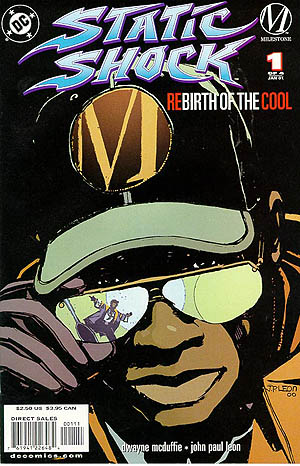
Static_Shock_-_Rebirth_of_the_Cool_(no.1_-_cover)

 
Static is the best known creation of the Milestone Comics label. Judging from the first collected volume, the rest of the line must be unmemorable indeed.

It doesn’t give me any joy to say that. Milestone’s efforts to create greater diversity in superhero comics were admirable and courageous, and I would like to be able to praise the results. But writers Dwayne McDuffie and Robert L. Washington III offer little in the way of innovation, or even interest. Static seems borrowed wholesale from Spider-Man — and not even from Lee/Ditko Spider-Man, but from the less interesting, less urgent, undifferentiated later rehashes. Static is a 15 year old trash-talking superhero. And…that’s really all there is to him. He experiences some minor relationship angst; flirts with some criminal acivity — but everything is resolved with little fuss or interest. Then the second bit of the first volume is given over to a largely incomprehensible and tedious crossover with a bunch of unmemorable other heroes. The goal is obviously to recreate the sense of a world of super-heroes you get in DC and Marvel — and I did get to feel just how utterly unapproachable those worlds must be to anyone coming to them cold without decades of background. I didn’t know who any of these people were, and there was no effort to make me care. The whole thing was almost impossibly pointless; random characters kept leaping up with no introduction to say something portentous before getting blasted. The whole exercise was dreary, joyless, and confused; not notably worse than the DC and Marvel competition of the day, but not any better either.

There’s a parallel with “Sleepy Hollow” perhaps, a current paranormal/crime television show notable for having a (relatively) diverse cast — and for not much else in terms of quality. I wish Sleepy Hollow was better, just like I wish Static Shock was better, because I appreciate their efforts to be more diverse and less racist than the competition, and I would like to be able to embrace them wholeheartedly.

But though I don’t really want to consume either Sleep Hollow or Static Shock, their badness is in its own way a kind of worthy breakthrough. Diversity shouldn’t have to mean greatness; most genre product is mediocre, and so, ideally, in a more diverse, less racist world, you’d have a lot more diverse mediocre genre product. White superheroes shouldn’t be the only ones who get to be poorly written and indifferently drawn; white actors shouldn’t be the only ones who get jobs in poorly conceived sit-com/adventure dreck. If we’re going to have mediocre entertainment, it should, at the least, be less racist mediocre entertainment. By the same token, I hope the new Spider-Man in the Marvel cinema franchise is played by a black actor. Someone is going to get to star in a massively overhyped bone-dumb nostalgia vehicle with explosions and moderately funny gags. Why should it always be a white guy?

Voices from the Archive: Caroline Small on Delany, Definitions, and Comics

DelanyKC
 
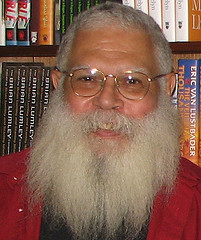
Caroline Small wrote an interesting commenton Samuel Delany’s view of comics and Scott McCloud; thought I’d reproduce it here.

Jeet and Noah: I guess I am still deeply skeptical about the assertion that Alan Moore and Neil Gaiman represent “Delany’s taste” in comics, rather than a strategic choice of writers to call attention to. I guess I just disagree that “taste” is what’s at stake here at all, or even that “taste” is a particularly useful category for understanding the role that Gaiman and Moore play in what Delany has to say about comics. (I realize I’m making a big deal out of something that I’m sure Jeet said casually, but it seems to me a particularly fecund slip…)

It’s not that I don’t agree to some extent: I find it deeply unpalatable when Delany uses words like “powerful, insightful and brilliant” to describe Scott McCloud. McCloud is the epitome of “middle-of-the-road” as far as I’m concerned. But I tend to read Delany’s praise as strategic rather than sycophantic.

I’m not sure what else from comics Delany could engage OTHER than Gaiman and Moore, given his project of deconstructing the binary between art and genre: despite those writers being palpably middlebrow (and with that I certainly agree), comics just doesn’t have a Marge Piercy or even a Sam Delany of its own that he could grapple with instead. And Gaiman/Moore have the strategic advantage, even over Piercy and Delany himself, of being very familiar to a great many people and therefore valuable as illustration. Jeet, are there comics creators/writers whom you think he should write about instead, that would be less disappointing, but still effectively work for his project?

I think the way I phrased my initial comment led to this notion that Delany exhibits some “highbrow” taste in literature, and that he hasn’t shown as sensitive an “ear” for comics. But — to use Jeet’s examples — Nabokov and Updike are really no less middlebrow than Gaiman and Moore. Delany’s fiction leaves no doubt that he reads and engages writers much much much more ambitious than Nabokov and Updike. But his project (and possibly but not necessarily his taste) dictates that he not privilege the highbrow at the expense of the lowbrow. I prefer to view him as capable of such great appreciation of human creativity that he privileges instead a synthesis of the entire spectrum: low, high, and middlebrow. There’s a “hippie appreciation” to his writing about art that I think has to be recognized and taken in context rather than at face value.

So for me the “disappointing” thing here is not that Delany has less sophisticated taste in comics than he does in literature: I don’t think we have access at all to his taste through his criticism, because he is far too fine a critic to be concerned with matters of taste.

What’s disappointing — although, really, it’s not so much disappointing as fascinating — is that as a writer he wasn’t able to make as much hay out of his perspective in comics as he was in fiction. Sam Delany’s prose SF really does participate in and advance his project of challenging the ways in which we presume genre cannot be art: Dhalgren is an essential, if not the essential, text for re-examining the conventional wisdom about how the strictures of genre characteristics preclude literary experimentation. But you both pointed out that his comics do not challenge the binary between genre and art in the same way. That’s interesting. Saying that he has middlebrow taste in comics is not sufficient to account for the fact that what Sam Delany has to offer can’t complicate and “elevate” graphic genre fiction in in the same way that it did prose genre fiction…

It’s a fun thread in general; Caro has some more thoughts, as do Robert Stanley Martin, Jeet Heer, and others.

Pajama Boy and Anti-Semitism

This first ran on Splice Today.
_________

large_pajamaBoy

Last week [when this first ran], the right’s five-minute hate was directed against pajama boy, a guy in an ad encouraging young people to sign up for Obamacare. I usually don’t pay much attention to the right’s five-minute hates, but I happened to click through on this one, and was somewhat startled to discover that this random guy looks kind of like me. I’ve even got a onesie that looks a big like that (my son calls it a sleep-skirt.) And the curly hair, strong features, prominent nose, sharp eyebrows, glasses…yep. He’s younger and handsomer, but there’s a similarity. Which is to say that he, like me, looks Jewish. And just to drive the point home, some anti-pajama-boy memes apparently post a “How did you know I went to Oberlin?” tag across the picture. I went to Oberlin, which is known both for being a very liberal school, and for having a sizeable number of Jews in its student body.

Rich Lowry sneers that pajama boy is “so nerdy he could guest-host on an unwatched MSNBC show.” The slur isn’t exactly surprising; Jewishness and nerdiness are often conflated, or equated (see Woody Allen or Howard Wolowitz.) Assimilated or model minorities are generally seen as unmanly or womanish; what happened to Jewish males is now happening more or less to Asian males.

I guess I could go on now to accuse Lowry and the right in general of anti-Semitism here. But the truth is, I don’t think that that’s exactly what’s happening. In the same paragraph where Lowry sneers at pajama boy’s nerdiness, he writes that the guy is “probably reading The Bell Jar and looking forward to a hearty Christmas meal of stuffed tofurkey.” He’s plugging into stereotypes around Jewish appearance (nerdishness, Oberlin), but those stereotypes adamantly don’t for him link to Jewishness. He knows pajama boy is nerdy, he’s catching the cultural signs rooted in ethnic difference, but he doesn’t link those signs to ethnic difference in any way. It’s not even clear he knows where they come from.

Again, you could see this as indicative of the persistence of anti-Jewish sentiment and stereotypes. But to me it seems more like a sign of just how marginalized and defanged anti-Semitism has become in an American context. We’re beyond a dog whistle here; the prejudice and vitriol has been basically completely severed from its original ethnic target. Lowry and the right literally do not see that this man is Jewish. The fact that he may well not be Jewish simply underlines the point. Prejudice creates a stereotyped view of what Jews look like. That’s gone. So when confronted with a guy who looks (like me) Jewish, Lowry doesn’t immediately think he’s Jewish, which he may not be. Stereotypical Jewish features still provoke a shadow of prejudice, but they don’t any longer link to “Jewish”. People who say, “I don’t see race,” are pretty much full of crap — but it’s different when you talk about Jews. People really don’t see them. They don’t have preconceptions about what they look like; they don’t assume that someone who looks like a Jew is a Jew. At worst, they see somebody who is kind of nerdy. But the original ethnic basis for that nerdiness is gone.

On the one hand, it’s not especially pleasant to realize that some not insignificant number of people think that my looks alone make me an object of ridicule. I’d thought I’d stopped having to deal with that when I got out of high school. But, on the other hand, I basically did stop having to deal with it. Even these folks who clearly are trying to be as unpleasant as possible aren’t able to figure out what my looks mean, much less connect them to an actual systematic program aimed at making the lives of people who look like me miserable. As pajama boy, I face no prejudice. I can work where I like, marry whom I like, even make policy at a conservative think tank, if that’s my bliss. Hate lingers, but it loses a lot of its sting when it can’t remember who its hating.

Fear of a Beyoncé Think Piece


Art exists in culture. By the same token, culture is represented in, and influences, art. That seems like a pretty obvious and irrefutable point. And yet, to talk about the links between art and culture consistently leads to panicked, even apocalyptic denunciations from those who otherwise occupy little intellectual common ground. Rather than being seen as complementary, or continuous, art and society are seen as matter and anti-matter; bringing them together, it is feared, will cause the end of all things.


Freddie deBoer fears, in particular, that the confluence of art and society will cause the end, or at least the decay, of society. In a Beyoncé think-piece calling for the end of Beyoncé thinkpieces, deBoer raises the familiar lefty fear that interest in art is a deadly form of false consciousness, distracting the intellectually flaccid from the real business of ridding the world of hegemons.
 

As I’ve said for a long time, a lot of progressive educated white types have essentially replaced having a politics with having certain cultural attachments and affectations. Really aggressively praising the Wire becomes a stand-in for “I am not racist.” Complaining that Selma was robbed becomes a stand-in for having done the necessary work to understand the history of race in America. Telling anyone who’ll listen that you think all of the creativity and risk are in hip hop now becomes a stand-in for advancing a meaningful political platform that could actually improve the lives of actually-existing black people. White people are so weird about Beyonce because Beyonce has become an all-purpose floating signifier, a vessel on to which bourgie white folks project all of their desires for how other people should see them. These vague associations with arts and media are intended to send a message that, if voiced explicitly, we all know by now to ridicule: some of my best friends are black.

It’s easy to get distracted here by the sweeping assumptions of bad faith — but that’s just standard deBoer being deBoer. What’s more interesting is the way that the typical Marxist/Frankfurt School mistrust of the popular arts is retooled in terms of racial justice. “Bourgeois” pops up rhetorically as it might have for Khruschev (who rather gloriously characterized an exhibit of experimental art as being equivalent to what you would see if you looked up from inside a toilet bowl at someone’s ass descending.) But the main sneer for deBoer is not directed at the middle-class, but at white people. DeBoer’s argument (with the unfalsifiable ad hominem mind reading taken out) is that white people care about Beyoncé, and that talking about her is (therefore) self-indulgent and decadent. Real revolutionaries should talk (all the time?) about income inequality, not pop music.
 

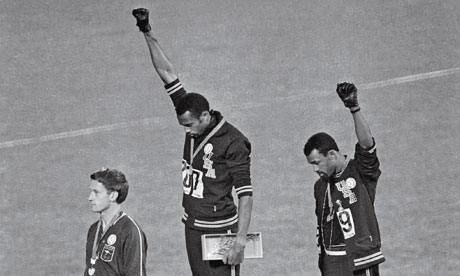
OLYMPICS BLACK POWER SALUTE

 
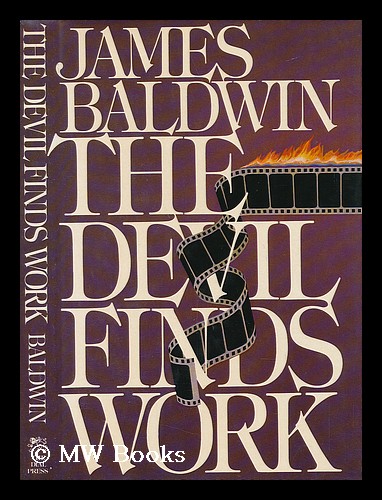
The problem for deBoer here is that black people have an incredibly long, rich, and important history of caring about art, and seeing it as central to their struggle for freedom and justice. Zora Neale Hurston, Langston Hughes, Miles Davis, Sam Cooke, bell hooks, James Baldwin, and many many more, would all be surprised to hear that their focus on cultural expression and representation was misguided and antithetical to the civil rights movement. Even if you’re just talking about Beyoncé, there are no shortage of black folks who have debated her as a political and cultural force (as just a sample, here’s Janell Hobson, Ebony Elizabeth, bell hooks and Janet Mock, Sydette Harry…the list could go on and on.)

DeBoer leaves himself some wiggle-room; you could read him as arguing that it’s only white people whose Beyoncé thinkpieces are awful. Perhaps he thinks, not that Beyoncé thinkpieces are bad in themselves, but that only African-Americans should be able to write about black popular music. But then you end up in a place where Beyoncé is a specialist, marginalized issue. Black people can talk about this thing that doesn’t matter; white people like deBoer will be over here analyzing matters of authentic importance, like the failure of the left, or the failure of the left (deBoer’s repertoire is somewhat limited). The need to separate trivial discussions of art from important discussions of social issues ends up effectively erasing black voices and black expression, either by suggesting those voices don’t exist, or by assuming that what they say is of only marginal importance to a struggle which is (in theory) centered on black people’s lives. (HT: Sarah Shoker for explaining this issue to me.)
 

60151

 
Sarah Horrocks comes at the issue of art and culture from a very different place. DeBoer is worried that discussions of art will distract from the important work of social change; Horrocks is concerned that the battle for social change will distract from the particular, transcendent importance of art.
 

I do not believe that art has societal power. I believe art creates the sacred. What I mean by that is that, for each individual that experience a piece of art, a space exists that only that person experiences, that can be profound and moving, based upon what they have projected out as their perception, and how that filters back to them with this thing called art. But that experience is not something you can translate to another person. Two people can see the same piece of art, but the experience they have is never wholely translatable to the other. You take that shit to your grave. I know this because as a critic, I spend tons and tons of words trying to explain the power of my experience–but in the end, all I can convey is just that…the power of my experience. But even if you think you experience something similar–it is still different.

So what that means is that art can be extremely powerful to the individual, but because it is not translatable to society as a whole, it’s power is isolated to each individual that perceives the work.

It’s popular to say that art is this super powerful thing. This notion that a great work of art can crack the world in half. It is a moronic idea, and I say that as an artist, who absolutely believes in the creation of the sublime experience. But if art was so powerful–then why couldn’t Godard stop Vietnam? Why couldn’t Ralph Ellison end racism? Was their art not powerful enough? And if their art isn’t powerful enough–how can a bullshit issue of batman be that powerful?

 
Horrocks’ piece is much more careful, and much more generous, than deBoer’s. Partially as a result, she says directly what is implicit, or danced around, in his piece. Ralph Ellison (or those Beyoncé thinkpieces) have not ended racism; therefore Ralph Ellison (or Zainab Akhtar criticizing Horrocks) are socially pointless; they don’t matter, and cannot matter. The fact that neither the Civil War nor Martin Luther King ended racism is an conveniently ignored (by deBoer as well). Art can affect people individually Horrocks says, and is valuable for that reason. But it can’t have any social or political effect — a truth witnessed by the fact that great art with social commitments has not created a utopia.
 

790329-3108ad96-82fc-11e3-90a9-2f6f5b597dd3

 
Which leaves you, with deBoer, wondering why all those fools like Ralph Ellison and bell hooks bother to try to deal with political issues in their art or criticism. It seems like you should either be creating individual AbEx yawps, or organizing protests. Mixing the two is dumb — and dangerous. For deBoer, it leads to decadent bourgie white people congratulating themselves rather than overturning capitalism the way they should be. For Horrocks, writing still in the shadow of Frederic Wertham, “A society where art is considered powerful is not a safe one for art to be created in.” If people think art matters, there will be censorship, and even violence, against artists. The problem with censorship is not that voices for freedom are silenced, but that the state and those creating political art both collude in a silly but tragic error. If only Paul Robeson had realized that political expression was irrelevant, he needn’t have bothered with all those songs about racial and class justice, and he never would have been blacklisted.


This isn’t the conclusion that either Horrocks or deBoer wants to arrive at, of course. Rather, Horrocks hopes that separating art and political expression will leave the world free for purer, less constrained artistic expression. DeBoer hopes that separating art and society will lead to purer, more effective politics. But if you stipulate that art can’t change the world, you end up with art made only by people who don’t care about changing the world — which makes much of the art by marginalized people irrelevant or incoherent. And similarly, creating a politics walled off from discussions of culture or aesthetics ends up with a politics of struggle oddly divorced from the emotions, or thoughts, or interests, or feelings of those on behalf of whom you’re supposedly speaking. #BlackLivesMatter is a movement, but it’s also a poem — which is why, with the power of art to mean more than it means, it can, and has to, apply to black women (and men) at the Grammys, as well as to black men (and women) targeted by police.

Horrocks loves art, and wants to see it protected. DeBoer is committed to creating a better world, and doesn’t want that struggle debased. I love art and want a better world too. But I don’t think you can have art without the impetus, or hope, of change, and I don’t think you can get to a better world by denying the power of dreams. Surely if the African-American experience in this country has demonstrated anything, it’s that you can’t take the struggle out of art, nor the art out of the struggle.