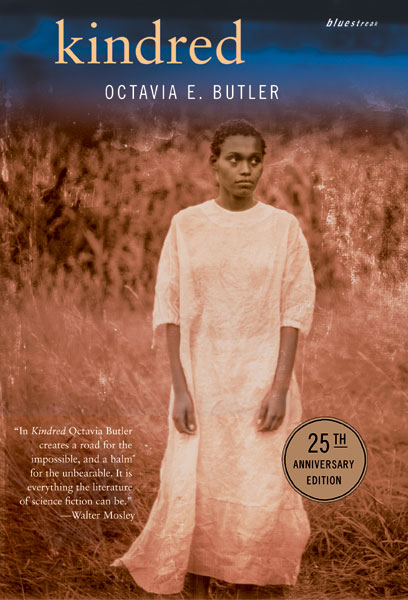
Staging Slavery

This first ran on Splice Today.
________________

I was both surprised and delighted 12 Years a Slave won the Oscar for Best Picture. Some, however, were gnashing their teeth. Jonathan Rosenbaum, for example called 12 Years “an arthouse exploitation gift to masochistic guilty liberals hungry for history lessons,” while John Demetry at CityArts argues that the film denies Northup specificity or consciousness, turning him into “a cypher representing Black hopelessness.” Both argue that other films are more insightful and respectful in their treatment of slavery—and in particular, both mention Charles Burnett’s 1996 film Nightjohn, which has almost no popular profile and which, like 12 Years, was created by a black director.

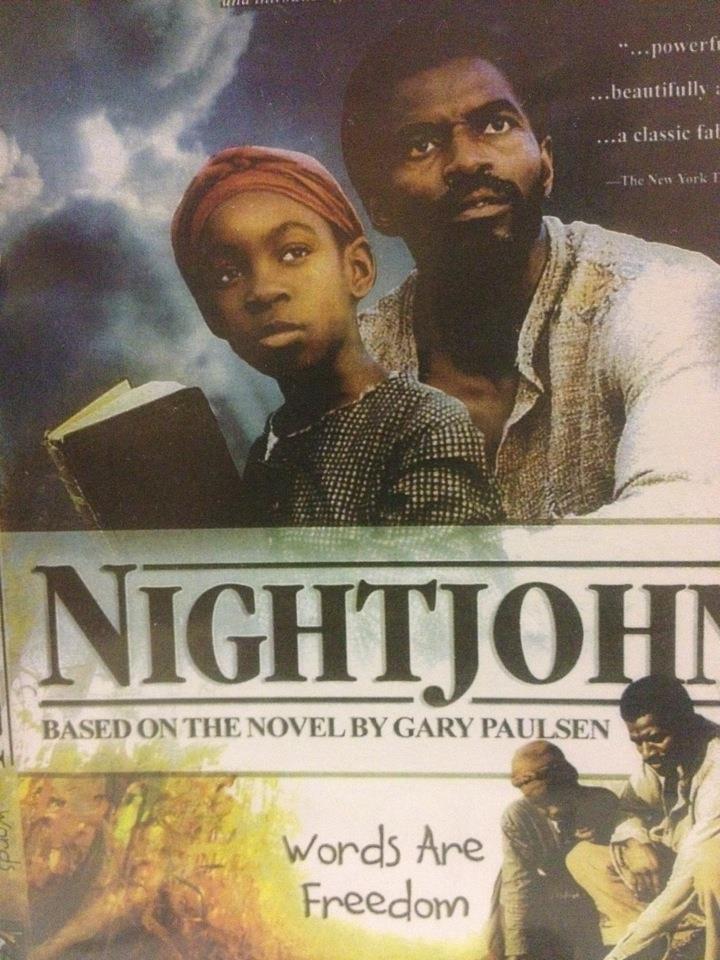
There’s no doubt that Nightjohn is distinct from other slavery films in a number of intriguing ways. Originally screened as a TV movie on the Disney Channel, it embraces the smaller-scale, living-room format. The plot centers on Sarny (Allison Jones), a young, avidly curious girl whose life as a slave is transformed by her owners’ purchase of Nightjohn (Carl Lumbly), who offers to teach her to read.

Putting literacy at the center of the story allows Burnett to avoid many of the standard slavery tropes. Though there are violent scenes in the movie, the main drama is not around physical endurance or resistance, as in Glory, Amistad, 12 Years, or the less well-known Sankofa. Instead, the drama is about intellectual achievement as a reclamation or assertion of self. Reading means that Sarny can write passes to help friends escape; it means she can manipulate white people to her own advantage and to the advantage of her community. Knowledge is power, and if slaves can learn to read, they can obtain that power.

Nightjohn, a runaway who had made it to the North, returned into slavery to teach other slaves to read. This recalls Beverly Jenkins’ Indigo (also from 1996), in which the protagonists’ father, a freeman, agrees to become a slave to marry the woman he loves. In both cases, the moral is not self-abnegation, but rather self-assertion—an insistence that slavery is not the most important truth, and does not define black people. They are not just victims, but human beings who, even in extremis, can pursue human goals such as knowledge, teaching, or love.

Yet, for all its focus on intellectual development, the interiority that Nightjohn imagines is an oddly public and dramatic one. Sarny’s lessons, for example, coalesce all at once while she is in church reading the Bible—suddenly the individual letters fall into place, and ta-dah! she can read. The moment is so powerful that she starts to cry, and the white minister thinks she’s been saved. “Yes, I am saved,” she agrees when asked, and is then baptized. The scene is equates, or conflates, the ability to read with religious salvation or awakening, making the attainment of reading a kind of mystical right of passage, complete with ceremonial trappings.

Along the same lines, the climactic scene of the film occurs, again, in church, in front of the entire community. Sarny’s owner, Clel Waller (Beau Bridges) threatens to start shooting slaves until one of them tells him who has written the passes for two escapees. Sarny defuses the situation by obliquely threatening to expose the fact that Clel’s wife has been committing adultery with the town doctor. Sarny knows about the affair because she was the one who carried notes back and forth; her ability to read gives her a weapon.

These scenes are meant to demonstrate that private knowledge is not merely private; learning to read for the slaves is a political act, with political ramifications. And yet, those political ramifications are actually somewhat undermined by the rank implausibility of the set pieces. People don’t actually learn to read all at once. Blackmail can be effective if applied cleverly and surreptitiously, but flaunting his spouse’s adultery in the face of a man with a gun pointed at you is not likely to result in a positive outcome. In his enthusiastic review of the film, Jonathan Rosenbaum characterized the movie as a kind of “fairy tale.” But the departures from realism here feel less like magic or dream logic, and more like standard film contrivance—drama for the sake of drama, and/or for the sake of communicating the requisite moral at sufficient volume that it can be deciphered in the nosebleed seats.

The didactic staginess is perhaps appropriate for a film about teaching. But it’s also somewhat disappointing, not least because it’s so familiar. Movies about slavery—whether Amistad or Glory, 12 Years a Slave or even Django Unchained—all have about them a sense of the educational spectacle as growth experience. There are probably a number of reasons for this. Films (even TV movies) are wedded to their status as events; it’s hard for a movie to resist the urge to be larger than life. Slavery is so intimately linked to ongoing racial disparities, and so relatively little explored on screen, that the impulse to say something definitive must be nearly overwhelming. Whatever the combination of factors is, though, the fact is that most movies about the subject are couched to some significant degree as “history lessons,” to use Rosenbaum’s dismissive characterization of 12 Years. And as a result the people in the films tend to turn into tropes, or icons, or curriculum enhancements. Like Nightjohn telling Sarny that the “A” is standing on its own two feet, the symbolic message can erase individuality and ambiguity, so that the letter means its image rather than all the things it can spell.
 

night-john1

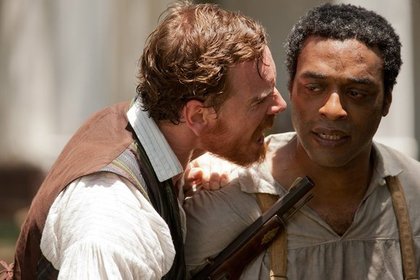
12 Years a Slave as Torture Porn

This first ran on Splice Today.
_________________

Cultural critics and politicians have long worried that media violence would lead to real-life anti-social behavior. Earlier this month, Armond White, CityArts film critic, may have provided an unexpected confirmation of those fears. White was so incensed by the very violent 12 Years a Slave that, according to a number of witnesses, he allegedly shouted obscenities at its director Steve McQueen during the New York Film Critics Circle awards ceremony.

White denies he was heckling, and I don’t want to go into the pros and cons of the expulsion, but I do want to discuss more about violence and its effects, an issue that’s at the heart of White’s loathing of 12 Years A Slave. In his review of the film, White says that 12 Years, about a Northern black man who is kidnapped and sold into slavery, confuses “[b]rutality, violence, and misery… with history.” He argues that director McQueen is interested in “sado-masochistic display,” and compares the results to The Exorcist and torture porn films like Hostel and Saw. For White, the film is detestable because it focuses unrelentingly on violence as violence; “This is less a drama than an inhumane analysis,” he thunders, and is especially angry that there’s no sign that the protagonist, Solomon Northup (Chiwetel Ejiofor) has “spiritual resource or political drive.” He concludes, “Patsey’s completely unfathomable longing for death is just art-world cynicism. McQueen’s “sympathy” lacks appropriate disgust and outrage but basks in repulsion and pity–including close-up wounds and oblivion.”

This discussion of Patsey (Lupita Nyong‘o) seems at first quite confusing. There is nothing “unfathomable” about her despair; in the narrative, she’s a slave who is constantly raped by her owner, causing the jealous mistress of the house to beat and torment her relentlessly. She is violated and abused over and over; it’s not at all difficult to imagine that she might long for death. For that matter, in Amistad, which White admires greatly (it was his best film of 1997) there is an almost exactly parallel situation, in which a woman faced with the horrors of the middle passage kills herself and her baby by falling over the side of the ship. Why is her decision fathomable, while Patsey’s is not?

I think that what White is reacting to is the way that violence is or is not framed as meaningful. Spielberg (who White adores) is a filmmaker of compulsive—one might even say facile—lucidity. He is careful to tell you again and again why something happened, and how it fits into the narrative.

Amistad shows numerous examples of violence, including whippings, drownings, stabbings, forced starvation, torture, and on and on—the body count, which includes dozens dead, is substantially higher than 12 Years. But all of these incidents of violence are carefully placed in a recognizable framework. The slave uprising and the murder of the white sailors that open the film, is a straightforward revenge story, nestled comfortably in Hollywood convention. The violence against the slaves is told in flashback in the course of the film’s extensive courtroom drama; it is evidence presented to sway the court and (presumably) the movie viewers. Any confusing bit (why did the slavers choose to drown so many of the slaves they planned to sell?) is carefully examined and explained in the course of cross-examinations. Even the suicide of the woman mentioned earlier is girded round with sense—she exchanges a glance with Cinque (Djimon Hounsou) before she goes over the edge, and he nods at her meaningfully, as if to validate and interpret her choice for the viewers. Similarly, Spielberg at first does not translate the Africans’ dialogue so that the violence done by and to them is (for most Western viewers at least) unspoken and uninterpretable. But as you go along the film interprets (directly and metaphorically) and contains the violence, until all of it is crystalline. By this alchemy, violence becomes empathy and triumph. The story of the injustice and violence done to the crew is told in order to win them the understanding of the court/movie audience, which in turn opens the gates to freedom—from slavery then and, by implication, from inequity now.

12 Years A Slave, as White says, does not make violence so fathomable. In one of the movie’s most striking scenes, Northup’s owner attempts to hang him. He’s interrupted and driven off by a man acting on behalf of Northup’s former owner, Ford, who has not been fully paid for Northup. The interrupter then goes off to fetch Ford. Even though the hanging has been stopped, no one bothers to cut Northup down. Instead he stands there for an indeterminate, endless time, his feet shuffling on the ground, choking, as McQueen’s camera watches mercilessly and the life on the plantation goes on around him, the only respite being when another slave scurries up furtively to give him a drink of water.

Eventually, Ford arrives and releases Northup, but there is never any explanation for the torture he underwent. It has no meaning except itself; the image of it, the length, the spectacle, overwhelms the narrative. Violence here is only violence. Similarly, Northup’s kidnapping and ordeal is not presented as leading to a politically hopeful or uplifting end. Northup does not gain by witnessing the violence, and it isn’t clear how the viewer gains either. Nothing, as White says, is presented “in order to verify and make bearable the otherwise dehumanizing tales.” White insists that “Art elates and edifies,” but violence in 12 Years A Slave does neither. It just sits there, an open wound, and when you it ends, you’re not enriched or educated. You’re depleted. Violence makes you less, not more.

One example of that torture-porn genre with which White dismissively groups 12 Years is a 2009 horror film called Martyrs. The plot centers on a quasi-religious conspiracy of torture. The brutalizers believe that inflicting pain on innocents will beatify those innocents, and transform them into saints, who will then, before death, offer a profound message to the world. White argues that 12 Years “accustoms moviegoers to violence and brutality” because it sadistically refuses to make its violence speak. Martyrs, though, suggests that people are accustomed to violence not through exposure, per se, but through narrative rationalization. Making violence speak—as evidence, as uplift, as spur to empathy—justifies it and excuses it. 12 Years refuses to make violence part of a bigger story. It doesn’t want you to see violence and feel elated or edified, like the torturers in Martyrs who whip their victims in the name of catharsis. Rather, 12 Years wants you to look at violence and say, with White, “I wish I never saw it.”
 

large_STA12FILM1_397402k

Utilitarian Review 7/12/14

On HU

Robert Jones, Jr. on giving up on mainstream comics.

Matt Thorn with a brief note on Ursula K. Le Guin’s Left Hand of Darkness.

Alexis Pauline Gumbs on Octavia Butler as uncomfortable foremother.

A.Y. Daring on wound as identity in Kindred.

Julian Chambliss looks at what scholars study when they study Octavia Butler.

Me on Octavia Butler’s mediocre prose and why it matters.

Chris Gavaler on how Fantax shows that the French know their way around super-hero violence.

I think we’ve got a couple more Octavia Butler posts next week, but then that’s it, and we’ll be back to regular old posting!
 
Utilitarians Everywhere

At Salon I have 19 songs that show that Jimi Hendrix was not a token.

At the Atlantic I argue that Elvis invented nothing and stole nothing.

At Splice Today I write about the great conservative novel, Gone With the Wind.
 
Other Links

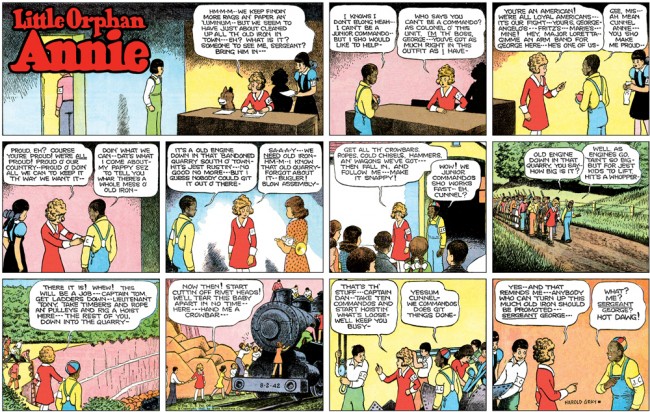
Jeet Heer on Harold Gray and the limits of conservative anti-racism.

Armond White on the mediocrity of Roger Ebert.

Elias Leight on new albums by Joe and Trey Songz.
 
ANNIE_Sunday_LOA420802-lo1-650x412

Adventures in Comic Book City

France’s Cité Internationale de la Bande Dessinée et de l’Image isn’t literally a city, but it’s getting there. It started as a single building, named after the French comic book artist Moebius:
 

more angouleme 126

 
Le vaisseau moebius currently houses (in addition to a cinema and cafe) a public library devoted entirely to BDs (AKA comics):
 

more angouleme 128

 
It also used to hold the research librarie (distinct from the above bibliothéque) and the Musée de la Bande Dessinée, but those moved across the Charente river. Just take the footbridge:
 

angouleme day 2, comics research 001

 
And you’re there:
 

angouleme day 2, comics research 002

 
You’ll pass a former paper mill renovated into the Musée de Papier, a tribute to Angouleme’s past as a paper manufacturing hub. Some of that paper is preserved in the librarie’s comic book collection. The BD Musée was a cognac warehouse in its former life, not that you would guess from its interior:
 

more angouleme 120

 
A tourist website likens it to the set of 2001: A Space Oddysey, presumably the spacecraft headed to Jupiter–though that was built on a rotating ferris wheel. The allusion still works though, because the film’s soundtrack features Richard Strauss’ Thus spake Zarathustra, a symphonic adaptation of the book that gave us the Superman.
 

more angouleme 122

 
One of the displays includes a facsimile of Action Comics No. 1, but the curators begin the history of “drawn strips” a century earlier, with a Swiss work I’d never heard of, Rodolphe Töpffer’s 1837  Histoire de M. Vieux Bois:
 

more angouleme 004

 
Photography isn’t allowed, but because I had scheduled a research consultation, they made a kind exception. They didn’t charge me the museum entry fee either. There’s a massive BD book store too, but I spent most of my time in a back room:
 

more angouleme 119

 
My French is shockingly non-existent, and the documentaliste I emailed with relied on Google Translate, and yet there was the stack of rare collection boxes waiting for me when I arrived. The conseiller scientifique (a job title I choose to translate as “Science Officer” to continue the scifi theme) was overwhelmingly helpful too, fielding my minutia-minded questions both before and after my visit.

I’d read that France’s BD-censoring law had passed in 1949 in part because of the violence of American superhero comics.  The censors wanted to end the damaging influence. American superhero comics were indeed violent, but I wanted to test the claim by looking at some of their French counterparts, most specifically Pierre Mouchot’s Fantax, a Batman-like adventurer stationed in New York. “It is no exaggeration,” I’d read on CoolFrenchComics.com, “to say that Fantax was single-handedly responsible for the adoption of the Law of July 1949 which thereafter heavily censored adventure comics.”

I untied the strings of the first rare collections box to find a stack of original Fantax magazines:
 

angouleme day 2, comics research 014angouleme day 2, comics research 015

 
My favorite cover features the hero smoking a cigarette:
 

angouleme day 2, comics research 013
 
As far as American superhero influences, it seemed Chott had based his Fantax costume on Bernard Baily’s Hourman, swapping yellow for red:
 

adventure_comics_48_001

 
The inside pages were colorless, but alternated between black and blue ink, a format I’d never seen before:
 

last fantax issue
 

last fantax issue late page

I came prepared to count panels and incidents of violence on objective scales. I’d worked up a lexicon of graphic representations based mainly on Bob Kane’s Batman: sound effects (including letter size, thickness, and exclamation points), gun clouds, bullet whiz lines, motion lines, impact lines, impact bursts (attached, detached and background), stars (implying internal state of near unconsciousness), foregrounded panel breaks, encapsulated vs. implied gutter violence, content angle and distance, violent movement through representational objects (dropped gun, falling hat), physical contact (punch, kick, grab, throw, pierce, shoot), aftermath imagery (corpse, unconscious body, wounds).

With the exception of panel breaks, Chott (that’s how Pierre Mouchot signs his pen name) uses them all. Each issue includes ten pages (plus the partially used back cover) with an average of ten panels each. I’m still in the process of tallying and averaging the number of panels with violent content, but at first glance I wasn’t seeing much outside the Kane’s Batman range.

Chott does substitute an occasional blood splatter for an impact burst:

angouleme day 2, comics research 087

And, more artfully, some of his panels offer a rare, first-person POV:

angouleme day 2, comics research 088

But it looked like Fantax, though lethally violent, was operating at the upper end of American superhero norms.

Until I looked at the cover of No. 6:

angouleme day 2, comics research 093

And this beheading in No. 8:

angouleme day 2, comics research 117

And I realized the French superhero had stepped beyond the influence of his American inspirations.

Fantax No. 8 was published in January 1947, while in the U.S. the notoriously violent EC was still publishing Pictures Stories from the Bible. EC owner Bill Gaines would later face a panel of offended senators while defending the artwork of Johnny Craig on a 1954 cover of Crime SuspenStories:

Crime-SuspenStories

SENATOR KEFAUVER: Here is your May 22 issue. This seems to be a man with a bloody ax holding a woman’s head up which has been severed from her body. Do you think that is in good taste?

GAINES: Yes, sir; I do, for the cover of a horror comic. A cover in bad taste, for example, might be defined as holding the head a little higher so that the neck could be seen dripping blood from it and moving the body over a little further so that the neck of the body could be seen to be bloody.

Gaines’ description of “bad taste” describes the Fantax beheading panel, published as the American superhero market was in collapse and the American horror market had barely launched with the first comic book horror title, Spooks Comics No. 1 (undated, c. 1946).

It’s no surprise Chott cancelled Fantax before France’s censorship law took effect. But the perception that the magazine mirrored American superheroes is wrong. Many of the hero’s adventures are set in New York, but they are a funhouse reflection of the U.S. as gleaned through U.S. comics. Chott is drawing a comic book version of a comic book.

His New York is a Comic Book City.
 

angouleme day 2, comics research 086
 

Pattern Flattener

This is part of a roundtable on the work of Octavia Butler. The index to the roundtable is here.
__________

Most of the posts in the Octavia Butler roundtable (including my earlier post) have been fairly laudatory of Butler’s work. And there’s certainly a lot to like in Butler’s novels. She tackles complicated themes in imaginative ways and manages to be quite repulsive while doing so. Not many folks out there walk the line between slavery narratives and tentacle sex. Hard not to cheer for that.
 

octavia-bulter

 
But, while I like Butler quite a bit, I do have some reservations. The main one being that she’s not a very good writer.

Of course, Butler is a good writer in some ways. As I said, she’s very inventive and thoughtful; she has lots of ideas; and she explores them in interesting ways. Still, reading her, you can’t help but notice that her prose rides a fine line between uninteresting and actively insipid. Yes, there’s tentacle sex, but it’s tentacle sex described with all the fever and poetry of a long, leisurely session at your tax accountant’s. Mutant eternal killer demons speak from out the ages with the somnolent laconic lack of affect of a Calvin Coolidge. Apocalypses of multivariant forms all land upon an unsuspecting earth like wire service news bulletins. Characters of diverse class, race, and ethnicity, whether blood-sucking vampires or gelatinous fern assemblages, all speak with a default mid-range vocabulary, eschewing figurative language for bland glops of transparent earnestness.

Here, for example, is Mary, a troubled young African-American girl who is coming into her own as a massively powered telepath who can read the minds of hundreds and hundreds of other psis all bound to her will. She has just defeated her only rival for power. It’s an emotional moment. Right?

Not so much.

They cremated Doro’s last body before I was able to get out of bed. I was in bed for two days. A lot of others were there even longer. The few who were on their feet ran things with the help of the mute servants. One hundred and fifty-four Patternists never got up again at all. They were my weakest, those least able to take the strain I put on them. They died because it took me too long to learn how to kill Doro. By the time Doro was dead and I began to try to give back the strength I had taken from my people, the 154 were already dead.

he sentences sit there in a Hemingwayesque funk, desperately hoping that the short. simple. structure. will lead you to think that the passage is economical, even though she keeps repeating the same not especially revelatory information with a distant, feeble ruthlessness. They were the weakest, and they could not take the strain; they were dead, and then they were dead, and at the end of another sentence, they’re still dead.

Perhaps you could argue that Butler is deliberately using a simple voice to convey Mary’s consciousness here — but, again, Mary is supposed to at this point be an incredible mutant superconsiousness. What is it like to be inside the head of someone who is inside the head of hundreds of other people? How must it feel to know all those other people’s lives and vocabularies? If Samuel Delany or Gwyneth Jones or Joanna Russ or any number of Butler’s compatriots in the realm of gender-bending avant sci-fi art were writing this, Mary’s consciousness would be multi-vocal and strange — it would mirror alienness in its syntax and grammar and language. Mary wouldn’t just say, “Hey! I’m different! How about that?” Her voice would be part of the meaning of the novel. But it’s not, because it can’t be, because Butler has no interest at all in language, the supposed tool of her trade.

There are times when the lax limpidity of the prose does work thematically, at least up to a point. “Dawn” and “Fledgling” can both be read as coming-of-age novels, with the protagonists growing up to discover their true selves as tentacled imperialist monstrosities and vampiric incestuous slaveholders, respectively. In these books, you could argue, the flatness of the prose (and as a result of the affect) has an almost satirical fillip; the default of bland genre becomes a patina of normalcy over a pit of perversion and alienness. The nice, easy story isn’t so nice and easy — or possibly vice versa.

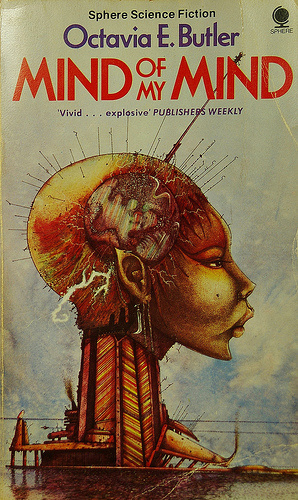
Still, it seems pretty clear that, in many respects, better prose would in fact result in better books. In “Wild Seed” and especially in the earlier “Mind of My Mind”, Butler creates careful moral dilemmas, only to have them sag beneath the damp uselessness of her style. Doro, the eternal mutant who survives by jumping from body to body and killing his hosts, is, as I’ve said, completely unconvincing; when he speaks he sounds not like an all-powerful parasite, but like mid-range science-fiction narrator explicating.

Even worse is the fact that the rest of the characters are equally indistinguishable and bland. Doro is supposed to be a monster, destroying person after person — but the people he destroys aren’t real. We never feel any deaths, because the characters are just chits Butler moves around the page. It’s almost as if Butler is Doro; he sees humans mostly as personality-less puppets to manipulate through his plots, and Butler treats the humans as personality-less puppets to manipulate through her plots.

This is especially painful in “Mind of My Mind” where Butler switches point of view characters repeatedly, in an effort (presumably) to have us get to know each one. But instead, what we get to know is that they’re all the same. In theory, if we actually could tell one from the other, we might feel some sort of loss when Mary pulls them into her pattern, and they abandon their independence. But it never happens, because they were never individuals to begin with. Similarly, the Patternists take over the minds of normal humans (mutes) and enslave them. But it’s hard to much care when the humans are blandly uninteresting before being slaves, and then blandly uninteresting afterwards. How can you provide a moral meditation on human individuality when you’re unable to create an even passable representation of an individual human?

In her post on Butler and empathy, Qiana Whitted says that she is impressed with the way that Butler creates repulsive insect-like aliens as a barrier to empathy. It’s true that Butler’s aliens can be squicky, and that can in some cases be a way to withhold empathy, or insist on difference. But those insisted-on differences in Butler’s work rarely go more than squick-deep. Bodies in Butler may be wildly heterogenous and imaginative, but her language is always the same untrammeled non-thing, scooping up tentacle creature and vampire alike in its unwavering similitude. Everybody thinks alike and talks alike, which means that on the level of the prose, which is the essence of the book, Butler often seems unable to think difference at all. Maybe that’s why her books can seem oppressive — not because she has a bleak vision of human intolerance for strangeness, but because the pattern in her books is too flat to allow the strangers called humans any life of their own.

The Body Envisioned: Octavia Butler

This is part of a roundtable on the work of Octavia Butler. The index to the roundtable is here.
__________

The MacArthur Foundation concisely explained Octavia Butler’s impact on science fiction in 1995. Popularly referred to as “Genius Grants,” the program “awards unrestricted fellowships to talented individuals who have shown extraordinary originality and dedication in their creative pursuits and a marked capacity for self-direction.” In describing Butler, the foundation said simply, “Octavia Butler, a writer of science fiction, brought elements of African and African-American spiritualism, mysticism, and mythology to her novels and stories.”[1] The direct and simple description is both accurate and jarring. Butler’s identity as a woman of color in a genre long dominated by white men made her a unique figure, but more importantly her identity informed her work. Talented by any measure Butler’s career placed her at the center of ongoing debates about the U.S. experience linked to questions of identity and power.

To think about Butler’s contribution and status, I complied a list of scholarly articles based on search queries on Butler. From that body of material I utilized Paper Machine, a plug-in for Zotero, the bibliographic and research software created by the Roy Rosenzweig Center for History and New Media to get a snapshot of how researchers approach Butler.[2] This approach does not take the place of the critical assessments of Butler work that we have seen in the roundtable. There are limitations to this approach based on the tool and my use of it. A more compelling analysis would be gained by exploring patterns in Butler’s published works or perhaps an examination of African-American authors writing speculative fiction in the twentieth century.

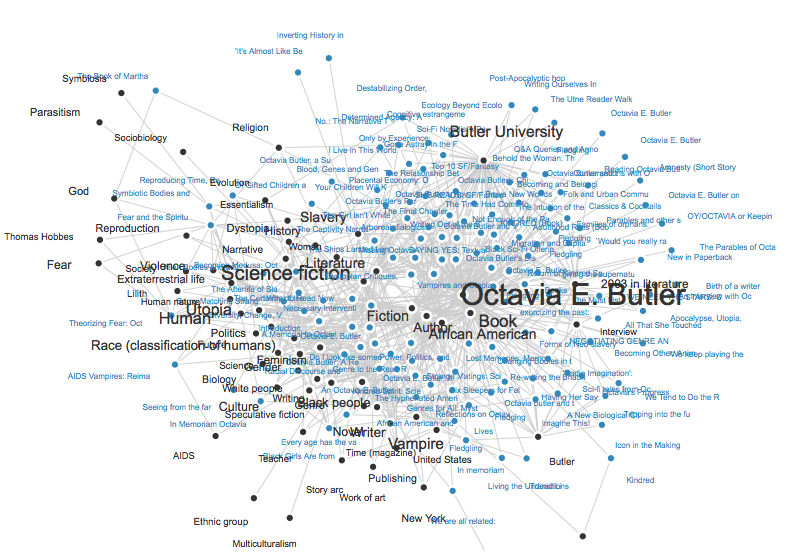
What Paper Machine facilitates for me is to understand how a select body of material shifts over time and visualize those changes quickly. I added about 340 articles to my Zotero library from academic databases using Butler and related search terms. Most people who know what they are doing will point out that I need a bigger corpus. My goal is more exploratory (weak defense) and frankly I had time constraints (weaker defense). Using Paper Machine, I was able to take this collective material to create several visualizations. The first figure is a DBpedia visualization of the corpus. DBpedia is a crowd-sourced effort to create systematized information from Wikipedia and make it available on the web. Paper Machine uses the name entities mentioned in the corpus and scaled those entries according to the frequency of their occurrence to create this visualization. Naturally, the author’s name is featured prominently along with terms such as parasitism, race, and utopia.

Figure 1: Butler Scholar DBpedia

Butler Scholar DBpedia

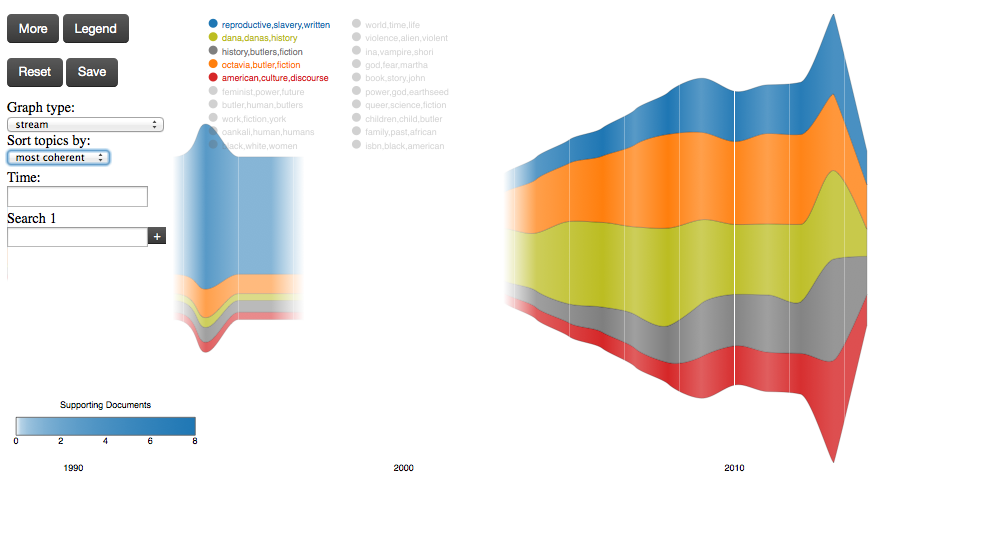
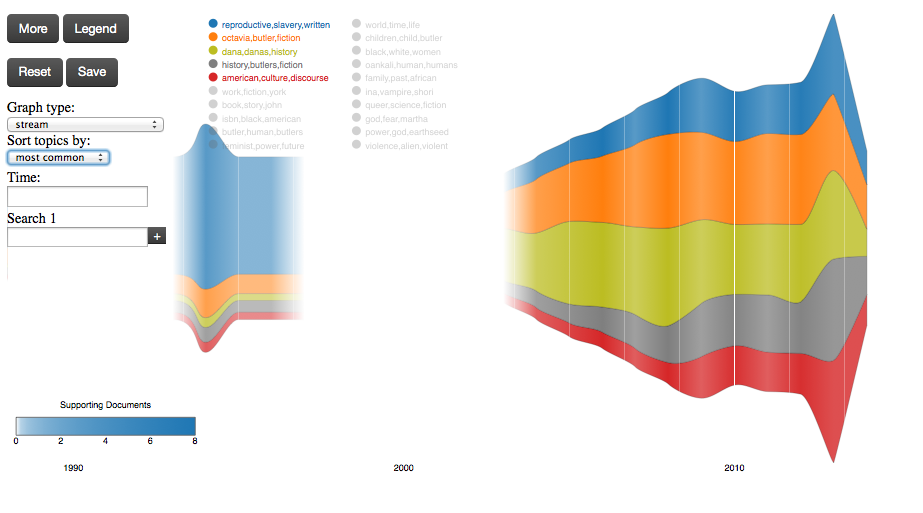
Perhaps more interestingly, Paper Machine can pull text from PDFs and use bibliographic metadata to create visualizations. This allows the program to create topic models via text mining. Paper Machine finds and clusters the words in the corpus based on the pattern of occurrence. The result is a steam graph of topics determined by the corpus. I sorted the output by the 20 “most coherent ” and “most common” topics. While Butler is the author of several noteworthy works, this modeling demonstrates that research has greater focus on Kindred (1979)and ideas such as reproduction and slavery.

Figure 2: Butler Scholar 20 Topic Most Coherent

Butler Scholar 20 Topics Most Coherent

Figure 3: Butler Scholar 20 Topic Most Common

Butler Scholar 20 Topics Most Common

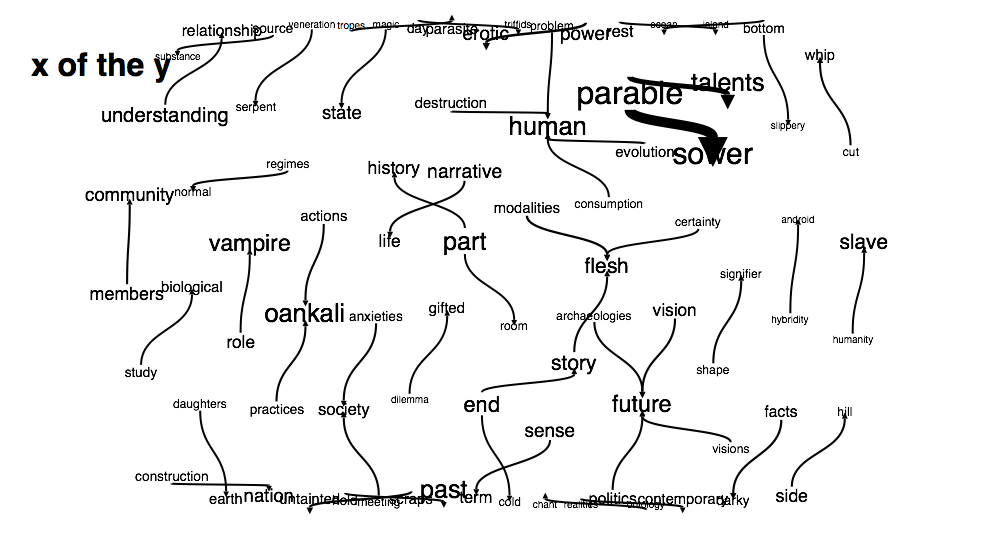
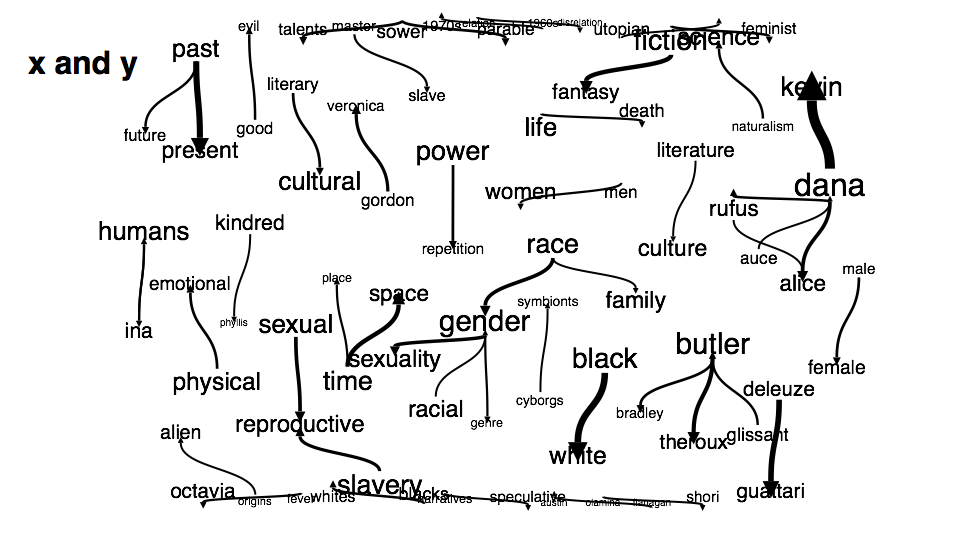
In addition to topic models, Paper Machine can generate a phrase net that gives a sense of the order within the entire corpus. The images below are phase nets for ‘x of the y’ and ‘x and y’ in the corpus. The direction of the arrow tells us how to read the connection, and the thickness indicates the relative frequency of the phase within the corpus.

Figure 4: Butler Scholar-Phase Net x of the y

Butler Scholar-Phase Net x of the y

Figure 5: Butler Scholar-Phase Net x and y

Butler Scholar Phase Net x and y

&nsp;
The trends within the corpus display a pattern of analysis that parallels the topic. Phrases such as anxieties of the society or slavery and reproduction are to be expected in the corpus based on Butler’s work. Ultimately, this exercise in visualization highlights Butler’s status has grown over time as scholars discuss Butler work with greater emphasis on race, gender, and society.

This result is no surprise. As a historian, my fascination with Butler has always been rooted in this collective recognition of her as signifier. As the corpus indicates, she is often mentioned, along with Samuel R. Delany as an African-American literary pioneer. The historical reality is more complex. Authors of African descent have imagined circumstances that challenged the reality of the dominant culture for decades. Martin Robinson Delany (1812-1885), abolitionist and the first African-American field officer in the U.S. Army wrote the serial adventure of Henry Blake, an escaped slave who travels throughout the southern United States and Cuba to plan a large slave insurrection. Published in the Anglo-African Magazine in 1859 and the Weekly Anglo-African in 1861-62, the story was a response to the 1850 Fugitive Slave Act and the U.S. Supreme Court’s Dred Scott v. Sanford decision. Delany’s story offered a militant protagonist that challenged southern and northern expectations.[3] In a similar vein, Edward A. Johnson’s utopian novel Light Ahead for the Negro (1904) imagined a protagonist transported to a future socialist United States free from racial strife.[4] Surprisingly, W.E.B. Dubois’ 1920 short story, “The Comet,” featured a black bank messenger and the white daughter of a wealthy businessman as the only survivors in a city ravaged by the toxic effects of a passing comet.[5]

Science-fictional approaches to race continued into the mid-century. As society became more mediated, science fiction was an integral part of speculating on the implication of a rapidly changing world.[6] For creators committed to challenging stereotypes, memorable efforts on television such as Twilight Zone (1959-1964) and Star Trek (1966-1969) reflected the broader societal dialogue connected to racial equality. Imaginative and provocative, what these stories share is the author’s use of speculative fiction to explore their world and challenge limiting expectations. Each narrative is reacting to contemporary debates and offering ideas and actions that point to new social and political circumstances.

First published in 1971, Butler emerged as the United States struggled to reconcile the promise of the postwar liberalism with reality of a functional society that balances individual agency against communal upset. As historian Bruce Schulman explained, “In race relations, religion, family life, politics, and popular culture, the 1970s marked the most significant watershed of modern U.S. History, the beginning of our own time.”[7] An African-American female in a field associated with white men, Butler’s emergence gave voice to the challenging intersectionality linked to race and gender. For all the possibilities associated with science fiction, Butler’s work and our collective recognition of it emphasizes this struggle is ongoing and unresolved. Butler recognized the clash between ideas and actions and made her writing about, “… when you are aware of what it means to be an adult and what choices you have to make, the fact that maybe you’re afraid, but you still have to act.”[8] Working through the lens of her identity within two marginalized groups, her vision has grown in importance as the wider society moves these questions to the center of our public discourse. No longer in an era of pioneering firsts, debates about equity and representation in science fiction have grown in importance as imagined and real landscapes converge. It is too much to suggest understanding Butler means unraveling this problem, but her advice to aspiring writers highlights why the effort bears worthwhile fruit–“I’ve talked to high school kids who are thinking about trying to become a writer and asking ‘What should I major in?’, and I tell them, ‘History. Anthropology. Something where you get to know the human species a little better, as opposed to something where you learn to arrange words.”[9]
__________________
[1] “Octavia Butler,” www.macfound.org, (July 1, 1995), http://www.macfound.org/fellows/505/.

[2] “Zotero | About,” www.zotero.org, accessed July 5, 2014, https://www.zotero.org/about/.

[3] Katy L. Chiles, “Blake; or the Huts of America (1859–1861),” Encyclopedia of Virginia, (September 24, 2012), http://www.encyclopediavirginia.org/Blake_or_the_Huts_of_America_1859-1861.

[4] Maryemma Graham, The Cambridge Companion to the African American Novel (Cambridge University Press, 2004), 42–43.

[5] W.E.B. Dubois, “Darkwater: Voice From Within The Veil,” Archive, www.gutenberg.org, (1920), http://www.gutenberg.org/files/15210/15210-h/15210-h.htm.

[6] J. P. Telotte, The Essential Science Fiction Television Reader (Lexington: The University Press of Kentucky, 2008), 3.

[7] Bruce J Schulman, The Seventies: The Great Shift in American Culture, Society, and Politics (Cambridge, MA.: Da Capo Press, 2002), xii.

[8] “Octavia E. Butler Interview (excerpts),” Magazine, Locus Online, (June 2000), http://www.locusmag.com/2000/Issues/06/Butler.html.

[9] Ibid.

When Loss Becomes You

This is part of a roundtable on the work of Octavia Butler. The index to the roundtable is here.
__________

When I got into college, Pasadena City College,…I heard some remarks from a young man who was the same age I was but who had apparently never made the connection with what his parents did to keep him alive. He was still blaming them for their humility and their acceptance of disgusting behavior on the part of employers and other people. He said, “I’d like to kill all these old people who have been holding us back for so long. But I can’t because I’d have to start with my own parents.” When he said us he meant black people, and when he said old people he meant older black people. That was actually the germ of the idea for Kindred (1979)

I’ve carried that comment with me for thirty years. He felt so strongly ashamed of what the older generation had to do, without really putting it into the context of being necessary for not only their lives but his as well. I wanted to take a character, when I did Kindred, back in time to some of the things that our ancestors had to go through, and see if that character survived so very well with the knowledge of the present in her head. – Octavia Butler

First, a spoiler-free refresher on Kindred if you haven’t read it, or if you can’t remember it: On July 9, 1976 (which was contemporary when it was written), Dana feels dizzy, and then collapses, while unpacking in her new house. She comes to on the banks of a river she has never seen before. Luckily, space and time travel have a short jet-lag period in this world, because almost immediately after she arrives 161 years in the past, she saves the life of a little red-haired boy drowning in the river beside her. We later learn that the boy is Rufus, her great-grandfather. Rufus will grow up to have several children by one of his future slaves, Dana’s great-grandmother Alice. But for now, he is a boy who needs saving, and so she saves him. Dana continues to save him over the course of the story, because consanguinity has bestowed upon Rufus the ability to call Dana into his time when his life is in danger.

Now, a spoiler free plot point: Dana loses her left arm on her way back from the last of these travels. It has to be amputated in the present-day, as a result of an injury she sustains while coming back. She also sustains a permanent scar on her face from being kicked by a slave-owner after falling down.

Amputation and scarring are permanent, and should not be the metaphor to represent the injuries that slavery has caused to those racialised-as-Black in this day. This isn’t to say that there are people racialised-as-Black living outside of structural racism, or that if you ignore reality, injustice goes away. Rather, what I want to hold up for scrutiny is the notion that injury and impairment are necessarily and perhaps even inevitably, a part of identity for descendants of slaves and those who look like them in contemporary America.

If you’ve read Wendy Brown, you’re probably familiar with what I’m getting at. If not she’s a political science professor at University of California, Berkeley, and my question is related to the one Brown poses in States of Injury. That is, “how does a sense of woundedness become the basis for a sense of identity?”, but my response is different. Brown argues that its the capitalistic superstructure that we need to jettison in order to bring about liberation. You see, by getting mad that the path to your piece of the pie is unjust, you maintain that the pie really is the thing you value. “The reviled subject becomes the object of desire,”she warns.

The horrors of the slave trade seem to lend its support for her proposition. What were the slaves doing? They were making things for people to buy while keeping the cost of production minimal. They were working on sugar plantations so the land owners could have cookies, and cakes, and boiled sweets. They were working on cotton plantations so the land owners could look fashionable. They were building Georgian colonial homes to shelter the plantation owners from the brutal southern heat and the back-breaking work of beating people within inches of their lives. Though slavery is not capitalism proper, it has the capitalist’s existential project at its core: that the making and buying of things for profit, determined by membership in stratified social classes, should be the primary preoccupation of state and society. All the while, the slaves wanted what the slave owners had- the spoils of the American Dream, despite the fact that it was the Dream that justified their enslavement. We still do this in various forms today.Many groups and movements criticise the state as a monolithic site of oppression qua unjust dominance, but then seek its protection under the logic that state dominance is only unjust if its dominating the wrong demographic.

I’m not convinced that capitalism is the problem though, or that anarchy or communism are potential solutions. Perhaps domination is inextricable from capitalism, but domination doesn’t belong to any particular political economy any more than religion has monopoly on morality. Yes, her experience of enslavement permanently impairs Dana. But let’s not elide over the fact that her impairment would not be a disability if her society did not make safety and self-actualisation a two-handed commodity.

So that’s why I loved Kindred, but am also a little wary of it. I loved that it shows so vividly the kinds of things that happen when you put ego and profit above universal human dignity and justice. But it also seems to suggest that injustice is primarily a problem of unjust commodity distribution, rather than a problem of us valuing a questionable set of social goods. It also reifies various forms of injustice by suggesting that we need to expand the class of people who can afford freedom, rather than question why freedom is so closely tied to desert and not something else. Do we really want to say that freedom is a cookie given only to those who have worked hard enough at the right things? Perhaps so, but then we’d need an account that can explain why freedom’s metaphysics only kick in after you’ve joined the right social club. If you’re really free, you need to be free from the start, not after conquering (or being born having conquered) a set of social ordeals.

“I never realized how easily people could be trained to accept slavery,”Dana thinks to herself, after a few travels back into the past. I now think to myself, “You can make a person accept nearly anything, if you tie acceptance to their livelihood”. The characters in Kindred that question slavery either attempt to run away, or hope to one day get their free papers. I sympathize with the characters who tried to run away, but I’m sympathetic of the stance of waiting and hoping. It’s just that, waiting for your free papers suggests that you really are property (as many slaves had been convinced), and continues to hold the plantation owner as the ultimate arbiter of freedom. If we untie our livelihood from needing to dominate others, we can start to live differently, and oppression becomes a social condition, rather than a permanent personal injury.

No, oppression is not an amputation, but a sign that you want to use that two-handed tool too. Whether or not that’s a bad thing is perhaps another conversation. What’s important though, is that we distinguish between “I want to be free”and “I want what those who deem themselves free have”. Pursuing the latter has the unfortunate and pernicious effect of stopping the conversation about whether self-professed free people are really any freer than those they dominate. There’s no need clamouring over one another for pie when what you really want is chocolate cake anyway. The metaphor might be trite, but you’d miss it if you took the injustice-as-amputation metaphor at face value.


Kindred-octavia-e-butler-124291_408_600