Caroline Small on Critic-Practitioners

Caroline Small has been away from HU too long. She left a comment recently on Suat’s post about comics criticism, though, and so in the absence of a real full length post, I thought I’d highlight this, in part because I miss new Caro content, but mostly because it’s worth highlighting.

Having spent a great deal of time lately thinking about critical theory and art practice in the company of some marvelous, critically minded practitioners (and not thinking at all about comics), I second Suat’s suggestion that at least one reason comics criticism is in this condition is because so few cartoonists practice criticism. And by “practice”, I mean read and write not journalism, not the “theory of craft” (as Frank Santoro does so brilliantly and charmingly), but classical “criticism” – argumentative/philosophical/descriptive essays, about art in general, both inside and outside their area of specialization. In fields where there is a strong critical culture, there is typically also a significant population of working artists who consider critical conversations about art, with other artists and critics, in their own and other fields, to be an essential part of their creative practice. Something they do for themselves, because it makes their art richer and better.

Film and literature and music have extremely healthy critical cultures, but they also have large numbers of engaged critic-practitioners – not just practitioners who occasionally toss off a piece of writing about something they’ve read or something they think is important, but practitioners who consider the work of criticism (i.e, reading incisive, informed essays on a range of art-related topics as well as working out their own ideas about their art and practice in essay form) to be an essential facet of being an original, challenging practitioner. (Fine art has a tremendous history in this regard although post-postmodernism is a bit of a nadir.)

This is not to say you have to be a practitioner to be a great critic (or vice versa), but to have a great critical conversation about any field, you need a critical mass of practitioners participating in that conversation at the highest levels. The conversation between…let’s call them practitioner-critics and philosopher-critics — so many of the great critical ideas historically have come out of that conversation. But the practitioner-critic has an exceptionally tough go in comics’ supercool, DIY, populist, “a picture is worth a thousand words” climate. There are vigilant souls, but by in large the critical stance seems to be treacherous waters for cartoonists.


082710_James_Baldwin

A practitioner-critic.


Why Michael DeForge is the greatest cartoonist of his generation: The Critics Explain

wtdsd_1a

The word of mouth has been abundant and the acclaim unremitting, but what exactly can we learn from the outpouring of reviews of Michael Deforge’s Very Casual—that work of unremitting “genius”, and that artist soon poised to seize the crown now tightly held by the desiccated funksters who emerged during the 80s and 90s.

For the uninitiated, the simplest of descriptions: Very Casual is a collection of stories by DeForge variously published in places like Best American Comics 2011, The Believer, and Study Group Magazine. It won the 2013 Ignatz Award for Outstanding Anthology or Collection as well as the award for Outstanding Artist. His work is easily accessible online as are some of the stories collected in this anthology.

Fans, academics, and journalists have had their way with the likes of Chris Ware and Dan Clowes, thoroughly disinterring the design, complexity, and intelligence of their comics. But what have the esteemed critics of the internet done in DeForge’s service over the last 2 years? Here are some recurring words and concepts from a moderately long trawl: body horror, disgusting, reader beware, favoritebest, winner. The overarching feeling from reading a sizable chunk of Deforge reviews in one sitting is that he is artistically as spotless as a baby’s bottom, a veritable second coming of a cartooning Christ.

Rob Clough writing at TCJ.com in 2011 on DeForge’s early works is certainly entranced by his promise:

“He’s clearly someone who has read everything—superheroes, manga, undergrounds, autobio, etc.—and has a keen sense of comics history. DeForge combines that encyclopedic knowledge of comics with a strong sense of perspective regarding the medium, synthesizing and understanding its strengths and weaknesses. That allows him to comment on and critique not only the length and breadth of comics history, but also to closely examine his own work. Finally, his facility as a draftsman is jaw-dropping. He has a remarkable facility as a style mimic, and the control he has over the page (both in terms of design & line) is incredible for an artist as young as he is.”

Strike that. This isn’t a description of mere “promise”, it is a description of a cartooning God mowing down all obstacles in his way.

On the other hand, it is never entirely clear from Clough’s description why DeForge should be taken for a cartooning deity outside of these statements—is it purely his draftsmanship, his mimicry, and absorption of influence? Or is it perhaps his ability to convince Clough that “body horror” in comics can be a successful endeavor? Clough is also especially drawn to his work ethic and search for style:

“One of the reasons why I like DeForge is, like Shaw, he is an artist who just does the work. Whatever doubts he has about his own abilities or place in the world of comics doesn’t stop him from drawing story after story….I’m enjoying this restless phase of his career as he explores every nook and cranny of comics history, but I’m eager to see how he harnesses his energy.”

I read Clough’s long gloss on DeForge’s comics in 2011 and once again this year. On both occasions, I gleaned nothing in the description of form and content which suggested a mind on the cusp of genius.

Which brings us to the present day and the torrent of praise for Very Casual—the collection destined to put DeForge on the cartooning map. It’s certainly been covered in all the best places.

Douglas Wolk writing in The New York Times only has a fraction of the space allotted to Clough and this allows only for bare description. It seems mostly like a straight recommendation to buy:

“Everything and everyone in his drawings is dripping, bubbling and developing unsightly growths. He warps and dents the assured, geometrical forms of vintage newspaper strips and new wave-era graphics into oddly adorable horrors; his stories are prone to whiplash formal shifts.”

Sean Rogers at The Globe and Mail gives us description, biography, and recommendation. Once again, we are encouraged to believe that DeForge’s stories are “unsettling”:

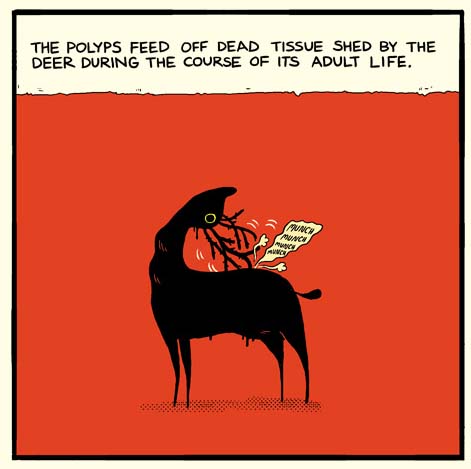
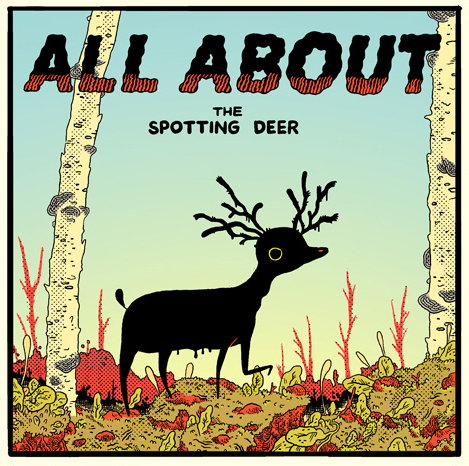
“DeForge’s is a world apart from our own, askew ever so slightly. It’s a world of uneasy cuteness, of pop art degeneracy, and it rewards the curious traveler with remarkable imagery and unsettling stories…Consider All About the Spotting Deer, which lends the volume its striking cover image. A disquisition on a breed of ambulant slugs that only look like antlered fauna, the strip resembles nothing so much as a bizarro Wikipedia page, explaining the social life of these creatures in deadpan, clinical terms.”

Well maybe if you’re a 90 year old spinster who only does crochet in her spare time.  The analysis once again offers nothing to bolster the prevailing belief that DeForge is the new messiah of cartooning. It is merely an encouragement to believe.

Brian Heater at Boing Boing is also concerned about his reader’s mental health when it comes to DeForge’s Very Casual:

“Speaking of exercises in public health, here’s a thing that probably shouldn’t be read by anyone — or at least not those prone to nausea and dramatic fainting… Very Casual is always fascinating, mostly grotesque and in the case of the biker gang with cartoon character helmets, actually pretty touch in the end.“

Basically buy because I said so. Really, just buy (if you’re not my grandma).

Timothy Callahan at Comic Book Resources invokes the names of Chris Ware, Dan Clowes, and Charles Burns. He has cited DeForge’s Lose #4 as the best comic of 2012. His reasons? DeForge’s ability to render “Lynchian oddness” and because the issue is “the lightning rod for his talents.”

In a more recent article, he connects the Day-Glo horrors of DeForge to his work on Adventure Time.

“DeForge started working as a designer for the “Adventure Time” animated series beginning with its third season, and that seems exactly appropriate for someone with his sensibility, but in the stories found in “Very Casual” it’s like we’re seeing the twisted underworld of the “Adventure Time” aesthetic.”

But then provides us with more marketing copy in an effort to encourage retail therapy:

“He revels in grotesquerie and absurdity and there’s a deep and profound sadness to much of the work even when the pages burst with a celebration of oddball joy. Disfigurement is not uncommon. And contagion is a leitmotif. DeForge’s comics are gloriously enchanting, but brutal…[…]…DeForge transforms his style and yet maintains a similar sense of tonal unease. These are comics that worm their way into your brain even as you try to process them. In the best way imaginable…There’s nothing, of course, clumsy, leaden, or inelegant in the pages of “Very Casual.” This is a work of supreme skill and unique sensibility.”

Jeet Heer on the other hand can be excused for resorting to the same when presenting DeForge with a 2012 Doug Wright Award:

“Visually, Spotting Deer is a delight, a virtuoso display of stylistic variety. The colours are startlingly unnatural as are the appropriations of different art styles, ranging from newspaper comics to video games to record cover art. It belongs to the line of artists like Richard McGuire and Gary Panter, who possess the ability to seep into your eyeballs and rearrange the wiring in your brain. You see the world differently, with sharper eyes, after reading DeForge’s comics. Like some of the best cartoonists of his generation, he’s bringing to comics some of the visual intensity of painting and forcing us to realize that the visual range of comics is much larger than we thought possible.”

The point of Heer’s statements was description and commendation preceding an award presentation. It is republished here as a stark reminder of how little it differs from all other descriptions of DeForge’s work online. The critic as award giver is certainly a perennial finding in this art form.

Sean T. Collins has written extensively on Michael DeForge but also confines himself largely to description when it comes to Spotting Deer—the centerpiece of Very Casual.  His most extensive examination of DeForge can be found in his review of Ant Comic at TCJ.com. Collins parodies his own predisposition right at the outset with his opening line:

“Oh, look, a Great Comic.”

The more detailed recommendation goes as follows—it is about important things and…

“…the bizarre visual interpretations of the bugs in question are pitch-perfect distanciation techniques, driving home their alien biology by depicting them in ways we’ve never seen, not even close…[…]…The power of these designs fuels the deployment of another one of DeForge’s go-to techniques: juxtaposing grotesque and high-stakes events with blasé, workaday reactions by the characters involved.”

In other words, we should read DeForge because he draws weird insect-humans and has a comedy shtick like the Black Knight with a “flesh wound” in Monty Python and the Holy Grail. It is also:

“…an existential horror story about going through the motions. Life is boiled down to the precious few biological drives ants possess—reproducing, eating, killing threats—which in turn become the social mechanisms that drive the entire colony.”

The question is, why should I read this particular existential horror story and not the hundreds of other existential horror stories lining the warehouses of Amazon.com? And why should I read about these  ant-workers as opposed to the ones covered by Emile Zola, Upton Sinclair, and John Steinbeck? Is DeForge, perhaps, a better writer or a man with a firmer grasp of the human-ant condition (this is entirely within the realm of possibility I assure you). What exactly does the ant metaphor add to the literature on the subject? Or is that completely irrelevant to our enjoyment?

And what of those who find DeForge less than spectacular you may ask. These are few and far between. In fact I found all of one.  Patrick Smith at Spandexless seems almost apologetic that DeForge’s comics don’t work for him. Smith’s review is a strange rambling psychological study in itself:

“…despite my fatigue for these books, I would still recommend them to anyone who might be interested in this kind of thing, because comics as a medium need this kind of work. The fact that it doesn’t work for everyone isn’t so much a point against it as it is a comment on the medium in general… the important thing to remember is that you need to be smart enough to know that something is competently executed and different enough in form that its exciting, but also having enough faith in your own personal taste that despite all that it still doesn’t resonate with you.”

As it happens the best intelligence about Michael DeForge comes from Michael DeForge himself. James Romberger’s interview with the artist at Publishers Weekly is at least a small font of information.

DeForge reveals the influence of silk screen gig posters on his coloring as well as the art of Jack Kirby, Kazuo Umezu, and Hideshi Hino. Drug induced dream states are also said to play a part, a practice which links him to the Undergrounds of old (just in case his art failed to elicit any of these connections):

“I want most of my comics to read kind of like dreams, or at least have a kind of dream logic to them, so inducing psychedelic states on the characters probably has to do with that. I haven’t really done a ton of hallucinogens, but I used to shroom a lot, and I was always struck by that buzzing, hyper-defined texture that everything would take on. I usually want my comics to read a bit like that, as if the whole world is filled with a prickly, hostile energy vibrating beneath the surface of everything.”

Of course, none of this tells me why Michael DeForge is the greatest cartoonist of his generation, a description which seems akin to an act of faith if the criticism available is anything to go by.

In most instances, the act of comics evangelism will succeed on the basis of sheer force of will—the overwhelming onslaught of “yay”-sayers. This heretic, however, wants an answer. Can Michael DeForge’s genius be substantiated? Or does it all boil down to the pretty pictures?
wtdsd_1b

Take, for example, All About The Spotting Deer  (read at link) which is easily Deforge’s most accessible work not least because of its narrative clarity and congenial art work. It is a story which has been described numerous times in capsule reviews of Very Casual. The one thing Spotting Deer isn’t though is disgusting or grotesque. DeForge’s construct—a confluence between Bambi and a nematode—would make a fascinatingly creepy but family friendly plush toy (less the penis of course).

Shawn Starr and Joey Aulisio  (writing on an obscure blog) provide the longest and best commentary available on this story. For once the substance of the comic which they adore is addressed:

Starr: All the story beats are there, the uncomfortable section on mating rituals (DeForge’s depiction of the “Sexual Aqueduct” perfectly captures that feeling of awkwardness experienced in a sixth grade classroom) and the oddly nationalistic/hyperbolic statement on the animals importance in popular culture and ecosystem. The book is even designed like an old CRT monitor, and its use of the four panel grid is reminiscent of a slideshow presentation.”

Aulisio: I have found it difficult to explain why it resonated with me so much…I think DeForge started out trying to make a book savaging the “fanboys” and then by the end realizing he was just like them, which was the real horror of it all. That moment of realization rendered by DeForge is truly chilling, nobody draws disappointment and disgust quite like him.”

Starr: …I think the “savaging” is too intimate to be from a fanboy. My reading of it is more as an affirmation of DeForge’s place as a cartoonist. He may have started as an outside figure (the writer), but once he (the writer) appears it moves away from the first half’s exploration of “herd” (nerd) culture and becomes explicitly about cartooning.

…I think DeForge realized he was one of the spotted deer. A part of the “study group”…there is the “Deer in Society” section, moving away from home to the city (but not before being ostracized by your family/community), the “ink spot” neighborhoods, the livejournal communities and the “pay farms” where their “psychic meat” adapts the characteristics of other products…

DeForge has less to offer on the story but seems convinced that his coloring is purely “ornamental”:

“I think I’ve been coloring my comics the same way I’d go about coloring a poster or illustration—where I’m just trying to make something eye-grabbing, and maybe establish a mood or whatever—so it’s really just decorative. I’m never doing anything I couldn’t accomplish with my black and white comics. So if I do a comic in color again, I want to make sure the colors aren’t just there to be, like, ornamental.”

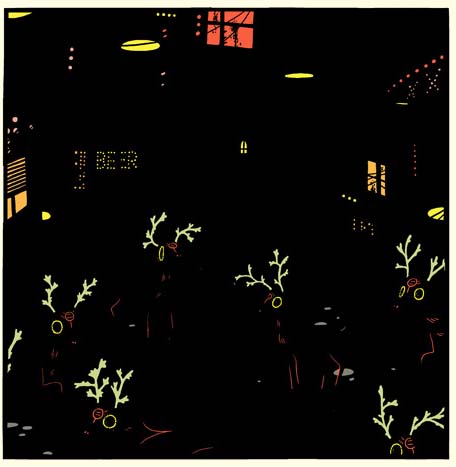
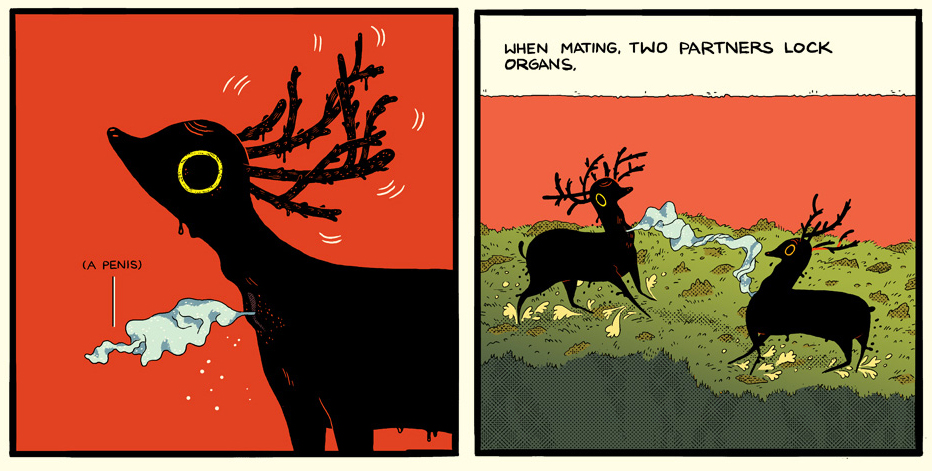
Some of this is apparent right down to the insistent use of what appears to be screentone to vary the color gradients in each panel. There are varying shades of red used to denote sexual activity; a panel blanketed in orange to signal an animal’s sixth sense; and the blue grey tinge of the deer’s penis which suggest less a fleshy protuberance than an extension of seminal fluid. The colors are descriptive, moving from the clear greens of the forest to the more murky environs found in the mechanized cities of Canada. Used as highlights, they add to the sense of desolation and isolation in his depiction of bioluminescent antlers stranded in dark space alongside beer halls and strip clubs.
wtdsd_6a

Spotting Deer is not mere parody of wildlife documentary but (as Starr and Aulisio indicate) a study in anthropology and sociology—a subject now quite familiar to the man on the street in the form of comparisons of human behavior to those of our simian forebears. It is a description of exclusion, exploitation, and half-hearted rehabilitation; a statement on the worm-like ancestry of third class citizenry. Not a simple representation of the dregs of society but a picture of their domestication—benumbed in this instance by soul stripping work and the allure of social networking. A strangely quaint and familiar argument popularly proposed by Noam Chomsky (using the example of sports) in Manufacturing Consent (among other places):

“Take, say, sports — that’s another crucial example of the indoctrination system, in my view. For one thing…it offers people something to pay attention to that’s of no importance.That keeps them from worrying about…things that matter to their lives that they might have some idea of doing something about. And in fact it’s striking to see the intelligence that’s used by ordinary people in [discussions of] sports [as opposed to political and social issues.”

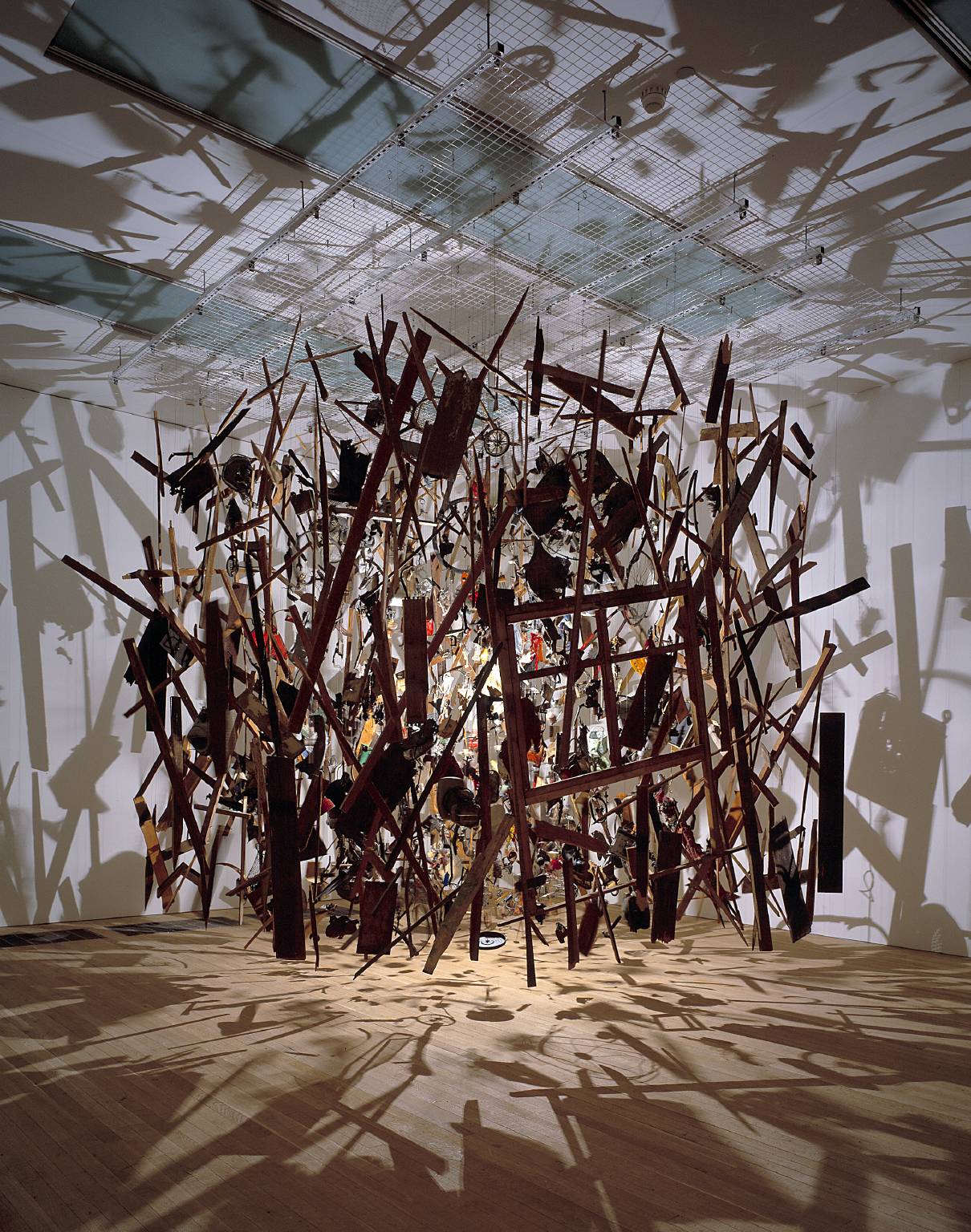
DeForge’s story works best at the convergence of narrative sense and mystery, when the products of deer-dom are suddenly presented to the reader in a hodge podge of styles carefully cultivated by the artist—the detritus of the cultural landscape of the family Cervidae now made real. At this juncture, the story moves from curious amalgamation of mammal and nematode (and host and parasite) to a metaphorical sociology and autobiography. And thus we have sightings of conceptual art, a King Features strip homage, the pixelated nostalgia of a computer game and a quarter bin rock LP.
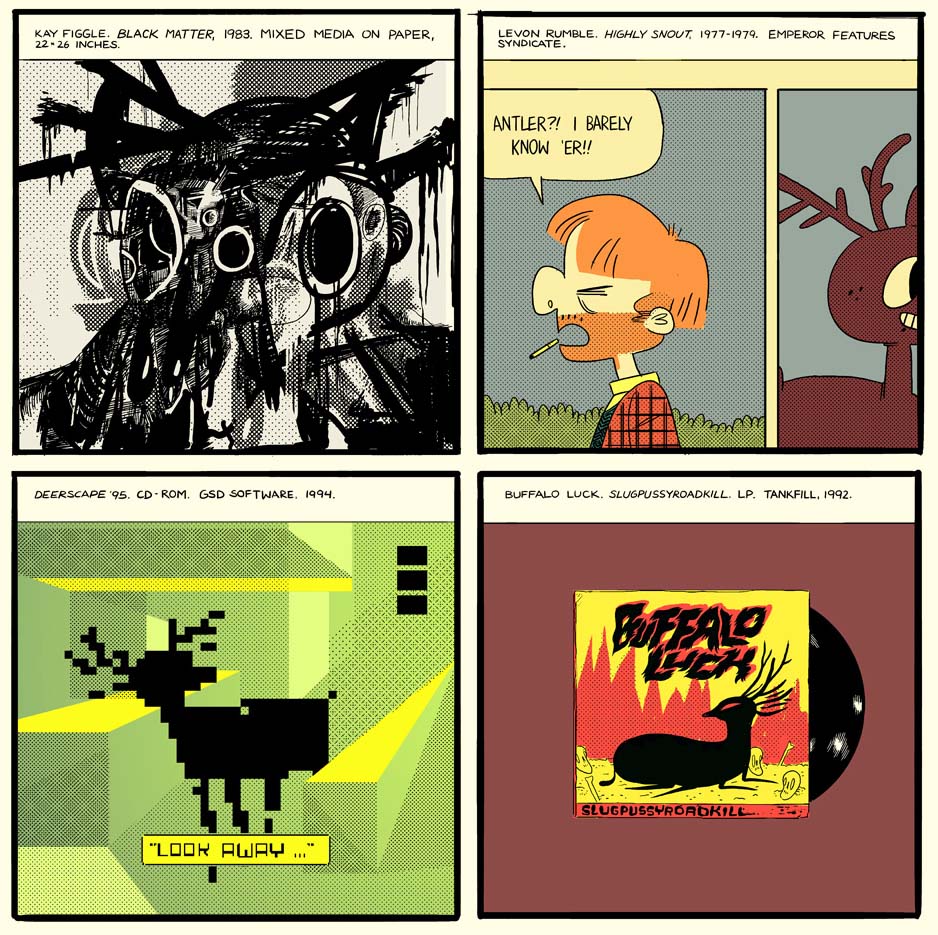
wtdsd_4a


Cold Dark Matter: An Exploded View 1991 by Cornelia Parker born 1956

[Cold Dark Matter-An Exploded View by Cornelia Parker]

A life exploded and examined; all of this enriching and complicating that mystical act of rutting and sex seen some pages before.
 

wtdsd_2a

Descriptions of DeForge’s work often suggest a visceral or emotional experience not easily communicated but Spotting Deer goes beyond a mere fascination with line and imagery to a more amenable complexity both to mind and eye. The sexual act which DeForge depicts is not between creatures of the opposite sex but between two antlered “males” which happen to be hermaphrodites. Seen in congress with the story’s later developments this becomes not so much a picture of  biological procreation but of artistic influence. Acting at once in concert and opposition to this, the antlers begin to resemble genetic fate acting both as tribal headdress and familial enslavement.

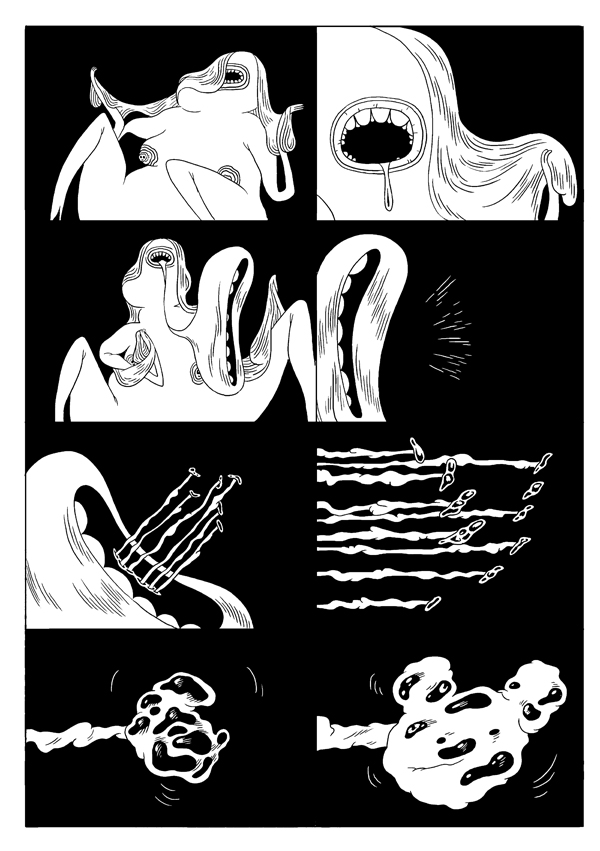
If DeForge’s comics lineage can be traced (at least) as far back as the Undergrounds, then one thing is clear—the transgressive is regressive as far as comics are concerned. It has been for decades. The banning of comic books and the jailing of cartoonists may make the headlines but these headlines no longer make for great and lasting art. Not even if you charmingly distort the act of artistic “pregnancy” and transmission, …
MMC

…imagine a drug induced head trip as a cannibalistic ritual, or punk up Dilbert and Nancy and make them Hell’s Angels on a trip to transcendence. These may amuse with their playfulness and herald “promise” in terms of technique but they are not the comics masterpieces we will remember 10 years hence.  As much as half of Very Casual is inconsequential fluff with his Ditko “tribute” (“Peter’s Muscle“) taking the rearmost, being nothing less than a veritable time capsule of 80s  mini comics drivel.  What is required from critics celebrating the works of DeForge I feel is some degree of moderation in praise.
AC13

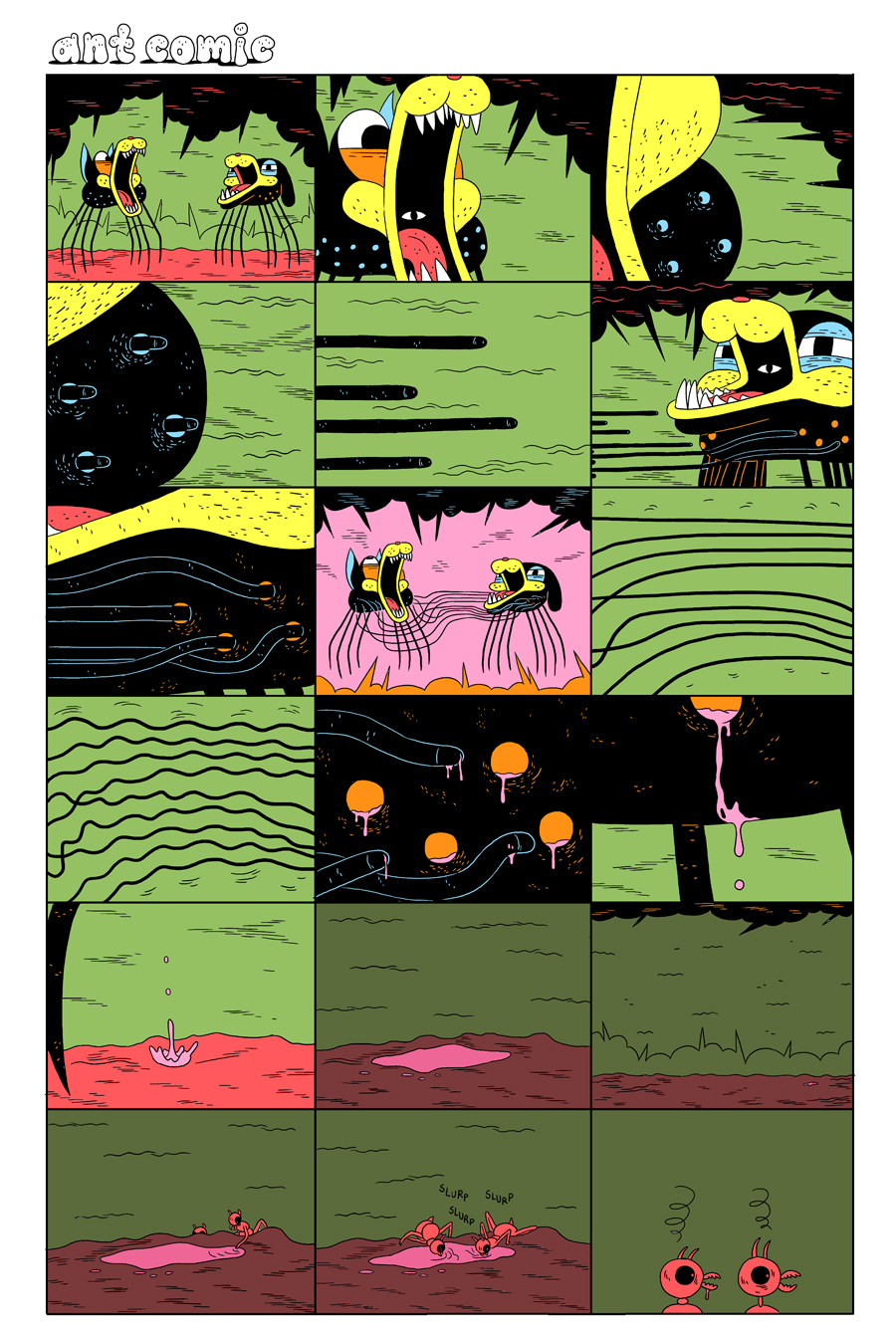
DeForge’s comics certainly seem far removed from the literary structures and complexities—the doublings, the repetitions, the triplings etc.—of the old hands. Despite its length, his Ant Comic largely dispenses with any sustained interplay between word and image or even panel layout.

It can be read most directly as an exercise in straight adventure coarsened by bloodless massacres, sudden death, multiple episodes of attempted infanticide, and god-like interventions from humans. In this it resembles Anders Nilsen’s Big Questions where the protagonists are finches. It is differentiated by its greater scientific curiosity and playfulness in design (the architecture of the ant colony, the technicolor queen, the dog spiders). The most appealing pages here impart a kind of primitivization of action; where violence and sexual death are seen as a series of abstractions—shuddering tentacles, puncture wounds, and a pool of blood.  A familiar type of comics montage which is enriched by simplicity bordering on abstraction. The dialogue follows a similar path and borders on autism. In its stripped down self-centeredness and solipsisms, Ant Comic mirrors the naked and frankly ridiculous existential angst and egotism of the comics of Mark Beyer (Amy and Jordan) but here grafted to exuberant world building.

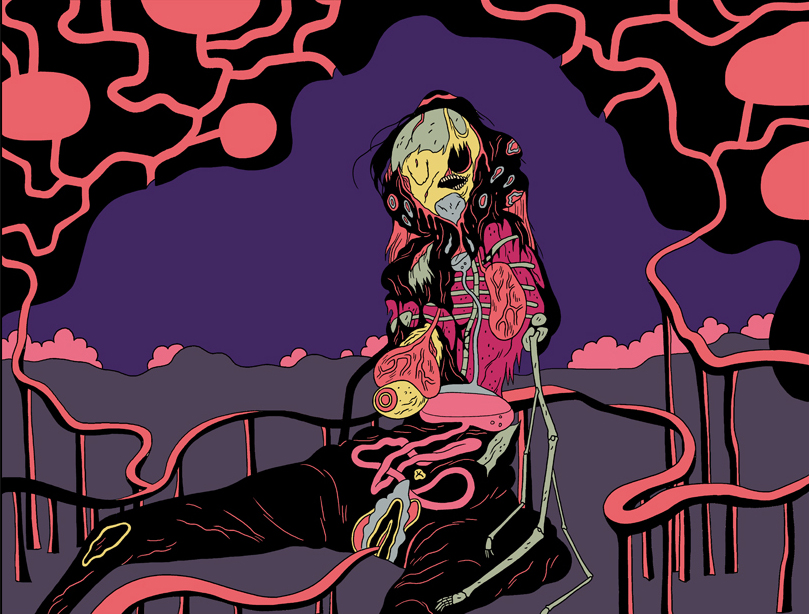
If Ant Comic generates some mood and the occasional flash of deadpan humor, then it should also be said that the gulf between the shock of recognition and our empathy is far too great to be surmounted; a case of technique—the whimsical creature designs and fascination with scale and detail—subverting feeling. It is telling that one of the few instances where any trauma registers is in DeForge’s delineation of the sorrows of war—his callous depiction of the rape and disfigurement of matriarchy (the somatically and anthropologically familiar ant queen).
AC45a

The natural world and entomology become proxies for an examination of primitive societies, a return to  the (seemingly) discredited theories that matriarchies formed a major part of the earliest human societies. It is a refutation of feminist utopias and a proposition that violence is biologically determined both in males and females. Both these themes have been explored quite thoroughly in feminist SF literature (Sheri S. Tepper’s The Gate to Women’s Country comes to mind) but here divested of ornamentation and boiled down to plot points—the matriarchal dystopia as a Sunday adventure strip; the Freudian longing for the mother wedded to a forlorn hope in the figure of a new queen towards the close of the narrative. Nature remains unpredictable; the future unknowable.

DeForge’s tools of reduction and humor bear comparison with the comics of R. Sikoryak as seen in Masterpiece Comics where we are presented with Crime and Punishment as a Batman comic by Dick Sprang, and Kafka’s The Metamorphosis as seen through the artistic tics of Charles Schulz. Even Mozart had his “musical jokes” and DeForge’s Ant Comic presents itself as a kind of artful popularization of martial and feminist themes, one where compulsion, sexual duty, and resurgent gynophobia and misogyny are brought into stark relief.

Taken as a whole, some might see in DeForge’s comics a kind of palate cleanser—primal offerings from the artist’s soul to a comics landscape sick to death of the worked out machinations and literary pretensions of the “heritage” cartoonists; the neglected bigfoot aspects of RAW, Fort Thunder, and Kramer’s Ergot once more brought to the fore even if few long form works of note have emerged from this tradition.

But all this is only guesswork.

As comics readers we have been constantly told what to love without being told how to love or even why to love by the critical community. In this we have a perfect metaphor in the form of DeForge’s Ant Comic where the ant drones directed by invisible hormonal signals congregate dutifully around the queen with a conscientious passion in the service of procreation and survival. And as with DeForge’s fable, the ultimate result of this docile compliance is death.


 

Thor vs. the Dark World of DC

Thor 2

According to the new Thor movie, every few millennia the universes line up for an anything-goes cosmic cross-over called the Convergence. Inhabitants of unrelated realms get sucked through portals and tossed together to defy the laws of physics. It happened for the first time in 2012. They called it The Avengers.  Superheroes from all the Marvelverses were plucked from their disparate origin worlds to converge in a single, box office-defying blockbuster.

Physicists predict the next Convergence will occur in 2015—not once, but twice! Not only will The Avengers 2 draw the sequel-spinning franchises of Thor, Iron Man, and Captain America together again, but Warner Brothers’ Batman vs. Superman has Gotham and Metropolis on a collision course—with Paradise Island and Starling City and other DC planets to be swept into the same Justice League gravity pit.

But which Convergence will come to define all of superhero reality?

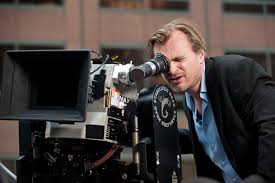
In Thor: the Dark World, an evil dark elf wants to use the Convergence to remake reality in his own dark image. He’s played by former Doctor Who Christopher Eccleston, but his real name is Christopher Nolan. The Dark Knight trilogy and the gray tones it casts over Man of Steel now define the DC brand. It’s a humorless void happier with the droning rumble of Christian Bale’s Bat-rasp than the giggles of a live audience.

Christopher Nolan

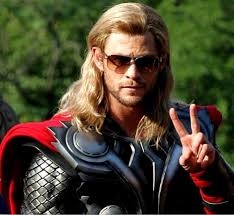
The Dark Knight Elf wants to crush the world into a Black Hole. But Thor, with his lightning bolts and deadpan timing, is all about levity. He’s super-hunk Chris (not Christopher) Hemsworth in the credits, but his real name is Joss Whedon. The Asgardian—like his buddies Tony Stark, Bruce Banner, and even the ever earnest Steve Rodgers—is a Comedian. He throws that mighty hammer at all kinds of monstrous bad-asses, but he it’s our funny bone he keeps hitting. I didn’t see Joshing Joss’ name in the credits, but I hear Mr. Whedon was responsible for major rewrites and reshoots—all part of his uber-duties as the overseeing Odin of the Marvelverses. He’s Captain Convergence, and he wants the world to end in a laugh not a rasp.

Joss Whedon

Of course the Whedonverse isn’t a flawless reality. There’s a moment in Thor 2 when a funeral barge sails over an Asgardian waterfall and hangs there a moment before dropping—a little like Wile E. Coyote after sprinting past the edge of a canyon. It would be pointless to criticize a Road Runner cartoon for its failure to follow basic laws of physics. And the same is true of Thor: the Dark World and the laws of plotting. The word “convenient” comes to mind, as does “inexplicable” and “far-fetched.” Director Alan Taylor is hoping we’ll be too busy enjoying ourselves to ask annoying questions like “How is it that a random convergence portal just happened to drop Thor’s girlfriend of all people into the exact spot where the Dark Elf’s reality-destroying superweapon has been hidden for millennia?” Comic worlds tend to cut corners. Do we really need to hear a ponderous explanation? Nolanland has plenty of those, and its’ still pockmarked with its own plot portals.

The Whedonverse—despite Whedon having literally majored in Women’s Studies—also can’t find much for Natalie Portman to do but look lovelorn and occasionally panic-stricken. This might be the result of the gender-challenged fabric of superhero reality, since DC can’t even turn a Wonder Woman screenplay penned by Joss Whedon into an actual movie. Apparently Hollywood executives think fanboys won’t buy tickets to see scantily-clad women in fight scenes. And yet the shirtless beefcake shot (Hemsworth provides a couple screamers) has become a staple of the genre (the clothing-challenged Stephen Amell flexes weekly on the CW’s Arrow).

This may or may not be why my wife surprised us both by saying she wanted to see the new Thor movie. I was so underwhelmed by the first that I was going to pass, but I’m glad she suggested it. I like dumb fun. I also like smart fun, but that combination has yet to Converge on a superhero universe. I’m hoping it won’t take a millennia.

So What Does A Gal Have to Do To Get Into Comics?

Editor’s Note: This first appeared as a comment on Heidi MacDonald’s recent post “So What Does a Gal Have To Do to Get Into the Comics Journal Anyway?” Annie edited her comment slightly before reprinting it here.
 
I grew up idealizing male cartoonists: Berkeley Breathed, Herge, Schulz, Jim Davis, Gary Larson, Maurice Sendak, and unbeknownst to me at the time, Art Spiegelman (for his work on the garbage pail kids). I had literally no idea I could even be a cartoonist until I got older–I had unconsciously relegated the vocation to the exclusive world of men. Until I rifled through my first roommate’s collection and had my mind blown open by Phoebe Gloeckner, Debbie Drechsler, Julie Doucet, Lynda Barry, and Love and Rockets (I was still too scared of myself to pick up a copy of Dykes to Watch Out For> and plus I was a punk, so I got my lesbian comics fix with L&R at the time).

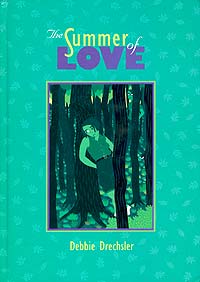
summer1011I remember when Dylan (Williams) told me Debbie Drechsler’s Summer of Love was the most important graphic novel in his life, his favorite book. i think he is the only man I have even heard bring her merits up in a conversation. For the comics class we were teaching, he suggested we assign the interview with Drechsler in TCJ # 249. But when I read it I was appalled at Groth’s insensitivity, disrespect and dismissal. Like, it was reaaally bad. And guess who stopped drawing comics altogether (shortly after creating the #1 book in Dylan’s library)?

I have not been able to stomach Groth’s interview with Gloeckner in the comics journal long enough to finish it (haven’t seen any new comics from her for awhile, though I am anticipating her newest project, a book that takes a close look at the femicides in Juarez. Wonder how that one’s going to go over with critics?)
By the time the interview with Alison Bechdel came out in #287, someone had the sense to ask a woman to interview her–but then added an addendum from some dude at the end who felt that the woman interviewer had not been thorough enough (I thought the interview was brilliant) and proceeded to ask Alison a bunch of asshat questions including something about masturbation to which she replied “did you ask Crumb these questions?” Reading this addendum turned my thrill at reading the article a little sour.

So I’m saying, all this relates to the environment of comics at large, the confidence of women artists, and the inclusion of people besides just straight white men. Groth’s comment about what is ‘good’ or not is the rule, not the exception. I cannot tell you how many women, queers, people of color have told me that they used to draw but stopped completely after someone told them their drawing was not ‘good’, because it did not look like what the straight white men were drawing. I’ve heard this from dozens and dozens and dozens.

My experience teaching in the IPRC comics and certificate program in Portland illustrates this point. Pre-program, we had a meeting to decide how to divide up the accepted applicants between the two teams of teachers (two different classes). When I entered the room, I saw that the director had already divided the applications up into two groups: ‘good art’, students whose work was perceived as ‘more advanced’ were on one side of the table (assigned to the teacher he considered the ‘expert’–a man) while on the other side were the beginners, the ‘unclassifiable’ applications, and the artists that he considered ‘less advanced’–assigning them to the ‘fun’ team of teachers (one of which was a woman). As I circled the table and read the applications, a rock grew in my stomach. “Did you notice that nearly all the artists you consider ‘good’ and ‘advanced’ are men, and the artists you consider ‘less good’ and ‘less advanced’ are all women?” Radio silence. I was the only female in the room. It took several minutes before the other men reading the applications could assess the situation and reiterate my observation to the director who eventually acknowledged (albeit through a different, male teacher) that my critique was valid. The gender imbalance being obvious, at first glance, only to me.

Is it any wonder that The Comics Journal gets so many proposals from women on the subject of comics education? It’s one of the only spheres in which we are granted authority, at best. Of course women want to have a say in what gets taught and how in all of the new schools.

The irony of a company whose name and image were built on the foundations of feminist artwork/stories, drawn by two people of color, whose most loved and reknowned characters are two Latina queers and a badass lady who carries a hammer around for protection and rage, is not lost on me.

Utilitarian Review 11/8/13 — Welcome to PencilPanelPage!

finallogo3
News

We’ve got an exciting announcement to make. The wonderful blog PencilPanelPage is going to be moving onto HU. PPP is a comics blog with an academic slant. They’re going to post every Thursday, kicking things off with a Krazy Kat roundtable which will run for several weeks and be cross-posted here and at their old location (where you can also catch up on their archives if you haven’t been over there.

PPP is going to be independently edited, and they’ll have guest posts and roundtables from time to time. You can read more about the blog and contributors here. They’ve posted a farewell which you can also check out.

All posts on PencilPanelPage can be found through the PencilPanelPage category tag. There’s also a tab on our homepage which will show all the PPP posts.

Qiana Whitted, who’s written for us occasionally, is a regular on PPP, so we’re psyched to have her contributing more regularly. We’re also thrilled to welcome Frank Bramlett, Roy T. Cook, Michael A. Johnson, and Adrielle Mitchell.

So check back Thursday to find the first PPP post, and the start of their Krazy Kat roundtable. Please take a minute when you do to welcome them aboard in comments!

And thank you to Jacob Canfield for making the adjustments to our site so PPP can fit in comfortably.

On HU

Featured Archive Post: Susan Kirtley on hating Betty and Veronica.

Bert Stabler has Frederic Wertham decapitate Art Spiegelman, Scott McCloud, and others.

Ng Suat Tong on pro-KKK outsider art.

Ng Suat Tong on how even comics critics don’t care about comics criticism.

Alex Buchet continues his prehistory of the superhero with a discussion of the Superman and Superman.

Me on Michael DeForge and how comics aren’t for kids anymore.

Shonté Daniels on racial difference and cosplaying.

Chris Gavaler on Age of Bronze and comic book gods.
 
Utilitarians Everywhere

On Salon I wrote about Amazon’s censorship of erotic ebooks.

I also talked about the Salon piece on HuffPost Live, so this is your chance to see me live and stuttering. Selena Kitt was also interviewed, and is less stuttery and more awesome.

At the Atlantic I talked about

Gloria Steinem as a Disney Princess

the Tea Party and the virtues of petty jealousy.

— Joss Whedon’s not very impressive speech about the word “feminist.”

At the Chicago Reader I reviewed/recommended Julia Serano’s great new book Excluded on making feminist and queer communities more inclusive. Buy it at once!

At Splice Today I talk about when to write for free and when not to.
 
Other Links

James Romberger interviews Frank Santoro about his graphic novel Pompeii.

Anna March on making fatherhood a choice.

Tom Spurgeon interviews Jeet Heer.

Notorious Phd on the Daily Mail profiling young female historians.

Amanda Hess interviews Melissa Gira Grant about sex work.

Tim Hodler’s response to crit of tcj and the fanta kickstarter. Brief but worth reading.

Sam Riedel on DC’s new video game crapola.

Alex Pareene on racist old men.

A nice piece about early Grendel.

No More Comic Book Gods

I don’t like demigods cavorting with superheroes.

Yes, Chris Hemsworth plays a hunky Thor, and Hercules had a perfectly respectable stint as an Avenger in the 60s. I didn’t even object when he went on to anchor the now forgotten Bronze Age team The Champions. But the argument that superheroes are just the latest issue of ancient mythology doesn’t do it for me.

Not that it’s a bad argument. Etymologically, “superhero” comes from Shaw’s “superman” which comes from Nietzsche’s “ubermensch” which comes from Goethe’s “unbermenschen” which is translated “superhuman” or “demigod” (though only in a mathematical sense can “greater-than-human” mean “less-then-god”). Semantics aside, comic book mythology, despite all those earthbound gods, is a lot more than antiquity in spandex.
 

Age of Bronze cover

 
Which is one in a long list of reasons to admire Eric Shanower’s The Age of Bronze.  The meticulously researched, multi-book interpretation of the Trojan War is a trove of source materials, from archaeological to Shakespearean, all compiled, sifted, rewoven and painstakingly etched into a literal epic of graphic storytelling. But from the dozens and dozens of Trojan tales, Shanower omits only one detail.

The gods.

“No supernatural intervention,” he told an auditorium of Washington and Lee college students last spring. (My Superhero class attended, but would you believe it was our Classics department that invited a comic book artist to campus?) When one of my fellow professors asked why “suppressing the supernatural” was the impetus behind the project, Shanower said he wanted to “bring the story down to human level.” He was tired of blaming the gods for bad behavior.

For Cassandra’s “origin story” that means replacing Apollo (the source of both her prophetic visions and her inability to convince anyone they’re true) with a priestly pedophile. The curse “no one will believe you” takes on a horribly human meaning.

Shanower’s take on Herakles (yes, same guy as Hercules) is far less disturbing. While the mass of Age of Bronze is rendered in near photo-realism (down to the rounded crenellations in Troy’s walls and the embroidered hems of King Priam’s robes), Shanower reduces that most famous demigod to a “cartoony buffoon.” He’s basically Popeye’s nemesis Bluto. The visual effect, explained Shanower, suggests that the king’s memory (Priam is retelling a story from his childhood) is unreliably exaggerated, the lines literally warped.

Which is another reason to dispense with the demigods. Comic books’ childhood was spent in superhero tights, the medium and the character type coming-of-age hand-in-glove. If you want to create a work of literary and artistic force and erudition (and, wow, does that describe Age of Bronze), it helps to give the kid stuff the boot.

Not that Shanower has anything against superheroes. He admitted at dinner (Classics let me tag along) that he was a big X-Men fan as a kid, was there for the Claremont-Byrne Dark Phoenix Saga, a Greek Tragedy if there ever was one, and arguably the highpoint of Marvel’s Bronze Age.

But how can you draw a naturalistic Herakles without also drawing a line pointing back to Jack Kirby’s 1965 Hercules? Any comic book demigod, even in an authoritative rendering of the Trojan War, might as well have “Sha-zam!”or “It’s clobberin’ time!” penned in his talk bubble.
 

Maui Legends of the Outcast

 
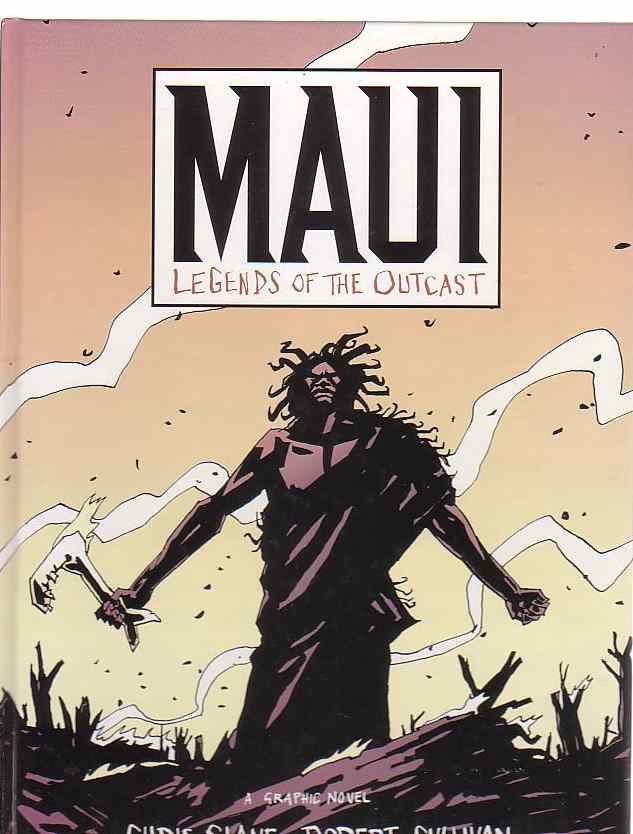
Look at Robert Sullivan and Chris Slane’s graphic novel Maui: Legends of the Outcast. It was published in 1996, two years before Image Comics started Age of Bronze, but it originates at least a thousand years earlier—about the time the first Maori landed in Aotearoa, AKA New Zealand. They carried tales of Maui, one of the most ubiquitous heroes of Polynesian mythology, with them. Sullivan visited my Superheroes class last year (a side trip between my wife’s poetry course and his evening reading) and said he didn’t intend any superhero allusions when adapting the Maui legends—and yet my students were ready to list them.

They’d identified “outcast” as a superhero trait on the first day of class, and there it is on the cover. An origin story follows, with the hero suffering a character-defining wrong that both motivates him and imbues him with special abilities. After Maui’s mother tosses him stillborn into the ocean, a prayer to the gods transforms him: “Revive the child. Let destiny take him to great deeds. Grant him unnatural powers.” Those include shapeshifting. Soon Maui is fluttering around as a bird, or buzzing in people’s ears, or flapping his fins. He even appears in a half-human state once, his body covered in green scales. He gets a costume too, a special battle suit able to withstand the fire of the sun. There’s no cape or symbol on the chest, but Slane colors his eyes blue and red—an iconic image that separates him from his fellow Maori. He’s also as egotistical as Tony Stark, but all his adventures benefit his people, securing them food, fire, and land.

I’m not  trying to draft Maui for the Justice League (though, actually, yeah, that’d be pretty cool), but like it or not, when you draw a superhuman inside a comic book panel, it’s going to flip the switch marked “superhero” in your reader’s brain. I think Shanower recognized that. He spent his early, 80s career inking Silver Age legend Curt Swan’s Superman. When John Byrne took over the character, Swan’s drawings looked about as sophisticated as Popeye. Sullivan looks back at his Maui with some embarrassment too. He wishes he’d made the goddess of death (she chews up Maui in her rocky vagina) less monstrous and a little more, well, human.

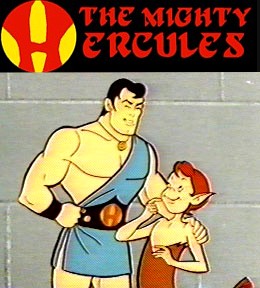
Gods just aren’t that interesting. Even Hercules knew that. He made his dad send him to earth even though it meant turning mortal. That’s The Mighty Hercules version, a second rate cartoon in production as Marvel started casting The Mighty Thor down to earthly newsstands in the early 60s. Even the crown princes of Olympus and Asgard would rather hang with us humans. My favorite demigod, that mightily dorky Hercules, died the year I was born. Those were reruns I was watching Sunday mornings before church on Pittsburgh’s old UHF channel 53. Like Priam’s memory, mine is a bit staticy, but I think Zeus molds Hercules’ godly powers into a magic ring to slip on while battling injustice and whatnot. Odin pulls the same trick with a walking stick. I understand the impulse. It’s hard watching your kids grow up and leave their childhood myths behind.
 

The Mighty Hercules

Cosplaying As Unsuccessful Escapism: Avoiding Something We Can’t Avoid

To cosplay means to become a human representation of a character. It demands full commitment to a transformation of any kind, from human to alien, from male to female, from pale to the darkest brown. It differs from Halloween, where a trick-or-treater walks up to a door, rings a door bell, chants her phrase and is greeted back by, “who are you supposed to be?” There is no supposing. You are no longer yourself; instead, you are the new expression of your character. It is an escape, a well needed one, from the world’s occasional lifelessness.

Unfortunately, escaping is easier for some, impossible for others. Last Halloween, I decided to break my tradition of telling myself I am too old to dress up. I spent a good deal of time and money on a great costume. I wanted to be Zero Suit Samus. The costume would be simpler to make than other costumes; I’m about the same shape as her (thin), and because her suit is only a blue jumpsuit with minor designs, I knew the work would not be strenuous. I bought the jumpsuit online, and used markers to design it as closely to Samus’s as possible. Obviously, my thrown-together costume would not be as unerring as other’s who have spent months on their designs, but I knew that anyone who was familiar with the bounty hunter would see herself in me.

However, I made one alteration: Samus’s hair. I decided to match my own hair color, black; I felt uncomfortable sporting a blonde wig on my brown head. I wanted to be Samus, but I also wanted a shade that complemented me, in the same way that blonde hair seems to suit Samus. Perhaps if I were white, wearing a wig that didn’t match my own hair color would not have felt so distressing, but knowing that Black people with naturally blonde hair are in the minority, I felt the need to conform, to reject the idea that I could, for one night only, be a perfect blonde. I couldn’t step out of my race and accept the costume, and neither could those around me.
 

Shonte as Samus!

 
The change in the design sparked a change in how others saw me. Walking around in my costume, I was not Samus; I was “Dark Samus,” an evil version of the hero I hoped to be. Eventually, I accepted my fate as the darker, evil villain, but I wondered how different the scenario would have been if I wore a blonde wig. Clothing and accessories are things I can adjust: skin color is not. Perhaps if my wig was blonde, the conversion from Black college student to Samus would have been more palpable—not only for others, but myself — but I believe even if I wore a matching wig, I still would not have been Samus. I still would be different.

If I limited myself to only black videogame female characters, I’d be stuck with Storm, a variety of Grand Theft Auto side characters, and other people with slightly darker skin tones who gamers have assumed to be black. (I don’t think Ganondorf is black, sorry). Sure, black male characters are more abundant, but if being darker than Samus made me “Dark Samus,” than a black male character will make me a female, male character. I still won’t be the same.

I don’t blame my skin tone for my unsuccessful attempt to escape like other cosplayers; rather, I blame the inability to understand the hardship of the dark skinned costumer. There is a desire to stick within someone’s race, not only from those around the cosplayer but sometimes from the cosplayer herself. If we were to think about forcing races to only dress as characters that match their own ethnicity, how many options would non-white people have? What about abiding by the same gender?

In order to increase the acceptance of interracial cosplayers, we need two things: First, we need more diverse protagonists. By diverse, I do not mean a customizable character. When given the option of creating their own protagonists, gamers will usually design a character similar to themselves. Who doesn’t want to see a version of yourself killing enemies and earning money? The fantasy is not far-fetched, but it prevents any use of creativity. Developers have the ability to create powerful, memorable, and influential people within their art. I want a Black Nathan Drake, a Latina Laura Croft.

Cosplaying, as big as a community as it may be, is really a small part of a greater community of gamers, developers and artists. And it’s all connected, a system working together. Diversifying cosplay can be encouraged if we ask for more diverse characters and force gamers to actively stray from their comfort zone. Currently, there are far more successful developers willing to adhere to the status quo than to part ways. The male, white, brown-haired, muscular, emotion-less protagonist seems to be here to stay. I believe this emphasis on this type of hero is why darker-skinned cosplayers receive criticism. This isn’t to say developers are racist and think dark-skinned people cannot be protagonists; this is to say, however, that there are so many white protagonists that any other skin tone is surprising.

There is no denying that the white, male character is still seen as the universal figure, one everyone can try to relate to. Video games are still at a point where a game featuring a female protagonist is still controversial; a game with a non-white lead, while ground-breaking and exciting for some, will be terrifying for the many who are xenophobic. There are other stories to be told, and different characters will allow for that exploration and contemplation of different cultures.

Eventually, non-white characters will no longer be seen as a specialty, as a risky task a developer placed upon himself. Then, the non-white hero will be admired, like any other character. The admiration will move to the cosplayers who wish to design costumes for their favorite characters, no matter the race. A break from the status quo, a re-envisioning and new abundance of diverse protagonists (minor characters, side characters, and everything in between) will give me, and others, more characters that may look closer in skin tone; More importantly, it will push those who have not cosplayed outside of their race to do so. There will be more interracial cosplaying, and more need for acceptance. Before we can get there, though, we need a push. The push is what we need for a progressive future in gaming, comics and other media forms.

A break from the status quo, a re-envisioning and new abundance of broader protagonists (minor characters, side characters, and everything in between) will give me, and others, more characters that may look closer in skin tone, but more importantly, will push those who have not cosplayed outside of their race to do so. Basically, an increase in differently designed characters will make more people interracially cosplay. More cosplay will lead to more acceptance. But none of this can happen without a shift from the norm.

But in order to achieve this push, we will need a wider range of artists creating these characters. In this case, I’m pointing towards video game developers, but we should not neglect our writers, cinematographers and artists. If the current developers cannot embrace the change in culture, then we need new developers. Since the introduction of technology and computer science, white males have dominated the field. While their contributions have been unequivocally necessary, they cannot represent an array of people without help from others.

A broader group of developers will lead to broader representation within games, an increase in diverse characters, and an increase in different costumes to design and parade in. I don’t want to be limited to only Black characters, nor do I want others to believe interracial cosplaying to be offensive. I would rather like to invite others to cosplay whatever they desire, because it is their choice who they wish to represent. I admire the white Garcian Smith, the lighter skinned Elena, but we must remember that they are just Garcian Smith and Elena. Race specificity is not required. Once more people start cosplaying out of their race, more will accept the fact that I was not Dark Samus; I was Samus.
 

Zero Suit Samus